Survey of London: Volumes 33 and 34, St Anne Soho. Originally published by London County Council, London, 1966.
This free content was digitised by double rekeying. All rights reserved.
'Dean Street Area: Portland Estate, Carlisle Street', in Survey of London: Volumes 33 and 34, St Anne Soho, ed. F H W Sheppard (London, 1966), British History Online https://www.british-history.ac.uk/survey-london/vols33-4/pp143-148 [accessed 30 April 2025].
'Dean Street Area: Portland Estate, Carlisle Street', in Survey of London: Volumes 33 and 34, St Anne Soho. Edited by F H W Sheppard (London, 1966), British History Online, accessed April 30, 2025, https://www.british-history.ac.uk/survey-london/vols33-4/pp143-148.
"Dean Street Area: Portland Estate, Carlisle Street". Survey of London: Volumes 33 and 34, St Anne Soho. Ed. F H W Sheppard (London, 1966), British History Online. Web. 30 April 2025. https://www.british-history.ac.uk/survey-london/vols33-4/pp143-148.
In this section
Carlisle Street
This street takes its name from the mansion which was built in the mid 1680's on part of the site of the present Nos. 10–12 Carlisle Street and which was occupied from 1725 to 1752 by the Countess of Carlisle.
The street was probably laid out in 1685 by Edward Roydon, turner, and Job Bickerton and William Webb, carpenters, all of St. Anne's parish, on a large plot of land on the west side of Dean Street leased to them by the assignees in bankruptcy of Benjamin Hinton, to whom Cadogan Thomas had mortgaged the property (see page 32). The three developers held the property on a building lease of forty-eight years, subject to a peppercorn rent for the first year and an annual rent of £20 thereafter. Between May 1685 and June 1687 they erected in the new street, or in the area immediately adjoining, one large mansion (probably Carlisle House), two inns and thirteen smaller houses, all of which were described in June 1687 as being almost complete. Some of the working capital and building materials were provided by Philip Harman, Joseph Girle's son-in-law and executor (fn. 1) (see page 32). The houses first appear in the ratebooks in 1691 (the ratebooks tor 1686–90 being missing), when thirteen ratepayers' names arc listed, one for the large house (later Carlisle House) at the west end of the street and twelve for the smaller houses on either side.
The street was at first known by a variety of names. Ogilby and Morgan's map of 1681–2 (Plate 2) calls it Marybone Street, the undated engraving reproduced on Plate 68b calls it Merry Andrew Street, whilst on Sutton Nicholls's engraving (Plate 68a) it is called Denmark Street. Blome's map of 1686 (Plate 3) describes the part east of Dean Street as King's Square Street and that to the west as King's Square Court, the latter being the name used in the ratebooks in the late seventeenth and early eighteenth centuries for both parts of the street. The name Carlisle Street was first used in the ratebooks in 1745 to denote the eastern part only, but the rate collectors continued to describe the western part as King's Square Court until 1837. Honvood's map of 1792–9 marks both parts as Carlisle Street.
In 1720 Strype described the eastern part as 'a short Street, called King's-Square Street, of small Account', and the western part as 'a handsome broad Court fronting Kings-Square; 'tis a Place well built and inhabited, and hath one very large House, which takes up all the West End or Front'. (fn. 2) The eastern part, between Soho Square and Dean Street, contained only the back and side premises and stables of the two corner houses in Soho Square (Nos. 37 and 38). There were no separate dwellings in this part of Carlisle Street until the mid 1730's, when two houses were built on the north side of the street, on part of the site of the original No. 38 Soho Square. (fn. 3)
The most prominent feature of the street from its earliest days was the mansion (later known as Carlisle House) built at its western end and facing eastwards down the street, with a façade which provided the vista from Soho Square with an impressive terminal feature (Plate 99). It was probably because of their proximity to this house and to other neighbouring mansions in Soho Square that the comparatively small houses in the street remained well inhabited with a few titled residents and military officers until the third quarter of the eighteenth century. (fn. 4)
Thereafter the street declined in fashion. In 1763–4 Carlisle House ceased to be a private residence and was turned into a fencing school. Some of the other houses were occupied by artists and musicians, of whom the most prominent are listed below. In the nineteenth century this artistic element persisted, notably amongst the occupants of Carlisle House, but after 1850 the majority of the inhabitants were craftsmen and tradespeople. Three of the original late seventeenth-century houses in the street (Nos. 4–6) still stand, much altered, and on the north side Nos. 16, 17 and 19 survive from the eighteenth century.
Notable Inhabitants and Lodgers
Karl Friedrich Abel, instrumentalist; he occupied a house adjoining the north side of Carlisle House (both demolished) from 1764 to 1771. (fn. 4) John Linnell Bond, architect; he was 'At Mr. Malton's Carlisle Street' (No. 8, demolished) in 1782. (fn. 5) Richard Bundy, divine and translator; he lived in the corner house in Carlisle Street on part of the site of the present No. 90 Dean Street from 1721 until his death in 1739. (fn. 4) Agostino Carlini, sculptor and painter; he occupied an earlier house on the site of the present No. 14 from 1771 or possibly 1769 until his death in 1790. Giuseppe Ceracchi, sculptor; he worked for and resided with Carlini. (fn. 6) Hester Chapone, essayist; daughter of Thomas Mulso who occupied a house (now demolished) in King's Square Court on the site of the present No. 90 Dean Street from 1721 to 1756. (fn. 4) Samuel Drummond, portrait and historical painter; he exhibited at the Royal Academy from No. 6 in 1799 and 1800. James Gabriel Hugier, portrait painter and engraver; he exhibited from No. 8 (demolished) in 1786. Thomas Malton, the younger, architectural draughtsman; at No. 8 (demolished) from 1781 to 1796. Henry Robert Morland, portrait painter, brother of George Morland; at No. 6 in 1792; later at No. 23 Dean Street. George Michael Moser, chaser and enameller, first Keeper of the Royal Academy 1768; said to have lived in Carlisle Street before his appointment. (fn. 7) Abraham Raimbach, line engraver and miniature painter; at No. 14 (demolished) from 1803 to 1805. George Keith Ralph, portrait painter; at No. 2 (now incorporated into No. 37 Soho Square) in 1795.
Nos. 4–6 (consec.) Carlisle Street
The fabric of these three houses probably survives from the late seventeenth century when Carlisle Street was first laid out. In January 1765 George Smith Bradshaw, the upholsterer and tapestry-maker, took leases of the three houses and also of the adjoining No. 7 (now demolished) from the third Duke of Portland for terms of ninety-four years from Michaelmas 1769. He paid a total of £388 in fines and covenanted to rebuild the existing old houses before the expiration of the leases. (fn. 8) After the sale of the Portland estate in Soho beginning in the 1790's it would have been impracticable to insist on these rebuilding covenants being fulfilled, so that three of the four late seventeenth-century houses have survived.
No. 6 was occupied, from 1756 to his death in 1763, by John Christopher Smith, Handel's amanuensis, (fn. 9) whose residence here is now commemorated by a plaque on the front of the house.
Although the fronts have been rebuilt, these three houses preserve their late seventeenth-century carcases and some original internal features. Conventional in plan, each house contains four storeys above a cellar basement, and has a plain front of stock bricks above a stucco-faced ground storey. The two windows in each upper storey are recessed in plain openings having stone sills and flat arches of gauged brickwork. No. 4 alone has a doorcase, a curious Grecian hotchpotch, the arch containing the six-panelled door and radial fanlight being flanked by fluted pilasters, their caps decorated with flower-bosses, below a lugged frieze, adorned with oval paterae, and a cornice of bold profile.
No. 5 retains more of its original interior finishings than the other houses. The panelling in the narrow hall is intact, with the arch opening to the dog-legged staircase, and some panelling survives in the rooms. All the panelling is plain, in unmoulded framing finished with a moulded chair-rail and a plain box-cornice. The hall archway is formed of panelled pilasters with boldly moulded caps, and an arch with a moulded archivolt broken by a tall and narrow plain keyblock. The staircase has moulded closed strings and a moulded handrail, extending between square newels with pendant bosses, and square-section balusters turned in the form of Doric colonnettes on urn-shaped bases.
Carlisle House, Carlisle Street
Demolished
This house stood on part of the site of the present Nos. 10–12 Carlisle Street. It had probably been erected between 1685 and 1687 and survived, comparatively little altered, until it was destroyed by bombing in 1941 (Plates 99, 100, 101, 131b).
There is, however, an incorrect tradition that Carlisle House was built in the 1660's by Charles Howard, first Earl of Carlisle, from the designs of (Sir) Christopher Wren. It was then supposedly a large free-standing house with open country on the north, south and east sides and the backs of the houses in Colman Hedge Lane (now Wardour Street) to the west. Apart from a leaden cistern said by a nineteenth-century writer to have been marked '1669', (fn. 10) there is no documentary or architectural evidence to support these assumptions and the plan of Soho Fields which was made in 1676 at the time of the grant of the royal licence to build there (Plate 8b) shows that no house then existed on the site.
It seems more probable, though the documentary evidence is inconclusive and the ratebooks for most of the 1680's are missing, that the house was built between May 1685 and June 1687 by three speculative builders, Edward Roydon, turner, and Job Bickerton and William Webb, carpenters. They held a building lease of a large plot of ground on the west side of Dean Street which comprised the sites of all the houses in what was later to become Carlisle Street. Philip Harman, Joseph Girle's son-in-law and executor (see page 31), provided some of the working capital and building materials. (fn. 1)
The house itself was built at the western edge of Soho Fields (see fig. 2 on page 28) on Crown land sub-leased to Richard Frith, the bricklayer and speculative builder primarily responsible for the initial development of this area. The garden behind the house, also Crown land, was subleased to the Pulteney family, who then held the head lease of a long strip of Crown property along the east side of what is now Wardour Street (fn. 11) (see page 288).
In June 1687 the house was described as being nearly finished (fn. 12) but as the ratebooks for the years 1686 to 1690 are missing it is not known when it was first occupied. In 1691 the ratepayer was Sir Henry Belasyse (a cousin of Earl Fauconberg at No. 20 Soho Square).
Sir Henry Belasyse was possibly the first occupant of the house. He moved away in 1692, to be followed by the Dowager Countess of Rochester, who probably died in the house in 1696. The ratebooks for 1698 to 1702 and 1704–5 inclusive are missing but 'Esquire Thinn' was living here in 1703; he was probably Henry Frederick Thynne, one of the clerks of the Privy Council, who died in 1705. The Dowager Countess of Essex lived here from at least 1706 to her death in 1717/18. (fn. 4) She bought the lease of the house from the executors of Joseph Girle (fn. 13) (see page 31), and in July 1715 obtained from the Portland family a reversionary lease from 1734, at a rent of £16 per annum (fn. 14) and on payment of a fine of £96. (fn. 8) The succeeding occupant was James Vernon, esquire, possibly either James Vernon senior or junior, both prominent office-holders and M.P.s, who lived in the house from 1718 to 1724. (fn. 4)
The connexion between the house and the Carlisle family began in February 1717/18 when the Countess of Carlisle, the estranged wife of the third Earl, inherited the lease of the property from her mother, Lady Essex. Lady Carlisle is recorded in the ratebooks as the occupant from 1725 until her death in 1752. (fn. 15) Carlisle House on the east side of Soho Square (see page 73) was occupied from 1725 to 1753 by her son, Lord Morpeth, who in 1738 became the fourth Earl. After Lady Carlisle's death in 1752, the house in Carlisle Street was retained by her daughter, Lady Mary Howard, for one year and then let to yearly tenants, Sir Thomas Robinson (possibly Sir Thomas Robinson, then Secretary of State and later first Baron Grantham) in 1755 and the second Baron Chedworth in 1756. (fn. 4)
In June 1756 the lease of Carlisle House was sold by the children of the late Countess to John (later first Baron) Delaval of Ford, Northumberland, for £700. (fn. 14) The latter renewed the lease of the house from the Portland family in June 1758 (fn. 16) but only lived there for a further two years. He seems to have let the house to a Colonel Fraser in 1761–2 and then sold it in March 1764 to Philip de la Cour, doctor of physic. The latter acted only as the nominee of the actual purchaser, Domenico Angelo Malevolti Tremamondo, an Italian fencing-and ridingmaster better known in England as Domenico Angelo. (fn. 17)
Angelo arrived in England in about 1753 and soon established himself as a leading master of arms, and was appointed riding-and fencing-master to the Prince of Wales (later George III). He moved into Carlisle House in 1763 or 1764, possibly before his actual purchase of the lease. He was now able not only to entertain on a large scale but also to widen his professional scope. He began to take pupils as boarders (at a fee of 100 guineas a year) and, soon after moving into the house, built a riding school on what had been the back garden.
During the next decade Carlisle House became the most fashionable school of arms and manners in London. Angelo made a large income and lived handsomely. He was frequently visited by a wide circle of distinguished friends, including David Garrick, Samuel Foote, Thomas Sheridan, Home Tooke, Sir Joshua Reynolds and George Stubbs. (fn. 18)
The later years were less prosperous. Although his name appears as the ratepayer for Carlisle House until 1800, Domenico Angelo seems to have left the house in the early 1780's. He eventually died at Eton in 1802. The fencing school was continued by his son Henry in rooms in the King's Theatre in the Haymarket and after the destruction of the theatre by fire in 1789, removed to premises in Bond Street. (fn. 18)
From the 1780's to 1859 Carlisle House, too large and old-fashioned a building to attract a private resident, was probably subdivided between a number of small tenants or lodgers. In 1801 the house was rated to the Viscount de St. Morys, but after that date it seems to have been occupied by tenants, many of them connected with the arts. From 1802 until 1847 three generations of one family successively occupied rooms there, George Simpson, picture dealer and cleaner, John Simpson, probably his son, a portrait painter and for many years the principal assistant of Sir Thomas Lawrence, and John's sons, Charles and Philip, also artists. From 1848 to 1856 William Gibbs Rogers, a prominent wood-carver, lived there and from 1858 to 1859 Edward Foreman, a picture restorer. (fn. 19) In 1821 and 1840 G. Gordon, a painter, exhibited at the Royal Academy from Carlisle House, as did another painter, E. Boratyriski, in 1839. Other tenants included a Freemasons' lodge, whose monthly meetings were held in the former ballroom. (fn. 20)
In 1860 the house became a 'Home for Clerical, Medical and Law Students', under the management of Mrs. Whittaker, and was later known as Whittaker's Private Hotel. (fn. 21) In 1873 Carlisle House was taken by Messrs. Edwards and Roberts as an antique furniture warehouse and in 1899 by a similar firm, Messrs. Keeble, who retained the premises until 1936 and redecorated many of the rooms. The house was subsequently occupied by the British Board of Film Censors until it was destroyed by bombing on 11 May 1941. The present office building on this site was erected in 1959–60 to the designs of the architect S. Stern. (fn. 22)
Architectural Description
Until its destruction by bombing in 1941, Carlisle House was one of the most valuable survivals of old Soho, its front forming a charming closure to the vista from Soho Square, along Carlisle Street (Plate 99). It was an asymmetrical composition, partly resolved by the placing of the prominent doorcase just off the centre, and by the dominating form of the crowning pediment.
There were three storeys, the second unusually lofty for its date, each having four windows of average width, spaced at slightly varying intervals to the south of a narrow window, blind in the first and second floors. The house was built of brown stock bricks, red rubbers being used for the jambs and segmental arches of the windows, stone for the plain bandcourses between the storeys, and wood for the doorcase and the modillioned cornice framing the brick pediment, which contained a small round-headed casement. The front door, with ten raised-and-fielded panels, was set with little recession in the wide moulded architrave of the doorcase, flanked by narrow panelled jambs below the trusses, carved with acanthus leaves, that supported an open pedimented hood with a panelled soffit. The windows were uniformly furnished with narrow moulded flush frames, containing original or later sashes, all having segmental heads. The cornice of the crowning triangular pediment was enriched with an egg-and-dart moulding below the corona, and a leaf moulding above. The front area railings, with urn-headed standards, were probably later than the front, as was the overthrow lamp-holder, furnished with link-extinguishers and decorated with a wave-scroll in wrought iron.
The front door opened to the north-east room, a hall lined with raised-and-fielded panelling, finished with a moulded chair-rail and an architrave, plain frieze and cornice. Photographs suggest that the prominent chimneypiece, surmounted by a picture and flanked by Corinthian pilasters supporting a broken pediment, was probably an addition. The south-east room was similarly panelled, but the dado-rail and cornice had carved enrichments, the doorcases being similarly enriched and finished with friezes and cornices (Plate 101b, 101c). From the hall an archway, its moulded archivolt rising from panelled pilasters, opened to the principal staircase, south of which was the service stair. The principal stair of about 1685 (Plate 100) had moulded closed strings, square balusters turned as Doric columns with twisted shafts above urn bases, and panelled square newels, supporting a wide moulded handrail which was ramped up before each turn. Fine plasterwork of about 1740 had been introduced to decorate the walls and ceiling of the oblong compartment. On each long wall were narrow panels containing rocaille pendants, flanking a Palladian eared frame surmounted by a serpentine motif of scrolls and shells. A similar motif, linked by festoons to cartouches and long pendants of flowers and shells, dressed the wall around the tall round-arched window above the lower landing. An enriched modillioned cornice surrounded the flat ceiling which was divided by raised mouldings into five panels, a large circle between pairs of lengthened spandrels, the former filled with Rococo ornament and the latter with diaperwork. The south-east room on the first floor was probably redecorated at the same time as the staircase, presumably by the same plasterer (Plates 101a, 131b). Here a highly enriched cornice, with dentils and modillions, surrounded a ceiling composition with panel mouldings framing an elongated octagon and four small triangles. Within the octagon a highly enriched architrave moulding framed a circular panel, containing four segmental shapes filled with a graduated diaper, between pendants of flowers and C-scrolls radiating from a central boss of shells. The field between the circle and the octagon was charmingly filled with a flowing decoration of scrolls, shells and foliage, and each triangular panel contained a profile head framed in scrolls. Another charming and tree-flowing ceiling, more pronouncedly Rococo in character, decorated the south-west room.
No. 16 Carlisle Street
This building was erected in 1773 (fn. 4) (Plate 113a). In 1758 Philip Baker of St. Anne's, gentleman, who then occupied both No. 15 and No. 16, took a reversionary lease of the two houses from the second Duke of Portland, on payment of a fine of £130 and subject to a covenant to rebuild both houses before 1791. (fn. 8) By 1773 the leasehold interest in No. 16 had probably become vested in William Wright, esquire, who was then the occupant, and it was probably he who was responsible for the rebuilding. (fn. 4) No. 15 (now demolished) was also rebuilt at the same time.
No. 16 is a four-storeyed house with a plain front of stock bricks above a stucco-faced ground storey. After considerable war damage, the top storey has been rebuilt and the windows furnished with new sashes. The only original feature appears to be the six-panelled front door.
No. 17 Carlisle Street
This building was erected in 1765, (fn. 4) probably by George Smith Bradshaw, the upholsterer and tapestry-maker who at about the same time was rebuilding the adjacent site in Dean Street (see page 139, Plate 113a, fig. 33). In November 1756 he had taken a reversionary lease of the existing house on the site from the second Duke of Portland, for a term of eighty-five and three quarter years from October 1769. The lease was granted to him on payment of a fine of £65 and was subject to a covenant to rebuild the premises before 1770. (fn. 8) According to the ratebooks this house was occupied from 1777 to 1783 by Dr. Walter Farquharson, possibly a mistake for Dr. Walter Farquhar, later a baronet and physician to the Prince of Wales (George IV). (fn. 4)
No. 17 is larger than most of the houses in Carlisle Street, its four-storeyed front having three widely spaced windows in each upper storey. The stock brick face, recently repaired, coloured and pointed, is devoid of ornament except for the wooden doorcase (fig. 33), on the right of the two ground-floor windows. The door, with six raised-and-fielded panels, is recessed in an arch, its reveals formed with beaded flush panels corresponding with those of the door. The narrow moulded archivolt rises from a cornice-impost which is returned inside the arch to form a transom below the radial fanlight. Flanking the arch are plain pilaster-strips below foliated upright scroll-consoles supporting the triangular open-bedmould pediment. The window openings, which have stone sills and flat arches of gauged brickwork, contain modern casements or sashes.
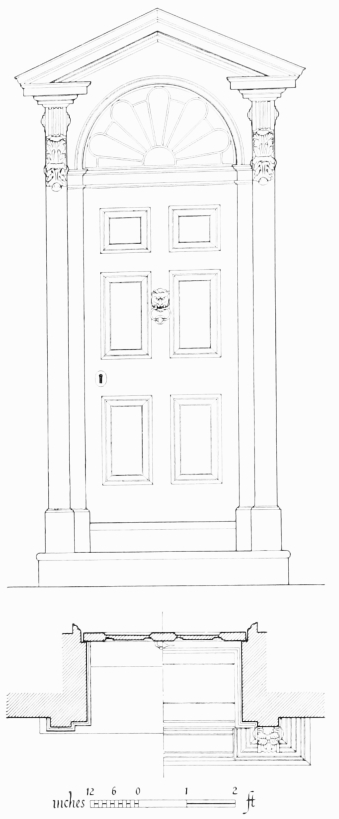
No. 17 Carlisle Street, doorcase
The passage-hall and the rooms generally have plastered walls finished with a moulded skirting and a moulded dado-rail of wood, and the plain ceilings are surrounded with delicately enriched cornices of plaster. The ground-floor front room has a fine chimneypiece of Adam character in wood and compo, and the back room chimneypiece has a shaped frieze decorated in compo with Rococo scrolls flanking a scallop-shell. On each side of this chimneypiece is a cupboard having a glazed door of Gothick design, with four tiers of delicate arcading finely executed in mahogany. The dog-legged staircase has cut strings with plain console-shaped step-ends, and a railing formed of delicately turned balusters extends between Doric column-newels to support the mahogany handrail.
No. 19 Carlisle Street
This house was erected in 1735–7 by John Sanger of St. James's, carpenter, on a site formerly occupied by part of the back premises of the original No. 38 Soho Square. (fn. 23) During these years Sanger was also rebuilding the three adjoining houses to the north, Nos. 38, 1 and 2 Soho Square, of which Nos. 38 and 2 still survive, both much altered. No. 19 Carlisle Street is a fourstoreyed house with a plain front, three windows wide. It has been altered to serve as a restaurant.