
Survey of London: Volumes 33 and 34, St Anne Soho. Originally published by London County Council, London, 1966.
This free content was digitised by double rekeying. All rights reserved.
'Frith and Bateman Street: Portland Estate, Frith Street', in Survey of London: Volumes 33 and 34, St Anne Soho, (London, 1966) pp. 151-166. British History Online https://www.british-history.ac.uk/survey-london/vols33-4/pp151-166 [accessed 11 April 2024]
In this section
CHAPTER VI
Frith Street and Bateman Street: Portland Estate
The streets described in this chapter are shown in fig. 2 on page 28. They take their names respectively from Richard Frith, citizen and bricklayer, and from the Bateman family which occupied Monmouth House for many years in the eighteenth century.
Frith Street
The first known mention of this street by name (if a later recital may be relied upon) is in June 1678, when Richard Frith and William Pym leased a site on the west side for building. It was then called a new street. (fn. 2) It is first named in the ratebooks in 1680, but with only three ratepayers. Ogilby and Morgan's map of 1681–2 (Plate 2) shows the street fully built but this is certainly a mistake. The chief period of building was in the 1680's. Eighteen ratepayers are named in 1683, and twenty-one in 1685. The ratebooks for 1686–90 are missing. Forty-two ratepayers are listed in 1691, when the street was fully developed except for those parts (all the east side north of Bateman Street and the west side north of No. 64) which were at that time included in the curtilages of houses in Soho Square.
The street name obviously derives from that of the main developer, Richard Frith (who was conceivably the 'Mr. Frith' rated for a house on the east side in 1684): the name of the street, like Richard Frith's, was sometimes transformed into 'Thrift', as on Rocque's map published in 1746.
The east side of the street north of Bateman Street was built up in the early eighteenth century: Nos. 6–10 (consec.), which did not form part of the Portland estate, in 1718 (see page 154) and Nos. 2–5 (consec.) in c. 1731 (see page 153). Three additional houses were added at the northern end of the west side (the former Nos. 65–67 consec.) by new building or reconstruction in the 1760's on the rearward curtilage of No. 31 Soho Square.
Almost nothing is known of the identity of the building tradesmen directly responsible for the first houses here, although it happens that two houses which can reasonably be associated with a known builder, Richard Campion, still survive in carcase (Nos. 60–61, see pages 164–5). Alexander Williams, probably the bricklayer, was rated for a house on the west side c. 1691–3.
A third builder, John Markham, carpenter, was in 1680 building six houses identified as being in this street and Romilly Street. He and Frith mutually agreed for the completion of the carpenter's and bricklayer's work respectively but the disputes in which they became involved (more fully described elsewhere) delayed the completion of the houses and consigned Markham to gaol (fn. 3) (see page 34).
From its early days until about the 1770's the street usually had two or more persons of title resident in it. The French element among the ratepaying occupants was a little less marked than in some other streets of Soho, if the occurrence of French-seeming names in the parish ratebooks may be taken as a rough guide; it becomes more noticeable in the 1730's and 1740's. As in Dean Street, by the 1790's few of the ratepayers' names look foreign. (fn. 4)
'Dancing Schools' are mentioned in the street in 1693 (fn. 4) and 'Mr. Hume's Dancing School' or 'great Dancing Room' in 1710–12. It was latterly run by Anthony Fert, a 'French Dancing Master'. It is probable that it was situated at the south-east corner with Bateman Street, (fn. 5) and that the building was subsequently used by the wellknown tapestry-workers, Joshua Morris, William Bradshaw and Tobias Stranover (fn. 4) (see page 516).
In 1720 Strype described Frith Street as 'graced with good Buildings well inhabited, especially towards Golden [sic, recte Soho] Square'. (fn. 6)
In the 1730's at about the time of, or shortly before, the realization of the Portland freehold, there was considerable rebuilding on the east side of the street, although not all of it seems to have been directly controlled by Portland building leases. On the west side the rebuilding was less extensive, and it is probable that five houses towards the northern end (Nos. 60–64 consec.) still preserve some of the original late seventeenthcentury fabric.
Most of the street south of Bateman Street is shown on the Portland estate map of c. 1792–3. (fn. 7) South of Old Compton Street most of the buildings that are shown have ground-floor plans which indicate the existence of shop fronts. North of Old Compton Street none of the houses on the east side seems to have a recognizable shop front except at corner sites: a few shop fronts are shown on the west side.
By 1850 very few houses in the street were in wholly private occupation. There were a number of ordinary retail tradesmen, and four or five engravers, but the trades most noticeably represented were those of tailor or dressmaker, and of goldsmith, jeweller or watchmaker. In 1900 this last class was still predominant, together with metal-workers, engravers and some other 'craftsmen': the tailors had almost disappeared. An 'advertising contractor' is listed in the street, and had in fact been there since 1869. (fn. 8)
The street is now the principal 'entertainment' street in Soho, containing the largest number of restaurants and 'clubs'. It is best seen at night when the glare of neon signs distracts attention from the dilapidated appearance of its buildings. It has been possible to identify eighteen of these as dating, at least in carcase, from the first half of the eighteenth century or earlier. But apart from Nos. 5–7 and No. 60, the early houses are barely recognizable from the outside, and two, Nos. 29 and 30, have been almost completely rebuilt, leaving wooden staircases of the early eighteenth century curiously embedded in the centre. Judging from the surviving buildings and from the evidence of the Portland estate map, the street was from the first one of modest, narrowfronted buildings having the standard two-room plan, the most notable exceptions being the former Nos. 9, 10 and 51–52. Rebuilding of a domestic character was still taking place at the beginning of the nineteenth century, when Nos. 44–49 were rebuilt, Nos. 44–48 with the arcaded second storeys that were also used in refronting the former Nos. 12 and 13. By the beginning of the present century a number of large commercial buildings were being erected, some of them, like No. 8–9, of very poor quality. The newest building, No. 11–13, pays at least some attention to the still domestic scale of the street, its five-storeyed front faced with pinkish-brown brick and containing relatively small square windows.
The rateable value of the houses in the street totalled about £1,780 in 1740, with an average assessment of about £34 for each house. In 1792 the total was about £2,170 and the average about £38. In 1844 the total was about £3,510, and the average had risen to about £54. In 1896 the total was about £5,480 and the average about £96. Very little amalgamation of sites had taken place. (fn. 4)
Residents and lodgers in houses in Frith Street which are not described elsewhere included: Dr. Walgrave, probably (Sir) William Waldegrave, physician to Queen Mary of Modena, c. 1685; Lady Coney, c. 1691–2; Robert Spencer, first Viscount Teviot, c. 1691–3; Colonel Parsons, possibly William Parsons, chronologer, c. 1691–4; Sir Henry Marwood, c. 1691–1709; Dr. Samuel Wall, c. 1691–1709; Sir William Monson, fourth baronet, c. 1691–1727, succeeded by Lady Monson, 1727–33; Sir David English, 1692–c. 1694; Lady Whaley, c. 1693; (fn. 9) Lady Garth, 1694–c. 1697; Colonel Ingoldsby, c. 1696–7; Sir William Norris, envoy to India, c. 1698; (fn. 10) Colonel Windham, c. 1703; Lady Downes, c. 1703–10; Lady Guise, c. 1703–19; Sir Thomas Aston, c. 1706–17; (fn. 11) Richard Coote, third Earl of Bellomont, 1709–11; Sir Roger Bradshaw, 1710–15; Sir John Thompson, first Baron Haversham, Lord of the Admiralty, 1710, succeeded by Lady Haversham, 1711–13; James Vernon, Secretary of State, 1711–26; Dr. Silvester, 1715–17; James Graham, first Duke of Montrose, c. 1716; (fn. 12) Joshua Morris, 1720–8, succeeded by William Bradshaw, 1729–31, and Tobias Stranover, 1730–3, all tapestry-workers (see page 516); William Vane, first Viscount Vane, 1722–c. 1725; Richard Phillips, governor of Nova Scotia, c. 1724–5; Lady Jenkinson, 1726–8; Dr. Barker, 1728–45; William Duncombe, miscellaneous writer, 1731– 1761; Sir Charles Mordaunt, 1734–55; William Herbert, second Marquis and second titular Duke of Powis, c. 1738–45; Maria, Duchess of Wharton, widow of first Duke, 1739–51; Dr. Beaumont, 1742–8; Charles Molloy, possibly the journalist, 1743–6; Peter Gillier, violinist of the chapel royal, (fn. 13) 1744–68; Dr. Oliphant, 1748–50; John Trotter, perhaps the army contractor, and associates, 1748–99; Matthew Mattee, perhaps Matthew Maty, physician and librarian, 1753, and Dr. Paul Mattee, 1754 or 1755–6; Dr. Brudenell Exton, 1753–9; Major Durand, 1753–65; Major-General (? William) Deane, 1753–75; Rev. Dr. Moore, 1755–9; Dr. Fleming, 1760–2; Dr. Hinchliffe, perhaps John Hinchliffe, headmaster of Westminster, later Bishop of Peterborough, c. 1760–5; (Sir) Robert Foley, baronet, 1766–81, succeeded by Lady Foley, 1782–94; Thomas Sheridan, actor, c. 1767; (fn. 14) Rev. Mr. Brilly, 1774–8; J. C. Fischer, oboist, c. 1776; (fn. 15) William Pether, mezzotint engraver and miniaturist, 1781–6; Timothy Sheldrake, perhaps truss-maker to the East India Company, 1785–7; General (? George) Garth, c. 1786–92; (fn. 7) John Bannister, comedian, 1787–95; Christopher William Hunneman, portrait and miniature painter, 1790–4; Elizabeth Inchbald, novelist, c. 1788–91; (fn. 16) J. T. Smith, topographical draughtsman and antiquary, c. 1797; (fn. 17) Horne Tooke, c. 1804; (fn. 18) Auguste Marie, Comte de Caumont, bookbinder, (fn. 19) 1801–14; Arthur Murphy, actor, c. 1801; (fn. 20) George Lipscomb, perhaps historian of Buckinghamshire, 1806–11; J. Foggo, painter, c. 1816–18; (fn. 21) Charles Ollier, perhaps publisher, 1830–2; John Bell, sculptor, c. 1832–3; John Hayes, painter, c. 1821–48; (fn. 22) John Snow, anaesthetist and investigator of cholera, c. 1840–9; (fn. 22) H. W. Diamond, surgeon and photographic innovator, c. 1844–9 (at former No. 22); (fn. 22) Jabez Hogg, surgeon and photographic writer, 1851–3.
Some artists whose addresses are given as being in Frith Street in exhibition catalogues, but whose names do not appear in the ratebooks, are listed below, with the years in which they exhibited:
Peter Vandyke, painter, 1764; Joseph Farington, painter, 1769–71; John Francis Rigaud, painter, 1772–3; Henry Edridge, miniature painter, 1786; Johann Heinrich Ramberg, painter, 1788; J. A. Gresse, painter and royal drawing master, 1794; (fn. 15) Adam Buck, painter, 1798–1812; G. Keith Ralph, painter, 1803; John Constable, painter, 1810–11; William Brockedon, painter, 1812–13; George Robert Lewis, painter, 1823–4; Anthony Stewart, miniature painter, 1827–8.
No. 5 Frith Street
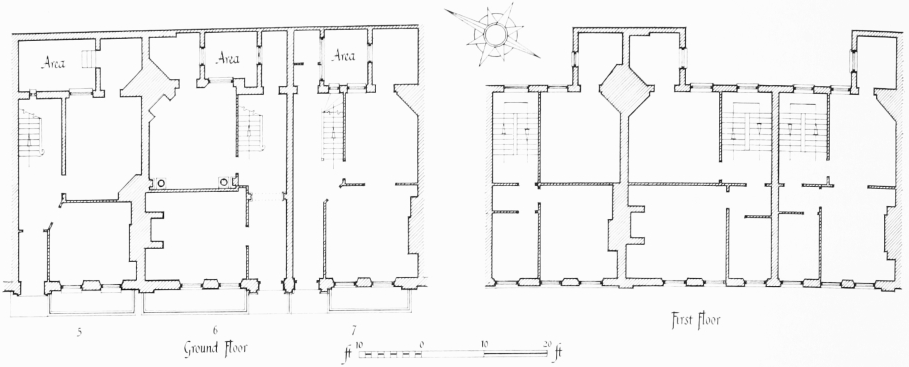
This is the southernmost, and only survivor, of a range of four houses (Nos. 2–5 consec.) built c. 1731 on the rearward (southern) part of the site of No. 30 Soho Square (Plates 120a, 121c, figs. 34–5). The head lessee of the whole site from the Portland family was the author, William Duncombe, (fn. 23) who was himself to be the first occupant of the adjacent house, No. 4. (fn. 4) The builder of Nos. 2 and 3, under sub-leases from Duncombe, was Joel Johnson of St. Marylebone, bricklayer (who was dead by August 1731). (fn. 24) It is not known whether Johnson built No. 5, or how far the range was uniform. The first occupant, in 1731, was a Mrs. Newdigate, (fn. 4) who in that year had as lodger Mary Barber, the poetess and friend of Swift. (fn. 25)
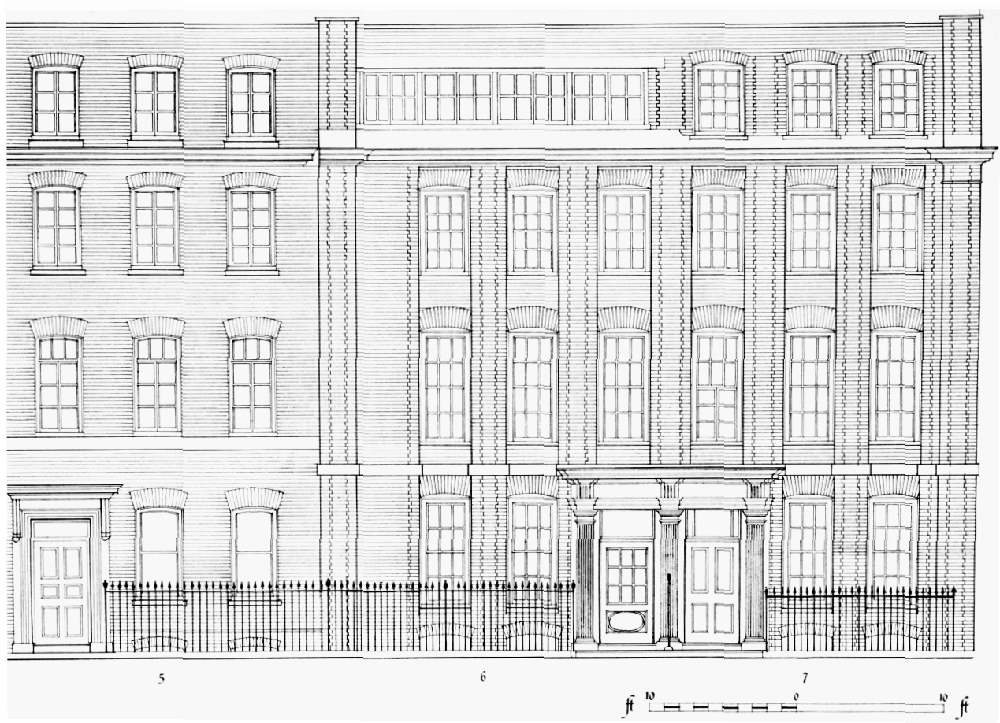
Although relatively plain the house is of interest as one of the best-preserved examples of its period in the area. It now comprises a basement and four storeys, with a brick front three windows wide. The brickwork has been resurfaced and dyed red, but it seems originally to have been purple-red in colour, except in the fourth storey, which is a later addition in yellow brick. The windows have segmental gauged arches, and within the openings are set recessed box-frames, some containing barred double-hung sashes, some modern casements. A broad sill-band of stone runs beneath the second-storey windows, while above the third storey is a moulded stone cornice. The doorcase is of stone, now painted, and comprises a moulded architrave with a (mutilated) moulded cornice on carved consoles above; the door itself is original with six raised-and-fielded panels in ovolo-moulded frames, but the fanlight is later. The area-railings remain, having urn-finials to the standards. The back wall is of purple-red brick with segmental-headed windows containing slightly recessed box-frames.
Internally the house has the standard plan of a single front and back room, the latter having the dog-legged staircase beside it on the north and a three-storeyed closet-wing projecting beyond it on the east. In the first three storeys the rooms, entrance passage and staircase compartment are lined with two heights of panelling, to which relatively few alterations have been made, even though the first- and second-floor front rooms have been subdivided. The ground- and first-floor panelling is set in ovolo-moulded framing and finished with a moulded dado-rail and a box-cornice, the entrance passage and the two front rooms having raised-and-fielded panels; on the second floor the panel-frames are plain and a smaller cornice is used. The ground-floor front room has an original wooden fireplace-surround enriched with leaf and cable mouldings, and in the second-floor back room is a plain flat surround of stone, simply moulded on the inner and outer edges. At the end of the entrance passage, flanking the opening to the staircase compartment, are two fluted pilasters, having above them entablature-blocks with moulded architraves.
Nos. 5–7 (consec.) Frith Street, plans
The staircase is the most handsome feature of the house. The first two flights have cut strings decorated with carved step-ends, each tread having a moulded nosing and carrying two turned and twisted balusters; the moulded handrail is continued over plain column-newels and at the foot sweeps round to form a volute. The upper flights, rising to the third floor, have moulded closed strings, but with the same type of baluster and newel. Some of the balusters are without the twisted moulding, but these are probably later replacements.
Nos. 6–10 (consec.) Frith Street
Nos. 8–10 demolished
This range of houses was built in 1718 (Plates 118, 119, 121a, figs. 34–5). The site did not form part of the Portland estate, being included in the curtilage of Monmouth House and having been formerly occupied by the back premises of the mansion. In February 1716/17 the Crown lease of that whole site had been acquired by the Lord Mayor, Sir James Bateman, who promptly had important alterations made to the mansion, doubtless by Thomas Archer (see page 109). In September 1717 Sir James was entering into articles of agreement for the construction of the five houses fronting on to Frith Street. The other party was William Thomas of Soho, subsequently described as a clothworker, a property speculator who was later responsible for the development of the Lowndes Market area of St. James's. (fn. 26) The agreement comprised a sub-lease for a year to Thomas, until September 1718, at a peppercorn rent. Thomas undertook to build and wainscot the five houses in conformity to an annexed ground plan. In January 1717/18 new articles were concluded, for building to an altered plan and to an elevational design, both of which survive (Plate 118): Bateman also lent Thomas £2,000 to complete the work. (fn. 27) Very little record remains of Nos. 8–10 as they were actually built, but from the evidence of Nos. 6 and 7 it would seem that the original design was adhered to only in its general lines. There was no delay in building, however, and by July the five empty houses could be insured against fire, for £2,000. (fn. 28) Three were occupied by October, when Bateman's son and executor, William, leased the houses to Thomas for sixty years. (fn. 29) A little over a year later Thomas disposed of his speculation, for some £3,197. (fn. 30)
The leases from William Bateman had stated that the houses had been built in accordance with the regulations of the recent Act to safeguard buildings against fire. The comparatively rapid construction may not, however, have been of the best, as the front of No. 10 was said to be giving way in 1820, (fn. 31) and that of No. 6 was required by the District Surveyor to be rebuilt in 1909. (fn. 32)
Nos. 5–7 (consec.) Frith Street, elevations
There is no evidence on the architectural authorship of the original or amended design or on any connexion of Thomas Archer with the work.
The first occupants of Nos. 6–10 were respectively Mrs. Millett, 1718–22, (fn. 4) Major Phillip Roberts, c. 1718–19 (fn. 33) (a Madam Kennedy paying the rates), (fn. 4) Captain Watson, 1718–30, (fn. 4) Edward Conyers, 1719–22, (fn. 4) and Edward Harrison, 1720–1, or William Pealing, 1721–8. (fn. 34)
At No. 6 later occupants (fn. 4) included Sir Marmaduke Wyvill, 1724–5, Lady Frances Hewett, 1736–56, (fn. 15) the Prussian Resident, 1757–64, Henry, thirteenth Baron Willoughby of Parham, 1768–75, George, the fourteenth Baron, 1775– 8, and Joseph Munden, perhaps the actor, in 1795. (fn. 22)
Early in 1830 William Hazlitt took lodgings at No. 6, and produced his last essays here, including 'The Sick Chamber'. He died in the house on 18 September of the same year: his last words were 'Well, I've had a happy life'. (fn. 35) He was buried in St. Anne's churchyard, Lamb and P. G. Patmore being the only mourners. (fn. 36) In 1905 a commemorative tablet was erected by the London County Council and was retained when the front wall was rebuilt, together with that of No. 7, in 1909. As is noted in more detail below, some alterations were made to the fronts at that time.
Occupants of No. 7 included Lady Hewett, 1731–5, (fn. 4) and probably Mrs. Henry Ross, the painter, and her son, later Sir William Ross, the miniaturist, who exhibited paintings in 1811 from a house in this street. (fn. 37)
An occupant of No. 8, in c. 1732–3, was Tobias Stranover, (fn. 4) the painter and tapestry-designer (see page 517).
Occupants of the former No. 9 included Captain Draper, 1724–7, Lady Buckley, 1728–9, Colonel Julius Caesar, 1754–7, and the Hon. Henry Roper, 1770–6. (fn. 4)
All five houses were disposed of by the Crown in 1829–30, by sale and exchange for properties in St. Martin in the Fields which were required for the West Strand improvements. (fn. 38) Nos. 6–8 had then recently been occupied wholly as furnished lodging-houses and Nos. 9 and 10 partly so. (fn. 39) (fn. 1)
No. 9 was demolished in 1904, when C. F. Hayward, the District Surveyor, suggested to the Clerk of the London County Council that an attempt might be made to preserve paintings that were visible on two walls of the stair hall. This proved impracticable although photographs were taken. A carved step-end from the house is said to have been deposited at the London Museum.
Architectural Description
The elevational drawing of January 1717/18 is a rare survival showing an unusually interesting design for a group of terrace houses (fn. 40) (Plate 118). It is a curious mixture of architectural features, some rather advanced and some old-fashioned for their period. Palladian influences, uncommon in builders' houses of this date, are clearly apparent, but more surprising is the attempt to disguise the varying widths of the frontages behind a uniform façade. The use of half-windows, on the other hand, is a device generally associated with the late seventeenth century.
The drawing shows a row of five houses, each containing a basement and four storeys. The fronts of Nos. 6, 7 and 8 are three windows wide while those of Nos. 9 and 10 are four windows wide, Nos. 6, 9 and 10 having the additional half-window in each storey. The fronts are arranged in three groups with pilasters between groups and at each end of the range. This is a departure from the more usual early eighteenth-century practice of placing a pilaster between each house, and has the effect of giving the row a single façade of three bays. Such an arrangement, moreover, has meant ignoring the internal grouping of the houses by placing Nos. 9 and 10, which have mirrored plans, in separate bays.
Above the ground storey in each bay is a raised bandcourse, and above the third storey a moulded cornice which breaks forward over the pilasters. The fourth storey, a rare feature in London houses of this date, particularly above a main cornice, is finished with a tall parapet. This again is unusual in having long raised panels, presumably intended to be of brick, extending nearly the full width of each bay. The doorways are shown with only plain architraves, but no doubt it was intended to elaborate on these when the houses were built. The area-railings are shown in more detail, and it is worth noting that they are an early type, having solid square standards with ball-finials.
The extent to which this design was carried out cannot be established with any certainty, for Nos. 8–10 were demolished without their exteriors having been recorded. However, a plan of No. 9, attached to a deed of 1826, shows a pilaster at the southern end of the frontage and none at the northern end, as in the original design. (fn. 41) This pilaster in fact still survives, between the rebuilt fronts of Nos. 9 and 10. The plan of 1826 also indicates that the intended half-window had been omitted.
Although Nos. 6 and 7 have not been destroyed, their fronts have been rebuilt as inexact copies of the originals (Plate 119a, fig. 35), and the only evidence of their appearance as built comes from an old photograph showing No. 6 and part of No. 7. (fn. 42) The main departure from the original design seems to have been that the windows in the three lower storeys were set in shallow, vertically continued recesses, the heads of the third-storey windows, unlike those in the rebuilt version, also forming the heads of the recesses. This is another unusual device without an exact parallel; the closest is perhaps Rutland Lodge, at Petersham. The windows had segmental arches, not flat as in the drawing, and contained double-hung sashes in flush frames, although these had probably been renewed in the nineteenth century. The half-window at the north end of No. 6, which has been omitted in the rebuilt elevation, was, however, built as intended. One other small difference was that the bandcourse above the ground storey was moulded on both edges and carried across the flanking pilasters, these having a small brick moulding below the main cornice to give the appearance of a capital. The doorways, set together in the centre of the double frontage, shared a single doorcase. This is not shown in the original drawing, but it was almost certainly the one actually built; it has survived the rebuilding, except that the lower parts have been renewed (Plate 121a). It is of wood, consisting of three fluted Doric pilasters supporting an entablature, the architrave and frieze of which break forward above the pilasters and are there decorated with triglyphs; the present doors are not the original ones.
The fourth storey had been considerably altered at No. 6 by the insertion of a long window containing four pairs of sliding sashes, but the single window of No. 7 shown in the photograph was much taller than those in the original drawing. There was no sign of the panelled parapet, but on the other hand there were flanking pilasters, suggesting that the fourth storey had been built in a revised form.
The fronts have been rebuilt in yellow brick with red dressings, in contrast with the brickwork of the surviving southern pilaster, which is purple-red with red dressings in the upper storeys. At the back the walls are wholly of this colour, containing segmental-headed windows with flush frames; the second landing window of the staircase at No. 6, however, is round-arched, and so probably was the one below, until it was altered, evidently in the early nineteenth century. There is a raised bandcourse above the second storey in both houses, and also below the parapet in the closetwings, which alone have not been heightened. The latter have quoins of red brick and retain the original red-tiled roofs with a hip at the eastern end.
Internally Nos. 6 and 7 have mirrored plans conforming closely to the original design (Plate 118, fig. 34), and No. 8 seems to have been intended in its turn to mirror No. 7. The plan is the standard one of a single front and back room, the latter with the staircase to one side of it and a closet-wing projecting at the back. Nos. 9 and 10 were planned on a more generous scale, as befitted their wider frontages. They too had mirrored plans, but L-shaped with a deep front and back room on one side of the house, and on the other side the two staircases, one behind the other. The main staircase was constructed round three sides of the entrance hall, a spacious room corresponding in depth to the adjoining front room. It is not known how far Nos. 8 and 10 conformed to this proposed plan, but the plan of 1826 already mentioned shows that No. 9 followed it almost exactly. (fn. 41)
The finishings of Nos. 6 and 7 are generally well preserved, despite the insertion of a few partitions. The ground and first floors have ovolomoulded panelling finished with moulded dado-rails and box-cornices, the front rooms, the entrance passage and, at ground-storey level, the staircase compartment, having raised-and-fielded panels. No. 6 has the characteristic pair of fluted pilasters at the end of the entrance passage, and although none remains at No. 7, space is left for them in the arrangement of the panelling. It is evident that the ground floor of No. 6 has undergone careful alteration, the front and back rooms having been thrown into one, perhaps in the early nineteenth century, and the dividing wall replaced by a rather crude screen composed of two wooden, or wood-encased, Doric columns with antae; the screen remains, but the rooms are now once again divided by a partition. In the entrance passage the fluted pilasters have been moved a little way eastwards of their original position, and the north wall relined with sunk panelling. The second-floor rooms have only plain sunk panelling finished with the smaller type of cornice, but modern bolection mouldings have been applied to the panel-frames.
No. 6 is unusual in having retained most of its original wooden fireplace-surrounds; all have now been boarded in, but a description of 1951 notes that they then had marble linings and that some contained good iron grates, presumably of the early nineteenth century. (fn. 43) The surrounds are mostly similar in type, eared, with egg-and-dart mouldings in the ground-floor front room and in both main rooms on the first floor, hollow-moulded in the ground-floor back room, and ovolomoulded in the second-floor back room; in the first-floor closet-wing, however, there is a bolection-moulded surround, apparently original. No. 7 has only one original surround, a flat stone one with simple mouldings on the inner and outer edges.
The staircases are of wood, built to the doglegged pattern instead of the narrow open-well type shown on the original design. At No. 6 the first two flights have cut strings decorated with shaped step-ends, each step carrying two turned balusters with square waist-blocks. The balustrade is finished with a moulded handrail which is carried over a column-newel at each turn of the stair, forming, at the foot of the stair, a half-volute over a fluted newel. The upper flights are simpler, with a moulded closed string carrying balusters of a less elaborate turning. At No. 7 the same design seems to have been used, although the balustrade has been boxed in.
Little attempt was made to record the interiors of the other three houses before their demolition, but there is a good drawing of the main stair hall of No. 9 made in 1885 (fn. 42) (Plate 119b), and this is to some extent supplemented by the notes and photographs taken by the London County Council in 1904. (fn. 44) The staircase was of wood, rising round the east, north and west walls of the hall to a first-floor gallery along the south wall. The cut strings were decorated with carved step-ends, each step carrying three turned balusters. These had square waist-blocks, and the outer two had twisted shafts, a pattern which was repeated in the balustrade of the gallery. The moulded handrail was ramped up at each turn of the stair over a fluted column-newel, and again in the centre of the gallery-balustrade over a similar newel. The walls of the hall had a panelled dado following the line of the balustrade, above which they were painted, at least on the east and north sides and at the back of the gallery. The paintings were in far too bad a condition for their subject to be deciphered. The north wall had the upper half of a partially draped female figure, while the east wall had at first-floor level a full-length figure, evidently male, in a relaxed posture with the head and one knee bent. Both paintings were flanked by a border resembling rusticated stonework. At ground-floor level the east wall had a panel of foliated scroll-work, and on the wall behind the gallery the head and breast of a woman were just visible. The hall was finished with a dentilled cornice, and there were signs of a ceiling-painting consisting of several naked female figures and a helmeted male figure floating among clouds.
Nos. 14 And 15 Frith Street
These houses were built in 1733–4, together with the former Nos. 12 and 13 (now demolished). The builder was possibly Samuel Price of St. Martin in the Fields, carpenter. (fn. 45) No. 15 was occupied in 1804–6 by Henry Meyer, portrait painter. (fn. 4)
The houses are of four storeys with fronts three windows wide, except for the (probably added) fourth storey of No. 15 which has only one window. Neither front retains much of its original appearance and that of No. 15, now rendered with cement, is recognizable only by the proportions of its windows. These suggest that there was a close similarity between the houses, and in fact the Portland estate map (fn. 7) shows that before No. 15 was gutted they had mirrored plans.
At No. 14 the front still has its original purpler-ed brick, the jambs and flat gauged arches of the windows being of red brick. The fourth storey is, however, an addition in yellow brick, and the first-floor windows have been lengthened and the doorway altered. Inside there is a wooden dog-legged staircase, much altered but retaining its original carved step-ends.
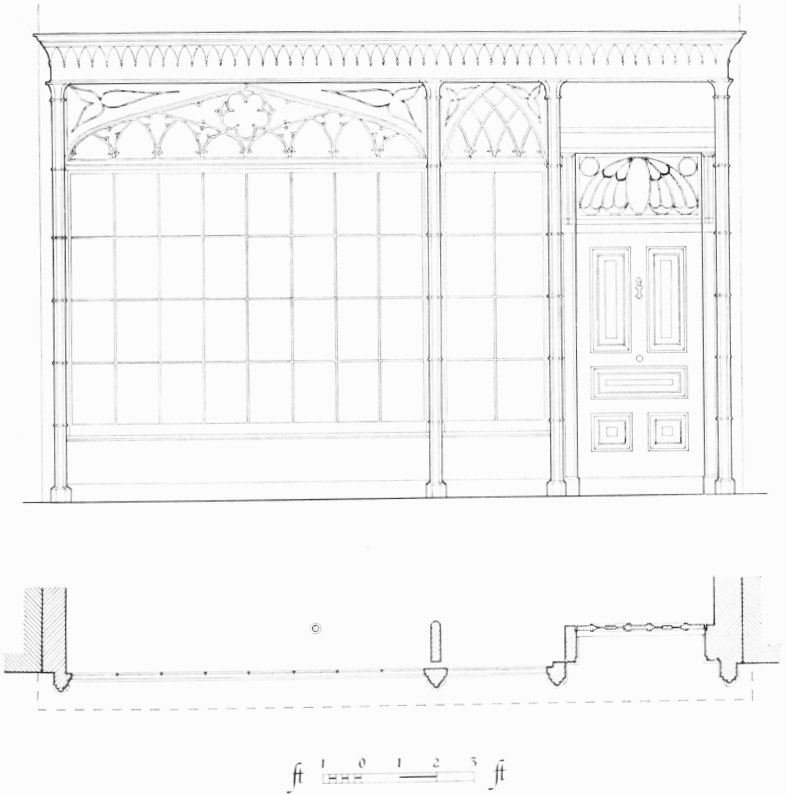
The whole interest of No. 15 lies in its early nineteenth-century Gothick shop front, a rare survival in London (Plate 132d, fig. 36). This was perhaps inserted in 1816, when the premises were in the occupation of Charles Clark(e), a bookbinder. (fn. 46) The shop (now restaurant) front has three unequal bays, with slender triple shafts of cast iron between them and at either end. The wide northern bay, originally the shop window, is divided by wooden glazingbars into four rows of eight small oblong panes, except that the top part is designed to resemble a four-centred arch filled with cast-iron tracery, the spandrels occupied by panels of an unclassifiable three-leaf pattern. The narrow centre bay, intended for the shop door, has now been converted into a window, but at the top there remains a panel like that over the adjoining window, except that the arch is two-centred and contains interlacing tracery. The southern bay is occupied by the door to the upper floors, this having five panels with raised centres and heavily moulded frames. Above it is a fanlight with tracery of a more orthodox geometrical pattern, and flanking this a pair of attenuated consoles, possibly designed to carry a cornice. The whole front is finished with a simple entablature consisting of a plain frieze and a groined cove cornice.
No. 15 Frith Street, elevation of shop front
Nos. 16–18 (consec.) Frith Street
These houses were erected in c. 1735 under a sixty-five-year building lease from Michaelmas 1734 granted by the Portland family to William Bignell of St. Anne's, glazier. (fn. 47) The first occupant of No. 17 was Peter Suidre, surgeon, and of No. 18 Mark Marcelein, staymaker. (fn. 48)
Sir Samuel Romilly, the law reformer, was born at No. 18 in 1757 when that house was occupied by his father, Peter Romilly, a successful jeweller. The family removed to St. Marylebone in 1769 but retained No. 18 for business purposes until 1792. (fn. 49) The house is referred to in 1800 as the Duke of Portland's office. (fn. 50)
Although very much altered, it is clear that the three houses were originally of similar character. Each contains a basement and four storeys, of which the fourth storey is a later addition, probably replacing a roof-garret. The fronts of Nos. 17 and 18 are three windows wide, and that of No. 16 two windows wide, all apparently built of pale yellow stock brick. Except where altered or rebuilt, the windows have segmental gauged arches which are probably of fine red brick, as are the jambs, but all have been dyed a deep red. No. 18 retains its original wooden doorcase, consisting of an enriched architrave flanked by panelled pilasters, above which are carved consoles; the cornice they were intended to carry has, however, been removed. The reveals and soffit of the doorway are panelled, and the door itself has six heavy raised-and-fielded panels in ovolo-moulded frames. All three houses have had shop fronts inserted in the ground storey and the third storey entirely rebuilt, while No. 17 has recently been rendered with cement. The back walls appear to be of purple-red brick with segmental windowarches.
Nos. 17 and 18 have mirrored plans of the standard two-room type, with projecting closets. No. 18, which is the better preserved internally, has a hall with a dentilled box-cornice and, flanking the entrance to the stair compartment, a pair of fluted Doric pilasters. The staircase is of wood, the dog-legged flights having in the lower stages cut strings decorated with carved step-ends. The treads have moulded nosings and each carries two turned balusters with square blocks above the urn-bases. The strings are fixed into column newels, and upon these rests the broad moulded handrail. No. 17 has been much altered, but probably the finishings were originally very similar. The staircase, now partly boxed in, appears to be of much the same pattern, and there are fluted pilasters in the hall, although this has been considerably reduced in width.
No. 16 differs from the other two in having an open-well staircase placed between the front and back rooms. Apart from a few traces of early eighteenth-century work, the finishings are entirely mid nineteenth century and the plan may therefore have been altered from the original. It does, however, date from the end of the eighteenth century at latest. (fn. 7)
No. 20 Frith Street
Demolished
The house formerly on this site was perhaps built or rebuilt about 1725–6, when it was occupied by Lewis Aubert, a wine merchant. (fn. 51)
It was in this house that Mozart, aged about nine, stayed with his father and sister in 1764–5, as lodgers of Thomas Williamson, a staymaker. The family had removed from No. 180 Ebury Street about the end of September 1764, (fn. 52) probably to No. 20 Frith Street, where they were certainly living in January 1765, when the young Mozart dedicated his Opus 3 (K.10–15) to Queen Charlotte from that address. (fn. 53) The family was still there on 30 May: (fn. 54) they left London in July. (fn. 55) During their stay in Frith Street the works composed by Mozart probably included K.19, 19d, 20, 21 (19c), 206 (21a), 220 (16a), 222 (19b) and 223 (19a). (fn. 56) Advertisements inserted by Leopold Mozart in The Public Advertiser in the spring of 1765 announced that 'those Ladies and Gentlemen, who will honour him with their Company from Twelve to Three in the Afternoon, any Day in the Week, except Tuesday and Friday, may, by taking each a Ticket, gratify their Curiosity, and not only hear this young Music Master and his Sister perform in private; but likewise try his surprising Musical Capacity, by giving him any Thing to play at Sight, or any Music without Bass, which he will write upon the Spot, without recurring to his Harpsichord'. (fn. 57)
The front of the house is shown in a photograph of 1908. (fn. 58) Quite apart from its association with Mozart, it is of interest as one of the best early eighteenth-century fronts known to have existed in the street. Built of brick, it was four storeys high and three windows wide, although the fourth storey may have been a later addition. The windows had segmental gauged arches and the jambs were probably dressed with red brick, while within the openings were slightly recessed boxframes. There was no bandcourse between the second and third storeys, but above the latter was a moulded brick cornice returned at either end. A shop front had been inserted in the ground storey in the early or mid nineteenth century.
No. 22 Frith Street
From August 1924 to February 1926 J. L. Baird occupied a two-room attic laboratory in this building and first demonstrated true television here, before an informal gathering of members of the Royal Institution of Great Britain, and others, on 27 January 1926. (fn. 59) In 1951 the London County Council erected a plaque commemorating the event.
No. 26 Frith Street
This house was erected in c. 1735 under a sixty-five-year building lease from Michaelmas 1734 granted by the Portland family to Francis Tredgold of St. Marylebone, carpenter. (fn. 60) The ground plan is shown on the Portland estate map of 1792–3 (fn. 7) (Plate 9, fig. 50 on page 197).
It is a very modest house, built on a site constricted by the gardens of the houses in Old Compton Street. But though much altered it remains one of the better-preserved early buildings in the southern part of the estate. It contains a basement and four storeys, the top storey probably converted from an original roof-garret, and has a front three windows wide, but this has been completely altered by a refacing of stucco in the mid nineteenth century. It has the standard two-room plan, but with no projecting closet and with a stair compartment that is shallower in depth than the adjoining back room. The wooden staircase with short dog-legged flights remains, these having moulded closed strings fixed into column-newels with big square heads; the balustrade, however, has been cased with asbestos. The compartment is lined with simple sunk panelling finished with a small cornice, and possibly the only room to receive a more elaborate treatment was the front room on the first floor, where a box-cornice remains. The first-floor back room retains a plain wooden chimneypiece consisting of a flat surround moulded on the inner and outer edges.
Nos. 37 and 38 Frith Street
These plain-fronted brick houses were built in 1781 (fn. 4) (Plate 120c). The builder is not known. (See also No. 24 Romilly Street, page 204.)
Nos. 39–41 (consec.) Frith Street
These three houses were built in 1743 by John Blagrave of St. George's, Hanover Square, carpenter, under a building lease running for approximately fifty-six and a half years granted to him by Edmund Byron, a Soho lawyer. Byron himself was only the assignee of an earlier Portland lease. (fn. 61) The first occupant of No. 39 was a shoemaker. (fn. 62)
Outwardly they constitute a more or less uniform group, each containing a basement and four storeys, and having a brick front three windows wide (Plate 120c). The windows have flat arches, mostly gauged, and each of the upper storeys has a stone sill-band of progressively diminishing width. All have had modern shop fronts inserted and the upper storeys of No. 41 have recently been rendered with cement. Possibly the only original work is in the second storey, where the brickwork (at least of Nos. 39 and 40) is purple-red and the windows, which have arches of the same colour, contain box-frames. The top two storeys of Nos. 39 and 40 have certainly been rebuilt in nineteenth-century yellow brick and perhaps the sill-bands were added at the same time. Possibly, however, the broad second-storey sill-band is original, like that at No. 5 Frith Street, although a second and slightly lower bandcourse at Nos. 39 and 40, now cement-rendered, may be the older feature.
The interiors vary in plan. No. 40 has the standard arrangement of a single front and back room with a dog-legged staircase beside the back room on the north and a closet projecting beyond it on the west. Nos. 39 and 41, restricted for space by the backs of houses in Romilly Street and Old Compton Street, are smaller, with the only good-sized room at the front; the back room is very small and cramped, and at No. 39 the staircase actually forms a projecting wing. Little remains of the original finishings. No. 40 has at the end of the entrance passage a pair of Doric pilasters supporting a plain round arch and in the first-floor room two heights of fairly complete cyma-moulded panelling with a moulded dadorail and a box-cornice. The staircase has heavily moulded closed strings, turned balusters, a moulded handrail and column-newels, the latter with small turned pendants. No. 39 has a similar staircase but the balustrade has now been boxed in.
Nos. 44–48 (consec.) Frith Street
This range of houses was built in 1804–7, after a fire. All were probably built as private residences. (fn. 4)
No. 45 was occupied in the 1840's by the Sydenham Society. (fn. 22) No. 46 was occupied in 1822 by J. R. Planché, dramatist and later Somerset Herald. (fn. 22) The first occupant of No. 47, in 1808–10, was William Ottley, (fn. 4) probably the writer on art and later keeper of prints at the British Museum. He was succeeded, from 1811 to 1816, by James Walker, court engraver to Alexander I of Russia, and at that period pictures were also exhibited from this address by the battle painter, J. A. Atkinson, another artist patronized by the Russian court. (fn. 37) The painter, Isaac Pocock, also perhaps exhibited from here. (fn. 63)
In 1829 Nos. 46 and 47 were taken by Sewell and Cross, silk mercers and upholsterers, (fn. 46) for whom J. B. Papworth designed a classical shop front and an interior in 1832. Neither survives, but the shop front is known from a photograph in the Council's collection (Plate 133b), and Papworth's drawings for the interior are preserved in the Library of the Royal Institute of British Architects. (fn. 64)
Architectural Description
The houses are of four storeys with basements, having uniform brick fronts, two windows wide. The brickwork has now been rendered with cement at No. 45 and dyed red at the other houses, but originally it appears to have been yellow in colour; the slightly taller parapets at Nos. 46 and 47 are the result of a rebuilding. The fronts are designed to a stock pattern widely used by London builders at the beginning of the nineteenth century. The windows are completely plain with flat gauged arches, but those in the second storey are set in shallow round-headed recesses, having below them a broad continuous sill-band of stone. No. 45 differs from the others in having narrower sillbands in the third and fourth storeys, but these may have been added when the front was rendered. In every case the ground storey has been altered in modern times.
The shop front inserted by Papworth for Sewell and Cross at Nos. 46 and 47 (Plate 133b) had two wide display windows in the centre and a doorway at either end, the divisions between these units being marked by attached Ionic columns supporting an entablature; the columns had fluted shafts and were placed singly, except for a pair in the centre disguising the end of the party wall. The display windows, which were probably arranged in small panes originally, had been altered, but the door of No. 46 was original, having six sunk panels in heavily moulded frames. In front of the windows was an unexpectedly domestic-type area-railing with urn-finials to the standards, doubtless a survival from the period before the ground storey was converted into a shop. One curious feature was a pair of low pedestals with panelled sides and pedimented tops, placed in front of the columns at either end of the front and possibly intended as bases for lamp standards.
The 1832 designs for the interior show an arrangement of bays, variously filled with shelves or doorways, divided by plain-shafted Ionic columns with enriched neckings to the capitals, the latter being linked from column to column by a band of key-fret. At that time Sewell and Cross's premises also had entrances at Nos. 40 and 42 (then Nos. 45 and 44) Old Compton Street, where Tallis's view of 1838–40 (fn. 65) shows a shop front apparently similar to that in Frith Street (fig. 49 on page 195).
The interiors of the houses have not been examined in detail, but Nos. 46 and 47 have the common plan of a single front and back room with a staircase beside the back room; such finishings as remain are of the plainest early nineteenth-century type.
No. 49 Frith Street
This house was built at the same time as, although separately from, the uniform range to its south, in 1804–5, after a fire. (fn. 4)
It contains a basement and four storeys with a yellow brick front three windows wide. The windows have flat gauged arches, now dyed red, and contain in the third and fourth storeys barred double-hung sashes recessed within plastered reveals. In the second storey the windows are longer, extending down to a stone bandcourse at floor level, and are guarded by diagonally braced iron railings, although these may have been renewed. The ground-storey windows have been replaced by a display window, but to the north of them is the original round-headed doorway, within which is a reeded door-frame flanked by pilaster-strips; the door is six-panelled, with four raised-and-fielded panels above two flush ones, and over it is a patterned fanlight. Around the basement area is an iron railing with urn-finials to the standards. The back wall is of purple-red brick, having window arches of yellow gauged brick.
The plan of the interior consists simply of a single front and back room, the wooden geometrical staircase lying beside the back room on the north. The finishings are of the plain type described below at Nos. 58 and 59, except that the hall has an eccentric modillion cornice, and, at the staircase end, a segmental arch springing from panelled pilasters.
No. 51–52 Frith Street
Demolished
A large house was built here in 1731 on the site of two houses, probably by the Soho carpenter, Thomas Richmond, who at that time held a sixty-five-year Portland lease of the site commencing at Michaelmas 1734. (fn. 66) An early occupant of the house was Major-General Onslow (probably Richard, nephew of the first Baron), from 1739 to 1747. (fn. 4) He was succeeded by Richard Osbaldeston, successively Bishop of Carlisle, 1747–62, and of London, until his death here in 1764. (fn. 4)
The house was burnt down in 1803 but in the later nineteenth century the interior was remembered as 'magnificent', with a painted staircase. (fn. 67) The ground-floor plan is shown on the Portland estate map of c. 1792–3, (fn. 7) although by that date the original layout had been considerably altered for conversion into a shop. It is clear, however, that the plan was fairly similar to those of Richmond's houses at Nos. 75 and 76 Dean Street. The main staircase was at the front of the house, at the northern end. This occupied a spacious compartment, some twenty feet in depth, with the flights of the stair rising against its west, north and east walls, probably to a gallery against the south wall. It was heated by a small fireplace set in the angle of the front and party walls. Almost certainly it had also been designed to serve as an entrance hall, probably with a width of thirteen feet six inches. In this case the shop doorway shown in c. 1792–3 would have been the original front doorway, giving access to the hall at its southern end.
Adjoining the hall on the south was probably a single front room about twenty feet square, while behind that on the west was the principal back room, probably about sixteen feet square. The north wall of this room appears to have been replaced, by the time the plan was made, with a row of columns of quatrefoil section, very likely cast-iron ones in Gothick style. Immediately behind the main staircase lay the back staircase, itself of open-well type in a compartment seven feet two inches wide and eight feet six inches deep. Behind this in turn was a small closet, and to the south of them both a narrow room or vestibule.
The house was replaced in 1805 by new premises for the previous occupants, Jackson and Moser, later Roger Moser and Company, ironmongers. (fn. 68) They comprised two houses over a shop, and a manufactory. These premises have now also been demolished.
A drawing of 1885 shows that the building was four-storeyed, with a brick front four windows wide. (fn. 42) The windows contained barred, doublehung sashes, and those in the second storey had moulded architraves, probably of cement, and elaborate Rococo cast-iron guard-rails. The shop front was the chief feature of interest, an imposing design, even if not, perhaps, the best suited for the display of goods (Plate 133a). Its principal elements were three doorways set in arched surrounds, a central one to the shop, flanked by a pair of rather insignificant display windows, and one at each end, presumably giving access to the upper floors. The doorways were round-headed, being flanked by panelled piers from which sprang plain recessed archivolts. In the heads of the arches were patterned fanlights, and at either side circular panels containing lion-heads. The doorways at either end had double doors, each of three panels, almost flush with the piers, but those to the doors to the shop were deeply recessed within panelled reveals. The shop front was finished with an entablature having a plain frieze and moulded cornice; in 1885 it was surmounted by an elaborate version of the royal coat of arms, centrally placed and almost two-thirds the height of the second-storey windows. A rather similar shop front formerly existed at No. 74 Dean Street.
Nos. 58 and 59 Frith Street
These two houses were probably both built c. 1800–1. The first occupant of No. 58 was Samuel Briggs, a plumber. (fn. 4) In 1841–3 No. 59 was occupied by H. W. Diamond, surgeon and photographic innovator. (fn. 22)
The houses are closely similar in style, each having a brick front comprising four storeys above a basement, but whereas No. 58 is two windows wide, the narrower No. 59 has space only for a single wide window (Plate 120b). The wallface is of pinkish-yellow stock brick with slightly cambered gauged window-arches to match, the only relief being afforded by a stone band at first-floor level; at No. 58, however, the brickwork has now been dyed yellow. Within the window-openings are barred double-hung sashes in concealed frames, the second-storey windows, which extend down to floor level, having iron guard-rails, these being plain at No. 58 but trellispatterned at No. 59. The doorways, placed at opposite ends of their respective fronts, are roundarched, containing six-panelled doors and fanlights with radial glazing-bars; at No. 59 the door has a good lion-head knocker (Plate 121d). The original area-railings have almost entirely gone, but there is a short length beside the doorway of No. 59, having a standard with an urnfinial; No. 58 now has modern wrought-iron railings and an overthrow lamp-holder designed in early eighteenth-century style.
The interiors have roughly mirrored plans, each floor having a single front and back room with the staircase compartment lying between, but No. 58, the larger of the two, has a closet behind the staircase and a passage beside the back room on the ground floor, leading out to the yard behind; above this passage on the first floor is a narrow closet with a lobby at the eastern end giving the back room separate access to the staircase. The finishings, where they have survived, are of the plainest type, the walls of the rooms being lined with plain wooden dadoes having moulded rails and skirtings, and finished with simply moulded plaster cornices; the doors are sixpanelled, the sunk panels being decorated with a raised moulding. The staircases are of the geometrical pattern, constructed of wood with shaped step-ends, moulded nosings to the treads, and thin square balusters supporting a continuous mahogany handrail.
No. 58 contains a number of ornate wooden chimneypieces, some of them incorporating early or mid eighteenth-century carving, but these must be modern insertions.
No. 60 Frith Street
This is one of the better-preserved late seventeenth-century houses surviving from the first development of Soho Fields (Plate 120b). It was perhaps built, together with No. 61, by the carpenter, Richard Campion. In 1691 the two houses were valued together, as part of his estate, at about £1,800. By 1688 No. 60 had been taken on lease from Campion by Elizabeth Price, who was perhaps the first occupant. (fn. 69) She was later said to have been 'a Player and mistress to several persons', (fn. 70) and by 1689 had acquired both a house in Pall Mall and an involvement with Charles the (titular) fourth Earl of Banbury, which finally resulted in a claim that he had taken her abroad and married her (bigamously or otherwise) at Verona. (fn. 71) This he denied, asserting that she had become engaged to 'a Spaniard one don Hugo Simple . . . but finding herselfe not in a condition for marriage chose to goe beyond sea till she had dissipated herself from that Incumbrance'. (fn. 72) In 1697 the Court of Delegates decided against the Earl's marriage to Elizabeth Price in favour of an earlier union. (fn. 70) In the following year, however, she was still designating herself Countess in her answer to a Chancery suit. This dispute was concerned with her or the Earl's power to mortgage No. 60 Frith Street, but does not reveal anything of interest beyond Campion's lien on this and the two adjacent sites. (fn. 73)
If Mrs. Price occupied the house, she soon let it to 'persons of quality'. (fn. 74) The first recorded in the ratebooks, in 1691, was Lady Butler. The next occupant, from 1692 to 1698 or later, was Colonel John Beaumont, (fn. 75) no doubt the soldier of that name (d.1701) who had fallen foul of James II and had been created colonel of the regiment formerly the Duke of Berwick's by William III. (fn. 76) He was (like the Earl of Banbury) a lethal duellist. A more pacific later occupant of the house, from 1753 to 1757, was the painter, Nathaniel Hone. (fn. 4)
In the period about 1840 a number of artists exhibited from this address, including Thomas Musgrove Joy. (fn. 77)
The house now contains a basement and four storeys, and has a brick front three windows wide (Plate 120b). In the ground storey the front has been rendered with cement, while the two storeys above have been resurfaced and mockpointed, but the brickwork appears originally to have been purple-red in colour, red brick being used for the jambs and arches of the windows. The fourth storey is a later addition in yellow brick, probably replacing an original roof-garret. The windows have slightly cambered gauged arches, and within the openings are recessed boxframes containing barred double-hung sashes, although both these are probably renewals of a later date. The ground and second storeys have keystones to the window-arches and are finished with stone bandcourses; the third storey is not treated in this manner because, presumably, it was intended to be overshadowed by an eaves-cornice.
The doorcase is a late eighteenth-century insertion, dating perhaps from 1778, when the house was unoccupied (fn. 4) (Plate 121d). It is of wood, consisting of a pair of Ionic pilasters supporting an entablature. The capitals of the pilasters are unconventional in having bands of acanthus leaves below volutes hung with swags, and the frieze is decorated with paterae, acanthus leaves and a pair of urns linked by a swag. The door itself is six-panelled, with four raised-andfielded panels above two flush ones, and there is a fanlight with radial glazing-bars.
The back wall is of purple-red brick, except for the fourth storey which is an addition in yellow brick, as at the front. The windows have jambs and segmental arches of red brick, and contain recessed box-frames, while above the ground and second storeys are raised brick bandcourses. The projecting closet-wing, though much rebuilt, appears to have been of similar character.
Internally the house has the standard plan of one front room, one back room and a projecting closet-wing, the dog-legged staircase lying beside the back room on the south. The finishings have been altered in both the early and late eighteenth century, but the ground and first floors retain a fair quantity of bolection-moulded panelling. For the most part only the dado has survived, but the south wall of the entrance passage and the first two storeys of the stair compartment are still panelled in two heights. The staircase has been largely rebuilt, but the pair of flights leading to the third floor are original, with moulded closed strings, twisted balusters, and a flat moulded handrail carried over thick square newels. The single flight from the ground floor to the basement is probably of the same date, but it differs in having only turned balusters. The first-floor front room has a moulded plaster ceiling and frieze of the late eighteenth century.
No. 61 Frith Street
This house is closely similar in its proportions to No. 60, and for this reason may be regarded as being basically of late seventeenth-century date. Like No. 60 it was perhaps built by the carpenter, Richard Campion, as he was named as owner of the house on this site in 1690. (fn. 73) The front was rebuilt in 1950, (fn. 43) but a photograph of 1943 shows that it had previously been completely altered and stuccoed in the early nineteenth century (fn. 78) (Plate 120b). The interior appears to retain little of interest, apart from some early nineteenth-century work, but a note of 1950 suggests that at that time traces of late seventeenth-century work still remained. (fn. 43)
Probably the first occupant, in 1691 or earlier, was Lady Cole, and later occupants included Colonel Matthews, c. 1694–6, and Sir Jeffery (or Geoffrey) Palmer, 1716–20. (fn. 4)
Nos. 62–64 (consec.) Frith Street
It is possible that these three houses, which are of similar proportions, are all of late seventeenth-century date, and were in existence by 1691 (fn. 4) (Plate 120b). Only No. 62, however, retains work that is certainly of that period. Some rebuilding by John Clarkson of St. George's, Hanover Square, carpenter, was probably undertaken at Nos. 63 and 64 in c. 1734, and it is possible that at No. 63 it amounted to a complete reconstruction. (fn. 79)
Lodgers at No. 64 included W. M. Bennett, portrait painter and miniaturist, in 1812–18, (fn. 80) and the actor, William Macready, at the time of his first appearance on the London stage, in 1816. (fn. 81)
Architectural Description
Each of these houses contains a basement and four storeys, the top storey of which has probably been converted from an original roof-garret. The fronts are three windows wide, but Nos. 63 and 64 have been rendered with cement and No. 62 rebuilt above second-floor level, so that little evidence of their original appearance is left. At No. 62 the brickwork in the second storey, though much blackened, appears to be purple-red, and the jambs and segmental gauged arches of the windows, though now dyed a deeper shade, appear to have been originally red. Cementrendered sill-bands, possibly of brick, remain in the second storey of Nos. 62 and 63, and No. 63 has bandcourses above both the second and third storeys. All three houses have modern shop fronts in the ground storey. Internally the houses are arranged on the standard two-room plan, with projecting closets at Nos. 62 and 63. No. 62 has its original, late seventeenth-century, doglegged staircase of wood, the moulded closed strings fixed into square newels and the vase-type balusters supporting a broad moulded handrail. No. 63 has been completely altered in modern times, but No. 64, the best of the group, retains a fair quantity of work dating from an early eighteenth-century refitting. The first-floor rooms are complete with sunk ovolo-moulded panelling finished with moulded dado-rails and box-cornices, and the cornice in the front room is further elaborated with dentils. The doors and shutters are panelled to match, and the back room has a simple wooden fireplace-surround consisting of a strip of ovolo-moulding. The staircase, also dog-legged, has moulded closed strings, column-newels and a moulded handrail, but the balustrade has unfortunately had to be cased with asbestos. The stair compartment is lined with ovolo-moulded panelling as far as the half-space landing above the first floor, and thereafter with unmoulded panelling to the top of the house.