
Survey of London: Volumes 33 and 34, St Anne Soho. Originally published by London County Council, London, 1966.
This free content was digitised by double rekeying. All rights reserved.
'Shaftesbury Avenue and Charing Cross Road', in Survey of London: Volumes 33 and 34, St Anne Soho, (London, 1966) pp. 296-312. British History Online https://www.british-history.ac.uk/survey-london/vols33-4/pp296-312 [accessed 11 April 2024]
In this section
CHAPTER XIII
Shaftesbury Avenue and Charing Cross Road
Shaftesbury Avenue and Charing Cross Road were formed by the Metropolitan Board of Works under powers granted by the Metropolitan Street Improvements Act of 1877 (later amended), and were opened in 1886–7. The general history of the project has been described in Survey of London, volume XXXI, chapter v, pages 68–71.
In 1838 a Select Committee of the House of Commons expressed concern at the volume of traffic from Paddington and Euston stations that might be expected to converge upon the east end of Oxford Street, and its recommendations included an improved line of street from St. Giles's to Charing Cross. (fn. 5) The opening of Charing Cross station in 1864 increased the need for such an improvement and a proposal to connect the new station and the northern railway termini by an underground railway to be built beneath a new street was considered. (fn. 6) In 1877 the Metropolitan Board of Works obtained through the Metropolitan Street Improvements Act the necessary powers for the formation of the streets now known as Charing Cross Road and Shaftesbury Avenue and for the execution of other improvements elsewhere in London. (fn. 7)
The line of the new street from Charing Cross to St. Giles's had been drawn up by the Board's superintending architect, George Vulliamy, and its engineer, Sir Joseph Bazalgette. The plans approved by the Act defined the limits of deviation within which the street must be formed and within which the Board was empowered to purchase all the ground that it might require (fn. 1) (fig. 73). The line approved was skilfully devised to make the maximum use of existing streets, and a large part of Charing Cross Road was formed by widening Castle Street and Crown Street, thereby keeping to a minimum the amount of ground to be purchased. Much of the ground which the Board could not avoid purchasing was in the area of Newport Market, the entire redevelopment of which, as part of the new street scheme, constituted a long-overdue social improvement.
The policy of the Metropolitan Board of Works in acquiring as little property as possible for the formation of new streets has frequently been criticized, and it may therefore be useful to recall that the Board's rates were 'in practice almost invariably paid by the tenant' of property, and not by the owner, the permanent value of whose estate was often greatly enhanced by the Board's improvement schemes. In 1866 a Select Committee of the House of Commons recommended that 'a portion of the charge for permanent improvements and works should be borne by the owners of property within the metropolis', but the Bill which the Board submitted to Parliament in the following year to give effect to this recommendation was so strongly opposed that it had to be withdrawn. (fn. 8) The Board was moreover until 1884 precluded from retaining for itself any of the long-term capital appreciation which its own improvements might produce, for the Metropolitan Street Improvements Act of 1877 required it to sell all its surplus land within ten years of the completion of the streets. (fn. 9) In the era of Gladstonian finance it is therefore not surprising that the Board continued to buy as little land as possible.
The delay in the formation of Charing Cross Road and Shaftesbury Avenue was caused by the obligation which was placed by Parliament upon the Board to provide housing for all displaced members of the labouring classes. Section 33 of the Act of 1877 stipulated that the Board should not take fifteen or more working-class houses until it had satisfied the Home Secretary that sufficient accommodation for the displaced inhabitants had been provided elsewhere. The Act also specified that certain land to be acquired by the Board for the new streets should be used to provide labouring-class accommodation and that after acquiring this ground the Board should sell or lease it for this purpose, the Board itself having no power to spend money on the erection of buildings.
Much of the proposed line of the two new streets crossed squalid poverty-stricken areas and within the limits of deviation laid down in the Act lived 5,497 of the labouring classes, all of whom would have to be rehoused if the Board acquired all the ground which Parliament had authorized. But in the Newport Market area, which the Board considered to be the only suitable site available for working-class accommodation, there was only space to rehouse about 1,470 persons, and the others could only be accommodated in the immediate vicinity by building blocks of artisans' dwellings along the frontages of the new streets, a course which the Board pointed out 'would not only entail a heavy pecuniary loss, but would be excessively detrimental to the character of the street'. (fn. 10)
After prolonged negotiation with the Government the Act of 1877 was amended in 1883. The Board surrendered its right to acquire part of the land defined by the Act of 1877, thereby reducing the number of persons to be displaced to four thousand. (fn. 2) In return the Board was authorized to take immediate possession of and demolish 130 properties in the Newport Market area, and to provide for the erection on their site of artisans' dwellings for at least two thousand of the labouring classes, i.e., half the total number to be displaced by the whole improvement. After this accommodation had been provided the Board could proceed with the construction of the two streets, relieved of all further obligation under section 33 of the Act of 1877. (fn. 11)
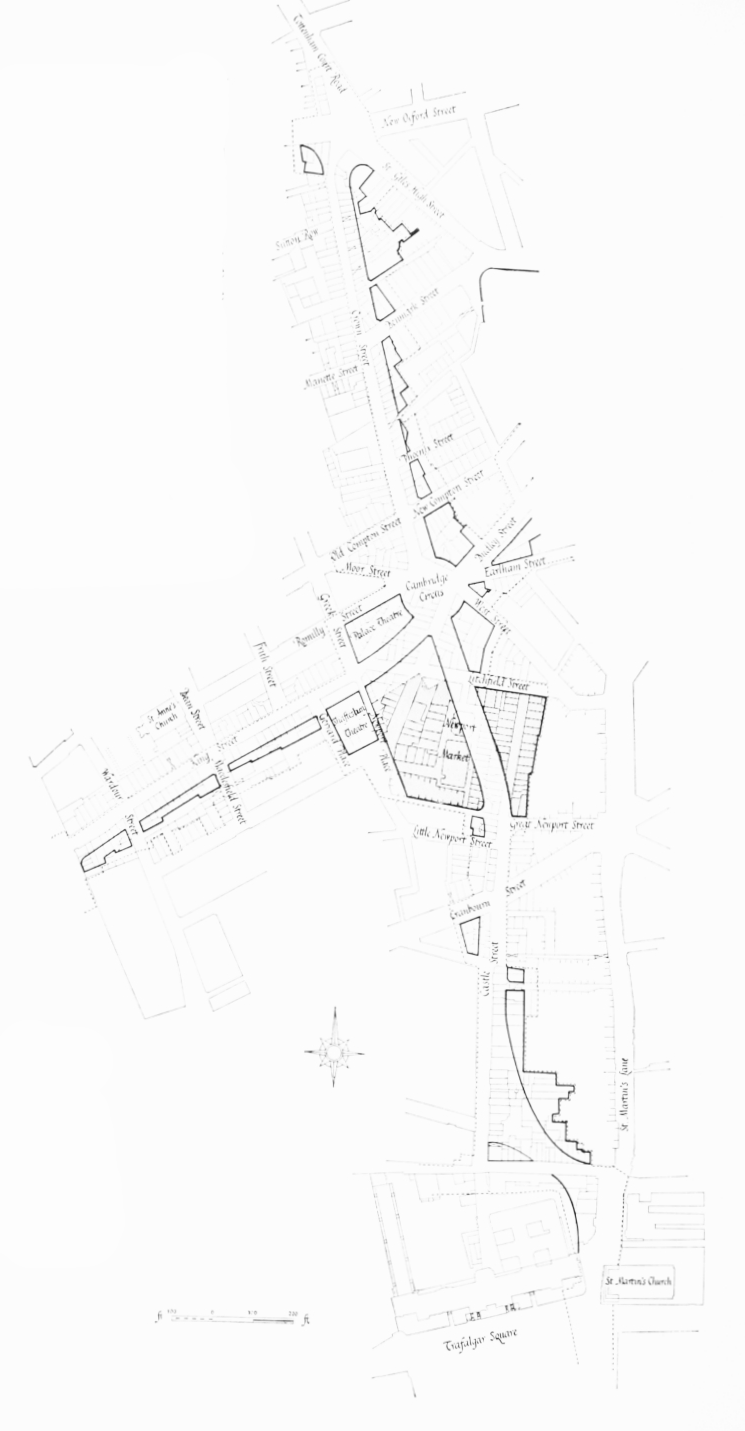
Charing Cross Road and part of Shaftesbury Avenue, plan. Broken lines denote the limits of the land which the Act of 1877 authorized the Metropolitan Board of Works to acquire. In 1883 these limits were reduced. Continuous lines denote the boundaries of the lands which were acquired by the Board but which did not form part of the new street. The stippling denotes the area set aside for the rehousing of the displaced working classes
By insisting that two thousand persons should be rehoused in the Newport Market area the Government compelled the Board to arrange for the erection of multi-storey blocks of artisans' dwellings along both sides of Charing Cross Road south of Cambridge Circus. These two blocks, known as Sandringham Buildings (Plate 138c), were erected in 1884 by the Improved Industrial Dwellings Company, to whom the Board granted building leases. (fn. 12) The rest of the Newport Market area set aside for artisans' dwellings was leased to Mr. G. Foskett, who had previously taken similar leases in Clerkenwell, and in 1884, when the dwellings which he had covenanted to build were nearing completion (Plate 138a), he bought the freehold of the site. (fn. 13)
In December 1884 the Home Secretary certified that the Board had provided artisans' dwellings for upwards of two thousand persons of the labouring classes, and that it was therefore relieved of its obligations under section 33 of the Act of 1877. (fn. 14) The Board was now able to proceed with demolition work for the formation of both streets, the contractors for which were Turner and Son, J. J. Griffiths, T. Turner and J. Mowlem and Company. The gross cost of the street from Charing Cross to St. Giles's was £778,238, and after deduction of the value of the land acquired, the net cost was £597,499. Taking both streets together accommodation in new buildings for 3,044 persons of the labouring classes was provided. Shaftesbury Avenue was completed in January 1886; Charing Cross Road was opened to the public by the Duke of Cambridge in February 1887, the intersection of the two streets at Cambridge Circus being named after him. (fn. 15)
The land which had been acquired by the Board but which was not required for the streets was divided up into plots of suitable size and shape and usually the land was then let on building lease by public tender. (fn. 16) The Act of 1877 had required the Board to sell all the freehold interest or reserved ground rents arising from surplus lands within ten years of the completion of the improvement, (fn. 9) but the Metropolitan Board of Works (Money) Act of 1884 had extended the prescribed period for the disposal of surplus lands to the year 1929, or, in the case of land bought under any Improvement Act passed in or after 1881, to the year 1941. (fn. 17) The London County Council, which superseded the Board in 1889, had power to hold land in mortmain and was therefore under no obligation to sell surplus ground. (fn. 18)
In Charing Cross Road the Board leased most of the ground for eighty years from Midsummer 1887. On the south side of Shaftesbury Avenue between Wardour Street and Newport Place about half the ground was leased and half sold freehold. In Cambridge Circus the freehold of all the ground in the southern segment between Romilly Street and West Street was sold, but the north-eastern segment between West Street and New Compton Street was leased. The Board's policy in deciding whether to sell or lease has not been discovered.
The general standard of design of the new buildings in Charing Cross Road and Shaftesbury Avenue was exceedingly low, (fn. 3) and it is therefore worth noting that after the resignation of its aged superintending architect, George Vulliamy, in May 1886, the Board frequently rejected designs submitted for its approval. In February 1888 A. R. Jackson, who had leased or bought several plots from the Board and commissioned Martin and Purchase as his architects, complained to the Board about delay in approving his plans. (fn. 19) Thomas Blashill, Vulliamy's successor as the Board's superintending architect, replied that 'the real cause of the delay arose through the utter inadequacy of the designs submitted by Messrs. Martin and Purchase'. (fn. 20) To this Martin and Purchase retorted (in reference to a building which has now been demolished) that they had 'sent in elevation after elevation but without success … in our poor opinion … the Board have now approved of the worst design of the four we sent in'. (fn. 21) The Board's good intentions were evidently frustrated by its own incompetence, but some of the responsibility for the architectural squalor of the two new streets rests with the Government for the conditions with which it required the Board to comply, and with the lessees and purchasers of the surplus ground for employing fourth-rate architects.
In some amelioration of the ugliness of the two streets, both were planted with trees in part of their length. The 1894–6 Ordnance Survey map shows trees at the southern end of Charing Cross Road, south of Bear Street: northward of Cambridge Circus trees are shown on both sides of Shaftesbury Avenue and on the east side of Charing Cross Road. With some modifications this distribution of trees remains to-day.
Shaftesbury Avenue
The original buildings lining Shaftesbury Avenue vary in height from four to six storeys, and in frontage width, but almost all have poorly composed fronts dressed with confused details, the materials generally being red brick with stone or terra-cotta. The style usually adopted was a hybrid Renaissance of Flemish derivation, with a frequent use of curvilinear or pedimented gabledormers rising against the slated mansard roofs, and domed or cone-capped corner turrets to emphasize the street corners. Noteworthy exceptions to this generalized description are the Palace Theatre by T. E. Collcutt, and No. 136 (the Welsh Chapel house) by James Cubitt.
Nos. 75 and 77 Shaftesbury Avenue
This building was erected in 1905 to the designs of E. Keynes Purchase. (fn. 22)
Nos. 93–107 (odd) Shaftesbury Avenue: Wingate House and The Columbia Theatre
This block of offices, with a cinema at the south-west corner, was erected in 1958 to the designs of Sir John Burnet, Tait and Partners (Plate 139c). The simple geometry and spare elegance of Wingate House provide a refreshing contrast to the fussy mediocrity of most of the buildings in Shaftesbury Avenue. The ground storey consists of shops extending between the entrance to the Columbia Theatre on the west, and the entrance to the offices on the east. Above is a tall face of six equal storeys where, apart from the first floor, the metal windows of uniform pattern are set in thin stone frames, above similarly framed apron panels of dark brick, in three-windows-wide groups separated by narrow rib-like piers. A flat cornice, inset with lenslights, projects boldly below the recessed attic stage of two storeys.
The Palace Theatre
On 15 December 1888 Helen D'Oyly Carte laid the foundation stone of the Royal English Opera House, now the Palace Theatre. (fn. 23) Richard D'Oyly Carte had previously entered into negotiations with the Metropolitan Board of Works for the site, which had been acquired by the Board for the formation of Shaftesbury Avenue, and he later bought the freehold from the London County Council for £32,240. (fn. 24) T. E. Collcutt designed the façades and internal decorations, but the constructional work was based on plans by G. H. Holloway, who superintended the erection of the theatre. There was no general contractor. (fn. 25)
The island site of the Palace Theatre is an irregular quadrangle fronting some 68 feet east to Cambridge Circus, 160 feet south to Shaftesbury Avenue, 97 feet west to Greek Street, and 148 feet north to Romilly Street (fig. 74). The concave entrance front, forming a segment of Cambridge Circus, is at the narrow end of the site, and the stage, which averages 66 feet in width and 46 feet in depth, backs on to Greek Street. The auditorium, with stalls just below the street level and three tiers above, is insulated from traffic noises by the shallow range of dressing-rooms, offices, cloak-rooms and exits extending the entire length of the Shaftesbury Avenue frontage, and by the foyers and staircases fronting to Cambridge Circus. Owing to the irregular shape of the site, the side walls of the auditorium shell are not parallel, but converge slightly towards the back. The first two tiers have horseshoe fronts with two boxes at each end, but the third tier was altered in 1908 from a segmental front to one of serpentine form, with small serpentine extensions above the boxes. All three tiers are of cantilevered construction, partly supported by columns at the sides and backs of the seating areas; the front of each tier recedes from the one below, and the steppings rise slightly from the centre to the sides of the auditorium in order to obtain the best possible sighting. As originally planned, the auditorium seated 1,976 and the orchestra pit accommodated 63 musicians. (fn. 26) In 1959 the amphitheatre was again remodelled and with other re-seating arrangements the present capacity of the theatre is 1,462.
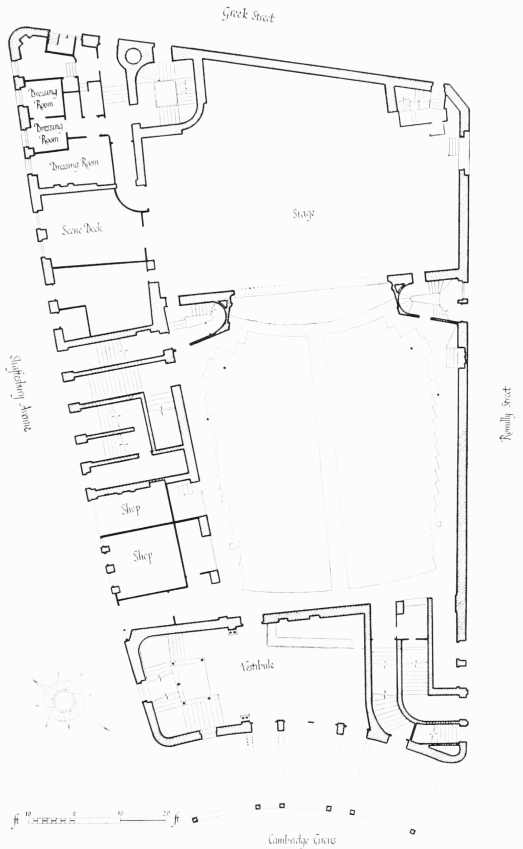
Palace Theatre, Shaftesbury Avenue, plan in 1959. Redrawn from a plan in the possession of the Greater London Council
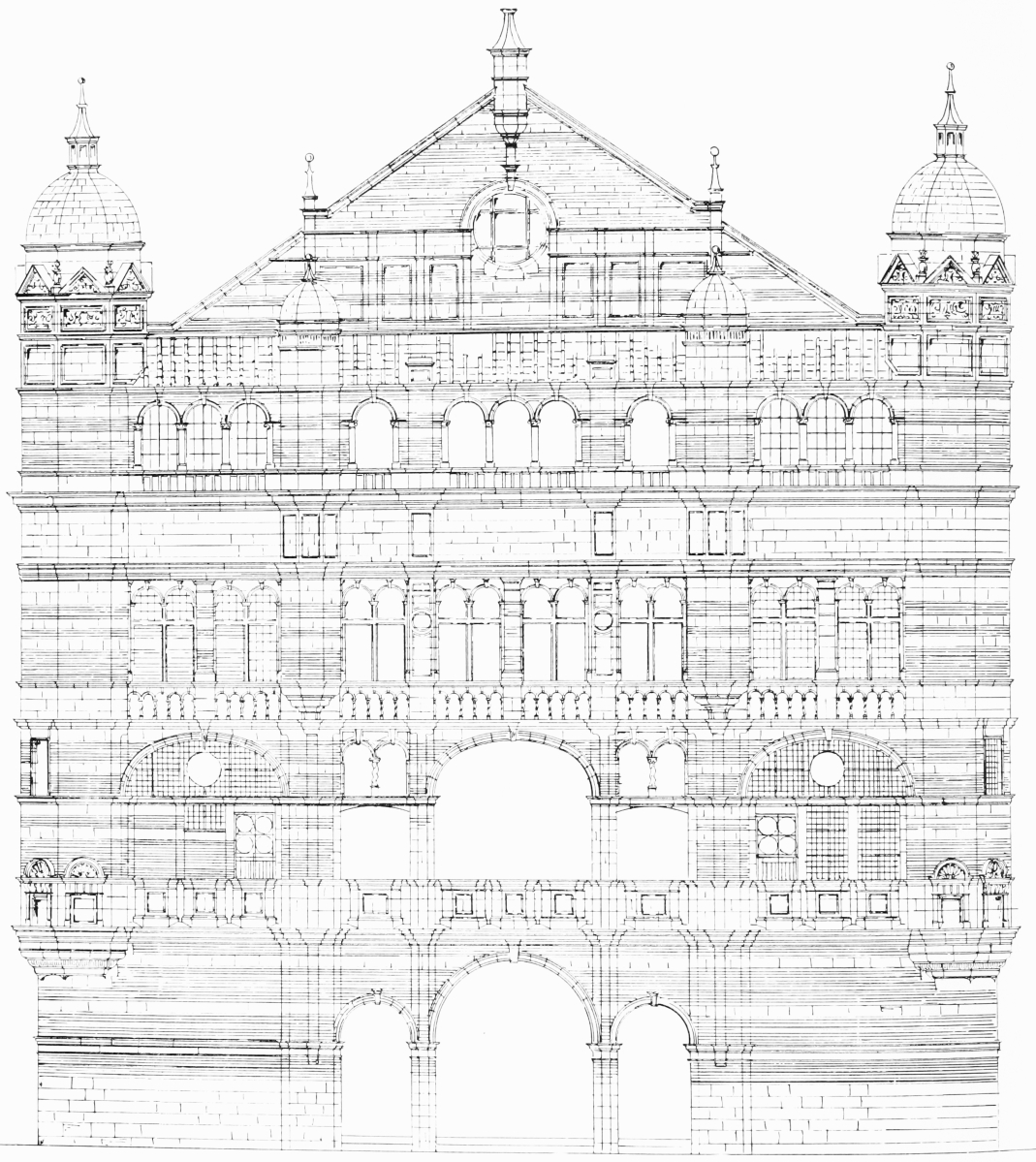
Palace Theatre, Shaftesbury Avenue, design for the east front: altered in execution. From a drawing of 1888 by T. E. Collcutt in the possession of the Greater London Council
The exterior is of red Ellistown bricks dressed with Doulton's terra-cotta of a deep salmonpink colour (Plate 37, fig. 75). The long and slightly convex front to Shaftesbury Avenue contains a diversity of elements and a variety of window groupings, not wholly mastered by the bay spacing effected by the introduction of six octagonal turrets, but the concave front to Cambridge Circus is an admirable example of Collcutt's northern Renaissance style, exhibiting a happy contrast of plain surfaces with richly detailed features. The ground storey, built of terracotta up to the impost and of brick above, is plain except for the arabesque-ornamented spandrels of the triple-arched entrance, with a wide opening between narrow ones. The upper face, embracing two lofty storeys below the entablature and an attic above, is flanked by two octagonal turrets and is divided into three bays, wide between narrow, by splay-sided buttresses, smaller versions of the angle turrets. The brick shafts of the turrets, striated by moulded strings and plain bands of terra-cotta, rise above the attic into tall belvederes with steep-pedimented windows and helmet domes, the buttresses being treated and finished in a similar but simpler manner. In the wide middle bay there are four windows to each storey, those of the first floor deeply set in round arches with paired lights above. Each second-floor window is divided by a mullion and transom into four lights, the upper pair with arched heads. In the side bays each storey has two mullioned-and-transomed windows, generally similar to those in the middle bay. Above the deep entablature, the frieze of which is enriched with arabesques above the windows only, is the attic storey of arcaded windows, three in each side bay and five in the middle. A pantiled roof slopes back from the attic to meet the gabled end wall of the auditorium, its panelled and banded face containing a large circular window in the centre, and its narrow cornice-coping, broken by finials, sloping up to a central turret originally surmounted by a statue.
Apart from the auditorium, the most important feature of the interior is the grand staircase, on the south side of the foyers (Plate 38). It rises from floor to floor with flights round three sides of an open arcaded well, the arches resting on Tuscan columns placed on the pedestals of the balustrade. Here, as in the foyers and around the proscenium, Collcutt used marbles to achieve a sumptuous polychromatic effect, with green cipollino for the columns, and black 'grand antique' for the capping and plinth of the alabaster balustrade, against walls of alabaster and ceilings modelled with arabesques painted in green and gold. The richness of the auditorium decoration culminates in the proscenium, with the framing arch and adjoining splays faced with 'grand antique', cipollino and pavonazzo marbles, inset with panels of Mexican onyx. Over the proscenium is an elliptical tympanum with gilded allegorical figures, framed by an outer arch and a ceiling band of the same arched form, decorated with two rings of circular medallions filled with gilded arabesques. The paired boxes flanking the first and second tiers are framed with arches rising from short columns above the bowed fronts which are decorated, like the tier fronts, with arabesques and, at regular intervals, boldly modelled putti holding lights. The ceiling above the auditorium well slopes up from the stage and features a large octagonal frame containing eight wedgeshaped panels, each decorated with coffers of arabesque ornament geometrically arranged round a pseudo niche containing an allegorical figure. The original colour scheme, additional to the marblework, was in tones of green and gold, with some touches of dark blue and red in the ceiling panels, and yellow draperies. Unfortunately, all this has been changed and much of Collcutt's delicate ornament flatted out by monochromatic painting, while his marblework is largely hidden by paint and wallpaper.
The Royal English Opera House, which is estimated to have cost about £150,000, (fn. 27) opened on 31 January 1891 with the first performance of Sir Arthur Sullivan's Ivanhoe. This was withdrawn in the autumn of 1891, and since D'Oyly Carte had no English opera to replace it, he was obliged to fall back on a French opera by André Messager, La Basoche. On 28 November 1891 D'Oyly Carte said that he had not pledged himself to mount opera solely by English composers, and that his future policy must depend on public support. The measure of this may be judged by the fact that D'Oyly Carte was forced to present a series of plays starring Sarah Bernhardt, and opening on 30 May 1892 with Sardou's Cleopatra. Discouraged by his failure with opera, D'Oyly Carte opened negotiations with Sir Augustus Harris, and in December 1892 the Royal English Opera House became the Palace Theatre of Varieties. However, it did not flourish and in 1893 that veteran of the music halls, Charles Morton, was called in as manager.
The Sketch of 10 February 1897 reported the Palace as being one of the best-paying concerns in London. This success was due to the skilled management of Charles Morton, and his innovation of the highly successful tableaux-vivants, which were a feature of programmes at the Palace. Morton also achieved his success by the extraordinary variety of his programmes and by engaging first-rate variety artists. In 1897 the Biograph, invented by an American, Herman Casler, made a successful appearance at the Palace, where it stayed as a regular part of the programme until it was replaced by Charles Urban's Bioscope in February 1904.
In this year Alfred Butt became manager of the Palace and in 1910 he engaged Anna Pavlova, the Russian prima ballerina, to make her first London appearance there. In 1911 he changed the name to the Palace Theatre, and presented Bernard Shaw's How He Lied to Her Husband (1911–12) and H. Beerbohm Tree in Rudyard Kipling's The Man Who Was (1912). From 1914 to 1919 there were several successful revues at the Palace including A. Wimperis' The Passing Show (1914) and The Passing Show of 1915. (fn. 23)
After the war the management passed to C. B. Cochran and the theatre did not have another success until Irving Berlin's The Music Box Revue (1923). The immensely successful musical comedy No, No, Nanette ran at the Palace from March 1925 to October 1926, followed by other successful musical comedies. (fn. 28) During the Second World War Jack Hulbert and Cicely Courtneidge frequently appeared at the Palace. Post-war successes include Emile Littler's Song of Norway (1946) and Ivor Novello's King's Rhapsody (1949). (fn. 23) Since 1951 Emile Littler has been in sole charge of the theatre, (fn. 28) and in recent years Peter Daubeny has presented a series of visits by famous foreign companies. (fn. 23)
No. 64 Shaftesbury Avenue: the George and Dragon Public House
This public house stands on the site of the George in Princes (now Wardour) Street, which existed here from at least 1731. (fn. 29) (fn. 4) In the 1830's the loyal name of George was changed to the George and Dragon.
This part of Shaftesbury Avenue was formed by setting back the south side of King Street, and the site of the George and Dragon thus became the corner of Wardour Street and Shaftesbury Avenue. The present building was erected in 1886 to the designs of the Metropolitan Board of Works' own architect, George Vulliamy. (fn. 30) Dansey Place or Yard, on the south side of the inn, was until 1884 called George Yard.
Nos. 66–86 (even) Shaftesbury Avenue
This block of shops and offices was erected to the designs of Martin and Purchase in 1888–9; the contractor was C. Wright. (fn. 31)
Nos. 90–98 (even) Shaftesbury Avenue
This block of shops with 'residential chambers' above was also erected in 1888–9 to the designs of Martin and Purchase, and the contractor was C. Wright. (fn. 32)
Nos. 100–124 (even) Shaftesbury Avenue
The whole of this block was erected in 1888–9. Nos. 100–112 (Exeter Mansions) were probably designed by James Hartnell, architect, to whom the Metropolitan Board of Works leased the site. Nos. 114–118 (Egmont House) and 120–124 (Nassau House) were designed by Davis and Emanuel. (fn. 33)
The Shaftesbury Theatre, Shaftesbury Avenue
Demolished
This theatre formerly occupied the whole of the block bounded by Shaftesbury Avenue, Newport Place, Gerrard Street and Gerrard Place. The northern part of the site was acquired in 1875–6 by the London School Board and the erection of a school there had actually begun when it was found that the Metropolitan Board of Works would require part of the land for the new street (later Shaftesbury Avenue) which was then being planned. (fn. 34) After the Metropolitan Street Improvements Act of 1877 had been passed the contract for the building of the school was cancelled, and in 1879 the Metropolitan Board of Works bought the site from the School Board. (fn. 35) The southern part of the block was subsequently purchased from the individual owners by the Board of Works. (fn. 36) In 1885–6 a narrow strip of land at the north end was incorporated into Shaftesbury Avenue, and the whole of the rest of the site was leased to John Lancaster for eighty years from Midsummer 1887. (fn. 37)
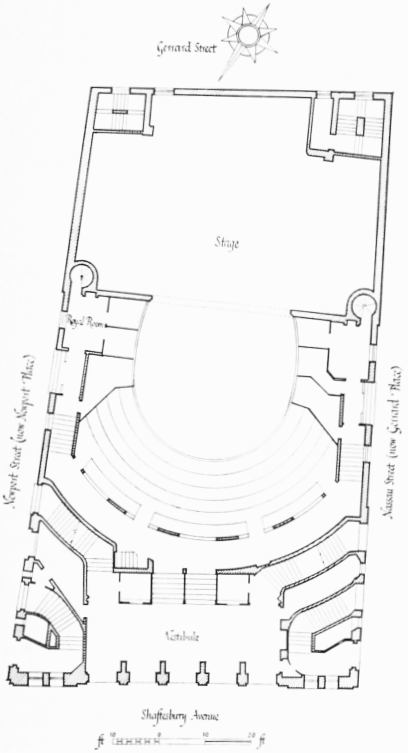
Shaftesbury Theatre, Shaftesbury Avenue, plan. Redrawn from a plan of 1887 in the possession of the Greater London Council
Lancaster was 'a shrewd Manchester merchant' who built the Shaftesbury Theatre 'for the gratification of his wife, Ellen Wallis, a well-known Shakespearean actress'. The theatre was designed by C. J. Phipps and built by Messrs. Patman and Fotheringham at a cost of £20,000. It was opened on 20 October 1888 with a performance of As You Like It. (fn. 38)
The quadrangular island site of the theatre fronted 75 feet north to Shaftesbury Avenue, 131 feet east to Newport Place, 66 feet south to Gerrard Street, and 130 feet west to Gerrard Place (fig. 76). Although the plan exhibited C. J. Phipps's usual skill in arrangement, with an ingenious dovetailing of entrance and exit staircases, the building was not nearly so advanced in its design and construction as the contemporary Palace Theatre. For instance, the raking girders of the tiers were cantilevered only a short distance in front of the supporting semicircle of cast-iron columns, which obtruded into the seating areas. From Shaftesbury Avenue a central range of five double doors opened directly into the shallow oblong vestibule, where two pay-boxes flanked the short central staircase rising to the corridor encircling the first tier. On the far side of each pay-box was a staircase descending to the front stalls, but the staircases serving the pit, upper circle and gallery were entered from the side streets. The auditorium contained a pit of sixteen rows behind five rows of stalls, a dress circle with six rows and an upper circle with five, both tiers having three boxes on either side, while the third tier contained an amphitheatre of four rows and a gallery of seven. The fronts of the first two tiers followed a horseshoe curve, and the third tier conformed to three-quarters of a circle. The stage, at the south end of the site, was 64 feet wide and 45 feet deep, with a storey of dressingrooms ingeniously constructed below the fly galleries and scene-painting gallery, supplemented by dressing-rooms in the basement.
The front of red brick with stone dressings was designed in a Caroline Renaissance manner, with some Jacobean features (fig. 77). The composition was attractive and appropriate to a theatre, being much less domestic in character than Phipps's Lyric Theatre near-by. The ground storey, dominated by an iron and glass canopy, was boldly rusticated to provide an appropriate base for an upper stage of two storeys, where a Corinthian order formed a colonnade of five bays, screening a shallow loggia, between end pavilions of one bay, dressed with pilasters. The first-floor windows were round arched and those of the second floor had straight heads, all being furnished with mullioned-and-transomed casements. Over each end pavilion rose a pedimented gable feature, flanked by scrollbuttresses, and the recessed attic storey was surmounted by a similar gable extending above the middle three bays.
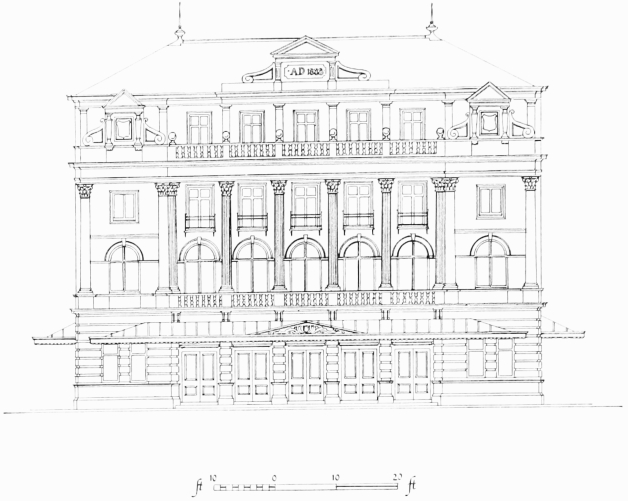
Shaftesbury Theatre, Shaftesbury Avenue, elevation. Redrawn from a drawing of 1887 in the possession of the Greater London Council
The interior decorations were simple and in much the same style as the front, with the architectural scheme dominated by the round-angled proscenium frame, surmounted by a pedimented tablet flanked by large foliated scrolls. The upper part of the auditorium walls were concave-curved in plan and divided into bays by pilasters supporting a groined cove rising to the flat circular ceiling.
The theatre's first great success was The Belle of New York, which opened here on 12 April 1898 and ran for 697 performances. In 1908–9 H. B. Irving became the lessee and manager and presented a successful season of plays. He was succeeded by Robert Courtneidge, one of whose most successful productions here was The Arcadians, which was first performed on 28 April 1909 and ran for two and a half years. His successors as lessees and managers from 1917 to 1921 were George Grossmith and Edward Laurillard. (fn. 39)
In 1941 the theatre was so severely damaged by aerial bombardment that the lease was vacated, and in 1956 the site was appropriated by the ground landlords (the London County Council) for use as a fire station. It is at present used as a car park and for advertising purposes. (fn. 40)
Nos. 128–132 (even) Shaftesbury Avenue: Fire Station
In October 1886 this site was leased by the Metropolitan Board of Works to the London Salvage Corps, (fn. 41) a private fire-fighting organization founded by various London insurance companies. A fire station was built here in 1887, the architect being either William Wimble (fn. 42) or Messrs. Brown and Mannering. (fn. 43) In 1888 the Board sold the freehold of the site to the London Salvage Corps for £11,700 (fn. 44). In 1920 the London County Council acquired the fire station for use as a new central London station for the London Fire Brigade. (fn. 45)
The station was damaged by aerial bombardment during the war of 1939–45, and though still in use, has never been fully rebuilt. Only a fragment of the original building survives.
No. 134 Shaftesbury Avenue: the Avenue Bar Public House
This public house, originally known as the Cock, was erected in 1887 to the designs of Messrs. Wylson and Long. (fn. 46) In c. 1938 it was renamed the Avenue Bar.
No. 136 Shaftesbury Avenue
This building, designed by James Cubitt, was the chapel house of the Welsh Chapel in Charing Cross Road (see page 308). Its front is a well composed design of Hanseatic character, built in dark red brick and terra-cotta. There are two wide and equal bays, divided and flanked by narrow buttresses. Each bay contains four tiers of windows—a wide one of mullioned-andtransomed lights framed in an elliptical arch serves the ground storey, the first floor has a pair of round-headed lights; the second-floor window is similar to that of the ground storey, and the third floor has a trio of round-headed lights. A great gable, divided by narrow buttresses into six equal bays, forms an effective finish to this front.
No. 138 Shaftesbury Avenue
This block of shops and chambers above, at the south corner of Shaftesbury Avenue and Charing Cross Road, is known as Albany Mansion. It was erected in 1889 to the designs of Martin and Purchase, and H. Bailey was the contractor. (fn. 47) The letters CB over the door stand for the City Bank, the first occupant of the building.
No. 140 Shaftesbury Avenue
This block of shops and offices on the southeast side of Cambridge Circus, and known as Gloucester Mansions, was erected in 1889, probably to the designs of Martin and Purchase.
No. 142 Shaftesbury Avenue: the Marquis of Granby Public House
This public house was erected in 1886 to the designs of Wylson and Long. (fn. 48)
Charing Cross Road
Some of the buildings in this street which are within the parish of St. Anne are described individually below. Those on the east side of the street to the north of Cambridge Circus are in the parish of St. Giles in the Fields and are summarized here.
The east side of the northern part of Charing Cross Road is lined with buildings of various styles, heights and materials, although red brick predominates and a general level of mediocrity prevails. Trentishoe Mansions, erected in 1891 to the designs of James Hartnell, (fn. 44) is a six-storeyed block in red brick and terra-cotta, flaunting a skyline of pedimented gables and having a Chambord pavilion at the corner of New Compton Street. No. 100, also of red brick and terra-cotta, is a Gothic building of warehouse character, dated 1888. Phoenix House, of the inter-war period, is grimly utilitarian, its rustic fletton bricks and general air of cheapness unworthy of a central street. The narrow and curving entrance pavilion of the Phoenix Theatre (opened in 1930), with a Corinthian colonnade in its upper face, was designed by Sir Giles Scott in the prim Renaissance style he sometimes favoured.
Nos. 114–116 is a four-storeyed building of red brick and stone, its round-headed windows giving a Florentine flavour; it was designed in 1888 by Roumieu and Aitchison for Crosse and Blackwell. (fn. 49) Nos. 118–120 is a good and unaffected modern building of seven storeys, the upper six having metal windows and plain brick aprons set between narrow stone mullions. Between Denmark Street and Denmark Place is a block dominated by the German Renaissance front of Sheldon Mansions. Built of dark red brick dressed with stone, this is a striking composition of three bays, narrow between wide, its five storeys surmounted by a great stepped gable containing three tiers of windows.
Nos. 142–146 (designed by H. H. Collins in 1888) (fn. 50) has a reticent front of grey brick dressed with stone or cement, the single and paired windows set in a grid formed of slender pilaster-strips and stringcourses. No. 148 (by Bateman and Bateman, 1888) (fn. 51) has a stone front of early French Renaissance character, with its first- and second-floor windows recessed in a great arch, and its attic storey surmounted by a tall pyramidal roof, a design more appropriate to a Victorian theatre than a shop.
The east side terminates north at the new St. Giles's Circus, dominated by an exciting tower block constructed of prefabricated T-shaped units of stone-faced concrete, and designed by Reuben Seifert and Partners.
Sandringham Buildings, Charing Cross Road
The deep decline in the standards of London's street architecture during the late nineteenth century is nowhere more evident than in Charing Cross Road. The southern half of the street is dominated by the ugly repetitions of Sandringham Buildings (Plate 138c), multi-storey artisans' dwellings with shops at ground-floor level, which extend along both sides of Charing Cross Road between Litchfield and Great Newport Streets. The Metropolitan Board of Works was compelled to arrange for the erection of artisans' dwellings here because the Home Secretary, Sir Richard Cross, insisted that the Board's Bill of 1883 to amend the Metropolitan Street Improvements Act of 1877 should provide for the rehousing of 2,000 of the labouring classes on the site of Newport Market. (fn. 52) In June 1882 a Select Committee of the House of Commons had agreed to the Board's proposal that only 1,470 persons should be rehoused here and another 600 in Old Pye Street, Westminster, (fn. 53) and the Board had immediately taken steps to rehouse 1,100 of the displaced persons in Newport Dwellings (fn. 54) (see page 377). The remaining 370 could have been rehoused to the east of Charing Cross Road, but in March 1883 the Home Secretary, in accordance with 'the settled view of Parliament on the subject', raised the total number to be rehoused in the Newport Market area from 1,470 to 2,000, (fn. 55) and the Board therefore had no option but to provide large blocks of dwellings along the frontage of the new street.
Sandringham Buildings were erected in 1883–4 by the Improved Industrial Dwellings Company Limited, to whom the Board leased the site. The architect was George Borer, probably of the firm of Borer and Dobb, architects and surveyors, of London Wall, and the estimated cost was between £65,000 and £70,000. (fn. 56) Nine hundred persons were to be housed here, and most of the tenements consisted of three rooms. Sandringham Buildings were formally opened by the Prince and Princess of Wales in July 1884. (fn. 57) They are designed in the sour Gothic style characteristic of artisans' dwellings, mixed with debased Renaissance motifs. Above the shops is a fourstoreyed face of yellow stock bricks, regularly patterned with single, paired, and three-light windows having flat Gothic arches of brick, now painted. The end blocks have another storey of the same character, but the intervening blocks are all finished with a steep mansard slope of red fishscale tiles, broken by Gothic gabled features flanked by pedimented dormers, the roof line being crested with a spiky ironwork railing.
No. 82 Charing Cross Road
This building was erected in 1888 as a police station, to the designs of the Metropolitan Police surveyor, John Dixon Butler (Plate 138b). In 1911 it was converted to use as a section house; since shortly after 1945 it has been occupied by a Government department. (fn. 58)
Raised on a battered plinth of rusticated granite courses, and built of dark red bricks sparingly dressed with stone, this building has a severity of expression appropriate to its original purpose. There are five storeys above the semi-basement, and the front is divided into eight bays by narrow piers. Generally the windows are of two lights, those of the lofty first storey being recessed in elliptically arched openings. In the next two storeys the windows have segmental arches, and those above are straight headed. The vertical emphasis of the design is checked by the impost and cornice of the first storey, the narrow string mouldings defining the aprons of the succeeding storeys, and by the cornice below the attic. (fn. c1)
Welsh Chapel, Charing Cross Road
In November 1886 the trustees of the Welsh Calvinistic Methodist Connexion, whose chapel in Nassau Street (now Gerrard Place) had been acquired in 1884 by the Metropolitan Board of Works for the formation of Shaftesbury Avenue (see page 411), made an agreement with the Board for a building lease of this site on the west side of Charing Cross Road. (fn. 44) The trustees employed James Cubitt to design a new chapel, (fn. 59) to which they moved in 1887. In 1889 they bought the freehold of the site from the London County Council. (fn. 44)
The cruciform plan of the chapel (fig. 78) is composed of a large square central space, with arches opening east and west to short transepts, and south to a nave of twice their length, all containing galleries resting on arcades. A shallow northern arm contains the Lord's Table, placed in front of the raised pulpit and flanked by choir stalls. Behind is a gallery of three bays, with the organ case projecting above.
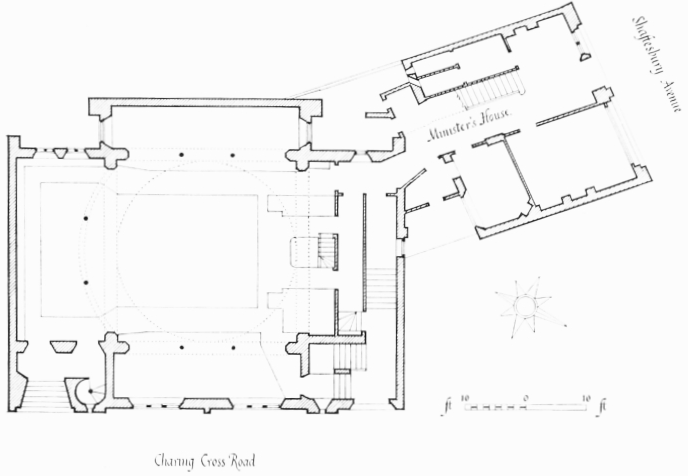
Welsh Chapel, Charing Cross Road, and minister's house, Shaftesbury Avenue, plan. Redrawn from an engraving in The Building News, 13 January 1888
The exterior (Plate 25b) is designed in the late Norman style and generally built of Yorkshire parpoints dressed with Ancaster stone. The Charing Cross Road front is a lively composition dominated by the east face of the transept, with a two-storeyed porch on the north side, and a deeply recessed doorway on the south. The transept front, flanked by wide buttresses, the south crowned by a small turret, is divided into two equal bays of four stages. In each bay of the second stage is a triple window with a tall middle light, and there are larger windows of similar form in the third stage, set in wide roundarched recessions. The twin gables of the fourth stage are decorated with two tiers of arcading. Behind the transept rises the octagonal stage above the dome of the central space, with two unglazed openings in each face except the north-east, where an octagonal turret abuts. Behind battlements rises a roof of pyramidal form, finished with a square louvre set diagonally.
Inside the chapel, the piers and wide pointed arches of the central space are of Ancaster stone, the walls generally, the pointed barrel vaults of the four arms, and the dome spandrels being of Fareham red bricks. The scalloped or umbrella dome appears to be of white plaster, and the furniture generally is of pine.
No. 93 Charing Cross Road: the Cambridge Public House
A public house called the King's Arms in Moor Street stood on approximately this site from at least 1744 until its demolition for the formation of Charing Cross Road. (fn. 60) The present building was erected in 1887 to the designs of Wylson and Long, (fn. 61) and was renamed the Cambridge in 1891. (fn. 62) The four-storeyed front of Flemish Renaissance character is built of red brick, banded and dressed with stone. The two equal bays have a three-light window in each upper storey and finish with a gable, ogee-sided and pedimented.
Nos. 1 Old Compton Street and 99A Charing Cross Road
See page 196.
No. 2 Old Compton Street: the Coach and Horses Public House
See page 199.
No. 101 Charing Cross Road
Formerly No. 68 Crown Street
This is the least altered in character of the surviving Crown Street houses. It is a very modest building, having above the ground storey a plain brick face of two storeys, each with two flushframed windows set in openings having crudely formed cambered arches. It was probably built or rebuilt about 1734, together with Nos. 2–6 (even) Old Compton Street (see page 199).
No. 103 Charing Cross Road
Formerly Nos. 66 and 64 Crown Street
This originally comprised two houses, respectively two and three windows wide, their simple fronts elaborated with a dress of Victorian stucco. Giant Doric pilasters mark the party walls, and the first-floor windows are finished with steep pediments.
A public house called the Bull's Head stood on this site from at least 1759 until 1893. (fn. 63) At the time of the opening of Charing Cross Road in 1887 the building was enlarged and repaired to the designs of R. W. Read (fn. 64) and its name was changed, firstly in 1894 to the Tam o'Shanter, and again in 1900 to the Palace Tavern. It ceased to be used as a public house in 1960, and is now occupied by a firm of caterers. (fn. 62)
No. 105 Charing Cross Road: Jacey Cinema
The Cambridge Circus Cinematograph Theatre was opened here in 1911. The cinema was subsequently known as the Tatler for many years. (fn. 62)
Nos. 107 and 109 Charing Cross Road: St. Martin's School of Art
See page 286.
No. 111 Charing Cross Road
This site was for many years occupied by the Plough inn, which had a large yard surrounded by a gallery with bedrooms above and stables below. By the 1870's the buildings were ruinous, and in 1875–6 Crosse and Blackwell erected new stables here to the designs of R. L. Roumieu in a severe but powerful Italian Romanesque manner. The entrance was through an archway from Crown Street, and the central covered yard was surrounded on the ground floor by accommodation for eighteen vans and four horses. A ramp led to the first floor, where there were stalls for thirty-five horses, a loose-box and living quarters for the stablemen. The Builder commented that 'The great value which is now attached to land makes it necessary to economise space in every way, particularly surface, and the London stables are following the example set by the London houses of shooting up vertically, instead of spreading horizontally'. The height from floor to roof ridge was, however, only forty feet. (fn. 65)
In the early 1920's Crosse and Blackwell removed from all their premises in Charing Cross Road, and in 1927–9 the existing block of shops, showrooms and offices was erected to the designs of F. Taperell and H. Haase. (fn. 66)
No. 119 Charing Cross Road
Formerly No. 52 Crown Street
This original Crown Street house, with a twowindows wide front to Charing Cross Road and a four-windows wide return to Manette Street, has been heightened by a storey and faced over with stucco. The windows are dressed with crudely detailed architraves, and an entablature has been introduced below the tall attic storey.
The building was for many years a public house, the Rose and Crown. (fn. 67) Foyle's, the booksellers, are the present occupants.
Nos. 121–125 (odd) Charing Cross Road
Formerly Nos. 50–46 (even) Crown Street
Nos. 121 and 123 were erected in 1903 to the designs of Alfred Burr, (fn. 68) and have been occupied by Foyle's, the booksellers, since 1913. (fn. 62) This four-storeyed building has a front of one wide bay to Charing Cross Road, a narrow splayed corner, and a return front of two wide bays to Manette Street. Simple in design and crudely detailed, it is built of red brick dressed with stone. The upper storeys are lit by large mullioned-andtransomed windows, the small windows in the splayed angle are finished with pediments, and a gable surmounts the Charing Cross Road front.
No. 125, another Crown Street survival, has a stuccoed front of four storeys, each three windows wide. The top storey probably replaced a mansard garret.
Nos. 127–131 (odd) Charing Cross Road
Formerly Nos. 44–40 (even) Crown Street
This building (Plate 136b) was erected in 1897 for A. Goslett and Company Limited, builders' merchants, to the designs of (Sir) Banister Fletcher. (fn. 69) The building was severely damaged by fire in September 1903, but its outward appearance was not altered during the ensuing restoration. (fn. 70) Messrs. Goslett are still the occupants.
Fletcher's design for Goslett's building pays tribute to the pervading influence of Norman Shaw. Built of red brick dressed with stone, it is a composition of three bays in two stages, each embracing two storeys, surmounted by a recessed attic crowned with three pediment-gables. The ground- and first-floor windows are set in three large arch-headed openings, their brick piers banded with narrow stone rustics, and their arches formed of a brick intrados and moulded stone extrados, broken by stone voussoirs and a triple key. The console-moulded middle keyblock of each arch breaks into a modillioned and dentilled cornice underlining the upper stage. This is a plain brick face with three tall straight-headed openings, the wide middle one containing a secondand third-floor window, each divided by mullions and transom into two tiers of eight lights. The side openings frame similar windows, each having two tiers of five lights. Ornament in this stage is restricted to the panelled aprons of the windows, the upper ones lettered and dated, and to the handsome lead rainwater-heads and pipes on the four piers. Above the crowning cornice is a brick and stone parapet, its moulded coping curving down above each bay, between tall rusticated dies surmounted by obelisks. The three mullionedand-transomed windows of the recessed attic are surmounted by steep pediments, having stucco tympanum decorations composed of cartouches and scroll-work.
No. 133 Charing Cross Road: The Royal George Public House
Formerly No. 36 Crown Street
The public house called the George which existed in Hog Lane (later Crown Street) from at least 1731 (fn. 71) probably stood on the site now occupied by the Royal George, at the south corner of Charing Cross Road and Goslett (formerly George) Yard. The present building, which was altered by W. Ansell in 1887 at the time of the formation of Charing Cross Road, (fn. 72) has four storeys and a cement-faced exterior. Above the ground storey is a giant order of Corinthian pilasters, spaced out to divide the Charing Cross Road front into three bays, narrow between wide, and the return front into four narrow bays. All the windows have straight heads, but those of the first floor are framed in arches, and those of the upper floors have architraves with scrolled heads. Above the narrow central bay of the Charing Cross Road front is an aedicule containing a bust.
Nos. 151–155 (odd) Charing Cross Road
Formerly No. 145 Charing Cross Road: previously Nos. 24–16 (consec.) Crown Street
The erection of this warehouse building for Crosse and Black well was begun in 1877, to the designs of R. L. Roumieu. Owing to the narrowness of Crown Street, to which the building then fronted, and to threats of proceedings from surrounding property owners for loss of light and air, the building was not immediately carried up to its intended full height of seventy-six feet. In 1885 the east side of Crown Street was demolished for the formation of Charing Cross Road, and the building was then completed to the original designs. R. L. Roumieu had died in 1877, and the completion of the building was superintended by his son, R. St. A. Roumieu, whose partner was Alfred Aitchison. The total cost of the building was over £16,000, and the contractors were J. M. Macey and Sons. (fn. 73) Crosse and Blackwell remained in occupation until 1921. (fn. 62) In 1925–6 the building was converted into showrooms and offices; the architects were F. Taperell and H. Haase. (fn. 74)
The original brick and stone Gothic front has been altered and completely disguised with a cement facing, vaguely classical in style, the large metal windows being framed in tall arch-headed openings. The only surviving feature of the original building is the angle turret, with pseudomachicolations supporting a low drum of segmental arches resting on stunted columns in pairs. This drum is finished with a cornice of corbelled brick courses, and crowned with a tall conical roof of slate and lead.
Astoria Cinema and Dance Salon, Charing Cross Road
Shortly after the formation of Charing Cross Road Messrs. Crosse and Blackwell erected a large warehouse on this site, to the designs of Roumieu and Aitchison. (fn. 75) The building was completed by 1893. (fn. 76) In 1926–7 Berkeley Syndicates Limited adapted it for use as a cinema and dance hall, which were opened in the latter year. (fn. 77) The architect for the conversion was E. A. Stone, (fn. 78) and the contractors were Griggs and Son Limited. (fn. 79)
The Astoria Cinema and Dance Hall were constructed inside the brick shell of Crosse and Blackwell's former warehouse. The cinema, planned on an east-west axis, is entered through a circular foyer at the corner of Sutton Street, and the dance hall entrance is at the north end of the Charing Cross Road front, with shop premises in between. The auditorium, its floor raised a few feet above street level, contains stalls with twentyfive rows of seats and a circle of twenty-one rows, making a total of two thousand seats. The cement-faced exterior is a heavy and crudely detailed classical design, with the upper face divided into wide and narrow bays by rusticated piers sustaining an entablature having a scrollornamented frieze. Over the rounded corner rises a low lantern crowned with a saucer dome, a feature oddly reminiscent of Theodoric's mausoleum at Ravenna. The interior is decorated in the Pompeian manner, with the rectangular proscenium frame recessed between arch-headed organ grilles, flanked by massive Doric columns which support the curving entablature beneath the semi-domed ceiling above the auditorium well. This semi-dome is decorated with painted grotesques, and is framed by a wide arched band of coffers. The dance hall beneath the cinema accommodates one thousand dancers in an octangular central space surrounded by a gallery.
No. 167 Charing Cross Road: The Excelsior Public House
Formerly No. 153 Charing Cross Road: previously No. 35 Crown Street
There has been a public house on this site since at least 1759. When the present building was erected in 1889 the old name of the King's Head was changed to the Excelsior. (fn. 80)