Survey of London: Volumes 33 and 34, St Anne Soho. Originally published by London County Council, London, 1966.
This free content was digitised by double rekeying. All rights reserved.
'Leicester Square, North Side, and Lisle Street Area: Leicester Estate, Leicester Place', in Survey of London: Volumes 33 and 34, St Anne Soho, ed. F H W Sheppard (London, 1966), British History Online https://www.british-history.ac.uk/survey-london/vols33-4/pp480-486 [accessed 9 May 2025].
'Leicester Square, North Side, and Lisle Street Area: Leicester Estate, Leicester Place', in Survey of London: Volumes 33 and 34, St Anne Soho. Edited by F H W Sheppard (London, 1966), British History Online, accessed May 9, 2025, https://www.british-history.ac.uk/survey-london/vols33-4/pp480-486.
"Leicester Square, North Side, and Lisle Street Area: Leicester Estate, Leicester Place". Survey of London: Volumes 33 and 34, St Anne Soho. Ed. F H W Sheppard (London, 1966), British History Online. Web. 9 May 2025. https://www.british-history.ac.uk/survey-london/vols33-4/pp480-486.
In this section
Leicester Place
Leicester Place (see Frontispiece) and the buildings on both sides of it stand on part of the site formerly occupied by Leicester House and its garden and outbuildings. The site was acquired in 1791 or 1792 by Thomas Wright of Henrietta Street, Covent Garden, (fn. 2) a banker in the firm of Wright, Selby and Robinson, and Leicester House was demolished at about the same time. Wright extended Lisle Street eastward across his vacant ground to join Little Newport Street, and Leicester Place joined this extension of Lisle Street with Leicester Square.
Eleven of the leases which Wright granted of land on either side of Leicester Place have been traced. All of them were for terms of ninety-nine years or slightly less and all except one are dated between 22 December 1792 and 1 June 1795. The lessees were Philip Norris of Castle Street, St. Andrew's, Holborn, builder (four leases, all of ground on the east side), (fn. 3) William Brooks of Castle Street, St. George's, Bloomsbury, mason (two leases), (fn. 4) and (one lease each) Thomas Jefferies of Carnaby Street, painter and glazier, (fn. 5) Richard Day of York Street, Covent Garden, linen draper, (fn. 6) Lawrence Nicholl of St. Anne's, Soho, physician, (fn. 7) and Robert Barker, the promoter of the panorama, described as of Castle Street, St. Martin's, gentleman. (fn. 8) There was a short cul-de-sac known as Duncan Place on the west side of the street; its site is now occupied by part of Queen's House. Wright intended that there should be a similar cul-de-sac on the east side, but this plan evidently did not materialize (fn. 9) and by a lease dated 27 June 1797 the vacant site in the now otherwise completed street was leased to William Brooks for the erection of Charles Dibdin's Sans Souci Theatre. (fn. 10)
Only one of the houses erected at this time— No. 3 on the east side, the lease of which has not been traced—now survives. It has a plain brick front of four storeys, each three windows wide. The sashes are recessed in plain openings, which have stone sills and flat arches of gauged brickwork, and are proportionate to the storey heights although the front generally has an attenuated appearance. The tall first-floor windows have not been lengthened, the raised cement band on the piers between the openings being an original feature of all the houses. The front is finished with a narrow stone cornice and a plain brick parapet, the latter partly concealing the two dormers in the slated mansard.
The rest of the ground on the east side of the street is occupied by Charles House and the Prince Charles Theatre, the Roman Catholic Church of Notre Dame De France and the return front of Victory House. The west side is occupied by the return fronts of Queen's House and the Empire Theatre.
No. 12 Leicester Place, on the west side, was occupied from 1805 until 1844 by Honoratus Leigh Thomas, surgeon. (fn. 11) In 1812 the French émigré general, Charles François Dumouriez, was living at a house in Leicester Place. (fn. 12)
The Sans Souci Theatre, Leicester Place
Demolished
The Sans Souci Theatre in Leicester Place was built in 1796 by Charles Dibdin, the dramatist and song-writer, and stood on the site of the northern part of Victory House. Dibdin had previously given recitals of his own songs at his theatre or rooms of the same name near Southampton Street, Strand, but these premises had proved unsatisfactory. In his autobiography he states that 'By the time I proposed leaving the Strand, the whole of Leicester-Place had been built up and finished, except a chasm which seemed to answer my purpose perfectly well, and which, indeed, I had almost bargained for five years before'. (fn. 13) The 'chasm' to which he refers was a vacant plot of land on the east side of Leicester Place which Thomas Wright had not leased in 1794. By 1796 houses had been erected on either side of this plot, and Dibdin therefore 'had no walls to erect, except one in front of the house, another at the back, and to give a greater altitude to that at the back of the theatre, for every other part of the brick work had been dry and seasoned for more than three years'. Dibdin also relates that when he 'came to measure the ground, its dimensions were to an inch, as far as it regarded the theatre, exactly the same as those of the premises I was about to quit, so I had nothing to do but remove my materials as a frame, and refix them'. (fn. 13) Dibdin's licence from the Lord Chamberlain for his rooms near Southampton Street expired on 19 March 1796 (fn. 14) and 'only twelve weeks passed between the period of laying the first stone' (fn. 13) of the new theatre in Leicester Place and the opening night there, which took place on 8 October 1796. (fn. 15) A colonnade was added a year later. The building, which seems to have included a shop for the sale of Dibdin's music, with living quarters above, 'was executed entirely under the direction of Mr. Dibdin, at the total expence of little less than £6,000. It is calculated to hold 500 persons'. (fn. 16)
The unsigned and undated watercolour reproduced on Plate 27b shows the exterior of the Sans Souci Theatre. Four storeys high and five windows wide, the front projected slightly from the flanking houses on the east side of Leicester Place. The ground storey was embellished with a colonnade of five bays, alternately narrow and wide, forming a porch to the theatre and musicshop entrance, centred between wide windows with elliptical cobweb fanlights, and an archheaded doorway at either end. The slender unfluted Doric columns rose from plain pedestals and carried architrave-blocks below a plain unbroken frieze and cornice. A simple iron railing surrounded the flat roof of the porch, forming a balcony for the first-floor windows. The upper part of the front was plain except for the pedestal beneath the second-floor windows, and the cornice below the parapet. A large splaysided dormer window, placed centrally, lit the garret storey.
Van Assen's engraved view shows the small auditorium, simply and elegantly decorated (Plate 27a). The pit was surrounded by two tiers of boxes, framed in tall elliptically arched openings. What appear to be small oval mirrors were fixed below the upper box fronts, and from the narrow piers projected brackets with pendant candelabra. The proscenium was dressed like a tent, with draperies suspended from a semidomed canopy.
The lease of the site was dated 27 June 1797 (sic) and was granted by Thomas Wright to William Brooks of Castle Street, St. George's, Bloomsbury, builder. The land was leased 'with the Messuage or Dwelling house thereon newly erected and built with the Exhibition Room or Place of Public Entertainment at the back of the same called the New Sans Souci'. The plot had a street frontage of 46 feet and on its north side a depth of 64 feet; the east end measured 37 feet, and the south side (which was not straight) 62 feet. The lease was to run for ninety-four years from 29 September 1796, and the rent was £40. (fn. 10) On 16 December 1797 Brooks assigned the lease for an unspecified price to Dibdin at a rent of £98. (fn. 17)
A newspaper of the time stated that 'The Sans Souci is fitted up in a shewy style, but with very humble pretensions to what may be called classical taste. Mr. Dibdin, however, if not a man of genius, is a man of much ingenuity. He writes ballads, sets them to musick, plays and sings them himself; and he now even engrosses the painter's art, and has embellished the Sans Souci with pictures from his own pencil'. (fn. 18) The Gentleman's Magazine recorded after Dibdin's death that 'The influence of his songs upon our gallant Tars has long been known, and probably has contributed to stimulate their heroism, and inculcate submission to the hardship of their profession, and to the will of Providence'. (fn. 19)
From October 1796 to April 1804 Dibdin gave three performances a week during the winter months. (fn. 20) In his autobiography he states that his first season 'upon the whole was very productive; but I soon found I had removed too far from the city, whence I had ever drawn my most substantial support'. (fn. 21) In February 1799 he mortgaged the theatre for £970. (fn. 22) He had intended to retire after the season of 1801–2, but 'out of all the numerous bidders for this property' he had 'not met with a single offer worthy the smallest attention', so he decided to continue. (fn. 23)
In December 1804 Dibdin mortgaged the theatre, which was evidently now closed, for a further £230. (fn. 24) The ratebooks indicate that the 'Theatre and Shop' were empty in 1805–7, but the Lord Chamberlain granted a licence to Frederick Schirmer for the performance of 'Musical and Dramatical Interludes in the German Language' there for one year from 22 June 1805, (fn. 25) and a playbill of December 1805 shows that these performances did take place. (fn. 26) The Lord Chamberlain also granted a licence to Henry Francis Greville of the Argyll Rooms, Little Argyll Street, (fn. 27) for 'Plays and Entertainments performed by Children', and for music and dancing, for one year from 1 March 1806. (fn. 26) A playbill of 22 May 1806 records that the theatre was then known as 'The Academical Theatre, Leicester Place (late Dibdin's)' and was used on that date for a benefit performance for Mr. Waldkron's four children. (fn. 28)
On 4 July 1807 Dibdin, described as of Cranford, Middlesex, esquire, leased the premises to Thomas Cane of the Strand, hosier, for sixtythree years at an annual rent of £298. (fn. 29) Dibdin subsequently became involved in financial difficulties and died in 1814. (fn. 30)
The ratebooks show that from 1808 to 1828 the premises were occupied as a warehouse by B. Carder and Company, (fn. 31) army clothiers and tailors. (fn. 32) In the early 1830's the theatre and shop appear to have been occupied by a Mr. Smythson, a dramatic agent and theatrical general factotum. Occasional benefit and other performances were given, the theatre being sometimes called the Sans Souci and sometimes the 'Vaudeville Subscription Theatre'. (fn. 33) The ratebooks for this period give the occupant as Benjamin Palmer, but in 1835 he is described as 'Lost Insolvent'. (fn. 31) In the following year the theatre was bought by Isaac Newton, a linen draper occupying adjoining premises in Leicester Square, who intended to use it as an annexe to his shop. (fn. 28) In 1841 it was occupied by a restaurateur, and from 1844 to 1857 it was known as the Hôtel de Versailles. (fn. 32) It was demolished in or before 1898, when Victory House was erected on the site (see page 471).
Notre Dame De France Roman Catholic Church, Leicester Place
Formerly The Panorama
The main circular body of this church stands upon the site of the panorama erected here by Robert Barker in 1792–3. It is said that while sketching on Calton Hill, Edinburgh, Barker was struck with the idea of painting a picture on a large cylindrical surface to represent the entire scene around him. (fn. 34) With financial assistance from Lord Elcho he was able to conduct experiments (fn. 35) and in 1787 he obtained a royal licence for the exclusive use of his invention for fourteen years. The patent stated that 'after much Study, Labour and Expence he hath Invented an entire new contrivance or Apparatus which he calls La Nature a coup d'œil for the purpose of displaying views of Nature at large by Oil painting … or drawing, [and] that he is the first and true Inventor thereof'. (fn. 36) The principal problem which he had to overcome was that the drawings 'being made on flat surfaces, when placed together in a circle the horizontal lines appeared curved instead of straight, unless on the exact level of the eye; and to meet this difficulty Mr. Barker had to invent a system of curved lines peculiarly adapted to the concave surface of his picture, which should appear straight when viewed from a platform at a certain level in the centre'. (fn. 37)
In 1789 he exhibited a view of Edinburgh in a large room at No. 28 Haymarket, and subsequently his son, Henry Aston Barker, made drawings of the view of London from Albion Mills, Blackfriars Bridge, which were exhibited in 1792–3 in a rough building at the back of Robert Barker's house in Castle Street, Leicester Square. (fn. 38) (fn. 1)
At about the same time Robert Barker acquired a plot of ground on the east side of Leicester Place, together with a large site at the rear with access to Leicester Square, and here he erected a circular building specially designed for the exhibition of his panoramas (Plates 41b, 42a). The first subject to be shown here was 'A View of the Grand Fleet regularly moored at Spithead', and the new building was opened on 25 May 1793. (fn. 39) Barker's lease of the site was granted by Thomas Wright, the owner of most of the ground on the north side of Leicester Square, and was dated 20 October 1794; his term was for ninety-six years from Michaelmas 1794 and the rent was £137. (fn. 8)
The architect of the panorama building was Robert Mitchell, who described it in his Plans, and Views in Perspective … of Buildings erected in England and Scotland, 1801. The rotunda (Plate 42a), which was 90 feet in diameter and 57 feet high, was 'divided into two compartments, which are concentric circles: this contrivance gives a double exhibition, by presenting for view two distinct pictures, an invention that happily has produced the most beneficial effects, not merely in pecuniary advantage, but in having at all times a picture to exhibit whilst the other is in painting.' The upper picture was suspended from the roof, and 'As the circle of the upper picture is much less than the under, an advantage is attained, that the under picture without interruption can occupy, if requisite, almost the whole height of the sides of the building.' (fn. 40) It is said that a joint stock company (in which Lord Elcho took a prominent part) was formed to help Barker to pay for the new building, but that the profits of the exhibition soon enabled him to buy all the shares. (fn. 41)
Robert Barker was assisted by his son, Henry Aston Barker, in the production of a long series of panoramas. In 1799 Henry Aston Barker went to Turkey to make a view of Constantinople, and during the short-lived Peace of Amiens he visited Paris. The battles of the Napoleonic Wars provided admirable subjects, and those of the Nile, Copenhagen, Salamanca, Vittoria, Badajoz and finally Waterloo were all presented at the panorama in Leicester Square, many of the drawings being made by the Barkers' assistant, John Burford. (fn. 42)
After the expiry of Robert Barker's fourteenyear patent in 1801 his eldest son, Thomas Edward Barker, who was not an artist but had assisted his father, and Ramsay Richard Reinagle (later R.A.), who had been employed as a painter by Robert Barker, entered into partnership and erected a rival panorama building in the Strand, a few doors west of Surrey Street. Robert Barker died on 8 April 1806 at his house in West Square, Southwark, and bequeathed the business in Leicester Square to his son Henry Aston; Thomas Edward is not mentioned in his will. (fn. 43) In 1816 Henry Aston Barker and his assistant John Burford bought the rival establishment in the Strand for a considerable sum, and conducted it in partnership until 1826; panoramas continued to be exhibited here by John Burford and (after his death in 1827) by his brother Robert until 1830. (fn. 44) In 1831–2 the building was converted into the Strand Theatre. (fn. 45)
The exhibition of the panorama of the Battle of Waterloo at Leicester Square had proved so successful that in 1826 Henry Aston Barker transferred the management of the business there to John and Robert Burford and retired; he died on 19 July 1856. (fn. 46) After the death of John Burford in 1827 the business was continued by Robert Burford, whose panoramas included views of Bombay, Canton, Jerusalem and New York, and later, of Sebastopol, Lucknow and Delhi. (fn. 47)
Robert Burford died in 1861. (fn. 34) His death was lamented by John Ruskin, who wrote that 'Burford's panorama in Leicester Square … was an educational institution of the highest and purest value, and ought to have been supported by the Government as one of the most beneficial school instruments in London'. (fn. 48) The business was continued by his son Robert William Burford until 1864, (fn. 49) but in March 1865 the lease of the building and of the adjoining house, No. 5 Leicester Place, was acquired by a French Marist priest, Père Charles Faure. (fn. 50)
Some years previously Cardinal Wiseman had foreseen the need for a centrally situated church for French Roman Catholics in London (fn. 51) and had asked the Marist Fathers at St. Anne's, Mile End New Town, to undertake its establishment. (fn. 52) Père Charles Faure (1825–1888) was placed in charge of the work, and in 1861 he appealed for funds in France. (fn. 53) Soho was at this time still the centre of the French colony in London, and Leicester Place therefore provided a suitable situation for the new church. On 8 December 1865 a small temporary chapel was opened in the former entrance to the panorama at No. 16 Leicester Square, and a school and an orphanage were established here in 1866. (fn. 54)
The conversion of Burford's panorama building into a church with access from No. 5 Leicester Place instead of No. 16 Leicester Square was entrusted to the French architect Louis-Auguste Boileau (1812–1896), who had made a study of the use of iron ribs in church architecture. (fn. 55) Boileau designed a cruciform church, to be constructed within the circular shell of Burford's panorama, having a central space and four equal arms, each of one square bay, the residual spaces forming quadrant-shaped aisles containing galleries (Plate 22a, fig. 105). Each bay was ceiled with a groined vault, the cast-iron arches and ribs rising from cast-iron bracketed capitals resting on iron columns cased with marble to form a central shaft with four engaged colonnettes. The ribs were plain, with a thin moulding projecting between the plaster panels of the vaulting, but the arches linking the piers were strengthened with webs, perforated with quatrefoils in square panels. The quadrant aisles were screened from the arms of the cross by three-bay arcades, all of cast iron, the slender colonnettes supporting trilobed arches having trefoil spandrels, below a gallery railing of quatrefoils set in a lattice of convex-sided squares.
The conversion of the panorama building was superintended by A. Sauvée (fn. 51) of 62 King William Street, who designed the porch of the church in Leicester Place. (fn. 56) The builders were Messrs. Wood of Mile End Road, (fn. 51) and the total cost was variously described as £2,000, (fn. 57) £4,000 (fn. 58) and £8,000 excluding interior decorations. The high altar, 'a handsome specimen of terra-cotta work', was by M. Viribert of Toulouse. (fn. 51) The church was blessed by Père Faure on 10 June 1868 (fn. 59) and Archbishop (later Cardinal) Manning celebrated the first Mass there on the following day. (fn. 51)
The orphanage was transferred to Norwood in 1870. In 1890 the boys' school was removed to No. 8 Lisle Street, and in 1911 to Nos. 34–35 Lisle Street. After the acquisition of Nos. 4 and 6 Leicester Place the entrance porch to the church was enlarged in 1903. (fn. 60)
In November 1940 the church was severely damaged by enemy action. (fn. 61) It was rebuilt after the war to the designs of Professor Hector O. Corfiato of Corfiato, Stewart Lloyd Thomson and Partners, (fn. 62) the first stone, brought from Chartres Cathedral, being laid by M. Maurice Schumann on 31 May 1953. (fn. 61) The new church was opened on 16 October 1955. (fn. 63) The contractors were C. P. Roberts and Company Limited. (fn. 61)
The present church has an impressive front to Leicester Place, designed in a style that might be described as Beaux Arts Modern, and built of fine narrow bricks sparingly dressed with stone. The purpose of the building is proclaimed by the entrance feature, with three doorways, the middle one arched, set in a concave face projecting boldly from the lofty first stage of two storeys (Plate 22b). The second stage contains two normal storeys, each with seven windows, and above there are three single-storey stages, successively set back. French artists were responsible for the sculptural decoration of the entrance. The panels of scenes from the life of the Virgin, on the rounded piers between the three doorways, are by students of the Beaux Arts de Paris, and the triangular relief of the Mater Misericordiae, above the central door, is by Professor Saupique.
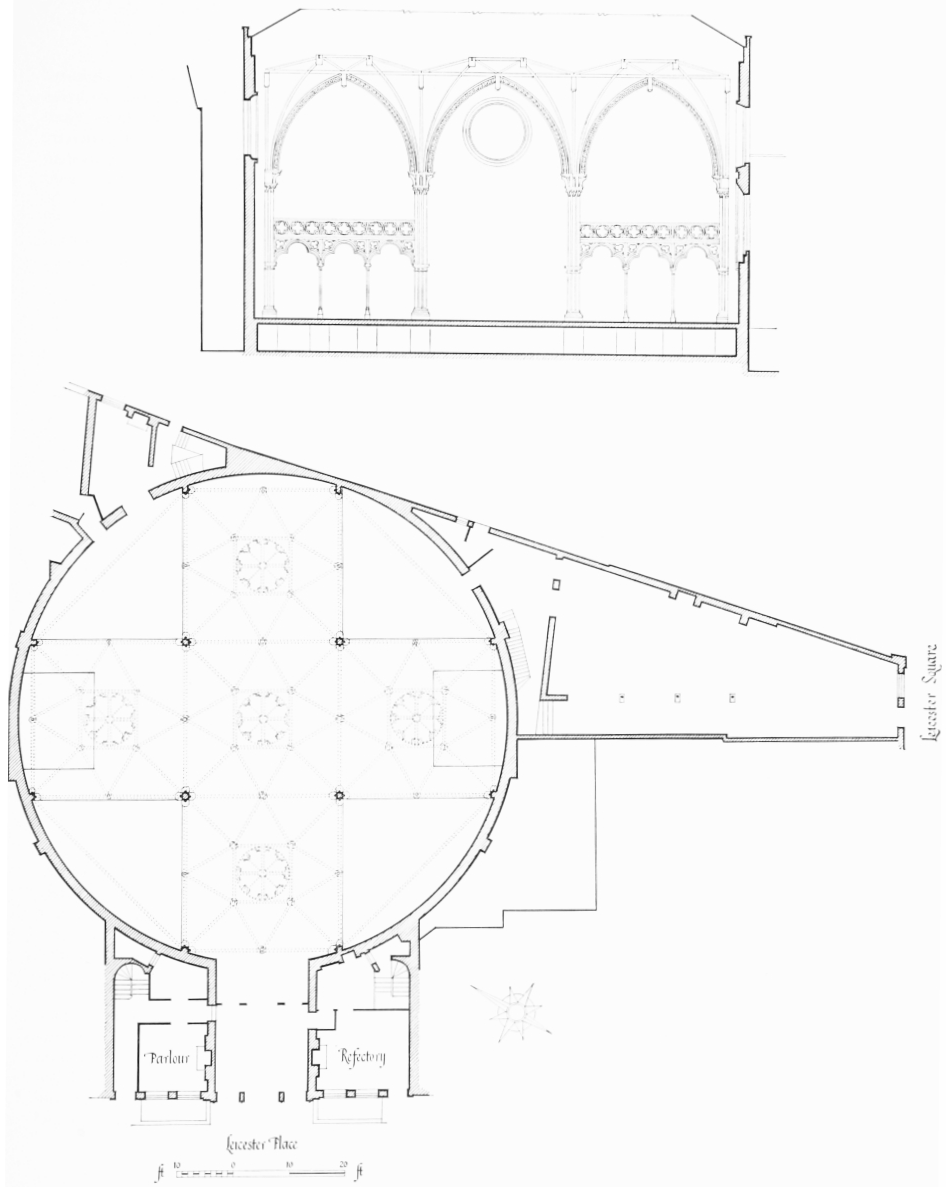
Notre Dame De France Roman Catholic Church, Leicester Place, section and plan before rebuilding. Redrawn from drawings by Corfiato, Stewart Lloyd Thomson and Partners
The circular plan of the panorama was retained for the interior, a ring of twelve columns being introduced to form a series of shallow recesses, below a continuous gallery, surrounding the central rotunda (Plate 23). The columns, which have plain shafts and simplified Doric capitals, support a series of plain arches, the spandrels decorated with circles. The ceiling is formed in concentric rings, first a flat surface decorated with shallow coffers, then a series of recessions rising to surround a large oculus opening to a low clerestoried lantern. The arch framing the high altar is emphasized by the large panel of tapestry decorating the wall behind, and each flanking arch contains a formal grouping of organ pipes.
The church has been embellished with great care, and the following items, some of which were given by the French Government, may be noted: the tapestry mentioned above, depicting the Blessed Virgin, Queen of Creation, was designed by Dom Robert, O.S.B., and made at Aubusson; the walls of the Lady Chapel were decorated by Jean Cocteau in 1960, and the statue of the Virgin was copied from a fourteenth-century original by L'École Boule of Paris; the font was cut from Vosges sandstone by Les Ateliers de L'Œuvre Notre Dame de Strasbourg, and the symbols of the seven sacraments and episodes from the Gospels were carved by E. Stoll of Strasbourg. On the south side of the church is a statue of Our Lady of Victories, evidently a restoration of a statue in the original church here.
No. 16 Leicester Square and the crypt of the church are now occupied by the Centre Charles Péguy, a club for young French men and women in London. The schools were closed a few years after the end of the war. (fn. 61)
Charles House and The Prince Charles Theatre, Leicester Place
The Prince Charles Theatre at the east corner of Lisle Street and Leicester Place forms part of an office block known as Charles House, which was built in 1961–2 for Alfred Esdaile, chairman of Atlas Securities, to the designs of Carl Fisher and Associates. The builders were Richard Costain (Construction) Limited. The foundation stone of the theatre was laid by Dame Flora Robson on 18 December 1961 and the theatre opened on 26 December 1962 with the Canadian revue, Clap Hands. It has seating for 420 persons and was the first entirely new theatre to be built in the West End since the Saville in 1931. (fn. 64) The interior decoration was entirely transformed in 1964, and in the following year the theatre became a cinema.