A History of the County of Lancaster: Volume 3. Originally published by Victoria County History, London, 1907.
This free content was digitised by double rekeying. All rights reserved.
'Townships: Toxteth Park', in A History of the County of Lancaster: Volume 3, ed. William Farrer, J Brownbill (London, 1907), British History Online https://www.british-history.ac.uk/vch/lancs/vol3/pp40-45 [accessed 5 May 2025].
'Townships: Toxteth Park', in A History of the County of Lancaster: Volume 3. Edited by William Farrer, J Brownbill (London, 1907), British History Online, accessed May 5, 2025, https://www.british-history.ac.uk/vch/lancs/vol3/pp40-45.
"Townships: Toxteth Park". A History of the County of Lancaster: Volume 3. Ed. William Farrer, J Brownbill (London, 1907), British History Online. Web. 5 May 2025. https://www.british-history.ac.uk/vch/lancs/vol3/pp40-45.
In this section
TOXTETH PARK
Stochestede, Dom. Bk.; (fn. 1) Tokestat, 1207; Toxstake, 1228; Tokstad, 1257; Toxstath, 1297; Toxsteth, 1447.
This township, which comprises the ancient vill of Smeedon or Smithdown, having been included in the forest, became extra-parochial. (fn. 2) It has from north to south a frontage of 3 miles to the River Mersey, and stretches inland for 2 miles. The ground in the northerly half rises somewhat steeply from the river; inland there are several undulations, the highest point, at the corner of Smithdown Lane and Lodge Lane, being about 190 ft. The total area is 3,598 acres (fn. 3) of which about half, 1,737 acres, was taken within the borough of Liverpool in 1835, and with the exception of Prince's Park is now quite covered with streets of dwelling houses; the outer half, with the exception of Sefton Park, containing 387 acres, has, within recent years, fallen largely into the hands of the builder. This portion also was included within the borough of Liverpool in 1895.
The northern half of the township is densely populated and there are docks and quays along the river front with the severe buildings of numerous factories reared in the background. In the southern half the character of the district changes abruptly, green fields and trees sloping down to the water's edge instead of stone quays and dock gates, and the neighbourhood becomes an important residential suburb, with larger houses set in private grounds.
The geological formation consists of the new red sandstone or trias, the pebble beds of the bunter series occurring in the centre from the river to Windsor, and again towards Aigburth, with upper mottled sandstones of the same series between, again occurring above the docks, where they intervene between areas of the basement beds of the keuper series. The soil is clay and sand.
Formerly a brook (fn. 4) rose in the eastern side of Parliament Fields, at the north end of the township, and ran down to the river near the boundary in Parliament Street, being used to turn a water-mill just before it fell into the river. About the middle of the river frontage is a creek called Knot's Hole, and a little farther to the south another creek once received a brook which rose near the centre of the township; (fn. 5) the Dingle lies around the former creek, and round the latter the district is named St. Michael's Hamlet, from the church. Just beyond the southern boundary is the creek called Otterspool, receiving a brook, known as the Jordan, which rose near Fairfield, formed the boundary between Wavertree and West Derby, and then flowed south to the Mersey; it was joined by another brook, rising in Wavertree and flowing south and west past Green Bank. (fn. 6) Portions of them are still visible in Sefton Park, part of the course having been formed into a lake there.
The principal road has always been that from Liverpool parallel to the river, formerly known as Park Lane, now as Park Place, Park Road, and (beyond the former municipal boundary) Aigburth Road. Park Road rises quickly to the summit, 180 ft., where the Park Coffee House formerly stood, (fn. 7) and then descends still more rapidly to the Dingle; near the bottom on the left is the old Toxteth Chapel. The foot of the hill was in 1835 the municipal boundary; Ullet Road thence goes eastward to the old lodge of the Park, situated almost at the centre of the township, where is now the principal entrance to Sefton Park. The main road, as Aigburth Road, (fn. 8) pursues its way to Otterspool, having the Dingle and St. Michael's on the right and Sefton Park on the left. (fn. 9)
Smithdown Road, formerly Smithdown Lane, forms on the east or inland side for some distance the boundary between the township and West Derby; by it are the Toxteth cemetery and the workhouse. It is joined at its northern and southern ends respectively by two ancient roads, called Lodge Lane from the old Lodge, and Ullet Road already named.
Modern necessities have covered the district with a vast number of streets, of which only a few can be named. Parliament Street follows the northern boundary line from the river to Smithdown Lane, at which point the district is popularly termed Windsor. Prince's Road runs from the centre of Parliament Street to the entrance to Prince's Park, round which are roads ending in Ullet Road. Mill Street lies between Park Road and the river.
The Liverpool tramway system provides liberally for locomotion. The Overhead Railway has a terminus at the Dingle, and runs by the dock side, with a number of stations. The Cheshire Lines Committee's Railway from Liverpool to Manchester has stations at St. James's, St. Michael's, and Otterspool, with a goods station, formerly the passenger terminus also, at Brunswick Dock. The London and North-Western Company's Liverpool to London line passes through the south-eastern corner of the township, with a station called Sefton Park, opened about ten years since.
The following docks of the Liverpool system are in this township: Queen's, formed 1796, and recently modernized; Coburg; Brunswick, 1811, formerly the seat of the timber trade; the old discharging ground has been utilized as the site of a carriers' dock; Toxteth, Harrington, and Herculaneum. To the south of the last are graving docks, and then the petroleum stores.
The Mersey forge stood near the Toxteth dock. The flour mills are further inland. The Herculaneum dock takes its name from a pottery established there in 1796 on the site of a former copper works; it was given up in 1841. (fn. 10) On the river side of the Queen's dock were formerly considerable shipbuilding yards. Near them a ferry was in operation for some years.
The principal park is Sefton Park, formed by the corporation of Liverpool in 1872; a palm house and aviary have since been presented. A statue of William Rathbone, unveiled in 1877, stands in it. Prince's Park, purchased about 1840 by Richard Vaughan Yates, with the intention of preserving it as an open space, is now public property.
An improvement Act was passed in 1842, (fn. 11) and a local board was constituted in 1856; (fn. 12) its operations were restricted to the extra-municipal portion in 1859. (fn. 13)
The former wards within the borough of Liverpool, down to 1895, were called North and South Toxteth. On the inclusion of the rest of the township in 1895 an entirely new arrangement of wards was made; five wards, since increased to six, having been formed, each having an alderman and three councillors.
The Royal Southern Hospital was founded in 1841; the first building was in Parliament Street, close to the docks. The present buildings in Grafton Street were opened in 1872. Not far from them is the City Hospital, under the management of the corporation; at Parkhill, Dingle, is the Infectious Diseases Hospital.
The new buildings of Liverpool College in Lodge Lane accommodate the principal school.
The industrial schools founded by the late Canon Henry Postance, (fn. 14) the school for the deaf and dumb, and the Turner Memorial Home at the Dingle for incurables, 1882, are among the charitable institutions.
Reports upon the wasting of the shore caused by the Mersey were made by Edward Eyes on behalf of the Duchy in 1828 and subsequent years. (fn. 15)
MANOR
Before the Conquest, TOXTETH was divided equally into two manors, each assessed at 'a virgate and a half of a plough-land,' otherwise two plough-lands; one was held by Bernulf, the other by Stainulf. (fn. 16) After the Conquest it was probably taken into the demesne of West Derby, but part at least seems to have been granted by Count Roger of Poitou to the ancestor of Molyneux of Sefton, being soon exchanged for a moiety of Litherland. (fn. 17) The whole vill was then afforested, and until 1604 continued to form part of the forest of West Derby, being described as a 'Hay' in the earlier records, and as a park from the time of Edward I. A separate keeper or parker was appointed for it. (fn. 18) The boundaries, somewhat within the present ones, are described in the perambulation of 1228. (fn. 19)
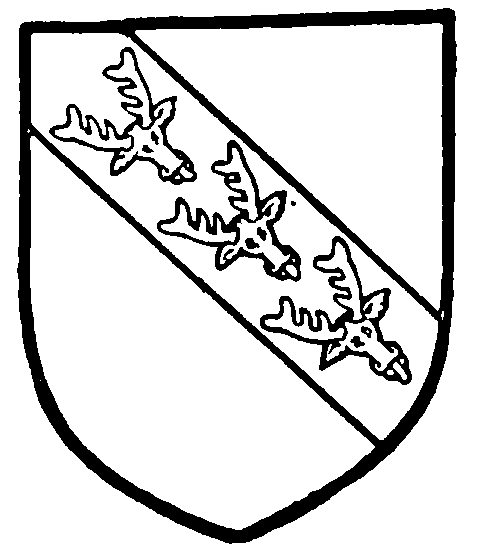
Stanley of Lathom. Argent, on a bend azure three stags' heads cabossed or.
In 1257 the yearly issues of Toxteth amounted to £7 14s. 6½d., arising from perquisites, agistment, and wood sold. (fn. 20) At the death of Edmund, earl of Lancaster, in 1296, the issues of Toxteth, Croxteth, and Simonswood amounted to £8 3s. 10d. per annum. (fn. 21) His son and successor, Thomas, in 1316, while a guest of the monks of Whalley, then but recently translated from Stanlaw in Cheshire, gave them Toxteth and Smithdown; they being dissatisfied with Whalley owing to the lack of timber there for building. (fn. 22) However, they decided to stay at Whalley, and the grant of Toxteth was revoked, Sir Robert de Holand being put in possession of this and other manors in the hundred, which he held till the earl's attainder in 1322. (fn. 23) Five years later Toxteth, with the other parks, was granted to Henry, brother of Thomas of Lancaster, on being allowed to succeed to the earldom and estates. (fn. 24)
By this time the profits of the park from the sale of fuel, &c., had become more important than the preservation of deer for the chase, and various leases and grants were made. (fn. 25) The custody of the park, after various changes, (fn. 26) was in 1447 granted in fee to Sir Thomas Stanley, controller of the household, at a rent of 11s. 7½d. yearly, with a lease also of the turbary. (fn. 27) This office descended in the Stanley family until 1596, when William, earl of Derby, sold the park with all his lands and tenements there and in Smithdown to Edmund Smolte and Edward Aspinwall, (fn. 28) who subsequently made a number of grants to kinsmen and others. Eight years later the earl agreed to sell the same to Sir Richard Molyneux of Sefton, (fn. 29) and after various intermediate arrangements (fn. 30) the transfer was completed in 1605, (fn. 31) from which time the estate has descended in the Molyneux family to the present earl of Sefton. The disparking occurred about 1592. (fn. 32)
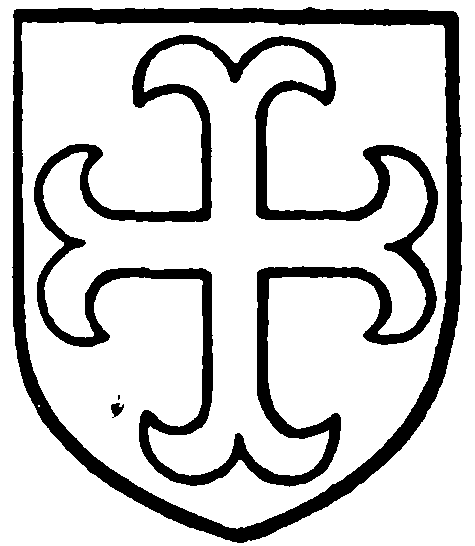
Molyneux, Earl of Sefton. Azure, a cross moline or.
No courts have been held from about 1770, and no perambulations of boundaries made. Lord Sefton has claimed wreck. (fn. 33)
The offices of forester and keeper of Toxteth park and of the park of Croxteth and chase of Simonswood were of some importance. They were usually held for life, the wages of the former being £2 per annum with some small perquisites. Robert de Sankey, the verderer, was incapacitated in 1330; (fn. 34) Roger de Moreton was succeeded in 1360 by Roger de Ditton; (fn. 35) Sir John le Boteler was master forester in 1379. (fn. 36) James Harebrown and Sir Thomas Stanley had a grant of the office of parker in 1440, to be held for their lives or in survivorship. (fn. 37) The master forestership of West Derbyshire had four years earlier been conferred on Sir Richard Molyneux, (fn. 38) but this grant, though confirmed in 1461 and 1483, (fn. 39) was revoked by Henry VII, who appointed Thomas Scarisbrick, servant of Sir Edward Stanley, to the office. (fn. 40) In 1505, however, the former grant was revived, (fn. 41) which confirmation was enrolled in 1706 in the office of the auditor of the duchy. (fn. 42)
SMITHDOWN
SMITHDOWN (fn. 43) has been merged in Toxteth Park for 700 years. The area is not definitely known, though the name continued in use down to the sixteenth century or later, but it is believed to have extended from Lodge Lane eastwards to the boundary. (fn. 44) Ethelmund held it as a separate manor in 1066, when it was assessed as one plough-land, and its value, beyond the customary rent, was the normal 32d. (fn. 45) King John, desiring to add it to the park of Toxteth, took it from its owner, a poor man, and gave him Thingwall for it. The perambulators of the forest in 1228 seem to have considered the exchange equitable, for they conclude their reference to Smithdown with the words: 'Therefore let the king do his will therewith.' (fn. 46) From that time onward the vill was involved with Toxteth, but a strip on the side of Liverpool, afterwards known as Smithdown Moss, was granted at various times in parcels for turbary. (fn. 47)
The prior of St. John's Hospital, Chester, at one time held 26 acres of waste in the hills by Smithdown by the grant of Henry, earl of Lancaster. (fn. 48)
In consequence of the change to a thickly populated urban district, there have been erected in recent times a large number of places of worship. The earliest in connexion with the Established Church was St. James's, on the border of Liverpool, built in 1774 under an Act of Parliament; the money was raised by shares, Lord Sefton giving the land. (fn. 49) A burial ground surrounds it. A district was assigned in 1844. (fn. 50) The rector of Walton presents to the perpetual curacy. St. Michael's was built in 1817, from Rickman's designs, being one of the iron churches of the time. There is a monument to commemorate Jeremiah Horrocks. The present patron is Mrs. W. Jones. (fn. 51) The more recent churches, with the dates of erection, are as follows: St. John the Baptist's, near the top of the hill, 1832; (fn. 52) St. Paul's, Prince's Park, 1848; (fn. 53) St. Thomas's, near the docks, 1840; (fn. 54) St. Barnabas's was built in 1841, and demolished in 1893; (fn. 55) St. Clement's, Windsor, 1841; St. Matthew's, Hill Street, 1847; (fn. 56) St. Silas's, High Park Street, 1865; (fn. 57) Holy Trinity, Parliament Street, 1858; (fn. 58) St. Margaret's, Prince's Road, 1869; (fn. 59) St. Cleopas's, 1866; (fn. 60) Christ Church, Sefton Park, 1870; (fn. 61) St. Philemon's, Windsor Street, 1874; (fn. 62) All Saints', Prince's Park entrance, 1884; (fn. 63) St. Gabriel's, 1884; St. Bede's, Hartington Road, 1886; St. Agnes's, Ullet Road, 1884; (fn. 64) and St. Andrew's, Aigburth Road, 1893. (fn. 65) The patronage is vested in various bodies of trustees, except where otherwise stated in the notes. St. Deniol's, Windsor, was built as a place of worship for Welsh-speaking Anglicans. After difficulties which kept it closed for some years it was licensed for service in 1901. (fn. 66)
The Wesleyan Methodists have many churches in Toxteth. The earliest is Wesley chapel, Stanhope Street, built in 1827. St. John's, Prince's Park, was built in 1862; St. Peter's, High Park Street, in 1878; and Wesley, Lodge Lane, in 1883. Smith down Road chapel dates from 1897. There is another in Lark Lane. Mission halls are Templar Hall and Hutchinson Hall. Mount Zion in Prince's Avenue is for Welsh-speaking Methodists; a previous chapel was in Chester Street. The New Connexion have a church in Park Place. The United Free Methodists have two places of worship.
The Baptists have three churches: the Tabernacle in Park Road, built in 1871; Prince's Gate chapel, 1881; and Windsor Street Welsh chapel. This last, built in 1872, represents a congregation formed in Gore Street in 1827.
The Welsh Calvinistic Methodists have churches in Prince's Road and David Street. They had a chapel called Ebenezer in Bedford or Beaufort Street, Toxteth, as early as 1805. (fn. 67)
As a result of a 'tent mission' begun in the year 1823, a Congregational church was formed in 1827. now represented by the Berkley Street church. (fn. 68) The same body opened Toxteth chapel in 1831; this building was replaced in 1872 by that at the corner of Aigburth Road. In 1881–5 a school chapel was built in Hartington Road. (fn. 69) In Park Road is a chapel for Welsh-speaking Congregationalists. (fn. 70)
There is a Church of Christ in Windsor Street.
The Presbyterians have four churches. The senior is that in Belvedere Road, known as Trinity, erected in 1857. The important church by the Sefton Park gates, where Dr. John Watson (Ian Maclaren) was minister, was built in 1879. In the same year a church was built in Prince's Road, replacing a temporary one founded by the United Presbyterians in 1864. St. Columba's, Smithdown Road, was opened in 1897.
The 'ancient chapel' of Toxteth Park is supposed to have been built about the commencement of the seventeenth century by the tenants and farmers of the park. (fn. 71) It was probably never consecrated, and it is not known whether the Anglican services were ever used in it. The commissioners of 1650 noticed it, and recommended that it should have a parish assigned to it. (fn. 72) In 1718 Bishop Gastrell recorded that it was uncertain whether the Park was extra-parochial or in the parish of Lancaster; that the chapel was held by the Dissenters under a lease from Lord Molyneux, whose agents returned it as a house belonging to his lordship when as a 'papist' his estates were registered. (fn. 73) A similar statement had been made in 1671–2, on the Declaration of Indulgence, the chapel being then licensed for worship. (fn. 74) At that time it was said that 'there was neither a Churchman nor a Catholic' here. (fn. 75) About 1716 a sum of £300 was bequeathed to the township by John Burgess and others, of which the interest on £260 was considered to belong to the 'orthodox minister' and the rest to the poor. (fn. 76)
Richard Mather, the first minister, is said to have settled in Toxteth as a schoolmaster about 1612; showing aptitude he was sent up to Brasenose College, Oxford; afterwards he was minister at Toxteth and Prescot, until silenced in 1633 by the archbishop of York for his nonconformity. In 1635 he emigrated to New England. (fn. 77) From his departure until 1646 nothing is known of the chapel's history; in the latter year Robert Port was minister; (fn. 78) Thomas Higgins in 1650; (fn. 79) and Thomas Crompton in 1657. (fn. 80) No doubt regular public services had to be discontinued for a time after 1662. Michael Briscoe, ejected from Walmsley, was minister at Toxteth at his death in 1685, (fn. 81) and was followed by Christopher Richardson, ejected at Kirkheaton. (fn. 82) About a hundred years afterwards the minister and most of the congregation, like the English Presbyterians in general, had adopted Unitarian tenets, (fn. 83) and the building continues to be used as a Unitarian place of worship. Another Unitarian church has been built in Ullet Road; (fn. 84) and there is a mission in Mill Street.
The Society of Friends have a burial-ground in Smithdown Road.
The first Roman Catholic church erected in Toxteth was St. Patrick's, Park Place, begun in 1821 and opened in 1827. (fn. 85) Our Lady of Mount Carmel, suitably placed at the top of the hill, was begun in 1865; the present church was opened in 1878. St. Bernard's school church was built in 1884; it was in 1901 replaced by the new church of Our Lady of Lourdes and St. Bernard. St. Clare's, near Sefton Park, was consecrated in 1890. St. Charles Borromeo's in Aigburth Road, begun in 1892 in a temporary iron building, was opened in 1900. (fn. 86)
The Orthodox or Greek church at the corner of Prince's Road, in the Byzantine style, was built in 1870 for the accommodation of the numerous Greek merchants and others resident in Liverpool.
The Jewish synagogue in Prince's Road was built about 1878 to replace the older one in Seel Street, Liverpool.