| 1 |
1,903, including five of inland water,
according to the Census of 1901. In
addition there are 11 acres of tidal water,
and 1,322 of foreshore. |
| 2 |
There were 20 officials and 114 boys
in the truant school at Hightown, belonging to the Liverpool education authority. |
| 3 |
Gregson, Fragments (ed. Harland), 224. |
| 4 |
Lancs. and Ches. Antiq. Soc. xix, 180–3
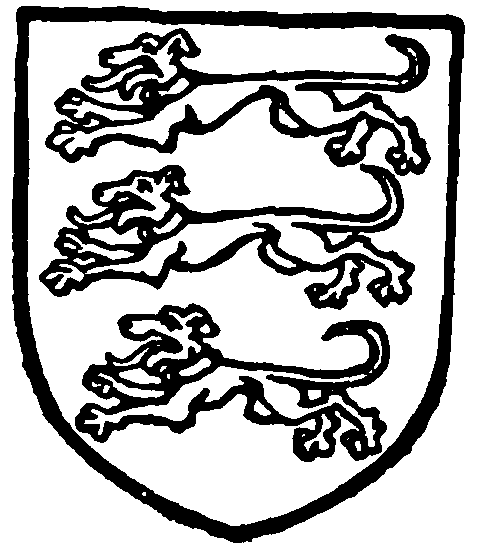
and 178. Some of them are funeral
crosses. |
| 5 |
An impression of the plate showing
these coins, engraved for Spelman's Life
of Alfred, may be seen in Crosby Rec.
(Chet. Soc. New Ser.), and Trans. Lancs.
and Ches. Antiq. Soc. v, 219. |
| 6 |
Lond. Gaz. 26 July, 1870. |
| 7 |
V.C.H. Lancs. i, 283b. Kirkdale and
Crosby together were one hide, of which
Kirkdale was half. |
| 8 |
Ibid. The three plough-lands, 'where
ten plough-lands make a knight's fee,'
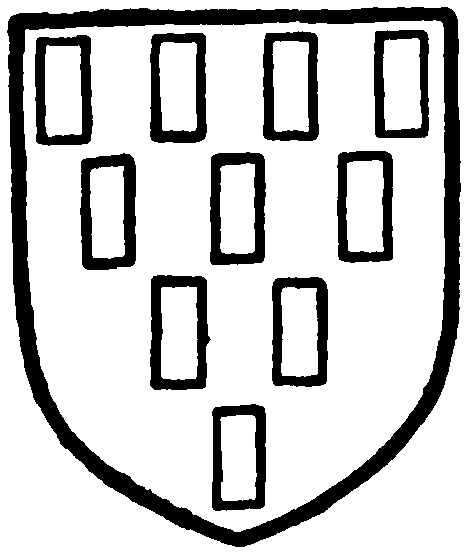
were described as the quarter and twentieth of a fee. |
| 9 |
Lancs. Inq. and Extents (Rec. Soc.
Lancs. and Ches.), 42. The relationship
of Little Crosby to Sefton is usually
stated in the feodaries, &c.; e.g. the
Halton Feodary in Ormerod's Ches. (ed.
Helsby), i, 709, states it to be held
by Richard de Molyneux of Sefton for
three plough-lands and a relief of £1 10s.;
and at the De Lacy Inquest of 1311 (Chet.
Soc.), p. 24, Richard de Molyneux of
Crosby held it by knight's service and a
payment of 2s. 8d. for sakefee and suit
to the court at Widnes.
In addition to the mesne lordship the
Molyneuxes of Sefton formerly held land
in Little Crosby. Part had been acquired
in various ways from William son of
Adam de Crosby and Ellen, Adam's wife;
Croxteth D. E. i, 1; ii, 4; and another
part by Dame Anne Molyneux in 1489
from Gilbert Thomasson; ibid. E. i, 2. |
| 10 |
Roger was brother of William son
of Adam de Molyneux; Croxteth D.
Genl. n. 2; Norris D. (B. M.) n. 480 *.
He had half of Speke, and in 1256 in
right of his wife Agnes half of Rainhill;
see Final Conc. (Rec. Soc. Lancs. and
Ches.), i, 125. Additional particulars
of his family may be seen in the accounts
of these townships. |
| 11 |
Cur. Reg. R. 180, m. 18. |
| 12 |
Roger was living in 1287, when he
granted land in Little Crosby to Richard,
son of Thomas de Aykescho; Blundell of
Crosby D. (Towneley MS. in possession of W. Farrer), K. 300. Richard
Molyneux of Little Crosby was witness to
a charter of 1294; ibid. K. 30. The seal
to a grant by Richard, son of Roger de
Molyneux, shows a lion rampant; Knowsley D. bdle. 1402, n. 1.
It may be added that there is a large
collection of Little Crosby deeds in Kuerden's folio MS. in the Chetham Library. |
| 13 |
See the accounts of Hindley and
Culcheth. Beatrice afterwards married
Robert de Bebington, and was living in
1349; De Banc. R. 273, m. 128; R.
286, m. 340; also R. 355, m. 109. The
former actions arose out of a lease of the
manor granted in 1326 by Beatrice to
Stephen de Hamerton; Kuerden's fol.
MS. n. 399. |
| 14 |
Pink and Beavan, Parl. Rep. of Lancs.
15. |
| 15 |
Richard de Molyneux, rector of Sefton,
as feoffee, gave to Richard son of Roger
de Molyneux and Beatrice his wife, all
his manor of Little Crosby in its entirety,
with remainders as stated; Blundell of
Crosby D. K. 229. A copy of this
charter seems to have been made for each
of those in the remainder, two of the series
being now at Little Crosby Hall.
The names of the homagers are thus
given: Nicholas Blundell, William son of
Adam, Richard son of Thomas, elsewhere
surnamed 'de Aykescho,' Richard Bolymer, Randle Wolvesegh, and William
Ballard.
Of these tenants William son of Adam
was the most important after the Blundells; Adam being son of Gilbert of Little
Crosby, originally one of the chief landholders in the township; see Assize R.
408, m. 4. Adam by his wife Ellen had
a son William (occurring down to 1322),
and a daughter Alice, who married Robert
de Orrell, and then Patrick de Prescot.
Her second husband seems to have endeavoured to secure his wife's estate for the
Molyneuxes of Little Crosby, though by
her former husband she had had a daughter
and heir, Margery wife of Simon de
Lydiate; Blundell of Crosby D. K. 122,
K. 276, K. 304, K. 216, K. 184, K. 256.
The Lydiates claimed the manor of Little
Crosby in 1342; Kuerden's fol. MS. n.
495.
William son of Adam granted to
Richard son of Roger de Molyneux all
his lands, including half a plough-land in
Little Crosby, with the homage of
Nicholas Blundell, and 6d. rent from the
Moorhouses, exception being made of an
oxgang held by his sister Alice and Adam
son of Thomas; another oxgang held by
Richard de Walton by the service of ½d.,
and a third by Patrick de Prescot by a
barbed arrow; Blundell of Crosby D. K.
251. He had several children—Richard
(occurring down to 1345) who had a
son William, whose wife was named
Margery; Thomas, who had a son Adam;
Robert; Sciletia; and Alice who married
Hugh the Tunwright of Huyton, and had
a son Robert; see Blundell of Crosby D.
K. 255, K. 258; also Kuerden fol. MS, n.
393, 411, 492. By this last, dated 1382–3,
Hugh son of William de Liverpool released to Henry, son of Nicholas Blundell,
half the manor of Little Crosby and one
oxgang, which Agnes widow of Richard
son of William of Little Crosby formerly
held.
William son of Adam of Little Crosby
gave one oxgang—a twenty-fourth part of
the vill—to his daughter Aline, who
married John de Hindley; and another
oxgang to his daughter Sibyl. Richard,
son of William, unsuccessfully laid claim
to this part of his father's estate in 1334;
Coram Rege R. 297, m. 64. Ten years
later, however, Richard recovered certain
lands and pasture rights which he had
temporarily lost through his father having
given a moiety of his lands (for his life)
to his two daughters, Sibyl wife of Alexander de Whalley, and Alice (as she is
now called) wife of Roger son of Hugh
of Great Crosby, who seem to be the
Sciletia and Alice of the charters above
quoted; Assize R. 1444, m. B. |
| 16 |
The Molyneux settlement was in 1314
confirmed by a fine relating to a messuage, five oxgangs, &c. and the manor of
Little Crosby, Richard and Beatrice being
plaintiffs, and Roger, son of Robert de
Molyneux of Rainhill, the deforciant.
There is a variation in the statement of
the remainders which afterwards led to
lawsuits, the daughter Agnes being omitted
altogether, and Margery, then wife of John
de Lanc. following Maud in the third
place; Final Conc. ii, 19.
The occasion of the settlement was probably the death of the eldest son Thomas
without male issue, though by his wife
Margery de Charnock he left a daughter
Agnes, afterwards the wife of Henry de
Atherton; see Final Conc. ii, 18; De
Banc. R. 344, m. 442, and R. 347,
m. 148d. Norris D. (B.M.) n. 944 is
the marriage agreement, dated 1304, by
which Thomas son and heir of Richard
de Molyneux was to marry Margery
daughter of Henry de Charnock, while
the latter's son Adam was to marry
Richard's daughter Joan.
Henry, son of Henry de Atherton of
Hindley, and Agnes his wife, released in
1343 their right in the manors of Little
Crosby and the Scholes in Eccleston to
Beatrice, formerly wife of Richard de
Molyneux of Crosby, and Sir John de
Molyneux; Blundell of Crosby D. K.
212. |
| 17 |
Richard de Molyneux held the manor
in 1324; Dods. MSS. cxxxi, fol. 33b.
Sir John de Molyneux in April, 1328,
gave his mother Beatrice for her life all
his right in the vill and manor of Little
Crosby, excepting 5 marks of yearly rent
which he had of her gift; Blundell of
Crosby D. K. 195. The original is at
Little Crosby.
In 1345 he granted Adam son of
Thomas son of Wilcot half an oxgang in
Little Crosby, with the meadow which
Adam formerly held from Beatrice, the
grantor's mother; ibid. K. 308. At the
beginning of 1349 he enfeoffed Robert,
son of William de Crosby, of his manors
of Little Crosby, Speke, and Scholes, and
all his lands in Rainhill and Appleton;
ibid. K. 258 (original at Little Crosby).
In December, 1350, he gave to William
de Liverpool and Emma his wife the sixth
part of the manor of Little Crosby, of
which one oxgang was held for her life by
Agnes, widow of Richard son of William
of Little Crosby; ibid. K. 222 (original
at Little Crosby). |
| 18 |
Rot. Scot. (Rec. Com.), 307, 421, &c. |
| 19 |
Sir John's first wife was named
Agnes; Norris D. (B.M.), n. 494, dated
1314. His second wife was Clemency,
daughter and co-heir of Roger de Cheadle,
and widow of William de Baguley; Earwaker, East Ches. i, 170; Staff. Hist.
Coll. (Salt Soc.), xvi, 5, 6, from a Chest.
Plea Roll of 1336; Geneal. (New Ser.),
xiii, 102; xii, 111, 112, where is an error
in the descent.
Richard son of Sir John de Molyneux
and Isabel his wife were defendants in a
plea of 1342; Assize R. 1435, m. 47 d.
He was witness to a charter in 1341, and
in the following year had a grant of lands
from Roger son of Adam son of William
de Crosby, his father (Sir John) being a
witness; Blundell of Crosby D. K. 127,
259. Five years later he was plaintiff in
a case of trespass; De Banc. R. 352, m.
311 d. |
| 20 |
Sir John de Molyneux was living in
1362; Norris D. (B.M.), n. 572. |
| 21 |
Cockersand Chartul. (Chet. Soc.), ii, 568
to 595, and notes. |
| 22 |
Kuerden MSS. v, fol. 124, nn. 172,
173. See also the account of Great
Crosby.
In 1199 Robert de Ainsdale, son of
Osbert, had a protection from King John;
it was dated at Bourg-le-Roi in Maine;
Rot. Cart. (Rec. Com.), 18. |
| 23 |
Farrer, Lancs. Pipe R. 247.' |
| 24 |
Cockersand Chartul. ii, 590, 591;
Lancs. Inq. and Extents (Rec. Soc. Lancs.
and Ches.), 117. |
| 25 |
Blundell of Crosby D. K. 203. |
| 26 |
He is described as a knight in the
deed last referred to. 'Robert de Crosby,
son of Adam de Ainsdale,' confirmed his
father's grants in Garston to the monks
of Stanlaw; Whalley Coucher (Chet. Soc.),
ii, 572.
As Robert de Crosby, knight, he gave
to Ralph de Greenhol and Anabel his
sister, Ralph's wife, an oxgang in Little
Crosby which Robert son of Thomas de
Ince formerly held, 'until the grantor or
his heirs should enfeoff Ralph of an oxgang in Much Woolton,' then held by
Robert the Heir; Blundell of Crosby D.
K. 270, K. 161. The original is at
Knowsley; bdle. 1402, n. 9. |
| 27 |
Blundell of Crosby D. K. 165,
K. 305; Eyton, Shrops. xi, 162, 163.
Eyton does not seem to have known
Agnes's family name, which is of interest as connecting her with the former
lords of Montgomery; op. cit. 120.
The charter K. 305 was executed in
the castle of Montgomery, among the witnesses being Sir Adam de Montgomery,
Baldwin and Stephen de Bolers. |
| 28 |
T. E. Gibson, Cavalier's Note Book, 6. |
| 29 |
Blundell of Crosby D. K. 164; the
seal shows the lion rampant. The estate
included all the land Sir Robert had in
Ainsdale (wreck of the sea being reserved
to him), in Bold, Woolton, Crooks and the
Dale; and all his rents from Ravensmeols
and Liverpool. Nicholas was to render
for Ainsdale, &c., 6 marks, and for Little
Crosby 2 marks. The penalty is noticeable: 'Should he fail in making these
payments he shall give to the fabric of
the King's new work at Royland
[Rhuddlan] 5 marks for each term.'
The witnesses indicate that it was
executed in Shropshire; they include
Masters Ralph de Freningham, Roger de
Seyton, and Ralph de Hengham, justices;
Sir Peter Corbet, Sir Ralph Corbet, and
others. A similar grant, ibid. K. 203,
has on the seal the billety coat now borne
by the Blundells. Charles's Roll, edited
by Sir George J. Armytage in 1869, gives
as the arms of Robert Blundell (n. 331):
Azure, ten billets or, four, three, two, and
one; on a canton or a raven sable. In
the same Roll (n. 466) Baldwin de
Boulers (?) has: Sable, a bend between
twelve billets argent. |
| 30 |
He was a collector of various subsidies in 1295, 1301, and 1302; Parl.
Writs; Lancs. Lay Subs. (Rec. Soc. Lancs.
and Ches.), i, 188, 236, 238.
Several of his grants are known. By
one he gave an acre in Little Crosby 'in
the Sand' to Nicholas son of Thomas de
Aykescho; and to Adam son of the said
Thomas he gave half an oxgang which he
had bought from William son of Ralph de
Greenhol; Blundell of Crosby D. K. 299,
K. 254. From William son of Adam of
Little Crosby he made purchases in the
Branderth and elsewhere; ibid. K. 148,
K. 307. |
| 31 |
His first wife was named Eleanor;
by her he had three sons—David, William,
and Nicholas. Sir Robert, the father,
gave to his son Nicholas and Eleanor his
wife, on their marriage about 1270, all
his right in Great and Little Crosby and
Moorhouses; ibid. K. 174. William,
one of the younger sons of this marriage,
was contracted in 1298 to Joan daughter
of Griffith de la Lee, probably a Shropshire
man, and had all his grandmother's property in Walcot, Chirbury, Lydbury,
Bishop's Castle, &c., settled upon him, so
that it appears no more in the Little
Crosby evidences; ibid. K. 154, K. 185,
K. 187. The Blundens of Shropshire,
who recorded a pedigree in 1623, claimed
descent from the couple; Shrop. Visit.
(Harl. Soc.), 48.
Nicholas son of Nicholas Blundell had
in 1313–14 a grant of land in Wedholme
from Alan le Norreys, at an annual rent
of a grain of pepper. The grantor
describes the younger Nicholas as his
'next of kin and heir,' but the relationship is otherwise unknown; Kuerden
fol. MS. 73, n. 630.
The elder Nicholas married a Margery
for his second wife; he had no issue by her;
Duchy of Lanc. Assize R. 1, m. iiij d. ix.
Dower was assigned to her in 1321–2;
Blundell of Crosby D. K. 186. She
afterwards married Thomas de Pentrith,
surviving until about 1335; K. 240. |
| 32 |
David died in or before 1311, in
which year Richard de Molyneux, rector
of Sefton, refeoffed Nicholas Blundell and
Margery his wife of lands between Ribble
and Mersey, including a windmill at Little
Crosby; after the death of her husband
Margery was to hold a moiety for her life,
paying 6s. 8d. a year to Nicholas son of
David Blundell, who was to have the
other half; Blundell of Crosby D. K. 181,
K. 273.
Agnes, David's widow, afterwards married Richard de Holland of Sutton, and
was living, the second time a widow, in
1335; ibid. K. 176 and K. 208. |
| 33 |
A grant of land in Little Crosby by
Nicholas son of David Blundell to Adam
son of his uncle Nicholas for a rent of 8d.
is in the Blundell of Crosby D. K. 303.
Abstracts of other grants by him are contained in the same volume, including the
grant of a third of Little Crosby to his
son Richard on his marriage with Emma
in 1336; ibid. K. 240. The wife was a
daughter of Thomas de Molyneux of
Sefton, and lands in Great Crosby also
were given; ibid. K. 121. There do not
seem to have been any children by this
marriage. |
| 34 |
Ibid. K. 262; the original is at Little
Crosby. Nicholas Blundell, senior, agreed
to sustain Nicholas son of David in
victuals, clothing, and all other necessaries, Richard de Holland doing the same
for Aline, assisted by a contribution of
1 mark a year from Nicholas senior. |
| 35 |
In 1328 he granted to Gilbert de
Halsall the ancestral manor of Ainsdale;
ibid. K. 183. He was witness to charters
made in 1342; ibid. K. 32, K. 211. |
| 36 |
Duchy of Lanc. Assize R. 1, m. jd.
The plaintiff, Sir John, stated that
though he had 'often offered to John
son of Nicholas, whilst he was under
age, suitable marriage, &c. the said John,
rejecting that marriage, and without
satisfying the said John de Molyneux
respecting his marriage, intruded into his
lands and tenements.' It thus appears
that by July, 1351, John Blundell had
attained his majority and taken possession
of his father's lands. The result of the
suit is not given. In 1358 Sir John
de Molyneux, John son of Nicholas
Blundell and Ellen his wife, John Anyon
and Joan his wife, Margery widow of
Nicholas Blundell, and Emma widow of
Richard Blundell did not prosecute a
claim they made against William Blundell
of Ince; Assize R. 438, m. 18. In the
following years also John Blundell appears
as plaintiff; Duchy of Lanc. Assize R. 7,
m. 2, 3, 4, 4d.; Assize R. 438, m. 7;
R. 441, m. 1, 1d, 5d.
In one of the pleas against John de
Liverpool is a pedigree of the Blundell
family; it concerned an acre in Little
Crosby which Sir Robert Blundell had
given to Nicholas Blundell and Aline his
wife and their heirs, and which therefore
descended, through David their son, to
Nicholas son of David and so to the
claimant as son of Nicholas; Assize R. 7,
m. 18.
In 1364 John Blundell was called upon
to defend his title against John de Lancaster of Rainhill. The difference between
the charter of Richard de Molyneux,
rector of Sefton, and the later fine, in
which the name of Agnes de Molyneux
was omitted, has been pointed out. Under
the fine John de Lancaster was heir, but
John Blundell established the validity of
the earlier charter by which he as son of
Nicholas son of Agnes succeeded to Little
Crosby on the death of Sir John de
Molyneux without heirs; De Banc. R.
418, m. 345; R. 425, m. 314d. It
appeared that John de Molyneux was
under age when the charter was made. |
| 37 |
William son of Adam de Liverpool
in 1361 granted to John Blundell a messuage and land in Little Crosby; and
three years later Richard son of Richard
de Molyneux of Little Crosby granted him
all the lands there he had received from
Richard his father; Blundell of Crosby D.
K. 266, K. 302. John was witness to
grants made by and to Henry Blundell of
Crosby in 1370 and 1371; ibid. K. 134,
K. 158. Some misdeeds of John and his
brother Henry, described in 1350 as
'common malefactors,' are given in Assize
R. 452, m. 1. |
| 38 |
In 1361 Henry attested the grant to
John Blundell by William de Liverpool,
cited in the last note. In a similar
manner he occurs down to 1404; Blundell of Crosby D. K. 13. In 1377 a
presentment was made against him for
trespass of cattle and fishing in the
Mersey; Liverpool Corp. D.
Although it would appear that Henry
Blundell of Crosby was the Henry son of
Nicholas Blundell of Crosby to whom a
grant by a feoffee was made in 1381–2, a
Henry son of John Blundell of Crosby
attested a Walton deed in 1368; Croxteth D. Bb. iv, 26. 'Son' may be a slip
for 'brother.'
In 1398, after the death of Richard de
Molyneux of Sefton, it was found that
Henry Blundell held land in Little Crosby
of him by knight's service, paying a rent
of 4d.; Lancs. Inq. p.m. (Chet. Soc.), i, 70.
This rent continued to be paid down to
1798, when at the Sefton sale it was
purchased for William Blundell, then lord
of Little Crosby. Nicholas Blundell records that on 3 May, 1710, he paid 'two
groats' to Lord Molyneux's bailiff for
two years' customary rent; Diary, 85.
Licence for an oratory for two years at
Little Crosby was granted him in Nov.
1387, by the bishop of Lichfield, and
extended in May, 1389; Lich. Epis.
Reg. vi, fol. 123b, 125b.
In 1381–2 Nicholas son of William de
Liverpool released his right in certain
lands which Henry Blundell had had from
Hugh brother of Nicholas; Blundell of
Crosby D. K. 14, K. 15.
The writ Diem clausit extr. was issued
in 1406–7; Dep. Keeper's Rep. xxxiii,
App. 7.
The seal of this Henry Blundell shows
a cross moline pierced; no doubt adopted
from Molyneux of Little Crosby; Croxteth D. Z. i, 18. |
| 39 |
Pink and Beavan, Lancs. Parl. Representation, 49.
Beatrice daughter of Hugh de Stanulf
and Agnes her sister, daughters and heirs
of Joan, the daughter of William Blundell
of Ince, in 1388–9 granted to Henry
Blundell of Crosby and Nicholas his son,
land on the Sand; Blundell of Crosby D.
K. 152. See also ibid. K. 39 and K. 129.
In 1396 Richard son of Henry de
Kighley acquired by fine the manor of
Lightshaw from Nicholas, son of Henry
Blundell of Crosby, and Ellen his wife;
the last-named was daughter and heir of
Nicholas de Tyldesley of Tyldesley; Pal.
of Lanc. Feet of F. bdle. 3, m. 3; and
Pal. of Lanc. Chanc. Misc. bdle. 1, file 9,
n. 1.
The writ of Diem clausit extr. on his
death was issued 12 March, 1422–3; Dep.
Keeper's Rep. xxxii, App. 24. |
| 40 |
See the account of Ditton. In 1422
Henry made several grants to John, son
and heir of Thomas Renacres of Bickerstaffe; Kuerden, ii, fol. 69–70, 72. A
Henry Blundell went to France in the
king's retinue in May, 1415; Dep.
Keeper's Rep. xliv, App. 564.
Henry had two brothers—John and
Robert. For John his father purchased
lands in Lydiate; he had a son Thomas,
vicar of Brackley in Northamptonshire;
Pal. of Lanc. Feet of F. bdle. 5, m. 15;
Gibson, Lydiate Hall, 101. Robert was
rector of Aldford in Cheshire from 1421
to 1461; he several times occurs in
charters of Henry VI's reign; Ormerod,
Ches. (ed. Helsby), ii, 759; Blundell of
Crosby D. K. 15, K. 31, K. 36. For all
three brothers, ibid. K, 47.
Henry Blundell was witness to charters
as late as 1456; ibid. K. 58, K. 33. |
| 41 |
Nicholas Blundell married Ellen
daughter of John Page of Thornton;
Blundell of Crosby D. K. 27. |
| 42 |
Scarisbrick charters, n. 166 (in Trans.
Hist. Soc. (New Ser.), xiii); P.R.O. Anct.
D., A. 12603.
In 1479 as Nicholas, son and heir of
Nicholas Blundell, he granted to Thomas
Blundell, vicar of Brackley, Master Boniface Blundell, and others, his manor of
Little Crosby. |
| 43 |
Gibson, Cavalier's Note Book, 10. The
petition from which this account of the
family troubles is taken is printed more
fully in Caröe and Gordon, Sefton, 73,
from the original at Little Crosby. It appears to have been drawn up by George
Blundell, a younger son of Nicholas, and
complains that the Molyneuxes had taken
away the Blundells' rights to waifs, strays,
and wreck; also their sporting rights and
rabbit warrens; their chapel on the north
side of Sefton church; 20 marks rent;
they had cast Nicholas and his son into
prison at Lanc. for 14 weeks, denied
George's right to the guardianship of his
brother's heir; and finally 'daily lay in
wait to kill and murder them.' |
| 44 |
Kuerden fol. MS, 261, n. 490.
Among the field names given are Oaklands,
Brandearth, Corscroft, Hayrkirk, Bergh,
Dobhey, Dalton, Ragh Winter Hey and
Wodeam. |
| 45 |
Liverpool Corp. D. An endorsement dated 1672 says, 'I think that the
heirs of William Molyneux have nothing
to do with Halton, and now I know no
homage that is due unto them.' |
| 46 |
Deed in Blundell evidences, 19 Aug.
1514. |
| 47 |
Cavalier's Note Book, 10–11. There are
numerous references to the matter in the
Ducatus Lanc. (Rec. Com.). In 1517 Nicholas Blundell complained that whereas
he had in 1512 let his manor of Crosby
to George Blundell, Edward Molyneux,
clerk, rector of Sefton, disregarding a decree made in the duchy of Lanc., had
expelled George from the manor. Edward
Molyneux replied that he and another recovered the manor against Nicholas to
certain uses, and their tenant had been
ejected by George; Duchy of Lanc.
Depos. xi, B. 5, 5a, 6.
The dispute also came before the Star
Chamber, which decreed that Edward
Molyneux should pay the debts of Nicholas Blundell out of the profits of the
manor of Little Crosby; the jointure of
Agnes, widow of Henry Blundell, is mentioned; Star Chamb. Proc. Hen. VIII,
v, 49–51; xxiv, 181; xxix, 86.
There is extant a grant by George
Blundell to his brother Henry, son and
heir-apparent of Nicholas Blundell, of all
the manor of Little Crosby and all the
messuages, &c., including courts-leet and
liberties, which George had received from
Nicholas; this is dated 1 June, 1513. |
| 48 |
Duchy of Lanc. Inq. p. m. iv, n. 74.
He died on Friday, 9 Sept. 1513, which
supports the statement that he was killed
at Flodden; James, his son and heir, was
then twenty-two years of age. The inquisition recites the provision made in 1502
and 1503 for his second wife Agnes,
daughter of Sir Henry, and sister of
Richard Bold, including Ditton, Great
Crosby and other lands. His first wife,
espoused in 1488–9, was Katherine,
daughter of William Heaton, of Heaton
under Horwich; Kuerden, fol. MS. 248.
n. 580; and iii, C. 34. |
| 49 |
Duchy of Lanc. Inq. p. m. vi, n. 16,
68. He had held the manor of Little
Crosby of William Molyneux by knight's
service and a rent of 4d., and lands in
Great Crosby (by a rent of 10s.), Ditton,
Ince Blundell, Bold, Hindley, Liverpool,
Orrell, and Warrington. |
| 50 |
Little seems to be known of Henry
Blundell; he was living in 1545; Ducatus
Lanc. (Rec. Com.), i, 181. Three years
later he sold a house to Richard Molyneux; Croxteth D. E. i, 3: and made a
settlement of his manors and lands in
August the same year, the remainder
being to his son Richard; Pal. of Lanc.
Feet of F. bdle. 13, m. 56.
In 1562, the will of Thomas Leyland
of Morleys mentions 'Anne Blundell, my
sister, widow,' so that Henry Blundell
had died before this; Piccope, Wills
(Chet. Soc.), i, 162; Richard Blundell was in possession early in 1561;
Pal. of Lanc. Feet of F. bdle. 23,
m. 94.
From this time the pedigrees recorded
at the Visits, of 1567 and 1664, printed
by the Chet. Soc., can be used. |
| 51 |
Duchy of Lanc. Inq. p.m. xv, n. 10.
His son and heir was then twenty-four
years of age. The father 'was in gaol
for recepting of a seminary' in 1590;
Lydiate Hall, 245 (quoting S. P. Dom.
Eliz. ccxxxv, n. 4). As early as 1568 he
had solemnly sworn to 'take the Pope to
be the supreme head of the Church';
ibid. 211. See Crosby Rec. (Chet. Soc.
New Ser.), 21–2; also Stanley P. (Chet.
Soc.), ii, 81, 89, 213; Gillow, Bibl.
Dict. of Engl. Cath. i, 247. |
| 52 |
See Gillow, op. cit. i, 248. Crosby
Rec. 21–40, contains an account of his
sufferings during the persecution, compiled by William Blundell himself, covering the period 1590 to 1630. He consoled
himself by writing 'ballads,' which he set
to music; three of them are given,
24–30. Two-thirds of his father's lands,
sequestered for recusancy, had been
granted to 'one Lever'; in 1594, when
he was in prison in London, John Gille
obtained a grant of the two-thirds; afterwards a division was made, and a lease
granted to William Norris, whose sister
married William Blundell; then Charles
Grimston obtained a new grant; Thomas
Heaton and Gervase Travis followed, and
then two of Queen Elizabeth's cooks—
'two of the black guard'—begged all his
lands as a fugitive, for at this time proclamation had been made in Liverpool
market according to the statute of fugitives, it being supposed that he had left
the country. By the pardon from
James I he recovered his lands, John
Gille having been the only one of the
grantees who had secured any profit by
the sequestrations. Further grants of the
sequestered two-thirds were made by
James I between 1607 and 1610, but
nothing seems to have come of them;
for instance, in 1610 Ambrose Astell,
pretending a grant from Bowes and
Beeston, seized some of William Blundell's cattle, but they were rescued;
'whereupon he caused a privy sessions
and indicted a great many—to the number
of seventy persons—intending to make a
Star Chamber matter of it—but in the
meantime he was proved to exceed his
commission and take bribes, and thereby
was driven the country'; ibid. 31–3.
Little Crosby Hall 'was once for fourteen days together [beset by pursuivants]
upon the report of a wicked priest
that fell and became a minister, discovering what he knew of Catholics'; Chron.
of St. Monica's, Louvain (ed. Hamilton);
i, 153.
The grant of John Gille was dated
2 March, 1593–4; that to Arthur Gibson
and Edward Thurleston, 27 July, 1607;
ibid. 90, 91. A special commission was
issued touching his lands in 1601 (n. 1220);
Lancs. and Ches. Rec. (Rec. Soc. Lancs. and
Ches.), ii, 344. |
| 53 |
Crosby Rec. 35–45. The immediate
occasion of the Star Chamb. proceedings was the rescue in 1624 described
above in the introduction; the Harkirk
burial ground then came under notice.
This ground had been in use since 1611,
when, 'having heard that Catholic recusants were prohibited to be buried at their
parish church,' William Blundell 'caused
a little piece of ground to be enclosed
within his own demesne land in a place
called of old time, as it is now also, the
Harkirk.' Harkirk was used occasionally for burial down to 1753; ibid.
69–85. The Star Chamb. imposed a
fine of £2,000, afterwards reduced to
£500; Cavalier's Note Book, p. 18 (quoting
Rushworth, Hist. Coll. ii, 21).
As a convicted recusant he paid double
to the subsidy in 1628; Norris D.
(B.M.).
Two of the court rolls of Little Crosby
of 1628 and 1634, with lists of the freeholders, are printed in Trans. Hist. Soc.
(New Ser.), vii-viii, 113–22. Officers
peculiar to the manors on the coast were
the 'surveyors of the sandy copps.'
The inquisition taken after William
Blundell's death—Duchy of Lanc. Inq.
p. m. xxviii, n. 54—shows little change
in the lands held by him; it recites the
provision made by him in 1631 for the
younger children of his son Nicholas
Blundell, deceased—Richard, Emily, Margaret, Anne, Winifred, and Frances.
Jane the widow of Nicholas was still
living in 1638. Nicholas Blundell seems
to have lixed at Ditton, paying double to
the subsidy of 1628 as a convicted recusant; Norris D. (B. M.).
Richard Blundell, after studying at St.
Omer's, went to the English College,
Rome, where he died 22 July, 1649,
having previously been received into the
Society of Jesus; Foley, Rec. S. J. i,
233–46; vii, 67. |
| 54 |
According to the inquisition last
quoted he was born on or about 18 July,
1620. |
| 55 |
A full account of his life will be
found in T. E. Gibson's Cavalier's Note
Book, 19–80; a fac-simile of the commission signed by Tho. Tyldesley forms
the frontispiece. See also Gillow, op.
cit. i, 249. His history of the Isle of
Man has been printed by the Manx
Soc. |
| 56 |
Royalist Comp. P. (Rec. Soc. Lancs. and
Ches.), i, 203–7, contains the petition
by Anne Blundell, his wife, and their
children; and the contract for sale to
Gilbert Crouch in 1653. In the Cal.
of Committee for Comp. iv, 2692, are
some further particulars. William Blundell was obliged to pay not only for his
estates, but also the sums unpaid since
1596 by John Gille and other grantees of
the sequestered two-thirds; details are
given in Crosby Rec. 89–104, the final
settlement being made in 1658. The
estate had been sold under the third Act
of 1652; Index of Royalists (Index Soc.),
42. The payment for the estate, in
which he had only a life interest, was
£1,340, and for the arrears £1,167;
Cavalier's Note Book, 29. A settlement
of his manors, &c., was made by William
Blundell early in 1662; Pal. of Lanc.
Feet of F. bdle 168, m. 11. In 1666 the
hall at Crosby had fifteen hearths liable
to the tax; Lay Subs. 250–9. |
| 57 |
Cavalier's Note Book, 52–54. He and
his son William had been marked out for
banishment in 1680; ibid. 166–7. |
| 58 |
Trans. Hist. Soc. (New Ser.), xiv,
236. |
| 59 |
For the charge and arrest see Kenyon
MSS. (Hist. MSS. Com.), 307, 319,
362. His defence in 1694 may be read
in Jacobite Trials (Chet. Soc.), 100. |
| 60 |
He died 2 August, 1702; N. Blundell,
Diary, 2. The son records: 'As his life was
virtuous and edifying so was his death.'
His eldest brother Nicholas renounced
the inheritance on entering the Society of
Jesus in 1663; he was charged by Titus
Oates with an intention to burn the city
of London, but was released after a brief
imprisonment; Gillow, op. cit. i, 245;
Foley, Rec. S. J. v, 44, &c.; vii, 66.
Thomas Blundell, a younger brother, was
also a Jesuit; Gillow, i, 247; Foley, vii, 67. |
| 61 |
See Gillow, op. cit. i, 246. One
brother, Joseph, was a Jesuit; Foley, op.
cit. v, 342; vii, 66; his will is at Stonyhurst; Hist. MSS. Com. Rep. x, App. iv,
183–4. The other, Richard, died in Maryland in 1704; Diary, 32.
Extracts from Nicholas's Diary were
published at Liverpool in 1895, giving a
multitude of interesting details as to
persons and customs. The following
topographical notes may be given as
specimens: 'Mr. Richard Molyneux of
the Grange and I set a merestone to be
the boundary between his coney warren
and mine; it was set about halfway between a great sandhill and Blanchard's
lane end, upon a hill called Tenpenny
hill, and lineable with the two merestones at each end of Blanchard's lane'
(p. 5); 'The jury met in the Town-field
about setting out some other ways; we
discoursed about the Doostone that's set
in Richard Harrison's butt' (p. 54); 'I
removed the great stone as has time out
of mind stood near the Lower Bark gate
and fixed it at the turning of the causey
in the west lane' (p. 163). The frontispiece is a view of Crosby Hall in 1735. |
| 62 |
Diary, 138. |
| 63 |
Ibid. 145; Eng. Cath. Nonjurors, 150. |
| 64 |
He is first mentioned in the Diary on
17 Oct. 1720 (p. 170); Foley, Rec. S. J.
v, 365, where the name is given as Pippard. He is said to have been a grandson of Thomas Peppard, alderman and
merchant of Drogheda, who represented
the town in the Irish Parliament from
1634 till his death in 1640; Names of
Members (Blue Bk. 1878), ii, 614. A
Colonel Peppard commanded Walsh's
regiment in the Irish Brigade in 1736;
Foley, op. cit. v, 399. Henry Pippard
and Frances his wife made a settlement
of the manor in 1735; Pal. of Lanc.
Feet of F. bdle. 313, m. 12.
The later stages of the Blundell pedigree have been taken from Gregson, Fragments, 223; Burke, Commoners, ii, 529,
and Landed Gentry. |
| 65 |
Cal. Home Office Papers, 1770–2, p. 634. |
| 66 |
He purchased the manor of Great
Crosby in 1798. |
| 67 |
A biography with portrait appeared
in the Liverpool Cath. Ann. 1895. |
| 68 |
This charter has been recited in a
previous note. Ralph had a son William,
whose widow was named Margaret; they
appear to have sold half the oxgang to
Nicholas Blundell; Blundell of Crosby D.
K. 283, K. 238. It was afterwards given
to Adam, son of Thomas de Aykesco;
ibid. K. 254. |
| 69 |
The descent is by inference merely.
John Anyon and Joan his wife and
John their son in 1367 received from
John Blundell a lease of land. It appears that Joan inherited from her
mother Aline a rent of 13s. 4d. from
an oxgang in Little Crosby, mentioned
in exchanges between Joan and Henry
Blundell in 1385 and 1386. Richard
Anyon had a grant of land in the Sand,
which seems to have been a hamlet, in
1405. The deeds are at Knowsley,
bdle. 1402, n. 15–20, 24. |
| 70 |
Thomas Anyon of Brackley was the
vendor; ibid. n. 25–26. The price was
40 marks. About a century later there
was an arbitration as to the common between William Moore and William Blundell; ibid. n. 29. |
| 71 |
It so appears in the Moore inquisitions; e.g. Lancs. Inq. p.m. (Rec. Soc.
Lancs. and Ches.), i, 14. |
| 72 |
The Knowsley deeds referred to are
described as 'relating to former possessions of the earl of Derby.'
The Moores had other lands in the
Moorhouses, Little Crosby, and Ince
Blundell, purchased in 1472 by Roger
Mercer of Walton from Thomas Linacre, to whom they had descended from
Thomas Wilson his grandfather; Moore
D. n. 749 to 751. |
| 73 |
Settlements of his estate at the
Sand, &c., made between 1361 and 1388
by William, son of William Dyken of
the Moorhouses, show that he had a son
John, and daughters, Margaret, Ellen, and
Clemency; his wife's name was Quenilda;
Knowsley D. bdle. 1402, n. 14, 21–22.
There are many deeds relating to the
family or families thus named in the
Blundell of Crosby D. |
| 74 |
In 1332 Henry the Shepherd (Bercator) of the Moorhouses gave to Adam
Lightfoot, in free marriage with his
daughter Ellen, lands which he had procured from Nicholas, son of David Blundell, in the Moorlands; Blundell of
Crosby D. K. 285. Ten years later
Roger son of Adam of Little Crosby
granted land to the same Adam Lightfoot;
ibid. K. 288. |
| 75 |
Nicholas Blundell in 1333 granted
to William son of Robert Langback common of pasture for all animals in Little
Crosby; ibid. K. 130. William's sons
Richard, John, and Thomas, in 1356 regranted to their father the lands they
had received from him; ibid. K. 132.
A grant to the son Thomas, made in
1355, is at Knowsley; bdle. 1402, n. 13. |
| 76 |
The Liverpool family several times
appear in the Blundell D. as feoffees or
owners of land. At Knowsley is a grant,
dated 1349, from Richard son of William
son of Ralph de Liverpool to John Dicconson of Liverpool, son of Maud del
Meles, concerning lands in Little Crosby
which descended to Richard after the
death of his brother Master Robert de
Liverpool, as contained in the charter of
Nicholas son of David Blundell made to
Master Robert; Roger de la Moore of
Liverpool and Adam son of Richard de
Liverpool were among the witnesses;
bdle. 1402, n. 11. |
| 77 |
Richard son of Hugh the Little resigned to Adam son of Robert de Ainsdale his right in an acre in Little Crosby
held of the house of St. John of Chester;
Blundell of Crosby D. K. 306. A certain
Roger in 1316–17 gave to William son of
William de Formby land held from the
same hospital; ibid. K. 133. Six years
later William son of Bimme of the
Moorhouses granted to Robert his son and
heir an acre in Little Crosby, to be
held of the chief lord of the fee, 2d. a
year being payable to the hospital; Kuerden, ii, fol. 254, n. 200. This land Robert
in 1342 gave to Richard son of John de
Langback; Blundell of Crosby D. K. 140. |
| 78 |
Margaret Sheppard, Thomas Marrow,
Margery Blundell, Richard Ainsworth,
William Weedow, John Blundell, William
Grey, Thomas Blanchard, Edward Howard, Walter Thelwall, John Tickle,
Thomas Mather, William Harrison, Bryan
Lea, Thomas Farrer, Richard Jackson,
William Wignall (also at Scarisbrick),
James Dary, John Molyneux, and William
Marrow; Engl. Cath. Non-jurors, 147–8,
154–5. |
| 79 |
'To the Blundells of Crosby the
Catholics of the south-west of Lancs.
were long indebted; for their domestic
chapel and the priest who served it were
at frequent intervals their only religious
help in penal times'; Jos. Gillow in
Trans. Hist. Soc. (New Ser.), xiii, 163–4. |
| 80 |
In 1568 there were 'two priests at
the hall of Crosby,' who said mass commonly; Gibson, Lydiate Hall, 211 (quoting S. P. Dom. Eliz. xlviii, n. 34). Christopher Small, sometime fellow of Exeter
Coll. Oxf. found a refuge here for several
years; see the account of Lydiate.
In 1586 the curate of Sefton reported
that James Darwen, a seminary priest,
was received by Richard Blundell of
Crosby; Lydiate Hall, 240 (from Harl.
MS. 360, fol. 7b). It was for harbouring one Woodruff, a seminary priest,
that Richard was imprisoned in 1590;
Crosby Rec. 21. James Forde, another
seminarist, was there in 1592; Gillow,
loc. cit. |
| 81 |
Foley, Rec. S. J. v, 340–5. |
| 82 |
Gillow, loc. cit., where a list will be
found. |
| 83 |
N. Blundell, Diary, 63. There is a
view of it opposite p. 72. |
| 84 |
Ibid. 163. There are numerous allusions to the 'chapel' and services in the
volume just quoted. On 1 July, 1721,
Bishop Witham confirmed 284 persons;
p. 178. |