A History of the County of Lancaster: Volume 3. Originally published by Victoria County History, London, 1907.
This free content was digitised by double rekeying. All rights reserved.
'Townships: Childwall', in A History of the County of Lancaster: Volume 3, ed. William Farrer, J Brownbill (London, 1907), British History Online https://www.british-history.ac.uk/vch/lancs/vol3/pp108-111 [accessed 30 April 2025].
'Townships: Childwall', in A History of the County of Lancaster: Volume 3. Edited by William Farrer, J Brownbill (London, 1907), British History Online, accessed April 30, 2025, https://www.british-history.ac.uk/vch/lancs/vol3/pp108-111.
"Townships: Childwall". A History of the County of Lancaster: Volume 3. Ed. William Farrer, J Brownbill (London, 1907), British History Online. Web. 30 April 2025. https://www.british-history.ac.uk/vch/lancs/vol3/pp108-111.
In this section
CHILDWALL
Cildeuuelle, Dm. Bk.; Childwall, 1261; Childewelle, 1291; Childewalle, 1212, 1332; Childewall, 1354 and onwards (common form); also Chaldewall, 1238; Chaldewal, 1305. The terminations 'wall' and 'well' appear indifferently. Childow is the local pronunciation.
The township of Childwall, containing 831 acres, (fn. 1) is principally situated on the slope of a low hill, the highest point of which is 223 ft. above sea-level, commanding an extensive panorama of a wide, flat plain lying to the east. The district has an agreeable park-like appearance, with plantations and pastures, diversified with cultivated fields, where crops of corn, turnips, and potatoes are raised. There are but few dwellings, besides the hall and the houses which cluster about the church. The geological formation consists of the bunter series of the new red sandstone or trias; the pebble beds to the south-west of the Cheshire Lines Railway and the upper mottled sandstones to the north-east. The soil is loamy.
An interesting road is that through the centre of the township from Liverpool through the Old Swan to Gateacre and Hale. (fn. 2) It is joined at the church by a cross road from Wavertree; another road from Old Swan to Huyton runs along part of the northern boundary. The Cheshire Lines Committee's Railway from Manchester to Southport passes through the centre of the township, and there is a station in Well Lane, about a quarter of a mile east of the church. The population in 1901 numbered 219.
Jeremiah Markland, a celebrated classical scholar, was born here in 1693, son of the vicar of Childwall. (fn. 3)
'The roads from Liverpool,' wrote Samuel Derrick in 1760, 'are deep and sandy; consequently rather unpleasant; but the views are rather extensive, particularly from a summerhouse on Childwall Hill, about three miles distant, where you have a prospect of fifteen counties and a good view of the sea. In the skirts of this hill are several small villages with gentlemen's seats scattered about, well covered and for the most part delightfully situated.' (fn. 4) Gregson also says: 'The views from the neighbourhood of the church, from the hall, Gateacre, and as far as Woolton Hall … are extensive and particularly fine. On the west are seen with more distant eminences, Aughton Hills, near Ormskirk, traversing a line of country to the north-east. The prospect from Prescot to Farnworth terminates on the south-east with a distant view of the ruins of Halton Castle—now fast mouldering away—a range of hills beyond, and Norton Priory … A large portion of the Mersey water forms one of the features of this scene, and gives great interest to a landscape that extends nearly fifteen miles … This highly cultivated vale is interspersed with more churches than are usually seen at one view in Lancashire.' (fn. 5)
A cross formerly stood on the roadside near Well Lane; the base is still there. (fn. 6) Another cross stood on the boundary of the township, near the entrance lodge of the hall; on the opposite side of the road are a number of 'seats' cut in the rock.
Well Acre is the name of a field in Well Lane just below the church. Another well or pool at the bottom of the slope to the north-east of the church was known as Monk's Bath; it was well protected by an interior four-sided wall of masonry, and a stream from it used to flow into the Childwall Brook a short distance away. (fn. 7) Ashfield is the name of the land round this well; Mire Lake and Coneygrey are fields near the railway and the Little Woolton boundary.
A local board was formed in 1867; (fn. 8) since 1894. the township has been governed by an urban district council of five members.
MANOR
Four Radmans held CHILDWALL in 1066 for four manors; it was assessed at half a hide, and its value beyond the customary rent was 8s. (fn. 9) The place is mentioned again in 1094, when Roger of Poitou gave the church to St. Martin of Séez. (fn. 10) Afterwards Childwall, with the adjoining Allerton, was given to Albert Grelley, baron of Manchester, and in his successors the superior lordship of the manor continued to be vested. It is recorded among the members of the barony down to 1473. (fn. 11)
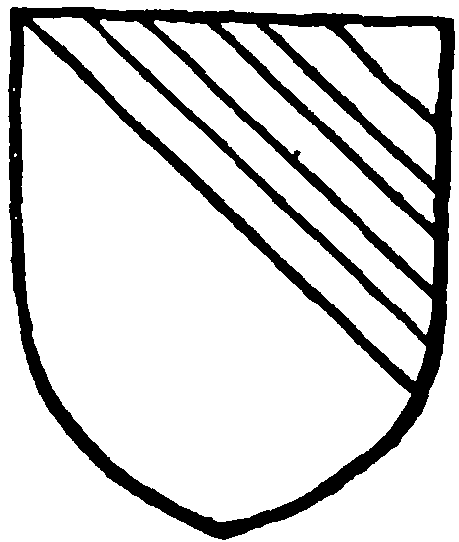
Grelley, Lord of Manchester. Gules, three bendlets enhanced or.
Under the lords of Manchester a subordinate fee of 6½ plough-lands was created, of which a portion was Childwall, being held in 1212 by Richard son of Robert (de Lathom). (fn. 12) In 1282 and later the regular statement is that the Lathoms held half a fee in Childwall. (fn. 13) In 1473 Thomas Lord Stanley, heir of the Lathoms, held Childwall for half a knight's fee, paying yearly for 'sake fee' 4s. 6d. and for ward of the castle 5s. (fn. 14) Later it appears to have been consolidated with Rainford and Anglezark, and these were held together of Lord la Warre by Thomas second earl of Derby, who died in 1521, by fealty and a rent of 3s., the value being estimated as £44 17s. 6d. (fn. 15) A similar statement is made in the inquisition after the death of Ferdinando, fifth earl, who died in 1594, but the value had declined to £30. (fn. 16)
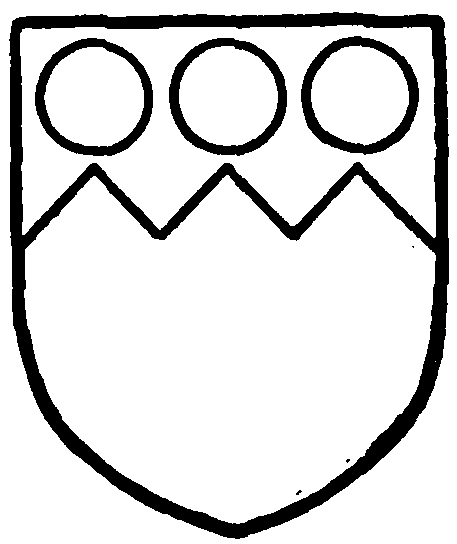
Lathom of Lathom. Or, on a chief indented azure three bezants.
In 1596 Childwall formed part of the lands settled on Thomas Stanley, (fn. 17) but reverted to the earl of Derby in 1614. (fn. 18) During the Civil War the earl's estates were sequestered by the Parliament. The manor was contracted for sale in 1653 to Henry Nevill and Arthur Samwell; the mill, then in the occupation of Isabel Broughton, to George Hurd and George Leaf, and other land there to John Broughton. (fn. 19) From another case before the parliamentary commissioners it appears that Childwall House had been leased to Hugh Houghton, deceased, but the lease had expired. (fn. 20) The succeeding earl of Derby was able to repurchase Childwall among other lands; (fn. 21) and in 1657 he obtained an Act of Parliament to enable him to sell several manors and chief rents at Childwall, Little Woolton, part of Dalton, and all Upholland, &c., whereby he raised a sum sufficient to free his estates from certain charges. (fn. 22)
The manors of Knowsley, Much Woolton, Little Woolton, and Childwall, with lands there, and the manor house of Childwall, lately occupied by Isabel Houghton, were in August, 1657, sold or rather mortgaged to Dame Elizabeth Finch and Edward Bagnell. (fn. 23) A year later, on 14 October, 1658, the purchasers, in conjunction with the earl and countess of Derby, for £4,700 transferred to Peter Legay the younger and Isaac Legay, who are described as 'of London, Merchants,' their right in the manors of Much and Little Woolton and Childwall, with the lands and mansion house, (fn. 24) and in the following February Peter Legay released his right in them to Isaac. (fn. 25)
From this Isaac Legay, who died in 1690, aged sixty-five, and was buried at West Stoke in Sussex, (fn. 26) the estates descended to his son Samuel, who appears to have resided at Childwall House, and died at Warrington in 1700, being buried at Childwall on 23 July in that year. (fn. 27) The heirs were his two sisters, one of whom, Hannah, was married to Thomas Hollis, and the other, Martha, to Nicholas Solly. These joined in 1718 in the actual sale to Isaac Greene of Prescot, an attorney practising in Liverpool, (fn. 28) of all three manors and the house known as the hall of Childwall or Childwall House, together with lands in Much and Little Woolton and Childwall. (fn. 29)
Isaac Greene (fn. 30) married Mary, surviving daughter and heir of Edward Aspinall of Hale, and thus became lord of Hale as well as of the manors of Childwall, Wavertree, Much and Little Woolton, and West Derby. He built a new Childwall Hall, but it was demolished by his grandson, and a castellated building from the designs of John Nash, the popular architect, substituted for it. (fn. 31) Of the three daughters of Isaac Greene the eldest did not marry, and the inheritance was divided between her sisters, the elder (Ireland) having Hale and the younger (Mary) Childwall and the other Derby manors. The latter married Bamber, son of Sir Crisp Gascoyne. (fn. 32) Her eldest son Bamber Gascoyne, who was member of Parliament for Liverpool (1780–96) (fn. 33) had an only child Mary Frances, who married the second marquis of Salisbury. Her grandson, the present marquis, is now lord of Childwall and the other manors. Mr. Hugh Schintz is the present tenant of Childwall Hall.
Land in Childwall was early granted to Stanlaw Abbey. (fn. 34) Richard son of Robert de Lathom gave a 'culture' in Deepdale to Burscough Priory. (fn. 35) An early charter by Robert de Grenol granted to Robert (fn. 36) son of Simon, son of Orm land in the Dale, and Henry son of Richard of the Dale transferred it to Nicholas son of Sir Robert Blundell of Crosby. Stephen son of Adam de Ditton released land in the Dale, perhaps the same portion, to the above Nicholas Blundell in 1298. (fn. 37)
Childwall does not appear frequently on the Plea Rolls, but a dispute between Robert son of Robert del Moss and John the priest's brother continued several years in Edward III's reign. (fn. 38) Later it was found that 2s. of issue of a messuage and 2½ acres in Childwall remained in the king's hands by reason of an appropriation made by the prior of Upholland from John the priest's brother. (fn. 39) Childwall Lodge, a very quaint old building, is the residence of Mr. A. Earle, member of an old Liverpool family.
An enclosure act for Childwall and Great and Little Woolton was passed in 1805. (fn. 40)