A History of the County of Lancaster: Volume 3. Originally published by Victoria County History, London, 1907.
This free content was digitised by double rekeying. All rights reserved.
'Townships: Speke', in A History of the County of Lancaster: Volume 3, ed. William Farrer, J Brownbill (London, 1907), British History Online https://www.british-history.ac.uk/vch/lancs/vol3/pp131-140 [accessed 3 May 2025].
'Townships: Speke', in A History of the County of Lancaster: Volume 3. Edited by William Farrer, J Brownbill (London, 1907), British History Online, accessed May 3, 2025, https://www.british-history.ac.uk/vch/lancs/vol3/pp131-140.
"Townships: Speke". A History of the County of Lancaster: Volume 3. Ed. William Farrer, J Brownbill (London, 1907), British History Online. Web. 3 May 2025. https://www.british-history.ac.uk/vch/lancs/vol3/pp131-140.
In this section
SPEKE
Spec, Dom.Bk.; Spek, 1317; Speck(e), 1320; Speke common from thirteenth century, with variants as Speek, 1332; Speyke, 1500; once 'Espeke' occurs. In the sixteenth century frequently 'The Speke.'
This district contains some of the best wheat growing land in the hundred, and has a considerable river frontage opposite the widest portion of the River Mersey. There are scattered plantations amongst open fields, where barley and oats as well as wheat grow well in light, sandy, or stiff clay soils. There are no brooks. The village of Speke consists of a small group of cottages near the church, a mile from a railway station. Other houses are scattered thinly over the district. The river bank in places is flat, but principally consists of high clay banks. Upon and about these the botanist may find many plants locally uncommon. The geological formation consists of the bunter series of the new red sandstone or trias; the pebble beds underlie the entire township. The area is 2,504½ acres, (fn. 1) of which the demesne of Speke Hall occupies 765 acres. Oglet (fn. 2) is a hamlet by the Mersey.
In 1901 the population numbered 381.
The road from Garston to Hale crosses Speke in two branches, and is met at the village by the road coming south from Woolton. The London and North-Western Company's line from Liverpool to Warrington passes through the northern part of the township, and has a station.
The remains of Hunt's Cross were described in 1895 as 'a displaced massive square stone socket, lying in a barn, at the crossroads, near the station.' (fn. 3)
At the boundary of Speke, Halewood, and Hale there is a piece of land called Conleach. Here formal challenge fights used to take place between the inhabitants of the adjoining villages.
The township is governed by a parish council.
MANOR
In 1066 SPEKE was one of the manors held by Uctred; it was assessed at two plough-lands and its value beyond the customary rent was the normal sum of 64d. (fn. 4) When the Lancashire forest was formed, Speke became part of the fee attached to the chief forestership held by the Gernet family and their descendants the Dacres. (fn. 5)
The interest of the master foresters in Speke was, however, merely that of superior lord after Roger Gernet, living in 1170, had granted the manor to Richard de Molyneux of Sefton in free marriage. (fn. 6) No service was attached to the grant, (fn. 7) and the Molyneux family did not long retain Speke in their immediate holding. Before 1206 half of the manor had been granted in free marriage with Richard's daughter to William de Haselwell, a grant confirmed by a charter of Benedict Gernet as chief lord. (fn. 8) The other half of Speke seems to have been granted by Adam de Molyneux to his younger son Roger, together with Little Crosby and other lands, (fn. 9) and descended to Sir John de Molyneux of Little Crosby, who died about 1361.
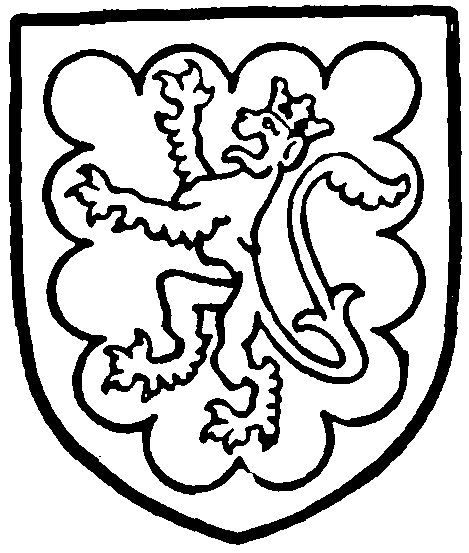
Gernet, chief forester of Lancashire. Gules, a lion rampant argent crowned or, within a bordure engrailed of the last.
Under the nominal lordship of the chief forester there were thus at the end of Henry III's reign the mesne tenancy of Molyneux of Sefton, (fn. 10) and the subordinate tenancies of Roger de Molyneux and Patrick de Haselwell. William de Molyneux of Sefton granted in free marriage with his daughter Joan to Robert son of Richard Erneys, a citizen and merchant of Chester, all his lands and wood in the vill of Speke with the homages, wards, and reliefs of the heirs of Patrick de Haselwell and Roger de Molyneux, the grantor's brother. (fn. 11) This grant was confirmed by Richard son of William de Molyneux about 1290, or before the death of Robert Erneys. (fn. 12)
The origin of the Erneys family seems to be unknown. Robert FitzErneys was settled at Chester early in the thirteenth century. (fn. 13) He was sheriff of the city in 1257 and 1259, and his nephew Robert, who married Joan de Molyneux, served in the same office several times, and probably died during his term in 1292–3. (fn. 14)
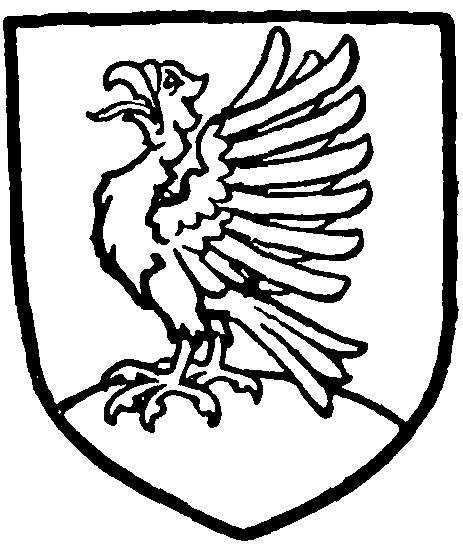
Erneys of Chester. Argent, on a mound vert an eagle with wings endorsed sable.
Richard, the son of Robert and Joan, appears to have been but an infant at his father's death. The earliest deeds in which he took an active part concern the marriage of his sister Mabel with Thomas de Carleton in 1308; but from 1311 onwards many of his charters are extant. In 1314 he and his mother made an exchange of lands in Speke with John le Norreys and Nicholaa his wife. (fn. 15) In 1332 he granted his manor of Speke to John le Norreys for life, by the service of a rose yearly for the first four years, and afterwards of 40 marks; and at the end of 1339 he granted to Alan le Norreys, son and successor of John, and to his sons Alan and Hugh for life all his lands in Speke, and the rents of the free tenants and tenants at will, by the yearly service of a rose for four years and £40 in silver afterwards. (fn. 16) After this he intervened but little in Speke.
In 1341 he made a small exchange of land with Sir John de Molyneux, and a year afterwards a marriage settlement was executed in favour of his son Thomas and Agnes his wife, daughter of Alan le Norreys. (fn. 17)
Probably Thomas died without issue, for the next Erneys to be mentioned is Roger son and heir of Richard Erneys, who in 1369 made a feoffment of his lands and tenements, rents and services, mills and fisheries, in the vill of Speke, &c. (fn. 18) Richard Erneys, the father, seems to have been still living in 1351, and Roger is first mentioned nine years later in conjunction with Sir John de Molyneux and Sir Henry le Norreys, in pleas concerning lands and encroachments at Speke. (fn. 19)
In 1379 he made an arrangement with Cecily, widow of Sir John le Norreys, as to the custody of the heir, Henry le Norreys. (fn. 20) The next step seems to have been the marriage of Henry le Norreys with Roger's daughter Alice; and as the latter became heir of the Erneys properties on the death of John her brother about 1396, (fn. 21) the Norreys family acquired the lordship of Speke, in which their subordinate tenancy of a moiety became merged.
It now becomes necessary to trace the story of this family. Alan le Norreys of Formby (fn. 22) had at least three sons, Henry, Alan, and John. The son Alan about 1275 married Margery daughter of Sir Patrick de Haselwell. As dowry Sir Patrick granted 'half his part of the vill of Speke, to wit the fourth part of the whole vill, retaining nothing,' to Alan and his heirs by Margery, performing the knight's service belonging to half a plough-land where 21½ ploughlands made the fee of a knight. (fn. 23) About the same time Sir Patrick gave the other half plough-land to his daughter Nicholaa and her heirs, who is found shortly afterwards to have married John le Norreys, a brother of Alan. (fn. 24) Thus the Haselwell moiety passed to the Norreys family. (fn. 25)
It is from the younger pair that the Norrises of Speke derive their origin, for Alan (fn. 26) and Margery left a son Patrick who died without issue in 1313, having granted to his uncle John, son of Alan le Norreys, all his lands and tenements, homages, rents and services of free men and natives and their sequel and chattels, mills and sites of mills. (fn. 27) John le Norreys thus became sole possessor of the Haselwell share of the manor. He made several purchases and exchanges of land, and by the lease in 1332 from Richard Erneys he further improved his position. (fn. 28) He died shortly afterwards, his son Alan succeeding. In 1334 the three lords of Speke, Sir John de Molyneux, Alan le Norreys and Richard Erneys, made an agreement with Robert de Ireland, lord of Hale, respecting the boundaries between the two vills, as to which there had recently been debate in a plea of novel disseisin at Wigan. (fn. 29) Alan pursued his father's policy, purchasing additional plots of land, making exchanges with Sir John de Molyneux, and renewing the lease of the manor from Richard Erneys. (fn. 30)
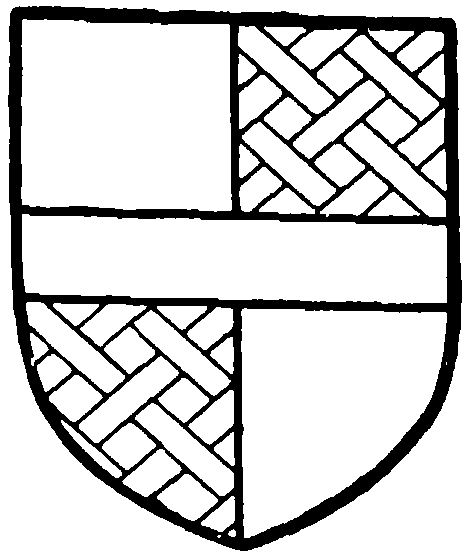
Norris of Speke. Quarterly argent and gules, in the second and third quarters a fret or, over all a fess azure.
Alan died in 1349 or 1350. (fn. 31) Henry his son, who succeeded him as lord of the manor, had begun to add to the estate, and in 1360, being made a knight about that time, (fn. 32) exchanged certain lands with Sir John de Molyneux, agreeing on the view of four men that Sir John should have 4½ acres lying between Speke Greves and the vill of Speke, saving to Sir Henry his mill, and should grant the same amount of land, as profitable to Sir Henry as that was to Sir John; the moor to lie in common to them and their tenants as it used to be, with right of turbary. (fn. 33) In 1354 he obtained a grant of free warren in all his demesne lands of Speke. (fn. 34)
Sir Henry had a son and heir John, who married Cecily, daughter of Hamlet de Mascy of Puddington in Cheshire. (fn. 35)
Of Sir John le Norreys, the next lord of Speke, but little is known. In 1369 he granted to feoffees his manor of Speke, together with lands in Garston, Hale, Woolton, Walton, Ince, and Lydiate. (fn. 36) He died about three years afterwards, leaving a widow and three young children—Henry, Katherine, and Agnes. In November, 1372, an agreement was entered into by Cecily his widow with Nicholas le Norreys of Halsnead, (fn. 37) and Gilbert le Norreys, coroner, with regard to the children. She was to be responsible for their living and clothing, such as belonged to their estate, for the next twelve years, and to make suitable provision for each of them when they were married. (fn. 38) But as already stated Roger Erneys, as superior lord, quickly intervened, (fn. 39) and in 1379 released to Cecily and her second husband the custody of the heir. At this time Henry was still under age, and the daughter Agnes is not mentioned.
Except for the dispute with John le Norreys, related in a note, Sir Henry's tenure seems to have been undisturbed. By his marriage with Alice Erneys he became lord of the manor. (fn. 40) In 1416 he made provision for his son William on his marriage with Elizabeth, daughter of Sir James de Harrington. (fn. 41)
William, son and heir of Sir Henry, succeeded about 1431. (fn. 42) A grant of land was made by him in 1433–4, and he occurs in 1453 in a bond for £40 from William Gerard. (fn. 43) He had a large family, and was succeeded by his son Thomas, who married a distant cousin Lettice, (fn. 44) daughter and heir of Thomas Norris of West Derby; by her he had six (or seven) sons and five daughters. (fn. 45) He died in 1487–8, seised of a messuage and land in West Derby, of four oxgangs and other land in Formby, also of the manor of Speke and land, meadow, wood, heath, and pasture in Speke, but the jurors at the inquest did not know of whom he held the same. William Norris, his son and heir, was then twenty-eight years of age. (fn. 46)
Sir William Norris, the successor, must therefore have been born about 1459. His knighthood appears to date from 1487, after the battle of Stoke, in which case he must have fought there on the Lancastrian side. (fn. 47) He was contracted in marriage as early as 1468 to Katherine, daughter of Sir Henry Bold. (fn. 48) Sir William died 1 September, 1506, seised of the manor of Speke, and lands there and in Siche, as also in West Derby, Formby, and Oglet. His son and heir, Henry Norris, was then aged twenty-eight and more. (fn. 49)
Henry Norris had in 1500 married Clemence, one of the daughters and coheirs of Sir James Harrington, of Wolfage and Brixworth in Northamptonshire. (fn. 50) On the division of the Harrington property in 1516, half of Blackrod fell to Clemence. (fn. 51) Henry Norris is said to have fought at Flodden, in company with his brother William, under the leadership of Sir William Molyneux. (fn. 52) He died at Speke 7 July, 1524, leaving as heir his son William, then aged twenty-three or more. The manor of Speke and the other lands, &c., in Speke, Siche, and Oglet were said to be held of Sir William Molyneux, by knight's service, except two parcels of land in Speke held of the same Sir William in socage by the rent of 18d. (fn. 53)
William Norris was knighted between 1530 and 1535, upon what occasion does not seem to be recorded. He made several exchanges and sales of various Norris properties, parting with Caldy, but buying the Grosvenor lands in Lancashire, exchanging lands in Formby, Lydiate, and Ince Blundell for others in Garston and elsewhere. (fn. 54) He dwelt sometimes at Blacon near Chester, but Speke was his principal residence. (fn. 55) In 1544 he engaged in the Scottish expedition of Lord Hertford, and it is notable as an indication of his character that the spoils he brought home were books. (fn. 56) He seems also to have fought at Pinkie, as the arms and initials on the 'gwyddon' won by Sir William Norris in Scotland are those of David Boswell of Balmuto, whose sons fell there. (fn. 57) In 1554 he represented Liverpool in Parliament. (fn. 58) Three years later he was too infirm for military service in person. (fn. 59) In 1563 he compiled his 'Genealogical Declaration,' (fn. 60) and on 30 January, 1567–8, was gathered to his fathers, being buried at Childwall four days later. (fn. 61)
Edward Norris, his son and heir, was of the age of twenty-eight years. A considerable portion of Speke Hall was built in his time. It does not appear that he took any marked part in the religious controversy of the age, though he held the Speke estates for the greater part of Elizabeth's reign, (fn. 62) but at the end of his life he desired his son to make provision for the maintenance of a 'sufficient chaplain' at Garston chapel, (fn. 63) £200 being the sum named; bequeathing also £60 for a schoolmaster at Much Woolton. He had in 1605 provided £140 for the rebuilding of the tower of Garston chapel. In 1605–6, 'being him self aged and sickly and his children many in number,' he made a release of all his lands to his son Sir William, and dying during the summer of 1606, was buried at Childwall. (fn. 64)
His eldest son William, who had resided at Blacon, succeeded him. He was made a Knight of the Bath at the coronation of James I. (fn. 65) The end of his life was embittered by a quarrel with his son (fn. 66) and a heavy fine inflicted by the Star Chamber. (fn. 67) These troubles seem to have hastened Sir William's end for he died in October, 1630. (fn. 68)
William his son was described as a recusant in 1624, and died 10 July, 1651. He married Margaret, daughter of Thomas Salisbury, of Llewenny. (fn. 69) It does not appear that he took any part in the Civil War, (fn. 70) but a younger son Thomas, who inherited the estates, had in 1650 fallen under the displeasure of the Parliament as 'adhering to and assisting the forces' of the king. His estates were described as 'the manor and capital messuage of Speke, with the demesnes thereof, three cottages, two windmills, two water-mills and lands of the yearly value of £224 5s. 8d., and the like estate in reversion of certain messuages and lands in Speke and Garston, then rented out at £69 17s. 6d.' The fine imposed was £508; and there is no mention of any recusancy. (fn. 71)
Thomas Norris, aged forty-six in 1664, (fn. 72) held Speke till his death about 1686. He married Catherine, daughter of Sir Henry Garvey, an alderman of London, and had by her a family of seven sons and four daughters. The eldest son Thomas was aged eleven at the visitation; he was sheriff of Lancashire in 1696, (fn. 73) and member of Parliament for Liverpool after the Revolution, being a Whig in politics. (fn. 74) He married in 1695 Magdalen, daughter of Sir Willoughby Aston, bart. Their only child Mary succeeded to the estates on the death of her uncles (fn. 75) without male issue, and married Lord Sidney Beauclerk, fifth son of the first duke of St. Albans. He was 'a man of bad character … notorious for panting after the fortunes of the old and childless.' The marriage took place in 1736, and the only son was Topham Beauclerk, the friend of Johnson and Reynolds, who married Diana, daughter of the third duke of Marlborough, the divorced wife of Lord Bolingbroke; by her he had a son Charles George Beauclerk, (fn. 76) who in 1797 (fn. 77) sold the Speke estates to Richard Watt, a Liverpool merchant.
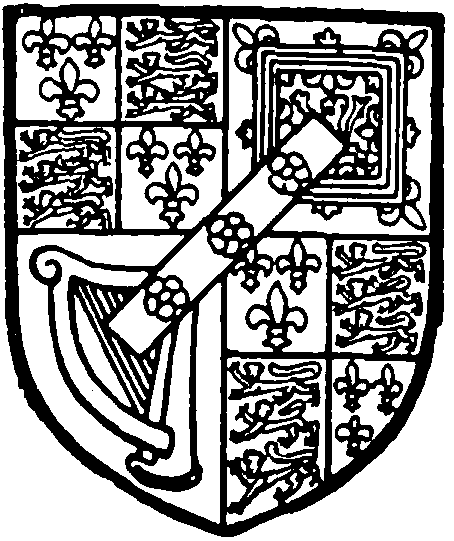
Beauclerk. Quarterly first and fourth France and England quarterly, second Scotland, third Ireland, over all a sinister baton gules charged with three roses argent.
The new possessor was born at Shevington in Standish. In his youth he was the driver of the only hired carriage then in Liverpool; having been taught at a night school he went out to Jamaica, where he amassed a fortune of half a million sterling. (fn. 78) Speke became the property of his nephew, Richard Watt of Bishop Burton in Yorkshire, who died in 1812, (fn. 79) and was succeeded by his son, grandson, and great-grandson, each named Richard. The last of these, who died in 1865, was succeeded by his only child Adelaide (born 19 May 1857), the present lady of the manor. (fn. 80)
Speke Hall stands a little back from the shore of the Mersey, protected by belts of trees on the west and north, and set in picturesque grounds which as yet show little traces of damage from the chemical fumes which have done so much to destroy the beauty of the neighbourhood.
The house is an admirable specimen of timber construction, being built round a central court and enclosed by a wide moat, now dry and grass grown, the chief entrance being on the east, reached by a stone bridge of two arches spanning the moat.
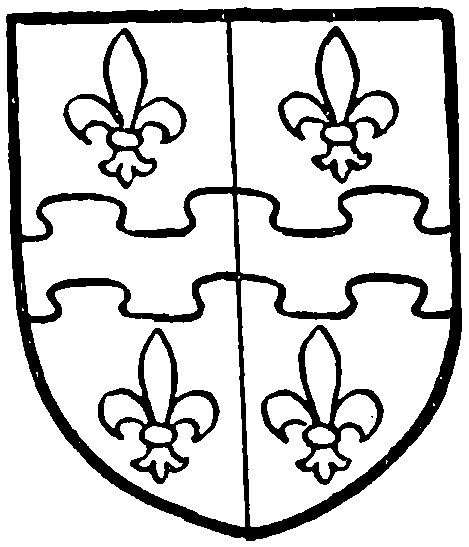
Watt of Speke. Per pale or and azure, a fesse nebulée between four fleurs-de-lis, all counter-changed.
The hall is at the north end of the west wing, with the great chamber adjoining it on the north, the kitchens and offices being in the south wing, and the chief living rooms on the north and east. The buildings appear to be of two main dates, the south and east wings, except the north end of the latter, being the parts built by Edward Norris about 1598, while the north and west wings are of earlier detail, and probably date from the beginning of the sixteenth century. There is nothing to show that anything older than this is standing.
Edward Norris's work follows the older building in general design, and is apparently a completion of an interrupted scheme, the main differences being in the smaller details, which show a marked renaissance feeling completely absent from the older work. The irregular setting out of the court is probably due to an alteration from the design during the course of the later work, the kitchen wing being swung southwards in order to allow room for a bay window in the southwest angle of the court, making an architectural balance to the hall window in the north-west angle. This care for symmetry is a sign of the growth of classical taste characteristic of the latter part of the sixteenth century, and is worthy of note in a building which in other respects is thoroughly Gothic in general effect.
The barge boards and gable finials are the most elaborate features, the cinquefoiled traceries of the former being imitated, though with somewhat clumsy detail, in the later sixteenth-century work. The rich quatrefoiled panelling of wood and plaster, which is used to such excellent purpose in many of the old timber houses of the district, occurs in the courtyard and garden front of Speke, and the close set upright and diagonal timbers, and the variety and unequal projections of the gables, make the house as a whole perhaps the most attractive of all the beautiful timber-built houses which the county has to show. The roofs are covered with heavy grey stone slates, making a charming contrast with the black and white walls, and a panelled cove runs round the walls and across the gables at the eaves level. The main framing—posts, sills, and heads—is of oak 10 in. square, resting on dwarf walls of red sandstone ashlar, and towards the court the uprights, set about 5 ft. 6 in. apart on the south wing, and about 7 ft. elsewhere, are marked out by shallow wooden 'buttresses' with profiles suggested by the weatherings of masonry buttresses, many times repeated.
The bridge by which the entrance doorway is reached is built of sandstone ashlar, with two roundheaded arches and cutwater piers, and the doorway itself has a four-centred sandstone arch flanked by wing walls of masonry with heavy stone cresting, and is set in a projecting bay with a six-light window on the first floor. In the spandrels of the arch are the initials of Edward Norris and his wife Margaret (Smallwood).
The bay is more richly treated than the rest of the front, having a band of quatrefoils in the gable, and below the first-floor window and above the latter band is Edward Norris's inscription: 'This worke twenty-five yards long was wholly builded by Edw: N: Esq: Ano. 1598.' To the left of the entrance, when the outer door is passed, is the porter's lodge and the passage to the kitchen wing, and on the right a wider doorway opening to the corridor running round the inner side of the north and east wings, and giving access to the ground-floor rooms. South of the porter's lodge is a projecting bay, the ground-floor room in which has an arched head to its east window, and is said to have been the chapel; it is now a servants' hall. North of the main entrance is a large room with fireplaces at each end, and doubtless once divided into two; it is now used as a morning room. At the north-east angle of the house, where the junction between the early and late sixteenth-century work occurs, is a large gable projecting eastward—the details of its windows showing that it belongs to the older part of the building. Edward Norris's work begins from this point southwards, and includes all the rest of the east wing, about 80 ft. long, thus agreeing fairly well with the 25 yds. mentioned in his inscription over the entrance doorway.
The rooms on the ground floor of the north wing are for the most part unimportant, the largest being that at the east end, now a billiard room; but at the west end is the chief staircase, nearly opposite the upper entrance to the hall, and beyond it the great chamber, a splendid room with a richly worked plaster ceiling, and a large fireplace at the north-west, lighted by an eight-light window on the west, and a deep bay window on the north. The details of the latter show, however, that it is of later date than the room. Over the fireplace is a very elaborate chimney-piece of wood, with many figures representing members of the Norris family; the execution is very inferior to the general details of the room. At the south-west angle a small stone entrance porch has been added, bearing the date 1612, and the initials of William Norris and his wife Eleanor (Molyneux).
The great hall, which adjoins the great chamber on the south, is of the full height of the two stories of the house, and has a flat panelled ceiling with diagonal ribs and heavy moulded beams, and at its upper or north end a canopy with a panelled soffit over the site of the high table, which with the dais on which it stood has long since been removed. The width of the hall is 25 ft. 6 in., and its extreme length 33 ft. At the north-east is a fine bay window of four canted sides, with twelve square-headed lights divided by a transom, and a flat panelled ceiling with moulded ribs converging to a carved central boss. On the transom is carved a vine trail. On the opposite side of the hall, at the north-west corner, is a rectangular chamber opening with its full width to the hall, but of less height, and having a large fireplace on the south, and a six-light window on the west. The hall itself is lighted by a large four-light window on either side below the projecting bays, and has also on either side a range of upper windows. The four-light windows are insertions of the end of the sixteenth century or later, and it is probable that the body of the hall was originally lighted from the upper windows only. The greater part of the south or lower end of the hall is taken up by a great fireplace with a heavy carved wood lintel and seats in the ingle. Above the fireplace is a panelled and embattled front, in plaster, and to the west of the fireplace, over the entrance from the screens, is a wooden gallery, entered from the first-floor rooms to the south. The hall is completely panelled in wood, that at the upper end being specially notable, both for its deep mouldings and free-standing fluted pillars, and for the tradition that it formed part of the loot of Holyrood Palace in 1544.
From the screens at the south end of the hall a porch gives access westward to the gardens through a sandstone arch with renaissance cresting, built in 1605 by Edward Norris, and bearing his initials and those of his wife Margaret (Smallwood). The rooms south of the hall passage are of little interest internally, that immediately to the south-west being used as a drawing-room, and the others as housekeeper's room, cellar, store-room, and butler's pantry. The bay window corresponding to that at the north-east of the hall is, and has been from the first, divided into two stories, the upper being now used as a bedroom. The drawing-room and butler's pantry with the rooms over them belong to the older work, the block now containing the cellar, &c., being added to range and harmonize with the former, but clearly showing its later date by the differences in detail.
The external elevation of the range just described, facing westward to the garden, forms one of the most charming pieces of domestic architecture in the country. The gables have lost, in all cases but one (that over the north-west bay of the hall), the carved barge boards which so greatly enhance the effect of the east front, and only three of the tall hip-knobs remain, but these defects are more than compensated for by the variety and richness of the timber-work, and the different sizes and projection of the gables. The frames of the first-floor windows, set out slightly from the wall face, and the moulded brackets which carry them, are good examples of a class often found in the Lancashire houses.
The southern wing contains the kitchen and offices, its salient feature being the massive stone chimneys which take up nearly the whole of the south front. From its west end a modern range of buildings runs southward, bounding the paved yard, from which a bridge leads southwards over the moat to the site of the farm buildings.
On the first-floor of the house corridors run round the inner sides of the north, east, and south ranges, opening to a series of rooms which, apart from their furniture, have little architectural interest. The roof space is, as usual, plastered and clay-floored, but has one unusual feature, a small room with a fireplace over the servants' hall, which, as has been said, may have been the chapel. There is a small staircase to this room. It is worthy of note that the ridge of the roof of the north wing is over the centre of the range of rooms on the upper floor, and not over that of the full width of the range including the corridor, which has separate timbers carrying down the slope of the roof. It is possible that this may imply a retention of an older arrangement of the house; but nothing else in the detail gives any support to the idea. The gabled roof of the north-east bay window of the hall is apparently a later addition, as the embattled plate of the hall continues behind it, and there is also the head of an upright timber with part of an applied wooden 'buttress' like those elsewhere in the court.
A MS. inventory of household stuff at Speke Hall in 1624, preserved at Rydal Hall, Westmorland, (fn. 81) gives a list of the rooms then existing. It is not possible to identify all the rooms mentioned, and the order in which they are named does not give much help, but the list is of sufficient interest to be quoted in full:—
The chamber called the little nursery
The chamber called the great nursery
The withdrawing chamber
The chamber over the compast window
The chamber at the stair-head
The chamber over the old chapel called Sir
Thomas Gerard's chamber
The painted chamber
My lord's chamber
The chamber over the school
The inner chamber
The chamber over the gates
The Chapel chamber
The chamber next to Mr. Tyldesley's
Mr. Tyldesley's chamber
The School chamber
The seller chamber
The great parlour
The little parlour
The hall
The new little Chapel
My mistress' chamber
Mrs. Wolfall's chamber
The kitchen chamber
The corn chamber at the stairhead
The inner chamber
The trunk chamber
The cheese chamber
The chamber over the little parlour
The inner chamber
The old Chapel (chests and lumber)
The store house
The closet over against the kitchen chamber
The porter's chamber (bedstocks)
The brewer's chamber (bedstocks)
The chamber next the new bridge where the
gardens lie
In the New Building:—
The chamber next the brew house
The chamber where the chimney is
The tailor's chamber
The dove house chamber
The work house (bedstocks)
The horse keeper's chamber
The chamber where the servants lie, which is on
the left side of the stairs
The chamber on the right side of the stairs
The ox keeper's chamber
The chamber over the dog kennel
The chamber adjoining the stairhead
The Upper Gallery
The Lower Gallery (pikes, &c.)
In the false roof (int. al. one canopy, one clock
and a bell, some armour)
In the outcast window by the kitchen where the
yeomen dine
The dey house
The brew house
The Boulting house
The bread loft
The Kitchen
The Dry larder
The wet larder
The Scullery
The new kitchen
The feather house
The buttery
It will be seen that the first sixteen rooms seem to be on the upper floor. Among them the chamber over the gates is perhaps that over the main entrance, and the chamber over the compast window may be that in the upper part of the bay window at the south-west angle of the inner court, already noted.
The great parlour and little parlour, mentioned next to the hall, would appear to be the great chamber and the room at the north-west angle of the hall. For the 'new little chapel' it is difficult to suggest a site. The mention of the new building should point to Edward Norris's work, done in 1598 and after, and the upper and lower galleries may be the inner corridors. Some of the rooms mentioned may have been detached from the main building—the deyhouse or dairy, for example, would most likely be so.
At the present day the house is rich in old furniture of all kinds, and has some good tapestry. There is a little old glass in the upper windows of the hall, with the initials of William Norris, which must date from the early part of the seventeenth century.
The portion of Speke granted, probably, by Adam de Molyneux to his son Roger descended as stated above to Roger's son Richard and his grandson Sir John. (fn. 82) Richard son of Roger de Molyneux in 1314 made a grant to John his son of the moiety of his land in Speke, with the moiety of the windmill, the homage and service of John le Norreys, William de Laghok, Roger de Culcheth, William de Molyneux, and Margery, wife of Adam le Roo, for lands which they held of the grantor, rendering yearly £12 of silver. (fn. 83) In 1328 Beatrice, widow of Richard, made grants of her dower-right in the Bankfield to her son John, and in other lands to John le Norreys and Alan his son and Emma, wife of Alan. (fn. 84)
Sir John Molyneux made various agreements as to the property, already alluded to, and about the end of his life granted to Margery, formerly wife of Richard de Bold, and to trustees, his manor in the vill of Speke, and all his lands there, including the wood called Speke Greve, with the homage of Sir Henry le Norreys, the heirs of Richard de Laghog, John le Molineux of Oglet, Cecily le Roo, and the heirs of Roger de Culchet. (fn. 85)
Early in 1366 Henry de Charnock granted to William his son and his wife Margaret, all his lands and tenements in the vill of Speke, with homages, rents, wards, reliefs, services of free tenants, and their appurtenances and easements as fully as Sir John de Molyneux had held them after the death of his father Richard. (fn. 86) The Molyneux manor thus descended to the Charnocks in accordance with the settlement of Richard de Molyneux, and the family continued to hold land here till the sixteenth century. (fn. 87) The estate seems then to have been acquired by the Norris family. (fn. 88)
Having thus traced the main line of Molyneux of Speke, mention must be made of William de Molyneux, son of Roger, and younger brother of Richard. He appears to have been settled on a small holding in Oglet. (fn. 89)
The name of Molyneux frequently occurs in the Norris leases and documents as that of farmers in the neighbourhood of Speke. In 1584 Edward Norris granted a lease in Garston to Thomas Molyneux, Edward his son, and Margaret wife of Edward, in consideration 'of the good, faithful, diligent, and acceptable service of Thomas and Edward Molyneux.' The last named died about 1618, and the lease was renewed to his son Robert and Elizabeth his wife. (fn. 90)
Speke itself gave a name to a family, or perhaps several families. In 1292 Roger son of Henry de Speke claimed from Alan le Norreys and his wife Margery a tenement in Speke by Hale of which he said they had disseised him. He was non-suited. (fn. 91) This Speke family held or farmed the mill of Speke, for in 1315 there was a release by Adam son of William de Speke to Adam son of Roger de Speke, miller, and Alice his wife and their heirs, of land in the field called Oglet Siche; and William son of the former Adam joined in the act. (fn. 92) Richard son of Gilbert de Speke transferred to Alan le Norreys in 1334 two oxgangs of land in Speke. (fn. 93)
William de Molyneux of Sefton granted to William de Allerton, for his homage and service, 22 acres in Speke—11 near Walleton near the wood of Speke, and 11 near Oglet Siche—to hold in fee and inheritance of the grantor with common easements, wood and mast, rendering yearly 5s. of silver. (fn. 94)
The Mossley family's holding was also originally granted by William de Molyneux, who gave Robert de Mossley for his homage and service 10 acres in three different places in Speke, and a fishery between Walton brook and Lithe brook, with the usual rights of wood and mast, at a yearly rent of 2s. 6d. (fn. 95) Robert seems to have been followed by Alan de Mossley, who married Ellen Erneys; in 1334 Richard Erneys granted to Alan and Ellen his wife a tenement in Speke by rendering a red rose yearly. (fn. 96)
The hamlet of Oglet gave its name to a family. In 1344 John son of Roger de Oglet granted to Alan le Norreys an acre there extending from the sea to the moor; and John son of John de Oglet in 1358 enfeoffed Robert de Yeldesley, chaplain, of all his lands, which Robert regranted to John and Emmot his wife, with remainders to Alice and Margery, daughters of Roger Alkoc. (fn. 97)
The rental of Thomas Norris, compiled about 1460, gives the names of all the tenants with their rents and services. (fn. 98) The demesne lands, 'lying to the hall,' included Oglet wood with the Branderth, the two 4-acre heys with Danyes croft, Holboche field, Coningry field, Wethersfield with the Calf hey, the hey by the greenway side, the near and far 2 acres in the moss. The windmill, 26s. 8d., was added later. The 'averages' or day-works expected from the tenants are recorded: Every tenant that pays 10s. of rent or above gives a day with his plough and another with his 'worthynge' cart; if his rent is under 10s., he shall bring his horse and his 'youle' to fill a day. Every tenant holding above 10s. shall fetch two cartfulls of hay from Redall meadow; under 10s., a day to make hay or else give 1d. Also every man a day to delve turves and every house a day to 'shear' in harvest or else pay 2d.
The Ven. John Almond or Lathom, known on the mission as Molyneux, was born at Speke of recusant parents about 1565 and went to school at Much Woolton. He was afterwards taken to Ireland. Thence he went to the College at Rheims and to Rome, where he was ordained priest, returning to England as a missionary in 1602. After labouring for ten years he was arrested, tried and condemned for high treason on account of his priesthood, suffering in the usual manner at Tyburn on 5 December, 1612. (fn. 99)
The recusant roll of 1641 contains a long list of names in Speke and Garston, including the familiar ones of Holme, Challinor, Molyneux, Mercer, and Plumbe. (fn. 100) On 29 March, 1714, Nicholas Blundell of Crosby records: 'I went in the forenoon to Edward Lathom's in Speke Town in hopes to have heard prayers [i.e., mass]. I found Mr. Maor there, but he had done before I came.' (fn. 101) William Harrison and John Rice as 'Papists' registered estates in Speke in 1717; Rice had land also in Eccleston. (fn. 102)
In connexion with the Established Church, All Saints' was built in 1876. (fn. 103) The vicarage is in the gift of Miss Watt of Speke Hall.