A History of the County of Lancaster: Volume 3. Originally published by Victoria County History, London, 1907.
This free content was digitised by double rekeying. All rights reserved.
'The parish of Ormskirk: Introduction, church and charities', in A History of the County of Lancaster: Volume 3, ed. William Farrer, J Brownbill (London, 1907), British History Online https://www.british-history.ac.uk/vch/lancs/vol3/pp238-246 [accessed 30 April 2025].
'The parish of Ormskirk: Introduction, church and charities', in A History of the County of Lancaster: Volume 3. Edited by William Farrer, J Brownbill (London, 1907), British History Online, accessed April 30, 2025, https://www.british-history.ac.uk/vch/lancs/vol3/pp238-246.
"The parish of Ormskirk: Introduction, church and charities". A History of the County of Lancaster: Volume 3. Ed. William Farrer, J Brownbill (London, 1907), British History Online. Web. 30 April 2025. https://www.british-history.ac.uk/vch/lancs/vol3/pp238-246.
In this section
ORMSKIRK
The parish of Ormskirk comprises six townships anciently arranged in four quarters, paying equally to the county lay; viz. (i) Ormskirk and Burscough, each paying equally; (ii) Lathom, (iii) Scarisbrick, (iv) Bickerstaffe and Skelmersdale; each quarter paid £2 1s. 8d. when West Derby hundred paid £100. (fn. 1) To the ancient fifteenth Burscough and Ormskirk paid nothing, Lathom £2 19s. 4d., Scarisbrick £3 9s. 1¼d., Bickerstaffe £1 2s. 6¼d., and Skelmersdale £1 11s.—in all £9 1s. 11½d., when the hundred paid £106 9s. 6d. (fn. 2)
The parish is over nine miles in length from north-west to south-east, and about five miles in width from Ormskirk to the River Douglas. The area is 31,009½ acres. The land is occupied as follows: Arable, 23,578 acres; permanent grass, 3,702; woods and plantations, 961. A ridge rising about 240 ft. above the Ordnance datum crosses it from east to west; on the southern slope lies Bickerstaffe, all the rest to the north. The River Tawd and Eller Brook flow northwards through Lathom to join the Douglas; the Mere Brook, which derives its name from being for a while the boundary between Ormskirk and Aughton, formerly ran into Martin Mere, on the northern boundary of the parish, now drained. Several brooks flow south through Bickerstaffe, to join the Alt or the Mersey. Originally both northern and southern boundaries were formed by a series of mosses; but these have now been drained.
The parish derives its name from the church. (fn. 3) The present boundaries indicate Ormskirk township area to have been taken from Lathom and Burscough; so that some early lord of Lathom was perhaps the founder of the church, his name being preserved by it. (fn. 4)
The part of the parish lying on the northerly slope of the ridge running westward from Upholland to Aughton was before the Conquest included in the privileged three-hide area, (fn. 5) while the portion which lay upon the ridge and to the south of it—Skelmersdale and Bickerstaffe—was outside it. This distinction did not endure; all the northern portion was granted to the lords of Lathom in thegnage, the southern townships being held by others as part of the forest fee, or in thegnage. It is interesting to notice that the earls of Derby, descendants of the Lathoms, are still the most prominent personages in the parish, holding a fragment of the original lordship—Newburgh; while another part—Burscough and Ormskirk with the advowson— was regained after the suppression of the priory, and Bickerstaffe has been acquired by marriage.
It is difficult to find how far the religious changes of the sixteenth century affected the district, apart from the suppression of Burscough Priory. The third earl of Derby was long opposed to Protestantism, and the adherents of the Roman Church have always been numerous, but no open opposition was made to the re-establishment of the Edwardian services and doctrines by Elizabeth, though the vicar was disaffected. Ormskirk is named in 1586 as one of the places which had entertained John Law, a seminary priest, (fn. 6) but the number of 'convicted recusants' in the parish appears to have been insignificant even before the more indulgent days of the Stuarts. In 1590 the Scarisbricks and Gorsuches were of evil note in religion, and Stanley of Bickerstaffe indifferent; in 1628 there seem to have been only three of the landowners convicted of recusancy, and paying double, but the lists of minor recusants and non-communicants in 1626 and 1641 are of great length. (fn. 7)
Besides the manorial lords—the earl of Derby, Scarisbrick, and Stanley of Bickerstaffe — the freeholders in 1600 numbered nineteen. (fn. 8)
The confiscations of the Parliamentary authorities in the Civil War period affected several families in the neighbourhood, the principal being, of course, that great 'delinquent' James earl of Derby. In Ormskirk itself a small case was that of Ellen wife of John West. (fn. 9) In Bickerstaffe besides the Mossocks, Peter Cropper and John Gore were victims. (fn. 10) Anthony Beesley of Burscough, aged ninety-eight years, and 'like to be turned out' of his house and 2½ acres of land, 'and to go a-begging,' asked to be allowed to rent it, as it had been sequestered. This was granted. (fn. 11) Cuthbert Halsall, yeoman, had not borne arms against the Parliament, but being a recusant his house and lands were sequestered; in 1650 he conformed to the Established religion, took the oath of abjuration of Popery, and afterwards asked for the restoration of his property. (fn. 12) Alexander Breres of Lathom had been within the garrison of Lathom House; he, however, took the National Covenant in March, 1644, and at the second siege showed himself friendly to the attacking force. In 1647 it was ordered that 'a fifth of his estate, except the demesne of Croston, should be allowed to so many of his children as should be brought up in the Protestant religion.' (fn. 13) At Scarisbrick the two families—Scarisbrick and Gorsuch — suffered for their political and religious disagreements with the ruling powers. Skelmersdale seems to have escaped notice, except as involved in Lord Derby's estates.
On the Restoration Lathom ceased to be the chief residence of the earls of Derby, a change which must have had a considerable effect on the district.
The hearth tax return of 1666 (fn. 14) gives some indication of the prosperity of the parish; the list for Ormskirk town seems to be missing. In Burscough there were four houses with three hearths and above, James Starkie's having twelve; in Lathom twentytwo; (fn. 15) in Scarisbrick eleven; (fn. 16) in Bickerstaffe eight; (fn. 17) and in Skelmersdale nine. Nonconformity made its appearance at Ormskirk and Bickerstaffe, while at the latter place a Quakers' meeting-place had been established. The Oates Plot caused some renewal of persecution of the adherents of the Roman Catholic faith. (fn. 18)
The revolution seems to have been welcomed in the district, the earl of Derby taking the side of the Prince of Orange. The rising in 1715 brought suspicion upon Robert Scarisbrick, who on trial was acquitted, and upon one or two others in the parish. (fn. 19) At the consequent 'registration of Papists' estates,' a considerable number of properties were enrolled. The rebellion of 1745 had no such ill results in the parish. More provision for education was attempted at this time, and material prosperity was advanced by the making of the Leeds and Liverpool Canal in the latter part of the century, and of the railway in the next; also by the opening of coal mines in the Skelmersdale district about fifty years ago. Apart from these, however, the main occupation of the people has been farming, the industries which from time to time have flourished at Ormskirk not being on a large scale.
Pennant in 1773 passed through the parish, and from his description the following portions are quoted to serve as an introduction to the more detailed accounts to be given: 'Four miles further [than Lydiate] lies Ormskirk, a neat little town with four well-built streets crossing each other. Its only trade is the spinning of cotton for the Manchester manufactures and thread for sail cloth. It has long been in possession of a fair and market… . The church is seated at the upper end of the town, and is remarkable for its two steeples, placed contiguous, the one a tower the other a squat spire… . At about two miles distant from Ormskirk I turned into a field to visit the site of the priory of Burscough… . Nothing is left of this pile but part of the centre arch of the church, and instead of the magnificent tombs of the Stanleys, which till the Reformation graced the place, a few modern gravestones peep through the grass, memorials of poor Catholics who fondly prefer this now violated spot… . At a little distance east of Burscough, on an eminence, stands Lathom Hall, a palace built by Sir Thomas Bootle, knight, chancellor to Frederick, late Prince of Wales. He was bred to the law, and raised by his profession vast wealth. He, dying a bachelor, left his estates to his brother, who had been captain of an East India ship, whose only daughter transferred them into the honourable house of Wilbraham, by marrying with Richard, son of the honest advocate Randle Wilbraham, a cadet of the house of Townsend of Nantwich, who had raised a large fortune with a most unblemished character. Lathom is placed on a most barren spot, and commands a view as extensive as dull… . (A) singular anecdote is preserved, serving to show the pride of high lineage and the vanity of low. The late earl of Derby had on sale a place near Liverpool called Bootle, which Sir Thomas was particularly desirous of, through the ambition of being thought to have been derived from some ancient stock. The earl refused to part with it to this new man, who with proper spirit sent his lordship word— Lathom being then to be sold—that if he would not let him be Bootle of Bootle he was resolved to be Bootle of Lathom… . From Lathom I descended and passed over Hosker Moss, leaving on the right some beautiful hills wooded and well cultivated; crossed the River Douglas at Newburgh… .' (fn. 20)
CHURCH
The church of St. Peter and St. Paul (fn. 21) consists of chancel with a large south chapel and north vestry, nave with north and south aisles, tower and spire at the west end of the south aisle, and a second tower at the west of the nave. It is finely placed on high ground to the north of the town, the land sloping down from all sides of the site, the steepest slopes being to the west and north. (fn. 22)
The earliest part of the building is the north wall of the chancel; its date is about 1170, and it forms the only remaining fragment of a church consisting of a chancel with probably aisleless nave, whose internal dimensions were approximately, chancel 30 ft. by 18 ft., and nave 65 ft. by 24 ft. No evidence as to its western termination can be deduced from the plan, and the chancel may have been shortened from its original size. No doubt this building passed through the regular process of enlargement by the addition of aisles and chapels, but little positive evidence of this remains. In 1280 or thereabout a chapel was added on the south of the chancel, opening into it by two arches. No fourteenth-century work is to be seen in the church, but to the fifteenth century belong the south-west tower and spire, the east wall of the chancel, part of the west wall of the north vestry, and probably the walls of the Scarisbrick chapel. The south-west tower gives the key to a great deal of the history of the church. Looked at in connexion with the present plan it seems to stand awkwardly, especially with regard to the south arcade of the nave. But an inspection of the north face of its north-east pier shows that when it was built the south arcade of the nave was not on its present line, but further south, and the tower was built against the southern side of either the first pillar from the west, or the western respond, of this arcade; the north-east angle of the tower pier, projecting beyond the sight-line of an arch of the arcade, being cut back to that line to avoid the partial blocking otherwise caused. Now if the plan of the present church be examined, it will be seen that the centre line of the nave is not the same as that of the chancel, but roughly speaking a foot to the north of it. But over the eastern arch of the large western tower is the weather moulding of a roof which preceded the present nave roof, and its centre line is exactly that of the chancel, or in other words, that of the twelfth-century church. Taking this line for a centre, it will be found that the present north arcade, and the former south arcade, against which the south-west tower was built, are equidistant from it, which means that they occupy the line of the nave arcades of the church in its earlier condition, and according to the usual process of development the line of the walls of the twelfth-century nave. So that the dimensions of the early church can be laid down with some accuracy.
Again, on the east face of the south-west tower is a gabled weather-moulding which, taken in conjunction with a straight joint in the masonry of the east face of the south-east pier of the tower, gives the width of the south aisle of the nave at the time the tower was built. Whether it was coeval with or earlier than the tower cannot now be determined; the fact of its being out of centre with the tower arch would suggest that it was not built at the same time, and the existence of a south arcade earlier than the tower demonstrates the existence of an earlier aisle. Later than the tower it cannot be, as the weathering is part of the original masonry and not an insertion.
As has already been said, the weathering shows that the aisle roof was gabled, and not a lean-to; and this raises the question of what was its east end, and how did it abut on the late thirteenth-century south chapel at the east of the church. The form of roof of this chapel cannot now be known, but the height of the arches in the south wall of the chancel makes it probable that it was a lean-to roof, and not gabled. But whichever it was, a little calculation will show that its pitch could not have been the same as that of the aisle roof, and that therefore the two roofs could not have run in one line from east to west. No decisive argument can be based on this, but the existence of a south transept is at least suggested, and further evidence is available on the point. The present nave arcades, which are entirely modern, replace an arcade of four bays of sixteenth-century date, whose east pier on the south side was level with the west wall of the Scarisbrick chapel, and between it and the western respond of the thirteenth-century arcade in the south wall of the chancel was an arcade of two bays of a totally different character from the rest. In the north arcade there was a corresponding eastern pillar, but as it was a complete pillar, and not a respond, it is clear that the arcade ran further eastward, and that consequently there was no north transept, at any rate after the building of the arcade. But any argument based on the positions of these arcades is weakened, as far as it refers to the earlier history of the church, by their late date, which will shortly be referred to.
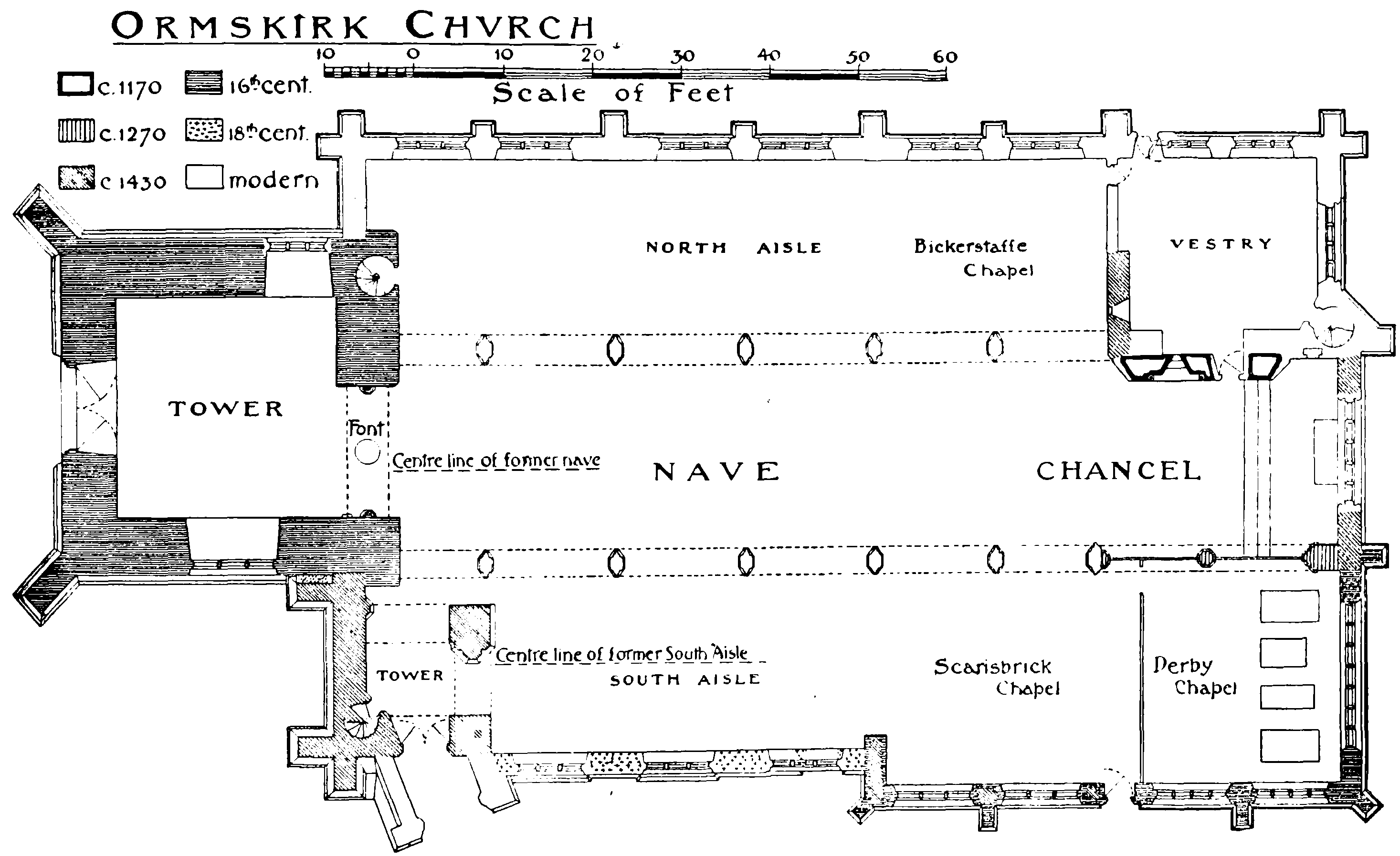
ORMSKIRK CHURCH
In the sixteenth century a great deal of building was undertaken, as may be shown both by documentary evidence and by actual remains. (fn. 23) The great west tower may be dated from 1540–50. The fact that on the eastern face of this tower the apex of the weather-moulding is on the centre line of the early nave shows that at this late date the nave arcades were almost certainly in their original position, and that the south arcade did not occupy its present site till after the building of the west tower. But it must have been built almost at once after this, and the words of John Bochard's bequest evidently point to other work than the tower being in hand. The plan shows that the old south arcade would give a very lopsided effect with the newly built west tower arch, and that the obvious remedy for this would be to rebuild it further north, on the line of the south wall of the chancel; and this is exactly what happened. Whether any sort of transeptal arrangement remained at this time is not clear, but the evidence given above suggests that it did, on the south side at any rate. In the late restoration both arcades and the whole of the north aisle were rebuilt, and any further light they may have had to throw on the history of the church is finally destroyed. The south-east or Derby chapel is, with the exception of the eighteenth-century south aisle wall, the latest piece of work in the church, the window mouldings showing distinct Renaissance detail, and it seems that the windows of the Scarisbrick chapel were altered about the same time, i.e. in the second half of the sixteenth century. (fn. 24)
The church is built throughout of wrought stone, which has been considerably renewed from time to time, (fn. 25) and the chancel contains no trace of mediaeval ritual arrangements. The twelfth-century window in the north wall is 2 ft. 10½ in. wide inside, with a recessed opening flanked by jamb shafts with bases and scalloped capitals, both modern, carrying a semicircular arch moulded with a keeled roll between hollow chamfers. It is 10½ in. wide at the outer face with a small bevel at the external angle. The south arcade of the chancel, of late thirteenth-century date, has octagonal shafts with moulded capitals and bases and arches of two plain chamfered orders. In the vestry north of the chancel is a single squareheaded light of the fifteenth century, looking westward into the north aisle, and retaining its original iron stanchions and saddlebars. It has never been glazed, and was always internal, as now, and probably belonged to the mediaeval vestry. The south-east or Derby chapel is enclosed on the north and west by a plain seventeenth-century wooden screen with turned balusters and wrought-iron cresting of fleursde-lis. It has a large east window of seven lights, with a low four-centred arch and a transom at the springing line, and plain uncusped lights in the head. In this chapel are three effigies, placed here at a recent restoration, and said to be those of Thomas, first earl of Derby, and his two wives.
The Scarisbrick chapel, west of the Derby chapel, retains no ancient features; the two windows on the south show detail similar to those in the Derby chapel, while their tracery is of an earlier type, but in both the stonework is modern.
The south aisle wall, of eighteenth-century date, retains its plinth and parapet, and the jambs of a blocked doorway at the east end; the three windows are modern three-light insertions in fifteenth-century style. The north aisle is completely modern, though apparently following the lines of an older building. A few fragments of old work are built into the inner face of its north wall; a piece of a crocketed sixteenthcentury label, and what looks like part of the coarsely worked base of a clustered pier. (fn. 26) Both nave arcades are modern, of fifteenth-century style, and replace the sixteenth-century arcade with octagonal pillars mentioned above.
The two towers standing together at the west end of the church form an unusual and not altogether happy composition. The south-west tower is of a type found elsewhere in the neighbourhood, and stands in point of date between the similar towers of Aughton and Halsall. In plan somewhat irregular, as having been fitted to the lines of an existing building, it is, roughly speaking, a square of 18 ft. at the base, with buttresses of 4 ft. projection at the external angles and a high moulded plinth. There is a vice in the south-west angle. The entrance doorway is on the south side, and is now covered by a modern porch; the north and east sides have open arches toward the church. Over the entrance doorway is a two-light window of original date with a quatrefoil in the head. The second stage of the tower forms the transition from square to octagon, and the third or belfry stage is octagonal with two-light windows with quatrefoils in the head in the four cardinal faces, surmounted by a plain parapet, from within which rises the plain octagonal stone spire. The second or western tower is exceedingly massive, 38 ft. square at the base with walls 6 ft. 6 in. thick. It is said to have been built to contain the bells from a suppressed religious house, probably Burscough, and its date (1540–50) and great size go some way towards confirming the tradition. It is clear that about this time a tower larger than the existing south-west tower was needed, whether for taking a large ring of bells lately acquired, or for some other reason; and as the south-west tower was not pulled down, the new one could not be built in the normal position of a west tower, i.e. with its axis on the centre line of the nave, unless its diameter were to be greatly reduced. This was, as it seems, impossible, which suggests that the size was determined by some pre-existing cause, and therefore the tower was built as far to the south as might be, its south wall close up to the north-west buttress of the older tower, and its eastern arch springing with no respond from the inner face of the south wall, quite out of centre with the square of the tower; but in spite of this the north aisle was overlapped to half its width. The details of the work are coarse, as might be expected; there is a high moulded plinth, cut away on either side of the west doorway in a manner which suggests that there has been at one time a wooden porch over the entrance. The west doorway has continuous mouldings. In the ground stage of the tower are three-light windows on north and south, the mullions of the north window being modern. There is a vice in the north-east angle, entered from the east, which is the original arrangement; but before the last restoration there seems to have been an entrance from the west through the jamb of the north window. In the belfry stage are two three-light windows on each face, with mullions intersecting in the head; a plain embattled parapet completes the elevation.
There are a Scarisbrick brass (fn. 27) and some Stanley monuments; also monuments of John Ashton of Penketh, who died in 1707, and Alice wife of the Hon. and Rev. John Stanley, who died in 1737, and others. The registers date from 1557. (fn. 28)
There is a peal of eight bells. (fn. 29) It is supposed that some or all of them came from Burscough Priory, but that the inscriptions have been lost in re-casting, with the exception of that on the treble. Nos. 4 to 7 are the work of Abraham Rudhall of Gloucester, and 2, 3 and the tenor of Thomas Rudhall. In the spire is a small bell, supposed to be a re-cast in 1716 of the old Saints bell.
Two of the chalices are dated 1633, and a silver chalice and paten 1674; and there is other plate of the eighteenth century. (fn. 30)
The churchyard was several times enlarged and improved during the last century. (fn. 31)
ADVOWSON
The first express mention or the church is in the confirmation charter of Burscough Priory, in 1189 or 1190, by which Robert lord of Lathom conferred on the new house 'the church of Ormskirk with all its appurtenances.' (fn. 32) This was ratified by successive bishops of Lichfield and by Pope Gregory IX in 1228. (fn. 33) But little is known of the early incumbents; the church is so near to the priory that it is probable the canons themselves took turns in serving it. It was not very long, however, before the bishops of Lichfield intervened. William de Cornhill, bishop from 1215 to 1220, judged it unfit that canons regular should meddle with temporal matters, and, allowing them not only the two-thirds of the revenues they already had, but the other third also, in compassion of their poverty, ordered that they should appoint a suitable vicar to have charge of the church, answering to them in respect of temporalities, but to the bishop as to spiritualities. (fn. 34) In 1285 Bishop Roger de Meulent modified this, by allowing that on the resignation or death of the vicar then holding, one of the canons, being a fit and honest priest, might be presented, seeing that Burscough was so near to the church. (fn. 35) Alexander de Wakefield, appointed vicar in 1339, seems to have been dissatisfied at the provision made for him, and appealed to the bishop, who on inquiry found that the preceding vicar had had a competent manse and 4 acres of land assigned to him, besides a stipend of £10, all liabilities being discharged by the prior and canons. This the bishop confirmed, (fn. 36) and the new vicar and his patrons accordingly came to an agreement, which was many years afterwards ratified by Pope Innocent VI. (fn. 37)
At the valuation made about 1291 by authority of Pope Nicholas IV Ormskirk was found to be worth 20 marks a year. (fn. 38) At the inquiry of 1341 the ninth of sheaves, fleeces, and lambs was found to be worth 24 marks, Lathom answering for 12 marks, Hurleton with Scarisbrick 6, and Bickerstaffe with Skelmersdale 6. (fn. 39)
The valuation in 1534 made the rectory worth £31 13s. 4d. from tithes and offerings of all sorts; the vicar received the £10 stipend fixed 200 years before. (fn. 40)
After the suppression of the priory of Burscough the £10 was continued to the vicar (Robert Madoke) and his successors, with the profits of the house and land attached; and as the size of the parish rendered an assistant priest necessary, a grant of 20s. towards the tenth payable to the king was made. (fn. 41) The rectory was leased out by the crown (fn. 42) until, in 1610, it was granted to the earl of Salisbury and others, apparently as trustees for the earl of Derby. (fn. 43) It was sequestrated with the rest of the family estates during the civil war, and in 1650 the vicar had the profits of the vicarage house and glebe, about 4 acres, valued at £5 a year, and £1 a year bequeathed by James Blackledge of London; the old stipend of £10 increased to £21, payable by the crown, and beyond this, £50 out of the sequestrated estates in the hundred. (fn. 44)
A 'review' of the possessions of the vicarage made in August, 1663, describes the house as 'old'; it had a small barn and shippon, a garden, and about 4 acres of land, worth £5 or £6 a year. (fn. 45) Bishop Gastrell, about 1720, found the value of the vicarage to be £44, including the £21 pension from the duchy. There were six churchwardens, the jurors in the several township courts appointing one for each. (fn. 46)
The rectory appears to have been part of the dowry of Amelia, daughter of James the seventh earl of Derby, who married the earl of Atholl; in 1713 it was held by John earl of Dunmore. (fn. 47) 'The rectorial tithes were some time since,' wrote Gregson in 1817, 'the property of Colonel Francis Charteris, of infamous character, whose grandson, the late Lord Elcho, sold them to various impropriators.' (fn. 48)
The right of presentation to the vicarage was purchased by the earl of Derby in 1549 from Sir William Paget (fn. 49) and has remained with his successors to the present time.
The bishop of Chester in 1593 sanctioned a division of the body of the church into four equal parts, each appropriated to one of the quarters of the parish. The central alley and the main cross alley leading from the south door were to be 7 ft. wide, the minor alleys 5 ft. wide. It was found on measurement that the body of the church contained 218½ yds. 7¼ ft., and a little over 54½ yds. was accordingly the allowance for each quarter. Edward Scarisbrick, the earl of Derby (two), and Henry Stanley of Bickerstaffe then agreed upon the division. (fn. 50)
There was a stormy scene in the church about 1540, when Thomas Gorsuch caused the arrest of Richard Gillibrand, the collector of the Easter roll, to be made within the building, during the celebration of high mass on Easter Day, and while most of the inhabitants 'were diligently preparing themselves to receive the most Blessed Sacrament.' The accused retorted with charges of intention to 'murder, maim, or evil intreat' him, which made it necessary for him to apply for the warrant. (fn. 51)
The following is a list of the vicars of Ormskirk:—
| Instituted | Name | Patron | Cause of Vacancy | |
| c. | 1190 | Henry the Chaplain (fn. 52) | — | — |
| c. | 1275 | Gervase (fn. 53) | — | — |
| 15 Dec. 1298 | William de Lutton (fn. 54) | Pr. and Conv. of Burscough | — | |
| 30 Dec. 1306 | Robert de Farnworth (fn. 55) | " | — | |
| 1 May, 1309 | Henry de Lichfield (fn. 56) | " | res. R. de Farnworth | |
| — | Henry de Melling | — | ||
| 6 Dec. 1311 | Richard de Donington (fn. 57) | " | d. H. de Melling | |
| 28 Mar. 1339 | Alexander de Wakefield (fn. 58) | " | d. R. de Donington | |
| 31 Dec. 1341 | William de Bolton (fn. 59) | " | d. of A. de Wakefield | |
| 3 April, 1384 | John Spink (fn. 60) | " | d. of last vicar | |
| 16 Mar. 1422–3 | Richard de Lancaster (fn. 61) | " | res. J. Spink | |
| — | Thomas Bolton (fn. 62) | — | — | |
| 12 Mar. 1454–5 | John Marke (fn. 63) | Pr. and Conv. of Burscough | [depr. T. Bolton] | |
| 1 Nov. 1467 | Richard Ince (fn. 64) | " | d. J. Marke | |
| 2 Oct. 1489 | William Ambrose (fn. 65) | " | d. R. Ince | |
| — | Hugh Hulme (fn. 66) | " | — | |
| 10 Aug. 1506 | Henry Hill (fn. 67) | " | d. H. Hulme | |
| — | John Devyas (fn. 68) | " | — | |
| 15 Nov. 1530 | Robert Madoke (fn. 69) | " | d. J. Devyas | |
| 28 Jan. 1537–8 | Eliseus Ambrose (fn. 70) | The king | d. last incumbent | |
| 19 Feb. 1571–2 | Richard Ambrose (fn. 71) | Thomas Hopford, etc. | depr. Eliseus Ambrose | |
| 21 May, 1613 | William Knowles, M.A. (fn. 72) | Hugh Hesketh, etc. | d. of R. Ambrose | |
| 31 Mar. 1615 | Henry Ambrose, B.A. (fn. 73) | Earl of Derby | res. W. Knowles | |
| 29 April, 1628 | John Broxoppe, M.A. (fn. 74) | Lord Strange | d. H. Ambrose | |
| — | — 1643 | William Dunn (fn. 75) | — | d. J. Broxoppe |
| 7 Aug. 1656 | Nathaniel Heywood, M.A. (fn. 76) | Dowager countess of Derby | — | |
| 4 Oct. 1662 | John Ashworth, B.A. (fn. 77) | " | depr. N. Heywood | |
| 29 Jan. 1662–3 | ||||
| 9 Mar. 1679–80 | Zachary Taylor, M.A. (fn. 78) | Earl of Derby | res. J. Ashworth | |
| 12 April, 1692 | Archippus Kippax, M.A. (fn. 79) | " | res. Z. Taylor | |
| 21 Aug. 1718 | Christopher Gibson, B.A. (fn. 80) | " | d. A. Kippax | |
| 26 Dec. 1727 | William Knowles, M.A. (fn. 81) | " | d. C. Gibson | |
| 10 Feb. 1780 | Randal Andrews, M.A. (fn. 82) | " | d. W. Knowles | |
| 17 Dec. 1800 | James Stanley, M.A. (fn. 83) | " | d. R. Andrews | |
| 30 Oct. 1812 | Geoffrey Hornby, LL.B. (fn. 84) | " | d. J. Stanley | |
| 7 June, 1813 | Edw. Thos. Stanley Hornby, M.A. (fn. 85) | " | res. G. Hornby | |
| 9 Dec. 1818 | Joshua Thomas Horton, M.A. (fn. 86) | " | res. E. T. S. Hornby | |
| 3 Jan. 1846 | Edw. Jas. Geoffrey Hornby, M.A. (fn. 87) | " | d. J. T. Horton | |
| 26 July 1850 | William Edward Rawstorne, M.A. (fn. 88) | " | res. E. J. G. Hornby | |
| 13 Sept. 1853 | Joseph Bush, M.A. (fn. 89) | " | res. W. E. Rawstorne | |
| 8 Nov. 1870 | Richard Vincent Sheldon, M.A. (fn. 90) | " | d. J. Bush | |
| 5 Sept. 1884 | John Edwin Woodrow (fn. 91) | " | d. R. V. Sheldon | |
It will be noticed that most of the pre-Reformation vicars were canons of Burscough Priory. In 1366 the parishioners subscribed the stipend of a chaplain to minister at the parish church at the altar of Our Lady. (fn. 92) In 1541–2 besides the vicar and the three regular chantry priests there were six others stationed in the parish, one paid by the vicar; two by Peter Stanley of Bickerstaffe; one by James Stanley of Cross Hall; and two by the earl of Derby. Some of these would be domestic chaplains, and others would celebrate at the parish church. (fn. 93) In 1554 there was a nominal staff of eleven priests, including the vicar, his curate, and three who had been chantry priests. (fn. 94) At the visitations of 1563 and 1565 none of them put in an appearance except the vicar; his curate, the only other name recorded, was Hugh Brekell. (fn. 95) The old staff of ten or eleven priests had quickly been reduced to two. At the visitation of 1592 there were none presented for recusancy; but Judith Whitstones was reported to have prayed upon beads. (fn. 96)
There were three endowed chantries in the church. The most ancient of them was founded in the latter half of the fifteenth century by Thomas the first earl of Derby, and others, at the altar of Our Lady. (fn. 97) The rental amounted to 78s. 6d., derived from lands in Aughton and Ormskirk; out of this 4s. 5d. was paid to the king in right of Burscough Priory and 6d. to Richard Whitstones. (fn. 98) The second chantry was at the altar of Our Lady of Pity, founded by Thomas Atherton of Bickerstaffe, for a priest to sing and celebrate for the souls of himself and his ancestors. The priest had an annual rent of 7 marks from the heirs of the founder, charged upon their lands in Aughton, Bickerstaffe, and Sutton. (fn. 99) The third chantry was that at the altar of St. Mary Magdalen, founded by Peter Gerard, clerk, brother of Miles Gerard of Aughton. The stipend of 46s. was derived from tenements in Aughton and Formby. (fn. 100) Afterwards the Gerards endeavoured to secure the property of the chantry on the ground that it was not founded in perpetuity. (fn. 101) None of the chantry priests had other benefices. The lands of the Gerard and Atherton chantries were leased in 1583 to Henry Stanley of Bickerstaffe, but making default in his payments he forfeited the lease, and it was transferred to Nicholas Dickson in 1599. (fn. 102) Six years later the chantry of St. Peter was leased to Robert Caddick for twenty-one years, (fn. 103) but shortly afterwards transferred to George Johnson. (fn. 104) It appears to have been finally disposed of by the crown in 1670. (fn. 105)
The grammar school was founded about 1612, and the charity school, now incorporated with the national schools, in 1725.
The charities of the parish, in addition to the schools, are numerous and valuable. Bishop Gastrell records many as existing in 1720. (fn. 106) Details elicited at the inquiry in October, 1898, are given in the notes. (fn. 107)