A History of the County of Lancaster: Volume 3. Originally published by Victoria County History, London, 1907.
This free content was digitised by double rekeying. All rights reserved.
'Townships: Lathom', in A History of the County of Lancaster: Volume 3, ed. William Farrer, J Brownbill (London, 1907), British History Online https://www.british-history.ac.uk/vch/lancs/vol3/pp247-258 [accessed 30 April 2025].
'Townships: Lathom', in A History of the County of Lancaster: Volume 3. Edited by William Farrer, J Brownbill (London, 1907), British History Online, accessed April 30, 2025, https://www.british-history.ac.uk/vch/lancs/vol3/pp247-258.
"Townships: Lathom". A History of the County of Lancaster: Volume 3. Ed. William Farrer, J Brownbill (London, 1907), British History Online. Web. 30 April 2025. https://www.british-history.ac.uk/vch/lancs/vol3/pp247-258.
In this section
LATHOM
Latune, Dom. Bk.; Lathum, 1200, and generally to xv. cent.; Lathom, 1223, became the usual spelling, sometimes as Lathome, about the end of xv. cent.
This township has an area of 8,694½ (fn. 1) acres, with an extreme length of nearly six miles. Two brooks, the Tawd and Eller, flow northward through it to join the Douglas, which forms part of the boundary. The portion between the brooks contains Lathom House, with its large park, situated about the centre of the township; in the extreme north is Hoscar Moss, below the 25 ft. level; in the west are Blythe Hall, and to the south of it, New Park, on the edge of which it is believed was anciently the lord's abode, known as Alton or Olton. To the west of Eller Brook is Wirples Moss, adjoining Hoscar; while in the south is the hamlet of Westhead, near which is Cross Hall.
The larger portion of this township consists of a plateau sloping gradually on its southern side, and rather more abruptly to its north-eastern boundary. The country is divided into arable and pasture fields, with small hamlets and farms scattered at intervals. To the west it is flat and uninteresting, but to the east it is undulating, rising to 215 ft. above sea-level, and pleasantly varied with plantations and farms. Newburgh is an old and picturesque village on the east, near the River Douglas, and contains a village green with a restored cross. To the south the country becomes singularly unpicturesque, with flat, bare fields and stunted hedges, with collieries and their usually unattractive surroundings.
The geological formation of the western part of the township consists of the upper mottled sandstone beds of the bunter series of the new red sandstone, with overlying beds of lower keuper sandstone, extending for a mile and a half north and south, and half a mile east and west of Cross Hall, and again around New Park. The eastern portion of the township lies wholly upon the middle coal measures and upon the gannister beds of the lower coal measures.
The principal roads are those crossing the township from west to east, in the northern part from Burscough to Newburgh, and in the south from Ormskirk to Dalton. There are cross roads leading north from Bickerstaffe and Skelmersdale. The Leeds and Liverpool Canal crosses from Burscough Bridge to Newburgh, and a branch goes north to join the Douglas. The Southport and Wigan line of the Lancashire and Yorkshire Railway runs to the north of the canal, and has a station about the centre called Hoscar. The same company's Liverpool and Preston line is near the western boundary, with a station at Burscough Bridge. The Ormskirk and St. Helens Railway of the London and North-Western Company passes through the southern part of the township.
The soil is loam, the subsoil being sand and clay. The chief crops are wheat, oats, and potatoes. The collieries are at Blague Gate.
Lathom adopted the Local Government Act in 1872, (fn. 2) the local board of eight members becoming an urban district council of fifteen members in 1894. The population in 1901 was 4,361.
In Lathom the pedestal of Hob Cross remains, north of the park. The pedestal of the Newburgh cross also remains, at the upper end of the green. (fn. 3)
In the seventeenth century there was a Spa at Lathom. The site is marked by Spa Farm, near the boundary of the township. The sinking of coal shafts in the neighbourhood caused its disappearance. It is mentioned as late as 1807. (fn. 4)
MANORS
At the death of Edward the Confessor LATHOM with a berewick was held by Uctred, the assessment area being half a hide and the value 10s. 8d. beyond the usual rent. It was within the privileged 3 hides. The woodland approximated to 720 customary acres. The berewick may have been the half of Martin which had been incorporated with Lathom, or else Ormskirk; the wood was probably Burscough. (fn. 5)
The next lord of Lathom whose name is on record was Siward son of Dunning, who held it in thegnage about the time of Henry II. Siward made a grant of one plough-land here to Gospatrick, probably the lord of Hindley. (fn. 6) Siward's son Henry received from Albert Grelley the elder a plough-land in Flixton, with the church of the manor, to hold as a member of the barony of Manchester. (fn. 7) Henry was succeeded by his son Robert, who at Michaelmas, 1169, rendered account of 10 marks due by him to the aid to marry the king's daughter. (fn. 8) His most notable act was the foundation of the priory of Burscough in or before 1189. (fn. 9) He took part in the rebellion of his chief, John, count of Mortain, in 1194, and later in the year paid an instalment of the fine of 20 marks incurred therefor. (fn. 10) He seems to have been married twice; his widow was Amabel daughter of Simon, who was suing her stepson for dower in 1199. Knowsley and Anglezark were subsequently assigned to her. (fn. 11)
Richard son of Robert succeeded. Early in 1201 he had livery of his father's lands, paying for relief of Lathom five marks and a palfrey at Pentecost and the same at Michaelmas. (fn. 12) The survey of 1212 shows that of the three plough-lands which he held de antiquitate in thegnage by a service of 20s., one ploughland, granted to Gospatrick as stated, was then held by Roger son of Gospatrick, his undertenants being Richard and John (1 oxgang for 12d.) and William de Stainford (3 oxgangs for 3s.); one plough-land had been given to Burscough, and half a plough-land was held by Richard de Elsintree for 4s. It would thus appear that only half a plough-land was left in Richard's own hands; probably the demesne of Lathom. (fn. 13)
Richard de Lathom confirmed his father's gifts to the canons of Burscough. (fn. 14) His wife's name was Alice; she survived him, and seems to have married Simon de Grubehead, who received Childwall, Roby, and Anglezark as her dower. (fn. 15) Richard died about 1220 and was succeeded by his eldest son Richard, who had livery of his lands by writ dated 27 January, 1221; he paid 100s. for his relief. (fn. 16) In 1229 a composition was made between him and Benedict, prior of Burscough, as to the corn mills of Lathom and Knowsley, which he held from the canons by a rent of 2s. and also as to Cross Hall. (fn. 17) He was a benefactor of Cockersand Abbey. (fn. 18) He died in the summer of 1232, having no issue by his wife Roesia, whose dower was claimed in the following autumn. (fn. 19)
He was succeeded by his brother Robert, a man of note in the affairs of the county. He confirmed the charter of Burscough and added the land of Adam de Birkes, which his brother Richard had bequeathed with his body, as well as two other plats. (fn. 20) By his marriage with Joan, (fn. 21) sister and coheir of Thomas son of Robert de Alfreton, he became possessed of a moiety of her father's estates in Alfreton, Norton, and Marnham, held of the honour of Tickhill. (fn. 22) She probably died without issue, as these manors did not remain with the Lathom family. Robert was made a knight in 1243 in consequence of the king's writ to enforce knighthood on all who had an estate of fifteen librates of land. (fn. 23) In 1249 the county and castle of Lancaster were committed to Sir Robert, during the king's pleasure. (fn. 24) By this appointment he held the office of sheriff from Easter, 1249, to Michaelmas, 1254; he held it again from Easter, 1264, to Michaelmas, 1265. (fn. 25) His second wife was Joan, daughter of Adam de Millom, (fn. 26) by whom he had several children. From 1277 until his death about 1290, he was engaged in the wars. (fn. 27)
He was succeeded by his son Nicholas, who was quickly followed by his brother Robert. (fn. 28) In 1298 Robert de Lathom held the manor by a service of 20s. and doing suit to the county and wapentake. (fn. 29) In 1304 he obtained a royal charter for markets and fairs on his manors of Lathom and Roby; also of free warren. At the former place there was to be a market every Tuesday, and fair on the eve, feast, and morrow of St. Barnabas. (fn. 30)
He served in the wars and in public offices. (fn. 31) In 1324 he was among those returned by the sheriff as holding land of the value of £15 yearly. (fn. 32) His wife's name was Katherine. (fn. 33) Sir Robert died at the beginning of 1325, (fn. 34) and at the subsequent inquisition (fn. 35) it was found that he had held the manor of Lathom as of the honour of West Derby by the service of 20s. and doing suit to the county every six weeks, and to the wapentake every three weeks. His heir was his son, Thomas de Lathom, then aged twenty-four years or more.
Thomas at once entered into public life and the fulfilment of the duties imposed upon him by his position in the county. (fn. 36) He had already (1322) been appointed a commissioner of array for Lancashire and in 1324 was one of the knights of the shire attending Parliament; in the following year he was appointed a conservator of the peace, and shortly afterwards again nominated a commissioner of array. (fn. 37) In 1339 he obtained a charter of free warren in his demesne lands of Lathom and elsewhere. (fn. 38) In 1340 he was a commissioner for the taxation of the ninth of sheaves, &c. (fn. 39) and was frequently engaged in levying forces in the county to repulse the inroads of the Scots in the reign of Edward III. (fn. 40) He was one of the knight bannerets with the king in the French expedition of 1344 to 1347, his retinue being a knight, eight esquires, and twenty-three archers. (fn. 41) The extent of the county made in 1346 records that he held the manor of Lathom, (fn. 42) and in the inquest taken after the death of Henry, duke of Lancaster (1361), it was found that he held of him a knight's fee in Knowsley, Tarbock, and Huyton. (fn. 43) There are but scanty records of his management of his estates. (fn. 44) He married Eleanor, daughter of Sir John de Ferrars, knight, by whom he had two sons. By his will (1369) he desired to be buried in the priory church of Burscough. (fn. 45)
Sir Thomas de Lathom, the younger, succeeded his father in 1370. He was the Sir Oskell of the Lathom legend. (fn. 46) He made an enfeoffment of his estates in 1376. (fn. 47) He paid his quota of the aid to make the duke of Lancaster's son a knight in 1378. (fn. 48) Two years later he was pardoned certain offences committed within the forest of West Derby, Joan his wife and Edward their son being included in the grant. (fn. 49) His wife Joan was daughter of Hugh Venables of Kinderton; (fn. 50) his children were Thomas, Edward, Isabel, Margaret, and Katherine. (fn. 51) He died at the beginning of 1382, having been lord of Lathom for twelve years. (fn. 52)
His son and heir Thomas had a shorter tenure, dying about eighteen months afterwards; his heiress was a daughter Ellen, born two months after his death. (fn. 53) The widow afterwards married Sir John de Dalton. (fn. 54) The heiress became a ward to the duke of Lancaster; she was still living in 1387, but died before the end of 1390, when the duke ordered John de Audlem and Richard de Longbarrow to continue in possession until further orders. (fn. 55)
After her death the Lathom manors reverted to the younger children of Sir Thomas, and Edward having died, Sir John Stanley received them in right of his wife Isabel. (fn. 56)
The manor continued to descend in the Stanley family (fn. 57) until the sale about 1717. Lathom was their principal residence until its destruction in the Civil Wars, after which Knowsley took its place, though William, the ninth earl of Derby, had some intention of rebuilding it. (fn. 58)
A very complete survey of the manor is contained in the compotus rolls of 13–14 Henry VIII, when the family estates were in the king's hands through the minority of Edward, the third earl of Derby. (fn. 59)
The most famous event connected with Lathom is the siege of 1644. In the previous year, Lord Derby being occupied in the Isle of Man, the countess was summoned by the Parliamentary governor of Manchester to subscribe to the propositions of Parliament, or yield possession of Lathom. She refused, but offered to dismiss all her armed servants except such as were needful for the protection of the household in the disturbed state of the county. This was allowed, but her people were constantly harried; and in the following February it was determined to demand the surrender of the house. The countess had timely notice and made preparations for a siege.
On Tuesday, 27 February, 1643–4, the Parliamentary forces took up positions around the house, at the distance of a mile or more; their leaders were Colonel Ralph Assheton of Middleton and Colonel John Moore of Bank Hall, Liverpool, to whom Colonel Rigby afterwards joined himself, and Ormskirk was chosen as head quarters. Next morning a formal demand was made for its surrender. A week was spent in fruitless negotiations, and the countess having peremptorily rejected the demand for surrender, the besiegers began to raise earthworks. They tried a little further parleying, but this time the countess responded with a sally of a hundred of her men (12 March), who, headed by Captain Farmer, a Scotchman, drove the enemy from their nearer trenches and secured a few prisoners; a similar sally was made on the succeeding Sunday. On Tuesday (19 March) the besiegers brought their first gun into position and next morning opened fire. By the following week several more cannon were available, and on 2 April a mortar was brought into use. No perceptible progress being made, the besiegers devoted themselves to prayer for several days, but on Wednesday 10 April the garrison made another sally, drove the besiegers from their works and spiked many of their guns.
This damage being repaired the attack became more serious, the guns being used more frequently and sometimes even during the night; the mortar in particular caused great annoyance. Easter Tuesday (23 April) was marked by specially vigorous firing, and such damage was done to the Eagle Tower, in the centre of the building, that the countess had to seek another lodging. On the Thursday, Colonel Rigby, now chief commander, sent a new summons to surrender, but the answer was a fierce refusal, the countess declaring that she would set fire to the place and perish therein, rather than surrender to Rigby. At four o'clock next morning (26 April) a determined sally was made in order to capture the mortar, and to the joy of the garrison this terrifying weapon was within a short time brought within the defences. The countess ordered a public thanksgiving. A prisoner captured at the same time revealed the plans of the enemy for stopping the supply of water.
For the next month the besiegers did little, hoping to starve the garrison into surrender; their troops, however, began to grow mutinous. On 23 May Colonel Rigby made another demand for surrender, which was refused as firmly as before; and at night there was news that Prince Rupert was in Cheshire on his way to relieve the place. This was too much for the besiegers, and on the following Monday (27 May) Colonel Rigby withdrew the last of his troops; marching off in the direction of Bolton he encountered the Prince and the earl of Derby, and was routed with considerable slaughter (28 May). Next day the earl presented to his countess 'twentytwo of those colours which three days before were proudly flourished before her house.' (fn. 60)
After this the earl and countess of Derby went to the Isle of Man, and Lathom House was delivered to Prince Rupert to fortify and defend. He placed Captain Rawsthorn in command, with a due store of provisions and ammunition. The second siege was not seriously undertaken until the early summer of 1645. The defeat of the king's forces at Rowton, near Chester (24 September), prevented him from doing anything to relieve the place; but the garrison held out until the beginning of December, when they surrendered on conditions. (fn. 61)
The house was then given up to plunder, and subsequently almost destroyed, two or three little timber buildings being alone left to mark the site of the palatial mansion. (fn. 62)
The earl's estates were sequestrated and afterwards confiscated by the Parliament. Lathom was found to be one of the manors charged with an annuity of £600 to the countess of Lincoln and her children by her first husband, Sir Robert Stanley. (fn. 63) In 1653 Henry Neville and Anthony Samwell contracted to purchase Lathom, Childwall, and some other manors, and others bought various lands in Lathom. (fn. 64) Soon afterwards, however, these manors were again in the possession of the earl. (fn. 65)
Lathom was sold in or about 1717 by Henrietta Maria, then countess of Ashburnham, daughter and heir of William, ninth earl of Derby, the transaction being completed in 1722. The purchaser was Henry Furnesse, described as 'of the parish of St. Stephen's, Coleman Street, London'; (fn. 66) and two years afterwards he sold it to Thomas Bootle of Melling in Halsall, and of the Inner Temple. (fn. 67)
Thomas Bootle held various public offices, being a baron of the Exchequer of Chester (fn. 68) and Chancellor to Frederick, Prince of Wales. He represented Liverpool as a Tory in Parliament in 1724 and 1727. (fn. 69) He was knighted in 1746. (fn. 70) Dying unmarried in 1753 he was buried at Melling. (fn. 71) Lathom and other estates passed to his brother Robert, a director of the East India Company, born at Maghull in 1693; who dying in 1758 (fn. 72) was succeeded by his only daughter Mary. She married in May, 1755, (fn. 73) Richard Wilbraham, of Rode Hall in Cheshire, descended of an ancient house, who on his succession assumed the surname of Bootle pursuant to the will of Sir Thomas Bootle. (fn. 74) They had a numerous family, of whom Edward Wilbraham, born in 1771, was the eldest surviving son. He obtained the royal licence in 1814 to take the additional surname of Wilbraham, thus becoming Edward Wilbraham Bootle Wilbraham. (fn. 75) He was member of Parliament for various constituencies from 1795 to 1828, and in the latter year was created Baron Skelmersdale of Skelmersdale. He died in 1853, his eldest son Richard having predeceased him in 1844, and was succeeded by Edward Bootle Wilbraham, Richard's only son, born in 1837. He had several official appointments, was a prominent freemason, and held an honourable position of respect and influence in the county. In 1880 he was created earl of Lathom; dying in 1898 he was succeeded by his son, Edward George, born 26 October, 1864, the present earl of Lathom and lord of the manor. The house is a fine building in the Renaissance style with a large park five miles round; it commands a beautiful view.
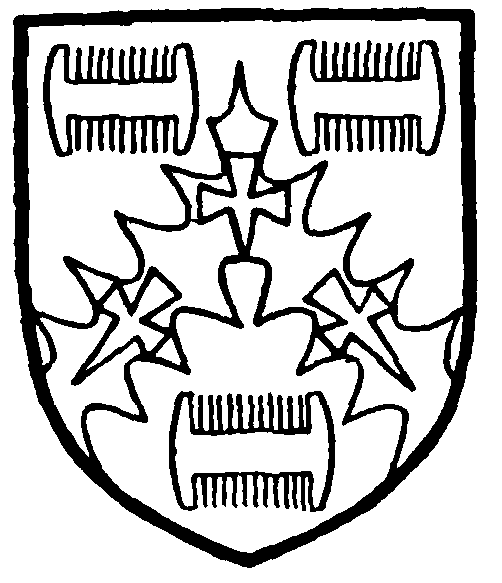
Bootle of Melling. Gules, on a chevron engrailed between three comb; argent as many crosses patée fitchée of the field.
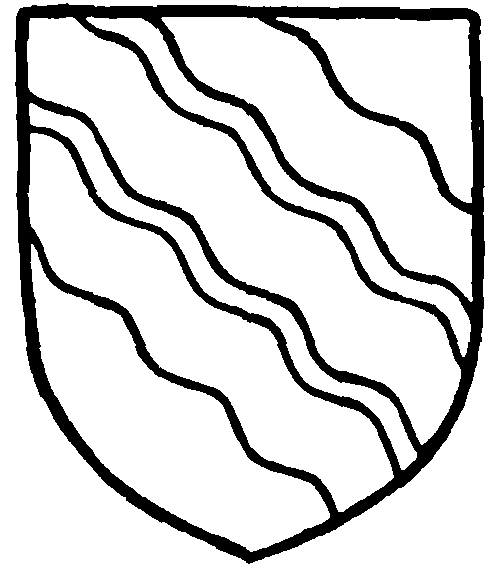
Wilbraham of Rode Hall. Argent, three bendlets wavy azure.
Wolmoor (fn. 76) was a small estate or manor in Lathom which early in the thirteenth century gave a surname to its owners. These granted part of it to Burscough. (fn. 77) Another small estate called Taldeford, later Tawdbridge, gave its name to the owners. (fn. 78)
BLYTHE
BLYTHE was held in 1189 by Geoffrey Travers, (fn. 79) whose son Henry, called 'de Blythe,' by his charter released to Prior Benedict of Burscough all his claim to mastfall in Tarlscough, Greetby, and Burscough; (fn. 80) Henry also gave to the priory a watercourse running through his Holme to the priory mill of the Bayes. (fn. 81) John and Robert de Blythe occur among the names of subscribers to the stipend of a chaplain at Ormskirk in 1366, (fn. 82) and the latter also in the Poll Tax Roll of 1381. (fn. 83) John de Blythe attested Scarisbrick charters in 1399 and 1401, and was the father of Roger, who in 1397 was charged with breaking into the parsonage house at Crossens. (fn. 84) From him descended Roger Blythe, whose daughter and heir Margaret by her marriage with John Blakelache (or Blackledge) conveyed the estate to this family. (fn. 85)
Evan Blackledge (fn. 86) by his will, made in July, 1565, desired to be buried in Ormskirk church 'on the north side of an overlay or stone under which Bishop Blackledge was buried.' (fn. 87) His brother John succeeded him, and in 1576 made an exchange of lands with Ralph Langley. (fn. 88) He was followed by Evan Blackledge, apparently his son, who in 1593 made a settlement upon the marriage of his son John with Margaret, daughter of Henry Walton of Little Hoole. (fn. 89) Evan died at Lathom on 31 January, 1612–13, seised of Blythe Hall and other lands, John, his son and heir, being then aged forty-two years and more. (fn. 90) John Blackledge contributed to the subsidy of 1628. (fn. 91) He was succeeded by another Evan, probably his son, who died in or before 1658, leaving three sons— John, James, and Thomas. The first of these married in 1658 Elizabeth, daughter of Thomas Jodrell of Leek, (fn. 92) but died without issue before 1683, and was succeeded by his brother James, a pewterer of London. The latter's son Evan, described as 'of the parish of St. John, Wapping, gentleman, and of Blythe Hall,' sold the Lathom estate to William Hill of Burscough in 1698. William Hill, junior, in 1761 conveyed the estate to William Shaw and John Sephton, probably as trustees. (fn. 93) About 1800 it was purchased by Thomas Langton, who in 1826 sold it to Edward Bootle Wilbraham, from whom it has descended to the present earl of Lathom. (fn. 94)
A family bearing the local name of Ellerbeck once resided in Lathom; one of them became prior of Burscough. (fn. 95)
Alton or Olton, later New Park, is mentioned in 1189 in the charter of Burscough Priory. The name suggests an early place of settlement in the township. In 1198 it appears to have been a hamlet. (fn. 96) There was a small ford over Edgeacre (Eller) Brook, lying to the south of Blythe, which is more than once described as the ford which leads from Alton to Harleton. (fn. 97) In course of time, perhaps in the fifteenth century, it had ceased to be a hamlet, and the lords of Lathom turned it into a park, called Lady Park, or New Park. (fn. 98) The earls of Derby occasionally kept house here. (fn. 99) It now forms part of the Cross Hall property.
CROSS HALL
CROSS HALL may have taken its name from a cross erected here by the Burscough canons. The boundaries are detailed in the early charter of Burscough Priory. (fn. 100) A later deed, dated 1229 and entitled 'charter of the rent of Cross Hall,' grants an annual rent of 2s. from this land, payable by Roger and Reginald of the Cross and their successors on behalf of Richard de Lathom. (fn. 101) The tenants seem to have been Welshmen; they are called le Waleys, and were perhaps kinsmen of the Aughton family. Richard le Waleys was said by the prior of Burscough to have erected a horse mill within the latter's 'Land of the Cross; 'but the parties came to an arrangement by which Richard acknowledged the prior's title and received the mill as tenant at a rent of 12d. (fn. 102) Another agreement, made about 1280, allowed the prior certain rights of way over Richard le Waleys' land. (fn. 103)
In 1309 Richard le Waleys of the Cross, the younger, complained that William de Codesbecke, Robert of the Cross the elder, and Adam his brother, had disseised him of his free tenement in Lathom; the estate had been mortgaged to Eustace de Codesbecke, (fn. 104) deceased, whose debt had not been paid. (fn. 105) The Cross family retained an interest in the place to the end of the fourteenth century, the lords of Lathom being superior to them as tenants of the prior of Burscough. (fn. 106)
Afterwards it appears to have reverted to the Stanleys as successors to the Lathoms, and in the accounts already quoted may be noticed the rent of 3s. paid to the prior of Burscough. It came into the ownership of the earls of Derby together with other lands of the priory. (fn. 107) A junior branch of this family had Cross Hall on lease from the earl, (fn. 108) and Sir Thomas Stanley of Bickerstaffe was still holding it in 1653. (fn. 109)
Sir Thomas Stanley's eldest son was ancestor of the earls of Derby. His second son, Peter, (fn. 110) was father of Thomas Stanley of Cross Hall, high sheriff in 1718, (fn. 111) who died in 1733, (fn. 112) and to whose son Charles the tenth earl of Derby bequeathed Cross Hall. (fn. 113) His male issue failing it devolved, in virtue of the terms of the bequest, on the issue of Dr. Thomas Stanley, rector of Winwick, the present owner being Mr. Edward James Stanley.
Apparently adjoining the estate of Cross Hall was a messuage called Cross Place, in Westhead. This was held until the end of the fourteenth century by the Cross family, and in the succeeding century passed to the Woodwards of Shevington. It is now the property of the trustees of the late Charles Scarisbrick. (fn. 114)
Westhead was apparently occupied by small freeholders from early times. (fn. 115) A grant made by Robert de Lathom in 1292–3 to Robert, his tailor, probably refers to land here. (fn. 116)
The lands of several persons in Lathom were confiscated and sold by the Parliament in 1652: John Wainwright, John Gregson, Richard Moss (a skinner), George Rigmaiden, and William Speakman. (fn. 117) John Speakman of Scarisbrick, as a 'Papist,' registered an estate here and at Ormskirk in 1717; and John Stock one here and at Newburgh. (fn. 118)
In 1792 the principal contributor to the land tax was R. Wilbraham Bootle; the others included T. Stanley of Cross Hall, W. Hill of Blythe Hall, Mr. Ashton's heirs and W. Johnson's heirs.
An Enclosure Act for Lathom and Skelmersdale was passed in 1778. (fn. 119)
NEW BURGH
NEW BURGH village is on elevated ground, sloping to north and east down to the Douglas; on the south the ground rises gently. The annual cattle fair, held on 20 June and made free in 1853, has lost much of its old prestige, but it is still celebrated with a great ingathering of the country-side for the amusements provided. The stalls and booths are erected on the village green, on a little knoll where are some remains of the ancient cross. 'Fairing cakes,' like Eccles cakes, are made and sent to friends. The weekly market has been discontinued. The old schoolhouse, built in 1714, stands at the west end of the village. (fn. 120) A court-leet is still held. (fn. 121)
A mock corporation—probably a relic of the ancient borough—once held its meetings here. The custom was for the villagers to assemble annually round the village cross and elect a new mayor. The last minute book, 1827–32, is extant.
A century ago the best cheese in the country was made here and at Leigh. There seems also to have been a small pottery. (fn. 122)
The name indicates that a borough had been formed. In 1385, Isabel, widow of Thomas de Lathom, had a rent of 8 marks of the freeholders of Newburgh as part of her dower right. (fn. 123) The accounts of the Derby estates during the minority of Edward, third earl of Derby, show that the ancient burgage rent was 1s. (fn. 124)
The manor became distinct from Lathom and has remained with the earls of Derby to the present time.
The school at Newburgh was founded in 1714 by the Rev. Thomas Crane.
LATHOM CHAPEL
LATHOM CHAPEL is a picturesque little building of c. 1500, in plan a plain rectangle 20 ft. wide internally by 61 ft. long. The east gable and five-light window remain unaltered, but the north and south walls are hidden by a coating of modern cement, and the windows are all modernized, with wooden mullions and plain four-centred heads. The west wall is partly hidden by the almshouse buildings, and is surmounted by an octagonal bell-turret with embattled cornice and short octagonal spirelet, capped by a stone ball in place of its original finial. The internal fittings of the church are modern, of the style of the early Gothic revival, with pulpit, reading-desk, and lectern to the west of a chancel screen with two rows of plain stalls, and at the west end an organ gallery carried by iron columns, with a plain octagonal font beneath it.
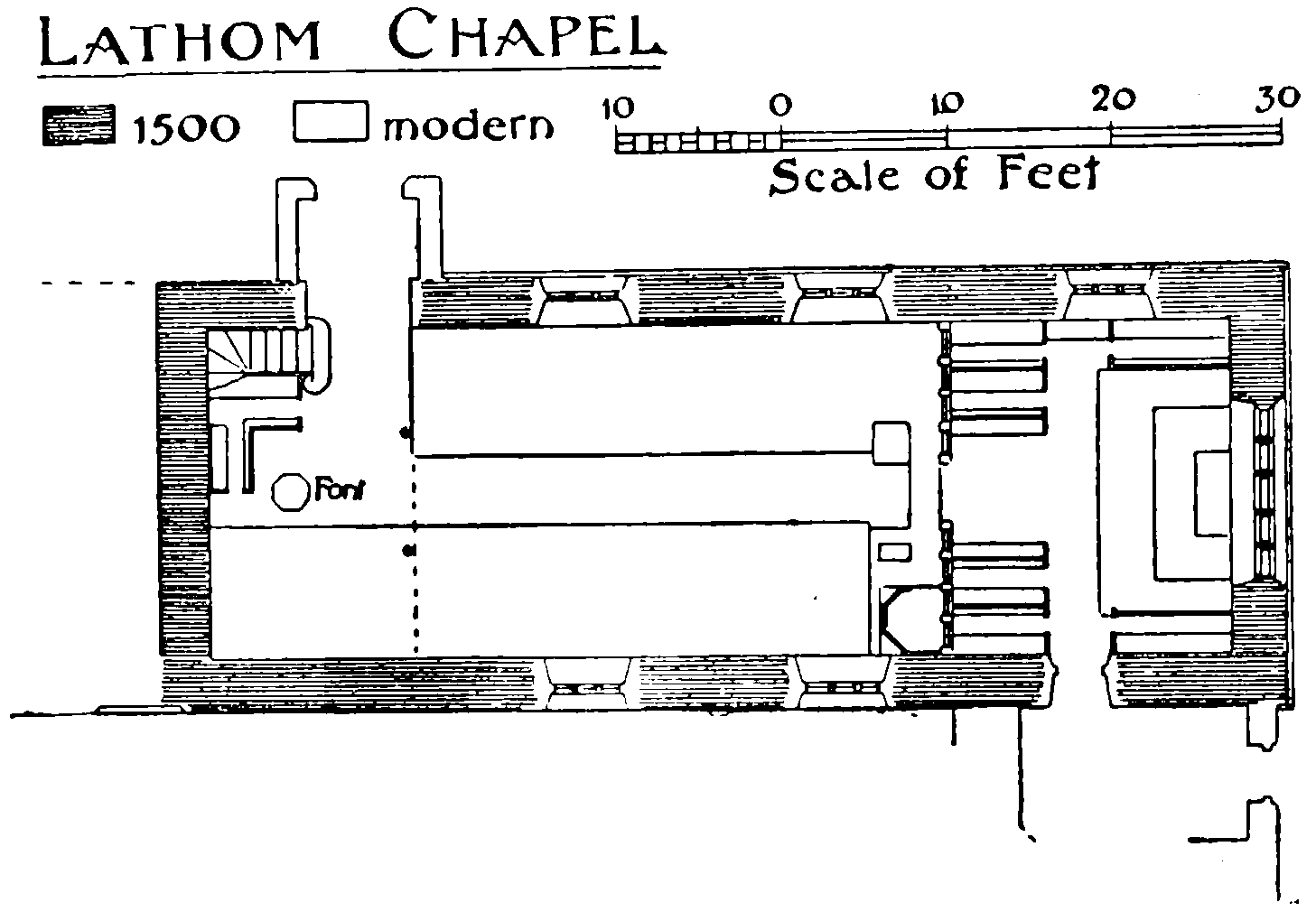
The chapel forms the north-east angle of a group of buildings, a row of almshouses adjoining it on the west, and a vestry and school building on the southeast. It is to be noted that the centre of the east window is 9 in. to the south of the centre line of the chapel, the error being probably one of setting-out only, but there may have been some reason for it, such as to provide extra space for the niche holding the statue of the patron saint, which would be set up on the north side of the window.
A chantry was founded in the new chapel at Lathom, to which a hospital was attached, by Thomas second earl of Derby in 1500. (fn. 125) In 1509 it was formally sanctioned by the bishop of Lichfield, the chapel to be consecrated by Huan, bishop of Sodor. (fn. 126) In 1548 the priest, John Moody, was fulfilling his duties according to the founder's wishes, and as the chapel was three miles from the parish church of Ormskirk he had licence to minister sacraments and sacramentals there for the benefit of the neighbourhood. (fn. 127)
The foundation, so far as concerned the almshouse, either escaped destruction in 1547–8 or was soon refounded. In 1614 it was described as a 'small chapel to Ormskirk,' served by 'a curate with a small pension.' (fn. 128) The minister has usually been styled the Almoner. In 1650 the almsmen sent to the Parliamentary Commissioners a protest against the confiscation of their endowment, although it was derived from lands of the earl of Derby. (fn. 129)
In October, 1686, an inquiry was held at Wigan as to the earl of Derby's right to dismiss the master or almoner; William Norris, clerk, who had been frequently absent from duty and otherwise neglectful, claiming a freehold. The earl's right appears to have been upheld. (fn. 130)
In 1827 the Charity Commissioners found that thirteen poor persons by ancient custom received £3 6s. yearly apiece; six of these pensioners lived in the almonry. The chapel attached was a domestic chapel, but was attended by residents in the neighbourhood who had permission to do so. The minister was nominated by the owner of Lathom House; the bishop of the diocese had no jurisdiction. (fn. 131)
A settlement of the endowment was made in 1845, when a rent-charge of £145, issuing from a messuage called Pennington in Upholland, was granted. There are thirteen pensioners, each receiving £3 6s. a year; the chapel clerk has £3, and the chaplain or almoner the rest. The chapel is used for ordinary services as well as a domestic chapel. (fn. 132)
The church of St. John the Baptist stands at Burscough Bridge, but is situated on the Lathom side of the township boundary. It was begun in 1827 and opened in 1832, the cost being defrayed partly by a parliamentary grant. (fn. 133) The district chapelry was constituted in 1847. (fn. 134) St. James's, Lathom, was built in 1850 by the earl of Derby; a district chapelry was assigned to it ten years later. (fn. 135) Christ Church, Newburgh, was built in 1857, and a new parish was formed in 1871. (fn. 136)
There are Wesleyan chapels at Hoscar Moss and Moss Lane, but the Independent chapel formerly at Ashbrow, Newburgh, has disappeared.
Burscough Hall, now belonging to St. John's Roman Catholic church, is said to have taken its name from the Burscough family. (fn. 137) The house, in the seventeenth century the property of the Longs, (fn. 138) recusants, was in 1667 granted to Peter Lathom of Bispham, founder of the now very important Lathom charity, who early in 1700 leased it for 999 years at a rent of £10 to John Heyes. (fn. 139) This was in trust for the mission. About this time Thomas Gorsuch, eldest son of James Gorsuch, of Scarisbrick, was tenant. It has been used continually for religious purposes since that time. (fn. 140) The first priest known to have resided here with any regularity was James Gorsuch. (fn. 141) In 1759 the chapel in the house was improved at a cost of £80. The present chapel and presbytery, near the old hall, were built about 1819 by William Coghlan, son of the publisher, he himself giving about a third of the total cost, £1,520. The church has since been altered and improved. (fn. 142) There is a cemetery attached, consecrated in 1890.