A History of the County of Lancaster: Volume 3. Originally published by Victoria County History, London, 1907.
This free content was digitised by double rekeying. All rights reserved.
'Townships: Rainhill', in A History of the County of Lancaster: Volume 3, ed. William Farrer, J Brownbill (London, 1907), British History Online https://www.british-history.ac.uk/vch/lancs/vol3/pp368-371 [accessed 30 April 2025].
'Townships: Rainhill', in A History of the County of Lancaster: Volume 3. Edited by William Farrer, J Brownbill (London, 1907), British History Online, accessed April 30, 2025, https://www.british-history.ac.uk/vch/lancs/vol3/pp368-371.
"Townships: Rainhill". A History of the County of Lancaster: Volume 3. Ed. William Farrer, J Brownbill (London, 1907), British History Online. Web. 30 April 2025. https://www.british-history.ac.uk/vch/lancs/vol3/pp368-371.
In this section
RAINHILL
Reynhull, 1256; Raynhull, 1285.
This township has an area of 1,639½ acres. (fn. 1) It occupies the southern slope of the hill from which apparently it has taken a name; roughly speaking the ridge of the hill forms the boundary against Eccleston on the north. The portion next to Sutton is called Ritherope. The open country is occupied by pastures and arable fields where crops of barley, wheat, potatoes and turnips are cultivated. Plantations dotted about give the landscape a park-like appearance.
The principal road, from Prescot to Warrington, passes through the township south-eastwardly; at the north-western boundary is the Holt; farther on, where the road crosses the London and NorthWestern Company's line from Liverpool to Manchester, is the station, where in recent times a considerable village has grown up. Formerly there was only a house or two, and the place was called the Cross, or Kendrick's Cross. Then the modern hall is passed on the left, and the original village reached, now reduced to a few houses; close by are the Stoops. At this point, near which is the old 'manor house,' a more southerly road from Prescot joins it, having passed the old 'hall' at a point known as Blundell's Hill, more than 250 feet above sea level. The view from this point is very fine, embracing an extensive panorama of the immediate country, right away over the River Mersey to the hills and plains of Cheshire, to which, farther still, the undulating line of the Welsh mountains forms an imposing background. On the north this township is bounded by a colliery district, and consequently the country becomes less pleasing in character. The greater part of the township lies upon the pebble beds of the Bunter series (new red sandstone), but small areas of the lower mottled sandstone of the same series occur on the western side of Cronton Lane and half a mile to the north-west of Rainhill Stoops.
The population in 1901 numbered 2,208.
There is a parish council of eight members.
A quarry is worked. The place has long been celebrated for the manufacture of files; other tools and parts of watches are also made, and there is a brass foundry.
Kendrick's Cross, in the village, is a small stone pillar fixed in an ancient pedestal; Blundell's Hill Cross also stands on an ancient pedestal. (fn. 2)
MANORS
From what has been recorded of Sutton and Eccleston it will be known that RAINHILL, assessed at two ploughlands, was held by the lord of Eccleston of the lord of Sutton, the latter holding of the Constable of Chester as of his barony of Widnes. (fn. 3) The Eccleston family, however, early created a subordinate manor of Rainhill, of which the first undertenant appears to have been Roger de Rainhill, father of Simon and Waldeve, who were enfeoffed by John de Lacy, constable of Chester, between 1220 and 1232, of four oxgangs of land in Rainhill, which had been their father's, to hold by knight's service, where ten ploughlands made the service of a knight, and by rendering the farm which belonged to Richard de Eccleston. (fn. 4) Simon seems to have had issue by Emma his wife (fn. 5) two daughters, to whom before 1246 the manor had descended, viz., Amice who married Alan de Windle, and Agnes who married Roger de Molyneux, a younger son of Adam de Molyneux of Sefton. (fn. 6)
The manor was divided between them, each family having one plough-land. The Windle half, like the other possessions of the family, descended through the Burnhulls, to the Gerards of Brynn, who held it until the sixteenth century. (fn. 7) In 1565 it was sold to the immediately superior lord, Henry Eccleston, (fn. 8) but it appears to have soon changed hands again, for in 1629 the heirs of Hugh Lee or Ley were lords of the manor. (fn. 9) John Chorley, son of Alexander Chorley of Furnival's Inn, married Elizabeth Ley, a daughter and coheir of Hugh Ley of Liverpool, and in August, 1630, a settlement was made of the manor of Rainhill and various lands there, John Chorley and Elizabeth his wife being in possession. (fn. 10) This family, who became attached to the Society of Friends, continued to hold the Rainhill estate for several generations, the last being John Chorley of the Red Hazels in Huyton, who died in 1810, leaving two daughters Mary and Sarah, married respectively to John Ford and John Walker. (fn. 11) The father had been one of the great West Indian merchants of Liverpool, but failed in 1808, when his estates were sold. Dr. James Gerard of Liverpool, who afterwards lived at Sandhills, Kirkdale, purchased Rainhill manor-house, and in 1824 sold it to Bartholomew Bretherton of Rainhill, a famous stage-coach proprietor, whose principal establishment was situated in the village. (fn. 12) It descended to his daughter and heiress, the Marchioness Stapleton-Bretherton, and on her death in December 1883, passed to the present owner, Mr. Frederick Annesley Stapleton-Bretherton. (fn. 13)
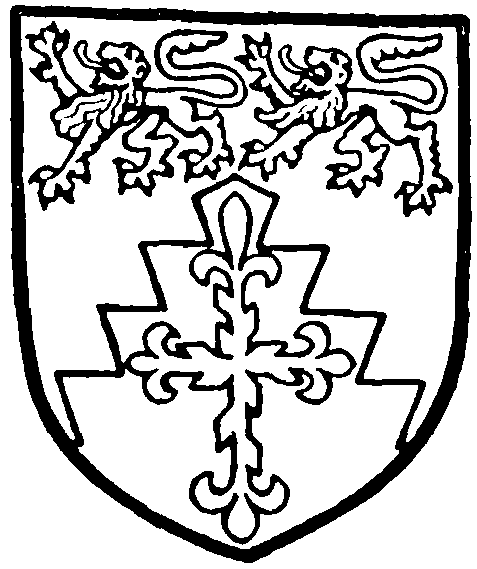
Bretherton of Rainhill. Per chevron indented sable and argent, in chief two lions passant and in base a cross raguly flory counterchanged.
The second moiety descended from Roger and Agnes de Molyneux to their son Richard; (fn. 14) on the death of the latter's son Sir John (fn. 15) without surviving issue, it became the right of John de Lancaster, son of that John de Lancaster who married Margery, one of the daughters of Richard de Molyneux. (fn. 16) But little is known of the Lancaster family, (fn. 17) though they held the manor for four centuries and their pedigrees were recorded at the visitations. (fn. 18) In 1628 Thomas Lancaster, as a convicted recusant, paid double to the subsidy; (fn. 19) but though his son John was a Royalist, and as such suffered the confiscation of his property by the Parliament, he does not seem to have been charged with the equally serious offence of recusancy. (fn. 20) Subsequently the estate was recovered. In 1717 John Lancaster and two other members of the family as 'Papists' registered estates here. (fn. 21) Parts of the estate were sold, but the hall descended to the Fleetwood family. (fn. 22) On Miss Fleetwood's death, in 1877, it passed to a cousin, James Beaumont, by whom it was sold to the Marchioness Stapleton-Bretherton, and has since descended with the manor-house. (fn. 23)
Rainhill Hall is now used as a farm-house, and is only reached by a field road. The main building is L-shaped, with north and west wings, but it is clear that it was originally built round a court. The south wing has entirely disappeared, but the south end of the east wing remains in a dismantled state, separated from the rest of the house and used as a lumber-room. The west wing is entirely modernized, but the north wing has a front of c. 1600 with mullioned windows, and at its east end an upper room with an open timber roof of c. 1350, a good specimen with quadrant wind braces, and valuable on account of the rarity of domestic work of this date. The room was formerly used as a chapel, and is lighted by mullioned windows on the east and south, of early seventeenth-century date. The south-east block is also c. 1600, and has a projecting rectangular bay at its south-east angle, with a stone chimney-stack immediately to the north. It has been of two stories with an attic, and, though now neglected and ruinous, was evidently a good specimen of its class in its best days, with large mullioned windows, and no doubt the usual accessories of ornamental glazing and panelling.
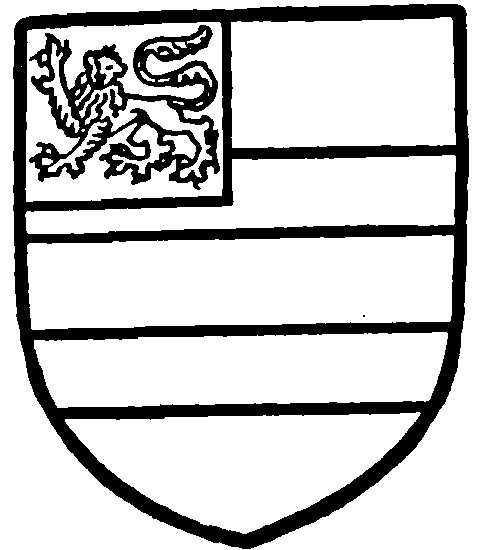
Lancaster of Rainhill. Argent, two bars gules; on a canton of the second a lion passant guardant or.
The farmyard lies to the north-east of the house, and has on its north side a range of wooden farmbuildings, on low stone walls at least as old as the sixteenth century. They are a fine example of the primitive method of construction known as 'building on crucks,' the crucks in this case being set about 15 ft. apart from centre to centre, a little less than the normal width of a bay.
Two other Molyneux families had estates here in the fourteenth century. Alan de Molyneux, son of Roger, had a son Roger described as 'of Rainhill'; (fn. 24) and at RITHEROPE settled Robert de Molyneux, possibly another son of Roger. (fn. 25) He was followed by a son Roger, (fn. 26) and a grandson Richard of the same place. (fn. 27) Molyneuxes of Rainhill are mentioned from time to time down to the sixteenth century, but it is not possible to give a detailed account of them. (fn. 28) Ritherope also is now owned by Mr. Stapleton-Bretherton.
Another family having lands in Rainhill bore the local name; (fn. 29) others were the Lees (fn. 30) and Garnets. (fn. 31) In 1600 the only resident freeholders seem to have been Thomas Lancaster and Simon Garnet. (fn. 32) Thomas Parker, Ralph Glover and Ellis his son, and Peter Glover of Sutton, registered estates here in 1717 as 'Papists.' (fn. 33) In 1785 the trustees of John Lancaster, — Chorley, and Edward Faulkner were the largest land-holders. (fn. 34)
In connexion with the Established Church St. Anne's was built in 1837; the patronage is held by Mr. James Brierley.
A Wesleyan Methodist church was built in 1858.
Congregationalist preaching at the Holt began in 1828, but it was not till 1857 that a mission room was erected; in 1891 a stone church was built by Miss Ruth Evans as a family memorial. (fn. 35)
St. Bartholomew's Church was built in 1840 by Bartholomew Bretherton for the Roman Catholics of the district. (fn. 36) There is also a convent of the Sisters of St. Paul. (fn. 37)