A History of the County of Lancaster: Volume 3. Originally published by Victoria County History, London, 1907.
This free content was digitised by double rekeying. All rights reserved.
'Townships: Westleigh', in A History of the County of Lancaster: Volume 3, ed. William Farrer, J Brownbill (London, 1907), British History Online https://www.british-history.ac.uk/vch/lancs/vol3/pp421-426 [accessed 30 April 2025].
'Townships: Westleigh', in A History of the County of Lancaster: Volume 3. Edited by William Farrer, J Brownbill (London, 1907), British History Online, accessed April 30, 2025, https://www.british-history.ac.uk/vch/lancs/vol3/pp421-426.
"Townships: Westleigh". A History of the County of Lancaster: Volume 3. Ed. William Farrer, J Brownbill (London, 1907), British History Online. Web. 30 April 2025. https://www.british-history.ac.uk/vch/lancs/vol3/pp421-426.
In this section
WESTLEIGH
Westeley, 1237; Westlegh, 1238; Westlay in Legh, 1292.
This township, occupying the north-westerly part of the parish, contains 1,882½ statute acres, and is much occupied by cotton factories and iron works, which have largely displaced agriculture and have destroyed almost all the former natural beauties of the place. The surface of the ground rises in undulations from 75 feet above the Ordnance datum on the south to a height exceeding 150 feet on the north and northwest. Westleigh Brook traverses the township from north to south and presently unites with Hey or Pennington Brook, flowing from the west, which appears to have been at one time the southern boundary of the township but now flows in a more southerly course through Lowton and Pennington. The Wigan and Leigh branch of the Leeds and Liverpool Canal runs through the southern part of the township, and the high road from Hindley to Atherton with a branch road to Leigh also passes through it. There is a station at Westleigh, originally named Leigh Station, on the Bolton and Kenyon section of the London and North-Western Railway. The Manchester and Wigan section of the same railway runs through the northern edge of the township. The geological formation consists of the coal measures on the north, underlying the permian rocks which outcrop from Westleigh village to Westleigh Heath and Strange Common. To the south-east of this line the formation consists of the pebble beds of the new red sandstone series.
A district chapelry was formed out of the parish of Leigh in 1881. (fn. 1) The Local Government Act, 1858, and the Public Works (Manufacturing Districts) Act, 1863, were adopted by the township in 1863. (fn. 2) By the 38 and 39 Victoria, cap. ccxi, the district was dissolved and merged in that of the Leigh Local Board, since controlled by an urban district council under the Local Government Act of 1894, and now incorporated in the borough of Leigh. The population in 1901 was 16,177 persons.
MANOR
This before the Conquest was one of the thirty-four manors dependent upon the chief manor of Warrington. The early dependency of the manor of WESTLEIGH and the Higher Hall upon the chief manor of Warrington terminated soon after the Conquest, and in the twelfth century Westleigh became a member of a scattered fee, having its caput at Bolton le Moors, which was granted about the time of King Stephen to the lord of Marsey and Gamston, in Nottinghamshire. (fn. 3) The rateable area seems to have been two and a half or three carucates of land, the tenure by knight's service, viz. by the fourth and twentieth part of a knight's fee. About the year 1230 Roger son of Ranulf de Marsey sold for 200 marks of silver his whole fee between Ribble and Mersey, including this manor, to Ranulf de Blundevill, earl of Chester and Lincoln. (fn. 4) Subsequently the superior lordship descended with the earl of Chester's other lands between Ribble and Mersey to the Ferrers, earls of Derby, then to the earls of Lancaster, and so became merged in the possessions of the duchy of Lancaster.
The early history of the manor is obscure and is complicated by the connexion of the church with it and by the fact that a landowner in Lancashire in the first half of the thirteenth century had not in every case received an established surname from his principal or residential estate. The facts appear to be that in the latter part of the twelfth century John de Westleigh was hereditary parson of the church of Leigh and presumably lord of the manor. He had sons Adam and Alan, benefactors to the abbey of Cockersand in the early part of the thirteenth century, and described as 'of Rainford' in charters by which they gave lands in that place to the abbey (fn. 5); and probably an eldest son Richard, who seems to have succeeded to the manor and patronage of the church, but owing to the more rigid enforcement of the decrees of the first Lateran Council against the hereditary possession of churches by persons not in orders, was compelled to present a clerk in holy orders to his church of Leigh. This clerk was duly admitted sometime during the reign of John. He was not a kinsman of the patron, for his name, Robert Cucy, or Coucy, (fn. 6) suggests a foreign origin. The loss of the old hereditary office of parson seems to have necessitated a division of lands in the manor, and the clerk appears to have had assigned to him the mansion afterwards known as the Kirk Hall, (fn. 7) standing half a mile distant from the church, with lands representing a fourth part of the manor or vill. (fn. 8) The situation of the house and lands points to its having been the lord's ancient residence. The lord himself seems to have removed to a site more remote from the church, and to have built the manor-house afterwards known as the Higher Hall. In 1219 Adam de Westleigh, probably younger brother and heir of Richard, was amerced by the justices at Lancaster. (fn. 9)
Before 1238 the advowson appears to have been divided, possibly by the death of Richard de Westleigh without heir of his body, or by alienation of half the church to the priory of Wallingwells. In that year five Lancashire knights were commissioned to take an assize of darein presentment at Lancaster between Adam son of John (de Westleigh) and the prioress of Wallingwells, between whom there was contention as to the next presentation to half the church. (fn. 10) The verdict is not recorded; but it is not improbable that the plea was that referred to some fifty years later as the result of which Isolda, prioress of Wallingwells, had presented Henry de Ulveston to the church. (fn. 11) This seems to gain confirmation from a reference to 'Henry the clerk of Leigh,' who found sureties at the assizes at Lancaster in 1246. (fn. 12) In 1242–3 Adam de Westleigh was one of the jurors returned from the hundred of West Derby on the inquest of the Gascon Scutage. (fn. 13) About this time or possibly a little later, a fourth part of the manor, subsequently associated with the Old Hall of Westleigh, came into the possession of a younger branch of the Bradshaws of Bradshaw, (fn. 14) who held under the lords of the remaining half of the manor. (fn. 15)
By Quenilda his wife Adam de Westleigh had issue Roger, who married Emma daughter (and perhaps heir) of Robert de Shoresworth, and had lands here with her in marriage.
Their issue was an only daughter, Siegrith, who married Richard, younger son of Richard de Urmston, lord of Urmston. (fn. 16) In 1292 she and her husband purchased the advowson of the church of 'Westlay in Legh' from the prioress of Wallingwells. (fn. 17) Richard died before 1305, and in 1315 Siegrith gave six messuages, including the Higher Hall, a mill, 40 acres of land, 2 acres of meadow, 40 acres of wood and 3d. of free rent to her younger son William, (fn. 18) and the same year gave to Richard, her elder son, the manor of Westleigh and the advowson of the church. (fn. 19) In 1313 she was associated with John de Urmston, parson of Leigh, and Richard de Bradshagh and Margery his wife in a plea of land brought by Richard de la Lache. (fn. 20) Richard, her elder son, married Alice, one of the daughters and coheirs of Richard de Lathom of Parbold, and had issue a son Richard, (fn. 21) who died young, and Lucy, who married Henry de Trafford of Prestwich, son of Robert of the same place.
In 1350 a fourth part of the manor was settled upon Henry and Lucy and their issue. (fn. 22) Between 1351 and 1353 they were engaged in litigation with Lucy's kinsman Gilbert de Urmston, (fn. 23) son and heir of William, younger son of Siegrith. In July, 1351, Gilbert recovered twelve messuages, a mill, 80 acres of land, 6 of meadow, 50 of wood, and 5s. of free rent here against Henry and Lucy, (fn. 24) who subsequently complained that some of the recognitors of the assize had delivered to Gilbert much more than the premises put in view, which they sought to recover against him and against Roger de Bradshagh of Westleigh, Robert de Blackburn, and Richard de Sale, free tenants of the manor. (fn. 25) Henry de Trafford died before the Feast of St. Michael, 1359, (fn. 26) his widow surviving him. As they had no issue their estate probably descended in accordance with the limitations of the settlement made in 1350, but the links in the descent cannot be traced until 1436, when Isabella widow of Thurstan Urmston died seised of messuages belonging to the Urmston estate and of 4s. of rent issuing out of lands and tenements parcel of the manor, which William Holland of Downholland then held. (fn. 27) This estate descended to Piers Holland, who died in 1524 seised of four messuages, 160 acres of land, meadow and pasture in this manor held of John Urmston, esq., by service unknown. Edmund his son and heir was then aged forty years. (fn. 28) He alienated the estate in 1522 (fn. 29) to Sir Henry Halsall, knt., who held at his death on 23 June, 1522, the mesne manor of Westleigh of John Urmston, esq., in socage by 4s. yearly free rent. (fn. 30) Subsequently the estate descended in the Halsall family, and was dispersed by Sir Cuthbert Halsall, knt. About twenty-six acres of the large measure were sold to James Sorocold of Highhurst in Knowsley, yeoman, (fn. 31) and another portion to Adam Mort, who held a tenement here at his death in 1631. (fn. 32)
After the death of Richard Urmston, brother of Lucy, the superior manor appears to have reverted to the heir male of Siegrith de Urmston in the person of John son of Gilbert, son of her younger son William Urmston. (fn. 33) John Urmston was father or grandfather of John Urmston who died seised of the manor in 1412, Thurstan his brother being his successor, then aged twenty-one years. (fn. 34) Thurstan died in 1415, when the custody of John his son was delivered to John Butler, esq., one of the ushers of the king's chamber. (fn. 35) The manor was held of the king as of his duchy of Lancaster by the fourth and twentieth part of a knight's fee and suit to the county of Lancaster and wapentake of West Derby. (fn. 36) John Urmston was of age and had livery of the manor in March, 1431. (fn. 37) The year following he made a settlement of his estates. (fn. 38) There was at that time a coal mine in the manor. (fn. 39) He died in March, 1436, (fn. 40) his son Gilbert being aged about ten years. (fn. 41) This Gilbert was the father of another Gilbert who died in 1499, his eldest son John being then aged fifty years; (fn. 42) William a younger son was afterwards vicar of Leigh. (fn. 43) From John Urmston, who died in or soon after 1548, (fn. 44) the manor descended in the fourth generation to Richard Urmston, (fn. 45) who died in 1659, aged sixty-nine years, leaving issue four daughters.
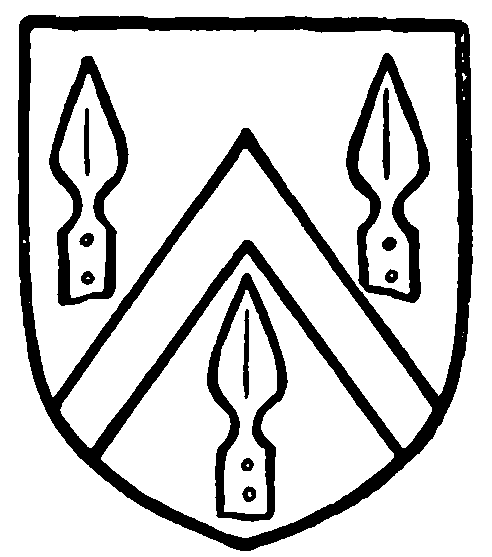
Urmston. Sable, a chevron between three spear-heads argent.
Mary married Robert Heaton of Westleigh, gent.; Frances married, first, Richard Shuttleworth of Bedford, gent., who died in 1650, and secondly, George Bradshaw of Greenacre, gent.; Eleanor was never married; and Anne, the youngest, married Thomas Mossock of Heatonhead in Cunscough. (fn. 46) A partition of the estate was made in 1661, when the coheirs each took a fourth part of the manor-house with certain tenements, and a fourth part of the tithes of corn and grain arising out of certain lands in the township. (fn. 47) In 1681 Anne Mossock, having survived her husband and having no issue, conveyed her share of the tithes of the parish to Sir William Gerard of Brynn, bart., Thomas Eccleston of Eccleston, and Thomas Culcheth of Culcheth, esqs. (fn. 48) She died in 1699 after devising the remainder of her estate to her nephew and heir-at-law, Richard Shuttleworth of Westleigh, esq., (fn. 49) who ultimately inherited the whole estate, with the advowson of the vicarage of Leigh and the ancient rectory or Kirk Hall estate. He was a recusant and as an adherent of the Pretender took part in the rebellion of 1715, for which his estates were forfeited, except the portion which Anne Mossock succeeded in retaining, as described in the account of Leigh.
Three of the shares held by Richard Urmston's devisees were acquired some years after 1715 by one of the Hiltons of Pennington, (fn. 50) and were subsequently sold by Samuel Cheetham Hilton to the predecessor of John Hodson Kearsley, M.P. for Wigan (1831–2 and 1835–7), whose executors conveyed his estates in or about 1848 to John Hall of Walmesley, near Bury. In August, 1900, they were formed into a joint-stock company, under the title of the Westleigh Estates Company, the representatives of John Hall, esq., owning one moiety, and Mrs. Bubb of Ullenwood, Cheltenham, the only child of the late William Hall of the 'Seven Springs,' Cheltenham, esq., brother of John Hall, the other moiety. (fn. 51)
The Higher Hall was rebuilt on a new site by Mr. Kearsley. After being occupied as a ladies' school, it became the residence of Mr. James Diggle, but has recently been demolished owing to subsidence caused by coal workings. (fn. 52)
The remaining fourth part of the manor was acquired by the Athertons. In 1762 Robert Gwillym, gent., and Elizabeth his wife suffered a common recovery of the manor of Pennington, the advowson of the vicarage of the church of Leigh, and a fourth part of the manor of Westleigh, in favour of their son Robert Vernon Atherton Gwillym, (fn. 53) from whom these estates have descended to John Powys, fifth baron Lilford, as described in the account of Atherton.
A court-leet of the manors of Westleigh and Pennington was formerly held yearly on the second Monday in November, but no court has been held for many years. (fn. 54)
OLD HALL.
The origin of the tenure by the Bradshagh family of a fourth part of the manor of Westleigh has not been ascertained. Roger de Bradshagh (fn. 55) gave lands here to his son John, about the year 1250, a date suggested by the witnesses' names, one of whom was Adam de Westleigh. (fn. 56) Besides John, afterwards of Westleigh, Roger had issue, William, who married Mabel la Norrise, and had with her the manors of Haigh and Blackrod, (fn. 57) and Adam, perhaps ancestor of the Bradshaghs of Aspull. (fn. 58) John de Bradshagh had issue two sons, Richard (fn. 59) and William. Richard had Westleigh by inheritance from his father and Blackrod under a settlement made in 1337 by Mabel de Bradshagh; William had Haigh under a similar settlement. (fn. 60) Richard had issue Roger, who is named with his wife in the settlement of 1337. (fn. 61) Hugh their son married Margaret daughter and heir of John de Verdon of Brixworth, county Northants, who immediately after her husband's death in August, 1383, (fn. 62) married John son and heir of Roger de Pilkington. (fn. 63) In 1385 William son and heir of Hugh and Margaret, being under age, was committed to the care of Henry de Bradshagh, who was to pay £80 within eight years for wardship of the heir's lands in Westleigh and Blackrod. (fn. 64) At the death of Sir William Bradshagh, chr., in 1415, he and Joan his wife were seised of this manor, and held it of the king in chief as of his duchy of Lancaster by knight's service and 6d. per annum. It was worth £20 beyond reprises. Elizabeth wife of Richard Harrington son of James Harrington, knt., was his daughter and heir, then aged thirteen years. (fn. 65) William Harrington, knt., their son, had a dispensation in 1442 to marry Elizabeth daughter of Edmund Pilkington, esq., being within the degrees of consanguinity. (fn. 66) He died in 1488, James Harrington, knt., his son and heir being then forty years of age. (fn. 67)
Sir James Harrington made his will in 1493 and died in 1497, leaving ten daughters his coheirs. (fn. 68) In the partition of his estates made in 1517 the manor of Westleigh fell to the share of Anne, one of his daughters and coheirs, wife of Sir Richard Stanley (fn. 69) of Hooton, county Chester, knt., Alice wife of Richard Hoghton (fn. 70) and daughter of Sir Thomas Assheton, knt., by Agnes, another daughter and coheir, and Isabel, wife of John Tresham, another daughter and coheir. (fn. 71) In 1560 Rowland Stanley, knt., grandson of Sir William, sold his estate here to William Norris of Speke, knt., (fn. 72) whose son Edward joined him in 1565 in a sale to Thomas Charnock of Charnock, esq., (fn. 73) whose son Robert Charnock, esq., died in 1616 seised of the capital messuage of Westleigh Old Hall, 4 other messuages, 140 acres of land, meadow, and pasture, which he held of Richard Urmston, esq., in free socage by fealty and ¼d. free rent. (fn. 74) In 1627 Thomas Charnock son of Robert having dissipated his property conveyed his estates to feoffees, (fn. 75) who sold 'the manor of Westleigh and Pennington' and the appurtenant lands in 1632 to Richard Blower and Francis Sherington, afterwards of Booths, esqs., for £1,000. (fn. 76) In 1641 Blower sold his moiety of the purchased estates to John Sorocold of Lowton, gent., for £730, (fn. 77) and the year following Sherington and Sorocold made partition of the manor of Westleigh and Pennington, by which Sherington took the Old Hall of Westleigh and enclosures containing about 41 acres of land of the large measure. John Sorocold took the remainder of the premises, in the description of which the following field names occur:—The Meare Leach, the Harr Shoots, Great and Little Terisse Meadows, Little Pingott, and the Boydells Field. The land lay mostly around Westleigh Mill. It was agreed that the 'Haymont, yordinge,' hedges and fences between the respective moieties should be maintained according to the deed of partition; Francis Sherington to begin at 'the Fenders of Westley Milne and make the hayments and fences after the Damsyde' to a certain boundary mark. The seat and burial-place in Leigh church was to be shared equally. The yearly chief rent of ¼d., due to Richard Urmston of Westleigh, esq., to be paid two years by Sherington and the third year by Sorocold. (fn. 78)
In 1688 Francis Sherington of Booths, esq., son of the last named, sold the Old Hall of Westleigh and the demesne lands, then in the occupation of Thomas Crooke, gent., and late of the vendor's father, to James Parr, citizen and haberdasher of London, John Parr, and Peter Parr of Westleigh, chapman, for the sum of £600. (fn. 79) Ann daughter of Peter Parr, who died in 1705, married Edward Green of Westleigh, chapman, and brought Westleigh Old Hall to her husband. He survived until after 1756 and left an only daughter Ellen, who married John Ranicar of Bedford, gent., Westleigh Old Hall and estate being settled upon them and their issue in 1756. John Ranicar died in 1781, leaving issue, besides a son James, who died unmarried in 1786, three daughters, of whom the second, Mary, inherited Westleigh Old Hall. She married Richard Nicholas Marsh, esq., to whom she bequeathed the estate. He died in 1837, leaving issue by a second marriage Richard Marsh, esq., solicitor, of Leigh, who died in 1895. His son William Edward Marsh, esq., of High Peak, Kenyon, died in 1904, when he was succeeded by his brother, Mr. Richard Thomas Marsh of High Peak, the present owner. (fn. 80)
The Hoghtons' pourparty descended from Richard Hoghton to his eldest son Thomas, who alienated a small portion of his estate here to Anthony Green, gent., (fn. 81) and died without male issue in 1580, (fn. 82) when he was succeeded by his younger brother, also named Thomas, who died in 1589 seised of lands here, (fn. 83) which descended to Richard his son. The subsequent devolution of his estate has not been ascertained.
The Treshams' pourparty descended to Thomas Tresham son of William, great-grandson of John Tresham and Isabel his wife. He sold 15 messuages, 260 acres of land, meadow, and pasture in Westleigh and Hindley, and the mill of Westleigh to John Byrom of Byrom, esq., in 1570, (fn. 84) who died in 1591 seised of the manor of Westleigh, and of several tenements which he held of Richard Urmston, esq., in free socage by the yearly rent of 21½d. (fn. 85) Henry his son died seised of the same premises in 1613. (fn. 86) The fifth in descent from Henry and the last male representative in the direct line was Samuel, better known as 'Beau Byrom,' who squandered the whole of his estates in early manhood and died in penury sometime after 1739. (fn. 87)
In 1527, ten years after the partition of the Harrington estates here, John Urmston set up a claim to Westley Heath, which had been assigned by Sir William Harrington, 'to be a sportyng place' to his tenants of Westleigh, to be occupied as common for their cattle, and also to have butts at which to shoot, and 'to have their dysportes wythyn the same Heth,' claiming the heath as parcel of his manor of Westleigh, of which he and his ancestors had been possessed for upwards of 200 years. The claim was resisted by Dame Isabel Tresham, widow, and Sir William Stanley of Hooton, knt., and Dame Anne his wife. The result of the suit is not recorded, but the heath remains common land to this day, in accordance with Sir William Harrington's intention. (fn. 88)
The Mather family (le Madur) (fn. 89) occur in records from the first half of the fourteenth century relating to places in this parish. In the seventeenth century they appear to have been yeomen of some substance. Their property in Westleigh passed to the Sorocolds of Brockhurst in Pennington. (fn. 90) In a lease made in 1632 between George Sorocold of Ashton in Makerfield, yeoman, and Geoffrey Mather of Westleigh, yeoman, and his sons Geoffrey and James, it was covenanted that during the continuance of the lease Geoffrey the father and Geoffrey his son would bear, carry, and show one 'muskett peece' with the furniture when George Sorocold or his heirs should be commanded to show a musket for lands sold by the two Mathers to James, father of George Sorocold. (fn. 91)
The Sorocolds of Barton and Lowton acquired a considerable amount of property in the parish during the first half of the seventeenth century. Thomas, grandson of the James named above, entered his pedigree at the Visitation of 1664–5. (fn. 92) One of the family is mentioned in Roger Lowe's Diary:— 'March, 1672–3, 7. Friday night died Capt. John Sorrowcold, an old cannibell that hath orethrowne many families, but he hath now arrived at his owne place, abundance of gold and silver is found under his handes.' (fn. 93)
The Hert family were also long established here as substantial yeomen. In 1448 John, son and heir of Richard Herte of Westleigh, yeoman, was under age and in ward of Agnes, his mother, with a messuage and 16 acres of land held of Gilbert Urmston, esq., in socage by the free rent of 8s., and another messuage and 10 acres of land held of Thomas Culcheth in socage by the free rent of 12d. Agnes Cholle, late of Atherton, widow, and Ralph Herte, late of Westleigh, souter, had endeavoured to remove the heir from his mother's custody. (fn. 94)
In the reign of Edward I mention occurs of Master Henry de Legh, clerk, whose son Henry held lands here from 1300 to 1320. He was suing Siegrith, relict of Richard de Urmston, in the King's Bench in 1305, for the advowson of the church of Leigh. (fn. 95) He was father of William de Legh, who married Alice, daughter and heir of Richard de Olifordhurst, with whom he had lands in Worsley. (fn. 96) Their son, Thomas de Legh, was living in 1370, when his daughter Alice, at her marriage to Adam, son of Robert de Buckley, was enfeoffed of lands in Worsley and Pennington. (fn. 97) Part of the estate was held of the abbot of Cockersand, of whom the heir of Adam Buckley held a tenement at 'Lech-Kyrkestele' in 1451 (fn. 98) and 1461. (fn. 99) Afterwards the Athertons of Atherton acquired it.
The principal landowners here in 1787 were John Walmesley, John Clayton, James Hilton, the executors of Mr. Starky, William Orrelt, Mr. Guest, William Grundy, Mr. Latham, the Rev. Mr. Hartley, and John Leigh. These owned among them more than half the township. (fn. 100)
The church of St. Peter was originally a mission school opened in 1862, and placed under a curate in charge appointed by the vicar of Leigh. A church was erected in 1881, the entire cost being defrayed by Mrs. Sarah W. Bubb, daughter of the late William Hall of Seven Springs, near Cheltenham, late widow of John Hampson of Ullenwood, near Cheltenham, and now wife of Henry Bubb of Witcombe Court, Gloucester. The structure is of brick, terra-cotta, and Runcorn stone, from the designs of Messrs. Paley and Austin of Lancaster, and consists of chancel, nave, north aisle, south porch, and central tower. The living is a vicarage of the gross yearly value of £175, in the gift of the bishop and chancellor of the diocese and the vicar of Leigh. The church of St. Paul, Westleigh, consecrated in 1847, was formerly a chapel of ease to the parish church of Leigh. It is a building of stone, consisting of chancel, nave, south aisle, south porch, and a tower on the south side containing one bell. The living is a vicarage, gross yearly value £157, in the gift of the vicar of Leigh.
There are two Roman Catholic school chapels, viz., the Twelve Apostles in Nel Pan Lane, and Our Lady of the Rosary, in Plank Lane, both opened in 1879. (fn. 101)
The CHARITIES are few in number. They are now administered mainly for the benefit of Leigh Grammar School. (fn. 102)