A History of the County of Lancaster: Volume 3. Originally published by Victoria County History, London, 1907.
This free content was digitised by double rekeying. All rights reserved.
'Townships: Tyldesley with Shakerley', in A History of the County of Lancaster: Volume 3, ed. William Farrer, J Brownbill (London, 1907), British History Online https://www.british-history.ac.uk/vch/lancs/vol3/pp439-445 [accessed 30 April 2025].
'Townships: Tyldesley with Shakerley', in A History of the County of Lancaster: Volume 3. Edited by William Farrer, J Brownbill (London, 1907), British History Online, accessed April 30, 2025, https://www.british-history.ac.uk/vch/lancs/vol3/pp439-445.
"Townships: Tyldesley with Shakerley". A History of the County of Lancaster: Volume 3. Ed. William Farrer, J Brownbill (London, 1907), British History Online. Web. 30 April 2025. https://www.british-history.ac.uk/vch/lancs/vol3/pp439-445.
In this section
TYLDESLEY WITH SHAKERLEY
Tildeslei, Tildeslege, 1190–1210; Tyldesley, 1242; Tildeslegh, Tildesley, 1332.
This township includes Tyldesley, containing 1,970 statute acres, and the hamlet of Shakerley on the north-west, containing 520 acres, and is bounded on the northern and eastern sides by the hundred of Salford. (fn. 1) The ground rises gently from an elevation of 100 ft. above the Ordnance datum on the south to 250 ft. on the north, forming the southernmost spur of the central and east Lancashire hills. The 'Banks of Tyldesley' command an extensive prospect over several counties, extending even to points in the counties of Salop and Montgomery. The town of Tyldesley is situate on the main road between Manchester, Hindley, and Wigan, near the western boundary of the township and on the northern side of the Eccles, Tyldesley, and Wigan branch of the London and North Western Railway, upon which is Tyldesley Station. The Leigh and Bedford branch of the same line connects this town with Leigh. A branch of the Lancashire and Yorkshire Railway from Pendleton to Hindley passes through Shakerley, about one mile to the north of the town. With the exception of a trifling area of the lower red sandstone of the permian rocks, near Dam House, the geological formation consists entirely of the coal measures, which are more or less covered with boulder clay. The soil is of clay, upon which a limited amount of wheat is grown. The land consists mostly of meadow and pasture which formerly produced the noted Leigh cheeses. The aspect of the township is eminently characteristic of an industrial district whose natural features have been almost entirely swept away to give place to factories, iron foundries, and collieries. Except from an industrial point of view this treeless district presents a most uninteresting landscape to the traveller.
In 1901 the population of the township was 14,843. (fn. 2) The inhabitants are chiefly employed in the collieries and in the cotton spinning and weaving industry. In 1863 the township adopted the Local Government Act of 1858, but under the recent Local Government Act, 1894, it is governed by an urban district council of fifteen members, representing its five wards—North, East, South, West, and Shakerley. It is supplied with gas from works belonging to the council, who also control the water supply. A cemetery of 9½ acres with three mortuary chapels was formed in 1878, and is administered by a burial board of fifteen members. A building in Elliott Street, known as the Miners' Hall and seating about 750 persons, was erected by the Tyldesley miners in 1893. The public baths in Union Street, erected upon land given by Lady Cotton, were opened in 1876. The township was formed into a parish from the civil parish of Leigh on 15 January, 1828. (fn. 3)
MANOR
The manor of TYLDESLEY was one of the thirty-four manors dependent upon the chief manor of Warrington before the Conquest, being held by a dreng, whose successors afterwards held it of the barony of Warrington. At the date of the inquest of 1212 it was held of William le Boteler by Hugh son of Henry de Tyldesley, (fn. 4) and at the date of the Gascon Scutage of 1242–3 by Henry de Tyldesley of the heir of Emery le Boteler. (fn. 5) Henry was living in 1260, (fn. 6) was seneschal of Warrington in 1261, (fn. 7) and survived at least until 1265. (fn. 8) It was probably he who in 1260 enfeoffed Richard son of John de Hulton of land called The Fall, on the boundary of which were places called Herbert's Clough, Cart Leach, Wych Brook, and Fairhurst Sike. (fn. 9) Henry son of the above Henry released the service due from this land, (fn. 10) and in 1300 had a charter from William le Boteler, his chief lord, releasing one of the two beadles whom he kept by custom to serve in his lord's court and fee of Warrington and acquitting him from all claim to, or services for, the wastes and assarts by him improved or to be improved—except the service of puture of one beadle, bode and witness due from his oxgangs of land—and of stallage and pleas of forestalling. (fn. 11) In 1301 he divided his manor, lands, and services among his three sons, Hugh, Adam, and Henry. To the eldest he gave the manor, seven messuages, one mill, 86 acres of land, 10 acres of meadow, 160 acres of wood, and 26 acres of pasture. (fn. 12) To Adam he gave the higher part of the township, bordering upon Worsley, Hulton, and Atherton, and adjoining on the south (from west to east) to lands held by Alexander de Haldale, called 'The Spenne,' the lands of Matthew 'of Hurst,' the King's Hedge of the Woodfall, the Fruyndes Sike, the Mosseld Yard, the lands of Richard de Wylkeshalgh, the Brooks, Holynshurst Sike, the lands of Margaret, relict of Walter the Fuller, and of Richard son of Richard son of John de Hulton. (fn. 13) To Henry, the youngest son, he gave lands called the Hurst, whereby later he was described as 'of Tyldesley Hurst.'

Tyldesley. Argent, three mole hills vert.
As a result of the infeudations the manor was vested in Hugh de Tyldesley and subsequently descended through the family of Tyldesley of Garrett, who held it by the yearly service of 20d. and suit to the three weeks' court of Warrington, whilst the higher part of the township was vested in Adam de Tyldesley, younger brother of Hugh, afterwards descending as a reputed or mesne manor through the Tyldesleys of Wardley, who held it for the 10th part of a knight's fee. In a schedule of the free tenants of the barony of Warrington between 1320 and 1330, Hugh de Tyldesley and Adam son of Adam de Tyldesley occur as tenants of this township. (fn. 14) These three brothers were noted transgressors during the period of rapine and violence which preceded the defeat and death of Thomas, earl of Lancaster. In 1321 Hugh de Tyldesley and five of his sons were concerned in a fray at Chaddock Hurst with a number of people belonging to the hundred of Salford, in which four of his kinsmen and friends were slain. (fn. 15) Three months later he and his sons, accompanied by certain partizans of the Holand faction in the county, burned the house of Margery de Worsley at Worsley and slew some of her servants. (fn. 16) A few years later Hugh's sons are found in the king's service in Gascony earning pardon for these misdeeds. (fn. 17) In 1341 Adam son of Hugh, slew his elder brother Henry, seized his inheritance, expelled his brother's wife and natural son Hugh, afterwards executing a deed of feoffment of the manor to Roger and Robert de Hulton upon condition that they should re-enfeoff him, as soon as he should obtain pardon for the felony. (fn. 18)
This feoffment occasioned much litigation between the Tyldesleys and Hultons, and between certain of the Tyldesleys' free tenants and Thomas del Bothe, whom the Hultons enfeoffed after 1341 for the term of his life. (fn. 19) The Hultons maintained that the deed of 1341 was a grant in fee and repudiated the conditions verbally made when they were put in seisin of the manor. (fn. 20) The dispute was not terminated until an appeal heard before the king in 1413, in which evidence of the original circumstances and of subsequent trials and judgements was adduced on either side. (fn. 21) In 1347 Hugh, natural son of Henry de Tyldesley, made an unsuccessful attempt to prove the legitimacy of his birth. (fn. 22) Two years before he had been successful in obtaining some part of his father's estates, for having petitioned the earl of Lancaster, his uncle's estates had been seized and a portion granted to him and to his mother Joan. (fn. 23)
Adam de Tyldesley died before 1350, (fn. 24) and Henry his son before 1352. (fn. 25) Robert, youngest brother of Adam, succeeded and held the manor for a brief term. At his death without issue before 1353 Nicholas son of Adam, and Margery widow of Robert, held the manor. John son of Nicholas predeceased his father, at whose death without male issue the manor passed under the limitations of a settlement made by Robert de Tyldesley to Thurstan son of Hugh, ancestor of Tyldesley of Garrett. In 1390 John son of Thurstan recovered the manor in a trial at Lancaster (fn. 26) against Roger de Hulton, son of Roger the feoffee of Adam de Tyldesley in 1341, who had forcibly intruded into the same, (fn. 27) and John Tyldesley, his son and heir, subsequently defeated an appeal brought in the king's court in 1413 by Roger Hulton, son of Roger the defendant in the trial of 1390, who sought to obtain a reversal of the judgement obtained in that trial. (fn. 28) The dispute appears to have reached a final stage in 1424, when John Tyldesley and Roger Hulton of Hulton entered into recognizances of £100 each to abide the award of Geoffrey Shakerley and Henry Byrom respecting all differences between them. (fn. 29) In 1468 John Tyldesley, senior, esquire, presumably son of the last-named, conveyed by fine to a feoffee the manor of Tyldesley and three messuages, 200 acres of land, 20 acres of meadow, 60 acres of pasture, 24 acres of wood, and 20 acres of heath in Tyldesley, doubtless for the purpose of making a settlement of his estates. (fn. 30) The later descent of the manor follows that of the estate of Garrett.
Returning to the reputed manor which Adam son of Adam de Tyldesley held by descent from his father circa 1320–30, the said Adam the son in 1335 enfeoffed Robert de Chisenhale, parson of Chidding-fold, county Surrey, of his estates to hold in trust for himself for life, with successive remainders to his sons, Nicholas and Ralph, in tail male. (fn. 31) In 1353 Nicholas son of Adam, having no surviving male issue, settled the reversion of these estates upon his kinsman Thurstan son of Richard de Tyldesley, (fn. 32) of Wardley, who soon after 1331 and at a tender age had been married to Margaret daughter and heir of Jordan de Worsley, of Wardley, in the adjoining township of Worsley, by which marriage the estate of Wardley and other lands passed into the possession of this branch of the Tyldesley family. (fn. 33) Thurstan Tyldesley died circa 1375 seised of the Hurst, which had descended to him from his grandfather, Henry de Tyldesley of Hurst; the Park, which had been given to the same Henry in 1347 by Robert son of Adam de Hulton; (fn. 34) and the Spen. (fn. 35) In 1410 Thomas Tyldesley, serjeant at law to Henry IV and son and heir of Thurstan, died possessed of these tenements, together with the reputed manor called Nicholas's manor, and having no issue was succeeded by his brother Hugh, then aged forty. (fn. 36) Hugh died in 1434, (fn. 37) Thurstan being his son and heir. (fn. 38) Thomas Tyldesley, (fn. 39) believed to be son of John (fn. 40) and grandson of Thurstan, died in 1495 seised of the reputed manor of Tyldesley, (fn. 41) and was father of Thurstan, who held the manor of Sir Thomas Butler, knt., in 1506, (fn. 42) receiver-general of the Isle of Man in 1532, and M.P. for county Lancaster 1547–52. (fn. 43) He died 4 July, 1554. (fn. 44)
His grandson Thurstan in 1563 mortgaged his estates in Tyldesley, Astley, Worsley and elsewhere to Edward Jackman and others for £1,200. (fn. 45) On his failure to make repayment within the specified term of twelve months, the mortgagees foreclosed and in 1566 joined with Thurstan in a sale of the manors of Tyldesley and Astley to Robert Worsley of Mossley and Christopher Anderton of Lostock. (fn. 46) In 1572 a partition of the estates was made between Worsley and Anderton under which the latter took this manor and 17 messuages, 280 acres of arable land, a watermill, 19s. 10½d. of chief rents, and a moiety of 40 acres of moor or moss as his share. (fn. 47) In 1633 Christopher Anderton of Lostock, grandson of the last, sold the manor and other lands to Francis Sherington of London, merchant, and of Booths Hall in Worsley, esq., (fn. 48) whose estates here and in Worsley were sequestrated in 1645 by order of Parliament, (fn. 49) his wife Awdrey receiving an allowance of one-fifth of the profits. (fn. 50) In 1677 Sherington entailed the manor on his eldest son, Bennet, with successive remainders to his younger sons, Gilbert and Francis. In 1690 the last-named, who had succeeded his father in 1684, sold the manor and lands here to Alexander Radcliffe of Leigh, esq., John Parr and Peter Parr, his brother, of Westleigh, gents., Radcliffe taking one half and the Parrs the other half of the manor and lands, (fn. 51) which with the coal mines they continued to hold in common until a partition was made in 1711. In 1721 Helena Radcliffe, mother and devisee of Alexander Radcliffe, grandson of the above Alexander, for the consideration of £2,500 (fn. 52) conveyed one moiety of the manor to Samuel Clowes of Manchester, merchant, who purchased a fourth part in 1723 from the trustees and executors of John Parr the elder in consideration of £1,300, (fn. 53) and an eighth part of the manor and other lands in 1727 from the devisees of John Parr the younger, son of the above Peter Parr, (fn. 54) in consideration of £685. Lastly, in 1752, his son Samuel purchased the remaining eighth part from Peter Green of Westleigh, gent., son and heir of Edward Green, by his wife Anne, sister and coheir of the said John Parr the younger, in consideration of £800. (fn. 55) By this transaction the second Samuel Clowes became possessed of the whole manor. A settlement made by Samuel (III) his son in 1774, upon the marriage of his son Samuel (IV) to Martha daughter of John Tipping of Manchester, merchant, describes his estates here as including 'the manor.' In 1810 Samuel Clowes, then of Sprotboro' Hall, co. York, son of Samuel IV, sold the manor with lands here and in Worsley to Robert Haldane Bradshaw, of Worsley Hall, for the sum of £47,000. (fn. 56)
Mr. Bradshaw was the first superintendent of the Bridgewater estates, and as such a trustee of the will of the late duke of Bridgewater from the duke's death in 1803 until he resigned his office in 1834. He acquired a large number of properties adjacent to the Bridgewater estates, and shortly before his death agreed to sell them to Lord Francis Egerton, afterwards first earl of Ellesmere. In 1836 Mr. Bradshaw's devisees in pursuance of this agreement conveyed the manor of Tyldesley, the mesne manor of Garrett, and the estate of Booths to the first earl of Ellesmere, grandfather of the present owner. (fn. 57)
CHADDOCK HALL
CHADDOCK HALL (Chaidok, 1332; Cheidocke, 1586), on the eastern side of the township, was for many centuries the estate of a family of yeomen of the same name, of whom Henry and Adam contributed to the subsidy granted in 1332. (fn. 58) Thomas de Chaydok, a free tenant, was living in 1350. (fn. 59) In 1547 Thomas, Piers, and James, sons of Hugh Chaddock, gent., were summoned to the Duchy chamber to answer Sir Robert Worsley of the Booths, knt., for breaking into his haybarn, taking a tame red deer and conveying it to the house of Sir John Atherton, knt., at Lostock, where they killed and ate it. (fn. 60) Thomas Chaddock, (fn. 61) great-grandson of the above Thomas, entered his pedigree at the herald's visitation in 1664–5, (fn. 62) and was father of Thomas Chaddock who graduated B.A. of Brasenose College, Oxford, in 1692 and was presented by George I to the vicarage of Eccles in 1721. (fn. 63) He died in 1723 leaving an only daughter Grace, who married, first, Miles Barrett, B.A., who died before 1728; secondly, James Markland of Chaddock Hall, gent., who joined with her in 1731 in a sale of the estate to Samuel Clowes of Manchester, merchant. (fn. 64) It passed by purchase with the manor of Tyldesley and the mesne manor of Garrett to Lord Francis Egerton, grandfather of the present earl, as already recorded.

Chaddock. Gules, an escutcheon argent charged with a cross of the field within an orle of martlets of the second.
THE GARRETT
THE GARRETT, standing half a mile north-west of Chaddock Hall, was the mansion house of the lords of the manor of Tyldesley, (fn. 65) whose descent has been traced to John Tyldesley, senior, esq., living in 1468. He is probably the same person as John Tyldesley who died in 1497 seised of this manor, and of moieties of the manors of Barnston and Arrow, county Chester, (fn. 66) whose son and heir John was described in 1505 as of Garrett, when he did homage for his lands in Tyldesley. (fn. 67) He died in 1509 (fn. 68) seised of a capital messuage called 'The Garrette' in Tyldesley, seven messuages, 276 acres of land, meadow, pasture, and heath, which he held of Sir Thomas Butler, knt., as of his manor of Warrington by the yearly rent of 20 pence and suit of court every three weeks. (fn. 69) Richard his son was a minor at his father's death, (fn. 70) and was married to Mary, daughter of Richard Heaton, who had purchased his marriage in 1511. (fn. 71) He was probably the father of Geoffrey, who succeeded him before 1548, (fn. 72) and was in turn succeeded by his brother Lambert before 1563, (fn. 73) who heads the pedigree entered at the visitation of 1664–5 (fn. 74) and died in 1596. In the fourth generation from Lambert the family failed in the male line, and by the marriage of his great-grandaughter Mary to Thomas Stanley of Eccleston this estate passed to that family. (fn. 75) Richard son and heir of Thomas and Frances was aged three years in 1664, and by his wife Anne was the father of Thomas Stanley of Garrett, (fn. 76) who joined with his trustees in 1732 in a sale of the estate to Thomas Clowes of Manchester, gent. (fn. 77) In 1829 Robert Haldane Bradshaw, esq., of Worsley Hall, purchased the estate from the Rev. Thomas Clowes of Darlaston Hall, county Stafford, for the consideration of £21,000, from whom it passed by sale with the manor of Tyldesley (fn. 78) and other estates to the grandfather of the present earl of Ellesmere, and so became merged in the Bridgewater estates. (fn. 79)
The NEW HALL, near Dam House, standing on part of the demesne lands, has long been used as a farm-house. It was formerly the property of the Tyldesleys of Garrett.
CLEWORTH
CLEWORTH (Cluworth, 1333) is an estate of about 163 acres, lying on high ground near the centre of the township and held of the lord of the reputed manor of Tyldesley by a yearly quit-rent of one halfpenny. (fn. 80) It was included in the grant of a great part of the township made in 1301 by Henry lord of Tyldesley to his younger son Adam, of whom it was then held by John de Waverton, who also held a fourth part of the manor of Bedford in 1315 of the inheritance of his grandmother, Avice de Bedford. (fn. 81) By Ameria his wife John de Waverton had sons—John, who died without issue before 1335, and William, (fn. 82) whose wife Agnes held part of this estate in 1335. (fn. 83) Their son Thomas married in 1333 Margaret daughter of John de Chisenhale of Longshagh, when a settlement of this estate and a fourth part of the manor of Bedford was made upon them and their issue. (fn. 84) The next link in the descent is not clear. In 1352 William son of John de Waverton held the Bedford estate (fn. 85) and died before 1365, (fn. 86) when Katherine, his daughter and heir by Ellen his wife, was under age and her marriage the subject of dispute between Gilbert Kighley and her guardians. (fn. 87) But Cleworth appears to have passed to Margery, a supposed daughter and heir of Thomas de Waverton, who married Henry de Totehill, by whom she had issue an only daughter, Emotte, upon whose issue the estate was settled in 1408. (fn. 88) Emotte married Oliver Parr of Kempnall, in whose family the estate descended to Anne daughter of John Parr, gent., who married first, before 1567, Thurstan Barton of Smithills, esq., (fn. 89) by whom she had no issue, and secondly, in 1578, Nicholas Starkie of Cleworth and Huntroyde, esq., whose descendant Mr. Edmund Arthur le Gendre Starkie, of Huntroyde, is the present owner. The old hall, which was timber-built, with bay windows and gables, was destroyed about the year 1810. It is memorable in the annals of witchcraft on account of the supposed fatality to the children of the first possessor, Nicholas Starkie, by reason of spells cast upon them by the credulous dupes of a reputed wizard named Hartley, who supposed themselves to be possessed of evil spirits. (fn. 90)

Starkie of Huntroyde. Argent, a bend sable between six storks proper.
The DAM HOUSE estate was held of the reputed manor of Tyldesley by the yearly quit-rent of 12 pence. (fn. 91) It was acquired in 1595 from James Anderton of Lostock, esq., by Adam Mort, gent., (fn. 92) who erected, early in the seventeenth century, the existing house, which is of brick, with bay windows and gables. It is a good example of the domestic architecture of the period, but has been largely added to and altered. It was a long time the residence of the Mort and Froggat families, but has recently been sold by its owner, Mr. Henry Augustus Ross Wetherall, to the Leigh Urban Council, and is used as a sanatorium for infectious diseases. It is often incorrectly named Astley Hall, and described as in the township of Astley. (fn. 93)
The BANKS estate was in 1685 the property of John Astley, gent., who held it of Francis Sherington, esq., lord of the manor of Tyldesley, under the yearly quit-rent of 6 pence. (fn. 94) In 1728 Thomas Johnson of Bolton, gent., purchased it from Astley's devisees.
Another estate, known since the sixteenth century from a former owner as 'Davenport's,' formed part of the property of the Tyldesleys of Morleys, and descended to the Royalist Major-General Sir Thomas Tyldesley. In 1670 it was conveyed to trustees with many other estates by his son Edward Tyldesley for the liquidation of his debts. In 1672 the trustees sold it to Ralph Astley, gent., and by his representatives it was sold to Hugh Lord Willoughby of Parham and others, who sold it in 1752 to Thomas Johnson, the elder, gent., father of Thomas Johnson, the younger, who purchased in 1742 another estate here from the representatives of the Stanleys of Garrett. Thomas Johnson, the elder, outlived his son and died in 1764, when the united properties passed to his grandson Thomas, who died s.p. in 1823. Elizabeth, sister of the last-named, married George Ormerod of Bury, esq., father of George Ormerod of Tyldesley and Sedbury Park, the historian of Cheshire, who succeeded his maternal uncle in 1823. He was grandfather of the present owner, the Rev. George Thomas Bailey Ormerod, M.A. (fn. 95) The town of Tyldesley, formerly known as Tyldesley Banks, stands almost entirely upon these three estates or farms. The tenure of the land is leasehold for a term of 999 years.
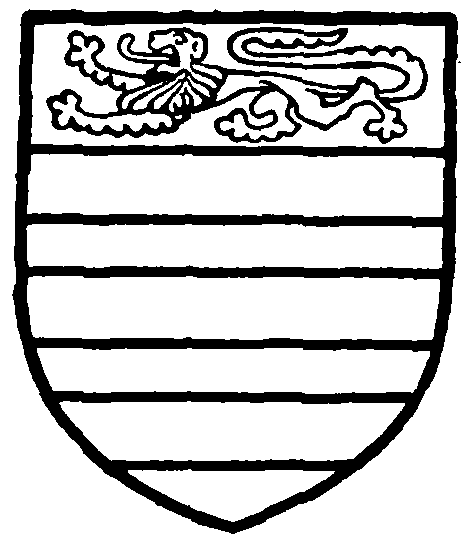
Ormerod. Or, three bars and a lion passant in chief gules.
In 1785 the principal landowners in the joint township were—Chas. Buckworth Shakerley, esq. the Rev. John Clowes, Samuel Clowes, esq., Thomas Johnson, esq., Thomas Froggat, esq., — Starkie, esq., the Rev. Robert Kenyon, and Alexander Radcliffe, esq. These owned four-fifths of the joint township. (fn. 96)
The hamlet and mesne manor of SHAKERLEY (fn. 97) was given by Hugh son of Henry de Tyldesley in or before the reign of John to Cockersand Abbey by these bounds — From the head of the Ley on the east, following Shakerlege broc to over against the Holhak where the cross stands, thence across to the Carr, following the Carr to over against the Knottihak, thence across to Blakesik and through the midst of the moss to the first boundary. (fn. 98) Thomas, abbot of Cockersand c. 1279–86, enfeoffed Robert de Shakerley of this land, but Adam son of Robert released it to the abbey about the year 1290, (fn. 99) when Henry son of Hugh de Tyldesley augmented his predecessor's gift to the abbey by the addition of lands bounded as follows—From the eastern head of Shakerley to Blaksic, following Blakesic to Blakelowe broc, following that brook to an oak tree marked with a cross in Haylege Komb, following Hailege Komb to Holge sike, thence by a cross to Fyfnakes over Blakelowe brook, thence to Goderic brook and so to the first boundary. (fn. 100) The same Adam soon after granted Shakerley, Fiveakis Hurst and Ylgridding to Adam son of Henry de Tyldesley in fee for a pair of white gloves yearly, and a rent of 12 pence yearly to the abbey of Cockersand, (fn. 101) the service which the Shakerley family continued to render to the abbey until the dissolution. (fn. 102) This grant was probably supplementary to the grant in 1301 of the northern part of the township to Adam from his father Henry, which included the service of Henry de Shakerley. In 1315 Adam de Tyldesley and Henry de Shakerley made an agreement that neither of them in the future would make enclosures upon the wastes or woods in their lands in Tyldesley without the consent of the other. (fn. 103)

Shakerley. Argent, a chevron between three mole hills vert.
The family of Shakerley resided at Shakerley Hall (fn. 104) until the time of Henry VIII, when they made Hulme in the township of Allostock, county Chester, their residence. This property came to Peter Shakerley (fn. 105) of Shakerley, esq., by his marriage to Elizabeth, daughter and heiress of John Legh of Booths, county Chester, esq., and granddaughter of Emma, one of the daughters and coheiresses of Robert Grosvenour of Hulme, esq. (fn. 106) The family estate of Shakerley, including the greater part of the hamlet, was sold in 1836 by Charles Peter Shakerley of Somerford Park, county Chester, esq. (created a baronet in 1838), (fn. 107) to the late Jacob Fletcher of Peel Hall, esq., whose only daughter and heir brought it in marriage to Viscount Combermere, father of the present owner, Francis Lynch Wellington Stapleton-Cotton, fourth Viscount Combermere.
In 1646–7 Lieut.-Col. Geoffrey Shakerley, as a royalist 'delinquent,' paid a fine of £784 on compounding for his estates, and took the National Covenant and Negative Oath. (fn. 108)
Geoffrey Hurst of Shakerley, who married a sister of George Marsh of Dean, was imprisoned as a Protestant in the Marian persecution, but liberated on the accession of Elizabeth. (fn. 109)
CHARITIES
In 1729 Joseph Parr charged certain premises in Tyldesley with a yearly sum of £2 to be distributed amongst the poor living in Tyldesley and Hurst Quarter. There are also a number of charities which have been created within recent years, mainly for the benefit of St. George's church and schools. (fn. 110)
The church of St. George, commenced in 1822 and completed in 1825, is an edifice of stone in the Early English style from designs by Smirke, and consists of chancel, nave, aisles, transept, western porch and western tower with pinnacles and a lofty spire containing a clock and six bells. In 1886 a new chancel was erected, the church re-seated, and the western gallery removed. There are nine memorial windows of stained glass. The registers date from the year 1825. The living is a vicarage of the net yearly value of £300, with residence at Hindsford, Atherton, and is in the gift of the bishop of Manchester. The church of St. John at Mosley Common, erected in 1886, is a chapel-of-ease to St. George's Church. It is built of Yorkshire freestone in the Gothic style, and consists of chancel, nave, aisles, and south porch.
The first Wesleyan chapel here was opened in 1814; a new building was erected in 1886.
The oldest Nonconformist chapel is in Tyldesley Square, generally known as 'Top Chapel.' It was built in 1789 by the countess of Huntingdon's Connexion.
There are also chapels of the Congregational, Primitive Methodist (built in 1828), Baptist, Welsh Congregational, Welsh Calvinistic, and Independent Methodist connexions.
For a century or more after the Reformation the ancient rites were continued in secret at Morleys as opportunity afforded. (fn. 111) It was at this place that the Ven. Ambrose Barlow was arrested on Easter Sunday morning, 25 April, 1641, after he had said mass and preached to his congregation of some hundred persons. (fn. 112) After a long interval mass was again said in the neighbourhood, but this time at Tyldesley in 1865 in a hayloft over a stable behind the 'Star and Garter.' A personal appeal to the late Lord Lilford resulted in the acquisition of a site, on which the church of the Sacred Heart was built and opened in 1869. The school chapel of the Holy Family at Boothstown was opened in 1897. (fn. 113)