A History of the County of Lancaster: Volume 4. Originally published by Victoria County History, London, 1911.
This free content was digitised by double rekeying. All rights reserved.
'Liverpool: Churches', in A History of the County of Lancaster: Volume 4, ed. William Farrer, J Brownbill (London, 1911), British History Online https://www.british-history.ac.uk/vch/lancs/vol4/pp43-52 [accessed 30 April 2025].
'Liverpool: Churches', in A History of the County of Lancaster: Volume 4. Edited by William Farrer, J Brownbill (London, 1911), British History Online, accessed April 30, 2025, https://www.british-history.ac.uk/vch/lancs/vol4/pp43-52.
"Liverpool: Churches". A History of the County of Lancaster: Volume 4. Ed. William Farrer, J Brownbill (London, 1911), British History Online. Web. 30 April 2025. https://www.british-history.ac.uk/vch/lancs/vol4/pp43-52.
CHURCHES
The erection of a chapel at Liverpool was probably contemporaneous with the foundation of the borough; burgages 'next to the chapel' are mentioned in a charter of the middle of the 13th century. (fn. 1) The building is identified with the chapel of St. Mary del Key (or Quay) which was standing, 'a great piece of antiquity,' used as the free school, in 1673. (fn. 2) It was a chapel of ease to Walton, and without any permanent endowment.
In or before 1356 there was built, perhaps at the cost of the town, the larger chapel of Our Lady and St. Nicholas, which then became the chapel of Liverpool. In the year named the king allowed the mayor and commonalty to devote lands of the value of £10 a year to the maintenance of divine service in the chapel according to an agreement they had made with Henry, Duke of Lancaster, (fn. 3) who himself gave an allowance of 12s. a year to the chapel. (fn. 4)
In September 1361 the Bishop of Lichfield granted a licence for burials in the churchyard, during a visitation of plague; (fn. 5) and in the following February he gave permission for the chapel and cemetery of St. Nicholas of Liverpool to be consecrated 'by any Catholic bishop having the grace of the Apostolic See and faculties for his office.' (fn. 6) Shortly afterwards William de Liverpool gave a rent of 6s. 8d. towards the stipend of the chaplain, as long as the chantry should continue. (fn. 7) The chantry referred to was probably that at the altar of St. John, founded by John de Liverpool to celebrate for the souls of his ancestors, the priest of which was nominated by the mayor and burgesses. (fn. 8) Another ancient chantry was that of St. Mary at the high altar, (fn. 9) founded by Henry, Duke of Lancaster; (fn. 10) while the succeeding duke, John of Gaunt, founded one at the altar of St. Nicholas. (fn. 11) There were thus three priests in residence serving the chantries from the latter part of the 14th century down to the Reformation.
Further endowments were acquired from time to time; (fn. 12) and in 1459 the Bishop of Lichfield granted an indulgence of forty days on the usual conditions to contributors to the restoration of the old chapel of St. Mary del Key and to the maintenance of a chaplain there and of its ornaments, or to those who should devoutly pray before her image. (fn. 13) This ancient chapel continued in use until the Reformation, for John Crosse in 1515 made a bequest to 'the priest that sings afore our Lady of the Key.' (fn. 14) The same benefactor established the chantry of St. Katherine, the priest of which was also to 'teach and keep a grammar school.' (fn. 15) By this means the endowed staff was raised to four priests. A house was provided for them, with a garden adjoining. (fn. 16) The church, consisting of a nave and a chancel of about equal lengths, with a tower at the west end, a south porch, and an aisle on the north side, (fn. 17) had four or five altars—the high altar, St. Nicholas's (perhaps the same), St. John's, St. Katherine's, and the Rood altar. (fn. 18) The chapel of St. Mary of the Key, which was a separate building standing on the river bank, a little to the west of St. Nicholas's, also had its altar. (fn. 19) There is no means of deciding how many priests and clerks were employed, but the size of the chancel indicates a considerable staff.
The suppression of the chantries and the change of religion made a great difference. St. Nicholas's chapel continued to be used, and one of the old chantry priests, John Hurdes, was placed in charge in 1548; he appeared at the visitation in 1554, but not in 1562. (fn. 20) At the abolition of the ancient services in 1559 it is uncertain what took place at Liverpool; (fn. 21) Vane Thomasson was curate in 1563, (fn. 22) and next year the Crown allowed the old stipend of one of the chantry priests for the payment of a minister to be nominated by the burgesses. (fn. 23) In 1590 the minister was 'a preacher,' (fn. 24) and the corporation afterwards took pains to secure a preacher or an additional lecturer. (fn. 25)
In 1650 the Commonwealth surveyors found that the Committee of Plundered Ministers had assigned to the curate of Liverpool all the tithes of the township and £10 from the rectory of Walton; the duchy rent of £4 15s. was also paid to him; the curate had, on the other hand, by the committee's order, to pay £11 10s. to the wife of Dr. Clare, the ejected rector of Walton. (fn. 26) Shortly afterwards, in 1658, Liverpool was made an independent parish, (fn. 27) but on the Restoration this Act was adjudged to be null, and St. Nicholas's became once more a chapel under Walton. The following is a list of the curates:—
| c. | 1563 | Vane Thomasson (fn. 28) |
| oc. | 1577 | James Seddon (fn. 29) |
| 1585 | James Martindale (fn. 30) | |
| oc. | 1590 | Hugh Janion (fn. 31) |
| 1596 | — Bentley (fn. 32) | |
| 1598 | Thomas Wainwright (fn. 33) | |
| ? | 1625 | Edwin Lappage (fn. 34) |
| c. | 1634 | Henry Shaw (fn. 35) |
| 1643 | Joseph Thompson (fn. 36) | |
| 1645 | John Fogg (fn. 37) | |
| 1662 | John Leigh (fn. 38) | |
| 1670 | Robert Hunter (fn. 39) | |
| 1688 | William Atherton (fn. 40) | |
| Robert Stythe |
Liverpool had by this time become so important that the governing body thought they might claim full parochial rights for the township. (fn. 41) After negotiations with the rector and vicar of Walton, and the patron, Lord Molyneux, an Act of Parliament was procured 'to enable the town of Liverpool to build a church and endow the same, and for making the same town and liberties thereof a parish of itself, distinct from Walton.' (fn. 42) Two joint rectors were appointed, the first being the two curates then ministering, and it was directed that £110 should be levied from the parishioners for each of them. (fn. 43) The church built under this Act was St. Peter's in Church Street, consecrated in 1704, which has since been regarded as the principal church of the parish, and was therefore appointed the pro-cathedral in 1880. It is a plain building with wide round-headed windows, consisting of a chancel with vestries, nave, and west tower. Its chief merit lies in the woodwork, and it preserves its galleries on three sides of the nave, the general arrangement of the seating having been but little altered since its first building. (fn. 44) It is to be demolished as soon as part of the new cathedral is in use.
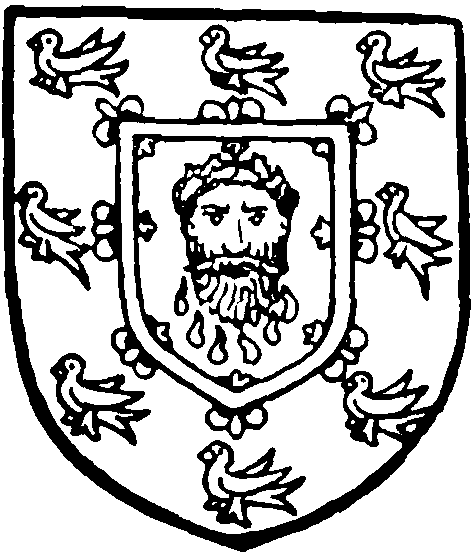
Gladstone. Argent a savage's head wreathed with holly and distilling drops of blood proper within a flowered orle gules all with an orle of martlets sable.
The patronage was vested in the mayor and aldermen, such as had been aldermen or bailiffs' peers, and the common council. In 1836 the reformed corporation sold the patronage to John Stewart, and about the same time provision was made for the union of the two rectories. (fn. 45) From the Stewarts the patronage was purchased in 1890 by the late W. E. Gladstone, whose son, the Rev. Stephen E. Gladstone, now holds it. (fn. 46) There is no rectoryhouse, but the gross value of the benefice is stated as £1,600 a year, largely derived from fees. (fn. 47)
The following is a list of the rectors:—
| I | |||
| 1699 | Robert Stythe, B. A. (fn. 48) | ||
| 1714–17 | vacant, owing to a dispute. (fn. 49) | ||
| 1717 | Thomas Bell, M.A. (fn. 50) | ||
| 1726 | John Stanley, D.D. (fn. 51) | ||
| 1750 | Robert Brereton | ||
| 1784 | George Hodson, M.A. (fn. 52) | ||
| 1794 | Samuel Renshaw, M.A. (fn. 53) | ||
| 1829 | Jonathan Brooks, M.A. (fn. 54) | ||
| II | |||
| 1699 | William Atherton, B.A. (fn. 55) | ||
| 1706 | Henry Richmond, B.A. (fn. 56) | ||
| 1721 | Thomas Baldwin, M.A. (fn. 57) | ||
| 1753 | Henry Wolstenholme, M.A. (fn. 58) | ||
| 1772 | Thomas Maddock, M.A. (fn. 59) | ||
| 1783 | Thomas Dannett (fn. 60) | ||
| 1796 | Robert Hankinson Roughsedge, M.A. (fn. 61) | ||
| 1829 | Augustus Campbell, M.A. (sole rector, 1855) (fn. 62) | ||
| 1870 | Alexander Stewart, M.A. (fn. 63) | ||
| 1904 | John Augustine Kempthorne, M.A. (fn. 64) | ||
St. George's Church, for which an Act of Parliament was obtained in 1715, (fn. 65) was begun in 1726 on the site of the castle; it was completed in 1734. 'It had originally an elegant terrace, supported by rustic arches, on one side; these arches the frequenters of Red Cross market used to occupy.' (fn. 66) The church was rebuilt piecemeal between 1819 and 1825, and its new spire was reduced in height in 1833; in its time it was regarded as 'one of the handsomest in the kingdom.' It was the property of the corporation and maintained by them, the mayor and the judges of assize at one time attending it. On Mr. Charles Mozley, who was a Jew, being elected mayor in 1863, the incumbent preached a sermon denouncing the choice, and from that time the mayor and corporation ceased to attend St. George's. The building having long failed to attract a congregation was closed in 1897 and then demolished, the site being acquired by the corporation. (fn. 67)
St. Thomas's, Park Lane, was built in 1750 under the provisions of an Act of Parliament. (fn. 68) 'The land was given by Mr. John Skill, who, however, afterwards charged three times the value of the ground for the churchyard when it was required.' (fn. 69) A very tall and slender spire was a feature of the exterior; after various accidents it was taken down in 1822, and the present miniature dome replaced it. A large part of the churchyard was acquired by the corporation about 1885 for a new thoroughfare. (fn. 70)
St. Paul's, one of the corporation churches, was begun in 1763 in accordance with an Act obtained the previous year, (fn. 71) and opened in 1769. Its chief feature is a dome; internally this had the result of rendering the minister's voice inaudible. In time this defect was remedied, but changes in the neighbourhood deprived the church of its congregation, and falling into a dangerous condition, it was closed by the corporation in 1900. (fn. 72)
St. Anne's, also erected under the authority of Parliament, (fn. 73) was built by two private gentlemen in 1772; it was 'chiefly in the Gothic style.' The first minister, the Rev. Claudius Crigan, was appointed to the see of Sodor and Man in 1783, in the expectation, as it was said, that he would live only a short time, until the son of the Duchess of Atholl, sovereign of the Isle, should be old enough; he lived thirty years longer, surviving his intended successor. (fn. 74) The old church was removed a little eastward to enable Cazneau Street to go through to St. Anne Street, the corporation replacing it by the present church, consecrated in 1871.
In 1776 a Nonconformist chapel in Temple Court was purchased by the rector of Aughton and opened in connexion with the Established Church. In 1820, some time after his death, it was purchased by the corporation and demolished. (fn. 75) In 1776 also another Nonconformist chapel, in Harrington Street, was opened as St. Mary's in connexion with the Established Church; the congregation is supposed to have acquired St. Matthew's, in Key Street, in 1795, after which St. Mary's was demolished. (fn. 76)
St. John's, like St. Paul's, was built under the auspices of the corporation, and consecrated in 1785: the style was the spurious Gothic of the time. There was a large public burial ground attached, consecrated in 1767. Becoming unserviceable as a church, there being but a scanty congregation, it was closed in 1898, demolished, and the site sold to the corporation. (fn. 77)
Trinity Church, St. Anne Street, was erected by private subscription in 1792. (fn. 78) In the same year a Baptist Chapel in Byrom Street was purchased and opened as St. Stephen's Church. (fn. 79) This was taken down in 1871 in order to allow the street to be widened, the corporation building the present church further north. In 1795 the English Presbyterian or Unitarian Chapel in Key Street was purchased for the Established worship, being named St. Matthew's. It was consecrated in 1798. The site being required in 1848 for the Exchange railway station, the Lancashire and Yorkshire Company purchased a Scotch Presbyterian Chapel in Scotland Road, which was thereupon consecrated as St. Matthew's. (fn. 80) In 1798 a tennis court in Grosvenor Street was converted into a place of worship and licensed for service as All Saints' Church. It continued in use until the present church of All Saints', Great Nelson Street, was built in 1848. (fn. 81)
Christ Church, Hunter Street, was built in 1797 by John Houghton. (fn. 82) It was intended to use an amended version of the Book of Common Prayer, but the design proving a failure, the church was 'put on the establishment,' and consecrated in 1800. (fn. 83) Originally there was a second or upper gallery, close to the roof, but this was taken away about 1865.
St. Mark's was built by subscription in 1803, and consecrated in 1815, becoming established by an Act of Parliament; (fn. 84) the projector was the Rev. Thomas Jones, of Bolton, who died suddenly on a journey to London before the opening. (fn. 85) St. Andrew's, Renshaw Street, was erected by Sir John Gladstone in 1815; (fn. 86) the site being required for the enlargement of the Central Station, a new St. Andrew's was built in Toxteth in 1893. St. Philip's, Hardman Street, was one of the 'iron churches' of the time; it was opened in 1816 and afterwards regulated by an Act of Parliament. (fn. 87) It was sold in 1882, the Salvation Army acquiring it, and a new St. Philip's built in Shell Road. (fn. 88)
More costly churches were about the same time designed and slowly carried out by the public authorities. St. Luke's, Bold Street, was begun in 1811, but not completed and opened till 1831; (fn. 89) it is a florid specimen of perpendicular Gothic, the chancel being a copy of the Beauchamp Chapel, Warwick. (fn. 90) St. Michael's, Pitt Street, in the Corinthian style, but with a lofty spire, was begun in 1816 under Acts of Parliament, (fn. 91) and opened in 1826. There is a large graveyard around it.
The chapel of the Blind Asylum was built in 1819 in Hotham Street in imitation of the Temple of Jupiter at Ægina. The site being required for Lime Street Station, the building was taken down and carefully re-erected in its present position in Hardman Street in 1850. (fn. 92) It is the Liverpool home of Broad Church doctrine.
St. David's, for Welsh-speaking Anglicans, was built in 1827. (fn. 93) As far back as 1793 Welsh services had been authorized in St. Paul's Church. (fn. 94) Another special church was the Mariners' Church, an old sloop-of-war moored in George's Dock. It was used from 1827, but ultimately sank at its moorings in 1872. (fn. 95)
St. Martin's in the Fields, a Gothic building with a western spire, was erected out of a Parliamentary grant in 1829, the land being a gift by Edward Houghton. (fn. 96) It was the first Liverpool church to be affected by the Tractarian movement. (fn. 97)
St. Catherine's, Abercromby Square, was consecrated in January 1831, (fn. 98) a fortnight after St. Bride's. (fn. 99) The first church of St. Matthias was built in 1833–4 in Love Lane, but the site being required by the railway company, the present church in Great Howard Street was built in 1848; the old one was accidentally destroyed by fire. (fn. 100) St. Saviour's, Falkner Square, was built by subscription in 1839; it was burnt down in 1900 and rebuilt in 1901 on the old plan. (fn. 101) In 1841 a congregation which had for some five years met in the chapel in Sir Thomas's Buildings, which they called St. Simon's, acquired a chapel previously used by Presbyterians and Independents, and this was consecrated as St. Simon's. (fn. 102) The site being required for Lime Street Station, a new church was in 1848 built close by, (fn. 103) and this was taken down and rebuilt in its present position in 1866–72, on an enlargement of the station.
A building in Hope Street, erected about fifteen years earlier for the meetings of the 'Christian Society,' and in 1838 occupied by the Rev. Robert Aitken, an Anglican minister who adopted 'revivalist' methods, was in 1841 acquired for the Established Church and called St. John the Evangelist's. (fn. 104) It was abandoned in 1853, but under the name of Hope Hall is still used for religious and other meetings. In 1841 also the churches of St. Bartholomew and St. Silas were opened. (fn. 105) St. Alban's, Bevington, dates from 1849–50.
In 1854 Holy Innocents' in Myrtle Street, primarily the chapel of the adjoining orphan asylums, was opened. All Souls', begun in the same year, had as first incumbent Dr. Abraham Hume, one of the founders of the Lancashire and Cheshire Historic Society. (fn. 106) 'As the population of this parish is mostly Roman Catholic' it is proposed to abandon the building. (fn. 107) A Wesleyan chapel was acquired and in 1858 consecrated as St. Columba's; soon afterwards St. Mary Magdalene's was erected for an object indicated by its dedication; (fn. 108) and more recently St. James the Less' (fn. 109) and St. Titus' (fn. 110) have been built, the former serving to perpetuate the High Church tradition of St. Martin's when this had resumed its old ways. (fn. 111)
The new cathedral is being erected within the township. The Church House in Lord Street provides a central meeting-place and offices for the different societies and committees; it contains a library also.
Scottish Presbyterianism was first represented by the Oldham Street Church, opened in 1793; (fn. 112) St. Andrew's in Rodney Street in 1824; (fn. 113) and Mount Pleasant in 1827. (fn. 114) Others arose about twenty years later: St. George's, Myrtle Street, in 1845; (fn. 115) Canning Street (fn. 116) and Islington in 1846, (fn. 117) and St. Peter's, Silvester Street, in 1849. (fn. 118) Another was built in Vauxhall Road in 1867. Except the first two, which remain connected with the Established Church of Scotland, they are now associated with the Presbyterian Church of England. The formal union which constituted this organization out of many differing ones took place at Liverpool in 1876. (fn. 119)
The German Evangelical Church occupies Newington Chapel, formerly Congregational. It seems to have originated in a body of converted Jews speaking German, who met for worship in the chapel in Sir Thomas' Buildings from about 1831, and were considered as attached to the Established Church. (fn. 120)
Wesleyan Methodism made itself felt by the middle of the 18th century. Pitt Street chapel was built in 1750, (fn. 121) enlarged 1765, rebuilt in 1803, and altered in 1875; John Wesley preached here for a week in 1758. A second chapel within the township was built in 1790, (fn. 122) and Cranmer Chapel at the north end in 1857. (fn. 123) These are now all connected with the Wesleyan Mission, formed in 1875, which has also acquired the old Baptist Chapel in Soho Street, now Wesley Hall, and a mission room near. (fn. 124) Leeds Street Chapel, of some note in its day, was opened about 1798 and pulled down in 1840. (fn. 125) Formerly, from 1811 to 1864, the chapel in Benn's Gardens was also used by Welsh-speaking Wesleyans. (fn. 126) Trinity Chapel, Grove Street, erected in 1859, is the head of a regular circuit; the conference was held here in 1881. The Wesleyans have also mission rooms.
The Wesleyan Methodist Association, later the United Methodist Free Church, had a chapel in Pleasant Street before 1844, now St. Columba's; it was replaced in 1852 by Salem Chapel or St. Clement's Church, in Russell Street, (fn. 127) recently given up, the Pupil Teachers' College now occupying the site. Another chapel in Scotland Road, built in 1843, is still used, as also one in Grove Street, built in 1873. (fn. 128) The Welsh-speaking members used a chapel in Gill Street from 1845 to 1867. (fn. 129)
The Methodist New Connexion, who appeared as early as 1799, had Zion Chapel, Maguire Street, by St. John's Market, before 1813; they removed to Bethesda in Hotham Street about 1833, after which the old building was converted into a fish hall. (fn. 130) They had also a chapel in Bevington Hill. Both have long been given up. (fn. 131) The Primitive Methodists also had formerly meeting-places in Liverpool. (fn. 132)
At the Bishop of Chester's visitations in 1665 and later years Anabaptists were presented, and it was said that conventicles were held. The Baptists, who had from 1707, if not earlier, met in Everton, opened a chapel in Byrom Street in 1722. (fn. 133) A much larger chapel was erected in 1789 in the same street, and the old one sold to the Established Church. The later building is still in use as Byrom Hall. (fn. 134) Myrtle Street Chapel, the successor of one in Lime Street, built in 1803, was opened in 1844 and enlarged in 1859. (fn. 135) In 1819 a chapel was built in Great Crosshall Street. (fn. 136) Soho Street Chapel, begun for 'Bishop West,' was used by Baptists from 1837 to 1889, when Jubilee Drive Chapel replaced it. (fn. 137) The Welsh-speaking Baptists had a chapel in Ormond Street, dating from 1799, but it has been given up, one in Everton succeeding it. (fn. 138)
The Sandemanians or Glassites long had a meeting-place in the town. (fn. 139)
Newington Chapel was in 1776 erected by Congregationalists dissatisfied with the Unitarianism of the Toxteth Chapel, and wishing to have a place of worship nearer to Liverpool. (fn. 140) It was given up in 1872, and is now the German Church. A youthful preacher, Thomas Spencer, attracting great congregations, a new chapel was begun for him in 1811 in Great George Street; he was drowned before it was finished, (fn. 141) and Dr. Thomas Raffles, who was its minister for nearly fifty years, became one of the most influential men in Liverpool. (fn. 142) This chapel was burnt down in 1840, and the present building erected. Seceders from All Saints' Church in 1800 met for worship in Maguire Street and Cockspur Street, and in 1803 built Bethesda Chapel in Hotham Street; from this they moved in 1837 to Everton Crescent. (fn. 143)
Burlington Street Chapel was bought as an extension by the Crescent congregation in 1859; about 1890 it was weakened by a division, most of the congregation assembling in Albert Hall for worship; this is now recognized as a Congregational meeting, but Burlington Street was worked for a time as a mission by the Huyton Church. (fn. 144)
The Welsh Congregationalists have a chapel in Grove Street, in place of Salem Chapel, Brownlow Hill, (fn. 145) given up in 1868. Formerly they had one in Great Crosshall Street, built in 1817, but the congregation has migrated to Kirkdale and Everton.
In Elizabeth Street is a United Free Gospel Church, built in 1871 to replace one of 1845 as an Independent Methodist Church.
The Calvinistic Methodists, the most powerful church in Wales, are naturally represented in Liverpool, where Welshmen are very numerous. The first chapel was built in Pall Mall in 1787, and rebuilt in 1816, but demolished to make way for the enlargement of Exchange Station in 1878, a new one in Crosshall Street taking its place. (fn. 146) There are others in Chatham Street and Catherine Street built in 1861 and 1872 respectively; at the latter the services are in English.
The Society of Friends had a meeting-place in Hackins Hey as early as 1706, by Quakers' Alley; this remained standing until 1863. The place of meeting was removed to Hunter Street in 1790; this continues in use. (fn. 147)
The Moravians held services 'for many years' in the Religious Tract Society's rooms.
The Berean Universalist Church was opened in 1851 in Crown Street, but had only a short existence. (fn. 148)
The Bethel Union, an undenominational evangelistic association for the benefit of sailors, maintains several places of worship near the docks. (fn. 149)
The Young Men's Christian Association has a large institute in Mount Pleasant, opened in 1877.
It has been shown above that Nonconformity was strong in the town after 1662. A chapel was built in Castle Hey, and the minister of Toxteth Park is said to have preached there on alternate Sundays from 1689. (fn. 150) This was replaced by Benn's Gardens Chapel in 1727, from which the congregation, which had become Unitarian, moved to Renshaw Street in 1811, and from this recently to Ullet Road, Toxteth. Another Protestant Nonconformist chapel was built in Key Street in 1707; in this case also the congregation became Unitarian. (fn. 151) A new chapel in Paradise Street replaced it in 1791, and a removal to Hope Street was made in 1849, the abandoned building being turned by its new owners into a theatre. The Octagon Chapel in Temple Court was used from 1762 to 1776 to meet a desire for liturgical services, the organ being used; but it proved a failure and was sold to the Rev. W. Plumbe, Rector of Aughton, who preached in it as St. Catherine's. The Unitarians have a mission room in Bond Street. (fn. 152)
The Christadelphians formerly (1868–78) had a meeting-place in Gill Street.
The Catholic Apostolic Church (Irvingite) was built in 1856. The choir is a rich specimen of flamboyant Gothic.
The ancient religion appears to have been stamped out very quickly in Liverpool, which became a decidedly Protestant town, and there is scarcely even an incidental allusion to its existence (fn. 153) until the beginning of the 18th century. Spellow and Aigburth were the nearest places at which mass could occasionally be heard in secret. Fr. William Gilli brand, S.J., who then lived at Little Crosby, in 1701 received £3 from Mr. Eccleston 'for helping at Liverpool.' (fn. 154) The first resident missioner known was Fr. Francis Mannock, S.J., who was living here in 1710; and the work continued in the hands of the Jesuits until the suppression of the order. The next priest, Fr. John Tempest, better known by his alias of Hardesty, built a house for himself near the Oldhall Street corner of Edmund Street, in which was a room for a chapel. (fn. 155) In 1746, after the retreat of the Young Pretender, the populace, relieved of its fears, went to this little chapel, made a bonfire of the benches and woodwork, and pulled the house down. (fn. 156) Henry Pippard, a merchant of the town, who married Miss Blundell, the heiress of Little Crosby, treated with the mayor and corporation about rebuilding the chapel. This, of course, they could not allow, the law prohibiting the ancient worship under severe penalties, whereupon he said that no one could prevent his building a warehouse. This he did, the upper room being the chapel. (fn. 157) It was wrecked during a serious riot in 1759, but was enlarged in 1797 and continued to be used until St. Mary's, from the designs of A. W. Pugin, was built on the same site and consecrated in 1845. In consequence of the enlargement of Exchange Station it was taken down, but rebuilt in Highfield Street on the same plan and with the same material, being reconsecrated 7 July 1885. The baptismal register commences in 1741. After the suppression of the Jesuit order in 1773 the two priests then in charge continued their labours for ten years, when the Benedictines took charge, and still retain it. (fn. 158)
They at once sought to obtain an additional site at what was then the south end of the town, and in 1788 St. Peter's, Seel Street, was opened. It was enlarged in 1843, and is still served by the same order. (fn. 159) The school in connexion with it was opened in 1817.
About the same time Fr. John Price, an ex-Jesuit, was ministering at his house in Chorley Street (1777), and by and by (1788) built the chapel in Sir Thomas's buildings, which was used till his death in 1813. (fn. 160) It was then closed, as St. Nicholas' was ready, work having been commenced in 1808, and the church opened in 1812. (fn. 161) Since 1850 it has been used as the cathedral. At the north end of the town St. Anthony's had been established in 1804; the present church, on an adjacent site, dates from 1833, and has a burial ground. (fn. 162) St. Joseph's in Grosvenor Street was opened in 1846, a new building being completed in 1878. (fn. 163)
These buildings (fn. 164) sufficed till the great immigration of poor Irish peasants, driven from home by the famine of 1847. St. Vincent de Paul's mission had been begun in a room over a stable in 1843, but after interruption by the fever of 1847 a larger room in Norfolk Street was secured in 1848, and served until in 1857 the present church was erected. Holy Cross was begun in 1848 in a room over a cowhouse in Standish Street, and in 1850 was given to the care of the Oblates of Mary Immaculate, who are still in charge. The church was built in 1860, and the chancel opened in 1875. St. Augustine's, Great Howard Street, was an offshoot in 1849 from St. Mary's, and is still in charge of the Benedictines.
Later came St. Philip Neri's Oratory near Mount Pleasant, 1853. All Souls', in Collingwood Street, was erected in 1870 by the efforts of a Protestant merchant, who was anxious to provide a remedy for the horrible scenes at wakes; the middle aisle of the church was for the bodies of the departed to lie in previous to interment, and was quite cut off from the aisles where the congregation assembled, by glass partitions. This has recently been changed. St. Bridget's, Bevington Hill, was also opened in 1870, and rebuilt in 1894. St. Sylvester's in Silvester Street began with schools in 1872; at the beginning of 1875 a wooden building was erected adjacent, continuing in use until 1889, when the present permanent church was opened.
There are two convents: Notre Dame, at the training college, Mount Pleasant, 1856; and St. Catherine, Eldon Place, 1896.
The followers of Emmanuel Swedenborg have long had a place of meeting in Liverpool, where they had been known from 1795. (fn. 165) The present building, New Jerusalem, in Bedford Street, was opened in 1857.
The Mormons have an institute. (fn. 166)
The Jews have had a recognized meeting-place since about 1750. The earliest known was at the foot of Matthew Street; it had a burial place attached; afterwards Turton Court, near the Custom House, and Frederick Street were places of Jewish worship. (fn. 167) The synagogue in Seel Street was built in 1807, the congregation migrating to Princes Road in 1874. A disused Presbyterian church in Islington has recently (1908) been purchased and reopened as the Central Synagogue. The Hope Place Synagogue of the New Hebrew Congregation was built in 1856. (fn. 168)