A History of the County of Lancaster: Volume 4. Originally published by Victoria County History, London, 1911.
This free content was digitised by double rekeying. All rights reserved.
'The city and parish of Manchester: Introduction ', in A History of the County of Lancaster: Volume 4, ed. William Farrer, J Brownbill (London, 1911), British History Online https://www.british-history.ac.uk/vch/lancs/vol4/pp174-187 [accessed 30 April 2025].
'The city and parish of Manchester: Introduction ', in A History of the County of Lancaster: Volume 4. Edited by William Farrer, J Brownbill (London, 1911), British History Online, accessed April 30, 2025, https://www.british-history.ac.uk/vch/lancs/vol4/pp174-187.
"The city and parish of Manchester: Introduction ". A History of the County of Lancaster: Volume 4. Ed. William Farrer, J Brownbill (London, 1911), British History Online. Web. 30 April 2025. https://www.british-history.ac.uk/vch/lancs/vol4/pp174-187.
MANCHESTER
The ancient parish of Manchester, with an area of 35, 152 acres and a population in 1901 of 878, 532, has from time immemorial been the most important in the county. The situation of the town from which it derives its name being at the junction of two important roads—from the south to the north-west of the country and from the port of Chester to York— must have attracted an urban population from very early times, (fn. 1) and the convenience of its position beside the Irwell and between two of its tributaries, if not the original reason for a settlement, was a concomitant attraction. The Romans established a fortified station, of which various fragments are known, (fn. 2) and from which great roads branched off in five directions. (fn. 3) Their English successors also occupied the place, which in the 10th century was included in Northumbria. In 923 King Edward sent a force to the town to repair and man it. (fn. 4) History is again silent for a century and a half, and then reveals the existence of an endowed church at Manchester and of a royal manor at Salford, to which not only the parish but the hundred owed service. (fn. 5)
By the Norman kings the town of Manchester with the greater part of the parish was granted to the Grelley family, who constituted it the head of their barony; (fn. 6) but Salford, with the adjacent townships of Broughton, Cheetham, Hulme, and Stretford, and the more distant one of Reddish was retained by the king as demesne or bestowed on the great nobleman to whom he entrusted 'the land between Mersey and Ribble' or in later times the honour of Lancaster, the holders of which received the title of earl and duke successively. (fn. 7) The duchy having long been annexed to the Crown, Salford may still be regarded as a royal manor.
A borough grew up at Manchester in the 13th century, and a market and fair were granted in 1227, while four years later Salford also became a borough. (fn. 8) The inhabitants of the former town were already probably to a great extent artificers and traders; a fulling-mill, a tanner, and a dyer are named about 1300. (fn. 9) Its earliest known charter was granted in 1301. The town appears to have grown and prospered; non-resident lords, represented by their stewards, at least did nothing to hinder its progress, and the foundation of a well-staffed collegiate church in 1421, when the lord of the manor, at that time also rector, gave to the new body of clergy his manorhouse as their residence, made the parish church the most important institution of the place, a position which it retained until the 18th century. (fn. 10) It drew round it numerous benefactions, such as the chantries and grammar school.
Adam Banastre and his associates displayed the king's banner at Manchester on 1 November 1315, at the outbreak of their insurrection. (fn. 11) John of Gaunt, Duke of Lancaster, was at Manchester on 7 September 1393. (fn. 12)
The district was visited by some form of plague about 1350—perhaps the Black Death itself (fn. 13) —and many later visitations are on record, two of the most notable being in 1605 and 1645. (fn. 14)
A bridge over the Irwell, connecting Manchester and Salford, existed from early times. (fn. 15) In 1368 Thomas del Booth of Barton left money for this bridge. (fn. 16) Another, over the Irk, is named in 1381. (fn. 17) These rivers were noted for their floods, often very destructive. (fn. 18)
About 1536 Leland thus described the place: 'Manchester, on the south side of the Irwell River, standeth in Salfordshire, and is the fairest, best builded, quickest, and most populous town of all Lancashire; yet is in it [but] one parish church, but is a college, and almost throughout double-aisled ex quadrato lapide durissimo, whereof a goodly quarry is hard by the town. There be divers stone bridges in the town, but the best, of three arches, is over Irwell. This bridge divideth Manchester from Salford, the which is a large suburb to Manchester. On this bridge is a pretty little chapel… . And almost two flight shots without the town, beneath on the same side of Irwell, yet be seen the dykes and foundations of Old Mancastel in a ground now inclosed. The stones of the ruins of this castle were translated towards making of bridges for the town.' (fn. 19) The quarry named was that at Collyhurst. (fn. 20)
The privilege of sanctuary which had been allowed to the town (fn. 21) was in 1541 transferred to Chester, having proved injurious to good order. (fn. 22)
The prosperity of the place was uninterrupted during the religious changes of the 16th century. (fn. 23) The endowments of the parish church were confiscated by Edward VI, but restored in great measure by Mary. No resistance was openly offered to any of the changes. The two great families of the parish—the Byrons of Clayton and Radcliffes of Ordsall—though at first adverse to Protestantism, declined in fortune in the time of Elizabeth, and their estates were early in the 17th century dispersed among the smaller gentry and prosperous traders; the great manor of Manchester itself was about the same time purchased by a wealthy merchant. The smaller gentry, excepting the Barlows, appear as a rule to have gone with the times, often becoming zealous Puritans, while the trading and artisan classes, in Manchester as elsewhere, soon embraced the new doctrines. (fn. 24) Thus by the end of Elizabeth's reign the population was almost wholly Protestant, and of the more extreme type. The change was, of course, chiefly due to the clergy of the parish church, the more respected and influential of the ministers serving there and in the dependent chapelries being of the Puritan school.
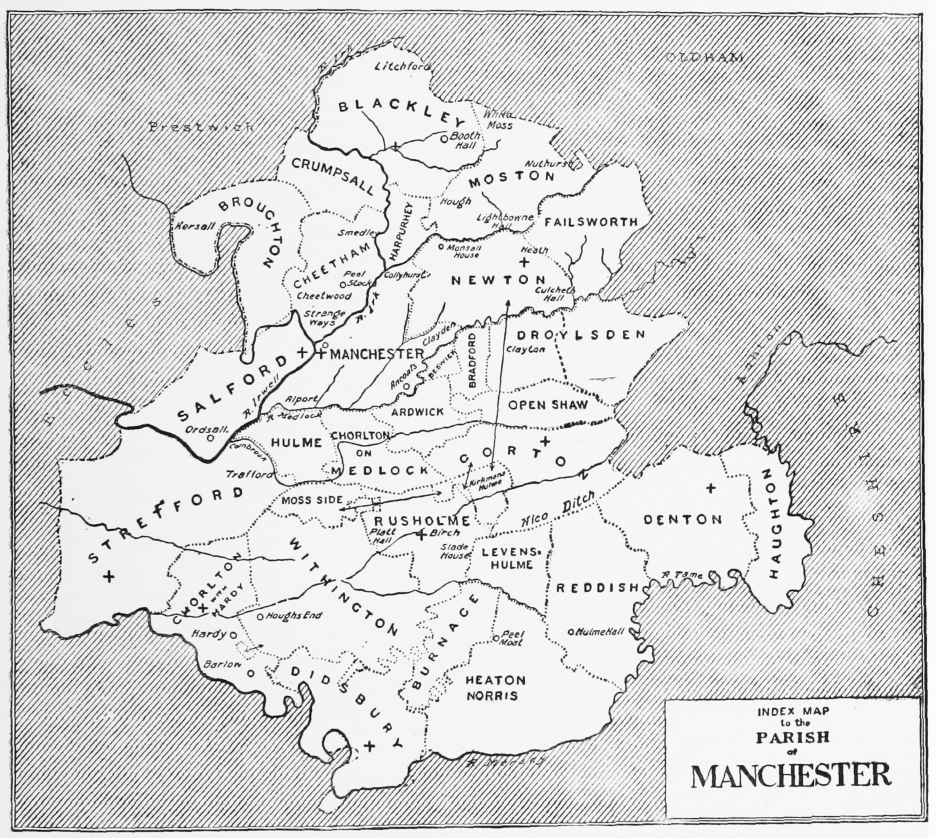
INDEX MAP to the PARISH of MANCHESTER
William Camden visited the place in 1586, and appears to have been pleased with it; he found the notable things to be the woollen manufacture, the market, church, and college. (fn. 25) John Taylor, the 'Water Poet,' passed through it about thirty years later. (fn. 26)
The Marprelate press was set up in 1588 at Newton Lane near Manchester, but discovered and suppressed soon after starting work. (fn. 27)
The number of recognized townships was formerly but small. In the Subsidy Roll of 1541 only seven are named—Salford, Manchester, Cheetham, Reddish, Withington, Heaton Norris, and Stretford—but Moston was taxed with Ashton. (fn. 28) The contributions to the ancient tax called the Fifteenth were arranged on the following basis:— When the hundred paid £41 14s. 4d., Salford paid £1 2s., Manchester with its members £3, Cheetham 4s. 10d., Reddish £1 2s., Withington £3 15s., Heaton Norris 13s. 6d., Chorlton 3s. 4d., and Stretford £1 1s. 8d. (fn. 29) The county lay, established in 1624, also recognized eight townships:—Manchester paying £9 3s. 11½d., Salford £3 1s. 3¾d., Stretford £1 4s. 6¼d., Withington £5 4s. 2¾d., Heaton Norris £1 16s. 9½d., Chorlton Row 12s. 3¾d., Reddish £1 10s. 7¾d., and Cheetham 11s. 2¾d., or £23 5s. in all, when the hundred contributed £100. (fn. 30) At this time, however, the 'members' or 'hamlets' of Manchester had separate constables, and were therefore townships. (fn. 31)
The geology of the parish of Manchester is represented by the New Red Sandstone, the Permian Beds, and the Carboniferous Rocks. The formation lying on the west side of a line drawn from Reddish through the Manchester Waterworks, Fairfield, Newton Heath, and Blackley, consists almost entirely of the New Red Sandstone, the exception being a long and irregular-shaped patch of the Permian Rocks and, at the widest part to the north-east of Manchester, of the Coal Measures, and lying on the west side of, and brought up by, a fault which extends northward from Heaton Norris, through Kirkmanshulme and Openshaw, trending north-west around Cheetham to Crumpsall. At the widest part this patch of the Coal Measures is 1½ mile in width, tapering out at Crumpsall Hall on the north and at Kirkmanshulme on the south. Further to the east a broad belt of the Permian Rocks, varying in width from ¾ mile to 1½ mile, crops out above the Coal Measures. These occur over the remainder of the parish on the east side of a line drawn from Hyde Hall in Denton through Audenshaw to Failsworth, and from Newton Heath between Blackley and the River Irk to the limits of the parish near Heaton Park.
The principal features of the town of Manchester as it was about 1600 still exist, though changed (fn. 32) — the church with the college (fn. 33) to the north of it, the bridges over Irk and Irwell adjacent, and the marketplace a little distance to the south—originally on the edge of the town. In Salford the small triangle formed by Chapel Street, (fn. 34) Gravel Lane, (fn. 35) and Greengate (fn. 36) was the village or inhabited portion, the dwellings naturally clustering round the bridge over the Irwell. (fn. 37) Then, as now, the road through Manchester from this bridge (fn. 38) went winding east and north round the church as Cateaton Street, (fn. 39) Hanging Ditch, (fn. 40) Toad or Todd Lane, (fn. 41) crossing the Irk (fn. 42) and mounting Red Bank. (fn. 43) Half Street, (fn. 44) at the east end of the church, was continued as Millgate, (fn. 45) which wound along by the Irk, to reach the lord's mills on that stream. The grammar school, on its original site, and some old timbered houses (fn. 46) still distinguish the street, though the mills have gone. From the northeast corner of the church Fennel Street (fn. 47) led eastward past Hyde's Cross, (fn. 48) at the corner of Todd Lane, to Withy Grove (fn. 49) and Shude Hill. (fn. 50)
From the south Deansgate, (fn. 51) on the line of the old Roman road from Chester, ran northerly towards the church, but curving to the east near the bridge was continued as Cateaton Street or Hanging Ditch; at the junction Smithy Door (fn. 52) led south to the marketplace, which was probably always an open square, though the area may have been diminished by encroachments through traders desiring to have their houses and shops upon it. Smithy Door has gone and Deansgate has been straightened, but the eastern side of the market-place remains; from it Mealgate, now Old Millgate, (fn. 53) leads north to Cateaton Street.
In the open space stood the market cross, the toll booth or town hall in which the courts were held, and the pillory and stocks. (fn. 54) The south side of the market-place was formed by a lane leading east and west; the eastern part was called Market-stead Lane, (fn. 55) and the western St. Mary's Gate. (fn. 56) The conduit stood in it. (fn. 57) Beyond this lane southward was the field where the fair was held, called Acres Field. (fn. 58)
Other street-names occur. (fn. 59) In the town the principal houses were that of the Radcliffes of the Pool near the Conduit, and that called Olgreave, Culcheth, or Langley Hall in Long Millgate; further out were Alport Lodge, Garrett, Ancoats, Collyhurst, and one or two others. To the south of Alport was Knott in Mill Hulme; a licence for the mill-dam was given in 1509. (fn. 60) The cockpit lay to the south-east of Old Millgate. (fn. 61) There exists a small town plan, of unknown origin but apparently trustworthy, which may be dated about 1650. (fn. 62)
Apart from the streets above mentioned the parish was mainly agricultural, areas of wood, (fn. 63) heath, (fn. 64) and moss (fn. 65) being intermixed with arable and pasture lands; the dwellings were the scattered manor and farm-houses and small villages. The rural population probably then, as later, combined tillage with weaving. The chapels existing in 1650 serve to indicate the chief centres of population—Blackley, Newton, Gorton, Denton, Birch, Didsbury, Chorlton, Stretford, and Salford. (fn. 66)
In the Civil War Manchester, as might be expected, took the Parliamentary side. (fn. 67) On an outbreak of hostilities becoming imminent, Lord Strange, who soon afterwards succeeded his father as Earl of Derby, fully alive to the disaffection as to the importance of Manchester, endeavoured to secure it for the king. A small quantity of powder was for convenience stored at the College, then Lord Strange's property, and in June 1642, it being expected that the sheriff would endeavour to secure it for the king's use, Mr. Assheton of Middleton managed to obtain possession of it, and removed it to other places in the town. (fn. 68) Lord Strange thereupon demanded its return, and on 15 July, after summoning the able men to meet him at Bury in virtue of a commission of array, (fn. 69) he came to Manchester, intending to lodge at Sir Alexander Radcliffe's house at Ordsall. The people of Manchester invited him to dine in their town, and he accepted the invitation; the matter of the powder was discussed and an agreement made. (fn. 70) But on the same day the Parliamentary Commissioners had issued their summons to the militia, and the banquet was followed by an encounter between the opposing forces, in which was shed the first blood of the struggle. (fn. 71)
The war did not formally begin until September, (fn. 72) and Manchester was speedily involved. (fn. 73) On Saturday the 24th and the following day Lord Derby assembled his troops against it, and the townsmen summoned assistance from their neighbours. (fn. 74) Lord Derby's forces were variously estimated—from 2,600 up to 4,500—and he had some ordnance, which he planted at Alport Lodge and Salford Bridge, thus commanding two of the principal roads into the town. (fn. 75) After some skirmishing he proposed terms, but being refused he continued the siege for a week without any success; on Saturday 1 October he drew off his troops, having been ordered by the king to join him. The success of the townsmen was chiefly due to the skill of a German soldier, Colonel Rosworm, who began on the Wednesday before the siege to set up posts and chains for keeping out horsemen and to barricade and block up street ends with mud walls and other defences. (fn. 76) After the raising of the siege he continued his fortifications, and led the 'Man chester men' in various excursions to places in South Lancashire, by which the town added to its reputation and the king's forces were harassed or defeated. The remuneration promised him having been refused later, he wrote a bitter complaint of the townsmen; 'never let an unthankful man and a promise-breaker have another name' than Manchester man. (fn. 77) A grant of £1,000 was made for the relief of Manchester out of the sales of 'delinquents'' estates by Parliament in 1645. (fn. 78)
The Restoration appears to have been welcomed with hearty loyalty, for the clergy and principal inhabitants were Presbyterians and had in 1659 shown their dissatisfaction with the existing government (fn. 79); but soon afterwards the religious cleavage between Conformists and Nonconformists (fn. 80) was supplemented by the political cleavage between Tories and Whigs. The 'Church and King' riots of 1715, (fn. 81) which led to the destruction of Cross Street chapel and other Dissenting meeting-places, showed that the Tories, headed by the collegiate clergy, Sir Oswald Mosley, and others, had a considerable following; while the Whigs, headed by Lady Bland, included all the Nonconformists and many Churchmen. The composition of the town is shown by the abortive proposal of 1731 that a workhouse should be built, with a board of twenty-four guardians, of whom a third should be High Church, a third Low Church, and a third Nonconformist. (fn. 82) The town, not being a borough, had no means of enforcing its political opinions, though public 'town's meetings' were called by the borough reeve and constables on occasion; the court leet confined itself to local business.
The postmaster is mentioned in 1648. (fn. 83) A number of local tradesmen's tokens were issued about 1666. (fn. 84) An official survey of the town was made in 1672. (fn. 85) A 'wonderful child' appeared in 1679, speaking—so the story went—Latin, Greek, and Hebrew at three years of age. (fn. 86)
Celia Fiennes about 1700 rode most of her way from Rochdale between hedges of quickset cut smooth and even. She writes: 'Manchester looks exceedingly well at the entrance. Very substantial buildings; the houses are not very lofty, but mostly of brick and stone; the old houses are timber work. There is a very large church, all stone; and [it] stands so high that walking round the churchyard you see the whole town. There is good carving of wood in the choir.' After describing the Chetham Hospital and Library, with its curiosities, she proceeds: 'Out of the Library there are leads on which one has the sight of the town, which is large, as also the other town that lies below it, called Salford, and is divided from this by the River Irwell, over which is a stone bridge, with many arches … . The Market place is large; it takes up two streets' length when the market is kept for their linen cloth [and] cotton tickings which is the manufacture of the town. Here is a very fine school for young gentlewomen, as good as any in London; and music and dancing and things are very plenty here. This is a thriving place.' (fn. 87)
A traveller, supposed to be Defoe, about 1730 calls Manchester 'the greatest mere village in England.' Its trade and population had much increased within the previous forty or fifty years; abundance not of houses only but of streets of houses had been provided. It boasted of four extraordinary foundations—a college, a hospital, a free school, and a library, all very well supported. 'I cannot but doubt,' he remarks, 'but this increasing town will some time or other obtain some better face of government and be incorporated, as it very well deserves to be … . There is a very firm but ancient stone bridge over the Irwell, which is built exceeding high, because this river, though not great, yet coming from the mountainous part of the country swells sometimes so suddenly that in one night's time they told me the waters would frequently rise four or five yards, and the next day fall as hastily as they rose.' Salford he calls 'the suburb or village on the other side of the bridge.' (fn. 88)
The Jacobites in 1745 hoped that Manchester would give them substantial assistance. (fn. 89) Mr. Clayton, one of the chaplains of the collegiate church, was an ardent partisan, and the other clergy were sympathizers. (fn. 90) One of the nonjuring bishops, Dr. Deacon, lived in the town, ministering to a small congregation. On 28 November a daring sergeant of the Pretender's, having hurried forward, appeared in the town and began to invite recruits. (fn. 91) His reception was not cordial, but sufficient supporters were obtained to secure his safety and freedom until the vanguard of the army arrived in the evening. The whole force reached Manchester the following day, the prince himself riding in during the afternoon, when his father was proclaimed king as James III. Mr. Dickinson's house in Market Street was chosen as head quarters and was afterwards known as 'The Palace.' At night many of the people illuminated their houses, bonfires were made, and the bells were rung. Some three hundred recruits had joined the invaders, and were called 'The Manchester Regiment.' Money due to the government was seized. (fn. 92) The army marched south on Monday 1 December, and returned to Manchester in its retreat on the 9th. Out of a contribution of £5,000 then demanded, £2,500 was collected and accepted, and the prince and his forces left the town next day. The Manchester Regiment still accompanied him, and was entrusted with the defence of Carlisle, which surrendered at the end of the month. The officers were tried for high treason in July 1746, and some were executed at Kennington. (fn. 93) The heads of two—Thomas Theodorus Deacon and Thomas Siddall—were sent down to Manchester, and fixed on the Exchange. (fn. 94) The men of the regiment were tried at Carlisle in August and September, and many of them executed. The successful party had their celebrations, the news of the capture of Carlisle and the victory of Culloden being welcomed by public illuminations and the distribution of liquor. (fn. 95) The ill-feeling between the two parties in the town — the Jacobites and the Whigs—continued for many years afterwards.
At this time begins the series of detailed plans of the towns of Manchester and Salford. (fn. 96) That of Casson and Berry, 1741–51, shows that the town had expanded considerably, along Deansgate, Market Street, and Shude Hill; a number of new streets had been laid out, but the principal improvement appears to have been the formation of St. Ann's Square on the site of Acresfield about 1720. (fn. 97) This drew with it other improvements, as a decent approach had to be formed from Market Street. Several large private houses are figured on the border of the plan of 1750, (fn. 98) which also gives a bird's-eye view of the town from the Salford side of the river, with a sporting scene in the foreground. Apart from churches and schools the only public building was the Exchange, built in 1729 by Sir O. Mosley, partly for trade and partly for a court-house. (fn. 99)
The first newspaper had appeared about 1719, (fn. 100) but was discontinued in 1726; four years later another appeared, and had an existence of thirty years. Some others were attempted from time to time, and in 1752 began the Manchester Mercury, published down to 1830. The first Directory appeared in 1772. (fn. 101) The old Subscription Library began in 1757–65 and was followed by others. (fn. 102)
From the middle of the 18th century the growth of Manchester was very rapid. (fn. 103) The improvement of means of communication was inaugurated in 1721 with the Mersey and Irwell Navigation, (fn. 104) and the Duke of Bridgewater's canal system followed in 1758, being imitated by other canals which within fifty years connected Manchester with the principal towns in the manufacturing districts. (fn. 105) A long series of road Acts began in 1724, resulting in the straight and good ways leading from the town in every direction. (fn. 106) Then came the great series of inventions which created modern industry—the spinning jenny, power loom, and others, followed by the substitution of steam power for the older water wheel. (fn. 107) With this development of manufactures the population also increased rapidly, and the town spread out in all directions. Externally the people of the district at that time were the reverse of attractive; an American visitor about 1780 describes them as 'inhospitable and boorish … remarkable for coarseness of feature; and the language is unintelligible.' (fn. 108) The Sunday schools, begun about 1781, probably had a good effect in that respect.
A plan prepared about 1790 shows that the network of modern, regular streets had covered a large part of the central township of Manchester, and was spreading over the boundaries into Hulme, Chorlton, and Salford. These streets, often narrow, lined with small and poorly-built houses, did not add to the attractiveness of the town. (fn. 109) Though little attention was paid to beauty by the busy and prosperous traders, it became necessary, in the interests of business itself, to widen the old streets in the heart of the town. In 1775, therefore, an Act was sought for raising money for this purpose, (fn. 110) and similar Acts have been obtained frequently since, the result being a great improvement in the appearance of the growing town. (fn. 111)
New bridges over the Irwell also became necessary. Blackfriars Bridge was erected in 1761 in a temporary manner by a company of comedians playing in the riding school in Salford, in order to induce Manchester people to patronize them, and was afterwards kept up at the public charge. It was at first a wooden bridge, flagged, for foot passengers only; the approach from the Manchester side was down twenty-nine steps, to gain the level of Water Street in Salford. (fn. 112) In 1817 the old bridge was taken down and replaced by a stone one. (fn. 113) In 1783 was laid the foundation of the New Bailey Bridge, opened in 1785; it was built by subscription, and a toll was charged until 1803, the capital having by that time been refunded. (fn. 114) Regent's Bridge was opened in 1808, (fn. 115) about the same time as Broughton Bridge leading from Salford to Broughton. (fn. 116) The Strangeways Iron Bridge was built in 1817, (fn. 117) and others have followed. Aston's Picture of Manchester in 1816 states that there were also seven bridges over the Irk, including Ducie Bridge, completed in 1814; nine bridges over the Medlock, and others over Shooter's Brook and various canals. (fn. 118)
The same guide book notices the following public buildings in addition to churches and schools: The Infirmary and Asylum in Piccadilly, (fn. 119) the Lying-in Hospital in Salford, close to the old bridge, (fn. 120) the House of Recovery for infectious diseases, near the Infirmary, (fn. 121) the Poor House (fn. 122) and House of Correction (fn. 123) at Hunt's Bank, the Poor House (fn. 124) and New Bailey Prison (fn. 125) in Salford, the Exchange, built in 1806–9, (fn. 126) somewhat behind the old one, also libraries and theatres. (fn. 127) The compiler could urge little in favour of the appearance of the town at that time: 'The old part of the town is sprinkled with a motley assemblage of old and new buildings, and the streets, except where they were improved by the Acts of 1775 and 1791, are very narrow. The new streets contain many capital modern houses, but they are more distinguished for their internal than their external elegance.' After noticing Mosley Street and Piccadilly, he proceeds: 'There are few other streets which can claim credit for their being pleasantly situated, attention having been too minutely directed to the value of land to sacrifice much to public convenience or the conservation of health. This, perhaps, has occasioned the present prevalent disposition of so many persons, whose business is carried on in the town, to reside a little way from it, that the pure breath of Heaven may freely blow upon them.' (fn. 128)
The agricultural land still remaining in the parish is utilized as follows:—Arable land, 4,835 acres; permanent grass, 9,460; woods and plantations, 56. (fn. 129)
In addition to the older charities mentioned many have since been founded, providing for most of the ills of humanity. (fn. 130) A number of scientific and literary societies, beginning with the Literary and Philosophical Society in 1781, have also been established. (fn. 131) There are many musical societies and a vast number of religious organizations.
While the development of Greater Manchester in these respects was proceeding steadily the religious and political progress of the people was comparatively peaceful. The Methodist Revival soon affected Manchester, and John Wesley paid the town many visits between 1747 and 1790; but perhaps the most singular religious movement was Swedenborgianism. The American Shakers owe their foundation to Ann Lee, a Manchester woman born in Todd Lane in 1736. She joined herself to an obscure sect, believed to be the 'prophets,' mentioned as having meetings in 1712, and being accepted as 'Ann the Word' emigrated to America, where she died in 1784. (fn. 132) Many churches and chapels for different denominations were built, but some have disappeared, the congregations having migrated or become extinct. The Manchester Socinian Controversy of 1825 was brought about by speeches made at the departure of one of the ministers of Cross Street Chapel for Liverpool. The 'Orthodox' Nonconformists resented the assumption that the Unitarians represented the Presbyterians and Independents ejected from their cures in 1662. (fn. 133)
After the retreat of the Pretender the internal conflicts were those resulting from scarcity of food and work—one of which, in 1757, was known as the Shude Hill fight—and the later ones due to party politics. (fn. 134) A body of volunteers, known as the 72nd or Man chester Regiment, was raised in 1777 to serve in the war of American Independence. It took part with distinction in the defence of Gibraltar in 1781–2, and was disbanded in 1783. (fn. 135) In 1789 the Dissenters petitioned Parliament for the repeal of the Test and Corporation Acts, and this led to a revival of dissensions. The advocates of reform were stigmatized as Jacobins, and refused admission to public houses. (fn. 136) The Government was suspicious, and in 1794 indicted Thomas Walker and others for conspiring to overthrow the constitution and aid the French in case they should invade the kingdom. The charges rested on perjured evidence and were dismissed. (fn. 137) The fear of invasion at the same time led to the raising of two regiments of 'Volunteers' in 1794, and others were raised later. (fn. 138)
The misgovernment of the town, the disagreements between employers and employed, and occasional periods of famine or bad trade all contributed to quicken the desire for reform both in the town and in the country at large. (fn. 139) In 1812 Radical meetings were held, at one of which, in Ancoats, thirty-eight workmen were arrested on charges of sedition; they were acquitted on trial. (fn. 140) The agitation began again in 1816, when meetings were held in St. Peter's Field, on the south side of Peter Street; they excited alarm and were stopped for a time; but were resumed in 1819. (fn. 141) This resulted in what was denominated the 'Peterloo massacre.' A meeting on 9 August having been prohibited, another was summoned for the 16th, which the magistrates resolved to disperse by arresting Henry Hunt, the leader of the agitation, in the face of the meeting, supposed to number 60,000. There were regular troops at hand, but the duty was assigned to the Manchester Yeomanry, described as 'hot-headed young men who had volunteered into that service from their intense hatred of Radicalism.' (fn. 142) These drew their swords and dashed into the crowd, while Hunt was speaking, but were unable to effect their purpose, and were themselves in danger from overwhelming numbers; whereupon the hussars charged and dispersed the assembly. Some were killed, and about 600 wounded. The magistrates considered they themselves had done well, and received a letter of thanks from the Prince Regent; but a fierce storm was aroused in Manchester and the whole district. (fn. 143) Henry Hunt and four others were brought to trial and condemned for unlawful assembly. For a time the agitation in this form ceased, but Manchester showed itself clearly on the side of reform in 1832, (fn. 144) and was the birth-place of the Anti-Corn Law League of 1838. (fn. 145) The Chartist movement of 1848 had adherents in Manchester, and many arrests were made by the police. (fn. 146) The rescue of Fenian prisoners in 1867 was a startling incident. (fn. 147)
The first royal visit to the district was that of Henry VII in 1495. (fn. 148) The next, after a long interval, was that of Queen Victoria in 1851; she stayed at Worsley Hall and came through Salford to Manchester. (fn. 149) She visited the Art Treasures Exhibition at Old Trafford in 1857, and in 1894 formally opened the Ship Canal. More recently, on 13 July 1905, King Edward VII and Queen Alexandra opened a new dock of the Ship Canal.
The government of the district was greatly altered by the formation of the municipal boroughs of Manchester in 1838 and of Salford in 1844. After several extensions of the former the ancient townships then within its bounds were in 1896 reduced to three —Manchester, North Manchester, and South Manchester; more recently the borough has been enlarged again. The township of Reddish has been added to the borough of Stockport.
While Manchester has taken a prominent part in English commerce and politics, it has not neglected learning. Its University is a typical modern one. (fn. 150) It traces its origin to the bequest of some £97,000 by a local merchant, John Owens, who died in 1846. He desired to found a college for higher studies which should be free from all religious tests, and in 1851 his wish took effect, the Owens College being opened in Quay Street, with a staff of five professors and two other teachers. Its first principal was A. J. Scott, the friend of Edward Irving. After a struggling existence it seemed about to fail, but in 1857, under Dr. J. G. Greenwood as principal, and with (Sir) Henry Roscoe as professor of chemistry, it began to grow. In 1870–1 it was reorganized, (fn. 151) and the management was transferred from the founder's trustees to a court of governors, and in 1873 the old site was left for the present one in Oxford Street. Not long afterwards came proposals to raise the college to the position of a degree-giving university. After opposition from other colleges it was agreed with the Yorkshire College at Leeds that the new university should have its seat at Manchester but should not bear a local name. (fn. 152) Thus Victoria University came to be founded by royal charter in 1880, the Owens College being the first college in it. From the outset attendance at courses of lectures was required from candidates for degrees, the university being a teaching body. (fn. 153) University College, Liverpool, was admitted in 1884, and Yorkshire College, Leeds, in 1887. This federal constitution was dissolved in 1903, when Liverpool and Manchester became seats of separate universities, the Owens College being then incorporated with the latter under the name of the Victoria University of Manchester. (fn. 154)
The charter defines the constitution. The governing body is the court, consisting of the chancellor, vice-chancellor, and other members, in part representative of local bodies; it appoints the council which acts as an executive committee. The studies are controlled by the senate, which consists of the professors; under it are the boards of the eight separate faculties in which degrees are given: Arts, Science, Law, Music, Commerce, Theology, Technology, and Medicine. The staff comprises fortyfour professors and a large body of lecturers. Women are admitted to all degrees. Liberal endowments have been given by Manchester men and others, (fn. 155) and the university receives annual grants from the national treasury, the county councils of Lancashire and Cheshire, and Manchester and other local corporations. (fn. 156)
The corporations of Manchester and Salford provide great technical and art schools. There is a training school for candidates for the Church of England ministry, and important colleges of several of the chief Nonconformist churches—Wesleyan, Primitive and Free Methodist, Congregational, Baptist, and Unitarian—have long been established on the south side of Manchester for the education of ministers. (fn. 157)
Secondary and elementary education is well provided for by the Grammar School, the High School for girls, and a multitude of others.
Of the various social movements of the last century there may be mentioned as originating in Manchester: the Rechabite Society, founded in 1835; the Vegetarian Society, 1847; the United Kingdom Alliance, 1853; and the Manchester Unity of Oddfellows. (fn. 158) Co-operative societies were organized in 1859.
Out of the multitude of useful and distinguished men who have been associated with Manchester either by their birth or labours, notices of some will be found in the accounts of their families, or of the townships to which they belonged; for example, Hugh Oldham, Humphrey Chetham, and Thomas de Quincey. Among those whose office or work brought them to the district, may be named Dr. Dee and others of the wardens of the Collegiate Church; Bishop Fraser; (fn. 159) John Dalton, enunciator of the atomic theory and one of the greatest chemists, who lived in Manchester from 1793 until his death in 1844; (fn. 160) Thomas Henry, also a chemist of distinction, who died in 1816; (fn. 161) four distinguished engineers: Eaton Hodgkinson, who died in 1861, (fn. 162) Richard Roberts, who died in 1864, (fn. 163) Sir Joseph Whitworth, 1803–87, founder of the Whitworth scholarships, (fn. 164) and Sir William Fairbairn, 1789– 1874; (fn. 165) Sir Charles Hallé, the musician, who founded the celebrated Hallé concerts in 1858; (fn. 166) Richard Cobden, the free-trade leader; (fn. 167) William Robert Whatton, who, born at Loughborough, 1790, settled in Manchester and wrote a history of the school; (fn. 168) John Harland, journalist, a diligent explorer of the antiquities of the city and county in which he had settled; (fn. 169) Thomas Jones, 1810–75, librarian of the Chetham Library for many years; (fn. 170) John Ferriar, M.D., who became physician to the Infirmary in 1785 and died in 1815; (fn. 171) Thomas Cogan, sometime master of the Grammar School, who died in 1607; (fn. 172) James Crossley, born in 1800 at Halifax, but resident in Manchester from 1816 till his death in 1883, distinguished as an essayist, antiquary, and book collector; (fn. 173) Richard Copley Christie, 1830– 1901, another bibliophile, who was chancellor of the diocese of Manchester, professor at Owens College, and one of the Whitworth Trustees. (fn. 174) Andrea Crestadoro, born at Genoa in 1808, librarian of the Free Library in 1864 until his death in 1879. (fn. 175) Benefactors of the town were Oliver Heywood, 1825–92, (fn. 176) and Herbert Philips, 1834–1905. (fn. 177)
The list of noteworthy natives of the parish is a long one, and, as might be expected, many of the more famous have found their opportunities outside its bounds. The names (fn. 178) include Thomas Sorocold, 1591–1617, author of Supplications of Saints; (fn. 179) John Booker, 1601–67, a notorious astrologer; (fn. 180) Samuel Bolton, D.D., 1607–54, a Puritan divine, born in Manchester; (fn. 181) John Worthington, D.D., 1618–71, master of Jesus College, Cambridge, during the Commonwealth period; (fn. 182) John Chorlton, Presbyterian divine, 1666–1705; (fn. 183) Henry Gore, who died in 1733, a mathematician; James Heywood, author, 1687–1722; (fn. 184) Thomas Falkner, S.J., 1706–84, author of an account of Patagonia; (fn. 185) Robert Thyer, born in 1709, was Chetham Librarian from 1732 till his death in 1781; (fn. 186) Thomas Patten, a divine, 1714–90; (fn. 187) Samuel Ogden, D.D., 1716–78, Woodwardian professor at Cambridge; (fn. 188) Charles White, M.D., 1728–1813, an eminent surgeon; (fn. 189) John Whitaker, 1735–1808, a fanciful antiquary, who published two volumes of a History of Manchester; (fn. 190) Thomas Barritt, 1743–1820, saddler and antiquary; (fn. 191) George Hibbert, merchant and collector, 1757– 1837; (fn. 192) John Hampson, miscellaneous writer, 1760–1817; (fn. 193) William Green, 1760–1823, the Lake artist; (fn. 194) John Hadden Hindley, oriental scholar, 1765–1827; (fn. 195) Daniel Orme, portrait painter, c. 1766–1832; (fn. 196) Joseph Entwisle, the 'boy preacher,' 1767–1841; (fn. 197) James Crowther, botanist, 1768–1847; (fn. 198) John Allen, D.D., 1770–1845, Bishop of Ely; (fn. 199) William Ford, bookseller and bibliographer, 1771–1832; (fn. 200) James Townley, a Wesleyan divine, 1774–1833; (fn. 201) Charles Hulbert, miscellaneous writer, 1778–1857; (fn. 202) Jabez Bunting, D.D., 1779–1858, another celebrated Wesleyan minister; (fn. 203) Samuel Clegg, gas engineer, 1781–1861; (fn. 204) Samuel Hibbert, M.D., 1782–1848, who wrote a history of the Manchester Foundations; in 1837 he assumed the additional surname of Ware; (fn. 205) Edward Hobson, botanist, 1782–1830; (fn. 206) George Ormerod, 1785– 1873, the historian of Cheshire; (fn. 207) Benjamin Rawlinson Faulkner, portrait painter, 1787–1849; (fn. 208) Francis Russell Hall, D.D., theological writer, 1788– 1866; (fn. 209) John Briggs, b. 1778, Bishop of Trachis, Vicar Apostolic of the northern district, 1836, and Bishop of Beverley 1850–60, died 1861; (fn. 210) James Heywood Markland, 1788–1864, antiquary; (fn. 211) Thomas Wright, philanthropist, 1789–1875; (fn. 212) John Blackwall, zoologist, 1790–1881; (fn. 213) John Owens, 1790–1846, founder of Owens College; (fn. 214) James Daniel Burton, Methodist preacher, 1791–1817; (fn. 215) David William Paynter, author of tragedies, 1791– 1823; (fn. 216) William Pearman, vocalist, 1792–1824 (?); (fn. 217) Sir Thomas Phillipps, baronet, 1792–1872, a great collector of books and manuscripts; (fn. 218) Edward Bury, engineer, 1794–1858; (fn. 219) Charles H. Timperley, printer and author, 1794–1846; (fn. 220) Samuel Robinson, Persian scholar, 1794–1884; (fn. 221) Nathaniel George Philips, artist, 1795–1831; (fn. 222) Thomas Heywood, 1797–1866, who edited several volumes for the Chetham Society, &c.; (fn. 223) Alfred Ollivant, D.D., 1798–1882, who was appointed to the bishopric of Llandaff in 1847; (fn. 224) Elijah Hoole, orientalist, 1798– 1872; (fn. 225) Richard Potter, scientific writer, 1799– 1886; (fn. 226) John Stanley Gregson, 1800–37; (fn. 227) Sir Edwin Chadwick, Poor Law Commissioner and miscellaneous writer, was born at Longsight in 1800, he died in 1890; (fn. 228) Frank Stone, painter, 1800– 59; (fn. 229) Henry Liverseege, 1803–29, an artist; (fn. 230) Mary Amelia Warner, actress, 1804–54; (fn. 231) William Harrison Ainsworth, 1805–82, novelist; (fn. 232) Thomas Bellot, surgeon, 1806–57; (fn. 233) William Harper, minor poet, 1806–57; (fn. 234) William Knight Keeling, painter, 1807–86; (fn. 235) James Stephenson, engraver, 1808–86; (fn. 236) William Rathbone Greg, 1809–81; (fn. 237) John Bolton Rogerson, poet, 1809–59; (fn. 238) Charles Christian Hennell, author, 1809–50; (fn. 239) Fred Lingard, musician, 1811–47; (fn. 240) George Aspull, musician, 1813– 32; (fn. 241) Joseph Baxendell, astronomer and meteorologist, 1815–87; (fn. 242) Thomas Bayley Potter, politician, 1817–98; (fn. 243) John Cassell, 1817–65, temperance lecturer and publisher; (fn. 244) George John Piccope, 1818–72, an antiquary, whose collections are in the Chetham Library; Charles Brierley Garside, divine, 1818–76; (fn. 245) William Hepworth Dixon, 1821–79; (fn. 246) Isabella Banks, author of The Manchester Man, and other works, 1821–97; (fn. 247) Lydia Ernestine Becker, advocate of women's suffrage, 1827–90; (fn. 248) Charles Beard, Unitarian minister, 1827–88; (fn. 249) Shakspere Wood, sculptor, 1827–86; (fn. 250) James William Whittaker, painter, 1828–76; (fn. 251) James Croston, editor of Baines' History of Lancashire, 1830–93; (fn. 252) Constantine Alexander Ionides, connoisseur, 1833–1900; (fn. 253) Henry James Byron, 1834–84, author of 'Our Boys' and other plays; (fn. 254) Walter Bentley Woodbury, 1834–85, inventor of the Woodbury-type process; (fn. 255) Alfred Barrett, philosophical writer, 1844–81; (fn. 256) John Parsons Earwaker, 1847–95, author of a history of East Cheshire and other antiquarian works; (fn. 257) John Hopkinson, optician and engineer, 1849–98. (fn. 258)
Of minor matters to be noted there occur the institution of an omnibus in 1825, to run between Market Street and Pendleton; and the appearance of the cab in 1839. The British Association held its meetings in Manchester in 1842, 1861, and 1887.
Manchester does not seem to have had any rushbearing of its own, but the rush carts from neighbouring towns and villages were brought to it. (fn. 259)
At Hulme Barracks are stationed a battery of the Royal Horse Artillery and an Army Service Corps. There are numerous volunteer corps—the 7th L.V. Artillery, Hyde Road; 3rd L.R. Engineers; 2nd, 4th, and 5th V.B. Manchester Regiment, at Stretford Road, Chorlton-upon-Medlock, and Ardwick respectively; and a cadet battalion; also a Royal Army Medical Corps (Vol.).
The press has long been active in Manchester The following are the principal newspapers now issued: (fn. 260) Daily—the Manchester Guardian, Liberal, started in 1821; Courier, Conservative, 1825; Evening News, Liberal, 1868; Evening Chronicle, and Daily Dispatch; Weekly—City News, 1864; also the Sunday Chronicle, 1885; Umpire, 1884; and Weekly Times, 1857. A large number of magazines is published. Tit Bits first appeared in Manchester in 1881. (fn. 261).