A History of the County of Lancaster: Volume 4. Originally published by Victoria County History, London, 1911.
This free content was digitised by double rekeying. All rights reserved.
'Townships: Salford', in A History of the County of Lancaster: Volume 4, ed. William Farrer, J Brownbill (London, 1911), British History Online https://www.british-history.ac.uk/vch/lancs/vol4/pp204-217 [accessed 30 April 2025].
'Townships: Salford', in A History of the County of Lancaster: Volume 4. Edited by William Farrer, J Brownbill (London, 1911), British History Online, accessed April 30, 2025, https://www.british-history.ac.uk/vch/lancs/vol4/pp204-217.
"Townships: Salford". A History of the County of Lancaster: Volume 4. Ed. William Farrer, J Brownbill (London, 1911), British History Online. Web. 30 April 2025. https://www.british-history.ac.uk/vch/lancs/vol4/pp204-217.
In this section
SALFORD
Salford, Dom. Bk. and usually; Sauford, 1168; Shalford, 1238; Chelford, 1240.
Ordeshala, 1177; Ordeshale, 1240 and common; Ordesalle, 1292; Urdeshale, 1337; Ordessale, 1338; Hurdeshale, 1354; Ordesale, 1358.
The township of Salford lies in a bend of the Irwell, which, except for a few deviations caused probably by changes in the course of the river, still forms its boundary except on the west, where a line, 2 miles long, drawn from one part of the stream to another, divides Salford from Pendleton. The area is 1,329 acres. (fn. 1) The surface is comparatively level, rising on the north-west side; on the south-west is a low-lying tract along the Irwell. The population in 1901 was 105,335.
There are five bridges across the river into Manchester, and a railway bridge; two into Cheetham, (fn. 2) and another railway bridge; two into Broughton; (fn. 3) a footbridge into Hulme, and a swing bridge into Stretford. Starting from Victoria Bridge, on the site of the ancient bridge connecting Manchester and Salford, (fn. 4) and proceeding west along Chapel Street, Trinity Church—formerly Salford Chapel—is seen on the north side. At this point the street is crossed by the road from Blackfriars Bridge to Broughton, which is afterwards joined by the old road towards Broughton from Victoria Bridge by way of Greengate. Further on, Chapel Street is joined by the road from Albert Bridge and Irwell Bridge. On the north side may be seen the Town Hall, and a little further on the Roman Catholic Cathedral. Then the hospital, (fn. 5) in what used to be known as White Cross Bank, is passed, and the Irwell is reached. The land on its bank has been formed into a park (Peel Park (fn. 6) ), in which stand the museum and technical school. Soon afterwards the boundary is touched. Windsor is the local name for this district.
Turning south by Cross Lane, the Cattle Market is passed on the west side. (fn. 7) After passing the railway station and crossing Regent Road, the entrance to the great Salford Docks of the Ship Canal Company is seen. Cross Lane, as Trafford Road, continues as far as the swing bridge over the Irwell, the docks lying on its west side, and Ordsall Park (fn. 8) on the east. Part of the dock site was formerly the New Barns racecourse, where the Manchester races were held.
Turning to the east before reaching the bridge, a cross street leads into Ordsall Lane, which takes a winding course to the north-east for over a mile and a half, joining Chapel Street near the Town Hall. On the west side of the lane stands Ordsall Hall, an ancient seat of the Radcliffe family. A little distance to the north, Oldfield Road branches off from Ordsall Lane to join Chapel Street opposite the hospital. There is a recreation-ground between Oldfield Road and Ordsall Lane.
Regent Road, a great east and west thoroughfare already mentioned, begins at Regent Bridge over the Irwell, and after passing Cross Lane is called Eccles New Road; on the north side is the Salford workhouse. (fn. 9)
The Manchester and Bolton Canal crosses Salford between Chapel Street and Regent Road, and joins the Irwell by Prince's Bridge. The London & North Western Company's Exchange station, Manchester, lies in Salford, in a bend of the Irwell. From this the line runs south-west, mostly on arches, to Ordsall Lane station, at which point it is joined by lines from Manchester, and then proceeds west by Cross Lane station to Liverpool. There are large goods yards at this part of the line. The Lancashire and Yorkshire Company's line from Manchester to Bolton and Bury runs parallel with the other as far as Salford station, (fn. 10) situated to the south of Chapel Street, on the road to Albert Bridge; it then proceeds west and north to Pendleton, having large goods yards along the south side, as well as a cattle station. There is a branch line to the Ship Canal docks.
Some Roman and other early remains have been discovered at various times. (fn. 11)
Woden's Ford was 'a paved causeway across the Irwell from Hulme to Salford.' (fn. 12)
The oldest part of the town is the triangular area formed by Chapel Street, Gravel Lane, and Greengate; much of it is occupied by the Exchange station. Greengate was continued north by Springfield Lane. In the centre of Greengate, near the junction with Gravel Lane, stood the Court House, with the cross at the east end. The Hearth Tax return of 1666 records a total of 312 hearths liable. The largest house was Ordsall Hall, then Colonel John Birch's, which had nineteen hearths, and there were a number of other considerable mansions. (fn. 13) A plan of the town in 1740 shows a line of houses along the west side of Cross Lane; also the mill and kiln to the north-west of Ordsall Hall.
The present St. Stephen's Street, which was not then formed, may be taken to represent approximately the western boundary of the town a century ago. The New Bailey prison, built in 1787–90 and taken down in 1871, near the site of the Salford station, was at the edge of the town. The plan of 1832 shows a considerable development to the west of Ordsall Lane, between Chapel Street—then known as White Cross Bank, Bank Parade, and Broken Bank—and Regent Road. Houses also stood by the Irwell, between Adelphi Street and the river. The Town Hall and market had been built; there were numerous churches and schools, also an infantry barracks, which stood till about ten years ago to the south-west of the junction of Regent Road and Oldfield Road. There is no need to dwell on the later history; new streets have been opened out and lined with houses and business premises, and a great improvement was effected by opening the straight road above-mentioned from Blackfriars Bridge to Broughton Bridge.
Railways and docks now occupy a considerable share of the area. There are also numerous factories and mills, many large engineering works, breweries, and other very varied industries.
Salford retains very few old buildings of any architectural interest, the only one necessary to mention here being the Bull's Head Inn in Greengate, a picturesque timber-and-plaster building on a stone base with four gables to the street. It has suffered a good deal from restoration and alterations, however, and the roofs are now covered with modern slates. The south gable is built on crucks, an interesting survival in a wilderness of brick and mortar. The house, once the abode of the Allens, has lost the projecting porch and gable, which formerly gave it an air of distinction, and has fallen on evil days.
The town can boast no public buildings of architectural importance. The Town Hall in Bexley Square, of which the foundation stone was laid by Lord Bexley in August 1825, is a plain building with a rather dignified classic front of the Doric order, erected in 1825–7, but now found entirely inadequate for the purposes of the borough. It was extended in 1847, 1853, and 1860, but in 1908 a proposal for the erection of a new and adequate building was put forward. The Roman Catholic Cathedral of St. John is a good specimen of the decorated Gothic style of the middle of the last century (1855), and contains some fine work by E. W. Pugin. At the west entrance to Peel Park are the handsome wrought-iron gates formerly belonging to Strangeways Hall, and bearing the arms of Lord Ducie. A great number of good well-built early 19th-century brick houses yet remain in the town, many of them with well-designed doorways, but the majority have now been abandoned as town residences, and are occupied as offices and for other business purposes.
Henry Clarke, LL.D., a mathematician, was born at Salford in 1743; he became professor in the Military Academy, and died in 1818. (fn. 14) William Harrison, a distinguished Manx antiquary, was born at Salford in 1802; he died in 1884. (fn. 15) Richard Wright Procter, barber and author, who did much to preserve the memories of old Manchester, was born in Salford in 1816, and died in 1881. (fn. 16) James Prescott Joule, the eminent physicist who determined the mechanical equivalent of heat, was born at Salford in 1818. He died in 1889. (fn. 17) Henry James Holding, artist, was another native, 1833–72. (fn. 18) Joseph Kay, economist, was born at Ordsall Cottage in 1821; he was judge of the Salford Court of Record from 1862 till his death in 1878. (fn. 19) William Thompson Watkin, born at Salford in 1836, became an authority on the Roman remains of the district, publishing Roman Lancashire in 1883 and Roman Cheshire in 1886. He spent most of his life in Liverpool, where he died in 1888. (fn. 20)
MANOR
Before the Conquest SALFORD was the head of a hundred and a royal manor, being held by King Edward in 1066, when it was assessed as 3 hides and 12 plough-lands, waste, and had a forest 3 leagues square, containing heys and eyries of hawks. (fn. 21) The manor was thus much more extensive than the present township. Since the Conquest Salford proper has always been retained by the lord of the land 'between Ribble and Mersey' as part of his demesne, and has therefore descended with the honour of Lancaster, remaining to the present day a manor of the king as Duke of Lancaster. The headship of the hundred has likewise been retained by it.
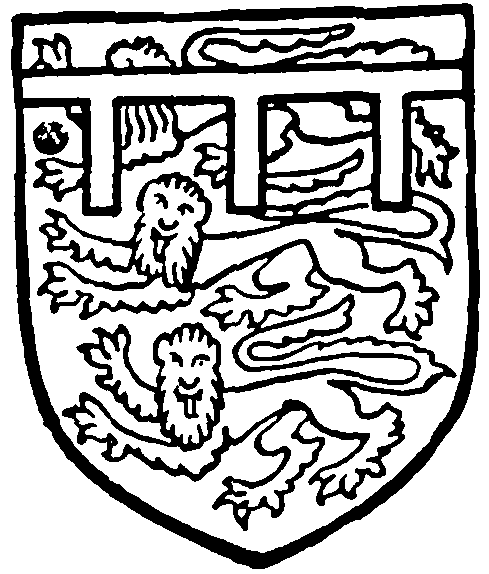
Duchy of Lancaster. England differenced with a label azure.
The men of Salford in 1168 paid £14 10s. to the aid for marrying the king's daughter. (fn. 22) An increase of 4s. for the halfyear appears in the rent of the manor of 1201. (fn. 23) In 1226 the assized rent of Salford was 23s., (fn. 24) and the vill, with its dependencies—Broughton, Ordsall, and a moiety of Flixton—paid 112s. tallage. (fn. 25)
The waste included wide strips along Oldfield Road, the road leading to Pendleton, and others. The inhabitants' pigs used to stray at will on this waste. (fn. 26)
The 'town of Salford and the liberties of the same' are frequently referred to in the Court Leet Records. Oldfield Lane seems to have been the most important liberty; in 1601 it had a separate bylaw man. (fn. 27)
BOROUGH
About the year 1230 Ranulf Blundeville, Earl of Chester, erected his vill of Salford into a free borough, the burgesses dwelling therein being allowed certain privileges. (fn. 28) Each burgage had an acre of land annexed to it, and a rent of 12d. had to be paid to the lord at the four terms—Christmas, Mid-Lent, Midsummer, and Michaelmas. Succession was regulated, (fn. 29) and right of sale admitted. (fn. 30)
A borough-reeve was to be freely elected by the burgesses, and might be removed at the end of a year. A borough court or portman mote (fn. 31) was established, in which various pleas affecting the burgesses were to be decided before the earl's bailiffs by the view of the burgesses. (fn. 32) No one within the hundred was to ply his trade as shoemaker, skinner, or the like, unless he were 'in the borough,' the liberties of the barons of Manchester, &c., being reserved. The burgesses were free from toll at markets and fairs within the earl's demesnes, but were obliged to grind at his mills to the twentieth measure and to bake at his ovens; common of pasture and freedom from pannage were allowed them, as also wood for building and burning.
A little earlier, viz. on 4 June 1228, the king had granted a weekly market on Wednesdays and an annual fair on the eve, day, and morrow of the Nativity of St. Mary, at his manor of Salford. (fn. 33)
By encouraging the growth of the borough as a trading place the lord derived an increasing rent; in 1257 it amounted to about £12 a year. (fn. 34) The extent made in 1346 shows that there were then 129⅓ burgages in addition to 12 acres in the place of another burgage, each rendering the 12d. yearly rent. There were also a number of free tenants paying over £8 10s. for lands in Salford and adjoining it. The profits of the portmote were valued at 12s. a year. The total was therefore nearly £16 a year. (fn. 35)
The records of the portmote court from 1597 to 1669 are in the possession of the corporation. The head of the Molyneux of Sefton family, as hereditary steward of the hundred, presided, except during the Commonwealth period. The courts were held at Michaelmas and April. The officers appointed in 1597 were borough-reeve, constables, mise layers, mise gatherers, bylaw men, affeerers, and ale-founders; in 1656 the following additional ones were elected: scavengers for the Greengate and Gravel Hole, scavengers for the Lower Gate, apprisers, officers for surprising and robbing of coals, for pinning of swine trespassing, for mastiff dogs, for the pump, and for measuring of cloth. (fn. 36)
A number of grants of tenements and tolls in Salford are found in the Duchy Records, (fn. 37) and some private charters are accessible; (fn. 38) the Plea Rolls have some records of disputes among the inhabitants. (fn. 39)
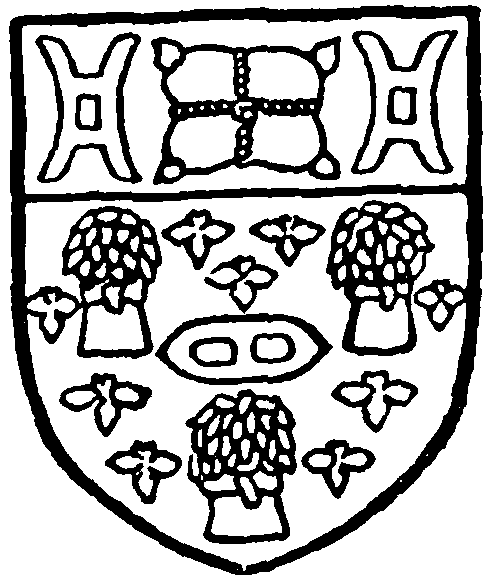
Borough of Salford.Azure semée of bees a shuttle between three garbs or, on a chief of the second a woolpack proper between two millrinds sable.
The township continued to be governed in the same way until 1791, when a Police Act was obtained for Manchester and Salford, and the administration of the town by commissioners appointed under it to a great extent superseded the manorial system. (fn. 40) In 1832 the parliamentary borough came into existence, one representative being assigned; (fn. 41) and in 1844 the municipal borough was created by charter. The area included the township of Salford, together with that small part of Broughton lying south of the Irwell, and it was divided into four wards, each with two aldermen and six councillors. At the same time a court of record was established, debts up to £20 being recoverable. (fn. 42) A coat-of-arms was granted in 1844. The town hall, built in 1825–6, (fn. 43) was purchased by the commissioners in 1834. The borough was extended in 1853 to include the adjacent townships of Broughton and Pendleton, (fn. 44) from which time the area has remained unchanged, except for some minor adjustments. (fn. 45) The borough is now divided into sixteen wards, each with an alderman and three councillors; there are seven wards in Salford proper, (fn. 46) three in Broughton and six in Pendleton. In 1891 an Act was obtained to unite the district, so that a uniform rate is levied throughout the borough. A separate commission of the peace was granted in 1870 and again in 1886, and quarter sessions were established in 1899.
The council has provided police and fire brigade. The cattle market is the principal one for the district. The gas supply (fn. 47) is in the hands of the corporation, which also has electric light works. Water is supplied by the Corporation of Manchester. There are four public baths, two within the township of Salford; a sanatorium, two cemeteries, both outside the township —at Weaste and Agecroft—and sewage disposal works at Mode Wheel, opened in 1883. A school board was formed in 1870. A Tramways Act was obtained in 1875, (fn. 48) and the cars are now driven by electricity; the lines extend as far north as Whitefield in Pilkington, and west to Monton. Four parks and a large number of recreation-grounds have been acquired and opened.
The museum and library was established at Peel Park in 1850, a lending department being added in 1854. It claims to be the first free public library. Queen Victoria, as lady of the manor, was patroness; hence the epithet Royal. (fn. 49) The natural history exhibits have been removed to Buile Hill, so that the museum at Peel Park is now an art collection. There are seven branch libraries, of which two are in Salford. (fn. 50) There is also a technical institute.
Queen Victoria passed through the town on her visit to Manchester in 1851. The king in 1905 unveiled the memorial to the soldiers who died in the Boer war.
Apart from the Radcliffes of Ordsall the Salford families recording pedigrees at the Heralds' visitations were those of Booth, 1613, (fn. 51) Byrom, 1613 (fn. 52) and 1664, (fn. 53) and Davenport, 1664. (fn. 54) Richard Pennington and Nicholas Hewett were ordered to attend the last visitation. (fn. 55)
Other land-holders are recorded in the inquisitions (fn. 56) and court leet records; (fn. 57) many Manchester people also held land in Salford, (fn. 58) as did several of the sur rounding gentry. (fn. 59) The freeholders of 1600 were: John Radcliffe of Ordsall, Adam Pilkington, Edward Bibby, (Ralph) Byrom, Thomas Byrom, and Adam Massey of Oldfield Lane. (fn. 60) The following contributed for their lands to the subsidy of 1622: Sir John Radcliffe, Dame Anne Radcliffe, Humphrey Booth, Adam Pilkington, Adam Byrom, Thomas Hartley in right of Margaret his wife, and John Duncalf. (fn. 61)
The Protestation of 1641 was agreed to by 341 persons. (fn. 62)
The Crown was accustomed to lease out the profits of the market, mills, &c. (fn. 63)
ORDSALL
ORDSALL, which may then have included Pendleton, appears in the Pipe Roll of 1177 as contributing 2 marks to the aid. (fn. 64) The manor of Ordsall was in 1251 granted by William de Ferrers to David de Hulton, together with a moiety of Flixton, (fn. 65) in exchange for Pendleton. (fn. 66) It descended for some eighty years in the Hulton family, (fn. 67) and on the partition of his lands made by Richard de Hulton about 1330 Ordsall was given to one of the Radcliffes, probably as near of kin. (fn. 68)
About 1354 John de Radcliffe obtained possession after long disputing. (fn. 69) He had many lawsuits, (fn. 70) but appears to have prospered, as his son Richard, (fn. 71) who died in 1380, held not only the manor of Ordsall and a portion of Flixton, but also the adjacent estates of Hope and Shoresworth, together with lands in Salford and Tockholes. (fn. 72)
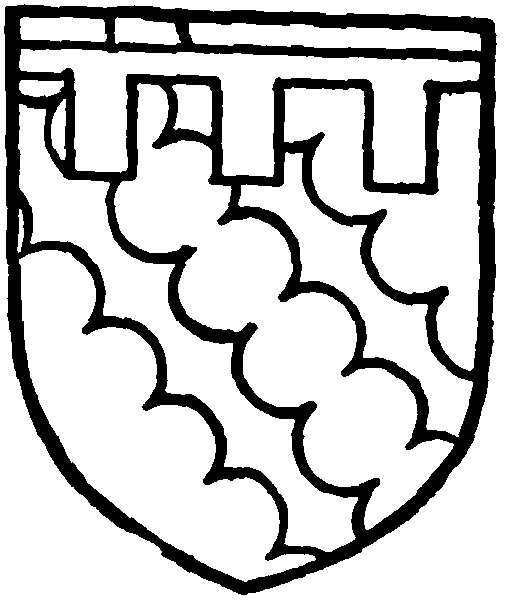
Radcliffe of Ordsall. Argent two bendlets engrailed sable and a label gules.
John de Radcliffe, the son and heir of Richard, was twentyseven years of age on succeeding. (fn. 73) In 1385 he had the king's protection on his departure for Normandy in the retinue of Thomas de Holand, Earl of Kent and Captain of Cherbourg. (fn. 74) His title to Ordsall seems to have been called in question in 1399. (fn. 75) He was afterwards made a knight, (fn. 76) and died in 1422 holding the manor of Ordsall and the rest of the patrimonial estate, except Shoresworth and Hope, which he had in 1396 granted to his son John on his marriage with Clemency daughter of Hugh de Standish. (fn. 77)
Sir John Radcliffe, who was forty-four years old on succeeding, (fn. 78) died on 26 July 1442, holding Ordsall by the ancient services. He had given his moiety of Flixton to his son and heir Alexander on marrying Agnes daughter of Sir William Harrington. He left a widow Joan. (fn. 79) Of Alexander, then thirty years of age, little is recorded, though he was knight of the shire in 1455; (fn. 80) he died in 1475–6, leaving a son and heir William, forty years of age. (fn. 81) William died in August 1498, holding Ordsall and the other manors; his son John having died shortly before him, the heir was his grandson Alexander the son of John, of full age. (fn. 82) Alexander, who was made a knight at Lille in 1513, (fn. 83) was one of the most prominent men in the county, being high sheriff four times. (fn. 84) He died on 5 February 1548–9, holding Ordsall and the other hereditary manors with some additional lands; Sir William Radcliffe his son and heir was forty-six years of age. (fn. 85)
Sir William Radcliffe, made a knight in the Scottish expedition of 1544, (fn. 86) appears to have added to his patrimony; he died on 12 October 1568, and was succeeded by his son John, then thirty-two years of age, an elder son Alexander having died before his father. (fn. 87) Sir John Radcliffe (fn. 88) died on 19 January 1589–90; the inquisition describes his lands in the counties of Lancaster, Chester, York, Lincoln, Nottingham, and Derby. (fn. 89) He had been knight of the shire in 1571 and 1572. (fn. 90) Alexander his son and heir was only twelve years of age. He was knighted at the sacking of Cadiz in June 1596, (fn. 91) and died on 5 August 1599 without issue, his brother John, seventeen years of age, succeeding him. (fn. 92)
John Radcliffe was made a knight in the following year, during the Irish wars, (fn. 93) and thereby freed from wardship. (fn. 94) He was knight of the shire in three Parliaments, 1620 to 1625, (fn. 95) but in 1627 was killed, or died of his wounds, during the Duke of Buckingham's expedition to the Isle of Rhé. (fn. 96) By his wife Alice daughter of Sir John Byron he left a son and heir Alexander, twenty years of age. (fn. 97) Though so young, he had been created a Knight of the Bath at the coronation of Charles I. (fn. 98) The dispersal of the family estates began about this time; a moiety of Ordsall was mortgaged in 1634 to Humphrey Chetham. (fn. 99) Sir Alexander married the step-daughter of Robert Radcliffe, fifth Earl of Sussex, and had with her by the earl's gift the manor of Attleborough in Norfolk. (fn. 100)
At the opening of the Civil War he, in conjunction with Lord Derby, took an active part in favour of the king, and was in 1644 committed by Parliament to the Tower. (fn. 101) He afterwards made his peace. (fn. 102) He was buried at Manchester on 14 April 1654, leaving several children, (fn. 103) of whom a younger son, Robert, became ancestor of the Radclyffes of Foxdenton in Chadderton. (fn. 104) The remainder of the Lancashire estates of the Radcliffes appears to have been disposed of by Sir Alexander or his son. (fn. 105)
The Chethams did not secure the whole of Ordsall; (fn. 106) their estate descended to the Clowes family. The hall was sold in 1662 to John Birch of Ardwick. (fn. 107) His issue failing, the manor passed through various hands, and is now the property of Earl Egerton of Tatton. (fn. 108)
Ordsall Hall has been in its best days a very fine example of a mediaeval half-timbered house, and is still of unusual interest. Within the last two generations it has suffered greatly from neglect and its gradual envelopment in a wilderness of mean and dirty streets. Leland mentions the beauty of its surroundings, when it stood in a pleasant park through which ran a clear stream, now hardly recognizable in the dirty waters of the modern Irwell, and even as late as sixty years ago Ordsall Lane ran between fields and hedgerows, with no buildings in sight except the Throstle Nest Paper Mills, the Blind Asylum, and some houses in Chester Road. The house stood within a rectangular moated inclosure, among gardens and orchards, and there were a number of detached outbuildings, barns, shippons, &c. The north and east arms of the moat still contained water, but the other two were dry. The entrance was from the north, through an embattled doorway in the brick boundary wall, which dated from 1639, being contemporary with the still existing brick west wing. The house was let in three parts, and much cut up by added partitions, the floor levels altered, and a floor inserted at half-height in the great hall, while all the ornamental timber work was hidden by lath and plaster. Some attempt at freeing the old work from its modern obstructions was made about thirty years since, when it was converted into a club for the workmen employed in a neighbouring cotton mill, the great hall being opened out and other parts of the house fitted up as reading and billiard rooms. In 1898 it became a theological college, and in 1904 a clergy training school; and in 1896–8 it was thoroughly repaired, and in part rebuilt, by Lord Egerton of Tatton, the church of St. Cyprian being built in 1899 on the site of the long-destroyed east wing. The lines of the moat are now represented by streets, and the boundary wall and gateway have vanished, together with the orchards and gardens and everything which once went to form a pleasant setting to the old hall; but a few hundred yards away a farmhouse yet stands, hidden among modern buildings and used as a lodging-house. One of the principal outbuildings was the Great Barn, with a nave and aisles divided by great oak posts, and sharing, with several others in the district, the entirely unfounded reputation of having formed part of an early wooden predecessor of the present cathedral church of Manchester.
At the present day the house consists of a central block standing east and west, a west wing running northward from it, and some outbuildings at the south-east. There was formerly an east wing, taken down in 1639, balancing the west wing, which with the boundary wall on the north inclosed a court measuring about 80 ft. by 75 ft. The boundary wall is said to have been set up in 1639, at the same time as the still existing west wing, and it appears that before this time a range of buildings existed on the north side of the court, forming a complete quadrangle, about 64 ft. by 75 ft.; part of its foundations was found in 1898. There is nothing to show of what date the eastern wing was, as its foundations only have remained to modern times, and the oldest part of the building is the central block, or, in other words, the south range of the original court. It is still in great part of timber construction on a stone base, the main beams being of the usual 10-in. scantling. The chief feature of it is the great hall, now, after the clearing away of the partitions which encumbered it, a very noble and impressive piece of 15th-century timber construction, 43 ft. by 25 ft., built in two wide bays of 14 ft. span and two narrow of 7 ft., one at the east to form the dais and one at the west for the passage through the screens. The roof is high pitched and open timbered, 32 ft. to the ridge, with three purlins aside and two intermediates in each of the wider bays, dividing the flanks into rectangular compartments each inclosing a quatrefoil. There are three principal trusses, the middle one springing from wooden moulded responds set against the side walls, with moulded octagonal capitals and large arched braces below a cambered and embattled tie-beam. The space over the tie-beam is filled in with a series of fourteen arched openings with traceried spandrels. The western truss forms the head of the hall screens, and its tie-beam is cambered over a central arched opening 15 ft. wide, but runs horizontally over the narrow screens or 'speres' which flank the opening, and are made of two tiers of solid square-headed panels, two in each tier. Originally a movable screen, much lower than the 'speres,' must have stood across the opening, like that still existing at Chetham's Hospital, leaving passageways at either end of it. The truss at the upper or dais end of the hall is closed in above with quatrefoiled panels, and has a flat ceiling over the dais at the plate level, replacing a panelled cove.
At the north-east of the hall is the great bay window of unusual character, being in plan seven sides of a decagon, with pairs of square-headed lights on each side, and a transom at half height, carved with a running vine pattern. The wooden framing stands on a stone base, with a band of quatrefoils on the inside below the sill of the window, and over the bay is a rectangular chamber or upper story, apparently contemporary with it, its angles projecting in a somewhat awkward manner over the canted sides of the window. The bay opens to the hall by a four-centred arch of wood, and the room over it is also open for its full width, and is reached by a stair contrived in the north-east angle of the hall, within the lines of the passage at the north end of the dais leading to a north-east doorway on the ground floor. The west wall of the hall is framed in square panels inclosing quatrefoils and has at the plate level a wooden cove, the gable above which is similarly treated. In this wall are now two doorways, but traces of the third, making the triple arrangement of buttery, pantry, and kitchen passage, were discovered in 1896. The heads of the doorways, only one of which now remains, were four-centred, cut from a single piece of wood, and with carved spandrels, and at either end of the passage through the screens were similar but wider doorways, that to the north, which still is preserved, being the most ornate, and having a band of quatrefoils above the spandrels. The external north elevation of the hall, though now much repaired, preserves its original design with little alteration. The wall surface is divided into square panels inclosing quatrefoils filled in with plaster, and a continuous line of narrow lights, six between each pair of uprights, runs along the upper part of the wall forming a sort of clearstory to the hall. The upper story of the bay is similarly panelled, but has lost its original window, if such existed. Its gable is also panelled and sets forward on a cove, and a similar cove existed below the eaves of the hall. The framing of the bay window is warped and leans to one side, but is otherwise sound; small shafts ending in crocketed pinnacles run up the face of the mullions. The south wall of the hall was of the same character as the north, but has been entirely rebuilt in grey brick, with two very unattractive four-light windows in terra cotta.
At either end of the hall are buildings which contain work contemporary with it, those at the east end, which were the principal living rooms, being the more interesting. They are of two stories, the original part being one room thick, and having two rooms on each floor. The rooms on the south front are the principal ones, that on the ground floor being known as the Star chamber, from the gilt lead stars with which its ceiling of moulded oak beams is studded. It is doubtless to be considered as the Great Chamber, with a solar over, the name of chapel which has been given to the upper room being entirely fanciful. Its walls are covered on three sides with plain oak panelling with a cresting of Tudor flowers, and from the arrangement of the panelling it seems that the room has been originally wider from north to south. In the south wall is now a modern rectangular bay containing a window, the successor of a very picturesque and interesting bay window of wood two stories in height, which survived, though in a mutilated state, till 1896. In plan it formed half of a twelve-sided figure, the alternate sides being treated as projecting semicircular bays with seven tall narrow square-headed lights in each. The plain sides were treated as windows of two lights, that in the middle being pierced in later times as a doorway to the garden. The room on the first floor over the Star chamber is also panelled, but with early 17th-century panelling with a modillion cornice and narrow oblong upper panels, the others being square. Above its canted plaster ceiling the mediaeval roof remains, with cambered tie-beam and arched braces beneath, and it was formerly lighted by a continuation of the bay window, ending under a rectangular projecting gable filled in with wooden studding. This room and the Star chamber have fireplaces on the east side, and the chimney-stack was found in 1896 to show clear signs of having been external, proving that at the time of its building the house extended no further eastward. An interesting theory worked out in some detail by the late E. W. Cox that this chimney belonged to a 14th century house seems to rest on too slight a basis of probability. The north side of this part of the house is now occupied by an entrance hall and stairs, the latter having newel posts of an ornamental baluster type, the lower one dated 1699. These are, however, only the posts of a bedstead, and the stairs are not ancient. The partition between these rooms and the great hall is of timber framing, and apparently modern, replacing a brick wall, which in itself cannot have been mediaeval. Adjoining the Star chamber to the east is a threestory block—or rather one of two stories with a low attic—which seems to be of 16th-century date, having on the first floor a room with panelled walls and a ceiling with a geometrical pattern of moulded ribs. The fireplace is of late Gothic type, and has over it four linen-pattern panels of oak. The groundfloor room beneath has no old features of interest, but in the attic, which seems to be an addition, probably of c. 1620, there is a good plaster panel of Jacobean style over the fireplace with the quarterly shield of Radcliffe between four roses: 1. Two bends engrailed, with a label of three points (Radcliffe); 2. Two bars, and over all a bend (Leigh); 3. Three billets and a chief; 4. A fesse between three garbs (Sandbach).
The block to the north of this shows no traces of antiquity, and the south-east wing already mentioned is also of no interest.
The buildings at the west end of the hall have been completely modernized on the south side, and their outer walls rebuilt in brick, and most of the old partitions on the upper floor removed. They are of two stories like the rest, and on the north, towards the courtyard, have a very picturesque timber-built elevation, with a large two-storied 17th-century bay window set against a Gothic front which is probably of the date of the hall, and has the same quatrefoil panels. The bay window is a half hexagon in plan, with square-headed transomed windows of four lights in each side, and quatrefoil panels below them to match the older work. They end below the springing of the gable, which is also panelled with quatrefoils and set forward on a coved cornice with a moulded and embattled string at its base. West of the bay the ground story has a range of narrow windows like those in the hall, now modernized, and on the first floor a very pretty six-light window projecting from the wall, and carried on a coved and embattled sill with Gothic tracery on the cove and a shield with the Stanley badge of an eagle's claw. Its gable on the south front was of half-timber work before its destruction, and the east side of the gabled wing was panelled with quatrefoils, which were cut into by the south wall of the hall. It does not, however, seem likely that the wing was earlier than the hall. The interior of this block is unfortunately modernized, and its original arrangements can only be inferred, as that the kitchen stood at the south-west, with a lobby or entry on the north towards the court, and between these and the hall were the buttery, pantry, and kitchen passage, while the floor above was divided into chambers, perhaps five in all. These arrangements must have been modified when the existing west wing was added, on the site of an older wing, about 1639. It is to be noted that the passage into the screens of the hall is on the axial line of the former courtyard. being halfway between the 17th-century west wing and the foundations of the destroyed east wing. The west wing was designed for the kitchen and servant's quarters, &c., and the old buttery and pantry were perhaps at this time converted into living rooms and the bay window towards the courtyard added. The wing is of plain character, in red brick, with squareheaded mullioned windows, now to a great extent renewed in terra cotta, and having towards the court a projecting bay containing a stair to the first floor, on which was formerly a panel with the arms and initials of Sir Alexander Radcliffe, a garter encircling the arms, and the date 1639. Its place is now taken by the arms of Lord Egerton of Tatton. The angles of the bay are cut away below, but corbelled out above to the square. The roof of this wing preserves its stone slates, and with its several gables is still very attractive; one of the original brick chimney stacks remains, with single bricks set herring-bone fashion between the shafts, as in other 17th-century work in the district. Near the north end of the wing the east wall sets back on a line so nearly coinciding with that of a foundation discovered in 1896, running westward from the old east wing, that it may be taken as marking the width of an original north wing, and also suggests that this wing was still in existence when the 17th-century work was begun.
There was formerly a fair amount of old coloured glass in the windows of the hall and elsewhere, but much jumbled together; among other things the coat of Radcliffe quartered with Fitz Walter in a garter, and figures of Our Lady and St. Katherine, since removed to Barlow Hall. Other things, including a lead statue of Mercury, after John of Bologna, which stood in the garden, were removed to Tatton.
The land tax in 1787 amounted to £210 (fn. 109); to this the principal contributors were Samuel Clowes, William Egerton, John Gore Booth, and Jonathan Bury, in all contributing about a fourth part. (fn. 110)
CHURCH
SACRED TRINITY CHURCH was originally built in a debased Gothic style in 1635. The tower was added early in the 18th century, but in 1748 the vibration of the bells which were then hung in it having brought down a part of the body of the church, (fn. 111) the whole of the building, with the exception of the tower, was taken down in 1751 and rebuilt in the following year. It is a simple parallelogram in plan, with a west tower, and architecturally uninteresting, being built in stone in a plain classic style with two tiers of semicircularheaded windows on each side, and entrances at the west end of each aisle facing north and south. The east end has two similar windows, above which externally is a niche said to have been intended for a figure of Charles I, in whose reign the church was founded. The interior has side and west galleries supported by square pillars panelled in oak, with stone pillars above carrying the roof. The old high pews were cut down and made into open seats in 1886. At the same time other improvements were effected, including the opening out of a baptistery under the tower and the removal of the old flat ceiling; and the organ was brought down from the west gallery and a quasi-chancel formed at the east end. (fn. 112) The arms of Booth and those of Kenyon (the Rev. Robert Kenyon was a former rector) are carved on the ends of the two front seats in the nave.
The tower, which originally had a short steeple or conical roof, is Gothic in form with buttresses and pinnacles and an embattled parapet, but with a classic cornice between the buttresses and other original renaissance detail. The tower was, however, largely rebuilt in 1859, when a large four-light mullioned and transomed window with ogee head was inserted on the west side in the lower stage. (fn. 113) The upper stage has a two-light louvred belfry window and a clock on each face.
There is a ring of six bells, hung in 1748.
The plate consists of two chalices, a paten, and an almsdish of 1635 (?), one of the chalices inscribed 'The Gift of Humphrey Booth unto Trinity Chapel in Salford;' a paten, 'The Gift of Humphrey Oldfield late of Manchester, gent.'; a flagon of 1697 inscribed 'Anno 1697, given to Trinity Chappell in Salford for ye Vse of ye Holy Sacrament, by John Higinbotham of Salford, merchant'; and a chalice presented in memory of the Rev. H. F. Gore-Booth, 1908. (fn. 114)
The registers begin 1709. (fn. 115)
ADVOWSON
Apart from the private chapel of Ordsall (fn. 116) there does not appear to have been any place of worship (fn. 117) in the township until Humphrey Booth built and endowed the chapel as above. (fn. 118) The patronage has descended with the Booth estates to Sir J. A. R. Gore-Booth. A district chapelry was assigned to it in 1839. (fn. 119) The present income is given as £1,340. The following have been curates and rectors:— (fn. 120)
| 1636 | Richard Hollinworth, (fn. 121) M.A. (Magdalene Coll., Camb.) |
| 1648 | William Meek (fn. 122) |
| 1658 | Robert Brown, (fn. 123) B.A. (Emmanuel Coll., Camb.) |
| 1667 | John Hyde, B.A. (fn. 124) |
| 1694 | Robert Assheton, M.A. (fn. 125) (Magdalene Coll., Camb.) |
| ? 1731 | Richard Assheton, M.A. (fn. 126) (Brasenose Coll., Oxf.) |
| 1764 | Thomas Barker, M.A. |
| 1766 | Robert Oldfield, M.A. (Brasenose Coll., Oxf.) Robert Kenyon, M.A. (fn. 127) (Brasenose Coll., Oxf.) |
| 1787 | John Clowes, M.A. (fn. 128) (Trinity Coll., Camb.) |
| 1818 | Samuel Booth, M.A. (Balliol Coll., Oxf.) |
| 1859 | Joseph Nelsey Pocklington, M.A. (St. Catharine's Coll., Camb.) |
| 1861 | Edward Allen, M.A. (Oriel Coll., Oxf.) |
| 1876 | Capel Wolseley, B.A. |
| 1885 | Henry Francis Gore-Booth, M.A. (Corpus Christi Coll., Camb.) |
| 1902 | Peter Green, M.A. (St. John's Coll., Camb.) |
In recent times, owing to the growth of the town, a number of new churches have been erected, those in connexion with the Establishment being St. Stephen's, near the Town Hall, 1794; (fn. 129) St. Philip's, more to the west at White Cross Bank, 1825; (fn. 130) Christ Church, near the Crescent, 1831, enlarged 1847; (fn. 131) St. Matthias, Broughton Road, (fn. 132) and St. Bartholomew's, Oldfield Road, (fn. 133) 1842, enlarged in 1863 and 1887 respectively; St. Simon's, in the extreme north corner of the township, 1849; (fn. 134) the Stowell Memorial Church, 1869; (fn. 135) St. Clement's, (fn. 136) and St. Cyprian's, both in Ordsall, 1878 and 1899; and St. Ignatius, 1903. All are entitled rectories. The patronage is in most cases in the hands of different bodies of trustees, but to St. Simon's the Crown and the Bishop of Manchester present alternately, while the Dean and canons of Manchester are patrons of St. Philip's and St. Stephen's. There are mission rooms in connexion with nearly every church.
The Wesleyan Methodists had a chapel in Gravel Lane as early as 1790; a new one close by has replaced it. The same denomination has other churches in Irwell Street, built in 1827, and now used for the Manchester Mission; Regent Road, 1870, Ordsall Park, and Bedford Street. The Primitive Methodists have a church in Trafford Road, near the docks; the United Free Church has two in Salford, and another in Eccles New Road; the Independent Methodists, who had one near Cook Street in 1807, now have one near the cattle market. (fn. 137)
The Baptists have a church in Great George Street, founded in 1833 and rebuilt in 1851.
The Congregationalists appeared in Windsor in 1797, when one John Joule built a chapel there. Another was built in Salford proper in 1819, and is now the Central Mission church. These have been followed by Hope, to the south, in 1837, and Richmond to the north in 1846. (fn. 138)
The Welsh Calvinistic Independents had a chapel in Jackson's Square, now under Exchange Station, in 1824, their present one is near Cross Lane. The Welsh Calvinistic Methodists had a chapel called Salem in Rigby Street in 1866, but have removed to Pendleton.
The Presbyterian Church of England has a place of worship in Chapel Street, built in 1847. (fn. 139)
The Unitarians built the above-named chapel in Jackson's Square, but had by 1824 removed to an adjacent one in Dawson's Croft; their present place of worship, known as Pendleton Unitarian Free Church, is at the extreme west end of the township, at Windsor.
The Swedenborgians had a New Jerusalem church in 1815 and later, but have removed to Wallness Road. The Bible Christians, a branch of the same denomination founded by the Rev. William Cowherd, (fn. 140) worshipped at Christ Church, King Street, from 1809; this about 1869 they abandoned for a new building in Cross Lane. A noteworthy member and minister was Joseph Brotherton, a local cotton spinner, who was the first member of Parliament for Salford, 1832 to 1857. A statue of him was erected in Peel Park in 1858.
The principal Roman Catholic church is St. John's Cathedral. The mission was not begun until 1844; the church, opened in 1848, was consecrated in 1890. The other churches are St. Peter's, begun in 1863, church built 1874; the Patronage of St. Joseph, 1871; Mount Carmel, 1880; and St. Anne's, Adelphi. There is a convent and school of the Faithful Companions of Jesus at Adelphi House.