
A History of the County of Lancaster: Volume 4. Originally published by Victoria County History, London, 1911.
This free content was digitised by double rekeying. All rights reserved.
'The parish of Eccles: Introduction, church and charities', in A History of the County of Lancaster: Volume 4, (London, 1911) pp. 352-362. British History Online https://www.british-history.ac.uk/vch/lancs/vol4/pp352-362 [accessed 26 April 2024]
In this section
ECCLES
The ancient parish of Eccles measures about 7 miles across, from the Irwell south-west to the Glazebrook, and has an area of 22,004 acres. The position of the church, from which the parish takes its name, was fairly central for the portion of the district habitable in former times, while the great area of moss land in the west was still unreclaimed, being close to the boundary between Pendleton, Pendlebury, and Clifton on the east, and the large areas of Worsley and Barton on the west. The general slope of the surface is from north to south, the highest land, about 300 ft. above sea level, being in the stretch of higher ground between Worsley and Kearsley.
The parish was anciently divided into three 'quarters'—Barton, Worsley, and Pendleton, assessed for the county lay of 1624 at £3 19s. 8½d., £2 18s. 3d., and £3 5s. 4¾d. respectively, when the hundred paid £100. (fn. 1) For the 'fifteenth' the townships paid as follows:—Barton, including Farnworth, £1 12s.; Worsley, £1 1s.; Pendleton, 13s. 6d.; Pendlebury, 5s.; Clifton, 7s., or £3 18s. 6d. out of £41 14s. 4d. for the hundred. (fn. 2)
Though the parish is of great extent, and lies near Manchester and Bolton, its particular history has been uneventful. There was a skirmish at Woolden in the Civil War, and in 1745 the Young Pretender's army passed through in its advance and retreat. The geological formation of the southern and central part of the parish consists of the New Red Sandstone, the northern part of the Permian Rocks and Coal Measures. Coal mines have been worked from the 16th century, and perhaps earlier. In the 18th century the Worsley navigation schemes led to a great development of mines, and later of manufactures, and Eccles and Pendleton have shared in the growth of Manchester trade. The following is the apportionment of agricultural land within the ancient parish: Arable land, 7,587 acres; permanent grass, 5, 914; woods and plantations, 716. (fn. 3)
Chat Moss remained waste until the beginning of the last century. (fn. 4) Defoe, who passed it on the way from Warrington to Manchester early in the 18th century, has given a description of it. It stretched along the road for 5 or 6 miles, the surface looked black and dirty, and it was 'indeed frightful to think of, for it would bear neither horse nor man, unless in an exceeding dry season, and then so as not to be travelled over with safety.' The land was entirely waste, 'except for the poor cottagers' fuel, and the quantity used for that was very small.' (fn. 5) Leland and Camden tell of a great eruption of the moss in the time of Henry VIII. (fn. 6) The carrying of the Liverpool and Manchester Railway over Chat Moss in 1830 was considered a great triumph of engineering. (fn. 7) The whole has now been reclaimed. (fn. 8) The corporation of Manchester has a sewage farm there.
Dr. Aikin says of Eccles in 1795:—
The agriculture of the parish is chiefly confined to grazing, and would be more materially benefited by draining; but the tax upon brick, a most essential article in this process, has been a very great hindrance to it. The use of lime—imported from Wales, and brought by the inland navigations to the neighbourhood of our collieries—has become very general in the improvement of the meadow and pasture lands … The advance of population in the parish of Eccles [the effect of the great demand for hands in our manufactures] has been attended with a due care respecting public worship and the religious education of children… . The excellent institutions of Sunday schools were early patronised in Eccles parish, and continue to receive the steady and liberal support of the parishioners. There are now, it is calculated, near one thousand children regularly taught in these schools, and with very considerable improvement. (fn. 9)
Eccles gives a name to one of the parliamentary divisions of the county formed of this parish and Flixton; it returns one member.
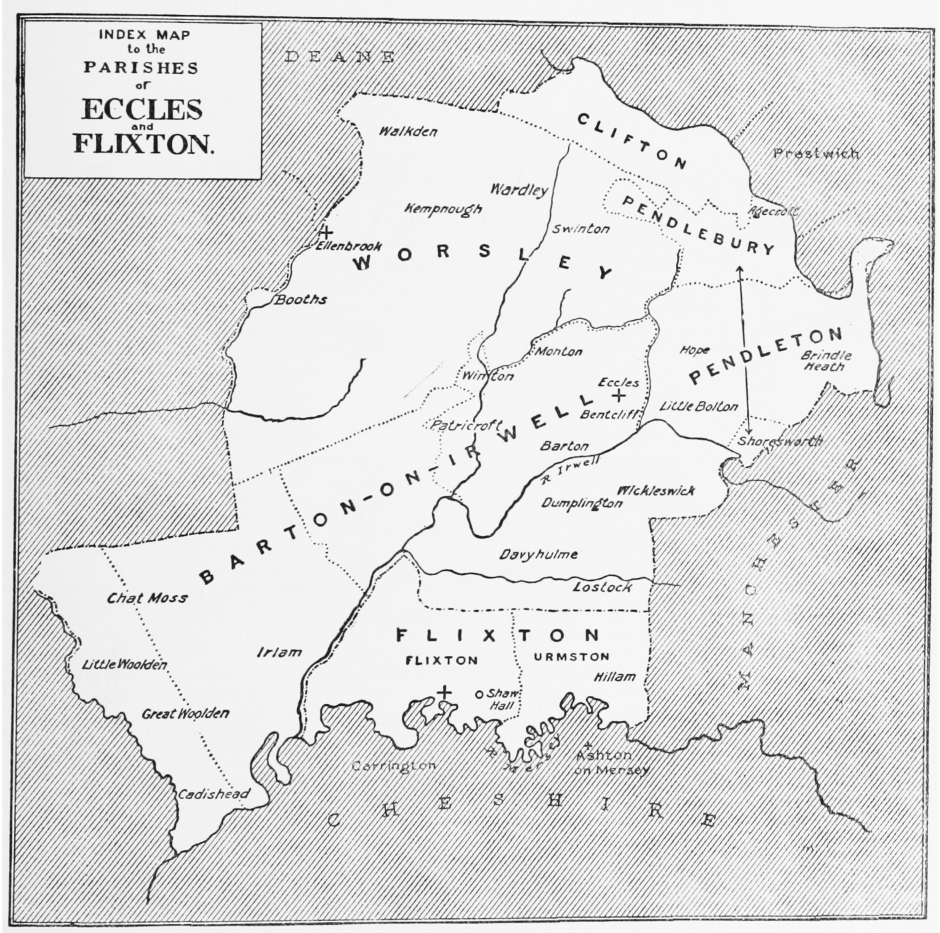
INDEX MAP to the PARISHES of ECCLES and FLIXTON.
There are three newspapers published at Eccles, the Advertiser, established 1853; the Journal, 1874; and the Telegraph.
CHURCH
The church of ST. MARY stands on elevated ground about 200 yds. to the north of the old market-place, and consists of chancel with north and south aisles, south transept with vestry on the east side, nave with north and south aisles, south porch, and west tower. There is also a building, now used as a strong-room and motor-house, with entrance porch, on the north side of the north chancel aisle.
The whole of the east end of the church has been rebuilt in modern times, but west of the chancel arch the building, except the tower and south aisle, is of early 16th-century date with some traces of 14th-century work at the entrance to the rebuilt south transept. The tower belongs to the 15th century, and possibly incorporates in its lower stage the masonry of an older structure.
The earliest parts of the building are the responds of the arch to the south transept in St. Katherine's Chapel, which are of 14th-century date, and may belong to the year 1368, when the chapel was founded. These form the only remaining fragment of a church which probably consisted of a chancel with north chapel and nave with south aisle, to which this chantry was added. Owing to the rebuilding of 1862–3 at the east end evidence of the extent of this early church is wanting, but both the chancel and nave seem to have been of the same length as at present, though of less width. The east wall of the north chapel, however, appears to have been standing up to 1861 in a line with the east wall of the chancel, and contained a good 14th-century window, of which the present window in the same position is said to be a copy. (fn. 10) Whether this earlier church had a north aisle it is impossible to say, and its south aisle was most likely narrower than the present one, though there is nothing actually to show that the arch to the south transept is not in its original position. If it is, the aisle must have been of almost equal width to the nave, which is unlikely. There was probably a west tower to the 14th-century church, but no positive evidence of this remains, successive rebuildings and restorations making it almost impossible to say whether the lower portion of the present tower is older than the upper part. Whatever the original western termination may have been, however, the tower was built, or rebuilt, centring with the nave, probably in the beginning of the 15th century, and at the same time, or shortly afterwards, the north aisle was added or reconstructed. The Jesus altar stood here. This aisle was lighted at its west end by a three-light window with cinquefoiled heads under a fourcentred arch, the remains of which may still be seen blocked up on the outside. Later in the same century, probably about 1450, when William and Lawrence Booth founded (or refounded) a second chantry of St. Katherine, the south aisle seems to have been rebuilt further southward. The evidence of the old plinth, now restored, showed it to be a later addition, and it is likely that the entrance to St. Katherine's Chapel was at this time taken down and reconstructed in its present position. That the south aisle is earlier in date than the 16th-century rebuilding, which brought the church to its present shape, is shown by the windows, whose jambs are moulded, in contrast with the plain chamfered jambs of the later work, and by the generally better and more careful detail as shown in the hood-moulds to the windows and in the buttresses, which had cusped panelled fronts. In the rebuilding of this wall much, if not all, of the old detail has been lost, the middle buttress having disappeared, and the diagonal one at the south-west having been renewed.
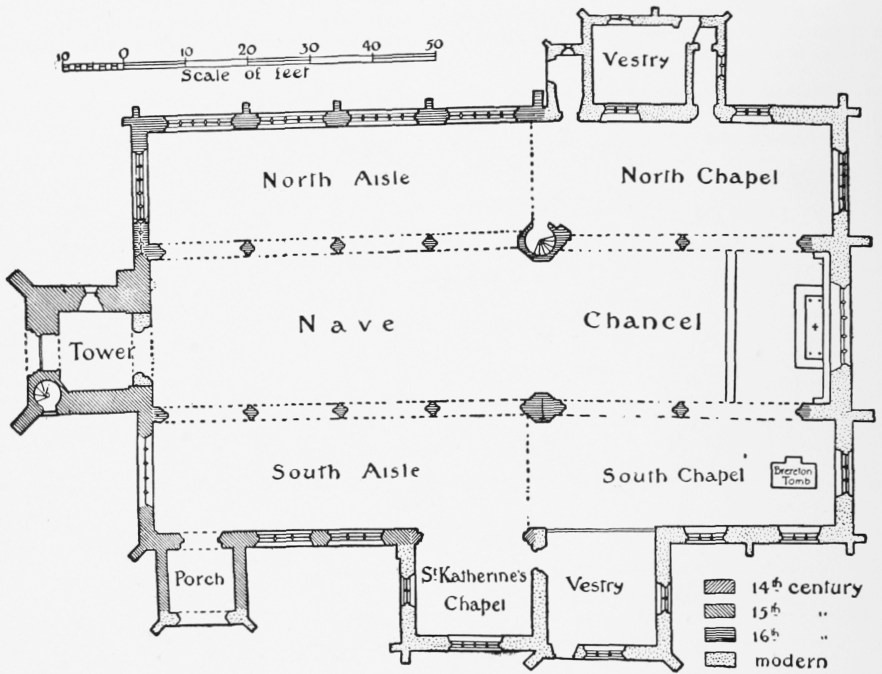
Plan of Eccles Church
The south aisle of the chancel, if it did not exist before, must have been built some time in the 15th century, and is probably the 'new chapel' which was built by Sir Geoffrey Massey, who died in 1457, having founded a chantry at the Trinity altar there in 1453. The old views of the church show the south chancel aisle with a three-light 15th-century window similar to that in the west end of the north aisle, together with a priest's door with a pointed head and hood-mould in the south-west corner.
It is possible that the south arcade of the nave was rebuilt at the same time as the south aisle was enlarged, but this would mean that the work then executed was taken down within forty or fifty years. It is more likely that the original north and south arcade stood till the beginning of the 16th century, when the great rebuilding of the church commenced. (fn. 11) The south arcade was the first to be taken down, and was reconstructed with a lofty clearstory on the same line. The north arcade was afterwards pushed out 5 ft. to the north, bringing the north aisle wall flush with the wall of the north chapel of the chancel, and throwing the tower out of centre with the nave. Whether there had been a chancel arch before this date it is impossible to say, but the chancel seems to have been reconstructed without one at this time or shortly after, and similarly widened to the north. The evidence of this was much more plain before the rebuilding of 1862–3 by the way in which the roof of the old chancel cut into that of the north chapel. (fn. 12) The axis of the chancel is twisted about 18 in. to the south, but whether this took place during the 16th-century rebuilding, or was so originally, there is nothing to show, and the south arcade of the chancel may be on the exact line of the former one. The only fixed point in the church through the various rebuildings seems to be the south pier between the chancel and nave, though this of course was only built in its present form in the 16th-century reconstruction. The arches and piers of the chancel are similar to those of the nave, but the arches are much wider and higher, leaving no space for the clearstory like that of the nave, unless the roof were taken very much higher. But the unfinished end of the nave roof as shown in old views of the church seems to suggest that it was intended to carry it on over the chancel, the two octagonal turrets alone marking the division of nave and chancel on the outside.
The building as finished in the first part of the 16th century remained more or less intact until 1801 when the taking down of the east end was begun prior to reconstruction. Many alterations, however, took place in the interior between these two dates, the first in 1595, when new pews and forms were set up. At this date, too, there were 'repairs to the church,' which probably included the insertion of much of the window tracery. In 1713 the church was 'beautified,' and in 1715 the vestry, which had been in the south aisle of the chancel, was removed to the west end under the tower. In 1717 a west gallery was ordered to be erected, and at the same time or shortly after the building was again thoroughly repaired. The roof was releaded in 1719. In 1770 north and south galleries were ordered to be erected, and in 1790 the south porch was restored. A gallery was erected at the east end of the nave in 1803 excluding any view of the chancel, but this was removed in 1862. The other galleries still remain. There were further repairs in 1832, 1846, 1854, and 1856, the nave roof being repaired and the lead recast, new roofs constructed to the aisles, and the old flagged floor relaid. (fn. 13) In 1862–3 the east end was entirely rebuilt and a small clearstory of three triangular-shaped lights added to the chancel walls. The work comprised the reconstruction of the chancel with its north and south aisles, the addition of a vestry on the north, and an organ chamber on the south, and the rebuilding of St. Katherine's Chapel, which had long been destroyed. (fn. 14) Three large circular 18th-century windows, formerly lighting the south gallery, were built up at this time, but their position may still be seen from the inside. The organ, formerly in the west gallery, was transferred to the chamber on the south side of the south chancel aisle and remained there till 1890, when a new one was erected on screens in the first and second bay on each side of the chancel, and the organ chamber turned into a vestry. At the same time the vestry on the north was converted to its present use. The organ chamber seems to have been erected prior to the rebuilding of St. Katherine's Chapel, as its west wall was built as an outside wall, as may be seen by the diagonal buttress and the blocked-up windows on that side. St. Katherine's Chapel, which is supposed to be on the site of the original chantry chapel, now forms a south transept.
The church is built of friable red sandstone, which had decayed so badly that an almost complete refacing of the old part became necessary in 1907. The work was completed in 1908, and very little of the exterior detail is now left. The interior was, till 1875, covered with an accumulated coat of limewash, but was then stripped and all its stonework cleaned. Externally the walls of the nave and aisles have battlemented parapets and the roofs are covered with lead. The aisles have lean-to roofs with a straight parapet on their west end. The walls of the chancel, south chapel and aisle, and transept also terminate in battlements, and the vestry has a stepped gable on the south side. The roofs of the chancel and chancel aisles are covered with slates, but those of the vestry and transept are leaded. The south aisle of the chancel has a lean-to roof, but the roof of the north aisle retains its original gable form.
The chancel is 43 ft. long by 23 ft. 6 in. wide and has north and south arcades of two bays with centre pier and east and west responds. The arches are 16 ft. 6 in. wide, and there is a piece of straight wall at the east end 4 ft. long. The columns and arches are similar to those in the nave, but the capitals are slightly different. The first bay from the west on each side is filled with a modern screen with an organ over and a similar screen partly fills the eastern bav. The east window is a modern traceried one of five lights in the style of the 15th century and belongs with the clearstory and roof to the 1862–3 rebuilding. The fittings are all modern and are of no particular interest. The chancel arch is a modern insertion of two chamfered orders springing high up from shafts corbelled out from the large octagonal piers which separate the nave from the chancel. The pier on the south side is 4 ft. 6 in. in diameter with a respond on its east and west faces and is built solid. That on the north side is bigger and contains a staircase leading to the roof, entered from the north aisle. On the outside these piers are carried up above the roof and are finished with pyramidal stone roofs and finials. The north aisle of the chancel, which is 17 ft. 6 in. wide, retains no ancient features, but has a copy of the five-light 14th-century window with reticulated tracery already mentioned at its east end. It has two three-light windows on the north side and a door to the strong room, with an outer door in the north-west corner to the west of the old vestry. The south aisle of the chancel, which is 16 ft. wide, has a three-light window at the east end and two three-light windows on the south side. The old organ chamber (present vestry) is built out to the south at its west end and is separated from it by a screen. The aisle contains a monument to Richard Brereton and his wife, described below.
The nave measures 60 ft. in length and 23 ft. 3 in. in width and is of four bays with north and south arcades having octagonal shafts 2 ft. 6 in. in diameter, their longer sides measuring 18 in. and the shorter 5 in., set diagonally. The longer sides have a hollow moulding stopping under the capitals, which are of a plain block character with upper and two lower fillets, and are carved with plain shields, three on each face. The capitals of the easternmost pier of the north arcade and of the east respond are slightly different, having only the upper and lower round fillet and two shields on each face. The arches are pointed and of two plain chamfered orders. On each side there are four pointed five-light clearstory windows of very poor detail. The jambs and heads are chamfered and there is no external hood-mould, while the tracery is straight and without cuspings. The sills of the windows on the inside are more than 2 ft. above the crown of the nave arcade, but they were formerly much lower, as may be seen by a straight joint at each side. In the recent restoration it was found that the jambs of the windows were continued below the present sills, these having been probably inserted at the time that the galleries were built, when the roofs of the aisles were raised in order to get head room. Two courses of masonry between the crowns of the nave arches and the sills of the windows above mark the former level of the clearstory.
On the east wall of the tower the line of the 14th-century steep-pitched roof may still be seen, together with the places where the purlins were housed into the wall. The roof of the nave is of flat pitch and probably retains a good deal of the original 16th-century timber, but it was repaired in 1846 and the decayed pieces replaced. The north-east diagonal buttress of the tower, the lower part of which has been cut away, is now an internal feature, together with the string-course marking the upper or belfry stage, with the lower part of a small window above. The tower arch is of two chamfered orders, the outer one of which is stopped at the springing, and is filled in behind the west gallery with a modern wood sevenlight traceried window. Under the gallery a modern doorway has been inserted. The west walls of the north and south aisles are not bonded in with the tower, (fn. 15) and it is possible that an extension of the nave westward or a rebuilding of the tower was contemplated by the 16th-century builders.
The two east piers of the north arcade and the east pier and east respond of the south arcade have canopied niches in the sides facing south-west (towards the entrance). The niches are empty, but show conclusively that the piers are of pre-Reformation date. (fn. 16) They are 3 ft. 6 in. high, and the shelf, which has a plain shield under, is 5 ft. 3 in. from the ground. The niche on the east respond of the south aisle, opposite St. Katherine's Chapel, has carved on either side a hammer and pincers together with a small cogged wheel, possibly with reference to St. Katherine. (fn. 17) The west pier of the north aisle has a stone bracket about 6 ft. 6 in. from the ground.
The west and south galleries are in line with the centre of the piers, but the north gallery is set back about 6 ft. behind the arcade and rests on small iron pillars. The north and south galleries retain their 18th-century pews, and are approached from the west end of each aisle by staircases.
The 14th-century responds of the arch to the south transept have been already mentioned. The capitals are modern, but are probably copies of the originals, and the arch over is a four-centred one of two rounded orders. The chapel is modern and has a four-light window on the south and one of two lights on the west. The south aisle has two three-light windows with moulded jambs and hood-moulds, as before mentioned. The mullions and tracery, however, are of late date like those of the other windows of the church. In the upper lights portions of the tracery have been cut away as in other parts of the building. Each aisle has a five-light window at its west end, and the north aisle is lighted by four five-light windows along its north side, all of which have been renewed. The south porch appears originally to have been erected in the 15th century with the south aisle, but the front part was rebuilt in 1790, which date is carved upon it. The inner door is old, of thick oak and nail-studded. The outer iron gates were set up in 1809.
The tower is rather squat and of two stages, being divided about midway by a string-course. It has diagonal buttresses of four stages, moulded plinth, and embattled parapet with angle and intermediate pinnacles. There is a vice in the south-west corner, entered from the outside. Externally the tower is 20 ft. square, but the walls not being of equal thickness, its internal dimensions are 11 ft. by 12 ft. 6 in. The west doorway, which has a pointed arch, has been rebuilt, and above, separated from it by a string-course between the buttresses, is a three-light pointed window with hood-mould, which is said to have originally shown signs of well-designed cusping. This had been hacked off outside, but remained on the inside to the ringing chamber. The window, which was of 15th-century date has, however, been entirely reconstructed and the ancient detail lost. The lower stage of the tower has a single-light window on the north side, but on the south is quite plain except for the door to the vice. The belfry stage has a three-light square-headed stone louvred window on each face, with a clock face below on the north, south, and west sides.
The fittings, including the font and the pulpit, are all modern, dating principally from 1862–3 and subsequent years. There are no traces of ancient ritual arrangements. In 1856, when the old flagged floor was relaid, two sepulchral slabs, one with a raised and the other with an incised cross, were found near the third column from the east on the south side of the nave at a depth of 2 ft. 6 in. These slabs now stand in the west porch under the tower at each side of the inner doorway. (fn. 18)
The monument of Richard Brereton and his wife was erected by the latter in 1600 and stands at the east end of the south aisle of the chancel, but is not in its original position. It is an altar tomb with recumbent figures, the man being in armour with helmet by his side and the lady in a ruff and with an enormous headdress. There is a figure of a child on a bracket on the south side of the tomb, around which runs the inscription.
Besides the Brereton monument there is an old brass to the Dauntesey family on the south side of the chancel arch, and a painted wooden shield emblazoned with the arms of George Legh (d. 1674) at the west end of the north aisle. (fn. 19)
There is no ancient stained glass.
There is a ring of eight bells. Four are mentioned in the inventory of Edward VI, but these were removed in 1709 and a new ring of six substituted. One of these bearing the inscription 'Prosperity to this church' still remains amongst the present ring. The tenor has the inscription: 'I to the church the living call and to the grave do summon all.' The curfew is still rung every night.
The plate consists of two chalices of 1618, with the date inscribed on each below the rim; a paten of 1681 with the date and names of the churchwardens; a flagon of 1723, inscribed 'Eccles Parish 1723'; another flagon of the year following inscribed 'Eccles Parish 1724'; an almsdish of 1777 inscribed 'This Dish given as a gratuity From the Several Inhabitants of Barton for the use of the Parish Church of Eccles 1777'; a paten of 1862–3 presented by Mr. Henry Blacklock, inscribed with the names of the donor and churchwardens, and the date 1863; and a chalice, paten, and flagon, silver gilt, of 1893.
The registers begin in 1563 (baptisms and burials 1563, marriages 1564). (fn. 20)
In the chancel are the banners of the Trafford House and Hulme Hall Local Militia, and the Eccles Corps of the Manchester and Salford Infantry Volunteers 1798.
The churchyard on the south and east sides is of great extent and is now completely paved with gravestones. As late as the 18th century the church stood amongst fields, and the churchyard was planted with fir trees, but in 1806 it was levelled and the headstones laid flat. The churchyard coming to be regarded as a common playground, the greater part of it was inclosed in 1886–7 by the erection of iron palisading and the public restricted to footpaths running from the north to the south and the east to the west entrances. The aspect of the churchyard is very desolate, though trees and shrubs have been planted. The principal entrance is from the street on the south-west by a flight of steps under a wroughtiron screen gateway bearing the royal arms and the date 1815, but set up in the year following at a cost of £49.
ADVOWSON
Something of the early history of the rectory can be gleaned from the charters of Whalley Abbey. It appears that just as the greater part of the parish, though under different titles, had by 1200 been acquired by the Barton family, so the patronage of the rectory was in their hands, partly perhaps in right of Barton and partly in right of Worsley. (fn. 21) At all events, the rectory had been divided into at least four portions, held usually by 'clerks' who were married and whose sons no doubt expected to succeed. (fn. 22) Priests as chaplains would have to be employed for mass and other rites, (fn. 23) the clerks themselves no doubt taking their share in those services for which holy orders were not necessary.
That 'the clerks of Eccles church' were a regularly established body is shown by the grant of rights of common in the manor of Barton made by Gilbert de Notton and Edith his wife. (fn. 24) 'G. and H., W. and T., clerks of Eccles,' as holding the rectory, sanctioned the opening of a chapel at Worsley before 1233. (fn. 25) The initials no doubt stand for Geoffrey de Byron, Hugh, William, and Thomas. Hugh and Thomas must therefore have divided the fourth part of the rectory between them. The former was son of Ellis de Worsley, and was probably married, as his daughter Ellen inherited his property. (fn. 26) Thomas seems to have been the only priest, and unmarried. He may be identified with the 'Master T. de Eccles' who attested a grant by Gilbert de Notton and Edith his wife. (fn. 27)
The prohibition of hereditary succession to benefices and the requirement that those who held a benefice which a priest should serve must within a limited time be advanced to the priesthood put an end to the customary arrangements at Eccles. In 1234 Gilbert de Barton granted to his lord, John de Lacy, Earl of Lincoln, the advowson of the church of Eccles, (fn. 28) and Lacy at once conferred it upon Stanlaw Abbey. (fn. 29) Some of the clerks who held the rectory seem to have been induced to resign, or were perhaps otherwise provided for; (fn. 30) episcopal and papal ratifications were obtained, (fn. 31) and a vicarage duly ordained. (fn. 32)
From this time until the suppression of Whalley, the rectory remained in the possession of the monks. In 1291 the revenues were taxed as £20 a year, (fn. 33) and in 1341 the ninth of the sheaves, &c., was found to be £15 7s. (fn. 34) In 1534 the gross value was returned as £57 2s., (fn. 35) but about 1540, after the rectory had come into the king's hands, the net revenue from the glebe and tithe was found to be £104. (fn. 36) A division now was made; the tithes and other revenues of the rectory were leased out and afterwards sold, (fn. 37) but the advowson was retained by the Crown and presentations are now made by the Lord Chancellor. An independent vicarage was created in the chapelry of Deane, thus increasing the royal patronage.
The vicarage of Eccles was formally constituted in 1277; a competent dwelling-house was ordered to be provided, the land occupied by the de facto vicar was secured, and a pension of 16 marks assigned to him from the revenues of the church. (fn. 38) This pension continued to be paid by the monks of Whalley, (fn. 39) and then by the Crown, but on the sale of the rectory it was increased to £16 13s. 4d., which is still paid. (fn. 40) The Commonwealth surveyors in 1650 found the tithes of Eccles to be worth about £170; they had been sequestered by the authorities for the 'delinquency' of the impropriator, who had been accustomed to pay £18 a year to the vicar. They recommended that Ellenbrook Chapel should have a parish assigned to it, that a new church should be built at Irlam, and that some re-arrangement of the other boundaries should be made. (fn. 41) With the growth of Manchester the value of the glebe increased, and the income of the vicarage, which in 1718 was under £46, (fn. 42) has now become £700. (fn. 43)
The following is a list of the vicars:—
| Instituted | Name | Patron | Cause of Vacancy | |
| oc. | 1277 | Roger (fn. 44) | —— | —— |
| oc. | 1284 | John (fn. 45) | —— | —— |
| oc. | 1294 | William the Parker (fn. 46) | —— | —— |
| oc. | 1310–15 | Simon (fn. 47) | —— | —— |
| 25 July 1320 | Adam de Blackburn (fn. 48) | Abbot of Whalley | —— | |
| 31 Oct. 1349 | John de Mulnegate (fn. 49) | " | d. A. de Blackburn | |
| 10 June 1372 | Robert de Monton (fn. 50) | " | d. J. de Mulnegate | |
| oc. | 1383 | John de Craunton (fn. 51) | —— | —— |
| oc. | 1402 | John de York (fn. 52) | —— | —— |
| — | — | John de Moreland | —— | —— |
| 8 Feb. 1412–13 | Richard Ewood (fn. 53) | —— | res. J. de Moreland | |
| 5 Nov. 1456 | Robert Lawe (fn. 54) | Abbot of Whalley | d. R. Ewood | |
| 12 Apl. 1471 | Christopher Whitehead (fn. 55) | " | res. R. Lawe | |
| 1474 | Thomas Wright (fn. 56) | Bishop of Lichfield | —— | |
| 8 Mar. 1504–5 | Thomas Holgate (fn. 57) | Abbot of Whalley | d. T. Wright | |
| oc. | 1534–54 | Thomas Crane (fn. 58) | —— | —— |
| — | — 1557 | Edward Pendleton, B. Gram. (fn. 59) | The Crown | res. T. Crane |
| 20 June 1559 | ||||
| 7 Dec. 1576 | Thomas Williamson, M.A. (fn. 60) | The Crown | d. E. Pendleton | |
| 20 May 1606 | John White, D.D. (fn. 61) | " | d. T. Williamson | |
| 9 Jan. 1610–11 | John Jones, D.D. (fn. 62) | —— | res. J. White | |
| ? 1659 | Edmund Jones, B.A. (fn. 63) | —— | —— | |
| 19 Nov. 1662 | Robert Hartley, M.A. (fn. 64) | The Crown | exp. E. Jones | |
| 25 July 1671 | Thomas Usherwood (fn. 65) | " | —— | |
| 24 Aug. 1678 | Thomas Hall, M.A. (fn. 66) | " | d. T. Usherwood | |
| 10 Jan. 1721–2 | Thomas Chaddock, B.A. (fn. 67) | " | d. T. Hall | |
| 8 Jan. 1724–5 | Thomas Bell | " | d. T. Chaddock | |
| 27 Nov. 1725 | William Crooke (fn. 68) | " | —— | |
| 27 July 1726 | Thomas Vaughan, M. A. (fn. 69) | " | —— | |
| 9 Mar. 1747–8 | Benjamin Nicholls, M.A. (fn. 70) | " | d. T. Vaughan | |
| 3 June 1765 | Cudworth Poole (fn. 71) | " | d. B. Nicholls | |
| 27 Dec. 1768 | John Crookhall, B.A. (fn. 72) | " | d. C. Poole | |
| 31 Oct. 1792 | John Clowes, M.A. (fn. 73) | " | d. J. Crookhall | |
| 9 Apl. 1818 | Thomas Blackburne, M.A. (fn. 74) | " | d. J. Clowes | |
| 8 Apl. 1837 | William Marsden, B.D. (fn. 75) | " | res. T. Blackburne | |
| Feb. 1861 | James Pelham Pitcairn, M.A. (fn. 76) | The Crown | d. W. Marsden | |
| — | —1893 | Hon. Arthur Temple Lyttelton, M.A. (fn. 77) | " | d. J. P. Pitcairn |
| — | —1899 | Frederic D'Austini Cremer, M.A. (fn. 78) | " | prom. A. T. Lyttelton |
Before the Reformation the regular staff consisted of the vicar, who was bound to reside, and three chantry priests; there were, however, others residing in the parish, and at the visitation of 1548 seven names were recorded, while six appeared in 1554. The old priests dying out, there were only four at the visitation of 1563; viz. Edward Pendleton, the conforming vicar, who had also to attend to the school at Manchester; his curate; George Wirrall, the survivor of the chantry priests; and John Pilsworth, chaplain of the Lady Brereton of Tatton. Two years later the curate had disappeared, his place being taken by 'a reader'; George Wirrall still survived, but the chaplain had no mention. (fn. 79) The parish church and the chapel at Ellenbrook were probably served for some time by the vicar and a licensed reader. In 1592 it was stated that the vicar, Thomas Williamson, did not wear the surplice, and the warden was enjoined to offer it to him 'so often as he shall hap to minister the sacraments.' Two men were presented for abusing one another in time of divine service, and giving bad words to 'the reader.' (fn. 80)
It was not long before things improved somewhat, for in 1610 the vicar and the incumbent of Ellenbrook were both 'preachers.' (fn. 81) In 1650 the parish church had two ministers, but Ellenbrook, which was not endowed, had sometimes 'a preaching minister' and sometimes not. (fn. 82) Little or no change seems to have been made until last century. (fn. 83) Many of the 18th-century vicars were non-resident, the curate of the parish church and the minister of Ellenbrook composing the working staff. The first additional church was that at Pendleton in 1776.
Attached to the parish church there were formerly several chantries. That at the altar of the Trinity in the south chancel aisle was founded by Sir Geoffrey Massey of Worsley in 1453, for a priest 'to celebrate mass and divers obsequies for the souls of him and his antecessors.' The endowment, £4 8s., was derived from lands at Wigan and in Cheshire. (fn. 84) The Booths of Barton founded more important chantries about the same time. Lawrence Booth, Bishop of Durham 1457 to 1480, secured the king's licence in 1450 to found a perpetual chantry at the altar of St. Katherine in Eccles Church; (fn. 85) there were to be two chaplains, and a rent of 24 marks was assigned for their support. In addition to their special duties, on double feasts the chaplains were to take part in the procession with the other priests and celebrate the canonical hours 'in their surplices, with note devoutly and with skill, within the choir of the church.' (fn. 86) An appropriation of the rectory of Slaidburn was obtained, but lost again, and this chantry failed about 1510. (fn. 87) Lawrence's half-brother, William Booth, Archbishop of York 1452 to 1464, secured in 1460 the appropriation of Beetham rectory to the new chantry or college of Jesus and the Blessed Virgin Mary, for which the Jesus Chapel was built on the north side of the chancel. A house of residence adjoined for the use of the chaplains. (fn. 88) At the time of the Suppression the clear revenue was £20 1s. 8d., out of which the two chaplains or 'fellows' received each 10 marks, the 'conduct' or assistant priest had 7 marks, and 20s. was given in alms. The incumbents were bound to celebrate mass daily in the chapel and 'maintain the choir' at divine service, and all three, 'by the occasion of the large circuit of the said parish and the vicar thereof not [being] able to minister to all the same' were 'enforced often and many times to minister sacraments to the parishioners.' (fn. 89) Jesus Chapel was acquired by the Traffords, and Trinity Chapel by the lords of Worsley, as representatives of the founders. (fn. 90)
There was an ancient schoolhouse in the churchyard. (fn. 91) The schoolmaster of Eccles formerly claimed a small sum from each newly-married couple; if refused, the boys took the bride's garter. The custom having become a nuisance, the churchwardens abolished it, levying 4d. or 6d. at each marriage, to be paid to the schoolmaster of Eccles. (fn. 92)
A place in the churchyard was known as Scots' Hole, the tradition being that a number of rebels had been buried there after execution. (fn. 93)
Near the church is a spring called the Lady's well. (fn. 94)
CHARITIES
The ancient charities of Eccles were but small. (fn. 95) There was in 1828 a Poor's stock of about £60; and James Bradshaw of Croft's Bank had in 1800 left a rent-charge of £12 a year for education in that hamlet, while a school had been founded at Roe Green in Worsley as early as 1710. (fn. 96) The more recent charitable endowments are chiefly educational or ecclesiastical. (fn. 97)