
Survey of London: Volumes 31 and 32, St James Westminster, Part 2. Originally published by London County Council, London, 1963.
This free content was digitised by double rekeying. All rights reserved.
'Kingly and Carnaby Street Area', in Survey of London: Volumes 31 and 32, St James Westminster, Part 2, (London, 1963) pp. 176-195. British History Online https://www.british-history.ac.uk/survey-london/vols31-2/pt2/pp176-195 [accessed 18 April 2024]
In this section
CHAPTER XI
Kingly and Carnaby Street Area: Six Acre Close
This close was probably formed soon after 1590, when two small adjoining fields, until then in different occupations, both came into the leasehold possession of Thomas Poultney. The western of these two small fields had belonged to the Provost and College of Eton (as custodians of St. James's Hospital) until its surrender to the Crown in 1531. At some time before 1575 Thomas Poultney became the subtenant, and on the plan of 1585 (Plate 1) it is marked as 'The Queene Mr. Poultney'. The other, eastern, field had belonged to the Abbot and Convent of Abingdon until its surrender to the Crown in 1536, and in 1590 Thomas Poultney acquired the lease. (fn. 6) It was probably soon after this date that these two adjoining parcels of land, now both held by the same tenant, were united. The new close was known as The Six Acres or more usually Six Acre Close (fn. 7) and remained part of the Pulteney leasehold estate until 1692/3, when it was sold to pay the debts and legacies left by Sir William Pulteney. (fn. 8)
In 1668 Sir William had obtained from the Crown the grant of a further term which extended his leasehold interest in Six Acre Close and other lands to 1722/3. (fn. 9) In the years immediately following this extension, Six Acre Close reverted to its former condition as two separate fields. In the 1670's Sir William Pulteney granted subleases of both parts, the dividing line being the foot-path to Marylebone which had run northsouth through the original close. In 1679, when part of it had been used for brickmaking and three small tenements had been built, the whole of Six Acre Close was valued at only £30 per annum. (fn. 10) During the next fifteen years both parts of the close were separately laid out with streets of small houses and the foot-path which ran between them became known as King (now Kingly) Street (fig. 23).
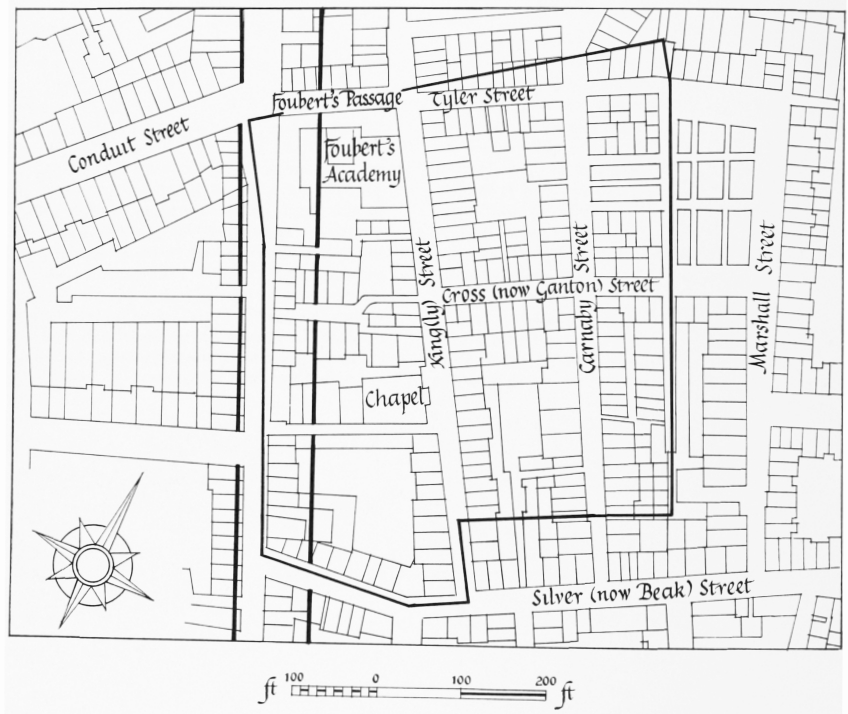
Six Acre Close, layout plan. Based on Horwood's map of 1792, with Regent Street superimposed
The Western Field
The leasehold of the southern extremity of the western half of Six Acre Close had by 1673 come into the leasehold possession of Ralph Wayne, (fn. 11) who erected there a messuage known as 'the Waterhouse.' By c. 1685 this ground, comprising about half an acre, had been purchased by Thomas Beak(e), together with twenty 'mean Tenements and some small shedds' which had been erected there. Beak, from whom Beak Street took its name in 1689, (fn. 12) was one of Queen Anne's Messengers in Ordinary, (fn. 13) and at some unknown date he acquired the leasehold of all of the rest of the land in the western half of Six Acre Close to the south of the modern Tenison Court. (fn. 14) He died in 1710. (fn. 15)
In 1671 Sir William Pulteney leased to Roger Looker, gardener, all of the land in the western half of Six Acre Close to the north of Tenison Court. This grant, which was for forty-five years at an annual rent of £8 5s., comprised a parcel of two acres and ten square perches and can be approximately identified as all the ground at present lying between Foubert's Place on the north, Tenison Court on the south, Kingly Street on the east and Regent Street on the west. In addition it included ground used when the footpath was widened into King Street and also a narrow strip of land now laid into the roadway of Regent Street and which, until the construction of that street, had been part of the site of houses on the east side of Swallow Street. (fn. 16)
At the northern end of his ground Roger Looker built himself a house. The remainder of the land was evidently enclosed with a wall and laid out as a market garden. In order to carry out these improvements he borrowed £500 from William Carter, vintner. (fn. 17) Looker died in March 1684/5 and the house and land in Six Acre Close passed to his widow, Bridgett. (fn. 18) Shortly afterwards the latter (possibly realizing the potential value of her inheritance as building land) obtained from Sir William Pulteney a five-year extension of her current sub-lease, agreeing to pay an increased rent of £50 per annum for the additional years. (fn. 19) After this extension of her interest in the western portion of Six Acre Close to 1721, she quickly disposed of her sub-lease to three purchasers.
One small parcel was assigned on 17 November 1687 to the rector of the parish, Dr. Thomas Tenison, for the erection of a chapel and school. This plot fronted on to the west side of the old foot-path, now Kingly Street. On the same day Edward Wilcox, carpenter, bought Bridgett Looker's leasehold interest in a parcel adjoining Tenison's land. He probably began to build a house there but in February 1689/90 sold it while still unfinished to Dr. Tenison as a residence for the schoolmaster. (fn. 19)
The residue of her ground, to the north of Tenison's plots and amounting to one and a half acres, was assigned to Lewis Maidwell. The date of this third sale is uncertain but it was probably also made in or shortly before November 1687 and certainly before January 1692/3. (fn. 20)
Maidwell's School: Foubert's Academy: The Parish School of Industry
Demolished
Lewis Maidwell (1650–1716) was the son of a Northamptonshire lawyer. He was educated at Westminster and St. John's College, Cambridge, and was at first a tutor in the family of Sir Stephen Fox. In 1680 he turned unsuccessfully to drama and wrote a comedy, The Loving Enemies. (fn. 21) In 1687 he established himself as a schoolmaster in what had by this time become King Street. (fn. 12)
The one and a half acres of land which Lewis Maidwell had purchased consisted of all the western portion of Six Acre Close to the north of Dr. Tenison's land. Part of the ground had been used when the foot-path was widened to become King Street, and another strip of land on the northern edge of Maidwell's new property was intended as a passage (now Foubert's Place) into Swallow Street. It is likely that parts of the remaining land had already been laid out for building and that in some instances, notably in Looker's Court, the erection of a number of small houses there had already begun before Bridgett Looker sold the property. By 1692/3 there were thirteen houses there. (fn. 22)
Maidwell himself laid out £2000 in building 'a substantial brick house and inclosed to the same a convenient garden with outhouses and stables', and also a riding school for his pupils, (fn. 23) or, as it was then called, an 'Academy for the Great Horse'. These buildings were probably erected on the site of the house which Looker had previously built.
Here Lewis Maidwell 'for severall years followed the imployment of a Schoolmaster to the great satisfaction of the Nobility and Gentry in the Education of their sons'. (fn. 24) His school was of the boarding variety and was run on what were then advanced lines. As well as the usual classical subjects, the curriculum included French and Italian, mathematics, 'Merchants Accounts', navigation, astronomy and geography, history and chronology, as well as dancing, fencing and riding. (fn. 25) Music also seems to have been taught for in 1689 a new work by Henry Purcell, 'A Welcome Song at the Prince of Denmarks Coming Home' was performed at the school. (fn. 26) (fn. c1) Maidwell claimed to provide a comprehensive education never previously practised in any English school, (fn. 27) and attracted a very fashionable clientèle. In 1706 the poet Nahum Tate wrote of 'the Happy Education of many Persons of Quality, very eminent in both Houses of Parliament' which Maidwell had provided. (fn. 28)
In March 1692/3 Maidwell obtained from the Crown a reversionary lease of his property for ninety-nine years from 1722/3, when his existing term expired. (fn. 29) He seems to have owed this extension to the interest of his neighbour, William Lowndes, whose son he had educated and who then enjoyed a similar limited interest in the eastern part of Six Acre Close. (fn. 30) Unlike Lowndes, Maidwell never succeeded in obtaining the freehold of his land, which still remains Crown property.
The school continued to prosper and in February 1699/1700, for seemingly altruistic reasons which some contemporaries doubted, Maidwell petitioned the House of Commons for leave to bring in a Bill which would, if passed, have turned his private school into a public institution. He proposed 'the beneficial Design of a publick Academy' to be set up at his school for the free education of forty scholars in 'Languages, Arts and Exercises'. He elaborated his scheme in a pamphlet and undertook to settle his premises in King Street for this purpose. He also suggested that the school should be supported by the proceeds of a tax on all printed books, pamphlets and papers. (fn. 31)
Maidwell's petition was unsuccessful, as were his subsequent attempts in 1703 and 1704, which were also supported by active pamphleteering. (fn. 32) He made a final unsuccessful effort to arouse public interest in his Academy in 1705 with an Essay upon the Necessity and Excellency of Education.
Maidwell blamed his lack of success on the jealous opposition of the universities. A contemporary Oxonian, Dr. John Wallis, the mathematician, wrote of Maidwell as 'a person who talks high, and keeps high company, and had perhaps lived higher … than his estate would well bear', and who by criticizing the contemporary system of education was seeking to better his fortunes by Act of Parliament. (fn. 33) The printers, booksellers and publishers were also actively opposed to Maidwell's schemes, which were largely dependent upon the proposed tax on their merchandise. In January 1704/5 they petitioned the House of Commons against his current Bill, on behalf of themselves 'and many others, exercising those Trades in the several Cities and Towns in England'. They claimed that they would all 'not only be hindered in carrying on their Trades, … but be liable to vexacious Suits, and Penalties' if the Bill became law. (fn. 34) When a tax on newspapers and pamphlets was eventually imposed in 1712 the proceeds were not used for educational purposes.
The only success which Maidwell achieved was in February 1701/2 when William III granted a charter of incorporation to the school as the 'Royal School of King William the Third'. The charter also appointed 'Six discreet, religious and honourable persons' (including the Archbishop of Canterbury and the Lord Chancellor) as governors, with Maidwell as the first master. No endowment was provided. (fn. 27)
After the failure of his efforts to obtain financial support Maidwell vacated the school premises in King Street in 1704, (fn. 12) and after an unsuccessful attempt to sell them to the Earl of Carbery in 1706, (fn. 35) he finally disposed of them to Henry Foubert. (fn. 36) He did not continue hisschool elsewhere and, after some years of ill-health, died in 1716. (fn. 37)
Henry Foubert was the proprietor of a school of arms which had originally been founded in Paris by his father, Solomon de Foubert, a Huguenot fencing-master. This school had been popular with English families, and when it and other Protestant academies were closed Solomon de Foubert and his family migrated to England, where they arrived in 1679. (fn. 38)
De Foubert is said to have been allowed the use of the Military Yard near Leicester House for riding and fencing instruction, (fn. 39) but if this was indeed so his tenure must have been very short, for in 1676 Lord Gerard had been granted a licence to build there, and Gerrard Street, which runs through the centre of the site of the Military Yard, was in existence by 1681. (fn. 40) John Evelyn must therefore have been referring to premises elsewhere when he noted in his diary in December 1684 that 'Mr. Foubert having newly railed in a Manage & fitted it for the Academy, I went with my Lord Cornwallis to see the Young Gallants do their Exercise: There were the Dukes of Norfolk and Northumberland, Lord Newburghe, and a nephew of the Earle of Feversham'. (fn. 41) It has been conjectured that these exercises took place in the fields adjoining Sherwood and Brewer Streets, (fn. 42) and this would accord with the evidence of the ratebooks, which show that in 1689 and 1690 de Foubert kept stables in Great Windmill Street nearby. (fn. 12)
From 1691 until his death in the winter of 1695–6 de Foubert received an annual pension of £500 from William 111. (fn. 43) He was succeeded by his son Major Henry Foubert, who had 'signalised himself at the Battle of the Boyne'. (fn. 44) In 1695–6 he vacated the premises in Sherwood Street, (fn. 12) but in 1697 the payment of the royal pension was continued to him 'for the support and maintenance of our Royal Academy which is now under … [his] care, inspection and government.' (fn. 45)
The ratebooks show that in 1699 and 1700 Henry Foubert occupied premises in Coventry Street, and from 1702 until at least 1707 in Rupert Street. He also had a house, possibly his private residence, in Old Spring Gardens, and in 1701 he tried to obtain the grant of a parcel of Crown land in the vicinity for the erection of a riding-house. If this additional property were granted to him rent free he promised 'to entertain one of the King's Pages without the present charge of £136 per annum' and claimed that 'ever since his father came over it was always promised that he would have a house rent free and a pension, as is allowed in all the Courts abroad'. His petition was unsuccessful, (fn. 46) and in 1702, when he appears to have been considering the establishment of another 'Academy' at Oxford, his pension was reduced to £250 per annum. (fn. 47) The payment of even this reduced allowance, and of his wages as a royal equerry, were frequently in arrears, (fn. 48) but the pension is said to have been later restored to the full amount. (fn. 49)
The actual date of the move from Rupert Street to Maidwell's former premises in King Street is uncertain for the poor ratebooks for the years 1708–1715 inclusive are missing, but the first reference to Major Foubert in the sewer ratebooks appears in 1710. (fn. 50)
The academy remained in King Street until its closure in 1778. It was managed by Henry Foubert until his death in 1743 (fn. 51) and subsequently by his nephew Solomon Durrell until 1771 and by the latter's son-in-law, Thomas Evans, who took the name of Durrell, until 1778. (fn. 52) The academy declined in fashion and in its later years became merely a riding-school and stables. It does not seem to have included in its curriculum 'the comprehensive education' provided by Maidwell, or to have maintained the fashionable connexions of the first Foubert.
Two years before its closure in 1778 Thomas Durrell procured from the Crown a new fiftyyear lease. The premises then consisted of a long 'Ride' or covered riding-school, running the length of the Swallow Street frontage, a stable-range fronting on to Foubert's Passage and a house in the court-yard behind these two buildings (Plate 38a). (fn. 53)
In April 1782 Thomas Durrell sold his lease of the riding-school to Samuel Mettayer for £2200, (fn. 52) the purchase being made in trust for the vestry of St. James. In the 1760's the parish overseers of the poor had adopted the practice of boarding out the younger pauper children with nurses in Wimbledon and the acquisition of the old riding-school in King Street in 1782 was for the accommodation of the older children from the workhouse. (fn. 54)
Part of the old premises, including the 'Ride' and the stables fronting on to Foubert's Passage, were let to a livery stableman; (fn. 55) the rest was fitted up as the parish school of industry for 'the maintaining, educating and employing the poor children of the parish'. (fn. 56) The parish spent £728 on repairs and alterations, and later a further £6687. (fn. 57)
Here the pauper boys and girls were separately lodged, fed and taught, the boys shoemaking and the girls household work; both also received some formal schooling. In 1797 there were 270 children in the school. Living conditions were comparatively healthy, for only six of the children who had entered during the previous five years had died. (fn. 54) In the early nineteenth century the children were apprenticed at about the age of thirteen or fourteen, often to factory owners in Derbyshire and Manchester. (fn. 58) Some of the pauper boys were also taught navigation and seventy-five 'promising boys' were sent into the Navy during the wars with France. (fn. 57) In peacetime other boys were apprenticed in the fishing industry. (fn. 59)
In 1820 the construction of Regent Street compelled the parish authorities to give up all their premises in King Street, which were then taken over by the New Street Commissioners and demolished. Some of the children were removed to the already over-crowded workhouse, but others returned to their homes because their parents refused to allow them to go there. (fn. 60)
St. Thomas's Church, Kingly Street (fn. c2)
This church was erected as a proprietary chapel in 1702 by Dr. Thomas Tenison, then Archbishop of Canterbury, on the site of an earlier wooden tabernacle or oratory which he had erected some fifteen years previously whilst rector of St. James's. The chapel, to which a small charity school was annexed, was first vested in trustees but became a district church in St. James's parish in 1869 and was then dedicated to St. Thomas.
In the 1680's the rapid increase of population had led to the division of the parish of St. Martin, the two new parishes of St. James and St. Anne being established, each with its own church. These additional churches soon proved insufficient and it was to remedy this situation that Dr. Tenison, the first rector of the parish of St. James, began to erect in 1687 a temporary chapel in King (now Kingly) Street, in the northern and less fashionable quarter of his large parish.
As well as being in need of additional church accommodation, the poorer inhabitants of St. James's parish were, with the exception of the Boys' Offertory School, without free schools. Dr. Tenison possessed an enthusiasm for education and whilst rector of St. Martin's had founded a small 'perfectly Free' school in that parish, from which 'great Benefit hath arisen … both in relation to the ease of poor House-Keepers, and the Learning of Good Manners of their Children'. (fn. 61) With the creation of St. James's, the poor of the newly established parish could no longer send their sons to this school and it was perhaps with this in mind that Tenison decided to found a charity school for boys alongside his new chapel.
In November 1687 he purchased from Bridgett Looker the sub-lease of a parcel of land on the west side of King Street, as a site for the buildings of his new foundation. The freehold of the ground, which was part of Six Acre Close, belonged to the Crown, by whom it had been leased to Sir William Pulteney. (fn. 19) The exact size and dimensions of Dr. Tenison's ground are uncertain, but it is clear that the plot fronted east on to King Street and extended back to Swallow Street, providing sufficient space for the erection of the tabernacle with two flanking open passageways on the north and south sides and a yard to the west. (fn. 62)
Building work began immediately after thecompletion of Tenison's purchase, for the chapel was completed by April 1688. (fn. 61) It was built of timber on a brick foundation at a cost of £900, and consisted of one large room. This sum was defrayed out of a large benefaction deposited in Tenison's hands for charitable purposes. (fn. 63) At first no separate school-room was provided and the boys were probably taught inside the tabernacle. (fn. 64) Apart from the fact that the tabernacle was erected between November 1687 and April 1688, there is no record of its consecration or first opening, or of the inauguration of the charity school.
In February 1689/90 Dr. Tenison purchased the sub-lease of a narrow strip of adjoining land on the north side of the tabernacle, fronting on to King Street on the east and extending back to Swallow Street. As with the first plot it had been sub-leased by Sir William Pulteney to Roger Looker and sold by his widow in 1687, to Edward Wilcox, carpenter. (fn. 19) It is likely that Wilcox had started to build a house on this second plot and conveyed the unfinished building to Tenison, who by September 1690 had completed it as a residence for the schoolmaster. Tenison had already built a smaller house behind the tabernacle for the underschoolmaster, and now proceeded to lay out gardens for the two houses (one with a wide 'Tarras Walk'), and also a play-yard for the charity school boys. (fn. 65)
By 1690 Tenison's property in King Street consisted of these three new buildings standing upon what had been two separate parcels, now forming together a large plot of leasehold ground, measuring approximately 200 feet from east to west and 96 feet from north to south. (fn. 65) To secure the continuance of his twin-foundation, Tenison (who was by this time Bishop of Lincoln) petitioned the Crown in August 1692 for a grant of the freehold of both parcels. By letters patent of January 1692/3 he was granted the freehold of the site of the tabernacle and the two adjoining houses and gardens 'for good and charitable causes', but 'the wast and unbuilt' land fronting on to Swallow Street was only leased to him for ninety-nine years from 1722/3 at a rent of twenty shillings a year. (fn. 66)
Though not a place of such fashionable devotion as the parish church, the wooden tabernacle in King Street soon became an established centre of religious life. John Evelyn made frequent references to it in his diaries; 'In the Tabernacle neere Golden Square' he heard in February 1692/3 'the Bishop of Lincoln [Tenison] on 2. John. 25', and on a Sunday in the following April 'Mr. Stringfellow preached in the afternoone in the Tabernacle set up by the Bishop of Lincoln … shewing the virtue of fasting and prayers'. (fn. 67)
In September 1700 Dr. Tenison, who was now Archbishop of Canterbury, executed a deed of settlement vesting his freehold and leasehold interests in the tabernacle and two adjoining houses and gardens in nine trustees, among whom were John Moore, Bishop of Norwich, William Wake, then rector of St. James's and later Archbishop of Canterbury, and (Sir) Isaac Newton. He also presented £500 for the endowment of the tabernacle 'as a publique Chappell or Oratory for divine service according to the Liturgy and Orthodox Practice of the Church of England, for the ease and conveniency of the Inhabitants of the said Parish of St. James'. The rent of any property purchased with the £500 and the profits from the pew-rents were to be used for the upkeep of the chapel and its services and for paying the stipends of the clergy. The trustees also had to 'find and provide … one or more able and sufficient Schoole masters or Schoole master, to teach and instruct [sixteen] poore Boys Natives & Inhabitants of the said Parish of St. James … to Read, Write, Cast accounts, and such other parts of mathematicks as may the better qualify [them] to be put out Apprentices'. Tenison reserved to himself and his successors at Canterbury the rights of Visitor to the new foundation. (fn. 19)
By the beginning of 1702 the tabernacle had become 'so very crazy and badd' that the newly appointed trustees considered that 'it may be dangerous to continue it any longer and that money on repairs will be but thrown away'. They therefore decided to demolish the chapel and the adjoining house, then in the tenure of Ambrose Warren, and to build a new chapel, 'more convenient and large', on this combined site. (fn. 68)
At their next meeting, held on 28 January 1701/2, the trustees selected (with some minor modifications of the interior) one of four alternative plans for the new building. There is no indication in their minutes of the name of the architect responsible, nor has any evidence on this point come to light. It is possible that 'Mr. Ludby', carpenter (probably John Ludby), whom the trustees appointed 'to manage the whole' (i.e. the work of construction), (fn. 69) may have had some responsibility for the design, under the general supervision of Sir Christopher Wren. The latter had already designed the parish church of St. James, and in 1713 he was consulted over the first major repairs carried out on the new chapel.
The other building tradesmen employed were Mr. Hester as bricklayer, Mr. Carr as smith, Mr. Jackson as joiner and Mr. Highmore as painter. The latter was probably Thomas Highmore, who had worked at the parish church. Captain John Outing (one of the trustees and resident in King Street) and Mr. Bryan Turbervill were to survey the building work as it progressed. The cost of the new chapel was to be met by calling in the Archbishop's gift of £500 (which had been lent at interest for completing St. Paul's Cathedral), and by raising a mortgage on the adjoining freehold house belonging to the trustees in King Street. (fn. 70)
The last services in the wooden tabernacle were held in February 1701/2. The congregation then migrated to the French chapel in Swallow Street (see page 63), where they remained during the short period of rebuilding. (fn. 71)
Demolition began almost directly. On 5 March the foundation stone of the new building was laid by Captain Outing and Mr. Justice Tulley (another trustee). It was a block of Portland stone, 18 inches long by 14 inches broad and inscribed 'This chapel was rebuilt, 1702, Thomas, Lord Archbishop of Canterbury being Founder and principal Benefactor'. (fn. 72) This stone, which is at the north-east angle of the church, is now concealed by cement.
The new building went up very quickly. By mid-May 1702 the roof was on and the workmen were given a 'raiseing dinner'. In July the interior was being decorated, the trustees deciding that 'the compass ceiling [in the] chapel be ribed from column to column in the plain mouldings only'. At the same time an organ was ordered at a cost of £230 from a Mr. Price. In August the trustees desired one of their number, (Sir) Isaac Newton, 'to wait on my Lord Archbishop of Canterbury, to know his Grace's pleasure relating to the consecration of the new chapel', but it was found that great delay would ensure if the opening were deferred until the consecration could take place. The new chapel was therefore opened, without that ceremony, on Sunday, 4 October, with services at 'the usual hours of near Tenn and Three'. (fn. 73) The trustees and congregation appear to have been pleased with their new building, which Dr. Burd, their preacher, pronounced to be 'a decent and pretty Chappel'. (fn. 74)
Furnishing and decoration continued into the following year. In April 1703 a type (a soundingboard) was set over the pulpit. It was also decided that 'Ye Altar Piece and place be in due season painted with good cedar colour, and well varnished, the oval Glory blew, and moulding well gilt.' The cost was not to exceed £10, given by Tenison for this purpose. In the next month the trustees 'Agreed that only part of the mouldings of the Altar piece and door be gilt. And that in the midst of the oval be drawn a large Bible opened, with the following words in fair print hand inserted "This do in Remembrance of Mee", with the chap and verse.' Two altar cloths, one of velvet and gold, the other of green serge embroidered and fringed, were provided, and there were also two silk tapestry-work cushions and a considerable quantity of altar plate. Later embellishments included 'A Dial set up in the chapel at the expense of Sir Isaac Newton' in 1705, and in 1708, following the Union with Scotland, the royal arms of the United Kingdom. (fn. 75)
The new chapel covered the site of the wooden tabernacle, the open passage-way which had flanked it to the north and the site of the house of Ambrose Warren formerly at the west end of the old building. In addition a smaller building was erected adjoining the west end of the new chapel, to contain the vestibules and vestry, chapelkeeper's rooms and a small school-room for the charity boys. The total expenses of the whole rebuilding amounted to £2072 18s. 8¼d. This sum included only part of the cost of the organ. (fn. 75)
To the west of the former tabernacle the Tenison trustees owned a large plot of land, then 'wast and unbuilt', with a frontage of 96 feet to Swallow Street, (fn. 64) and which by the early years of the eighteenth century had become valuable for building. In 1703 part of this site was leased to Ambrose Warren, whose house adjoining the old tabernacle had been demolished to make way for the enlarged building; he was to provide himself with 'a new and better house', and was also given the materials of his former dwelling. The remainder of the vacant land was leased to Ludby. At the same time the passage-way which had flanked the south side of the old tabernacle, was extended into Swallow Street, the new houses of Warren and Ludby being built on its north side. This became Chapel Court, now Tenison Court. (fn. 76)
The speed with which the chapel was erected in the six months between March and October 1702 was probably achieved at the expense of sound building work. As early as 1713 a serious defect was found in the south wall and roof, which the trustees, under 'Absolute necessity', had to take down and repair at considerable expense. The damage seems to have been surveyed by the Queen's Master Carpenter, John Churchill, with three of his men. Their report and proposals were submitted to Sir Christopher Wren. The repairs were carried out by the ubiquitous Ludby, whose faulty workmanship may have been responsible here, as it was later for the partial destruction of the newly built parish workhouse. (fn. 77) A contemporary account of the newly repaired chapel describes it as 'now a very spacious, and beautiful Chapel, wherein is an excellent and extraordinary Organ, fine capacious Galleries on both sides, a large Altar-piece, and Chancel, paved with Marble, two large Branches, and other Ornaments'. (fn. 78)
The chapel and charity school were now firmly established, with two preachers, a reader and schoolmaster and thirty-six free scholars. There were two services on Sundays and four on weekdays. The school hours were from seven to eleven o'clock in the morning and from one until five o'clock in the afternoon, with morning school an hour shorter in winter. (fn. 79)
In this state Tenison's foundation continued for the next century. No major work on the fabric was put in hand, but in 1766–7 some repairs to the roof and windows were carried out and the interior was redecorated at a cost of £58 by Mr. Pickering, probably the son of William Pickering, the painter stainer and grocer of No. 3 St. James's Street. Some changes were also made in the chapel furnishings. The pulpit and reading desks, which had previously stood in the middle aisle towards the west end of the chapel, were now moved to the east end and fitted out with new hangings of purple velvet. New hangings were also bought for the altar, all the old materials being sold to the vestry of St. James's for use in the Berwick Street Chapel. A new organ was bought from Mr. Byfield, the old case being retained but the original organ being likewise sold to St. James's vestry for the Berwick Street Chapel. In 1791 the east window of the chapel was glazed with ground glass. (fn. 80)
By the beginning of the nineteenth century the chapel had become very much out of repair. In 1805 it was found that the timbers and boarding of the floor were in a decayed state and that a number of other repairs and alterations were necessary. These were carried out at a cost of £3162. The seating was also re-arranged and new velvet hangings again bought for the altar, pulpit and desk. Two plain mahogany chairs with kneeling stools were placed at the ends of the altar and, at the same time, the altar plate regilded at an extra cost of £34. (fn. 81)
In 1809 the Tenison trustees opened negotiations with the Treasury for a new lease of the Crown land adjoining the chapel. This ground had been granted to Tenison for ninety-nine years from February 1722/3 and subsequently it had been sub-leased by his trustees for the erection of the small houses and stables in Chapel Court and Swallow Street, which by 1809 had become 'very much out of repair'. In 1814 the lease was renewed by the Crown and the trustees immediately granted sub-leases at considerable profit. (fn. 82)
This lease had hardly been granted before the formation of Regent Street involved the trustees in fresh negotiations. The line of the street passed very close to the chapel, and the New Street Commissioners needed to acquire part of the trustees' ground. By an agreement which was not finally reached until 1824 the trustees gave up a substantial part of the western portion of their land, which is now part of Regent Street. They also surrendered to the Crown their recently renewed lease of the site of what later became No. 172 Regent Street (at the north corner of Tenison Court) in exchange for a small annuity to be paid to them by the Crown. They retained the freehold of the land to the north of No. 172, with a valuable frontage of some ninety feet to Regent Street, and immediately leased this ground to the Crown for ninety-nine years from 1821. (fn. 83) (fn. 1)
These changes provided an opportunity to make an entrance to the chapel from Regent Street, and as part of the agreement the Commissioners undertook to build the façade. At the same time the trustees decided to demolish the building which had been erected in 1702 at the west end of the chapel and contained the vestibules, vestry and school-room, and to erect in its place a series of new rooms behind the Commissioners' façade. They could not build on all this land, some of it being required as a play-ground for the school. (fn. 84)
This plan was carried out by 1824. C. R. Cockerell designed the Regent Street façade for the Commissioners (fn. 85) and Thomas Hardwick the new rooms behind for the trustees. The tradesmen employed by the latter included Burt, bricklayer; Mather, mason; Smith, carpenter; Prigg, plumber; and Rogers, smith. The new additions consisted of a vestibule leading from Regent Street into an octagonal lobby and then through a narrow passage into the church. The rest of the ground floor was taken up by the new vestry, the chapel-keeper's room, a few small closets and a staircase leading up to the school-room placed above the Regent Street entrance. Hardwick also supervised the repair and redecoration of the interior of the chapel itself, (fn. 86) and the total cost to the trustees of all these works amounted to £3239. (fn. 87)
In the decades following these changes the size of the congregation attending the chapel began to decrease, despite its imposing new frontage to Regent Street. The neighbourhood became increasingly commercialized, with few middle-class residents and a great many poor householders; for a chapel depending largely on pew-rents, these social changes involved considerable loss of income. In 1847 the organ was repaired by Messrs. Bevington and £720 was spent on painting the chapel. This latter work was carried out by Thomas Ponsonby, a Regent Street decorator, supervised by Charles Mayhew, the trustees' surveyor. New hangings were also bought for the chapel, but these were of cloth as the trustees could no longer afford velvet. The present east window of blue stained glass was inserted at this time at a cost of £102 and was paid for by subscription. (fn. 88)
In 1849 economies and improvements were made in the working of the charity school, and the curriculum was extended in order to attract more fee-paying pupils. In 1850 the stipends of the clergy were reduced, and in 1851 two of the congregation, Mr. Tombleson, carpenter, and Mr. Burt, bricklayer, recoloured the gallery of the chapel at their own cost, leaving it to the trustees to pay them whenever possible. (fn. 89) But despite these economies the income of the trustees was still insufficient to meet current expenses.
In 1853 a new rector was appointed to St. James's parish, the Rev. J. E. Kempe. At his suggestion the Tenison trustees opened negotiations with the Ecclesiastical Commissioners for the chapel to be converted into a district church of the parish, with a defined cure of souls in the adjoining streets. He also seems to have been largely instrumental in persuading the trustees to increase their income by converting the Regent Street entrance to the chapel, with the schoolroom above, into a shop and dwelling house. This work was carried out in the autumn of 1854, the remaining rooms behind the vestibule being re-arranged to provide a new entrance lobby from Chapel (now Tenison) Court. The interior of the chapel was repaired and redecorated at the same time, Charles Lee of Golden Square being the architect responsible for these changes and Messrs. Saunders and Woolcott the building contractors. A new organ was also built, by Messrs. Gray and Davison, but was not completed until 1857. (fn. 90)
The loss of the Regent Street entrance aroused protests in the newspapers and also from the clergy and congregation. The rector of St. James's replied to the former that the vestibule had never formed an integral part of the original building but was a modern annexe, and that the chapel trustees had no other way of increasing their income. The rector was less forbearing to the clergy and congregation who had protested that all hope of building a more fitting church on the site was now lost. Speaking for the trustees he said 'By a more "fitting" church, we presume is meant one of better ecclesiastical architecture. But it seems to us an unprecedented notion that, especially in London, and in a parish and district of great spiritual destitution, a church, which is substantial and needing only adequate repairs, should be pulled down and replaced by a new one on such considerations alone.' (fn. 91)
The part of the foundation which had most cause for complaint was the charity school. It lost both the school-room overlooking Regent Street and the play-ground and was removed to other premises taken for its accommodation at No. 6 Cambridge (now Lexington) Street. Here the school re-opened after the summer holidays of 1854, still governed by the Tenison trustees. (fn. 92)
The negotiations with the Ecclesiastical Commissioners which had been opened by the trustees in 1854 continued until July 1869, and the agreement then made ended the independence of both the chapel and the school. The freehold of the chapel building in King Street was conveyed to the Commissioners to become a district church, and the chapel clergy, previously the preacher and reader, became the first vicar and curate respectively of the new district church. The school, which had been linked with the chapel for the previous one hundred and eighty years, was made a separate institution and in 1871 was amalgamated with Archbishop Tenison's other school in St. Martin's parish, which is now at Kennington Oval. The trustees retained their property, except for the freehold of the chapel, and in future were to pay one quarter of their income for the use of the school and the remaining three quarters to the church. Finally in November 1869 the new district church was consecrated under the dedication of St. Thomas. (fn. 93)
The parochial responsibilities of St. Thomas's have greatly increased since 1869. In 1937 the church of St. John the Baptist in Great Marlborough Street was demolished and its parochial district united with that of St. Thomas. With the demolition of St. Luke's, Berwick Street, in 1936, the destruction of St. Anne's, Soho, during the war of 1939–45 and the subsequent demolition of St. Peter's, Great Windmill Street, St. Thomas's has become the only Anglican parish church in the wide area formed by Regent Street, Oxford Street, Charing Cross Road and Shaftesbury Avenue. (fn. 94)
The church fabric has changed little during the last hundred years. Butterfield is said to have refitted the interior in the 1870's or 80's but it is difficult to discern what changes he made. (fn. 95) It is known that the church was put into a good state of repair in 1884–5, under the supervision of the architects, Messrs. Lansdown and Harriss. The roof bell-turret and stone work were then repaired and the interior walls and ceiling coloured, at a total cost of £700. (fn. 96) (fn. 2) In 1903–4 a 'general restoration' was carried out costing £3000. The architect was W. J. Parker and the builders Messrs. Patman and Fotheringham. The work included the erection of the present entrance from Tenison Court with the top-lit lobby behind, the present gallery staircases, and repairs to the roof. It is also likely that the memorial chapel at the south-east end of the church was inserted at this time. In 1919–23 £2000 was spent on repairs to the organ and ceiling. (fn. 97)
The building sustained only minor damage during the war of 1939–45 but in 1950 dry not was discovered in the north-east corner. This was quickly eradicated and later the exterior walls were partly faced with cement, which covered the foundation stone of 1702. St. Thomas's has recently become a centre of liturgical experiment, which has involved the re-arrangement of some of the furnishings. The future of the church is at present uncertain.
Architectural description
The church (Plate 10a, 10b, figs. 24–5) is a plain brick building, oblong in plan with slight rectangular projections at the east and west ends, the western projection having attached to it a small square tower. The nave is spanned by a single, high-pitched roof and the aisles by lowpitched roofs with a hip at either end. The east front, now covered with cement, has in its central projection a tall, round-headed window, below which is a blank rectangular panel contained in a shallow recess. The projection is finished with a triangular modillioned pediment of wood, sharply pitched and with a small round opening in its centre. At either side of the projection is a doorway with a moulded architrave, and beyond it, set at a higher level, the round-headed window of the aisle. The front has no other decorative features except for a bandcourse, placed below the parapet over the aisles, which extends as far as the central projection. The west front is now entirely invisible from Regent Street and only a glimpse of it can be obtained from Tenison Court. However, the upper part, which is not obscured by the single-storey buildings erected in 1903–4, is shown in a photograph (fn. 98) taken when the Regent Street block in front of it was still in course of erection. It is very similar to the east front, but with a wide segmental-headed window, perhaps a later insertion, on either side of the central projection. The tower is entirely plain with no openings or adornments other than a moulded wood cornice at the top, but surmounting it is a hexagonal bell-turret of wood. Each face of the turret is pierced by an opening with a shouldered, semi-circular head, its lower part guarded by a balustrade, and above it is an entablature with a prominent cornice surmounted by an ogee-profiled roof. From the apex of the roof rises a wroughtiron weather-vane inscribed with the date 1702. The south front is very plain with two rows of five segmental-headed windows set in a wall face of purple-red stock brick, the eastern window of each row being blind. The window-arches are of red gauged brick, and above each row is a bandcourse. The brickwork beneath the lower row of windows has been covered with cement and a moulded sill-course introduced. Inset at the western end is a stone tablet recording that the outer edge of the kerb, which runs down Tenison Court at a distance of about six feet from the building, is the southern boundary of the land owned by the King Street Chapel Trust.
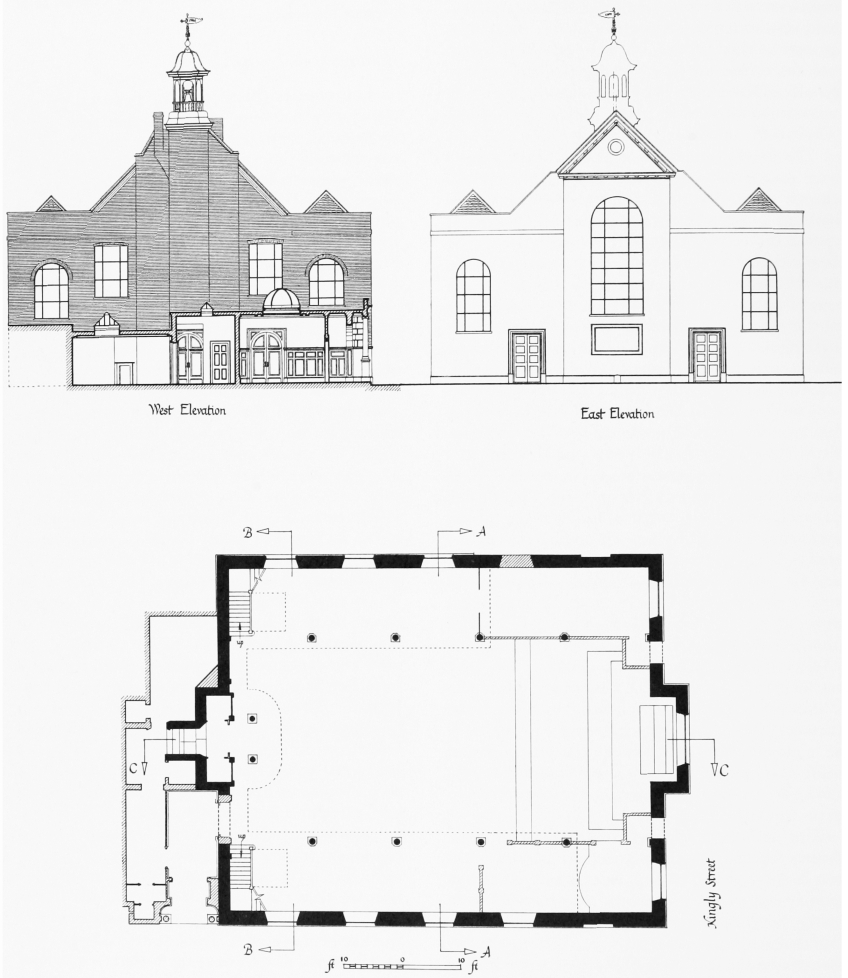
St. Thomas's Church, Kingly Street, elevations and plan
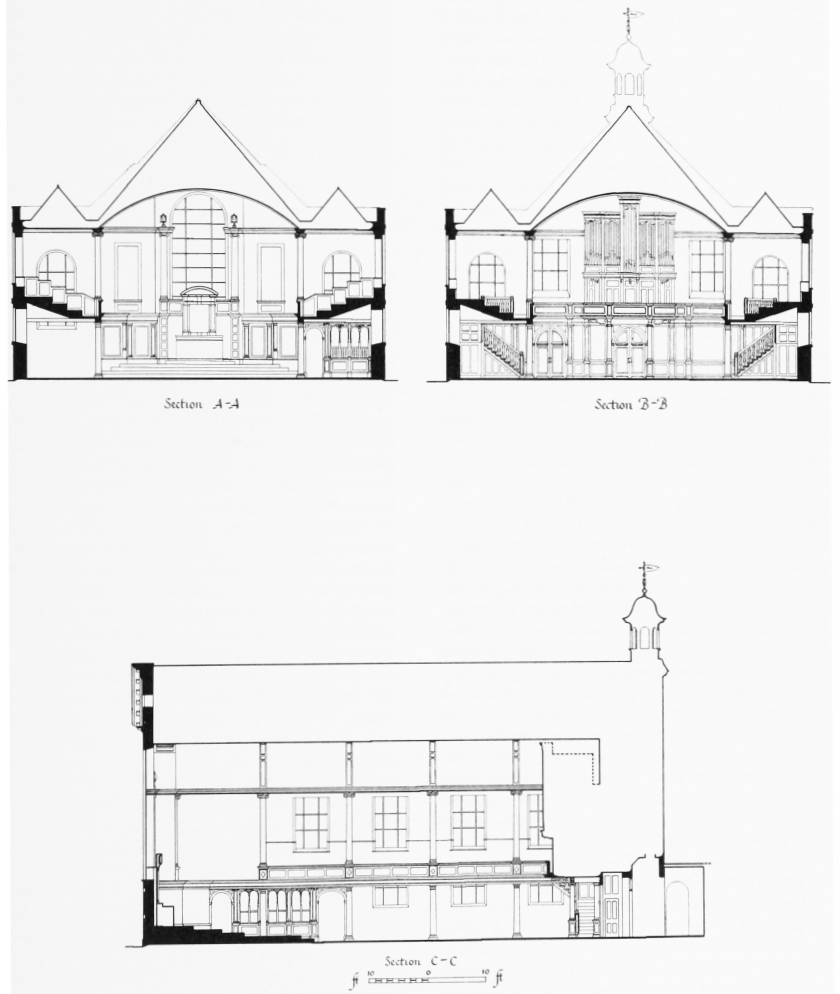
St. Thomas's Church, Kingly Street, sections
The interior of the church is pleasantly proportioned but very plain, and the piecemeal enrichments added to it in the late nineteenth and early twentieth centuries have merely tended to detract from its unity of design. The nave is in five bays, being divided from the aisles by two ranges of superimposed columns, Ionic upon Doric. The aisles are galleried, but at the east end the galleries appear to have been cut back at some time and now extend for only three bays on the north side and four on the south. A narrower gallery is carried across the west end of the nave, being broken forward in the centre to accommodate the organ, where it is supported by two Ionic columns. There is no chancel, but in the two eastern bays of the nave is a series of steps, alternately broad and narrow, leading up to the altar, which is contained in the shallow central recess. The Doric columns of the lower order, and the two Ionic columns under the organ, are solid tree-trunks, while the entablature above the former disguises the heavy beam into which the floor of the gallery is framed. The Ionic columns of the upper order are probably of wood, but they have been covered with plaster and then painted and grained. They stand on rough octagonal pedestals of wood, but these are deceptively concealed by a continuous panelled pedestal-course which breaks forward in front of them; the woodwork, however, appears to have been grained like the columns. At the eastern end, where there is no gallery, the entablature and pedestal-course are not continued, being limited to a short length between each pair of superimposed columns.
The gallery-staircases are now at the west end, being imitations of early Georgian work, but there are indications that the original ones were at the east end. The columns of the upper order support a moulded beam, from which springs the shallow segmental arch of the nave ceiling. The panelled transverse ribs of this ceiling, extending from column to column, could be original, but the indifferent painted decoration probably dates from 1884–5. The whole of the west wall below the gallery has been panelled in imitation early Georgian style, probably in 1903–4, while the gallery itself is probably a reconstruction of the same date. At ground level the two eastern bays of the aisles have been partitioned off in the present century, that in the southern aisle as a chapel with an ornate screen and interior panelling which probably also date from 1903–4. The reredos in this chapel contains an oil painting of the Madonna and Child with the Infant St. John the Baptist, said to be sixteenth-century Italian. (fn. 99) The north, south and west walls of the church are otherwise entirely plain, except, inexplicably, for some stretches of re-used Jacobean panelling in the galleries.
The east wall of the nave is fully panelled in the lower stage with pilasters supporting an entablature, but it is cheap flush panelling with the mouldings painted on to it. The wooden reredos behind the altar is of inconspicuous design, the centre panel being flanked by scroll-buttressed pilasters inlaid with mahogany, and the entablature above finished with a segmental pediment. The centre panel now contains an oil painting showing St. Thomas touching Christ's wounds. Behind the altar is a plain wooden face stopped at each end by the panelled return of the lower stage, here carried up to the underside of the cornicecapping. Upon this capping stand two tall Ionic pilasters supporting the imposts of the east window. Their pedestals are linked to the reredos by a panelled pedestal-course, and above them, upon the imposts of the window, stand urns in low relief. At either side of the altar recess the upper stage has a blind, flat-headed window with a moulded architrave standing on a panelled pedestal.
There are no other original fittings now remaining in the church, the pulpit which was described by the Royal Commission on Historical Monuments in 1925 (fn. 99) having been removed; its present whereabouts is unknown. The font cover is probably contemporary with the building, but the Commission make no mention of it, so that presumably it is a recent importation. Constructed of carved wood, it has an octagonal pedestal with a winged cherub-head in each face. Upon the pedestal stands an ornate finial buttressed by large foliated scrolls radiating outwards towards the angles of the pedestal.
The confessional box was installed in recent years; it is highly ornate, and perhaps of Italian origin. It consists of a priest's cabinet flanked by recesses for penitents. Between and at either side of these three sections are narrow pilasters enriched with baluster-shafts, foliage and masks. Above each pilaster is a short length of entablature, the architrave alone being continued. Over the priest's cabinet the entablature is finished with an open triangular pediment having a flattened apex, the two sides of this pediment and the entablature over the outer pilasters being ornamented with carved finials on pedestals. The priest's cabinet has a low, panelled gate and its round-arched head has carved spandrels, while set into the open pediment is a foliated cartouche bearing a coat-of-arms, thought to be Franciscan, and surmounted by a coronet. The side-compartments each have a trefoiled head carved with open tracery, and above the continued architravemoulding is an overdoor composed of a scallopshell floating on a mass of foliage.
The organ dominates the west end of the church, rising from the gallery almost to the ceiling. It is rectangular in plan, but with curved angles, the pipe-casing, which is raised on a panelled chest, being arranged in eight panels flanking a projecting column of pipes in the centre. At the foot of the pipe-casing is a panelled pedestal-course and above it an entablature with an enriched cornice, the head of each panel having a carved valance. The projecting central column is supported by carved brackets, its head, which rises above the panels at either side, having the same entablature and carved foliage and being flanked by scroll-buttresses.
The Eastern Field
In the early 1670's the eastern half of Six Acre Close appears to have been 'digged for Brickearth' by Sir William Pulteney, but in 1674 he came to an agreement with Ralph Wayne of St. Martin's, who already occupied part of the western half and seems to have wanted the land for farming. Wayne was to have a sub-lease for forty years at an annual rent of £14 and a fine of £12. After occupying the land for a few months and spending £6 on new fences and manure, he found that the ground formed part of the parish Lammas land, and that he had to open it to common pasturage from Lammas Day (1 August) to Candlemas (2 February). Wayne therefore did not complete his agreement and the land reverted to Pulteney. (fn. 100)
In March 1676 Sir William Pulteney again sub-let the land, this time to Richard Bent, gentleman. By 1679 Bent had built a house there but three years later he surrendered the whole property to Pulteney. (fn. 101) By this time the land had become valuable for building, and in May 1682 Pulteney leased the whole of the eastern half of Six Acre Close to Richard Tyler, bricklayer, for forty years at an annual rent of £7.
Excepted out of this lease was a parcel of ground upon which a windmill, with an adjoining well, had formerly stood. Also excepted was a right of way into this ground together with the privilege of working the windmill should it ever be reerected. (fn. 30) This excepted ground may perhaps be identified with the site of Kingly Court. Shortly afterwards the land was laid out for building, which was largely completed by 1693. The footpath, which had run north-south through the middle of Six Acre Close and which now formed the western boundary of Tyler's land, was widened to become King Street. Parallel to this line on the east, Carnaby Street was laid out, sufficient space being left for small houses to be built between its eastern side and the boundary wall of the adjoining Pesthouse Close; between these two longer streets Cross Street (now Ganton Street) and Tyler Street (now part of Foubert's Place) formed shorter connecting links.
Richard Tyler was presumably responsible for this layout. The houses were built by him and his associates, Davies, Horsnel, Hutchinson, Pym and Richardson, (fn. 102) not in any very creditable manner. As early as 1693 the Surveyor General reported them to be very meanly built and inhabited by poor people; some tenements were unfinished, others already decaying and many uninhabited. Those that were completed 'will hardly last out ye 30 year Leases in being'. (fn. 24) All this development was financed by a mortgage to Thomas Crosse, of Westminster, brewer, which was assigned to Cesar Chamberlain in 1685, and re-assigned by 1692 to John Tompson. The latter may have been John Thompson or Tompson, mason, who worked on St. James's Church in 1687 and on several of the City churches. (fn. 103)
The total ground-rent payable to Tompson as mortgagee amounted to about £110 per annum. All Sir William Pulteney received from these hundred or so new houses built on this part of his leasehold estate was an annual rent of £7, secured to him by the lease which he had granted in 1682 to Tyler. (fn. 30)
Sir William Pulteney died in 1691, leaving a will empowering his trustees to sell parts of his property to pay debts and legacies. (fn. 104) In February 1692/3 his remaining leasehold interest in this eastern portion of Six Acre Close was sold to William Lowndes (fn. 105) for £400.
William Lowndes (1652–1724) was a financier and politician. He had come to London from Winslow in Buckinghamshire at about the age of fifteen and by 1679 had obtained a place in the Treasury. Subsequently he rose to become Secretary of the Treasury with a seat in the House of Commons, where his financial skill and political influence earned him the chairmanship of the Committee of Ways and Means. The considerable fortune which he made was invested in land in his native county and in London, one of his first purchases being this leasehold estate in St. James'. (fn. 106) (fn. 3)
The property was, however, of little immediate value, for it yielded only the small rent reserved in Pulteney's sub-lease of 1682 to Tyler. Moreover there was little prospect of any increased return, for the Crown lease originally granted to Pulteney would fall in very shortly after the expiry of the sub-lease. The only possibility of future gain was therefore to obtain from the Crown an extension of the current term. By reason of his office, Lowndes was well placed to achieve this, and it was probably this prospect that induced him to pay £400 for a comparatively valueless lease. His speculation succeeded, for in March 1692/3 a reversionary Crown lease of ninety-nine years from 1722/3 was granted to his two nominees. (fn. 4) His leasehold interest in the eastern moiety of Six Acre Close was thereby extended to 1822, (fn. 107) but there was still no immediate profit, for it was not until February 1722/3 that Tyler's sub-lease terminated and Lowndes entered into de facto possession of the property, now greatly in need of rebuilding. At this time also, his possession was further secured by the purchase from the Crown of the freehold reversion of his ninety-nine year lease. The Act (fn. 108) permitting this sale received the royal assent on 22 March 1722/3. (fn. 109)
The redevelopment of what had now in effect become the Lowndes freehold estate began almost immediately. Although William Lowndes died in 1724 the rebuilding was continued by his executors and trustees (fn. 110) and was completed by 1726. (fn. 12) William Thomas, citizen and clothworker of London, and evidently also a property speculator, undertook to dispose of many of the sites for rebuilding. In this way most of the plots were let to various building tradesmen on sixty-one year building leases, though some of the properties (possibly those difficult to dispose of) were taken by Thomas himself. (fn. 5)
The most notable feature of the layout was the new Lowndes Market. In 1720 an inquisition held at St. Clement Danes church-house had found that a proposed grant by the Crown to William Lowndes of the right to hold three weekly markets for flesh, fish, vegetables and other provisions on Tuesday, Thursday and Saturday, on his estate in St. James's would not be prejudicial to the interests of neighbouring merchants and shop-keepers. In the same year these market rights were granted to William Lowndes by letters patent; the grant included a licence to collect the market tolls and also to build a market house. (fn. 111)
This grant was obtained before the date of expiry of the sub-lease to Tyler and in anticipation of the redevelopment of the estate. It was not, however, until June 1725, after the death of William Lowndes, that his executors came to an agreement with William Thomas for the latter to build 'a good and substantial market house with shops and other conveniences'. This building was erected by the following March, when Thomas received a sixty-one-year lease of the newly completed market house, together with the sole right to keep the market and collect the tolls. (fn. 110)
The market house was erected on the east side of Carnaby Street on land which had been cleared of small houses and which backed on to the wall of Pesthouse Close. The site was large enough to contain a free-standing building flanked by two narrow streets or pavements. These have since become Lowndes Court and Marlborough Court and the position of the market house built in 1725–6 can be identified as the island site between them (see Plates 6, 7). When the adjoining Craven estate (hitherto known as Pesthouse Close) was developed in the 1730's, the existing Lowndes market house was enlarged by an eastward extension built on Lord Craven's land, an agreement for this expansion having been reached between William Lowndes's grandson, Richard, and Lord Craven in February 1735/6. The freehold ownership of the two portions of the enlarged site remained unchanged and each estate owner retained the use and benefit of his own share of the new market house. Soon after this extension the name was changed from Lowndes to Carnaby Market (fn. 112) (see page 198).
In this condition the Lowndes estate in St. James's remained until the later eighteenth century. In 1774–5 the then owner, another William Lowndes, disposed of numerous small freeholds, the purchaser of much of this property being the sixth Baron Craven, who in 1774 purchased Lowndes's share of Carnaby market house and a number of small adjoining freeholds. In this way he was able to extend his estate, previously Pesthouse Close, into the eastern portion of what had been Six Acre Close. His purchases covered all the land east of Carnaby Street between what is now Foubert's Place (then Tyler's Court or Street) in the north and Ganton Street (then Cross Street) on the south (fn. 113) (fig. 23). By 1801 only three small freehold sites remained unsold out of the three and three-quarter acres first purchased in 1692/3 by William Lowndes in this eastern moiety of Six Acre Close. (fn. 114)
Carnaby Market was closed in 1820 and almost the whole of the area bounded by the modern Foubert's Place, Marshall, Ganton and Carnaby Streets was rebuilt under leases granted by Lord Craven shortly afterwards. Many of the buildings erected then still survive, and are described on page 202.
Kingly Street
This street was known as King Street until 1906. It was developed out of the foot-path from Piccadilly to St. Marylebone, which ran through Six Acre Close and which marked the boundary between William Lowndes's land to the east and that of Lewis Maidwell, Dr. Tenison and Thomas Beak to the west (fig. 23). Writing about thirty years later William Lowndes described the footpath thus: 'I (who in the year 1667 came from Winslow the place of my birth to the City to abide there) can well remember this footpathway by which we used to walk to and from Marybone, which footpath, as I take it, was afterwards layd into King Street.' (fn. 105) The houses on the east side of King Street, on the Lowndes estate, were built by Richard Tyler between 1688 and 1693 and rebuilt in the 1720's as part of the redevelopment of the Lowndes estate.
The west side of the street was built up soon after 1687, following the extension of Bridgett Looker's leasehold term and her subsequent disposal of the land for building. As well as a number of houses, the west side of the street contained a large building at the upper end which housed Lewis Maidwell's academy and further south stood Dr. Tenison's wooden tabernacle.
King Street first appears by name in the ratebooks in 1686. It was described by Strype as being in 1720 'a pretty good Street, having divers very good Houses fit for Gentry'. (fn. 115) These houses were probably on the west side, those on the east side of the street being then in a bad state of repair and shortly to be rebuilt.
Kingly Street is very narrow and now looks rather drab, since the whole of the west side, except for St. Thomas's Church, is occupied by the backs of the tall blocks fronting on to Regent Street. However, a focal point has been provided by the arch with its gabled, timber-framed superstructure which spans the north end, linking the two blocks of Messrs. Liberty and Company on either side. The east side retains much of its original scale and only in a few cases have two of the narrow-fronted plots been absorbed by a single large block in the late nineteenth or twentieth century. Much rebuilding has taken place, however, from the early nineteenth century onwards, and there is now little external evidence of anything previous to that date. Up to about the middle of the nineteenth century the rebuilding seems to have taken the form of houses with shops in the ground storey but since then the new buildings have been mostly warehouses and offices.
The Blue Posts public house at the corner of Ganton Street has existed on this site since at least 1737. (fn. 116)
Nos. 1 and 2 Kingly Street
These houses stand at the south end of the east side of the street and formed part of Gelding Close; for convenience they are described here.
Nos. 1 and 2 Kingly Street were probably rebuilt or refronted in the early nineteenth century, but the front of No. 1 has been elaborately stuccoed, possibly in the 1860's. Both are four-storeyed with fronts two windows wide. No. 1 has a shopfront, now altered, in the ground storey, and flatheaded windows with moulded architraves above. The second and third storeys are flanked by fluted Doric pilasters enriched on the necks of the capitals, and upon these rest an entablature with a bracketed cornice, the brackets being arranged in groups of three. No. 2 has an entirely plain front of yellow brick with slightly cambered gauged arches to the windows. In the ground storey, to the north of a later shop-front, is a narrow roundarched doorway, the altered door having above it a fanlight with radial glazing-bars.
Nos. 7–11 (consec.), 24 Kingly Street
Nos. 7 and 8 have been stuccoed externally but they date from the rebuilding on the Lowndes estate in the 1720's. Each has a three-storeyed front three windows wide and a garret contained in a mansard roof. No. 8 has in the entrance passage some plain rebated panelling finished with a small wooden cornice, and at the back a dog-legged staircase with moulded closed strings, turned balusters and column newels.
Nos. 9, 10 and 11 are all four-storeyed houses with fronts two windows wide. They may be basically of the 1720's, but their main interest lies in the fronts, which have been stuccoed in the early or mid nineteenth century to form a single design. In the ground storey is a row of shops, now much altered, forming a basement for an order of pilasters embracing the second and third storeys. The two middle pilasters, flanking No. 10, are Ionic and the two end ones Doric with enriched capitals, the entablature, which lacks an architrave, breaking forward above the Ionic pilasters. In both the second and third storeys the windows have moulded architraves and in the latter they are further adorned with keyblocks and moulded, bracketed sills. In the fourth storey each house has only one wide, low window with a shouldered architrave; and this is set in a shallow semi-circular recess spanning the distance between the pilasters below and flanked by sunk spandrel-panels. Above this storey is a small moulded cornice, upon which, in the middle of No. 10, is a panelled pedestal buttressed by scrolls and finished with a triangular pediment. Beneath the north end of No. 10 is a wide, open passage into Kingly Court.
No. 24 also dates from the 1720's; it contains four storeys and has a front three windows wide. The front has now been stuccoed, but the windows have recessed box-frames and there is a raised bandcourse above the third storey. In the ground storey the original wooden doorcase survives to one side of a mid nineteenth-century shop-front. The moulded architrave, partly renewed, is flanked by panelled pilasters and above these are carved consoles supporting a moulded cornice.
Foubert's Place
In 1882 Foubert's Passage or Place, Tyler Street, Tyler Court and the western arm of Marshall Street were all designated under the one name of Foubert's Place. The latter had originally been a narrow passage connecting Swallow and King Streets; it had been laid out in the late 1680's, and subsequently took its name from Major Henry Foubert's riding-school, which stood on the south side (see page 179).
Tyler Street and Tyler Court were in the eastern part of Six Acre Close and took their name from Richard Tyler, bricklayer. Building seems to have progressed slowly, and Tyler Street does not appear by name in the ratebooks until 1716.
The depths of the houses on the north side of Foubert's Place become progressively shallower towards the west end, following the boundary between Six Acre Close and Millfield; this boundary dates from medieval times when it divided the lands of the Mercers' Company from those of the Abbot and Convent of Abingdon. The influence of the boundary in restricting the house-plots may be seen at No. 31 Kingly Street, which stands on the north-east corner of Foubert's Place, where the third storey of the return front is set back at an acute angle following the line of the old division (Plate 159).
The eastern extremity of Foubert's Place was previously the western arm of Marshall Street and formed part of Pesthouse Close (see Chapter XII).
Foubert's Place is a very narrow street that can never have contained much of architectural interest, and now the western end is entirely occupied by the sides of buildings fronting on to Regent Street while the eastern end has been rebuilt with warehouses and offices. Between Kingly Street and Carnaby Street, however, the original, narrow-fronted plots remain, occupied by buildings with nondescript fronts ranging in date from the early nineteenth to the early twentieth century but with busy shops and cafés in the ground storeys which give this part of the street a more lively air. The sections between Regent Street and Kingly Street, and between Carnaby Street and Newburgh Street have been covered with pavingflags and are reserved to pedestrians. None of the interiors of the existing buildings has been investigated, but No. 22, which has exposed boxframes in the windows, may date from the early eighteenth century. The Shakespeare's Head public house at the west corner of Foubert's Place and Great Marlborough Street was probably established in 1735, and evidently takes its name from Thomas and John Shakespear, who were the licensees until 1744. (fn. 116)
Carnaby Street
This street takes its name from Karnaby House, a large building on the east side of the street, erected in 1683 by Richard Tyler, the bricklayer responsible for the development of the eastern moiety of Six Acre Close, and by Pym, one of his associates. (fn. 102) It is not known why the house was so called.
The street was probably laid out in 1685 or 1686 and first appears in the ratebooks in 1687. It was almost completely built up by 1690 with small houses, though there were also a number of stable buildings and a riding-house built on the site of the present Pugh's Place. The most conspicuous element among the early inhabitants were the Huguenot residents and more than one house in the street was noted in the ratebooks as being 'filled with french Protestants', who appear to have lived there rate-free. (fn. 117)
Later, from 1700 to about 1721, one of the houses in the street was occupied by the girls' charity school which later moved to Boyle Street and is now the Burlington School, Shepherd's Bush (see page 539).
All these first houses in Carnaby Street (described by Strype in 1720 as 'ordinary') (fn. 115) were rebuilt in the 1720's as part of the redevelopment of the Lowndes property which followed the termination of the original building lease to Tyler and the grant of the freehold reversion of all the eastern moiety of Six Acre Close to William Lowndes in March 1722/3. Despite these large improvements Carnaby Street did not become a place of fashionable residence. The eighteenthcentury inhabitants were undistinguished and in the nineteenth century the houses were nearly all in commercial occupation. A considerable amount of rebuilding took place in 1820–5, after the closure of Carnaby Market, when most of the property which Lord Craven had bought on the east side of the street between Ganton Street and Foubert's Place, was rebuilt by or under the supervision of Thomas Finden (see page 202).
The south end of the street has now been rebuilt with offices and warehouses in nondescript styles, and the first building of character is on the east side, in the station of the former St. James and Pall Mall Electric Light Company (Plate 140c). The southernmost part of this building is the earliest, a curious structure of yellow brick with red dressings, designed in a strange mixture of Victorian Gothic with Baroque details. To the north of Ganton Street on the east side are two much altered houses (Nos. 22 and 23) of early to mid eighteenth-century date, which were evidently not rebuilt after the closure of Carnaby Market; they are both four storeys high and two and three windows wide respectively. The rest of the east side of the street is occupied by two groups of buildings erected as part of the redevelopment of the market in the 1820's. On the west side there are a number of much altered Georgian buildings.
Nos. 5 and 6 Carnaby Street
Demolished
These houses were erected in the 1720's and were of some interest, No. 5 for the unusual features of its plan, and No. 6 for its elevation (Plate 131d). No. 5 was the larger house, with a three-windows-wide room in front. At the back was a dog-leg staircase, sandwiched between a narrow closet on the south and a small room on the north, the latter having a chimney-stack projecting between the two windows. The front, with an altered ground storey and two tiers of segmental-arched windows in the brick face above, was unremarkable save for the placing of the windows with a wide pier at the south end and a narrow one at the north. The plan of No. 6 was conventional, with a wide front room and the stairs to the south of the back room. The front, however, was distinguished by having a single large window in each upper storey, Venetian on the first-floor, with panelled pilasters between the lights and a fan-shaped tympanum within the framing arch, and a three-light segmental-headed window on the second floor. Both houses had some simply panelled rooms in their much altered interiors.
Nos. 30, 31 Great Marlborough Street
Formerly Nos. 29, 28 Great Marlborough Street, previously Nos. 28, 29 Carnaby Street
Nos. 30 and 31 Great Marlborough Street appear to be, on the evidence of the fenestration pattern, early eighteenth-century houses, four storeys high and each four windows wide, No. 31 having a return front of four windows (one blind) to Foubert's Place. A modern shop fills the ground floor of both houses, and the rest of the exterior has been stuccoed, with joints imitating stonework, the windows being dressed with moulded architraves. The interiors have been completely modernized.
Nos. 37–39 (consec.) Carnaby Street
No. 37 is the most interesting of the older houses in the street (Plate 131b). On the ground floor of the three-storeyed front is the picturesque shop of an ironmonger and oilman, and at the south end is a passage to Pugh's Place, a rather squalidlooking enclave. The upper part of the front is of stock bricks, with four irregularly spaced windows in both storeys, the second window from the south being blind. The flush frames survive on the first floor, where they are set in openings with flat arches and flush keyblocks of red brick. The second-floor windows have exposed frames recessed within the plastered reveals of openings with plain gauged flat arches.
Nos. 38 and 39 are paired houses, probably late eighteenth century, with shops below the three storeys of living accommodation. Each shopfront is finished with an entablature having a dentilled cornice, but that at No. 38 is straight and rests on simple Doric antae, whereas that at No. 39 breaks into a gentle bow and is supported by slender pilasters with elongated consoles. Presumably an original bowed shop-front window has been replaced by the present commonplace flat one. The upper part of each house front is of yellow stock bricks, with the windows, two to each storey, recessed in plain openings with stone sills, plastered reveals, and flat arches of gauged red bricks. At No. 38 the sashes still have their slender glazing-bars.
Nos. 44–48 (consec.) Carnaby Street
No. 44, a three-storeyed house with a return front in Ganton Street, is an early eighteenthcentury structure that has been crudely refronted and much altered inside. The only obvious sign of antiquity is the roof of old tiles, with three hipped dormers above the Ganton Street front.
Nos. 45 and 46 are probably mid nineteenthcentury houses, yet their fronts retain a late Georgian flavour. The three-storeyed face above the simple shop-fronts is of pinkish stock bricks, with flat arches of gauged yellow bricks to the windows.
No. 47 (with 47A) is four storeys high and four windows wide. Above the simple shopfronts is a plain brick face, apparently of late eighteenth-century date but now painted red and mock-pointed. The sashes, which retain their glazing-bars, are recessed in plain openings with stone sills, plastered reveals, and flat arches of gauged bricks, presumably red.
No. 48 is a commercial building with a pleasant front of red brick with stone dressings, a simple design in a style stemming from the Queen Anne revival, dated 1906. It is four storeys high and the three middle windows of the three upper floors are grouped within a high arch, slightly recessed.
Ganton Street
In 1886 Cross Street, Cross Court and South Row, extending from Kingly to Marshall Street, were renamed Ganton Street. Cross Street connected Kingly and Carnaby Streets; it first appears by name in the ratebooks in 1686 and was laid out by Richard Tyler, the bricklayer responsible for the development of the eastern part of Six Acre Close. When building began in Lord Craven's Pesthouse Close in the 1730's the street was extended eastward, its eastern extremity being known as South Row from the fact that the houses on its south side also formed the south side of Carnaby Market. The houses on the north side between Newburgh and Marshall Streets date from the redevelopment of the site of Carnaby Market in the 1820's, but Nos. 10 and 12 Ganton Street and No. 17 Newburgh Street appear to be older; they are described on page 202.
Nos. 24 and 26 Ganton Street
Formerly Nos. 6 and 7 Cross Street
Nos. 24 and 26 Ganton Street appear to be of mid eighteenth-century date, with plain fronts, four storeys high and two windows wide. Both houses have modern shop-fronts and the upper face of No. 24 has been slightly altered and painted. No. 26 seems little changed, with an amber stock brick face and windows with slender glazing-bars, recessed in plain openings having stone sills and flat arches of gauged brickwork, probably red.