
Survey of London: Volumes 31 and 32, St James Westminster, Part 2. Originally published by London County Council, London, 1963.
This free content was digitised by double rekeying. All rights reserved.
'Burlington House', in Survey of London: Volumes 31 and 32, St James Westminster, Part 2, (London, 1963) pp. 390-429. British History Online https://www.british-history.ac.uk/survey-london/vols31-2/pt2/pp390-429 [accessed 19 April 2024]
In this section
CHAPTER XXIII
Burlington House: Stone Conduit Close
The history of Burlington House commences with the erection about 1665 of a mansion begun but not completed for Sir John Denham, poet and Surveyor General of Works, of which some parts still remain in the much reconstructed fabric of the present building. The house made a third to the two Piccadilly mansions being built about the same time to the west of it for the Earl of Clarendon and Lord Berkeley. It was the smallest of the three and, as first built, probably the least pretentious. Like the other two it stood on land which had been granted to Clarendon and his son Lord Cornbury by the King on 23 August 1664 (fn. 22) and of which the easternmost seven acres (being the greater part of Stone Conduit Close) were conveyed by them on the following day to Denham and Sir William Pulteney. (fn. 23) Five days later, on 29 August, the recipients agreed to divide the benefit of the ground between them, a strip 100 feet wide at the west side being held to Denham's use, a similar strip at the east side to Pulteney's, and the residue being held in common. (fn. 24) On 1 October they were granted royal licence to erect ten or twelve houses on the close, each to cost £1000 or more in building. (fn. 25) Despite the agreement of 29 August the property was then divided into two halves separated by a brick wall. On the western part Denham had a single house erected which he was subsequently able to sell for his own benefit although Pulteney was a party to the transaction. (fn. 26)
There is no suggestion in reference to Denham's house during his short-lived and ill-fated ownership that it was intended for anyone's occupation other than his own. The first mention of the house is on 20 February 1664/5 when Pepys visited the new-building Clarendon House and noticed 'my Lord Barkeley beginning another on one side, and Sir J. Denham on the other'. Some years later the chief building tradesmen responsible for the fabric of the house stated that they had been engaged by Denham in or about 1666, (fn. 29) and it may be that Pepys saw little more than the foundations. Whatever the precise date of commencement Denham may well have begun the house in consideration of his second marriage, to Margaret Brooke, which took place in May 1665. By April of the following year, however, it was being reported that 'Sir John Denham, that great master of wit and reason, is fallen quite mad, and he who despised religion, now in his distraction raves of nothing else', (fn. 28) and in the same month Hugh May, Paymaster of the Works, was made acting Surveyor General during Denham's indisposition. (fn. 29) This mental disturbance was an occasion of much comment, by Grammont, Aubrey, Marvell and others, and was plausibly associated with the favour shown the Duke of York by Denham's wife, which Pepys repeatedly noted during the summer and autumn of 1666. (fn. 30) (fn. 1) By October, however, Denham seems to have been capable of discharging business again. (fn. 31) In November Lady Denham fell sick, rallied, relapsed and in the following January died. It was said that she thought she had been poisoned 'in a cup of chocolate'. Rumour credited various people with the deed, including her husband and the Duke of York's supposedly aggrieved wife, the daughter of Denham's intended neighbour at Clarendon House. But a post-mortem discovered no sign of poison. (fn. 32)
On 18 January 1666/7, twelve days after his wife died, Denham sold the unfinished carcase of his house and the three and a half acre site on which it stood. The disposal of the property seems related to his domestic misfortunes. It is clear, however, that despite Denham's supposed prosperity an immediate cause was difficulty in paying for work on the house. In February 1670/1, some two years after his death, six of the workmen brought a Chancery petition against his daughter. This stated that when they had completed so much of the work as Denham had ordered, he owed them and another workman on the house some £707 beyond what he had already paid. Being 'much pressed and importuned' Denham 'did att length acquaint your Orators that he would sell the said house and Land with the appurtenances and out of the money which he should raise thereby would pay and satisfie the same.' (fn. 27) Of the purchase price of £3300 only £1400 was paid to Denham immediately. The rest was, by agreement, retained by the purchaser or banked with Alderman Backwell to pay Denham's debts. (fn. 33) Of this, £500 was paid over to Denham's heirs in 1678, but £163 was still owed, pending the authorization in Chancery of its payment, as late as 1682. (fn. 34)
The new owner of the house was Richard Boyle, first Earl of Burlington and second Earl of Cork, Lord Treasurer of Ireland, a friend of Lord Clarendon whose son Laurence Hyde had a year or two before married Burlington's daughter Henrietta. The sale of the three and a half acres and the house, on 18 January 1666/7 was, as has been said, for £3300, payable to Denham. A fine was levied by Denham and Pulteney in favour of Richard Graham of Clifford's Inn, gentleman, Burlington's agent or steward, in trust for the Earl and Countess. (fn. 26)
Work had probably hardly begun on the interior and out-buildings; the street wall was also unbuilt. No doubt, however, the essential features of the exterior design were already in existence.
No individual authorship of the design is clearly established. Nevertheless it seems certain that (as might perhaps be expected) the Office of Works was associated with its building. The names of some of Denham's workmen are known from their Chancery petition of 1671. The creditors were Joshua Marshall, mason, Maurice Ematt or Emmett (fn. 2) and Isaack Corner, bricklayers, Henry Wilkins, carpenter, Peter Brent, plumber, and George Drew, smith. A third bricklayer, Burrage Salter, was said in the petition to have been employed also but was not then a creditor. (fn. 27) Of these, Corner and Brent were employed by the Office of Works at the time of their employment by Denham, and Emmett was doubtless the son of the workman of the same name who had been Master Bricklayer in 1660, himself succeeding Corner in that office in 1677. Marshall was to become Master Mason in 1673. (fn. 35) Drew was presumably Wren's smith at St. Paul's and a number of City churches. (fn. 36) Denham is said to have engaged them about 1666 for his house 'as his workemen in their severall Trades and occupacions in and about the erecting and building thereof with severall large outhouses and walls belonging thereunto And did promise and ingage to pay unto your Orators all such moneyes as should grow due unto them severally and respectively as well for and in respect of every of your Orators expences in finding materialls and otherwise as allsoe of their labour and workemanship respectively in and about the premisses And your Orators … did undertake the building of the said house and premisses and finished and compleated the same soe farr as the said Sir John Denham had directed them.' (fn. 27)
The builders' petition would be consistent with Denham's having himself directed the work, and it may be that he was chiefly responsible for the initial design. There is, however, no certain knowledge that Denham acted as an architectural designer and it is very possible that the design came from another. In the completion of the house for Burlington during 1667–8 the overall direction was in the hands of Hugh May, then Paymaster of the Works. Since the workmen at that stage likewise were also employed on the 'Kings worke' (fn. 37) there was perhaps some continuity in the direction and execution of the building. If so, it could be surmised that Hugh May is chiefly to be credited with the design, which on the exterior had some stylistic resemblances to his known work at Eltham and (in a lesser degree) Cornbury. This may be thought the more likely in view of his temporary assumption of Denham's post in the Office of Works during the latter's incapacity in the spring of 1666 at which time the house had probably made little progress. May had already acted as architect at Berkeley House (fn. 38) and executed some work at Clarendon House. (fn. 39) Against this, however, had he been clearly responsible for the initial design of the house, it is to be expected that Evelyn and Pepys, on account both of their acquaintance with him and of their interest in the Piccadilly mansions, would have learnt and recorded the fact, but neither does so. When Pepys visited the finished house he spoke of it merely as 'built by Sir John Denham'. (fn. 40)
Some information about the finishing of the house for the Earl of Burlington is given in his diary preserved at Chatsworth. This first records a visit to 'settle the finishing of my new house' at the end of March 1667 and a week later notes a visit to the house with his prospective neighbours Clarendon and Berkeley. From April to October Burlington was away from London but in November and again early in the new year of 1668 he records giving directions for the work. During his absence in Yorkshire and Ireland in the spring and summer of 1667 news of the house is to be found in letters now preserved among Earl Spencer's archives at Althorp. These were written to him or the Countess by members of the family and the steward or agent Richard Graham. (fn. 3) An early letter is that written to the Countess in April by her son-in-law, Laurence Hyde, from Clarendon House. He could see activity at Burlington House, where the builders were 'at worke on the wall next the fields where you may remember there was a breach'. Hugh May sent his apologies to the Countess for being prevented from waiting upon her before she left town, when 'he would have gone with you into every roome and have sett downe in writing what you would have had done'. Other letters make it clear that the Countess's views were, as might be expected, constantly sought. There are frequent references also to the concern at the work's slow progress of the family at Clarendon House where there was 'noe smale grumbleing' and the Lord Chancellor himself was reported 'angry' and 'very inquisitive' at the delay. (fn. 37)
This seems to have had its origin in the state of public affairs: the City was rebuilding after the Fire, and the Dutch war doubtless needed builders' artificers. The accounts of the house in these letters are mingled with news of the Dutch in the Thames and the prospects of 'a peace'. The Burlingtons' workmen were said to be 'all much imployed about ye Kings worke' and the Earl's son, Lord Clifford, reported that he and Graham 'doe all wee can to quicken ye workmen, whoe in these unsetled times are generally very backward to worke'. Planks for floor-boards were particularly hard to come by, and prices were high. But Burlington's sister, Viscountess Ranelagh, urged him not to wait in the hopes that peace would bring the price down since the saving would be 'to triffleing a thing to you to let it stop your proceeding'. (fn. 37)
The finishing of the house evidently included virtually all the interior decoration, and some of the interior planning, which a discussion of the graphic evidence will show to have been imperfectly related to the symmetrical exterior. In letters dated May to August 1667 there is much mention of carpenter's, joiner's and plasterer's work but in July the position of an opening in the main-floor garden-front rooms was undecided and in August some floors were still not laid down. In the meantime the street wall was being built, and paving stones laid before the front door. (fn. 37)
One piece of exterior work on the main fabric remained to be accomplished at this stage. At the end of July Graham reported a discussion with 'Mr. Scudamore' and 'Captain Ryder'. The latter was the Richard Ryder who in the following year was appointed Master Carpenter in the Office of Works and was both builder and building speculator in the west end of London. (fn. 41) The former paid a workman (fn. 42) and bought material on Burlington's behalf; (fn. 37) it is not known whether he was, similarly, one of the building speculators in St. James's. (fn. 43) Their names occur repeatedly in the letters as if together acting as clerks of the works under May's supervision. They were now settling the treatment of the doorcase. 'They are both for a Balcony, over the front doore, which they say will not be onely gracefull, but also serviceable to protect the doore from ill weather.' (fn. 37) A balcony was added accordingly.
Earlier in July Burlington's son Lord Clifford had written about a misunderstanding over the 'two winges', which were as yet unbuilt—presumably the buildings on each side of the forecourt. Burlington had intended that until the delay in building was overcome no foundations for them should be dug and that 'ye wall as is designed for those two winges onely bee made up with Deale boardes'. But Mr. Scudamore thought that 'your Lordship left it to Mr. May', who had ordered the foundations to be dug as deep as those of the house. (fn. 37) By January 1667/8 Burlington was recording the planning of the subordinate offices. After evening prayers he 'went with Mr. May and my wife to my house to set out our outer houses'. (fn. 44)
The decorative character of the house does not emerge very clearly from the family's comments. The Hyde daughter and son-in-law visited the stone-cutter to see two marble chimneypieces, liked one and not the other, but gave no details except to report a conventional assurance from the workman that 'all shall goe on better then it hath done'. (fn. 37) One chimneypiece was, perhaps, exiled by the third Earl to Chiswick and there seen by Horace Walpole who scornfully noticed in 1760 a 'monstrous heavy chimney of Marble from old Burlington House'. (fn. 45)
The good progress of the plasterer, 'Mr. Groves'—presumably John Grove, the Master Plasterer in the Office of Works—gave satisfaction, but nothing is recorded of the character of his work. By August 1667 Graham was reporting that the ground-floor rooms were variously wainscoted to a height of three feet, eight and a half feet, or to the top; on the floor above, the wainscoting of the dining-room had been lengthened. (fn. 37)
It is likely that the interior had a good deal in common with Clarendon House, with which both Ryder and May were associated. (fn. 46) May had indeed invited the Countess to give directions in writing 'if you remember any roomes in Clarendon house, which you would have imitated'. The example of that house was again in mind when deciding not to pave all the forecourt. (fn. 37)
Burlington had wanted to occupy his house by the winter of 1667–8. But it was February 1667/8 before the painting of the rooms was in hand (fn. 47) and Burlington did not move in until April. In his diary he noted that the total cost of the house had been some £5000, and added a prayerful aspiration. 'I beseech god,' he wrote, 'I may in it sence him constantly and that hee will blesse us in it, and confirme it to my family.' (fn. 48) This sober piety which seems to have been common to the families at Burlington and Clarendon Houses found impressive expression a month or two later when Burlington noted that the Archbishop of Canterbury and the Bishops of Winchester and Lincoln 'came a house warming to mee'. (fn. 49) There is not at this period any reference to a chapel, (fn. 4) but by the time Burlington came to make his will in 1697 the house contained a 'consecrated Chappell' wherein the 'Plate gilt with gold' was to be preserved to sacred use by his heirs. (fn. 50)
The house was first entered in the ratebooks in 1668. (fn. 51) By September of that year Pepys had managed to get in—'the first time I ever was there'—to visit his patron's son and Burlington's son-in-law, Lord Hinchingbrooke. He contrived to set his wig on fire but was favourably impressed by the Countess, 'a very fine-speaking lady, and a good woman, but old, and not handsome; but a brave woman in her parts'. (fn. 40)
In 1670 Laurence Hyde wrote to the Countess in the country assuring her that she would be pleased with Burlington House by the time 'some alterations' had been made. (fn. 37)
The house was rated in 1674 for 41 hearths, compared with 39 in Sir Thomas Clarges's house next door, 57 at Berkeley House, and 100 at Clarendon House; (fn. 52) hearths in outhouses were doubtless included so these numbers may not indicate with complete accuracy the relative dimensions of the mansions themselves.
Architectural Description
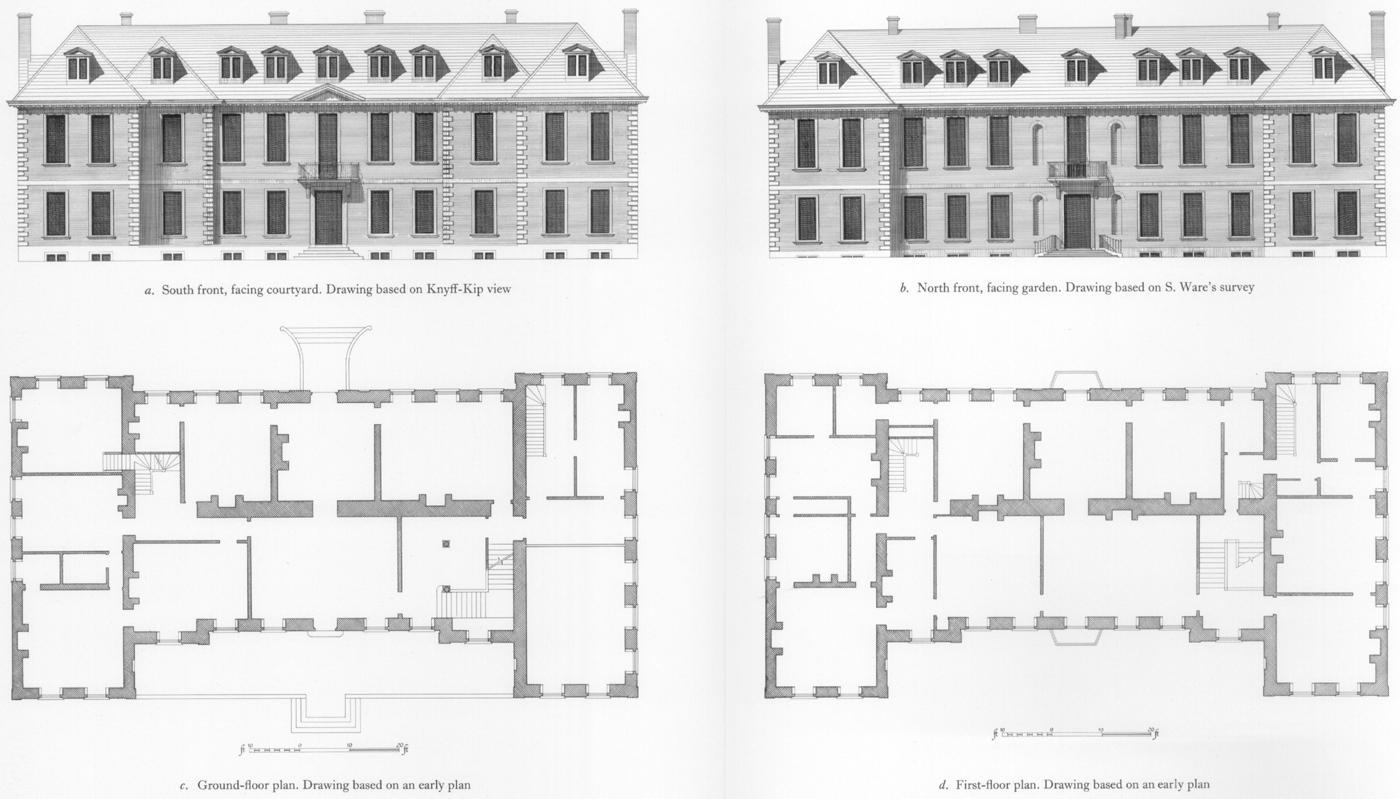
Although much of the carcase of the original house survives in the fabric of the present Burlington House, it has been entirely encased with later work. Fortunately, four early plans in the possession of the Royal Academy show the original arrangement of the interior (Plates 40, 41), and the external appearance is recorded in Samuel Ware's survey drawings (also in the possession of the Royal Academy) of the north front (not altered until 1816–17) (Plate 42b) and by J. Kip's engraving (probably made c. 1698–9, soon after the second Earl's succession) of L. Knyff's bird'seye view from the south (fn. 5) (Plate 42a). There is, however, no available graphic evidence bearing on the interior decoration.
Burlington House, as completed for the first Earl of Burlington (c. 1668)

Burlington House, as remodelled for the third Earl of Burlington by James Gibbs and Colin Campbell
The Knyff-Kip engraving gives a comprehensive picture of the entire layout, showing the house with its forecourt and attendant buildings in the foreground, and the garden stretching away to the north over the Ten Acre Close, later to be built over. The extension of the garden beyond the present line of Burlington Gardens is perhaps an anticipation of an impending but short-lived enterprise of the second Earl's. (fn. 53) The buildings are shown symmetrically grouped about the northsouth axis, but this did not lie centrally between the east and west boundaries of the site, being thirty feet nearer the east side. This peculiarity was turned to an advantage when the Burlington Arcade was built against the west boundary in 1818. Fronting to Piccadilly was a high screenwall evidently set back some 20 feet or so from the southern boundary of the Burlington property (fn. 54) to allow passage by foot along Piccadilly. The foot-path, which thus corresponded approximately in width to the present pavement, was separated from the roadway by an evenly planted row of trees and wooden posts and rails. The screen wall was of plain brickwork, buttressed at regular intervals and broken near the centre by a carriage gateway, the iron gates hung on massive stone piers, square in plan, with panelled shafts, cornice cappings and ball-finials. From the gateway a wide paved path extended north across the gravelled forecourt, to join the steps rising to the terrace in front of the mansion. On the west side of the forecourt was an office block, balanced by stables on the east, each building consisting of a single storey and a roof garret.
The office block was a deep oblong in plan whereas the stables comprised three shallow ranges grouped round a yard, open on the east. The elevations matched, each having four evenly spaced windows on either side of a central doorway in a brick front of simple design, finished with a modillioned eaves-cornice of wood. These attendant buildings were linked to the mansion by straight screen-walls, and to the Piccadilly front wall by concave quadrant walls, these last probably suggesting the form of the later colonnade. North and west of the office block were walled kitchen gardens, with a range of outhouses built against the west boundary wall. South of the stables was a yard, and to the north was another kitchen garden.
The large garden behind the great house is shown in the Knyff-Kip engraving laid out in a simple formal style. Three wide gravel walks extended northwards—one from the doorway in the middle of the house, and one near to each boundary wall. These walks were linked by cross walks, dividing the south part of the garden into four equal rectangular lawns, each furnished with a central statue on a pedestal. The layout of the north part of the ground may have been only a projected development at the time of the engraving. It is shown set out as a tree-lined flower garden, further divided into triangular plots by diagonal paths, each one bordered by high cut hedges, or enclosed by 'green tunnels', like those round the sunk garden at Kensington Palace. Espaliered fruit trees are shown planted against all the garden walls.
The mansion was planned in the form of a double pile, some 80 feet wide and 50 feet deep, fronting north and south and flanked by transverse wings, each a single pile of some 24 feet by 75 feet, projecting 3 feet from the north front and some 13 feet from the south, where the raised terrace extended between them. The principal rooms were contained in two storeys, the first being 12 feet high and raised about 4 feet above ground level by the semi-basement, the second being 15 feet high and surmounted by a garret storey in the hipped roof. The four early plans (Drawings between pages 394–5 and Plates 40, 41) show the arrangement of the 'Ground Storey' (semi-basement), 'First Story' (ground floor), 'Second Story' (first floor), and the 'Garrat Story'. A very substantial wall separated the two ranges of the central double pile, and there were thin brick walls between the rooms in the north range. It would appear, however, that the south range was divided by framed partitions, as were the east and west wings.
The marked contrast between the balanced form of the exterior and the apparently haphazard asymmetry of the internal planning suggests that the house was finished to suit the special requirements of the Earl of Burlington, and not to the original plan of 1665. It is worth noting that the entrance hall, occupying the three middle bays of the south front, led to a square ante-room in the middle of the north front. This ante-room and a corresponding room above were bounded by brick walls, and each had only one source of daylight—a glazed door downstairs and a window upstairs—poor provision for living-rooms. It seems reasonable to assume, therefore, that this square space, rather than the odd-shaped compartment to the east of the entrance hall, may have been intended for the great staircase. About two-thirds of the east wing was taken up by the chapel, which appears to have had its floor at basement level and a private gallery at the north end, reached from the main staircase compartment.
The exterior, presumably of good red brick simply dressed with stone and wood, seems to have been markedly similar to Field Place, near Horsham in Sussex, and to have had the quiet virtues of many other Restoration houses such as Groombridge Place, near Tunbridge Wells in Kent. The Knyff-Kip engraving gives a reasonably clear picture of the south front, particularly if the details are interpreted through Samuel Ware's survey of the north elevation. The face of the central double pile was seven windows wide, with each end window contained in a slightly projecting bay. The south face of each wing was two windows wide and the inside return face had a recess, probably round-headed, in each storey. The architrave-faced boxes of the sash windows in both storeys were set slightly recessed in tall rectangular openings of uniform size, having moulded sills of stone, plain jambs, and gauged flat arches, both of brick. The angles of the wings, and the breaks at each end of the double pile, were quoined with long-and-short chamfered stones; there was a plain stone plinth, and a narrow bandcourse of stone separated the two storeys. A short but wide flight of stone steps, returned at each end, rose to the paved terrace extending between the wings. The Knyff-Kip view shows the central doorway dressed with a simple stone doorcase of architrave, frieze and cornice, with bracket lamps on the flanking piers and the ironrailed balcony of 1667 to the window above. The hipped roof with its row of small dormers, all furnished with paired casements and finished with triangular pediments, rose above an enriched modillioned eaves-cornice of wood, this breaking into a triangular pediment extending above the middle window and the flanking piers. There were two large chimney-stacks on the east wall, and two on the west, and several smaller shafts rose out of the roof.
The original north front was almost unaltered when Samuel Ware surveyed it, prior to heightening and refacing it in 1816–17 (Plate 42b). The details were generally similar to those of the south front, the wings were also two windows wide, but the main face between them, recessed only three feet, was unbroken. There were in each storey three evenly spaced windows on either side of the garden doorway and the large first-floor middle window, originally a casement opening on to an iron-railed balcony. The wide pier on each side of these middle openings was simply decorated with a round-headed shallow recess in each storey. It is worth noting that similar arch-headed recesses occur in these positions on the garden front of Eltham Lodge, Kent, built about 1664 by Hugh May.
No trace of the original decoration has survived within the house, but some idea of its character can be learned from the Graham-Burlington correspondence, already referred to. From this it is clear that all the ground-floor rooms on the south front, except the chapel, were 'wainscotted eight feet and a half high'. As these rooms were about twelve feet high, the upper parts of the walls were, presumably, plastered. On the north front, facing the garden, the central ante-room was 'wainscotted to the top', and the parlour on either side was 'wainscotted a yard high and cornished'—that is, furnished with an oak dado and crowning cornice, the main wall face being covered, presumably, with tapestries or other hangings. The same treatment was adopted in most of the rooms on the first floor, although in some the window wall was fully wainscoted. In the great 'dyning roome', facing south, the original wainscot dado was 'lengthened'. It is fair to assume that 'right wainscot' or oak was used for all this woodwork, with the bolectionmoulded panelling typical of the period. The presumed employment of John Grove as plasterer suggests that decorative plasterwork was a feature of at least the state rooms.
Until the second decade of the eighteenth century nothing is known of any architectural changes. The exterior of the house during its sixyear ownership by the first Earl's grandson, the second Earl, is shown in the Kip engraving of Knyff's view, described above. The second Earl died early in 1704, when still quite a young man, and was succeeded by his only son, who was not yet ten years of age.
The Third Earl's Ownership of the House
By his will made in the year of his death (fn. 55) the second Earl committed the guardianship of the young third Earl to his wife Juliana, who was thirty-two at his death and lived for another thirty-six years. (fn. 56) He requested her to be advised in the education of their son by a judiciously selected triumvirate consisting of his own uncle, the Earl of Rochester, the 'proud' sixth Duke of Somerset, and Lord Somers. Until the third Earl reached the age of twenty-one, on 25 April 1715, the Countess was to have the management of his estate; in this the second Earl recommended her to seek the 'assistance and help' of his servants, Anthony Spurrett and Richard Graham, esquire.
The celebrated transformation of the rather plain old house in palatial style during its ownership by the third Earl has an important place in the history of Palladian architecture. But the details and even the outline chronology of the work are obscure. It is clear that the alteration of the house was carried out in more than one phase, and that the earliest phase, which was probably not markedly Palladian in its inspiration, was well advanced before the Earl's first visit to Italy, from April 1714 to May 1715, and before the publication of the first volume of Colin Campbell's Vitruvius Britannicus in April of the latter year. It is possible, in fact, that the alteration of the house began under the aegis of his mentors rather than of the young Earl himself.
Before discussing the alterations of the house in any detail the probable chronology may be indicated. Decorative wall paintings by Venetian artists can be attributed with considerable probability to the period between 1709 and the summer of 1713. The main structural alterations in the plan of the house were almost certainly executed by the early months of 1715. They were perhaps the work of James Gibbs who about that time had been making substantial alterations to the house and forecourt, but was supplanted in about 1717 by Colin Campbell. The latter was responsible for the dogmatically Palladian elements of the exterior which was completed by the end of 1719 or the beginning of 1720. The dressing of the interior with a Palladian architectural character probably took place more or less contemporaneously, and chiefly at Campbell's hands. Kent executed some decorative paintings here in 1720 but it is not known how long work by him on the interior may have continued.
A probable date for the earliest element in the sequence of alterations made to the house during its ownership by the third Earl is a period around 1712 or the first half of 1713, when Burlington was eighteen or nineteen. This seems a likely time for the execution of decorative wall paintings by the Venetians, Giovanni Antonio Pellegrini and Sebastiano Ricci. The former painted the walls of the hall and the latter the walls and ceiling of the staircase and other unidentified ceilings (Plates 64, 65). The staircase was particularly admired; Vertue called it 'a noble fine work' (fn. 57) and Walpole thought it an example of Ricci's 'best manner'. (fn. 58) At the end of 1715 or beginning of 1716 Gay referred in his Trivia (fn. 6) to the decoration of the walls of Burlington House with 'animated Picture' and may be supposed to have been referring to the Venetians' work. The paintings of Pellegrini and Ricci on the hall and staircase were certainly in existence by August 1717 when Thornhill in his memorial to the commissioners for building Greenwich Hospital (fn. 59) cited Burlington's payment of £200 to Pellegrini and £700 to Ricci for their work here. Pellegrini had come to England probably late in 1708 (fn. 60) but in July 1713 had left for Düsseldorf (fn. 61) and did not return until 1719. (fn. 62) His paintings were probably not frescoes but, like Ricci's, on canvas, and could therefore have been put into position some time after their execution, which might conceivably have been carried out elsewhere; but in the absence of evidence to the contrary it may be presumed that his work was performed before his departure in 1713. Ricci was in England from 1711 or 1712 until December 1716 at latest, when he was in Paris. (fn. 63) The evidence of structural alterations made to the staircase by the early months of 1715 suggests that Ricci's paintings had probably been executed by that time. Burlington's absence abroad from May 1714 to April 1715 further suggests that Ricci's work may not have been executed much, if at all, after the latest likely date of Pellegrini's. (fn. 66)
The possibility must, however, be mentioned that Pellegrini's, and perhaps Ricci's, work dated from a period even nearer their arrival in England, c. 1708–9 and 1711–12 respectively. In the Royal Academy collection are some small, very rough sketches of parts of the house by the antiquary John Carter (1748–1817). One of these shows the main street gateway. Placed above this drawing is an apparent transcription of an incised or inscribed date '1709/1717', and also the words 'Date of building. Burlington House.' Other representations of the gate seem to show that the double date was not in fact to be seen in the position Carter appears to suggest and it is uncertain what authority lies behind his note. The later of the two dates does not in fact represent the conclusion of the work of reshaping the house (being earlier than the date of the design of the gateway itself), but the earlier date, when Burlington was about fifteen, could be related to the commencement of work in London by Pellegrini.
In view of this possibility the identity of the Richard Graham who was one of the advisers to the third Earl's mother is of some interest. There seems no doubt that he was son of the Richard Graham who was agent to the first Earl, and he was himself later to play an active part as the third Earl's secretary in the financial and legal transactions arising from the rebuilding of the house and the development of the leasehold estate. It is perhaps relevant to the early embellishment of the house that he can be identified with the Richard Graham who in 1697 was Steward of the Society of Virtuosi of St. Luke. He signed the minutes of that club of dilettanti for many years afterwards and according to Vertue possessed 'memoirs or papers' relating to its foundation. He died in November 1741. (fn. 65) (fn. 7) He can also with virtual certainty be identified with the Richard Graham whose Short Account of the most Eminent Painters, both Ancient and Modern was appended to Dryden's translation of Du Fresnoy's Art of Painting published in 1695. The second edition of 1716 contains an Epistle Dedicatory addressed by Graham to the third Earl of Burlington, which speaks of 'a continued Series of undeserv'd Favours, which by Inheritance have descended to me from Your NOBLE HOUSE. They bear Date from the earliest Years of my Father's Life: and YOUR LORDSHIP is now in the Fourth Generation of our Patrons and Benefactors'. This seems clearly to refer to the employment of the Richard Graham, whose letters have been quoted earlier, by the first Earl, Burlington's great-grandfather.
In view of the second Richard Graham's interest in art it may well be that he had some responsibility for the adornment of Burlington House with decorative paintings and perhaps encouraged the young Earl's interest in painting, which seems to have antedated his serious interest in architecture.
The existence, probably by about 1713, of the Venetians' wall paintings would not in itself imply a scheme of general interior redecoration or reconstruction and there is, as will be seen later, reason to think that the work on the interior of the house about 1719–20 required alterations to the staircase as painted by Ricci. It seems, however, that there were structural as well as decorative interior alterations before 1715. For the plan included in the first volume of Colin Campbell's Vitruvius Britannicus, published in April of that year, strongly suggests that the major structural alteration of the interior was by then well advanced. This plan, like the elevation in the same volume, shows the outer form of the original building only very slightly changed, but differs in several ways from the early manuscript plans already noticed, particularly where the hall and great staircase are concerned. Furthermore, a comparison of the plan in the first volume of Vitruvius Britannicus with that in the third volume of 1725, made after Campbell had himself refaced the south front, reveals only minor additional changes in the internal planning, such as the insertion of a new window in the west wall and the removal of a wall between the two east rooms on the north front. It is worth noting that the elevation of the original building given in Campbell's first volume does differ slightly from the Knyff-Kip view: it shows the entrance doorcase finished with a segmental pediment, and the window above without the balcony of 1667. There is thus evidence of some alteration of the house by 1715, chiefly inside, involving substantial work. Graham's Epistle Dedicatory of 1716 (fn. 66) also suggests that some architectural as well as merely decorative work had by then been executed under Burlington's aegis. It lists 'Painting, Sculpture, Architecture, Music, etc.' as the arts which might be found 'in their utmost Perfection' at Burlington House.
It may be remarked here that the ratebook entries for 1710, 1714, 1716–18 and 1720 onwards give no indication that the house was unoccupied, (fn. 67) and it is known that the family continued to occupy the house during its Palladian refronting in 1719. (fn. 68) No ratebook entries exist, however, for this area for the years 1708–9, 1711–13 or 1715 (nor for 1719) and it may therefore be that any reconstruction which required the house to be vacated was prior to 1714.
The architectural changes made down to about 1716 were probably the work of James Gibbs. That he was employed at the house is known from the manuscript memoir of him in Sir John Soane's Museum. This does not indicate the period, but it should be noted that in 1714 a 'James Gibbs' was rated for a house in a street then called 'Burlington Street', behind Burlington House. He had not been there in 1710 and was gone in 1716. (fn. 69) In April of the latter year the Jacobite Duke of Mar wrote from Avignon to Gibbs, supposing that he had 'work enough upon your hands in Piccadilly' (fn. 70), which is presumably a reference to his employment at Burlington House, although in the circumstances the Duke's information could have been a little out of date.
As to the extent of Gibbs's work there is considerable conflict of evidence. The Soane Museum memoir states that 'the Earl of Burlington had him to build and adorne his house and offices in piccadilly, they are all biult wt solid portland stone, as is likewise the fine circular colonad fronting the house, of the Dorick Order'. (fn. 71) This all-embracing claim is, of course, partly discounted by Colin Campbell's more detailed statement in volume three of Vitruvius Britannicus, where he wrote that 'the Stables were built by another Architect before I had the Honour of being called to his Lordship's Service, which obliged me to make the Offices opposite, conformable to them: The Front of the House, the Conjunction from thence to the Offices, the great Gate and Street-Wall, were all designed and executed by me'.
It will be noticed that the Soane Museum memoir tells less of the house than of the 'fine circular colonad', this feature receiving only a bare mention from Campbell. Had it been the latter's work, he would surely have included an engraving and a description of his 'invention'. By the same reasoning, and having in mind his plate and laudatory description of the Casina at Chiswick, it seems certain that Campbell would have illustrated the colonnade, and described it with fulsome praise, if Burlington had designed it. Assuming that neither Campbell nor Burlington was responsible, it would seem that Gibbs is the most likely candidate for the honour of having designed that greatly admired feature. The suppression of Gibbs's name in the Vitruvius Britannicus account of Burlington House might well have been an insult added to the injury done to him when his place as Burlington's architect was taken by Campbell.
Whether or not Gibbs was the designer, it is clear that the colonnade must have been built about the same time as the stables, if not earlier. For it is hard to find a good reason why Burlington should not have rebuilt the office block to match with the new stables before proceeding to erect the colonnade, a decorative feature which could only make its full effect when linked with buildings that were matching elements in the general composition. In any case, the new stables and the colonnade were elements that had to be incorporated in any scheme proposed by Campbell, when he came on the scene, for he states that he designed the new offices to conform with the existing stables, and made the great gate to Piccadilly 'agreeable to the Colonnade in the Court'. Before leaving the subject of Gibbs's connexion with Burlington House and the extent of his work there, it should be noted that Burlington probably intended from the commencement of the exterior work to mask the homely brick of the old house with an imposing façade of stone, otherwise he would not have sanctioned the use of stone for the new stables. It is feasible to assume, therefore, that Gibbs (or whoever Campbell's immediate predecessor was) provided designs for transforming the whole group of buildings, and that the stables, colonnade, and some changes within the house were all that were finished when Burlington turned against the 'modern Italian' style exemplified by Gibbs (a disciple of the 'affected and licentious' Fontana) and transferred his patronage to Campbell.
That it was in 1716 or 1717 when this occurred seems clearly indicated by the dating in the latter year of Campbell's design for the front of the house and in 1718 of his design for the great gate, both published in the third (1725) volume of Vitruvius Britannicus (fn. 8) (Drawing between pages 394–5 and fig. 75). As late as September 1719 Burlington's agents were making payments for the measurement of bricklayer's and mason's work 'as by a Bill of Particulars signed by Mr. Gibbs'. (fn. 72) It may be that some elements of Gibbs's design were still being completed, or that, as is known to have been the case with some of Burlington's debts, payment had been much delayed.
Apart from the Vitruvius Britannicus plates, Campbell's work on the house is not well documented. Burlington had been in France in September 1717, (fn. 73) and went to Italy for a second, shorter visit in August 1719, (fn. 74) to study Palladio's buildings at first hand: it seems that mason's work on the new front had then hardly begun, (fn. 75) and he empowered his agents to make contracts with building tradesmen. (fn. 76) It is possible that the period which apparently elapsed between the preparation of Campbell's designs and the commencement of the exterior work was taken up by the initiation of a second stage in the alteration of the interior, modifying towards a dogmatic Palladianism the work done during the period of employment of Gibbs and the Venetians. It is probable, however, that the delay was partly caused by a lack of funds, the reason (it may be supposed) why Burlington never altered the back of the house at all. By the summer of 1717 Burlington's debts required far-reaching measures for their discharge and it was probably some time before he could venture on further commitments. As is mentioned elsewhere, the mortgaging of property in Ireland, and of the ground behind Burlington House itself which began to be developed residentially in 1718, would have brought some immediate increase in Burlington's capital resources. Campbell's association with the latter development would itself have absorbed some of his attention in 1718.
On 17 September 1719 Burlington's agents, his secretary Richard Graham and his lawyer Jabez Collier, wrote to him in Italy about the house: 'In obedience to your Commands, we have been very punctual with your Mason, in making a Payment to him of 534 17. 6. for the Rustic Basement. And that nothing may be wanting on his side, He resolves, that both the VenetianWindows (as well as ye Marble, as Portland-Stone) shall be sett, by the latter end of the next week'. (fn. 75) On 22 October they were able to report the advance of the mason's work towards completion: 'The Masons have sett the Capitalls of all the Columns and pilasters, brought upp the Wall upon a Levell and are preparing to sett the Entablature. They have now made their 2d Measurement which will come to near 1000 ll. and wee are Ready to pay them accordingly to our Contract'. (fn. 68) An account book of Graham and Collier for the period July 1719 to July 1722, preserved, like their two letters, at Chatsworth, gives the names of the masons, 'Messrs. Fletcher and Cass', (fn. 77) that is, Joshua Fletcher and Christopher Cass. The payment of the £534 17s. 6d., to Fletcher alone, is recorded on 21 August, and of £991 to the two masons, for their '2d Measurement' on 24 October. On the same day they were paid £109 'in part of a former Bill', for unspecified work. The last payment for the front of the house was on 12 December to Fletcher, 'in full for finishing the Front of Burlington house and a Day Bill', and was for £763 9s. This sum included payment for work 'not in their contract' and the masons undertook to make an adjustment if it was judged overcharged. Other payments were made about this time to Fletcher and Cass (including two sums of £800, in June 1719 and May 1720) and Fletcher alone was paid other sums, but these may have been for work at Chiswick where a bricklayer, carpenter, joiner, plumber and glazier were being paid at that time. (fn. 78)
The second letter from Graham and Collier, in October, records also the progress of other work: 'The Carpenter has done his parte in raising the Roof upon which the plumber is at worke and the Bricklayer is carrying on the Front wall in the streete before the little stable'. (fn. 68) The identity of these workmen cannot be established certainly, although the plumber was probably John Fincher who was paid for work at the house in March 1719/20. (fn. 78) But few of the other payments to building tradesmen recorded in the account book are said to be for work there; some are said to be for work at Chiswick, and most are unspecified. Of these unspecified payments the largest were to Thomas Churchill, bricklayer, and to John Simmons, joiner, each amounting to some £1900. Part at least of Simmons's work is known to have been at Chiswick, where Burlington's agents and Campbell examined faulty work by him, ending the day with dinner at the 'Pack Horse'. In addition to these payments the workmen were evidently owed other sums, including £750 owed to Fletcher and Cass, £1000 to Churchill and £300 to Simmons, which were charged on Burlington's estate, under provisions described on pages 446–7.
The names of the workmen mentioned in the account book may be noted, although of most it is not known whether they worked at Burlington House or elsewhere. (fn. 9) Of the twenty-four workmen, only two can be associated with the Office of Works; Churchill, who became Master Bricklayer in 1725, and James Richards, who became Master Sculptor and Carver in 1721.
Burlington was back in England before the end of 1719 (fn. 76) and must have found the new front almost completed. He had brought back William Kent with him, to lodge in the house, and in January 1719/20 Kent was confiding to his old patron, Burrell Massingberd, that 'I don't now were I am when I am once out of the gates of Lord Burlingtons house were I think you may see a true Palladian front'. (fn. 79) By February a glazier, John Kent, was being paid for work at the house and in the following month Mr. Gumley, doubtless the noted glazier and cabinet-maker John Gumley, was paid £76 'for Looking-Glass-Plates for Burlington House windows'. The completion of heavy builder's work is perhaps indicated by the payment in May 1720 of a first instalment of the paviour's bill for the 'new pavement' before the house. (fn. 80) An early published comment on the exterior was Macky's in 1722, when he remarked on its 'fine Appearance of Free-stone'. (fn. 81)
The period occupied by the Palladianizing of the interior is not known precisely. It may have preceded the work on the exterior, although payments totalling a few hundred pounds were made to a carver and plasterers in 1719–20, either for Chiswick or Burlington House. When Kent took up lodgings in the house at the end of 1719 (fn. 82) there was scope for decorative painting to be executed by him, in what Walpole was to call his 'worst' manner. (fn. 58) Writing in January 1720 Kent told Burrell Massingberd of his design for the saloon: 'I have made a skecth in Collers for the great roome in the front, and all the rest of the ornements yt are to be al Italiano'. (fn. 79) In February he was 'hard at work' and in June reported that he was 'at present upon ye greatest works in England', including that at Lord Burlington's. (fn. 83)
Another painter, 'Monsr Devoto', was paid fifteen guineas in February 1720/21 'for Painting the ornaments in ye Ceiling painted by Signor Rizzi'; (fn. 84) how long before this date the work had been executed is not known (fn. 10) but it may well have consisted of re-paintings consequent upon Colin Campbell's alteration of the staircase postulated on page 410. By the summer of 1722 the payments to building tradesmen were considerably decreased in volume and frequency. One aspect at least of the Palladianizing of the interior was then presumably complete, as in that year the hall was taken by Leoni as a model for the hall at Queensberry House.
How far the architectural alterations of the interior were Campbell's work there is no positive documentary evidence to show, although, as will be seen, the first-floor saloon seems stylistically to be his work. The letter of Burlington's agents in September 1719 had conveyed a message of complaint against that architect. A bill for Burlington House had been in dispute, and they reported: 'We have settled the Carpenters Bill by an Arbitration: and in the presence of Mr. Campbell, got 18.6.10. even of his last Bill abated. If that Gentleman wou'd have spar'd us but one single word, on your Lordships behalf, to an Article in dispute betwixt us, We shou'd have sunk it yet lower. But however, as it is, We have struck off 80.7.4 from his first Bill; which Mr. Campbell had given under his hand, was a very just, and a reasonable one.' (fn. 85) Whether this indicates the existence of a source of friction which became exacerbated is not known but the relations between Burlington and Campbell became less evidently active in the 1720's. Kent illustrates a chimneypiece and wall-composition of his own design in The Designs of Inigo Jones published in 1727 (Plate 67a), and it may be that he modified the interior architecturally during his long residence in the house. But no architectural features clearly attributable to him survive.
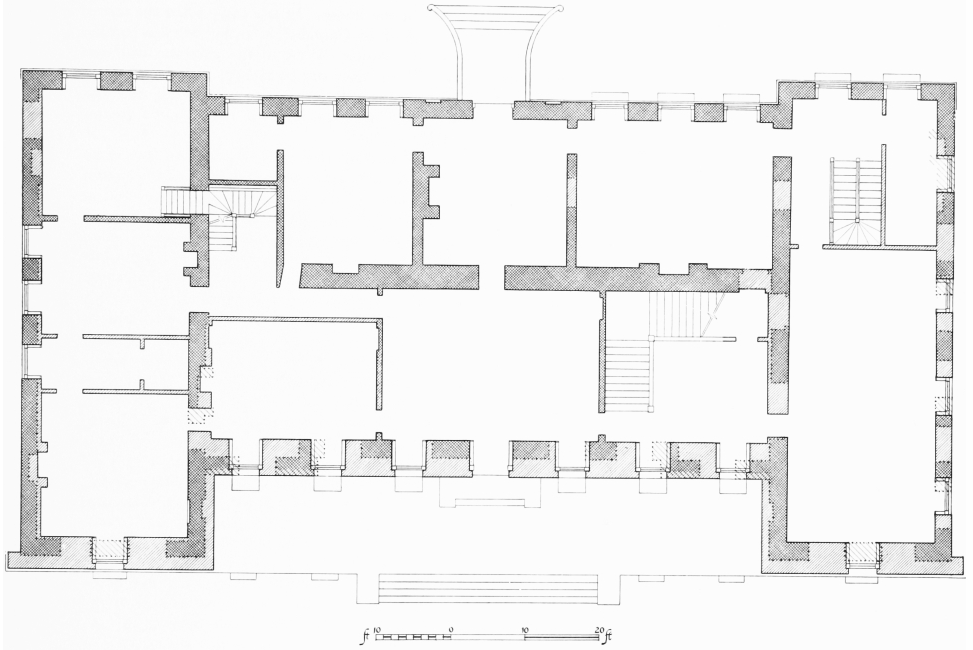
Burlington House, ground-floor plan. Cross hatching represents work of 1665–8: single line hatching represents work of c. 1713–20. Redrawn from a plan in the possession of the Royal Academy and from the engraving in Vitruvius Britannicus, vol. III, 1725
With respect to the inspiration of Burlington's reshaping of the house it is to be noted that the first alterations seem clearly to have preceded his first visit to Italy. More significantly, the subsequent development towards a dogmatically Palladian ideal preceded his second visit in 1719 when he first made a direct study of Palladian buildings. It seems indubitable that the impulse to Palladianism came from the first volumes of Campbell's Vitruvius Britannicus and Leoni's Palladio, published in 1715 and 1716 respectively, and that the immediate inspiration of the reshaping came from the former. The Campbell design chosen by Burlington for his purpose was not, indeed, itself wholly of direct Palladian inspiration. For while most commentators have expressed the opinion, apparently based on no evidence apart from the design, that Campbell was instructed by Burlington to model the south front of the house on Palladio's design for the Palazzo Porto (Iseppo de' Porti), in Vicenza, a careful comparison of the two buildings will suffice to reveal merely a superficial general resemblance and many differences of detail between them. There is, however, a close correspondence between the Burlington House front and Campbell's unused 'New Design for the Earl of Islay' dated 1715 and published as plate 54 in the first volume of Vitruvius Britannicus. Of course, it can be argued that the 'Islay' design was also based on the Palazzo Porto, but analysis shows it to be combined of elements directly copied from some of Inigo Jones's buildings, which Campbell had studied and drawn for inclusion in his first volume. Thus, the Burlington House design derives its rustic basement, or ground storey, from the Queen's House, Greenwich, (fn. 86) and the Ionic colonnaded principal storey, like that of the 'Islay' design, is taken from the first storey of the Banqueting House, Whitehall, (fn. 87) without the rusticated wall face and with window surrounds modelled on those of the Great Gallery at Somerset House. (fn. 88) That Campbell wished to emulate Jones, even more than Palladio, is made evident by his expressed opinion of the Banqueting House, of which he wrote that 'It is, without Dispute, the first Structure in the World'. (fn. 89)
No documentary evidence has come to light to show how Campbell came to be employed at Burlington House, but it seems fair to assume that Burlington, in his newly aroused enthusiasm for Jones and Palladio, may well have turned for ideas to the Vitruvius Britannicus plates. He would have admired the 'Islay' design as an essay in the manner of Jones and, seeing in it a solution of his own problem, commissioned the author to adapt it for the Burlington House front.
Architectural Description of the Exterior, c. 1720
The Knyff-Kip view of the original house already referred to probably errs in showing the Piccadilly screen-wall parallel with the south front of the house. In any case, when the screen was rebuilt by Campbell only the gate was parallel with the house. West of the gate the wall ran parallel with the site boundary, inclining slightly inwards towards the north-west, while the east part of the wall was inclined forwards at a greater angle.
In front of the wall Burlington evidently renewed the wooden posts and rails and the row of trees shown in the Knyff-Kip engraving, and at each extremity of the street front set posts and rails so placed as to prevent the passage of sedan chairs. In about 1737 the posts and rails along the roadway were replaced by stone posts but those across the footway were not renewed. (fn. 54)
The awkward alignment of the wall and its junction with the gate were blemishes often remarked upon. It also did the disservice of concealing totally from public view the house, forecourt and colonnade. In elevation, however, Campbell's wall was well designed and properly related to the noble gateway. It was some twentyeight feet high and built of brick, stone being used for the plinth and plain capping of the pedestal, for the architrave and cornice of the entablature, and for the blocks coursing the shafts of the brick pilaster-buttresses. These were spaced at fifteenfeet centres, dividing the east wall into seven bays and the west into eight. A large rusticated archway occupied the fifth bay on either side of the central gateway, the east arch opening to the stable court and the west to the kitchen court. Above each pilaster-buttress was placed a stone ball-finial.
Campbell's 'great Gate' (Plates 43, 45, fig.75) was designed in the style of a triumphal arch, with a strong reminiscence of the York House Water Gate, then greatly admired as a presumed work of Jones (fn. 11). It was faced with stone and the forecourt and street elevations were similar in design, each being a composition of three bays, wide between narrow, divided by engaged three-quarter columns raised on pedestals. The order was the rich but plain-shafted Doric already employed for the colonnade, but Campbell rusticated his columns by encircling each shaft with two deep bands of icicle-work. In the wide middle bay was a large archway formed of chamfer-jointed masonry, with the jambs rising from pedestals and the voussoirs from a Tuscan architrave-impost, the great keystone being carved with icicle-work. The pedestal and architrave-impost were carried across each side bay, where the chamfer-jointed masonry framed a plain niche below the impost and a rectangular panel above. On the forecourt face the side bays were narrower than those on the street face, and the niches and panels were replaced by windows lighting the porters' lodges. The crowning entablature was broken forward above each column, and, to match with the colonnade entablature, the triglyphs were interspaced with metopes variously carved with emblems, with circles containing the monogram R B and with the Burlington crest—a lion's head above an earl's coronet. Over the middle bay was an attic pedestal, with an oblong panel sunk in the die. The attic cornice framed a triangular pediment, crowned by three acroterial pedestals and containing in its tympanum a richly carved armorial cartouche between swagged garlands. Flanking the attic were scrolled consoles, extending across the side bays, each with an upper scroll terminating in a grotesque mask on the street front, and a female head on the forecourt front. Above each end column on the street front rose a carving of a heraldic beast holding a Baroque shield. Campbell's engraved design was slightly varied in the execution—the niche keystones were not rusticated as shown; the attic consoles were elaborated and their scrolls were reversed; the cartouche in the pediment was reduced in size and the three acroterial vases were omitted.

Burlington House, gateway. From the engraving in Vitruvius Britannicus, vol. III, 1725
The inside face of Campbell's gate provided a powerful link between the returns of the colonnade's twin segments, which formed a hemicycle embracing the south end of the forecourt (Frontispiece, Drawings between pages 394–5 and Plates 45, 47). Each segment was less than a quadrant and they were struck from two radial points, some 18 feet apart on the east-west axis. The columns were set out on a radius of about 68 feet, and the enclosing wall followed an inside radius of 72 feet 6 inches. Each segment was divided into eight equal bays by single columns, ending with pairs, the corner shafts being a slightly contorted square in plan. The return faces towards the gate consisted each of an open bay and a narrow bay closed with a rusticated face matching that of the gate.
Steps, bounded by projecting pedestals, rose from the irregularly inclined surface of the court to the level pavement of the colonnade. The order employed was a Renaissance Doric (near to Palladio) and the intercolumniation was diastyle, the columns having a diameter of 2 feet with an overall height of 17 feet 1½ inches, including the plain square plinths. The columns had plain shafts composed of three drums, their necks were ornamented with roses and husks, but the capitals were not enriched. The entablature, with its metopes of emblems, crests and monograms, was surmounted by an open balustrade with plain dies over the columns. The wall behind the colonnade was divided into bays, each containing a plain niche, by pilasters responding to the columns, and the ceiling, a plain flattened cove, rose from a continuous architrave. At the north end of each segment was a slightly recessed bay, straight and of araeostyle intercolumniation, giving access to the side court and linking the colonnade with the stables on the east side, and the offices on the west.
The buildings flanking the forecourt (Drawing between pages 394 and 395 and Plate 47) were identical in size and elevation, each being 82 feet in length, 46 feet in depth, and two storeys high. Gibbs's stable block on the east contained two long rooms in its ground storey, both originally fitted with stalls, and living quarters in the second storey. Campbell's office block on the west contained the kitchen (Plate 53b), sculleries, laundry and accommodation for servants. Chamfer-jointed straight quoins bounded each front, which was divided into three faces, all three windows wide. Each end face was of plain ashlar, but that in the middle was coursed with chamfer-joints corresponding with the quoins. The windows of both storeys were similar in size, with sashes recessed in openings framed by moulded architraves, those of the ground storey rising from a plain pedestal, and those of the first floor resting on individual sills, there being no storey-band. The dominating feature was the central doorway, its rusticated arch being flanked by Doric columns with entablature-blocks supporting an open triangular pediment into which rose the large keystone of the arch, carved with a grotesque animal-mask. The front was finished with a simply moulded cornice and a parapet, treated as a pedestal and divided by projections into sections, each with a panelled die.
The re-entrant angle-links with the mansion were originally designed by Campbell, whose plan (Plate 44) suggests that they took the form of arcaded loggias, with three bays facing east or west. There is, however no other evidence to suggest that they were built in this form, and all representations show the links as screen-walls, of equal height with the ground storey of the house. Each had a wide central opening framed by a rustic-blocked flat architrave, and on either side a narrow opening with tapered jambs, framed by a moulded architrave and finished with a plain frieze and cornice (Drawing between pages 394–5). Chambers, in his Civil Architecture, expressed surprise that Burlington should have introduced 'these ill-formed Doors in the Cortile of Burlington-House'. (fn. 90)
The origins of Campbell's design for refronting the house itself having already been discussed, it seems best to begin the description of his work by quoting the note relating to the engraving in the third volume of Vitruvius Britannicus:
'In the double Plate you have the principal Front, where a bold rustick Basement supports a regular Ionick Colonade of ¾ Columns two Feet Diameter. The Line is closed with two Towers, adorned with two Venetian Windows in Front, and two Niches in Flank, fronting each other; where the noble Patron has prepared the Statues of Palladio and Jones, in Honour to an Art of which he is the Support and Ornament.' (fn. 91)
It remains to add the following details, augmenting Campbell's description of the front as originally completed (Drawings between pages 394–5 and Plates 43, 46, 49a).
A plain plinth, rising to the terrace level, underlines the basement or ground-storey wall face, which is composed of eleven courses, each 1 foot 2½ inches high, of chamfer-jointed stones with an average length of some 2 feet 4½ inches. Originally, there were three continued courses below all the window-openings, and two above, the latter being broken over each opening by a projecting plain keystone flanked by single voussoirs. The sashed windows and centrally placed door are deeply recessed in plain openings with narrow margins against which the chamfered arrises of the rustic face are stopped.
A projecting bandcourse forms the finish of the ground storey and serves as a plinth for the Ionic order of the principal storey. Three-quarter columns are employed to divide the central face into seven equal bays, and pilasters divide each wing, or tower, into three bays—wide between narrow. The columns and pilasters, which have plain shafts and diagonally-voluted capitals, support an entablature composed of an enriched architrave, a plain pulvino-frieze, and an enriched modillioned cornice. The wall face of the principal storey is of plain ashlar, but between the columns and pilasters extends a simple pedestal, broken forward below the window in each of the seven intercolumniations of the central face. Here, as in the Banqueting House, the pedestals of the middle three windows are balustraded, the others being plain, and every opening is dressed with an enriched architrave, lugged at the feet, and a plain pulvino-frieze flanked by scroll-consoles which support a pediment, the triangular form being used alternately with the segmental. In each wing the narrow bays are plain, but the wide middle bay contains an Ionic Venetian window with a balustrade beneath the middle light. (fn. 12) The narrow side-lights, originally blind, are finished with entablatures resting on plain-shafted pilasters and supporting the moulded and enriched archivolt of the arched middle light. The single bay of each return face contains a pedimented tabernacle, matching the middle windows and enclosing a plain niche. The front was originally finished with a balustrade which Campbell intended to deck with urns and statues to provide a lively skyline for the heightened south range, which had been finished with a leaded flat roof.
As an architectural ensemble, the court-yard of Burlington House was less than satisfactory (Drawing between pages 394–5 and Plate 43). The elements in its composition were too disparate in character, betraying the accretive nature of the grouped buildings, and the different tastes of the architects employed. There could have been little fault to find with Campbell's great gate, or with the twin segments of the Doric colonnade, but their conjunction with the wing buildings was at once weak and abrupt. Gibbs's stable wing and Campbell's matching offices were astylar buildings, long and low, but the rustic quoins and central features implied a giant order, rising for two storeys between the pedestal and the crowning cornice. One senses that Gibbs would have used a giant order for the front of the house, but Campbell returned to the scale of the Doric colonnade in the Ionic order with which he dressed the piano nobile, raised above a rusticated ground storey of modest height. As a result, his front was too low and too horizontal in emphasis to dominate the group.
The court-yard seen through the proportioned panes of the mansion could nevertheless fire the enthusiasm of a fastidious critic. To this Horace Walpole's considered and often quoted words will testify. 'As we have few samples of architecture more antique and imposing than that colonnade, I cannot help mentioning the effect it had on myself. I had not only never seen it, but had never heard of it, at least with any attention, when soon after my return from Italy, I was invited to a ball at Burlington-house. As I passed under the gate by night, it could not strike me. At day-break looking out of the window to see the sun rise, I was surprised with the vision of the colonade that fronted me. It seemed one of those edifices in fairy-tales that are raised by genii in a night's time.' (fn. 92) Walpole's words also show how effectively Burlington's notorious street-wall concealed even the exterior from both the general public and the informed amateur of the arts. Chambers similarly remarked how little known was a building he considered 'one of the finest pieces of architecture in Europe'. (fn. 93)
In Vitruvius Britannicus Campbell says nothing of the interior of the house, which has been greatly altered since Burlington's time. The three first-floor rooms in the middle of the south front are the most important survivals of the work of this period. The east room was formed in 1816– 1817 out of the upper stage of the great staircase, which may have been designed by Gibbs, but the central saloon and the adjoining west room are by Campbell or Kent, probably the former. (fn. 13) The plans of 1715 and 1725 suggest that Burlington also remodelled the entrance hall and the west rooms on the north front, and altered the chapel in the east wing by raising its floor to ground-storey level, and presumably heightening it by including the second storey. This could account for the fact, commented on by Phené Spiers, (fn. 94) that until 1816–17 there was no door opening on the east side of the great staircase landing.
Later History to 1815
There is no record of any alterations by the third Earl after the completion of this major reconstruction. In 1733 he resigned his offices under the Crown and went into opposition. His friend Sir Thomas Robinson reported at that time that he had 'quite quitted' London for Chiswick, whither he had sent all his pictures and where he was making great additions. (fn. 95) He certainly did not give up Burlington House but it may be that with the completion of his riverside villa and the renewed intensification of financial difficulties which he seems to have experienced in the late 1730's there was some loss of active interest in the London residence. As has been noted, Burlington never brought the back of the house into harmony with his Palladian tastes.
It was perhaps with reference to Burlington House rather than to Chiswick that Kent reported to Burlington in September 1745 that 'the gravil walks are all layd down in ye Garden'. (fn. 96)
When Burlington died in 1753, aged 59, his property passed to his widow and then, on her death in 1758, to their grandson William Cavendish, Marquis of Hartington, (fn. 97) the son of their daughter Charlotte by the fourth Duke of Devonshire, whom he succeeded as fifth Duke in 1764. At the time of Lady Burlington's death the Marquis was only ten years of age, but from that time his name appears as ratepayer for the house until 1771. As the Cavendishes' London residence was at Devonshire House, nearby in Piccadilly, they would have had no permanent use for Burlington House. In 1766 John Gwynn suggested that the site of the house should be 'laid out into elegant streets'. He admitted that 'the demolition of Burlington-House may be thought an extraordinary proposition', (fn. 98) but in 1770 the Duke of Devonshire's architect, James Paine, was asked to value the site and report upon the advantages of selling it or letting it on building leases. (fn. 99) It is not known what Paine advised, but in the following years there were plans for building over the garden. (fn. 100) In the latter part of 1771, however, the Duke of Devonshire's name is replaced in the ratebooks by that of his brother-inlaw, the third Duke of Portland, who in 1766 had married Devonshire's sister and Burlington's grand-daughter Dorothy. (fn. 14) Portland remained there as Devonshire's tenant until early in 1782 when he gave it up to another brother-in-law, Lord George Cavendish, Devonshire's younger brother, who in later life was to purchase and make important alterations to the house. (fn. 101) Wheatley and Turberville (fn. 102) imply that Portland lived there during his premiership in 1783, but Lord George Cavendish continued to pay the rates in the years 1783–5. In the course of 1785 or in 1786 Portland reappears as ratepayer, and in 1787 repairs were carried out on the house, doubtless for him, which involved the use of some eight and a half tons of new lead 'to Flatt on House, at West End of Building.' In 1790 more new lead was used on a 'Reservoir' in the garden, (fn. 103) which is shown in drawings of the house and grounds made about 1816, perhaps by J. C. Nattes (fn. 104) (Plate 52b). These drawings also show quite substantial buildings of farm-house appearance in the southern part of the garden near the mansion, which may have been put up by Portland. His tenure of the house lasted over twenty years. In the summer of 1807, after becoming Prime Minister for the second time in March of that year, Portland proposed to give the house up, (fn. 105) but still occupied it in the spring of 1809. (fn. 106) During his residence here Portland may well have altered the house to his taste but no documentary evidence has come to light to show whether he did or not. In at least the later years of his occupation he paid no rent in consideration of his keeping the house in repair: in 1807 the parish wanted to increase the rating but did not do so until four years later. (fn. 107)
Portland's contemplated departure from 'the most comfortable Habitation in all London' in 1807 had been caused, at least in part, by a desire of the Duke of Devonshire to sell the house. (fn. 105) After the Duke of Portland's death in 1809, the fourth Duke of Portland continued to be rated for the house until the death of the Duke of Devonshire in 1811. (fn. 108) But during the years 1807–11 schemes were very seriously considered for the demolition of the house and the redevelopment of the site. (fn. 109) The Devonshires no doubt wanted a source of income to replace the annual rental of some £10,400 from the leasehold estate north of Burlington Gardens, which terminated in 1809. Their agent, John Heaton, invited several architects to submit schemes for buildings over the site. The Portlands seem to have been in active sympathy with the idea as their surveyor, John White, was responsible with Richard Wooding for the valuation of the site and for some plans of redevelopment. (fn. 110) In 1808 Heaton received two schemes from 'John White and Son', one from John White, junior, four from Wooding and one from H. Repton and Sons. William Atkinson submitted one in 1809–10. (fn. 111) In 1811 three schemes were submitted by Samuel Ware, the most remunerative being estimated to yield, after the expiry of the sixty-year building leases, £11,946 per annum. (fn. 112) In all, some £930 was paid for the preparation of these abortive schemes. (fn. 113) (They are described, with later ones of a similar nature, on page 428.) At the same time three architects, John Soane, W. Porden and G. Saunders, were asked to estimate what rent the house might be let for. Their estimates varied from £800 to £2500 per annum. Soane, whose valuation was the lowest, remarked on the difficulty of making an estimate. His comment, reported by Heaton in November 1811, may be quoted. 'This superb and unique residence although not "raised by Genii in a nights time" is a creation of such rich fancy and refined taste that persons feeling all the Architectural Beauties of this Classical spot would consider the possession desirable at thousands per annum—Whilst others without such feelings, would regard the occupancy of the premises, for a limited time, and with covenants to maintain them agreeably to their original destination, a very heavy tax!' (fn. 114) By that year, however, an appreciative prospective tenant had appeared. This was a former occupant, Devonshire's younger brother, Lord George Cavendish, who had recently inherited the bulk of the personal fortune of his kinsman, Henry Cavendish the scientist. (fn. 115) Lord George was then resident in No. 1 Savile Row. (fn. 116) He expressed a wish to buy Burlington House (fn. 117) and to have improvements made to it by Samuel Ware. (fn. 118) Plans for redevelopment of the site thus came to nothing, although the achievement of Lord George's aim was delayed by the Duke of Devonshire's death in the summer of 1811.
The Duke, shortly before his death, had permitted Lord Elgin to place the Marbles, which Elgin had recently failed to sell to the Government, in the grounds of the house. This permission was accompanied by a warning that the arrangement was for a brief period only as it was likely that the house and grounds would be let or sold before the end of the year. (fn. 119) In fact, however, the Marbles remained at Burlington House until the latter part of 1816 when its reconstruction required their removal to the British Museum. (fn. 120) During the last months of their lodgement on the site the drawings already referred to show the Marbles lying in and around the tall timber structure, between the western colonnade and the street wall, in which they had been housed. (fn. 104)
By the autumn of 1811 Lord George's nephew, the sixth Duke, had removed paintings (perhaps including some belonging to the Portland family) to Devonshire House (fn. 121) and in 1812 Burlington House was empty, (fn. 116) permitting a very detailed survey to be made by Samuel Ware, probably in contemplation of its sale. (fn. 111) An unexplained circumstance is the increase (foreshadowed in 1807) of the valuation of the house for rating purposes in this year from £450 to £563, at which sum it remained throughout the very substantial reconstruction three or four years later. (fn. 116) The sixth Duke was rated for the house in the years 1813–14 but may not in fact have occupied it regularly: in the victorious summer of 1814 White's Club gave a 'grand ball' here (fn. 122) and in July of the same year Mr. Ferrari was licensed to hold a subscription concert in the house. (fn. 123) At that time the demolition of the house or its lease to speculators as a hotel or subscription house was still being considered. (fn. 118)
But finally, on 28–29 August 1815, the Duke conveyed the house to his uncle, Lord George Cavendish, for £70,000. (fn. 124) This was evidently in confirmation of a lien on the property which Lord George already possessed in the spring, perhaps by March. (fn. 125) In April Lord George had been anxious to commence rebuilding (fn. 126) and his architect, Samuel Ware, had already prepared an agreement with the main contractors, which he submitted in that month to the Cavendishes' London agent, John Heaton. (fn. 127) In June the activity of 'a great number of workmen' had been reported. (fn. 128) By August, a few days before the conveyance, the architectural antiquary, John Carter, wrote that the house had been 'disrobed of many of its internal adornments' and expressed gratification that the detailed record recently taken by the architect would enable him to preserve in some degree 'this example of professional skill in high life' (as Carter supposed Burlington House to be). (fn. 129) In fact, what was undertaken by Samuel Ware was a careful and thorough reshaping of the house, occupying the next three years or so. The agreement with the contractors, Messrs. Wilson and Woolcot (fn. 15) was carefully framed to secure economical and rapid work. They were to purchase all material at the cheapest rate, on '72 days bills', and hire and direct all labour. Their profit was specified at 2½ per cent on some materials and 5 per cent on others, and at 7½ per cent on ordinary workmen's labour and 10 per cent on finer work: Ware considered their profit would be saved to the owner 'in the better markets, which from their extensive concerns as builders, they can resort to'. Power of dismissal and the alteration of labour rates was reserved to Ware's clerk of the works, and the periods of work, during which the street gates were shut, were to be marked by a bell rung by the porter, with five minutes' grace allowed. (fn. 127) The work is shown in progress in the drawings (fn. 16) already referred to (fn. 104) (Plates 52, 53).
Before describing Ware's work the evidence of his 1812 survey should be reviewed. Ware's fully dimensioned notes and the finished drawings made from them have most fortunately survived, and are in the library of the Royal Academy. They provide an accurate record of the planning and convey something of the appearance of the house at that time.
The Interior in 1812
A comparison of Ware's ground-storey plan (Plate 48b) with Campbell's in the third volume of Vitruvius Britannicus (Plate 44) shows that although the central double pile was hardly changed, the end wings had been considerably altered, possibly for Burlington but more probably for the Duke of Portland.
The entrance doorway in the centre of the south front opened directly to the hall, which was the largest of the ground-floor rooms, being 30 feet long and 20 feet 7 inches deep. It was symmetrically arranged, with the entrance door between two windows in the south wall, one large doorway in the centre of the north wall, and a smaller door at each end of the east and west walls. The south-east door opened to the great staircase, the north-east door was a sham, the north-west door led to a passage serving the private apartments and the south-west door opened to a parlour. This was 22 feet 8 inches long and 16 feet deep, with two windows in the south front wall, and a doorway on the south side of the fireplace in the west wall. The large doorway in the north wall of the hall served a square vestibule, 19 feet 10 inches by 19 feet 8 inches, with a glazed door opening to the garden on the north, a door in the east wall leading to the drawing-room, and in the west wall a fireplace and the door to a bedroom. This bedroom, 17 feet 3 inches long and 19 feet 9 inches deep, had two windows in the north front wall and a fireplace in the south wall, east of which was a gib-door opening to the passage behind the south parlour. Off the north side of this passage lay the secondary staircase and a door at its west end led to the dressing-room in the middle of the west wing. North of the dressing-room was a large bedroom, 20 feet 1 inch wide and 25 feet long, with two windows in the north end wall, a central door on the east side opening to a lobby behind the secondary staircase, a fireplace centred in the west wall, and a door in the middle of a five-bay colonnade-screen against the south wall.
South of the dressing-room was a parlour, 20 feet wide and 19 feet 4 inches long, having a single window in the south front wall, a central fireplace in the west wall, and in the east wall a door communicating with the south parlour already mentioned. Against the west wall of the parlour was the passage linking the house with the offices, and west of the bedroom was an ante-room and a water-closet, probably added in the late eighteenth century.
The drawing-room on the north front, east of the vestibule, was 26 feet 11 inches long and 19 feet 5 inches deep, with three windows in the north front wall, a central fireplace in the south wall, and doors at the north end of the east and west walls. The east door led to the family dining-room at the north end of the east wing, a room 26 feet 4 inches long and 20 feet wide, with two windows in the north wall and a central fireplace in the east side. A gib-door in the south wall gave access to the library, an ovoid room 28 feet 9 inches long and 24 feet 6 inches wide, with its east end projecting into a bay, splay-sided externally. Apart from the three windows in the bay, the fireplace in the south wall and the west door opening to the great staircase, this library was lined with bookcases divided by slender columns. South of the library was an ante-room and water-closet. These rooms in the east wing together with the rooms above them on the first floor had presumably been constructed after 1751 when the chapel, which had occupied both storeys of this wing, is mentioned as still existing. (fn. 130) Rhodes's parish map of 1770 (fn. 131) shows the house unaltered but may in this respect merely follow Rocque's map of 1746. The alteration is first shown on Horwood's map of 1792.
The great staircase, east of the front hall, rose in three flights against the west, north and east sides of the two-storeyed compartment, to a gallery landing on the south side (Plate 63a). This compartment was almost a square, 22 feet 9 inches long by 20 feet 6 inches deep, with two windows to each storey in the south front wall. The first-floor stage of the compartment is now a room, and the door in its east wall was originally a sham, matching the west door leading to the saloon, a room of similar size and arrangement to the former hall below. The room to the west of the saloon is designated by Ware as a bedroom, 23 feet 2 inches long and 21 feet deep, with two windows in the south wall, a fireplace centred in the north wall and, originally, a door in the west wall communicating with the south-west bedroom in the wing. The door in the north wall of the saloon originally opened to an ante-room of the same size as the vestibule below. This anteroom served a suite of state rooms, all linked by wide centrally placed doorways. First was the dining-room, of similar size and form to the drawing-room below, then came a second anteroom, 18 feet 6 inches long and 20 feet 6 inches wide, occupying the north end of the east wing, the rest of which was taken up by the ball-room. This was 42 feet 6 inches long and 20 feet 6 inches wide, increased to 29 feet by the large apse on the east side, opposite the central fireplace. These two rooms in the east wing, like those below, had presumably been constructed between 1751 and 1792 (Plate 48a).
On the west side of the first ante-room was a bedroom of similar size and arrangement to that below. West, beyond this, was a lobby leading to a state bedroom, 24 feet long and 20 feet 8 inches wide, with a colonnade-screen of three bays at its north end forming an ante to a water-closet, built out as a bay on the west side. This bedroom had two windows in the west wall, a central fireplace in the east wall, and in the south wall were two doors leading to a dressing-room. South of this last was another bedroom, almost a square of 20 feet, with a central fireplace in the west wall and a Venetian window in the front wall.
Ware made no drawings of the interior other than those of the great staircase mentioned below. Apart from Kent's plates in The Designs of Inigo Jones the only evidence bearing on the decoration of the rooms that were destroyed or remodelled by Ware in 1815–18 is given by some annotated sketches quickly and roughly made on seven small pieces of paper by John Carter. (fn. 132) (fn. 17)
The most informative sketch is a first-floor plan indicating some of the more important ceilings. That of the saloon is not shown, but the room adjoining on the west has a compartmented ceiling as at present. The ante-room in the centre of the north range of rooms appears to have had a flat ceiling with a large circular panel and four angle motifs. The adjacent state dining-room ceiling also had a large circle, fringed with festoons. The north-east ante-room ceiling was plain, but that in the great ball-room had a large circular panel of ornament, enclosed by a square and flanked north and south by oblong panels of ornament, and in the apse was a small circle between ornamental motifs. The south bedroom in the west wing is shown with a deep cove surrounding a flat centre and a perspective sketch of the north-west state bedroom indicates a Corinthian screen, a marble chimneypiece with tall console-jambs supporting the entablature-shelf, and a ceiling painted to represent coffers and arabesques. A note referring to the great ball-room suggests that it had been modernized, but that the doorcases were old. Other sketches of rooms, not easily identifiable, show Kentian furnishings such as carved and gilded console tables below pier glasses in pedimented tabernacle frames.
Ware's two drawings of the great staircase (Plate 63a) show that it was of wooden construction, with three flights of stairs, easy of ascent and 6 feet wide. The massive balustrade was of wood, probably oak, the strings being of architrave form, with an enriched cyma and three fascias, the first wide and plain, the second carved with a wave-scroll and the third with egg-and-dart ornament. The newels were tall square pedestals, their shafts panelled and ornamented with foliage pendants, and their base and cap mouldings carved with leaf ornament. The balusters had square-section shafts of vase profile, each face being carved with a panel of scale ornament rising from acanthus-leaf bosses, and they supported a broad handrail, its moulded sides carved with leaf ornament. The spandrels below the first two flights were filled in with panels set in richly moulded framing, and the soffit of the third flight was simply panelled. Ware's elevation of the west side shows that the ground-floor doorway to the hall had a doorcase composed of an enriched architrave, a pulvino-frieze carved with laurel garland, and an enriched cornice, but the firstfloor door to the saloon had only an architrave.
The walls of the compartment were plain, apart from a narrow band of ornament just above the first-floor level, but it seems certain that the upper stage was originally decorated with paintings on canvas, presumably those by Sebastiano Ricci now set in ornamental frames on the walls of the present great staircase and on the ceiling of the assembly room in the west wing. The casting of shadows on the architectural and sculptural ornaments flanking each composition suggests that the paintings were disposed in the following order. The panel of Diana and Attendants (now on the east wall of the present staircase, Plate 65a) was on the west wall, where the landscape on the right would link with that on the left of the north-wall panel (now on the assembly room ceiling, Plate 64b) depicting Bacchus and Ariadne. This panel has the sea shore off Naxos as its right-hand background, which matches the sea in the background of the third panel, depicting the Triumph of Galatea (now on the west wall of the present staircase, Plate 65b), which would have decorated the east wall. All of these paintings have been cut down to fit their present positions, but they would probably have filled the original staircase walls above the first-floor string level, the spandrel shapes below being painted, probably, with grisaille subjects or to imitate masonry.
If the present quadrant cove above the dentilled and modillioned cornice is original, it would have been painted to continue the decoration of the walls through to the flat ceiling, but the painting there also appears to have been considerably reduced in size to fit its frame of richly ornamented beams (Plate 64a). It seems most probable, therefore, that Ricci's painting was once large enough to cover a flat ceiling extending over the whole area of the staircase compartment, perhaps the original first-floor ceiling which would have been some five feet lower than the present one. Then the central oval, with its gods and goddesses in a cloudy sky, would have been surrounded by four arches in perspective, with lunettes of open sky, between spandrels which formed the backgrounds for realistically painted animals and putti. A smooth conjunction of walls and ceiling may have been effected with a cove, lined with canvas and painted to link the architectural and sculptural motifs flanking each wall subject with the arches and spandrels of the ceiling. In support of the foregoing hypothesis, it must be evident that the present cove and high ceiling could hardly have been contrived in the roof space without considerable alteration to the original roof structure, and it seems more likely that a change was made when the present saloon was decorated, probably when Campbell refaced and heightened the south front and formed a new roof over the south range of rooms. The work by Devoto, painting ornaments in a ceiling by Ricci, which was paid for in 1721, may have been in this staircase well and occasioned by such an alteration as is suggested here.
Lord George Cavendish's Alterations
The alterations to the house by Lord George Cavendish and his architect Samuel Ware constituted a very considerable though unobtrusive achievement. Owner and architect showed exemplary good taste and great skill in the remodelling carried out between 1815 and 1818. Considerable preliminary study had preceded every operation and full respect was shown for the work done in Lord Burlington's time. The new work was designed to harmonize with the old, so successfully that much of Ware's decoration was, until recently, ascribed to Burlington. Many of the details were copied from Burlingtonian sources, at Chiswick Villa, Devonshire House and in Burlington House itself, and only the new great staircase clearly belonged to the early nineteenth century. The circulation within the house was greatly improved, important additions were made to the reception suite on the first floor, and additional bedrooms were provided by replacing the garrets on the north front with a full attic storey. The most important change was effected by constructing a new great staircase in the centre of the north front, in a compartment replacing two ante-rooms, the old stair compartment on the east side of the hall being converted into two rooms. It is possible that Ware's re-positioning of the great staircase was anticipated by the designer of the original house (see pages 394–5).
The first plans proposed fewer structural changes than were finally carried out, for Ware intended to adapt the existing wooden staircase to fit the new compartment which, before enlargement, was much the same size as the old one. Fireplaces were to be inserted in the new rooms that were to replace the old staircase, in the apse on the east side of the ball-room, and in the library below, which was to be enlarged to the same size and form as the ball-room. It was also proposed to form a state dining-room on the first floor, in place of the south bedroom and dressing-room in the west wing.
In his executed design (Plates 50 51), Ware enlarged the new staircase compartment from a square to an oblong by adding a projecting centrepiece to the north front. Few alterations were made to the central double pile apart from transposing the staircase but both wings were changed, the west chiefly by forming the state dining-room in the south half of the principal storey. The east wing was altered by removing the large bay from the side wall and reconstructing the interior to provide the great ball-room on the first floor and three rooms below. The new attic storey on the north front contained three large bedrooms, two with adjacent dressing-rooms, and a maids' room.
The rooms on the ground and first floors were now disposed as follows. The hall in the middle of the south front was unchanged, but on the west side was 'Mr. B's room' leading to a bedroom in the west wing, and on the east side was a waitingroom communicating with Lord George Cavendish's room in the east wing. North of the hall was the new staircase compartment, with a door on the west side leading to Miss Cavendish's suite which consisted of a sitting-room, ante-room and bedroom. East of the staircase was the drawingroom, leading in turn to the family dining-room, an ante-room and Lord George Cavendish's room, which was fitted up as a library. The new great staircase rose with a single central flight to a halflanding, then returned in short twin flights to the first-floor landing gallery. On the east side of the north front was a drawing-room, and on the west side were Lord and Lady George Cavendish's dressing-room and bedroom, linked by a lobby behind a staircase serving the attic bedrooms. The doorway on the south side of the staircase landing opened to the saloon, east of which was a reception room leading to the great ball-room in the east wing. West of the saloon was an ante-room leading to the state dining-room in the west wing.
It was intended from the first to reface the old north front (Plate 42b), and this work was made essential by the addition of the attic storey and the projecting central feature. Ware produced at least three designs for this refacing, the most elaborate being one with a rustic ground storey supporting an Ionic order of pilasters, with a high pedestal attic above the entablature. Another design has a plain ground-storey face, except for rustic quoins to the breaks, and all the windows, except those of the first floor in the middle and end pavilions, are simply dressed with moulded architraves. The three-light window in the middle, and the two windows in each end pavilion have architraves flanked by plain jambs curving out at the feet and are finished with triangular pediments resting on consoles. The two-storeyed upper face is finished with a modillioned cornice, rising into a triangular pediment over the projecting central pavilion.
The adopted design (Plate 49b), carried out in cement with some stone dressings, was a composition of three similar pavilions, end and centre, projecting from relatively narrow wings, each three windows wide. The ground-storey face was rusticated to form a base to the upper face of imitation ashlar. This contained the windows of the principal and attic storeys, the first being underlined by a continuous pedestal with blind balustraded sections below the windows. In each pavilion was a three-light window, dressed with Ionic pilasters and a segmental pediment above the middle light, and in each wing were three singlelight windows with architraves like those of Campbell's south front, finished with pediments, segmental between triangular. The attic-storey windows were square and framed with moulded architraves, and the front was finished with a simple cornice and blocking-course.
Besides remodelling the great house, Ware improved the offices on the west side of the forecourt, and he rebuilt the interior of the stable block to serve as a separate residence for a married member of the family. New stables were built against the Piccadilly front wall and east boundary of the east court. The street wall along Burlington Gardens was also rebuilt and straightened during Lord George's ownership. (fn. 133)
The cost of all this work was certainly very great. According to Ware's pupil, Henry Baker, writing in 1870, (fn. 134) some £50,000 was spent on the alterations, and there is at Chatsworth (fn. 135) a record of a bill from Ware covering the period April 1815–April 1819, amounting to some £47,400. In this most of the details relate to interior decoration and furnishing, including payments of some £2557 to Mears, the smith, some £1743 to Millbourne, the carver and gilder, and some £1483 to the painters, Hakewell and Company. The clerk of the works, named Dudley, was paid £543.
The building of the Burlington Arcade, at about the same time as these alterations, is described in Chapter XXIV.
Lord George was able to remove from No. 1 Savile Row to Burlington House in 1818. (fn. 116) He was created Earl of Burlington when the title was revived by William IV in 1831 and died at Burlington House in May 1834. (fn. 56) He was succeeded in the title by his grandson William but by his will (fn. 136) the Piccadilly property passed to his widow and then, on her death in 1835, (fn. 56) to their youngest (but only surviving) son, the Hon. Charles Compton Cavendish, who had previously lived in the house formed by Ware in what had been the stable block. (fn. 137) The Earl's will had made provision for the Duke of Devonshire to repurchase the property within six months for £200,000 but the Duke did not exercise this option.
Again there were proposals to build over parts of the property, and in 1836 various plans were prepared by Charles Nathaniel Cumberlege, Ware's nephew and successor. The house and forecourt wings were to remain, but shops and houses were to be built along the frontages to Piccadilly and Burlington Gardens, and in one scheme an arcade of shops was to have been formed along the east boundary of the site, to balance the Burlington Arcade which had proved a very successful undertaking since its opening in 1819. (fn. 111) The Hon. Charles Cavendish's grandson, the future third Baron Chesham, was born at Burlington House in December 1850 (fn. 56) but rumours of the family's abandonment of the house continued. (fn. 138) The schemes made at this period, of which one by Charles Lee is dated 17 March 1853, were for demolishing all the existing buildings except the Burlington Arcade, and for building a new street linking Piccadilly and Burlington Gardens. Two projects by C. J. Richardson, one dated 1853 and the other 1854, were based on the Palais Royal in Paris, with bachelor and family flats above shops, which, in the first scheme, were set back behind arcades. The 1854 scheme was fully worked out, and eight sheets of Richardson's drawings were reproduced by lithography for circulation, with plans of the existing buildings, when Burlington House was finally offered for sale early in 1854. (fn. 132)
The Site in Government Ownership
By March of that year the Office of Works had decided to recommend the purchase of the house by the Government for £140,000. (fn. 139) The proposal did not come before the House of Commons until July, when the Chancellor of the Exchequer, Gladstone, successfully commended the purchase at that amount. (fn. 140) The acquisition of this property, which is said to have been undertaken on James Pennethorne's advice, (fn. 141) was intended to relieve the growing pressure on accommodation for government offices. The site was to house the learned societies which it was proposed to remove from Somerset House, and also perhaps offices of some royal commissions. The Chancellor expressed the opinion, in the face of opposition from some Members, that it would hardly be possible to preserve the existing buildings: he suggested that shops might be built on the Piccadilly frontage. (fn. 140) The conveyance was made by the Hon. Charles Cavendish and others to the Commissioners of Works on 31 October 1854. (fn. 142) When announcing the impending sale earlier in the year The Builder had been moved to remark, 'the misfortune is, that however good the purpose may be, government officials and commissioners always move so slowly that the present generation are not quite certain of benefitting by the acquisition'. (fn. 143) This proved rather too pessimistic a view: nevertheless, some twenty years were to pass before the site was finally rearranged for its new uses.
For twelve years the choice of institutions to be housed on the site was discussed in Parliament and in the press; The Builder in particular took a close interest in the question and recorded the changing fortunes of the debate. In addition to the learned societies to be rehoused from Somerset House and elsewhere, the University of London was conceded a claim to accommodation on its removal from Marlborough House. The hottest debate, however, arose on the alternatives of transferring to the site one or other of the two institutions— the National Gallery and the Royal Academy— which then shared inadequate accommodation in Wilkins's generally despised building in Trafalgar Square.
The temporary utilization of the site was not greatly delayed. The first institution to be accommodated, in 1855, was the University of London. In May 1856 the use of the house was offered by the Government to the learned societies at Somerset House and elsewhere. (fn. 144) The Royal Society accepted the offer in June (fn. 145) and moved from Somerset House into its new premises that winter, holding its first meeting in Burlington House in April 1857. (fn. 146) The University of London thereupon removed from the house itself to the eastern forecourt block to make way for the societies, and an additional meeting room for the Royal Society, to be used also by the University for examinations, was made in the western block by Messrs. Myers and Smith of Pimlico, under the direction of the Office of Works. (fn. 147) The Chemical and Linnean Societies also took up accommodation in the house at this time, the former removing from Cavendish Square and the latter from Soho Square. (fn. 148) It was in the rooms of the Linnean Society in old Burlington House that J. D. Hooker and C. Lyell communicated the papers of Charles Darwin and A. R. Wallace on 'Natural Selection', on 31 June 1858. (fn. 149)
There was opposition in Parliament to this provision of accommodation for semi-private bodies and in June 1857 the future use of the site was the subject of 'some rather fractious discussion' in the House of Commons. (fn. 150)
In 1859 the Conservative government of Lord Derby put forward the first scheme for a thorough re-arrangement, by which all the existing buildings would have been swept away. The intention to devote part of the site to the Royal Academy, which had elected to build new premises at its own expense, was announced by the Chancellor of the Exchequer, Disraeli, in February. (fn. 151) At this period it was intended to grant the Academy the freehold of their site. (fn. 152) In April the First Commissioner of Works, Lord John Manners, appointed the partnership of Robert Richardson Banks and Charles Barry to prepare designs. (fn. 153) The former had been Sir Charles Barry's 'chief confidential assistant' and the latter was Sir Charles's eldest son. (fn. 154) Their choice for the commission was evidently intended as a measure of compensation to them as authors of the Classical design placed second in the great Government Offices competition of 1857 when the winners of the first and second premiums had been passed over in favour of (Sir) George Gilbert Scott.
They were now instructed to prepare plans for an entirely new building to occupy the whole site and to comprise not only accommodation for at least six of the learned and scientific societies and for the University, but also a new Royal Academy and a much enlarged Patent Office and Museum. The building was to surround two spacious quadrangles, communicating, and entered by arched gateways in the middle of the frontages to Piccadilly and Burlington Gardens. The Royal Academy was to have had almost the whole of the Piccadilly range and the west side of the south quadrangle, it being agreed that their premises were to be built under the direction of the distinguished Academician, Sir Charles Barry, acting in collaboration with Messrs. Banks and Barry. (fn. 155) This Matthew Digby Wyatt described after Sir Charles's death in May of the following year as 'among his last and finest designs'. (fn. 154)
Banks's and Barry's design was submitted to the Treasury in July 1859 (fn. 156) but a change of Government had by then taken place and despite its great merits, the scheme came to nought.
A year later the Liberal Chancellor of the Exchequer, Gladstone, made a statement in the House of Commons on the failure to settle permanently the use of the site. This, like other such failures, was 'entirely owing to the lamentable and deplorable state of our whole arrangement with regard to the management of our public works. Vacillation, uncertainty, costliness, extravagance, meanness and all the conflicting vices that could be enumerated were united in our present system. There was a total want of authority to direct and guide… . He believed such were the evils of the system, that nothing short of a revolutionary reform would ever be sufficient to rectify it.' (fn. 157)
Four days later the Prime Minister, Palmerston, after some rather diffuse debate in a thinly attended House declared that the removal of the Academy from Trafalgar Square 'was, he apprehended, a question already decided. The material point to be determined upon was where they were to go'. (fn. 158) Nevertheless in 1861 James Pennethorne as architect to the Office of Works was making two detailed plans for a National Gallery behind Burlington House. (fn. 159)
In 1862 and 1863 questions in the House about the Government's supposed intention to remove the National Gallery were directed at the First Commissioner of Works, the Right Hon. William Cowper (later Lord Mount-Temple), who was noted among his friends 'for his charming way of bowing in complaisance, if something was suggested to him that he did not mean to do'. (fn. 56) In June of the latter year Mr. Cowper said that no decision had been reached. The forecourt and the garden were being used at this time by corps of Volunteers as a drill-ground. (fn. 160)
By 1864 a further scheme was prepared and was introduced by Mr. Cowper into the House of Commons in June. (fn. 161) This scheme, the failure of which was subsequently lamented by Liberal spokesmen in the Commons who professed an admiration for Burlington's architecture, would have made over the whole of the Trafalgar Square building to the Academy, Banks and Barry having been instructed to design a new National Gallery covering the whole of the garden ground to the north of Burlington House, (fn. 162) which was to be retained without much external alteration and probably with its existing forecourt buildings. The estimated cost was said by the Government to be £152,000. (fn. 163) The architects' lithographed plan (fn. 132) shows that their building would have provided 3950 lineal feet of hanging space on sight line, against the meagre 950 lineal feet of the Trafalgar Square building, or even against the 2220 lineal feet of the Dresden gallery, then one of the largest in Europe. The design provided a great cruciform gallery for Italian pictures; in each angle of the cross were four rooms for cabinet pictures; on the south and north sides were two long galleries separated by the entrance vestibules; and on the east and west sides were three galleries. Offices, workshops and refreshment rooms were arranged on the Burlington Gardens frontage, where there was a central entrance to the galleries. A feature of the design was that the building was to have been of single storey, permitting all the available ground to be covered, as top lighting throughout made inner courts unnecessary. The main entrance was to be arranged in the ground storey of Burlington House, the rest of which was to be allotted to the learned and scientific societies, and the wings were to be occupied by the University of London. Although the Piccadilly screen wall was to be demolished and replaced with an iron railing, the colonnades were to be retained as covered approaches to the gallery.
The Government's proposal was, however, defeated. This was chiefly because of opposition to the removal of the National Gallery from 'the finest site in Europe', coupled with doubts about the cost. The Builder commented: 'The Government seem to have mismanaged their own scheme. Members knew little or nothing of the building that was to have been erected behind Burlington House'. (fn. 164)
A few days later Mr. Cowper announced that the Royal Academy would have no objection to taking new premises at Burlington House, where they were prepared to spend £80,000 on a permanent gallery. (fn. 165) In November he instructed James Pennethorne, as architect to the Office of Works, to prepare a block plan of a building for London University fronting Burlington Gardens, on part of the site recently intended for a new National Gallery, and in December Pennethorne submitted a plan and estimate. (fn. 166) The use to be made of the site ultimately—by the Royal Academy, learned societies and the University— thus appeared to be broadly settled. In June 1865 the Government offered the Academy a choice of sites on either the Burlington Gardens or Piccadilly frontage, not as a freehold but under a lease of 99 years. The offer was accompanied by the expression of a wish for certain changes in the constitution of the Academy. (fn. 167) In July the President, Sir Charles Eastlake, communicated the Academy's preference for the latter site (though complaining of the shortness of the lease). (fn. 168) Impending changes in the Academy's constitution were notified to the Government in March 1866, (fn. 169) and in that and the following month Pennethorne, who as official architect had again replaced Banks and Barry in these deliberations, prepared a block plan for such a scheme to be embodied in a draft lease. A site on the southern and eastern sides of the forecourt was now to be leased to the Academy for the long term of 999 years. (fn. 170) But The Builder expressed doubts: 'Will the Royal Academy go to Burlington House after all, and build for modern art a proper palace? They do not know themselves; how, therefore, should we? They do not believe that the Government are in earnest in the matter'. (fn. 171) For at this time the removal of the Academy to South Kensington was also finding its supporters. The Queen in particular was anxious that a site should be taken there, in conformity with the plans of the late Prince Consort for the development of that locality. (fn. 172)
The appropriation of at least part of the Burlington House site was virtually determined by April, when a sum was voted for the London University building on the Burlington Gardens frontage. (fn. 173) (The rather curious history of the design of this building is given in Chapter xxv.)
In June, however, a change of government brought in the Conservatives again, and Mr. Cowper was replaced as First Commissioner of Works by Lord John Manners. A new President of the Academy had also come into office earlier in the year, after Eastlake's death. This was Sir Francis Grant, whose second wife was a relation of Lord John's. Grant now succeeded in having set aside both the project for a site facing Piccadilly and for one in South Kensington. (fn. 174) On 22 June he wrote to the Secretary of the Office of Works, declining the site fronting Piccadilly, where building would have cost upward of £135,000, and where the necessity of making a carriage entrance would have caused inconvenience. (fn. 175) He also informed the Queen that the Academy might wish to disappoint her hopes of their removal to South Kensington. (fn. 176)
An attempt was now made in the Commons during the last days of the Liberal and the first days of the Conservative Government, to revive the main features of the 1864 scheme for placing the National Gallery behind Burlington House, particularly by the Liberal (Sir) Henry Layard and the independent Conservative A. J. BeresfordHope. The latter acknowledged that the use of the site was a 'stale topic'. But he was concerned at the 'sacrilege' to be committed in the extensive alterations to Lord Burlington's house which the current schemes seemed to involve, and lamented that 'the traditions of old historic London were every day swept away'. He considered, however, that the 'heavy' forecourt buildings might be improved, and himself suggested that the main house might be improved by the addition of another storey. (fn. 177) Another member argued that Burlington House was architecturally of the highest class and that 'such structures … ought to be preserved'. (fn. 178) The House was reminded, however, that it had already voted funds for the appropriation of part of the site by London University and for the acquisition of additional ground for the National Gallery in Trafalgar Square. The dissentient resolution was therefore rejected by an emphatic majority on 23 July. (fn. 179)
The removal of the Academy from Trafalgar Square now seeming finally settled, Grant promptly sought an interview with Lord John Manners at which he obtained permission to submit an alternative scheme for the Academy's use of the Burlington House site. (fn. 178) A few days later, on 27 July, he forwarded a plan prepared by the Academy's Treasurer, Sydney Smirke, which was thought to be more convenient and cheaper than those previously proposed. This was substantially the scheme carried out. Burlington House, not greatly altered, was to be taken for the Academy's offices, and galleries were to be built behind it, south of the London University building. (fn. 180) The plan thus had some resemblances to the earlier scheme for a new National Gallery behind Burlington House. Smirke seems to have envisaged the retention of the colonnade, perhaps exposed to view from Piccadilly through an open palisade. On 31 July Pennethorne reported to Lord John Manners that the plan, though 'not altogether new' was 'highly worthy of consideration.' He doubted if the colonnade could be retained and thought it might be necessary to add a storey to Burlington House. (fn. 181) On the same day the General Assembly of the Academy authorized Grant to accept this plan if it secured the Government's approval. (fn. 182)
Grant thereupon wrote to the Prime Minister, again Lord Derby, who as President of the Commissioners of the 1851 Exhibition had shared the Queen's wish for the Academy to move to South Kensington, asking for Burlington House and the ground behind it. The South Kensington site was thought to be too distant, but Grant dwelt mainly on the greater economy of the plan now proposed. The expense of building would be the less since by this scheme the Academy would already have 'a perfect Architectural front in Burlington House'. (fn. 172) Derby replied on 11 August. He communicated the Queen's regret at the Academy's preference, and did not disguise his own. But he rejoiced 'to see an end put to the controversy of many years', and declared the Government's willingness to make over the desired site. (fn. 183) On 14 August Grant accepted the offer on behalf of the Academy. He stated that the cost of building would be between £40,000 and £45,000 compared with £80,000 or £100,000 at South Kensington and £135,000 on Piccadilly. His estimate for the Burlington House site evidently envisaged, as his reference to the 'perfect Architectural front' implies, no substantial addition to Burlington's mansion. (fn. 184)
On 21 August the formal offer of the site for 999 years was made by Lord John Manners, and this was accepted on the following day. (fn. 185)
On 29 August the General Assembly of the Academy recorded their thanks to Grant 'by whose skill and untiring energy such a satisfactory and advantageous result had been secured to the Academy'. He was requested to deposit with the Academy a statement of his negotiations with the Government. In this he paid a tribute to Lord John Manners's exertions: 'the Academy must ever regard him as the best friend they ever had'. He also praised Smirke's 'sound judgment and Gentlemanlike feelings'. Smirke had been instrumental in preventing the acceptance of 'the most inconvenient and expensive site' fronting Piccadilly, by his preparation not only of the alternative plan but also of statements of the Academy's finances in his capacity as Treasurer. (fn. 176)
At the same General Assembly Smirke was appointed the Academy's architect for the work on the site and a Building Committee was set up including, in addition to Smirke, E. M. Barry, P. Hardwick, G. G. Scott and G. E. Street. (fn. 186)
The three societies which it was necessary to displace from the main house to make way for the Academy were to be accommodated in new or remodelled premises in the forecourt, in company with three other societies which had hitherto remained at Somerset House, the Society of Antiquaries and the (Royal) Astronomical and Geological Societies. (fn. 187) (The last of these had been temporarily accommodated in the forecourt of Burlington House during the period 1860–3 when ladies were admitted to its meetings.) (fn. 188) In September Banks and Barry were appointed architects for the new forecourt buildings. (fn. 187) In consideration of this they reduced from £5007 10s. to 1500 guineas the bill for the abortive schemes they had prepared from 1859 onwards. (fn. 189) This bargain was later questioned in the House but was defended as a saving to the public. (fn. 190) It had, however, not yet been decided whether the existing wings would be remodelled or entirely new buildings erected. The architects were required to consult with Smirke to secure 'harmony of design' in the work to be executed for the societies and for the Academy. (fn. 189) The Academy was anxious to have the arrangements settled and by the end of December Sir Francis Grant was becoming angry at the apparent slowness of Banks and Barry in preparing a block plan of the whole Burlington House site for submission to Lord John Manners: discussion of their remuneration for earlier work had perhaps retarded progress. On 28 December he wrote to Barry, 'I must say I think this matter of public and national importance should not have been delayed for your private interest'. The architects responded to Sir Francis's urgency, and the plan reached Lord John at Belvoir for his signature on the following day. (fn. 191)
Thus it was that, after successive proposals for the complete rebuilding of the whole Burlington House site in two large Victorian courts, and for the substantial preservation of the Burlingtonian ensemble, had in turn been abandoned, a solution was reached which effected a visual compromise. A good deal of the old house, and particularly of the exterior, was preserved, but outwardly camouflaged and deprived of its intended setting by new buildings which were themselves adjusted towards its Palladianism. Critics of the Government were soon saying that it would have been better to have removed the old house entirely. (fn. 192)
Thenceforward events moved without serious delay although a decade or so was to pass before the alterations were completed. The first work to be undertaken, apart from the London University buildings by Pennethorne on the Burlington Gardens frontage, was the construction of Smirke's exhibition galleries and schools for the Academy behind the old house. This had to wait on the execution of the lease of the site to the Academy and Sir Francis Grant was now exasperated by the cautious slowness of the Secretary and Solicitor to the Board of Works. Ten days after his rebuking letter he wrote affably to Barry: 'The fact is you Pennethorne Smirke and myself perfectly understand all our arrangements—But to Mr. Gardiner [the Solicitor] who I see is of a timid disposition and also to Mr Austin the Secy of the Office of Works—the whole thing is Greek or Hebrew—their fears are numerous and groundless —they fear getting into some scrape with the rival architects—and then they contemplate getting into a mess with the Albany people etc.' The block plan sent so urgently for Lord John Manners's signature had been forwarded by him to the Office of Works, but 'when I went yesterday I found Mr. Gardiner had never even heard a word of it and would not believe it. Red Tape was supreme in its faculty of doing nothing'. (fn. 193) Finally the lease of the house and ground at the rear, for 999 years from Christmas 1866 at a rent of £1 per annum, was made to the Academy on 6 March 1867. (fn. 194) The main conditions associated with the lease were that the premises should be at all times devoted to the purposes for which the Academy was founded, and that within two years additional galleries should be built. By this time it was also a condition that an upper storey should be added to the mansion in harmony with the new buildings to be erected in the forecourt by the Government. (fn. 195) The Academy's Building Committee had first met in November 1866, and Smirke's plans for the new buildings and alterations to the old house were approved by the Academy at the end of March 1867. It was now estimated that the cost would not exceed £70,000. (fn. 196) The foundations of the galleries at the back were being dug in the following month. (fn. 197) The contract drawings for the superstructure were signed in the following July by the builders, Messrs. Jackson and Shaw. (fn. 132) In May 1868 the building was said to be 'nearly completed', (fn. 198) but it was not until the Summer Exhibition of 1869 that the galleries were first used. (fn. 199) The final payments were being made by the Academy in the summer of 1870 by which time the total cost was £81,774 14s. 2d. This included payments to S. J. Ruddock for modelling and carving, to L. W. Collman for 'Decorations', and to W. H. Burke and Co. for 'Marble work': the clerk of the works, John Jarvis, had a salary of four guineas a week. (fn. 200)
The alterations to be made by Smirke to the old house itself had to await the approach to completion of Banks's and Barry's buildings for the learned societies, including those occupying apartments in the old house intended for the Academy. The architects had communicated with the various societies in the autumn of 1866. (fn. 201) The Academy appears to have hoped for an 'open Arcade' on the street frontage but in December Lord John Manners thanked its Building Committee for agreeing to the construction of a 'continuous facade facing Piccadilly'. (fn. 202) By this time the decision had been taken to reconstruct entirely the forecourt buildings, and as has been seen, on 29 December Lord John signed a block plan submitted to him by Banks and Barry showing the disposition of the whole Burlington House site. (fn. 203) In mid-January 1867 plans were prepared for a complete rebuilding around the forecourt. (fn. 204)
The Academy was naturally concerned that the work should go on quickly and that the learned societies' buildings should make a fitting forecourt to its own. The Academicians continued to have an active spokesman in Sir Francis Grant who maintained a correspondence with Banks and Barry. (fn. 205)
Early in March 1867 the architects were modifying their first plan, to introduce a large and lofty archway. Smirke had praised it to Sir Francis as 'a very noble arch' and Sir Francis was enthusiastic: 'It certainly would have the great merit of being something new—For there is nothing of the sort in London and it does appear to me that there is a great sameness in all the architectural character of the Town. This archway may be a great success.' He begged for a sketch to show to the Academy's Building Committee, which in midMarch expressed its liking for the design but was anxious, as was Sir Francis, that the gateway should be widened two feet to permit the easier passage of carriages. This suggestion was adopted. The General Assembly of the Academy was also allowed a sight of the design and thought the 'new noble archway' to be a 'striking, original and beautiful feature as architecture'. Sir Francis's enthusiasm for the gateway to be 'a grand thing per se' had led him to send the architects two drawings on 11 March which gave this feature greater independence of the flanking ranges than Banks and Barry intended. He wrote: 'You may by adopting this arrangement, produce one of the most striking and original things in this or any other Capital—Of course it will involve no end of trouble—but only on paper. But you will cover yourself with glory if you succeed.' (fn. 205) He apologized for his 'presumption' but did not in fact succeed in persuading Banks and Barry to give the entrance pavilion different floor levels from the rest of the front.
Sir Francis furthered Lord John Manners's wish to have helpful publicity given to the proposals for the site, particularly the Banks and Barry design, and articles generally favourable appeared in The Times and The Illustrated London News on 28 and 30 March respectively. Sir Francis similarly concerned himself with recommending the design to the Queen, to Gladstone, and to other Opposition or semi-independent Members of Parliament such as Layard, (Sir) W. H. Gregory and Beresford-Hope. From the latter two he communicated at the end of March suggestions that the Piccadilly front should be enriched with columns of red or grey polished granite. He himself asked whether the 'turrets' at either end 'would be better wider', and ventured to improve the water-colour drawings which Banks and Barry made for exhibition in the Commons library to encourage the voting of the necessary supplies. One of these drawings he thought best not sent at all: 'it will turn the whole thing into ridicule'. (fn. 205)
By the summer of 1867 the removal of the much-abused Piccadilly wall had begun. The Builder published a suggestion that the colonnade should be re-erected in a public park. (fn. 206) Work in the forecourt was delayed, as the Office of Works had feared, by its alleged interference with Albany's right of light. (fn. 207) But in June 1868 Lord John Manners's attention was drawn to the fact that the materials from the colonnade and gateway were being advertised for sale: BeresfordHope renewed the proposal for the re-erection of the colonnade and Lord John promised to withdraw the advertisement. (fn. 208) The numbered stones of the colonnade were removed to Battersea Park, then in the care of the Office of Works, but were not re-erected. (fn. 209) Their subsequent fate may be briefly noted. Little more was done until November 1892 when the London County Council, which now controlled the park, considered alternative proposals for re-erecting the colonnade as a 'shelter' or as a 'ruin'. Drawings were prepared and estimates worked out, the 'shelter' scheme to cost £3000, and the 'ruin' £1600, and the Council gave these proposals further consideration in February 1893 when it was recommended that the Government should be asked to contribute £1000 towards the cost of the work. To this the Government would not agree and consequently the idea of re-erecting the colonnade was abandoned. (fn. 18) Later, the stones were handed over to the Council's Works Department, to be pulverized and used for hardcore. A report by the Superintending Architect on 9 October 1903 records the identification of a single carved stone then lying in the yard 'as an angle stone from the corona course of a Roman (mutular) Doric Cornice … in a fairly good state of preservation, … a remnant of the colonnade which formerly stood in the Court of Burlington House'. This remnant had disappeared by the 1920's. (fn. 210)
A vote of £25,000 towards the cost of the Banks and Barry buildings had been agreed to in May 1868 despite some sweeping last-minute criticisms in the House of Commons, which Lord John Manners dismissed as 'absolutely impracticable'. (fn. 211) In June the materials and fittings of the eastern forecourt block were offered for sale, and those of the western block in October. (fn. 212) Demolition followed quickly upon these sales, and the foundations for Messrs. Banks's and Barry's forecourt buildings were begun in November 1868. The clerk of the works was Daniel Ruddle who had been employed under Sir Charles Barry on the Houses of Parliament. (fn. 213) The contractors for this stage of the work were Messrs. Trollope and Sons, whose tender of £10,865 was the lowest. The superstructure was begun in October 1869 by Messrs. Mansfield and Price, whose tender amounted to £128,803. Unfortunately, this firm got into financial difficulties and progress was halted in the early months of 1871. (fn. 214) In 1872 Banks died and his partner continued as sole architect. The completion of the work, by Messrs. Perry and Co. of Bow, was reported in May 1873. In December the iron gates, made by the Midland Iron Company, were being placed in the archway. By that time the Royal Society and the Linnean Society had taken possession of their new quarters, (fn. 215) followed in the course of 1874 by the Chemical, Geological and (Royal) Astronomical Societies. (fn. 216) The Society of Antiquaries, whose Apartments Committee had been in constant consultation with Banks and Barry since 1866, held its first meeting in its new premises in January 1875. (fn. 217)
Meanwhile Smirke had lost no time in preparing schemes for altering and adding to the Academy's own premises in Burlington House. In the drawings collection at the Royal Institute of British Architects is a small folder, containing fourteen sheets of sketches and drawings by Smirke, most of them relating to the Academy's premises here. An early block plan (fn. 19) proposes retention of the forecourt wing buildings and the segmental colonnade of Burlington's time, but the Piccadilly 'great gate' is replaced by a vestibule leading to a 14 feet-wide glazed corridor extending north across the forecourt to meet a lobby, 26 feet square, projecting from the mansion. Another block plan shows a development similar to that executed. A further sheet consists of three undated sketches for the proposed heightening of Campbell's front. The first shows the addition of an attic pedestal, with a bas-relief panel in each bay, over the recessed seven-bay centre, and a pilastered storey with a Venetian window above each end pavilion (Plate 54a). The second sketch shows a full storey added to the recessed centre, dressed with Corinthian pilasters and having a niche in each bay (Plate 54b). (fn. 20) The third sketch adds a full storey to the pavilions and the recessed centre, the middle three bays of which are surmounted by an attic pedestal, with a bas-relief panel in each bay and the royal arms over the centre (Plate 54c). A drawing dated 30 October 1871 (Plate 70a), is a detailed section taken on the north-south axis, and shows the newly built galleries and the proposed alterations to the mansion. These include a deep porte-cochère added to the front, columned screens replacing the walls of the entrance hall, a new great staircase rising to the new galleries, placed in a compartment ceiled with a deep cove and a lantern-light, and a top-lit gallery in the new storey to be built above the first-floor front rooms.
Smirke's plans were submitted to the First Commissioner of Works in February 1872 and approved by him on 12 June 1872. (fn. 218) Work was begun immediately by the contractors, Messrs. Jackson and Shaw, whose clerk of the works was Thomas Farrer. (fn. 200) In November The Builder reported that the upper storey had been added; (fn. 219) disturbance to the learned societies then still occupying the house was lessened by 'the stones being all prepared beforehand in the contractors' works'. (fn. 220) The nine niches in this storey were to be filled with statues and in January 1873 a committee of the Academy recommended that these should represent Giotto, Leonardo da Vinci, Flaxman, Raphael, Michelangelo, Titian, Reynolds, Wren and William of Wykeham. The Council of the Academy wished to substitute British artists—Hogarth, Turner, Gainsborough, Strange and Wilkie—for the five Italians, but the General Assembly confirmed the original choice except for the substitution of Phidias for Giotto. (fn. 221) The figures were carved by four sculptors, who were paid in January 1874; the statues of Phidias and William of Wykeham were by Joseph Durham, A.R.A.; those of Michelangelo and Titian by W. Calder Marshall, R.A.; those of Leonardo da Vinci, Reynolds and Wren by Edward Stephens, A.R.A.; and those of Flaxman and Raphael by Henry Weekes, R.A. Each statue cost £210. In addition, J. B. Philip, who was not a member of the Academy, was paid £312 for carving 'the Relievos etc.' on the entrance porch. The alterations were completed in 1874, at a total cost of £34,523 6s.: (fn. 200) this excluded some painting and decoration of the Gibson Gallery which was opened to the public in November 1876 and of the Diploma Galleries which were not opened until January 1878. (fn. 222)

Burlington House, site plan. Based on the Ordnance Survey, 1870–5
The lofty third storey added by Sydney Smirke (Plate 55) is similar in general composition to Campbell's piano nobile. It is dressed, quite appropriately, with a Corinthian order of plainshafted columns in the seven-bay central face, and pilasters on each wing where the wide middle bay contains a Venetian window, left open to form the screen of a loggia. The detailing here shows the Victorian hand, in the stilted arch rising from an architrave impost, in the heavy console keystone, and in the panelled spandrels. In every bay of the middle face, and in each return face, is a tall and narrow niche, its arched head having a moulded archivolt rising from an architrave impost and broken by a console keystone. Below each niche projects a panelled pedestal, and in the recess is a smaller pedestal supporting one of the statues mentioned above. The crowning entablature has a plain frieze and a dentilled cornice, its top members ornamented with lion-head stops, and above there is an open balustrade. Smirke also added the arcade that screens Campbell's ground storey. Doric pilasters, with blocked shafts, divide the arches which are simply rusticated and without imposts, but have carved mask keystones. Above the cornice and blockingcourse is an open balustrade. The projecting cornice-hood above the three middle bays, resting on large and ornate trusses, is probably a later addition.
These additions have had an unfortunate effect on Campbell's Palladian front, for although what Smirke did was generally right in principle, the manner was wrong. It has already been remarked that Campbell's design was largely derived from Jones's Banqueting House, and the addition of a Corinthian storey should have strengthened the resemblance. Smirke seems to have recognized this, but unfortunately his Corinthian order is raised on a high plinth, and the frieze of his entablature is much deeper than that of Campbell's Ionic order below. The apparent disproportion between the two storeys is increased by the visual cut-off of the lower part of Campbell's piano nobile, caused by Smirke's arcaded screen before the ground storey.
To lessen expense, Smirke's original plan was modified by G. E. Street, particularly in the substitution of a temporary staircase for one of marble planned by Smirke to lead from the entrance hall to the galleries. (fn. 223) In December 1875 E. M. Barry, the Treasurer, presented plans for altering and completing the staircase. These were approved and he was directed at the same time 'to devise some means of decorating the entrance generally'. Barry then submitted a plan for 'improving and decorating the entrance archway at an estimated cost of £300'. (fn. 224) In January 1876 he reported that on examining the entrance archway over the staircase he had found that the columns needed to be of sufficiently substantial material to support a considerable weight and it was resolved that they should be of marble instead of lath and plaster; the sum authorized to be spent was increased to between £500 and £600. It was also resolved that the decorations of the staircase should be made to accord with the rest of the building, and that the Riccis hanging at each side of it should be cleaned. All this was completed between the summer and winter exhibitions of 1876. (fn. 225) It is not clear from the Academy's records, however, whether these alterations were made at the foot of the staircase at the columned arch leading from the entrance hall, or at the head of the staircase where a columned entrance leads into the exhibition galleries.
In 1880 the General Assembly of the Academy resolved that the 'Vestibule', that is, the apartment leading into the exhibition galleries, should be 'decorated as an Entrance Hall.' (fn. 226) This was carried out by R. Norman Shaw in the autumn of 1881, together with alterations to the sculpture gallery, at an estimated cost of about £2500. (fn. 227)
In June 1880 a Building Committee, including G. E. Street (the Treasurer), and Shaw, had been appointed to report on the use of vacant ground on the west side of the Academy buildings. (fn. 228) They reported in July 1881, recommending the construction of new buildings including a watercolour gallery, a refreshment room, and an additional Diploma gallery. (fn. 229) This was not done immediately but new plans for the work submitted by Shaw in January 1883 were accepted. They included, in addition to the three rooms mentioned above, a room for engravings, etchings and miniatures, and an architectural room. Alterations were to be made to the Keeper's room, the former refreshment room was to be 'restored to its old shape, as a Council Room', and various alterations were to be made in the back stairs and corridor of the old house. Building was commenced in that year by the contractor, George Shaw, whose tender had been accepted at £20,183. (fn. 230) The work was finished by the summer of 1885. The Academy Schools were enlarged during the summer and re-opened in November. (fn. 231) The total cost of these alterations was some £37,478. (fn. 232)
In 1891 the central front room in the old house was 'done up and decorated' to designs in a Kentian style provided by J. D. Crace and modified by the Council. Crace was also asked to restore the library, which was then in the former ball-room (now the Reynolds room). (fn. 233) To prevent future discoloration electric light was introduced into the five first-floor rooms at the front of the old house the same year and was extended throughout the premises by 1894. (fn. 234)
At the beginning of 1899 the Treasurer, Alfred Waterhouse, R.A., and (Sir) Thomas Jackson, R.A., recommended improvements to the Keeper's house and a plan of alterations by the latter was carried out in 1899–1900 at a total cost of nearly £2300. (fn. 235) At the same time 'the common red and black tiles' with which the entrance hall had been paved were replaced by 'black and white marble slabs after the pattern of the old pavement in the hall of Burlington House, as seen in the entrance passage of the Keeper's House'. Jackson also made a design for the insertion into the entrance hall ceiling of four paintings by Angelica Kauffmann, which were placed at each end of the ceiling, and five by Benjamin West, which were placed in the centre. They had decorated the ceiling of the Council Room at Somerset House and subsequently at Trafalgar Square. Jackson was at the same time asked to prepare plans for the improvement of 'the somewhat mean aspect of the Hall' (fn. 236) at a cost of £2360. The work was completed in 1900: the total cost had risen to some £3592 as structural defects had had to be remedied. (fn. 237) Jackson's work in the entrance hall included panelling removed in 1962–3. (fn. 238)
Subsequent changes have included the clearance of the ground floor of the eastern wing to form the present library, equal in area to the former ball-room (now the Reynolds room) above it, by W. Curtis Green, R.A., in 1927. Eastward of this, alterations have also been made to the annexe, which had formed part of the Keeper's house. (fn. 239) In 1962–3 the entrance hall was altered as described below.
Architectural Description: The Interior of Burlington House: Entrance Hall
Until early in 1963 the entrance hall (Plate 56b) retained the character given it by (Sir) Thomas Jackson's redecorations of 1899–1900. The double screen of columns between the hall and the great staircase may have been inserted by Sydney Smirke or, more probably, E. M. Barry, but the arched openings to the cloakroom (north-west) and to the Diploma Gallery staircase (north-east) were certainly due to Jackson. In character the decoration is decidedly eclectic, perhaps of necessity, embracing as it does some features surviving from Burlington's time, some late eighteenth-century paintings brought from Somerset House, and a mid nineteenth-century Doric order, these disparate elements being combined until lately with a high dado of oak panelling (now removed) and much plasterwork designed in what has been termed the 'Anglo-Jackson' style (which has now been considerably 'edited').
Interest is concentrated on the ceiling and the long north wall, the latter being divided into bays by Doric pilasters, having plain shafts of a figured dark grey marble with bases and pedestals of white marble. In the middle is the double screen of columns, its wide central bay opening to the first flight of the staircase, and each narrow side bay leading to passages below the return flights. On either side of the screen are four pilastered bays, the first and third being narrow and plain, apart from the recently added bandimpost. The second bay is wide and contains an arched opening, with a cornice-impost and a moulded archivolt broken by a tall keyblock. The narrow fourth bay also contains an arched opening. Both end walls are plain, in the east wall is a central door leading to the library, and in the west wall are two doors opening to the offices. The long south wall is also plain and without pilasters, Jackson's oak panelling formerly extending between the seven embrasures, two windows on either side of three doorways. The central doorway is dressed with a fine doorcase of fluted Corinthian columns, supporting a highly enriched entablature. This was probably designed by Ware, and a drawing by J. W. Archer of 1855 (fn. 240) shows its fellow on the north wall, where it framed the entrance to the new great staircase. The flanking doorways, altered by Smirke from windows, have plain embrasures, but each end pair of windows has retained the enriched architraves and panelled shutters of Burlington's time.
The ceiling is divided into three compartments by transverse beams, these marking the positions of the original walls. Each compartment is subdivided by low-relief ribs, forming a geometrical arrangement of panels designed to incorporate some decorative paintings by Angelica Kauffmann and Benjamin West, originally in the Academy's apartments at Somerset House. The four oval medallions by Kauffmann are placed in the end compartments, 'Genius' and 'Painting' in the west, 'Composition' and 'Design' in the east. West's five paintings are in the middle compartment, arranged in the form of a Maltese cross and contained in a circular panel (Plate 56a). The central tondo represents 'The Graces unveiling Nature' and the arms of the cross depict the four elements. Each intervening sector within the circle was originally modelled with relief decoration incorporating the initials 'R.A.'
At the close of 1962 the entrance hall was redecorated under the direction of Raymond Erith, R.A. All of Jackson's oak panelling in the hall was removed, along with some of his decorative plasterwork on the ceiling. The cumbersome lobbies and the porters' box have given place to elegantly designed revolving doors in oak and glass, the stripped walls have been painted a deep Egyptian buff, and the woodwork generally has been painted white.
The Library
The doorway in the east end wall of the entrance hall leads to the Royal Academy library, which occupies the ground storey of the east end wing of the house. Samuel Ware remodelled this wing in 1816–17 and planned the ground floor with a study at the south end, an ante-room in the middle, and a dining-room at the north end. His drawings show that the study was furnished with glass-fronted bookcases, constructed of old oak and finished with Spanish mahogany. The fireplace was dressed with a marble chimneypiece, its cornice-shelf resting on two Corinthian columns.
The most important decorative feature in the dining-room was the three-bay screen of flutedand-cabled Corinthian columns, placed against the south end wall. This screen survives and now divides the library into two compartments. The enriched Corinthian entablature, probably original in the north compartment, has been continued round the south compartment, above the bookcases of oak which were adapted for their present positions by W. Curtis Green, R.A., who remodelled these rooms in 1927.
The Great Staircase
The great staircase (Plate 57b) was designed by Ware with one long flight of steps rising centrally to a wide half-landing, flanked by short twin flights returning to the first-floor gallery landing. Owing, however, to the recurrence of accidents on the long first flight, this was altered in 1876 by E. M. Barry, who introduced an intermediate landing and increased the width of the flight up to this stage. The steps are of stone, with bracketprofiled soffits, the return flights being cantilevered from the walls while the middle flight rests on cast-iron girders. Ware made several designs for the railing, one of them having S-scroll balusters similar to those used by Kent at Holkham and No. 44 Berkeley Square. The executed design is much more typical of Regency taste, incorporating large oblong panels of heavily moulded cast iron, each panel composed of a wreath surrounded by foliagescrolls.
The lower stage of the compartment is severely plain, but the upper stage has on each long wall a large architrave frame, eared at the head and enriched with an egg-and-dart moulding. The frame on the west wall contains Ricci's painting of 'The Triumph of Galatea' (Plate 65b), and on the east wall is his 'Diana and Attendants' (Plate 65a), both paintings having been brought here from the Burlingtonian staircase. The north wall, originally containing a three-light window, was removed by Smirke to form the entrance to the new galleries. E. M. Barry designed the present screen of Corinthian columns in antis which stand on plain pedestals of brown marble and have bases of white marble and plain shafts of brown marble scagliola. There are three doorways on the firstfloor landing gallery, each dressed with an architrave, enriched ogee frieze and dentilled cornice. The door at the end of the east side wall opens to a lobby, serving a cloakroom and communicating with the Diploma Gallery staircase. The corresponding doorway in the west wall opens to a short barrel-vaulted passage, linked by a crossvaulted bay to the screened landing that overlooks Norman Shaw's staircase of 1883–5. In the middle of the south wall is the door to the saloon.
The walls of the compartment are finished with an enriched modillion cornice, and the flat ceiling is quartered by laurel-banded ribs, these stopping against the frame of a central circular panel containing Kent's painting of 'Architecture contemplating the portrait of Inigo Jones' (Plate 57a).
The Saloon
The saloon (Plates 58, 59, 60, 61, 62) is the finest, and the least altered, of the few rooms that survive from Burlington's time. Designed, probably, by Campbell, and adorned with a ceiling painting by Kent, it must rank as one of the first achievements of eighteenth-century Palladian taste in decoration. Although the original colour scheme has not been perpetuated, the architectural decoration, finely executed in woodwork, bears no obvious sign of alteration. It is a simple and well-ordered scheme, and the details are rich and harmonious.
The long north wall is dominated by the pedimented doorcase of the principal door, and the space on either side is taken up by a wide oblong panel, presumably intended for a picture, set in an elaborate frame resting on a pedestal. There is a similar panel on each end wall, placed between two smaller doors, each dressed with an architrave, frieze and pediment. In the south wall are three windows, the wide piers between them being decorated with pedimented frames intended, presumably, for looking-glasses. The walls are uniformly finished with a rich entablature, above which a deep plain cove rises to meet the rich frame of Kent's painting on the flat ceiling, representing the marriage feast of Eros and Psyche (Plate 61a).
The principal doorcase (Plate 62a) is composed of two engaged Corinthian columns, with fluted shafts, supporting a triangular-pedimented entablature of the Ionic order, its pulvino-frieze carved with a ribbon-banded laurel garland, and its cornice having three carved members and acanthus-scrolled modillions with flower-bosses between them. Each of the smaller doorcases (Plate 62b) is composed of an enriched stepped architrave, eared at the head and surmounted by a laurel-garland pulvino and a triangular pediment having two carved members. Reclining on each pediment are the charmingly modelled figures of two putti. The mahogany doors have three raised-and-fielded panels, with carved mouldings, on each side of a central staff-bead, the large north door alone being made in two leaves.
Each of the large oblong picture panels has a frame composed of a highly enriched architrave, its outer moulding eared and curved across the head in the form of a scrolled pediment. The scrolls or volutes are linked by an oak leaf garland which is festooned in three loops, the middle one curving below a large scallop-shell and the others following the curved architrave moulding to terminate against foliated scrolls that are placed above each end of the frame. Another oak leaf garland hangs in two loops along the base of the frame, depending from a central flourish of acanthus leaves, and from flowers placed in the lugged ends of the frame. Against each side of the architrave hangs a pendant of rope and bellflowers, and about half-way down is an acanthus flourish. The pedestal below each frame has a plain die, but the base moulding is enriched with leaf-ornament, and the cornice capping with eggand-dart. (fn. 21)
Around each window embrasure is a staff-bead carved with flower-and-bead ornament, the reveals are furnished with four-panelled shutters, and below the window is a single-panelled apron, the details of this painted deal panelling matching that of the mahogany doors. On the two piers between the windows are carved wooden frames, miniature versions of the smaller doorcases, probably designed for looking-glasses.
The entablature finishing the walls comprises a fasciated architrave with enriched mouldings, a pulvino-frieze of ribbon-banded laurel garland, and a cornice having dentils, an egg-and-dart moulding, acanthus-scrolled modillions with flowers between them, and a bead-ornamented moulding below the plain cymatium. The plain cove above may well have been painted originally by Kent with grotesque ornament 'al Italiano', dimly echoed, perhaps, by the Crace decoration that appears in a photograph published in 1904. (fn. 241)
The Council Room
The south-east doorway of the saloon opens to the council room (Plates 59b, 59c, 60, 63b, 64a and 67b, 67c), originally the upper stage of the early eighteenth-century staircase compartment. This room is almost square, with two windows in the south wall, a door at the south end of each lateral wall, and a fireplace with a door on the right in the north wall. The fireplace and north door were inserted by Ware, who also made the south-east door (originally a sham) open to the ball-room in the east wing. The walls, once covered with Ricci's painting of classical myths, are now painted a dull red and present a plain surface extending from the enriched moulding of the skirting to the underside of the cornice. Above this is a plain cove, of less girth than that in the saloon, rising to the frame of the flat ceiling, which is filled with Ricci's trompe l'oeil painting of Juno and Jupiter on Olympus, seen through an open dome on pendentives (Plate 64a).
The mahogany six-panelled doors (Plate 67b) match those in the saloon, but the doorcases are of simpler design. Each consists of an enriched architrave of wood, plaster being used for the ogee-profiled frieze, which is decorated with acanthus scroll-work, and for the cornice, which has dentils and acanthus-scrolled modillions. The cornice finishing the walls is highly enriched and has dentils, and acanthus-scrolled modillions interspersed with flowers on the soffit of the corona. The heavy beams that frame the painted ceiling have a soffit ornamentation of a richly foliated Vitruvian scroll, with formal leaf-bosses at the corners, a plain fascia, and a cavetto with acanthus ornaments in the form of paired leaf-scrolls interspersed with buds. The chimneypiece of white marble (Plate 67c) is the Diploma work of Joseph Wilton, R.A., and was brought here from the Royal Academy assembly room in Somerset House. (fn. 242) It is composed of two Doric pilasters with panelled shafts, supporting an entablature which is returned and continued at each end to rest on half-pilasters with fluted and cabled shafts. The bases and capitals of the pilasters are highly enriched, and the shaft panels are ornamented in low relief, each with an arabesque composed of foliated stems rising in curves below a Medusamask about half-way up the shaft. Above this is an oval medallion, the left one carved with a relief of Andromeda, and the right with Perseus. The architrave of the entablature has two plain fascias between enriched mouldings, and in the centre is another Medusa-mask. The frieze has a central tablet, an oblong with outcurved sides, carved with a scene of Mars and Venus with a cupid holding a Medusa shield. On either side of this tablet is a grotesque female merging into an elaborately scrolled tail. All members of the cornice-shelf are enriched with finely carved ornaments.
Secretary's Room
The south-west door of the saloon leads to the secretary's room (Plates 59b, 59c, 60 and 66a, 66b), its plan reflecting that of the Council room. Here, however, the ceiling is flat and at the original (late seventeenth-century) height of 14 feet 7½ inches from the floor. Each of the three doorways in this room is furnished with a fine six-panelled door of mahogany, framed in a doorcase composed of an enriched moulded architrave of wood, with a frieze and a dentilled cornice of plaster. The former is of ogee-profile and is decorated with raffle-leaves, cross-banded with ribbons, and, at each end, overlaid with an acanthus leaf.
The marble chimneypiece is of late eighteenthcentury character, simple and classical in design, with free-standing Ionic columns supporting an entablature, returned and continued across the opening. The column shafts are of a veined dark marble and are fluted, the rest of the work being in white statuary marble.
The plain, painted walls are finished with an architrave consisting of two plain fascias, divided by a leaf-moulded cyma. The wooden ceiling (Plate 66b) is a Burlingtonian survival, its design clearly derived from Jonesian prototypes. Intersecting ribs divide the surface into compartments, the large middle one almost a square, each side a narrow oblong, and each angle a small square. The rib soffit is decorated with a flowered guilloche, and each compartment is framed with a bold egg-and-dart. The surface of each compartment is twice recessed so that two plain margins are formed, the first recession being effected by a foliated moulding, and the second by a bead. A large boss of formal foliage ornament is placed in each corner square, the side oblongs are left plain, and the middle compartment contains a painting on canvas (Plate 66a), attributed to Kent, representing 'Jupiter's consent to the nuptials of Eros and Psyche'.
The plain surfaces of the ceiling are painted a stone colour, but most of the carved ornament is gilded.
The Reynolds Room
The first floor of the east wing is entirely taken up by the Reynolds room (Plates 66c, 68a), formerly the library of the Royal Academy. Designed by Ware to serve as a ball-room, it is a triple cube, 61 feet long, 20 feet wide, and about 21 feet high, including the cove surrounding the ceiling. In each end wall is a large window of three lights, the long east wall is unbroken, and the west wall contains the single fireplace, centred between two doors, the south opening to the Council room and the north to the Diploma Gallery staircase. For the doorways Ware repeated the mahogany doors and enriched wood and plaster doorcases, with ogee friezes and dentilled cornices, that he had used in the Council room. The skirting, with its enriched mouldings, is also similar, but the walls, now covered with a 'Cordova leather' lincrusta, are finished with a full entablature. The frieze of this is adorned with a rich acanthus scroll, and the enriched cornice has dentils and scroll-modillions. Ware designed for the fireplace a marble chimneypiece in the style of Kent, with female terms below consoles sustaining a cornice-shelf, this extending above a frieze decorated with scrolls flanking a tablet. The existing chimneypiece of white marble is less ornate, and has a cornice-shelf, enriched with carving, resting on free-standing Ionic columns, the shafts being inlaid with pseudo-fluting of verde antico. The windows are divided into three lights, wide between narrow, by shutter casings, and each embrasure is framed by an enriched architrave, eared at the head. The north end window alone retains the fine mahogany sashes with delicately profiled bars, detailed by Ware.
Above the entablature rises a cove, less than a quadrant in profile, with single trusses dividing each long side into seven parts and paired trusses squaring off the angles. The side divisions are alternately wide and narrow, and all contain octangular panels framed by a raised egg-and-dart ovolo moulding. The flat ceiling (Plate 66c) is divided by ribs into a geometrical pattern of compartments, three large octagons separated by small oblongs and semi-hexagons. The cove and the compartments have plain grounds, but the ribs and trusses are heavily moulded and highly enriched, the soffits being modelled with a bold guilloche. Against the base of each truss rises a large acanthus leaf, and in the centre of each octagonal compartment is a large acanthus-boss for a chandelier.
The Assembly Room
The assembly room (Plate 68b) was designed by Ware to serve as a state dining-room. It occupies the south part of the first floor in the west wing, and is 33 feet long, 20 feet wide and 21 feet high, including the cove. The architectural scheme is basically similar to that of the Reynolds room, but the cove surrounding the ceiling is of greater girth, and the north end wall is divided into three equal bays by an engaged screen of Ionic columns, having fluted and cabled shafts, and diagonally voluted capitals. Ware originally provided two doorways to this room, placed in the side bays of the screen. The present central entrance, framed by a shallow round-arched recess, was designed by Norman Shaw. The entablature of the screen has a soffit decoration of key-fretted panels, the architrave mouldings are enriched, the frieze is modelled with a bold anthemion, and the dentilled cornice has enriched mouldings. The three-light window in the south end wall is similar to those in the Reynolds room. Ware intended that the fireplace should be furnished with a marble copy of the Jones-Kent chimneypiece in the south-west room at Chiswick, but the existing chimneypiece is of little interest.
Above the entablature, which is continued round the room, rises a deep cove, its angles being squared off by heavy trusses, each decorated with a guilloche and partly overlaid with a large acanthus leaf. The surface of the cove is divided into oblong panels, three on each long side and one at each end, by raised egg-and-dart ovolo mouldings. Highly enriched ribs, with a soffit decoration of wave-scrolls, frame the single compartment of the flat ceiling which contains Ricci's painting of 'Bacchus and Ariadne' (Plate 64b), originally on the north wall of Burlington's staircase.
The Learned Societies' Rooms
According to the late Mr. Goodhart-Rendel, the design of the forecourt buildings was the work of Banks 'with the help, or quite possibly the hindrance, of his partner'. The same critic suggested that they belonged to the category of the senior Barry's 'particular rich Italian mixture', although 'the design is faulty in architectural grammar, and totally lacking in geniality'; in another place he conceded that it 'need offend nobody who does not examine it closely'. (fn. 243)
The forecourt, slightly increased in width at its northern end to expose the whole length of Burlington House, is bounded on the west, south and east sides by continuous ranges of threestoreyed buildings (Plate 70b). It is entered from Piccadilly through a triple archway in the centre of the south side, the central arch of the three rising through two storeys and forming, on the Piccadilly front, a projecting centrepiece which is still further emphasized by being four storeys high instead of three. The general effect is that of an Italianate version of a college quadrangle and gatehouse.
The west range is occupied by the Society of Antiquaries and the Astronomical Society, both entered from the quadrangle. In the south range, west of the archway and entered from it, is the Linnean Society, whilst the space east of the archway is shared between the Chemical Society and the Geological Society, the Chemical Society being approached from the archway and the Geological Society from the east end of the Piccadilly front. The east range is occupied almost entirely by the Royal Society. The rooms over the archway are at present occupied by the Linnean Society and the Royal Society. Until 1904 one ground-floor room west of the archway was used as a Post Office. (fn. 244)
An early design of January 1867 (fn. 245) would have placed the Linnean Society's library directly over the carriage entrance, which, therefore, would have lacked its high central archway and, perhaps, its crowning storey. The gatehouse-tower idea appears in drawings dated April 1867. (fn. 246) These show the Piccadilly front largely as built, except for minor differences in ornament, in the treatment of the foot passages flanking the central archway, and in the treatment, also, of the end bays, which are shown carried up as turrets. (fn. 247)
Inside, the six societies are entirely separate from roof to basement, with the minor exception that a door has been cut between the first-floor rooms of the Royal Society and those of the Geological Society to allow of greater circulation during Royal Society soirées. Heating arrangements were, and remain, separate. In 1887 the Society of Antiquaries and the Royal Society combined to install electric light. (fn. 248) The basic requirements for each society included meeting-rooms, a library, and rooms for the secretary who, in the case of the larger societies, was formerly residential: but the accommodation varies considerably, from one society's rooms to another's, in arrangement, in size and in the dignified disposition of classical detail. Types of staircase, for example, range from the enclosed stair with saucer domes over the landings at the Royal Society, like those of the elder Barry at the Reform Club and Bridgwater House, to the simple open-string staircase with iron balustrade at the Geological Society. At the Linnean Society the stairs rise behind a triple-arched screen, two of the arches being partially closed by panels below open lunettes.
Libraries two storeys high, top-lit and with colonnaded galleries on columns or piers, such as those of the Royal Society, the Society of Antiquaries, the Linnean Society and the Geological Society (formerly their museum) call to mind on a lesser scale the two-storeyed saloon of the Reform Club. A series of saucer domes over the firstfloor corridor of the Royal Society is reminiscent of one in Bridgwater House, whilst the suites of rooms on the ground and first floors seem to emulate the Reform Club.
Externally the elevations of the two lower storeys (Plate 71) elaborate the themes of old Burlington House ('but with more finished details' as The Builder put it (fn. 249) ) and are surmounted by a third, attic, storey. The windows of the rusticated ground storey have bracketed sills, architraves and cornice-hoods supported on consoles. The second storey has an engaged plainshafted Ionic order with garlanded capitals. Its entablature is broken forward over each column, except in the end pavilions and those flanking the central archway, which have a pilaster order. All windows, except those in these pavilions, have open balustrades, architraves and pedimented cornices supported on consoles. Those in the pavilions lack pediments, and their solid balustrades are decorated in low relief. The panelled attic pilasters of the third storey are again Ionic, and, again, the cornice breaks forward over them at the centre and end pavilions. Comparatively simple moulded architraves surround the windows. The crowning open balustrade has long-necked urns above each column or pilaster, those on the centre and end pavilions being larger than the rest.
Above the central archway, which has spandrels decorated in low relief on both fronts, with a coffered barrel vault above the carriage-way and saucer domes above the pedestrian passages, three bays of the attic order are carried on brackets to enable the columns to be free standing, thus emphasizing the central windows both within and without the quadrangle. The fourth storey, crowning this central feature, is arcaded, with panelled pilasters of a Corinthian order framing its flanking pavilions in a manner not unlike that of the loggia-topped towers favoured by Sir Charles Barry for country houses. Altogether the contemporary comment of The Illustrated London News may fittingly be applied to the forecourt buildings as a whole: 'The design has no pretensions to originality, yet is handsome without being extravagant'. (fn. 250)
Royal Academy Exhibition Galleries
Smirke's exhibition galleries form a three-pile plan with the octagonal central hall in the centre (Plate 70a, fig. 76). The galleries are all on the first floor, with storage and packing rooms below, and every gallery is roof-lighted; there are no windows. The front pile consists of the vestibule with galleries I and II on the left and galleries X and XI on the right; the wooden doorcases of this series of rooms are straight-headed, composed of panelled piers with enriched shallow Doric capitals, entablature and cornice. Each gallery has a coved ceiling with a rectangular skylight outlined by garlanded ribs which are brought down to a cornice below the coving.
The octagonal central hall is covered by a glazed dome, divided into eight sections by ribs, and carried on eight ribbed pendentives, springing from the angles, above an unbroken entablature bearing an inscription in the frieze. Below the entablature in the upper part of each wall is a roundel containing a bust, representing a great artist, supported on a scrolled bracket. Access to the galleries on the principal axes is by way of semi-circular arched openings, the arches having broad moulded archivolts, with scrolled keyblocks, springing from imposts forming the capitals of panelled Doric pilasters.
The doorcases in dark grey, pink and white marble are round-arched with scrolled keystones, and the jambs are panelled with a familiar north Italian motive, the circle in a rectangle.
Gallery III to the west of the octagon and the one-time lecture room with gallery IX to the eastward form the middle pile of galleries. Gallery III, where the annual dinners are held, is 43 feet 6 inches wide by 84 feet long. The great rectangular opening under the skylights is divided by cross-beams from which gilded mouldings are brought, with those surrounding the open rectangle, down the ribbed and groined cove to the cornice, at which points the cornice breaks forward and is supported by half-length angel corbels. A water-colour drawing (Plate 69a) of gallery III prepared by or for Smirke probably late in 1866, does not show details such as these corbels, nor the interrupting of the anthemion frieze for a crown-and-laurel motive over the door to the octagon. The north and south doorcases are similar to those in galleries I and II but with the addition of pediments.
The lecture room is chiefly distinguished by the greater height of the cornice, originally to allow for a speaker's platform and rising tiers of seats. The corners of the room are now brought forward, and over the east and west doors shallow tunnel vaults are created in front of which ribbed and groined coving rises to the skylight. Early drawings by Smirke (in the library of the Royal Institute of British Architects) proposed a domed skylight over tiers of seats in a hemicycle with a semi-circular exterior wall, apparently projecting from the site of the present gallery IX.
The back pile of five galleries is similar to the front except for their enfilade of marble roundarched doorways, and for the segmental vault, with roof lights set into the curve of the ceiling, of gallery VI which is on the vestibule-octagon axis.
Norman Shaw's additions were made between the front galleries and the old house. The architectural room on the south-eastern corner, off gallery X, is a quiet example of his playfulness with classical themes: a shallow guilloche moulding is surmounted by a row of lugged panels around the room like an abnormally deep frieze under a modillioned cornice. From below the frieze rise segmental iron supports for the roof lights. His large south room, on the southwestern corner off gallery II, has a very deep cove with an all-over grotesque design in shallow terracotta relief, and a type of wooden doorcase with lugged architrave and pulvinated frieze borrowed from the saloon in the old house. The smaller south room (originally the engravings and miniatures room) has Palladian mouldings and no cove. From the larger room a new staircase (Plate 69b) was constructed by Shaw just north of the west wing of the old house. It is overlooked by a small first-floor lobby with two Ionic columns in antis, between the stair compartment and Ware's state dining-room. The staircase leads down in two flights with a half-way landing below the lobby—both the lobby and the landing having similar iron balustrades of an eighteenthcentury type—to the L-shaped restaurant under the two south rooms. This is a crypt laced with arcades: two large round arches with panelled soffits down the middle, three against the west wall each filled with a full-blown Palladian window not unrelated to those on Campbell's original front, and two against the staircase wall filled with murals of 'Spring Driving Away Winter' by Fred Appleyard (1902) and 'Autumn' by Harold Speed (1898).
North of the exhibition galleries, the Royal Academy schools are housed in two ranges of studios along a wide corridor, in a building of which the Italianate exterior vies with its northern neighbour by Pennethorne.
The Reynolds Statue
In the court-yard stands the over-lifesize bronze statue of Sir Joshua Reynolds, by Alfred Drury, R.A. (1857–1944). It was commissioned by the Academy through the Leighton Fund and erected in 1931. The statue, standing on a plain high stone pedestal, represents the painter holding a palette and brushes in his left hand, with a brush poised in his right hand.
Early nineteenth-century schemes for the redevelopment of the Burlington House site
In the Royal Academy library are several sets of drawings, some deposited on loan by Lord Chesham, relating to various proposals for developing the site of Burlington House. Between 1808 and 1811 at least twelve schemes were prepared, one by Humphrey Repton and Sons, one by William Atkinson, two signed by John White & Son and one by John White junior, four by Richard Wooding, and three by Samuel Ware.
Repton, in his scheme of 1808, proposed retaining the colonnade and twin ranges of the forecourt as a fitting entrance to Burlington Place, a deep rectangle with a long strip of garden down the middle, and lined with houses on the east, west and north. On each long side there were to be seven houses, all fronting 48 feet except for that at the north end, which had a narrow front to the Place and its principal rooms overlooking a garden bordering Vigo Lane. The plots were to be 75 feet deep on the east side and 100 feet deep on the west. Alternative plans were provided for completing the north end block as one large mansion or as two houses. Shops were proposed for the Piccadilly frontage, and the kitchen block on the west side of the forecourt was to be reconstructed for a chapel. A drawing of the Vigo Lane front shows a charming neo-Classical building of three storeys, a three-part composition having the ground-floor windows set in a rusticated arcade, and an upper face dressed with a plain-shafted Ionic order of pilasters, all reminiscent of the earlier Regent's Park terraces.
Of the two schemes signed by John White & Son in 1808, the first was somewhat similar to Repton's design, retaining the great gate, the colonnades and the twin forecourt buildings, with the kitchen block reconstructed as a chapel. The street, also designated Burlington Place, was to consist of two terraces of four-storeyed houses, the east containing ten, and the west with wider and deeper plots containing eight. The matching elevations were to be very simple with semioctagonal porches projecting from a rusticated ground storey, presumably of stucco, and an upper face of brick with the first-floor windows set in arched recesses. The second scheme envisaged clearing the site and forming a new street, 60 feet wide, extending north to Vigo Lane. There were to be houses with shops fronting Piccadilly, four on either side of the new street, and houses along Vigo Lane. Each side of the street was to consist of seventeen houses, with the middle three and the three at either end accented to form pavilions, the central house of each three projecting and finished with a pediment.
The scheme by John White junior, dated 10 February 1808, proposed that the site should be entirely cleared for a new street entered from Piccadilly and closed at its northern end with a chapel, having a semi-circular porch and a domed lantern-light. The shops along Piccadilly were to be fronted with colonnades, presumably re-using the columns of Gibbs's forecourt colonnade.
Richard Wooding's four schemes, numbered 1/A, 2/B, 3/C and 4/D, were accompanied by a full report dated 16 March 1808, addressed to John Heaton, the Devonshires' agent. Scheme 1/A was for a south-north street, 60 feet wide, having on either side sixteen houses with fronts varying from two to four bays, and a square chapel closing the northern end. Parallel with the street, along the west side of the site, was to be a mews with nineteen coach-houses on either side. Along Piccadilly and Vigo Lane there were to be houses with shops. Scheme 2/B was symmetrically laid out with a 55-feet wide street on the northsouth axis, open at each end, and a single-sided mews behind each terrace. Scheme 3/C was basically similar to 1/A, but the principal street was to be only 45 feet wide, with sixteen houses of varying frontage on either side, and instead of a mews on the west side there was to be a secondary street, 35 feet wide, with twenty-one uniform houses on each side. Scheme 4/D combined 1/A and 3/C by substituting a small mews for the north end of the secondary street. Commenting on his proposals, Wooding wrote that 'the Designs Nos 3 & 4 are in my Judgement best calculated to produce a full Ground Rent. The Design Nos 4 I prefer … Should two Streets be determined on, then the Houses in the principal Street must not be less on their plan than first Rates, & in the other Street not less than second rates.'
William Atkinson's scheme of 1809–10 proposed retaining the colonnade and twin ranges of the forecourt, with the kitchen block converted into additional stables. Quadrant-fronted stables, echoing the form of the colonnade, flanked the entrance to a 70-feet wide street containing nineteen large houses. The houses in the west terrace were to have coach-houses giving on to a mews along the west site boundary. The terrace fronts, generally three storeys high, with three attic-crowned pavilions, were to be somewhat like the east front of Mecklenburgh Square, by Joseph Kay. For the Piccadilly front Atkinson proposed a new Doric gateway, replacing Campbell's, flanked by terraces of houses with shops below four storeys of living accommodation.
Several unsigned and undated drawings in Lord Chesham's collection (some having counterparts in the Royal Academy collection) can be identified as developed versions of three schemes outlined by Samuel Ware and dated 12 July 1811, now at Chatsworth. Plans 1 and 2 are basically similar, Ware proposing to retain only the great gate and colonnade, the latter to form part of an oval forecourt from which a 70-feet wide street was to extend northwards to Vigo Lane. Plan 1 shows each side of this street with eleven houses, all fronting 41 feet 2 inches except the middle house of 48 feet frontage. Plan 2 shows fifteen houses on each side, the middle one again 48 feet wide and the rest having fronts of 30 feet. The outline plan suggests a chapel built in the space to the east of the forecourt, and a mews in the corresponding space on the west, this leading to the main mews extending behind the west terrace of the street. In the developed schemes the positions of the chapel and supplementary mews have been reversed. Ware's third plan proposed retaining Burlington House and its forecourt buildings, and forming two short streets containing twenty-eight small houses on the north part of the garden ground fronting to Vigo Lane. In all three schemes it was proposed to erect houses with shops along Piccadilly. Later schemes by Ware and his nephew, C. N. Cumberlege, were for limited development on the lines adumbrated in Plan 3.