A History of the County of Sussex: Volume 3. Originally published by Victoria County History, London, 1935.
This free content was digitised by double rekeying. All rights reserved.
'The City of Chichester: Historical introduction', in A History of the County of Sussex: Volume 3, ed. L F Salzman (London, 1935), British History Online https://www.british-history.ac.uk/vch/sussex/vol3/pp82-90 [accessed 30 April 2025].
'The City of Chichester: Historical introduction', in A History of the County of Sussex: Volume 3. Edited by L F Salzman (London, 1935), British History Online, accessed April 30, 2025, https://www.british-history.ac.uk/vch/sussex/vol3/pp82-90.
"The City of Chichester: Historical introduction". A History of the County of Sussex: Volume 3. Ed. L F Salzman (London, 1935), British History Online. Web. 30 April 2025. https://www.british-history.ac.uk/vch/sussex/vol3/pp82-90.
HISTORY OF CHICHESTER
The HISTORY OF CHICHESTER, after Roman archæological evidence fails, is impossible to trace with certainty. The earliest written mention of the city appears in an undated charter by which King Ethelbert of the South Saxons gave to Wilfrid, Bishop of Selsey (681–707), 'a certain parcel of land … in the southern part of Chichester (Cicestriae), close to the sea with all the fields, meadows and rivers to it pertaining.' (fn. 1) If this charter is authentic, it carries the name back to the 8th century. The Saxon Chronicle, under the year 477, records that 'this year Aella and his three sons, Cymen, Wlencing and Cissa came to the land of Britain with three ships.' (fn. 2) Historians have doubted the very existence of these early invaders, but recent study of the place names with which they are connected has resulted in a strong tendency to believe that they are historic figures of royal rank. (fn. 3) Whether Chichester was sacked and burnt by them, as was Anderida, it is impossible to prove, but probability would seem to lie with the hypothesis (fn. 4) that Cissa's name was attached to a fortified city which he occupied and utilised, rather than to one which he destroyed. The line of the walls and the position of the gates, at least, were preserved. The South Gate is men tioned in a charter (fn. 5) dated 930, at which time there was evidently a Fore Street outside that gate, while 'Stanstrete' (fn. 6) is given as a boundary near Kingsham. (fn. 7) Chichester must have grown to a 'burh' of some importance by 894–5, when the South Saxons near Chichester were harried by the Danes, (fn. 8) but the men of the burh (the burhware) beat them off, slaying several hundreds. In the 'Burghal Hidage,' (fn. 9) a document dating probably from the reign of Edward the Elder (900–24), or earlier, Chichester is assigned 1,500 hides. It is clear that the city must have been organised for defence during the Danish raids, to which it was exceptionally exposed. Mr. Ballard believed that the mention of the South Gate in 930 'certainly implies the existence of the walls.' (fn. 10)
In the charter of 930 (fn. 11) (quoted above) King Aethelstan granted to Beornege, Bishop of Selsey, lands in Selsey at Medmerry (Medmeney) and Earnley. With these lands was included a meadow lying near the city, called in Saxon 'Garston' (an inclosed meadow). The boundaries suggest that it lay to the south-east of the city, with its western boundary on Fore Street, and running up to the city walls.
The fact that there was a mint at Chichester (fn. 12) as early as the reign of Aethelstan (925–39) shows that it was an important borough at that date. In the clause de monetariis of the Grateley Laws of Aethelstan, the borough of Chichester was assigned one moneyer, and the earliest coins attributed to this mint are of Aethelstan's reign, and bear the mint signature in the form Cissan Civ(itas) with the name of the moneyer, Iohan. After the death of Aethelstan the use of a mint signature on the coin fell out of fashion; this, rather than a closure of the mint, may explain the gap in the Chichester coinage between the reigns of Aethelstan and Edgar; a coin of Edgar (959–75) has the signature Cise Ci(vitas) coupled with the name of a moneyer, Flodwine. An increase in the establishment at Chichester in the reign of Aethelred II (979–1016), which was part of a general increase of moneyers throughout the country, brought the number of moneyers up to eight in the course of the reign, namely, Aelfwine, Aethelm, Aethelstan, Cunna, Eadnoth, Heawulf, Leofric and Wunstan. In Cnut's reign (1016–35) we have the names of the following moneyers at Chichester: Aegelm, Aelfric, Aethelm, Brihtnoth, Leofric, and Leofwine. In the time of Harold I (1035–40) the moneyers were Aelfric, Goda, Godric, and Leofric, and in that of Harthacnut (1040–42) we have only the name of Leofwine. Four names occur in the reign of Edward the Confessor (1042–66), namely, Aelfwine, Eadwi, Godwine, and Wulfric, while in the brief reign of Harold II (1066) we find Aelfwine and Godwine. After the Conquest the mint continued with a reduced establishment. Three names, Brunman, Edwine, and Godwine, appear on the coins of the two Williams, and two, Brand and Godwine, on coins of Henry I. Chichester did not participate in the interesting baronial issues of the period of anarchy in Stephen's reign, and a coin of the moneyer Godwine of the ordinary early type of Stephen is all that is known of the Chichester mint at this period. No further coinage appears until the reign of King John.
The existence of a monastery in the city seems to be implied in a charter (fn. 13) of 956 by King Edwy to the 'brethren residing at Chichester,' while William of Malmesbury's (fn. 14) evidence as to a pre-Conquest minster of St. Peter, possibly of the double monastery type, would seem to be reliable.
A theory has been maintained that a large Norman force landed at Chichester in 1066 at the time of the Conquest, and proceeded to Wallingford, via Guildford, to meet the main body of William's army, which had marched by way of Kent and the south of London. (fn. 15) The evidence does not appear to be conclusive, but Chichester Harbour would be a likely base, if William's fleet really supported him along the south coast.
The Domesday Survey (1086) throws some light upon the condition of the city in the 11th century, but its interpretation is one of the most difficult questions of the city's history. The problem is one which attracted the special interest of Mr. Ballard, being intimately associated, as he thought, with the theory of the military origin of the borough. (fn. 16) There is no account of Chichester at the beginning of the survey of the county, such as is to be found for the chief town of a county elsewhere in Domesday. All we have is a very brief notice of the city under 'The Land of Earl Roger' de Montgomery. From this we learn that in the time of Edward the Confessor (1066), there were 97½ haws, or what we may call building plots, and 3 crofts, which returned £2 8s. 11d. (fn. 17) There were 135 haws attached to outlying manors, some 37 of which manors were in the Rape of Chichester and 3 in the Rape of Arundel. Deducting the 36 haws which belonged to the bishopric, we are left with 99. Presumably these are identical with the 97½ and paid to the overlord of the city a yearly gafol (possibly 6d. each), from which those of the bishopric had been exempted. (fn. 18)
Unfortunately, we cannot allocate these haws. The 15 haws attached to Stoughton, (fn. 19) held of Earl Godwin, may be represented by the houses on the west side of North Street, from which a quit-rent was claimed by the lord of Stoughton. (fn. 20) Perhaps also the 11 haws attached to Bosham, (fn. 21) held of King Edward the Confessor, may be represented by houses in West Street, which were parcel of the manor of Bosham. (fn. 22) Hay mentions the palace of the South Saxon kings without giving an authority for it, (fn. 23) yet there is every probability that the king or earl had a residence here before the Conquest, which was probably abandoned when both the kingdom and the earldom had become merged under other titles and Roger de Montgomery, the post-Conquest earl, made his Sussex seat at Arundel. The residence of the king or earl one would expect to have been in the north-west quarter, and on its abandonment there would arise the haws of Edward the king and Godwin, probably the earl. (fn. 24)
The size of the haws must have varied considerably, as Flamme held one which yielded 10s., while another held of the Countess Gida only yielded a penny, but the average value was between 6d. and 1s. As a whole, the king's haws were the most valuable. Besides these haws, upon each of which there may have been one or more houses, there were six burgesses attached to the manor of Felpham held by the Abbess of Shaftesbury, and three burgesses attached to Halnaker held by Alward. The dwellings of these burgesses were probably in the north-east, or the burgesses' quarter of the city, and it is interesting to note that several houses in the St. Pancras parish, which extends into the eastern side of this quarter, were held of the manor of Halnaker. (fn. 25) All the haws in Chichester and the manors to which they were attached were granted after the Conquest to Roger de Montgomery with the earldom of Arundel, Chichester or Sussex.
The city prospered by the translation of the see from Selsey to Chichester, (fn. 26) and by Norman rule. It grew by the subdivision of the haws, 60 additional houses being built during the 20 years before 1086, on the 97½ haws in the city previously mentioned. In the time of King Edward, the city returned £15, two-thirds of which went to the king and one-third to the earl, but in 1086 it was worth £25; nevertheless, it returned £35. The Saxon holders of the haws and the manors to which they had been attached, had all been dispossessed by 1086. Eleven of the haws were then held by Robert Fitz Tetbald, sheriff of Arundel (d. 1087), (fn. 27) whose son Hugh forfeited in the time of Henry I for his adherence to Robert de Bellesme. (fn. 28) It is probable that most of the haws soon became detached from the outlying manors, and a modification of such tenures was general after the series of fires in the 12th century. The first of these fires occurred in 1114, when the city and cathedral were burnt; the second was in 1160, when the Market Place (fn. 29) was consumed; and the last in 1187, when again the city and cathedral were burnt. (fn. 30) Many collections of deeds show how property was changing hands at this time as a result probably of the fires. (fn. 31)
Roger de Montgomery died in 1094, and was succeeded by his younger son Hugh, who died without issue in 1098. Hugh's brother, Robert de Bellesme, forfeited in 1102. During the early years of the 12th century Chichester appears to have been in the hands of Richard de Belmeis, who acted as administrator for Robert de Bellesme's demesnes and offices. (fn. 32) Henry I granted Chichester to his second wife Adeliza on her marriage in 1121, but while the city was in the king's hands, before this grant, he issued a writ confirming the privileges of the gild merchant. (fn. 33) Adeliza, in her widowhood, married in 1138 William d'Aubigny, and died in 1151. William d'Aubigny does not seem to have succeeded at once to Chichester on the death of his wife, as it must have been in the hands of the Crown in 1155, when Henry II granted two charters direct to the citizens. William d'Aubigny, however, obtained possession of the city later and continued to hold it until his death in 1176, when his son William succeeded to the title but did not recover the estates of Adeliza until 1189. He died in 1193, (fn. 34) when Chichester seems to have passed to the Crown. Before the earl's death Chichester may have seen the embarkation of Richard I, in 1190, on the Crusade, if Dr. R. L. Poole's conjecture be accepted that his charter to the church of Chichester, dated 'apud Frankenef,' supplies the name of the ship in which he sailed. (fn. 35)
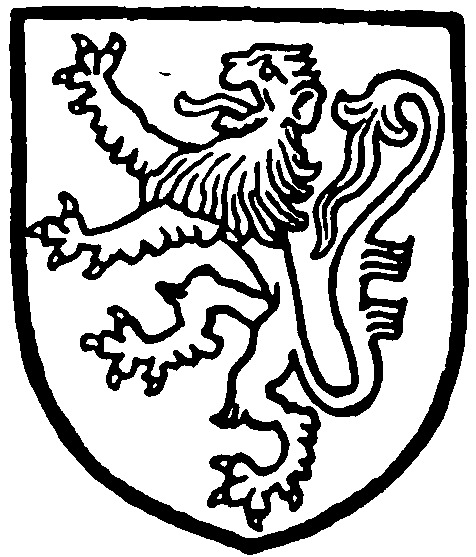
D'Aubigny, Earl of Arundel. Gules a lion or.
In 1204 Simon, Bishop-elect of Chichester, had a grant of Chichester for life, at the ancient farm, for which he gave the king two palfreys. (fn. 36) This is the earliest reference we have to the city being held at farm. The reversion of the grant of the city, after the death of Simon, was given a fortnight later, as dower, to Queen Isabel, wife of King John. (fn. 37) A raid on the city was apparently feared in this year, and an order was sent that all who owed aid should repair the defences by view of the bishop. (fn. 38) Simon was a favourite of the king, and obtained many liberties for the church of Chichester.
In John's reign, Chichester was a borough selected for one of the mints newly opened, or reopened, for the issue of the reformed coinage of the year 1205, and after a very brief spell it closed permanently in the year 1207. This short period of activity has an interesting background of documentary evidence. Three writs of the year 1205 bear reference to the coinage of Chichester. (fn. 39) In April 1205 the Bishop of Chichester was granted the privilege of one die (i.e., the services of one moneyer), available so long as the king used dies there, and orders were issued for dies to be delivered to the bishop accordingly. (fn. 40) In the following month the graver at London received an order to supply one pair of dies to the bishop and two pairs to the king's nominee. (fn. 41) Finally, in July of the same year, the king granted to the bishop the use of the two royal dies in addition to his own, and the free use of the mint and exchange in Chichester for one year commencing on 1 August. (fn. 42) The mint receives its last mention in a writ of October 1207, when moneyers of all mints were summoned to attend at Westminster with their dies and to bring with them operatives and others qualified to advise upon coining. (fn. 43) The inquiry was perhaps occasioned by one of the outbursts of forgery which frequently accompanied the issue of a new coinage. Whatever its cause, its result was the closure of some mints, among them Chichester, which never again took part in the royal coinage.
Simon, Bishop of Chichester, died in 1207, when the Queen entered into possession of the city, and held it at the ancient farm. After the death of John, Queen Isabel married in 1220 Hugh of Lusignan, Count of la Marche, and in 1222 they received a confirmation of their rights in Chichester. (fn. 44) In 1224, however, Henry III resumed the lands held by his mother in dower, and Chichester was committed, during pleasure, to the Bishop of Chichester. (fn. 45) In 1226 the custody of the city was granted direct from the Crown to the citizens at the farm of £36 a year, saving to the king the customs of wools, hides and wool-fells. (fn. 46) The citizens, however, seem to have held the city from 1224, as in 1230 they were in arrear of their payments at the rate of £38 10s. from that date. (fn. 47) They only held the city under this charter direct from the Crown for one year, as in 1227 Henry III granted the dower lands of his mother, including Chichester, to his brother Richard, Earl of Cornwall, (fn. 48) when the farm was paid to the earl instead of the king. (fn. 49)
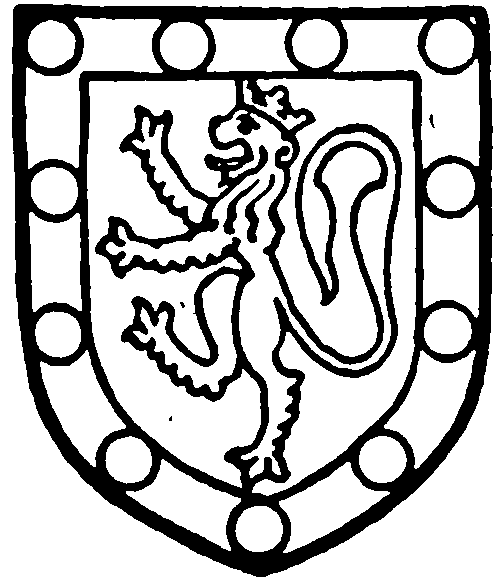
Richard, Earl of Cornwall. Argent a lion gules crowned or in a border sable bezanty.
Besides the farm the citizens had to pay tallage to the king while the city was in his hands, and to the earl after it had been granted to him. (fn. 50) Henry II imposed both aids (fn. 51) and tallages on the citizens, but later in 1187, 1214 and 1220, tallage only was assessed (fn. 52) on them. The imposition of tallages, which were collected by the royal officers and fell as a burden on all the citizens alike, shows perhaps a decrease of independence of the citizens; the levy of aids, on the other hand, was assessed and collected by the citizens themselves.
Richard, Earl of Cornwall, died in 1272, and was succeeded by his son Edmund, who died in 1299, seised of the city of Chichester, which he held by the same rent as before, his cousin, King Edward I, being his heir. (fn. 53)
Edward I paid several visits to Chichester and spent some days in the city at the time of the translation of St. Richard in 1276. (fn. 54) He came again in 1281, 1285, 1286, 1290, 1294, 1297 and 1299. (fn. 55) He seems to have had a special veneration for St. Richard, and repeatedly sent offerings to his shrine in the cathedral. In December 1305 he sent a gold buckle to the shrine 'in the name of the lord Richard the King's son, being still in his mother's womb'; (fn. 56) the child, however, when born proved to be a girl.
While the city was held by the Earls of Cornwall it was attached to the Honour of Wallingford, and in 1302 the keeper of the Honour was ordered to deliver the farm of the city to Roger le Bigod, Earl of Norfolk. (fn. 57) The earl, however, surrendered it shortly afterwards, and Edward II in 1307 committed the city, with the Honour of Wallingford, to John de Clinton of Maxstoke. (fn. 58) Two years later it was given in exchange for lands in Yorkshire and elsewhere to the king's favourite, Piers Gaveston, and Margaret, his wife. (fn. 59) Piers was beheaded in 1312, and Chichester returned to the Crown. In the same year Edward II gave the custody of the city, during pleasure, to the mayor and citizens at the reduced farm of £32. (fn. 60)
In 1316 the citizens made fine with the king for 40 marks for having the city at fee farm, (fn. 61) whereupon Edward II granted the city to them, their heirs and successors, together with the liberties and free customs and all other commodities and profits belonging, by land and water, rendering yearly the fee farm rent of £36 and paying the alms and other charges incumbent on the city; saving, as before, to the king his customs on wools, hides and wool-fells and all other customs. (fn. 62) With this charter the administration of the city was placed in the hands of the citizens in perpetuity. Previously the grants of the city at farm to the citizens had been limited in time and power. Hereafter the Crown from time to time granted out the fee farm rent, but the citizens retained the full custody of the city. Thus in 1318 the farm was given to William de Montacute until he should be provided for otherwise, (fn. 63) and in 1327 it was given in fee tail by Edward III to his uncle Edmund, Earl of Kent, (fn. 64) who died seised of it in 1330. (fn. 65) It descended with the earldom to Joan, the Fair Maid of Kent, wife of Thomas de Holand, (fn. 66) who became Earl of Kent and died seised of the rent in 1360. He was succeeded by his son Thomas (d. 1397) and grandson Thomas (d. 1400). The fee farm rent in part or as a whole has been granted in the form of annuities from time to time, the owners having no personal connexion with the city. (fn. 67) It was eventually purchased by the Corporation, and is now extinguished. (fn. 68)
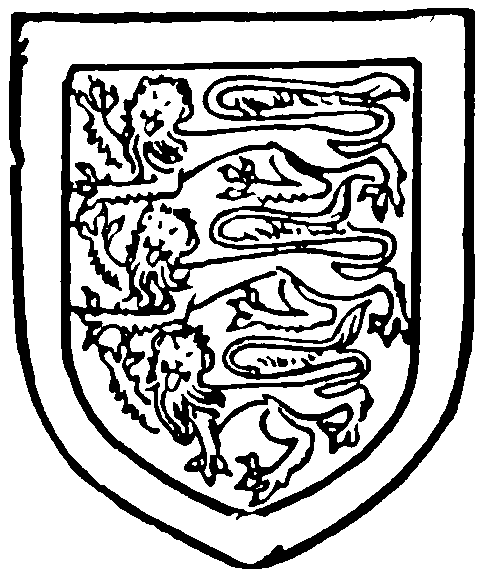
Holand, Earl of Kent. England in a border argent.
In 1342 we have an early instance of intense political bias in Chichester. Robert de Stratford, Bishop of Chichester, succeeded his brother John, Archbishop of Canterbury, as Chancellor in 1340. To the two brothers, who had opposed the French war, was attributed the cause of Edward's ill success in France, by withholding money for the troops. The citizens were themselves put to great charges in repairing the walls of the city against a threatened invasion of the enemy and were pardoned the arrears of their farm. (fn. 69) In December the bishop was amoved from the chancellorship and a number of judges and merchants were arrested, the two brothers only escaping imprisonment by their ecclesiastical rank. There was very strong popular ill-feeling against them throughout 1341 while their conduct was under discussion in parliament. (fn. 70) The reflection of their unpopularity is shown by a conflict which occurred at Chichester in 1342 between the bishop on the one side and the dean and chapter, the cathedral and city clergy, and all the chief citizens on the other. (fn. 71) The bishop stated that when he wished to go to his cathedral church, a confederation or conspiracy was made to prevent his coming to the city or sending letters and mandates pertaining to his jurisdiction; access was forbidden him by an armed multitude that came out to the suburbs, closing the gates of the city and assaulting, injuring and imprisoning his servants, and extorting fines and ransoms by threats and fear of death. The individuals accused of this outrage were the dean, three canons, the parsons of the churches of St. Andrew, St. Mary and St. Martin, Chichester, the chaplain of St. Mary's Hospital, fourteen vicars of the cathedral church, and at least 68 laymen, including all the most noteworthy citizens of Chichester, many of whom were past or future mayors and members of Parliament. It is not clear if the mayor himself was involved.
An inquiry was made by the justices at Horsham, where the bishop claimed £1,000 for the loss of the services of his servants, and as compensation for assaults such as seizing his bridle. At Lewes (Easter 1343) the defendants did not appear, and the sheriff returned that they all belonged to the liberty of Chichester, and had nothing in his bailiwick by which he might attach them. The bailiff of the liberty declared that they were not to be found in his bailiwick. At a further county court held at Chichester, the dean and 18 clerks appeared, and were remitted to custody. Probably as a means of withdrawing the suit, a hardly credible statement was made as to their death, which the bishop did not deny. One canon, John de Mitforde, was fined and outlawed by the judgment of the whole county and in the presence of the coroners. The sheriff was ordered to pursue 37 laymen from county court to county court and to outlaw them if they did not appear.
In another account, the bishop expressly stated that he, in obedience to letters from the king, was endeavouring to send letters to the chapter, requiring them to pray for the king's success overseas, and that his letters were taken and torn up. (fn. 72) Possibly this indicates that the war with France was unpopular with the Chichester merchants. There seems to be no reason for any local unpopularity of the bishop: he had recently contributed towards the murage for the defence of the city, though maintaining that he did so without prejudice to the question of his rights. (fn. 73)
There is little evidence as to the 'Black Death' in Chichester, which is surprising as the disease was so commonly ship-borne. It is almost certain, however, that the absence of records is the explanation, and not the absence of the pestilence, as cases occurred as near as Appledram. (fn. 74)
For the next two centuries there is little to record. During the rising of Jack Cade, on 6 August 1450, William Hovell of Sutton, gentleman, Richard Seynt of Pulborough, clerk, and others assembled in arms at Chichester and in full market proclaimed that all true men in the county should appear before them in three weeks' time, on pain of death. (fn. 75) The city does not appear to have been further involved, but next year a quarter of Nicholas Jakes, traitor, was sent to be exhibited there as a warning. (fn. 76) Edward IV visited Chichester in 1471, (fn. 77) and again in 1479, when he spent a month, from 7 September to 10 October, there. (fn. 78) A subsidy (fn. 79) collected in 1524 shows that there were resident in the city seventeen Frenchmen, including a doctor, 'Mr. John Phisicon,' one Breton, and six Dutchmen. Far the most wealthy citizen was John Cresweller, whose goods were valued at £200; next to him being John Carter with £43; only six others reached £40, and five of these served at various dates as mayor.
We have not much evidence to show how the Reformation affected Chichester. Bishop Sherburne was nearly eighty, and although he proclaimed the king's supremacy in June 1535, he begged to be excused from any active policy, considering his age and impotency. The two orders of Friars in Chichester surrendered to the king in October 1538. (fn. 80) There were no other monastic foundations, and consequently the city did not receive as severe a setback as most large towns: the cathedral and its foundations were left untouched, except for the destruction of the shrine of St. Richard and the suppression of the numerous chantries. The hospitals of St. Mary and St. James escaped confiscation and were reformed and remodelled by Queen Elizabeth.
Some light on the condition of the city in the late 16th century is thrown by an anonymous petition addressed to the Lord Treasurer of England in 1596. (fn. 81) The petition emphasises the multitude of poor in Chichester who would certainly drive out the better sort of inhabitants; the decay of the city was ascribed to the poor, but no explicit mention is made of the poor-laws. A desire was expressed that the ruins of the city should be repaired and amended, according to the charters of the city. We know from another clause that thieves could go in and out of the city over the broken walls. The ancient methods of buying and selling in the city should, it was thought, be restored, a reference probably to the decayed gilds, if we may judge from the 17th-century revival of industrial companies. The good harbour, not three miles away, ought to shelter 300 sail of ships of 100 or 150 tons apiece. A part of the fee farm of about £120 per annum ought to be devoted to the upkeep of the walls.
Chichester in the 17th century has a clearer and more interesting political history than at any other period; it has also certain marked constitutional and economic developments, but the different lines of advance are best treated separately.
The chief political problem was the defence of the realm; in 1628 some 200 soldiers were billeted in the rape and city of Chichester, which was considered burdensome, as the district was 'already full freight with soldiers. (fn. 82) In 1634 the city was ordered to join with other corporate towns in Kent and Sussex to provide at Portsmouth a ship of 800 tons with a crew of 260 men, fully furnished with munitions and victuals. (fn. 83) The city was assessed at £150 for the first levy of Ship-money, but the second assessment was reduced to £77 7s. 4d. In 1640 there was evidently acute discontent with this form of taxation. Sir F. Fane wrote to the Earl of Rutland that shipmoney was unpaid and the soldiers unruly, adding: 'Sheldon escaped hardly for his life, with his wife, at Chichester, being first sore beaten and having been forced to stay in the church at the last day.' (fn. 84)
There was evidently some religious discontent in the city at the time of Laud's visitation by his commissioner, Dr. Nathaniel Brent, in 1635. A few citizens had been summoned before the High Commission, but on the whole the impression gathered from Brent's report is one of carelessness and poverty rather than of opposition. There was evidently friction between the city and the Close: the mayor and his brethren were puritanically inclined, and Brent publicly and canonically admonished one of the aldermen for putting his hat on in time of divine service. Mr. Speed, of St. Pancras, had built a gallery in his church to receive strangers, and at their charges, but he was willing to pull it down. (fn. 85)
The part which the city would play in the coming struggle could, however, hardly be predicted, as the Puritan leanings of the chief citizens were balanced by the influence of the Close, and by the country gentry of the neighbourhood, many of whom had houses and property in the city. The importance of Chichester lay in its position on the coast, its proximity to Portsmouth and its comparative nearness to London. It could be used as a provisioning base for western campaigns, and in the Parliamentary organisation during the war it came under the 'Committee for the West,' and is always ranked as 'Western parts.' The Sussex gentry tried to persuade the king at Oxford to form a combination to take Chichester and use it as a basis against the West.
By August 1642, however, the city put forth a 'Valiant Resolution,' declaring its determination to stand for the privileges of Parliament, the Protestant religion, the laws of the land, and the liberty of the people. (fn. 86) This was not, however, an official decision, and the mayor, Robert Exton, issued the Royal Commission of Array, calling upon all able-bodied men to take arms for the king; he was supported by the bishop, Henry King, and the recorder, Christopher Lewknor, M.P., but apparently he felt the insecurity of his position and fled to the king. (fn. 87)
William Bartholomew succeeding him, obtained ordnance from Portsmouth and 200 of the county militia, and by 16 December 1642 Sir Edward Ford, the sheriff, with other royalist gentlemen of the neighbourhood, had taken possession of the city and imprisoned many of the opposition. (fn. 88) They were aided to some extent by the forces of Sir Thomas Verney, retreating from Farnham, and by others from the neighbourhood of Arundel. (fn. 89) On 22 December Sir William Waller, advancing by Farnham, Winchester and Arundel, took up his position on the Broyle, and occupied Cawley's Almshouses (q.v.) in readiness for a siege. (fn. 90)
Between 15 and 21 December an internal struggle had taken place in the city between William Cawley with the Parliamentary adherents (who called the inhabitants together in the Town Hall, and secured their general assent against the king) and the Royalists. (fn. 91) The mayor agreed that a joint watch should be kept by 20 citizens and 20 gentlemen, but Sir John Morley of Halnaker appeared with 30 gentlemen and 50 others and refused to dismiss them, threatening the mayor and seizing the keys. Next morning the sheriff, Sir Edward Ford, entered the city with trained bands, and took control, forcing the mayor to stand by at the Town Cross, while a general pardon was proclaimed. The Parliamentarian citizens sought aid from Portsmouth which did not arrive. The sheriff, by alarmist rumours, brought many people from the country into the city, but countrymen, it was said, 'have no heart in the service'; further royalist forces threatened to plunder, and some were set in prison and in irons. Hence the city was divided against itself throughout the brief siege. (fn. 92) Waller's plan, from his encampment on the Broyle, was to seize first the north defences, then the east and west, and so inclose the city. The royalists began with a sortie through the North Gate, which was beaten back. Waller, in spite of some damage by the town ordnance, mounted his batteries to the north and called upon the garrison to surrender. His guns at first overshot the city, but gradually drew nearer and gained the suburbs on the west; he was driven back by Royalist 'wild-fire,' and the suburb on the east was also fired by the city. From Cawley's Almshouses the Parliamentary troops shot through the North Gate to the Market Place. A small force was then quartered at the South Gate, but not without warm skirmishes; the eastern suburbs were seized and from St. Pancras Church Waller's troops fired upon the town.
On the seventh day, at night, preparations were made for a simultaneous attack all round; culverins were drawn within pistol shot of the East Gate, plans were made to fire the West Gate and to petard the Postern Gate that issued out of the Deanery through the city walls into the fields, and was walled up only a single brick thick. The old Deanery, which in spite of protests in the Middle Ages had been built upon one of the bastions of the wall, was apparently destroyed by Waller's guns. On 29 December 1642 before the concerted assault took place, the city surrendered on terms of 'quarter and honourable usage.' Clarendon declares that the surrender was caused by shortage of provisions, the disloyalty of the citizens, and the consequent heavy burdens which fell upon the officers and gentlemen of quality. (fn. 93) In any case, the city paid very heavily for its divisions: the royalists were plundered, as Thomas Verney asserts, of all but their clothes, and the story of the barbarous assault upon the cathedral, which Waller evidently made no effort to check, has often been told in detail. The dean, Dr. Reeves, was obviously an eye-witness to the destruction. The records and muniments of the cathedral probably suffered severe losses at this time, and the cathedral library narrowly escaped being sold in London, after a period of neglect and confusion. Some of the royalists were allowed to 'compound' by the payment of large fines, varying from £992 down to £18; the mayor, Exton, paid £150, and Sir John Caryll of Harting was assessed at over £3,000. (fn. 94) The cathedral clergy were reduced to poverty, the bishop's palace was sold, and the bishop himself retired into seclusion until at the Restoration he was able to resume his see. The suburbs of St. Pancras and St. Bartholomew had been almost completely demolished and recovered very slowly. (fn. 95)
After the siege Chichester remained Parliamentarian, but there was considerable restlessness in the city. In 1643 Hopton threatened an attack, advancing as far as West Dean, but the citizens took no further part in the struggle. William Cawley appears to have been left as Governor, and he found great difficulty in fulfilling Fairfax's demands for money and troops. The Clubmen, who opposed both sides, were active in the surrounding villages, and when 67 men were to be impressed within the rape, only 27 could be brought in, and these with great violence. When £4,000 was due, only £100 could be collected, the collectors fearing to have their brains dashed out by bodies of 40 servants and women taking action with prongs and similar weapons; an appeal was made to the House for stronger measures. (fn. 96) In 1645 Col. Algernon Sidney was Governor of Chichester, but there are no details of his period of office. William Cawley achieved a wider fame by acting as one of the 'judges' of the High Court which condemned the king. As a regicide he fled in 1660 to Switzerland, where he died in 1666. (fn. 97) In 1646 the garrison of Chichester appears to have been dissolved as being useless and expensive. In 1653, 400 Dutch prisoners were sent to Chichester for safe custody, and the Elizabeth of Chichester was given a commission for privateering against the Dutch. (fn. 98) The Spaniards attacked Chichester merchants, and a Portuguese vessel was captured in the harbour. In 1659 it was suspected that Chichester might be the objective of Royalist attack; 2,000 troops were sent to the neighbourhood, an order was given to demolish the walls, and naval defences were organised, (fn. 99) but the city played no part in the Restoration. Cromwell had made something of an internal revolution by consolidating the eight parishes into two, by making the mayor and corporation governors of St. Mary's Hospital and by increasing the allowances to Puritan divines from the confiscated revenues of the dean and chapter.
Puritan feeling remained strong even after the Restoration, and in 1671 a chapel was built in Eastgate Square, for the small Baptist congregation which had previously assembled at a house in South Street. There was a Quaker meeting in Rumboldswyke in 1678, when William Cooper was presented by the churchwardens for allowing it to be held in his house.
Towards the end of the reign of Charles II there was a marked increase of a strong dissenting and Parliamentary party, especially between 1678 and 1681. Monmouth was very popular and visited the city four times. The bishop, Carleton, was very unpopular and was in close touch with Sancroft, Archbishop of Canterbury, to whom he wrote detailed letters on the political situation. One of these letters gives a dramatic picture of Monmouth's visit in 1679, and of the mayor's hesitating welcome, and the cathedral clergy's unhesitating reception of him with bells and bonfires, to the great disgust of the bishop. (fn. 100) The bishop was evidently sharply at variance with his dean and chapter, who were not as completely Tory as might have been expected.
The year 1680 saw a strange scheme (never executed) for transporting the 'Papists' of Cumberland to Chichester, and in 1681 there was considerable activity on behalf of Parliament and against the Duke of York, duly reported by Bishop Carleton. (fn. 101)
The mayor, however, felt obliged to play for safety, and in 1681 he sent an address to the king, disclaiming any part in complimenting members on their vote for the Exclusion Bill. Mr. Farrington's house in South Street was evidently a centre of disaffection: it was suspected that arms were concealed there, and certainly Dissenters met there and elsewhere in strictly guarded meetings. A crisis was reached in 1682, when an informer, Richard Habin, was attacked by Mr. Farrington's coachman, and died of his injuries. The coachman was found guilty of murder, and although it is impossible to check the truth of the evidence, the crime witnesses to the violence of political and religious feeling in the city. Municipal independence suffered severely at the hands of James II, and Carleton's successor, Lake, was warmly supported by the city when he, as one of the famous Seven Bishops, opposed the king's unconstitutional proceedings. (fn. 102) There was a strong Protestant feeling against James II at Chichester as elsewhere, and on the news of his flight on 17 June 1689 reaching the city, a meeting was called at the Unicorn, lately built at the corner of the Hornet Square, which was attended by men of all classes. It was resolved at this meeting to establish a club to be called the Corporation of St. Pancras, consisting of a mayor, aldermen, town clerk, 'common counsel men,' two serjeants at mace and a crier. The club was to meet every year on 4 November, the eve of the anniversary of the Gunpowder Plot and the landing of William of Orange at Torbay, and to dine off 'all the good things in season' with 'a plentiful supply of wine and ale.' The club still has its yearly dinner and has entertained many celebrated men as mayors and guests. It possesses a wooden mace bearing the date 1689, a serjeant's staff with date 1692, and a loving cup which formerly belonged to the True Blue Club, dated 1815 and presented to the Corporation of St. Pancras in 1895. (fn. 103)
The history of Chichester in the early 18th century marks a period of considerable decay of ancient standards and former prosperity, together with the re-birth of a city not unlike that of to-day. The change is recorded in the memoirs of James Spershott, a member, and later the pastor, of the Chichester Baptist congregation. (fn. 104) Spershott, who was born in 1710 and died in 1789, has recorded the progress of social history in a manner all too rare among memoir-writers. He notes the 'mean appearance' of the city when he was a boy; the old low timber-built houses, with shops open to the street; the few new houses, with solid brick fronts, of which only four in the East Street had sash-windows, none in West Street and only two or three in North Street. Little London, 'now so gay,' was then very dirty, with a few old houses partly underground: the Pallant in general was very old, with only a few good houses, and otherwise full of malt-houses. The wooden cross in the centre of the Pallant was taken down about 1713. The Leather Market had long disappeared. (fn. 105)
The old Corn Market stood on the west side of North Street, the Sheep Market against the dead wall of the Priory. The city walls were in broken, ruinous condition, overgrown with ivy: the southeast walls were still in existence; none of the streets were paved and the roads outside the gates were narrow and difficult. Not more than three coaches, besides the bishop's, were known in the city, and only one 'very awkward' horse-chaise could be hired from a shoemaker. There was no post-chaise, no roadwagon to London, and regular communications depended on two sets of pack-horses. Forty-five public-houses in the town and suburbs had by 1784 been reduced to twenty-nine.
Spershott gives a graphic schoolboy's picture of the rough manners of the 'commonalty,' of their bull-baiting, wrestling, cudgelling and footballing in the streets, cock-fights, dog-fights and badger-baiting: 'cock-scaling' took place even in the 'High Church Lighten' (i.e., the cemetery of the cathedral church). He notes the changes of fashion in furniture, having watched the solid old pieces of English oak give place to deal dressers, and Norway oak, called wainscot, while the 'higher sort' esteemed walnut veneering above everything, and the cabinet-makers began to make walnut chairs, mahogany not having yet come into use. Spinning was common in most families, and the making of bread; 'at Christmas the whole Constellation of Patty-pans which adorned their chimney-fronts were taken down.'
According to Spershott, the process of rebuilding seems to have begun about 1724, when the Cross Clock was set up by Lady Farrington, the North Walls, walk and rampart were levelled, repaired and beautified by Lord Beauclerk, the city member, and the trees at the East Walls were planted. In 1731 the old Market House and Council Chamber were taken down and the new one built. Throughout the century to 1784 Spershott notes the changes, concluding that he must have seen almost the whole city new built or new faced 'as if another Cissa had been here.' A few additional notes bring the memoirs down to 1809, thus linking them to the material to be found in Hay's History of Chichester (1804).
From other sources it is clear that Chichester in the 18th century was by no means destitute of intellectual life and vigour. The city had stood firmly on the side of Protestantism since the visit of Monmouth; 'the Prince of Orange and Queen Ann's Marlborough' were the favourite toasts of Spershott's boyhood; a loyal address to George I on his accession offers him support against the Pretender and the 'boundless Ambition' of his patron; if the bonfires were to be no larger than half a dozen faggots each, that was on account of the dryness of the weather. In 1716 the Prince of Wales paid a visit to the city and was to have been received in the Council House by the mayor and corporation. A handsome quilt to cover the great table was borrowed from Sir John Miller and the cushions of the corporation seat in the quire of the cathedral were sent for to lay on the upper benches, and a fitting dessert of sweetmeats with a bottle of sack and two dozen bottles of best red and white wines for his Highness's refreshment were provided. (fn. 106) But as the Prince arrived at night, he merely passed through the illuminated East and North Streets amid the acclamations of the people, and the mayor and corporation consumed the refreshments prepared for him.
One citizen at least, the builder of the George Inn, was involved in the South Sea Bubble (1720), but generally speaking there was a decided increase of prosperity after 1714.
Defoe (fn. 107) (c. 1724) speaks of Chichester as having only about six or seven 'good families,' apart from the cathedral dignitaries; he describes vividly a 'fire-ball' or lightning which had recently damaged the steeple and the neighbouring houses, but otherwise adds little information. His description of the distance that stones were cast by the lightning has in it a note of the fabulous. He notes with approval a development in the corn trade, by which a few moneyed men bought up the corn which had previously been sent to Farnham, lodged it in granaries near the 'Crook,' milled it, and sent it to London by the 'long sea.'
Another description of Chichester, dated 1739, serves to confirm Spershott's memoirs. In a letter addressed to Mr. Browne Willis, a certain Mr. Philpott describes the city as 7 miles from the sea, but supplied with merchandise brought up to within two miles of the city (i.e., to Dell Quay) by vessels not exceeding 100 tons. He names some of the streets, including Shamble Lane and Hog Lane and describes the houses as mainly of brick, covered with tiles. The five churches, namely, those of All Saints, St. Andrew, St. Martin, St. Olave and St. Peter the Less, are noted; the first four all had spires covered with shingles; the spire of St. Peter the Less was covered with tiles; there were not above three bells in any and no clock. The clock on the High Cross is described as having three dial faces. The Town Hall, where all courts of Judicature were kept, was in the north-east, and had been the chapel of the Franciscans. The Council House, where business relating to the corporation was transacted, stood in North Street, built of brick and Portland stone covered with slates. The number of houses in the city and its liberties 'I compute at 1,000 or upward.' William Cole, the antiquary, among whose papers this letter is preserved, could not identify Mr. Philpott, but suspected him of being a schoolmaster. (fn. 108)
Care for education was a marked feature of Chichester in the 18th century. In 1702 Oliver Whitby, son of the Archdeacon of Chichester, left by his will property for the foundation of a school ('with a particular regard to navigation') for twelve Church of England scholars from the city or the Sussex parishes of Harting and West Wittering. In this school, William Collins, the poet, began his education, passing on to Winchester. James Spershott probably passed his school days at the prebendal, or free school, then in a very flourishing condition. (fn. 109) There were evidently some private schools in the city: William Clowes, the printer, notes that his father, an Oxford man, had kept a large school in Chichester, and that his mother, when a widow, carried on a small school. Hayley, the critic, and grandson of Dean Hayley, began his education in a school kept by three sisters named Russell.
The local tradesmen were clearly men of education who had many links with the outside world, and with literature and art. Collins's father was a hatter, who had been mayor three times; his mother was the daughter of a scientific schoolmaster, and his sister married first Captain Sempill, and later the Rev. Dr. Durnford. Hardham, the tobacconist of Ludgate Circus and friend of David Garrick, was a Chichester man, to whom Collins went for advice as to whether to take Holy Orders. (fn. 110)
The three artist brothers William, George, and John Smith were the sons of William Smith, a cooper and baker of Guildford and a Baptist minister, who was later a grocer in St. Pancras, Chichester: they apparently owed their artistic education, in St. Martin's Lane, London, to the Duke of Richmond. Their cousin, James Biffen, was a timber merchant, still building ships for the Baltic trade. The connection with Flaxman, the sculptor, was due entirely to Hayley, living at Eartham and later at Felpham.
The cathedral served as a musical centre: the famous Thomas Weelkes had been organist in 1608, and probably six years before, when William Lawes was a member of the cathedral choir; and Kelway (organist 1720–1747) had some fame as a composer. The poet-verger, Charles Crocker, was educated at the 'Blue Coat' or Whitby's school, and left some appreciative notes on the cathedral. (fn. 111)
Extensive building and improvement schemes marked the end of the 18th and the early 19th centuries. In 1794 the city was newly paved, under an Act of Parliament (1791) which roused considerable controversy. (fn. 112) Ballard states that the new paving was carried out at the expense of the city members (Thomas Steele and George White Thomas). Hay describes (in 1804) how the gutter or kennel, formerly in the middle of the street, had been transferred to the sides, and the street raised and rounded towards the footpaths. The commissioners further removed all signposts, water-spouts, gutters, sheds, and other encroachments, and thereby greatly added to the 'elegance and salubrity' of the city. A public road, leading from Baffin's Lane to the south wall and to the South Gate, was closed by a certain Mr. Bull (1763), which is the reason that much of the site of the south-east walls is now private property. (fn. 113)
Some changes in charitable endowments took place in the 18th century; St. Mary's Hospital, after a period of neglect, received new regulations in 1728 from Dean Sherlock, who had built the new Deanery in 1725; St. James's Hospital house was burnt down in 1780, (fn. 114) and has never been rebuilt.