A History of the County of Sussex: Volume 4, the Rape of Chichester. Originally published by Victoria County History, London, 1953.
This free content was digitised by double rekeying. All rights reserved.
'Bepton', in A History of the County of Sussex: Volume 4, the Rape of Chichester, ed. L F Salzman (London, 1953), British History Online https://www.british-history.ac.uk/vch/sussex/vol4/pp41-43 [accessed 9 May 2025].
'Bepton', in A History of the County of Sussex: Volume 4, the Rape of Chichester. Edited by L F Salzman (London, 1953), British History Online, accessed May 9, 2025, https://www.british-history.ac.uk/vch/sussex/vol4/pp41-43.
"Bepton". A History of the County of Sussex: Volume 4, the Rape of Chichester. Ed. L F Salzman (London, 1953), British History Online. Web. 9 May 2025. https://www.british-history.ac.uk/vch/sussex/vol4/pp41-43.
In this section
BEPTON
Bepton is a parish of 1,910 acres, with a population of 292 in 1931, lying south of Midhurst, to which the northern part of the parish has been annexed for ecclesiastical purposes. On the Downs in the south a height of over 750 ft. is reached, falling to 600 ft. on its southern boundary and steeply northwards to about 250 ft. at the foot-hill road between Cocking and Harting, and then gently to 130 ft. on Bepton Common in the north of the parish. Such village as there is lies mostly ½ mile east of the church along the road running north to Midhurst. A cottage on the west side of this road, known as 'Green Meadows', is probably of late-15th-century origin, though much renovated. It has timberframed walls with curved braces below the wall-plates, and the doorway in the east front has an ancient arched and square-headed lintel with sunk spandrels. The lower story has open-timbered ceilings with stopchamfered beams. The central chimney-stack has two wide fire-places, the northern with an arched bressummer. Above the roof, which is tiled but was formerly thatched, the stack is of the local rebated type. About ½ mile north, on the east side of the road, another cottage shows similar framing and chimney-stack. Farther down the road is a late-17th-century house of red and black brickwork, with a projecting chimneystack at each end.
The south-west corner of the parish, where Linch Ball, on Linch Down, rises to 818 ft., represents the ancient parish of Linch, now surviving only in its former wealden outlier, 7 miles to the north. (fn. 1) A deep track from the Down leads to Linch Farm, a modern house the walls of which, and of the farm buildings, are partly of old squared free-stone, perhaps from the church which once stood nearby.
A detached portion of the parish, some 10 miles north, at Great and Little Brookham, has been united to Linchmere. Part of the parish was annexed to the adjacent parish of Midhurst for ecclesiastical purposes by Order in Council in 1931. About 107 acres were inclosed in 1834. (fn. 2)
MANOR
In 1086 BEPTON was held of Earl Roger by Geoffrey; it had been held of King Edward by Wigot, and was assessed at 4 hides; there was one haw in Chichester attached to the manor. (fn. 3) The overlordship passed with the honor of Arundel and in 1243 was assigned to the pourparty of Robert de Tateshale. (fn. 4) On the division of the Tateshale fees between coheirs in 1309 the group of 5 fees which included Bepton was divided equally between Joan de Dryby and John de Orreby and Isabel his wife, (fn. 5) and in 1339 it was stated that William de Bernak had held half these fees in right of Alice his wife, (fn. 6) who was daughter and heir of Joan. The overlordship is last mentioned in 1359, when a moiety of the manor was held of Thomas, son of John de Orreby, a minor in ward to the king. (fn. 7)
The manor was probably held in the 12th century by Rainald de Dunstanville and Alan his son. (fn. 8) The latter left two sons, Walter and Alan, and a mesne lordship seems to have been held by Walter and his descendants. His grandson Walter de Dunstanville died in 1270, leaving a daughter Pernel who married Robert de Montfort. Their son William de Montfort was holding 5 knights' fees of Robert de Tateshale in Bargham (in Angmering), Bepton, Greatham, Elmer, and Tortington in 1303 (fn. 9) and 1306. (fn. 10) He died in 1310, (fn. 11) having previously granted the reversion of the manor of Bargham, which was the caput of these 5 fees, to Henry, father of Thomas Tregoz. (fn. 12) This mesne lordship seems then to have descended with the manor of Walderton in Stoughton (q.v.) as Bepton was held of Richard Mille, (fn. 13) who died in 1476, (fn. 14) of his heir Nicholas Apsley in 1525, (fn. 15) and of John Newman as of his manor of Walderton in 1593. (fn. 16)
The manor of Bepton seems to have been held in fee by Alan de Dunstanville, the brother of Walter. He left three daughters, Emma the eldest was mother of William de Englefeld, Cecily married William Basset and had a son Alan, the third daughter Alice was mother of Gilbert de Baseville. (fn. 17) They had had a brother Alan, but he had died without issue, leaving a widow Isabel, who was still alive in 1241. (fn. 18) Apparently a further sub-infeudation occurred at this point, William de Englefeld retaining the lordship while the manor itself was divided between Basset and Baseville; for in 1236 Alan Basset agreed to render to William the service of one knight for his lands in Bepton and in Cornwall, (fn. 19) and in 1241 Gilbert de Baseville held of William 2 knights' fees in Bepton and Greatham. (fn. 20) In this year 1241 Gilbert de Baseville made over to Alan Basset the lands which he had inherited in Cornwall, and Alan gave him £8 rent in Bepton and the advowson of the church. (fn. 21) Robert Danvers and Muriel his wife, widow of the elder Alan de Dunstanville, (fn. 22) put in a claim. Alan Basset may have been succeeded by Laurence Basset, who occurs in 1279 with his wife Hawys (probably of the de Vylers family), (fn. 23) as Hawys Basset was the largest contributor to the subsidy of 1296 in Bepton. (fn. 24) In 1305 William Basset died seised of half the manor, which he held from William de Montfort, leaving a son William as his heir, aged 4. In the same year the Escheator was ordered to deliver to Alice, late wife of William Basset, tenant in chief, (fn. 25) lands in Cornwall and in Bepton. (fn. 26) The latter are described as a capital messuage with 27½ acres of arable, 1 acre of meadow, ⅓ of several inclosed pastures containing 20 acres, ⅓ of rents and services of 8 customary tenants, ⅓ of pleas and perquisites of Court, to hold as dower until full age of the heir William. This William figures under Bepton in the subsidy lists of 1327 and 1332, (fn. 27) and in 1333 free warren was granted to William Basset and his heirs on their lands in Bepton. (fn. 28) Sir William Basset died shortly after this, leaving a widow Joan and a son William, under age, in ward to Sir Philip de Englefeld. (fn. 29)
Gilbert de Baseville, grandson of Alan de Dunstanville, left as coheirs five sisters: of these Alice married John de Teuelby, or Tylleby; Ladereyna William de Valoynes; Margaret John de Wykeford; and Joan William Payn of Angmering. All of these were sued in 1276 by the other sister Hawys de Baseville for 1/5 of the manor of Bepton. They maintained that she had no claim, as she was a nun at Rusper, but she said that she had never actually taken the vows. (fn. 30) Alice had previously been married to William Torel, (fn. 31) of Torrells Hall (Essex), and had a son John Torel, who with his wife Agnes in 1282 agreed that John de Tylleby and Alice should hold the manor of Bepton for their lives, with reversion to John and Agnes and his heirs. (fn. 32) John Torel died in 1282, and his son John in 1329, (fn. 33) in which year his son John settled the manor on himself and Margery, daughter of Stephen de Abyndon, and their issue. (fn. 34) He died in 1355 and his widow Margery died on 26 December 1356 holding what is here called half the manor of Bepton. (fn. 35) Their son Thomas was then aged 24. Richard Torel, probably son of Thomas, and Roger Mareschall in 1390 received a grant of a moiety of the manor of Bepton which had been forfeited by John Blake 'under the judgement against him in the parliament of 11 Richard II'. (fn. 36) This moiety was evidently that formerly held by the Bassets, and when Richard Torel died in 1405 he held of the earl of Arundel as of the honor of Tateshale the manors of Estcourt and Westcourt in Bepton. (fn. 37) His son Thomas was only 9 years old, and the united manor was held during his minority by John and Walter Tyrrell (fn. 38) (sic), but in 1428 Thomas Torrell was returned as holding 1 knight's fee in Bepton, formerly of Henry Darcy and Philip Englefeld. (fn. 39) In 1480 Henry Torrell, apparently grandson of Thomas, died seised of the manor (fn. 40) leaving a son and heir Humphrey aged 1¼ years. In 1502 Humphrey sold the manor to Edward Palmer of Angmering, (fn. 41) who held his court of the manor in that year; (fn. 42) but this was presumably a mortgage rather than a true sale, for the manor descended to Humphrey's son Henry, who by demission of feoffees, (fn. 43) among them Sir William Compton and Sir Thomas Tyrell of Huon, (fn. 44) settled the manor on the marriage of his son and heir Humphrey with Alice, daughter of his kinsman Thomas Leventhorp. Humphrey Torrell died in 1544 leaving a daughter and heir Anne aged 2. (fn. 45) Two years later custody of the manor of Bepton with the wardship and marriage of Anne, was entrusted to Sir Thomas Darcy, a gentleman of the Privy Chamber. (fn. 46) Anne married Henry son of Sir Thomas Joscelyn, and licence to enter upon Anne's lands with issues from the time she reached the age of 14 was granted to them in 1557. (fn. 47) A complicated series of leases gave rise to a chancery suit in 1556, (fn. 48) in which Anne is mentioned as Henry Joscelyn's wife, so the marriage must have taken place before that date. In 1568 Henry Joscelyn sold the manor of Bepton with the advowson of the church to Anthony Browne, Viscount Montague, (fn. 49) since when it has formed part of the Cowdray Estate and followed the descent of Cowdray (q.v.).
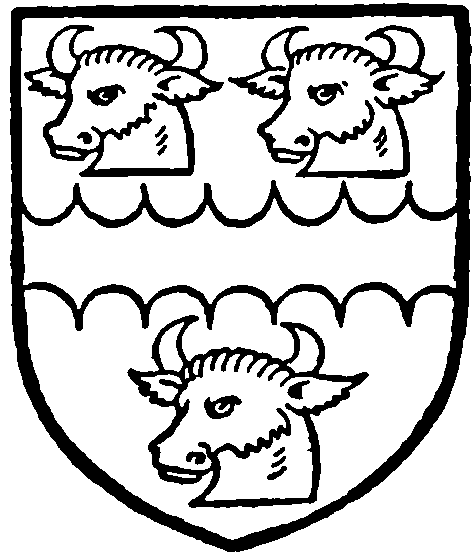
Torrell. Gules a fesse engrailed argent between three bulls' heads couped or.
The manor seems to have been for a while in the tenancy of the Alcock family after 1685 (fn. 50) when it was conveyed to Laurence Alcock together with the advowson, for in 1710 Jane Alcock, granddaughter of this Laurence and daughter of Laurence Alcock, the Member of Parliament for Midhurst, presented to the rectory of Bepton. (fn. 51)
Tortington Priory had a small property in Bepton, worth 10s. at the Dissolution, (fn. 52) and this was bought in 1553 by Oliver St. John and Robert Thorneton, (fn. 53) land speculators. In 1582 Thomas Michelborne of Winchester died seised of 5 acres of land in Bepton, (fn. 54) held of the Queen, as of her manor of East Greenwich, which probably represents the Tortington lands.
CHURCH
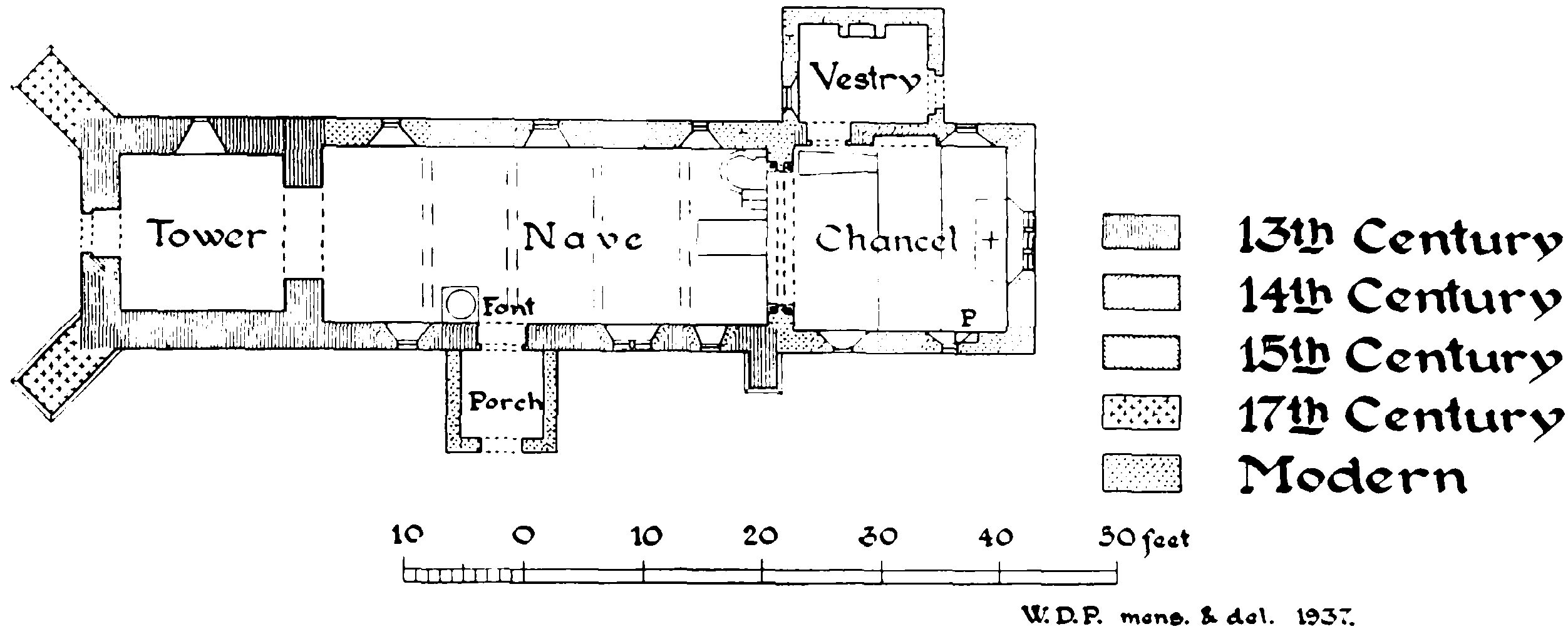
The church of ST. MARY (fn. 55) stands on a knoll south of the Manor House. Of the building mentioned in Domesday Book (fn. 56) nothing now remains; it seems that in the 13th century a completely new church of chancel, nave, and tower was built, while in the 19th century the chancel and north wall of the nave were rebuilt and a north vestry and south porch added. The chancel is of local sandstone ashlar, the rest of flint rubble, some bricks being used in the 17th-century work; the roofs are of tile.
The chancel (modern) has an east window of three trefoiled lights with pierced spandrels under a pointed arch. In the south wall is a trefoil-headed piscina (drain missing); in both north and south walls is a short lancet window with segmental rear-arch and wide splay; farther west on the south side is a second, larger lancet, also with segmental rear-arch, having a lower sill. Next to the window in the north wall is a niche tomb with a cinquefoil pointed arch under a straight crocketted pediment with trefoiled tympanum. An inscription in Lombardic capitals on the slab is now damaged; it has been read as RADO DE LA HEDOL GIT ICY DEV LY RENDE MERCY RYCH. Near this on the floor is a taper-sided tombstone of the 13th century with a fourcircled cross. West of the tomb is a plain doorway with round head, now leading to the vestry; perhaps 13th-century and the old north doorway of the nave re-used. The chancel arch, in the Early English style, is modern.
Parish Church of St Mary Bepton
On the south side of the nave a single lancet and a window of two trefoiled lights under a square head are modern. The south doorway is ancient, probably 13th-century, with plain jambs and round arch; west of this is another modern lancet; (fn. 57) three similar lancets, all modern, are in the north wall. The roof is modern.
The south porch (modern) has a plain pointed exterior doorway.
The tower has large diagonal buttresses in two stages with sloping offsets at both west angles; to judge by the brickwork, these are of the 17th century. The tower arch is pointed, of one order springing from square jambs with crude imposts. In the north wall is a single lancet window, like the arch, of the 13th century. The west doorway has a four-centred arch with moulding on arch and jambs, but no square framing, probably 15th-century. The second stage has small squareheaded windows to the south and west, the latter blocked. The roof is pyramidal, with eaves.
The font and fittings are modern.
There are three bells; (fn. 58) one, by Anthony Wakefield, (fn. 59) is dated 1598, the others 1636 and 1751 respectively.
The communion plate includes a silver cup with a deep, almost straight-sided, bowl, dated 1625, and a paten cover of the same date. (fn. 60)
The registers begin in 1723. (fn. 61)
ADVOWSON
The advowson followed, in general, the descent of the manor. John Locke, who presented in 1625, Jane Alcock and Sir Charles Matthew Goring, who presented in 1710 and 1749 respectively, (fn. 62) were probably lessees of the manor or had grants of presentation for one turn. (fn. 63) The living is now in the gift of Viscount Cowdray.
The rectory was valued in 1291 at £10, (fn. 64) and in 1340 the rector was said to have 16 acres of arable besides his manse and garden, while among the tithes those of apples (for cider) amounted to 10s. (fn. 65) In 1535 the church was rated at £6 19s. 10d. clear. (fn. 66)