A History of the County of Sussex: Volume 4, the Rape of Chichester. Originally published by Victoria County History, London, 1953.
This free content was digitised by double rekeying. All rights reserved.
'West Dean', in A History of the County of Sussex: Volume 4, the Rape of Chichester, ed. L F Salzman (London, 1953), British History Online https://www.british-history.ac.uk/vch/sussex/vol4/pp97-101 [accessed 30 April 2025].
'West Dean', in A History of the County of Sussex: Volume 4, the Rape of Chichester. Edited by L F Salzman (London, 1953), British History Online, accessed April 30, 2025, https://www.british-history.ac.uk/vch/sussex/vol4/pp97-101.
"West Dean". A History of the County of Sussex: Volume 4, the Rape of Chichester. Ed. L F Salzman (London, 1953), British History Online. Web. 30 April 2025. https://www.british-history.ac.uk/vch/sussex/vol4/pp97-101.
In this section
WEST DEAN
Most of the 4,803 acres of this parish is downland, lying between 400 ft. and 500 ft., but at the north-west angle the ground rises steeply to nearly 780 ft. on Treyford Hill. At the south-east corner, where the Lavant flows west and then south, the village lies on its right bank at a height of 200 ft. The western portion of the parish constituted the chapelry of Chilgrove, and the bounds of the tithing of West Dean proper are set out in the 15th century as follows: (fn. 1) beginning (1 mile south of the village) at the Earl of Arundel's sheepcote at Preston, they run along the edge of Binderton parish to 'the upper end of Smallden' (at Brickkiln Farm), to 'a meadow at Ramnesden' (Ramsden Copse), to a meadow in Elyngeden 'at the end of Witeweye' (perhaps Hylters Lane), … 'to a ditch above Stapelherssch' (wood called 'The Ditches' above Stapleash Farm), … 'to a green way between the wood of the Earl of Arundel (Westdean Wood) and Lynch (now Linchball) wood'. The next identifiable marks are 'the logge of Downle (Downley) on the east side', and 'the Portway' (main road) between Singleton and West Dean; 'thence to the cross of Langedon' (probably 'The Seven Points', just west of the Trundle, where the parish boundary turns at a right angle west); and so by 'Duddelepe' back to Preston. Though not so heavily wooded as East Dean there is a considerable block of woodland in the north of the parish, plantations to the west of the village, and to the east of it the extensive park.
The line of the railway (fn. 2) between Chichester and Midhurst runs parallel to the road, following the curve of the Lavant valley, with Singleton station just within the parish.
By the West Sussex Review Order of 1933 Binderton was attached to this parish.
The main road from London sweeps round in a wide bend from Singleton on the east towards Chichester on the south, passing west of the parish church, which stands at the north-east end of the small group of buildings that may be said to constitute the village. West Dean House, a large building of flint and stone erected in 1804, stands south of the church and West Dean Park lies east and south of it.
The buildings along the main road are of little interest, but south-east of and parallel with the bend is a back lane running south-westwards from the church and connected with the main thoroughfare by short cross lanes. (fn. 3) The older buildings of the parish are in this loop road. One, a former farm-house, on the south side of the southernmost cross lane, about 3/8 mile south-west of the church, is of 17th-century origin. The walls are of flint and brick. The north front is modernized, but the gable ends have mullioned windows either of stone or of old plaster imitation. A lower wing behind has a 17th-century cross-shaped chimney-shaft. A flintand-brick cottage opposite also has a 17th-century pilastered chimney-shaft. Another house at the next corner to the north-east has walls of cut flints with 17th-century brick dressings, and the mullioned windows are treated with plaster to imitate stone. The chimney-shaft of brick is of the rebated type. A thatched cottage north-west of it on the north side of the next cross lane is built half of early-17th-century timberframing and half of later flint and brick. Most of the other later buildings also have flint-built walls.
MANORS
At the time of the Domesday Survey, West Dean was included in the manor of Singleton. Like East Dean, it was a forest area and the park of West Dean frequently occurs among the appurtenances of the earldom of Arundel. (fn. 4) Later the manor of WEST DEAN was one of the manors belonging to the honor of Arundel. In 1272 it is mentioned among the manors held by John Fitzalan, Earl of Arundel, at his death, one-third belonging to his mother in dower; (fn. 5) and it was among the property remaining in the king's hands during the minority of the heir. (fn. 6) In 1274 John's widow Isabel sued in her turn for dower, including ⅓ of the manor of West Dean. (fn. 7) She was granted the custody of lands in West Dean and Charlton (q.v.). The manor continued to descend with the honor. It passed to Lord Lumley and his wife Jane, daughter of the earl, by the agreement of 1566. (fn. 8) It was one of the manors conveyed in 1588 to Richard Lewknor by John Lumley. (fn. 9) In 1621 Richard Lewknor, (fn. 10) and in 1636 his grandson Richard Lewknor, (fn. 11) died in possession of it. It remained in the family until the death (s.p.) in 1706 of John Lewknor who left it by will to Elizabeth Woodward Knight (later married to Bulstrode Peachey). She is said to have left it to Thomas May. In 1738 it passed back to Sir John Peachey; (fn. 12) and from him came to Sir James Peachey, later Baron Selsey, on the death of whose grandson, the last Lord Selsey, in 1838 it passed to the latter's sister Caroline Mary Peachey, who married the Rev. Leveson Vernon Harcourt, and died in 1871. It was subsequently acquired by Frederick Bower, and in about 1893 by William Dodge James. (fn. 13) In 1938, E. F. W. James was lord of the manor and principal landowner. (fn. 14)

Peachey, Lord Selsey. Azure a lion with two tails ermine crowned or and on a canton or a molet gules.
While in the hands of the Earls of Arundel, the actual manor seems to have been sub-let only for the short period from 1294 until after 1302, when Henry de Guldeford held it for life together with East Dean (q.v.) and land in Charlton. (fn. 15)
The western half of West Dean parish constituted the tithing and chapelry of CHILGROVE. In 1200 Peter Blund, who held land worth 40s. in West Dean in 1195, (fn. 16) was in possession of 11½ virgates in West Dean and Chilgrove, (fn. 17) and in 1244 Thomas le Blund and Itarius de Sandrevill held jointly ½ fee in Chilgrove of Robert de Tateshale, the service of which was assigned to the Countess of Arundel in dower. (fn. 18) Mary le Blunde was the largest contributor to the subsidy of 1296 in West Dean. (fn. 19) John le Blount had succeeded to the ¼ fee by 1304, (fn. 20) the overlordship of which was assigned in 1309 to Thomas de Cailli, as one of the coheirs of Tateshale. (fn. 21) In 1333 John Blount the elder conveyed to John Blount the younger a messuage and 2 carucates in West Dean which William de Cherlton held for life. (fn. 22) It was presumably the younger John who in 1342 settled on himself and his wife Thomasine land and rents in West Dean and Chilgrove. (fn. 23) In 1348 John le Blount held of John Bernak ½ knight's fee described, probably in error, as the manor of West Dean. (fn. 24) He probably left four coheirs, as in 1352 John de Marlebergh and Agnes his wife conveyed one-quarter of this property to Adam Husee, (fn. 25) and in 1357 Richard, Earl of Arundel, acquired one-quarter and half a quarter of it from Nicholas Maunsel and William Hervy and Joan his wife. (fn. 26) Two years later the earl bought from Walter Bechere and Lora his wife an estate in West Dean and Chilgrove which probably represented another quarter. (fn. 27)
As already mentioned, (fn. 28) Itarius (sic) de Sandrevill was joint tenant of the ½ fee in Chilgrove in 1244. This can be carried back to 1184, when Hugh Esturmi had the custody of the lands and heirs of Gilbert de Salnervill in the honor of Arundel. (fn. 29) These heirs were his daughters Sara, Agnes, and Itaria (also called Italia). (fn. 30) Agnes and Itaria married respectively William Bernehus and Henry de Cheney, and in 1224 they were disputing the right to land in 'Wellegrave', (fn. 31) which is probably an error for Chilgrove. It seems probable that the 'Itarius' of 1244 should read 'Itaria'; she had a son Hugh de Cheney, whose widow Mabel confirmed a grant in Chilgrove made by Itaria to Waverley Abbey, (fn. 32) which suggests that he had left no heir. This ¼ fee is next found in 1304, when it was held of Robert de Tateshale by John le Child, (fn. 33) whose name appears under Chilgrove in the subsidy of 1296. (fn. 34) On the division of the Tateshale fees in 1309 this was assigned to Joan de Driby, (fn. 35) and it was held of her daughter Alice and her husband William de Bernak in 1339 and 1341 by Thomas Child, (fn. 36) who occurs in the subsidy of 1332. (fn. 37) This is the last definite mention of this ¼ fee, but in 1348 tenements in Chilgrove were held of John Bernak, grandson of William, by William and Richard atte Wenden (fn. 38) by knight service as of his manor of Walderton. (fn. 39) The subsequent history of this estate is not known, but it was probably acquired by Richard, Earl of Arundel, as in 1428 the entire ½ fee in Chilgrove and West Dean was in the king's hands as guardian of Earl John's heir. (fn. 40)
The portions of the Blund fee purchased by Richard, Earl of Arundel, no doubt formed part, at least, of the later manor of BROMES in Chilgrove. This first occurs as one of the manors of which John, Duke of Norfolk, and his wife Elizabeth made a settlement in 1469. (fn. 41) The next owners of the manor were the family of Dawtrey. Sir John Dawtrey inherited it from his father and died possessed of it in 1550. (fn. 42) It continued in the family of Dawtrey until 1624, when Francis Dawtrey conveyed it to John Hall, (fn. 43) who died seised thereof in 1638, leaving a son John, then aged 35. (fn. 44) The manor next passed to Henry Bulstrode and his wife Mary: in 1657 by a fine with William Hall, and in 1666–7 by a fine with Mary Hall. (fn. 45) Mary wife of Henry Bulstrode has been called the granddaughter of John Hall but was apparently widow of (the younger) John Hall. (fn. 46) Between 1670 and 1693 the manor of Brome alias Chilgrove (with tenements in Chilgrove and West Dean) was the subject of a series of fines made by Henry and Mary Bulstrode by which the reversion thereof seems to have been ensured to their son-in-law William Peachey. (fn. 47) Dallaway says that William Peachey's son Bulstrode Peachey, who took the name of Knight, left it to his son by will and that it descended to John, Lord Selsey, (fn. 48) after which it descended with the main manor of West Dean.
At HYLTERS, in the centre of the parish there was an estate which was held of the honor of Petworth. In 1302 John Child (of Chilgrove) held 1 virgate there, (fn. 49) and in 1310 Gerard Huraunt was paying 7s. rent to Henry de Percy for a tenement in le Hulstre. (fn. 50) The greater part of the land, however, was given by Richard de Percy to Geoffrey de Neville. (fn. 51) He gave it to his son John, who in 1230 assigned it as a manor to his brother Alan, subject to a lease for seven years to Claremunde widow of Brune de Hamton and then wife of Stephen of Bordeaux. (fn. 52) In about 1245 Geoffrey son of this Sir John de Neville, with his father's consent, sold to Ernis, Precentor of Chichester, all his estate of Hultre, to be held by yearly render of a pair of gloves or 1d. as ¼ knight's fee. (fn. 53) It was held in 1302 by 'the communar (comunarii) of the Church of Chichester', (fn. 54) and in 1316 the vill of West Dean and Chilgrove was said to be held by the Earl of Arundel and the Chapter of Chichester. (fn. 55) In 1535 'the farm of West Dean called Hilster', £4 11s. 8d., is entered as belonging to the Precentor of Chichester, (fn. 56) but in 1584 'the manor of Hulters', in the tenure of William Palmer, was said to have belonged to the chantry of Bishop Ralph II in Chichester Cathedral and to be worth 29s. above the rent of £3 3s. 1½d. paid to the queen. (fn. 57) As it had been 'concealed' it was forfeited to the Crown and was shortly afterwards conveyed to the Lord Chancellor, Sir Christopher Hatton, who in 1588 sold it to Elizabeth Palmer of Parham, widow, subject to the feefarm rent of £3 3s. 1½d. (fn. 58) In 1611 this rent was being paid by William Smyth of Binderton, (fn. 59) and in 1652 Thomas Smyth was paying £4 12s. 1½d. for 'Heltors'. (fn. 60) The Smyths, however, were presumably only tenants, as Peregrine Palmer, grandson of Elizabeth, owned the manor (fn. 61) and in 1677 he conveyed it to William Westbrooke. (fn. 62) The only later reference to the manor appears to be in 1749, when it was conveyed by Mary Woods, widow, and John Woods to Charles Cole. (fn. 63)
Parish Church of St Andrew West Dean
A so-called manor of WEST DEAN CANONS, late of the Dean and Chapter of Chichester, was sold by the Commissioners in 1652 to William Baldwyn and Edward Cobden. (fn. 64) It apparently corresponded to the rectory, (fn. 65) as John Alwyn of Cannons in West Dean, who made his will in 1557, (fn. 66) was probably the John Alewyn who was farming the rectory of West Dean from the dean and chapter in 1535. (fn. 67)
William d'Aubigny, 2nd Earl of Arundel, in about 1180 gave to the monks of Waverley Abbey (where his father had died in 1176) land in Chilgrove. (fn. 68) The abbot's tenants were said in 1278 to owe suit to the hundred of Singleton, (fn. 69) and in 1339 he was excused from providing 2 men-at-arms for his lands in Chilgrove, as they were not worth more than 40s. (fn. 70) At the Dissolution these lands were granted to Sir William Fitzwilliam, (fn. 71) who also received other lands in West Dean which had belonged to Durford Abbey. (fn. 72)
Tortington Priory also had a small property in the parish, which in 1545 was granted to William Berners; (fn. 73) it was then in the occupation of Richard Aylwyn and may probably be identified with the messuage called Staple Ash held by Thomas Aylwyn at his death in 1594. (fn. 74) His son John died in 1604, leaving a son John, aged 4½. (fn. 75) Staple Ash is next found in the hands of John Tregosse, who died in 1618; (fn. 76) he may have been guardian of John Aylwyn, as the families were connected by marriage. (fn. 77)
Another small property, valued at only 6s. in 1535, (fn. 78) was held by the Hospital of Arundel and on its suppression was granted in 1546 to Sir Richard Lee. (fn. 79)
CHURCH
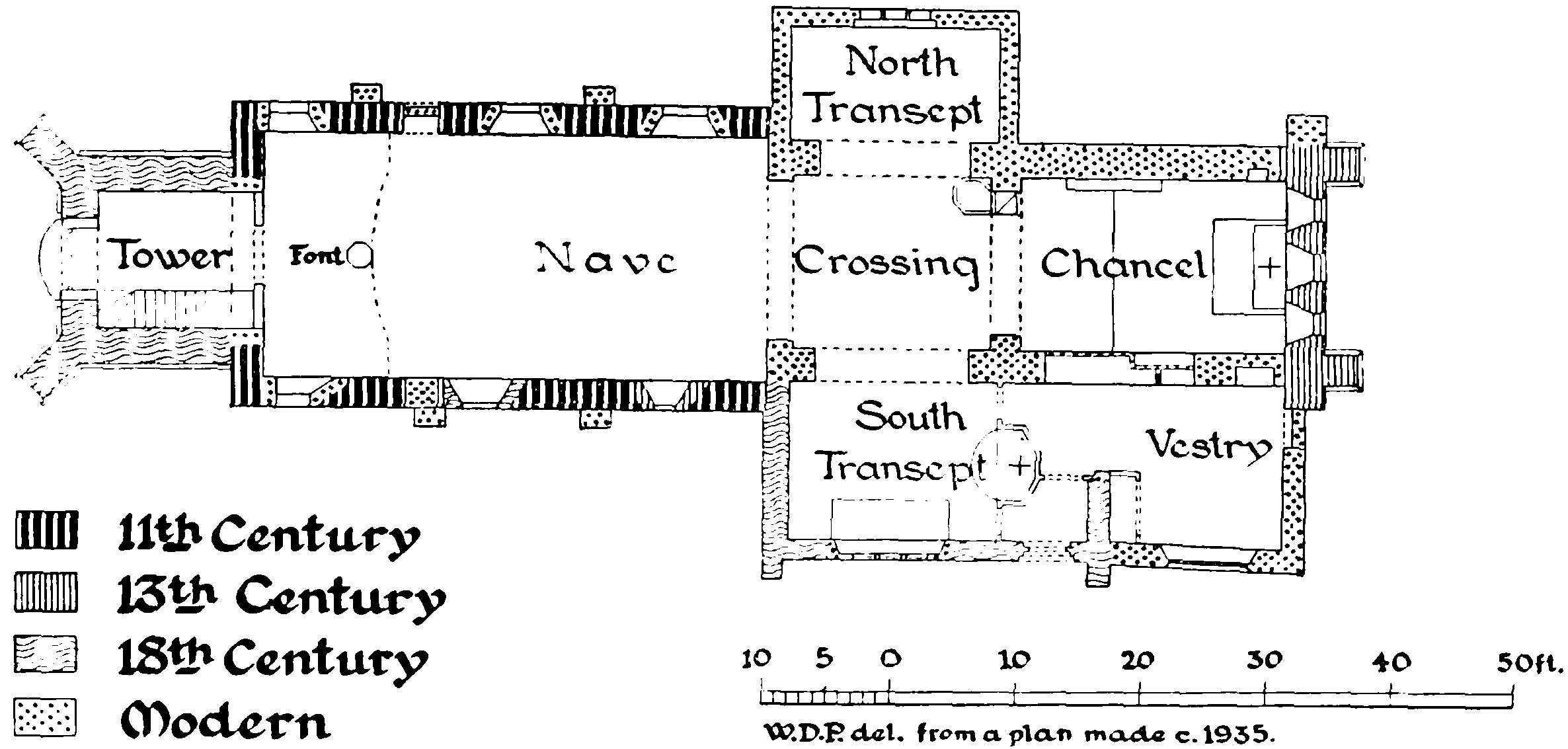
The church of ST. ANDREW (fn. 80) stands in the Lavant valley south of the village; till diverted the Binderton-Singleton road ran along the north boundary of the churchyard. The plan is now cruciform, with chancel flanked by a vestry on the south, crossing, transepts, aisleless nave, and west tower; it is built of rubble with ashlar dressings, part plastered, and is now roofed with slate. The 11th-century church consisted of nave and chancel, the latter on the site of the present crossing, east of this a new chancel was built in the 13th century, one or both transepts and the tower were added in the 18th, and the vestry late in the 19th. The church was seriously damaged by a fire on 26 November 1934, after which all roofs and some of the stonework were renewed.
The chancel (originally 13th-century) has at each eastern corner a pair of buttresses of two stages with sloping offsets, three being of the 13th century, the northern modern. In the east wall is a group of three lancet windows rising to the centre, also 13th-century; in the south wall is a modern recess serving as sedilia; at the east end of the (rebuilt) north wall is a small recess possibly representing an ancient aumbry. West of this is a mural monument (fn. 81) to Sir Richard Lewkenor (d. 1616) and his namesake son and grandson (d. 1602 and d. 1635). In the cleft of a broken segmental pediment were the arms, helm, and crest of Lewkenor quartering Camoys; a classical entablature below this was carried on two unfluted columns of ? Composite order. At the back of the space enclosed were two niches with round heads resting on an impost continued as a string-course; in each of these was the kneeling effigy of a man in armour of the tasset period, bareheaded; the eastern, Sir Richard's son, had a full beard, over him was a shield bearing Lewkenor impaling Brome; the western, Sir Richard's grandson, had a shorter beard and wore jack-boots instead of greaves, over him was a shield bearing Lewkenor impaling Bennett. Between the two niches, below a large console, was a shield having fifteen quarterings. (fn. 82) Resting on a slab which formed the uppermost member of the dado was the recumbent effigy of Sir Richard, the grandfather, in square cap, ruff, and gown, his feet resting on a greyhound. The epitaph commemorating the three was in two panels on the dado.
All four arches of the crossing are now plain pointed arches of one order resting on square responds without imposts, and are plastered.
The south transept was built between 1781, when Sir William Burrell (fn. 83) enumerated 'nave, chancel, and square tower', and 1795, (fn. 84) and was doubtless originally made to be the private pew of West Dean House; it has on the south side two buttresses of two stages with sloping offsets, a doorway with four-centred arch and hood-mould, both of the 18th century, and a squareheaded window with three uncusped pointed-headed lights, modern. The doorway now leads to a small vestibule giving access both to transept and to the vestry; the latter (modern) has a single window of three square-headed lights.
The north transept, perhaps originally contemporary with the south, but now largely reconstructed, has in its north wall a window resembling that opposite.
The north wall of the nave has two brick buttresses of one stage with sloping offset, modern, two singlelight windows with segmental arched heads, originally 18th-century but renewed, and the (blocked) 11th-century north doorway; this has a round arch of one order resting on chamfered imposts and square jambs without rebate or door-check; west of it, under the modern choir gallery, is a small window, modern, but with head copied from those farther east. Outside the south wall are two buttresses like those on the north, a single plain lancet window of the 13th century, one 18th-century window like those on the north, and, under the gallery a window corresponding to that opposite. The remains of an 11th-century doorway exist, but are plastered over.
The tower arch (modern) resembles those of the crossing; below gallery level it is closed with wooden doors, the organ occupies its opening at gallery level.
The west tower (18th-century (fn. 85) ) has at each western corner a diagonal buttress; besides a plinth at ground level these have a rebatement of like dimensions at the level of the first stage, and are finished with sloping offsets. In the west wall is a doorway with plain jambs and imposts carrying an equally plain segmental arch for the fan-light over the door. Over this, in the first stage, is a wide single-light window with moulded jambs and segmental arched head, lighting the former ringing, now organ, chamber. There are similar, but smaller, windows on all faces of the uppermost stage, which is finished with a slight cornice, battlements, and corner pinnacles in what was then understood to be the Gothic manner.
All fittings are modern, save for a large brass chandelier (perhaps 18th-century) now fitted for electric light and hanging in the crossing.
There were three bells: (fn. 86) one inscribed HALTON FECIT; the others with the blundered dates 1601 and 1605 respectively.
The communion plate (fn. 87) includes a tall silver cup of 1706 with ornamentation added apparently in 1839; another small cup, of foreign origin; and a silver flagon given in 1730 by Bulstrode Knight.
The registers begin in 1554.
ADVOWSON
The church of West Dean was given with that of Singleton (q.v.) to the Cathedral of Chichester by the Earl of Arundel in 1150, and it has ever since remained in the hands of the Dean and Chapter of Chichester. A vicarage was ordained in 1237, to which were assigned the small tithes, tithes of apples and of the canons' mill, and half the tithe of wool and cheese; the tithe of flax was set aside for the ornaments of the church. (fn. 88) In 1535, when the rectory was farmed at £32 6s. 8d., (fn. 89) the vicarage was worth only £6 11s. 0½d.; (fn. 90) and in view of its poverty it was united to the rectory of Singleton in 1768. (fn. 91) In 1849, however, the two benefices were again separated. (fn. 92)
The dean and chapter in 1481 demised to William Collock for ten years the rectory of West Dean with the chapels (i.e. the tithes of the chapelries) of Binderton, East Dean, Chilgrove, Didling, and Dumpford. (fn. 93) The church or chapel of Binderton (q.v.) had been, practically if not formally, united to West Dean at some unknown early date. That of Chilgrove was already in existence at the beginning of the 13th century, when a road 'under Grenemere going to the chapel of Chelegrave' is mentioned. (fn. 94) It was presumably the chapel of St. Margaret to the repair of which John Ferour, vicar of West Dean, left 20d. in 1526. (fn. 95) The responsibility of the vicar for this chapel was in 1596 referred to the arbitration of four canons of Chichester, who decreed that: the vicar of West Dean should read service at Chilgrove on one Sunday in every month; he should cause service to be held on every holy day and festival; and should administer to the sick and impotent there and solemnize marriages and baptisms; the inhabitants were at other times to attend the church of West Dean, and were to provide a Book of Prayer for the chapel. (fn. 96) Two years later Bartholomew Storie left a rent charge of 6s. 8d. on Chappell field to the chapel of Chilgrove for its repair and provision of books and ornaments, so long as service was performed there by the vicar of West Dean; but if the chapel was not maintained the bequest should be void. (fn. 97) It is not known how much longer the chapel continued to function, but information was given in 1618 of the repair of its roof and of the provision of a bible, surplice, and communion cup. (fn. 98) Under the Commonwealth John Lewkenor was ordered to pay £150 yearly to the ministers of East Dean, Charlton, and Chilgrove, (fn. 99) but that this implies that the chapel had temporarily replaced its mother church is less likely than that Chilgrove was used as a synonym for West Dean, perhaps to avoid confusion with West Dean in East Sussex; if so, the innovation was not continued.