A History of the County of Sussex: Volume 4, the Rape of Chichester. Originally published by Victoria County History, London, 1953.
This free content was digitised by double rekeying. All rights reserved.
'Bosham', in A History of the County of Sussex: Volume 4, the Rape of Chichester, ed. L F Salzman (London, 1953), British History Online https://www.british-history.ac.uk/vch/sussex/vol4/pp182-188 [accessed 30 April 2025].
'Bosham', in A History of the County of Sussex: Volume 4, the Rape of Chichester. Edited by L F Salzman (London, 1953), British History Online, accessed April 30, 2025, https://www.british-history.ac.uk/vch/sussex/vol4/pp182-188.
"Bosham". A History of the County of Sussex: Volume 4, the Rape of Chichester. Ed. L F Salzman (London, 1953), British History Online. Web. 30 April 2025. https://www.british-history.ac.uk/vch/sussex/vol4/pp182-188.
In this section
BOSHAM
The parish, which measures 3 miles from north to south by 2 miles from east to west, contains 3,915 acres, of which 116 acres are tidal water and 609 acres foreshore. The southern half is bounded by two channels which form parts of Chichester Harbour. The western of these, Bosham Channel, runs inland to Cut Mill, (fn. 1) the village and the church, above which point it is joined by a stream running past the former mill at Broadbridge. The main Chichester—Portsmouth road crosses the north of the parish, and the railway runs close to it on the north, with Bosham station on the boundary of the parish at Broadbridge. From this point a minor road leads southwards past Walton and is connected by a cross-road at Church Farm with another road southwards from the main road, passing Stonewall Farm. The 'tradition' that this farm was an important Roman site ('Vespasian's Palace') has been disproved by excavations, but Roman remains have been found at various places within the parish. (fn. 2)
Almost the only woodland is in the south of the parish at Old Park Wood, near Hook Farm. The park is referred to on a number of occasions, as in 1233, (fn. 3) 1366, (fn. 4) and 1482, (fn. 5) and in 1554 'the old park' was let for 12s. and grazing rights in 'the new park' brought in £6 13s. 4d. (fn. 6) Some 830 acres in Bosham and Funtington were inclosed in 1834. (fn. 7)
While the now popular 'tradition' of Canute's association with Bosham seems to have started about the end of the 18th century, the place was probably the chief seat of Earl Godwin. Here in 1049 his eldest son Swegen murdered his cousin Beorn, (fn. 8) and from here in 1064 Harold set out on the voyage which ended in his falling into the hands of William of Normandy. (fn. 9) Conventional representations of the church and hall of Bosham therefore figure on the Bayeux Tapestry. In the 12th century it was presumably the birthplace, or at least residence, of Herbert of Bosham, the friend and biographer of Archbishop Thomas Becket.
The Manor House, north-east of the church, is said to have been constructed from the remains of an ancient structure that stood near the site; but it dates from about the middle of the 17th century. The original part is of rectangular plan lying east and west. The walls are of rubble masonry of freestone (the reused material) and flints with 17th-century brick dressings to the angles and windows, moulded plinth, and first-floor string-course. The east and west ends are gabled and of three stories. The west end, towards the garden, has sash windows to the two lower stories and a two-light casement to the third. The windows on the south side also have flush sash-frames of the 18th century, but there are remains of 17th-century brick-dressed windows now blocked for a chimney-stack built within them. The east end has a doorway and casement windows, perhaps in original openings. The middle of the three ground-floor rooms (dining-room) has a 10 ft.-wide fire-place, recently opened out again, with an oak lintel. The study west of it has an angle fire-place of the 18th or 19th century, for which the original windows were blocked. The upper story has no noticeably old features. The roof, in the attics, retains only one of the original curved wind-braces. In the late 18th century the drawing-room wing of brickwork was added (or rebuilt) at the west end projecting northwards. Perhaps the part east of it containing the staircase and entrance hall is partly of the same period but has been altered, making the plan rectangular. The staircase has 18th-century turned pitch-pine balusters and steps in the upper part, the lower flights being modern. The original chimney-shaft above the tiled roof is of cross-plan. East of the house is a small moated square plot said to be the site of the early house that provided the reused masonry. If so it must have been very small.
At the south-west corner of the garden adjoining the churchyard are the remains of a small rectangular building with stone rubble walls of the 12th or early 13th century. In the north wall is a rough round-arched opening, now low down because of the earthing up of the interior. The west side-wall, 2½ ft. thick, contains three narrow rectangular loop-lights; the east wall is missing; the south end wall seems to be unpierced but is much overgrown with verdure.
There is little else of interest in the village itself. The south wall of the lane south of the churchyard is of 14th-century masonry. (fn. 10) It is about 60 ft. long, of flintwork with stone dressings at both ends, and an intermediate doorway with chamfered jambs and a pointed head with a hood-mould. In it is a pair of oak doors hung with strap-hinges with fleur-de-lis ends. A stone at the west end is inscribed L/RM 1743. The wall bounds the garden behind (east of) Brook House, a good 18th-century house occupied by the vicar. At the east end of the garden is a thatched cottage of some age. A few of the other buildings near the church may be of the 17th century, but if so they are effectively disguised by later alterations.
Walton, ¾ mile north-east of the church, is a 17th-century farm-house now converted to tenements. It has flint walls with brick dressings and a central chimneystack of thin bricks above the tiled roof. A little south of it is 'Parker's Pound', a house formerly an inn. The north half of it is of early-17th-century timber-framing with brick nogging mostly of herring-bone pattern. The other half is of modern brick and the central chimney-stack above the thatched roof has been rebuilt.
Church Farm, about 1¼ miles south-east of the church, is a late-16th-century farm-house of L-shaped plan facing north. Originally a timber-framed building, it has been much altered. The main block is faced with 19th-century brickwork and has a gabled two-storied porch-wing in the middle having timber-framed sides and a wide entrance but faced in front with similar brickwork. The east end of the main block has framing to the upper story; the infilling is of herring-bone brickwork. The west wing projecting in front has similar framing in the sides to both stories, but the gabled north front is built of early to mid-17th-century brickwork with a moulded plinth. It had large windows with moulded labels, afterwards reduced to small lights. The three-light mullioned window to the attic story is blocked. The central chimney-stack of 17th-century bricks is of the local rebated type. An upper room has old panelling.
MANORS
Before the Conquest Bosham seems to have constituted a great lordship covering not only the parish of that name but, on the west Thorney and Chidham, on the north Funtington and West Stoke, and on the east (New) Fishbourne and Appledram, with outlying members, many at a considerable distance. The western portion was attached to the church and was given by Edward the Confessor to his Norman chaplain Osbern, afterwards Bishop of Exeter, becoming the Chapelry of Bosham (see below). The remainder was obtained by Earl Godwin and consisted of 56½ hides, rated at 38 hides. This manor of BOSHAM was the only Sussex estate retained in his own hands by the Conqueror; it included 8 mills, 2 fisheries, and woodland yielding 6 swine; 11 haws in Chichester had belonged to it, but 10 of these had been given to the bishop. (fn. 11) The commissioners gave the value as £40, but added that it returned (or was leased for) £50 of assayed money, equivalent to £65 by tale. The fee farm rent paid by William fitz Aucher, to whom King William is said to have granted the manor, was £42, (fn. 12) equivalent to £57 by tale, so that presumably some of the outlying portions were farmed separately. The manor evidently reverted to the Crown, as in about 1125 Henry I granted first Funtington and then, instead, Appledram (q.v.) to Battle Abbey. (fn. 13) Subsequently the manor seems to have been alienated, probably to John the Marshal, son of Gilbert, as his dispute with Archbishop Becket (fn. 14) was apparently concerned with the estate of Bowley, (fn. 15) which lay within the Canterbury manor of Pagham but was an outlier of Bosham manor; (fn. 16) moreover, John is supposed to have died in 1164 or 1165, (fn. 17) and the Sheriff of Sussex is found in 1165 accounting for £12 11s. 4d. farm of Bosham for the (last) quarter of that year. (fn. 18) Next year the farm was £50 18s., and in 1167 it was £62 5s. 6d., but a note was made that it should in future be £42, including the lastage (port dues along the coast from Langstone, on the borders of Hampshire, to Pevensey), (fn. 19) which had been farmed by William son of Durand for £26 13s. 4d. (fn. 20) The manor was restocked in 1167 by the purchase of, inter alia, 315 sheep, 88 swine, and 33 oxen. (fn. 21) From 1170 to 1178 Saulf answered for the farm, in 1179 Roger, who next year is associated with William and Simon; in 1182 we find Roger and Simon 'and other men of Bosham', and in the last year of Henry II Roger, Simon, and Thomas, 'reeves (prepositi) of Bosham', (fn. 22) corresponding, no doubt, to the three bailiffs of the 17th century: these were the chamberlain, who acted as coroner and to some extent as sheriff within the liberty, controlled the woods and fisheries, and collected certain rents; the hayward, who collected some rents, casualties, and the perquisites of courts; and the reeve, who collected certain copyhold rents. (fn. 23) It looks, therefore, as if during this period the manor was farmed by the men of Bosham. Between 1190 and 1193 John Marshal, elder son of the previous John, answered for the rent, and in 1194 he was succeeded by his brother William Marshal, the famous Earl of Pembroke. (fn. 24) As both brothers held the office of sheriff, their exact connexion with the manor is not clear; but it was certainly granted or confirmed to William, subject to the fee farm of £42, (fn. 25) and he had licence to export 400 quarters of corn from his manor of Bosham in 1206, (fn. 26) and to hold a market there on Thursdays in 1218. (fn. 27) The great Earl Marshal died in 1219 and his title and lands passed in rapid succession to his five sons, none of whom left any issue. Richard, the second son, was involved in a violent quarrel with Henry III, who in October 1233 ordered the sheriff to utterly destroy the houses and gardens of Richard, Earl Marshal, at Bosham and to sell (the timber of) his park. (fn. 28) After the death of Walter, the fourth son, and of Anselm, who only survived his brother by a few weeks, Bosham manor was assigned as dower to Margaret, widow of Earl Walter, (fn. 29) and was valued, after deduction of the fee farm, at £97 3s. 5¾d. (fn. 30) The marshalcy fell to Roger Bigod, Earl of Norfolk, (fn. 31) as son of Earl William's eldest daughter Maud, who had married first Hugh Bigod, and afterwards William de Warenne, Earl of Surrey, (fn. 32) but Bosham seems to have been assigned to Roger's brother Hugh, the justiciar. In 1262 it was shown that Bosham was ancient demesne and that when the king tallaged his boroughs Hugh Bigod could tallage Bosham, including its member of Buckfold in Petworth; (fn. 33) and in 1265 the Barons caused Hugh, who had fled abroad after the Battle of Lewes, to be summoned at Bosham to attend the council. (fn. 34) In June 1266 Hugh's executors were pardoned rent of the manor during the time that it was in the hands of the rebels, (fn. 35) and it was delivered to his son Roger, although he had not yet proved his age. (fn. 36) This Roger succeeded to the earldom of Norfolk and the marshalcy on the death of his uncle in 1270. (fn. 37) He led the baronial opposition to the high-handed measures of Edward I, and in 1301, either to placate the king or because he had quarrelled with his brother and heir presumptive John, (fn. 38) he made over all his estates to the king, receiving them back as tenant for life, (fn. 39) being excused payment of the rent of £42 for Bosham. At the time of his death in 1306 Earl Roger held the manor of Bosham, with the hamlet of Funtington, including two chief messuages and two watermills, (fn. 40) and it was assigned in dower to his widow Alice. (fn. 41) The titles and estates of Earl Roger were bestowed on the infant son of Edward I Thomas of Brotherton and the heirs of his body, (fn. 42) and he gave Bosham to his son Edward and his wife Beatrice daughter of Roger Mortimer. (fn. 43) Edward died without issue in his father's life-time and Beatrice married Thomas de Braose, (fn. 44) who died in 1361, when the manor was confirmed to Beatrice for her life. (fn. 45) On her death in 1383 the manor reverted to the elder daughter of Earl Thomas, Margaret, Countess of Norfolk. (fn. 46) She was raised to the rank of Duchess of Norfolk in 1398 and died, at a great age, in the following year, (fn. 47) when she was succeeded by her grandson Sir Thomas Mowbray, Duke of Norfolk. He died in exile in 1399, when Bosham passed to his son Thomas, (fn. 48) during whose minority the manor was granted for life to Sir John Pelham. (fn. 49) Thomas, who was allowed only the titles of Earl Marshal and Nottingham, was executed for rebellion in 1405, and Bosham passed to his brother John, (fn. 50) who became Duke of Norfolk in 1425 and died in 1432, leaving a son John, (fn. 51) who before his death in 1461 settled the manor on his son John at his marriage to Elizabeth Talbot. (fn. 52) This John died in 1476 and his only child Anne, married when five years old to Richard, Duke of York, who was murdered in the Tower by Richard III, died in 1481. The Mowbray estates were then divided between the representatives of the two daughters of Thomas, Duke of Norfolk, namely William, Lord Howard, created Duke of Norfolk in 1483, and William, Lord Berkeley, created Earl of Nottingham and in 1489 Marquess Berkeley. (fn. 53) The reversion of the manor of Bosham after the death of Elizabeth, Duchess of Norfolk (d. 1507), fell to Lord Berkeley, who settled it on himself and the heirs of his body, with remainder in default of such heirs to the king. (fn. 54) When, however, he died without issue in 1492 his brother Maurice Berkeley disputed the settlement and recovered the manor. (fn. 55) With his descendants the Earls of Berkeley it remained until 1810, when the earl, Frederick Augustus, devised it to his second son, Captain (afterwards Vice-Admiral Sir) Maurice Fitzhardinge Berkeley. (fn. 56) From his cousin Charles, Lord Fitzhardinge, it was inherited by Edric Frederick, Lord Gifford, v.c., (fn. 57) grandson of the 1st Lord Fitzhardinge. He died in 1911, and his brother and successor in 1937, before which date the lordship of the manor had been bought by the Earl of Iveagh, the present owner.
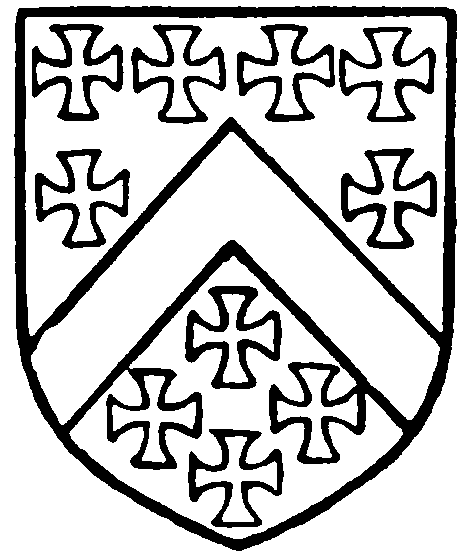
Berkeley. Gules a cheveron and ten crosses formy argent.
John Smythe, steward of the Earl of Berkeley, wrote an account of the manor of Bosham in 1637. (fn. 58) It comprised the seven tithings of Bosham, Bradbridge, Hook, Creed, Walton, Fishbourne, and Southwood, and also Funtington with East and West Ashling, all of which attended the court baron at the manor-house, adjoining the church. There were three particular courts leet, and one 'great leet called Sheriff's Tourne', which were attended also by the tenants of four other manors in the Isle of Thorney and Chidham. There were about 20 freeholds, including Bowley in Pagham; the demesnes, comprising 1,600 acres, were let at that time, under 24 leases, for £631 10s., and there were 175 acres of coppice. There were some 4,000 acres of copyhold land, bringing in about £84 in rents, and they were of three varieties: (1) Forrepland, which paid relief as a socage tenure, but no heriot, and its holders did not have to serve as bailiffs; (2) Boardland, from which the three bailiffs (see above) were chosen, and which paid a heriot of the best beast or 2s. 6d.; and (3) Cotland (in Creed and Funtington only), each holding consisting of a messuage and 5 acres, paying 5d. for heriot. At Buckfold in Petworth were 9 holdings amounting to 210 acres. The inhabitants of Bosham were exempt from tolls, &c., throughout England, and from contributing to the payment of knights of the shire. The steward of the manor was said to be admiral under a grant of 8 Edward IV.
Henry I gave 30 shillingsworth of land at BROADBRIDGE in Bosham to William son of Ernulf in exchange for the site on which was built the Abbey of St. Mary de Pré at Rouen. (fn. 59) This figures on the Pipe Rolls of Henry II as 'the land of Ærnald of Bradebrigge'. By the 13th century it was held of the Crown as a serjeanty, the holder of which had to give two white capons to the king when he rode past Broadbridge, and it is recorded that on 9 August 1269 William Papillon duly produced the capons when Henry III passed through Bosham. (fn. 60) This William died in 1283, holding by the said service a messuage with 28 acres of arable, an acre of meadow, 2/3 of a mill, and 4s. 6d. rent for lands alienated. (fn. 61) His heir was his nephew Roger; but as the lands had been alienated without licence, these portions were seized into the king's hands, the tenants holding in future directly of the Crown by rent. One portion consisted of a messuage and 8 acres in Walton, alienated to Geoffrey atte Punfold, who died in 1305, when it passed to his son John, (fn. 62) who in 1316 granted it to William de Fisseburne and William son of Isabel de Bradebrugge. (fn. 63) The other portion alienated was a messuage, ⅓ of a watermill, and 18 acres of arable, which William Papillon gave to his brother Henry and his sister Mabel for their lives. After Henry's death Mabel demised this to Rose de Wheghelton, who demised it to Henry de Clare. He died in 1309, leaving a daughter Isabel, then married to Henry atte Houke. (fn. 64) In 1326 Roger Papillon had licence to convey his property to William de Fisseburne, Robert de la Houke, and Alice de Bradebrugge and the heirs of her body. (fn. 65) The whole estate was acquired by Thomas de Whelton and Isabel his wife and Thomas their son about 1340, (fn. 66) and it was probably the younger Thomas who died in 1361 seised of the messuage, mill, &c., in Broadbridge, held of the king, partly by serjeanty and partly by a rent of 15s. (fn. 67) His son Richard, who was then 19, died in 1384, (fn. 68) leaving three daughters, Elizabeth, Margaret, and Joan. (fn. 69) Elizabeth died in 1387, and orders were given that Margaret, then aged 15, should receive a moiety of the estate, and that the moiety of Joan, who was only 12, should be delivered to her next friend outside the line of inheritance. (fn. 70) Margaret died in 1420, as the widow of Richard Fuyst, holding 20 acres in Broadbridge by the service of rendering 1 white capon. (fn. 71) Her heir was her son, by a previous husband, William Scardevyle, aged 30. He died in 1453, leaving a son William, (fn. 72) who settled the watermill and other property on his son Peter. (fn. 73) The latter was succeeded in 1498 by his son William. (fn. 74)
Joan, the other daughter of Richard Whelton, is probably the Joan widow of John Michelgrove, who was holding ½ a mill and lands in Broadbridge in 1439 by service of 1 capon; (fn. 75) her son John Michelgrove who died in 1459, holding by similar service, (fn. 76) left a son John, and the property may perhaps be represented by the lands in Bosham of which, inter alia, Elizabeth daughter of John Michelgrove was seised when she married John Shelley, and which they settled in 1511 on their son William at his marriage. (fn. 77)
One of the two moieties, probably that of Scardevile, came to Ellis Bradshawe, who died in 1545, holding a toft, a fulling mill, and land in Broadbridge by service of 1 white capon when the king rode through the land. (fn. 78) He left a son William, aged 9, but the property passed eventually to his daughter Dorothy Drewe, widow of Roger Drewe of Densworth in Funtington (q.v.), who died in 1595 and was succeeded by her son Bradshawe Drewe. (fn. 79) His son Francis left a son Francis, who died an infant in 1630, and a sister Martha, wife of Sir Gregory Norton, bart., who inherited the property. Sir Gregory, who was one of the regicides, died in 1652 and Martha married Robert, 4th Viscount Kenmure, whom she survived, dying in 1671. The estate is said to have been bought soon after this by one of the Peckhams, from which family it passed by bequest to John Williams; (fn. 80) but all manorial rights seem to have lapsed before that.
In 1086 Engeler was holding 2 hides of Bosham manor. (fn. 81) This was [OLD] FISHBOURNE, as is shown by the 12th-century charter of Turstin son of Engelram (sic) giving to the Prior and canons of Southwick (Hants) 'all my lands of Fisseborn, namely that which King William gave to my father Engeler'. (fn. 82) An inquiry held in 1280 showed that Southwick Priory then held at Fishbourne a messuage and 2 hides of land 'by gift of Thurstin Ingelyr', worth £10 yearly, (fn. 83) and in 1320 the canons had a grant of free warren in their demesne lands here. (fn. 84) The estate remained in the hands of the priory until the Dissolution and in 1540 seems to have been granted to Anne of Cleves as 'the manor' of Old Fishbourne, (fn. 85) but there is no later evidence of its manorial status and its subsequent descent has not been traced.
The second lordship of Bosham consisted of the great estates belonging to the church. The early history of this presumably collegiate establishment is lost, but before the Conquest its endowment amounted to 112 hides; it was given by the Confessor to his Norman chaplain Osbern, who became Bishop of Exeter. In 1086 Bishop Osbern still held 65 hides, but 47 hides lying in Plumpton and Saddlescombe in the Rape of Lewes had been lost and were in the hands of William de Warenne. (fn. 86) It is possible that these distant outliers had been separated before Osbern received the lordship, as both are said to have been held in the time of King Edward by Godwin the priest under Earl Godwin. (fn. 87) The bishop's 65 hides constituted the CHAPELRY OF BOSHAM, which was held by the service of 7½ knights' fees: 2 for Thorney, 1 for West Stoke, 2 for Woolavington, 2 for Elsted, and ½ for Preston in Binderton, (fn. 88) of which the last three places, at some distance from Bosham, were entered separately in the Domesday Survey. (fn. 89) The history of the College of Bosham has been dealt with elsewhere, (fn. 90) and manorially the centre of the lordship was Chidham (q.v.). On the suppression of the college its estates came to the Crown and were granted in 1564 to Sir Richard Sackville, who at once exchanged them to the Dean and Chapter of Chichester. (fn. 91) In 1633 Sir John Howell of Wrotham claimed them under an alleged lease from Sir Richard Sackville, and Dr. Edes, precentor of Chichester, seems to have availed himself of the dispute to acquire a long lease, which passed with his heiress to John Frankland, from whom it was purchased by Richard Barwell of Stansted Park. (fn. 92)
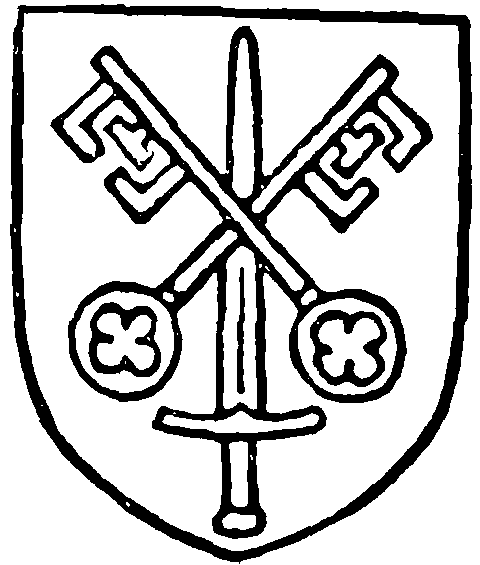
See of Exeter. Gules a sword in pale surmounted by two keys in saltire or.
CHURCH
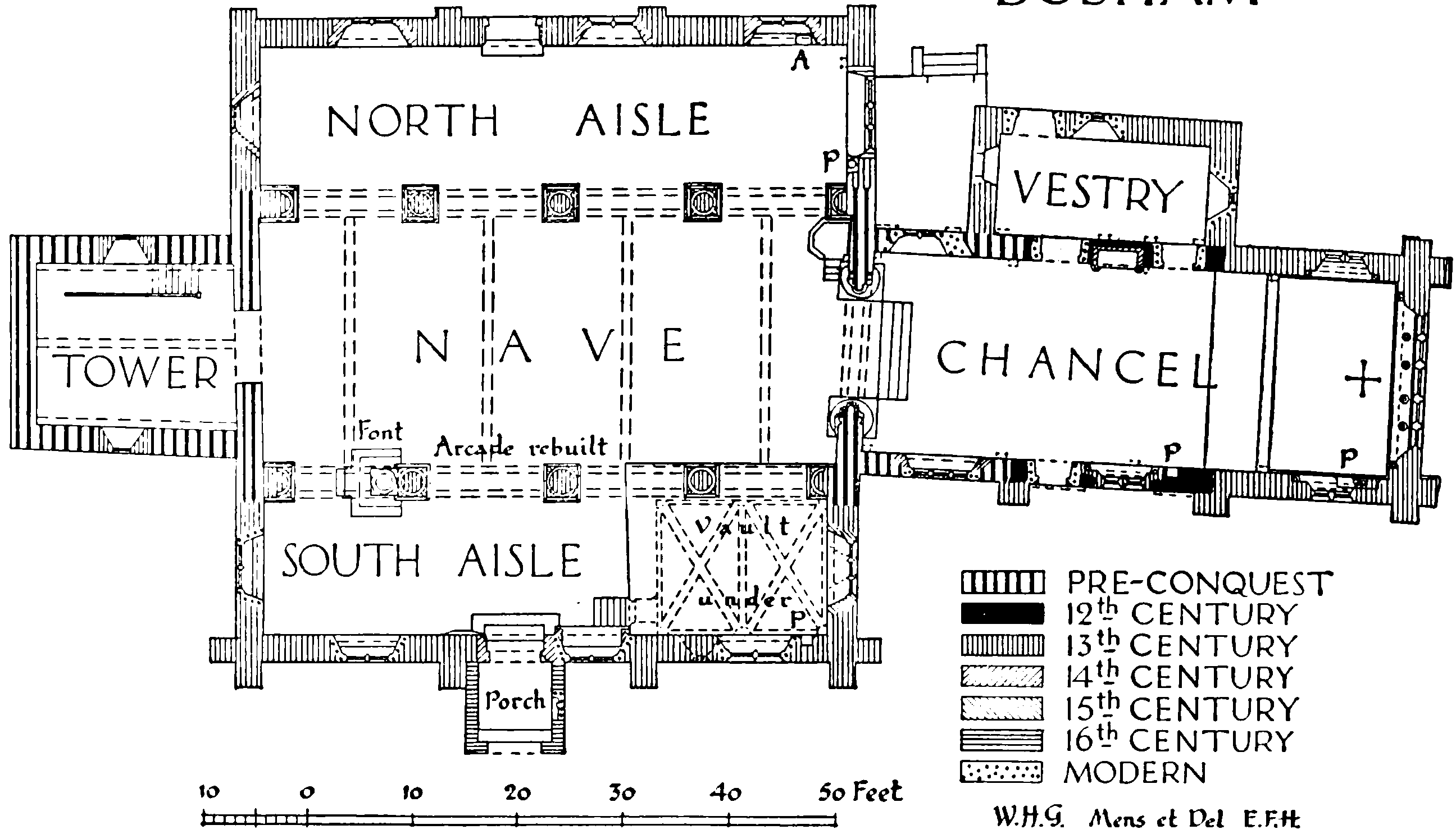
The church of HOLY TRINITY (fn. 93) stands in the middle of the village and is built of rubble with ashlar dressings, and roofed with tile, except the north aisle and sacristy, which are covered with lead, and the spire, which is shingled. The original church consisted of a short chancel, nave, and tower (though this may be an early addition); of this a (very conventional) representation is to be seen on the Bayeux Tapestry; it is also mentioned in Domesday Book. (fn. 94) The chancel was lengthened twice, once in the 12th century, and again in the 13th, when a sacristy was added to the north of it. About the same time aisles were added, the north being the earlier in date; under the east end of the south aisle is a contemporary vaulted crypt, probably a charnel. (fn. 95) The south porch is of the 16th or 17th century.
At each of the two eastern corners of the chancel is a pair of buttresses of two stages each with sloping offsets; there are two like buttresses on the south side, but the sacristy walls take their places on the north. The east window is a group of five lancets, rising to the centre, separated by slender piers. On the inside they are enclosed by a stilted segmental pointed arch, moulded, carried on Purbeck marble shafts with moulded capitals and bases; four shafts of like design carry the rear-arches (but their abaci are not of marble), those of the middle three lights being stilted. In both north and south walls of the east bay is a pair of lancets under a common moulded rear-arch on Purbeck marble shafts like those of the east window. Below the south window is a double piscina under two arches, each a round-headed trefoil, carried on a short shaft whose capital is carved with foliage and its base moulded. A moulded string-course runs round all three sides of this bay; this work is all of the 13th century.
PARISH CHURCH of The HOLY TRINITY BOSHAM
On the north side of the next bay are the door to the sacristy and the arch of the organ keyboard opening into it, both modern plain pointed arches. Between them is a niche tomb surmounted by a pointed cinquefoiled arch, moulded, with remains of crockets on the extrados, resting on triple shafts with moulded capitals and bases. In this niche is the somewhat mutilated effigy of a lady, of less than life size, bare-headed and wearing a sideless cotte, her feet rest on a lion; below the niche are four cinquefoiled panels; this is late-14th- or 15th-century work. (fn. 96) Over this tomb is an opening, possibly originally a window like that in the east bay and of the same date, now occupied by the organ. In the south wall is a window like that in the east bay and of the same date, and a doorway with plain pointed head, its stonework wholly renewed; below the window is a piscina with plain pointed head and mutilated drain, perhaps early-13th-century. The original walling of this bay is of about the 12th century and shows herring-bone rubble, the plaster of the inside walls having been stripped off. Remains of a weather-mould suggest that a lean-to building may once have stood outside this bay.
In the westernmost bay on the south side is a three-light window of three lancets surmounted by two quatrefoils; this is modern, but the lancets may reproduce old work, and the rear-arch and splay jambs are ancient. On the north side is a two-light window with net tracery, now wholly modern; east of it are visible the arch and one jamb of a pre-Conquest window with round head and concentric splay; this bay represents the original chancel. At the extreme west end of the south wall are traces of a blocked doorway. About nine carved human heads built into the inner side of the chancel wall below plate level may be the remains of corbels of a former roof.
The sacristy, originally of the 13th century, is of two stories; the lower has been much altered and now has modern single-light windows with square-headed trefoil heads on the east and north sides and a doorway with plain pointed arch and jambs on the north; the upper story has ancient square-headed single-light windows on the east and north.
The chancel arch (pre-Conquest) is semicircular, of two orders each worked with a bold roll moulding; the outer order is carried on nook-shafts, the inner on a shaft attached to the face of the respond; each shaft has a crude bell capital, and above these is an abacus common to all, made in two stages, the lower semicircular on plan, the upper square; the base is of the same design inverted. This work has been claimed, on insufficient evidence, to be Roman work reused. South of the chancel arch on the west side is a crude triangular piscina of doubtful date.
The north arcade is of four bays with pointed arches of two chamfered orders, showing some attempt at chromatic decoration in the different colours of the voussoirs; the piers are cylindrical with moulded capitals and bases, the latter of the water-holding type with spurs and resting on square pedestals; this is 13th-century work. Above the arcade are three circular windows, about 1 ft. across, with concentric splays, of pre-Conquest date.
The south arcade resembles the north, but the mouldings of the (renewed) capitals are of different profile; the bases of the east respond and of the pier next to it are at a higher level than the others, resting on the wall of the crypt; all the capitals and arches of this arcade have been rebuilt in modern times and any windows corresponding to those on the north have disappeared.
The tower arch (pre-Conquest) is semicircular, or slightly horseshoe, in form, and of one order, the joints of some of the lower voussoirs approaching the horizontal; it shows some chromatic decoration, and rests on chamfered imposts and square jambs which show long and short work. At the level of the first stage of the tower is a doorway having a plain straight-lined arch on square jambs with neither rebate nor doorcheck, presumably pre-Conquest and intended to give access to a gallery; to the south of this is a small square-headed opening of uncertain date, probably a squint for the ringer of the Sanctus bell; a plain round-headed doorway at the next stage may have given access to a chamber above a former flat ceiling.
On the north face of the north aisle are four buttresses, each of one stage with sloping offsets, of the 13th century. In the east wall is a three-light window with trefoil-headed lights and scanty tracery under a segmental-arched head, 16th-century; south of it is a piscina with moulded round-headed trefoil arch, 13th-century but incorporating as its drain a pillar piscina of the 12th.
In the north wall are a rectangular wall locker of uncertain date, a doorway with moulded pointed arch and hood-moulded and semicircular rear-arch, 13th-century, and three two-light windows with net tracery, modern but perhaps reproducing 14th-century work; in the west wall is a single-light window with uncusped arch, slightly pointed, 13th- or 14th-century.
The south aisle has pairs of buttresses at each outside corner, and two intermediate ones; these are of one stage with sloping offsets, perhaps late-13th-century; the south wall is surmounted by a cornice and battlemented parapet of about a century later. In the east wall is a three-light window with geometrical tracery, in the south are three two-light, and in the west wall one two-light, windows in 14th-century style; the stonework of all these is modern. In the south wall at the east end is a piscina with pointed trefoil head and credence shelf, and between the second and third windows is a doorway with moulded pointed arch, hood-mould, and jambs and segmental rear-arch, 14th-century; the woodwork of this door is ancient, of two layers of planking.
Under the sill of the middle window is a niche tomb with segmental pointed cinquefoil arch with subcusping and carved human heads (one missing) on the cusps; this is set in a square frame with panelled trefoil spandrels, and is probably 15th-century work.
Under the eastern part of this aisle is a small crypt, its pavement being about 3 ft. below the level of the church floor. It is vaulted in two bays with quadripartite vaulting having groin, division, and wall-ribs of semi-octagon section resting on plain corbels, and is lit on the east and south sides by openings at ground level about 9 in. high; access is from the aisle by a doorway with plain pointed arch and jambs; the door and door furniture are ancient. This is evidently coeval with the construction of the aisles.
The south porch has rubble walls on the east and west and a plain pointed opening in brick on the south; there are traces of a blocked window in the east wall. Though much restored this work may originally have been of the 16th or 17th century.
The roofs throughout are modern, reproducing the pitch of ancient roofs which had subsequently been lowered.
The lowest stage of the tower (pre-Conquest) shows long and short work in its western quoins, and some, probably Roman, brickbats in its rubble. On both north and south sides are small single-light windows, round-headed, but 13th-century; above this stage there is a string-course on the north and south sides. The next stage has similar windows on the north, west, and south sides, and a string-course on the north side only. The third stage has on the north the round arches and jambs of a pre-Conquest two-light window whose mid-wall shaft has perished (a modern two-light window like those in the uppermost stage occupies its place); on the south side below a modern stone clock dial the remains of the jambs of a similar window are traceable; on the west are still more doubtful remains of a window. The uppermost stage has on the west face a window like that on the north of the stage below, the mid-wall shaft, with carved capital (of a form suggesting post-Conquest work) exists here; on the other three faces are square two-light windows with trefoil-headed lights, 15th-century; this stage ends with a corbel-table and is surmounted by a broach spire.
The font (late-12th-century) is an octagonal block with plain sunk round-headed panels; it rests on five shafts, one thick, the rest slender, which have no capitals but a moulded base.
Of the ancient stall-work one bench-end survives, its arm-rest being carved with a representation of an angel. (fn. 97)
In the chancel is a large wooden chest with front and back of three planks each, framed ends, and single-slab lid; it has two tills, one secret; this is 13th-century work.
The other fittings are modern.
There are six bells: (fn. 98) (1) and (2) by Richard Phelps, dated 1713 and 1709 respectively; (3) dated 1665; (4) dated 1572; (5) by Clement Toscar 1688; and (6) by W. and T. Mears, 1787.
The communion plate includes a plain silver cup given by George, Lord Berkeley, in 1675, and a paten of 1692 given by Dr. Henry Edes. (fn. 99)
The registers begin in 1557.
ADVOWSON
Bosham can claim to be the most ancient site in Sussex with a continuous tradition of Christianity. When St. Wilfrid came to convert the South Saxons in 681 there was already, according to Bede, a small Celtic monastery at Bosham, with five or six brethren under the headship of Dicul. As late as 1637 'the ruynes of an out worne foundation' near the church were still pointed out as 'St. Bede's Chapel', (fn. 100) but all memory of the spot has long been lost. The history of the church as a collegiate establishment has been already dealt with. The nave of the church was parochial and the services were conducted by a perpetual vicar presented by the canon holding the Parochial Prebend. The vicarage was rated at £4 6s. 8d. in 1291 (fn. 101) and at £6 13s. 4d. in 1535. (fn. 102) After the suppression of the college in 1548 the advowson remained in the hands of the Crown until about 1613, (fn. 103) after which date it was held by the Dean and Chapter of Chichester or their lessee until it passed to the bishop under the Act of 1840.
In 1330 licence was given for the alienation in mortmain by Laurence de Rustiton and James de Northstok of some 40 acres to Mr. William de Fisshebourne, Prebendary of Funtington, to support a chaplain celebrating daily in the church of Bosham for the good estate of Thomas, Earl of Norfolk, and for the soul of Alice his wife. (fn. 104) This was the chantry of the Blessed Mary in the nave of Bosham church to which several presentations were made by the Prebendaries of Funtington during the 15th century. (fn. 105) At the suppression of the chantries in 1548 it was called the Chantry of Fishbourne, its yearly value being 40, (fn. 106) and its lands were granted to Henry Polsted. (fn. 107)
CHARITIES
Elizabeth Beazley.
The share of the charity of Elizabeth Beazley applicable for this parish consists of an annual payment of £1 applied by the vicar and churchwardens for the benefit of the poor of the parish.
Elizabeth Nash.
By an indenture dated 10 November 1716 Elizabeth Nash granted to trustees certain lands in Sidlesham upon trust that out of the rents and profits 20s. be paid to the minister of Walberton for the benefit of the poor of that parish and that the remainder of the income should be divided into three parts, one part to be applied for the parish of Boxgrove, another part for the parish of Bury and the tything of Westburton, and the remaining part for this parish. The third part of the income for this parish is applicable for poor people, being sick, lame, ancient, and most needy, in money, clothes, or other necessaries. The annual income amounts to £5 approximately and is administered by the vicar and churchwardens.
Catherine Joanna Preece by her will dated 19 June 1940 bequeathed her property known as Pearcey's Cottage, Bosham, to the Roman Catholic Bishop of Southwark for the benefit of the Roman Catholic Mission in Bosham.
George Frank Graham Rochfort Wade by his will dated 31 July 1936 bequeathed £200 upon trust to form the May Rochfort Wade Fund, the annual income to be divided on 6 May in every year between the four oldest male old-age pensioners and the four oldest female oldage pensioners, all eight being natives of and living in Bosham. By a scheme of the Charity Commissioners dated 23 January 1940 it was provided that the charity shall be administered by the vicar and churchwardens of Bosham. The annual income amounts to £8 3s. 10d.