A History of the County of Hampshire: Volume 3. Originally published by Victoria County History, London, 1908.
This free content was digitised by double rekeying. All rights reserved.
'Parishes: Empshott', in A History of the County of Hampshire: Volume 3, ed. William Page (London, 1908), British History Online https://www.british-history.ac.uk/vch/hants/vol3/pp17-19 [accessed 10 May 2025].
'Parishes: Empshott', in A History of the County of Hampshire: Volume 3. Edited by William Page (London, 1908), British History Online, accessed May 10, 2025, https://www.british-history.ac.uk/vch/hants/vol3/pp17-19.
"Parishes: Empshott". A History of the County of Hampshire: Volume 3. Ed. William Page (London, 1908), British History Online. Web. 10 May 2025. https://www.british-history.ac.uk/vch/hants/vol3/pp17-19.
In this section
EMPSHOTT
Hibesete, Imbesete, Yuleshate (xiii & xiv cent.); Impshott (xv cent. et seq.).
Empshott is a small parish of about 761 acres lying between Selborne and Hawkley. It is on exceptionally high ground, and is reached by a steep hill, both from Selborne on the north and Hawkley on the south. The village consists only of a few scattered farms and houses, a church, and vicarage. (fn. 1) Ellis's Farm is to the west, Reed's Farm and Butler's Farm to the east, Grange Farm to the north, and Brunstable and Burhunt to the far north near the border line between Selborne and Empshott. The road from Selborne enters the parish between the two farms and branches for a second time just below Grange Farm, which is probably on the site of the original manor house. The branch to the west leads to the vicarage and on to Ellis's Farm, while that to the east leads to Holy Rood Church. At the back of the church is the Grange, owned by Mr. A. E. Scott, standing in the midst of well-wooded country. A little further down on the eastern road is the old farmhouse, now almost in ruins, which, according to local tradition, was once a hiding place of Charles II. South-east of the Grange is Lithanger, now tenanted by Lord William Seymour, and still further east is Empshott Lodge, the residence of Mrs. Butler, backing on Empshott Terrace. The National school which was enlarged in 1872 and a few cottages are also in this remote corner. The parish lies on marl with a subsoil of rock, and consists of a series of corn and wheatfields with a few hopfields interspersed, nestling among small woods and hangers. The arable land of the whole parish only covers 362¾ acres, 244¼ acres are pasture land, and 38 woodland. (fn. 2) The River Rother rises in the south and flows along south of the village, otherwise with the exception of a fish-pond near Lithanger there is no water in the parish.
MANOR
The manor of EMPSHOTT was held of the king in the reign of Edward the Confessor by Bundi and Saxi, and at the time of the Domesday Survey by Geoffrey Marescal, (fn. 3) otherwise Geoffrey de Venuz, the king's marshal. (fn. 4) From Geoffrey it descended to Robert de Venuz his son and heir, to Robert's son William, (fn. 5) to William's son Robert, and to Robert's son John who was holding in the reign of Henry III. (fn. 6) During the thirteenth century the manor remained in the hands of the Venuz family, but by the reign of Edward II it had come into the possession of Aymer de Valence, earl of Pembroke, who died seised of half a knight's fee in Empshott in 1323. (fn. 7) Like Newton Valence, Hawkley, and Oakhanger (q.v.) the manor then passed to Laurence de Hastings, grandson of Aymer's sister Isabel, (fn. 8) and seems to have been included, though not by name, in the grant made by Laurence to Thomas West in 1339 (fn. 9) since in 1532 Empshott was said to be held of Thomas West, Lord De La Warr, as of his manor of Newton Valence. (fn. 10) From this date all trace of the overlordship seems to be lost, the tenure not being returned in later inquisitions.
William Dawtrey (de Alta Ripa) was holding the manor of Empshott in 1291, in which year he settled it on Peter de la Stane (or Stone) (fn. 11) for life, with reversion to John Dawtrey (possibly son of William) and Elizabeth his wife, who may have been a daughter of Peter, (fn. 12) with reversion to the heirs of Peter if John and Elizabeth died without issue. It is just possible that this Elizabeth survived her husband and became the wife of James de Norton who held the manor in the early fourteenth century. (fn. 13) By 1316, however, William Paynel was holding Empshott, evidently by the right of his wife Eva, who possibly was the direct heir of Peter de la Stane, and succeeded to the manor on the death of Elizabeth because Elizabeth had no children by her first husband. (fn. 14) William died without issue in 1317, (fn. 15) and Eva, who in 1321 was abducted and married by Edward de St. John, 'she being willing and consenting thereto,' (fn. 16) was holding the manor conjointly with her second husband in 1346. (fn. 17) She survived him also and lived until 1354, when the manor passed to her kinsman and heir Roger son of John de Shelvestrode. (fn. 18) Joan, the daughter and heir of John de Shelvestrode, and probably granddaughter of Roger, married John Aske of Yorkshire, (fn. 19) who in 1428 was holding the half fee in Empshott which Edward de St. John once held. (fn. 20) From this date the manor remained in the Aske family until it was confiscated in 1537 by reason of 'divers treasons made, perpetrated, and committed' by Robert Aske the leader of the Pilgrimage of Grace. (fn. 21) In May, 1537, Robert Aske wrote to Cromwell begging him to petition the king for the payment of his debts, among which came the 'board of my workmen at Imbishot about 30s. and workmen 30s. These may be paid out of my goods that my soul abide no pain for the satisfaction hereof, for at my coming to London I intended to have paid.' Moreover he asked that his lands in Hampshire might revert to the right heirs, 'for I only had them for life, and yielded £8 a year to my brother.' (fn. 22) However in 1537 Empshott was granted to Sir William Sandes, Lord Chamberlain of the Household, (fn. 23) who within the next few years conveyed the same to Sir William Fitzwilliam. Sir William Fitzwilliam conveyed Empshott by fine in 1548 to John Norton, the lord of East Tisted, (fn. 24) who in 1560 died seised of the manor, which from this time followed the same descent as that of East Tisted (q.v.) until sold by Norton Poulett to John Butler of Bramshott in 1750. (fn. 25) In 1762 John Butler by will devised the manor to his eldest son John, who died without issue, leaving the estate to be divided among his two brothers James and Thomas and his sister Ann. (fn. 26) In 1792 Ann and her husband, John Newland of Petworth, Sussex, conveyed their third in the manor to John Butler of Havant, (fn. 27) and in the same year Thomas Butler conveyed his third to the same, while in 1794 James Butler conveyed his third. (fn. 28) In 1805 Col. John Butler, who served in the Indian Mutiny, was still lord of the manor. After his death his widow Henrietta Butler and his brother Thomas Butler held the courts of the manor as trustees for his son Frederick John Butler, the present lord of the manor. (fn. 29)
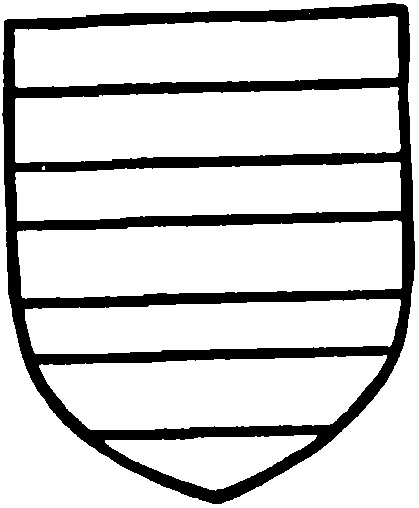
Aske. Or three bars azure.
The courts of the manor have always been held in Grange Farm, which was originally the manor house, and in a conveyance of the farm made in 1792 a special provision was made that John Butler and his heirs and assigns, being lords of the manor of Empshott, should hold courts for the said manor 'in that part of the manor house where courts have usually been held.' The customs are for the most part quite ordinary, except that, according to the court book, all the tenants are supposed to purchase the timber on their estates.
CHURCH
The church of the HOLY ROOD has a chancel 24 ft. 6 in. by 14 ft. 9 in., with a modern south vestry, nave 43 ft. by 23 ft., and west porch, with a wooden bellturret over the west end of the nave. A chapel at the north-west of the chancel, and north and south aisles to the nave, formerly existed. In 1860 the east wall of the chancel and its windows were repaired, and in 1868 the rest of the chancel, a new roof and south vestry being added. The bell-turret and walls of the nave were repaired in 1884.
The chancel is the oldest part of the building, and was begun soon after 1200, the north-west chapel being contemporary with it. The work was carried on slowly, the chancel arch and north arcade of the nave being next built, and then the south arcade. There is no evidence that a west tower was ever contemplated, and the east wall of the nave has been thickened on the west side, probably to carry a bellturret on the gable above. By the beginning of the seventeenth century the church seems to have fallen into bad repair, and the date on the screen at the west end of the nave, 1624, is probably that of the alterations which have brought the building to its present shape. The north chapel has entirely disappeared, and the outer walls of the aisles have been rebuilt close to the nave arcades, leaving a space of barely two feet between them. A wide arched opening has been made in the west wall of the nave, and the screen before noticed set across it, with a porch forming the main entrance to the church at the west. The chancel has three lancets in the east wall, with keeled rolls on the inner heads and jambs, having bases at the level of the sills, and labels with dogtooth over the arches. Modern cinquefoiled heads have been inserted in the lights. The side walls of the chancel have been pushed outwards, whether by a roof or failure of foundation, and the gap between them and the east wall bonded with ashlar masonry. Each wall has two modern buttresses. In the north wall is a lancet window, in which at the glass-line have been inserted small half-shafts and capitals of twelfth-century style, with a round arch. East of the window is a modern recess with the Ten Commandments, and below it a shouldered locker. The arch formerly opening to a north-west chapel is of one square order, pointed, with a moulded string at the springing on the east side, and three moulded corbels at the west, the jamb on this side being set back six inches from the soffit of the arch. Over the arch is a label with dogtooth, partly overlapped at the west by the west wall of the chancel, which is cut back to expose it. The arch is blocked with a thin modern wall in which is a cinquefoiled light.
The south wall has at the east a modern recess like that in the north wall, and to the west of it a tall lancet, which seems to have been widened. Near the west end is a plain round arched opening 6 ft. 8 in. high, in which is a pointed arch, apparently modern, opening to a modern vestry. All the original masonry in the chancel has diagonal tooling.
The chancel arch is pointed, of two chamfered orders, with a label having a line of dogtooth and clustered responds, with foliate capitals and moulded abaci and bases. On its west face an arch of some-what higher pitch has been built over it, projecting one foot, and overlapping the labels of the nave arcades; it is clearly an afterthought, and its jointing does not range with the responds of the arcades or chancel arch. The tooling on the chancel arch is vertical.
The nave arcades are of four bays, and though not far apart in date, differ considerably in detail. The north arcade has pointed arches of two chamfered orders with dogtooth labels. All capitals have well-executed foliage, and square abaci moulded like those in the arch at the north-west of the chancel. The middle pillar of the arcade is octagonal and the other two round, while the responds have each had three shafts, which remain at the east, but the middle shaft of the west respond has been cut away and its capital replaced by a corbel. The tooling on the arches is diagonal, except on the soffits.
The south arcade differs from the north in having its arches worked with larger stones and rather coarser chamfers, and the tooling is vertical. The arrangement of the pillars is the same, but the responds have no shafts, and only a moulded corbel to take the inner order of the arch. The capitals have no foliage, like those on the north side, but that of the first pillar from the east has a late form of scallop, the middle pillar a plain hawksbill section, and the third is worked with hollow flutings. The side walls of the aisles, as has been said, have been rebuilt close to the arcades, and contain windows which may be, in part, of ancient date, but are mainly of the date of the rebuilding. The four on the north are all single pointed lights, the eastern window having a Jacobean quarter-round moulding, and on the south are three windows, two lancets and one two-light window. One of the lancets and the two-light window have the same Jacobean section, and the latter has a blank quatrefoil in the head. In the west bay on this side is a pointed archway with square jambs, blocked, with a single-light window set in the blocking. There is nothing to show whether a door has ever been hung here.
At the west end of the nave is a wide pointed arch of a single order, and in it a very good wooden screen with a cresting of pierced strapwork inclosing a shield. On the screen is the inscription, 'The gift of James Medecaulfe 1624,' and the arms on the shield are those of Metcalfe; vert, three calves gules, quartering four other coats.
The porch has small windows on the north and south, their heads being those of twelfth-century lights re-used, and a plain pointed west doorway with a panel over it inclosing a date of which the first numeral only is left.
Over the west end of the nave is a wooden bellturret with a shingled spire. It is open to the church below, and the part immediately above the nave roof is glazed between the upright timbers, lighting the west end of the nave in a very satisfactory way. Its east side is carried on a seventeenth-century truss, probably part of the work done in 1624, and the turret is perhaps of the same date. The rest of the nave roof is modern, of fifteenth-century style, and the chancel roof is the same. Part of a Jacobean pulpit stands at the west end of the nave, and a panel from it is worked into the modern reading desk. The altar rails and table are of the seventeenth century, and in the nave are a good number of open benches with sunk trefoiled panels in the ends, of fifteenth or early sixteenth-century date.
The font is of Purbeck marble, with a square bowl ornamented with five shallow round-headed arches on each side, and carried on a central and four angle shafts. Its date is c. 1190. It has a wooden cover dated 1624. On either side of the east windows of the chancel are remains of late painting in black, a floral design apparently of seventeenth-century date.
The plate consists of a silver cup and paten of 1620, a paten of 1829, and a plated cup of old Sheffield make.
In the bell-turret are two bells, of 1627 and 1897. The earliest register dates from 1718 to 1795, and the second from 1754 to 1812. The churchwardens' accounts date from 1754.
ADVOWSON
The chapel of Empshott was granted in free alms by Ralph son of Gilbert and Constance his wife to the priory of Southwick, probably soon after its foundation in 1133, (fn. 30) and was confirmed to them by Papal Bull between 1159 and 1181. (fn. 31) In 1242 a compact was made between the prior and convent of Southwick and the prior and convent of Selborne concerning the tithes of Empshott. The prior and convent of Southwick, by reason of their rights in the chapel of Empshott, were to have all the great and small tithes owed by the lord of the manor of Empshott, together with half the small tithes of the villeins of Empshott, while the prior and convent of Selborne were in the name of the parish church of Selborne by reason of parochial rights owned by them in the chapel of Empshott 'to have the other moiety of small tithes of villeins.' (fn. 32) In virtue of this agreement the prior of Selborne claimed the moiety from Gilbert vicar of Empshott in 1283, and by the judgement of the prior of Southwark, the papal delegate, the prior's right was established, and Gilbert was condemned to pay 20 marks for the tithes of which he had deprived them. (fn. 33) The vicarage was ordained in 1333. (fn. 34) The church remained in the hands of the house of Southwick as late as 1535, since it was entered in the Valor Ecclesiasticus as appropriated to the priory of Southwick. (fn. 35) Between 1535 and 1537 it was evidently granted away by the priory, and does not appear on the Ministers' Accounts. (fn. 36) In 1590 Elizabeth granted the free chapel or church of Empshott to William Tipper and others, (fn. 37) and confirmed the same in 1592. (fn. 38) In 1595 she granted the same to John Wells and Henry Best, (fn. 39) who conveyed to Richard Norton and George Leicester. (fn. 40) George Leicester sold to Richard Norton in 1596, (fn. 41) and in 1597 Richard Norton conveyed to William Brice. (fn. 42) The latter in 1601 conveyed back to Richard Norton, (fn. 43) and from that time the church and advowson followed the same descent as the manor of Empshott (q.v.) until 1803, when John Butler of Havant made release of it to his brother the late Rev. Thomas Butler, by whose representatives it is held at the present day.