
A History of the County of Hampshire: Volume 3. Originally published by Victoria County History, London, 1908.
This free content was digitised by double rekeying. All rights reserved.
'Parishes: Bramdean', in A History of the County of Hampshire: Volume 3, (London, 1908) pp. 45-50. British History Online https://www.british-history.ac.uk/vch/hants/vol3/pp45-50 [accessed 26 April 2024]
In this section
BRAMDEAN
Brondene (xi cent.); Brundon, Brandun, and Brendon (xii cent.); Branden and Bromdene (xiii cent.).
Bramdean is a small parish, with an area of 1,237 acres, situated nine miles east from Winchester. The village, in the south-west of the parish, lies along the main road from Petersfield to Winchester, at an average height of 270 ft. above sea-level, the fall of the ground being westward, and close to the west boundary of the parish is the source of the little stream which runs through Cheriton and Tichborne to join the Alre below Alresford, a short distance above its junction with the Itchen. Bramdean Common in the north-east of the parish rises to 450 ft., and the view from the wooded ridge which forms its northern boundary is very striking. The open common slopes down, backed by woods on the south and east, and crossed by two roads, one running south-east towards West Meon, the other south-west to join the Winchester road in the middle of Bramdean village. At the south-west of the common is a group of thatched and timbered cottages, and beyond them the view opens out over the lower ground on which the village stands to the downs which form the western boundary of the Meon valley, Beacon Hill, five miles away, standing out against the skyline. The well-timbered park and grounds of Woodcote House, now occupied by Sir Francis Seymour Haden, are in the south-west angle of the parish, north of the Winchester road, and a short distance east of the village. The thatched and ivy-covered Manor Farm stands at the west of the village on the south side of the road, and beyond it is the Fox Inn with its large bay windows. On the higher ground to the south is a picturesque group of houses, to which a road strikes off at right angles. The rectory stands in the middle of the village, on the south of the road, at the point of junction with the road from Bramdean Common, and is in part of considerable antiquity, with some good early seventeenth-century panelling and beams. Further to the west is the church, standing half hidden by trees on the hillside to the south, and approached by a steep lane, at foot of which is a brick bridge over a dry water-course which runs all along the south side of the village street. To the east of the church is College Farm, an eighteenth-century red brick house of good style, with several well-designed chimney-pieces. The rectory meadow, planted with several fine trees, rises towards the church from the main road, and opposite to it on the north is Bramdean House. This house formed part of the property entailed by the Rev. Egerton Arden Bagot on his sister Honora, the wife of the Rev. the Hon. Augustus George Legge, about the middle of last century, and is at present the property of the Misses Legge, the heirs of the Rev. Augustus George Legge. The gravel valley in which the village lies was apparently in former times the bed of a river. At irregular intervals a spring bubbles up from what is called 'a pocket' in the chalk in Woodcote Park by the roadside, flows through the village and across the meadows to Hinton Ampner, and finally joins the Itchen at Cheriton. For years perhaps the brick arch of the church path and the channel by the roadside might be considered a needless precaution, but as recently as the winter of 1903–4, after a very heavy rainfall during the summer and autumn, there was a swiftly-flowing stream covering the village street and flooding floors and cellars. Bramdean Lodge, the residence of Mr. Charles A. Linzee, lies to the northwest of the road from Bramdean Common, close to the schools. On the common is a small iron chapel of ease erected in 1883. Much of the land in Bramdean is a flinty loam on a subsoil of chalk well adapted for the growth of barley. Along the valley in which the village is situated the upper soil rests on a subsoil of gravel. The chief crops are wheat, oats, barley, and turnips. The parish contains 714¾ acres of arable land, 305½ acres of permanent grass, and 168 acres of woods and plantations. (fn. 1) Among place-names in Bramdean found in the thirteenth and fourteenth centuries are the following:—'Torte Acre, La Breche, Vineshawede, Sendrie londe, Setacres, Setesgrovesforlonge, Grithethhorne, La Wogelonde, Hankeneweie, Eustrecumbe, and Schepehusezorne.' (fn. 2) A wood called 'Imbele' and a messuage and land called 'Jenettes lond' occur in inquisitions taken in the fifteenth century.
MANORS
At the time of the Domesday Survey Miles the porter held BRAMDEAN of the king. Two freemen had held it, as three manors, in the time of King Edward. (fn. 3) The service by which Miles held must have been that of keeping the gate of the king's gaol of Winchester. This service and the personal character of the early owners seem to have determined the history of the manor.
In 1199 Henry de Bramdean, then owner of Bramdean, lodged his claim to the service of being porter of the gaol of Winchester, as his inheritance from his father, except one hundred shillingsworth of land which William de Hoe held of the grant of King Richard. (fn. 4) Documentary evidence between 1086 and 1198 is wanting, but the subsequent history would make it seem probable that the Bramdean family, being engrossed in pursuits which soon landed it in the grip of money-lenders, (fn. 5) neglected the service which they owed to the king of keeping his gaol in the city. As it was a matter of necessity that this service should be put in the hands of a responsible and local man, Richard I granted the one hundred shillingsworth of land before referred to to the less important personage who really performed the duty. The subsequent history of this land is shown under the heading of Woodcote (q.v.). For a time, however, there seems to have been some doubt as to the service, for in the Testa de Nevill it is said that Henry de Bramdean held Bramdean 'per custodiam gaole Winton quam dicit ad se pertinere.' (fn. 6)
From the year 1224 onwards Hugh de Bramdean was alienating his manorial lands piece by piece, (fn. 7) and finally in 1236 granted his capital messuage and 60 acres of land, together with 140 acres in Bramdean, 24s. quit-rent, Bramdean Wood, and the advowson of the church of Bramdean, (fn. 8) to the priory of Selborne in frankalmoign for the annual rent of 4s. and a covenant by the prior to give every year to Hugh and Maud his wife six loads of wheat and three of barley and 4 marks of silver, and to their son and heir Bartholomew 6 quarters of wheat and 1 of barley and 2 marks of silver. (fn. 9) The prior compounded with Alan Fitz-Warin, (fn. 10) John de Blakedown, (fn. 11) and Nicholas his brother, for their interests in the manor for £100, (fn. 12) but some fifteen or twenty years later Alan and John extorted 43 marks and £100 respectively for a final surrender of their claims. (fn. 13) Other premises in Bramdean which had been alienated by Hugh de Bramdean were bought up by the prior and convent as opportunity arose. Soon after 1260 Amice de la Cnolle released to the prior of Selborne all her right and claim in the wardship and marriage of John son and heir of Andrew de Caen, and in all his lands and tenements in Bramdean. (fn. 14) In 1289 Richard son and heir of Henry de la Putte granted lands in Bramdean to the priory. (fn. 15) Margery the widow of Walter Launcel in 1293 released to the priory the land which her father had given to her, (fn. 16) and some time afterwards her son Walter Launcel (fn. 17) made a further grant of 32 acres of land and 5 acres of wood. In 1302 the prior and convent of Selborne were pardoned for acquiring the lands in Bramdean from Richard de la Putte and Walter Launcel contrary to the statute of Mortmain. (fn. 18) By this time the priory was in possession of nearly, if not all, the lands in Bramdean formerly held by Hugh de Bramdean, (fn. 19) and the manor remained in its possession till the end of the fifteenth century. The affairs of the priory having become much involved, Bishop Waynflete, on 2 September, 1484, appointed Richard, prior of Newplace, and two others, to hold an inquiry as to annexing the priory to Magdalen College, Oxford, which the bishop had lately founded. (fn. 20) The decree of annexation was pronounced on 11 September, 1484, and in 1486 the manor of Bramdean was transferred with the other possessions of the priory to the college (fn. 21) and remains with them to the present day. The manor house was probably on the site of the modern 'Manor Place Farm,' which is at present occupied by Mr. George Anthony Dowling, to whom the college lets all its property in Bramdean except its woodland as one holding. The college has still certain manorial rights at Bramdean, particularly in regard to the common, but it no longer holds a court there as it does at Selborne.
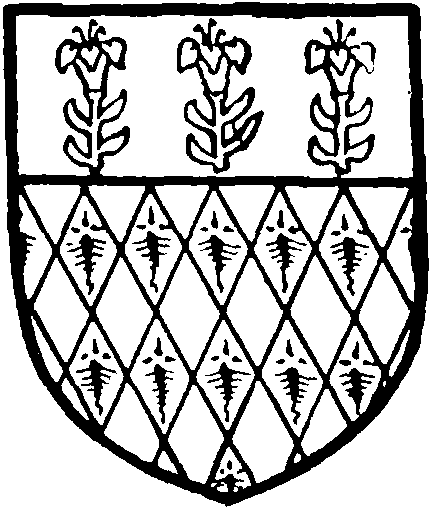
Magdalen College, Oxford. Lozengy ermine and sable a chief sable with three garden lilies therein.
The manor of WOODCOTE (Wudecote, Wcdecota, Wodecot, Wutecot, Woodecote, and Woodcot, xiii cent.; Wodekote, xiv cent.; Woodcott, xvi cent.), as has been shown, owed its origin to the neglect of the family of Bramdean to perform the service of keeping Winchester Gaol. King Richard I granted the manor to a certain William de Hoe to hold by this service. (fn. 22) As soon as King John came to the throne, Henry de Bramdean disputed William de Hoe's claim to the custody of the gaol, though not to the ownership of Woodcote. (fn. 23) John, however, disregarded the claims of both Henry and William, and in 1204 bestowed the custody of the gate of the castle and gaol of Winchester, together with the land of Woodcote, appertaining to the custody, upon Matthew de Wallop to hold to him and his heirs for ever. (fn. 24) In return, Matthew and his heirs were to mew the royal hawks within Winchester Castle, finding one servant at their own cost to mew them and to keep them throughout the whole mewing season. They were also to find the cost of three harehounds in the same castle throughout the same season. It is clear from the patent rolls that Matthew was still holding the office of warden of the gaol in 1207 (fn. 25) and 1215. (fn. 26) In the latter year he evidently wished to resign, but the king ordered that, if he did so, Henry de Bramdean should receive the office with its appurtenances upon the payment of 20 marks. (fn. 27) Soon after the accession of Henry III, William de Hoe pressed his claim anew, this time against Matthew de Wallop. (fn. 28) He does not seem to have been successful, however, for Matthew was seised of the custody of the gaol with its appurtenances at the time of his death ten years later. (fn. 29) After his death the king committed the custody of the gaol to Warin Fitz-Geoffrey, (fn. 30) and ordered the sheriff of Hampshire to deliver over to Warin, without delay, the lands in Woodcote which appertained to the custody. Warin evidently neglected his duties as warden, and owing to the escape of prisoners he was at one time deprived of the custody of the prison and the lands appertaining to the service, but they were eventually restored to him, (fn. 31) though not for long. William de Hoe seems to have taken advantage of his adversary's inefficiency to press his claim, and eventually obtained restitution of his rights. (fn. 32) He was succeeded by Robert de Hoe, who granted the manor and service to Nigel FitzRobert and his heirs. This grant was confirmed by King Henry III in 1246. (fn. 33) In 1249 the same Nigel, described as 'son of Robert of Winchester,' re-granted the manor to Robert de Hoe to hold of Nigel and his heirs for the term of his life. (fn. 34) In 1270 Nigel, described as 'Nigel Beket, of Southampton,' died seised of the manor and service. (fn. 35)
His heir was his son Valentine, aged eighteen, who died seised of the manor in 1307, leaving a son and heir Richard, aged twenty-seven. (fn. 36) The latter died in the same year without issue, and was succeeded by his brother Valentine, aged twenty-four. (fn. 37) On Valentine's death in 1336 the manor passed to his son and heir Valentine, aged twenty-three. (fn. 38) In 1344 the latter obtained licence to convey the manor to trustees for purposes of settlement on himself and his heirs, (fn. 39) and this was done by fine in the following year. (fn. 40) The date of the inquisition taken after Valentine's death is 1354, but the manuscript is all but illegible, and it is impossible to decipher the date of his death and the name of his heir. (fn. 41) His widow Alice died in 1359, (fn. 42) and in the inquisition taken after her death it was stated that she was seised of the manor for the term of her life of the inheritance of William Beket, parson of the church of Colemore, the brother and heir of her deceased husband. In 1360, however, the escheator of Hampshire was ordered to take Woodcote into the king's hands on the grounds that certain prisoners had escaped from Winchester Gaol. (fn. 43) In the same document there is mention of the fees which the wardens of the gaol were accustomed to receive, viz.: for every prisoner in the gaol they received 4d. and for every prisoner brought up before the king's justices 5d. for irons. (fn. 44) The manor remained in the hands of the crown till 1363, when the escheator was ordered to give full seisin to William Beket upon receipt of a reasonable relief. (fn. 45) Two years later, however, the manor was in possession of John, who is described as son of Valentine Beket. It does not seem at all probable that he was the son of Valentine and Alice Beket, for there is no mention of him in the inquisition taken after Alice's death. He may perhaps be identified with John Beket, son and heir of a certain Valentine Beket who died in 1372 seised of the office of door-keeper of Winchester Castle by the service of finding two armed men within the tower of the king's castle of Winchester to guard it in time of war. (fn. 46) John may have been a kinsman of William Beket, and it is possible that William, being an ecclesiastic, conveyed the office of warden of the gaol with all its appurtenances to him. In 1367 John son of Valentine Beket granted the manor of Woodcote to John Marshall and Agatha his wife, to hold to them and their issue by the same service. (fn. 47) In the inquisition ad quod damnum which was taken on this occasion, mention was made of the fact that holders of the manor were to repair the buildings of the gaol and get irons for the prisoners from the proceeds of Woodcote. John, however, neglected his duties and allowed the prison to fall into such bad repair that many prisoners escaped. Hence he was brought before the king's justices in 1372 and was fined 100s. for the escape of each prisoner and 7s. 6d. for the bad state of the gaol, (fn. 48) but was still allowed to keep the manor, of which he died seised in 1391, leaving a son and heir Edmund, aged thirtyfour. (fn. 49) Edmund died seised of the manor in 1427, and on his death Woodcote passed to his daughter Joan, the wife of John Frampton. (fn. 50) Five years later John Frampton and Joan his wife settled the manor, 4s. 6d. rent and the rent of one pound of pepper and two pounds of wax, upon John Thornes and his heirs. (fn. 51) John Thornes conveyed the manor to trustees in 1453 for purpose of settlement on Elizabeth his daughter and her husband John Quydhampton. (fn. 52) The latter died seised of the manor in 1490, his heirs being his four daughters, Margaret wife of Edward Cowdrey, Anne wife of John Conewey, Elizabeth wife of Thomas Morley, and Iseult Quydhampton. (fn. 53) The manor was probably sold by the four co-heirs, as in 1505 it was settled upon William Tisted and Maud his wife and the heirs of William. (fn. 54) Six years later William died seised of the manor, his heir being his brother Thomas, aged forty and more. (fn. 55) On the death of Thomas Tisted without issue a few years later the manor was divided among his four sisters Amy, Christian, Thomazin, and Iseult, or their descendants. (fn. 56) In 1535 Henry VIII by letters patent granted the office of constable of Winchester Castle to Thomas Uvedale, but no mention is made of the manor of Woodcote in the grant. (fn. 57) It is possible that he had bought up the four moieties of the manor previous to this date, but there seems to be no record of the purchase. (fn. 58) He was, however, seised of the manor in 1548, in which year it was settled on himself and his wife and their heirs on his marriage with Elizabeth Ringwood. (fn. 59) Their son Anthony Uvedale died seised of the manor in 1597, his heir being his daughter Eleanor, the wife of Richard Bruning. (fn. 60) Two years later the bishop of Winchester wrote to Secretary Cecil (fn. 61) that he had committed a certain priest, Edward Kenyon, to Winchester gaol 'in as strict manner as he could devise.' He had, however, 'been rather daily feasted as a guest than safely kept as a traitor, and had been suffered most wilfully to escape upon the very day that he had expected to be produced.' (fn. 62) An examination was held by order of the bishop, the results of which he sent to Cecil in 1599, adding that 'the manor of Woodcot in Hampshire was given to the ancestors of one Anthony Uvedale, a recusant lately dead, for the safe keeping of the gaol'; and that he 'fearing the danger of the law and loath that the prisoners for recusancy should come into any man's keeping but at his own appointing, conveyed the inheritance of the gaol with the aforesaid manor to Anthony Brewning his daughter's son, a child of seven years of age, his father and mother being both recusants'; and, therefore, 'no man has the keeping of the gaol but such as will favour recusants.' However, the child was a ward for the tenure, and hence both he and the manor were at Cecil's dispensation until he should come of age, 'if this and such other wilful escapes and releasing of prisoners do not endanger the inheritance and reduce it back into the queen's hands.' In 1608 Richard Bruning, father of Anthony, had forfeited the manor and the custody of the gaol because of recusancy. (fn. 63) On Richard's death the manor descended to Anthony, and there is a reference to his tenure of the manor in a fine of 1625. (fn. 64) The tenure of the manor was changed from socage in chief to knight's service in capite in 1628 in order to enable Anthony and his wife Mary to dispose of the manor more easily, (fn. 65) and in the same year Anthony held Winchester Gaol and the manor of Woodcote by the service of the fortieth part of a knight's fee. (fn. 66) In February, 1651, it was stated that until Anthony cleared himself before the committee for compounding his rents were to be stayed. (fn. 67) However, he was twice dealing with the manor in 1652, (fn. 68) and was succeeded by his son Charles Bruning who was holding Woodcote in 1663. (fn. 69) Before 1677 the manor passed by purchase into the family of Venables, (fn. 70) with whom it remained (fn. 71) until the death of Catharine Venables in 1789, when it descended to her kinsman, Edward Hooper of Hurn Court, formerly M.P. for Christchurch, who only occasionally visited it, and bequeathed it on his death to the earl of Malmesbury. The latter in 1809 sold Woodcote to a speculator called Lipscombe, who, while Mr. Greenwood of Brookwood was deliberating on the purchase, bought the place and felled the timber. Mr. Greenwood, however, repented of his mistake, and eventually bought the manor without the timber at the price he had demurred to give for the estate. Woodcote remained in the Greenwood family until 29 September, 1900, when Mr. Ulick Burke, the present lord of the manor, purchased it. (fn. 72)
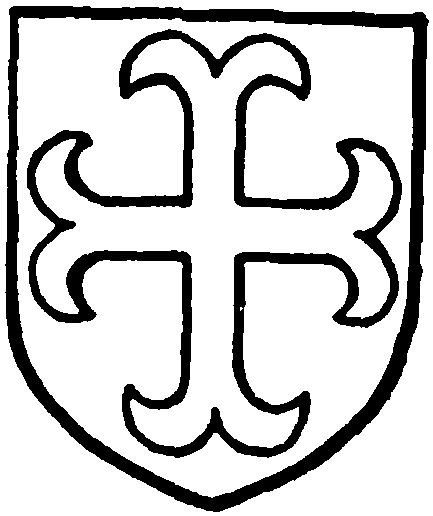
Uvedale. Argent a cross moline gules.
Woodcote House is a good example of a country house of the late sixteenth or early seventeenth century, to which time the oldest parts of it seem to belong. It is built of red brick of two stories with an attic, with four gables on its principal front, which faces the west, and two at the north end. All the windows were originally mullioned, but except in the gables the mullions have given place to sashes; those which remain are of brick, plastered, and the windows have lead latticed lights. The house formerly had wings running westward at the north and south, and inclosing a forecourt with a wall and gateway on the west; but nothing of this remains. The main entrance is by a porch on the west front, and the arrangement of the house is simple, there being four rooms on each floor in a line from north to south, opening into each other, the staircase being on the north-east. There are fine wooden chimney-pieces in three of the first-floor rooms and in the north room on the ground floor, the latter probably of somewhat later date than the others, which appear to be original. That in the second room from the north on the first floor has been freed from the paint which unfortunately covers the rest, and shows the remains of decoration in black and gold. In this room also is some tapestry, and some of the original panelling exists. On the ground floor, the south room, and that next to it, to which the porch opens, are fitted with good early eighteenth-century panelling. The staircase has solid turned balusters, and the doorways opening on to it have moulded oak frames with nailstudded doors hung by wroughtiron strap hinges. At the stairhead in the attics is a screen formed of two ranges of balusters like those of the staircase, and within it a room known as the 'priest's chamber,' from which a smaller room opens. Two of the rain-water heads on the west front are dated, one being of 1630, when Anthony and Mary Bruning were living at Woodcote, and the other of 1677, when it had passed to the Venables family.

Burke. Or a cross gules with a lion sable in the first and fourth quarters.
At the present time the house contains a number of fine paintings and drawings, including many from the hand of its occupant, Sir Francis Seymour Haden.
At the back of the house is a charming walled garden, with picturesque red brick stables to the south, and at the south-east of the main block is the old brew-house, now used as a workroom.
CHURCH
The church of ST. SIMON AND ST. JUDE, BRAMDEAN, has a chancel 16 ft. 6 in. by 13 ft. 6 in., nave 36 ft. 8 in. by 16 ft. 8 in., with north porch, south vestry, and large south transept, and a wooden bell-turret over the west end of the nave. The oldest details are the north doorway of the nave and the chancel arch, which date from circa 1170, and if the walls of the nave are older than this there is nothing to show it, all the masonry being covered with plaster inside and out.
The chancel has undergone a good deal of restoration, and of the south wall of the nave only the west end is old, the rest having been destroyed by the addition of a large modern south transept 16 ft. 9 in. wide with a vestry to the east of it. An old drawing of the south side of the church, hanging in the vestry, shows in the south wall of the nave two curious windows, each of two round-headed lights, and a square-headed low-set window near the east end of the wall. The traces of one of these double windows may still be seen in the outer face of the wall just west of the transept, set rather high in the wall after the fashion of early windows, but there is nothing to fix their date, whether early or comparatively modern. The church is roofed with red tiles, and the west bell-turret is boarded and finished with a short octagonal shingled spire. The chancel was repaired and reroofed in 1863, and has a modern east window of three lancets under an inclosing arch. In both north and south walls are two plain and short lancet windows with modern rear arches, the external masonry being too much covered with plaster to show its character, but the windows are probably contemporary with the walls in which they are set and may belong to the end of the twelfth century.
The chancel arch is pointed, of two orders, with the springing line considerably below the level of the capitals and a small chamfer on the angles. The capitals have plain scrolled leafwork, and there are nook shafts on the west face and half-round shafts on the jambs with spreading moulded bases.
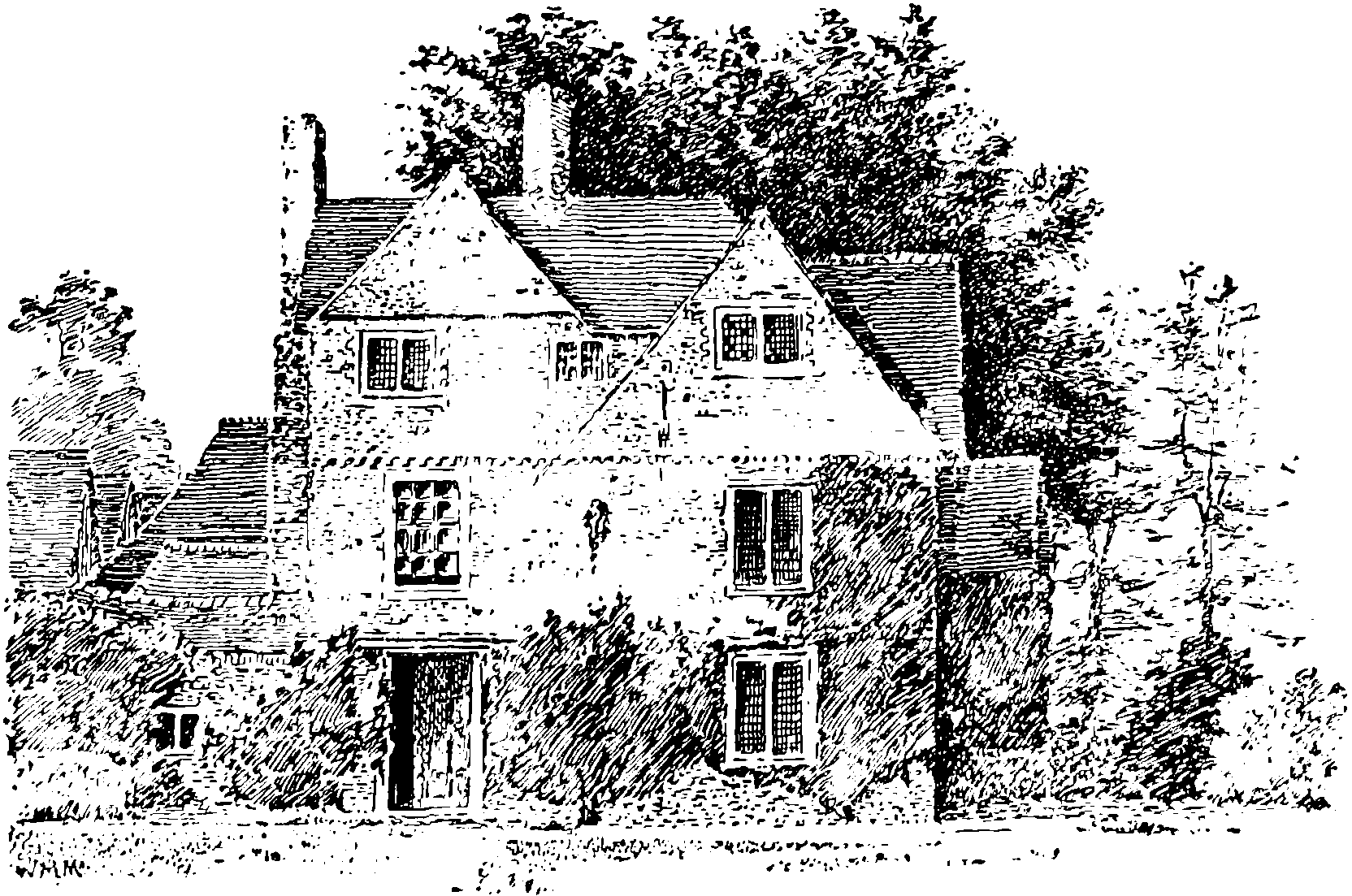
Woodcote House, Bramdean.
The nave has a square-headed fifteenth-century west window of three cinquefoiled lights, and above it in the gable a plain lancet of uncertain date. The north door has a round arch of one square order, with hollow chamfered abaci and a small chamfer on the jambs, but beyond this there are no old masonry details. East of the doorway are a large two-light window, with a quatrefoil in the head, and a single lancet high in the wall to light the pulpit, and west of the doorway a two-light window, all being modern. In the south wall is the door to the modern vestry and a wide arch to the south transept, which contains nothing of note. The north porch is of red brick, and modern.
The nave roof is old, with trussed rafters, and has been ceiled, and the chancel roof is a modern copy of it, dating from 1863. A west gallery in the nave was removed in 1877. The south door of the nave is old, made of two thicknesses of board, with old strap hinges and a wooden lock case, but otherwise all the fittings of the church are modern, except the altar table, which is of early seventeenthcentury date, and on the south side of the chancel is a credence table made up from parts of the seventeenth-century altar rails, which were unfortunately taken away during 'restoration.'
The font, near the north door of the nave, is modern, of thirteenth-century style.
The bell-turret contains two small bells, and rests partly on the west wall of the nave and partly on a tiebeam, its angle posts not coming down to the floor of the church.
The plate consists of a chalice of 1842 with paten of 1852; a flagon given by Dame Frances Gould to the parish in 1731, the lid bearing the London date-letter for 1721 and the body that for 1706; and a silver-gilt alms dish of 1845, given in 1852.
The first book of the registers begins in 1573, containing baptisms and burials to 1773, and marriages to 1776. In the first pages is a list of benefactions from 1618 to 1675, recording among other things the gift of a silver chalice and paten in the latter year by Stephen and Catherine Green, and at the end are some paper leaves with a record of briefs from 1659 to 1663. The second book goes from 1774 to 1813, and there is a set of churchwardens' accounts from 1779 to 1852.
The small modern district church on Bramdean Common possesses a silver chalice and paten of 1838.
ADVOWSON
The advowson of the church followed the descent of the manor of Bramdean until 1234, when Hugh de Bramdean leased it for forty years to Alan Fitz-Warin. (fn. 73) In 1236 Hugh de Bramdean granted it to the prior and convent of Selborne, (fn. 74) and this grant was confirmed by Hugh's son Bartholomew in 1240. (fn. 75) However, in 1250 John de Blakedown held the advowson, and granted it, together with the land he held in Bramdean by the gift of his brother Sir Nicholas, to the prior and canons of Selborne for £100. (fn. 76) The church was worth £5 per annum in 1291. (fn. 77) In 1395 the living was in the gift of the bishop of Winchester, (fn. 78) who continued to be patron till 1858, (fn. 79) when it was transferred to the crown, the bishop receiving in exchange the patronage of the rectory of All Saints, Southampton. (fn. 80) The living is at present a rectory in the gift of the Lord Chancellor.
CHARITIES
(1) In 1862 James Turner, by will proved this date, bequeathed to the rector and churchwardens £100 upon trust to invest the same and to pay the dividends on St. Thomas's Day equally among three of the most deserving poor families, members of the Church of England residing in the parish. Invested in £102 19s. Consols.
(2) In 1863 the Hon. Mrs. Honora Legge, by will proved this date, directed that £200 Consols should be transferred to the official trustees of charitable funds, the dividends to be remitted to the officiating minister of Bramdean, to be expended by him in purchasing candles and soap to be given to the wives and widows of labourers living in the parish.
(3) In 1893 Mrs. Louisa Frances Katharine Bishop, by will and codicil proved this date, directed her executors to purchase £170 Consols and to pay the dividends annually at Christmas among the mothers of children most regular in attendance at the Sunday school, with a provision for accumulations in case of unpunctual attendance. The legacy (less duty) is represented by £152 14s. £2 10s. per cent. annuities.
The same testatrix bequeathed £2,000 to be invested and income applied in providing divine service in the church on Bramdean Common, and other purposes. The legacy (less duty) was invested in £1,815 14s. 9d. £2 10s. per cent. annuities.
In 1898 Mrs. Honora Augusta Cowper-Coles, by codicil to her will proved this date, bequeathed £120 2½ per cent. annuities to the officiating minister of Bramdean, dividends to be applied in providing warm winter clothing for poor women. The several sums of stock are held by the official trustees of charitable funds, and the incomes of the charities are duly applied.