
A History of the County of Hampshire: Volume 3. Originally published by Victoria County History, London, 1908.
This free content was digitised by double rekeying. All rights reserved.
'Parishes: Bedhampton', in A History of the County of Hampshire: Volume 3, (London, 1908) pp. 142-144. British History Online https://www.british-history.ac.uk/vch/hants/vol3/pp142-144 [accessed 4 May 2024]
In this section
BEDHAMPTON
Betametone (xi cent.); Bodehampton (xv cent.); Bedhampton (xvi cent.).
The parish of Bedhampton is very long and narrow, being about 1½ miles in breadth at the widest part and 6½ miles in length; its southern part extending down Langstone Harbour nearly as far as the South Hayling farm, and including the four islands, Baker's Island, Long Island, and North and South Binness. A small part of the town of Havant lies within its boundaries. The London Brighton and South Coast Railway passes through the village, which is about a mile west from Havant Station and 6 miles north-east of Portsmouth. A cluster of low houses near the church forms the older part of the village, while a group of inns, shops, and houses lying along both sides of the high road from Portsmouth to Havant, and separated from the church by a wide meadow called Bedbury Mead, marks the modern outgrowth. Here are the schools which were built in 1868, enlarged in 1873, and again in 1895, for about 180 children; and also a Primitive Methodist chapel erected in 1875. From the schools a footpath over Bedbury Mead leads south-west to Lower Bedhampton, as the part near the church is called. Opposite the church are the rectory, a large white house, and Bedbury House, which is at present unoccupied. Directly north-west of the church the manor house stands on rising ground overlooking Bedbury Mead. Other houses are The Elms, at the corner of the road to the west of the church, occupied by Mr. Lionel Fawkes, and The Towers, occupied by Miss Meiklam, on the main road from Portsmouth to Havant, west of the village.
There are numerous springs in the village, which have become quite famous for their properties; St. Chad's Well, near the manor house, being supposed to possess the most health-giving virtues. A stream rising near the post office runs parallel with the village street. The hamlet of Belmont lies on high ground north of the church, and is almost a continuation of the village.
Belmont Park, the seat of Mr. W. H. Snell, lies to the north and covers an area of some 20 acres. The north-west part of the parish of Bedhampton is thickly wooded, once forming part of the Forest of Bere, which in early times extended as far south as the range of the Portsdown Hills.
The road which leads northward from Belmont to Waterlooville goes through the heart of this beautifully wooded country, Little Parkwood, Neville's Park, and Beech Wood being the names of the largest stretches of woodland. The area of the parish is about 2,401 acres of land, and 4 acres of land covered by water; 228 acres covered by tidal water and 1,166 acres of foreshore. (fn. 1) The proportion of land in the parish is 542¾ acres of arable land, 1,125 acres of permanent grass, and 413½ acres of woodland. (fn. 2) The soil is loam; subsoil chalk; and varies in quality. The chief crops are wheat, barley, and oats.
MANORS
Early in the ninth century King Egbert granted the manor of Bedhampton to the cathedral church of Winchester. (fn. 3) By the reign of Edward the Confessor it had passed to the abbey of Hyde, of whom it was held by a certain Alsi. However, at the time of the Domesday Survey Hugh de Port held it of the abbey as he held so many other Hampshire manors. (fn. 4)
By 1086 the manor had decreased in value, probably owing to the incursions of the Norsemen, who sailed into Portsmouth Harbour and devastated the surrounding abbeys and lands. The St. Johns continued to hold the manor from the abbey of Hyde, and eventually obtained the over-lordship. (fn. 5)
Bedhampton was held by Herbert in 1167, the son of Herbert the Chamberlain, ancestor of the baronial Fitz Herberts, who held the manor until the beginning of the fourteenth century. (fn. 6)
Herbert Fitz Peter, a descendant of the above, held Bedhampton in 1236, and was forced in that year to acknowledge the right of Walter abbot of Hyde to exact scutage and relief from two knights' fees there. (fn. 7) Reginald his brother died seised of the manor in 1281, leaving a son John, a minor, and a widow Joan, (fn. 8) who received dower in the manor in 1286. (fn. 9) Eight years later Bedhampton, which had been taken into the king's hands by reason of default made by Joan against the master of the Hospital of St. John and St. Nicholas at Portsmouth, (fn. 10) was evidently recovered by her, and in 1314 she died seised of the manor which she held of the abbot of Hyde. (fn. 11) Hugh le Despenser the elder held Bedhampton in 1316 (fn. 12) by enfeoffment from John son of Reginald and Joan in 1305. (fn. 13) Upon his attainder and forfeiture in 1326 the manor passed to Edmund earl of Arundel, who held it for a short time before his attainder at the end of the year 1326. (fn. 14) In 1327 the manor was granted to Edmund of Woodstock earl of Kent, (fn. 15) youngest son of Edward I. After the deposition of Edward II the earl of Kent was soon engaged with the earl of Lancaster against Isabel and Mortimer, who therefore plotted to inveigle him into an attempt to release Edward II by inventing stories that he was still imprisoned abroad or at Corfe Castle. The earl at once began to take measures for his release, and was thereupon arrested for treason on 13 March, 1329; and having been hastily and unjustly condemned, he was beheaded outside the walls of Winchester on 19 March. (fn. 16) Upon his forfeiture Bedhampton was granted for life to John Maltravers, steward of the household, in consideration of his agreement to stay always with the king. (fn. 17) However, the attainder of the earl of Kent was reversed in favour of his son Edmund in 1330. (fn. 18) In 1346 Margaret countess of Kent, widow of Edmund of Woodstock, held one-and-a-half fees in Bedhampton by right of wardship, since her son Edmund had died in 1333 and his brother and heir John was a minor. (fn. 19)
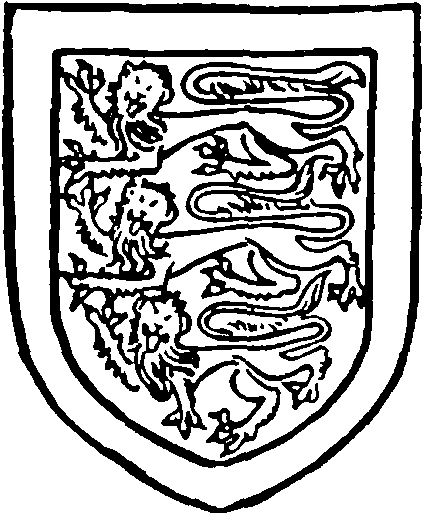
Edmund of Woodstock, Earl of Kent. The arms of England with a silver border.
In 1352 John died without issue seised of Bedhampton manor, which therefore passed to his sister Joan, the Fair Maid of Kent, wife of Thomas lord Holland, who became earl of Kent in right of his wife. (fn. 20) The manor remained with the Hollands as earls of Kent until the extinction of the male line of that house, when it descended through Margaret, one of the co-heirs of the last earl, to her son John Beaufort first duke of Somerset, (fn. 21) whose daughter Margaret became the countess of Richmond and mother of Henry VII; and it was hence merged in the crown on her death in 1509. (fn. 22)
Henry VIII leased the manor in 1522 to Stephen Copes for a term of 21 years. (fn. 23) Before this term had expired the king again granted it in 1537 to William Fitz William earl of Southampton, (fn. 24) on whose death without issue in 1542 the estate again reverted to the crown. (fn. 25)
Edward VI on his accession granted the manor to Richard Cotton 'in consideration of long and faithful service'; and it remained with the Cotton family for a considerable period. (fn. 26) On the death of Richard Cotton in 1556 (fn. 27) his lands passed to his son George, who died in 1609 and was succeeded by his son Richard. (fn. 28) Richard conveyed Bedhampton manor to the king in 1610 by fine, (fn. 29) probably for assurance of title, as it was re-granted to him in the same year, (fn. 30) and he died possessed of it in 1635, Richard his grandson, son of his son George, being his heir. (fn. 31)
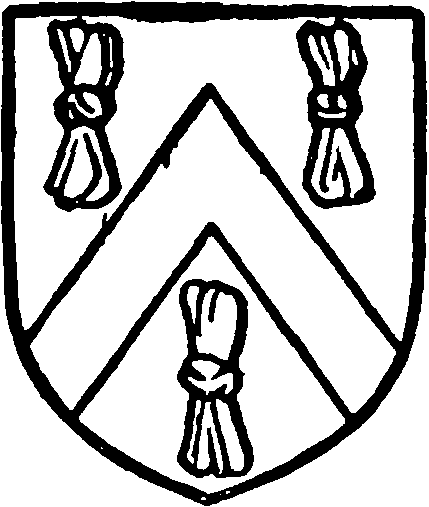
Cotton. Azure a cheveron between three hanks of cotton argent.
The manor was still in the hands of the Cottons in 1714, and was sold by them to Adam Cardonnell, who gave it to his daughter Mary on her marriage with the Rt. Hon. William Talbot. (fn. 32)
Mr. Legge, afterwards Lord Stawell, purchased Bedhampton from Lord Talbot in 1778, and was in possession of it in 1790. (fn. 33) Lord Stawell left Bedhampton to his daughter and heir, Mary Legge, who was married to Lord Sherborne as her second husband. By his will Lord Sherborne left the manor to his third son, Ralph Dutton, from whom it passed to his grandson, Henry Dutton, in whose hands it remains at the present day. (fn. 34)
The old manor house, pulled down in 1881, was an L-shaped building of red brick and timber framing, which for some time before its destruction had fallen into disrepair, and was divided into six tenements. It was a picturesque building of two stories, the upper overhanging, and the roof was thatched, but contained nothing of architectural interest, and was probably only a fragment of a more important building. A view of it drawn by Mr. M. Snape in 1876 is published in the Proceedings of the Hants Field Club, ii, 253.
At the time of the Domesday Survey there were two mills in Bedhampton parish, and also two salt pans worth 37s. 8d. (fn. 35) The mills are mentioned as a water-mill and a fulling-mill in 1338, (fn. 36) and again in 1352. (fn. 37) In 1537, (fn. 38) and again in 1547, two mills 'built under one roof' (fn. 39) are mentioned among the appurtenances of the manor.
CHURCH
The church of ST. THOMAS consists of chancel 28 ft. by 18 ft. 6 in. (18 ft. at the west end), with north vestry, and nave 46 ft. by 19 ft. 3 in., with north aisle and south porch.
The chancel arch, c. 1140, is the oldest piece of architectural detail remaining, and the south and west walls of the nave may be in part of the same date. The chancel, the south wall of which is in line with that of the nave, seems to have been rebuilt in the thirteenth century, and probably lengthened about 1360–70, the south wall being set outside the line of the former south wall. The line of the north wall, however, has probably not been altered, and the wall may contain older masonry in its western portion. The north arcade and aisle were added to the nave in 1878, and the chancel was repaired and the north vestry added in 1869. The old walls are of flint and freestone rubble with ashlar quoins, and in the upper part of the wall at the south-west of the nave a piece of twelfth-century zigzag ornament is used up.
The chancel has an east window of three trefoiled lights, with two quatrefoils in the head, c. 1370, and north and south windows of the same date, with square heads, two-light trefoiled tracery, and segmental rear-arches. In the south-east angle is a contemporary cinquefoiled piscina, with a stone shelf. The western part of the north wall is taken up by the organ, opposite to which in the south wall is a square-headed window of two shouldered lights, probably of thirteenth-century date, and in the south-west angle a square-headed low side window 16 in. wide at the glass line by 3 ft. high, splayed internally with a segmental head, its sill being 2 ft. from the present floor, which is slightly above the old level. In the north vestry a trefoiled fourteenth-century light is re-used.
The chancel arch is semicircular, of one order and 11 ft. wide, having a roll and lozenge pattern on the western side, a label with a double line of hatched ornament, and small angle shafts with scalloped capitals and moulded bases with spurs. The abacus has a hollow chamfer below, and is continued as a string on the west face, and on the east face of the south respond are parts of a string of different section, perhaps not in situ.
The nave has a modern north arcade of three bays and a north aisle, the west window of which is a late fourteenth-century two-light window re-used, with trefoiled lights and tracery. In the south wall of the nave is a similar window, and to the east of it two single-light windows one over the other. The upper, which has a square head, has been inserted to light the rood-loft, and the lower, which is pointed, with a segmental rear-arch, lighted the south nave altar. There are no other traces of this altar, but the remains of a fifteenth-century niche on the north of the chancel arch mark the site of the corresponding north altar of the nave.
The south doorway of the nave has a plain late fourteenth-century arch with continuous mouldings, and to the west of it is a contemporary window of two trefoiled lights with a trefoiled opening in the head. In the wall above its west jamb is a stone corbel, which may have carried a beam supporting a western gallery.
The west window is of early fourteenth-century style, with three acute cinquefoiled lights; the tracery looks like old work re-used. On the west gable is a modern bell-turret containing one bell by Clement Tosier, 1688, but its corbelled base on the east face of the wall seems to be ancient.
The roofs are red tiled, the timbers of the chancel roof being modern, while those of the nave are old, with plain tie-beams and trussed rafters. Otherwise all woodwork is modern, but within the chancel rails are a seventeenth-century chair and bench. The font, near the south door, is modern, with a square bowl and a central and four angle pillars of twelfth-century style, the angle pillars being of yellow marble.
The first book of the registers contains all entries from 1690 to 1813. There is a book of parish accounts, 1692–1783. The plate consists of a silver almsdish, paten, chalice and flagon.
ADVOWSON
In 1086 there was a church in Bedhampton. (fn. 40) At the time of Pope Nicholas's taxation (about 1291) the rectory of Bedhampton was assessed at £10 16s. 8d.; and the tithes at £1 1s. 8d. (fn. 41) In the reign of Henry VIII the rectory was valued at £10 14s. 10d. (fn. 42)
The advowson followed the descent of the manor until the year 1634, when it was granted by Richard Cotton, the holder of the manor, to Thomas Greene for a turn. (fn. 43) The crown held it for a turn in 1660, and in 1688 William Heycroft so held it; but in 1713 it was again in the hands of the Cotton family, who were still holding the manor. It continued to follow the descent of the manor till 1801, when the duke of Beaufort held it; and in 1817 the marquis of Downshire. (fn. 44) The Rev. C. B. Henville bought the advowson for his own use in 1818 and remained the incumbent until 1836. (fn. 45) Andrew Reid held the advowson from 1836 until 1844, when it was bought by St. John Alder for his own use. (fn. 46) From 1866 until 1888 both the living and the advowson were held by Rev. E. Daubeny. The Andersons held the advowson from 1888 until 1897, when it passed into the hands of Mrs. Poyntz-Sanderson, who holds it at the present time. (fn. 47) The living is a rectory of the net yearly value of £285 with residence and 26 acres of glebe.
CHARITIES
In 1875 Henry Snook by deed gave £500 consols, dividends to be applied as to £10 for encouraging further education of girls, the remainder for clothing to boys or girls as prizes. The stock is in the name of the Bedhampton School Board, for the benefit of whose schools the dividends are applied.