
A History of the County of Hampshire: Volume 3. Originally published by Victoria County History, London, 1908.
This free content was digitised by double rekeying. All rights reserved.
'Parishes: Boarhunt', in A History of the County of Hampshire: Volume 3, (London, 1908) pp. 144-147. British History Online https://www.british-history.ac.uk/vch/hants/vol3/pp144-147 [accessed 25 April 2024]
In this section
BOARHUNT
Boorhunt, Burghunt (xiii cent.), Bourhunt Herberd (xv cent.), Burrant Harbard (xvi cent.), Boarhunt (xvi cent.).
Boarhunt is a small parish 3 miles north-east from Fareham station and 8 miles north from Gosport. The River Wallington flows westward through the parish, dividing it into two parts, of which the northern is larger than the southern. South Boarhunt is a tiny secluded hamlet lying in the midst of fertile country on the lower slopes of Portsdown, and consists of a few cottages, the little church of St. Nicholas standing picturesquely on the edge of a disused chalkpit, overgrown with trees, and the old manor house, now used as a farm. The principal road in the parish is that running from Wickham to Southwick; through beautiful wooded country. Boarhunt Mill, with its back-ground of copses, stands at a little distance to the west of the bridge by which the lane running south from the Wickham road crosses the river, and probably occupies the site of one of the two mills mentioned in Domesday Book. (fn. 1) Near the southern boundary of the parish, on the heights of Portsdown, is a monument to Nelson erected about 1814— a stone column about 120 ft. high supporting a bust— while at the base are inscriptions recording the results of the battle of Trafalgar. From the Portsdown heights fine views can be obtained of the surrounding country. To the north stretches the Forest of Bere, while to the south there are spread open to the view Portsmouth Harbour with its shipping, Portsmouth Town, Fareham, Gosport, the Isle of Wight, and the English Channel. The more populous part of the parish is North Boarhunt, which lies north of the river about a mile and a half from the church, and consists of a straggling street running northwards to the Forest of Bere. Nearly all the buildings lie on the west side of the street, and opposite them are allotments, for market gardening is the chief occupation of the inhabitants. In the village is a small Wesleyan chapel, and an elementary school which was built in 1873 for about fifty children and is supported by Mr. Alexander Thistlethwayte, who owns most of the land in the parish. To the north is the pound. The West Walk extends as far as Wickham on the west, while to the north and east as far as the eye can reach stretches the Forest of Bere.
The soil of the parish is clay and loam, subsoil chalk and clay; the area is 2,538 acres, of which 1,033 acres are arable land, 377½ permanent grass, and 457 woodland. (fn. 2)
The following place-names occur in 1538: Crageland, Aishe Land, and Langislond; (fn. 3) and in 1775 Mitchell Land. (fn. 4)
MANORS
Boarhunt had at least three manors, all of which can be traced in Domesday with a fourth holding in addition. These were subsequently known as Boarhunt, East Boarhunt, and West Boarhunt. Domesday assigns in addition to the monks of St. Swithun's, Winchester, a holding of half a hide.
The principal manor was WEST BOARHUNT, which Earl Roger held at the time of the Domesday Survey; three freemen had held it of King Edward as an alod. A knight held one hide of this manor where he had one plough. (fn. 5)
The over-lordship of Boarhunt passed from Earl Roger to his son Robert de Belesme, earl of Shrewsbury and Arundel; (fn. 6) and after his forfeiture to the earls of Arundel, for in 1273 one-third of the manor of Boarhunt was held in dower by Maud de Verdun, late the wife of John Fitz Alan, senior; and two thirds were held by John de Mareschall as guardian of the heirs of John Fitz Alan, junior. (fn. 7)
In the reign of Henry III Westburhunte (fn. 8) appears among the fees of the earl of Arundel, being then held of him by the prior of Southwick as half a fee of the old feoffment; (fn. 9) it remained in the hands of this priory until the Dissolution. (fn. 10) After the Dissolution the manor of West Boarhunt was granted to Thomas Wriothesley, earl of Southampton, (fn. 11) in order that he might alienate it to Ralph Henslowe. Thomas Henslowe, Ralph's grandson, died seised of the manor in 1617, leaving a son Thomas aged eleven. (fn. 12) After this date, however, there seems to be no mention of West Boarhunt until 1691, when Henry Lacy and his wife Catherine were holding half the manor and advowson, though whether by right of inheritance or by purchase it seems impossible to discover, and conveyed them in that year to Richard Caryll, evidently for the purpose of a settlement. (fn. 13)
Three years later Richard Caryll, Henry Lacy, and Catherine sold the manor to Richard Norton for £660; (fn. 14) and from this time it evidently follows the descent of the manor of Boarhunt (q.v.).
The manor of BOARHUNT was held by Hugh de Port in 1086; at the time of the Survey he held one hide in Boarhunt and Tezelin held it of him; Lefsi and Merman had held it of King Edward as an alod. In the time of King Edward the Confessor, as well as in 1086, it paid geld for one hide. There was enough demesne land for one plough and a mill worth 5s.; the whole manor being worth 20s. (fn. 15) In the reign of Henry III it was held of his heir Robert de St. John as 'Borhunte' by Herbert de Boarhunt, who owed him the service of two knights' fees. (fn. 16) These were held by Thomas de Boarhunt at his death in 1262. (fn. 17)
The family which took the name of Boarhunt were holding lands in the parish early in the thirteenth century, (fn. 18) and by the beginning of the fourteenth century were in possession of the manor, which on the murder of Sir Herbert Boarhunt in 1312 was divided between his two sons Richard and Henry. One part, known as the manor of Boarhunt, the manor proper, remained with Richard the elder, and the other part, subsequently known as Boarhunt Herbelyn (q.v.), passed to Henry the younger. (fn. 19) Sir Richard de Boarhunt settled the manor on his son Thomas for the term of his own life in 1305, (fn. 20) and in 1314 on him jointly with Margaret his wife in fee. (fn. 21) Thomas held the manor in 1316, (fn. 22) and died seised of it in 1339. (fn. 23)
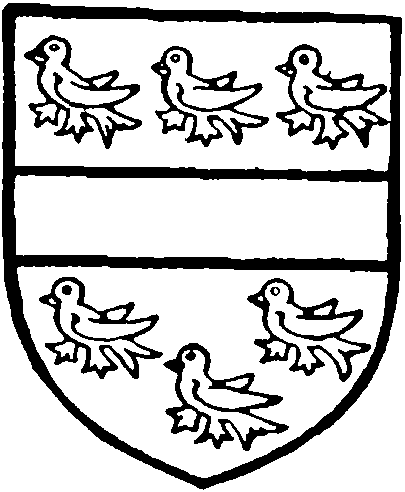
Boarhunt. Argent a fesse between six martlets gules.
His widow, Margaret, married William Danvers as her second husband, (fn. 24) and held the manor until her death, which took place before 1359, when the manor passed to her son John de Boarhunt and his wife Mary des Roches. (fn. 25)
John died seised of it in 1359, leaving an only son John, aged fourteen, (fn. 26) who probably died soon afterwards, since in 1363 the reversion of the manor after the death of Mary, widow of John, now wife of Bernard de Brocas, is said to have belonged to John son of Herbert de Boarhunt, a cousin of her former husband, and to have been made over by him to Valentine atte Mede of Bramdean. (fn. 27) Bernard Brocas and Mary conveyed their estate in Boarhunt to William of Wykeham, then archdeacon of Lincoln, in 1365 (fn. 28); and two years later Valentine atte Mede also granted to William of Wykeham, bishop of Winchester, all his right in the manor of Boarhunt, now sometimes known as Boarhunt Herberd. (fn. 29)
Finally in 1369 the king confirmed the manor of Boarhunt Herberd to William of Wykeham, together with all the lands which had belonged to John de Boarhunt, in order that he might give them to the prior and convent of Southwick. (fn. 30)
The manor remained in the hands of the prior and convent until the Dissolution, when it was granted in 1543 to Thomas Wriothesley, earl of Southampton. (fn. 31) In the next year licence was granted to the earl to alienate the manor to John White of Southwick, (fn. 32) and from this time onwards the manorial descent follows that of Southwick (q.v.).

William of Wykeham. Argent two cheverons sable between three roses gules.
There were two mills in Boarhunt at the time of the Domesday Survey, one worth 42d. and one for the use of the hall; there were also two salt-pans which were valued at 22s. 4d. (fn. 33)
In 1365 there was a mill among the appurtenances of the manor, which Bernard Brocas and his wife Mary conveyed to William of Wykeham. (fn. 34)
A grant of free warren in his demesne lands of Boarhunt was made to Richard de Boarhunt in 1358, (fn. 35) also the right of holding a market every week on Saturday and a fair every year to last three days, namely, the eve, day, and morrow of St. Thomas the Apostle. (fn. 36) There are no traces of these remaining at the present day.
The manor of BOARHUNT HERBELYN (Burrant Harbelyn, xiv cent.) evidently takes its name in the reign of Henry III from Herbelin who held it by serjeanty. (fn. 37) Earlier in the reign it was held by William de Boarhunt as one carucate, elsewhere described as worth 40s. a year, by the serjeanty of serving in Portchester Castle, with a 'habergellum' in time of war for twenty (or forty) days. (fn. 38) At this date the manor of Boarhunt Herbelyn passed to Henry de Boarhunt, who held it until his death in 1320, when it passed to his son Gilbert. (fn. 39) Thomas son and heir of Gilbert died unmarried, but before his death he granted his estate to Richard Danvers, who resettled it on himself and his brother William, who had married Margaret de Boarhunt; Thomas (fn. 40) cousin of William Danvers died in 1361 and Richard in 1362. (fn. 41) On the death of William, Richard made over this estate to trustees in order that they might convey it to the prior and convent of Southwick. (fn. 42)
The manor remained with the prior and convent until the Dissolution, when it was granted in 1543 to Thomas Wriothesley, earl of Southampton. (fn. 43) From this time the descent of this manor follows that of Boarhunt Herberd (q.v.).
The manor of EAST BOARHUNT is identical, in Mr. Round's opinion, with one of the two unnamed holdings of William Mauduit in Portsdown Hundred, recorded in Domesday Book. For in the reign of Henry III it was held of his descendant and namesake as 'Estburhunt' by Robert de Bello Alneto, and is there entered as half a hide of land. (fn. 44) In 1262 it was found to be held of William Mauduit by William de Bello Alneto as half a knight's fee. The same tenant was holding a quarter of a fee of Thomas de Boarhunt, the St. John's tenant in the manor of Boarhunt (fn. 45)
The tithing of HIPLEY (Huppeley, Hippeleye, Ipley, xiv and xvi cent.) lies to the north-west of the parish of Boarhunt. The earliest mention seems to be in the year 1248, when Basil de Hipley granted half a carucate of land in Hipley to Robert le Burgeys after an assize of mort d'ancestor. (fn. 46)
Philip de Benstede and his wife Imania granted the fourth part of half a carucate of land, 25 acres of meadow and 6s. 11d. rent in Hipley, to the prior and convent of Southwick in 1270. (fn. 47)
From this time the prior and convent were gradually acquiring lands in Hipley, from Geoffrey de Wanstede in 1335, (fn. 48) from John, son of Robert le Porter, and William Rushmere in 1336, (fn. 49) from Hugh Beneyt in 1343. (fn. 50)
After the dissolution in 1537 the lands in Hipley belonging to the prior and convent were granted to John White of Southwick, (fn. 51) and as there is no further separate record of Hipley, the lands evidently followed the descent of the manor of Southwick (q.v.).
CHURCH
The church of ST. NICHOLAS has a chancel 15 ft. 3 in. east to west by 14 ft. 9 in., and a nave 41 ft. by 19 ft., with a bell-turret on the west gable. It is a very valuable specimen of a small pre-Conquest building, preserving its main dimensions unchanged. The walls are 2 ft. 6 in. thick, built of flint rubble, originally covered with a thick coat of yellow plastering, of which a certain amount remains intact, and the angles have Binstead stone dressings of excellent quality, preserving in places short diagonal tool-marks. The stones are not set after the common pre-Conquest fashion of long and short work, and though in some cases of good size are not remarkable in any way.
All internal angles, whether salient or re-entering, are built with ashlar quoins.
The only original window is on the north side of the chancel, and is a round-headed light 2 ft. wide at the outer opening, and double splayed, the pierced midwall slab having an opening 1 ft. 10 in. high, surrounded by a double line of cable-moulding. The head and jambs within and without are of good fine-jointed ashlar work, the sills being of plastered rubble. Internally this window is blocked by a sixteenth-century monument.
The east and south windows of the chancel are inserted thirteenth-century lancets, and at the west end of the south wall is a plain segmental-headed doorway, now blocked.
On either side of the east window are image brackets, that on the north side being the larger, while that on the south has a carved human head beneath it. Close to the latter is a small piscina with a groove for a shelf and a projecting bowl, and near it in the south wall, in the jamb of the south window, is a second recess which has been fitted with a shelf.
The chancel has had a flat ceiling, perhaps representing the original arrangement, but is now covered with a canted plastered ceiling. The chancel arch, 6 ft. 8 in. wide, is semicircular, of a single plain order, with a square-edged rib-mould, and a deep moulded abacus chamfered below, and setting out to take the rib, which was originally continued down the jambs, though now cut back. The masonry here, as in the external quoins, shows no tendency to 'long and short' work.
The west face of the wall on either side of the chancel arch is occupied by segmental-headed recesses 20 in. deep, the side walls of the nave being also cut back at the east end and carried on half arches; the object being to make convenient room for the nave altars. The northern recess is lighted on the north by a small lancet, but the southern recess has lost its south half-arch by the insertion of a square-headed two-light sixteenth-century window. The recesses are of thirteenth-century date, as shown by the moulded strings at the west of the lateral recesses, and the corbel which is set beneath the abacus of the rib-mould on the north jamb of the chancel arch is of the same date. Below the south window is a small piscina.
The present nave was originally divided into a nave and a western chamber by a wall 2 ft. 6 in. thick, which crossed it at right angles 26 ft. from the chancel arch. In it was probably an archway, and the western chamber may have been of two floors, but nothing beyond the bonding of the cross wall now remains.
The original north and south doorways of the nave, of which traces only remain, were further to the east than those which now exist. These are blocked with masonry, but show pointed archways of thirteenth-century date, their eastern jambs just overlapping the western limits of the doorways they replace. The cross-wall was probably in existence when they were built, or they would have been set further to the west. At the same time lancet windows were inserted in the north and south walls of the western chamber at a height which tells against any division into two floors at the time. Both lancets are widely splayed, with sloping sills, and in the west wall is a third lancet in modern stonework with a modern west doorway below it. The west wall with its buttresses and bell-cot above is all modern or refaced.
The nave has a canted plaster ceiling with dealcased tie-beams, and the fittings of the church are of plain deal, with a west gallery. In the chancel are considerable remains of wall paintings, with indistinct subjects under a trefoiled arcade and painted drapery below.
The font, at the south-west of the nave, has a plain round tapering bowl without a shaft or any detail to suggest its approximate date.
Against the north wall of the chancel is set a monument dated 1577, with no inscription except the initials C P, R H, and K P of the persons commemorated.
The upper part has three panels surmounted by a flat cornice on which are three pediments, one of rounded form between two which are angular; on these stand three headless figures, apparently Charity between Faith and Hope. Under the soffit of the cornice are angels holding shields inscribed with I H S, and the panels below are divided from each other by Corinthian columns carrying an architrave, on which over the columns is the date 1577, one figure over each column, and over the panels the initials already noted. In the panels are shields, as follows:—Under C P, the arms of Pound, Argent a fesse gules between two dragons' heads and a cross formy fitchy sable with three molets argent on the fesse; under R H, the arms of Henslow, Argent a cross gules with five lions' heads erased or on the cross; and under K P, the arms of Poole, Party or and sable a saltire engrailed counterchanged. The central shield is that of Ralph Henslow, who married a sister of John White, the grantee of Southwick Priory.
In the bell-cot is one modern bell.
The plate comprises a silver communion cup of Elizabethan type, c. 1570, with a wide engraved band on the bowl, a standing paten of 1691, and a plated flagon and almsdish.
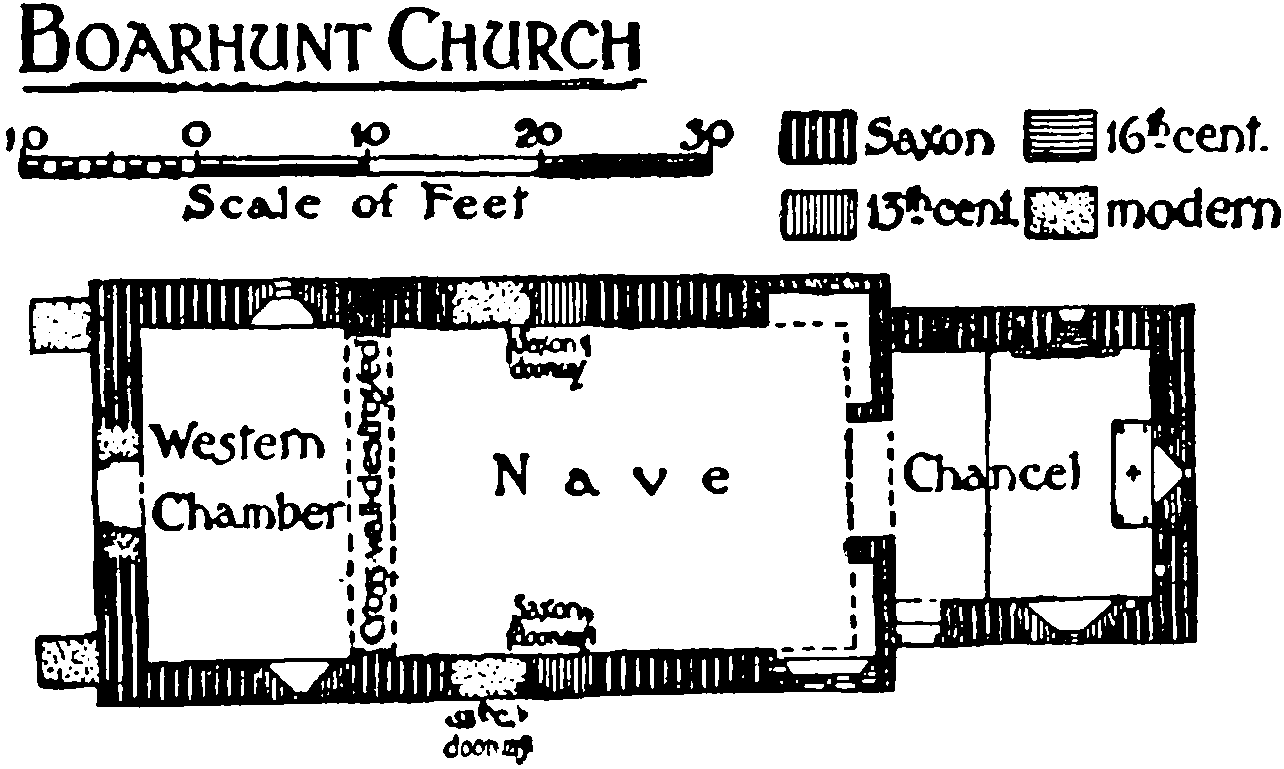
Boarhunt Church
The earliest book of registers contains baptisms from 1578 to 1628, and burials from 1588, and the next contains all entries from 1653 to 1805. The remaining entries to 1812 are in three small books.
ADVOWSON
At the time of the Domesday Survey there was a church in Boarhunt, (fn. 52) which probably became at a later date the parish church of West Boarhunt as it was called. The church and the advowson of the rectory of West Boarhunt evidently passed into the hands of the prior and convent of Southwick between 1262 and 1316, together with the manor of West Boarhunt (q.v.), and remained in their possession until the time of the Dissolution. (fn. 53) The value of the rectory was given in 1291 as £7 6s. 8d., tithes 14s. 8d. (fn. 54) After the Dissolution the advowson followed the descent of the manor (q.v.). The living is now consolidated with that of Southwick, and is in the gift of Mr. Alexander Thistlethwayte, who is lord of the manor.