A History of the County of Hampshire: Volume 3. Originally published by Victoria County History, London, 1908.
This free content was digitised by double rekeying. All rights reserved.
'The liberty of Portsmouth and Portsea Island: Manors, churches and charities', in A History of the County of Hampshire: Volume 3, ed. William Page (London, 1908), British History Online https://www.british-history.ac.uk/vch/hants/vol3/pp192-202 [accessed 5 May 2025].
'The liberty of Portsmouth and Portsea Island: Manors, churches and charities', in A History of the County of Hampshire: Volume 3. Edited by William Page (London, 1908), British History Online, accessed May 5, 2025, https://www.british-history.ac.uk/vch/hants/vol3/pp192-202.
"The liberty of Portsmouth and Portsea Island: Manors, churches and charities". A History of the County of Hampshire: Volume 3. Ed. William Page (London, 1908), British History Online. Web. 5 May 2025. https://www.british-history.ac.uk/vch/hants/vol3/pp192-202.
In this section
PORTSEA MANOR
PORTSEA MANOR is not distinctly mentioned in the Domesday survey of Hampshire. From the fact that it was held by later tenants of the fee of the successors of Hugh de Port it may be concluded that in 1086 it was then considered as part of Hugh's possessions in Buckland (q.v.). The actual tenants in the twelfth century took their name from the manor. Baldwin of Portsea gave a virgate of land in Porteswald (Portswood) to the abbey of Quarr in the Isle of Wight. (fn. 1) This Baldwin in 1166 was holding two knights' fees of John de Port and forfeited half a mark in 1167–8 on the non-appearance of an alleged murderer for whom he had become bail. (fn. 2) It was he who in 1170 granted the church of Portsea to Southwick. He had also granted a virgate in Fratton with his two tenants William and Ernulf and their children, and firebote and hedgebote in Portswood, to the monks of Sherborne for the welfare of the souls of Henry de Port and his wife Hawise, and of his own soul and those of his wife Adelis and his parents. To this gift the overlord, John de Port, son of Henry, gave his consent. (fn. 3) Baldwin of Portsea evidently died childless, for he was succeeded by his brother Payne before 1189. The latter confirmed his brother's gift to Quarr Abbey, and exchanged his demesne lands at 'Leuchestoche' with the monks for half a virgate at Copnor. (fn. 4) Payne of Portsea had a son Adam, who may possibly have been identical with the Adam of Portsea who was justice in assize for Hampshire in 1218, (fn. 5) and accounted for the fifteenth levied in the county in 1226. (fn. 6) In 1230 Adam of Portsea witnessed a charter in conjunction with his eldest son Andrew and the whole borough-moot of Portsmouth (fn. 7); Andrew was still living six years later, (fn. 8) and was probably the father or grandfather of Richard of Portsea, who came into prominence at the latter end of the thirteenth century. In March, 1302–3, he obtained a grant of free warren in his demesne lands of Portsea. (fn. 9) In 1310 he was one of those appointed to arrange a loan of victuals to the king for his expedition to Scotland, (fn. 10) and in 1315 was a commissioner of array. (fn. 11)
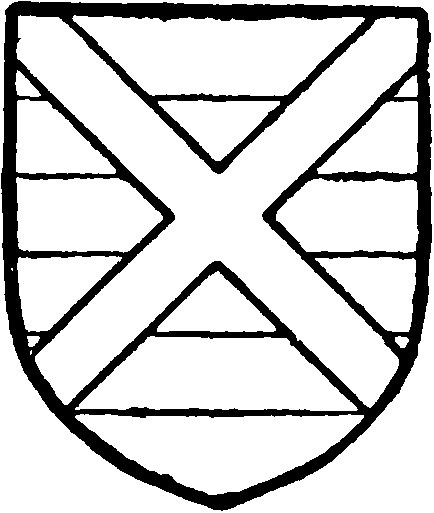
De Port. Barry azure and argent a saltire gules.
At his death, which took place before 21 December, 1318, he was said to hold the manor of Portsea of Sir John de St. John (a descendant of Hugh de Port), by service of a knight's fee. (fn. 12) His sister and heir, Alice Loveraz, was then aged 50. In 1322 she conveyed the manor, together with the reversion of the dower in it held by Scolastica, her brother's widow, to Robert Halsted in exchange for an annuity of 100 marks for life. (fn. 13) Halsted immediately obtained a renewal of the grant of free warren in the demesne lands, (fn. 14) but apparently failed to pay the annuity. (fn. 15) Consequently the manor reverted to Alice Loveraz, who nevertheless settled the remainder of it at her death on Robert Halsted and his wife Nichola in tail male, with contingent remainders to Nicholas son of Ralph de Crophull and his wife Margery, and to the right heirs of Robert. (fn. 16) Evidently Robert and Nichola died without male issue, for in 1346 Nicholas Crophull was in possession of the manor. (fn. 17) From him and his wife it passed, presumably by deed of gift, (fn. 18) to Sir Richard Willoughby, (fn. 19) who conveyed it first to William Willoughby, clerk, and other trustees, (fn. 20) and later to John Edindon, to whom Nicholas and Margery de Crophull made quitclaim. (fn. 21) Edindon's trustees granted it in June, 1373, to the abbey of Titchfield to find a lamp to burn every day before the high altar at high mass. (fn. 22) During the abbot's possession a dispute arose between him and the lord of Chalton manor as to the bounds of Portsea Sewood; it was, therefore, agreed that trenches should be made between the woods of the two lords, i.e. from the way called 'Strogetway' to a certain pasture called Stubbs. (fn. 23)
In 1537 the manor was surrendered to the crown together with the other possessions of Titchfield Abbey, (fn. 24) and with them was immediately granted to Thomas Wriothesley, afterwards earl of Southampton, (fn. 25) whose political influence was thus strengthened in Portsmouth, for two years later he wrote to Cromwell, ' For Portsmouth I intend John Chadreton to be one (burgess), and for his fellow and for the burgess of Midhurst I will furnish honest men.' (fn. 26) The earl was succeeded at Portsea by his son Henry, (fn. 27) whose eldest son Henry sold it in 1598 to Robert Bold of Idsworth, (fn. 28) who was mayor of Portsmouth in 1613. (fn. 29) He died in December, 1626, (fn. 30) having settled Portsea on his son William in tail male with contingent remainder to William's brother Henry. William died without issue male in 1631, (fn. 31) and John and Henry Bold were in possession of his lands in 1638. (fn. 32) Subsequently it passed into the possession of Anne Mason who in 1669 bequeathed it to her son Robert Mason with contingent remainder to her kinsman William Bold. (fn. 33) Robert Mason was in possession of the manors of Portsea and Copnor with free warren and view of frankpledge in Portsea in 1704, (fn. 34) and in 1725 Hannah Mason, single woman, probably his daughter, obtained a settlement of the estate, (fn. 35) which passed by her marriage to Isaac Moody, whose son John Moody bequeathed it to a kinsman, Samuel Leeke, in whose family it still remains. (fn. 36)
Court baron only was attached to the manor of Portsea. (fn. 37) The lord had common of pasture over a large part of the island, in the liberty of Portsmouth and in the Forest of Bere. (fn. 38) His rights of common pasture also extended to Fratton, and an apportionment of the common appurtenant to the two lordships was effected in 1600. (fn. 39) Right of wreck was also attached to the manor. In 1383 three hundred tuns of wine came ashore upon the land of the lords of Portsea and Fratton. It was immediately seized by the two lords, but certain citizens of London and merchants to whom it belonged prayed that it might be released to them because two of the men from the wreck had been saved alive. The wine was therefore restored to its owners on payment of a fine. (fn. 40)
LANDPORT
LANDPORT is still more modern than Portsea. It is a suburb of Portsmouth and consists of numerous small streets of two-storied houses and cottages leading east and west out of the main thoroughfare, the Commercial Road, which may well be called the most busy street of the town. Near its base, where it curves slightly, is the centre of the borough. On one side stands the town-hall, a magnificent building opened in 1890; it contains a spacious assembly hall, council chamber, and court rooms, and has ample accommodation for the numerous officials of the borough in addition to the police station and public library. Behind it an imposing erection is being built as a technical institute, while opposite the hall stands a statue of the late Queen Victoria. The tramways pass before the main entrance of the townhall, this being the centre of a complete system of tram service by which any part of the borough may be reached. Tramways were first laid down in 1870, (fn. 41) and rapidly extended to Landport, Southsea, and Portsea. In 1883 the various companies were amalgamated. (fn. 42)
Leaving the town-hall on his left the traveller passes up Commercial Road by the most important shops in the town, on his right is the joint station of the London and South Western and London Brighton and South Coast Railways, built before 1859. Still further up the road, where the shops give place to villas interspersed with timber-yards and inns, is the house where Dickens was born. It has recently been bought by the corporation and converted into a Dickens Museum. On the same side of the road is the Portsea Island cemetery which overlooks the harbour. This district took its name from the Landport Gate in the middle of the last century. It was previously called the Halfway House, from an inn known as the Halfway House to Kingston. Within the last century this inn and a few scattered houses were the only buildings along what was then a country road, and where streets of cottages are now crowded together a footpath led across the fields to Kingston Church. (fn. 43) Twyford Avenue, a continuation of the Commercial Road, brings the traveller to STAMSHAW (Stampeshaw, xiii cent.; Stanneshowe, xv cent.). This district has always been included within the liberty of Portsmouth. (fn. 44) Late in the thirteenth century it was in the possession of Nicholas Malmains, who held it of the king by the service of rendering a sparrow-hawk yearly and paying 35s. 4d. to the bailiffs of Portsmouth towards the ferm of the town. He died before 1292, leaving a son of the same name aged seventeen. The latter was seised of a house and lands in Stamshaw at his death in May, 1349, (fn. 45) when his possessions were divided among the heirs of his three daughters. (fn. 46)
Henry Kesewyke held a toft and lands called Stamshaw, in the parish of Portsea, 'within the bridge called Portesbrygge' at his death in 1420, (fn. 47) and his son Henry conveyed the 'manor' of Stamshaw in February, 1437–8, to William Chamberlayn, (fn. 48) who had, however, parted with it before his death. (fn. 49) It is said to have been sold by a certain Constantine Derrell to Henry White, whose son Robert conveyed it to Richard Playfote in 1548. (fn. 50) In 1553 Richard Playfote died, leaving a daughter and heir Grace, (fn. 51) who was probably the same Grace, wife of John Wateryng, who joined with her husband in a sale of the manor of Stamshaw to Henry Bickley in 1659. (fn. 52) The later descent is unknown.
A branch road from Stamshaw leads to STUBBINGTON, which was for many years in the possession of the priory of Southwick. It is situated to the right of the road from London to Portsmouth, the centre of the prior's possessions being doubtless marked by Stubbington Lodge and Stubbington Farm, the residences respectively of Mrs. E. H. and Mr. A. L. Kent. The land around is laid out in building plots, while near at hand bricks are burnt for the new houses. The priory of Southwick had lands in or near Portsmouth at the beginning of the thirteenth century, for in 1201 the prior and convent granted to the abbeys of Savigny and Aunay a certain place which they held of William de Ste. Mère-Église, and which extended from 'the east road leading to the mill of the town of Portsmouth, to the sea. (fn. 53) In 1320 the prior and convent received a grant of free warren in their demesne lands of Stubbington, next Portsea, (fn. 54) a privilege which was confirmed to them by Richard II and Henry VI. (fn. 55) It appears that the prior had manorial rights over Stubbington, together with reliefs, heriots, fisheries, and fowling, and these rights were reserved while the demesne lands were leased out from time to time. Thus Thomas Carpenter had a lease of the lands in January, 1525–6. (fn. 56) The manor was surrendered with the other possessions of the priory in April, 1538. (fn. 57) In January, 1539–40, the manor was settled on Anne of Cleves in part satisfaction of her dower, and in the following January it was granted to her successor, Catherine Howard, who was beheaded in February, 1541–2. (fn. 58) In July, 1543, the king granted the manor to the warden, scholars, and clerks of St. Mary's College, Winchester, (fn. 59) a foundation to which it still belongs, while under them, as under the priory of Southwick, the demesne lands have been leased to various tenants from time to time. (fn. 60)
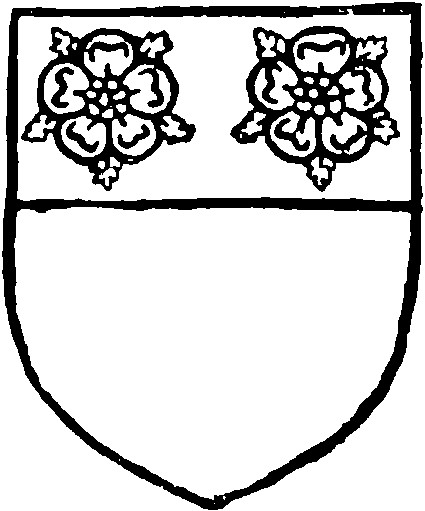
Southwick Priory. Argent a chief sable with two roses argent therein.
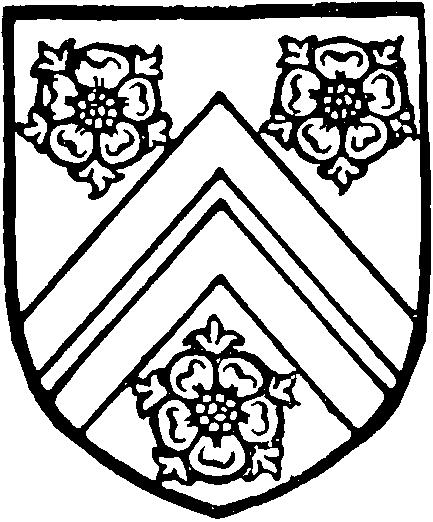
Winchester College. Argent two cheverons sable between three roses gules.
A cross road leads from the highway to London past Stubbington House to COPNOR (Copenore, xi-xii cent.; Copenhever and Coppenore, xiii cent.; Cupenore, xiv cent.; Copenore, xv cent.). Here there is a small hamlet still known as ' Copnor Village,' though it is now practically a part of Landport, for a broad road lined on either side with modern red-brick houses leads from New Road East, the terminus of the tramway, through Copnor to Little Gatcombe, and new roads are being laid out in all directions. To the west of the road Copnor Manor Farm stands surrounded by thatched barns, and facing it is Manor House, the residence of Miss Russell. To the north, further from Landport, are large brick-kilns surrounded by waste land, with here and there a scanty crop of vegetables; and to the east are flat marsh-lands, stretching out towards Great Salterns. The saltings, which are on the north side of a creek known as Great Salterns Lake, represent a very ancient industry in the island, for in 1086 the saltings of Copnor were assessed at 8d. (fn. 61) By the seventeenth century, however, the salt-works had been separated from the manor, for in November, 1629, the king granted the land known as Copnor or the Salt Pit in Portsea to Sir Edward Sidenham, with power to make salt there. (fn. 62) Nevertheless he appears only to have had a moiety of the profits. (fn. 63). In 1662 a dispute arose between the owners of the salt-works and the lord of Copnor manor as to a fish-pond which the former claimed as part of the salt-works, but the latter considered as waste belonging to the manor. (fn. 64)
The manor of Copnor was among the possessions of Earl Godwin, and was held of him by Tovi. After the Conquest it was held by Robert son of Gerold, the tenant under him being a certain Heldred. Of the successors of Heldred nothing is known until the thirteenth century, when the lords of Portsea (q.v.) also held the manor of Copnor. (fn. 65) Andrew of Portsea then held both the manors, and from that time the two manors have been held by the same lords. The manorial rights attached to Copnor were more extensive than those pertaining to Portsea, for the lord held view of frankpledge as well as court-baron for his tenants there. (fn. 66) In addition to this privilege he had rights of fishery at Milton Fleet and Burfield Fleet, besides the whole of the fishing at 'Mileresde Fleet' and 'Midomstonores Fleet,' and fowling at 'Setore ' and other places within the lordship. (fn. 67)
South of Copnor lie KINGSTON and BUCKLAND, two adjacent suburbs of Portsmouth. Buckland was held of Earl Godwin by Alward before the Conquest, and in 1086 was among the lands held of Hugh de Port by Heldred. (fn. 68) Kingston contains the church of St. Mary, Portsea. It was evidently a hamlet of some importance at the time of the settlement of Portsmouth, probably owing to its proximity to the church, and was at first included in the liberty of the borough, for in 1198 the farm of Portsmouth and Kingston was accounted for as £14 2s. 7d., (fn. 69) and in 1201–2 the rents of assize of Portsmouth and Kingston together amounted to 41s. 7½d. (fn. 70) The chief tenant there was Richard de Landa, who in 1225 held a carucate of land in Kingston under a charter of King John. (fn. 71) Apparently it was separated from the borough at this date, for 35s. 4d. was deducted from the farm of the town for the lands in Kingston which Richard de Landa held in farm. (fn. 72) This carucate formed a part of the portion which Richard gave his daughter Joan on her marriage with Robert de Audley. (fn. 73) The road from Copnor to Milton crosses the railway line near Kingston cemetery. From the level-crossing a rough roadway leads almost due east to a picturesque farm-house which lies beyond a broad willow-fringed sheet of water known as Baffin's Pond, while a wide curving road leads past the grim stone walls of the borough gaol, which has recently replaced a much smaller building in the High Street. On the same side of the road are the warmer-toned brick walls of the union workhouse, facing which stands the hospital for infectious diseases, while beyond, over stretches of flat waste land, the gabled roofs of the borough asylum appear among the trees, and in the far distance the woods of Hayling Island can be seen across the blue waters of Langstone Harbour. The road leads on to the picturesque village of Milton, which consists of one street. On either side are old weather-beaten cottages, and, half-hidden by the trees of overgrown gardens, dilapidated plastered and thatched farmbuildings. On the left of the road stands the stone church of St. James, built as a district chapel to Portsea in 1841, (fn. 74) and facing it is the Baptist church. The village still retains its rural character, though the streets of Fratton and Eastney are fast extending to it.
MILTON
MILTON manor was granted with Warblington, of which it was a member, (fn. 75) to Matthew son of Herbert by King John. (fn. 76) Peter son of Matthew alienated Milton, where he apparently had three tenants in villeinage, together with the tenants and pasture land there to William Falconer of Hurstbourne Priory to hold by the service of rendering a pair of gloves yearly at Easter. (fn. 77) The overlordship of Milton thus remained with the lords of Warblington, but the descendants of William Falconer and his wife Emma were the actual tenants for more than three centuries. In 1388 John Falconer obtained a confirmation of the original grant by Peter son of Matthew, (fn. 78) while in 1635 John Falconer was in possession of it together with the manor of Emsworth, another member of Warblington. (fn. 79) Both Emsworth and Milton were purchased by Richard Cotton of Warblington, with the history of which manor theirs is thenceforward coincident. It appears that Peter son of Matthew did not grant all his lands at Milton to William Falconer with the manor, for in 1494 the lord of Warblington held, in addition to the rent due from John Falconer, certain rents from tenants-at-will and the profits of the woods, besides fishing and fowling. (fn. 80) The common lands belonging to Milton and the neighbouring hamlet of Eastney were inclosed under an Act of 1810, at which time also the common field known as the Velder or Welder was inclosed. (fn. 81)
EASTNEY
EASTNEY is a fast-growing suburb of Southsea lying to the south of Milton. The farm at the head of Eastney creek or fleet probably represents Eastney manor-house. Like Milton, Eastney was originally a member of Warblington manor. (fn. 82) Herbert son of Matthew, who received a royal grant of Warblington, with its hamlet of Eastney, in 1231, had free warren granted to him in Portsea in 1239. (fn. 83) Some years later he was returned as holding four hides in Eastney. (fn. 84) His brother and heir, Peter son of Matthew, was said to have permitted his tenant at Eastney to exercise manorial rights in the hamlet. (fn. 85) This tenant, Philip son of Peter of Eastney, added to his holding there an acre of land which he purchased from Ralph Lumpe and his wife Cecily. (fn. 86) The land was doubtless a part of the farm known latterly as Lumpstead. (fn. 87) The manor of Eastney was settled on Philip, evidently son and heir of Philip of Eastney, and his wife Alice in 1308. (fn. 88) Four years later, Eleanor widow of Matthew son of John, late lord of Warblington, sued Philip and Alice for dower from Eastney, and it having been found that Philip of Eastney had usurped the lordship there (fn. 89) the lands were seized by the king's escheator. (fn. 90) Philip then came into Chancery and proved that he and his ancestors had held the hamlet in demesne, and that Matthew son of John had had no right therein save the wardship of himself during his minority, and the lands were restored to him in 1314. (fn. 91) Two years later Alice of Eastney was holding the manor in accordance with the settlement of 1308; (fn. 92) she married as her second husband Sir Robert Norton, to whom Gilbert son and heir of Philip of Eastney quitclaimed the manor for life, receiving in return during the life of Alice a robe of an esquire's suit at Christmas, 40s. yearly, and maintenance for himself, his horse, and his groom so often as he was entitled to stay with his stepfather. After the death of Alice the yearly allowance was to be increased to £10. (fn. 93) Eastney suffered with Portsmouth from French attacks during the Hundred Years' War. (fn. 94) In 1339, Sir Robert Norton evidently being dead, the manor was settled on Gilbert of Eastney and his wife Joan. (fn. 95) At about this date Gilbert obtained licence for the celebration of divine service within his house in Portsea parish. (fn. 96) The right of his grandson, Gilbert son of Philip, to a certain messuage and lands in Milton was disputed by John Beek and his wife Maud in 1391, but unsuccessfully, as the premises had been included in the settlement of Eastney manor on Philip and Alice of Eastney in 1308. (fn. 97) Between 1391 and 1458 Eastney appears to have escheated to the overlords, for in 1458 Alice wife of Richard earl of Salisbury, then lady of Warblington, bestowed it on her son John Neville and his wife Isabel and their heirs. (fn. 98) During the minority of George Neville, duke of Bedford, the young son and heir of John and Isabel, the latter's second husband, Sir William Norrys, knight, had the custody of the manor. (fn. 99) Upon the death of George Neville in 1461 his lands were divided among his five sisters or their heirs, Eastney evidently being assigned to his third sister, Lucy, then wife of Sir Thomas Fitzwilliam, (fn. 100) whose son, Sir Anthony Browne, was in possession of the manor at his death in 1548. (fn. 101) His son, Anthony Viscount Montagu, sold it to George Cotton of Warblington in 1567; (fn. 102) thus the manor was again united to Warblington, from which it has not since been separated.
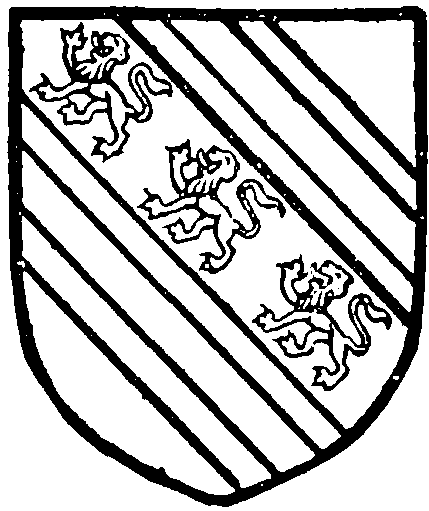
Browne, Viscount Montagu. Sable three lions passant bendwise between double cotises argent.
FRATTON
FRATTON (Frodintone or Froditon xi-xiii cent.; Frodington xiv-xvii cent.) is a considerable district to the east of Landport and the north of Southsea. Its main thoroughfare, the Fratton Road, is the route of the electric trams from North End to Southsea, while the London and South Western and London Brighton and South Coast railways have a joint station near the junction of Fratton Road with the main road from Portsmouth Town Hall to Milton.
Before the Conquest there was a little settlement at Fratton. The manor was held of Edward the Confessor by Chetel, and was among the lands obtained by William de Warenne under William I. The actual tenant under him was Orsmelin, who had one plough in demesne, while there were four villeins and four bordars with two ploughs. (fn. 103) The overlordship belonged to Earl Warenne in the thirteenth century, while Hugh de Plaiz, a successor of Orsmelin, had granted half a knight's fee in Fratton to the Domus Dei of Portsmouth. (fn. 104) Hugh de Plaiz had other lands in Portsea by virtue of a royal grant, but these were given in 1215 to Walter Rufus, (fn. 105) and afterwards to William Briwer. (fn. 106) The master of the Domus Dei obtained a grant of free warren in his demesne lands at Fratton in 1306, (fn. 107) and this privilege was confirmed to the house in 1321–2. (fn. 108) In 1346 the master's holding at Fratton was described as one fee. (fn. 109) Though there is now no trace of a manor house, the hospital appears to have had a house of some kind within the vill, for in 1470 William Cocke and his wife Joan sold a cottage in Fratton ' opposite the door of the warden of the Domus Dei.' (fn. 110) At the surrender of the lands of the hospital to the crown in 1540, its possessions included rents of assize at Fratton and rents from various fields in the neighbourhood, and from Henry Bickley, who farmed the demesne lands, while the perquisites of court, together with the hall, parlour, rooms, stables, and dove-cote, were reserved to the master of the hospital and his successors. (fn. 111) Some of the lands, such as the field called Feldersche or Feldryche, were granted out separately, (fn. 112) while the demesne lands were leased from time to time to various tenants, (fn. 113) the manorial rights being reserved by the crown. (fn. 114) In 1599–1600 an apportionment of the common land belonging to the two manors of Fratton and Portsea took place, (fn. 115) but the common of Fratton was not inclosed till 1786. The manor was granted to Henry Prince of Wales, eldest son of James I, in 1610, (fn. 116) but excepted from the grant to Prince Charles (afterwards Charles I) in 1623. (fn. 117) The demesne lands finally passed in moieties to Anne wife of George St. Loe Beeston, and Elizabeth wife of William Dugard. (fn. 118) Thomas Beeston conveyed a moiety to Jude Storer in 1743, (fn. 119) while Mary wife of John Clempson and Margaret Charlotte wife of John Thompson were in possession of a moiety in 1783. (fn. 120) The estate has long since been divided into building plots. The manorial lands originally extended over the greater part of Southsea northwards as far as Lake Road. (fn. 121)
SOUTHSEA
SOUTHSEA is a well-known seaside resort, which, though it lies within the boundary of Portsmouth borough, and is contiguous to Portsea and Landport, differs from them considerably in style. The northwestern district, being the nearest to Portsmouth and Landport, resembles them in that its streets are narrow and its buildings chiefly in use as small shops. This district is divided from the rest of the town by a broad street known as Somers Road, to the east of which the wide roads of detached villas, hotels, and private residences which form the town of Southsea proper extend over a flat country celebrated for the amount of sunshine which it enjoys. Southwards from the centre of the town, Palmerston Road, lined with the best shops of the neighbourhood, leads on to Southsea Common directly opposite the castle. The common, which is the property of the War Office, is a flat, turf-covered expanse extending from Portsmouth town beyond Southsea Castle. It is traversed by asphalt paths which lead across it to the Clarence Esplanade, the favourite walk of visitors, which stretches from the Clarence Esplanade Pier, whence a fine view of the harbour and Spithead is obtained, along the coast to Southsea Castle, where it is continued in a paved walk past the Canoe Lake, surrounded by well-laid-out public gardens. At intervals along the esplanade there are monuments to commemorate naval victories, including the anchor of the Victory.
The whole town is of very recent growth. Southsea Common, which lay within the manor of Fratton, was inclosed in 1785. During the Peninsular War Southsea first came into favour as a seaside resort, and hotels were built along the parade facing the sea; but the common, which was originally a stretch of morass and marsh land, was not completely drained till the middle of the last century. (fn. 122) The western portion of the town was then already built, its central and most compact district being temporarily called Croxton Town. (fn. 123) About 1865 large districts now known as Havelock Park and Nelsonville were laid out in building sites. (fn. 124) This part of the town was then known as New Southsea, and is still being extended eastwards towards Eastney and Milton. The London and South Western, and London Brighton and South Coast railways have a branch line to Fratton from East Southsea, where a station was opened in 1885.
CHURCHES
No church is mentioned in the Domesday Survey of the manors of Buckland, Copnor, and Fratton. The earliest foundation was probably the parish church of Portsea, now represented by ST. MARY, KINGSTON, one of the finest modern churches in the country, begun in 1887 while the present bishop of St. Albans was vicar, and built at an enormous cost from the designs of Sir A. W. Blomfield. It has a shallow chancel and transepts of two bays with side chapels, a nave of five bays with aisles and porches, and a lofty west tower embattled and pinnacled, which in spite of its low-lying site is a landmark for miles around. The churchyard contains a monument to Admiral Kempenfeldt and the crew of the Royal George.
The registers date from 1753, except the marriage register, which begins in 1754. There is also a register of marriages for the chapel of St. Peter from 1788 to 1794. Extracts from the interesting book of churchwardens' accounts for Portsmouth from 1560 onwards have been printed in Extracts from the Portsmouth Records. (fn. 125)
Portsea church was appropriated at an early date to Southwick Priory. In 1291 the value of the church with its chapel was £30 and of the vicarage £10. (fn. 126) The chapel here mentioned may possibly have been the chapel of St. Andrew, Fratton, which was granted to Edward Wymarke in 1588. (fn. 127)
In 1339 Stephen, vicar of Portsea, craved respite from the triennial tenth granted by the clergy, as his vicarage, houses, goods, and chattels had been burnt by the French, and a similar petition had been made by Walter, vicar of Portsmouth, in the preceding year. (fn. 128) After the surrender of the priory of Southwick to the Crown in 1538 the rectory and advowson of the vicarage were granted to the college of St. Mary, Winchester, in whose possession they still remain. (fn. 129)
There was a devotional brotherhood attached to Portsea church for the purpose of maintaining lights there. At the time of its abolition by Edward VI it had lands in Portsmouth liberty. (fn. 130)
The parish church of ST. THOMAS OF CANTERBURY, which stands in the High Street, was also a possession of Southwick Priory, to which it had been appropriated before 1291. (fn. 131) The rectory and advowson were granted with those of Portsea to the college of St. Mary, Winchester, in 1544, (fn. 132) and are still retained by the college.
The church has a chancel of two double bays 54 ft. by 25 ft. with vaulted aisles, modern north porch and south vestry, north and south transepts 25 ft. wide, the north transept being 39 ft. long and the south 29 ft., and nave of four bays, including the site of the former central tower, 86 ft. by 27 ft. 6 in., with north and south aisles 18 ft. 6 in. wide, and west tower 23 ft. square, flanked by north and south porches. All measurements given are internal. A grant of land by John de Gisors in 1180 'for the erection of a chapel in honour of the glorious martyr Thomas, formerly archbishop of Canterbury,' gives the earliest limit of date for the building, and the details of the eastern part show that work must have been begun soon after the grant was made. The church was probably completed according to the first design, but the evidence of the finishing of the work is lost, as the central tower was taken down, and all west of the crossing rebuilt between 1683 and 1693, the date 1691 over the west door of the tower showing the progress of the work. The chancel has been lately repaired and made structurally sound, the arcades having been in a dangerous state for some time.
The internal effect has been injured by the removal of the plaster in 1844, leaving the rubble masonry exposed.
In spite of the decay of the Caen stone-work which is much used in its construction—the Binstead stone as usual standing well—the external effect of the church is imposing from its scale and the massive clasping buttresses at the salient angles. The nave stonework is in better condition, the ashlar facing of the tower being very sound and good. The chancel is lighted from the east by three wide lancet windows on the upper or clearstory level, at the sills of which a wall passage runs round the chancel, communicating with a passage in the south transept, which is reached from a vice in the south-west angle of the transept.
The arches of these windows are carried on Purbeck marble shafts with moulded capitals and bases, and rings at half height, the half-shafts at either side being of stone, with similar details. The clearstory windows on the north and south of the chancel are of the same description, but the Purbeck shafts have no rings. Below the east window is an illdesigned reredos of 1844, masking a pointed recess, in the back of which is a small lancet, still to be seen on the outer face of the wall. In the gable above the clearstory is a large blocked circular window. The north and south arcades of the ground story of the chancel are of two bays, with clustered responds at either end, and an octagonal column in the middle. Each bay has two pointed sub-arches of two moulded orders with a central column of Purbeck marble, included under a round-headed arch of a single moulded order. Before 1904 two of the Purbeck marble columns, those in the western bays, were ancient, the two in the eastern bays having been replaced by iron columns in 1842. All four are now of marble, and date from 1904, but the old circular moulded marble capital of the south-west bay has been preserved, the other three capitals being of stone and modern.
The chancel was designed for and probably once covered with a quadripartite stone-ribbed vault. The old vaulting shafts with foliated capitals, and stopping on corbels in the spandrels of the main arcades, are still in position. At the present time there is a plastered wooden vault, set up in 1844 in place of a flat wooden ceiling, the chancel arch being poor work of the same date. The aisles of the chancel are vaulted in four bays with ribbed vaults, springing from triple vaulting shafts in the outer walls, and from single shafts in the eastern angles. The capitals, which in the main arcades are moulded, are here foliate of various designs, and square abaci and plain leaf-work show the Romanesque feeling which still lingers. The west arches of the aisles are pointed, of three moulded orders, that to the north having foliate capitals in the north respond, and moulded in the south. The aisles were originally lighted by single lancets in each bay, but only those in the east bay on the north, and the two east bays on the south, are ancient. The east windows of the aisles, each of two uncusped lights, are in modern stone-work. The transepts, like the chancel, have been vaulted in stone, the north transept in two bays, the south in one wide bay, but both now have flat plastered ceilings. The north transept has two trefoiled lancet windows in the clearstory stage on the east, and a third light to the north, while in the north wall are three trefoiled lancets with a sexfoiled opening in the gable above. The west wall has a single trefoiled lancet in the clearstory. In the lower stage is a north window of three uncusped lancets, set considerably to the east of the centre-line of the gable, and in the east wall are two recesses, that to the north having a wide and tall pointed arch, continuing down to the floor level, and lighted from the back by two lancets with a quatrefoiled circle over, while the second recess, whose sill is some four feet from the floor, has a trefoiled head, and fortunately retains most of its original plastering, with remains of painting on it; traces of a Majesty in a vesica are to be seen. In the south jamb of the large recess is a piscina and a small locker, and it is probable that there were two altars in the transept. In the north wall near the north-west angle is a large square-headed locker, rebated for a door; the reason for the irregular setting of the three-light window to the east of it may be connected with some former arrangement of a vestry or cupboards in the west angle of the transept.
The south transept, which, perhaps because of the nearness of the High Street on the south, has been built of less projection than the north transept, has a single lancet on the east, and below it an arched recess like that in the north transept, and formerly lighted by a single lancet. To the north is a second recess corresponding to that in the north transept, but much narrower, with a trefoiled head, and preserving traces of paintings on the back. In the south wall are two lancets, and over them a single lancet in the clearstory, while in the west wall is part of a similar lancet, destroyed in the seventeenth-century alterations, and in the south-west angle a small doorway leading to the vice already mentioned.
The only remaining part of the central tower is the east wall, on which show the internal quoins of the eastern angles, and the eastern piers of the crossing, which have lost their old capitals and are fitted with clumsy substitutes.
The nave is of four bays, the eastern bay, representing the crossing, being wider than the others, and has round-arched arcades springing from tall Tuscan columns which support large curving north and south galleries with panelled fronts. At the west is an organ gallery containing a fine organ, said to be by Father Smith, set up here in 1718. At the crown of the east arch of the north arcade is the date 1691, and in the corresponding position on the south T.B.M, for Thomas Brouncker, mayor.
The nave has a coved plaster ceiling, and a canted ceiling over the galleries, both pierced with sky-lights which appear as a double row of dormers on the external elevation. The aisles beneath the galleries are lighted by square-headed three-light windows. The west tower is very plain and massive, having small belfry windows which are nearly hidden by large clock dials in the upper stage, below a plain parapet with embattled angles, and at half height a moulded string-course, below which, on the west, is the west window and doorway. The tower is capped by a large wooden domed cupola set up in 1702, with a lantern above, from which rises a spirelet adorned with a fine gilded vane in the form of a three-masted ship with flags on the bowsprit, fore, main, and mizen masts, and a large flag on the gaff. This was set up in 1710, the flag on the fore-top being inscribed M C E S 1710.
The fittings of the chancel are almost entirely new, but the pulpit dates from 1695, and has a new sounding board copied from a former one, surmounted by the gilt figure of an angel. The soffit of the sounding board is covered with wooden stars made from famous old ships, the Tremendous, Queen Charlotte, Actaeon, and Chesapeake, and the central star is of wood from the Victory. The poorbox under the western gallery and the mayor's seat and desk were also made in 1904 from the wood of the Tremendous. The carved wooden head of the west door of the nave is dated 1674. On the pulpit is a red velvet hanging with a silver fringe and the date 1694, and the altar table has a similar frontal of 1695. There is a good modern mace stand in the mayor's pew. The font, at the west end of the south aisle, is of the fifteenth century, with a panelled octagonal bowl, ornamented with blank shields in the panels and on the chamfered lower edge of the bowl, the shaft and moulded base being also octagonal.
The monuments in the church are of no great interest, except that of the duke of Buckingham, assassinated here in 1628. It was formerly at the east of the chancel, and is now in the west bay of the south aisle of the chancel. The upper part consists of a phoenix on an urn, under a pediment bearing the duke's arms, and flanked by warlike trophies, while on the base is a marble slab with an inscription between two allegorical female figures. In the tower are eight bells, five of which are said to have been brought from the Roman pharos in Dover Castle in 1702, and recast at the expense of Prince George of Denmark. They are the present treble, second, third, fifth, and sixth, and are by Abraham Rudhall, of Gloucester, 1703; the fourth is by Joshua Kipling, of Portsmouth, 1737; the seventh by Thomas Lester, of Whitechapel, 1749; and the tenor by Richard Phelps, of Whitechapel, 1730. There is also a fire-bell, bearing on the waist the arms of Leon and Castile, the work of Matthias Solano, at the beginning of the eighteenth century. It is possible that it was brought here as loot after the taking of Gibraltar.
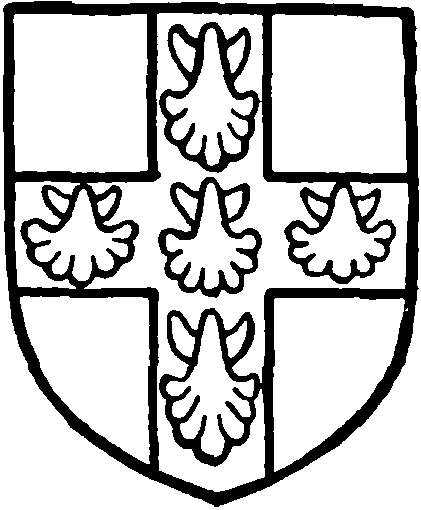
Villiers, Duke of Buckingham. Argent a cross gules with five scallops or thereon.
The plate is of very great interest, consisting of two communion cups with domed covers, two flagons, two patens, ten plates, and a strainer. On 12 November, 1687, James II gave to the church a set of plate comprising a chalice and small paten, two flagons and two standing patens, weighing 119 oz.; the record of this gift being preserved in the registers on the back of Charles II's marriage certificate. The small paten has been lost, but the five pieces which remain and are older than 1687 together weigh 113 oz. 8 dwt., leaving the very probable weight of 5 oz. 12 dwt. for the lost paten.
It so happened that in 1683 the garrison of Tangier was brought home by Lord Dartmouth, landing at Portsmouth, and among other things the plate of the church of St. Charles the Martyr was brought with them. Lord Dartmouth in a letter of 5 November asked that the plate might be given to Godshouse chapel, (fn. 133) and a list of the plate, (fn. 134) exactly agreeing with that in the register, was drawn up on 16 January, 1683–4, doubtless just before its departure for England. Of the two flagons which the church has, one is of 1639, and the second apparently a locally made copy of it, without hall-marks, and inscribed ' Aldern**** John McMath his Gist (sic) to the Chirrch of Tangier November the 10 1672.' These are a pair, the second made to match the first, and obviously formed part of the Tangier plate. The other pieces, which, as seems possible, also belonged to Tangier, are a cup, with no mark but that of Anthony Nelme, a London goldsmith of the latter part of the seventeenth century, and two standing patens of 1677. The inference is that James II handed over the set of Tangier plate to Portsmouth church, and not, as it seems, to Godshouse chapel.
The remaining pieces of plate are (1) a cup made to match that already noted in 1764, and fitted with a domed cover of 1803; the other cup has a like cover of 1858; (2) nine silver plates, two of 1708 given 1725, two of 1804, two of 1804, two of 1809 given 1810, two of 1812 given 1812, and one of 1900; (3) a strainer of 1805 given 1806. There is also one plated plate, modern, and a silver verger's rod of 1812 given 1812. The earliest register runs from 1653 to 1662, the second being a finely-bound book beginning with the record of Charles II's marriage, 22 May, 1662— now cut out and framed—and containing baptisms and marriages to 1694, and burials to 1678, with a few of 1683–6. The third book goes from 1695 to 1710, the fourth 1710 to 1727, the fifth 1727 to 1748, and the sixth 1748 to 1769, with marriages to 1758 only. The seventh, eighth, and ninth contain marriages 1754 to 1758, 1758 to 1763, and 1763 to 1778. The tenth has baptisms and burials 1770 to 1787, the eleventh and twelfth marriages 1778 to 1785, and 1785 to 1795, the thirteenth baptisms and burials 1787 to 1800, the fourteenth and sixteenth marriages 1795 to 1806, and 1806 to 1813, and the fifteenth baptisms and burials 1801 to 1812.
In addition to these and to the Garrison Church described above, numerous churches have been built during the last two centuries to meet the needs of an ever-increasing population. St. Mary's in Highbury Street was built as a chapel of ease to Portsmouth parish church in 1839, (fn. 135) but the greater number of the more modern churches are attached to St. Mary, Portsea. Of these daughter churches St. George's in St. George's Square, Portsea, was built in 1754 for the benefit of the town which was then fast rising in the neighbourhood of the Dockyard, (fn. 136) but the district was not erected into a separate parish till 1875, the church being still in the gift of the vicar of Portsea. (fn. 137) In 1822 the church of St. Paul, Southsea, was erected, (fn. 138) and a part of Portsea parish assigned to it to form a district chapelry in 1835. (fn. 139) All Saints' in the Commercial Road was built in 1828, a part of Portsea parish being assigned to it in 1835. (fn. 140) Holy Trinity, Portsea, was built in 1841 (fn. 141) on ground belonging to the Government, by which it has recently been resumed for the purpose of extending the Dockyard, while the district which had been assigned to it has been divided between the churches of St. George and St. John. In 1841 also a church under the invocation of St. James was built in the outlying district of Milton, (fn. 142) which was formed into a district chapelry three years later. (fn. 143) St. Mark's church, North End, was built in 1874, a portion of Portsea parish being assigned to it in the following year. (fn. 144) In 1898 was erected the mission church of St. Agatha, Conway Street, well known as the scene of the labours of the late Father Dolling. These are all in the gift of the vicar of Portsea. The church of St. John in Prince George's Street, Portsea, was built in 1788 (fn. 145) and is in the gift of five trustees. A district was assigned to it in 1835. (fn. 146) St. Jude's, Southsea, also in the gift of five trustees, was built in 1851, (fn. 147) and erected into a parish in 1879. (fn. 148) In 1862 three new churches were built: St. Luke's, Marylebone, of which the bishop of Winchester is patron, was endowed as a separate parish church in 1865; (fn. 149) St. Bartholomew's, Southsea, originally built as a chapel of ease to St. James, Milton, is also in the gift of the bishop; St. Simon's, Southsea, in the gift of the Church Patronage Trust, was built as a chapel of ease to St. Jude's. A part of the parish of St. Paul's, Southsea, was assigned to the church of St. Michael and All Angels in Park Road in 1882. (fn. 150) In the following year a part of the parish of St. Jude and the chapelry of St. Paul was assigned to St. Peter's, Southsea. (fn. 151) The churches of St. Stephen, Portsea, and St. Matthew, Southsea, of more recent date, are in the gift of the bishop, as also is St. Margaret's, Eastney, to which a district was assigned from that of St. James, Milton. The Circus church in Surrey Street is in the gift of the trustees of the Rev. J. C. Martin.
The Roman Catholic diocese of Portsmouth includes Hampshire, Berkshire, and the Channel Isles. It was formed in 1882, in which year was opened the Cathedral of St. John in Edinburgh Road.
There is a Roman Catholic church in Gladys Avenue, and the church of St. Swithun in SaxeWeimar Road was opened in 1901 to replace a smaller church, which has since been converted into a school.
There is a Presbyterian church in Commercial Road, and another in St. Michael's Road, built in 1878.
In the seventeenth century there were many Nonconformists in Portsmouth. Among those fined for preaching at conventicles was John Hickes, well-known for his share in Monmouth's Rebellion. (fn. 152) Conventicles were frequently held at a house called the Golden Ball, which belonged to a baker, Robert Reynolds, (fn. 153) while the bitter animosity between Dissenters and members of the Church of England in the town is shown by the disputes between them in 1710. (fn. 154) In 1865 there were more than sixteen Nonconformist places of worship in the neighbourhood; of these five were Baptist chapels, four Wesleyan, and three Independent. The number of meeting-houses of all denominations has increased rapidly to meet the needs of a large population. There are now nine Baptist chapels; one in Kent Street is said to occupy the site of a meeting-house founded in 1698. The Bible Christians have three places of worship; the Plymouth Brethren meet at the Assembly Room, Bush Street, Southsea, and at St. James's Hall, Commercial Road. The Congregationalists have seven chapels, chiefly at Landport and Southsea. The Unitarians have a meeting-house in the High Street. The Primitive Methodists have four places of worship, two at Southsea, one at Stamshaw, and one on the Eastney Road ; and the Wesleyans have fourteen. (fn. 155) There are also numerous mission halls.
CHARITIES
The following is an account of the principal charities in Portsmouth:—
In 1679 Thomas Winter by his will gave £200 for the benefit of the poor. At a subsequent date Thomas Mills gave the lease of a house to the poor with power of sale. The house was sold for £100. In respect of these sums, and probably of other small legacies, the Corporation pays £15 a year, which is distributed on St. Thomas's Day among the poor in sums varying from 1s. to 2s. 6d.
In 1765 Charles West by will left £100 Old South Sea Annuities, one moiety of the income towards the relief of the poor at Christmas, and the other moiety to be given to thirty poor housekeepers. The fund is represented by £113 15s. 4d. consols, the dividends of which are duly applied.
John Bass Eltham, by will proved 1880, left a legacy invested in £2,927 0s. 8d. consols, income amounting to £73 5s. 6d., distributable between the months of October and April to the poor of Portsmouth and Southsea, in money or in articles of kind. In 1905 disbursements were made to 152 aged persons.
Alderman Joseph George Whitcombe, by his will proved with four codicils 23 November, 1892 (inter alia) bequeathed £6,000, to be known as 'The Whitcombe Charitable Trust Fund,' for providing pensions of £10 per annum to poor persons of sixty years of age or upwards, resident in the borough of Portsmouth. The trust fund consists of £5,339 17s. 6d. India £3 per cent. stock. In 1905 annuities of £10 each were given to fifteen poor persons. On the determination of certain life interests the trust fund will be considerably augmented. The same donor founded scholarships in connexion with the grammar school and other schools.
The above three charities are administered by the Corporation.
In 1774 William Pike by his will left £300 on trust for the interest to be paid on St. Thomas's Day to the poor. The legacy was invested in Old South Sea Annuities, which are now represented by £440, £2 10s. per cent. annuities, with the official trustees, the dividends on which, amounting to £11 a year, are duly applied. The vicar and churchwardens were appointed trustees by an order of the Charity Commissioners of 12 March, 1869.
The Highbury Street Almshouses.—There was formerly an almshouse in Penny Street which, being required for the enlargement of the county goal, was sold in 1831 for £650. With this sum and voluntary subscriptions a site was acquired in St. Mary's Street, afterwards called Highbury Street, and almshouses containing ten rooms for ten aged women were erected, and a schoolroom used for infants. Mrs. Caroline Jones, by her will proved in 1883, left £1,000 to be invested and income to be paid to the inmates, 5s. each on Lady Day and Michaelmas Day, and £1 each on Midsummer Day and Christmas Day, any surplus for such charitable purposes as the vicar should think fit. The investment was made in the purchase of £980 7s. 10d. consols with the official trustees, and the dividends are duly applied.
Miss Anne Marie Williams, by her will, 1843, bequeathed to the vicar of Portsmouth an immediate legacy of £600 consols, and a further legacy of £600 consols after the determination of a life interest therein, and directed that the income there of should be applied for the use of the most deserving poor, including poor women in the almshouse, at Christmas and Easter in each year, in such articles as the vicar should think proper. The two legacies are represented by £1,071 3s. 8d. consols with the official trustees. In 1905 the dividends, amounting to £26 15s. 4d., were applied in grocery and coal tickets to seventyfour persons.
By deed, dated 31 March, 1865, Mrs. Anna Victoria Little, widow of Major Robert John Little, settled a sum of £100 consols (held by the official trustees) upon trust that the dividends should be applied in the distribution of bread and coals among the wives and families of corporals, gunners, and drummers in H.M. corps of Royal Marine Artillery resident at Portsmouth. The income is distributed among necessitous families of non-commissioned officers and men through the agency of the Royal Marine Artillery Benevolent Fund.
In connexion with the General Baptist Chapel, St. Thomas's Street, is Bowes's Charity, which is supposed to have originated in a gift of a Dr. Bowes, the earliest deed in existence being dated 20 January, 1792, whereby the appointment of trustees is regulated. Its endowment formerly consisted of £2,000 new 3 per cents., but now of £1,467 North Eastern Railway 4 per cent. debenture stock, producing £58 12s. 4d. yearly, which together with £15 9s. 3d. the rent of a dwelling-house, 19, St. Thomas's Street, belonging to the chapel, was in 1905 applied in providing pulpit supplies, &c., £40, expenses of the chapel £24, and the balance in repairs.
The High Street Meeting House Charity Fund now consists of £1,320, £2 10s. per cent. annuities held by the official trustees, arising from gifts of various donors, producing £33 a year, of which 7½ are paid to the minister of the chapel (now known as the Unitarian Chapel), and 4½ to the poor of the congregation. Last appointment of trustees 23 May, 1901.
Jacob Nathan, by will, proved 1867, left £63 0s. 9d. consols, dividends to be applied for benefit of poor Jews, through the agency of the Jewish Mendicity Society.
By will, proved 12 May, 1884, the Rev. Edward Sheridan bequeathed his residuary estate to the Roman Catholic bishop of Portsmouth and his successors upon trust to apply income in support of charitable objects in his diocese. The trust fund at present consists of £547 8s. 4d. consols, the dividends of which are applied towards the pension of one ecclesiastical student. The charity is further entitled to £562 on the determination of a life interest.
The Royal Portsmouth, Portsea, and Gosport Hospital, Fitzherbert Street, Landport, which was founded in 1849, was possessed in 1904, in addition to its general funds, of various securities valued at £29,598, producing an annual income of £939, arising from legacies and gifts of various donors, including legacies by will of John Bass Eltham (1880) and of Miss E. M. Scale (1884).
Henry Wood, by will and codicil, proved 1887, bequeathed contingently his residuary trust funds for investment, and, subject to certain existing life interests, directed income to be applied in gifts of £15 to poor persons born and resident in the borough of Portsmouth, with a further trust for the above mentioned hospital.
Mrs. Caroline Jones, by will, proved in 1883, left £1,000 in augmentation of the endowment of the existing church of St. Mary's parish. The legacy was invested in £973 3s. 5d. consols with the official trustees.
Mrs. Hannah Stokes, by will, proved in 1883, directed her trustees to invest in consols such a sum as would produce £3 a year to be applied in keeping in order a tomb in the Portsmouth Cemetery, the unapplied surplus thereof to be paid to the porter residing at the lodge of the said cemetery. The official trustees hold a sum of £100 consols in respect of this charity.
The following charities apply to Portsea:—
Edward Crafts, by his will, 1780, directed his trustees to lay out certain securities in paying for the schooling of as many poor boys as the interest would allow to learn to read and write and arithmetic to fit them for trades, subject as therein mentioned. In 1782 the minister and commissioners of St. George's Chapel agreed to accept the charity, which became attached to the schools in Kent Street, established by the Portsea Beneficial Society. The endowment, including a legacy of £50 consols given in augmentation by will of John Ring, proved in 1839, consists of £1,000 consols held by the official trustees.
By a scheme of the Board of Education, dated 21 September, 1905, trustees were appointed, and a sum of £10 a year was directed to be paid to the said school so long as it continued to be conducted as a public elementary school, the residue of the income in the maintenance of exhibitions equivalent to the tuition fees, with £5 added at the discretion of the trustees, tenable at secondary or technical schools in Portsea, with a view to training the exhibitioners for pupil teachers.
Richard Wilmot, by will, proved in the P.C.C., on 27 April, 1805, left certain securities as a perpetual fund for educating boys in the knowledge of the English language, writing, accounts, and navigation, with a preference for the sons of widows. The endowment now consists of a messuage on the north side of Trafalgar Buildings, Portsea, let at £13 a year; a messuage in Bow Street, let at £11 14s. and £388 4s. 1d. consols with the official trustees. By a scheme of the Charity Commissioners of 20 March, 1894, the yearly income—subject to the payment of all outgoings—is directed to be applied in the advancement of the education of the sons of widows bonâ fide resident in the parish of Portsea, who are scholars in the schools of the Portsea Beneficial Society, with a preference to those who have shown aptitude for the study of navigation, in granting prizes of from £1 to £5, and in the maintenance of exhibitions of £10 at the Portsmouth Grammar School, or any place of higher education.
Major Ebenezer Vavasour, by will, 1808, also left to the said schools £100, represented by £92 8s. 2d. consols, with the official trustees.
The charity of Thomas Brewer, will 1666, consists of 20s. a year charged on land in Buckland, 10s. to be applied on St. Thomas's Day, and 10s. on Good Friday.
Eleanor Brewer's charity was instituted by her will, dated 1667, bequeathing 40s. a year out of a close called Bird's Close.
William Sheppard, by will, proved in the P.C.C., 1798, left £100, interest to be applied on Whit Monday in distribution of bread among four widows resident in the parish, invested in £102 6s. consols with the official trustees. — Claypitt, by will, 1848, left £265 13s. 6d. consols upon the like trusts. These charities are administered together by the vicar and churchwardens. In 1904 an allowance of 2s. each was made to eighty-six widows.
Thomas Fitzherbert, by a codicil to his will, 1821, directed that £10,000 stock should, after the determination of certain life interests, be applied in annuities for five poor men and ten poor widows, and five poor single women of the parish of Portsea of fifty years and upwards. The Trust Fund, consisting of £10,350 consols, was transferred to the official trustees, and was sold out on the 15 August, 1906, and re-invested in the following colonial securities, namely, £2,576 9s. New South Wales 3 per cent. stock; £2,512 9s. 7d. New Zealand 3 per cents.; £2,569 3s. 7d. Victoria Government 3 per cent. consolidated stock; and £2,613 8s. 3d. South Australia 3 per cent. consolidated stock. The dividends are applied in annuities of £15, payable quarterly, to persons qualified under the trusts.
Henry Moody, by will, proved 14 November, 1889, left £10,000 to the trustees of Thomas Fitzherbert's charity, income to be applied by them upon similar trusts. The estate was administered in the High Court (Chancery Division), and proved to be insufficient to pay the legacies in full. By an order of the court of 11 April, 1906, a sum of £3,691 1s. 7d. consols was transferred to the official trustees, in satisfaction of the legacy. The stock was subsequently sold out and re-invested in £1,858 13s. 1d. Queensland Government 3 per cent. stock, and £1,819 12s. 2d. Western Australia Government 3 per cents. The two charities will be administered together.
Aria College is an institution founded and endowed by the will of the late Mr. Lewis Aria, for the training and maintaining therein of young men, natives of Hampshire, as Jewish divines, up to twentyone years of age, but with an extension of not more than three years in the discretion of the trustees. The benefits may also include residence and maintenancy in London to attend the Jews' College and University College; each student to receive a yearly stipend of from £20 to £30. The endowment fund is estimated to be about £20,000. The institution was regulated by a scheme of the Court of Chancery, dated 30 May, 1873 (amended in 1876), but its operation has recently been suspended.
By will of Miss Emily Catherine Scale, proved in 1884, a sum of £199 10s. consols (with the official trustees) was bequeathed upon trust that the dividends be distributed among poor persons of the parish of All Saints on St. Thomas's Day.
The Albert Cottages Institution, situated in Canal Walk, Fratton, was founded in 1866 by members of the registered friendly societies of Portsmouth, and was discontinued in 1891. It was purchased by Sir John Baker, knt., who by deed dated 8 March, 1897, conveyed the property to trustees for the benefit of necessitous members of registered friendly societies of the borough, their wives and children. The inmates receive the dividends on £210 0s. 8d. consols (with the official trustees) left by will of Miss Emily Catherine Scale above mentioned.
The following charities relate to Southsea:—
The poor of Southsea are entitled to share in the charity of John Bass Eltham (see above).
The School and Home for the Blind, St. Edward's Road, was established in 1864 by Miss I. HennGennys for the purpose of educating and giving industrial instruction to the blind of both sexes. By an indenture dated 11 March, 1867, William Thorngate, among other annual payments to various charitable institutions, provided that £5 a year should be paid to this institution. By an order of the Charity Commissioners made under the Board of Education Act, 1899, it was provided that a sum of £200 consols should be set aside in the books of the official trustees under the title of the Educational Foundation of William Thorngate in connexion with this institution.
By will proved 24 November, 1894, William Pelham Winter left £350 to be invested and income applied by vicar and churchwardens of St. Luke, Southsea, in such manner as they should think most advisable for the education at the Portsmouth Grammar School of one or more boys who should have attended the day school in connexion with the church. The legacy was invested in the purchase of £326 14s. 5d. India 3 per cent. stock.
William Pelham Winter likewise bequeathed £221 4s. 9d. consols, dividends to be applied in support of a soup kitchen. The two sums of stock are held by the official trustees.
William James Patterson, by will proved 1884, left £1,000 to be invested and income distributed to the poor of the parish of St. Paul, Southsea. The legacy was invested in £902 5s. 1d. consols which is held by the official trustees. The dividends, amounting to £22 11s., are applied by the vicar and churchwardens in giving tickets for groceries and coals and clothing.
There are more than forty elementary schools within the borough limits, the oldest foundation being that of the Portsea Beneficial Society's School, established under a deed of 1754. (fn. 156) They include also the Royal Marine Artillery School, opened in 1872, and the Royal Seamen and Marines Orphan School, built in 1874. (fn. 157)
The Portsmouth Grammar School was founded by Dr. William Smith, who endowed it with land by his will proved in 1733. (fn. 158)
In Highbury Street stands the house of John Pounds, a local cobbler, who held a ragged school there.