A History of the County of Hampshire: Volume 3. Originally published by Victoria County History, London, 1908.
This free content was digitised by double rekeying. All rights reserved.
'The hundred and parish of Fareham', in A History of the County of Hampshire: Volume 3, ed. William Page (London, 1908), British History Online https://www.british-history.ac.uk/vch/hants/vol3/pp209-216 [accessed 9 May 2025].
'The hundred and parish of Fareham', in A History of the County of Hampshire: Volume 3. Edited by William Page (London, 1908), British History Online, accessed May 9, 2025, https://www.british-history.ac.uk/vch/hants/vol3/pp209-216.
"The hundred and parish of Fareham". A History of the County of Hampshire: Volume 3. Ed. William Page (London, 1908), British History Online. Web. 9 May 2025. https://www.british-history.ac.uk/vch/hants/vol3/pp209-216.
In this section
THE HUNDRED OF FAREHAM
CONTAINING THE PARISH OF (fn. 1)
FAREHAM
At the time of the Domesday Survey the hundred of Fareham consisted of Fareham only, and it had probably been included in the grant of the latter to the see of Winchester about the ninth century. In 1284 the king, probably as the result of a suit of which, however, no record can be found, gave up to John bishop of Winchester, and his successors, all his right in the hundred of Fareham. (fn. 2) In the thirteenth century Peter des Roches withdrew the suit of Bromwich from the hundred of Titchfield to his court of Fareham, and by 1279 the tithings of North Fareham, Catisfield, Dean, Pokesole, Cams, and Bedenham had been added and are mentioned as having neglected to do suit at Fareham. (fn. 3) By 1346 Fareham had been still further enlarged by the addition of Crockerhill, Camsbishop, and Prallingworth, the latter having been transferred from Titchfield Hundred, while some time during the next century Abshot was added. (fn. 4) Of these places Camsbishop has probably been merged in Camsoysell, Dean is in Bishop's Waltham, Bromwich and Abshot in Titchfield; Crockerhill and Catisfield are small hamlets in Fareham, while Prallingworth, Bedenham, and Pokesole have ceased to exist.
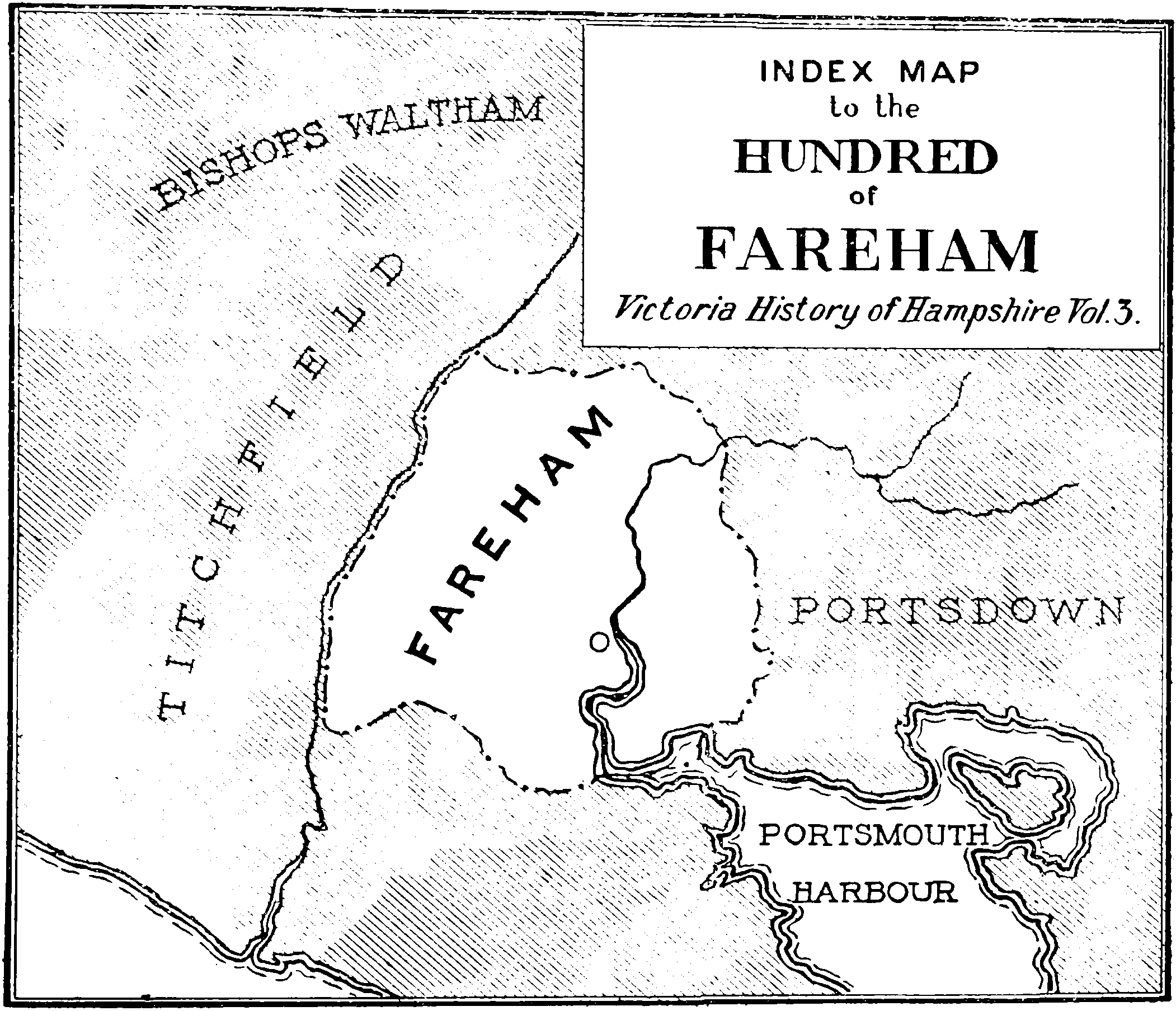
INDEX MAP to the HUNDRED of FAREHAM
FAREHAM
Ferneham (xi cent.); Ferham (xiii cent.); Fareham (xiv cent.).
The parish of Fareham consisting of 6,736 acres, of which eleven are covered by water, is situated on the shore of a deep inlet of the sea forming the northwestern branch of Portsmouth Harbour. The two main streets of the town are West Street, on the Portsmouth road, the houses extending from the railway station on the east to the tidal mill on the west, and High Street, which runs northward from the west end of the former street. From the middle of West Street another road runs southward to the harbour, skirting the quays on the west. In its western part West Street is bordered by small red-brick villas, and then broadens out into what is really an elongated marketplace, with shops, inns, and public buildings. The modern church of the Holy Trinity is on the south side of West Street. The High Street, though broad at first, narrows down quickly as it ascends a rise on the crest of which stands the old church, well back from the road in a large churchyard. There are many specimens of good eighteenth-century brick fronts in the town. The most picturesque part is at the east, where the river is held up by the sluices of a tidal mill, and forms a wide sheet of water with wooded banks. The mill is an old tarred wooden building at the head of the harbour, on the eastern side of which are the wooded grounds of Cams Hall. There are 2,768 acres of arable land, 2,299 of permanent grass, and 415 of woods and plantations. (fn. 5) The road from Southampton to Havant crosses the parish from west to east; a second road enters the town from Bishop's Waltham, while a third runs southwards to Gosport. The London and South Western Railway has a station at Fareham, at which is also the junction of a branch line to Gosport and Stokes Bay. Fareham Harbour, formed by a long broad inlet called the Cams, lies to the south-east of the parish, and though unimportant to-day, in the seventeenth century it had a considerable reputation, as may be seen from the following letter written from Portsmouth in 1630 to Sir John Coke, Principal Secretary of State. 'The river leading to Fareham within a mile of the town is an absolute good and safe place to moor ships and in all respects as convenient and safe a harbour as Chatham. £2,000 may be saved to the king in moorings and men.' (fn. 6) The Portsmouth road cuts across the head of this inlet, on a causeway with swinging water-gates opening inwards, through which the tide flows into a big natural reservoir, the water being used to work the old mill already mentioned, probably formerly known as the 'Tyde or Sea Mill.' (fn. 7) There is a small house in West Street, now used as a lending library, where Thackeray is supposed to have written several of his novels. A little out of the town on the Wickham road is Roche Court, now occupied by Mr. H. F. Rawstorne, who acquired it through his wife—a member of the Gardiner family whose ancestors have possessed the estate since 1661. It is of some antiquity, the original house being said to have been built by Peter des Roches. The oldest part now existing is a block standing east and west, with thick walls of flint masonry, but, unfortunately, no architectural features of very ancient date. It is doubtless mediaeval, but its original windows, &c., have long been replaced by later work. At its east end is a large chimney breast, and against it on the north-east is built a wing standing north and south, of timber construction, with two pretty half-timbered gables on the east side. The first floor room contains some good early seventeenth-century panelling, and the wing is probably an addition of this date. It has been lengthened northward in the eighteenth century, and the panelling is made out in the detail of the time. The main entrance is on the west side of this wing, and with the entrance passage, is a comparatively modern addition. In front of it is a fine cedar, which is, unfortunately, rather too near the house. The stables and offices stand to the south-west, and the garden is mainly to the east, with a pretty garden house. The approach to the court is through the park from the Fareham road, by a gate and lodge in Strawberry Hill Gothic. There are some very fine trees in the park, and a thick belt of trees shuts off the road on the north boundary. Cams Hall, a large house on the east bank of the Cams, standing back in a large park is now occupied by Captain Ramsey, J.P. The house was built in 1781 of materials taken from Place House, Titchfield, and contains some woodwork brought thence and now in the stables. Blackbrook Grove, a large thatched house on the Titchfield road, belongs to Mr. J. H. Harvey, and on the opposite side is Blackbrook House, the residence of Lady Parker. Uplands House, formerly owned by Mr. Sidney Waterlow, and Wallington House, owned by the War Department, are now empty. In mediaeval times Fareham was a free port, and in 1346 the mayor of Southampton was pardoned for having taken 'divers distresses under the name of customs to the great damage of Fareham.' (fn. 8) It was famous too as a wine port in the fourteenth century, while in the sixteenth and seventeenth centuries it was largely used as a shipping port for timber, especially that supplied from Titchfield Park, though subject to some competition from Warsash, the charge for wood bought at Titchfield being 38s. the load if shipped from Warsash and 40s. from Fareham. (fn. 9) In 1637 Robert Rigge, 'undertaker on the part of the county of Hants' for the carriage of 1,000 loads of timber to the waterside of Fareham at 3s. 4d. per load, was accused of having detained from the carters 4d. on every load. He was also charged with not repairing the bridge at Fareham Quay 'which he is bound to do taking quayage.' (fn. 10) At this time the charge for timber conveyed from Titchfield Park to Fareham Quay was 5d. per mile. (fn. 11) In 1636 a sum of £50 was levied on the parish of Fareham for ship-money, while two years later 'the good men of Fareham' were asked to supply the king with a ship of 400 tons, with 160 men, to be ready at Portsmouth within four months. (fn. 12) To-day a few fishermen find occupation round the Cams but the shipping is quite unimportant, the chief article imported being coal. Brick-making, which has been carried on in Fareham for at least two and a half centuries, (fn. 13) is still a flourishing industry—'Fareham Reds' being well-known throughout the south of England. There is also a large tanyard. Agriculture is in a good condition, there being no unoccupied land in the parish. The soil is loam on chalk in some parts; gravel on chalk in others, while in the north there is a good deal of loose flint. The corn crops are good. Sheep-rearing, once an important industry at Fareham, has died out. A weekly cattle market is held, but the annual fair, formerly of great importance, was abolished in 1871. (fn. 14)
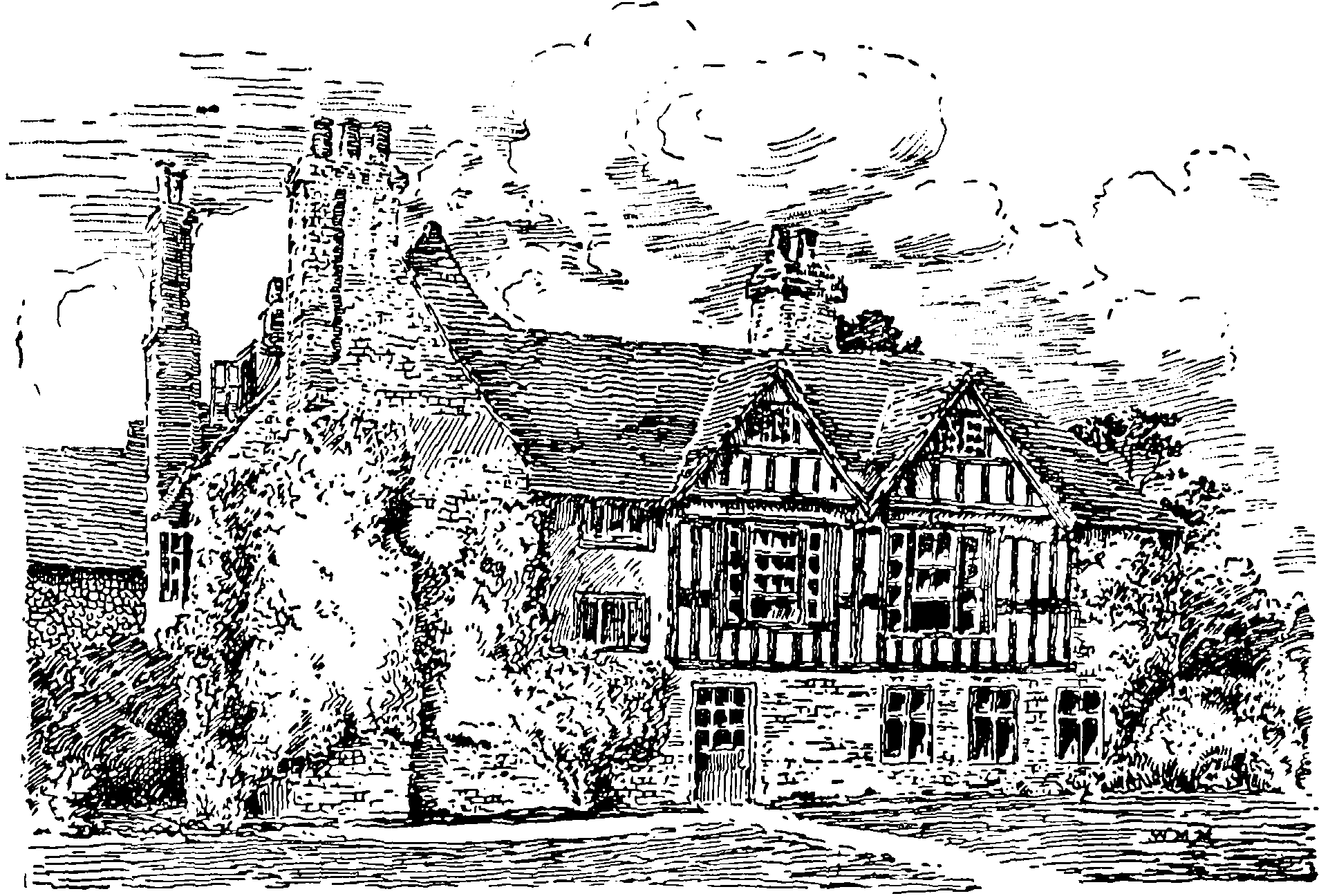
Roche Court, Fareham
Among other names there are:—Witelcroft, (fn. 15) Christonman's Land, Bletchinors, Brookfurlong, Clapgate, Grubbwood, Gunnersclose, Brithfrithheath, Toppett, Horgaston, (fn. 16) and Broadcroft. (fn. 17)
BOROUGH
Fareham was a mesne borough owned by the bishops of Winchester, (fn. 18) and, except for a short period in the seventeenth century, always retained by them. (fn. 19) In 1648, after the ordinance for the sale of bishops' lands the borough, including rents, fairs, markets, courts, &c., of the yearly value of £4 14s. 8d., was bought by Peter Wilkins for £909 14s. 8d., (fn. 20) but it was probably restored to the see of Winchester with the other episcopal estates at the Restoration. There is no evidence to show when the borough originated, and the first definite proof of its existence is to be found in 1261 when Elias of Rochester obtained a grant under letters patent of a burgage, and a stall in the borough of Fareham, which was in the king's hands by reason of the vacancy of the see of Winchester. (fn. 21)
In the reign of Edward I two members were returned to the Parliament of 1306, (fn. 22) and this is the only occasion that Fareham was represented in Parliament. The first record of a borough court is in 1337, and from that date the courts were held almost continuously until 1729, but it is possible that during the next century the privileges of the burgesses were allowed to lapse, as Fareham is omitted from the Hampshire boroughs in the Report of 1835. The town was governed by a bailiff, who was elected in the borough court; the accounts were always noted separately from those of the manor, and a detailed account is given of the proceeds of the court, the assize rent being 64s. The Public Health Act was adopted in Fareham in 1849, and the government of the town vested in a Board of Health of nine members, but under the provisions of the Local Government Act (1894) the Urban District Council became the local authority.
MANORS
At the time of the Domesday Survey Fareham was held by the bishop of Winchester, and it appears to have formed part of the original endowment of the bishopric. Though it actually contained 30 hides it had always been assessed at 20 because of its exposed position and its liability to attacks from the Danes. In King Edward's time it was worth £18, its value after falling to £10 rose to £16 before the date of the Survey, when it was farmed at £20; 'it cannot however bear it.' (fn. 23) In 1284 the king granted all right and claim in the manor of Fareham to John bishop of Winchester and his successors. (fn. 24) Land in the manor or rents from the manor were granted to various tenants from time to time. (fn. 25) In 1455 John archbishop of York was granted rents from the manor of Fareham, (fn. 26) while about 1541 Sir Thomas Wriothesley, who already held 100s. rent in Fareham, (fn. 27) was granted a lease of the park. (fn. 28) In 1641 a lease of the manor was granted to Ralph Riggs for three lives, and in 1647 Margery his widow petitioned the Commons to confirm to her and her sons this lease, otherwise they would be reduced to great extremity, because on its security she had lent her husband £1,000 in 1645, which lease was void by the ordinance of October, 1646, for taking away bishops' lands, and annulling all estates taken of the bishops since December, 1641. (fn. 29) Once only the manor passed out of the bishop's hands. After the ordinances of 1646 for the sale of bishops' lands, it was sold in 1648 to Nicholas Bond for £1,632 12s. 7¼d., (fn. 30) but was restored in 1660 to the see of Winchester, and retained until the estates of the see were taken over by the Ecclesiastical Commissioners in 1869. (fn. 31)
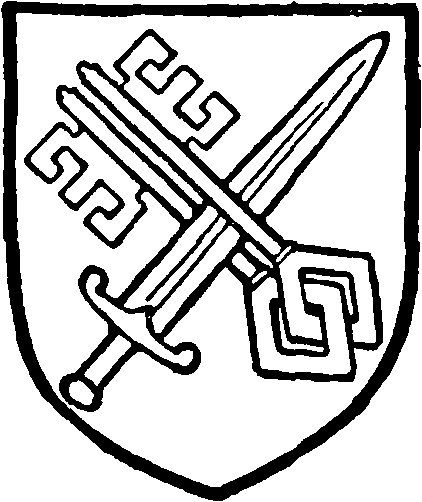
See of Winchester. Gules St. Peter's keys crossed with St. Paul's sword.
PARK
Fareham Park has existed from a very early date. In 1279 complaint was made that certain persons had broken into the bishop's park at Fareham and carried away the deer, (fn. 32) while on the Pipe Roll for the year 1323 the wage of the park keeper is noted among the expenses of the manor. (fn. 33) Various references to the park are made in the Court Rolls from time to time. In 1477 there was a payment of 3s. 4d. for a hedge round the park, while during the seventeenth and eighteenth centuries 50s. for the farm of the park is a yearly entry among the receipts. (fn. 34) A lease of the park was granted to Sir Thomas Wriothesley about 1541, when he acquired 100s. of rent in Fareham from the bishop, and this lease was devised to his wife Jane during the minority of her son, and was held successively by the second and third earls of Southampton. (fn. 35) The timber, like that of Titchfield Park, appears to have been in great demand for shipbuilding, and there are various records of sales of the wood made to the Admiralty.
A letter written on this subject by Sir Antony Windsor to Lord Lisle, deputy of Calais and sheriff of Hampshire in 1538 is interesting, and it also throws some light on the political intrigues of the time. 'As to your great wood you wrote for there is a thousand ready tallied in Farahame Park and a thousand more shall be ready shortly and then your warrant is expired. I would advise you to make suit to my lord of Winchester to have a quantity of wood every year for there is a new woodward a servant of Sir William Paulet's. As to game there is no great plenty of male deer but there is a pretty score of rascal as all the borders, gentlemen, and others, report . . . (fn. 36) Your lordship will understand that by sudden changes of officers there will be secret enemies and when the wrongdoers are tried it will be well to have a friend about the King. You should write a loving letter to my Lord Admiral to assist your officers. I doubt not the forest will increase in spite of all your enemies, and this will be a good means to stay warrants which are like to come thick and threefold if some persons can help it.' The 'bishop's meadow' containing 15 acres, is mentioned in the sale of the Fareham estate in 1648. (fn. 37)
It is probable that the 7½ hides in Fareham held by Ralph in 1086 (fn. 38) developed later into the manor of NORTH FAREHAM (Norfarham, xiii cent.), which always belonged to the bishops of Winchester. (fn. 39) At the beginning of the thirteenth century this manor was held by William Fitz Roger, though there is no evidence to show how it came into his possession. On his death about 1225, Peter des Roches, in right of his see, held the wardship of William's daughter Emma Fitz Roger, whom he gave in marriage to his nephew Geoffrey des Roches. (fn. 40)
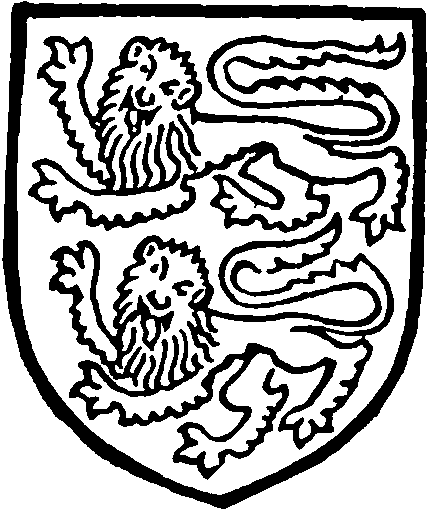
Des Roches. Satle two leopards argent.
North Fareham, which about this time became known by the alternative name of Roche Court, descended to Martin their son, but as he left no child on his death in 1277, the property passed to his brother Hugh subject to the life interest of Lucy widow of Martin. (fn. 41) On the death of Lucy, who survived her husband certainly ten years, John des Roches son of Hugh came into possession of the manor, which he held for half a knight's fee, for which he did suit at the bishop's court of La Soke, and at his view of frankpledge at South Fareham. On his death in 1312 his widow held the estate in dower, (fn. 42) it being then worth yearly £7 17s. She died in 1361, and was succeeded by her daughter Mary des Roches, widow of Sir John Boarhunt, and the property passed on Mary's marriage, about 1381, to Sir Bernard Brocas, (fn. 43) one of a family of great importance at this period. Sir Bernard Brocas represented Hampshire in most of the Parliaments of the reign of Richard II, and he obtained, first by right of his wife and afterwards by purchase, the mastership of the Royal Buckhounds, (fn. 44) an office which remained in the Brocas family for three centuries. In 1363 he received a grant of free warren in his demesne lands of North Fareham. (fn. 45) After his death in 1395 the manor was held in dower by his third wife Katherine, (fn. 46) from whom it descended to her step-son Sir Bernard Brocas, who was beheaded in 1400 for his share of the conspiracy in favour of Richard II. (fn. 47) Much of Bernard's property being in trust escaped forfeiture, but North Fareham, together with other manors in Surrey and Dorset, escheated to the crown. (fn. 48) Bernard's widow shortly after his execution was granted dower in all the forfeited lands, (fn. 49) and her son William obtained restitution of his father's estates in November, 1400. (fn. 50)
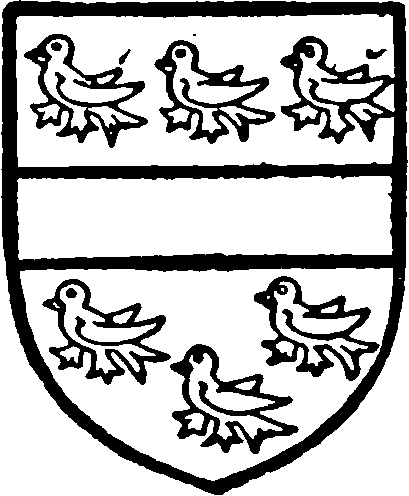
Boarhunt. Argent a fesse between six martlets gules.
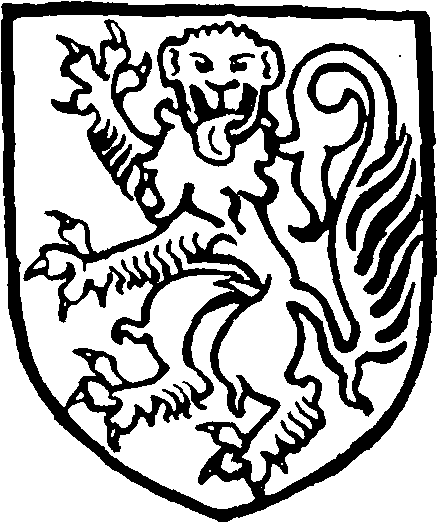
Brocas. Sable a leopard rampant or.
William was succeeded by a second William Brocas in 1456, whose son John also had a son William, on whose death in 1506 without heirs male North Fareham passed to one of his two daughters, Edith, afterwards wife of Ralph Pexall, (fn. 51) from whom it descended to their son Richard about 1540. On his death in 1571 he demised the whole of the property to his second wife Eleanor Cotgrave for thirteen years until his grandson Pexall Brocas, son of his eldest daughter Anne, should be of age, and left a legacy of £500 each to three of his daughters by his first wife Eleanor Paulet, the eldest, Anne, who had married Bernard Brocas, being passed over. The will was declared void as regarded one-third of the property, and this was divided amongst four daughters:—Anne, who married Bernard Brocas; Margery, wife of (1) O. Beckett, (2) F. Cotton; Elizabeth, wife of J. Jobson; and Barbara, who married A. Brydges, as co-heiresses. In 1572 Lady Eleanor bought the one-twelfth belonging to Elizabeth Jobson for £1,800. (fn. 52) Pexall Brocas came of age in 1584, when Lady Eleanor's legal claim was reduced to the one-twelfth she had purchased from the Jolsons. In the following year Pexall settled his two-thirds of the property in North Fareham on his wife Margaret, daughter of Sir Thomas Sherley. (fn. 53) The descent will be more easily seen from the following pedigree:—
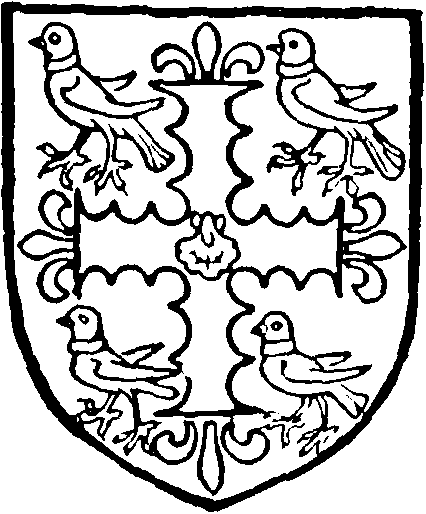
Pexall. Argent a flowered cross engrailed sable between four birds azure having beaks and legs gules and collars argent with a scallop argent on the cross.
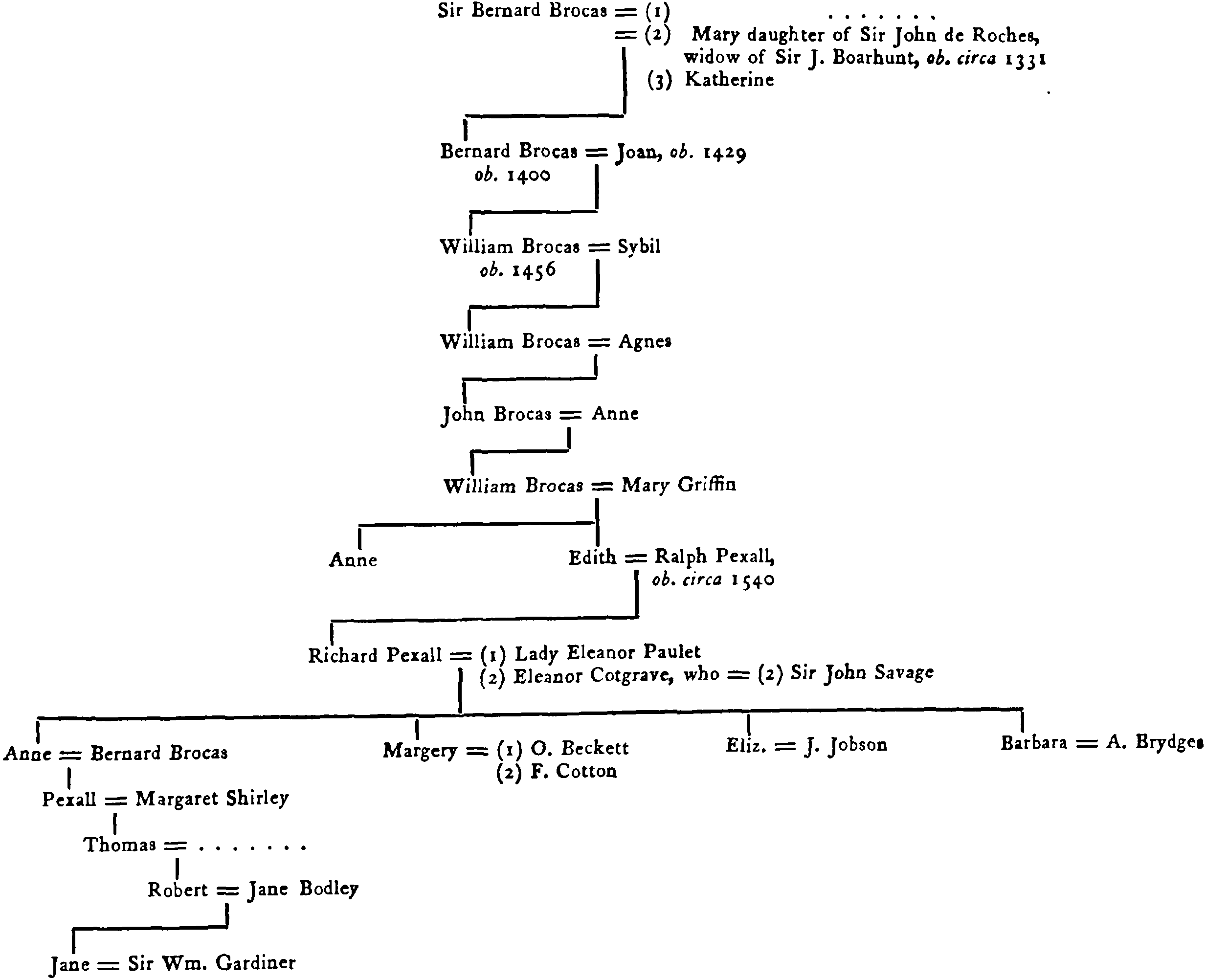
Pedigree of the Brocas family
In spite of Sir Pexall's extravagance much of his property was saved by the efficiency of his trustees, and on his death in 1630 he was possessed of ten-twelfths of the Des Roches property, and his son Thomas secured the remainder by purchasing the Jobson and Beckett twelfths. (fn. 54) In order to escape his creditors, Thomas handed over the estate to his mother's trustees, and it thus remained in the family until 1661, when the marriage of his granddaughter Jane Brocas with Sir William Gardiner brought the manor of Roche Court into a family of great political distinction at this time. On the death of Sir William Gardiner, grandson of the above, in 1779, without children, the baronetcy became extinct, but was revived in the person of Sir John Whalley Smythe Gardiner, representative of a younger branch of the family in 1783, and from his brother Sir James W. S. Gardiner it descended in direct succession to Sir John Brocas W. S. Gardiner, who died in 1868, and in whom the baronetcy became extinct for the second time. (fn. 55) The property passed to his only daughter Mabel, who died in 1892, and who in 1887 had married Mr. H. F. Rawstorne, the present lord of the manor.
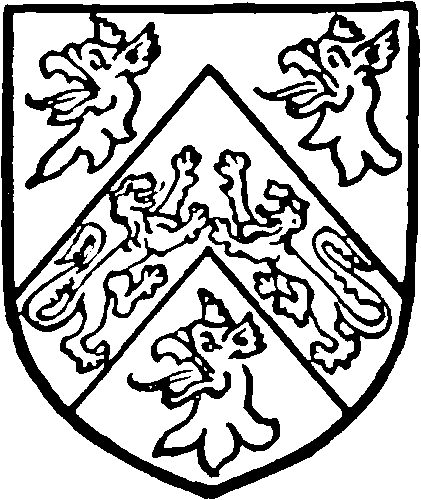
Gardiner. Argent a cheveron gules between three griffons' heads razed azure with two lions azure counter passant on the cheveron.
The Court Rolls of the manor of North Fareham from the years 1632 to 1749 are in existence, and an interesting entry under the latter date is to the effect that 'this manor is out of the jurisdiction of the Court of the lord bishop of Winchester called the Cheney Court,' and 'that no tenant or inhabitant of the manor ought to take the office of tithing man of the tithing of North Fareham by the authority of the Court of the lord bishop of his manor of South Fareham, but ought to take the said office and be sworn into the same at the Court of this manor, and by the order thereof as have from time immemorial (been) usual and accustomed.' (fn. 56)
The second holding in Fareham belonging to the see of Winchester consisted of 4 hides, mentioned in Domesday as held by William, formerly held by Earl Godwin, (fn. 57) and probably became the manor of CAMS (Cammes, xiii cent.; Cammes Oysell, xiv cent.; Camoyse Oysell, xvi cent.). The early history is obscure, but by the twelfth century it seems to have passed to the Oysell family, for in 1166 Robert Oysell was holding one knight's fee of the bishop of Winchester in Hampshire. (fn. 58) This was probably Cams, which seems to have been held subsequently by that service. In 1306, in the only Parliament in which Fareham was represented, John Oysell, probably a member of the same family, sat as one of the representatives of the borough. (fn. 59) In 1316 the vill of Cams was held by Nicholas Oysell, who appears to have been the last member of the family connected with the place. (fn. 60) In 1346 Nicholas Stake, a man evidently of some importance in Hampshire, who witnessed various deeds relating to the Brocas property, held one knight's fee in Cams. (fn. 61) There are no records to show how the manor came into the hands of the Audley family, but in 1397–8 it was conveyed by William Audley and Julia his wife to trustees, one of whom was Sir William Scrope, for the use of the heirs of Henry Maupas, (fn. 62) while in 1417–18 John Kingsmill and Cecily his wife conveyed it to trustees for the use of the heirs of Reginald Curteys. (fn. 63) Robert Barbot, one of the trustees, was holding in 1428, (fn. 64) and in 1451 Nicholas Wymbish, another trustee, conveyed the manor to Matilda, wife of Thomas. Radford, kinswoman and heiress of Reginald Curteys. (fn. 65) The Ludlow family, probably a branch of the important Wiltshire family of that name, appears to have had some interest in Cams early in this century, for in 1437 William and Richard Ludlow were granted £10 from the manor. (fn. 66) A hundred years later John Ludlow held the manor as one knight's fee, (fn. 67) and it remained in his family until the beginning of the seventeenth century, when it passed into the hands of Emmanuel Badd, (fn. 68) who died in 1632, and whose son Thomas, created a baronet in 1642, succeeded to the estate. Thomas died without male heirs in 1683, (fn. 69) having previously conveyed his manor worth £500 a year to trustees for the use of himself and his wife Joan, with the direction that after his death the estate should be sold and the proceeds divided among his five daughters. (fn. 70) Before 1701–2 Richard Chandler had purchased the manor from two of the daughters, (fn. 71) possibly the only two then surviving, and later in the century it passed probably by purchase to the Carnac family. (fn. 72) In 1781 it was bought by Mr. John Delmé, in whose family it remained until 1895, when it was acquired by Mr. Montagu Foster, who is the present lord of the manor. (fn. 73)
CHURCH
The church of ST. PETER and ST. PAUL preserves of its mediaeval building only the chancel. To the north of it is the large modern chancel and vestry, and the nave of the church is a great rectangular room with a coved plaster ceiling and large round-headed windows of the plainest description. Externally it is of red brick, and though it has the merit of being exceedingly spacious and well adapted for preaching, it is a distinctly unattractive building. Local tradition goes so far as to say that the designs from which it was built were originally intended for a silk factory. The tower at the northeast, built in 1742, is also of red brick, but has its merits, and is rather attractive than otherwise.
The general appearance of the old chancel is that of a thirteenth-century building with later windows inserted, but its south-west angle has at its lower part ashlar quoins of distinctly pre-Conquest character in long and short work, and the lower courses of the walls are of larger and coarser flint rubble than the rest.
In the east wall are three thirteenth-century lancets, and in the north wall five windows altogether, blocked or open. The first is a thirteenth-century lancet, the second a square-headed window of two cinquefoiled lights, c. 1500, and the third a round-headed trefoiled light, probably c. 1320. Of the fourth window, which was like the third, only a jamb remains, and the westernmost window is of three trefoiled lights under a square head, c. 1500. Between the third and fourth windows is a fifteenth-century doorway.
On the south of the chancel the windows correspond to the first three windows on the north, and the third has at the west angle of its sill on the outside a small square-headed opening rebated for a frame, and splayed inwards, but not showing on the inner face of the wall. The chancel arch is of late twelfth-century date, with half-round responds and a pointed arch of two chamfered orders. There are a number of seventeenth and eighteenth-century wall tablets in the chancel, and at the south-west an old stone coffin has been placed.
The fittings of the rest of the church are of no particular interest; there is a large west gallery running right across the nave, but the eighteenth-century arrangements are destined to give way to modern Gothic work in continuation of the chancel. At present only the foundations of the nave arcades serve to show the form of the future building.
There are eight bells, of which the treble and second, by Warner, were added in 1883, and the rest are by Joshua Kipling of Portsmouth, the tenor being dated 1745, and the other 1742. On the tenor are a set of verses referring to the rising of 1745, which witness rather to their writer's loyalty than his poetic skill.
In vain the rebls strive to gain renown
Over our Church, the laws, the King and
Crowne;
In vain the bold ingratfull rebls aim
To overturn when you support the same.
Then may great George our King live for to see
The rebllious crew hang on the gallows tree.
The plate consists of two Communion cups of 1830, given in 1831; a standing paten of 1718, given by Edward Jenkins, vicar; a flagon of 1720, towards which Mrs. Susanna Hobbs gave £10; an alms dish of 1723, and another of 1734, and a spoon of 1852. There is also a very beautiful secular standing covered cup, parcel gilt, of English work, undated, but its approximate date must be c. 1500.
The register books are as follows; i, 1558–1634; ii, 1634–90, with at the end a list of briefs, 1663–7; iii, 1690–1743; iv, 1743–92, the marriages ceasing at 1753; v, baptisms and burials 1792–1812; vi–ix, marriages, 1754–1812.
The church of HOLY TRINITY, erected by funds bequeathed by the late Lady Thompson, is a brick building with stone dressings, and consists of small chancel, nave, aisles, north and south porches, and an embattled western tower and spire. A district was assigned to it in 1835, and the registers date from 1836. The living is a vicarage in private gift.
ADVOWSON
There was a church at Fareham in 1086 (fn. 74) and it is probable that it was included in the grant of the manor to the bishopric of Winchester. As there is no mention of the advowson being held by the feoffees of the manor it may be assumed that the bishop kept the right of presentation in his own hands. In 1157 Henry de Blois, bishop of Winchester, appropriated the church of Fareham with all its appurtenances to the hospital of St. Cross, and in the valuation of Henry VIII it appears among the revenues of that house as yielding a sum of 60 marks yearly. (fn. 75) In 1544 the parsonage was leased to Thomas Wriothesley for fifty years, (fn. 76) and in the middle of the seventeenth century a lease of the rectory was granted to the family of Benett for a term of three lives. In 1693 the tithes were worth £180 per annum but by 1697–8 they had risen to £300. In the reign of William III, and again in that of Anne, several disputes arose between the master and brethren of St. Cross and the vicar of Fareham as to the payment of certain tithes, and evidence was brought to show that the former had no interest in any lands that had hitherto paid tithes to the vicar. (fn. 77) The tithes were retained by the Benett family until 1840 when the lease was sold to Sir John Whalley-Smythe Gardiner and on its expiration it reverted to the hospital of St. Cross. (fn. 78) In 1879 Fareham and the parochial chapelry of Holy Trinity were included in the rural deanery of Alverstoke and in 1881 the chapelry was endowed with £17 10s. out of the common fund. (fn. 79)
The lords of the manor of North Fareham had a free chapel at Whipstrode St. James, first mentioned at the beginning of the thirteenth century, when it belonged to Emma des Roches. (fn. 80) It followed the descent of the manor until the sixteenth century, (fn. 81) when the chapel passed to the crown by the surrender of the incumbent, and was pulled down. The tithes and glebe lands were impropriated by the Pexalls, the heirs of the original donors, and passed to successive owners of the manor. (fn. 82) The tithes have, however, gradually diminished in value, and now are quite unimportant.
The rectory of Whipstrode was granted to Thomas Wriothesley some time before 1550, (fn. 83) and followed the descent of Titchfield until 1762.
The Roman Catholic church of the Sacred Heart was founded in 1873 and rebuilt in 1878. There are also Congregational, Wesleyan and Baptist chapels in the town.
CHARITIES
Miss Elizabeth Barnard by will dated 1819 left consols to the amount of £494 4s. 8d. the dividends of which, producing £12 7s. yearly, are to be applied for educational purposes.
Mrs. Harriet Lawson by will dated 1852 left £1,000 invested in consols to the amount of £904 10s. 3d., the income from which, amounting to £22 12s. to be applied in the discretion of the vicar and churchwardens in the support of the Sunday school, the church house, and the provident funds for the poor.
Mary O'Bryen by will dated 1838 left consols to the amount of £270 13s. 6d., producing an income of £6 15s. 4d., to be applied to the distribution of fuel among the poor of the hamlet of Catisfield.
The Paddon Memorial Almshouses were erected in 1850 by Joseph Paddon for two almspeople in memory of his wife, and by his will they were endowed with £41 0s. 8d. Bank of England land stock. This was increased, in 1878, by the will of Miss Mary Ann Paddon, who left a sum amounting to £206 19s. 8d. consols; by the gift of £63 16s. 7d. Bank of England stock by John Edward Paddon in 1884; and by £167 14s. 7d. India three per cent. stock left by Miss Anne Agnes Follet. The income amounts to about £18 regulated by the scheme of 21 November, 1879.
Mrs. Isabella Watts by will dated 1875 left £500 which, invested in £476 15s. 1d. consols, produces an income of £11 18s. 4d. to be given to twelve poor widows. She also left a legacy of £100 for the repair of her tomb in the churchyard and her monument in the church. The official trustees hold the sum of £476 15s. 1d. consols and a sum of £10 2s. consols, producing 5s. a year in respect of the last-mentioned legacy, the court having declared that the trust for the repair of the tomb in the churchyard was void.
Mrs. Louisa Ayling by her will dated 1883 left a legacy represented by £195 7s. 4d. consols, the income from which, amounting to £4 17s. 8d., is distributed in coals to the poor.
Frederick Bradley by his will dated 1890 left a legacy to be invested, and the income to be applied in pensions to five aged poor persons to be elected by the minister and deacons of the Congregational church. The legacy, invested in £925 18s. 2d. India three per cent. and producing an income of £32 8s. was in 1905 given in weekly payments of 2s. 6d. each to five persons.
In 1886 about four acres of land was acquired as a recreation ground by means of the 'Assembly Room Fund' under an Order of the Chancery Division of the High Court, and in 1891 an additional piece of land consisting of 3 acres, 1 rood, 24 poles was secured for the same purpose.
The Rev. Sir H. Thompson by deed of trust dated 1835 gave £1,089 18s. 4d. consols in augmentation of the salary of the minister of Holy Trinity, subject to the payment of £10 to the clerk and £242 15s. 2d. consols for the church repair fund.
Mrs. Elizabeth Harriet le Blanc by deed dated 1850 gave £6,312 4s. consols, the income from which amounting to £157 16s. is applicable as to one moiety for the curate, and as to the other moiety for church expenses, salary of the organist, &c., in connexion with the church of Holy Trinity.
Seymour Robert Delmé by will dated 1894 left a legacy represented by £460 6s. consols, producing an income of £11 10s. to be distributed among the poor of Holy Trinity. He also left the same amount for the poor of the church of St. Peter and St. Paul.
For the school, founded by the will of William Price, see article on 'Schools,' V. C H. Hants. ii, 387, 398.