A History of the County of Hampshire: Volume 3. Originally published by Victoria County History, London, 1908.
This free content was digitised by double rekeying. All rights reserved.
'The parish of Bishop's Waltham', in A History of the County of Hampshire: Volume 3, ed. William Page (London, 1908), British History Online https://www.british-history.ac.uk/vch/hants/vol3/pp276-282 [accessed 2 May 2025].
'The parish of Bishop's Waltham', in A History of the County of Hampshire: Volume 3. Edited by William Page (London, 1908), British History Online, accessed May 2, 2025, https://www.british-history.ac.uk/vch/hants/vol3/pp276-282.
"The parish of Bishop's Waltham". A History of the County of Hampshire: Volume 3. Ed. William Page (London, 1908), British History Online. Web. 2 May 2025. https://www.british-history.ac.uk/vch/hants/vol3/pp276-282.
In this section
BISHOP'S WALTHAM
Waltham Woolpit (xv–xvii cent.); Waltham Westputt (xvii cent.); also called South Waltham to distinguish it from various other places of the same name.
The parish of Bishop's Waltham, together with the former tithing of Curdridge, comprises the whole of the Hamble valley from its source to the head of the estuary at Fairthorne, and also those spurs of the South Downs at the foot of which the two branches of this river rise. The transition from the down lands to the woods of the valley is very marked, and divides the county into two distinct geological portions, the downs being of chalk formation and the valley chiefly clay. The meeting of these two formations is the cause of some curious springs close to the town. (fn. 1)
Entering the parish from the north or east (that is to say, over Stephen's Castle Down or Bishop's Down), the slope down to the valley is steep, the town lying not more than 120 ft. above sea-level, whereas Stephen's Castle Down attains at one point a height of 389 ft. The name Stephen's Castle Down is supposed to date from the days of King Stephen, during whose war with the Empress Maud some earthworks are said to have been here erected. Over this down runs the old road from Waltham to Winchester; the new one (opened in 1830) strikes west from the town and approaches Winchester up the Itchen valley. A continuation of the old Winchester road leads through Curdridge to Botley, and maintaining a fairly high level gives a good view of the Hamble country, with the Hamble itself on the right hand and one of its tributaries on the left. The whole valley is well wooded, the road being bordered by oaks and pines, through which fields of wheat, oats, barley, and occasionally strawberries, may be seen. As the road approaches Botley station, Curdridge church is passed on the right hand. Here a few cottages behind the church constitute the village of Curdridge. 'Curdridge Common' consists of a few fields with patches of furze and heath, sloping up from the road opposite the church. In 1894 Curdridge was constituted a civil parish, 2,174 acres being deducted from the original 8,325 acres of Bishop's Waltham. Of these, 2,189¾ in Bishop's Waltham and 715¼ in Curdridge are arable land; 1,641½ in Bishop's Waltham and 730½ in Curdridge are permanent grass; and 160¼ in Bishop's Waltham and 267¼ in Curdridge are woods and plantations. (fn. 2) The chief crops are wheat, barley, oats, and clover; and the cultivation of fruit is on the increase.
Botley station in this parish was opened by the London and South Western Railway Company in 1832. A single line of railway from Botley Junction to Bishop's Waltham, with a station at the latter place, was opened in 1863. A steam rail-motor has recently replaced the ordinary train service for passengers on this line.
The best view of the town of Bishop's Waltham, which stands on the left bank of the Hamble stream about half a mile below its source, is from the hill on the opposite side of the valley. Immediately below lies the station, the head of the single line which runs up the valley. Beyond the station is the Abbey Pond and Mill, and beyond these again rise the ruins of the old palace of the bishops of Winchester. To the north of the palace lies the little town, red-tiled and compact, with the church at its east end. On the west side of the valley, facing the town, is a large clay-pit, and the brick and tile works which are the chief industry of the place. Terra-cotta used to be included, but, like the matting and tanning trades, has been discontinued of recent years.
On the west side of the valley the groups of houses known as 'Newtown' have arisen within the last thirty years, chiefly along the Winchester road.
The principal street of the town is the High Street, running north and south, and ending southwards in the square. Two streets run parallel to it on the east, Houghten Street and Basingwell Street, and at the north of the town Bank Street meets them at right angles, a narrow street in continuation of Houghten Street leading to the church. There are no buildings of unusual interest in the town, but a good many examples of eighteenth-century brickwork, and a few timber fronts of older date, notably a gabled house in the west of the square with a moulded beam below the gables, an almost exact replica of which, dated 1613, is to be seen in Petersfield. The Crown Inn is an old house, with latticed windows, and a picturesque yard behind it. (fn. 3) Near the entrance to the churchyard is an early eighteenth-century house with good detail.
There used to be stocks at the entrance to St. George's Square, (fn. 4) standing back from the road on a little plot of grass which may still be seen. Until about thirty years ago a maypole stood behind the church on a plot of grass which still bears the name, but the old dances were discontinued in the seventeenth century. Tradition says that the present High Street runs through what was once the village green. The old market-house, which used to stand in the centre of the square, was pulled down about the year 1841, a good deal of the material being used in the construction of the present fire-engine house. Under the market-house, which was built on arches, was the cage or lock-up for prisoners.
Dr. Samuel Ward, one of the translators of the authorized version of the Bible, was buried at Bishop's Waltham in 1629, and several other interesting persons have been connected with the town and neighbourhood. Vernon Hill House, which stands on the hill of the same name to the north-east of Bishop's Waltham, was built by Admiral Vernon just after the capture of Porto Bello, and Emerson once visited here. Northbrook House was the residence of Parry the Arctic explorer, and here Lieutenant Cresswell brought him the news of the finding of the north-west passage. The Priory, a large red-brick house at Newtown on the hill overlooking the valley, was built some fifty years ago for an infirmary, the land being given by Sir Arthur Helps, a great benefactor to the neighbourhood. Prince Leopold laid the foundation stone in 1864, and Sir Frederick Perkins presented a statue of the Prince Consort. But owing to the circumstances in which Sir Arthur Helps died, the building was claimed by his creditors and sold as a private house. Sir Frederick Perkins therefore sent to take back the statue, but the villagers objected strongly, and a fray was fought which came to be called the 'Battle of Bunker's Hill.' The statue is now in Southampton.
A particularly beautiful seat, in what is now the parish of Curdridge, is Fairthorne Manor. Miss Mitford, after visiting Cobbett here, wrote: (fn. 5) 'Cobbett showed the same taste in the purchase of his beautiful farm at Botley—Fairthorne. To be sure he did not give the name, but I always thought it unconsciously influenced his choice in the purchase. The fields lay along the Bursledon River, (fn. 6) and might have been shown to a foreigner as a specimen of the richest and loveliest English scenery.' The place is also interesting as having been the site of a Roman villa. (fn. 7) At high tide barges are punted up here as far as Botley Bridge. Charles II contemplated making the river navigable for vessels right up to Bishop's Waltham, and an Act was passed in 1664 (fn. 8) with this intent, but never carried into effect.
The Inclosure Act for the open fields of Bishop's Waltham was passed in 1759. (fn. 9) The inclosure of Curdridge Common was effected under the Act of 1856, (fn. 10) and that part of Wintershill Common which lies in this parish was inclosed in 1870. (fn. 11)
The following place-names occur, among others, in this parish: (fn. 12) Gyves, Playstones, Cokes Croft, Paine Meade, Downers, Penny Acre.
MANORS
The manor of BISHOP'S WALTHAM formed parcel of the lands of the see of Winchester from the year 904, when King Edward the Elder effected an exchange of lands with Denewulf, bishop of Winchester. (fn. 13) The king acquired Portchester, and granted to Denewulf in return 'that part of the lands of the king called by the people Waltham; to have, hold, and possess it with fields, woods, meadows, fisheries, and everything belonging to the same.' The land was to be held by the bishop and his successors of the king and his heirs. (fn. 14) King Edgar renewed the grant shortly before the Norman Conquest. (fn. 15) The Domesday Survey states that 'the bishop himself holds Waltham in demesne; it has always belonged to the bishopric,' assessing it at 20 hides, 'though there be 30 hides in number,' with a rateable value of £30. (fn. 16) The bishops of Winchester continued to hold the manor among the other possessions of the see until 1551, (fn. 17) when Bishop Poynet conveyed the property to Paulet the lord treasurer (as representative of the crown) in return for a fixed annual income. (fn. 18) The king granted the manor to William earl of Wiltshire the following month. (fn. 19) Queen Mary, however, restored it to John White bishop of Winchester in 1558, (fn. 20) and his successors continued to hold the manor until the sale of the bishops' lands in 1647. Bishop's Waltham was then purchased by one Robert Reynolds for the sum of £7,999 14s. 10¼d. (fn. 21) Reynolds's name appears as the holder of a court at Waltham manor in 1653. (fn. 22) At the Restoration, Bishop's Waltham was restored to the bishops of Winchester, who retained their hold upon it until the Bishops' Resignation Act of 1869 vested all the 'lands, tithes, hereditaments, and endowments then belonging to the bishopric of Winchester' in the hands of the Ecclesiastical Commissioners. (fn. 23)

See of Winchester. Gules St.Peter's keys crossed with St. Paul's sword.
The palace of Bishop's Waltham (fn. 24) was originally built by Henry de Blois bishop of Winchester during the twelfth century, (fn. 25) and was shortly afterwards the scene of two important councils: in 1182 when the barons met Henry II and granted him supplies for the second crusade; and in 1194 when Richard I held a council here preparatory to his last expedition to France. (fn. 26) The palace seems to have been a favourite residence of the bishops, and to have been frequently visited by royalty. The wills of both Henry II and William of Wykeham are dated at Waltham, and Wykeham spent his last days here. Cardinal Beaufort in his will bequeathed to Queen Margaret of England his 'blue bed of gold and damask at his palace at Waltham, in the room where the Queen used to lie when she was at that palace, and three suits of the arras hangings in the same room.' William of Waynflete also made his will and died at Bishop's Waltham palace. (fn. 27) The State Papers of the reign of Henry VIII contain many references to the visits of that king and of Wolsey and Thomas Cromwell to Bishop's Waltham palace; (fn. 28) and in 1512 it was the scene of the convention between king and emperor which came to be known as the Treaty of Waltham. (fn. 29) Within a few years of this date Leland described the palace as 'a right ample and goodly Maner Place moted aboute, and a praty Brooke renning hard by it.' (fn. 30) Later in the sixteenth century, when the manor and palace of Waltham were in the hands of the crown, Edward VI described the palace as 'a fair old home, in times past of the bishops of Winchester, but now my Lord Treasurer's.' The great Civil War saw the destruction of Bishop's Waltham palace, which after a gallant defence by 200 cavaliers under Colonel Bennett surrendered to General Brown, on 9 April, 1644. On the 11th a cavalier wrote: 'Waltham House in ashes.' Bishop Curll, who was resident in the palace at the time, is said to have effected his escape in a dung cart. For some time after this anyone who required building stone helped himself from the palace ruins. In 1869 the property passed into the hands of the Ecclesiastical Commissioners, who sold the site and ruins of the palace to Sir William Jenner. Since the latter's death in 1898, his widow Lady Jenner has owned the place.
The ruins of the palace are still imposing, though little is left but the shell of the north wing. The house was probably foursquare, with an inner court, and a gateway in an outer court on the north-east, round which the offices were built. The whole was defended by a moat, which remains very perfect on the north and east, and a large space south and west of the moated site is inclosed by a picturesque brick wall, built by Bishop Langton (ob. 1501), with a square two-story garden-house remaining at its southeastern angle. Through it a stream runs northwest towards the Hamble, leaving the inclosure at a second red-brick garden-house in the north-west angle, which has served as a latrine. In the western part of the inclosure stands the house known as Place House, owned by Lady Jenner, part of which may be of seventeenth-century date, but its chief attractions are its garden and the view of the ruined palace.
Part of the arrangement of the palace building is still to be made out, though the site is much overgrown and heaped with fallen rubbish. The south front is 180 ft. long, with a square tower at each end, projecting beyond the line of the main wall. The general appearance of the work is that of a fifteenthcentury building, but in reality a great deal of twelfth-century walling and detail exists, especially in the western part. In the centre of the range stands the hall, with tall two-light windows on the south, the inner or north wall being in this part entirely destroyed. At the east end are the kitchen and offices, and at the west of the hall are living rooms. Along the west wall of the hall are remains of a twelfth-century wall arcade, and in the room immediately adjoining it a large twelfth-century window remains in a fair state of preservation. The other wings of the house are completely ruined, but the remains of the chapel, a small twelfth-century apsidal building, were excavated some years since, and are still to be seen, though much overgrown, to the south of the hall. Parts of the outer gatehouse exist at the north-east angle of the inclosure, the side walls only being left, with fireplaces in what must have been the porter's lodgings. At the south-east angle of the inclosure is a long building standing east and west, and formerly of two stories. At the east end is a large fireplace, and the building was probably a bakehouse, brewhouse, or the like, and is of late fifteenth-century date.
The large pond to the south of the palace, separated from the southern arm of its moat by the high road, is an artificial pool made to work the mill at its west end. Below the mill are the banks of a second pool, now dry, and there seems to have been a third bank further down stream. All the pools no doubt served as stew-ponds for the use of the palace.
PARK
The park of Bishop's Waltham, which was attached to the palace, formerly extended for over 1,000 acres. (fn. 31) It was bounded by the 'Lug,' a mound 16½ ft. broad and some 6 ft. high, with trees planted on the top to form a barricade. (fn. 32) After the destruction of the palace, Dr. George Morley (bishop of Winchester 1662–84), being in need of money for the repair of Farnham Castle, (fn. 33) conceived the idea of dividing up the park into farms. He therefore obtained the royal assent to an Act enabling him to lease out 'the two parks and other demesnes at Bishop's Waltham,' in July, 1663. (fn. 34) A year later the place was spoken of as 'the great disparked park of Bishop's Waltham,' (fn. 35) which very accurately describes it at the present day.
The land known as Waltham Chase was probably included in the original tenth-century grant to the bishopric, but the Chase is only specifically mentioned at the time of its acquisition by the Lord Treasurer in the sixteenth century, and the subsequent grant to the earl of Wiltshire and regrant to Bishop White. (fn. 36) It stretched away to the south and east of the park, and was practically an outlying portion of the Forest of Bere. Originally the hunting-ground of the bishops, the chase became famous in the eighteenth century as the haunt of a gang of deer-stealers, who were known from their blackened faces as 'The Waltham Blacks.' It was in consequence of their doings, and at the instigation of Bishop Trimnell, that the Black Act of George I was passed in 1722, though apparently it was never enforced. Some twenty years later, Bishop Hoadly, on being asked to re-stock the chase with deer, refused, saying that it 'had done mischief enough already.' Waltham Chase was inclosed in 1870, (fn. 37) since when the timber has been entirely cut down, (fn. 38) though the name forest still clings to the locality.
The earliest reference to a market at Bishop's Waltham is in the reign of Edward I, when it was reported by some inquisitors that 'the market of Titchfield and Waltham is to the damage of the market of … . which is held on a Saturday.' (fn. 39) This was in all probability a joint market, held alternate weeks at either place, and dropped in consequence of the inquisitors' report, which would account for the entirely new grant by Elizabeth in 1602 to the bishop of Winchester and his successors of the right to hold a market at Bishop's Waltham on Friday in each week. (fn. 40) When the main line through Botley was opened in 1832, Botley became a more convenient centre than Bishop's Waltham, and the market was transferred thither, where it was held alternate weeks with Fareham.
Queen Elizabeth's grant to the bishop in 1602 included the right to hold two fairs in Bishop's Waltham, one on the vigil of St. Philip and St. James, and the other on the first Tuesday in Lent. By 1792 there were four annual fairs, viz.: the second Friday in May, the thirtieth day of July, the first Friday after Old Michaelmas, and the tenth day of October. (fn. 41) The last-named appears to have lapsed before the year 1848, (fn. 42) and by 1888 all had ceased with the exception of a small pleasure fair which is still held annually in August.
Of the three mills mentioned in the account of Waltham in Domesday Book, (fn. 43) two are in the present parish of Waltham, (fn. 44) viz.: Abbey Mill on the palace pond, (fn. 45) and Waltham Mill on the Fareham road. The former was rebuilt in 1862 after a fire. On a court roll of Queen Anne's reign mention is made of 'one mill called a paper mill in the tithing of Curdridge.' (fn. 46) This was the 'Frog Mill' on the Hamble River, just below Durley Mill. Having long been disused, it was pulled down some twelve or fifteen years ago, with the exception of a small portion now used as a barn.
There is no indication that the so-called manor of FAIRTHORNE (fn. 47) (Fayerthorne, Fayrethorne, xvi cent.) was ever anything more than an estate included in Bishop's Waltham manor. The land is possibly to be first traced in the 'one messuage and one carucate of land in Hulle' acquired in 1296 by William de la Hulle and Agnes his wife, (fn. 48) but the name Hulle or Hill is so common in Hampshire that this identification cannot be more than conjectural. In 1332 William de Overton and Joan his wife held 'one messuage and one carucate in Hulle and Titchfield,' (fn. 49) and in the following year this same tenement is described as lying 'in Southwaltham and Hulle near Botley,' (fn. 50) which clearly identifies it with the Hulle or Fairthorne of later times. From this date the descent of the property can be fairly traced. In 1361 Thomas de Overton, son of the above William de Overton, died seised of 140 acres of land in Hulle. (fn. 51) His heir was his son William, presumably the father of that Isabella whose marriage with Sir William Tanke (fn. 52) brought the Hulle property into the hands of the Tankes. Hull is not mentioned by name in 1393 and 1394 among the lands 'in Waltham' held by Robert Tanke and Elizabeth his wife, (fn. 53) but a Robert Tanke was holding the 'Manor of Hylle beside Botley' in 1431. (fn. 54) This date is noticeable as the first occasion on which the term manor is applied to the tenement. In 1504 William Tanke died seised of 'lands in Bishop's Waltham held by the bishop of Winchester.' (fn. 55) He left two daughters, the elder of whom, Joan, became in turn the wife of Richard Ryman and Edward Bartlett, (fn. 56) and under a settlement of 1542 Joan and her second husband were to hold the manor during their lives, with reversion to the children of Joan by her first husband. (fn. 57) Joan died in 1561, (fn. 58) and Humphrey Ryman her elder son in 1568. (fn. 59) John, the son and heir of Humphrey, succeeded to the property on the death of his uncle William Ryman, who had only had a life interest in it. John Ryman was still holding in 1573 (fn. 60) and 1579, (fn. 61) but in 1600 Francis Serle was in possession. (fn. 62) The Serles seem to have been closely connected (probably by marriage) with the Bartlett and Ryman family, for the name appears on family settlements of the years 1542 (fn. 63) and 1576, (fn. 64) and John Serle and Francis Serle apparently acted as successive trustees of the manor. (fn. 65) The descent of Fairthorne is very obscure in the seventeenth century, but by 1684 the manor was in the hands of Wriothesley Baptist Noel, descendant of Thomas first earl of Southampton, who acquired the manor of Titchfield after the Dissolution. Wriothesley's daughter Elizabeth married Henry first duke of Portland, and the Portlands were holding Fairthorne with their Titchfield property in 1734 (fn. 66) and in 1762. (fn. 67) When they parted with it is uncertain. (fn. 68) The next known fact concerning Fairthorne is that about the year 1806 William Cobbett 'purchased Fairthorne Farm of about 300 acres, and around it he planted a broad belt of trees.' (fn. 69) On the site of Cobbett's summer-house, as it was called, the present house was built about fifty years ago. It is now the residence and property of Mr. R. A. Burrell, who purchased it from Sir Thomas Freke in 1878.
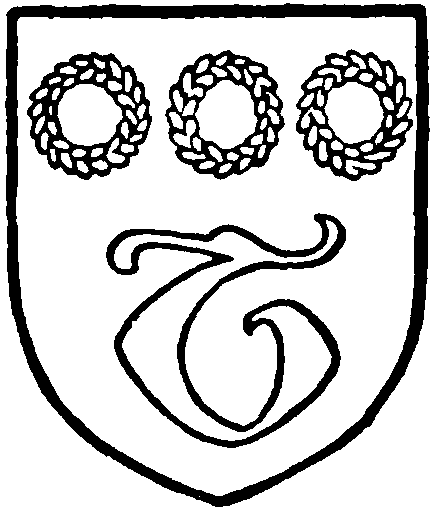
Tanke. Argent a text T gules and three wreaths vert in the chief.
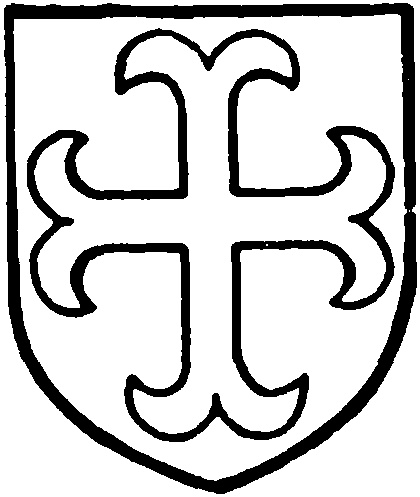
Bentinck, Duke of Portland. Azure a cross moline argent.
CHURCHES
ST. PETER'S CHURCH, BISHOP'S WALTHAM
ST. PETER'S CHURCH, BISHOP'S WALTHAM, has a chancel, nave of four bays with aisles and south porch, south-west tower, and at the west end of the north aisle a vestry with gallery over. There is also a large gallery in the west bay of the nave. The repairs and alterations of the last three centuries have been extensive, and little early work remains. The capitals and arches of the north arcade of the nave date from the beginning of the thirteenth century, and from the evidence of windows discovered in 1868 in the north wall of the chancel it appeared that the chancel was also of thirteenth-century date. It was, however, remodelled in the fifteenth century, or in the late fourteenth, and to that time its earliest features now belong. The tower is recorded to have fallen 31 December, 1582, and to have been rebuilt in 1584–9; the north aisle was rebuilt in 1637, and the south aisle in 1652. The south arcade of the nave was destroyed in 1798 to make place for a gallery over the aisle, the wooden posts carrying this gallery and the nave roof being replaced in 1822 by Tuscan columns in Portland stone. In 1894 these in their turn gave way to a modern arcade in fourteenth-century style, and the gallery was removed. The church generally was restored in 1864–8, and again in 1894, and in 1849 the west end of the nave was rebuilt. The nave roof was 'new made' in 1669, and the west gallery was set up in 1733 to hold the organ. The chancel has a three-light east window with fifteenth-century tracery, and a rose on the crown of the rear arch, a fifteenth-century north window of two lights at the west, and two like windows on the south, the eastern of which has modern tracery; between them is a plain priest's doorway. The roof is old, low-pitched, and opentimbered, with arched braces, and the altar-rails are a pretty example of seventeenth-century work with turned balusters and a carved top rail. The altar-table is also of the seventeenth century, with carved legs. The quire seats and marble pavement date from 1894. In the same year the chancel arch, which is of two continuous chamfered orders, was made symmetrical, its south jamb having been at some time cut back and the arch widened in a clumsy manner on one side only. The extent of the widening is still to be seen, as the lower part of the cut-back jamb is preserved, a space being left between it and the new jamb, and the result might easily be mistaken for a mediaeval squint.
The north arcade of the nave has plain octagonal capitals and pointed arches of two chamfered orders in Bonchurch stone, with half-round responds in chalk at either end. The circular columns were of the same material till 1894, but being out of the perpendicular they were then rebuilt as they now appear, with new bases on a slightly different line from the old. Of the capitals only those to the responds are old. At the east end of the north aisle is preserved a large late twelfth-century scalloped capital, perhaps from the old south arcade, and worked to fit a round column. With it is the stem of a twelfth-century pillar piscina with zigzag ornament, which has been re-used in the fifteenth century as part of the shaft of a canopied niche.
The north aisle, known as the Ashton aisle, and said to have been built with the stones of Ashton chapel, which stood near Chapel Farm, has a three-light east window with a curious and clumsy attempt at fifteenth-century tracery, doubtless dating from the rebuilding of 1637, and is lighted on the north by three square-headed windows each of three cinquefoiled lights of better style. The gallery over the vestry at its west end was formerly used as the school, and is reached from the west by a stair in a projecting buttress, dated 1637. It is lighted on the north by a four-light window with uncusped four-centred lights, and gives access on the south to the west gallery of the nave. This preserves its panelled front of 1733, a good specimen of its kind, but no longer holds the organ, which is now in the east end of the south aisle.
The south aisle has an east window of the same kind as that in the north aisle, and in its south wall three three-light windows, also like those in the north aisle. It is faced with wrought stone externally, a good deal of which looks like twelfth-century material re-used. Over the east window is a stone dated 1652, with the initials of the churchwardens, then as now four in number. Before 1894 there were dormer windows on the south with stone tracery, set up in 1867 to light the south gallery, and replacing wooden dormers. In the west bay of the aisle is the south door and porch, with detail of sixteenth-century character, and a panelled door dated 1613, while on its large key is the date 1681. The doorway may perhaps be of the same date as the door, as the west wall of the porch, which is also of late Gothic character, is built against and is therefore later than the southeast buttress of the tower, and this latter is recorded to have been rebuilt in 1584–9. The rebuilding, however, may not have been from the foundations. In any case, there must have been a re-use of old material in the seventeenth-century work, and it is not likely that the whole of the window tracery is of the same date as the poor stuff in the heads of the east windows of the two aisles.
The tower is of three stages, with square-headed windows of two uncusped four-centred lights in each stage on the west face, and in all four faces in the belfry stage. At the south-west angle is a newel stair, with a plain circular turret, probably of eighteenth-century date, rising above the parapet of the tower. The tower opens to the south aisle by a four-centred doorway, and has a west doorway of brick to the churchyard. In the south wall of its ground story is a locker rebated for a door and with a groove for a shelf, removed from the chancel in 1867, and in the north wall is a second recess, probably in situ, and dating from the rebuilding of the tower. A list of ringers' rules, dated 1766, and renewed in 1835, is kept here.
The west front of the nave, dating from 1849, has a four-light window of fifteenth-century style, and below it a west doorway.
The nave roof, as already noted, was 'new made' in 1669, and the aisle roofs are probably of the same date, though both may contain older timbers re-used. The pulpit in the north-east angle of the nave is a great ornament to the church, and dates from c. 1600. It is hexagonal with a panelled body on a stem, the panels inclosing arches with strapwork borders, under pediments. Over the pulpit is a very fine tester, relegated to the tower in 1867, but repaired and replaced in 1894, with strapwork cresting and pendants, and a panelled soffit, in the centre of which is a rose.
The font, at the south-west of the nave, is modern, and has a square bowl worked with shallow tracery patterns.
There are no monuments of importance, the best being that of Thomas Ashton, 1629, on the north wall of the north aisle. It is said to have been brought from Ashton chapel, and is a pretty alabaster panel with a half-length figure under a pediment; it has lately been redecorated. Below it is a marble panel, with the arms of Kerby, to the 'much lamented pious charitable good catholic' Mary Kerby, 1716, and on the north wall of the chancel is a black marble tablet in an alabaster frame, to Anna Cruys, 1634.
A few mediæval tiles, found during repairs, are kept in the north aisle.
There are six bells, the treble recast 1901, formerly dated 1724, the second of 1712, the third of 1651, the fourth formerly of that date, but recast in 1901, the fifth of 1599, and the tenor of 1597. The two last bear the initials of John Wallis of Salisbury.
The church possesses a fine set of silver-gilt plate; an Elizabethan communion cup without hallmarks, having two bands of engraved ornament on the bowl, a small paten and a flagon of 1747, a second flagon of 1629, and a large standing almsdish of 1669, though recorded to have been given in 1665.
The first book of the registers, 1612–68, contains a note of the fall of the tower and the rebuilding of the aisles; the second goes from 1669 to 1736, and the third from 1736 to 1812, the marriages ending in 1754 and being continued to 1812 in two more books.
Parish accounts are preserved from 1759, and there are notes of briefs down to 1823. The record of a curious disturbance in 1688 is preserved at length, and tells how the parish clerk and one churchwarden being excommunicate, for some reason not set down, withheld the key of the church from the parishioners, who eventually defeated the adversary by getting episcopal permission to break open the church door and have a new lock made.
A homily book of 1683 is kept in the vestry, which having been originally the property of the church, was lost in course of time, but in 1869 was discovered by Mr. A. V. Walters, who bought it and gave it back to the church.
The church of ST. PETER, CURDRIDGE, replacing an older building near the same site, was erected in 1887, its tower being added in 1894. It is of flint, with stone dressings. The register dates from 1835.
ADVOWSONS
It is recorded in Domesday Book that 'Ralf the priest holds the two churches of this manor, with two and a half hides.' (fn. 70) The first of these two churches was the parish church of Bishop's Waltham, in the gift of the bishop of Winchester, lord of the manor. Henry de Blois (bishop of Winchester, 1129–71) granted the advowson of this church to the hospital of St. Cross, Winchester, some time during his tenure of office. (fn. 71) The hospital had, however, lost it before 1284, in which year, under an agreement between the bishop of Winchester and the monks of St. Swithun concerning certain advowsons, the monks gave up their claim to Bishop's Waltham in favour of the bishop. (fn. 72) The living, which is a rectory, subsequently remained in the bishop's hands. (fn. 73) In 1533 the curate of Bishop's Waltham wrote a pathetic letter to Lady Lisle to ask for a gown cloth which she had promised him: 'you have so many whelps pertaining to you that poor Thomas Gylbert shall be forgotten.' (fn. 74) In 1551 Bishop Poynet surrendered the advowson of Bishop's Waltham, together with the hundred and manor, to the crown. (fn. 75) They were granted to William, earl of Wiltshire, the same year, (fn. 76) and eventually restored to the bishopric by Queen Mary. (fn. 77) Since this latter date the living has remained in the gift of the bishop. (fn. 78) Bishop's Waltham was a peculiar benefice. The first reference to this is in the fourteenth century, (fn. 79) and it is again recorded in the reign of Henry VIII. (fn. 80) There is also an entry in the parish registers of the year 1736, saying that mortuaries are due from Bishop's Waltham, Hamble, and Bursledon, to the minister of Bishop's Waltham, 'as having a peculiar jurisdiction there.' (fn. 81)
Several theories have been put forward for the identification of the second church recorded in Domesday.
Of these the principal are: (fn. 82) (1) That the second church was at Ashton, where the road to Upham meets Ashton Street, on the spot now occupied by a smithy; the site was at one time occupied by a little chapel of ease. (2) That Bursledon was this second church, the old Waltham registers showing that at one time the rector of Waltham exercised a peculiar archidiaconal jurisdiction over Bursledon. (fn. 83) (3) That this second church was at Upham or Botley.
Curdridge was formed into a district chapelry, out of the parish of Bishop's Waltham, in 1838. (fn. 84) The patronage of the living, which is a vicarage, was transferred in 1880 from the rector of Bishop's Waltham to the bishop of Winchester, in consideration of a further endowment of Curdridge out of the revenues of Bishop's Waltham. (fn. 85) Between 1892 and 1893 the advowson passed from the bishop to the dean and chapter of Winchester. (fn. 86)
There is a Congregational chapel (built 1862) at Bishop's Waltham, and a Primitive Methodist mission room. There is a mission hall at Ashton, and an iron chapel at Curdridge.
CHARITIES
The charities in the ancient parish of BISHOP'S WALTHAM were by a scheme established by an order of the Charity Commissioners, dated 14 February, 1896, consolidated under the title of 'The Combined Charities,' whereby—as modified by a further order of 14 October, 1898—provision was made for their future administration, in equal parts, as educational and eleemosynary. By an order of the said Commissioners the following charities were specifically allocated for educational purposes, viz.:—
1. The Educational Institute in Bank Street, erected with moneys arising from accumulations and from a grant of the Hampshire County Council on a site conveyed by deed of 30 September, 1898.
2. Bishop Morley's Charity, deed, 1679, being an annuity of £10, part of a fee-farm rent of £51, issuing out of the site of the late priory of the Holy Trinity of Mottisfont, and other manors and lands.
3. Mary Bone's Charity for education, will, 1732, a rent-charge of £20 issuing out of a farm and lands known as Lomer in the parishes of Corhampton and Warnford.
4. A sum of £500 consols with the official trustees of charitable funds to an account entitled 'The Hampshire County Council Repayment Fund,' which may be claimed in certain contingencies by the County Council; and
5. A sum of £1,360 Great Eastern Railway Company £4 per cent. consolidated preference stock, which includes £1,195 stock representing investment of proceeds of sale in 1882 of land belonging to Robert Kerby's charities.
The income of the educational branch, amounting to £96 18s. a year is applied in support of the institute, which is open without distinction of creed to all young persons of the civil parishes of Bishop's Waltham and Curdridge, and so much of the civil parish of Swanmore as was included in the ancient parish of Bishop's Waltham upon payment of such fees as the trustees may fix; but the buildings are by the scheme reserved to the free use on Sundays by the rector for the purposes of religious education in respect of Mary Bone's charity.
The Combined Eleemosynary Charities consist of the following charities, viz.:—
1. The Almshouse Charity, almshouses sold in 1882, now £44 of above-mentioned railway stock.
2. Poor's Stock Money, being £854, other part of said railway stock.
3. Mary Bone's Charity for poor widows, will, 1732, formerly rent-charge of £6 out of Stakes Farm in this parish, redeemed in 1902 by transfer to the official trustees of £240 consols, forming part of £1,237 17s. 8d. consols mentioned below.
4. Bishop's Palace Charity, consisting of rentcharge of £8 on Palace House, Bishop's Waltham, and of £28 of said railway stock.
5. Thomas Grant's Charity, rent-charge of £2 issuing out of a messuage in the High Street.
6. Elizabeth Penford's Charity for poor of Bishop's Waltham, £372 of said railway stock.
7. Elizabeth Penford's Charity for poor of Curdridge, will, 1842, £186 like stock.
8. Unknown Donor's Charity, £81 like stock.
9. £1,400 Great Eastern Railway £4 per cent. preference stock, forming part of £2,760 like stock with the official trustees, which comprises the several sums of railway stock above-mentioned; and £1,237 17s. 8d. consols, also with the official trustees representing balance of accumulations, and £240 consols, Mary Bone's charity for poor widows above-mentioned.
The income of the Eleemosynary Branch, amounting to £96 18s. 8d. a year, is applicable under the scheme for the benefit of necessitous poor in the area above mentioned in such manner as the trustees may consider most conducive to the formation of provident habits, in aid of the funds of provident clubs or societies, contributions towards provision of nurses, &c., also in pensions to old people. In 1905 £80 was expended in providing parish nurses, and six old persons received pensions.
Poor's allotments consist of 8 acres, deed, 1832; the rents, about £12 16s., a year, are carried to the poor rate.
By an award, 1870, 4 acres were acquired as a recreation ground, the rent of 'feed' being carried to the highway rates.
The Wheat Charity.
5½ sacks of wheat to poor yearly charged on the rectory.
The National Schools.
See article on schools, V.C.H. Hants, ii, 396.
Curdridge
The Combined Charities.
See Bishop's Waltham.
Gravel Pit Allotment consists of 3 acres acquired by award, 1856, rent applied in aid of highway rate.
The National Schools.
See article on schools, V.C.H. Hants, ii, 398.
Sir Henry Jenkin's Memorial Scholarship Fund consists of £304 10s. 4d. London County Consolidated Stock which the official trustees raised by subscription. By scheme of 31 August, 1901, the dividends are applicable for maintenance of a scholarship for a boy or girl who has been a scholar in a public elementary school in Curdridge or Botley.
Poor's Allotment consists of 3 acres award, 1856, subject to a yearly rent-charge of £3.
Recreation Ground.
By an award, 1856, 4 acres were acquired for this purpose, regulated by schemes of the Charity Commissioners of 25 August, 1885, and 9 March, 1887.
Reading Room.
By deed, 1884, a site and building thereon, together with a cottage, were dedicated for the use of the parishioners—an income of about £12 16s. is derived therefrom.