A History of the County of Hampshire: Volume 3. Originally published by Victoria County History, London, 1908.
This free content was digitised by double rekeying. All rights reserved.
'Parishes: Fawley', in A History of the County of Hampshire: Volume 3, ed. William Page (London, 1908), British History Online https://www.british-history.ac.uk/vch/hants/vol3/pp292-296 [accessed 30 April 2025].
'Parishes: Fawley', in A History of the County of Hampshire: Volume 3. Edited by William Page (London, 1908), British History Online, accessed April 30, 2025, https://www.british-history.ac.uk/vch/hants/vol3/pp292-296.
"Parishes: Fawley". A History of the County of Hampshire: Volume 3. Ed. William Page (London, 1908), British History Online. Web. 30 April 2025. https://www.british-history.ac.uk/vch/hants/vol3/pp292-296.
In this section
FAWLEY
Falegia (xi cent.); Fallele (xii–xiv. cent.); Falle (xiv cent.).
Fawley parish is a low tract of land 9,850 acres in extent, stretching from the eastern limit of the New Forest to Southampton Water. It is separated from the true forest country by the table-land of Beaulieu Heath, the spurs of which extend into Fawley. Arable and pasture land, with fine woods of oak and pine, characterize the coast districts, but a large tract of uncultivated moorland stretches eastward from the banks of the Dark Water and occupies the centre of the parish. The larger portion of this moor bears the name 'Badminston Common'; further west it is called 'Hugh's Common.' The latter is the name sometimes applied to the little inclosed plot of land, right in the centre of the moor, which from time to time has been sold in small allotments since about the year 1858. Mud cottages were at first erected, but these have been replaced by small red-brick houses. The settlement forms a sharp contrast to the surrounding country. Its usual name is 'Blackfields.' On the outskirts of the moor are several large farm-houses, which indeed characterize the whole district. In some cases a few cottages have sprung up in the neighbourhood of these farms, but except in the cases of Fawley and Langley there is nothing which can claim to be called a village. There are 2,544½ acres of arable land in the parish, 1,779¾ of permanent grass, and 1,211 acres covered by woods and plantations. (fn. 1) The soil is sandy, and the chief crops are oats and barley. The district is sparsely populated, and the means of communication bad, the roads being in many cases only tracks across the fields, while the nearest railway station is Beaulieu Road in the New Forest. The best mode of access is the road which runs down the parish from Hythe to Fawley, and on to Hillhead. A motor-bus service, opened by the London and South-Western Railway Company on 13 August, 1906, and running from Totton to Fawley, promises to open up the country by making it more accessible to visitors. The combination of moor, wood, and cornfield, with the glimpses of the sea and the hills of the Isle of Wight in the near distance, makes the country peculiarly attractive. The Cadland estate, which stretches down the coast of Southampton Water for nearly eight miles, is the residence of Mr. Drummond, who owns nearly all the land in the parish. The house was built in 1773, but was greatly enlarged by Mr. A. R. Drummond in 1836. Forest Lodge, the residence of Mr. Baring, is chiefly notable for its beautiful surroundings. It can also boast the possession of a Chinese pagoda and bridge in the grounds, and an observatory from which a fine view over Southampton Water is obtained. Eaglehurst, the residence of Mr. Huth, is also prettily situated, and the house itself is somewhat of a curiosity, part of it having been built, according to local report, in imitation of the tent which its first owner had used while on active service. The rectory house is of several dates, and stands in a charming garden, the mildness of the climate being witnessed to by the camellia-bushes which flourish in the open air.
The nucleus of the parish is the little village of Fawley. A quarter of a mile to the west of the village stands the parish school. Here the road forks, that on the right hand leading to the inn, the post office, the parish hall, and the few shops which constitute the village. The left-hand road leads past the high wall of the rectory garden to the church, which overlooks Southampton Water. Of many little paths leading down to the shore, one lane leads to Ashlett, where a natural creek has led to the establishment of yacht stores on the site of the old Fawley Mill. Ships of 100, or even 150 tons can be brought up here at high tide, and are unloaded at 'Victoria Quay.' (fn. 2) There is a tradition that lepers at one time lived in Fawley village, and the fact that an old farm building, pulled down some fifty years ago, and now the site of a hayrick, was called 'Lazarus' is given as a corroboration of the tradition; but it is one not to be easily credited, as leper-houses as a rule were not founded in villages. A mile and a half south of the village, the 'Floating island' used to be an object of great interest, but the drainage of the surrounding bog has now robbed it of its floating capacities.
At Fawley village the road turns sharply southward, and runs parallel with Southampton Water, past Ower Farm, until it reaches Hillhead, the Fawley beach. Here a narrow strip of shingle connects the mainland with Calshot Castle, a small fort built by Henry VIII with stones from the ruins of Beaulieu Abbey. The arms of Queen Elizabeth, and the letters 'E.R.' on a waterspout, witness to later work on the castle. The unstable character of the shingle on which it stands causes a displacement of as much as a foot at spring tides. From the commanding position of Calshot at the entrance to Southampton Water, the view both up that harbour and down Spithead is a particularly fine one.
In sharp contrast to the rest of the parish is the detached portion which contains the little fishing village of Hythe. From its close connexion with Southampton by an hourly steamboat service, Hythe is the natural gate to Fawley. The club-house of the Hythe Yacht Club stands at the end of the pier. The manor courts of Cadlands were held at the 'Anchor in Hope' in this village until they lapsed two years ago. There were formerly stocks in the village.
The common lands of Fawley were inclosed in 1814. (fn. 3)
MANORS
In Domesday Book FAWLEY is given among those lands which were held by the bishop of Winchester for the support of the monks of Winchester. (fn. 4) In 1284, when various agreements were concluded between the bishop and the monks, the latter gave up all their rights in Fawley to the bishop, (fn. 5) and the king ratified the agreement. (fn. 6) There seems to have been a close connexion between Fawley Manor and the manor of Bitterne, which also belonged to the bishops of Winchester. The two are generally spoken of as 'Bitterne with Fawley.' (fn. 7) It is probable that the bishop's tenant at Fawley did suit of court at Bitterne. In 1546 John Skullard was tenant at Fawley Manor, (fn. 8) which remained in the hands of that family until 1681. (fn. 9) In 1705 the manor was conveyed to Edward Peachey, (fn. 10) and a family settlement concerning Fawley Manor was made by William and Erlysman Peachy in 1765. (fn. 11) In 1801 the manor was conveyed by John and Philip Lockton, and spinsters Catherine, Elizabeth, Harriet, and Sophia Lockton, to Mr. Robert Drummond of Cadlands. (fn. 12) Fawley thus became annexed to the neighbouring manor of Cadlands (q.v.), and separate courts for Fawley ceased to be held. Mr. Drummond owns by far the greater part of the land, but there are a few copyholders who still pay in their quit-rents to Bitterne Manor. (fn. 13) Except for this, the rights of the bishops of Winchester over Fawley seem to have entirely lapsed. There is, however, one rather curious trace of them. The tradition runs that King John and the bishop of Winchester were once riding together in the New Forest when the king laughingly told the bishop that he might have 'as much land as he could crawl round.' The bishop, who was stout, had a machine made wherewith to support himself, and so managed to 'crawl' round a considerable piece. This was the Bishop's Ditch or Purlieu, near the present Beaulieu Road station. When the London and South-Western Railway Company built their line over it, all the copyholders in Fawley were compensated, and certain rights of common over the dyke still remain to them. (fn. 14)
In the thirteenth century Roger de Scures was lord of the manor of CADLANDS, which was attached to the lordship of the Isle of Wight. (fn. 15) In 1241 Eva de Clinton, his daughter and heiress, granted the manor to Isaac abbot of Titchfield, to be held by him in frankalmoign of herself and her heirs, (fn. 16) Reginald d'Albemarle being lord of the Isle of Wight at the time. (fn. 17) During the time that Isabella de Fortibus, countess of Devon and Albemarle, was lady of the island (1256–1292–3) she sold the over-lordship of the manor to Edward I. (fn. 18) The manor remained in the hands of Titchfield Abbey until the dissolution of the monasteries. (fn. 19) In 1537 John Salisbury, suffragan bishop of Thetford and commendatory and abbot of Titchfield Monastery, surrendered the possessions of the abbey, including the manor of Cadlands, to Henry VIII, (fn. 20) who granted it in December of the same year to Thomas Wriothesley, first earl of Southampton. (fn. 21) In 1546 Wriothesley gave the manor to Thomas Pace, who held it jointly with his wife Elizabeth until his death in 1560. (fn. 22) Alice, his daughter and heir, married George Powlett, (fn. 23) and their son, William Powlett, sold Cadlands in 1608 to Sir Walter Longe of Draycot Cerne, Wiltshire. (fn. 24) The Longes held it until 1626 or 1627, when Sir Walter Longe sold it to Nicholas Pescod. (fn. 25) In 1641 Pescod granted a ninety-nine years' lease of the manor lands to Peter Cardonell, a Norman merchant from Caen, (fn. 26) and also married his daughter and heir Mary to Adam Cardonell, probably a son of Peter. In the hands of these Cardonells the manor fell into two moieties, one inherited, the other originated by sale. Mary the granddaughter of Adam and Mary Cardonell—and by her brother's death sole heir of her father, Adam Cardonell the younger— married William, Lord Talbot, baron of Hensol, son of Charles Talbot, the chancellor of George II. (fn. 27) In 1741 a moiety of Cadland Manor was settled upon her and Lord Talbot and their children. (fn. 28) In 1772, however (ten years before Lord Talbot's death), this moiety was in the hands of Mary and Catherine, holding in their own right as the wives respectively of Joseph Small and Joseph Gibbs. (fn. 29) They quitclaimed to the Hon. Robert Drummond, a younger son of William Drummond, fourth Viscount Strathallan. His descendant Mr. A. C. Drummond is the present lord of the manor, and resides at Cadlands.
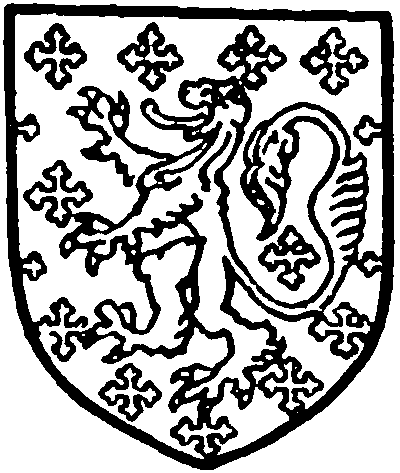
Longe of Draycott Cerne.Sable crusilly and a lion argent.
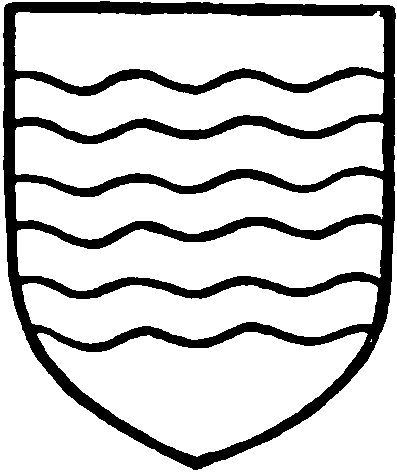
Drummond. Or three bars wavy gules.
The other moiety apparently carried no manorial rights with it, but consisted simply of the Rollstone Farm estate, which Adam de Cardonell and Mary his wife (daughter of Nicholas Pescod) conveyed to William Stanley of Paultons in 1657. (fn. 30) In 1693 the Stanleys were in possession of 'a moiety of the manor of Cadlands,' (fn. 31) and there are subsequent references to this moiety in the eighteenth century. (fn. 32) Mr. Cyril Hans Sloane Stanley of Paultons Park, Romsey, is owner of Rollstone Farm at the present day.
The first trace of HOLBURY Manor is in 1312, when Roger Bernerall and Gilbert de Shupton obtained licence of the king to 'grant land in Holebury to the abbey of King's Beaulieu.' (fn. 33) Holbury remained in the hands of the abbots of Beaulieu until the dissolution of that monastery in 1538. (fn. 34) Four years later Henry VIII granted it to Robert Whyte in exchange for a manor and lands in Middlesex. (fn. 35) Holbury was to be held as one-twentieth of a knight's fee for a rent of 14s. 6½d. There is no mention of Whyte heirs in the grant, and some time between this date and 1560 the manor fell into the hands of Thomas Pace. (fn. 36) From the death of Thomas Pace onwards, Holbury Manor followed the same descent as Cadlands (q.v.), being last spoken of as a whole manor when Nicholas Pescod granted a lease of the site to Adam de Cardonell. (fn. 37) As in the case of Cadlands, one moiety passed to Lady Mary Talbot, (fn. 38) and thence in 1772 to the Hon. Robert Drummond. (fn. 39) Whatever lands were signified in the conveyance of this moiety would be included in the Cadlands estate. The other moiety was in the possession of William Stanley of Paultons in 1693, (fn. 40) and his descendant, Mr. Cyril Hans Sloane Stanley, is the present owner of Holbury Farm.
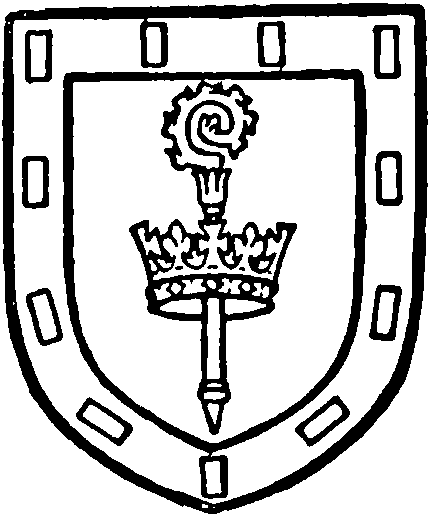
Beaulieu Abbey. Gules a crozier enfiled with a royal crown or and a border sable billetty or.
Domesday Book records two tenements in LANGLEY held by the king's thegns; of these the smaller was held by Cola the huntsman, (fn. 41) the larger by Hugh de St. Quintin. (fn. 42) In 1372 John Baron of South Langley (fn. 43) and Julia his wife were seised of a messuage and land in South Langley. (fn. 44) Thence the tenement passed indirectly to Richard Goolde and his wife Joan in 1413. (fn. 45) This Joan afterwards became the wife of William Soper, and on being left for the second time a widow conveyed her holding to John Ludlowe in 1482. (fn. 46) In 1500 the right of the Ludlowes to hold the manor (here so called for the first time) was fiercely disputed in the Court of Chancery by one William Fletcher. (fn. 47) The Ludlowes, however, evidently made good their claim, for in 1609 Sir Edward Ludlowe sold the manor of Langley to Sir Walter Longe. This united the manor of Langley to the manors of Cadlands and Holbury, all three following the same descent henceforward. Langley, like the other two, fell into two moieties in the seventeenth century. Of these, one went to the Drummonds in 1772, (fn. 48) and coalesced with Cadlands. The other, as in the case of Holbury, is first mentioned in 1693, among the possessions of William Stanley of Paultons. (fn. 49) This latter moiety is represented by the ownership of Langley Farm by Mr. Cyril Hans Sloane Stanley at the present day.
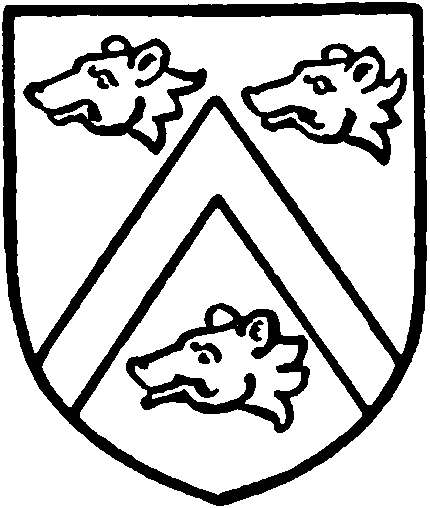
Ludlowe. Argent a cheveron between three bears' heads razed sable.
HARDLEY
HARDLEY was assessed in Domesday at a hide and 3 virgates attached to the New Forest. (fn. 50) After this there is no further trace of it until the fourteenth century, when William Chippe held lands there. (fn. 51) In the sixteenth century the estate assumed the title of a manor in the hands of William Buckett, who held it from at least 1531 to 1579. (fn. 52) After this it changed hands rapidly (fn. 53) until finally conveyed to Richard Pittis, attorney of the King's Bench in 1628. (fn. 54) There is no further trace of Hardley as a separate manor, but a moiety of lands there is mentioned among the possessions of the Stanleys of Paultons in 1693, (fn. 55) 1745, (fn. 56) and 1781. (fn. 57) The land now forms part of the property of Mr. Drummond of Cadlands. During the tenure by one Thomas Tracie in the sixteenth century of a lease of Hardley Farm from William Buckett, an amusing incident occurred. (fn. 58) Peter Kembridge and a man named Oglander wishing to rob Tracie of some of his possessions, arrested him, Oglander impersonating the sheriff's bailiff. Carried by force to an alehouse at Dibden, Tracie, who describes himself as 'a poor plain simple creature,' was compelled 'to seal and deliver certain writings, but to what effect he himself knoweth not.' Tracie's wife meanwhile followed her husband, and 'made moan' for him outside the chamber. On gaining his freedom, Tracie appealed to the Court of Chancery.
Domesday records a manor of STANSWOOD in Fawley, reduced by the encroachments of the New Forest from two hides to one. It was then worth £7, and was included in the sources of the king's ferm which he had from the Isle of Wight. (fn. 59) There is no subsequent trace of any separate manor of Stanswood, which probably at an early date became merged in one of the neighbouring manors of Cadlands, Holbury, or Langley. Appurtenances in Stanswood belonging to Cadlands manor are mentioned in the inquisition on Thomas Pace's death, taken in 1560, (fn. 60) and in several subsequent extents of Cadlands before it fell into two moieties. (fn. 61) Land in Stanswood belonging to the Stanleys of Paultons is also mentioned in those documents of 1693, (fn. 62) 1745, (fn. 63) and 1781, (fn. 64) which deal with their possession of the moieties of the three manors. The land now forms part of Mr. A. C. Drummond's estate. A mill in Stanswood is men tioned in Domesday, and is possibly referred to in some of the documents. (fn. 65) A mill stood in this locality until comparatively recently.
Domesday Book gives STONE in Fawley among the lands of the king's thegns, and mentions that its value had sunk since the time of Edward the Confessor from 60s. to 5s. (fn. 66) The tenement is not called a manor until the sixteenth century. In the fourteenth century William Chippe, and his son Robert Chippe after him, were holders of a messuage and land in Stone. (fn. 67) In 1346 one-twelfth part of a knight's fee in Stone, formerly in the tenure of Aymer de Valence, was held by Thomas West, (fn. 68) who was evidently one of the same family which early in the fourteenth century was united to the De La Warrs; (fn. 69) for in 1547 Thomas West, Lord De La Warr, was holding the manor of Stone. (fn. 70) In 1608 Thomas Fashion died seised of this manor, bequeathing it by will to West Fashion his son. (fn. 71) West Fashion in 1639, and his son Thomas the following year, died seised of the manor of Stone; the heir of Thomas was another Thomas, his son. (fn. 72) The family of Fashion was of Guernsey; (fn. 73) when they parted with Stone is not clear, the next trace of that manor being in 1704, when William Bulkley conveyed it to Samuel Mason. (fn. 74) Some time between this date and 1740 Stone came into the hands of the Mitfords of Exbury (probably about 1718 when William Mitford purchased Exbury of Henry Compton). In 1740, 1765, and 1774 family settlements concerning Stone were made by the Reveleys and Mitfords. (fn. 75) The estate now forms part of the property of Mr. Drummond of Cadlands.
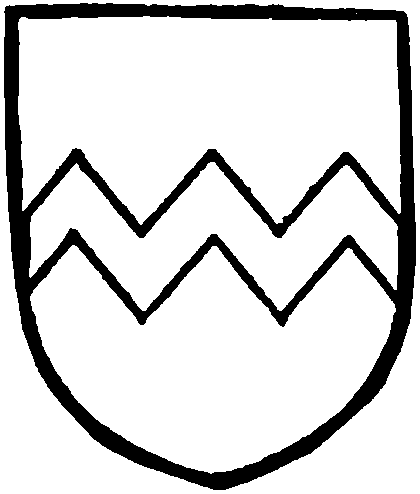
West. Argent a fesse dancetty sable.
CHURCHES
The church of ALL SAINTS, FAWLEY, has a chancel 30 ft. 6 in. by 15 ft. 4 in., with north and south chapels, nave of the same width, 59 ft. 3 in. long, with north and south aisles 11 ft. 8 in. wide, southeast tower, and west porch.
As it stands to-day, without taking into account the modern details, the church seems to belong to two main periods, c. 1170–1210, and 1300–1340. But it is evident that its present plan, which is, roughly speaking, a rectangle 100 ft. long by 50 ft. wide, has only been reached by a long series of developments, some of which at least may be conjectured from existing evidence. The north wall of the tower, 2 ft. 3 in. thick, as against 3 ft. in the other three tower walls, is clearly the south wall of a nave older than the tower, and probably of the same date as the thin east (2 ft. 1 in.) and north walls of the nave (2 ft. 3 in.). The equality of width between nave and chancel suggests that the latter has been built round an older and narrower chancel, and above the east face of the chancel arch are the marks of a roof belonging to a narrower building. The evidences therefore of a small aisleless church, consisting of chancel about 11 ft. wide, and nave 15 ft. 4 in. wide, are demonstrable, but its east and west dimensions can only be suggested from the analogy of other examples: 13 ft. for the chancel and 35–40 ft. for the nave are probably near the mark.
The chancel built round the early chancel at some date in the twelfth century difficult to fix was probably at first aisleless, a length of string-course on the north wall, west of the present arcade, pointing to the fact that the wall is older than the arcade. It was also probably some 8 ft. shorter than the present chancel. About 1170–80 a north aisle to the chancel was built, probably narrower than the present aisle and of equal length with the chancel, and some thirty years later a south aisle of like dimensions was added.
The tower at the south-east of the nave must have been begun about the same time as the north aisle of the chancel, and the lengthening of the nave and addition to it of north and south aisles was probably determined on, but, from the evidence of the details, carried on very slowly. The two eastern bays of the north arcade have been altered, if not rebuilt, in the fourteenth century; and this, together with some evidence of the former existence of an east wall to the north aisle, suggests that some transeptal arrangement balancing the tower may have been originally intended. Unless the west arch of the tower has been tampered with, the width of the south aisle of the nave must always have been as now; and since the north aisle is of exactly the same width, it also may preserve its original plan. The first part of the fourteenth-century enlargements probably began with a lengthening, c. 1300, of the chancel, and some thirty years later the aisles were similarly lengthened and also widened, the north aisle to the width of that of the nave, and the south aisle to the width of the tower. The work in the nave, beyond the alterations to the south arcade already noted, involved no changes in the plan. The chief repairs to the building of modern date are those of 1840 and 1866.
The chancel has an east window of three trefoiled lights with intersecting mullions, and a plain circle in the head, an interesting piece of early tracery, c. 1300. Beneath its sill on the outside is a small round-headed recess with a pedimented seventeenth-century slab with an inscription to Elizabeth Light, the back of the recess being also part of a seventeenth-century tombstone. The north arcade of the chancel is of two bays with pointed arches of a single order, round shafts, and square capitals scalloped;. the bases are moulded and have angle-spurs; all details being much worked over in cement. The south arcade is evidently of a later date, though of the same general design, and has plain leaf-work on the bells of the capitals. The north chapel has a three-light east window with net tracery, c. 1330, the mullions being modern, and in the north wall two square-headed three-light windows, much repaired. On the north of the east window is a plain image-bracket, in the south wall a trefoiled fourteenth-century piscina.
In the south wall of the chancel is a modernized trefoiled piscina and a square locker, the back of which has been cut through and now opens to the south chapel, the east end of which is used as a vestry. It has east and south windows corresponding to those in the north chapel, and at the south-west a small pointed doorway of late twelfth-century date with a continuous edge-roll on its outer face. At the west is a modern arch to the tower, and at the south-east an arched piscina recess with a small trefoiled recess, also with a drain, below it. North of the east window is an image bracket, on which rests a stone with roughly-cut fourteenth-century tracery on it. In the east window are the arms of Henry VIII in a garter, and several loose pieces of fifteenth-century glass are kept here, one being part of a crucifixion, and another having a figure of St. Nicholas. The chancel arch is semicircular, of one square order, with a moulded and chamfered abacus of late twelfth-century detail. The wall in which it is set is only 2 ft. 1 in. thick, and it probably succeeds an early and narrower arch.
The nave arcades are of plain character, with pointed arches of one order, circular columns, and square capitals with the angles cut back. The general details are of thirteenth-century style, except in the two east bays of the north arcade, where the detail of capitals and bases looks like fourteenth-century work. The tower at the south-east of the nave is of late twelfth-century date, with a plain round-headed light in the south wall of its ground story, and modern round-headed arches on the north and west. The north-west pier also has been rebuilt, but the responds of the arches are old, with scalloped capitals and moulded bases with spurs. The capital of the south respond of the west arch has curious foliate detail, resembling that at South Hayling, but of earlier type. On the south and east walls is a modern wall arcade, with memorial inscriptions of the Drummond family. The upper part of the tower is a fifteenth-century addition or rebuilding, and has a plain parapet and two square-headed lights on each face of the upper stage. In the second stage are trefoiled windows on the north and east, and on the south side is a rainwater head dated 1743.
The north aisle of the nave has four trefoiled fourteenth-century lights in its north wall, partly modernized, and the west window, of two trefoiled lights, is modern. The south aisle has similar windows, but in place of the second from the east is a plain fourteenth-century doorway.
At the west end of the nave is a gallery lighted by a modern three-light window, and beneath it a west door of good twelfth-century style, and looking earlier than the other twelfth-century work. The semicircular arch has a plain inner order, and an outer order ornamented with a roll and zigzag, springing from nook-shafts with scalloped capitals. Its south jamb and part of the arch are in large stones of later date than the rest, perhaps fifteenth-century work, and the arch has doubtless been moved from its original position, which may have been in the south wall of the nave. Over it is a porch of 1844 in twelfthcentury style.
The roofs of the church are ceiled, except in the north chapel, and at the east end of the south chapel is a fourteenth-century truss. The nave walls have a line of stone corbels on both sides at plate level, and corbels which carried part of the rood-loft remain in the east angles of the nave.
The font, at the west end of the south aisle, is modern, octagonal with panelled sides.
The pulpit is octagonal, the upper part of good early seventeenth-century work, with arched panels and a projecting book-board carried on scrolled brackets; no other wood fittings are old, and the only monument of interest is a brass plate on the south side of the chancel to Henry Audley, 1606, a copy of whose will is kept among the church papers.
There are four bells, the treble by Joshua Kipling, 1737; the second by Richard Flory of Salisbury, 1677; the third, of 1603, inscribed 'Give God the glory,' R.B.; and the tenor by Warner, 1867.
The plate includes an interesting pre-Reformation paten, 55/8 in. diameter, parcel gilt, with a vernicle in a six-lobed depression. Its date is c. 1520. There is also an Elizabethan communion cup of 1562, a flagon of 1834, a standing paten of 1844, two silvertopped glass cruets, and an old pewter plate.
The first book of the registers runs from 1677 to 1759, but there are two loose pages with entries of marriages 1674–7, and burials 1673–7. The second book is the marriage register 1754–92, and the third contains baptisms and burials 1759–98. The fourth continues the baptisms and burials, and the fifth the marriages, to 1813 and 1812 respectively. There are two pages of churchwardens' accounts for 1681, and consecutive accounts for 1725–1818.
The church of ST. JOHN THE BAPTIST, HYTHE, erected in 1874, is of red brick, with Bath stone dressings, in thirteenth-century style. The register dates from 1823.
ADVOWSONS
A chapel in Fawley is mentioned in Domesday Book. (fn. 76) The living is a rectory, and has always been in the gift of the bishop of Winchester. There is a chapel of ease at Langley licensed for divine service. Exbury was a chapelry of Fawley until 1868. The two formed one of the 'peculiar benefices' of the bishop of Winchester. (fn. 77) Hythe was separated from Fawley in 1841, (fn. 78) and formed into an ecclesiastical parish. The living is a titular vicarage in the gift of the rector of Fawley.
Fawley contains a Primitive Methodist chapel and a Wesleyan chapel, and there is a Baptist chapel at Blackfields, and a Congregational chapel at Hythe.
CHARITY
Mary Trattle by will, proved 1868, bequeathed a legacy and a share of residuary estate, now represented by £1,068 9s. 2d. consols (with the official trustees) upon trust that the income should be applied, one-half in the distribution of beef to the poor at Christmas, and the other half in providing them with blankets or articles of clothing.
The annual dividends, amounting to £26 14s., are duly applied.