A History of the County of Hampshire: Volume 3. Originally published by Victoria County History, London, 1908.
This free content was digitised by double rekeying. All rights reserved.
'Parishes: Owslebury', in A History of the County of Hampshire: Volume 3, ed. William Page (London, 1908), British History Online https://www.british-history.ac.uk/vch/hants/vol3/pp332-335 [accessed 30 April 2025].
'Parishes: Owslebury', in A History of the County of Hampshire: Volume 3. Edited by William Page (London, 1908), British History Online, accessed April 30, 2025, https://www.british-history.ac.uk/vch/hants/vol3/pp332-335.
"Parishes: Owslebury". A History of the County of Hampshire: Volume 3. Ed. William Page (London, 1908), British History Online. Web. 30 April 2025. https://www.british-history.ac.uk/vch/hants/vol3/pp332-335.
In this section
OWSLEBURY
Oselbury (xiv. cent.); Owlesbury (xiv cent.).
The parish of Owslebury consists of 22 acres of land covered with water and 5,412 acres of land which rises gradually from south to north, reaching the greatest height, with the exception of the rise on Green Hill in the west of the parish, near the village, which stands on the crest of a hill towards the north. The main road from Winchester to Bishop's Waltham, passing south-east through Morestead, sends off a branch road directly south towards Owslebury. Rising on to high ground this road then descends steeply into Owslebury parish. At the bottom of the hill two or three thatched cottages and the Shearer's Inn standing on the right-hand side make up the outlying portion of Owslebury, known as Owslebury Bottom. A few yards on as the land begins to rise the road curves slightly east round by the Cricketers' Inn and winds up the hill, curving sharply south-west into the village. Entering the village, the blacksmith's shop, a low tiled picturesque building, stands on the north side of the road facing wide sloping fields which stretch away to the south. As the road continues uphill, past two or three thatched cottages and outbuildings, the old windmill, near which is a new mill which supplies the pumping power for the Owslebury waterworks, stands in a high field to the north, marking the crest of the hill. Beyond this the greater number of the cottages and houses composing the village are grouped. On the south side of the road are the village schools, immediately west of which is the square-towered church of St. Andrew, standing on high ground overlooking the valley as the ground falls away to the east and south-east. Immediately to the east over the valley lies Baybridge, beyond which the high land which sweeps away to Millbarrow Down rises in the distance; to the southeast, over the stretches of woodland which lie in the south-east of Owslebury parish, lies the parish of Upham, beyond which rises the high ground round Winter's Hill House. South-west of the church is the vicarage, to which a pathway from the church leads across the square inclosed recreation ground of about four acres. The village stocks stood at the churchyard gate until recent times, but have now disappeared. As the long village street continues to run south-west down the slope of the hill beyond the church and vicarage, several picturesque thatched cottages lie on the left, while others lie on either side as at the further end of the village the road forks north to Twyford and south to Marwell Hall, round a small triangular green. On the north side as the road forks stand two tiled lichen-covered cottages, known as Yew-tree Cottages, in front of which grow two large yew trees, shaped like the trees of a toy Noah's Ark. Beyond these cottages is the Ship Inn, a low, thatched, timberframed house, which has some good panelling within, and the date 1681 on the tap-room fireplace. Marwell Manor Farm, the manor farm of Owslebury parish, stands on the site of the ancient palace of Marwell, which was probably destroyed (fn. 1) in the sixteenth century, after the grant to Sir Henry Seymour, who already had a house in the adjoining manor of Marwell Woodlock. The site is marked by a large moated inclosure within which the present dwellinghouse stands, but such old masonry as is now to be seen is said to belong rather to the college of priests founded here than to the episcopal house. Beyond the moat to the south is a small early sixteenthcentury building now used as a cottage.
Marwell Hall, the manor-house of Marwell Woodlock, now the property and residence of Captain William Standish, J.P., belongs for the most part to the nineteenth century, having been almost rebuilt about 1816 by Mr. William Long, on the site and in the style of the former building. It retains, however, in its central portion, once the hall of an H-shaped house, a certain amount of old work. A very fine wooden chimney-piece with the Seymour crest, and a stone panel of their arms now above the fireplace in the entrance hall, are from the old building. The house has a fine position in about seven acres of well-wooded grounds, the western edge of which extends along the crown of the sloping fields that rise east of Hensting hamlet in the south-west of the parish. Tradition asserts that the old house, built probably in the early part of the sixteenth century, was the scene of the marriage between Henry VIII and Lady Jane Seymour, the sister of the lord of Marwell. Edward VI is also said to have visited Marwell Hall, and the initials E. R. were carved in stone over the porch of the old house. Tradition of another kind makes Marwell Hall the scene of the well-known 'Mistletoe Bough' tragedy. (fn. 2)
The hamlet of Baybridge, consisting of a small group of cottages, a Primitive Methodist chapel, and the farm-houses and out-buildings of Baybridge and Lower Whiteflood Farms, lies about a mile, as the crow flies, south-east of Owslebury village. It is approached from Owslebury by a branch road leading south from the road which runs north-east from the village to Longwood House, and the cottages and farms stand about three-quarters of a mile along the branch road at the corner where it sends off a branch south-west to Marwell.
The hamlet of Hensting lies in the south-east of the parish, and is approached from Owslebury village by a downhill lane which branches southwest from the narrow road which turns off north towards Twyford by the Ship Inn at the west end of the village. This lane, passing between fine stretches of meadow and plough-land, comes to the outbuildings and the long thatched barn of Hensting Farm, behind which stands the farmhouse on high ground. Passing on it curves more directly south between the cottages and farmyards of Hensting and runs on to the high pine woods which slope from the north towards Fisher's Pond, the long narrow stretch of water which runs along the south side of the road, and gives its name to the small hamlet which lies immediately south-west. Woods also rise from the south side of the pond, which is thus one of the most beautiful spots in the neighbourhood. Water fowl of all sorts haunt the banks of the pond, and the deep water affords good fishing which is carefully preserved. West of the pond goes the main road from Winchester to Botley, and on the east side of this stands the Queen's Head Inn and the two or three cottages composing Fisher's Pond hamlet. Continuing from Fisher's Pond the main road rises to Crowd Hill, on the top of which on either side of the road are grouped the cottages and farms composing the hamlet of Crowd Hill, the southern portion of which belongs to Fair Oak (see under Bishopstoke). From the top of Crowd Hill remarkably fine views open out on almost every side. To the north-west is the fine woodland surrounding Cranbury House, followed by the high down land that composes the north-west of Compton parish; to the north over Twyford village are the fine curves of Twyford Downs, stretching away towards the east to the high country round Chilcomb. Colden Common, formed into a separate ecclesiastical parish in 1843, is for civil purposes included partly in Owslebury and partly in Twyford.
Formerly there was an iron foundry in Owslebury parish; but all traces of this have disappeared except a few specimens of the work, dated in the latter part of the seventeenth century. The soil of the whole parish is clay with a subsoil of chalk on which crops of wheat, barley, oats, turnips, and sainfoin are grown.
The tithe map is at the vicarage.
The common lands were inclosed in 1851. (fn. 3) Of the 5,399 acres of land in the parish, 2,520 are arable land, 1,570¼ are permanent grass, and 827 are woodland. (fn. 4) Owslebury Down and part of Colden Common were inclosed in 1861. (fn. 5)
The following place - names occur in 1400: Varlonde, Waddene, Tichehurst, Okheltislade, le Hurst, and Grenewey. (fn. 6)
MANORS
As early as 964 King Eadgar granted lands in Owslebury to the bishop of Winchester, (fn. 7) and at the time of the Domesday Survey the bishop held the manor of Owslebury under the name of Twyford. It was held under the bishops in the time of Edward the Confessor by Wulfric, the under-tenant in 1086 being Elded wife of Oswald. (fn. 8)
In 1284 the king gave up to John bishop of Winchester and his successors all his right in the manor of Twyford with Marwell, (fn. 9) the name by which this manor in Owslebury was known. There are occasional notices of the ownership of Owslebury by the see of Winchester. In 1313 Bartholomew of Widehaye who held under the bishop conveyed two messuages and two carucates of land in Owslebury held of the bishop to William de Overton and Joan his wife; (fn. 10) and after this date, though the name of the parish remained Owslebury, the name of the manor in the parish became MARWELL or MARWELL WOODLOCK. A pardon was granted to William Woodlock (fn. 11) in 1316 for acquiring in fee without licence land in the manor of Marwell from Henry late bishop of Winchester. The land and tenements were to be subject to a rent of 55s. 4d. payable to the bishop; and service was due at the bishop's court of Marwell. (fn. 12)
Bishop Fox, who founded Corpus Christi College, Oxford, in 1515–16, endowed it with the demesne lands round Owslebury, which the college retains at the present day. (fn. 13)
In 1520 Lionel Norreys held half the manor from the bishop; (fn. 14) and in 1523 William Holgyle held the remainder and conveyed it by fine to Richard Wotton. (fn. 15)
When John Poynet was granted the see of Winchester in 1551 one of the conditions attached to his appointment was that he should surrender all the episcopal manors in exchange for a fixed income of 2,000 marks, and thus Marwell passed into the hands of the crown. (fn. 16) In the same year the manor and the advowson of the vicarage were granted to Sir Henry Seymour, the king's uncle. (fn. 17) The manor of Marwell, among other lands, was restored by Queen Mary to the bishopric of Winchester; but Sir Henry Seymour evidently compounded with John bishop of Winchester for Marwell, as in 1577 he died seised of it, leaving a son and heir John, (fn. 18) who died in 1618 and was followed by his son Edward. (fn. 19)
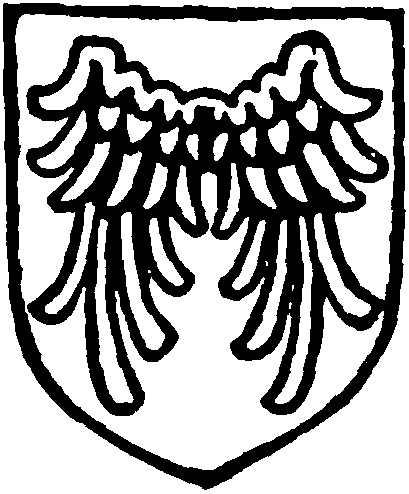
Seymour. Gules a pair of wings or.
In 1625 Sir Edward Seymour and Henry Seymour conveyed the manor with all appurtenances to Susanna Holliday widow, (fn. 20) daughter of Sir Henry Rowe; who married as her second husband Robert earl of Warwick. (fn. 21) In 1626 she and her husband conveyed the manor of Marwell to Sir Henry Mildmay and his wife Anne, the latter being Susanna's daughter by her first husband. (fn. 22) The manor then descended in the male line. On the death of Carew Mildmay of Shawford House, Hants, at the end of the eighteenth century, it passed to his daughter Jane, who had married Sir Henry Paulet St. John, bart. In 1786 the latter obtained licence to use the name and bear the arms of Mildmay as well as his own. (fn. 23) Sir Henry left his Hampshire estates to be divided between his widow and his thirteen children. Marwell remained in the possession of the Mildmays until 1858, when it was sold to Mr. J. E. Robinson of Pontefract, who transferred the manorial rights to Mr. Bradley, the present owner. (fn. 24)
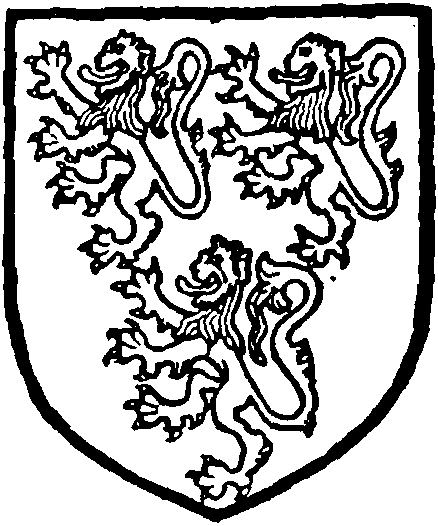
Mildmay. Argent three lions azure.
There are occasional references to the bishop of Winchester's PARK of MARWELL. In 1280 an order was issued to William de Hamilton, guardian of the bishopric of Winchester, for the immediate deliverance of five oaks from the park of Marwell granted by Nicholas late bishop of Winchester to the sacristan of St. Swithun's Priory, for the works of the priory. (fn. 25) In the Ministers' Accounts for the manor of Twyford for the year 1322 the following occurs: '39s. 6d. for animals pastured in the park of Marwell till Trinity.' (fn. 26) In the sixteenth century a complaint was entered by William bishop of Winchester that Aumary St. Amand with others hunted in his park at Marwell where he had free warren. (fn. 27) A park existed down to the middle of the seventeenth century, for in the court rolls for 1651 reference is made to the 'park of the President and Scholars of Corpus Christi College, Oxford, called the Coney Park.' (fn. 28)
At the time of the Domesday Survey there were two mills in Owslebury, (fn. 29) and among the appurtenances belonging to the manors of Twyford and Marwell in 1625 and 1626 were two mills, a free fishery, view of frankpledge, and rights of free warren. (fn. 30) At the present day there is only one mill.
BRAMBRIDGE
BRAMBRIDGE, a hamlet in the civil parishes of Twyford and Owslebury, became part of the newlyformed ecclesiastical parish of Colden Common in 1843.
Upon the foundation of Corpus Christi College, Oxford, in 1515–16, Brambridge, as part of Owslebury parish, probably passed into the possession of the college under the endowment by Bishop Fox, for in 1535 Corpus Christi College was receiving an annual rent of 24s. from land here. (fn. 31) In 1609–10 Brambridge was granted to John Peirson together with the lands belonging to the recusants Ursula Uvedale, Richard Bruning, and Thomas Welles. (fn. 32) Charles I granted Brambridge to Gilbert Welles in 1636, (fn. 33) and his widow married Sir William Courtenay, who was a recusant and compounded for his Brambridge estates in 1648. (fn. 34) Brambridge remained in the Welles family until towards the end of the eighteenth century, when in accordance with the will of Henry Welles (2 August, 1762) it passed to his cousin Walter Smythe, second son of Sir John Smythe, bart., of Acton Burnell, Shropshire (fn. 35) (see under Boyattin Otterbourne). Walter Smythe's eldest daughter was the famous Mrs. Fitzherbert, wife of George IV, who spent the early years of her life, before and after her education in France, at Brambridge until her marriage to Edward Weld of Lulworth Castle, Dorset. She is also said to have lived at Colden Common, in a cottage which still exists, during her first widowhood. (fn. 36) During the nineteenth century Brambridge House (see under Twyford) was the residence of the Fairbairns family. It is now occupied by Major Cecil du P. Powney.
The earliest mention of BAYBRIDGE (Baberigge, Babbrigge, Barbridge, xiv cent.), a hamlet in Owslebury parish, seems to be in a grant made in 1324 by Henry bishop of Winchester of a messuage and half a virgate of land in Baybridge, near Owslebury, to William son of William de Overton, in confirmation of a grant made to him by John late bishop of Winchester of the land formerly held by Henry le Carter. (fn. 37) In 1377 the abbot and convent of Titchfield were holding land in Baybridge. (fn. 38)
In 1441 Thomas Sands died seised of lands in Baybridge held under lease from the bishop of Winchester, leaving an infant heir, William, aged three. (fn. 39) The Sands continued to hold the reputed manor (fn. 40) of Baybridge until 1610, (fn. 41) when Sir William Sands sold it to Thomas Ridley, LL.D. (fn. 42) Nine years later, in 1619, the Ridleys were still holding Baybridge, (fn. 43) but after this date no mention has been found of it until the year 1802, when Sir Henry Paulet St. John Mildmay, John Clerk of Worthy, and George William Ricketts of Lainston were holding it in right of their wives Jane, Ann, and Letitia, (fn. 44) the daughters and co-heirs of Carew Mildmay of Shawford House. (fn. 45) It must therefore have been acquired by the Mildmay family in addition to their manor of Marwell (q.v.). After 1802 it evidently became amalgamated with the Marwell estate and followed its descent (q.v.).
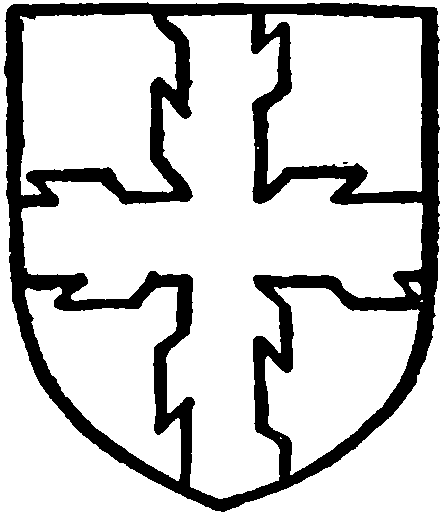
Sands. Argent a ragged cross sable.
The capital messuage of LONGWOOD FARM, originally part of the possessions of the bishopric of Winchester, was granted to Edward Vaughan and Thomas Ellys in 1589. (fn. 46) Eight years later Longwood was in the possession of Richard Garth, who died seised of it in 1597. (fn. 47) In 1648 Longwood Warren and Lodge were sold by the Trustees for the Sale of Bishops' Lands to Thomas Hussey and his heirs. (fn. 48)
Longwood House is now the property of the earl of Northesk and the residence of Lord Aberdare. It stands in the north-east of the parish in wide grounds which extend north-east into the neighbouring parish of Tichborne. When Duthy wrote in the early part of the nineteenth century this house was known as Rosehill. About the beginning of the eighteenth century General (afterwards Lord) Carpenter, the ancestor of the earls of Tyrconnel, lived at Rosehill, then called Longwood, which is thus its original name.
CHURCH
The church of ST. ANDREW has a chancel 28 ft. by 16 ft. 3 in., nave with aisles 33 ft. 8 in. long by 38 ft. wide, and west tower 10 ft. by 11 ft., all measurements being internal.
The chancel appears to be the earliest part of the church, dating from the first quarter of the fourteenth century, and the building has at one time been cruciform, but in the latter part of the seventeenth century the nave and tower were remodelled, and in spite of later repairs a good deal of work of this date yet exists.
The chancel has an east window of three lights with modern tracery of geometrical style, the rear arch being old. On north and south are single uncusped lights with modern heads, and below that on the north a tomb recess, apparently of early fourteenthcentury date, as are the old parts of the windows. The chancel arch is pointed, of two chamfered orders, with seventeenth-century capitals of classic design.
The nave is covered by a central roof running east and west, and pairs of gabled roofs on each side, running north and south, a single cast-iron column on each side supporting the wall plates. It is lighted by two north and two south windows, of which all but the south-east window are of three uncusped lights with tracery, of seventeenth-century date, the remaining window having trefoiled lights under a transom and trefoiled tracery over. In the west wall on either side of the tower is a doorway, that to the north having a pointed head of two moulded orders and a label, and that to the south a modern shouldered arch.
The tower is of three stages, embattled, with a west window in the ground stage of two trefoiled lights, curious work which is dated by a panel over it bearing the initials of the churchwardens for 1675. The tower arch appears to be of the same date. In the second stage and belfry stage are windows of fourteenth-century style but modern stonework.
The roofs of the nave are of the trussed rafter form, and the panels from destroyed seventeenthcentury pews, with carved top rails, are fixed as wainscoting round the nave walls. The altar rails are eighteenth-century balusters, and in the chancel is an ancient iron-barred chest with three locks, made from a solid log.
Below the east window are four quatrefoiled stone panels inclosing blank shields, of fifteenth-century date; on one shield is a dent to which the tradition attaches that it was made by a bullet which killed the priest who celebrated the last mass here in the sixteenth century.
The font, at the west end of the nave, is octagonal with a moulded base to the bowl, and perhaps of fifteenth-century date, but much re-tooled.
In the chancel are some large marble mural monuments to the first and second Lords Carpenter, 1731 and 1749; and to the last earl of Tyrconnel, 1853.
There are six bells, the first three by Mears and Stainbank, 1905; the fourth, formerly of 1674, recast by Taylor in 1900; and the fifth and tenor, of 1622 and 1619, by the founder i h (possibly for John Higden), with the usual inscription, 'In God is my hope'; on the fifth is the founder's mark of Roger Landon, re-used.
The church possesses a very fine and early communion cup of 1552, inscribed 'The Communion Cup of Owsylbury,' and an almsdish with the inscription 'This with my soule I dedicate to God— Alice Mildemay, June the 8th, 1680.'
The first book of the registers is of burials in woollen, 1678–1812; and the second contains the baptisms 1696–1812 and the marriages 1696–1704, 1722, and 1744–54.
Bishop Henry of Blois founded a small college of secular priests, called later a chantry, in the church or chapel of Marwell Park, Owslebury, between 1129 and 1171, (fn. 49) to which were attached four chapelries.
The site of the episcopal house at Marwell Park is marked by a square moat inclosing a large area, at the north-east corner of which stand the remains of the college buildings, now of little importance, and serving as out-buildings to the present dwelling-house, which though in itself of no architectural interest, is built with fragments of the old work. No details appear to be older than the fifteenth century. It was suppressed under the Act of Edward VI for the dissolution of such foundations.
ADVOWSON
The earliest mention of the present church of St. Andrew seems to be in the year 1551, when the advowson of the vicarage of Marwell, the site of the ancient chapel in Marwell Park, and the manor, were granted to Sir Henry Seymour. (fn. 50) The advowson was annexed to the manor of Marwell until 1836, since which date it has been in the hands of the vicar of Twyford. (fn. 51)
CHARITIES
In 1840 Mrs. Alice Long, by will proved this date, directed (inter alia) that sufficient stock should be purchased to produce £30 a year to be applied by the incumbent in payment of her usual subscriptions to the parochial school, and subject thereto in the purchase of fuel, blankets, clothing, or provisions for the benefit of the deserving poor.
£1,000 consols was set aside in satisfaction of this legacy, and forms part of a larger sum held by the Corporation of Winchester in trust for this and other charities founded by this donor. By an order made under the Board of Education Act, 1899, a sum of £400 consols has been determined to be the proportion of the charity applicable for educational purposes.