
A History of the County of Hampshire: Volume 3. Originally published by Victoria County History, London, 1908.
This free content was digitised by double rekeying. All rights reserved.
'Parishes: Hursley', in A History of the County of Hampshire: Volume 3, (London, 1908) pp. 417-422. British History Online https://www.british-history.ac.uk/vch/hants/vol3/pp417-422 [accessed 25 April 2024]
In this section
HURSLEY
Hurseleghe (xiii cent.), Hursele (xiv cent).
The parish of Hursley, covering 6,949 acres, (fn. 1) lies south-west of Winchester. The north of the parish, being part of the girdle of bare chalk downs which surround the city of Winchester, reaches over 500 ft. near Crabwood Farm. The land falls towards the centre of the parish, where the village lies on low ground, but rises again to a moderate height in the south. The main road from Winchester to Romsey traverses the whole length of the parish, passing through the hamlets of Pitt and Standon, Hursley village, and Ampfield. Hursley village is one of the most picturesque types of the larger Hampshire villages. Entering it from Winchester, low thatched cottages are grouped on the left and right. A row of pollard limes stands in front of some low cottages on the east hand, and away on the west, behind a low hedge, are stretches of meadow, and in the distance behind a belt of trees is the church spire. Farther along the road by the 'White Horse' a sharp bend up-hill to the left leads by Collins Lane to Upper Sharland, and then the main road winds slightly west into the centre of the village. Standing well back from the road on the right is the village school; beyond is the church, and behind the church the vicarage. Facing and parallel with the low stone wall of the churchyard is a row of cottages, one of which serves as the post office, and at the end of the row is the quaint blacksmith's shop overshadowed by a tall elm tree. Beyond the church, on the right, are four or five cottages fronting on the street, tiled and timbered with latticed windows and overhanging stories belonging at latest to the seventeenth century. Lower down the street and on the opposite side of the road are more modern houses and cottages, and at the end of the street on the left, surrounded by a high wall, is Southend House, the residence of Mr. H. V. Henry. Following this wall round to the left a narrow lane branches from the main road and leads to Bunstead and on to Silkstead, which is partly in Hursley parish.
West of the village and almost parallel with the village street is Hursley Park, covering 450 acres of luxuriantly wooded country well stocked with deer. Hursley House, standing in the park, was built in 1718–20 by Sir William Heathcote, first baronet, and has been very much extended and refitted within the last few years by the present owner, Sir George Cooper. In the north of the park are the ruins of Merdon Castle, one of the palaces of the bishops of Winchester.
The Cranbury estate, including Cranbury Park and Cranbury House, a residence of Mr. Tankerville Chamberlayne, M.P., lies in the south-east corner of the parish. The thickly-wooded country which closes around the park on the east and south continues southwards to Hiltingbury Common, which is now since 1894 part of Ampfield parish, but was part of Hursley when Ampfield itself was a hamlet of Hursley. Ampfield Wood, lying to the west, stretches across from the woods which lie south of Hursley Park to the border line between Ampfield and Romsey parishes.
Ampfield village is south of the wood and consists of a number of scattered cottages brought probably into existence by the necessity for workers at the saw-mills and the gravel-pits in Ganges Wood. St. Mark's church stands on high ground north of the main road, and west of the church, about half way down the hill, is the vicarage. Ampfield House, the residence of Mr. David Faber, J.P., and Philpott's Farm are also close on the main road, but the cottages and the village school lie away to the north along a branch in the road between the church and vicarage.
The hamlet of Standon lies about half a mile north of Hursley village where the main road curves to the right towards Winchester. It consists of a group of some picturesque half-timber thatched cottages lying back for the most part behind bright cottage gardens
Pitt hamlet nestles between two steep hills about two miles north-west from Stanton. Pitt Farm is on the right, and along a branch road to the left are a few scattered cottages and a school chapel built by Miss Charlotte Yonge in 1858, served by the vicar of Hursley. The oldest house is at the corner of the road, a long low half-timber thatched cottage possibly dating back to the sixteenth century. There is no river in Hursley parish, but there are several lakes and ponds covering 10 acres altogether; one in Hursley Park, three in Cranbury Park (Great Pond, Upper Pond, and Lower Pond), a small one at Parsonage Farm, another at Upper Sharland, and several at Standon and Pitt. The soil of the parish varies from chalk in the north to clay, sand, and gravel with peat in the south, and the vegetation differs accordingly. The chief crops are wheat, barley, and oats, with good crops of turnips and peas.
CASTLE
Although it is possible that an earthwork existed at Merdon in the eleventh century or earlier, yet there is no mention of such in Domesday, and the foundation of the castle is ascribed to Bishop Henry de Blois, who built and fortified it in 1138. (fn. 2) During the next few years, in the struggle between Stephen and the Empress Maud, the castle was doubtless of military importance, but from that time it seems to have been rather a bishop's palace than a military castle.
Like Farnham and Wolvesey it was kept in good repair, and between 1265 and 1268 in Bishop Gervase's account book an entry was made of the expense of fitting up the hall in the castle of Merdon. (fn. 3) In 1278 Bishop Nicholas of Ely was resident at the castle, and the ceremony of reinstating the prior of St. Swithun was performed there. (fn. 4) However, by the fourteenth century such parts as were useless for habitation seem to have fallen into decay, though Bishop Edendon seems to have resided there as late as 1365. (fn. 5)
The site of Merdon Castle is marked by a fine circular earthwork surrounded by a deep ditch, with traces of a second line of banks outside the ditch, and a causeway on the east leading to the central inclosure. A small length of the curtain wall remains on the south, with a tower which may be of twelfth-century date. Its walls are 7 ft. thick, and the windows and doorways have lost their architectural detail, but appear to have been round-headed.
MANOR
There is only one manor in the parish of Hursley, and that bearing not the name of the parish, but of the ancient castle of MERDON—(Maerdune, Meredune, Meretune, Merantune (ix cent.), Mardon, Merden (xv cent. et seq.)—within the parish. Though it is difficult to state with any certainty that the 'Merantune' of the AngloSaxon Chronicle, the scene of Cynwulf's murder by Cynheard his kinsmen in 784, was Merdon in Hursley, yet there is much to be said for the suggestion. (fn. 6) Certain it is that the murdered king was buried at Winchester, his capital; and his visit with a small company to 'Merantune,' made evidently from Winchester, is more likely to have been a short journey to a quiet country place just outside Winchester than across Surrey. The next mention of Merantune or Maerdune is in 781, when two months after the Danes had been victorious at Basing King Ethelred and Alfred his brother fought with them at Merdon. Though for a time fortune favoured the king, yet in the end the Danes were victorious and held the place of battle. (fn. 7)
Merdon was probably included in the grant made about 636 by King Kinegils to the bishop and church of Winchester of land within a seven-mile circle of Winchester, (fn. 8) and from that time onwards to the reign of Edward VI the bishops of Winchester held the manor. In 1291 Merdon was included among the bishop's lands, and was worth £80. (fn. 9)
In 1341 Adam, bishop of Winchester, granted the office of parker or warrener in his manor of Merdon to Giles de Mansynton, subject to the confirmation of the grant by the prior and convent of St. Swithun. There is little else in the history of the manor, apart from the castle, until the reign of Edward VI, when in 1552 John Poynet, bishop of Winchester, surrendered Merdon among other lands to the king. (fn. 10) In the same year Edward granted it to Sir Philip Hoby, together with the park of Hursley, to be held in chief for the fortieth part of a knight's fee. (fn. 11) Before this time there was probably no manor-house at Merdon except the castle, and that was in decay by the fourteenth century, and it was Sir Philip Hoby who probably built the 'great Lodge.' But he had little time to enjoy his new possession, since in 1557, when Mary dared to restore the church lands, the manor of Merdon was granted to John White, bishop of Winchester. (fn. 12)
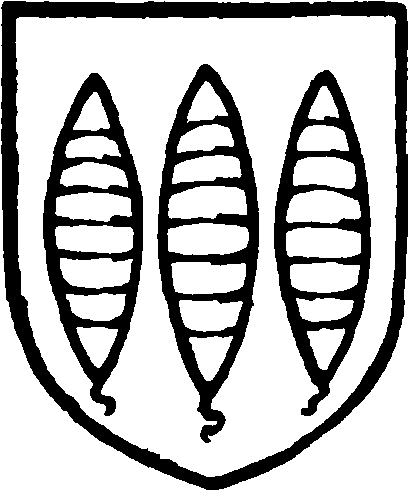
Hoby. Argent three weavers' bottoms gules.
An entry on the steward's roll for 1559, the year of the regrant by Elizabeth to Sir Philip Hoby's half-brother William Hoby, (fn. 13) shows that the profits of the manor, 'part of the Bishopric of Winchester before this,' were then brought into the annual account register, 'since the said manor by Act of Parliament was granted to William Hoby.' (fn. 14)
William Hoby seems, according to a monumental inscription in Hursley church, to have married as his second wife the widow of the Thomas Sternhold who in collaboration with John Hopkins first 'sounded out the Psalms of David' in metrical verse, and employed much time in singing his psalms to his organ for his own 'godly solace'. (fn. 15) On his death, probably at Hursley, in the latter part of the sixteenth century, (fn. 16) the manor descended to his son Giles, who in 1600 sold the castle and manor to Thomas Clerke of Ardington in Berkshire, his fatherin-law, reserving to himself and his wife a life interest in the lodge and park of Hursley. (fn. 17)
In 1602 Sir Thomas Clerke was living at Merdon, and in that year his son was married in Hursley church. (fn. 18) At this time the copyholders of the manor were still required to perform their customary services of reaping and carrying crops, and in Robert Morley's manuscript there is an account of a quarrel between the lord and his tenants on one of the 'hay dobyn' or service days. The lord was obliged to supply breakfast and dinner for the workers, and one day 'the cart brought afield for the reapers a hogshead of porridge which stunk and had worms in it.' The tenants headed by Mr. Coram, the holder of Cranbury, refused to work without better provision, and he and Mr. Pye, Sir Thomas Clerke's steward, drew their daggers, and rode at one another through the wheat. At last Lady Clerke promised to dress two or three hogs of bacon for them, and they quietly retired to work. (fn. 19) It is not difficult to imagine how much these hay dobyn days were hated by the tenants, especially as a hindrance to their own work, and Morley writes how 'a heire went for a man on hay dobyn days if able to carry a hook aforesaid.' (fn. 20) In 1606 Sir Thomas Clerke sold the manor of Merdon with the rest of his property to William Brock, 'a great lawyer,' who died in 1618, leaving his only child, a daughter and minor, under the joint guardianship of Sir Thomas Savage and Sir Richard Tichborne, (fn. 21) on whom settlement was made at the time of the sale in 1606. (fn. 22) In 1626 Anne Brock married John Arundell, (fn. 23) who in right of his wife became lord of the manor. The Arundells do not, however, seem to have lived at Hursley, but leased the manor in 1623 to Richard Lumley, (fn. 24) in 1626 to Henry Hastings, (fn. 25) and before 1630 sold it to Sir Nathaniel Napier of Crichel (Dorset). (fn. 26)
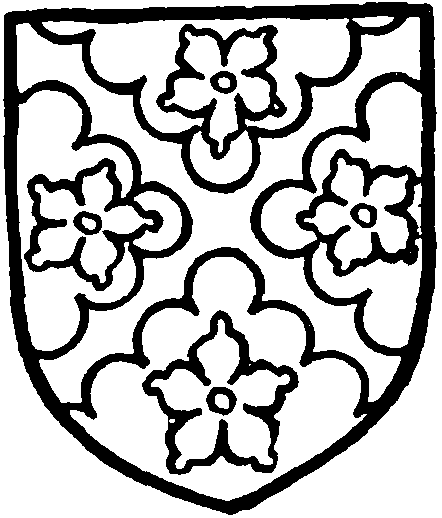
Napier of Crichel. Argent a saltire engrailed between four cinquefoils gules.
In the meantime, in 1621, Giles Hoby had leased the lodge and park of Hursley to Nicholas Peascod. (fn. 27) Giles died in 1626 and his wife in 1630, and thereupon the lodge and park reverted to the holder of Merdon Manor, Sir Nathaniel Napier. (fn. 28) On the death of the latter some time before 1635, (fn. 29) the manor descended to his son Gerard, who sold it in 1638–9 to Richard Major, who was, according to the description of a contemporary, a man witty and thrifty even to miserliness, and an unscrupulous oppressor of his tenantry. (fn. 30) More especially did he 'usurp authority over his tenants,' when 'King Charles was put to death and Oliver Cromwell was Protector of England and Richard Major of his Privy Council and Noll's eldest son Richard was married to Mr. Major's Doll.' (fn. 31) The marriage there referred to was that of Richard Cromwell with Dorothy Major, which brought Merdon into the Cromwell family, and gave it a part in one of the most interesting periods in English history. Richard Cromwell lived at Merdon from 1649, the year of his marriage, until he became Protector on the death of his father in 1658.
On his forced withdrawal from Whitehall in 1660, he came to Hursley for a few months, but early in the summer left England for France, (fn. 32) leaving behind him a heavy burden of debts contracted, as he himself stated, upon the public account. (fn. 33) While abroad he went by another name, 'though he did not disguise himself nor deny himself to any man that challenged him.' (fn. 34) It was thus under assumed names that he corresponded with wife and children at Hursley, where they lived in quiet seclusion, and where Mrs. Cromwell died in January, 1675–6. During her illness Cromwell wrote to his daughter Elizabeth, bidding her desire her mother to quiet her conscience concerning him and strive to be cheerful. (fn. 35) Yet the letters that follow show how little cheerfulness there was for the solitary exile. In 1680 he returned to England, (fn. 36) but not to Hursley; so the letters to his children continue. His great anxiety concerning the marriage of his son Oliver, who was of age in 1677, became quite pathetic. To his daughter Elizabeth he wrote in 1689 'it would greatly please to see your brother answer a duty both to God and his family… I would hope he would not dalley any longer with Providence, but take a resolution to fixe his minde. (fn. 37) ' In the next year he wrote 'Pray let your brother settle, and that will be the best step for us to enjoy each other, according to what you desire.' (fn. 38) About this time there was evidently some thought of Richard joining his family at Hursley, (fn. 39) but the idea fell through and the letters continue.
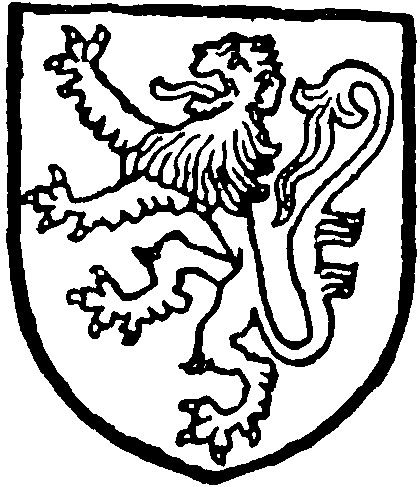
Cromwell. Sable a lion argent.
In the meantime Oliver, on the death of his mother, had claimed Merdon in right of her marriage settlement and took possession of the estate. It was then that the customary tenants, possibly taking advantage of his youth, determined to win back some of the privileges and customs they had lost under the oppression of Richard Major. The Chancery suit was in progress in 1692, and lasted on until after the death of Oliver in 1705. In 1707 Imber, on behalf of the tenants, since the Chancery decree was 'written in chancery hand and part thereof being in Latin and therefore not able to be read and understood by the tenants,' made an English abstract of the same in order that the tenants and their successors 'might on all occasions rightly know the customs of the manor.' (fn. 40) They claimed ordinary copyholders' rights, right to demise customary lands by copy; to pay a fixed fine on admittance; to let their tenements for a year without licence; to have sole right to fell trees on their tenements except oak, and even oak for repairs; to have sole pasture and feeding on the lord's heaths and wastes, and in the three coppices of South Holme, Heale Coppice, and Holman Coppice. Oliver Cromwell had ignored these customs on several occasions, as for instance when he brought an action against Mrs. Elliot for leasing her copyhold for a year, and against Thomas Lloyd for cutting down some oak trees for repairs on his copyhold of Nevil's Close and Hiltingbury (fn. 41) In 1705 Oliver died before the suit was finished, and a dispute arose concerning the Hursley estate. Richard Cromwell, who had allowed his son's right to the manor, now disputed the right of his daughters, who considered themselves the heirs of their brother. The case was heard and decided in Richard's favour, (fn. 42) and after this he seems to have lived partly at Hursley and partly at Cheshunt. (fn. 43) In 1712 he died at Cheshunt, and was buried at Hursley with much pomp. (fn. 44) His two surviving daughters, Elizabeth and Anne, succeeded to the estate, but only lived at Merdon for a few years, selling the whole manor in 1718 to Sir William Heathcote. (fn. 45) Sir William pulled down the old mansion-house, then in ruins, and built the modern house. He died in 1751, (fn. 46) leaving his eldest son Thomas as heir. On the death of Sir Thomas in 1787 the manor descended to his son William, whose great-grandson, Sir William Percival Heathcote, sold the estate in 1899 to Joseph W. Baxendale, who sold it in 1905 to Sir George Cooper, bart., the present owner.
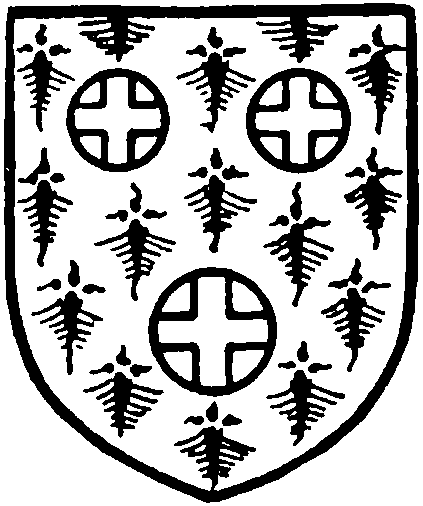
Heathcote. Ermine three roundels vert with a cross or upon each.
Hursley House is a fine building, the central part of which dates from the early part of the eighteenth century, while the wings are modern additions. The great attraction of the house is the splendid oak panelling and fittings formerly in Winchester College Chapel, and most unfortunately removed at the disastrous 'restoration' of the chapel by Butterfield. The work is of the time of Charles II, the carving being, as usual, attributed to Gibbons; in this case it is at any rate worthy of him. The site of the former house lies behind the present building on lower ground, and its foundations may be seen in the turf, though no part is now above ground.
CRANBURY
CRANBURY seems originally to have been an important hamlet of Hursley, (fn. 47) and to have consisted of many distinct tenements or copyholds, (fn. 48) but now the name belongs only to Cranbury House and Park. Of the proprietors of Cranbury, who held of course of the bishop as of his manor of Merdon, the first mentioned seems to be a certain Shoveller, who surrendered to a Roger Coram before 1580. The latter, according to Marsh, seems to have been 'a zealous assertor of the tenants' rights against the lords of the manor.' (fn. 49) On the death of this Roger Coram Sir Edward Richards seems to have held the property until 1640–3, (fn. 50) when he let it, with the lord's consent, to Dr. John Young, dean of Winchester, who lived in quiet retirement at Cranbury during the Commonwealth. His widow, Mrs. Young, was holding in 1650, and probably resigned the house to Sir Charles Wyndham, who married her daughter in 1665. Sir Charles, who seems also to have been 'a zealous assertor of the tenants' rights,' and 'of a most respectable family,' died in 1706, before his wife, who survived him until 1720. (fn. 51) On her death the house and estate were sold to Jonathan Conduit, who sold the whole in 1737 or 1738 to Thomas Lee Dummer. The latter died in 1765, leaving a son and heir Thomas, from whom the estate devolved to Sir Nathaniel Holland. (fn. 52) On the death of Lady Holland, widow of Sir Nathaniel, the estate passed into the Chamberlayne family, and is held at the present day by Mr. Tankerville Chamberlayne.
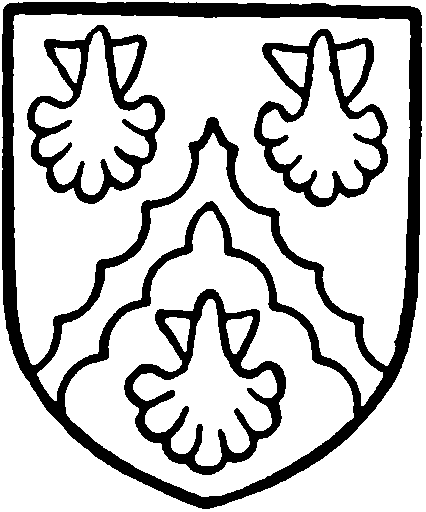
Chamberlayne. Gules a cheveron engrailed or between three scallops argent.
Cranbury House is a large eighteenth-century red-brick building, with a projecting entrance porch on the south front, the main rooms being arranged round a central hall and staircase. There is a good deal of fine plaster decoration in the Adam style, especially in the saloon on the south front, which has a circular domed ceiling. The house contains a good number of valuable paintings, there being one very fine Romney, of Lady Hamilton as a maenad, and several of less merit. In the rooms on the east front are a number of pictures by Richter and Westall, and a curious unfinished subject painting, said to be by Romney.
The site of the house is well chosen, the ground falling steeply on the north, in well-wooded slopes. Some way down the slope is a spring, over which a domed well-house has been built, and on the higher ground to the west of the house is a circular earthwork. To the north of this is a summer-house and a stone sun-dial, said to have been designed by Sir Isaac Newton; its gnomon is supported by a monogram in openwork, apparently I.L.C. for Jonathan Conduit. In the park, at some distance to the south-west of the house, is a gamekeeper's cottage, masked by a sham ruin made up of fragments from Netley Abbey, whose north transept was destroyed for the purpose. A set of very beautiful early fourteenthcentury bosses from a vault are built into the work.
Tenements in LONGMOOR, which is now the name of a farm on the western borders of Cranbury Park, were included in 1551 and in later grants among the appurtenances of the manor of Merdon. (fn. 53)
The hamlets of STANDON (Staundone, xiv cent.; Stonden, xvi cent.) and PITT (Putte, xiv cent.) were given among the bishop's possessions in 1316 as the 'villa de Staundone' and the 'villa de Putte,' and were evidently quite important hamlets. (fn. 54) Tenements in both were also given among the appurtenant tenements of Merdon manor in 1551. (fn. 55) A messuage and lands in Pitt were held by Sir John Philpott, lord of the manor of Compton, on his death in 1502, (fn. 56) and remained in the Philpott family until 1623, when Sir George Philpott held the same on his death. (fn. 57)
Hursley parsonage-house and the tenement of SHARLAND (Shorling, xv cent. et seq.) belonged in the fourteenth and fifteenth centuries to the college of St. Elizabeth near Winchester as appropriators of the church of Hursley. (fn. 58) At the Dissolution they were granted as 'the parsonage of Hursley and a tenement and pasture called Shorlinge in Hursley' to Thomas Wriothesley, Lord Southampton. (fn. 59)
In 1562 Frances Kempe and Thomas Wilmot brought a Chancery suit against John Forster concerning a lease of the parsonage and 'the manor or tenement of Shorling.' They petitioned that Thomas Runcorne, warden of the late college of St. Elizabeth, and the chaplains of the same being lawfully seised of the house and tenement about 1539, leased the same with the consent of the bishop of Winchester for a term of forty-one or forty-two years to John Wilmot. In 1558 John Wilmot bequeathed the same to his wife Joan for her life and after her death to his son Edward Wilmot. In later days the parsonage-house and the great tithes were purchased by the Heathcote family.
AMPFIELD
AMPFIELD (Annfelde, xiv cent.; Anfield xvi and xvii cent.), civil parish, was created out of Hursley parish in 1894. Before this time it was a hamlet of Hursley, appurtenant to the manor of Merdon. In 1316 it was given among the bishop of Winchester's possessions. (fn. 60) In 1551, when, after John Poynet had surrendered the manor of Merdon among others to Edward VI, the king granted the manor to Sir Philip Hoby, lands and tenements in 'Anfield' were given among the appurtenances together with those in PUCKNALL (Pukenhale, xiv cent.; Puckinhall, xvi cent.); HILTINGBURY and HAWSTEAD (Horstead Field, xiv cent.). (fn. 61) The latter are now included in Ampfield parish; Pucknall Farm is in the north-west, Hiltingbury Common in the south-east, and Hawstead in the east.
CHURCHES
The church of ALL SAINTS, HURSLEY, has a chancel with north and south chapels, a nave with north and south aisles, and a western tower, all except the tower being modern, and rebuilt by John Keble during his long incumbency, 1836–66. The work is of fourteenthcentury style, but rather lifeless; the church owes its picturesque effect rather to its situation than its architecture. The tower is of three stages, faced with chequer work of flint and stone, the two lower stages being old, and apparently of fifteenth-century date. There is a pointed west doorway under a square head, with what may be a consecration cross on its south jamb, and above the doorway is a squareheaded window of three cinquefoiled lights. The belfry stage is modern, and from it rises a stone spire.
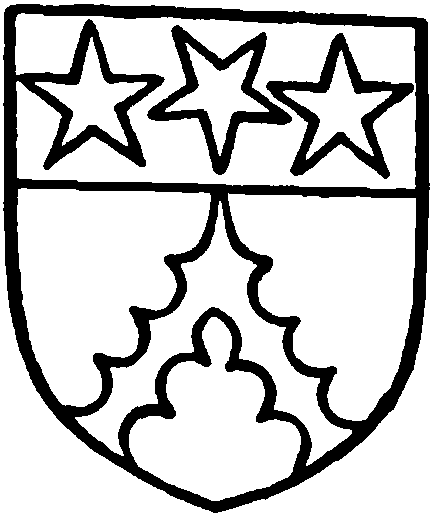
Keble. Argent a cheveron engrailed gules and a chief azure with three molets or therein.
Two brasses are preserved from the old church, one of John Bowland, 1470, and another of Anne Horswell, 1559, with a quaint inscription in English. In the tower is a large monument to Mrs. Elizabeth Connell, 1731.
There are six bells: the first by Mears & Stainbank, 1880; second and third by W. Taylor, Oxford, 1835; the fourth bears the inscription 'Prayse God, I W, 1616'; the fifth 'O Give thanks to God I W, 1616,' both by John Wallis of Salisbury; the sixth is by Robert Cor of Aldbourne, 1713.
The plate is a silver-gilt set dating from 1841, consisting of a chalice, two patens, a large flagon, and an almsdish.
The first five books of registers, containing mixed entries, run as follows:—1600–39, 1640–53, 1653–66, 1665–1706, 1706–53. The sixth and seventh books contain baptisms and burials, 1755–82, and the eighth the same, 1783–1820. The ninth and tenth contain marriages, 1754–1813.
The church of ST. MARK, AMPFIELD, was built in 1838–40 by Sir W. Heathcote, bart., of blue brick and stone. It consists of chancel, nave, north transept, south aisle, porch and open octagonal western turret with spire, containing two bells. The register dates from 1841.
ADVOWSONS
The church of Hursley was in the gift of the bishop of Winchester until the beginning of the fourteenth century when John de Pontoise founded the college of St. Elizabeth, Winchester. (fn. 62) This foundation led to the ordination of the vicarage of Hursley, the rectory of which was given by the bishop to the college. (fn. 63) The grant of the appropriation of the church, which had been made without the licence of Edward I, was confirmed to Richard de Bourne, the provost, and the chaplains and clerks by Edward II in 1307. (fn. 64) Bishop Edendon, when ratifying to the college the gift of Hursley Church, (fn. 65) contrived to secure for himself and his successors the rectory-house. (fn. 66) The possession of the rectory was, however, restored to the provost and chaplains by William of Wykeham in 1372, when the college undertook to pay an additional annual pension of 13s. 4d. to the bishop. (fn. 67) The provost and chaplains presented the vicars until the Dissolution, when the advowson fell into the hands of the king. Edward VI granted it together with the manor of Merdon to Sir Philip Hoby, (fn. 68) and from this time the advowson followed the descent of the manor. (fn. 69)
The living of St. Mark's, Ampfield, is a vicarage in the gift of the Heathcote trustees.
CHARITIES
In 1720 Mrs. Wyndham left £20 in respect of which 20s a year was distributed among the poor on St. Thomas's Day.
By deed, 1817, the trusts of a sum of money were declared which had been raised by subscription for the purpose of providing a Sunday evening service at the church. The fund was added to from time to time, and is now represented by £1,224 18s. 8d. consols.
In 1864 James Beckley, by will proved this date, left £3,647 2s. 6d. consols to the rector and churchwardens, and directed that the income should be applied weekly to five poor widows or widowers not under the age of fifty-five, who receive 7s. 6d. a week each.
In 1893 Emma Baker, by her will proved this date, bequeathed a moiety of her residuary estate for the benefit of the poor. A sum of £318 was received in respect thereof, of which £300 was invested in £301 16s. 9d. India £3 per cent. stock, the balance being distributed among the poor together with the income accruing on the stock.
The sums of stock belonging to the charities respectively are held by the Official Trustees of Charitable Funds.