A History of the County of Hampshire: Volume 3. Originally published by Victoria County History, London, 1908.
This free content was digitised by double rekeying. All rights reserved.
'Parishes: North Stoneham', in A History of the County of Hampshire: Volume 3, ed. William Page (London, 1908), British History Online https://www.british-history.ac.uk/vch/hants/vol3/pp478-481 [accessed 30 April 2025].
'Parishes: North Stoneham', in A History of the County of Hampshire: Volume 3. Edited by William Page (London, 1908), British History Online, accessed April 30, 2025, https://www.british-history.ac.uk/vch/hants/vol3/pp478-481.
"Parishes: North Stoneham". A History of the County of Hampshire: Volume 3. Ed. William Page (London, 1908), British History Online. Web. 30 April 2025. https://www.british-history.ac.uk/vch/hants/vol3/pp478-481.
In this section
NORTH STONEHAM
Ad Lapidem (x cent.) (fn. 1); Staneham (xi cent.); Stanham Abbatis (xiii cent.)
The parish of North Stoneham, comprising over 5,026 acres, thirty-two of which are covered by water, is situated in the New Forest division of the county, north-east from Southampton, and south-west from Eastleigh.
In the east is the River Itchen, which forms the boundary between North and South Stoneham, and one of its tributaries, Monk's Brook, traverses the parish from north to south. The land is fertile and well wooded; there are 896 acres of wood, 1,485 of arab'e, and 1,088 of permanent grass-land. (fn. 2)
The soil is red loam with a gravel or clay subsoil, and the inhabitants, mostly engaged in agriculture, cultivate wheat, oats, and barley.
The main roads from Southampton to Winchester, and from Romsey to Botley, cross the parish.
There is a gradual slope of the land from the north-west, where the average altitude is 200 ft. above the ordnance datum, to the south-east and south, where is the River Itchen, and where the altitude is only 50 ft. Most of the centre of the parish is occupied by North Stoneham Common and North Stoneham Park. The latter surrounds the Manor House, now unoccupied, and covers 500 acres. The grounds are well laid out, and are used by the members of the North Stoneham Club for games and athletic sports of all kinds. There are also two fine fishponds, now used for boating. The church of St. Nicholas stands just within the park, while opposite is the rectory.
There is no village of North Stoneham, but about half a mile north of the church is the little hamlet of Middle, consisting of a farm and a few cottages, the Cricketer's Arms Inn and the post office.
North End is a hamlet in the extreme north of the parish, near Chandlersford, and comprises a few picturesque old cottages, and a farm called the Home Farm. Chandlersford was formed into a separate civil parish in 1897, from portions of North Stoneham, North Baddesley, and Ampfield. A few years ago it contained only a few small cottages, but it is now rapidly developing into a favourite residential neighbourhood, owing to its healthy situation and charming scenery. The iron church and schools erected in 1889 lie to the north of the village. Chandlersford Railway Station on the Eastleigh and Salisbury branch of the London and South Western Railway is in North Baddesley parish, according to the boundaries of 1895. Bassett, a group of large modern residences, lies on the southern border of the parish and contains the fine new church of St. Michael and All Angels, opened in 1897.
Saxholme, to the north of the village, is the residence of Sir Alfred Wills, Ridgemount is the property of W. Erasmus Darwin, J.P., and Red Lodge, in the south-west of the village, is owned by Sir Harold Hewitt.
The old canal from Alresford, which still forms part of the parish boundary, is now disused and practically dry.
The village stocks have disappeared, but they were formerly on the road to Chandlersford near the pound, close to the gates of North Stoneham Park.
Lord Hawke, the victor of Quiberon Bay, formerly lived in this parish, and is buried in the church.
MANOR
King Athelstan, in the year 932, at the Witenagemot at Amesbury, granted certain land in NORTH STONEHAM to the thegn Alfred, (fn. 3) who in 941 gave the same land to the abbey of Hyde, Winchester. (fn. 4)
In Domesday North Stoneham is given as one of the possessions of St. Peter's Abbey of Hyde, 'to which it has always belonged.' Then, as in the time of King Edward, it was assessed at 8 hides, and there were considerable lands belonging to the manor. (fn. 5)
In 1329 the abbey of Hyde was granted free warren in its demesne lands in North Stoneham. (fn. 6)
The property of the abbot here had been increased three years before by a grant of one messuage and land from John de Chekenhull and Beatrice his wife, for the maintenance of a chaplain who every day should pray for the souls of the donors and their ancestors. (fn. 7)
At the dissolution of the monasteries North Stoneham manor, with many of the other possessions of Hyde Abbey, was granted to Thomas Wriothesley, earl of Southampton. (fn. 8) He was succeeded on his death in 1550 by his son Henry, then a minor. (fn. 9) Henry died in 1582 and left as his heir a son Henry, then only eight years of age. (fn. 10) Shortly after attaining his majority he sold the North Stoneham estate to Thomas Fleming, (fn. 11) whose descendants are the present owners. His son Thomas, who succeeded him in 1623, (fn. 12) died in 1639, leaving a son Edward as his heir. He also left a daughter Katherine, who afterwards married Daniel Eliot. (fn. 13)
Edward's grandson died unmarried, and the male line of the Fleming family became extinct. The estate of North Stoneham then passed to Thomas Willis, great-grandson of Katherine and Daniel Eliot, who assumed the surname Fleming. He died without heirs, and was succeeded by his half-brother John, who also took the name Fleming, but died without issue in 1802. The property then devolved upon his cousin John Barton Willis, great-grandson of Browne Willis the antiquary by Katherine Eliot, daughter of Daniel Eliot and Katherine Fleming, who became John Barton Willis Fleming. (fn. 14) His grandson, Mr. John Edward Arthur Willis Fleming, holds the manor at the present time.

Fleming. Gules a cheveron between three owls argent with an ermine tail on the cheveron.
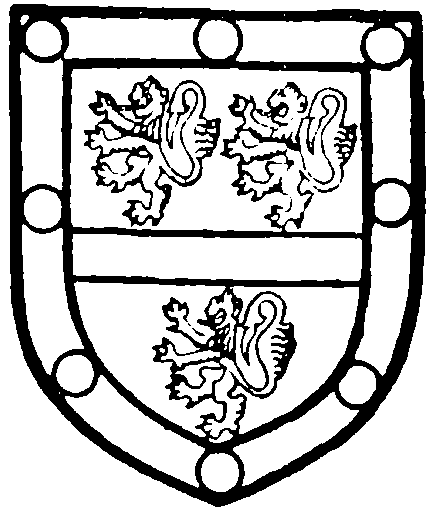
Willis. Argent a fesse between three lions gules and a border gules bezanty.
Two mills are mentioned in Domesday among the possessions of Hyde Abbey in North Stoneham. (fn. 15) No such buildings exist here at the present day, although there are two in the neighbouring parish of South Stoneham, one called the 'Wood Mills' at Swaythling, the other called 'West End Mills,' a little above the old Mansbridge, on the River Itchen.
In the extent of North Stoneham, as granted to Hyde Abbey in 941, the boundary extended as far as the River Itchen in two places, at 'Swathelyngford,' and at 'a mylle place by Northe Mannysbrygge,' (fn. 16) from which it seems conclusive that the mills now in South Stoneham are those formerly in North Stoneham, having been transferred from one parish to the other by a change of boundary, especially as there is no river or stream in North Stoneham capable of turning a mill. In the time of George I the sheaves for the blocks of the men-of-war were turned in the Wood Mill, some of the Hanoverian bodyguard being given employment at the work. Now, however, it is a flour mill worked by Messrs. A. & F. Ray, roller millers, of Southampton. 'West End Mill' is now a corn mill, the property of Mr. John Gater, whose family have held it for over a century. It was formerly a paper mill, belonging in 1686 to the company of White Papermakers. Nine of the fifteen members of the company were French refugees, and in 1702 Gerard de Vaux, 'frenchman,' was living at South Stoneham Mill. Here he was joined by another Huguenot, Henry Portal, who afterwards set up for himself at Laverstoke, and in 1724 obtained the contract for making bank-note paper, which his descendants still hold.
North Stoneham Park is of great antiquity, and in the fourteenth century was a fine deer park belonging to the abbot of Hyde. (fn. 17)
The messuage granted to the abbot by John de Chekenhull in the fourteenth century was conveyed with North Stoneham manor to Thomas Wriothesley at the dissolution of the monasteries, (fn. 18) and shares the same history as that manor. (fn. 19) Traces of this messuage possibly still exist in Chickenhall Farm.
CHURCH
The church of ST. NICHOLAS has a chancel 25 ft. long, and of equal width (15 ft. 2 in.) with a nave of 35 ft. 9 in., aisles of the full length of nave and chancel, 11 ft. 5 in. and 11 ft. 2 in. wide respectively, a west tower 10 ft. by 9 ft. 6 in., a north porch and a south vestry.
The various additions and alterations which have brought the church to its present symmetrical plan have destroyed all evidence of any work earlier than the fifteenth century, with the exception of the west window of the tower, which is a beautiful triplet of thirteenth-century lancets, re-used here, as it seems, when the tower was built in the sixteenth century.
The nave arcades, of three bays with octagonal pillars, simply moulded capitals, and arches of two chamfered orders, are probably fifteenth-century work, while the two bays on either side of the chancel are of curious pseudo-Gothic character, and apparently of late eighteenth or early nineteenth-century date. They are of different section, and may perhaps be intended as copies of mediaeval work formerly existing here, but if this be the case the copying is not sufficiently close to give grounds for assuming the date of the former arcades.
The east window of the chancel is of fifteenth-century style, of three cinquefoiled lights with tracery, and flanked on the inside by modern niches for images; it is filled with painted glass made in 1826 by Edwards of Winchester, the subject being an adaptation of Raphael's Transfiguration; the result is not happy.
The aisle windows are of late Gothic character, and probably in no case earlier than the sixteenth century; they have been a good deal repaired, modern cusping being inserted, so that their dates are chiefly matter of conjecture. Both aisles have three-light east and west windows, the east window of the south aisle having image brackets on either side of it; in the north aisle are four north windows, the eastern of two cinquefoiled lights with tracery under a pointed head, the next two square-headed, of three and four cinquefoiled lights respectively, and the fourth also square-headed, of three cinquefoiled lights. Between the third and fourth windows is a round-headed north doorway with a plain quarter-round moulding of uncertain but not ancient date.
In the south aisle the south windows are all square-headed, of three or four lights. The details of the windows are not uniform, the west window of the south aisle, and the four-light window in the north aisle, being of better style than the rest.
The tower is of three stages, with a stair at the north-east angle. It is probably of sixteenth-century date, but externally its details are hidden by ivy; the east arch is of a single pointed order, edge-chamfered. The west window, as already noted, is a beautiful piece of thirteenth-century detail: a triplet of lancets under a segmental rear arch with engaged shafts to the lights and rear arch, having moulded capitals and bases and bands at half height. The rear arch and lights are also moulded, and the date of the whole is about 1230; the bonding of the masonry shows that it has been carefully re-used in the tower at the time of its building in the sixteenth century.
All the roofs and wood fittings of the church are of modern date, but a seventeenth-century altar-table with twisted baluster legs stands at the east end of the south aisle. The organ is at the east end of the north aisle, and the font, which has an octagonal bowl of Purbeck marble on a modern stone stem, is under the east arch of the tower. The bowl looks like fifteenth-century work, but may be an older bowl refashioned at that time.
In the middle of the chancel floor is a bluish limestone slab, 6 ft 8 in. by 3 ft. 8 in., formerly in the north aisle, which was perhaps its original position. On it is a shield charged with a double-headed eagle surrounded by foliage of foreign Gothic type, and round the edge of the slab runs a marginal inscription with the evangelistic symbols at the four angles—
SEPULTURA DE LA SCHOLA DE SCLAVONI AÑO DÑI MCCCCLXXXXI
There appears to be no record of any connexion of North Stoneham with these Slavonians, who doubtless came to Southampton with the Venetian fleet. The Rev. G. W. Minns (fn. 20) suggests that the slab may have been brought here from the destroyed church of St. Mary, Southampton, c. 1550, as it is said that some of the material of this church found its way to North Stoneham. At the east end of the south aisle, on the south side, is the monument of Sir Thomas Fleming, Lord Chief Justice, who died in 1613, with his effigy in scarlet robes, and that of his wife, and kneeling figures of the six sons and two daughters who survived him. Two sons and one daughter died before their father, and are not represented on his tomb. The inscription is in two panels on the base, and above the effigies are the arms of Fleming, gules a cheveron between three owls or, an ermine spot on the cheveron, between Fleming impaling James (his wife's family), and James, gules a dolphin or, quartering per fesse sable and or a lion or and gules.
Opposite to the Fleming monument, on the north side of the aisle, is a mural tablet to John Serle, 1576, his wife Christine, 1561, and their son John, 1575.
In the south aisle also is a monument to Lord Hawke, 1781, with a sea piece carved in white marble of very good style.
A wooden screen now in North Baddesley church, bearing Sir Thomas Fleming's initials and the date 1602, is said to have been brought from North Stoneham. It has been, as it seems, lengthened a few inches, and its original size, 15 ft. 2 in., is precisely that of the width of North Stoneham nave and chancel, so that the tradition may be correct.
There are six bells by Taylor of Loughborough, 1893. The former ring was of three, by I H., 1651, Antony Bond, 1623, and a Salisbury founder, c. 1400.
The plate consists of a silver-gilt cup of 1702, with a cover paten, inscribed 'TA ΣA EK TΩN ΣΩN anno domini 1702,' and a standing paten of the same date, the gift of Margaret and Thomas Fleming, bearing the Fleming arms, and Fleming with Bland on a scutcheon of pretence.
The flagon, which has no marks but that of the maker Ro — perhaps Philip Rollos of London—was given in 1703, and is inscribed 'Humbly offered by Richard Dummer.' There is also a modern paten, silver-gilt, and two glass cruets, with silver-gilt mounts.
The first book of the registers runs from 1640 to 1716, and the second, which bears on the cover the date 1716, and has lost a few pages, runs from 1722 to 1812, the marriages ceasing in 1754, and being entered in a third book which carries them to 1812.
ADVOWSON
A chapel evidently existed in North Stoneham as early as the tenth century, for besides the grant of Stoneham by Aelfrid the thegn to Hyde Abbey, it also received from King Athelstan 6 hides of land at 'Stanham,' together with the chapel thereto pertaining and the vestments. (fn. 21)
The abbey held the church with the manor at the time of the Domesday Survey, and in 1330 the abbot received licence in fulfilment of a grant to his convent by Edward I to appropriate the church as well as hold the patronage. (fn. 22) The advowson continued in the gift of the abbot until the Dissolution, when it was granted with the manor to Thomas Wriothesley, since which time it has always been held by the lord of North Stoneham manor (q.v.).
CHARITIES
In 1720 Edward Dummer, by his will proved in the P.C.C. charged his manor and lands in Swaythling with the yearly payment of £5 for a schoolmaster for teaching boys and girls to write and read.
The Poor's Money, the gifts of various donors, formerly consisted of £168, which, it is understood, was laid out on some cottages, now forming part of the North Stoneham estate belonging to John Fleming, esquire, by whom the sum of £6 15s., being interest at £4 per cent., is paid annually and distributed on Easter Thursday by the rector and churchwardens. In 1906, sixty-eight cottagers received from 1s. to 2s. each.