A History of the County of Hampshire: Volume 3. Originally published by Victoria County History, London, 1908.
This free content was digitised by double rekeying. All rights reserved.
'The borough of Southampton: General historical account', in A History of the County of Hampshire: Volume 3, ed. William Page (London, 1908), British History Online https://www.british-history.ac.uk/vch/hants/vol3/pp490-524 [accessed 30 April 2025].
'The borough of Southampton: General historical account', in A History of the County of Hampshire: Volume 3. Edited by William Page (London, 1908), British History Online, accessed April 30, 2025, https://www.british-history.ac.uk/vch/hants/vol3/pp490-524.
"The borough of Southampton: General historical account". A History of the County of Hampshire: Volume 3. Ed. William Page (London, 1908), British History Online. Web. 30 April 2025. https://www.british-history.ac.uk/vch/hants/vol3/pp490-524.
In this section
BOROUGH OF SOUTHAMPTON
Pleasantly situated on the banks of the Southampton Water, on a tongue of land with the mouth of the River Itchen to the east, and on the west a fine bay formed by the outflow of the River Test, Southampton has grown, especially within recent years, far beyond its ancient proportions.
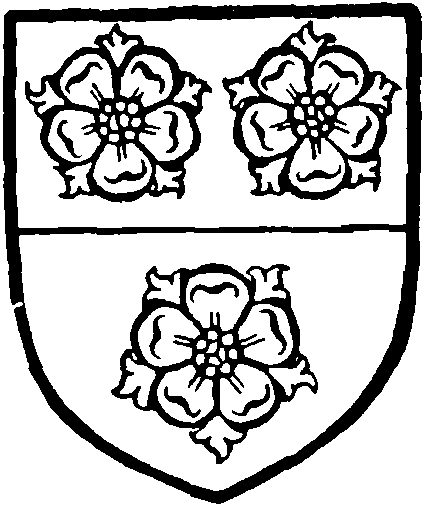
Southampton. Party fessewise argent and gules with three roses countercoloured.
Leland (fn. 1) heard on his visit to Southampton before 1546 that the town did not originally stand where it now does, but in the immediate neighbourhood of St. Mary's Church, some quarter of a mile or more to the north-east of the walled town, whence it stretched away to the river side. Camden, (fn. 2) some thirty years after, heard the same account, and excavations of the last century go some way to confirm the tradition which these writers have handed down. (fn. 3) The growth of the town on its present stronger and better site probably belongs to the earlier part of the eleventh century in the settled time before the death of Canute in 1035. By the end of that century there is evidence that the town stood where it does now; while the tokens of the population would seem to indicate an occupation of the old site till about the period suggested. The movement was but within the same civil and ecclesiastical district, and it seems likely that there is evidence of the relationship between Old and New Hampton in the traditionary ecclesiastical connexion between the churches of the borough. (fn. 4)
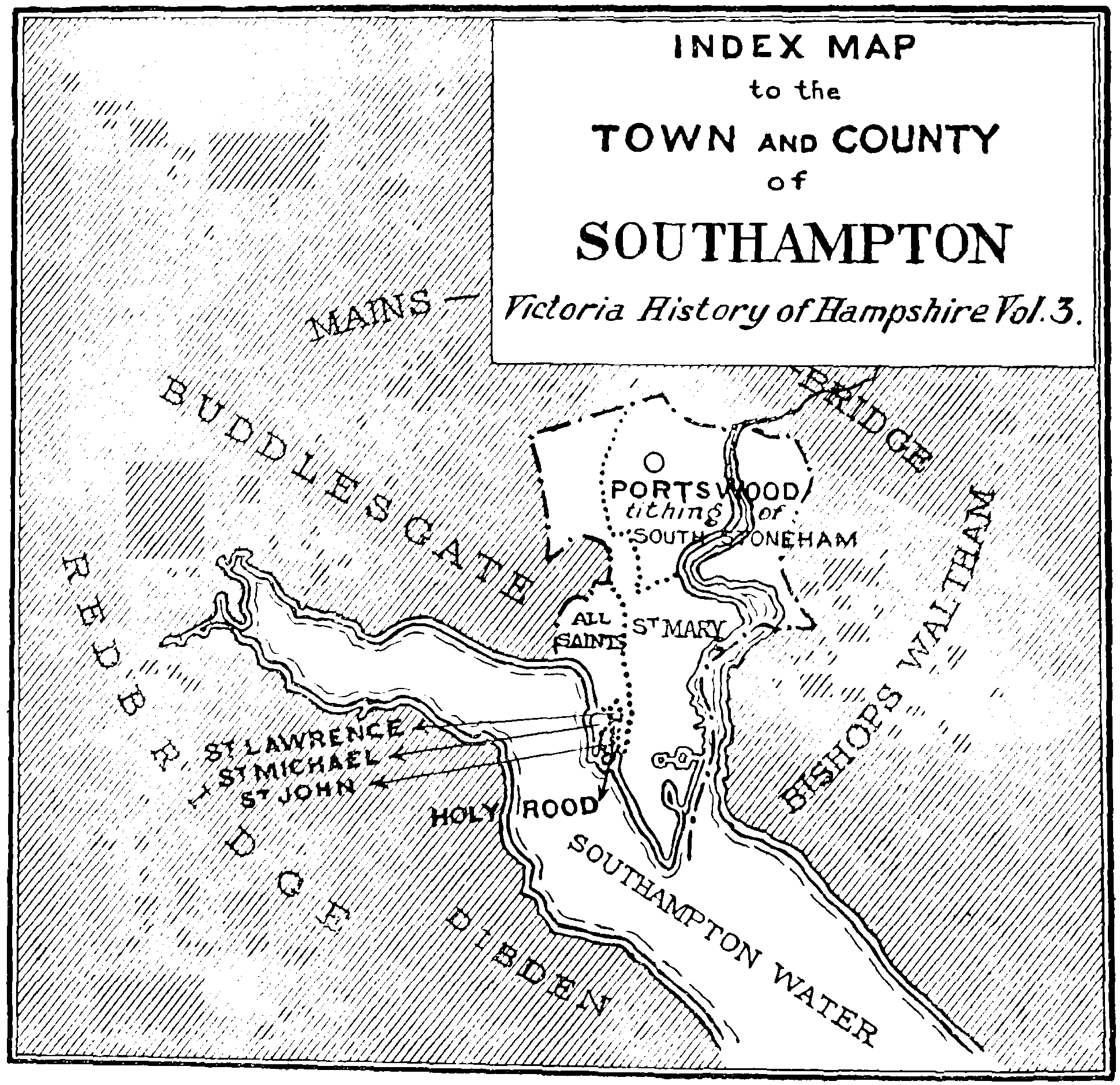
INDEX MAP to the TOWN and COUNTY of SOUTHAMPTON
The mediaeval plan of the town is a parallelogram stretching north and south, following the line of the western shore. Its fortifications are still to be traced on every side, and partly on the north and almost entirely on the west they exist to this day in good preservation, affording a unique and striking example of ancient defences. The parallelogram was divided by several principal streets. English Street, the modern High Street, runs due north and south from the Bargate on the north: French Street, which still retains its old name, runs parallel to it on the west, and farther to the west is the ancient Bugle or Bull Street. The last two run no farther northwards than St. Michael's Square, the north-western quarter of the town being in great part taken up by the castle inclosure. West Street leads from Bugle Street, through the West Gate, still existing, to the western shore. East Street, which retains its ancient name, ran from near the north end of High Street to the East Gate, now destroyed, and so into a suburb of old standing. Lower down the east side of High Street the modern Bridge Street, which leads to the railway station and floating bridge, is an expansion of an ancient lane which ended at a postern in the town walls. Still farther south exists with but slight alteration the ancient Winkle Street, which passes the entrance to God's House and through the South Castle Gate, still existing.
On the east side of the old town the long streets or alleys running north and south, called Back of the Walls and Canal (fn. 5) Walk or the Ditches, mark exactly the fortifications on that side.
At the south of the town an ancient quay at the bottom of High Street has been transformed into the wide modern platform with pier and quays, and farther to the east lie the spacious docks and railway station, while on the west of the town the mediaeval quay outside West Gate, the ancient scene of traffic, has entirely changed its purpose and given way to a broad esplanade of land reclaimed from the sea outside the walls, connecting the southern quays with the railway station of Southampton West.
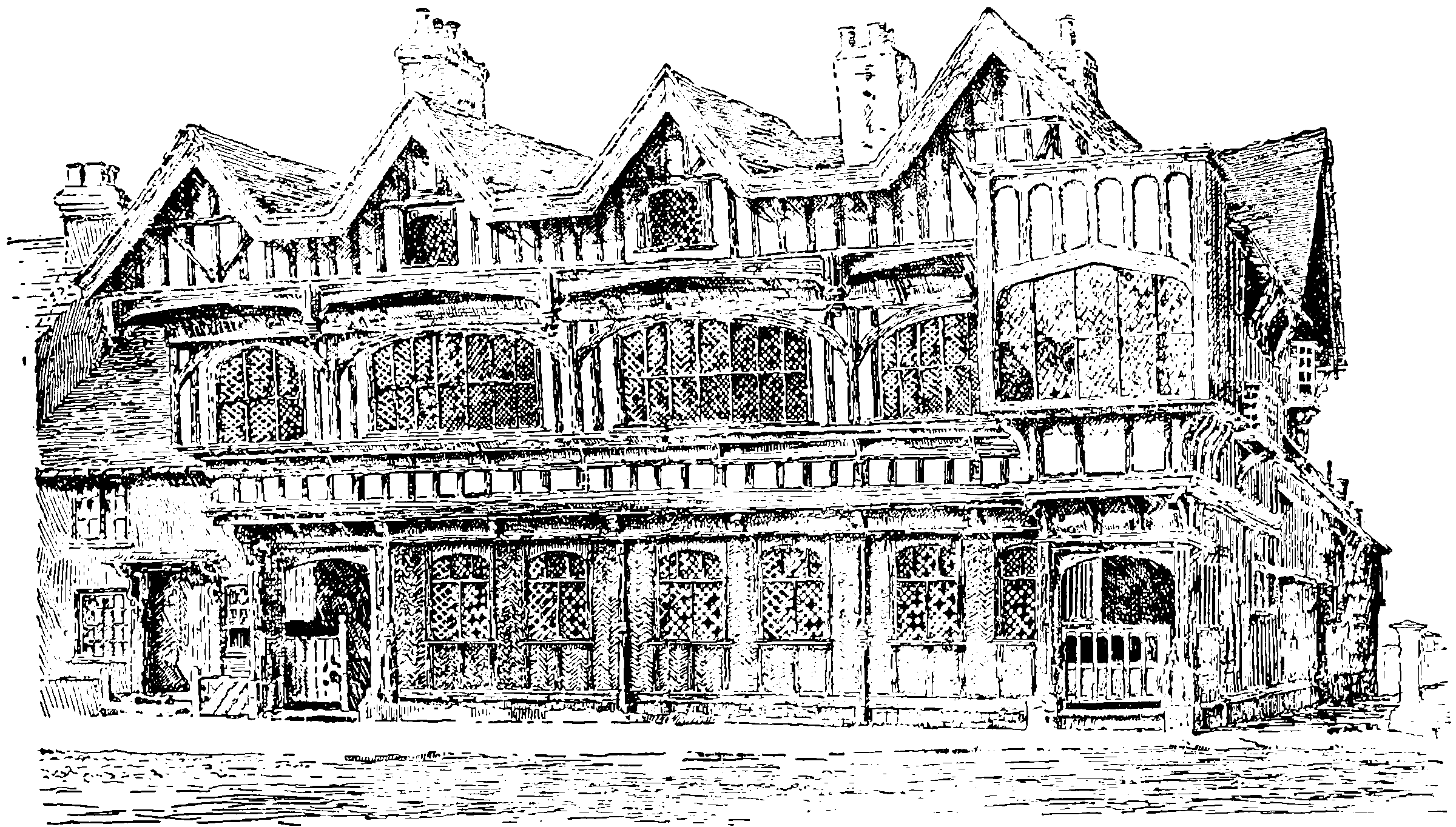
'Henry VIII's Palace,' Southampton
To the north-east the ground connecting the ancient town with the old suburb of Northam has been built over. To the north Portswood must be included, and to the west Freemantle. Fortunately there are beautiful public parks, the inheritance of ancient days in one form or other; and there is the Southampton Common, a lovely piece of forest scenery approached from the town by a wide avenue of old elms. This large extent of busy life is well connected and held together with all the modern appliances of electric trams and other facilities. At the present time the population of the borough and county of the borough is estimated at 108,000.
In spite of prosperity and growth of population, which are so often fatal to the older buildings of a town, Southampton is rich in remains of mediaeval houses and the vaulted cellars on which they commonly stood. Besides the well-known 'King John's House,' elsewhere described, there are several pieces of twelfth-century work, the best being a house on the south of St. Michael's Church, and 'Canute's Palace' in Porter's Lane. The former has a large vaulted cellar with a central round-headed entrance, and on the ground floor two semicircular-headed doorways, all of late twelfth-century date. Only the lower part of the early house remains, but at the back are many traces of later mediaeval work. On the west side of St. Michael's Square is the fine timber-built house now called 'Henry VIII's Palace,' and probably to be identified with that built by Henry Huttoft in the early years of the sixteenth century, and mentioned by Leland. It has four projecting gables towards the square, being of two stories and an attic, with a row of large mullioned windows on the first floor. It runs back some distance from the street, and includes parts of an older building. A little to the north of the square is Simnel Street, where the vaulted basement of an early fourteenth-century house has been preserved from the general demolition which has here taken place. It is a good example, vaulted in two bays with excellent details, and has a stone-hooded fireplace on the east with brackets for lights, and two windows and a doorway on the south. Parts of the house attached to it yet stand, with the pit of a large garderobe.
Leland mentions the timber houses of Southampton, and no doubt the majority of the mediaeval town buildings were so constructed, standing on masonry basements. Such basements, stone vaulted, remain in a good many places, as at Nos. 91 and 111, High Street. On the latter is an ancient timber building, now faced with cement in imitation of stonework, and other timber buildings, now brick-fronted, are the Nag's Head and Red Lion Inns in High Street. Next to Holy Rood Church is another timber house, faced with tiles which are made in imitation of brickwork, and there are several other examples of this, both in white and red tiles, in various parts of the town.
A great deal of good wood and iron work of later date exists, as at Nos. 1, 17, 90, 111, and 150, High Street, at Bugle House in Bugle Street, and elsewhere. A chimney-piece at 17, High Street is dated 1605, and bears the initials of James I. The many eighteenth-century projecting bay windows are a prominent feature, those of the Dolphin Inn in High Street being conspicuous examples, and a good deal of pretty red brickwork of this time has so far escaped destruction in favour of something more showy.
The modern buildings of Southampton are neither better nor worse than the general run; the Hartley Institute is the best of them, and has a front to the High Street of some distinction.
The ancient boundaries of Southampton are said to date from the reign of King John, (fn. 6) and though they cannot with certainty be traced further back, yet it is not to be supposed that the borough was without an ample extent of land from the very first. In documents of 956 and 1045 we read of a haye or inclosure, which could hardly have been other than the western boundary of the town's land. (fn. 7) Again, in 1180 (26 Hen. II), William Briwer (fn. 8) was made forester of the forest of Bere with power to arrest transgressors there between the 'bars' of Hampton and the gates of Winchester; and these 'bars' almost certainly formed the northern boundary of the town's liberties, considerably to the north of, and not to be confounded with, the present Bargate, the core of which then existed. Moreover it is distinctly stated that land granted to the canons of St. Denys within the area in question, as early as 1174 (see below), formed a portion of that for which the town paid its annual fee-farm, (fn. 9) so that, in spite of the town tradition, it is fair to conclude that these liberties of the borough existed before any grant of King John, if such there were, and that whatever he may have done in this respect could only have been in confirmation.
In 1254 the bound and limit between the forest of Bere and the King's Majesty's town of Southampton was declared to be 'from Acard's (now Four-post) bridge as the way lies northward by the crosses to Cut-thorn, (fn. 10) and from Cut-thorn to Burle stone, and from Burle stone to the water course of Furse-welle as it goes down to the River Itchen.' (fn. 11) Within these bounds the canons of St. Denys held a certain wood called Portswood by a grant from King Richard in free, full, and perpetual alms. For this wood and the land called Kingsland the aforesaid king remitted 100s. of his farm of the town of Southampton. (fn. 12) In 1488 almost identical but more elaborate boundaries were given. (fn. 13)
'The perambulacion of the franchise of the toune of Suthampton graunted by King John and confermed by mayny other noble kings his successours.'
'Item, first fro Barred-gate unto Acorn [otherwise Acard's] brig and crosse, west-north-west: and fro the Acorn brig and crosse unto the Hode crosse, north, thorough the village called Hill: and fro the Hode crosse to the Cutted-thorne crosse, suth suth est: and fro the Cutted-thorne crosse to the Berell stone crosse, est, at Burger's strete ende: and so along Burger's strete and thorough Kinghern [otherwise Langherne] yate unto Haven stone in Hilton upponne the water side, est: and fro Haven stone along as the water lyeth unto Hegstone [later Millstone] at Blackworth, suth: and fro Hegstone as the water lyeth to Ichenworth [i.e. by the existing Cross house] suth: and fro Ichenworth as the water lyeth to the Mesynedue [Maison Dieu] yate of Suthampton, west.' (fn. 14)
It is difficult to reconcile what were till lately the municipal and Parliamentary limits of the borough county with those given in the documents above. From these it would appear that the western boundary was through the village of Hill, including a considerable amount of property, with Banister's, all of which was in fact ultimately excluded, as a glance at the map will show. This boundary was long in dispute. In 1528 (20 Henry VIII) an entry occurs of a 'meeting of the Town's counsel and Mistress Whitehede for the variance of our liberties in Hill lane.' (fn. 15) In 1600, (fn. 16) 1611, (fn. 17) 1651, (fn. 18) and again in 1652 (fn. 19) the town persistently made claims in maintenance of its ancient boundaries, but the claims became relaxed early in the next century. From 1704 the town presents that the 'metes and bounds ought to extend through a village called Hill etc.' In 1748 the name of Sidford is added, and afterwards the bounds were presented as extending northward 'from a village called Hill and Sidford.' But there was hesitation to the last. The Parliamentary Boundary Commissioners of 1832 took the larger limit; on the other hand the Municipal Corporation Commission of 1835 excluded the disputed district; this the commissioners of 1868 followed, and the matter at length rested.

Plan of Southampton, showing the Walls, Castle, etc. (From a plan belonging to the Society of Antiquaries)
At the north-west angle of the old borough limits was another loss. At this point there seems to have been hedging and ditching about 1577 not altogether to the satisfaction of the court leet. They present (1579): 'That whereas of late daies theare hathe bin a peece of our comon and heathe ditched and hedged and enclosid in and planted wth willows under the name of a shadow for our cattel wch have hitherto many yeres past prosperid verie well as the comon was beefore; wherefore we dessire yt may be pulled down agayne and levelid as before; for we doubt that in short time yt wilbe taken from the common to some particuler man's use, wch weare lamentable and pitieful and not sufferable; for as our auncestors of theire great care and travell have provided that and like other many benefyts for us theire successors, so we thinck it our dwetie in conscience to keep, uphold and maintain the same as we founde yt for our posteritie to come without diminishing eny part or parcel from yt, but rather to augment more to yt yf yt may be.' This hedging and ditching, for some reason or other, had left the ancient Hode cross, which is mentioned in every description of the franchises, standing as it does now, some 100 paces from the corner of the inclosed common; and the jury immediately continue: 'Also wee fynd that theere ys a great peice of our sayd comon and heathe leaft unclosed from the rest by Hood crosse, for what purpose wee know not, but we doubt that in continuance of tyme yt will be quit lost, and so by litell and littel we shall loose and diminish oure Lyberties wch we so long have enjoyed wch weare greate pitie.' Similar presentments and warnings continued to be made for many years; but no teps seem to have been taken, and in time this portion became abandoned and the Parliamentary Commissioners of 1832 drew the boundary along the inclosure on the evidence of the latest perambulations.
At the north-eastern limit the ancient inquisitions and the court-leet books describe the boundary line as passing the Burle or Borell stone along Burgess Street to Langherne gate, and thence to Haven stone; and there is evidence that the corporation exercised jurisdiction within these limits. (fn. 20) However the modern perambulations had been confined to the shorter route by the Burle stone, and along the stream there to the River Itchen; and in accordance with this the boundary was drawn by the commissioners of 1832, in which they were followed by those of 1868. It is a matter now of small moment since the alterations of 1895; and the discussion of the old boundaries serves but to illustrate the methods of the past. There can be little doubt that the old borough-county limits had in time somewhat shrunk from their ancient dimensions. The area till 1895 comprised the parishes of All Saints, Holy Rood, St. Lawrence, St John, St. Michael, so much of the parish of St. Mary as lies west of the Itchen, the tithing of Portswood in the parish of South Stoneham and Southampton Common, which is extra-parochial.
The existing boundaries as settled (fn. 21) in 1895 are much more extended. Three large wards have been added on the west, the Shirley, Freemantle, and Banister wards, the greater part of which were formerly comprised in the urban district of Shirley and Freemantle; (fn. 22) while on the east a large addition was made to the Portswood ward consisting for the most part of the Bitterne Park estate in the South Stoneham rural district on the opposite side of the Itchen, which is crossed by the Cobden bridge, opened in 1883. The wards are now thirteen in number, viz., the Town, St. James's, St. Mary's, All Saints', Trinity, Northam, Nichols Town, Newtown, Bevois, Portswood, Banister, Freemantle, and Shirley wards. And the acreage of the whole, as against the old boundaries of 2,817 acres, or, excluding mudlands, 2,004 acres, is now 5,295 acres, or, excluding mudlands, 4,416¾ acres. The population of the borough-county immediately prior to the alteration was estimated to be 71,750, immediately after, 94,150; while at the last census the population of the enlarged borough was found to be 104,911; it is now estimated at 108,000. The extension order expressly provides that the whole area included within the altered boundary shall be 'the Borough and also the County of the Borough of Southampton and shall be the County Borough for the purposes of the Act of 1888.' (fn. 23)
Southampton Common, an important member of the above precincts, demands a special notice. It is first mentioned in 1228, when the burgesses of Southampton, represented by John de Lillebane, were in contention with Nicholas de Scherleg or Surlie (Shirley) concerning the moiety of a messuage in Southampton, and battle (fn. 24) in the court was pending between the two, when a final concord was arranged in the king's court, John de Lillebane quitclaiming all his right or possible right to Nicholas. Upon this, Nicholas, at the instance of John, granted the burgesses one piece of land without the town of Southampton to remain to the burgesses; neither party was to have rights on the other's common, but each to have free way to and from his own. (fn. 25) Although it is impossible to identify the thirteenth-century boundaries with those of the present day, there is little doubt that the extent of the common remains as in the sixteenth century.
Of the remaining ancient common lands and their modern transformations, 'The West and East Marlands' (corrupted from Magdalens) represent property formerly belonging to the Hospital of St. Mary Magdalene, (fn. 26) and Houndswell and Hoglands are transformed into a zone of park and recreation grounds on the north and east of the town, or rather, as it will soon be, in the centre of the extending population. To the south of the town a tract of land, partly lammas but chiefly common, known as the saltmarsh, stretched from the old bowling green outside God's House gate to Cross house and chapel; the western or lammas portion of this, which belonged till recently to Queen's College, Oxford, is now represented by Queen's Park, opened in 1885.
Having dealt with the territory we pass to the town itself and its fortifications. A wall of varying thickness some 25 ft. to 30 ft. in height inclosed the mediaeval town in its irregular parallelogram, measuring on the north side about 217 yards, on the east 786 yards, on the south from east to west as far as the site of Bugle Tower about 435 yards, and from that point to the north-west angle of the town some 543 yards. The wall was strengthened at unequal intervals by twenty-nine towers.
These fortifications belong in part to the Norman period. Of this range of date are the core of the Bargate, with a portion of the present walls, some existing works below the castle, and domestic buildings in the line of the western wall, forming part of its original circuit and subsequently adapted for defence.
There were eight gates, four of which remain. These are the north or Bargate, God's House or South Castle Gate, West Gate, and the postern called Blue Anchor Gate. Those which have disappeared were East Gate, Biddles' Gate on the west, and the South or Water Gate. In addition to these was a Castle Water Gate, now to be seen in the face of the wall on the western shore, having been discovered in 1887; there was also a postern near the friary, the site of which is lost. The insertion called York Gate in the north wall east of the Bargate is of the eighteenth century.
The chief periods of construction will be indicated by the aids granted for the purpose. In 1202–3 and the following year John allowed £100 each year out of the farm towards the walling of the town. (fn. 27) During the latter part of the reign of Henry III two murages were granted, the former on 30 November, 1260, for ten years, the latter on 12 November, 1270, for five years. A considerable number of tolls is scheduled on these grants. (fn. 28) In April, 1282, a murage had been recently granted, and in March, 1286, another was allowed for five years from Easter of that year. (fn. 29) In 1321 a murage was granted for three years, (fn. 30) after which a renewal was petitioned for. (fn. 31) By this time the flanking towers, to be mentioned presently, had been added to the Bargate. The Quayages and Barbican duty, granted from 1323 to 1346 (see below) should also be mentioned as having an immediate connexion with the fortifications. To this period may be assigned the arcade work described below. The next efforts of construction were called forth by the invasion of the town in 1338 (see below). It appears that in spite of murages the town was not entirely walled. The enemy are supposed to have landed at 'the gravel' (see below) or in that immediate neighbourhood, and the weak quarter was now ordered to be strengthened. By the advice of his council the king issued a mandate for the building of a stone wall as quickly as possible towards the sea, (fn. 32) Stephen de Bitterle being commissioned on 30 March, 1339, to find all necessary timber, and governors were appointed with a special view to the fortification of the town and the reassurance of the inhabitants. A writ in aid of the inclosure was issued in 1340. (fn. 33) On 20 May, 1345, a murage of considerable length was granted for six years, (fn. 34) and ten years later the burgesses received a further grant for ten years, in the usual form of a penny in the pound, a halfpenny in ten shillings, and a farthing in five shillingś on all goods brought into or carried out of the town, whether by land or water, by their own burgesses or not, in aid of the walls. This was dated 28 June, 1355. (fn. 35)
Further repairs were ordered in April, 1369, and contributions were exacted from all persons according to their means, workmen being employed at the wage of the community. (fn. 36) Accordingly, in 1376, the poor commons and tenants prayed the king to take the town into his hands and forgive them the farm for the last two years, which sum, together with £1,000 besides, they had expended on fortifications. The town was but half inhabited, they stated, owing to the above burdens, and those who remained were preparing to go. They also petitioned for soldiers to defend the town and neighbourhood, being themselves unable to hold the place against the force prepared by France. (fn. 37) They obtained no relief at the time, but evidently there had been considerable outlay on the walls. In the first year of Richard II, under the immediate apprehension of invasion, the mayor and bailiffs were ordered to look to the walls and compel necessary contributions, 8 December, 1377; and a few months later, 9 April, 1378, provision was made for the reconstruction of the castlekeep. Sir John Arundel had been appointed governor in the preceding July. In 1386 the defences of the town were ordered to be surveyed in view of the threatened invasion of the French; walls and ditches were to be repaired and fortified. (fn. 38)
In 1400 (1 Henry IV) a grant of £200 per annum, during the royal pleasure, £100 out of the duty of wool in the port of the town, and £100 out of the fee-farm for the first year, but after that entirely from the latter source, was made in aid of the fortification, provided the inhabitants raised among themselves another £100 each year for the like purpose. This £300 per annum was to be spent under the supervision of Richard Mawardyn, king's esquire, of the mayor, and controller of the port. (fn. 39) By this time the beautiful octagonal projection had been added to the front of the Bargate.
Henry V, in 1414, released 140 marks (£93 6s. 8d.) from the fee-farm for ten years, with licence to purchase lands in mortmain to the value of £100 in aid of the fortifications. (fn. 40) At this period possibly, or not long after, the spur-work and tower outside God's House Gate were added. Under the act of resumption of 1482 grants for repairs of the walls were especially saved to the town; (fn. 41) but at this very period we have a note of their miscarriage. Thus the Steward's Book of 1483 (rather 1484) contains an account of the town's suit 'ayeynste Roger Kelsale, (fn. 42) Elizabeth Sorell, and Thomas Nutson, as to the xl li the which was graunted to the reparacon of the walles by Kynge Edwarde for vij yeres; and they and Richard Wystard have take alowance of the same as for iiij yeres, and have not paid hit to the towne.'
In 1493 (8 Henry VII) the king granted £50 out of the fee-farm towards repairing the walls on the west side, several private persons contributing at the same time. (fn. 43)
On 9 November, 1486, licence had been given to export thirty sacks of wool, free of custom, in aid of the maintenance of the walls, stathes, and quays of the port; and again in February, 1511, the corporation obtained licence to export 100 sacks of wool, free of custom, towards the repair of the town walls inundated by the sea. (fn. 44)
Some provision against this danger to the wall-footings had been made from early times. In 1469 the town purchased 'a grove of wood' from the abbot of Netley for 53s. 4d. for piling the shore for the purpose. The lightermen of the town had also by ancient custom to bring their lighter-loads of stone yearly from the Isle of Wight or elsewhere, to shoot between the piles; receiving for 'every lighter of 20 ton a barrell of beer, and under 20 ton a verkyn.' There was, too, of old time, a ferry from Hythe to the western shore, by virtue of which the corporation claimed of the ferrymen their service of a boat or lighter-load of stone every half-year to be deposited between the piles.
Such were the chief periods of construction. It now remains to deal with such of the fortifications as demand notice in connexion with town history.
The Bargate is a fine structure of various periods in two stages, the upper part of which is occupied by the Gildhall, arranged as a court of justice for the petty sessions of the borough; and the lower pierced by a principal or central archway, with a postern of modern construction on either side—that to the east belonging to 1764, that to the west to 1774. The original gate of the twelfth century had a plain semicircular arch about 10 ft. wide, of three orders, and there was probably an upper story over the arch. This arrangement seems to have remained with but little alteration till the fourteenth century, in the early part of which two towers (fn. 45) were built on either side of the north face of the gate, and about 1330 the south front was added, and carried to the east and west beyond the lines of the old gate, giving a much larger room space above, on the first floor. About the end of the century, or a little later, the north front was enlarged by the addition of a projecting forebuilding with its east and west angles canted off, a fine and imposing structure, with its battlements carried forward on large corbels, and a central gateway between a pair of boldly designed buttresses. Above the arch is a band of panels with heraldry, and a central loop-hole flanked by two narrow slits.
The south front is of very different character, with a flat face divided into two stages. In the upper stage are four two-light fourteenth-century windows, with a canopied niche between the middle pair, now containing a statue of George III in classical garb, and in the ground stage are three archways, that in the centre being of the fourteenth century, and the two others eighteenth-century insertions. Beyond them on either side are original entrances to stairs, that on the east leading up to the Gildhall over the gate, while the other is blocked. It formerly led to the old Bargate prison, mentioned in the Steward's Book of 1441 and afterwards. The central archway beneath has been pared and cut away to make the opening as wide as possible, and comparatively recently the roadway has been deepened 20 ins. to give headway to the electric tram-cars. Under the archway may still be traced the loopholes, one on either side, which commanded the ditch, and also those which still earlier, from the basement of the flanking towers. defended the Norman gate.
It is possible that the alterations to the Bargate on the south side in the first half of the fourteenth century may have been carried out to provide a fixed Gildhall, or there may have been no such hall till after the octagonal work was projected. In the earlier history of the gate the space required for working the portcullises and drawbridge would have left little room for civic purposes; but after the addition on the north side the regulation of the defences may have been confined within the projection, and thus sufficient room left for the hall.
The ordinances of the gild-merchant (fn. 46) (see below) make no reference to a Gildhall. The gild meetings were held at different places (ord. 4); the community assembled for business 'in a place provided,' as if perhaps for each occasion (ord. 32); the common chest, with the treasure and muniments, was kept in the chief alderman's (i.e. really the mayor's) house, or in that of the seneschal (ord. 35); in much later times it was ordered to be kept in the Gildhall or audit house. In the steward's book of 1441, under the heading 'Bargate,' the first observed notice occurs of a 'townhall' in repairs to the lead of the roof; mention is also made of a new key for the 'tresory dore in the hall.' A few years after (1468) we find the hall made a receptacle for guns in an account of the distribution of artillery among the various towers of the fortifications. 'Fyrst, in ye Guyld halle over ye Bargate j gonne of Bras chawmbred of hymself. Item in the same place ij gonnes and v chawmbres wt tressels to ye sam. Item in the same plas ij gonnes wt owght chambres The whiche ij gonnes lay in ij towres the whiche beth next to ye seyd Bargate eastward to Seynt Denystowr.' (fn. 47) The Gildhall in its present condition dates from 1852 and measures about 52 ft. by 40 ft.
It is impossible, with the space at command, to go into the history of what the court-leet books call 'the monuments of Bargate' (fn. 48) the lions, (fn. 49) Sir Bevis and Ascupart (fn. 50) or of the heraldry, (fn. 51) paintings, niches, statues, and watch-bell. (fn. 52)
Following the westward course of the walls, at about 100 ft. from the gate a half-round tower existed which, in 1468, seems to have been furnished with 'ij gonnes wt ij chawmbres.' A few yards beyond this the wall, destroyed to this point in 1854, is traced behind the houses on its way to Arundel, or as it is often called, 'Corner tower next Hill.' This is a drum now in ruins, at the north-west angle of the walls, 22 ft. in diameter, and from 50 ft. to 60 ft. high. The level within the walls here is some 30 ft. or more above that of the beach or road below. About 130 ft. from the north-west angle southward is 'Catchcold,' which, with the adjacent curtain for some feet, Mr. Clark (fn. 53) considered to be a fifteenth-century addition to what seems to be a fourteenth-century wall. 'Catchcold' is a half-round tower, about 20 ft. in diameter, and 30 ft. in height, with machicolations at the level of the curtain. South of this the wall, in substance Norman, runs obliquely to a rectangular buttress, heading a salient, the angles of which are crossed with low pointed arches pierced as garderobes. Some 20 ft. to the south of this, the north wall of the castle bailey struck the town wall, a plain rectangular buttress marking the junction. The wall, probably of Norman date, and about 38 ft. high, now continues southward some 380 ft., being common to the town and to the castle, as far as the remains of a tower at the south-west angle of the castle bailey. Somewhat more than half-way some broken bonding occurs, to the south of which is a series of six rectangular buttresses, the first three being additions to the Norman wall; the fourth contains the late fourteenth-century Castle Water Gate, disclosed in 1887. Immediately to the north of this is a vaulted chamber, lying north and south, 55 ft. long by 19 ft. wide, and 23 ft. in height, the only indication of which from without since ancient times was a narrow loop hole, now somewhat enlarged. The floor is on a higher level than the ground outside, and the chamber is covered with a barrel vault, which formerly had ashlar (fn. 54) ribs at intervals springing from twelfth-century corbels, of which a few yet remain.
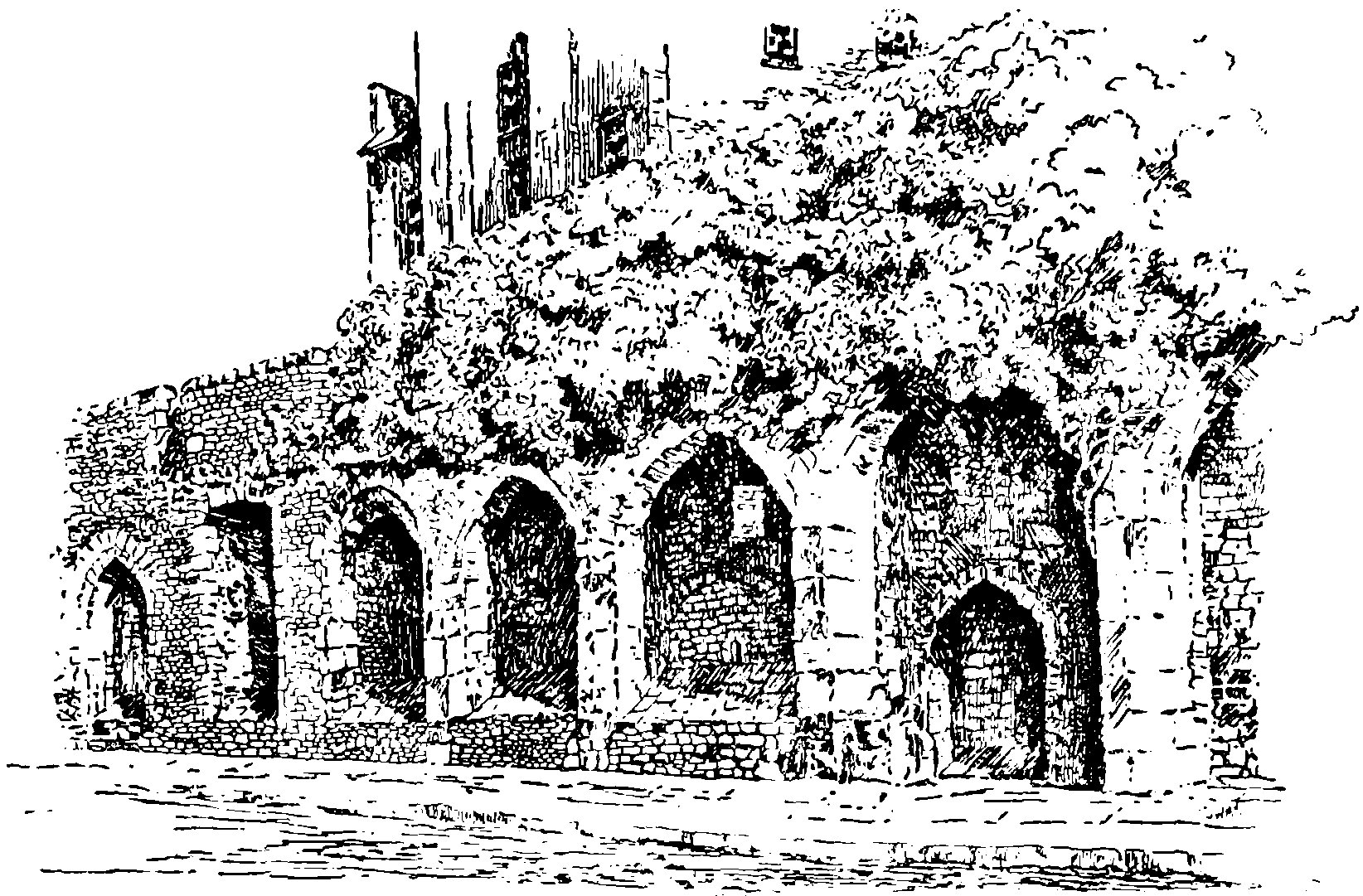
Town Walls, Western Shore, Southampton
A doorway to the north of the loop opened westward, but it had been carefully walled up with ashlar and no trace of it was to be seen till recently, when an archway with door admitting to the vault was inserted. Adjoining the water gate at the south, the wall exists in two stages, divided by a plain string, for about 32 ft. as far as the sixth and last buttress: and from the indication of a couple of round-headed windows above, and two narrow apertures below, it is evident that chambers existed behind. Outside this part of the wall was the castle quay of which frequent mention is made in the close rolls of John and Henry III; and the buildings may have served partly for stores and cellarage of the king's prisage wines, and may well have been those for the protection of which the quay was so frequently ordered to be kept in repair. From this point the castle wall turns nearly due east. Portions of this wall, of late twelfth-century date, have been recently disclosed by the removal of buildings. At about 110 ft. from the south-west angle, the wall crossed Castle Lane (south). Here was the south gate of the bailey, demolished about 1770. Beyond this the wall continued some 40 ft. till it struck the lofty mound of the keep round which it continued for about 400 ft., the mound's diameter being 200 ft.; it then ran north-east for about 60 ft., then north-west for another 85 ft., crossing at this point Castle Lane (north), where was the principal gate of the castle, destroyed also in the last century, though a fragment may still be seen on the north of the lane, at the judge's entrance to the county court. Beyond this the wall made a curve to the north-west till it struck the curtain as before described. A considerable length of the substructures of this bailey wall remains. The wall stood at a good elevation with a deep ditch at its foot, but towards the end of the eighteenth century the surface was very materially lowered, and the wall's foundations exposed to view. These, now denuded of earth, stand up as an arcade of fourteen or more perfect arches, some of them slightly pointed, on square piers, at a height of about 12 ft. above the present level: the span of the arches averaging 9 ft., and the piers about 7 ft. square. Some of the ashlars of the battlemented wall above this foundation may still be detected. (fn. 55) The area thus inclosed was surrounded by a ditch, and the changes of line in the town walls north and south of the bailey are no doubt an evidence of the positions of its north and south ends.
Of the buildings within the castle precincts there is but too scanty information. As soon as the Normans became possessors of the soil, their first step was probably to throw up the castle mound with material from the deep and wide double ditch drawn along two sides of the town—very probably an enlargement of a former ditch—placing on this mound a circular stockaded fort. (fn. 56) This must have been succeeded by a fort or keep of stone; for it is quite improbable that, while during the Norman period there is ample evidence of their stone work in the town walls and other buildings, wood should have been perpetuated here. This reconstruction may have occurred before we have any accounts.
The first mention of the castle is found in the articles of agreement (fn. 57) in 1153 between King Stephen and Prince Henry, settling the succession on the latter, when it was arranged that the bishop of Winchester (fn. 58) should give security for delivering the fort or castle (munitio) of Southampton, and the castle (castrum) of Winchester, to Prince Henry in the event of the king's death: like pledges being required of the keepers of the other royal fortresses.
The early Pipe Rolls from 1156 constantly refer to the castle, its repairs, its bridges, the bailey bridge, the chapel, the houses, the king's houses, king's chamber and cellar, the storage for his prisage wines, the gaol, the castle quay: and among these notices we get a few hints at construction, but they do not help us much.
In 1156 repairs at the castle cost £7. In 1157 works on the castle bridge £4 13s. 4d; on the chapel and bailey bridge £3 12s. 4d.; a parapet ('bretesce') for the bridge 10s.; further for bridge and chapel £1 11s. 3d. In 1161 Richard son of Turstin, sheriff of the shire, was charged with the payment of Milo of Hamton (£7 6s. 8d.) in fortifying (in munitione castelli). In 1162 the 'vicecomitissa' of Rouen (fn. 59) paid 14s. 4d. and Richard, the shire official, spent £16 on repairs at the castle. In 1172–3 works were going on there, and on the castle well, by writ of Richard de Lucy, justiciar, and under view of John the controller, Fortin, and Walter of Gloucester (£7 1s.). In 1173 and 1174 the castle was receiving and transmitting warlike apparatus and royal treasure, and it was garrisoned by five knights. In 1183 work on the gaol cost £24. In 1192–3, when William Briwer was governor, the sum of £40 15s. was spent on the castle, in the next year £68 3s., and in the following year £24 6s. It is stated that in 1286 the castle was in ruins, and dues were assigned for its restoration. (fn. 60) But there seems to be no detailed account till the rebuilding of the keep in 1378 and 1379 under Sir Richard Arundel the governor. This keep of the fourteenth century was a shell of masonry encircled by an embattled wall surmounting the escarpment. The patent of 1378 directed Henry Marmesfeld, John Pypering and Richard Baillyf (fn. 61) to cause the erection as quickly as possible of a certain tower on the 'old-castell-hill' (fn. 62) with two gates, a mantelet and barbican of stone, that is, an encircling wall about it with an outwork before the gate. The patent of the next year required the tower to have four turrets, three gates and three portcullises, a bridge also was to be constructed. Timber was to be procured from the New Forest, and material provided at the king's cost, necessary masons and workmen being taken from the neighbouring counties, and kept at work as long as needful at the king's wages. (fn. 63) In November 1378 John Polmont (or Polymond) and William Bacon, (fn. 64) two well-known burgesses who both for some years represented the borough in Parliament, were commissioned to carry out the works under the survey and control of John de Thorpe, king's clerk. (fn. 65) Bad work was to be punished by imprisonment. The keep must have been finished in 1380; as we find that year a grant of the custody of 'the gate of the king's new tower;' (fn. 66) and there can be little doubt it was brought into immediate use. (fn. 67) Next there is the survey of the mantlet and 'pavement' round the new tower under William Bacon the elder, (fn. 68) and control of Thorpe. (fn. 69)
The remaining works were hurried on especially under a lively apprehension of a French invasion. (fn. 70) The king's clerk, Thorpe, seems to have been generally superintendent; but in July 1386 occurs the appointment of Thomas Tredyngton, chaplain, to serve the king in his new tower, both in celebrating divine service for his good estate and keeping the armour, artillery, victual and guns therein for its garrisoning and defence, to do everything necessary for its safe custody, and to control all the king's works within the castle. His salary was to be £10 a year from the town's custom of wool; but being retained for this service expressly as an expert in guns and the management of artillery the appointment was not to be drawn into a precedent to burden the king with finding a chaplain therein who might not be so skilful in these matters. (fn. 71) Later in this year (November) John Polymond and William Bacon, burgesses, and William Hughlot one of the tellers of the Receipt, were directed to take the muster of men-at-arms and archers at the king's wages in the castle, reckon with them and certify accordingly to the Exchequer. (fn. 72) At this time the king's brother, Thomas earl of Kent, was keeper of the castle and town, Sir John Sondes, kt., being his deputy. (fn. 73)
The buildings as reconstructed at this time seem to have remained substantially the same till the castle's decline. (fn. 74)
A chapel, doubtless within the keep, had existed from the first, the chaplains, as we have seen, drawing their 'wages' with the other officials. This arrangement was succeeded or supplemented later by the chapel of St. George, which stood apparently towards the north-west of the bailey inclosure, since we find it occasionally mentioned in the beat of the town watch. (fn. 75) The chaplains were practically endowed, as stated above, from the time of Richard II; and being appointed by patent they are mostly known but cannot here be noticed. Their duties became those of chantry priest to celebrate for the good estate of the king and the souls of his progenitors: but the commissioners of the sixteenth century could not discover the origin of this foundation and contented themselves with the return of the salary as £10 in ready money from the king's customs in the town. (fn. 76) In 1553 the then incumbent received a pension of £6.
Leland in 1546 tells us 'The Glorie of the castelle is in the dungeon (keep) that is both large, fair and very stronge, both by worke and the site of it.' (fn. 77) Queen Elizabeth dates from the castle in 1569. Speed, writing at the end of the same century, describes it as 'most beautiful, in forme circular, and wall within wall, the foundation upon a hill so topped that it cannot be ascended but by stairs. (fn. 78)
Hortensio Spinola in his report on the southern ports in 1599 speaks of the castle as being strong with sixty pieces of artillery and 100 soldiers. (fn. 79) However, in spite of these accounts, it appears that some dismantling of the bailey had occurred as early as the end of the fifteenth century. In 1550 the 'castle green' had fallen into utter neglect; in 1591 it had been let to the butchers for some years by Captain Parkinson, the governor, and the court leet presented that the sheep had spoiled the hill—i.e. of the keep—'most ruinously: and they begged no more sheep or cattle might be allowed there; moreover the windows and gates of the castle tower lie open to all the inhabitants, whereof they desire reformation.' (fn. 80) The condition of the building became more and more deplorable and in July, 1618, the ruined castle, its site and ditches, passed by a grant of James I, for £2,078 to Sir James Ouchterlony and Richard Garnard, (fn. 81) citizen and clothworker of London, who in the next month (10 August) consigned their interest to William Osey, (fn. 82) of Basingstoke, who in his turn made it over to George Gollop of Southampton, merchant, in July 1619. In 1636 George Gollop obtained the royal grant (fn. 83) of the castle and its ditches at the yearly rent of 13s. 4d. In the next year we find him plaintiff against several who had already converted the ditches into gardens. (fn. 84) The property remained in the Gollop family for some few years. In 1650 Peter Gollop was in possession, and 11 October that year he gave permission to Major Peter Murford (of whom later), commandant of the town, to take such stone from the castle as he might think needful for the fortifications. (fn. 85)
In later times the site became encroached upon by houses and gardens. In the last quarter of the eighteenth century a windmill made out of the old tower had given place to a summer house. In 1804 the castle hill was purchased from Mr. Watson by Lord Wycombe, afterwards marquis of Lansdowne, who by degrees created an extensive castellated mansion of brick and stucco upon it, which appears to have contained some slight remnant of the old fortress. He died in 1809, and in July 1816 the property was put up for sale for building material together with the freehold site of the castle, having a river frontage of 377 ft. (fn. 86) The mansion was taken down in 1818 and the mound lowered; (fn. 87) and in 1824 Zion Chapel, converted since to several uses, and in 1904 made a store for chemicals, &c., was erected on the site of the Norman keep.
To return now to the town walls. From the south-west angle of the castle bailey, the wall on a lower level and fragmentary in condition ran south-west at an angle of about eighteen degrees to a small tower which headed the salient at about 100 ft. distance from the bailey. It then ran southward for about 80 ft. and re-entered sharply to the east so as to cover Biddles' Gate, set some 50 ft. back. All this was removed in 1898 and 1899 under a scheme of improvement by the corporation, a clearance being made of all the houses and courts in the vicinity for a considerable extent, including a large part of Simnel Street. Happily the interesting fourteenth-century vaulted room (34 by 22) which was beneath a house on the north side of that street has been preserved.
Immediately below the site of Biddles' Gate the defences for a distance of 260 ft. are composed of the walls, some 4 ft. thick and 30 ft high, of Norman buildings of a domestic and mercantile character, which can never have been very suitable for defences, and have in consequence been strengthened on the outside by a series of nineteen arches, probably of fourteenth-century date, and of sufficient depth to provide a rampart walk defended by a battlemented wall along their entire length, and connecting with a similar walk on the north and south.
Between the arches and the wall behind a chase is left at intervals something like the groove for a portcullis, but in this case much wider, forming a series of machicolations. This arcade appears to have been strengthened by three towers; one by Biddles' Gate, the second in front of the fourth arch, and the third beyond the ninth arch.
The first of these was no doubt 'Pilgrims' Pit' tower, (fn. 88) close to Biddles' Gate, deriving its name, as did the gate itself sometimes, with a garden and its surroundings, from the Pilgrims' Pit, perhaps some well connected with the pilgrimages (fn. 89) to the tomb of St. Thomas of Canterbury.
The buildings to the rear of this part of the wall have been removed by the corporation, who have erected on the north of what was Blue Anchor Lane a large lodging-house for single men, immediately to the north of which a twelfth-century well was discovered and still exists. The corporation has also erected a considerable building let out in flats, the clearance of the site having involved the destruction of the remains of a small Norman house on the north of Blue Anchor Lane, close to the postern, some ancient substructures only having been preserved. This postern, called for many years Blue Anchor, but formerly Lord's Lane Gate, and more anciently simply Postern, has been much pared away in former times to obtain width, but the groove of its portcullis remains in the head of the arch.
Immediately to the south of the postern and behind the last three bays of the arcade is the twelfth-century house called locally 'King John's Palace.' It is in two stages, and measures on the south side 44 ft., on the east 41 ft., on the west along the town wall, of which it forms a portion, 35 ft., and on the north, along Blue Anchor Lane 43 ft. On the first floor is a large room with an original fireplace and chimney, and five original windows, one a mere loop and four of two lights each, all in the west or outer wall excepting one two-light window on the north facing the lane and the site of the destroyed Norman house opposite. On the same floor a wall passage started at the middle of the east side and led round through the south side to the town wall. This passage, or what remains of it, is now hidden by a lean-to roof constructed within the eastern half of the house. The ground-floor has two Norman doorways; one in the lane, the other in the archway next to the postern. (fn. 90)
From this point all the houses which were in front of the walls have been removed as far as the southern entrance of Cuckoo Lane—some 800 ft., two insertions flush with the walls alone remaining; the former of these a small tenement immediately south of the Norman house, the latter the Royal Standard Inn adjoining the north side of West Gate. A little further to the north, just beyond the entrance to what was Collis's Court, the picturesque fragment of a tower is seen, three sides of an octagon, the front carried upon a broad rectangular buttress having its hollow angle crossed by a squinch supporting the side above and pierced in the usual way for a garderobe.
West Gate, 'West-hethe-zate' as it is called in 1441, is a plain rectangular work flush with the outer face of the walls 23 ft. broad and 30 ft. deep. It is in three stages, the lowest being pierced by a roadway 10 ft. broad covered by a low-pointed vault. The entrance was formerly defended by a heavy door and two portcullises; there are also traces of other defences and modes of worrying a foe. The tower is embattled and capped by a tiled roof.
From West Gate the wall stretches for about 250 ft. with a south-westerly inclination to the site of Bugle Tower, so called from the ancient Bull or Bugle Hall which stood above it on the east.
In the rear of this wall, and only divided from West Gate by a stairway to the rampart walk on the walls, is a fifteenth-century timber building on a stone basement, built against the town wall, but leaving space for the rampart walk. It is now called the 'guard room.'Its length is about 60 ft.; its width, exclusive of the rampart walk, about 20 ft. It is now covered with weather-boarding externally, but preserves much of the wattle-and-daub filling between its original timbers. It has an open timber roof with cambered tie-beams and arched windbraces.
To the south of the 'guard room' the wall projects westward some 9 ft. and continues southward for about 50 ft., and is then succeeded by a bastion 40 ft. broad, behind which are remains of masonry, showing that the rampart walk was here carried on arches. From this bastion the wall—which has been much rebuilt here in consequence of the breach made in it by the early eighteenth-century house of the Maretts (the late Madame Maes), pulled down in 1898—continues for nearly 70 ft. to the vestiges of what was Bugle Tower; this stretch having been occupied by an arcade of five arches, two of which, next to the Bugle Tower, still remain. At this point the ancient shore or quay, which commenced at the sharp re-entering angle of the town wall outside Biddles' Gate, seems to have ended.
From the vestiges of Bugle Tower the wall, now exposed, exists in ruins or is to be traced south-east by east for 300 ft., as far as the remains of what appears to be called in the town books 'Square Tower' or 'Corner Tower,' at the entrance to Cuckoo Lane adjoining the Royal Southern Yacht Club-house. Behind this wall and just south of Bugle Tower was the Spanish prisoners' burial ground of the eighteenth century, close to the garden of the adjacent Roman Catholic nunnery.
A little short of 'Square Tower' were to be seen till the recent clearances the arms of the town under a Tudor moulding, together with some huge gun stones worked into a piece of rebuilding, in memory, as was supposed, of the direful French invasion of the fourteenth century, the foe having landed in this quarter, which was formerly called the 'Gravel.'
From 'Square Tower' the wall passed the ends of Bugle Street and French Street, joining the Water Gate which crossed the High or English Street. This line of walling was taken down in 1803, but a portion of it appears in front of Canute Hotel near where it joined the Water Gate.
In its convex sweep of 600 ft. from Square or Corner Tower, in which were included two towers, St. Barbara's and Woolbridge, the wall passed some notable buildings. Just behind the wall, commencing at the mouth of Bugle Street and passing that of French Street, ran Porter's Lane, at one time called le Cheyne, and sometimes Wool Street, from wool stores existing there. At its ancient mouth at the south-east corner of Bugle Street stands a stone building about 80 ft. by 40 ft., with heavy cylindrical buttresses along the west wall, called the 'wey-hous' and 'wolhous' in the fourteenth century. (fn. 91) It appears to be of early fourteenth-century date, and was used in the latter part of the eighteenth century as the 'Spanish prison,' hence its more recent name. Its south front, towards the harbour, has been nearly rebuilt at a late date. Adjoining this building on the east and all along the south quay are traces of handsome stores of considerable importance. In Porter's Lane are the remains of a twelfth-century house called since the beginning of last century 'Canute's Palace.' It is in two stories, and had originally a frontage of 111 ft., with a central doorway and two windows on the first floor.
Water Gate crossed the High Street a few feet to the rear of the machicolations still to be observed on the front of Castle Hotel, and slightly to the north of the present entrance to Winkle Street. It was a deep and wide structure with a low pointed arch and the usual defences to its opening. Above was a boldly projecting parapet with seven machicolations; all the windows on the second stage faced the town. This gate was probably not erected much before the reign of Richard II. It is referred to in a patent of his first year, but is still called new in his twentieth. (fn. 92) On its west side the gate was recessed and protected by the rounded curtain or flanking tower, the machicolations of which exist, while on the east its approach was completely covered, as was also much of the quay outside, by the town wall, which here struck out boldly to sea as a salient, south-east by south for about 110 ft., to a lofty round tower—Watch Tower—on the sea line. This is now marked by the bow window of the Sun Hotel, which stands on its basement.
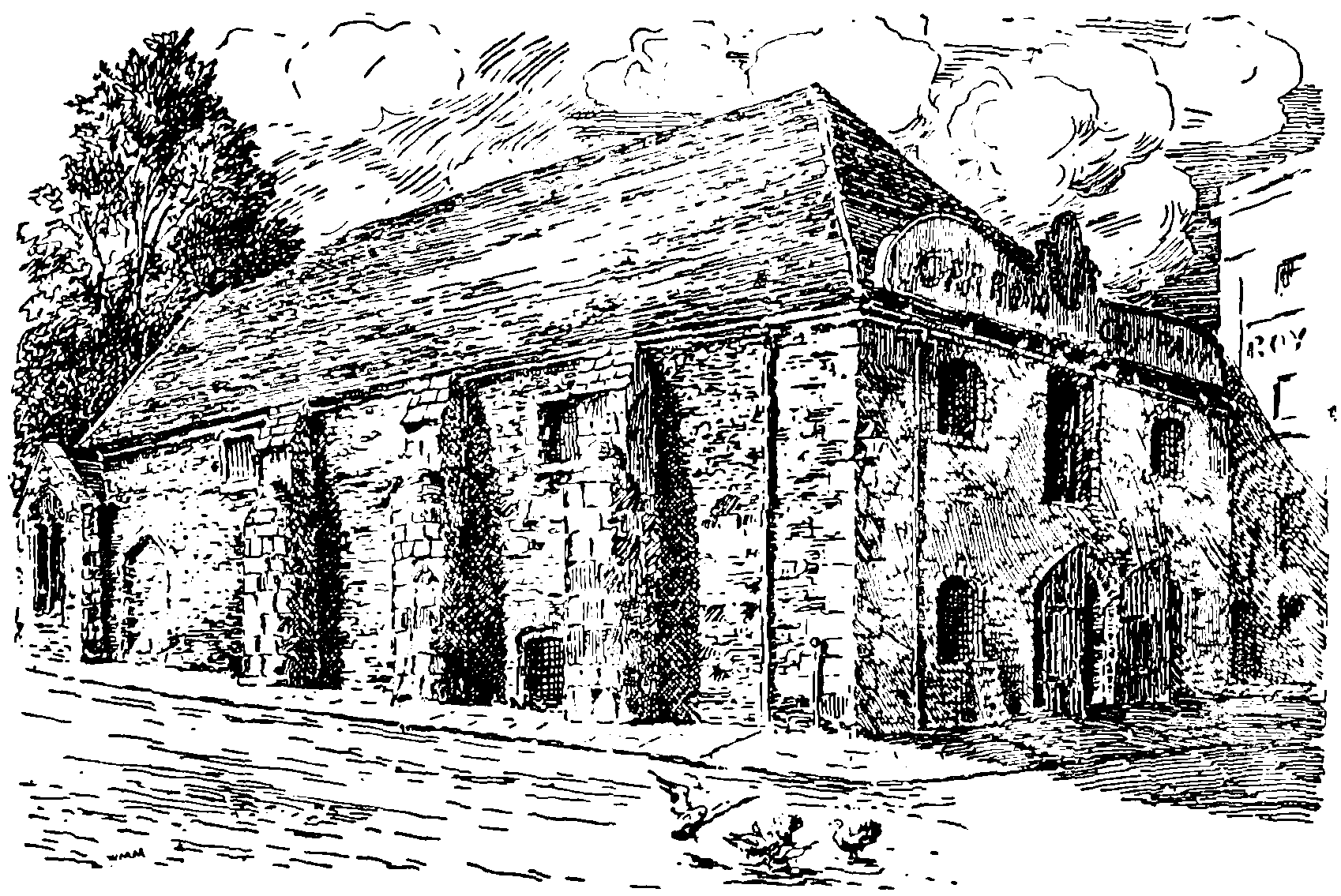
The Wool House, Southampton
Inside the wall was Winkle Street, entered by a narrow passage to the east of the gate either through the archway of the ancient custom house or that of a house adjoining, the lessee (fn. 93) of which obtained permission (1439) to construct solars above, provided he left a highway (via regalis) 13ft. broad with a headway of at least 16 ft. to admit of the passing of carts and men-at-arms and their serving-men with lances and arms. The 'kynges custom hows' (fn. 94) was 'by ye water gate,' and 'j gret gonne upon wheles' stood before it. The present entrance to Winkle Street was due to a breach in the town wall made towards the end of the eighteenth century to facilitate business on the quay. Finally in 1804 the gate and ancient buildings flanking it were removed.
From Watch Tower below Water Gate the wall, some vestiges of which remain, passed eastward with a southerly inclination for about 250 ft., when it touched the south flanking of God's House Gate. This portion of the wall did not exist at the end of the thirteenth century, as we have proof that the south side of the quadrangle of God's House (see below) was exposed to the sea.
God's House Gatehouse is a plain oblong structure of two stories, 23 ft. deep and 30 ft. broad, its south end projecting with an obtuse angle beyond the line of the town wall. A lofty vaulted roadway, 10 ft. wide, piercing its north end leads into Winkle Street; and no other ancient opening occurred in the basement, which was used as a dungeon. The somewhat awkward position of this gateway passage was governed by the abutment of the town wall; it may also be noticed that the gatehouse was in existence some 100 years before the erection of the adjacent gallery and tower, which have in effect thrust the old entrance into a corner. These latter buildings belong to the close of the fourteenth or beginning of the fifteenth century, their object being not only an increase of the accommodation, but the securing an extensive flank defence for the gate and the protection of the sluices of the ditch over which the tower was constructed.
This work projects about 85 ft. The two-story gallery connecting the gate with the tower is about 55 ft. in height by 30 ft. in breadth. The lower story had no opening on the south or outside, and was originally covered with a vaulted roof. The tower is in three stages crowned by a battlement with only one wide-splayed embrasure on each side adapted for fire-artillery.
Since 1775 it had been used as the town gaol, the Bridewell having been settled over the gateway since 1707. The felons' gaol was within the gallery, the debtors' prison in the tower. In 1835 the whole condition was very bad. (fn. 95) The buildings themselves had become misused, injured, and dilapidated: but when their use for prison purposes had been abandoned in 1855, and when again in 1875 the gatehouse and gallery were needed for storage accommodation, a careful repair of the whole surface was carried out, and a curious garderobe was discovered at the north-west angle of the second floor, carefully blocked by clear masonry at least 2 ft. thick. (fn. 96) Close by the tower was the 'Millhouse,' which was probably the gallery adjoining. In 1468 labourers were paid to 'sette owte the gonnes' there. Among its several guns in store was one called 'Thomas with the beard'—'the whiche seyd gonne called Thomas wt ye Berd new bowned and pencylled, as in yis sam bok shewt, wt ij holle chawmbers to ye sam, wt viij gonne stones and viij tampons to ye same were delyvered by Master Andrew James, leftenaunte, ye xxx day of May, Ano. viij R. E. iiij, to my lord Scales by endenture as y onderstond.' In connexion with these buildings frequent mention is made of the 'Longhouse before God's house,' which was no doubt the early fifteenth-century building the remains of which we see in that position with the town wall behind it.
From the north-west corner of the spur-work just described the wall runs 160 ft. to a half-round tower, 23 ft. in diameter. This tower in 1468 carried two guns. Ninety feet farther on are the remains of a small rectangular tower, 22 ft. broad, which at the same date was furnished with two guns with chambers. At another 90 ft. was a second square tower, 30 ft. broad, which had two guns and six chambers. The wall is traceable most of the way, but nothing remains of the other towers as far as East Gate. In this line from God's House Tower to East Gate there were altogether eight towers, two rectangular and six drums or halfdrums; though the muster book of 1544 enumerates only seven, possibly omitting one as too small for special defence.
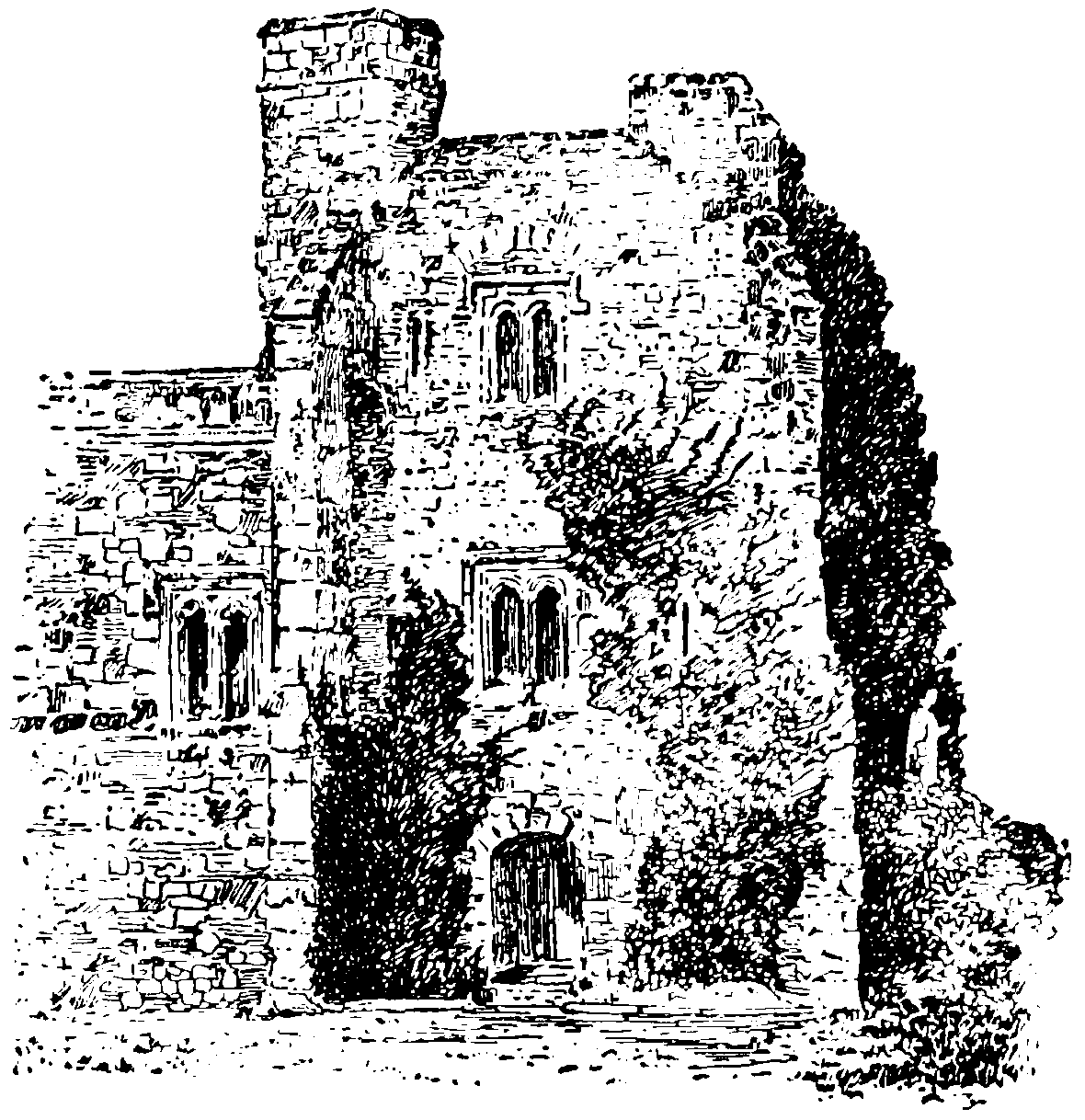
God's House Tower, Southampton
East Gate was a heavy structure with bold side towers and a front thrown well forward beyond its flankings. There was a chapel above the gate dedicated to St. Mary to which Agnes le Horder (fn. 97) left a bequest in 1348. In 1641 we find this same chapel leased out with a tenement and garden close by. It had been for many years used as a warehouse. (fn. 98) Between East Gate and St. Denys Tower some 145 ft. from the gate was a small tower.
St. Denys or Polymond Tower at the north-east angle of the town, a drum 28 ft. in diameter and in three stages, mostly demolished in 1828–9, still presents some considerable remains. In 1468 it was furnished with a gun and eight chambers. Subsequently heavy ordnance was provided for it. In 1654 there was a great gun on its top, the carriage of which was found to be rotten, as likewise the whole staging was in danger of sudden collapse; and another great gun 'on the rampier by the said tower' was half buried in the ground.
Turning westward towards Bargate much of the wall remains behind the houses; there are also remnants of two half-round towers, the former with a diameter of 16 ft. at a distance of 160 ft. from St. Denys Tower; the latter about 120 ft. farther with a diameter of 22 ft. Another distance of 120 ft. brings us to Bargate.
Such is, as slightly as possible, the history of the walls and towers; it may be of interest to show how the various towers were to be defended and to whom they were appointed, at least in 1544, by order of the mayor and his brethren. (fn. 99)
Arundel Tower and the little tower towards Bargate were assigned to the shoemakers, curriers, cobblers, and saddlers. Bargate Tower with the next to the east were to be held by the town. The next small tower and Polymond's were assigned to two burgesses, William Knight and John Capleyn. The next little tower towards East Gate and the gate itself were entrusted to the goldsmiths, blacksmiths, lockiers, pewterers, and tinkers. Next came the seven towers enumerated from East Gate to God's House Tower. The first five were known by the names of those opposite whose gardens they stood, the sixth was over against the friars; the seventh next to God's House Tower; for the keeping of these no appointment had as yet been made. God's House Tower, the Watch Tower, and Water Gate Tower were kept by the town. The tower by the wool-house was given to the mercers and grocers; St. Barbara's and 'Corner' or Square Tower, 'next to Beaulieu selde,' were assigned to the brewers and bakers. That behind Bull Hall was given to the coopers; West Gate to Mr. Baker; the Tower behind Thomas Marsh's house to the vintners, mariners, and lightermen; that against Mr. Huttoft's to the weavers, fullers and cappers, and the tower next Biddles Gate to the butchers, fishers, and chandlers. The last three were evidently the towers in front of the arcade (see above). It will be noticed that Catchcold (fn. 100) Tower on the north and the destroyed salient to the south of the castle area are not included in the enumeration.
The town is stated by Leland (1546) to have been double ditched, (fn. 101) and Speed's map (1596) shows the same, excepting that by his time the portion to the west of the Bargate had been filled in and also as far as the first tower on the east. There were archery butts, approached from the north, on the bank along the middle of the ditch, which were frequently the subject of presentment, as also were those on the Castle Green. They were constantly out of order, and men were said to be obliged to shoot in Houndswell or the Salt marsh in consequence. The ranges can hardly have been satisfactory, but there is no doubt they were there. (fn. 102) The counterscarp of the moat on the north side was apparently at what is now the south side of Hanover Buildings, that is at a distance of about 120 ft.
On the west and south sides of the walls, when the tide did not wash their footings, were the shores and quays.
The Platform, outside God's House Gate, (fn. 103) dates in a very incipient stage from the end of the thirteenth century. Subsequently it was adapted for fire-artillery. In 1457, (fn. 104) under the apprehension of invasion—it was the year when Sandwich was burnt—there was some activity along the shore-line between God's House Gate and Itchen Cross (Cross-house), where in the eighteenth century, in Southampton's fashionable days, was a lovely and far-famed drive with its row of elm trees, some of which remain.
With 'Castle Quay' we have already dealt, as also with the shore from Biddles Gate to Bugle Tower. But what was specifically the 'West Quay,' the centre of life and trade in mediaeval Southampton, was in front of West Gate. A quayage in the usual form was granted in aid of the repairs to this quay for one year in 1323 (17 Edward II); two years later, 1326 (19 Edward III), in consideration of the labour of the burgesses on the quay and inclosure of the town by royal mandate, a similar grant was made for seven years. In the following year, 1327 (1 Edward III), what was really a confirmation of the previous quayage for six years was obtained. (fn. 105) Further, in connexion with these works on the quay the burgesses had constructed a barbican of wood, and were now proposing to build it in stone for the better security against hostile invasion: in consequence of this they obtained in 1336 (10 Edward II) a grant of a penny in the pound on all merchandise for five years, and on the expiration of this term in 1341 secured a renewal for a similar period. (fn. 106) But the jealousy of neighbours had eyed the concessions with alarm, and in 1339 a controversy with the men of Winchester about the payment of this barbican duty was settled by a release to them from this impost for five years. (fn. 107) West Quay was sometimes called 'Galley Quay' in the eleventh century. In the middle of the eighteenth it served for the Channel Islands trade, which was considerable, the Guernsey and Jersey vessels always anchoring off it.
Judging from documents of 1411, it would seem that South or Water Gate Quay was then of recent construction, and had not been carried out without opposition from the merchants of Winchester and New Sarum. (fn. 108) A patent of that year sets forth that the burgesses, with the assistance of Thomas Mydlington, one of their number, had constructed at great cost a certain bank called a 'wharf' with a crane upon it, at 'la Watergate,' in aid of the fortification and merchandise of the place, and for receiving custom; and that they had incurred the wrath of many who had been accustomed to evade or purloin the dues: the king therefore desired the work might be maintained henceforth, and authorized such tolls from all parties using the wharf or crane as were levied in London or other ports where such accommodation (ripa et crana) existed. (fn. 109) The growth of the quay can be traced from the town books.
Leland and Speed in the sixteenth century speak of the two quays as large, fair, and stately. In the time of Charles II their dimensions are thus given officially: (fn. 110) Water Gate Quay was 223 ft. in length, with a breadth at the gate and wall of 190 ft., and at the head of the quay 63 ft. It had three pairs of stone stairs, one at the head and two on the east side. West Quay was 225 ft. in projection, its width by the gate and wall 58 ft., and at the end 37 ft. Water Gate Quay was therefore by this time the more important structure.
The development of these quays, no longer of offence or defence, belongs to comparatively recent times, and its result must be given later. We now turn to the history of the borough.
Southampton was in all probability the home of Saxon invaders of the late fifth and early sixth century, the first of whom were Cerdic and Cynric his son in 495. (fn. 111) As soon as the raiders began to have a hold on the land the site of the later town undoubtedly became a basis from which new conquests were made, securing as it did a hold on the river and a key to the upper country. (fn. 112) Although the town does not appear by name until the ninth century, it was of importance at an earlier date than Winchester, since it gave its name to the shire as early as the eighth century, when in 755 Sigebryht remained under-king of Hamtunscire, though deprived of the rest of the kingdom by Cynewulf and the West Saxon Witan. (fn. 113)
The earliest remarkable mention of Southampton by name is as the landing-place of the Danes in 837 and again in 860. (fn. 114) The next notice is of more peaceful character. In the year of Athelstan's accession, 925, the town is mentioned as having two mints among burhs which had a mint or mints assigned to them in the constitutions of the synod of Greatley, which gave the earliest English laws about coinage. The mints were appointed as follows: At Canterbury, seven minters or coiners, four for the king, two for the bishop, and one for the abbot; at Rochester, three, two for the bishop, and one for the abbot; London, eight; Winchester, six; Lewes, two; Hampton, two; Wareham, Exeter, Shaftesbury, each two; Hastings and Chichester, each one; and 'other burhs' one. (fn. 115) This list affords some notion of the relative position taken by the town at this time. The name of Southampton occurs on coinage from the reign of Eadmund in 940 to that of Stephen, under the forms of H., Ha., Ham., Amtd., Han., Hamt., Hantv., Hamtun, after which period it occurs no more. (fn. 116)
In 980 and 981 the town was ravaged by the Danes, (fn. 117) and in 994 was made the head quarters of the Danish and Norwegian forces under Sweyn and Olaf. Canute was at Southampton in 1016, (fn. 118) and tradition has placed here the well-known story of his rebuke to his courtiers. (fn. 119) At least there is little doubt but that the town revived under his strong rule. On the death of Canute, Edward (afterwards the Confessor), the son of Ethelred by Emma, hastened over from Barfleur to Southampton with forty ships as a competitor for the crown; and in his disappointment is said to have returned whence he came not without plunder. (fn. 120) After this there is little to record of Southampton for many years. (fn. 121)
There can be little doubt that the Norman Conquest brought prosperity and enlargement to Southampton. At the time of the Domesday Survey (fn. 122) the king had in the borough seventy-six men in demesne who paid their tax as under the Confessor; these were no doubt the original burgesses, the resident burgage holders fulfilling their duties in scot and lot, taxation and service, probably supplemented by the ninety-six French and English mentioned below, whose location in the town became known as French Street. Besides these were eight who held land or houses free of claims by grant of King Edward, and who, no doubt, so continued to hold with certain specified exceptions. Thus Cheping, a wealthy holder of old days, formerly had three houses free, which were now held by Ralph de Mortimer, a relative of King William on the mother's side, and one of his commanders; and Godwin, another ousted proprietor, formerly had four houses in which he had been succeeded by Bernard Pancevolt. Three of these houses are referred to in the entry about Chilworth, (fn. 123) where they are called 'hayes in Hantune,' showing that there was inclosed ground around them. There were also sixty-five French and thirty-one English born settled here by King William. And a list is given of certain who received the custom of their houses by grant of King William. They were mostly great landowners, and the houses they held, (fn. 124) forty-eight in all, were presumably inhabited by the burgesses, the resident trading population, who subsequently obtained supreme authority and government in the towns owing to their enrolment in strong trading gilds, and who when they had purchased the ferm of their towns passed in due time by an almost natural process into the more modern 'corporations.'
None but the most general inference can be drawn from the Domesday entry as to the size and population of Southampton. Besides the forty-eight there were many houses, if such they might be called, of the poorer classes of which no account could be taken, whose occupiers enjoyed few or no privileges. Still, though the borough may compare disadvantageously with some others, there can be no doubt that it had started on its upward growth. Amid much decay of town life at this period Southampton, in common with the other few ports leading to the Continent, showed distinct signs of prosperity. The growing importance of the place may be seen in the number of powerful barons and other wealthy folk who possessed houses or lands within its limits.
After Domesday the earliest notices of the town and its life occur in connexion with the payment and administration of its fee-farm.
The Pipe Rolls are the most valuable authority. From the earliest extant of these which touches Southampton the town was being farmed in 1156 by Roger the son of Folcher, whose account for the third part of a year stood thus:—In the treasury, £25 2s.; payment to the chaplain of the castle for the last year, £1 3s. 4d., and for the present year by writ, 9s. 8d.; fixed payments to the porter and watchmen, 19s. 4d.; to John the controller, (fn. 125) 19s. 4d.; transport service by king's writ, £2 7s. 6d.; balance of king's farm for third part of the year, £68 8s. 10d. (fn. 126) In the next account, that of William Trentegeruns, sheriff, (fn. 127) fixed tenths amounting to £18—a payment of much earlier origin—were assigned to the monks of Lire and Cormeilles, who already had houses in the town free of dues; and an annual assignment of 13s. 4d. was made in favour of the Templars, who had only been introduced into England in Stephen's reign. The usual payments go on to the chaplain, porter, and watchmen of the castle; for transport of the king's treasure, cages for his hawks, &c., in transport service of the king and queen; for the queen's board when she came from Normandy (about February, 1157), and for the king's when he came from Barfleur a couple of months later. The next account of the same sheriff gives a settlement during life of 3s. land tax on Wimarch, (fn. 128) the mother of Nicholas; payment for the king's board at Brockenhurst, £16—he had evidently been enjoying himself in the New Forest; payment for catching and carrying the king's deer, for carriage of his wines and various transports by his writ. (fn. 129)
For the next five years the 'vicecomitissa' of Rouen rendered account for the farm. In 1160 the queen's last passage cost £16 12s. 6d., and a good deal of wine was bought for her, £3 1s. 1d. (fn. 130) In 1163 the 'vicecomitissa' paid £8 15s. for the transport of the king's cows, and 10s. 9d. for their keep while here; for wounded clerks, 12d.; and for conducting the king's daughter, 6s. 4d. (fn. 131) For the next five years three burgesses accounted for the farm—Roger son of Milo, Fortin, and Robert of St. Lawrence (fn. 132) —but towards the end of their time they protested vigorously that they did not hold the town at farm. In their second year (1165) the 'vicecomitissa' rendered her final account for the old farm (£1,423 9s. 2d.), and nothing further was to be required of her. (fn. 133) In 1166 there is payment for the 'esnecca' in which the king crossed in Lent, £7 10s.; the same sum is paid by writ for the passage of the king of Scotland, while the Lord Geoffrey, the king's son, requiring two ships, besides the 'esnecca,' drew on the farm for £10. (fn. 134) For the last quarter of 1167 Richard of Limesey took up the farm. (fn. 135) At this period a change occurs. When the fee-farm first appears under Henry II it is the enormous sum of £300 'blanch,' a sum only equalled by that which London had paid, and twice as large as was paid by Winchester. But for whatever reason, from 1167 the farm seems to have become settled on a basis of £200 'blanch,' which continued so till the purchase of the farm by the town, to be mentioned presently. In 1168 an aid of £29 13s. 4d. for the marriage of the king's daughter was charged to the burgesses, (fn. 136) and in 1171 and 1172 they owed £2 13s. 4d. for arrears thereof. (fn. 137) In 1173 Robert of St. Lawrence (fn. 138) claims allowance for land in the town itself, given to the lepers (fn. 139) of Southampton, worth £1 3s. 2d. per annum, by writ of the king, (fn. 140) and in 1174 for land at Portswood worth 7s. 2d., given to the canons of St. Denys. (fn. 141)
A memorable royal visit occurred on 8 July 1174, when King Henry landed from Barfleur to perform his vow as pilgrim to the city already famous for reported miracles at Becket's shrine. (fn. 142) On Good Friday, 1176, the two princes, Richard—afterwards king—and Geoffrey, were here on their way to join the king at Winchester; and the same year the king's daughter, the Princess Joan, sailed for Sicily in the 'esnecca' (£7 10s.) with seven ships in consort (£10 12s.), to be married to the king of Sicily. Henry II was here apparently for the last time in April, 1186. He died 6 July, 1189. Before the coronation of the new king on 3 September that year the port was alive with the transit of great folk and preparations of various kinds; and Geoffrey the son of Azo, who rendered account for the shire, was charged, among other things, with £6 1s. for repairs to the houses within 'the tower' of Southampton, probably those generally called 'the king's houses,' as if for the accommodation of the court and its supplies.
The return of Gervase, reeve (prepositus) of Southampton, shows that the royal 'esnecca' made six passages before the coming of King Richard, the charge being £45. (fn. 143)
William Briwer accounted for £106 13s. 8d. of the town farm in 1192–3, and in 1198–9 the sheriff of the shire accounted for the same amount. (fn. 144) It appears that Hugh de Bosco, the sheriff, had offered King John 20 marks to hold the town to farm till Michaelmas next after the coronation; upon which it had been intimated to William Briwer that if he wished to retain the town so long he must pay the 20 marks offered by Hugh. This he evidently declined, as Hugh was charged the 20 marks and held the office. (fn. 145)
The beginning of the thirteenth century—always a period of advance in borough history—was the time when the town, possibly through the agency of its gild merchant (see below) purchased its fee-farm, obtaining it (1199–1200), together with that of the port of Portsmouth and all that belonged to the farm of Southampton, in the time of King Henry, for the fine of £100, and the annual rent of £200, payable at the Exchequer each Michaelmas Day. (fn. 146) Thus in 1204 the burgesses rendered account by the hand of Azo, who was perhaps alderman of the gild and whose son in all probability was mayor a few years later, for the £200 farm of Southampton with Portsmouth. In 1208 they did the same. In 1210 they rendered account for two years together (£400), claiming abatement each year for land at Portswood and Kingsland given by King Richard (8 September, 1189) to the canons of St. Denys; but they appear to have been charged to King John 40 marks (£26 13s. 4d.) and two tuns of wine of Aucerra. (fn. 147) In 1216 Richard of Leicester answered for the town's farm; he had been, in and before 1199, controller of the town as his ancestors before him, but had in that year been ousted from office by Robert Hardwin, who had fined for it with the king. (fn. 148) In these troublous times the burgesses and their officials must often have been perplexed as to who should be their masters. On 27 October, 1217, the sheriff (shire) was directed to cause the king's uncle, William Longespee, earl of Salisbury, who had returned to his allegiance and obtained restitution of his estates several months before, to have in peace the town of Southampton; (fn. 149) on 29 November the same year a writ to the earl required him to remove his bailiffs, the town being taken into the king's hands; this is repeated to the bailiffs of the town by writ of the same date, who are required to account for the farm as usual at the Exchequer. At this period the town, or city as it is called, is stated to be entirely in the king's demesne, and settlements were held there directly of the crown. (fn. 150) A little later (6 October, 1226) the burgesses received in aid of their farm the customs of salt at Pennington, which Henry of Pont Audemer held, but which belonged to their town. (fn. 151)
In 1276 the farm was raised. The town, which had been seized into the king's hands by judgement of Exchequer for certain transgressions of the burgesses, was only restored upon a fine at the usual farm with an increment of forty marks (£26 13s. 4d.), (fn. 152) a circumstance referred to in 1531, up to which date the increment remained. (fn. 153) Apparent occasional exceptions to this amount till that date are generally capable of explanation. Releases sometimes came on special grounds, e.g. the cost of maintaining the fortifications (see below), or on woful representations of the town's financial straits. Thus Edward IV and Richard III at the commencement of their reigns remitted arrears of the fee-farm, among other matters, in general pardons to the mayor and burgesses. (fn. 154) In the early years of the next century the borough seems to have been systematically two or three years behind in its payment.
Before finishing the account of the farm some notice of the charges on it may be of interest. The practice of drawing on it by writ continued; soldiers and archers had to be paid, the king's chambers had to be repaired, wine orders to be executed, presents to be made. Alms and settlements on religious houses continued; the college of St. Mary and All Saints, Fotheringhay, founded by Henry IV in 1411, succeeded in due time to the assignment to Lire; and Shene Priory, commenced by Henry V in 1414, obtained that formerly given to Cormeilles. (fn. 155)
Again, the queens of England often obtained the fee-farm in part dowry. In 1286 Eleanor, the king's consort, had an interest in the customs of the town (30 March), and in the same year (23 June) Eleanor, the king's mother and widow of Henry III, obtained the farm for life together with the prise of wine. (fn. 156) She died in 1291, and in 1299 (10 September) the king endowed his second wife, Margaret of France, at the church door, with the farm which was to yield her £201 3s. 2d.; he also gave her a long list of manors, castles, and towns, among which was the castle of Southampton. (fn. 157) In 1331 when Queen Isabel was deprived of her possessions the fee-farm was granted, with the assent of Parliament, to Queen Philippa, (fn. 158) but in 1340 was again in possession of Isabel, who dated her rights back from the burning of the town (October, 1338). (fn. 159) She was afterwards dispossessed and died in August, 1358. Joan of Navarre, queen of Henry IV, had a jointure of 150 marks on the farm in 1400. (fn. 160) She died in 1437. Margaret of Anjou was endowed (May, 1444) out of the customs of Southampton (£1,000), and in 1454 obtained an annuity of £100 from the fee-farm. (fn. 161) Elizabeth, queen of Edward IV, received £46 per annum from the farm (1467), (fn. 162) and three years later the mayor had to borrow £7 to make up the allowance, (fn. 163) for the town always made an effort to pay the queens with some kind of regularity, even when lapsing into a chronic state of arrears. In the reign of Henry VIII similar payments were made, and in 1605 James I made the same settlement on his queen. (fn. 164)

Provence. Or four pales gules.
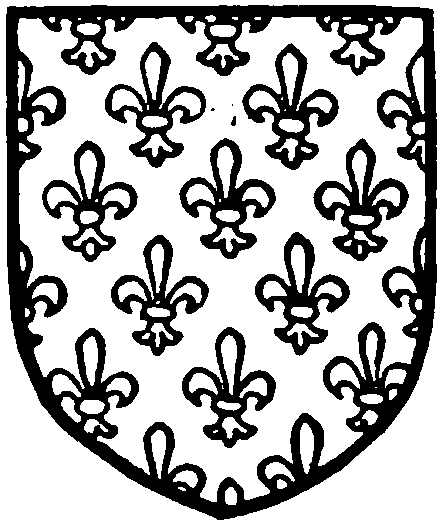
Old France. Azure powdered with fleurs-de-lis or.
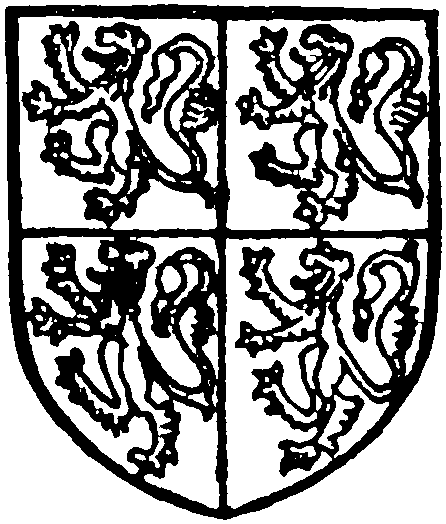
Hainault. Or a lion sable for Flanders quartered with Or a lion gules for Holland.
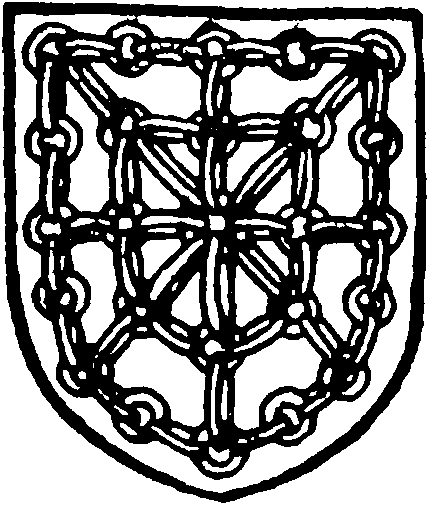
Navarre. Gules a double orle, a cross and a saltire of chains or all conjoined.
Again, payments were often made to great nobles. Thus, not to mention smaller amounts of an earlier date, in 1461 (14 December) an annuity of £154 from the farm was confirmed to Richard Nevill, the stout earl of Warwick; and payments were continued till he fell at Barnet, Easter Day, 1471, though not without the usual confusion and delay. On one occasion the mayor had to ride to London (1469) 'to rekyn wt the erle of Warwicke.' He was there twelve days and spent 50s. 6d., and it appears he had to borrow money in 'contentacion of the fee-ferme.' (fn. 165) The next settlement (£154) was made on William Fitz Alan, earl of Arundel, and payments were made to him in numerous small instalments till his death in 1487. Payment was sometimes tendered in wine, sometimes the earl would draw on the town for his friends. Occasionally his letters are quite pathetic as to his non-payment, always expressing the moderation of his demands, and begging 'his right trusty and well beloved friends and neighbours, the mayor and his brethren' to bear in mind his great charges (January-November, 1482). Two years later he urges his expenses in 'setting forth to the sea his right entirely beloved son, Sir John Arundel' at the king's command, and having to furnish so many men 'diffensibly arrayed' when needed for the royal service (April, 1484). (fn. 166)

Anjou. Old France in a border gules.

Wydvile. Argent a fesse and a quarter gules.
Charges for the king's household, varying considerably, were also made on the farm from time to time; thus £26 18s. 6d. in 1450; (fn. 167) £133 6s. 8d. in 1461; (fn. 168) £154 in 1495. (fn. 169)

Nevill. Gules a saltire argent and a label gobony argent and azure.

Fitz Alan. Gules a lion or.
It will be gathered that the town was occasionally in difficulty about its rent. It was frequently obliged to resort to loans and gifts (fn. 170) from private individuals. Sometimes its burgesses suffered in person for the debts of the community. Thus in 1461 we find one of the chief burgesses thrown into the Fleet at the suit of John, Lord Wenlock, of the Privy Council, for the 'rerage' of the fee-farm; and on 24 July 'Symkyn Patrycke (fn. 171) and John Gryme' rode to London by commandment of the mayor and burgesses 'to labour for the worship of the town and the welfare of Richard Gryme, (fn. 172) the which was in the prison of the Fleet for the debt of the said town.' (fn. 173) The sum of £20 was paid for his deliverance, to be considered apparently as a loan by Richard. (fn. 174)
Returning now to the amount of the fee-farm: a permanent reduction of 40 marks (£26 13s. 4d.) was made in 1530–1 on urgent petition of the burgesses; (fn. 175) but in 1533 the corporation wrote to Cromwell urging again their great charges, stating that they had derived no benefit from past favours, and begging that their arrears might be 'stalled.' Their letter received small attention, and in 1537 matters had got so much worse that the mayor in fear of a process at the Exchequer, and seizure of the town's liberties, had recourse to the merchant Nicholas Dogra, called also Demagrine, who came to his temporary relief and advanced £200 for the farm, receiving in security (fn. 176) West Hall, a locally noted tenement which stood in Bugle Street on the site of the buildings formerly occupied by the grammar school. By 1549 the sum of £1,844 1s. 6d. was owing to the Exchequer; of this total the amount of £1,044 1s. 6d. was remitted in the following year on the corporation entering into a bond for £1,000 to pay the remaining £800 at the rate of £100 a year. (fn. 177) In 1552 the farm was reduced under certain conditions to £50, and in consideration of the present poverty of the town, 'as well on account of the repairs of the walls and forts called "bulwerkes" now in a ruinous state and demanding attention, as also on account of the town being a frontier lying on the sea-coast towards Normandy, France, and other southern ports,' all arrears were also remitted. (fn. 178) Yet in September, 1561, the town was in debt to many persons in various sums, and especially to John Caplen, who at the request of the corporation undertook to receive and administer all moneys that might be due to the town within the next two years, and from them to pay the fee-farm, officers' wages, and other ordinary charges, to satisfy the other creditors, and 'of his good nature and accustomed goodness' to be 'contente that his own dette shalbe laste payed.' No repairs were to be carried out for the town, or any money transactions negotiated without cognizance of John Caplen. (fn. 179) Loans from the burgesses in payment of the farm not uncommonly occur. The conditions of the reduction of the farm to £50, which were confirmed by the last governing charter of 1640, (fn. 180) were that the petty customs should not have amounted in any year to £200, that no ships called 'carracks of Genoa' or 'galleys of Venice' should have visited the port, and that a certificate accordingly should be sent each year to the lords of the Treasury and the barons of the Exchequer. Certificates of the amount were regularly sent, but in 1803 an Act of Parliament was passed (fn. 181) abolishing the payment of petty customs to the corporation, and giving them instead one-fifth of the port-dues to be received by commissioners created under the new Act. But when on 9 November, 1804, the corporation transmitted a certificate reciting this Act to the Treasury and Exchequer, it was rejected for want of stating the amount received in lieu of petty customs until fourteen days afterwards another was forwarded giving the required details. (fn. 182) The reduced farm of £50 was paid to the crown from the time of Edward VI to the death of Charles I. It was sold under the Commonwealth 29 September, 1650, together with the fee-farm of the city of Hereford (£42) by the commissioners appointed for selling the fee-farm rents of the late crown of England under the Act of the then present Parliament, to Azariah Husband and his heirs for £785 11s. 8d. (fn. 183) After the Restoration this, with other crown properties, was resumed; and on 20 October, 1674, was sold to Sir Robert Holmes. (fn. 184) In 1681 it passed to John Garland and his heirs, being sold and conveyed by the Trustees for Sale of the Crown Fee-farm Rents. (fn. 185) It was afterwards conveyed to Thomas Osborne, first duke of Leeds, in whose family it remained till 1737, when it was sold for £1,500 by Thomas, duke of Leeds, greatgrandson of the above, to Ann, countess of Salisbury, widow, for the purpose of endowing a charity school which she had lately founded. (fn. 186) By 1835 this settlement had been for gotten, since the municipal corporation commissioners of that year conjectured that the fee-farm rent of £40 2s. paid annually to a charity called 'Hatfield's Charity' might be the remains of the old fee-farm transferred at one time probably from the crown to the charity, but could not find that anyone knew more of the matter. Yet the connexion of the payment with the 'Hatfield Charity School' appears clearly in the Journal of 28 October, 1825. (fn. 187) At the end of the petty customs certificate of Michaelmas, 1836, the entry occurs: 'ordered that the Treasurer of the Borough do pay to the Trustees of Hatfield's charity the sum of £40 2s. the remainder of the fee-farm rent, land tax deducted.' The origin of the payment was rightly inferred, its direction still a matter of confusion. A similar order to the above occurs 24 November, 1837. The payment is of course continued.
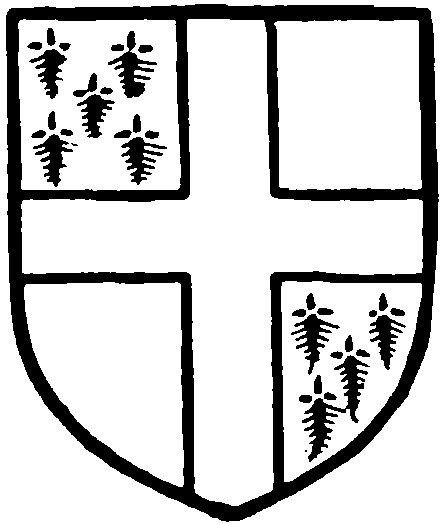
Osborne. Quarterly ermine and azure a cross or.
The early history of the government of the town can best be learnt from the history of the gild as deduced from the earliest gild ordinances, (fn. 188) for the gild was, in the case of Southampton, the nurse of its corporation. The earliest charter, that of Henry II, shows that the 'men of Hanton,' that is the burgesses, 'had their gild' by the time of Henry I; that is from the beginning of the twelfth century. Some six versions of the gild ordinances are extant, versions made from time to time as changing circumstances demanded, dated from the opening of the fourteenth to the latter half of the seventeenth century, with alterations running on a century later. (fn. 189)
Evidently by the early fourteenth century, the date of the earliest version, (fn. 190) the identity of the borough government was merged in that of the gild, since the ordinances profess to regulate both.
The officials of the gild, in many cases, had certainly functions which were beyond those of the original gild merchant, and nothing remained to show the distinction between gild and borough, so completely had the gild dominated over the old borough idea. But whenever it was that the gild became settled as the supreme authority—and it may have been from its first existence by charter (probably in the time of Henry I)—there then entered an element of restriction alien from the more ancient government of the town. The privileges of the borough communities were no longer shared by all the free, that is unservile, town dwellers who bore their part in the public burdens, but were henceforward restricted to the few, and these remained so until the Act of 1835, which restored the meaning of the word 'burgess' to something more like the original.
The alderman or chief alderman of the town, (fn. 191) assisted by two bailiffs and twelve sworn men, was head of gild and town. The 'twelve assistants,' as they were afterwards termed, were elected each year by the whole community, and themselves the same day elected the two bailiffs. There were also four sworn men, discreets of the market, and twelve aldermen of wards who had the view of frankpledge in their wards, and controlled the police and sanitary regulations of the town. The seneschal or steward acted as treasurer under the direction of the chief alderman, and the four 'skavyns'—as the word was usually written and pronounced—probably served under him as chamberlains in his department. (fn. 192) The usher gave warning of town meetings and was perhaps the mouthpiece of the gild in proclamations.
The gild did not always meet in the same place, perhaps in this respect preserving the old tradition of the gild-merchant, which was not even confined to town-dwellers, and there is no mention of a gildhall. (fn. 193) The meetings, solemn no less than festive, were to be held twice in the year, the Sunday next after St. John Baptist's Day (24 June), and that after St. Hilary (13 January).
The gildsman or burgess, with certain exceptions in the case of honorary members, was of necessity a resident of the town and held his membership, which involved the widest possible privileges, by right of inheritance or purchased it by fine. The one important restriction on his rights was that he could not barter away or sell his position. After the gildsman comes the man of the franchise, who, dwelling within the liberties of the town, bore his part in duties and taxation, and was admitted to trade by the enabling and essential permission of the gild. The stranger or foreigner was not necessarily, or indeed, generally, a foreign subject, but dwelt without the town liberties and was only admitted to the markets or even into the town on sufferance. The expression 'man of the town,' sometimes met with in the ordinances, is evidently a comprehensive term including both gildsman and franchiser.
It was in comparatively recent times that the name of gild was finally given up. The entries in the 'Burgess book' of 1496 record admissions 'into the gilde' or into 'the libertie of the gilde.' One or other of these forms occurs without a variation till the admission of Bishop Horne in 1562, whose name is the last thus entered. After this there is a marked change in the style. The next and most of the subsequent admissions are 'to be one of the burgesses,' or in the latest times till 1835, 'admitted and sworn a burgess.' Still in 1597 there is an admission 'to be one of the burgesses and gilde'; and the same or similar form of 'gild and burgess' occurs not infrequently till 1704; after which the name does not appear in documents, and only remains in the word 'gildhall.'
Of the town charters the earliest, that of Henry II (quoted above), is known only by Inspeximus. It was probably given in the first year of his reign (1154–5), and granted to his men of 'Hanton' their gild liberties and customs by land and by sea 'in as good, peaceable, just, free, quiet and honourable a manner as they had the same better, more freely and quietly in the time of King Henry I.' (fn. 194) Richard I, by a charter of 1189, known by Inspeximus, granted the burgesses freedom from toll, (fn. 195) passage and pontage both by land and water, both in fairs and markets, and from all secular customs ('de omni seculari consuetudine') in all parts of the king's dominions on both sides of the sea. This is confirmed in the oldest extant charter given by King John in June, 1199. (fn. 196) Three days later came the grant of the fee-farm (see above).
Henry III confirmed all the above grants in 1227, (fn. 197) and in 1252 forbade the barons of the Cinque Ports to take 'Karke' (fn. 198) within the port of Portsmouth, which was held at farm from the king (as above), to execute attachments, or do any injury to the men aforesaid contrary to their liberties and customs as granted by the king; but ordered them to permit the purchase of the king's wines from the barons' ships within the port of Portsmouth. In 1256 Henry granted the burgesses freedom from arrest in their persons or goods for debts of which they were not themselves the sureties or principal debtors; unless the debtors were of their community and capable of satisfying their debts in whole or in part, and the burgesses had failed in doing justice to the creditors. (fn. 199)
From the reign of Henry III to Henry VI various charters of inspection and confirmation (fn. 200) were given, that of 1401 (2 Henry IV) granting further to the mayor (fn. 201) and bailiffs cognizance of all pleas of whatever kind to be held in the gildhall ('guyhalda') and there finally determined, the right of holding court leet (fn. 202) and practically self-government.
In 1445 (23 Henry VI) came the incorporation charter setting forth as usual the heavy charges of the town and its great impoverishment, and incorporating it under the title of a mayor, two bailiffs, and burgesses. Provision was made for the election of mayor and bailiffs, who were also made controllers of the staple granted by this Act, on the Friday before St. Matthew's day each year, and in case of death or deposition, &c., within fifteen days of such vacancy. The mayor was to be the sole escheator with right of attachment like the sheriff of London. Further, the town and the port of Portsmouth, 'which port is within the liberty of the said town of Southampton,' were exempted for ever from obedience to the constable marshal or admiral of England, or the steward, and marshal or clerk of the market, who should not enter the town to hold pleas, or hold pleas out of the town concerning matters within the same. The mayor was to be clerk of the market, and strangers were prohibited from buying of, or selling to, strangers.
Two years later came the charter of Henry VI creating the county, granting that since the merchants and mariners of the town were incommoded by the sheriff of the county serving writs on them, and in consideration of the heavy fee-farm of 340 marks (£226 13s. 4d.) 'our said town, with the port and precinct thereof, and the port of Portsmouth, which is now called "the town of Suthampton and its precincts," shall be one entire county, incorporated in word and deed, separate and distinct from the county of Southampton for ever, and shall be called "our county of the town of Suthampton." ' (fn. 203)
The sheriff, who was to hold a county court, was to be chosen from among the burgesses each year on the Friday before St. Matthew's Day and certified by the mayor to the barons of the Exchequer; in case of death, &c., a new one was to be chosen within ten days and certified as above. In 1451 a further confirmation charter gave an additional right to the mayor to perform all acts belonging to the office of steward and marshal of the household, and admiral of England, within liberties of the town and county.
In spite of the foregoing charters, in the following year notice occurs of a dispute with the justices of the county concerning mulcts ('emendas') from the assize of bread and ale and fines from various tradespeople and artisans, which belonged by right to the townsmen of Southampton, but which the justices were about to appropriate. The right of the townsmen was maintained by royal writ except that any fines or amercements of artisans or dyers arising within the aforesaid town were to be levied to the king's use under the present commission. (fn. 204) In 1461 further privileges, including court of pie powder and authorized resistance to the king's officers, were given by Edward III. In 1468, 1480, 1484, 1510, and 1515 further confirmation charters were given, to which in 1553 was added that of Edward VI, regulating and limiting the payment of the fee-farm (see above).
Various confirmations were given by Philip and Mary (1557–8), by Elizabeth (1564), and by James I (1616). The last governing charter was given by Charles I in 1640. (fn. 205) It rehearsed and confirmed former charters with certain variations, ordered the appointment of a common council to consist of mayor, recorder, aldermen, bailiffs, and sheriff, and all who have held these offices, to assist the mayors, with power to make statutes, by-laws, &c.; also the appointment of a court of orphans and of a town clerk or common clerk of the town, to be clerk of the peace and sessions and have fees. Four serjeants-at-mace were also to be appointed and fines were to be levied for refusal to take office. Power to tax the inhabitants was given to the corporation; piccage and stallage were ordered to be paid by strangers; one or more prisons were to be kept in the town; a corn market was to be held every Thursday. The mayor and corporation were to take tolls, while no person who had been mayor was obliged to bear arms in person. For the benefit of sailors and fishermen and the bettering of navigable streams, the mayor might cleanse all creeks and rivers within the liberties where the tide flows, and take the soil. The most important item on the charter, however, was the clause by which a judgement in the court of the Exchequer which had been given against the town in 1635 was reversed. (fn. 206) The liberties, franchises and privileges which had then been taken into the king's hands by reason of their exercise without warrant or royal grant (fn. 207) were now restored to the town, and the mayor, bailiffs, and burgesses were freed from all penal consequences which had been involved in this judgement.
It appears that soon after the Restoration, in May, 1661, the town considered the advisability of renewing this last, or procuring a fresh charter, (fn. 208) a question periodically mooted. In December the same year the Corporation Act (fn. 209) was passed with a view to capturing the boroughs; and in the following February (1662) commissioners, consisting of the mayor, aldermen, and others were appointed by letters patent to administer the Act. But towards the end of the reign, November, 1683, the town was again compelled to deal with the charter. The attempt of the crown to obtain control over all municipal elections involved a correspondence with Sir Leoline Jenkins, Chief Secretary of State, in which the town avowed its willingness to surrender, but pleaded utter poverty—'the late rebellion had robbed the chamber of all public money—the plague had consumed their inhabitants, the Dutchmen had spoiled them of nearly all their ships, their looms were useless owing to the late Act of Prohibition, (fn. 210) their revenues had sunk, their burdens increased, let his sacred majesty be assured that the true cause of their tardiness in delivering up their charter was want of money, not of loyalty.' Meanwhile they determined, should the king desire it, to yield up their charter at once without waiting for a quo warranto, and get a new charter on the best terms they could. In December the reply from Sir Leoline came; the king would require the town to surrender its franchise of being a separate county, and to be united to the body of Hampshire, all other liberties being saved and restored; on such terms he would consent to their having a new charter for nothing, if they could not afford half fees, the rate at which other poor corporations had renewed.
The town swallowed this bitter pill, professing to be grateful, and on 6 September, 1684, the instrument was sealed surrendering the charter with all that went under it. In November a commission was appointed to negotiate a new one; but owing to the king's death in the following February the matter fell through. James II followed the policy of the preceding king in regard to the corporations. A quo warranto bearing date 28 November, 1687, but not produced to the mayor till 23 January, was issued against the town requiring the presence of the mayor and bailiffs at Westminster to answer for their franchises. On this a correspondence ensued with the Attorney-general. They would make no defence, but humbly submit their charter to His Majesty's mercy; nothing but their poverty had prevented their seeking renewal before, and the same was their plea now; thus they begged that suffering judgement to pass by default might not be interpreted unfavourably, as they had been advised to that course as most submissive to the king, least troublesome to the Attorney-general, and easiest for themselves. Towards the end of the year it was understood that the matter would not be pressed, and on 5 November, 1688, the recorder was desired to employ some one 'to see that a nolle prosequi be entered upon the quo warranto brought against the town,' and for this they were ready to disburse.
Meanwhile a 'new charter,' destined to be a dead letter, had been prepared, and is said to have been lodged in private hands at Southampton to be produced at the proper time. The preamble states that the ancient franchises of the town had, for various abuses, been seized into the king's hands by a judgement on quo warranto, and that a new charter was granted on petition of the inhabitants. A common council was provided to consist of the mayor, recorder, thirteen aldermen, and twelve burgesses, one supervisor of the customs, and one common, i.e. town clerk. The mayor, recorder, four senior aldermen, and four burgesses were to be justices. But the significant variations were these:—The king was empowered under seal of privy council to remove any officer or burgess, and to appoint others mayor, aldermen and burgesses within twenty days, to elect person or persons named in royal letters mandatory to vacant offices, however small the number of burgesses attending, and all officers and burgesses were dispensed from taking the oaths of supremacy and allegiance, and that contained in the Corporation Act, from receiving the Sacrament of the Lord's Supper after the Anglican Rite, and from subscribing the declaration in the Popish Recusants Act (25 Chas. II, cap. 2). Moreover, no recorder or town clerk was to be admitted without royal consent under seal. A rectification of the governing charter (16 Chas. I) in some particulars was occasionally contemplated; and on 6 September, 1723 (10 George I) a petition for a new charter received the town seal. But nothing came of this action, and the charter of 1640 continued in force till the Municipal Corporations Act of 1835.
Of the officers of the town the prominent persons in Southampton before and during the thirteenth century were the king's bailiffs, (fn. 211) to whom he directed his writs on matters concerning the town and the royal fiscal requirements. The earliest names of bailiffs to be found in this century are:—In 1205, William of St. Lawrence and Thomas de Bussuse; (fn. 212) in 1209, Goce; (fn. 213) in 1212, Roger Swein and William the Englishman. These two bailiffs (ballivi), together with six principal men of the town—Simon of St. Lawrence, Robert the Controller (talliator), Denys Fortin, Walter Fleming, Roger Bonheit, and Thomas de Bulehus (fn. 214) —were called upon to answer for the town's trespass in appropriating certain money from Ireland belonging to the king. (fn. 215)
The bailiffs are referred to in the laws of the gild, where their election is provided for by the 'twelve discreets' (see above). In the course of time their duties varied and the status of their persons. They were bound by oath to serve the town court, to see that common right was ministered, as well to strangers as to Englishmen, and generally to advance the good of the town. In 1571 an alderman was chosen as bailiff; in 1587 it was ordered that henceforth the senior alderman should be bailiff of the court, and that the junior bailiff should preside at Trinity Fair, and be at the charges thereof. In the eighteenth century it had become usual to choose the bailiffs from the younger burgesses who had not served the office before. The senior was bailiff of the court, the junior, water-bailiff. (fn. 216) Until 1835 the bailiffs were, jointly with the mayor, judges of the civil court of Pleas; and with the mayor were also the returning officers at the election of members of Parliament. (fn. 217)
As well as the office of bailiff that of mayor certainly existed early in the thirteenth century. There was a 'mayor' about 1217; (fn. 218) and Benedict, the son of Azo, or Ace, ruled in that capacity and under that name (major) at least from January, 1235 (fn. 219) to 1249.
At the end of this long tenure of office, for some reason probably connected with the rise of the gild, (fn. 220) to which the title of alderman came more naturally, the burgesses obtained by royal patent (22 October, 1249) the curious grant (fn. 221) that neither they nor their successors should at any time be governed by a mayor. (fn. 222) Futile as the grant was in the long run, Matthew Gese, the next head officer whose name is known (1260), was styled 'alderman,' (fn. 223) and his successors the same till 1323, when Hugh Sampson appears in deeds both ways. But the title of alderman continued usual (fn. 224) till Lawrence de Mees in 1334, when the older title was finally dropped and 'mayor' prevailed.
According to the charter of 1445 (see above) the mayor and bailiffs were to be elected by the burgesses on the Friday before St. Matthew's Day, 21 September each year, no doubt in accordance with ancient precedent.
However, a patent given (fn. 225) fifteen years later (1460), called forth by riotous proceedings threatening bloodshed at the choice of a mayor, shows that the method of election was in reality much more restricted. By a custom there, reported to have been immemorial, the outgoing mayor on the Friday before St. Matthew's Day, in the presence of the bailiffs and burgesses, in the gildhall, nominated two burgesses, one of whom was to be chosen as his successor by the assembly. (fn. 226) However, in spite of this nomination the mayor himself might be reelected. A variation on this oustom, which seems capable of being dated from about the middle of the sixteenth century, and is mentioned in 1587, consisted in what was called 'the private nomination.' On the Friday before St. Bartholomew's Day (24 August) the mayor and aldermen met in the Audit House and put two aldermen and two junior burgesses or any four burgesses in nomination for mayor; and on the morning of the day of election, the Friday before St. Matthew's Day, they struck off two names, and proposed to the burgesses the decision between the remaining two by ballot. It was usual, however, for the outgoing mayor to suggest the name, and the ballot was generally a matter of form. The ceremony was attended with considerable formality, the gildhall being decorated with flowers and duly strewn with rushes, the aldermen attending in their scarlet gowns, and the mace and oar being carried before the mayor. Before the Act of 1835 it was usual to put in nomination the two senior aldermen who had not occupied the mayoralty twice, and the two senior burgesses who had served as sheriff but not as mayor. This custom of private nomination was continued till the passing of that Act, under which, according to a uniform rule for all boroughs, and extended by the Act of 1882, the mayor is elected by the council each 9 November from among the aldermen or councillors or persons qualified to be such; so that previously to election the mayor need not have been a member of the corporation.
In the earlier centuries, as in later times, the burden of municipal office, like that of parliamentary representation, was not unfrequently avoided. In November, 1414, Thomas Armorer, who had been M.P. for the last two years, and had served as bailiff from 1404 to 1414, appeared before the mayor, John Mascall, three aldermen, his fellow bailiff and others of the prodes-hommes in assembly, and produced letters patent of the late king (15 February, 1412), granting him freedom from serving the office of mayor, a compliment possibly otherwise awaiting him, or coroner, or filling any other corporate office for the rest of his life. (fn. 227)
The dignity and importance of the mayor's office grew with the privileges of the town and with its charters: and generally, as the high functionaries from without were debarred from entering the town so the mayor ascended in their stead. For instance, by charter of 1445 he was made escheator, &c.; charter of 1447 creating the town and port a county gave him a further rise; that of 16 Charles I (1640), the governing charter till 1835, regranted all particulars.
Previously to 1835 the mayor continued to be appointed to offices which had long fallen into abeyance. These will be mentioned with others at the end of this section.
Formerly, like the members of Parliament, the mayors received remuneration. Until 1481 we find £10 assigned to the mayor of old custom. In 1579 the allowance was increased to £20, and in 1617 to £50; again, in 1623, it fell, from prudential motives, to £30, namely £20 the older sum, and £10 in lieu of making a burgess. In 1725 this old allowance of £20 for table money was taken away (fn. 228) till the town should have again at least £400 at interest. Table money, however, though to no great amount, was frequently voted; and the privilege, which can be traced from 1501, of making one burgess during the year of office and retaining the admission fee seems always to have remained. The mayor had also some small port dues on corn and coals. In 1802, when these dues were discontinued, the mayor was allowed twenty-five guineas per annum. In the depression of 1830 all dinners, perquisites, and even the daily newspaper hitherto taken in for the mayor, were stopped. (fn. 229)
The mayor has no perquisites at the present day, but it would be lawful for him to receive such remuneration as the council might think fit. The quaint oaths of mayor, &c, which are not given here, are no longer taken as oaths, but as solemn declarations.
The mayor is now invested with the chain of office, the gift of Bercher Baril in 1792, as anciently with the tippet. He also receives, 'that he may always have money in his pocket,' the £5 of quaint coins given under the will of Andrew Meares of Millbrook some time before 1639. (fn. 230) The coins are preserved in the Audit House.
The Common or Town Council.
Next to the mayor we place the town council; and we are now dealing with the close government of the town and gild which prevailed with small variation till the last century.
The 'twelve assistants' of the chief alderman of the gild (see above) were the original mayor's or town or common council. They had of course been sworn, as the ordinance provides, from the beginning, although the oath taken at the earliest period is not extant. From that which belongs to the far later period of about 1650 we gather that the title of 'assistant' was being dropped. In the heading, as also in the body of the oath which bound them to attendance in 'the counsell-house,' the word 'assistants' was replaced by 'comon councill men,' whose office at this period, and no doubt long before, was strictly annual. It becomes a little difficult to state in what particular this body was assistant to the mayor and when he might be left to act, as he often did, motu suo, or how far again originally the council was itself assisted by and virtually comprised others, e.g. the aldermen of wards or other chief officials; whether in fact the common title 'the Mayor and his brethren' connoted only these 'twelve discreets,' or included other selected burgesess, certainly the bailiffs could not have been excluded; or what indeed in any accurate definition 'constituted the Assembly' or 'the house' in the early days.
Under the charter of 1640 the common council was appointed to consist of the mayor, recorder, aldermen, bailiffs and sheriff, and all past holders of these offices who were empowered to make such by-laws, the mayor always being present, as in their 'sane discretion' should be salutary for the government of the burgesses, artisans, and inhabitants, and to punish the breach of them.
This constitution of all the town council remained as here provided till the alterations of 1835. At the present time, under the county extension of 1895, the councillors are thirty-nine in number. (fn. 231) They act collectively and in eighteen committees.
The Recorder.
The earliest observed notice of this officer occurs in 1457, when we find his wages were £5 a year; he had also, as was usual, his livery gown at Christmas made of five yards of 'musterdyvelyg' at 3s. 4d. the yard. (fn. 232) This continued to be his payment for a considerable time. It may be that in the earlier period he and the town clerk were identical, and that the offices were separated under the pressure of town business. In 1649 he was allowed £20 per annum, so long as he should live in the town. In 1688 it was determined that his fee should be £5 per annum. But presents of wine and new year's gifts of sugar, spices, and olives were frequently made, as special and delicate attentions.
The oath of the recorder required him to 'minister common right after the common law of England, and the laudable customs of this town, to every person that shall duly require the same, as well to poor as rich,' and give 'true counsel to the mayor and his brethren,' and be in attendance when reasonably expected. The duties of the recorder here, as everywhere else, are now regulated under the Consolidating Act of 1882.
The Town Clerk must have been in existence from a very early period, if not under that name. He first appears in 1315, when William Fowell, (fn. 233) the 'town clerk,' received a bushel of wheat from God's House for professional assistance. Again, in 1321 John le Barbur, 'town clerk,' received a quarter of wheat under the same circumstances, by the advice of John le Flemyng, the late alderman. The 'wages' of the town clerk, as of the recorder, were £5 a year, with a varying allowance for paper, parchment, and ink: he had also his five yards of 'musterdyvelyg' (1457) for his gown and tippet of fur. His duties were to 'see that true records are kept and due processes made between party and party, and true judgements given, as nigh as he could, in the Mayor and Bailiffs' behalf': to minister, 'if required, common right after the common law of England and the laudable customs of this town'; to give good advice to 'the Mayor and his brethren,' and to keep 'their counsel.' No declaration is now required by law of the town clerk.
The Aldermen existed in name from a very early period (see above). Among the officials under the chief alderman, who was in fact the mayor, the ordinances of the gild-merchant mention twelve aldermen who had view of frankpledge and controlled the order and sanitary regulations of the five wards. The first charter which refers to aldermen is that of 1401, when power was given or confirmed to elect four aldermen for the purposes therein named. The last governing charter (1640) speaks of six aldermen, but probably the number was indefinite, and nothing is said of their election. Previously to the Act of 1835 the aldermen were those who had served the mayoralty, and they became such without any election; their number at the passing of the Act was nineteen, including the mayor. Under the above Act they became ten in number, but at the extension of the county in 1895 their number was increased to thirteen, six or seven of whom go out of office every third year, but may be re-elected. They hold office for six years, and are chosen from the councillors or persons qualified to be such: the councillors themselves being thirty-nine in number, three being elected by each of the thirteen wards. They have a property qualification, and hold office for three years.
The succession of burgesses was arranged for by the gild ordinances, but from an early period irregularities occurred in their appointment from without. For instance, in 1303, John de London of Bordeaux was granted burgess-ship by royal letters, which in 1312 were extended to his wife Blanche and their sons and daughters in every particular. (fn. 234) Admissions also on the part of the town were sometimes a little arbitrary. In 1509 one was admitted, with surely a reflection on the townsmen, because he was 'an honest man and good of name'; another because 'he hath been always a helper to the town'; another, from the Isle of Wight, on promising (1520) to reside and 'victual the town with his fish.' In 1543 two barber-surgeons were admitted free on promising to be 'ready at the commandment of the mayor and burgesses' to exercise their 'craft or science' when required 'without excess taking for the same.' In 1545 burgess-ship was prohibited to any more Guernsey or Jersey men without a special vote: a point strongly urged (1550) by the court leet. It seems that a few years later the making burgesses 'for friendship' had become too common, and was said to have lowered the office in public estimation. Hence in 1561 (September) it was ordered that the fine of £10 should be exacted, except from 'prentices, or such that be men of honour and worship that shall so request for their pleasure for no gain of the petty customs and men's children which ought of right to inherit their father's room, according to the Paxbread.' Again, in 1600, the court leet presented that 'gentlemen and others' were admitted to burgessship without being obliged to undertake the offices of constable, steward, or bailiff, but enabled at once to advance to the dignity of sheriff, and so of mayor.
Burgesses lost their status under certain circumstances. Residence was required, and absence from the town for 'a year and a day' was a cause of their being 'disgraded,' 'discharged from the gild,' and so forth; but exceptions were allowed occasionally. Again, offences against the peace by fist, sword, or dagger, or by abusive words were constantly visited with expulsion. In 1495 one was degraded for assault upon another 'whom he did streke with his fiste.' Those who had been degraded were frequently readmitted on a fine. Sometimes burgess-ship was forfeited, but not the freedom of the town (a distinction made in the ordinances). In 1602 an alderman was disburgessed and so expelled the corporation, but he did not lose his freedom. Other offences against town-laws were similarly visited.
Certain sumptuary laws affected the burgesses. In 1559 (2 Elizabeth) it was ordered that all burgesses from the sheriff upwards should provide and use 'one right honest gown of crimson or scarlet cloth' on certain days, under a penalty of £10, the crimson being relieved by a black velvet tippet. By a minute of 4 August, 1569, their wives also were to be clothed in scarlet under a like penalty, according to old custom, and the husbands were desired to see the gowns provided and worn. The alderman whose wife did not possess such a gown was to be fined £10, and those whose wives, though possessing, did not wear them were to forfeit 10s. each day. All the gowns were to be ready against the queen's coming under pain of £10, and the ladies were to wear with their scarlet gown 'frentche whoddes' (French hoods). (fn. 235) Fines on such matters were frequently exacted, and the dignity of the corporation duly maintained. In 1613 it was ordered that the burgesses and their wives should be placed according to their degrees in all public assemblies and at church, and one of the serjeants was to see to this. All burgesses were expected to attend the mayor (1637) in state on the days of assembly; and in 1594 it had been presented as a discredit that they should go on foot to the law day at Cut-thorn, and were ordered to attend Mr. Mayor on horseback.
The feasting and good fellowship encouraged by the old gild ordinances never went out of fashion. It would be easy to give an idea of many a good gild dinner. A menu of 1457 includes a dozen capons, a dozen 'pestelles of porke,' nine 'legges of beffe,' a dozen 'cople conyngges,' and many lighter refreshments, red wine, tent, muskadell, malvesy-almonds, dates, &c. This, with kitchen help, and ten capons borrowed from my master the mayor and four players from St. Cross to enliven the feast, cost the town £2 3s. 5½d. (fn. 236) In contemplating such lists one has to remember that much was given away in charity; the capacity of the burgesses themselves was but mortal. Passing to much later times it was the custom for burgesses to give a feast on being sworn, and these entertainments (1753) were to be made separately. (fn. 237) This was very well for good cheer, but the expense became an objection to the honour of burgess-ship, and moderation was enjoined (1767). Years after a composition in money payment was made in lieu of entertainments.
In the middle of the seventeenth century (1652), a sorry period for the town, the offices could scarcely be filled for lack of burgesses. A similar complaint was made after the Restoration, when it was ordered (1660) that every resident whom the mayor and common council should think fit to nominate gratis as serving burgess should accept the office under penalty of £20. From one cause or other a like scarcity was felt again towards the end of the eighteenth century, when, 13 October, 1788, the corporation made a spirited appeal to the grand jury at Quarter Sessions with a view to replenishing their ranks. The appeal, which is very lengthy, spoke of the 'complicated wickedness of the inferior class of inhabitants,' the shameless indecencies and blasphemies were such as 'all the watchfulness of the magistracy would not be able to prevent or punish without the concurrence of those of superior rank.' Very much more to this effect was urged; they gave their own origin, defended their utility as a corporation, and urged the necessity for strengthening the arm of authority. The appeal was remarkably successful. Forthwith two knights and eleven esquires joined the corporation, and others quickly (17 &c. October) followed, being all elected as serving burgesses. It does not appear that the town suffered again from lack of serving burgesses.
The oath which the burgesses took formerly savoured of the gild ordinances and the early charters. They were to maintain the franchises, customs, and ordinances of the town, contribute to all charges within the same—summons, watches, wards, contributions, taxes, tallages, lot and scot; not to colour or bear the name of foreigners' goods; to warn the mayor of foreigners trading within the town; not to sue an inhabitant out of the town; to take no apprentice for less than seven years, and within the first year to cause his enrolment, and to further his advantage at the end of his time; to attend the mayor on all public occasions; to warn him of any possible breach of the king's peace, or of the ordinances of the town; to keep all counsel faithfully.
Honorary burgesses were in fact provided for by the gild ordinances, and had records survived we should no doubt have been in possession of interesting examples. As it is, the first observed occurs in 1490 when 'my lord of Winchester' was 'made burgess' 'free of charge, but of his gentilnes he pardoned us for the same the fyne of the pavelyne (fn. 238) and all other costes longing to the same with the homage for that yere.' (fn. 239) At the same time the abbot of Beaulieu, Sir Edward Berkeley, and William Middleton, esquire, were admitted. Again, in 1514 Thomas Skevington, bishop of Bangor and abbot of Beaulieu, was admitted. He had been a donor of some of the town plate. But it would not be practicable to deal with the very copious entries of honorary burgesses, or the regulations made concerning them. (fn. 240) From the end of the seventeenth century the roll of burgesses consists very largely of non-townsmen and men of position. These honorary or out-burgesses were not admitted to the common council, but could vote at the election of a mayor and of members of Parliament. The election of burgesses previously to the Act of 1835, whether serving or honorary, was by the common council, nine being a quorum. The serving burgesses were inhabitants, bankers, merchants, or the higher tradespeople, the honorary persons, generally speaking, living away, who had either done some good to the town, or from whom the town expected benefit. In 1831 it was resolved that no one should be elected as honorary burgess who lived within any of the town parishes. Within the ten years immediately preceding the Act of 1835 fifty-three burgesses had been elected, forty-seven honorary, and six serving, there being in the corporation just previously to passing the Act twenty resident or serving burgesses, and about one hundred and sixty non-resident, chiefly honorary. By the Act of 1835 the admission to burgess-ship by gift or purchase became illegal, but by Act of 1885 the boroughs can now admit to honorary freedom. (fn. 241)
The exclusive trading privileges enjoyed by burgesses had long since ceased: the only privilege which remained to them being that, whether resident or not, they equally with the inhabitants paying scot and lot were electors of members of Parliament for the borough. The qualification for burgess-ship is now universally regulated under the modern Acts of Parliament, and no further notice is needed.
The grant of a Sheriff from among the burgesses, to be sworn before the mayor and certified by him to the barons of the Exchequer, was made under charter of 9 March, 1447, by which the borough was constituted a county (see charter above). Accordingly on 1 May that year Henry Bruyn was elected first sheriff. The sheriff continued to be elected as specified by the charter, and was invested with the powers of a county sheriff: he attended at the assizes when held for the town and county of the town, and at the sessions, for both of which he summoned the juries. He held a county court when necessary, and executed writs from the superior court, which were directed to him immediately. He is now appointed next after the mayor each 9 November, being invested with a chain of office, and has the powers of a county sheriff, which indeed he is, continued to him.
The Seneschal or Steward, and more recently the Treasurer, held an office in many ways identical, but with a different status in reference to the corporation. The appointment of seneschal or steward was ordered by the gild ordinances (No. 1). The chief receipts and disbursements of the borough passed through his hands, and the stewards' books, many of which are extant from 1433 (fn. 242) to the time of Charles II, are of considerable interest. The treasurer now holds office during pleasure; he is appointed by, but cannot be himself a member of, the town council.
The election of Coroners, of whom there were generally two, from among the burgesses for pleas of the crown was authorized by charter of 14 July, 1256. The earliest local oath of the coroners appears in Overey's Ordinances (1473), where their duties are set forth in the usual way: viz. to sit with a jury super visum corporis in every case of violent death: to determine what forfeitures might belong to the king, and what to the town in consequence: to give attendance at the sessions, assizes, and shire court (of the town), 'especially when any exigent is to be called, or any to be outlawed, thereon to give judgment for the king's advantage and for the town.'
Mayor and Constables of the Staple.
Previously to the Act of 1835 the incoming mayor always was, and the two senior resident aldermen generally were, elected to these obsolete offices by the town council in practice, and not, as specified by the charter of 1445, by the burgesses.
The Petty Customer took oath to deal truly with the town's customs and tolls by water, of all manner of goods, according to ancient use. There was also a receiver of customs and brokage at Bargate, who was also sworn (see below).
The four Aldermen of Wards (see above) were sworn officers, probably identical originally with those appointed under charter of 1401.
The Alderman of Portswood was a sworn officer, the earliest observed notice of whom occurs under 1469, when he makes payment to the steward on the law day 'for divers alewytes xxijd,' and similar but varying payments in other years. He is still appointed every year, following ancient custom, but has no duties.
Four 'discreets of the market,' formerly sworn officers (see above), are now appointed from the borough police, but have no duties to perform.
The four Serjeants-at-mace.
These sworn officers are mentioned in the gild ordinances. They were formerly elected by the 'twelve men at the common assembly in the Guildhall,' and could only be removed by the same power (1548); (fn. 243) in the next century they appear as 'biddelles.' Before the Act of 1835 two of them were gaolers, one of the debtors', and the other of the felons' prison; the third collected the tolls of the vegetable and poultry market, and the fourth was water-bailiff. There are now two serjeants-at-mace who, with the crier, are attendant upon the corporation and justices.
The Brokers were sworn to their office between merchant and merchant (Ord. 59 etc.); and were especially to 'make a stay' of 'things forren boughte and forren solde' until the pleasure of the mayor and his brethren should be known.
Porters, Bearers, and Packers.
Officers of this description are referred to in the gild ordinances. Their position was confirmed by charter 1445. (fn. 244) The porters existed as a company and were possibly already associated together as the beremanni Suhamptonie in 1225, when they were directed to be paid for storing wine. (fn. 245) When we know more of them they were seven in number, exclusive of their steward. This number had been arranged at least from 1501. They found security to pay the town their rent. They possessed a common stock-in-trade in horses and carts, and the takings for the week were divided every Saturday night by their steward. They were bound to provide four able horses for the service of the merchants, each horse being worth at least 26s. 8d. (1547). (fn. 246) They bought and sold their places, but were only admitted or discharged by the town council, who also fixed their rates of carriage. The company was in existence in 1835.
Before the Act of 1835, besides the offices mentioned above, the following were also held by the corporation, but not named in any charter. (fn. 247) One weigher of wool, whose duties had become nominal; one aulnager; four keepers of the keys of the gates—these were always the mayor, the late mayor, and two senior resident aldermen; besides these, warders of the gates were formerly appointed; two keepers of the keys of booths—these were supposed to have reference to booths erected at the fair above Bar; three keepers of the keys of the great chest (where the minutes were locked up)—these were the mayor and bailiffs, but the mayor really kept the keys; supervisors of lands—the mayor and aldermen indefinite in number, but they had no duties as such, the property of the corporation being managed by the common council; one crier, who attended quarter sessions, kept the weights and scales, and keys of the market gates, and acted as crier for those who paid him; besides the water-bailiff (of whom above) there were sand-walkers, indefinite in number, who formerly watched for waifs and wrecks, and their appointment had been an object of desire during the French War as a protection against impressment (fn. 248) — there were latterly from twenty to thirty of these; two wardens of Sendy's gift; auditors of accounts, indefinite. There were also fourteen beadles of wards, and extra beadles indefinite; two constables; measures of corn and coal, indefinite; one scavenger.
Besides the above there were also anciently the town gunner, an official who appears in the earliest consecutive town records. In 1457, under a hasty menace to the town from French ships, are several interesting entries (fn. 249) concerning the gunner and his work. His wages were 6d. a day; his office to superintend the handling and repair of the guns, and the making of gunpowder. In 1512 (4 Henry VIII) a townsman offered his services as gunner at the yearly salary of 26s. 8d. and a gown. He was to receive 2d. for the making of every gunstone, and 7d. a day 'when he workyth yn makinge of gun-powder,' and 4d. a day for every man employed by him. A few years later he was ordered to serve the town in peace and war at 10s. per annum, receiving also an allowance of four yards of cloth at 3s. 4d. for his livery. In 1657 the town gunner and the town drummer each received as annual wages 18s. 4d.
There were also the town carpenter and the paviour; of the paviour's work we first hear in 1384. (fn. 250) In 1457 we find him paving along the middle of the street assisted by 'the pavyer of London.' He had a good house assigned him, and a yearly gown, his work being to 'serche the pavement' and pave where necessary. (fn. 251) The chimney sweep was a sworn official, new in 1654. The town brick-maker has the price of his bricks given him in 1623 at 9s. 6d. per thousand; a little later it was 10s. In 1704 the assize of bricks, according to ancient custom, was said to be 10 in. in length, 4¾ in. in breadth, and 2½ in. in thickness.
There was a cowherd who superintended the common lands, with whom were four overseers and twelve drovers of the common.
A common carrier compounded for his place with the town and received from them the tariff of his charges. In July, 1593, he was forbidden to enter the gate of the town by himself or servants with his cart for fear of plague-infection, the sickness daily increasing. (fn. 252)
In 1602 his fine was £10. Some years later (1637) he was allowed to increase his charges, his trade having fallen off from the scare of plague. (fn. 253) A foot-post, between the town and London, wore a silver badge with the town arms, and usually started on Monday or Tuesday each week (1637). (fn. 254) And of course there were town minstrels who received regular wages and a livery. In 1433 they appear to have been but three in number. (fn. 255) Independently of these, strolling companies under the protection of some great lord or important town were constantly visiting the place, and receiving the town's wages. But after enjoying high favour for many generations minstrelsy fell into discredit. In 1623 we find the town musicians, who were apparently five in number, asking for their liveries, which they received with a broad hint to ask no more, but take what was given them. (fn. 256) A few years later silver badges with the town arms were distributed to them by the mayor. In this connexion may be mentioned stage-players. The town does not seem to have had any recognized company, but permitted the use of the Gildhall until 1624, when for certain adequate reasons it was forbidden. (fn. 257)
Further, at all events in 1615, there was a town-cook, who on condition of being allowed a monopoly of the oyster beds in the haven, covenanted to supply the town with good oysters at 2d. the hundred at most, to keep the beds in good order, and to bring in 500 oysters for the mayor's fish dinner yearly. (fn. 258)
Lastly, at the opposite end of man's needs, there was the gild or mayor's priest. For the old gild-merchant not only regulated the trade and civil government, but preserved a certain eleemosynary and religious character, and had its chaplain with a definite position and allowances (see Gild Ord. 1, 2). Subsequently the chaplains, who seem to have been appointed permanently, received a fixed stipend of £3 6s. 8d. per annum, with a gown and hood worth generally about 13s. 4d. Thus (fn. 259) in 1457 Sir William and in 1478 Sir Harry were paid. Passing rapidly towards the changes of the sixteenth century, Sir William, who sang for Holmage (see below, chantries), was also gild priest in 1501 and 1509. In 1543 Sir Hector was mayor's chaplain and received for his 'hatte, gowne and typpate' 24s. After this the office disappears from the town books, and in the following century it became usual to bestow a gratuity on the rector or vicar of the parish in which the mayor resided for the performance of such duties as might be required. (fn. 260) At the commencement of the nineteenth century the 'chaplain of the Corporation' with his allowances of £5 5s. per annum re-appears in the town books. (fn. 261) At the present time the office is purely honorary.
The Parliamentary representation of the borough commences in 1295, and the returning officers were the bailiffs, other burgesses being bound as manucaptors or bailsmen for the appearance of the elected members at the appointed day and place.
Until the time of James I, when the custom was broken through, the members elected were bona fide burgesses of the town. There was an attempt to restore this more ancient way in 1624 and 1625; the burgesses (fn. 262) being warned by order of the corporation not to give their voices for any one who was not already an in-burgess of the town, on pain of forfeiting their condition. This regulation was observed at first, but was soon again interrupted, and after the Restoration persons of a certain position, irrespective of their dwelling, who had done, or might be expected to do, something for the town were generally chosen; but even so, the form of previous election to burgess-ship was observed.
In the early days, here was elsewhere, and through the Middle Ages, the town paid their burgesses of Parliament; in later times occasionally, it may be feared, the burgesses paid the town. Their 'wages' were 2s. per day each man, the usual rate of payment perhaps from the earliest period for borough representatives, and fixed at that amount in 1322. (fn. 263) A writ for expenses, tested 20 January, 1306–7 (25 Edward I), was issued in favour of the Southampton members; (fn. 264) the next known was in 1313. (fn. 265)
There were symptoms, especially in the earlier period, of no great eagerness to serve at the great council of the nation and no great readiness on the part of the towns to make return to the sheriff's writ.
The first instance of such remissness on the part of Southampton occurs in 1300–1, when no return was made by the bailiffs; other instances soon followed; the meaning probably being that the town shirked the expense consequent on such return, a negligence which appears to have been provided against by statute of 1445–6. (fn. 266)
It is not so easy to state what was exactly the electing body. Broadly it was no doubt the burgesses, those who in after times were called the in-burgesses, strictly resident and performing their parts in duties and taxation; but how far they acted uniformly, whether sometimes in meeting assembled, at another by delegation to a smaller body, or whether the governing body at times assumed the function of the whole, can hardly as yet, it seems, be determined. Passing to a later period, in October, 1584, the nomination of one of the burgesses was given to the earl of Leicester 'according to his honour's request,' the town nominating the other. They were to be at their own charges and receive nothing from the town. (fn. 267) In 1624 the in-burgesses were the electors (see above), as in 1658–9 (fn. 268) and subsequent years. In 1661 the corporation invited two gentlemen to accept burgess-ship with a view to their representing the town, and they were elected accordingly. (fn. 269) In 1689 the election was by the mayor, bailiffs, and select burgesses, but this was overthrown on petition, and the House decided 31 December that the right of election was vested in the burgesses and inhabitants paying scot and lot. (fn. 270) Hitherto practically, there can be little doubt, the elections were very much managed by the corporation; but the right of all was re-affirmed by the House of Commons, 17 March, 1695–6, (fn. 271) and finally the Act of 1835 secured uniformity of election in all constituencies. (fn. 272)
Of the borough courts, the court leet or law day, the most ancient local criminal court here as everywhere else, was opened with considerable ceremony. It was held before the mayor, aldermen and discreets on Hock Tuesday, i.e., the third Tuesday after Easter Sunday, most anciently at Cut-thorn (mentioned before), but afterwards frequently in the Gildhall, the town clerk being steward and judge of the court, the sheriff foreman of the jury, the latter being summoned anciently from the burgesses alone, but subsequently with greater latitude.
The duties of the court were to take the pledges of freemen, who all with certain exceptions, above the age of twelve years, were bound to be sworn and enrolled, to inquire periodically into the condition of roads, watercourses, boundaries, to be vigilant against encroachment, keep watch and ward in the town, to overlook the common lands and adjust all rights, to guard against adulteration of food, inspect weights and measures, to look generally to the morals of the people and their attendance at divine worship, to have a remedy for every inconvenience. Beyond this the court leet took cognizance of every felony at common law, larceny, murder, treason, &c., the jury acting in these cases as indictors, when action was taken accordingly. But for the greater number of cases brought before the leet the remedy was summary by amercement or fine.
The Court Leet Book of 1550, the earliest extant, shows that the court had no respect of persons. 'Mr. Maire kepith a sowe in his Backsyde whiche is brought in and oute contrary to the ordenaunce (fn. 273) of the Towne, wherfore be yt comanded to hym and all other that they kepe no hoges within the Towne to the annoyaunce of theire neighbours, upon payne' &c. Under 1576 minute regulations occur as to the apparel not only of the ladies, but of the mayor himself and the grave town officials. (fn. 274) In the next year many presentments were made as to the particulars of each offence, e.g. Walter Earl wears guards of velvet on his hose; John Delisle's wife has a petticoat guarded with velvet. In 1579 a complaint of witchcraft having been made against Widow Walker, the jury prescribed the following test: 'We desire yr worships to examine hir before you, and to permyt five or six honest matrons to se hir strippidd to thend to se wheather she have eny bludie marks on hir bodie wch is a comon token to know all witches by and so either to stop the mouthes of the people or els to proceade farder at yr worships pleasure.' In the same year the great need of a 'cucking stoole' upon the ditches, as had been accustomed, was presented; and in 1587 the pillory, the stocks above Bar, and those in East Street were found out of repair contrary to the statute; about this period every householder was to have his club ready in his house against a fray. In 1594 the town was suffering from overcrowding, and in 1603 greedy landlords were taken to account who, to the great destruction of the town, were admitting too many under-tenants.
The law of fencing between properties we find perpetually laid down in the books. The local custom was for the south to fence the north, and the east the west, and towards the highway everyone was required to make his fence.
The court leet has been practically obsolete at least since 1819, but it meets annually, when 'presentments' are made, and its old festive accompaniments are not forgotten. (fn. 275)
The town court or common court of the town, a civil court of pleas of ancient date, is first mentioned in charter of 1256. It was ordered by charter of 1461 to be held in the gildhall before the mayor and bailiffs every Tuesday on personal pleas, and on pleas of lands and tenements on Tuesday once a fortnight. Town court books are extant from 1482, but Liber Niger contains a more ancient note of the court in ordinances by the mayor, aldermen, and community for the amendment of its procedure, dated 17 October, 22 Edward III (1348). (fn. 276)
Before the Act of 1835 the common court was held on every Tuesday for the first three weeks after the election of each new mayor, and on alternate Tuesdays afterwards.
The county or sheriff's court followed upon the erection of the town and its liberties into a county in 1447, when it was ordered that the county court be held every month on a Monday, and all business which might lawfully be brought before county courts was to be transacted in it. This court had no relation with the modern county court.
The court of quarter sessions, the justiciary court of the town, has varied in form at different times. Under the ordinances of the gild-merchant, (fn. 277) the whole community elected twelve discreets, who with the two bailiffs executed the king's commands, kept the peace, protected the franchise, maintained the right between man and man. The charter of 1401 empowered the election of four aldermen, three or two of whom, together with the mayor and with four, three, or two of the more honest and discreet persons of the community, to be chosen yearly by the mayor and community, were to hold the office of justices of the peace in full and ample manner, but were not to proceed in felonies without special commission. The charter given by Edward IV in 1461 added a person 'skilled in the law' to the court of justices, which was otherwise composed of the mayor, four aldermen, and four other burgesses. The charter of 1640 made the mayor, the bishop of Winchester, the recorder, and ex-mayor, together with five aldermen and two of the more discreet burgesses, to be the court, the mayor and recorder being always of the quorum; but previously to the Act of 1835 it was not the practice for the bishop or the burgess justices to attend. The court had cognizance of all offences triable at county quarter sessions, and also of capital felonies, but seldom exercised jurisdiction in these latter, removing them where possible to the assizes of the county of Hants, or in case of removal being barred, petitioning the Home Office or the judges of the Western Circuit for a commission of assize made out to the county of the town.
A court of orphans was instituted by charter of 1640, which gave power to the mayor, recorder, aldermen, bailiffs, and sheriff to hold the same for the town and county, with authority over their persons and goods, as in the case of the lord mayor and aldermen of London. The court (fn. 278) was obsolete by the middle of the eighteenth century.
The charter of King John granting the town of Southampton to the burgesses to farm, together with the port of Portsmouth, probably involved some maritime jurisdiction, by reason of which the town assumed extensive rights before the formal grant of admiralty. In 1239 the burgesses claimed rights not only within the port but in the town of Portsmouth, the claim on the water only being finally maintained. (fn. 279) In 1285 they destroyed a weir at Cadlands, constructed by the abbot of Titchfield, as hurtful to navigation. (fn. 280) In 1302 they granted a lease of customs over a wide extent which was clearly identical with the port, the members demised being Portsmouth, Hamble, Lymington, Scharprixa (on the east side of the Lymington river, south of Walhampton), Keyhaven, and Redbridge. (fn. 281) In 1324 it was set forth that from Hurst to Langstone was within the port of Southampton. (fn. 282) In 1432 the customer at Southampton was desired to appoint deputies at Lymington, Newport, and Portsmouth. (fn. 283) The charter of 1451, which first formally granted the admiralty jurisdiction, gave the limits as of old, i.e. Langstone on the east, including the port of Portsmouth, and from Hurst on the west, including Lymington, together with all tidal harbours, rivers, creeks, &c., within the boundary line. All this was confirmed by the last governing charter of 1640. But according to the settlement of the bounds of the port of Southampton as returned into the Exchequer in 1680 the line on the west was drawn from Christchurch Head, thence south-east to the Needles, then eastward to the west end of the Brambles, thence to Hill Head on the mainland at the south of the Southampton Water, and so up to the town quays, and thence up stream to Redbridge, so that Portsmouth was excluded at this time, though in the settlement of that port it is described as 'a member of the port of Southampton,' as is also the port of Cowes. (fn. 284) The court incident on this jurisdiction stood upon charters of 1445 and 1451. (fn. 285) The charter of 1640 enjoined that the court should consist of the mayor, recorder, and four aldermen, or three of them, the mayor or recorder being one; to these a civil lawyer might be added. Cognizance and power were given in all admiralty causes, with authority to choose officers of the court, registrars, notaries, attorneys, scribes, proctors, marshals, servants, &c., appeal being allowed to the Lord High Admiral. The earliest record (fn. 286) now existing in the town books is dated 14 July, 1493, when the court assembled at Keyhaven; on 15 July it was held at Lepe, when the jury, who presented the rescue by the servants of the abbot of Beaulieu of a Portuguese barque that had been seized on behalf of the mayor, was composed of men representing Hythe, Lepe, Pennington, Ower, Exbury, Hardley, and Cadlands. On 24 September it met at Hamble in the accustomed place on the sea-shore. The number of jurors at these courts varied greatly. At Hamble in April, 1508, it consisted of no less than thirty-six persons, Itchen, Netley, Hamble, Botley, Warsash, Satchell, and Bursledon being represented. From the early part of the seventeenth century the courts were held at irregular periods. In 1707 and 1708 they were held at Lymington, the corporation apparently asking leave to erect their booth on the quay, and to carry their oar erect through the borough. (fn. 287) In 1756 the admiralty circuit, which had been omitted some time, was ordered 'to be gone' by the corporation, and the recorder (fn. 288) was to receive a 'handsome grantuity' if he attended. Before the courts met the corporation of Lymington objected to a booth being erected on their quay for the purpose without permission having been first obtained. The corporation of Southampton replied that they could find no precedent for such a course, but consented to ask, and eventually marched through Lymington with their trumpeter and silver oar erect. The records of these courts are the last in the books. They were held at Southampton in the gildhall on 20 September, 1756, when the boundaries of the admiralty jurisdiction were defined at some length: at Lymington, 21 September; at Lepe, 22 September; at Hamble, 23 September. It had been intended to hold an admiralty court in 1798, partly with a view of preserving rights; but it was finally resolved to suspend it 'until the corporation purse shall be so replenished as to admit of so expensive a mode of asserting so valuable a prerogative.' (fn. 289) The opportunity does not seem to have occurred, and all rights of admiralty were finally extinguished by the Municipal Corporation Act of 1835.
Pie-powder courts (fn. 290) were held with the fairs. There can be no doubt that from ancient time South-hampton had possessed a fair. (fn. 291) The most important of the four fairs of later years was Trinity or Chapel Fair, which was in existence at least by 1461, and which was confirmed by a grant of 19 July, 1496. (fn. 292) The profits were divided between the town and the chapel, a place of some honour with pilgrims. (fn. 293) The opening of the fair was attended with certain 'solemnities,' the whole body of burgesses being bound to attend Mr. Mayor to the 'proclamation'; the watch and guard of halberdiers being set, and the bailiff ready with his pie-powder court. After the proclamation, (fn. 294) which was somewhat lengthy and quaint, a pole was raised on which was fixed a large glove, or rather gloved hand, still existing. The senior bailiff then took possession of the fair, as chief magistrate for the time within its precincts and president of its court, and duly entertained the corporation in his booth. The glories of the opening day began to fade about 1840 and finally became extinguished; and the fair, now reduced to one day, is held in the cattle ground near the railway. The three remaining fairs were Shrovetide, held on the Tuesday and two following days before Shrove Sunday; Above Bar Fair, held on St. Mark's Day (25 April) and two days following; and St. Andrew's, kept on the Tuesday before St. Andrew's Day (30 November) and two succeeding days. These fairs with pie-powder courts stood on a patent of Elizabeth (fn. 295) (1600), probably but a grant of confirmation; at least as regards Shrovetide and Above Bar Fairs, since the court-leet book of 1596 calls attention to them. Above Bar Fair was abolished in 1875; the two other fairs had disappeared, after a lingering existence, before 1834.
There have been several official seals of the town, most of which bear the characteristic one-masted ship, generally with a star and crescent on the mainsail of the vessel or elsewhere, the earlier having a steerage oar at the side, a rudder appearing towards the middle of the fourteenth century. (fn. 296) A fine obverse, presented (fn. 297) in 1587, shows a magnificent three-masted ship in full sail, with the newly given town arms on the mainsail; the older obverse was a one-masted vessel, no ship in England having had more than one mast till about 1514. On the forecastle were two men blowing with trumpets. The legend on the newer obverse is Sigillum commune villae Southamptoniae. The original reverse, still in use, bears in a central canopied niche the Virgin and Child; within a niche on either side is a figure in adoring attitude; the legend is 'Mater Virgo Dei tu miserere nobis.' Casts of these and of various other official seals are in the Hartley Museum.
The present arms of the borough were granted by patent, 4 August 1575, with a crest of a golden castle on a green mount, 'out of the castell a quene in her imperial majestie, holding in the right hand the sword of justice, in the left the balance of equitie.' The supporters are two lions or standing in the fore part of two ships upon the sea. The patent states that the town had borne arms since its incorporation by Henry VI. The regalia of the borough consists of six maces, (fn. 298) the silver oar, the badge of admiralty, and a two-handed sword of state; the chain and the coins belonging to the mayoralty have already been mentioned.
The great prosperity of Southampton, which commenced with the Norman Conquest, probably continued till the loss of the French possessions in 1451–3, and the town seems to have taken third place in mercantile rank in 1204–5, when its fifteenths amounted to £712 3s. 7d., being only distanced by those of London, £836 12s. 10d., and those of Boston, £780 15s. 3d. (fn. 299)
The wine trade was settled here at the beginning of the period. The early Close Rolls abound in writs to the bailiffs concerning the wine trade generally or the king's wines, whether prisage or otherwise, or the wines of wealthy folk, all which must have kept the port alive. Wine was the chief import, but beer was at least an occasional export. (fn. 300) Coeval with this early trade are many of the vaults and cellars in the older parts of the town. (fn. 301)
The wool trade was on orderly footing here in the reign of Edward I; and it appears from a suit of 1275 that the custody of the town- or weighing-beam was in the hands of the earl of Warwick, who held a tenement in the town by service of weighing. (fn. 302) In 1299 Nicholas de Barbeflet, (fn. 303) a wealthy burgess, obtained by royal grant the tronage and pesage of wools for export from Southampton for six years at the rent of 40s. per annum. (fn. 304) In 1316 a grant of the pesage, which had belonged to Guy, earl of Warwick (d. August, 1315), was made to William Mauncel, at the above rent. (fn. 305) In 1327 the collectorship of wool in the port of Southampton and along the coast as far as Weymouth was in the hands of Geoffry Hogheles, and for some years we find the townsmen holding the collectorship. The Beauchamp family retained their office. Earl Thomas died in 1369, seised among other possessions of two messuages in Southampton and the office of pesage there, and its possession was in the family for some generations. (fn. 306) The office of pesage in the town was the more important in the Middle Ages, since by an injunction (fn. 307) of Edward II in 1320 Southampton was one of the ports from which alone wool could be shipped, and under the statute of the staples (fn. 308) in 1353, staple goods from Winchester had to be weighed a second time at Southampton, wools also after 1465 were to be shipped only from Southampton and such other places where the king's beam was kept. (fn. 309)
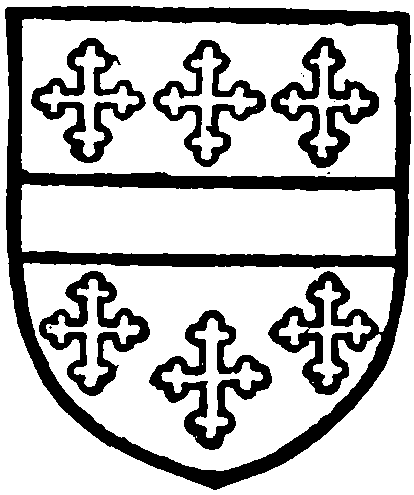
Beauchamp, Earl of Warwick. Gules a fesse between six crosslets or.
The Venetian trade is untowardly introduced by the notice of an affray between the mariners of five Venetian galleys on the one side and the townspeople on the other in April, 1323. Blood was shed and property destroyed, but by desire of Edward II the mayor and community forbore from pressing the quarrel with these wealth-bearing strangers, and the matter was patched up by a money compensation. (fn. 310) The prosperity of the port increased, and eventually, it seems, incurred the jealousy of the London merchants. (fn. 311) In 1378 special inducement was held out to the Levant trade by Act of Parliament, (fn. 312) which gave Genoese, Venetian, Catalonian, and other merchants a privilege of freely trading at 'Hampton,' or elsewhere, provided they paid the dues they would pay at the staple of Calais; provided also they carried their exports of wool, woolfells, &c., westward to their own countries and no farther eastward than to Calais 'if they desired to go there.' As a matter of fact the offer of these advantages, and of a shortened voyage, brought the ships to 'Hampton'; and from the date of the above grant they came with the regularity of the seasons for the next 150 years, from three to five galleys being commissioned by the Doge each season, and the port remained the centre of the Venetian trade in the kingdom; but the hindrance to the foreign purchase of wool towards the middle of the sixteenth century (fn. 313) soon involved the loss of the galleys, though the town books note the presence of some few Venetian ships very occasionally as late as 1569. (fn. 314)
In the reign of Henry V much shipbuilding was carried on at Southampton. Here he built his famous ships, the Holy Ghost in 1414 and the Grace Dieu (fn. 315) in 1417. The trade had never been unknown here, and was occasionally revived, as in the reign of Elizabeth, and rather conspicuously in the time of George III, and though no ships of war are now built here, the building and repair trade of a smaller class is carried on; and on the Woolston side of the Itchen the important works of Messrs. Thornycroft & Co. are established in succession to those of Messrs. Moody, Casney & Co. In the fifteenth century Southampton was also the great emporium for tin. In 1453 it was all arrested and required to be sold towards the cost of the army to be sent into Guienne. The tin-house is mentioned in the ordinances of 1478 and subsequently. (fn. 316)
A tailors' petition of 1474, direful enough in itself, bears witness to the constant presence in the port of 'carracks, galleys and ships' of Spain, Portugal, Germany, Flanders, Zealand, and others, which all, of course, brought their treasures and would carry away wool and other goods from Southampton. (fn. 317)
In spite then of shipping detentions, hindrances from war and invasion, piracies, and the other mishaps which waited on mediaeval commerce, Southampton prospered in the fourteenth and fifteenth centuries. It was a brisk centre still for its old trades, and a staple for metals (fn. 318) (1492); it could advance heavy loans on national requirements or become security for them. (fn. 319) But by the end of the first quarter of the sixteenth century we find the townspeople complaining of ill times, as they had never done before excepting possibly when suing for some fresh charter privilege. (fn. 320) Trade was falling off; and the bishop of Bangor (fn. 321) writes to Wolsey on his elevation by the king to Winchester, thereby becoming earl of Southampton, that the townspeople were expecting great things from him in their now smaller resort of shipping. (fn. 322) In 1533 the carracks and galleys were not coming as they used. (fn. 323) But in truth, from whatever cause, decay had been slowly creeping over the port. It is referred to in an Act of 1495, (fn. 324) again in 1523, while in 1531 the loss of trade was successfully alleged in abatement of the fee-farm. (fn. 325) At the middle of the century (1551) the expediency of establishing a free mart in England for cloth and tin was debated, and the experiment was to be tried at Southampton. Nothing came of this, but shortly after the town obtained a monopoly in the landing of sweet wines, (fn. 326) a privilege at least partially confirmed by Elizabeth in 1563, and worth at least 200 marks a year. The settlement of foreign refugees in 1567 did something in the long run for trade, though the town was loth to own it. Twenty years later Southampton is classed with Bristol and other best towns as falling to decay. (fn. 327) In the year of the Armada (1588) the mayor was unable to furnish the two ships and pinnace required. Nor do the town books of the period impress us with the concerns of the merchants at this time. The vessels were of small tonnage, the ownership divided: thus, among others, the Mayflower of 28 tons was let out in four several holdings. (fn. 328) Later on, in 1619, the mayor with difficulty provided £150 out of £300 required towards the suppression of piracy, and the complaint of burdens again falls heavily on the ear. Much of the town shipping was employed in the middle of the sixteenth century in the New-foundland fishery, (fn. 329) which also made its impress on the later town ordinances, (fn. 330) but a hundred years later had migrated to Poole. The Channel Islands trade was settled in the town from early in the sixteenth century, (fn. 331) wool being exported to the islands for the manufacture of stockings which came back to England for sale. The wine trade continued together with much smuggling.
It is not to be supposed that the depression of the town was suffered without an effort on the part of the townsmen. After the Fire of London the Corporation advertised the attractions of Southampton with its many very good houses with cellars and warehouses then standing vacant. The London sufferers, being men 'of credit and reputation,' were invited to throw in their lot with Southampton and open up fresh trade. (fn. 332) In the next century a similar offer, with that of free burgess-ship, was made to 'merchants of credit and substance' if they would come and help revive decaying fortune. (fn. 333) But the turn of fortune was not to come yet. (fn. 334)
Meanwhile turning to the interior trades of the townsfolk in the fifteenth, sixteenth, and seventeenth centuries, they are found to be of the usual kind, and mostly gathered into corporations, craft gilds, or companies, with a common hall, admitting their members by fine, and having relation to the town corporation, by which they were all supervised. The usual arrangement was for one half of admission fines to go to the particular craft or trade, and the other half to the town. The articles of these corporations were to be read publicly among themselves at least once a year. Thus in 1441 all the bakers were fined by the town. (fn. 335) In 1517 they were formed into a company with usual powers of self-government; two years later (1519) certain members of the craft having engrossed the making of ship-biscuits, all were ordered to bring their portions of biscuit into the hall over the market-place, there to be sold by the masters of the craft indifferently; any evasion of the order, which was agreed to before the mayor and his brethren, was to be visited by a mulct of 10s., namely, 6s. 8d. to the town and 3s. 4d. to the light of St. Clement; for further offence the loss of liberty in the craft corporation was awarded. (fn. 336) They had always to report to the town what stock of grain they had ready for the supply of the public; the same applies to brewers. In 1584 the fine charged for admission into the bakers' corporation was 26s. 8d., half going to the town, and half to the craft. (fn. 337)
The fine for barber-craft, which embraced common surgery, besides 'trimming' or hair-cutting, was also (1512) 26s. 8d., half to the town, and half to the craft. (fn. 338) The relations between the town and the barbers, who were often 'of a froward mynde,' were sometimes strained, but the following entry deals with conflicting jurisdiction. In 1638 a barber surgeon with episcopal licence having been amerced by the leet jury—he was not a Southampton product—and called before the House, said he had no respect for the House and never got 6d. by it, 'which proud and peremptorie language of soe meane a fellow in this place is not to be indured. It is therefore this day ordered that he finde sureties for his appearance at the next sessions of the peace there to answer etc.' (fn. 339)
Brewing was a popular trade and was constantly being regulated. In 1488 the fine for admission to beer brewing by the year seems to have been 10s. each man. (fn. 340) In 1531 for the avoidance of gambling and idleness, 'by reason that every other house is a bruer or tapper,' the number of brewers and tappers was strictly apportioned, and the brewers were forbidden to serve their customers otherwise than in the gross, on the principle, often repeated, 'that one may lyve by another,' the tapper being the retail dealer. (fn. 341) The beer supplied was of several strengths, all regulated and charged for according to a standard set ultimately by the town corporation, which otherwise looked after the brewers. They were allowed no iron on their cart wheels; such wheels not only meant 'decay' to the pavement, but caused 'the spurging of theire beere so that their barrels cannot come full to their customers.' (fn. 342) However, it had been the practice to bring round 'filling beer' to make up deficiencies, until the regulation came out (1579) that they must supply twenty-one barrels as twenty, and be particular that they all went out full. (fn. 343) The 'tipplers' i.e. the beer-house keepers may here be mentioned. They were being constantly regulated both corporately and individually; and in 1581 were ordered not to receive into their houses any of the common drunkards of the town, the names of some being given. (fn. 344)
In 1457 the butchers, whose chief market was by the Friars Gate, paid 4s. per annum for each stall, but 1d. if only taken for a day. (fn. 345) They were constantly being regulated, and seem to have had some unpleasant customs. (fn. 346) In 1555 they were formed into a company on the usual plan. In 1575 we find slaughter houses forbidden within the walls. In connexion with the butchers, bull-baiting should be mentioned. The bull-ring was in the upper part of the High Street; its use was supposed to make the meat more wholesome; its disuse in 1496 was visited by a fine of two loads of faggots. (fn. 347)
In 1507 two chandlers sufficed, who bound themselves to supply the town with tallow candles at ¾d. per pound. In 1576 we find the same number—early hours were kept; they were appointed for twenty-one years, one to serve the parishes of Holy Rood, St. Michael, and St. John, the other the parishes of All Saints and St. Mary. The butchers were to supply the tallow which was to be divided equally; and no form or regulation was too minute in this as in other trades. At the end of the period there was but one 'town-chandler,' who in 1598 was dismissed from his office, bitterly complaining of the terms set him by the town; but another was appointed. (fn. 348)
In 1504 the wardens and company of clothworkers (shearmen) came before the mayor and his brethren complaining of the infringement of their liberties by certain galley men, when several arrangements were made. (fn. 349) A hundred years later (1608) usurpers of their trade were again encroaching; they were made to pay the usual fine, half to the town and half to the company, for their privilege. (fn. 350) In 1616 a company of clothworkers was formed or reformed; and in 1629 they were fined £5 for not having read among themselves the articles of their incorporation. (fn. 351)
The fine of admission to the cappers (1502) was one mark divided equally, as usual, between the town and the master of the craft. (fn. 352) Early in the same century the cobblers were fined for breaking the rules of their corporation by giving strangers work. (fn. 353)
The coopers probably existed as something of a community from early times; but at all events in answer to a petition concerning infringements of rights in 1486 they received a charter from the corporation; no one was permitted to exercise the craft without having made fine in the usual way, under penalty of £5 to be levied by the mayor's command and divided equally between the town and the craft company. (fn. 354) In 1608 the admission fine was £4, one half to the town, the other to the society. (fn. 355)
Very similar to the petition of the coopers was that of the tailors in 1474 against the encroachment of strangers and foreigners, such as galley-tailors, &c. They received the desired concessions and gave the town £5 for them. (fn. 356) In 1616 the company was partially reconstituted, but as usual in all money payments, whether of admissions or of amercements, the interests of the town and the company were equally consulted. (fn. 357)
The shoemakers' (corvesers, cordwainers) company existed here at least in 1488, when the town steward acknowledges dues from the masters of the craft. (fn. 358) In 1550 seven fishmongers were appointed for the town, the arrangement being annual. (fn. 359) In 1553 the linen-hall which was in West Street was ordered to be used under severe penalties, a custom having arisen of stowing away linen cloth contrary to good order. (fn. 360)
The mercers had their craft company here before 1486, admission to which was in the usual way. (fn. 361) A company of serge-makers, serge weavers, and wool combers was formed in 1609, dissolved in 1620, and re-formed in 1657. (fn. 362)
Tobacconists were here before 1629. In 1632 retail tobacconists to the number of seven were licensed for the town. (fn. 363) Other trades of course there were, such as the bowyers in the earlier time, the vintners or wine-sellers at all times: but whether or not gathered into gilds or fraternities, they were equally held in the iron grasp of the corporation, not without at least occasional protest.
A 'sisterhood' for wool-packing consisting of thirteen women, two being wardens, existed here in the sixteenth century. They were sworn and their regulations are given at length. The employment of women in this capacity is said to have been customary from old times. (fn. 364)
A revival of the town may be dated from the commencement of the last century. From the rôle of a fashionable watering-place which Southampton was enjoying about the middle of the eighteenth century—with its distinguished company, its retired naval and military gentlemen, the occasional presence of warlike equipments and of royalty; its balls and concerts, and master of the ceremonies, its spa, and archery, its sea bathing, (fn. 365) its libraries, its theatre, its unrivalled coaching and beautiful drives—the Act of 1803 (fn. 366) for abolishing the 'petty customs,' making convenient docks, and calling the harbour board into existence, aroused her and may be said to have been the harbinger of Southampton's prosperity. The Act was amended by that of 1810, (fn. 367) but the formation of the docks was still in abeyance owing to the demand on capital by harbour and quay improvements already being carried out under the board. It was not until 1836 that the dock company was incorporated by Act of Parliament, the construction of docks being commenced in 1838. Meanwhile, the formation of a railway to London, which had been contemplated as far back as 1825, was taken in hand in 1830 and following years, the works being actually commenced in March, 1836; but it was not until 1840 that the whole line was opened from London to Southampton.
The docks were now rapidly advancing in construction. The great tidal dock, then the largest in England, which had been commenced in October, 1839, was opened in August, 1842. It contains a surface of 16 acres of water, 18 ft. deep at low water of spring tide, the average rise of tide being 13 ft.; its entrance 150 ft. wide. An inner or close dock with a surface of 10 acres of water, 28 ft. deep, was opened in 1851. The Itchen extension quay, with a frontage of 1,720 ft. and a depth of 20 ft., now deepened to 28 ft. at low water spring tides, was opened in 1876, and formed the first instalment of the Empress Dock, opened by Queen Victoria in 1890, and containing a surface of 18½ acres of water with a depth of 26 ft. at spring tide low water, and entrance 165 ft. wide. The first graving or dry dock was opened in July, 1846, entrance gates 66 ft. wide, length 400 ft., depth over blocks 21 ft.; the second, opened in 1847, entrance 51 ft., length 280 ft., depth 15 ft.; the third, finished in 1854, entrance 80 ft., length 521 ft., depth 25 ft.; the fourth (1879), entered from the Itchen, width 56 ft., length 450 ft., depth 25 ft. Since the purchase of the docks by the London and South Western Railway Company (1892) there have been constructed the 'Prince of Wales' graving dock, opened August, 1895, width at entrance, 91 ft., length 750 ft., depth to blocks, 32½ ft.; and the Trafalgar (graving), opened October, 1905, width at entrance 90 ft., length 875 ft., depth 33½ ft. Another open dock, contracted for in August, 1907, will have a depth at low water of 35 ft., to be increased to 40 ft., area 16 acres. The new quay extensions in the Itchen and the Test—the Prince of Wales Quay 2,000 ft. long, and South Quay 430 ft., have each a depth alongside of 28 ft. at low water, and the Test Quay, 1,600 ft. long, a minimum depth of 32 ft. No expense has been spared by the railway company to bring the docks to the highest efficiency, and to secure to the port the pre-eminence it now enjoys. The docks, the capabilities of which were experienced in the late South African War, have also the natural advantage of their position within one of the finest harbours of England, with a deep-water channel 5 miles long from Calshot Castle at its entrance to Southampton. The double tide (fn. 368) also at this port is of extreme value to shipping, the second high tide occurring about two hours and a quarter after the former, the fall between the two being only about 9 in., so that practically high water is stationary for nearly four hours.
In this connexion should be mentioned the splendid work of the harbour board on the quays and channels, and special notice should be made of the new pier, said to be the finest in the south of England, with ten landing stages, opened by the duke of Connaught, 2 June, 1892, in place of the older pier opened by the late queen when Princess Victoria in 1833. Part of this remains, but has been entirely reconstructed and is devoted to mercantile traffic, while the new pier is reserved for passenger business.