A History of the County of Hampshire: Volume 5. Originally published by Victoria County History, London, 1912.
This free content was digitised by double rekeying. All rights reserved.
'Parishes: Binstead', in A History of the County of Hampshire: Volume 5, ed. William Page (London, 1912), British History Online https://www.british-history.ac.uk/vch/hants/vol5/pp151-155 [accessed 9 May 2025].
'Parishes: Binstead', in A History of the County of Hampshire: Volume 5. Edited by William Page (London, 1912), British History Online, accessed May 9, 2025, https://www.british-history.ac.uk/vch/hants/vol5/pp151-155.
"Parishes: Binstead". A History of the County of Hampshire: Volume 5. Ed. William Page (London, 1912), British History Online. Web. 9 May 2025. https://www.british-history.ac.uk/vch/hants/vol5/pp151-155.
In this section
BINSTEAD
Benestede (xi cent.).
Binstead, a small parish of 1,206 acres, including in 1905 299½ acres of arable land, 476¼ acres of permanent grass, and 253 acres of wood, (fn. 1) extends from Ryde to Wootton Creek. It is separated from the modern parish of Ryde by the small stream flowing into the Solent east of Binstead Church. The village consists of a line of cottages and small houses on either side of the Ryde to Wootton road. The better inhabited part lies to the north, where many superior villas have been built overlooking the Solent. The ruins of the Cistercian abbey of Quarr lie within the parish, as also the ancient quarries from which it took its name. The position of these latter is clearly indicated by the irregular ground between the high road and the lane to Quarr. The stone, a tough, hard, shelly limestone, used as far back as the Roman occupation, (fn. 2) has practically ceased to be quarried, though a small seam has lately been opened in the copse to the west of the church.
There is a small hamlet at the mouth of the creek, consisting of the coastguard station and a few small villas and cottages, which doubtless represents the place called Fishbourn or Fishhouse, upon the coast, which the Abbot of Quarr in 1365–6 had licence to inclose with a wall of stone and crenellate. He was also permitted to build castles and fortalices there. (fn. 3) A messuage called 'le Fysshehouse' was granted in 1544 to John and George Mill. (fn. 4) Near Wootton Bridge is the 17th-century house called Kite Hill belonging to the Fleming estate, the residence in the 18th century of James Perry, whose daughter married John Popham and lived on there with her husband. It has been somewhat modernized, but retains its original plan of a central block with projecting wings.
Samuel Woodford (1636–1700), the divine and poet, lived at Binstead 'in a married and secular condition.' (fn. 5)
MANORS
At the time of Domesday BINSTEAD, which Tovi, the king's thegn, had held as a free manor of the Confessor, belonged to William son of Stur. (fn. 6) It would appear that Binstead must afterwards have passed to the Crown, as it is probably to be identified with half a hide in the Isle of Wight, whence stone might be quarried for the cathedral church of Winchester, granted by William the Conqueror to Walkelin, Bishop of Winchester. (fn. 7) This grant William Rufus extended by leave to dig for stone throughout the Island where quarries existed, (fn. 8) and Henry I in a precept to Richard de Redvers bade him, somewhat peremptorily, allow the monks of St. Swithun's to take their due. (fn. 9) Indeed, some friction must have arisen between the new lord of the Island and the bishop, as the precept concluded with the significant words, 'Quod si non fecis, Alveraldus de Lincoln faciat ecclesiae et episcopo habere,' and a further command was sent him to allow the monks to hold their land, increased to a hide, peaceably and to quarry stone without let or hindrance. (fn. 10)
Binstead, as a member of the episcopal manor of Swainstone, (fn. 11) remained with the see of Winchester till the surrender of that manor to Edward I in 1284. In 1292–3 it was found that the king's quarry at Binstead could supply stone for the fabric of the abbey church of Quarr as well as for any work the Crown might wish to undertake in the Island, so the abbot was to be allowed to dig and remove what stone he required, paying at the customary rate of 40d. a 'millena.' (fn. 12) The history of the manor is identical with that of Swainstone (q.v.) till the attainder of the Countess of Salisbury in 1541. (fn. 13) It was granted in 1544 to Sir William Berkeley, (fn. 14) who sold it in the same year to John Mill of Southampton. (fn. 15) It then passed with Nursling to Sir Richard Mill, by whom it was sold in 1609–10 to Sir Thomas Fleming. (fn. 16) The manor has since followed the same descent as North Stoneham (fn. 17) (q.v.) and now belongs to Mr. John Edward Arthur Willis-Fleming, the present representative of the family, who has a residence at Binstead House.
It seems probable that the abbey of Quarr was built on the manor of NEWNHAM, for in the taxation of the abbey lands in 1291 no land at Quarr is mentioned, while the land at Newnham heads the list of the abbey's possessions in the Isle of Wight. (fn. 18) Further, in the valuation of the possessions of the abbey in 1536 under the heading 'Quarr' is included the manor of Newnham with the site of the abbey. (fn. 19)
The manor, therefore, probably belonged to the abbey from its foundation in 1131. The abbot and convent obtained a grant of free warren in all their lands including this manor in 1284. (fn. 20) The possessions of the abbey at Newnham in 1291 were valued at £10, (fn. 21) and in 1536 the manor with the site of the monastery was worth £11 19s. 4d. (fn. 22) The site of the abbey and the grange of Newnham were leased in 1537 for twenty-one years to John Mill of Southampton, (fn. 23) and this estate with the manor of Quarr was granted in 1544 to John and George Mill. (fn. 24) The manor of Newnham, the site of the abbey, and the southern portion of the manor of Quarr from that time followed the descent of Binstead Manor, and now belong to Mr. John E. A. Willis-Fleming, but the northern part of the manor of Quarr called the Quarr House estate was sold about 1858 to Admiral Sir Thomas Cochrane. His son sold the house and grounds in 1907 to the Benedictine community from Solesmes, who have recently erected conventual buildings on the site.
Newnham Farm is of the 17th century, but has been added to in the 18th century, and a series of initialled dates cut in the brickwork over the east door refer to a family of Young, tenants of the manor in 1774. (fn. 25)
QUARR ABBEY
The Cistercian house of our Lady at Quarr was founded in 1131, by Baldwin de Redvers, as a colony from Savigny, and was consecrated 1 June 1150. A licence to wall and crenellate was granted in 1340, and this work was still in progress in 1366. The abbey was dissolved in 1537.
The existing remains are scanty, but present the general features of a normally arranged Cistercian house, save for the fact that all the conventual buildings are on the north instead of on the south side of the church. (fn. 26) The church was completely demolished at the Dissolution, so that its very site was uncertain sixty years later, when Sir John Oglander visited the spot.
The fragments revealed by excavation indicate that the general type of architecture in the church and the greater part of the conventual buildings was that of the middle of the 13th century. For the most part nothing can be recovered beyond the foundation plan, the foundations themselves having been dug out in many places. The portions of the abbey left above ground are a great part of the cellarium, of which the southern end has been converted into a barn; parts of the kitchen, part of the south-west walls of the frater or refectory, and two buildings believed by Mr. St. John Hope to be the wood-house and the infirmary chapel.
The church was of the usual Cistercian type, consisting of a presbytery, quire and nave, together about 160 ft. long and 26 ft. wide, north and south transepts about 35 ft. north to south by 20 ft. east to west, each with an eastern aisle 15 ft. wide, of three bays, and containing a chapel in each bay, with dividing walls between, and nave aisles about 10 ft. wide. Apparently at a later period north and south chapels were built to the presbytery, lining with its east wall, and with the southernmost and northernmost bays of the north and south transept aisles respectively, and a porch or galilee some 16 ft. deep was built right across the west end of the church, while a chapel 50 ft. long by 20 ft. wide covered the southern end of this porch as well as the two westernmost bays of the south aisle of the church. The northernmost of the north transept chapels appears to have been lengthened about the same time.
In the thickness of the presbytery wall on the north, and just west of its junction with the east wall of the north transept aisle, is a grave, apparently constructed during the building of the church. This was probably the founder's tomb. When opened in recent years it contained the bones of a tall man and a woman, but showed indications of previous disturbance.
The clearstory appears to have been lighted, as at Netley, by triple lancet windows, of which fragments are to be found in the modern farm buildings at the south end of the cellarium. If this was so, the usual western progression of the church is plainly indicated, though, by analogy with Buildwas, which Quarr closely resembles in general proportions, the use of the pointed arch is no evidence of late 'transitional' date.
Of the existing buildings the most considerable portion is the southern end of the cellarium, which extended northwards from the western portion of the church; a doorway opened to it from the porch next to the west wall of the church. Another wide doorway in its east wall opened into the north aisle of the church, opposite to a corresponding opening in its west wall, thus forming a clear way, doubtless partitioned from the rest of the cellarium, from the outside to the church. This southernmost portion of the cellarium therefore practically formed an extension of the north aisle. Another and smaller doorway in the west wall stands opposite to a window looking into the cloister. To the north again a window in the west wall faces a narrow doorway in the east wall opening to the cloister, and a little further north is a narrow loop in the west wall, with a wide window opposite to it. Most of these are blocked, and the upper part has been rebuilt in the 17th century. There are no traces of any sub-vault, though a set-off runs along both walls for about two-thirds of the present length, at about 9 ft. 6 in. from the present floor level. A circular light in the north wall and a blank window in the east gable have been brought from elsewhere. At the north-east angle of the cellarium, and forming the western part of the north range of the cloister, are the remains of the kitchen. Apparently there were two entrances from the cloister. Near the easternmost is a deep recess. The fireplace probably stood in the north wall, which was 9 ft. thick. In the east wall are a locker and a hatch to the frater. The shelf grooves of the locker appear to be of Roman tiles. Next the kitchen to the east remain portions of the south and west walls of the frater, which ran north and south. In the south wall the western jamb of the great door, raised by two steps from the cloister, remains. It had Purbeck marble capitals and jamb shafts. There are traces of arcading on the interior walls, and the hatch to the kitchen, on the frater side, has jamb shafts and a segmental head. In the south-west angle are two lockers, also with segmental heads. A lavatory recess was just to the east by the frater door, in the cloister. Next to the frater on the east, and completing the north range, was the warming-house, with a recess and a large fireplace in the east wall, and a doorway to a yard in the north wall. From the yard a passage led northwards to the building considered by Mr. St. John Hope to have been the wood-house. It opened northwards to other apartments, and possibly to a passage to the reredorter.
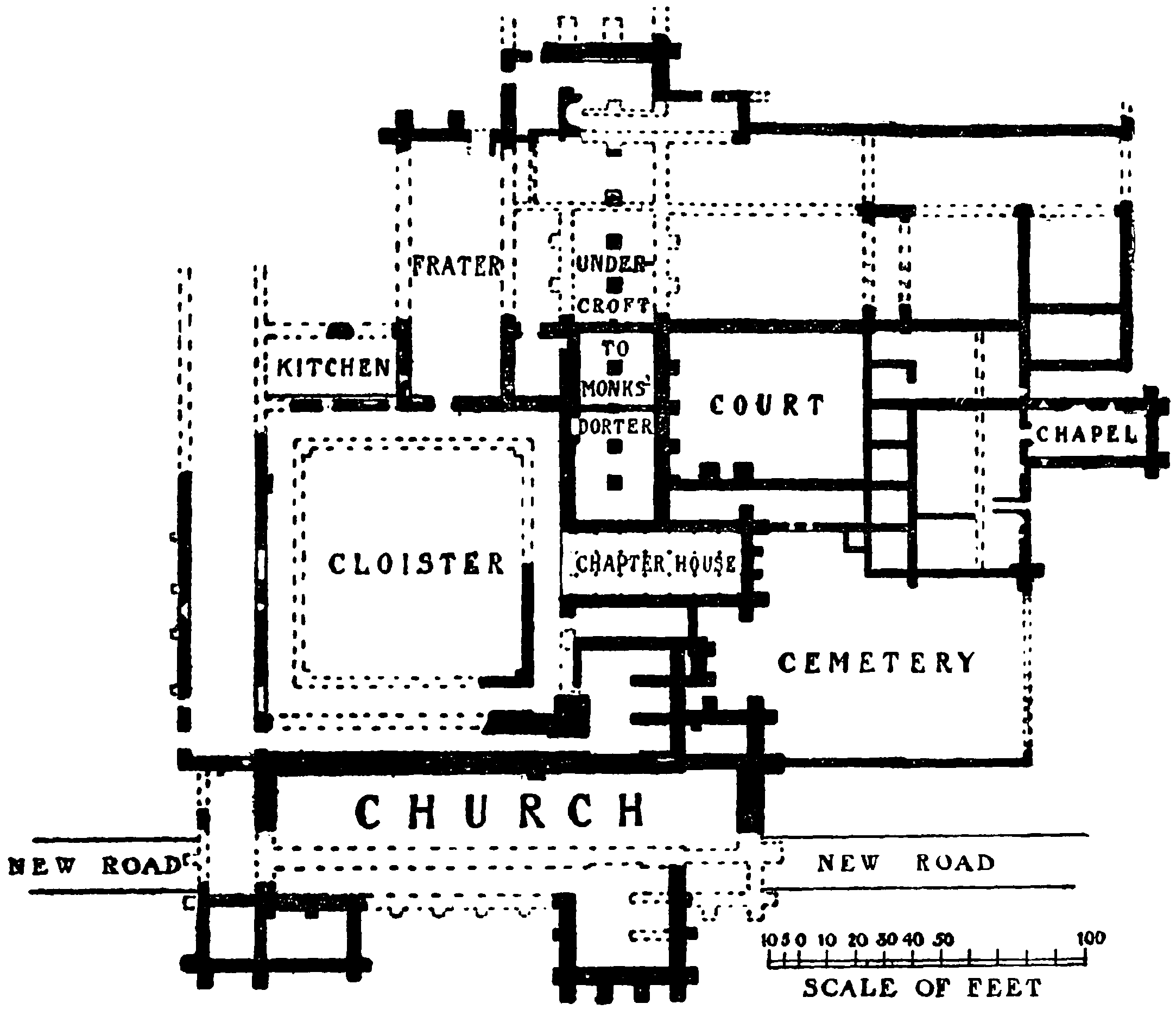
Sketch Plan of Quarr Abbey
The dorter undercroft, of which the southern end formed the north half of the eastern range of the cloister, projected northward till it was stopped by the wall of an apartment between it and the passage to the reredorter. It had a central row of seven columns, and was doubtless vaulted and divided into several chambers. In the third bay from the south is a deep recess in the western wall. To the south of it was the chapter-house, which was divided into three alleys by two rows of six columns, supporting the triple vault of seven bays, and was entered from the cloister at the west end by a triple doorway, or arcade of three bays, of its full width, supported on groups of three shafts, one row of four shafts on each of the three steps down from the cloister. The two outer rows were cylindrical, the lower ones thicker than those on the top step. Those on the lowest step were, like all the rest of the columns in the chapter-house, of four slender columns clustered round and attached to a central thicker shaft. The columns on the two descending levels were stilted on plinths to bring the bases of all three rows to a common level, and the bases of all the columns in the chapter-house itself were brought to this level by similar plinths. Each group of three columns on the steps was linked together by a little arcade of moulded arches running through the thickness of the entrance arch. The lowest row not only matched the other columns of the chapterhouse, but also formed the westernmost supports of the three alleys of quadripartite vaulting. A wall arcade ran round the three remaining sides of the building, its shafts being exactly like those of the free arcades, and almost completely detached from the wall. Between their plinths was a stone bench-table. All the bases, shafts and capitals throughout the building were of Purbeck marble, and the ribs of the vault were of freestone. Externally pairs of rightangled buttresses stood at the east angles, with two smaller buttresses between the bays of the east wall.
Alongside the chapter-house to the south, between it and the north transept of the church, was a slype leading from the cloister to the cemetery. It is possible that the sacristy may have been in the small extension of the northernmost transept chapel, but its position is uncertain. At the east end of a long passage or pentice leading from the dorter subvault along and beyond the north wall of the chapterhouse, and forming the south side of the infirmary court, lay the infirmary hall, a large building of three aisles running north and south. The west aisle was at a later date divided into rooms by partition walls. Opening off the hall on the east is a building, still partially standing, which is thought by Mr. St. John Hope to have been the infirmary chapel. It was a building of two stages of late 13th-century date, and its western doorway, opening to the infirmary hall, was pointed, with shafted jambs and a segmental rear-arch on the infirmary or western side, where the jambs were also shafted. This doorway formed the central arch of an arcade across the western end of the building, the other two arches inclosing recesses with stone benches in them. It had a window on the north-west with a pointed head and shafted jambs, a wide internal splay and a pointed and moulded rear-arch. A similar window was opposite in the south wall. In the middle of the north is a wide fireplace, of at least a century later, with a square head and panelled sides, and eastward of it a doorway to the open. There was another fireplace in the upper stage at the west end. It seems very likely that, whatever the original purpose of the building may have been, it was converted into a misericorde in the late 14th or early 15th century.
The rest of the remains of the monastery are so fragmentary as to make conjectural restoration idle. The new road to Ryde was driven some forty years since right through the southern half of the foundations of the church from east to west, and many other indications of buildings on the site are no less completely obliterated.
CHURCH
The church of the HOLY CROSS stands on the high ground at the northeastern corner of the parish, and consists of a nave and chancel built of the local stone, the employment of which probably accounts for the apparently early 'herring-bone' work in the walls. (fn. 27) The church was probably erected for the use of the workers in the quarries, c. 1150, and was originally much as it is shown in Tomkins' print of 1795. (fn. 28)
From Tomkins' print of 1794, Sir Henry Englefield's description of 1816, and Mr. Withers' notes and drawings in Weale's Quarterly Papers, the church originally consisted of a nave and chancel, separated by a plain semicircular arch springing from roughly carved Romanesque imposts and lighted by small narrow single lights. (fn. 29) In the latter part of the 13th century a remodelling must have taken place, as is shown by the windows of that period still remaining and the vestry door now walled up. A south porch was added in the 18th century, and in 1844 the nave was pulled down bodily and rebuilt. The south wall of the chancel has a square-headed low-side window, and in the sill of the south window is a trefoiled piscina. In the outer face of the north wall is an aumbry recess, and below the east window, now blocked by the modern reredos, is another recess, the door of which, with its 15th-century hinge, (fn. 30) is in the vestry. In the west wall two Romanesque keystones have been built in, as has also a rude representation of the Sanctus Spiritus over the porch. All three came from the ancient nave, as did also the present entrance to the churchyard, which was originally the north door of the church. In the new belfry hangs an ancient bell inscribed in black letter 'Sancta Maria ora pro nobis,' which may have come from Quarr. There are no monuments of any interest, but in the churchyard is a pictorial headstone to Thomas Sivell, 'cruelly shot on board his sloop by some officers of the Customs at the Port of Portsmouth, June 15, 1786.' Sir John Oglander notes that one of the early pioneers of Arctic research, Captain John Gibbons, 'comminge from ye northwest passage—being imployed thethor for ye discoverie of that passage by Prince Henry, sonn of Kinge James … dyed at Ride and … wase buryed in ye midle of ye chawncell' (of Holy Cross, Binstead). (fn. 31)
The plate is modern.
The registers are in three books: (1) burials 1710 to 1759; (2) baptisms and burials 1758 to 1812; (3) marriages 1755 to 1812.
ADVOWSON
The advowson has always been, as now, with the see of Winchester, (fn. 32) and on the surrender of the bishop's lands in the Isle of Wight in 1284 was specially reserved with those of Calbourne and Brighstone, the king resigning 'all right he might claim to the said churches by reason of his manor of Sweyneston or for any other cause.' (fn. 33) The rector of Calbourne claimed archidiaconal jurisdiction over Binstead, but was resisted in 1321 by the parson of Binstead, John de Witney, who, however, had to give way and resign in favour of Nicholas de Yestele (Eastleigh), collated by the bishop. (fn. 34)
The church paid a yearly pension of 2s. to Winchester, (fn. 35) and was served in the 16th century by an obedientiary of Quarr. (fn. 36) After the Dissolution, Sir John Oglander notes, (fn. 37) the rectors assumed the abbot's privilege of marrying without licence and proving wills, 'and all thinges that ye Abbot in former times cowlde doo; whereupon ye parsons for longe time afterwardes weare called Bischoppes of Binsteede. But that power, as it wase butt usurped, so it wase taken from them when Bilson and Andrewes weare Bischoppes of Winchester' (fn. 38) (1597–1628).
There is a Nonconformist chapel (Wesleyan).
The schools are non-provided, worked by the Local Education Authority in conjunction with local managers.
There do not appear to be any endowed charities or permanent institutions in this parish other than the National school. (fn. 39)