A History of the County of Hampshire: Volume 5. Originally published by Victoria County History, London, 1912.
This free content was digitised by double rekeying. All rights reserved.
'Parishes: Brading', in A History of the County of Hampshire: Volume 5, ed. William Page (London, 1912), British History Online https://www.british-history.ac.uk/vch/hants/vol5/pp156-170 [accessed 30 April 2025].
'Parishes: Brading', in A History of the County of Hampshire: Volume 5. Edited by William Page (London, 1912), British History Online, accessed April 30, 2025, https://www.british-history.ac.uk/vch/hants/vol5/pp156-170.
"Parishes: Brading". A History of the County of Hampshire: Volume 5. Ed. William Page (London, 1912), British History Online. Web. 30 April 2025. https://www.british-history.ac.uk/vch/hants/vol5/pp156-170.
In this section
BRADING
Brading, originally said to have included the whole of the eastern seaboard from Ryde to Bonchurch, is one of the largest parishes in the East Medine. Till 1894 Bembridge and Sandown lay within its boundaries, and the chapels of Yaverland and Shanklin owned Brading as their mother church. The parish now contains 5,524 acres of land, of which 18 acres are covered by water, 2,008½ acres are arable land, 2,462 acres are permanent grass, and 246½ acres are woodland. (fn. 1)
The town lies under the chalk down of the same name at the head of the haven, about 4 miles south from Ryde. The oldest part is the main street on the slope of the hill running south from the church to the Bull Ring, many of the houses being halftimbered and dating from the 16th–17th century, the most noticeable being that adjoining the south side of the churchyard, (fn. 2) and a cottage opposite the west end of the church with the inscription cut on the lintel 'William Southcot. 1698.' A house called Crouches on the west side of the High Street, near the Mall, has a date-stone in the gable—
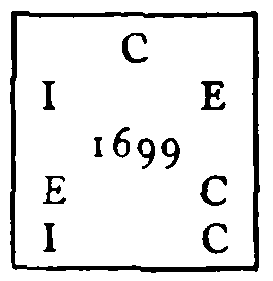
Date-stone in gable of house 'Crouches'.
The town hall by the west end of the church is an ancient half-timber building restored in 1876. It was within the upper room that the bailiffs and burgesses met to transact business until the middle of the 18th century, when it was converted into a school. (fn. 3) In 1902 the quaint old 'Malting' by the Bull Ring was pulled down and the present town hall erected and opened the following year by H.R.H. Princess Henry of Battenberg. The cottage once occupied by the subject of Legh Richmond's tale, The Young Cottager, lies on the right of the lane here leading to the down.
The main street rises from this point to the Mall, a street of villas built about the middle of the 19th century, and, crossing the down road to Newport at right angles, descends again by Morton Manor and joins the Sandown road by Morton House. The more modern road starts east from the Bull Ring, and with a sharp turn to the south runs parallel to the railway, meeting the ancient coach road by Morton Common. By the side of the road across the Sandown level is an ancient causeway, (fn. 4) formerly kept up by the lords of Yaverland. (fn. 5) A bridge existed here from an early date, and was repaired in 1641. (fn. 6) The road, under the down, from Adgestone and Alverstone crosses the upper or old road by Morton Manor, and the lower or modern road by Yarbridge, where is a quaint little inn, 'The Angler's Arms.'
Formerly the water in the haven came up to the present cement mills, where remains of the quay are still visible. Besides these cement works there are lime kilns on the upper road by Morton and brickworks at Sandown.
In 1880 a Romano-British villa was found in a field at Morton, (fn. 7) but was a good deal damaged when first excavated. The northern portion, however, on the Nunwell estate was more carefully and systematically uncovered and cared for, and at present the whole villa has been roofed in and the finds cased and arranged at the cost of the lord of the manor, Mr. J. H. Oglander, LL.B., F.S.A., D.L.
The haven level is said to have been first reclaimed from the sea by William Russell, an early lord of the manor of Yaverland, who at the end of the 13th century made the causeway across the marsh to his manor of Yaverland. In 1562 George Oglander of Nunwell and German Richards of Yaverland reclaimed the north marsh and some land adjoining. (fn. 8) Thirty-two years later Edward Richards added the Mill Marsh to the cultivated land. (fn. 9) In 1616 Henry Gibb of the king's bedchamber obtained a grant of 'lands called Brading, Isle of Wight, which have been much overflowed by the sea and are to be inclosed at his expense.' (fn. 10) This right he sold to Sir Bevis Thelwall, who, assisted by Sir Hugh Middleton of New River fame, made an embankment right across the mouth of the haven in 1620. Ten years later a spring tide and storm breached the bank, swept in over the land, and once more reduced the haven to a tidal estuary. An abortive attempt was again made in 1699, but nothing further was done till Jabez Balfour took the matter in hand in 1877 and constructed the present embankment, which was completed in 1880, the railway being opened for traffic in 1882.
There are church schools on the east side of the road to the north of the church, built at the cost of John Long of Brading, who left by his will, dated 19 February 1823, £300 for that purpose. There is a council school in the Mall, and a school at Alverstone supported by Lord Alverstone.
Bembridge, which was constituted a civil parish in 1896, (fn. 11) includes all the eastern peninsula beyond Yaverland. It comprises 2,000 acres of land, of which 20 acres are covered with water, 495½ acres are arable land, 826¾ acres are permanent grass, and 84 acres woodland. (fn. 12) Since the railway extension from Brading the old-fashioned village has grown to a favourite watering-place without the usual drawback of loss of picturesqueness. Lane End, near the extreme eastern point, where there is a National Lifeboat station, is now being rapidly transformed into a collection of houses and cottages for summer visitors. There is a post-office in the village not far from the head of the pleasant, leafy road called Ducie Avenue, leading to the sea. At Foreland there is a coastguard station, also a few cottages, and the Crab and Lobster Inn. To the south-east of the parish is White Cliff Bay (la Blanche Falaise, xiv cent.), wellknown for the interesting geological section of its cliffs, of which Bembridge Down, 355 ft. above the sea level, forms the southern arm. On the summit is a granite obelisk, erected in 1849 by the Royal Yacht Squadron in memory of their Commodore, the Earl of Yarborough, and a Marconi station in charge of the coastguard. There is a church school, a well-built structure erected in 1833 and enlarged in 1897. There is a station on the Isle of Wight railway, and there are two good hotels, the 'Bembridge' and the 'Spithead,' the latter being the head-quarters of the Royal Isle of Wight Golf Club, which has a nine-hole course on the Dover. There is a sailing club and club-house by the side of the railway station.
Sandown, a modern health resort, lies in the centre of the bay of the same name at the eastern end of the Yar valley. The civil parish was formed from Brading in 1894, and extended in the following year. (fn. 13) It consists of the upper road now called Broadway, the main road between Brading and Shanklin, and the lower road or High Street with connecting streets between. It has a good esplanade and an excellent beach for bathing. The principal hotels are the 'Pier,' (fn. 14) 'Ocean' (fn. 15) and 'Sandown.' The parish contains 1,231 acres of land, of which, in 1905, 359¾ acres were arable land and 515¼ acres permanent grass. (fn. 16) The soil is sand, gravel, and to the north clay. There are barracks (fn. 17) for artillery garrisoning the neighbouring forts. Sandown Fort has taken the place of the old Sandown Castle which in 1631–2 had been built to supersede the original fort erected by Henry VIII. The first Sandown Castle was built between 1537 and 1540 and formed part of the defence scheme of the southern seaboard. It was of the usual Tudor form with a rear building and a gun platform towards the sea and was erected on land now overflowed by the sea; it had a landing-stage, as in 1618 timber was supplied for mending the pier and planking the platform. As it was built too near the shore, the sea began to encroach and undermine its walls, which by the beginning of the 17th century had got into a ruinous state. In 1627 Charles I promised to have it repaired, (fn. 18) but nothing was done till 1631, when it was taken down by Sir John Oglander, (fn. 19) and a new fort built nearer Yaverland to the north, mostly from designs of two eminent military engineers, T. Reed and J. Heath. The new fort was now directly under the Governor of the Island, who was also called Captain of Sandown Castle, and the arms of the first holder under the new scheme—Richard Weston Earl of Portland—were carved over the mantelpiece. To prevent further encroachment of the sea two groynes were built in 1654. At the end of the 18th century it had again got into bad state, but was repaired at considerable expense. (fn. 20) In 1864 it was taken down and the present fort, known as the 'Granite Fort,' was built to the northward and probably completed in 1869.
The notorious John Wilkes had a villa at Sandown about opposite to where the present Ocean Hotel stands. Sandown possesses a town hall built in 1869, a free library opened in 1905, an excellent pier begun in 1878 and lengthened in 1895, and a public garden and Kursaal overlooking the sea. There is a Home of Rest at the Shanklin end of the parish, founded in 1893 by the late Mrs. Harvey and presented to the Winchester Diocesan Council of the Girls' Friendly Society.
Till the middle of the 19th century Sandown consisted of a few fishermen's huts and cottages, the only buildings of note being the old castle and Wilkes's villa. The old coach road to Brading ran across the heath by the church to the shore and so through what is now termed Lower Sandown to the road across the marshes.
BOROUGH
Fifty hides at BRADING are said to have been given by King Ine (c. 689) to the church of Winchester, but the authenticity of this grant is seriously doubted, (fn. 21) and no further connexion of the church with this land has been found.
Before the Conquest the manor (Berardinz) was held by Aelnod of King Edward as an alod, but in 1086 it belonged to William son of Azor, under whom it was held by his nephew. (fn. 22) The town of Brading which arose later was built on the manor of Whitefield, and the manor of Brading seems to have lost its identity, for in 1285 it is called 'Brerding, a member of the king and queen's manor of Whytefeld.' (fn. 23) Doubtless there was a hamlet of some sort at the head of the estuary in quite early times, but the first indication of the existence of the nucleus of a town occurs in 1285, when Edward I granted a market to be held at Brading every week on Wednesdays and a fair for four days at the feast of the Decollation of St. John the Baptist, with freedom from toll for five years for all persons buying and selling there. (fn. 24) It would therefore seem that the prosperity of Brading dates from the acquisition of the manor of Whitefield by the king.
At first the vill appears to have been farmed by the custodian of the Island for the time being, (fn. 25) and all pleas were made at the Court of Knights at Newport, (fn. 26) but before 1350 a court leet had been established at Brading, (fn. 27) the issues of which appear to have been let to farmers for the sum of £2 13s. 4d. a year. (fn. 28) By the end of the 14th century, however, it had become the custom for the king to lease the farm of the assize of bread and ale and pleas and perquisites of the courts and view of frankpledge to the bailiff and men of the town at a rent of £2 13s. 4d., (fn. 29) and from that time the affairs of the town were administered by the bailiffs and inhabitants, independently of the castle officers, subject only to the yearly fee-farm rent. This rent appears to have become appurtenant to the lordship of the Island. (fn. 30) It is said to have been sold by the Parliamentary Commissioners in 1650 to Daubeny Williams, (fn. 31) but was restored to the Crown at the Restoration. (fn. 32) It still belonged to the Crown in 1780, (fn. 33) but had been sold before the end of the century. (fn. 34) It belonged in 1878 to Georgiana daughter of George Young of Appley Lodge, Ryde. (fn. 35) A fee-farm rent of £2 13s. 4d. chargeable on 186 different properties in the borough is now paid by the trustees of the Brading Town Trust (successors to the bailiffs) to Mrs. Georgina Price.
The fee-farm rent was collected from every field in the borough and from some of the buildings. (fn. 36) Among the muniments in the custody of the present Town Trust is a custumal containing the mode of raising the fee-farm rent. (fn. 37)
The town has no charter of incorporation, but by the evidence of the court books its affairs were at first administered by two bailiffs and thirteen jurats. (fn. 38) At the beginning of the 15th century there appears to have been only one bailiff, but before the end of the century there were two. (fn. 39) In 1835 these officers were assisted by two justices, two constables, a steward, deputy steward and hayward. (fn. 40) The two bailiffs, senior and junior, were elected yearly in October. At a meeting composed of the two bailiffs then in office, the two justices (the bailiffs of the preceding year) and the deputy steward, one inhabitant of the town who had served the office of constable was chosen as senior bailiff, while two others with the same qualification were nominated as junior bailiff. One of these was elected at the next meeting of the court leet, at which the senior bailiff was presented. The constables were chosen at the same time and in the same way. (fn. 41)
The duty of the bailiffs, who composed the working body of the corporation, was to keep the records, give orders to the constables, receive the revenues and make all payments due from the corporation. They were nominal presidents of the court of pie-powder and summoned meetings of the court leet, but they appear to have possessed no magisterial power. The only function of the two justices appears to have been attendance at the meeting at which bailiffs and constables were elected. The constables managed the lock-up and stocks and warned the leet jury. (fn. 42)
The steward, who held office for life and was chosen at a private meeting of the corporation, had no duty beyond that of presiding once a year at the court at which the new officers were sworn in; the deputy steward, who was elected in the same way as the steward, and also held office for life, was judge of the court leet and made out the list of jurymen for the constables. The hayward had the management of the pound and received a small sum from the party concerned whenever he turned the key. (fn. 43)
The burgesses or free men of the borough enjoyed no privileges in 1835. They had formerly possessed certain rights of common, which they had lost, perhaps through non-user. The jury of the court leet, under the name jurats, seem to have formed an integral part of the corporation. They were selected from the householders of the town, and seem originally to have been thirteen in number, though in the 19th century seventeen were warned. (fn. 44)
It is doubtful whether a court was ever held for the borough apart from the court leet. The corporation books, which begin in 1550–1, contain, besides entries of courts leet and courts of pie-powder, entries of what are called 'assemblies.' (fn. 45) As, from the fact that the corporation had a common seal, received and paid fee-farm rents, had power to tax the inhabitants of the town and to exclude traders except on payment of a fine and rent, it would seem that there must have been some court besides an ordinary leet, these 'assemblies' were perhaps originally borough courts. As the attendants at the two courts would, after the attendance of the inhabitants of the town at the court leet ceased to be required, have been the same individuals, the two probably became confused at an early date and there is nothing in the court books to distinguish one from the other. At the court leet the constables and hayward were elected, weights and measures were inspected, nuisances presented and fines imposed, and the ordinances and customs of the borough presented. (fn. 46)
The court of pie-powder was granted to the town by a charter of Edward VI in 1547. (fn. 47) In 1835 it was a mere form and the stallage collected amounted only to a few pence.
The Wednesday market was changed in 1309 to Tuesday by a grant of Edward II to his niece Margaret wife of Piers Gaveston, the grant of the fair being confirmed to her, and proclamation of the change being issued in the following year. (fn. 48)
In 1547 by a charter of Edward VI the market day was again changed to Wednesday and two fairs were granted, one for three days at the feast of the Apostles Philip and James (1 May), and the other for two days at the feast of St. Matthew the Apostle and Evangelist (21 September). (fn. 49) The market and fairs were still regularly held in 1835, (fn. 50) but the market was obsolete before 1859, and the two fairs held in May and October were of small importance. (fn. 51) The fairs were held on Brading Down and became such a cause of trouble that they were discontinued towards the end of the 19th century.
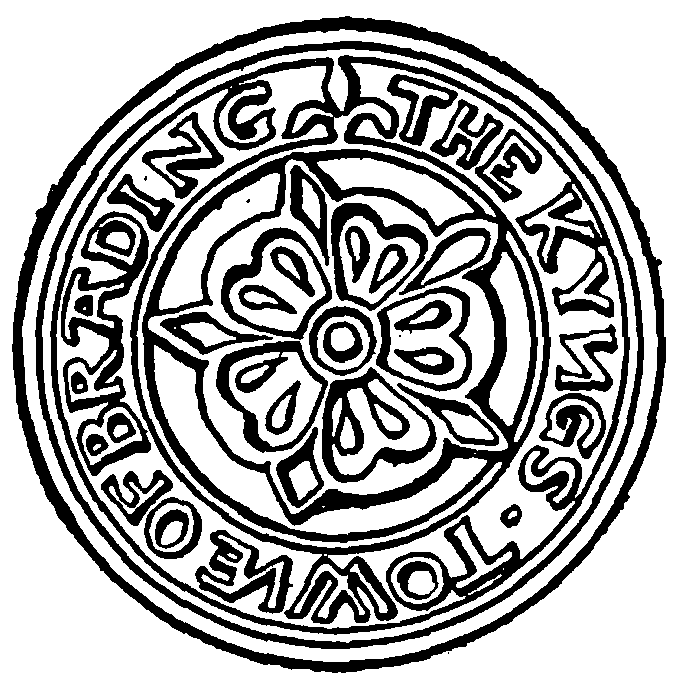
Seal of Brading
The corporation had power to impose a fine of 3s. 4d. on all tradesmen setting up business in the town and demanded a small annual sum afterwards. (fn. 52) In 1878 the corporation derived about £72 15s. 9d. from rent and tolls. (fn. 53) A sum of £1 per annum was paid by the schoolmaster for the use of the town hall as a school. (fn. 54)
The official seal of the 16th–17th century is still in existence—a Tudor rose with the legend 'THE. KYNGS. TOWNE. OF. BRADING.' Among the muniments preserved in the court-room of the old town hall are the charter of Edward VI and a custumal which bears at the head the Tudor rose and the title 'The Kinges Town of Brardinge,' the records of the courts comprised in six volumes (fn. 55) and a court leet book and custumal of 1723 with two poor-rate books of 1816–27.
By the Municipal Corporations Act of 1883 the corporation of Brading was dissolved in 1886 (fn. 56) and a town trust was formed to administer the borough property.
MANORS
WHITEFIELD
WHITEFIELD (Witesfel, xi cent.; Whytefeld, xiii cent.) is the principal manor in the parish, of which it forms the north-west angle. There are two entries in Domesday referring to Whitefield, then in the possession of William son of Stur. The first, held of him by Rainald, had a saltern and was worth 20s.; the second, held by him in person, was of considerable value, having three mills and being worth £7. Both had been held as alods of King Edward, the first by Chetel, the second by Godric. (fn. 57) The overlordship of the manor remained with the owners of Gatcombe, the descendants of William son of Stur, until the end of the 13th century. (fn. 58)
The manor early gave name to a family and was granted in 1158 by Hugh de Witvil or Wyvill to the abbey of Quarr, (fn. 59) with whom it remained till John de Witvil disseised the monks at the end of the 12th century. (fn. 60) In 1333–4 the Abbot of Quarr ineffectually sued the king for this manor. (fn. 61) In the 13th century Whitefield came into the possession of the Tracy family and was sold in 1279 by Joan wife of William de Tracy to John de Hardington. (fn. 62) John, who died in 1292–3, had demised the manor for the term of his life to the king, (fn. 63) who seems to have entered on possession of the manor after John's death, presumably in default of heirs. (fn. 64) In 1302 he granted it, among other lands, for the support of his daughter Mary, who had taken the veil at Amesbury. (fn. 65) The manor was granted in 1312 to Prince Edward, (fn. 66) but Mary probably drew its revenues till her death about 1332, when it reverted to the Crown. (fn. 67) It remained a Crown possession subject to numerous grants and leases (fn. 68) until 1628, when it was given by Charles I as security for his debts to the City of London, (fn. 69) and sold by the trustees in 1630 to John Oglander of Nunwell. (fn. 70) The manor has since descended with Nunwell (fn. 71) and is now the property of Mr. J. H. Oglander.
ADGESTONE
ADGESTONE (Abedestone, Avicestone, xi cent.; Auythestone, xiii cent.; Aucheston, xv cent.; Aidotone, xvi cent.; Ageston, xvi cent.; Adgestone, xviii cent.) was held of the Confessor by three freemen as a free manor, and at the time of Domesday was in the hands of the king. (fn. 72) Two other holdings called Avicestone, held in 1086 by William son of Azor and by Edric the king's thegn, may be identified with Adgestone. (fn. 73) At the end of the 13th century John de Weston held half a fee of John de Insula (Lisle) in Milton and Adgestone, and the lord of Whitefield held a fortieth of a fee in Adgestone of the honour of Carisbrooke Castle. (fn. 74) The latter holding belonged in 1299 to John de Witvil or Wyvill, and passed afterwards to Edward de Whitefield, and from him to William de Whitefield. (fn. 75) Anna Witvil or Wyvill held land at Adgestone in 1384–5. (fn. 76) The former followed the same descent as Milton (q.v.) until 1431, when it was held by John Haket and John Roucle or Rookley. (fn. 77) After this date it seems to have passed with Brook to the Bowermans, as Joan Bowerman and her grandson Nicholas both died seised of land in Adgestone, which they held of the manor of Alverstone. (fn. 78) In the rental of Alverstone Manor, 8 October 1510, land in Adgestone was held by Thomas Fitchett, who did homage at Alverstone. (fn. 79) This suggests that part of Adgestone, probably the western portion, had been absorbed by Alverstone. In 1576 William Rogers held land in Adgestone, (fn. 80) for which he did suit at John Worsley's court at Bembridge. In the middle of the 19th century Adgestone was owned by Mr. E. Horlock, from whom it was purchased by the father of the present owner, Mr. Edward Granville Ward.
ALVERSTONE
ALVERSTONE (Alvrestone, xi cent.; Alfricheston, Aluredeston, xiii cent.; Alvredeston, xiv cent.; Auverstone, xvi cent.), where there was a mill worth 40d., was held before and after the Conquest by William son of Stur. (fn. 81) The overlordship passed with Gatcombe until the end of the 13th century at least. (fn. 82) At the end of the 13th century William de Aumarle was holding a fee at Alverstone. He died in 1288–9, leaving a son Geoffrey, (fn. 83) but the manor seems to have passed to Iseult de Aumarle, who was probably William's widow. (fn. 84) She married Geoffrey de Insula (Lisle) of Gatcombe, and he is returned in 1293–4 as holding this fee in her right. (fn. 85) Geoffrey de Aumarle died in 1320–1, but he does not seem to have been holding the manor. (fn. 86) Geoffrey's son William, however, held it at the time of his death in 1335–6, when it passed to his son William. (fn. 87) William the son died without issue, and his sister and co-heir Elizabeth married John Maltravers of Hooke, co. Dorset, by whom she had a daughter Elizabeth. As her second husband she married Sir Humphrey Stafford of Southwick, (fn. 88) and they were in possession of the manor in 1402. (fn. 89) Elizabeth daughter of Elizabeth and John Maltravers married Sir Humphrey Stafford, son of her mother's second husband, (fn. 90) and the manor of Alverstone remained in the Stafford family until the execution of Sir Humphrey Stafford, Earl of Devon, in 1469. (fn. 91) Alverstone passed to one of his co-heirs Eleanor Strangways, (fn. 92) and was sold in 1556 by her grandson Sir Giles Strangways to Henry Stower. (fn. 93) John Stower sold it in 1587 to Peter Fuller. (fn. 94) Peter sold it in 1597 to Richard Baskett of Apse, (fn. 95) of whose son Richard it was purchased in 1630 by Daniel Broad, (fn. 96) contemptuously termed by Sir John Oglander 'a pedlar's son in Newport.' Grace Broad, whose relationship to Daniel is not known, married Alexander Alchorne and had a daughter Grace, who married John Popham and was in possession of the manor in 1713 and 1728. (fn. 97) Grace died in 1735, but her husband still held the manor in 1746, (fn. 98) and must shortly after have sold it to Thomas Holmes, created Lord Holmes in 1760. (fn. 99) It then passed with Yarmouth until 1859, (fn. 100) when it was sold by William Henry Ashe A'Court - Holmes to Mr. Thomas Webster, Q.C., whose son, the present Lord Alverstone, (fn. 101) Lord Chief Justice of England, still holds it.
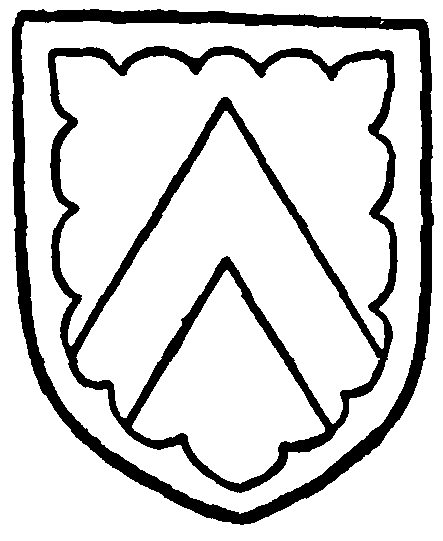
Stafford of Southwick. Or a cheveron gules and a border engrailed sable.
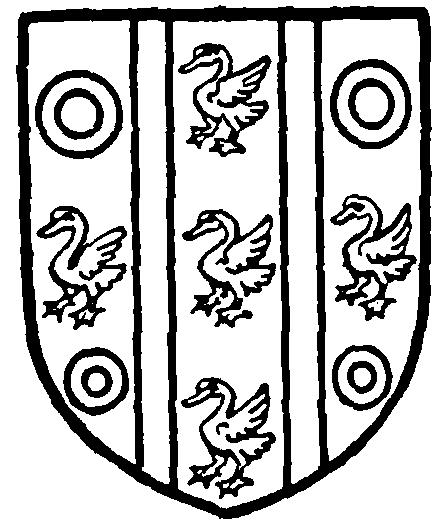
Webster, Lord Alverstone. Azure two pales or with five swans argent set crosswise between four rings or.
BARNSLEY
BARNSLEY (Benverdeslei, Benveslei, xi cent.; Bernardesle, xiii cent.).—There are two entries in Domesday which may be identified with this holding, the one belonging to the king, (fn. 102) the other to William son of Azor. (fn. 103) The latter, possibly the southern part now known as Hill Farm, was held under William son of Azor by Roger. In 1203–4 Juliana the wife of John de Preston gave to the Prior of Christchurch Twyneham, in return for a corrody, a third of a carucate in Barnsley which she held as dower. (fn. 104) The priory was in possession of a manor called Barnerdesligh at the Dissolution. (fn. 105)
Besides this estate there seem to have been two others at Barnsley, one held by the Trenchards and the other by the lords of Whitefield. In 1263 Henry Trenchard granted to Elias de la Faleyse a carucate of land in Barnsley to hold by service of one-seventh of a knight's fee. (fn. 106) Since the lords of Whitefield held their property under the Trenchards by the service of an eighth of a fee (fn. 107) it is possible that Elias' holding passed to them, and with Whitefield came into the hands of the king, who was holding it in 1316. (fn. 108) It appears to have become merged in Whitefield, and in 1589 William Oglander, farmer of Whitefield under the Crown, claimed Barnsley as included in his lease, but his claim was disallowed. (fn. 109) Barnsley, with Whitefield (q.v.), was granted by Charles I to the citizens of London, and by them conveyed to Sir John Oglander in 1630, and still remains with the family, being at present held by Mr. J. H. Oglander.
Another estate in Barnsley was held by the Trenchards in demesne, (fn. 110) and seems to have passed with Shalfleet to the Brudenells. (fn. 111) It may perhaps be identified with land in Barnsley sold in 1523 by Walter Dillington to William Lovell. (fn. 112)
The vill of BEMBRIDGE (Bynnebrigg, xiv cent.; Bichebrigge, xvi cent.; Bymbridge, xvii cent.) was held in 1316 by Robert Glamorgan, Peter D'Evercy, John de Weston and the heir of William Russell, (fn. 113) and the suggestion by Sir John Oglander (fn. 114) that the name arose as a general term for all the land lying east of the bridge connecting it with Brading may have some foundation in fact. It was divided at the beginning of the 16th century, like East Standen, between the Wintershill and Covert families, (fn. 115) and a third of it was conveyed by Richard Covert to John Meux in 1548. (fn. 116) From that time deeds relative to the manor are wanting, but it seems to have come in the reign of Elizabeth to the Worsley family and descended with Appuldurcombe till the middle of the 19th century, (fn. 117) when it was sold to Sir Graham Eden Hamond, the grandfather of the present owner, Sir Graham Eden William Graeme HamondGraeme, bart.
WOLVERTON
WOLVERTON (Ulwartone, xi cent.; Wolveton, xiii cent.) was held before the Conquest by Eddeva of Earl Godwine, and in 1086 belonged to the king. (fn. 118) Robert Glamorgan held it in demesne of Carisbrooke Castle at the end of the 13th century. (fn. 119) The Glamorgans, who were also lords of Brook (q.v.), held Wolverton until the death of Nicholas Glamorgan in 1362–3. Nicholas left sisters and co-heirs, one of whom, Nichola, married Thomas Haket. Eleanor, a second co-heir of Nicholas, married Peter de Veer, and her son John was in 1383 engaged in a suit against John Mortaine and Alice his wife as to the ownership of an eighth of the manor of Wolverton. (fn. 120) Peter de Veer seems to have enfeoffed Nichola Glamorgan of the manor, and as John and Alice called to warranty her son Walter Haket it may be assumed that she had transferred her interest to them. The suit was postponed on account of Walter's minority, and John Mortaine seems to have retained possession at least until 1397. (fn. 121) Another part of the manor passed with Brook to John Roucle or Rookley, and in 1431 the estate was held jointly by him and John Haket, to whom Mortaine's holding had reverted before 1428. (fn. 122) John Haket was said to be in sole possession of the manor in 1438, (fn. 123) and it passed with a moiety of Brook to his daughter Joan wife of John Gilbert. (fn. 124) Her grandson George Gilbert conveyed the manor in 1565 to Anthony Dillington, (fn. 125) who sold it in the same year to John son of Richard Worsley. (fn. 126) The manor then followed the descent of Appuldurcombe (fn. 127) until 1848, when it was sold to Sir Graham Eden Hamond, whose grandson Sir Graham Eden William Graeme Hamond-Graeme, bart., now holds it.
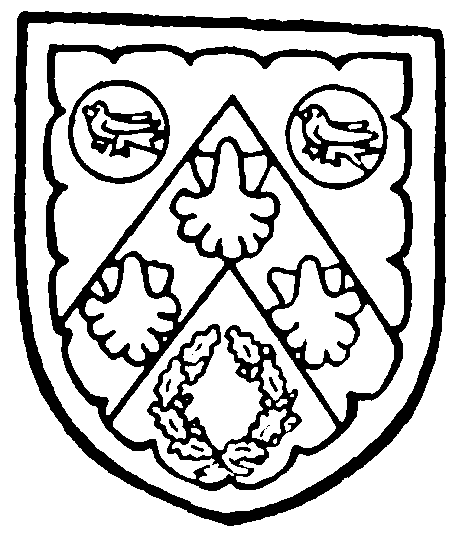
Hamond. Argent a cheveron between two roundlels sable in the cheif each charged with a martlet argent and a wreath of oak in its proper colours in the foot with three scallops or upon the cheveron all within a border engrailed vert.
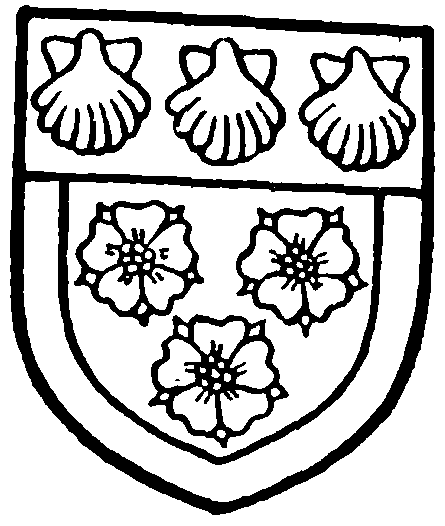
Graeme. Or three roses in a border gules and a chief sable with three scallops or therein.
MILTON
MILTON (Middleton, xiii cent.) was held with land in Adgestone, of the manor of Appleford for the service of half a knight's fee. (fn. 128) The manor was given by Queen Eleanor in 1280 to John de Weston and Christina his wife. (fn. 129) John died seised of it in 1323–4, when his son John succeeded. (fn. 130) On his death in 1344 the manor passed to his brother William, a clerk in holy orders. (fn. 131) In 1346 Katherine de Weston held the manor, (fn. 132) and in 1354 Thomas de Weston died seised of it, leaving as his heirs his daughter Eleanor wife of Sir John de Rattlesden, his granddaughters Eleanor and Isabel daughters of another daughter Margaret and his grandson Roger, son of another daughter Isabel. (fn. 133) The eldest co-heir Eleanor is perhaps to be identified with Eleanor wife of Sir William Bouchier, kt., who died seised of a quarter fee in Milton in 1397. (fn. 134) Her heir was her son William, but John Haket was holding the estate at the end of the 14th century, (fn. 135) and was returned for aid in 1428 as holding the de Weston half fee with Henry Howles, (fn. 136) the latter being succeeded in the joint holding three years later by John Roucle or Rookley. (fn. 137) In the 15th century the manor seems to have been split up into East and West Milton. East Middleton, the Hakets' portion of the manor, passed with Wolverton (fn. 138) (q.v.), with which it evidently became merged, as the joint holding was known as Wolverton alias Milton from the end of the 16th century onwards. West Milton apparently passed with East Standen to Joan Cooke, who leased it in 1514 to William Howles. (fn. 139) The lease, and apparently later the tenancy, of the manor came like East Standen into the hands of the Meux and Bannister families, (fn. 140) and in 1573 William Meux sold two parts of West Milton to John Worsley of Appuldurcombe, (fn. 141) the remaining third being sold by Sir Edward Bannister in 1616 to Sir Richard Worsley. West Milton thus became united with East Milton, and subsequently followed its descent.
WODE
WODE (La Wode, xiii–xiv cent.; Wode, xv–xvi cent.), probably the northern wooded portion of the peninsula, seems to have been a member of the manor of East Standen, and passed with it until the death of Nicholas Glamorgan about 1362–3. (fn. 142) It then seems to have been divided, part going with Standen to the Bramshotts and Howles, (fn. 143) and the rest with Wolverton to the Hakets and Gilberts. (fn. 144) The former moiety is not mentioned after 1480; the latter apparently followed the same descent as Wolverton. (fn. 145) The name is now lost, and the manor is apparently merged in Bembridge Farm.
HARDLEY
HARDLEY (Hardelei, xi cent.; Hardeleghe, xiii cent.) belonged in 1086 to William son of Stur, and had previously been held by Godric as a free manor of the Confessor. (fn. 146) At the end of the 13th century it was held of the honour of Carisbrooke by Robert de Glamorgan of Wolverton, and it passed with that manor (fn. 147) (q.v.) until about the middle of the 15th century. Later it became part of Bembridge Farm, and lost its identity, the name being retained only in a field belonging to the farm.
BLACKPAN
BLACKPAN (Bochepon, xi cent.; Blakepenne, xiii cent.) is entered in Domesday as a small holding of 10 acres held by William son of Azor. (fn. 148) It passed to the Lisles, with whom the overlordship remained until the 15th century. (fn. 149) Of them it was held at the end of the 13th century by John Fleming, (fn. 150) whose widow Hawise held it early in the next century. (fn. 151) In 1346 Thomas le Vavasour and Elizabeth de Lisle held this half fee in succession to Hawise Fleming. (fn. 152) Before 1428 the manor had been divided between three holders, John Lisle, John Stower and Thomas Middlemarch. (fn. 153) It reverted before 1460 to the overlords the Lisles of Wootton, (fn. 154) and followed the descent of Shanklin (q.v.) until 1894, when it passed to Miss White, sister of Francis White-Popham. It now belongs to Mrs. White-Popham, but Capt. Macpherson, R.N., is tenant for life.
BORTHWOOD
BORTHWOOD (Bourdourde, xi cent.; Bordewode, xiv cent.), a small holding on the borders of Newchurch and Brading, was originally a wooded tract of far greater extent, (fn. 155) and termed a forest. (fn. 156) It appears among the lands of William son of Azor in Domesday, being held with Branston and Lessland. (fn. 157) Borthwood seems frequently to have been granted with the lordship of the Island, and belonged to Piers Gaveston in 1309, (fn. 158) and to the Earl of Chester in 1316. (fn. 159) In 1415 it was granted with the lordship to Philippa Duchess of York, (fn. 160) and in 1507 paid a fee-farm rent of 66s. 8d. to the Crown. (fn. 161) Borthwood afterwards seems to have become annexed to the manor of Thorley, for in 1587–8 'the farm of the manor of Brodewood parcel of the manor of Thorley with Brodewood' was leased for twenty-one years to Thomas Keys. (fn. 162) In 1780 Robert Worsley paid the Crown a rent for tithes in Borthwood. (fn. 163) Borthwood in 1820 was owned by Sir W. G. Stirling, (fn. 164) who acquired it probably by his marriage with Susannah daughter of George T. Goodenough of Borthwood, and it is at present held by Mr. W. G. Stirling.
GROVE
GROVE doubtless originally formed part of the Adgestone holding, from which it became separated in the 16th century, and may be identical with the land in Adgestone (q.v.) held of the manor of Alverstone by Thomas Fitchett in 1510. (fn. 165) The first owners seem to have been the Fitchetts, an early Isle of Wight family, (fn. 166) whom Sir John Oglander speaks of as having been seated there for many generations, and who certainly held Grove in the 16th and 17th centuries. (fn. 167) John Fitchett of Grove died in 1738 and his widow Elizabeth in 1742. (fn. 168) In the 19th century Grove was held by the Jacobs family, (fn. 169) who in 1846 sold it to Mr. Thomas Hillier, whose daughter had married a Jacobs, and to whom it passed on the death of her father. It is now owned by the trustees of —Muggeridge. The old house, an 18thcentury structure, was pulled down in 1890, and the present new one built.
HARDINGSHUTE
HARDINGSHUTE (Hortyngeschete, xiii cent.; Hortyngshute, Hortyngshott, xv cent.; Hustingshute, xvi cent.; Arthingshoote, Ortingshote, xviii cent.) lies to the north of Brading and Nunwell. In the 13th century land at Hardingshute was held by Richard Malet, whose heirs are returned in the Testa de Nevill as holding a seventh of a fee under Robert de Glamorgan, (fn. 170) and William atte Welle held an eighth of a fee there in 1431. (fn. 171) The estate, which afterwards became known as the manor of Hardingshute, belonged, however, to the Lisles of Wootton. In 1306 Sir John de Insula, kt., was granted free warren in the demesne lands there, (fn. 172) and six years later granted to Walter Paye half an acre in the vill of Hardingshute. The manor then passed with South Shorwell (q.v.) to Michael Dennis, who exchanged it in 1557 for part of the manor of Compton with George Oglander. (fn. 173) It has since followed the same descent as Nunwell, (fn. 174) being now owned by Mr. J. H. Oglander.
HILL
HILL, a small holding held, with the adjoining Beaper, (fn. 175) by the late Miss le Marchant, lies to the east of Hardingshute, and was in the 14th century held by Reginald le Corner. (fn. 176) It probably formed part of the manor of Nunwell at one time. (fn. 177) In 1333 Walter le Burgeys de la Brigge granted a rent in Hill to John de Kingston, (fn. 178) but this may refer to another holding. In 1604 Robert Dillington died seised of the 'manor of Hill.' (fn. 179)
KERN
KERN (Lacherne, xi cent.; Kurne, xiii cent.) was held before the Conquest by Earl Harold, and in 1086 by the king. (fn. 180) It seems afterwards to have passed to the Aula family, and part was given by Roger de Aula to the Knights Templars. His gift was confirmed by Ralph Mackerell and apparently augmented by Robert Russell. (fn. 181) The Templars' holding was attached to the preceptory of South Baddesley, and on its suppression in 1558 Kern was granted to Winchester College. Another holding at Kern belonged at the end of the 13th century to the chaplains of Barton Oratory, (fn. 182) and passed with their other estates in 1439 to Winchester College, (fn. 183) who are now owners of the whole manor.
The house, a simple structure of the 16th–17th century, lies under the down, just to the north of Alverstone, and is now divided up into two cottages.
LANDGUARD
LANDGUARD (Levegarestun, xi cent.; Langred, xiii cent.) is perhaps to be identified with Levegarestun, which was held of the Confessor as an alod by two freemen, and belonged in 1086 to William son of Azor. (fn. 184) It was held of the honour of Carisbrooke in the 13th and 14th centuries, but was said in 1582 to be held of the manor of Wolverton. (fn. 185) In the latter half of the 13th century it was held with Wolverton by Robert de Glamorgan, (fn. 186) but had perhaps previously been held by Geoffrey Tichborne, who had given land in Landguard to the chaplains of Limerstone (fn. 187) (q.v.). It appears to have passed with Wolverton until 1431. (fn. 188) At the beginning of the 16th century the manors of Landguard and Watchingwell were held by Thomas Baker and his wife Joan, and came to their daughter Joan wife of John Earlisman, on whose death in 1542 the property was divided between her two daughters, Landguard being assigned to Jane, the wife of Edward Hungerford. After her husband's death Jane married Edward Moore, and the two in June 1572 granted 'the site and capital messuage and farm-place of the manor of Langorde' to Richard Cooke of Chale for the term of 100 years. (fn. 189) Edward Moore and Jane remained in possession until 1574, (fn. 190) but they probably left no issue, as the manor passed to John Cheke, probably son of Jane's sister Joan Cheke (see Watchingwell). John died seised of it, then called the manor of North Landguard, in 1582, leaving a son Edward. (fn. 191) This estate afterwards seems to have passed to Sir John Richards, who died seised of it in 1626, leaving a son John. (fn. 192) The further descent of this estate has not been traced.
A second manor later known as Great Landguard belonged to the Knights, Michael Knight dying seised of it in 1612. (fn. 193) This estate then passed with Luccombe in Bonchurch to Mr. Arthur Harry Howard Atherley, (fn. 194) who is the present owner.
The old house, a 17th-century stone structure, with a later Georgian brick front, was pulled down in 1879 and rebuilt by the present owner's father, Lieut.-Col. Atherley.
LEE
LEE (Leygh, xiv cent.; Lee, xvi cent.) lies just to the west of Sandown and is now held with Landguard by Mr. Arthur Atherley. It is first mentioned in 1332 and then belonged to John de Glamorgan. (fn. 195) In 1580 it seems to have been divided up between John Worsley, John Knight and John Colman. (fn. 196) It may have had its origin in the 'Alalei' of Domesday, held before and after the Conquest by Ulnod the thegn. (fn. 197) Richard Knight in 1712 charged Lee Farm within his manor of Landguard with a charity.
MORTON
MORTON (La Morton, Mourton, xiii cent.) consists of a narrow strip of land stretching south from the foot of the down by Yarbridge to the north end of Sandown Manor (q.v.), once known as Appley, and comprises Morton Villa, the farm under the down and the farm on the Brading road. The identification of Morton with any Domesday holding can only be conjectural. (fn. 198) The manor evidently formed part of the estate of the family of Aula, being held of Thomas de Aula's manor of Tothill in 1267–8, and subsequently of his descendants the Russells of Yaverland. (fn. 199) Richard Malet of Hardingshute and Sandown appears to have been the tenant under these overlords, and he subinfeudated a messuage and a third of a carucate of land to Richard de Witvil or Wyvill. In 1267–8 difficulties arose between them as to which was liable for the service due to de Aula as chief lord. (fn. 200) At the close of the century John Morin, Thomas Westbrook and John Wyvill were holding the estate in Morton of William Russell lord of Yaverland, (fn. 201) and part afterwards seems to have passed to Thomas Aliners, who with others was in possession at the beginning of the 14th century. (fn. 202) The Wyvills still retained their share, Thomas Wyvill and his coparceners holding the estate in 1346. (fn. 203) In 1384–5 Richard Couper, one of the heirs of John Wyvill, released to Annora Wyvill, widow of John, all his right in land at Morton and elsewhere. (fn. 204) Part seems to have lapsed to the overlords before 1428 when Henry Veer and Joan Russell held the half fee. (fn. 205) This Joan Russell was probably the widow of Sir Maurice Russell (see under Yaverland), and on her death it probably reverted to the owners of Yaverland, and is evidently to be identified with the manor of Brading mentioned in conveyances of Yaverland in 1488. (fn. 206) The manor, which is sometimes called the manor of Brading and sometimes land in Brading, then descended with the manor of Yaverland (fn. 207) until 1846, when it was sold to Sir William Oglander. It is now owned by Mr. J. H. Oglander.
NUNWELL
NUNWELL (Nonoelle, xi cent.; Nunewille, xii cent.; Nunnewelle, xiii cent.) was one of Earl Tostig's manors before the Conquest, held in 1086 by the king. (fn. 208) In 1199 Stephen son of Odo conveyed 20 acres of land in Nunwell to Ralph son of Nigel, (fn. 209) and in 1286 John de Tracy and his wife Benedicta exchanged land in Nunwell for land in Holton with William de Houton. (fn. 210) The statement of Sir Richard Worsley that the Oglander family had been seated at Nunwell ever since the Conquest (fn. 211) is difficult to substantiate, but Roger Oglander (fn. 212) was possibly holding the manor at the beginning of the 13th century when land at Nunwell was given by his servant Geoffrey Escoutard to Carisbrooke Priory, and his grandson Roger recovered 2 acres in Nunwell from Gilbert Abbot of Lire in 1256. (fn. 213) It is not, however, till the end of the century that we are on firm ground; Henry Oglander then held Nunwell of the honour of Carisbrooke Castle. (fn. 214) He died about 1310, (fn. 215) and his son and successor Robert died in 1344, leaving as his heir his son Reginald, who had married Roberta the daughter of Robert Urry. (fn. 216) Reginald held in 1346 with his coparceners three parts of a fee in Nunwell, (fn. 217) representing what in later years came to be termed West Nunwell. (fn. 218). He died in 1349, leaving a son Robert, and livery of the manor was made to his widow Roberta in that year. (fn. 219) Robert died without issue and his brother John succeeded to the manor. (fn. 220) Reginald Oglander, who held the manor in 1428, is given as John's brother in a pedigree printed by Berry, but the pedigree is clearly wrong at this date. (fn. 221) Alice Oglander was in possession in 1431. (fn. 222) John Oglander, whose relationship to Reginald is not known, died seised of the manor in 1483, leaving a son Thomas, (fn. 223) whose grandson George died in 1567 holding the manor, which was then known as West Nunwell. (fn. 224) His son and successor, Sir William Oglander, kt., died in 1609, (fn. 225) and his son Sir John Oglander writes of the manor-house of West Nunwell that it was 'now altogether dilapidated, but before it was consumed by fire in Henry VI's time was a goodly house and a great village of fifty houses belonging to it.' (fn. 226) Sir John, a well-known Royalist deputygovernor of Portsmouth and deputy-lieutenant of the Isle of Wight 1595–1648, died in 1655, (fn. 227) leaving a series of valuable local notes, now preserved at Nunwell, and was succeeded by his son William, created a baronet by Charles II in 1665. (fn. 228) The manor descended with the title in the direct line until the death of the seventh baronet Sir Henry in 1874 without issue. (fn. 229) He left the estate to his cousin John Henry Glynn, who, in compliance with Sir Henry's will, took the name of Oglander by royal licence in 1895, (fn. 230) and is the present possessor of Nunwell.
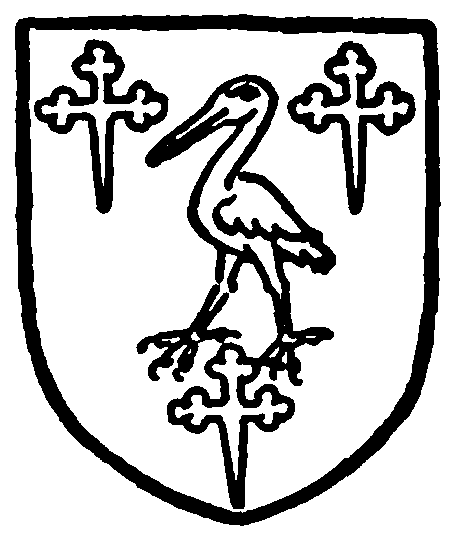
Oglander. Azure a stork between three crosslets fitchy or.
The house, lying under the north slope of the down, mostly dates from the beginning of the 17th century, and the work of that period still in existence may be attributed to Sir John Oglander, who came to reside at Nunwell in 1607 (fn. 231) and 'bwylt moost part of ye house,' to use his own words. There must have previously been a dwelling of some size here, as George Oglander died there in 1567, and Sir William his son spent his early married life there. The 16thcentury west wing and hall were probably left standing, and the east wing, consisting of a withdrawing room and study, added by Sir John. (fn. 232) The 17thcentury house thus took the form of the period, a centre and two wings, and so remained till the latter half of the 18th century, when Sir William, the fifth baronet (1767–1806), added what is now the library, inserted the present staircase, partitioned off the west end of the hall and remodelled the drawingroom. (fn. 233) Of recent years a dining-room and billiardroom have been added. On the terrace stands the old Brading gun, presented by the inhabitants to Sir Henry Oglander, the last baronet. It is similar to the Carisbrooke gun, now in the Castle Museum, and is inscribed 'John and Robert Owine Brethren made this Pese Brerdynd 1549.'
PARK
PARK is a 300–400 acre holding lying on the north-east boundary of the parish and partly in St. Helens, which came in the 16th century to be termed a manor. It was held with Ruttleston (? Nettlestone) at the close of the 13th century by William de Nevill and his wife Muriel as half a fee of William Russell, lord of Yaverland, (fn. 234) and was perhaps the same holding which Amice de Insula (Lisle) granted to William and Muriel in 1271–2. (fn. 235) At the beginning of the 14th century Thomas Gatcombe is given as owner of Park. (fn. 236) This name should perhaps be Daccombe, as in 1346 John Daccombe and his coparceners were holding half a knight's fee at Park, which had formerly belonged to Thomas 'Lacombe.' (fn. 237) In 1428 Elizabeth Lisle was in possession of this estate, (fn. 238) which three years later had passed to Henry Lisle. (fn. 239) The manor has since followed the same descent as Nettlestone in St. Helens (fn. 240) (q.v.). The courts from the time of Edward VI were held for Park and Nettlestone together.
ROWBOROUGH
ROWBOROUGH (Rodeberge, xi cent.; Rowberg, xiii cent.; Rotirburgh, xiv cent.; Rowbarho, xvi cent.) lies between Hardingshute and Hill. From the fact that it was held of the Confessor by the Abbot of St. Swithun's, Winchester, as an alod (fn. 241) it may be inferred that it was included in the 50 hides at Brading reputed to have been granted to the monastery by Ine king of the West Saxons. (fn. 242) In 1086 it was in the possession of William son of Azor. (fn. 243) The overlordship followed the same descent as Yaverland to the Russells, John Rivers (de Riperiis) being their tenant at the end of the 13th century. (fn. 244) The estate afterwards came to Ralph de Olne, (fn. 245) but had lapsed before 1346 to the overlords, the Russells, (fn. 246) and subsequently followed the same descent as Yaverland until 1846. (fn. 247) It was then sold with the other estates of the Wright family, the purchaser being Sir William Oglander, bart. The manor is now owned by Mr. J. H. Oglander.
SANDOWN
SANDOWN (Sande, xi cent.; Sandham, xiii to xviii cent.) was held by Ulnod of the Confessor as an alod and was in the king's hands at the time of Domesday. (fn. 248) It had passed before the middle of the 13th century to the Glamorgans of Wolverton, Philip de Glamorgan making grants of land there in 1236 and 1241. (fn. 249) It seems at this early time to have been divided into North and South Sandown. (fn. 250)
In 1236 Philip Glamorgan granted William Malet 2 virgates of land in Sandown in addition to land which William already held there, (fn. 251) and about 1280 the heirs of Richard Malet held a quarter of a fee there of Robert de Glamorgan. (fn. 252) A few years later John le Marche held this estate, which was evidently in North Sandown. (fn. 253) From this time until the middle of the 14th century it would seem that the Glamorgans held the manor in demesne, as in 1316 Robert de Glamorgan was said to hold the vill of Sandown, (fn. 254) while tenements in North and South Sandown, later called a manor, were held by John de Glamorgan at his death in 1337. (fn. 255) In 1346, however, John Serle held the quarter fee which had formerly belonged to John le Martre (fn. 256) (evi dently the John le Marche mentioned above), and John Stower was in possession in 1428 and 1431. (fn. 257) The manor apparently remained in this family until about the middle of the 16th century.
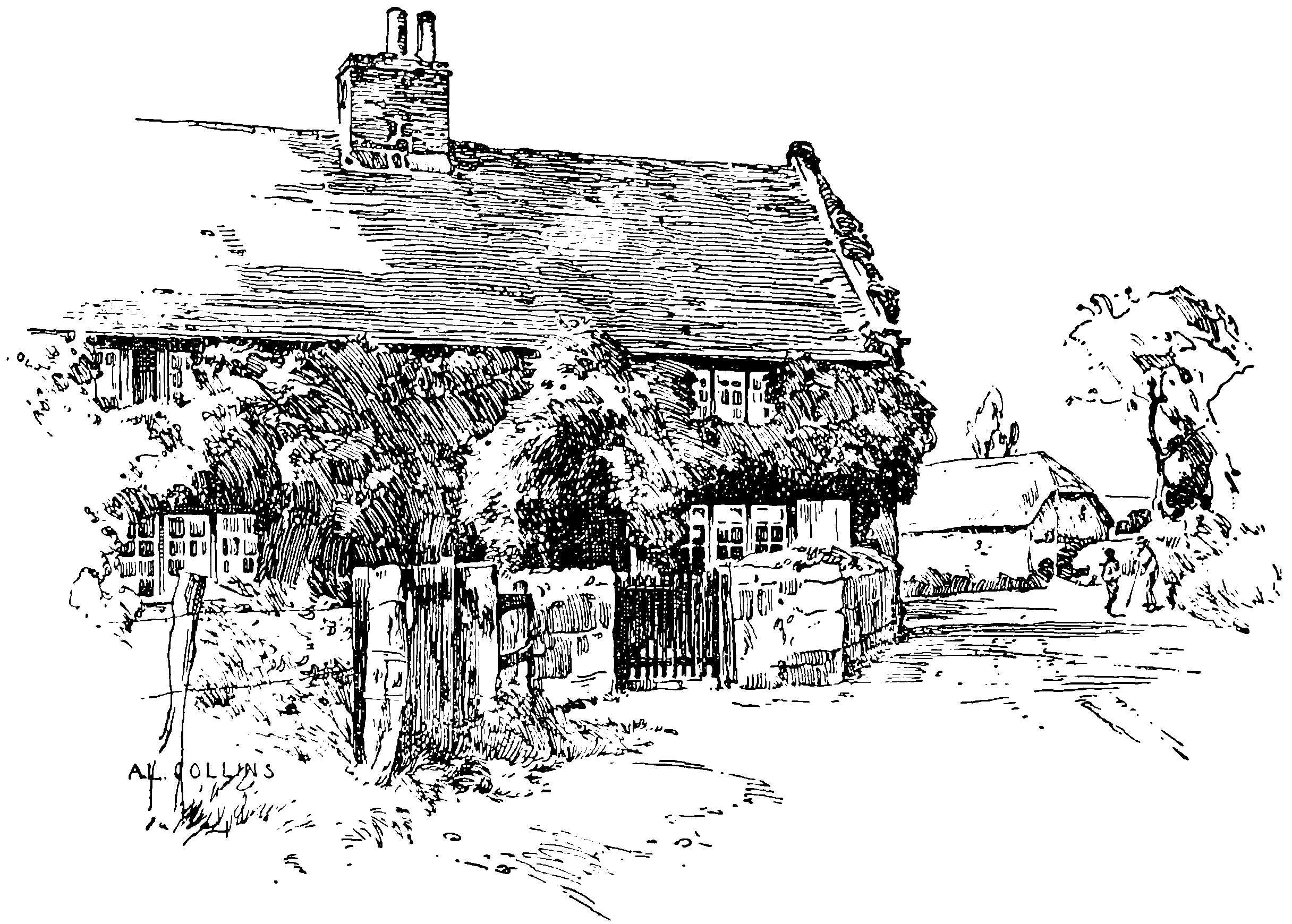
Lake Farm in Sandown, Brading
In 1552 Henry Stower sold the northern portion of the manor to William Jeffreys, who seven years later disposed of it to George Oglander, (fn. 258) and with the Oglanders of Nunwell it still remains. (fn. 259) Other portions of the manor were sold by John Stower to Kingswell, Knott, Knight and others. (fn. 260)
In 1808 Sir William Oglander established his right to the manor of Sandown in an action against Winchester College, who had inclosed part of the waste land known as Ryal Heath.
The manor of APPLEY probably formed part of the northern manor of Sandown and was held at the close of the 13th century by William Malet of the manor of Gatcombe as half a fee. (fn. 261) In 1609 Sir William Oglander died seised of the manor or farm of 'Apple' in North Sandown. (fn. 262) Sir John Oglander, writing in 16th–17th century, calls it 'Appleford alias Apley now Sandam Ferme,' and says it anciently belonged to the Stower family. It was evidently always part of Sandown and has now become merged in it, even its name having disappeared.
SCOTLESFORD
SCOTLESFORD (Scaldeford, xi cent.; Scottesford, xiii cent.; Scotteford, xiv–xv cent.) can only be identified now with the Scotchells Brook, which rises by Apse and flows into the Eastern Yar just to the east of Alverstone, and two fields called Scottescombe on the west side of Batts Copse to the west of Shanklin Manor. The holding has evidently been absorbed into the surrounding manors. (fn. 263) Originally it was held as an alod of the Confessor by two thegns, Savord and Osgot. At the time of Domesday Savord's portion was held by the king; Osgot's by William and Gozelin, sons of Azor. (fn. 264) By the 13th century it had become attached to the manor of Wolverton in Bembridge, with which it was held by Robert de Glamorgan. (fn. 265) It seems to have passed with it until 1431, (fn. 266) but by the 16th century had ceased to exist as an independent holding.
CHURCHES
The church of ST. MARY, BRADING, stands on high ground at the head of the main street, the tower (fn. 267) abutting right on to the road, from the level of which it is raised some 3 ft. It consists of a nave of five bays with north and south aisles, a chancel of two bays with north and south chapels, a south porch and a western tower with spire. The church agrees in its earliest details with the date of the foundation, the latter part of the 12th century. The pointed arches of the nave arcades springing from 'scallop' capitals are of this period. To the 13th century belong the finishing of the aisles, (fn. 268) the reconstruction of the chancel and the erection of the tower at the west end. This tower is a plain square structure buttressed (fn. 269) at the four corners, with an unpierced parapet springing from a simple corbel table, and is surmounted by a broached stone spire with a good cock weather-vane. At the ringing stage a lofty arch opens to the nave, a very effective feature from the interior of the church. In the west wall under the sill of the west window is a 14th-15th century image niche. The north chapel may have been originally built in the 14th century, as the northernmost pier of the chancel appears to be of that date, and rebuilt at the end of the 15th century. (fn. 270) It has been called the De Aula chapel, from the circumstance of the altar tombs of William Howles and his wife being placed there in the 16th century, but there is no evidence to prove it was founded by that family. About the same period the north and south aisles were remodelled, the south porch added and the Oglander or south chapel built. (fn. 271) Behind the pulpit is built in what appears to have been part of a stone screen with the date 1513, and over the priest's door in the north wall of the De Aula chapel is an engrailed double consecration cross. (fn. 272)
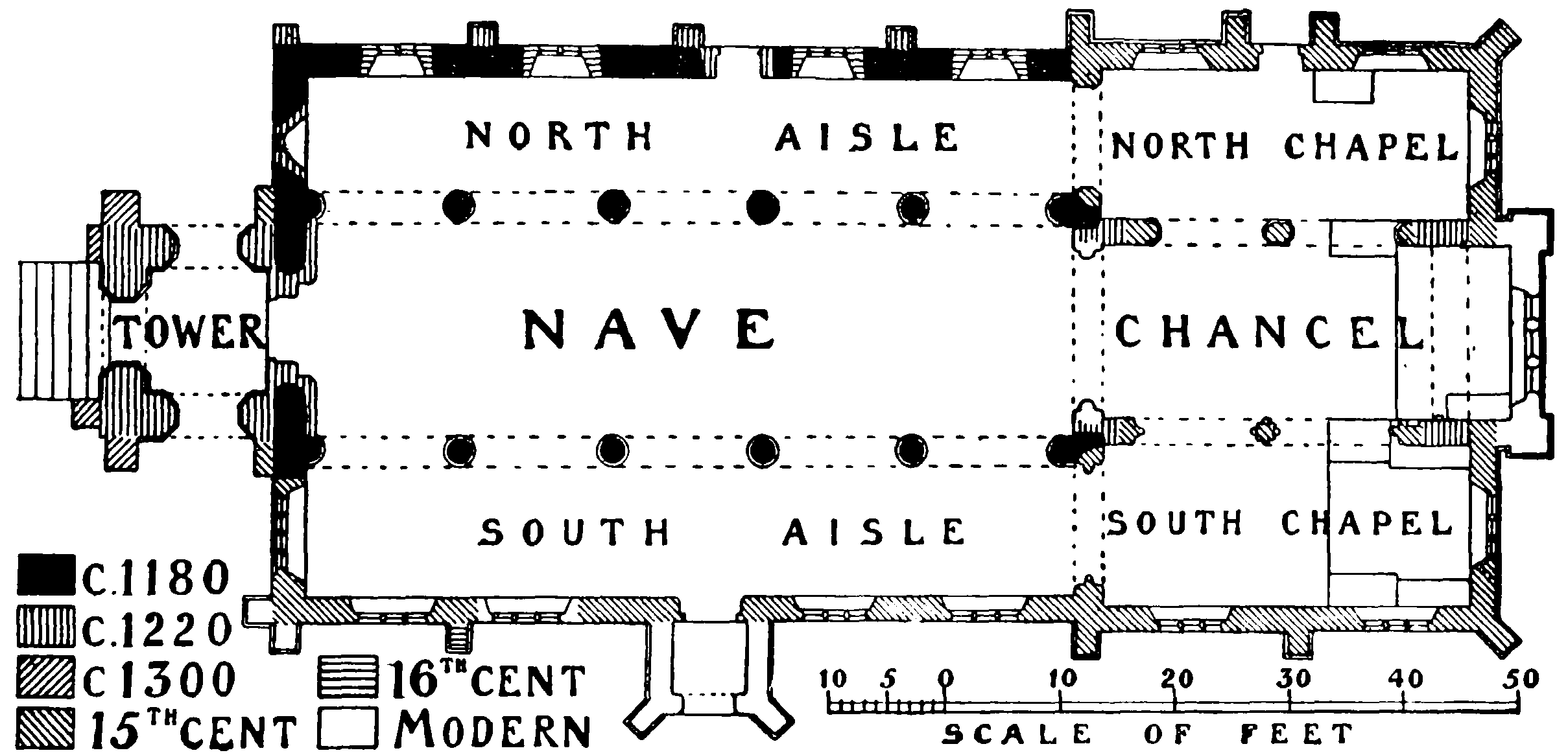
Plan of Brading Church
The oldest memorial is an incised slab of Purbeck stone in the sacrarium to John Curwen, constable of Portchester Castle, who died in 1441. It is a fine specimen, probably of Flemish origin, measuring 8 ft. in length and 3 ft. 6 in. in breadth; the head, hands (fn. 273) and sword-hilt were apparently inlaid with stone or metal, the shield of arms with enamel. In canopied niches each side are figures of saints (fn. 274); in the centre the Virgin and Child (fn. 275); at the four corners the symbols of the Evangelists; on either side of the figure, which is clothed in the plate armour of the period, is his shield of arms (fn. 276); round the margin the legend 'Hic jacet nobilis vir Johannes Cherowin armiger dum vivebat connestabularius Castri de Porcestre qui obiit anno Domini millesimo quadringesmo quadrago primo die ultima mens Octobris anima ejus requiescat in pace Amen.' (fn. 277)
John Oglander, who died in 1483, lies under an altar tomb in the south chapel. William Howles, died 1520, and his wife Elizabeth are commemorated by altar tombs in the north chapel. (fn. 278) Opposite to John Oglander's is his son Oliver's tomb, a somewhat elaborate one crowded with figures and bearing traces of colour; and to the east of John Oglander lies the fine wooden effigy of his descendant Sir William Oglander, (fn. 279) while to the east of Oliver Oglander's tomb is that of Sir John Oglander, whose wooden representation, as well as the smaller one of his son George, are in decided contrast to the stately figure of his father. The last monument to be noticed in the south chapel is that to Sir Henry Oglander, the last baronet, and his wife. It is mainly of alabaster, with supporting angel figures at the angles, and is a fine specimen of modern art. On the floor are slabs to Ann wife of John second Lord Powlett, 1710; Sir William Oglander, third baronet, 1734, and Elizabeth Strode, his wife, 1722; Sir John Oglander, fourth baronet, 1767. In the nave are grave slabs to Sir Thomas Knight, 1689, and other members of the Knight family from 1695 to 1735, and the Fitchetts of Grove 1738 to 1742. In the chancel is an armorial slab to Rev. Richard Palmer, vicar, 1763, also a brass to Rev. T. Waterworth, 1790.
In the sacrarium is an ancient stoup and piscina, the former evidently out of position, and from the chancel roof hangs a good 18th-century candelabrum inscribed 'William Macket and David Bull, Churchwardens, Brading, March 20th 1798.'
The south chapel is inclosed by open oak parclose screens, erected in place of the solid panelled work when Sir Henry Oglander restored the chapel in 1866. In the vestry is a panel of the royal arms of William and Mary, also the Jacobean communion table, and two panelled oak chests dated 1634 and 1637, the latter having a money till, are still preserved in the church.
There is an octagonal font of small dimensions and mixed dates, the shaft and base of the 13th century, the bowl of the 16th century, and a small octagonal stoup stands in the porch.
In 1865 the church was put into a state of repair, the chancel east end was rebuilt and lengthened, and the old pewing removed.
The bells are eight in number, three bearing dates respectively of 1594, 1622, 1709. A fourth bell, 'GOD BE OUR GUYD 1604,' was recast in 1887, when the other four trebles were added. The inscribed bells are:—
| 1. |
'PR(A)IS · THE · LORD. 1594—ER. WO. MK. TL. RR.,' and below 'I.B. W.B. B. T.G. I. I. C.' (fn. 280) |
|
| 2. | 'J.J. J.O. R.B. 1622.' | |
| 3. | 'BENJAMIN SALTER | CHURCHWARDENS. |
| RICHARD DAW | ||
| CLEMANT · TOSIEAR CAST MEE IN THE YEAR 1709.' | ||
The ancient plate consists of a chalice and paten inscribed 'Brading 1696 C.B. Vic. (fn. 281) E.D. R.L. Ch.wardens,' an alms-dish 1725–6 and two pewter tankards. The modern plate is a chalice and paten presented to the church in 1895, and a chalice, paten, alms-dish and cruets used at Alverstone chapel.
The registers date from 1547 and contain many notes of local interest.
In the churchyard is what may have been the base of a churchyard cross, now used as a sundial, (fn. 282) also many altar tombs of the 17th century. (fn. 283)
CHRIST CHURCH, SANDOWN
CHRIST CHURCH, SANDOWN, consisting of a nave and chancel with north and south aisles and a south tower, was built in 1845. It contains some good glass windows by Clayton & Bell and Frampton.
The church of ST. JOHN, LOWER SANDOWN, was built in 1881. It is a plain, simple structure of good proportion, with a nave of five bays, chancel, north and south aisles, and a clearstory. The style is 13th-century Gothic.
The church of HOLY TRINITY, BEMBRIDGE, was built in 1845 to replace a former structure of 1826. It has a chancel, nave of five bays, western tower with spire, clock and three bells.
ADVOWSONS
There is a tradition that the church of Brading was founded in 704 (fn. 284) by St. Wilfrid when at Selsey, but there is no evidence of any kind to establish this as a fact, and the first evidence of its existence occurs in the middle of the 12th century, when William de Insula (Lisle), with the assent of his wife Muriel, granted the advowson to the priory of St. Helens, a cell of Wenlock in Shropshire. (fn. 285) Henry of Blois, Bishop of Winchester (1129–71), and Bishop Richard Toclive (1174–88) confirmed this grant. (fn. 286) In the early part of the 13th century John de Marisco, rector of Brading, granted land which Walter Lisle, his mother and others had bestowed on the church of St. Mary 'before and at its dedication.' (fn. 287) In 1241 Walter Lisle, who had married Maud the granddaughter of William Lisle, claimed the advowson in right of his wife. The Prior of Wenlock disputed Walter's claim, but urged that he was unable to answer because the advowson belonged to the Prior of St. Helens. (fn. 288) The suit was resumed twelve years later, and was decided in favour of the prior. (fn. 289) Aymer, Bishop-elect of Winchester, purchased the advowson of the Prior of Wenlock in 1255, (fn. 290) and on Bishop Aymer's death in 1260 the advowson came to his next of kin, Henry III, (fn. 291) and remained with the Crown until 1301, when Edward I granted it, at the request of the executors of Isabel de Fortibus, to the Prior and convent of Breamore as a set-off against the 500 marks he owed for stock and produce in the late countess's manors devised to him. (fn. 292) The church was appropriated to the priory in 1301, (fn. 293) and Edward II confirmed his father's grant in 1315. (fn. 294) In 1332 the Prior of St. Helens again claimed the advowson, (fn. 295) and the matter was not finally settled until 1347, when the Prior of St. Helens gave up his claim. (fn. 296) The priory of Breamore held the advowson till the Dissolution, (fn. 297) and it was granted in 1536 to Henry Courtenay Marquess of Exeter, (fn. 298) on whose attainder in 1539 it reverted to the Crown, and was granted in 1546 to Trinity College, Cambridge, (fn. 299) in whose gift it still remains. While the advowson was held by the priory of Breamore the rectory was let to farm to the Prior of St. Denys near Southampton, with the condition that 'the alms to be given to the poor should in no wise be diminished.' (fn. 300) In 1476 Thomas Heyno and his wife Joan obtained a lease of 'the site or mansion of the Rectory of Brading with appurtenances and 20 acres of land,' and in 1495 Joan was summoned by the Prior of Breamore for cutting timber on the estate. (fn. 301) Four years later the rectory-house seems to have got into a ruinous state owing to neither party having done any repairs. (fn. 302)
The ecclesiastical parish of Holy Trinity, Bembridge, was formed from Brading in December 1884. (fn. 303) The living had been made a perpetual curacy in 1828, (fn. 304) but in 1884 it became a vicarage, in the gift of the vicar of Brading.
Sandown was constituted a separate ecclesiastical parish in 1847. (fn. 305) The living, a vicarage, is in the gift of the Church Patronage Society. The parish of St. John, Lower Sandown, was formed from Sandown in 1881. (fn. 306) The presentation is in the hands of the Church Patronage Society.
A manorial chapel existed at Alverstone in the 14th century and had a chantry endowed with the tithes of the demesne of Sir Geoffrey Abbas, kt., in Alverstone. (fn. 307) The advowson belonged to the lords of Alverstone, being first mentioned in 1335–6, and remained with them until 1746. (fn. 308) At the time of the suppression of the chantries Giles Strangways was incumbent, (fn. 309) and the chapel was supposed to have been founded by the ancestors of Sir Giles Strangways. Services do not appear to have been held at that time, and the chapel, which was situated about a mile from the parish church, (fn. 310) has since disappeared.
A chapel at Wolverton is mentioned in the dean's return of 1305. (fn. 311) Its advowson belonged to the lords of the manor, (fn. 312) and at the time of the dissolution of the chantries it is said to have been founded by the ancestors of John Gilbert, to be served weekly by a monk from Quarr, and to be dedicated to St. Eurien. (fn. 313)
Worsley mentions chapels at la Wode and Milton. (fn. 314) Of the former nothing has been found in original deeds, but about the middle of the 14th century John de Weston obtained licence to have divine service celebrated in his chapel of Milton. (fn. 315)
There was a chapel at Whitefield endowed with the great tithes of the manor. (fn. 316) The first recorded presentation was in 1328, when the king presented John de Thomerton to the chantry of his manor of Whitefield. (fn. 317) The chapel was dedicated to St. Nicholas, and presentations were made by the king during the 14th century. (fn. 318)
In 1404 Thomas Brading and Margaret his wife obtained licence to have divine service celebrated in their chapel in the manor of Whitefield. (fn. 319)
There are denominational chapels in Brading, United Methodist, Congregational, Salvation Army barracks; in Bembridge, Wesleyan (1844); in Sandown, Wesleyan (1865), Congregational (1866, rebuilt 1873), Primitive Methodist (1866), Baptist (1882), United Methodist (1828, rebuilt 1882); Bible Christian at Lake.
CHARITIES
In 1609 Sir William Oglander, kt., by his will, proved in the P.C.C., in order to carry out the desire of his late wife, charged his farm of Smallbrook with an annuity of £6 for distribution of bread to the poor.
In 1617 Richard Gard by his will (among other charitable gifts) devised two annual sums of 10s. each for the poor, one of which only is now paid.
In 1710 Richard Knight by his will, proved in the P.C.C., charged his farm, known as Lee Farm, within his manor of Landguard, with clothing for six aged poor men, and bread for six aged poor widow women of the annual value of £11 2s.
Edward How, as appears from the Parliamentary returns of 1786, gave £30 for meat for the poor. This gift, augmented by Sir Henry Oglander, is now represented by £50 consols, producing £1 5s. yearly.
In 1888 Mrs. Cecilia Scott by her will, proved at London 3 March, bequeathed £300, now £305 13s., the annual dividends amounting to £7 12s. 8d. to be applied in the distribution of bread and coals to the poor at Christmas.
In 1888 Lady Louisa Oglander by her will left a sum of money for the poor, now £123 13s. 9d. consols, producing £3 1s. 8d. a year.
In 1889 Louisa Dennett by her will, proved at Winchester 5 September, bequeathed £100, now £102 19s. 2d. consols, the annual dividends, amounting to £2 11s. 4d., to be distributed in bread and coal to the poor on or about 12 January.
The charities of Miss Mary Surgey Moore are regulated by scheme of the Charity Commissioners, 18 March 1890, the endowment funds of which consist of £1,058 0s. 7d. India 3 per cent. stock, the annual dividends amounting to £31 14s. 8d. being applicable for the benefit of the poor, and £117 5s. 11d. like stock, the dividends of £3 10s. 8d. being for education.
The several sums of stock above mentioned are held by the official trustees, who also hold a sum of £36 15s. bank stock, representing a gift of £100 by Mrs. Mary Matilda Summers for nursing sick poor.
This parish is in possession of certain real property known as the Town Trust, bringing in about £70 a year, which is regulated by a scheme of the Charity Commissioners 13 May 1890, under which a sum of £122 17s. 6d. consols has been placed with the official trustees for extraordinary repairs and improvements.
The income of the trust is applicable to the maintenance of the library and of pumps and for lighting.
Bembridge.
In 1854 Colonel the Hon. Augustus John Francis Moreton by his will, proved 5 September, left £300, the interest to be given to deserving poor. The legacy was invested in £327 5s. 8d. consols, producing £8 3s. 8d. yearly.
In 1879 Jeremiah Dennett by will, proved at Winchester 17 December, left £100, the interest to be applied for the benefit of the school, or National school, or partly for one and partly for another. The legacy was invested in £99 15s. consols, producing £2 9s. 8d. yearly.
In 1887 Henry Creswell Priddle by will, proved at London 7 January, left £20 and one-third of his residuary estate, now represented by £44 12s. 9d. consols, the annual dividends amounting to £1 2s. 4d. to be given to the poor at Christmas.
In 1889 Louisa Dennett by will, proved at Winchester 5 September, bequeathed £200, now represented by £205 18s. 4d. consols, the dividends amounting to £5 2s. 8d. to be divided between six poor men and six poor women annually on 27 April.
In 1894 William Pelham Winter by will, proved at London 24 November, left £500, the interest to be applied in bread and coals for the poor in the winter months. The legacy was invested in £442 9s. 7d. consols, producing £11 1s. a year.
The general sums of stock are held by the official trustees, and the dividends are duly applied.
Sandown.
The Rev. Edmund Hollond by deed, 9 April 1847, gave a sum of £120 18s. 2d. consols (with the official trustees), the annual dividends amounting to £3 0s. 4d. to be applied for repair of church, or to be applied, if trustees think fit, in effecting and maintaining an insurance thereof.