A History of the County of Hampshire: Volume 5. Originally published by Victoria County History, London, 1912.
This free content was digitised by double rekeying. All rights reserved.
'Parishes: Shanklin', in A History of the County of Hampshire: Volume 5, ed. William Page (London, 1912), British History Online https://www.british-history.ac.uk/vch/hants/vol5/pp195-197 [accessed 30 April 2025].
'Parishes: Shanklin', in A History of the County of Hampshire: Volume 5. Edited by William Page (London, 1912), British History Online, accessed April 30, 2025, https://www.british-history.ac.uk/vch/hants/vol5/pp195-197.
"Parishes: Shanklin". A History of the County of Hampshire: Volume 5. Ed. William Page (London, 1912), British History Online. Web. 30 April 2025. https://www.british-history.ac.uk/vch/hants/vol5/pp195-197.
In this section
SHANKLIN
Sencliz (xi cent.); Schlenting, Sentlyngges (xiii cent.); Sheynclyng (xv cent.); Shenklyn (xvi cent.).
Shanklin, 9 miles south from Ryde, lies under the north slope of the down, for the most part on high ground, on which the residential part of the town is built. On the low ground near the shore runs the parade, with buildings, mostly consisting of lodging-houses, facing the sea, to which access is gained by a lift from the northern cliff. The old village of Shanklin lies at the head of the chine, and with its thatch-roofed cottages forms a picturesque grouping. The pier, completed in 1891, is 1,200 ft. long, with landing-stage for steamers and a pavilion for entertainments. Under the provisions of the Local Government Act of 1894 the affairs of the town are now controlled by an urban district council. A clock tower on the esplanade commemorates the 1897 Jubilee of Queen Victoria. There is an excellent social club on the south cliff facing the sea, and a literary institute in Steephill Road. The Arthur Webster Memorial Hospital in the Landguard Road was built in 1905 by Lord Alverstone.
The parish contains 799 acres, of which in 1905 12 acres were arable land, 230¼ acres permanent grass and 30 acres woodland. (fn. 1) The soil is gravel and clay. In 1894 the parish was divided into two parts for civil purposes: Shanklin, including that part of the parish within the urban district, and East Shanklin, including that part of the parish of Brading in Shanklin urban district. (fn. 2) In the following year East Shanklin was further extended to include part of Brading, (fn. 3) and in 1898 it again became part of Shanklin. (fn. 4) Another extension was made in 1901, when more of Brading parish was added to Shanklin.
John Keats the poet stayed at Shanklin early in 1819, writing Otho the Great and Lamia. The poet Longfellow was a visitor in 1868.
MANOR
SHANKLIN was held at Domesday by Gozelin son of Azor, and was of considerable extent and value. It had been held before the Conquest by six freemen of King Edward, and Livol held a hide of the manor in 1086. (fn. 5) By the 13th century Shanklin, with Gozelin's other estates, had passed to the de Lisle family, probably descendants of Azor, being held at the end of the century by John de Lisle. (fn. 6) The manor, which was held of the honour of Carisbrooke, (fn. 7) then followed the same descent as West Court in Shorwell (q.v.) to the Popham and Hill families. (fn. 8) It seems eventually (after 1765) to have passed to the Pophams, while West Court passed to the Hills. John Popham was dealing with half the manor in 1780 and 1803, (fn. 9) and died in 1816, his only son John having predeceased him. The manor therefore passed to his daughter Mary, wife of the Rev. Richard Walton White. (fn. 10) Her son Francis assumed the name Popham in 1852 under the terms of his grandfather's will. (fn. 11) He died without issue in 1894, and the manor at present belongs to his widow. (fn. 12) The old manor-house was restored and enlarged by Mr. White-Popham in 1883. It practically occupies the same site and is picturesquely situated.
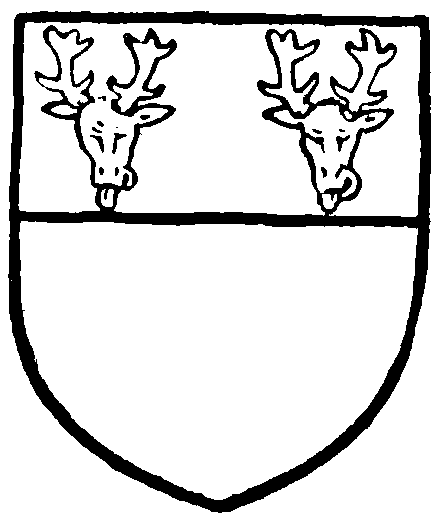
Popham. Argent a chief gules with two harts' heads caboshed or therein.
CHURCHES
The church of ST. JOHN BAPTIST, (fn. 13) or the 'old church,' as it is called, stands at the southern end of the parish at the angle made by the roads to Wroxall and Ventnor. It has been so altered and added to that it is now of little interest. Originally it must have been of the usual aisleless type of manorial chapel—an oblong structure with nave and chancel in one line; and so it remained (fn. 14) till 1852, when transepts were added, the church lengthened westward and a bell turret formed at the intersection of the roofs. A lych-gate with clock and bell was put up as a memorial to Mr. White-Popham. There is a good Renaissance oak chest, apparently brought from elsewhere. (fn. 15) There are memorial tablets to members of the Hill and Popham families. The registers date from 1717.
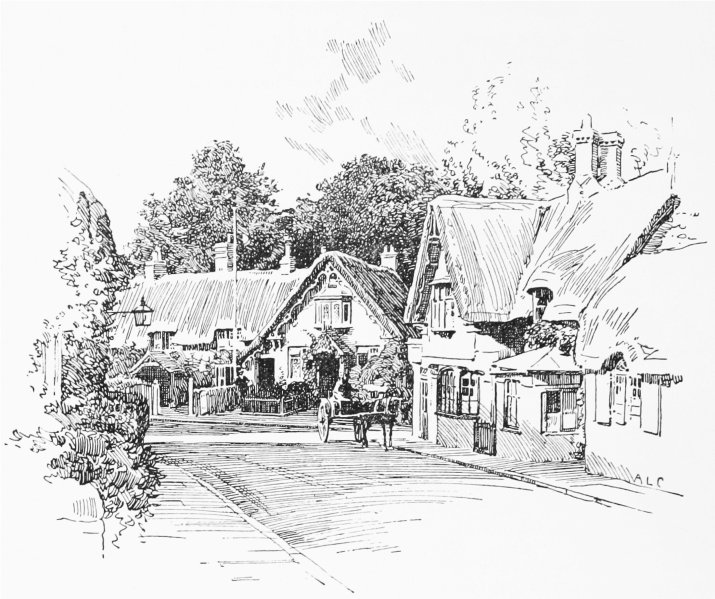
Shanklin Old Village
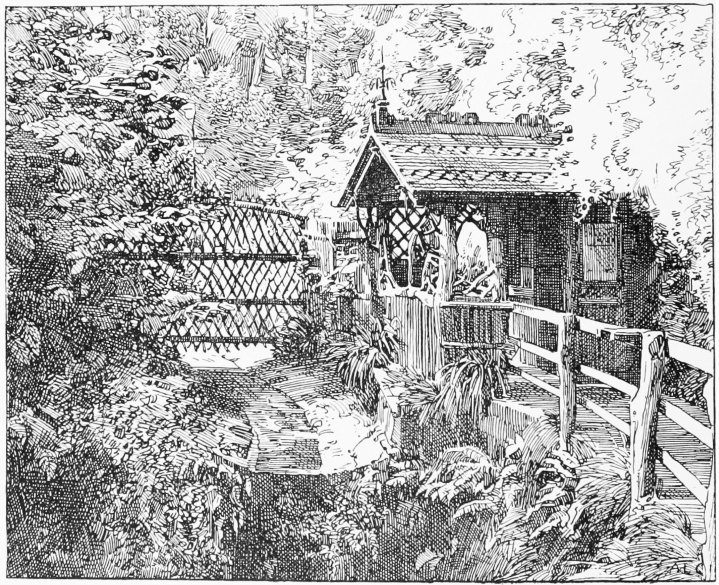
Entrance to Shanklin Chine
There are two bells. The plate consists of a chalice and paten of 1681–2, two patens of 1719 and 1807 respectively, a chalice of 1854 and a flagon of 1855.
ST. SAVIOUR'S ON THE CLIFF, the church of an ecclesiastical parish formed in 1869, (fn. 16) has a chancel, nave with aisles of four bays, and a western tower with spire, containing a peal of eight bells, added in 1887.
ST. PAUL'S, GATTEN, now in Shanklin, is an ecclesiastical parish taken out of Sandown in 1876. (fn. 17) The church was built 1880–90, and has an apsidal chancel, a nave with aisles of five bays and a stone tower at the north angle.
ADVOWSONS
Shanklin was a chapelry annexed to Bonchurch rectory (fn. 18) until 1853, when it was constituted a separate rectory. (fn. 19) The advowson has always followed the descent of the manor (fn. 20) and now belongs to Mrs. White-Popham. In the middle of the 13th century the chapel of St. John the Baptist, Shanklin, was not assessed on account of poverty. (fn. 21)
The living of St. Saviour's on the Cliff is in the gift of the rector of Shanklin, and the advowson of St. Paul's, Gatten, is in the gift of the Church Patronage Society.
Other places of worship are: Congregational Church in High Street (1883), Wesleyan Methodist Chapel in Regent Street (1883), United Methodist, Victoria Avenue (1885). A new Roman Catholic church was built in Atherley Road in 1907.
There do not appear to be any endowed charities or permanent institutions in this parish other than the Home of Rest, Sandown Road, erected in 1893 by Mrs. Harvey, and the Literary and Scientific Institute in Prospect Road. (fn. 22)