
A History of the County of Hampshire: Volume 5. Originally published by Victoria County History, London, 1912.
This free content was digitised by double rekeying. All rights reserved.
'Parishes: Wootton', in A History of the County of Hampshire: Volume 5, (London, 1912) pp. 204-206. British History Online https://www.british-history.ac.uk/vch/hants/vol5/pp204-206 [accessed 12 April 2024]
In this section
WOOTTON
Wootton, formerly a parish on the north of the Island, is now only a village, having been divided in 1894 between the parishes of Gatcombe and Whippingham for civil purposes. (fn. 1) Part of Chillerton was transferred from Wootton to Carisbrooke in 1882. (fn. 2) It comprises the land between Fishbourne Creek and Whippingham, lying north of the road from Newport to Ryde. The district is mostly given up to villa residences, and the village of Wootton Bridge, formerly in Arreton parish, has been separated from it for ecclesiastical purposes and a new church, St. Mark's, erected (1909) to serve it.
Fernhill, the residence of Mrs. Brodie, was built by the Rt. Hon. Thomas Orde-Powlett, and is described under Arreton (q.v.). There is a station on the Isle of Wight Central railway about a mile from the village. The soil is loam and clay with a subsoil composed of clay and gravel.
There is a Sunday school room, erected in 1888.
MANOR
WOOTTON (Odetone, xi cent.; Woditon, xiii cent.) was held by Queen Edith, and at the time of Domesday was in the king's hands, being valued at £3. (fn. 3) The manor was held of the honour of Carisbrooke by the service of finding a horseman for the defence of the Isle of Wight in time of war, and doing suit at the court of knights at Newport every three weeks. (fn. 4) It had passed by the 13th century to the de Insula or Lisle family, and was held by John son of William de Lisle at the end of the century. (fn. 5) It had probably also been held by Walter de Lisle, who was patron of Shorwell in 1205, and is supposed to have built the church of Wootton. (fn. 6) He died about 1224, when his son Geoffrey succeeded. (fn. 7) Geoffrey died about 1251–2 holding land of Baldwin de Lisle, but the names of his manors are not given. (fn. 8) His son William (fn. 9) was succeeded by a son John, and he is the first member of the family who is known to have held Wootton. He died about 1301–2, leaving a son John, who succeeded to the estate, (fn. 10) and obtained a grant of free warren there in 1306. (fn. 11) He died in 1331 (fn. 12) seised of the manor of Wootton, which then included a rabbit warren and a fishery in an arm of the sea. (fn. 13) He was succeeded by a son Bartholomew, to whom the manor was delivered in September 1331. (fn. 14) He died in 1345 holding the manor jointly with his wife Elizabeth. (fn. 15) Sir John Lisle, son of Bartholomew, died abroad about 1370, (fn. 16) and to his son and successor John the grant of free warren made in 1306 was confirmed in 1390. (fn. 17) He was succeeded about 1427–8 by a son John, (fn. 18) on whose death in 1470–1 the estate passed to his son Nicholas. (fn. 19) Nicholas Lisle, then Sir Nicholas, died in 1504 and was succeeded by a son Sir John. (fn. 20) He, the last of the direct line, died in 1523, leaving a niece Mary, married to her cousin Thomas Lisle, his heir. (fn. 21) Sir John had, however, bequeathed the manor of Wootton to his cousin and heir male, Lancelot son of George Lisle, an uncle of Sir Nicholas, in tail-male with remainder to Thomas and the right heirs of John. (fn. 22) Lancelot died seised of the manor in 1543, (fn. 23) leaving a son and heir Thomas, who died in 1562. (fn. 24) Anthony, son of Thomas Lisle, (fn. 25) held Wootton at his death in 1604, (fn. 26) having settled it on his son William on his marriage with Bridget daughter of Sir John Hungerford, kt., in 1603. (fn. 27) The manor then followed the same descent as Ellingham until about the middle of the 18th century. (fn. 28)
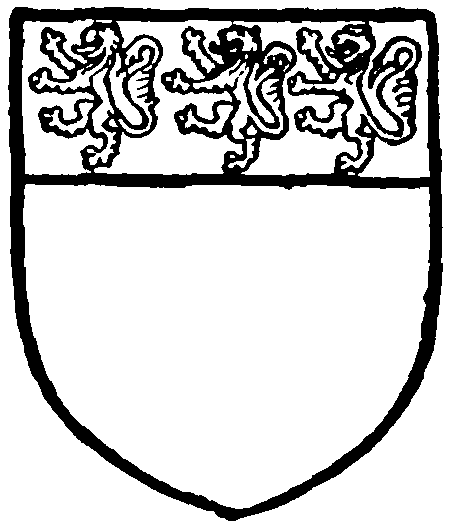
Lisle of Wootton. Or a chief azure with three lions or therein.
The estate was probably sold by Edward Lisle to James Burton, who was in possession in 1767. (fn. 29) It was sold by James Burton in 1775 to Joseph Tarver of Romsey and William Hearn, (fn. 30) and in 1800 Joseph Tarver and his wife Anne conveyed it to William Young. (fn. 31) In the 19th century the manor was acquired by Mr. Nunn, the introducer of the manufacture of machine lace into the Isle of Wight.
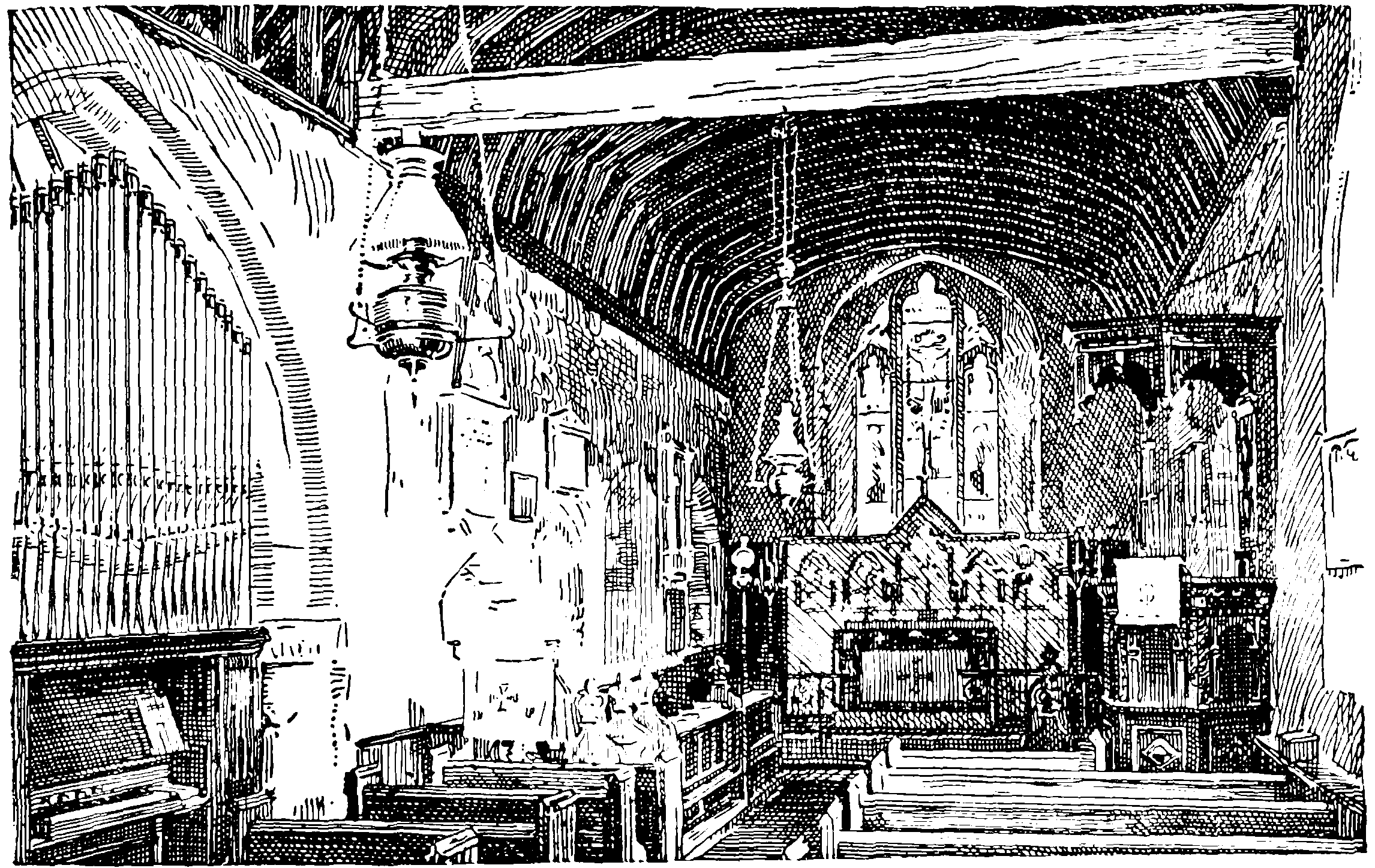
Wootton Church: Interior looking East
The manor then passed to Mrs. Harvey, whose nephew Colonel Stephenson Clarke now exercises the manorial rights, though the land itself for the most part was acquired in the early part of the 19th century by Mr. R. S. Holford. (fn. 32)
In 1492–3 reference is made to the park of Wootton. (fn. 33)
CHURCHES
The church of ST. EDMUND is one of the smaller or manorial chapels of the Island, consisting of an aisleless nave and chancel, built in the 12th century, to which period the north and south doors belong. (fn. 34) A chantry to the north was added at the end of the century and dedicated to St. Edmund. (fn. 35) In the 13th century the chapel appears to have been lengthened eastward, probably the outcome of the building of the chantry. (fn. 36) In the 14th century—owing, by tradition, to a destructive fire—there seems to have been a remodelling of the structure. Ogival-headed double lights were inserted in the south and west walls. The 15th century is responsible for the square-headed window in the south wall and the addition of a rood-loft. (fn. 37) There is an ancient stoup attached to the chantry respond and a piscina in the south wall of the sanctuary. In the nave hangs the royal arms 1818. A western bell turret was added in 1893 and contains one bell.
There is a silver alms-dish with handle, punched W.P 1644, and a silver-gilt chalice and paten given by the Rev. Richard Walton in 1787. (fn. 38)
The registers date from 1756.
The church of ST. MARK, WOOTTON BRIDGE, a brick and stone structure, was built in 1910.
ADVOWSON
The advowson of the chapel of Wootton followed the same descent as the manor until 1736 or later. (fn. 39) Mary Lisle, widow, presented in 1736, (fn. 40) and the advowson subsequently passed to the Rev. Richard Walton. His godson the Rev. Richard Walton White was in possession of the advowson and rectory in 1803–4. (fn. 41) The Rev. Richard Walton White married Mary daughter of John Popham of Newport, and left issue an only son Francis, who took the name of Popham in 1852 under his grandfather's will. (fn. 42) Francis died without issue in 1894 and the advowson belonged to his sister Miss White until her death in 1911. (fn. 43) Her nephew Captain Macpherson, R.N., holds the advowson for life.
The advowson of the chantry of St. Edmund the King also belonged to the lords of the manor, (fn. 44) as did that of a second chantry dedicated to St. Edmund the Confessor, founded in the middle of the 14th century. (fn. 45) The two chantries were apparently served by the same chaplain (fn. 46); the later chantry was known as that of 'Edmund the Confessor de Brocke or de Wodyton' in the church of Wootton. (fn. 47) A chantry at Wootton, probably including both these, was dissolved in 1536 by the parson of Wootton, as was supposed, without the king's licence. (fn. 48)
From an entry in the Winchester registers in the middle of the 14th century it would appear that Wootton was then a chapelry of Bonchurch. (fn. 49) It seems more probable, however, that it was taken from the parish of Whippingham, as it paid 10s. annually to that church at the end of the 18th century. (fn. 50)
There are no endowed charities in this parish.