A History of the County of Hampshire: Volume 5. Originally published by Victoria County History, London, 1912.
This free content was digitised by double rekeying. All rights reserved.
'Parishes: Brook', in A History of the County of Hampshire: Volume 5, ed. William Page (London, 1912), British History Online https://www.british-history.ac.uk/vch/hants/vol5/pp215-217 [accessed 9 May 2025].
'Parishes: Brook', in A History of the County of Hampshire: Volume 5. Edited by William Page (London, 1912), British History Online, accessed May 9, 2025, https://www.british-history.ac.uk/vch/hants/vol5/pp215-217.
"Parishes: Brook". A History of the County of Hampshire: Volume 5. Ed. William Page (London, 1912), British History Online. Web. 9 May 2025. https://www.british-history.ac.uk/vch/hants/vol5/pp215-217.
In this section
BROOK
Broc (xi and xii cent.); Broke, La Brouke, Brok (xiv cent.).
Brook was at one time claimed as part of Freshwater. (fn. 1) The village consists of a few scattered cottages, mostly to the south of the road from Shorwell to Freshwater, which here takes a sharp turn to the north past the church standing above it. The parish was early separated into Upper and Lower Brook, (fn. 2) north and south of the little stream from which it apparently takes its name. There is a coastguard station and a station of the Royal National Lifeboat Institution on Brook Green. Hulverstone and part of Brook Green were transferred from Shalfleet parish to Brook in 1889. (fn. 3) There is a National school (mixed) at Hulverstone for the parishes of Brook and Mottistone, founded about 1870. In 1905 the parish of Brook included 538 acres of arable land, 744 acres of permanent grass and 113 acres of woodland. (fn. 4)
MANOR
BROOK at the time of the Domesday Survey was held in demesne by King William, (fn. 5) having been forfeited by Roger second Earl of Hereford, lord of the Isle of Wight. (fn. 6) It was held of Carisbrooke Castle (fn. 7) by the Mackerel family, a member of which, William Mackerel, granted the tithes of his mill of Brook and common pasture on the down land to the Abbot and convent of Quarr before 1189. (fn. 8) Sir Ralph Mackerel, brother and successor of William, was in possession of the manor early in the 13th century, (fn. 9) but before the end of that century it had passed to the Glamorgan family, (fn. 10) who, according to Sir John Oglander, obtained it by marriage with the daughter and heir of William Mackerel. (fn. 11) Brook passed, like Mottistone (q.v.), from Robert de Glamorgan (fn. 12) to John de Glamorgan, who was granted free warren in both Brook and Mottistone in 1326. (fn. 13) He died in 1337, (fn. 14) having before his death made a life grant of the manor to his daughter Isabel wife of Godfrey de Hunstan, with reversion to his own right heirs. (fn. 15) Isabel and Godfrey held the manor for about fourteen years, but on their alienation of it to John Stopham it was seized by Thomas Haket, guardian of Nicholas de Glamorgan, (fn. 16) brother and heir of Peter de Glamorgan, son and heir of John, and thus the right heir of John. (fn. 17) Nicholas being an idiot, the manor was taken into the king's hands, (fn. 18) and at his death without issue about 1362–3 the manor appears to have been divided among his sisters. (fn. 19) Geoffrey Rookley or Roucle, who had apparently married Isabel Hunstan mentioned above, (fn. 20) seems to have acquired the shares of three at least of the other sisters, and was styled in 1370 Geoffrey Roucle 'de la Broke.' (fn. 21) He died in 1390, (fn. 22) and in 1445–6 his son John (fn. 23) gave the manor to John Lisle of Calbourne, John Stoure and Thomas Bowerman. The two former in 1450 released all their claim to Bowerman, (fn. 24) who had married Joan, one of the daughters of John Rookley. (fn. 25) This transaction probably related to only half the manor, which alone passed to the Bowermans, the other falling to the share of Joan wife of John Gilbert, who seems to have been the daughter and one of the co-heirs of John Haket, a descendant of Nichola wife of Thomas Haket, one of the co-heirs of Nicholas Glamorgan. (fn. 26) Joan Gilbert outlived her husband and died in 1502 holding a moiety of the manor of Brook, which then passed to her son Robert. (fn. 27) This part of the manor was sold in 1566 by George Gilbert son of Robert to William Bowerman, (fn. 28) a descendant of Joan Bowerman, and thus the two moieties again became reunited.
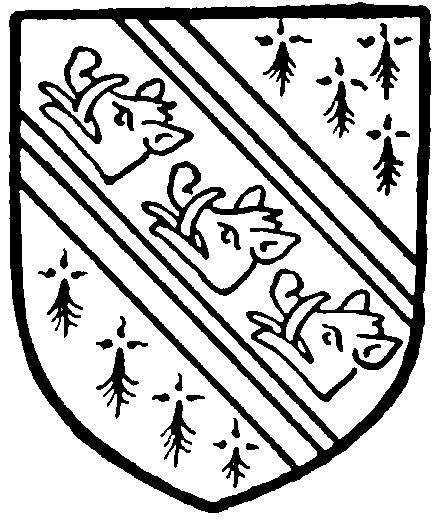
Bowerman. Ermine a bend cotised sable with three boars' heads or thereon cut off at the neck.
The mansion-house of Brook evidently formed part of the Bowermans' moiety of the manor, for when Henry VII paid a visit to the Isle of Wight in 1499 he visited Thomas and Joan Bowerman at Brook House, and was so pleased with the entertainment given him that he presented Joan with his drinking horn and gave her a warrant for a fat buck of the season to be annually delivered to her from his forest of Carisbrooke during her life. (fn. 29)
Joan, dying in 1503, was succeeded by her grandson Nicholas son of Thomas Bowerman, who died in 1559, leaving a son and heir William. (fn. 30) The latter acquired the other moiety of the manor from George Gilbert, as stated above. In 1580 his son Thomas was dealing with the manor, (fn. 31) and it passed from him to his son William, who was one of the judges of the Knighten Court in 1625. (fn. 32) Thomas, the son and successor of William, was member of Parliament for Newport in 1658 and died in 1677. (fn. 33) His second son John succeeded to the manor, apparently settling it in 1688 upon his son William. (fn. 34) The manor passed in the direct line in this family (fn. 35) until 1792, when William Bowerman sold it to Henry Howe. (fn. 36) On Henry's death in the following year it passed to his brother William Howe, (fn. 37) who with his wife Sarah conveyed it in 1798–9 to James Clarke for the purposes of settlement. (fn. 38) In 1848 and 1856 John and William Howe were joint lords of the manor, (fn. 39) but they sold it before 1859 to Charles Seely, (fn. 40) whose son Charles, created a baronet in 1896, (fn. 41) is the present owner of the estate.
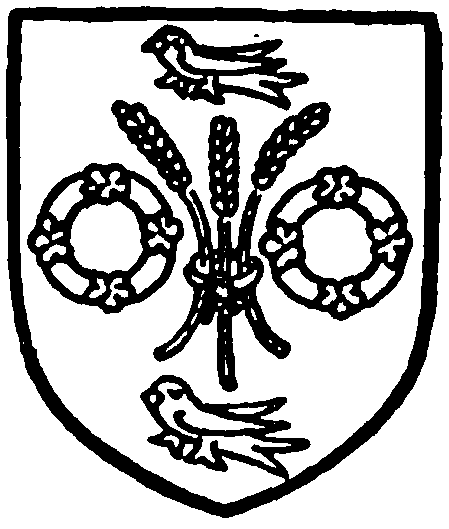
Seely, baronet. Azure three ears of wheat tied together or between two martlets paleways and two wreaths of roses fesseways argent.
CHURCH
The church of ST. MARY stands on a knoll at the turn of the road northward from Mottistone to Freshwater, and possesses little of antiquarian interest. Completely gutted by fire in 1863, (fn. 42) it was practically rebuilt the following year, and in 1889 had the tower raised 14 ft. and finished with a shingle spire. Of the original 13th-century church the only evidence is the arch (fn. 43) in the south wall opening to the tower, which must have originally opened into a side chapel, (fn. 44) and a carved stone representing a seated lion. (fn. 45) The north chapel was probably erected by William Bowerman, lord of the manor in the middle of the 18th century. (fn. 46) The church consists of a nave and chancel without dividing arch, a north chapel and a small tower. In the west wall is a 14th-century window, and the original tower was erected in the 16th century on the site of the demolished chantry. There is a piscina with an ancient drain, but it is a made-up restoration. In the tower is a peal of eight tubular bells.
The communion plate, consisting of flagon, chalice and paten, was given by William Bowerman in 1717.
The registers are as follows: (i) all entries from 1653 to 1671; (ii) all entries 1695 to 1783; (iii) marriages 1754 to 1812; (iv) all entries 1784 to 1802. There is a church rate and account book from 1728 to 1876.
ADVOWSON
The advowson of the chapel of Brook evidently belonged in early times to the lord of the manor, for William Mackerel gave it to God's House, Yarmouth, and his grant was confirmed by Ralph his brother. (fn. 47) Possibly by the suppression of the hospital the lords of the manor by the middle of the 14th century (fn. 48) became reinvested with the advowson, and they continued to hold it (fn. 49) until the sale of the manor in 1792, when William Bowerman retained it and presented in 1795. (fn. 50) The Bowermans continued to present until about 1858, (fn. 51) when the presentations were made by various persons, possibly as their grantees. (fn. 52) The advowson passed about 1859 to the Gaze family, in whose possession it remained until 1892–3, (fn. 53) when it was sold to Sir Charles Seely, the present lord of the manor and patron.
The chapel of Brook does not appear in the Taxatio of Pope Nicholas in 1291, being then a chapel belonging to Freshwater. In the 18th century a dispute arose as to the patronage of Brook between St. John's College, Cambridge, patron of Freshwater, and the Bowerman family, owners of the manor of Brook, and the cause was determined in favour of the latter. (fn. 54) In 1535–6 there was no incumbent in the chapel of Brook and Nicholas Bowerman took all the income of the chapel. (fn. 55)
There was a chantry founded in the chapel of Brook by Joan Bowerman, lady of the manor of Brook, who died in 1503, for one priest to sing for her and her husband and her father and mother, John and Joan Roucle, and for all Christian people. (fn. 56) The Chantry Commissioners (fn. 57) found that the patronage was in controversy between Nicholas and the parson of Freshwater and that they had so continued in variance for eighteen years.
CHARITIES
There are no endowed charities in this parish other than the elementary school at Hulverstone for this parish and Mottistone, which is mainly supported by Sir Charles Seely, bart.