
A History of the County of Hampshire: Volume 5. Originally published by Victoria County History, London, 1912.
This free content was digitised by double rekeying. All rights reserved.
'Parishes: Newport', in A History of the County of Hampshire: Volume 5, (London, 1912) pp. 253-265. British History Online https://www.british-history.ac.uk/vch/hants/vol5/pp253-265 [accessed 25 April 2024]
In this section
NEWPORT
Newport, the capital town of the Island, lies at the head of the Medina estuary, with a quay to which the tidal water reaches. The River Medina by the middle of the 16th century had washed down sufficient alluvial deposit to form two marshy tracts east and west of the quay. The former was suffered to remain as a place for 'old botes and crayers to lye in for the use of the toune,' but the latter was considered of sufficient importance, being opposite the warehouses in Sea Street, to be claimed and annexed to the town, by the 17th century gaining the name of Little London.
The area of the civil parish and borough is 499 acres of land, of which about 46 acres are arable land and 151 are permanent grass. (fn. 1) There are also 7 acres of foreshore, 5 of land covered by water and 2 by tidal water.
The boundaries of the municipal borough formerly extended north down the river to a shoal called the Brambles, (fn. 2) and about two miles out to sea, and comprised all land on the banks of the Medina where the tide had ever flowed, thus including a small part of East and West Cowes. (fn. 3) The northern part of the borough which had been excluded from the parliamentary borough in 1868 (fn. 4) was in 1876 also excluded from the municipal borough, (fn. 5) and from that date the municipal and parliamentary boundaries have been identical, and include parts of the parishes of Carisbrooke, St. Nicholas and Whippingham. (fn. 6)
Newport is now the main centre and station of the Isle of Wight Central railway, (fn. 7) which has its sheds and workshops here; and the town supplies a large part of the Island with necessaries, and has some large provision shops and wholesale houses, besides the extensive brewery of Mew, Langton & Co. The town lies low, surrounded by high ground, and consists of six main streets—High Street, South Street (formerly called Cosham Street), Pyle Street, Crocker Street, Lugley Street and Sea Street, running east and west, crossed by three others— Quay Street, Holyrood Street, St. James's Street—running north and south. (fn. 8)
The Tudor town evidently comprised three squares or open spaces for assembly and trade, the principal of which, St. Thomas's, was the Corn Market place. In the centre stood the church with, to the north of it, the fish and flesh shambles, (fn. 9) or shops, forming an island between it and High Street, while to the south, adjoining Pyle Street, was a row of standings or retail shops. At the west side, opposite the church, was the market house, (fn. 10) used as such up to the 19th century, when it was turned into an inn called the 'Newport Arms.' (fn. 11) Here the temporary 'pavillion' was erected for the pie-powder court held during fair time, when the 'glove' was set up. (fn. 12) At the north-east angle stood the Cheese Cross, (fn. 13) forming a connecting link with the square or space at the junction of Quay, High and Holyrood Streets, in the middle of which, facing east and west, was the town hall with the audit house, and probably the Knighten Court House, in close proximity. The third open space or square was called after St. James, and served the same purpose that it does to-day, (fn. 14) that of a beast market, and it is probable that here stood the ring for the bull-baiting. It was certainly used as the place for public punishment, a poor woman in the reign of Elizabeth being burnt here as a witch.
The town hall stands at the intersection of High Street and Quay Street, and apparently occupies nearly its original position. (fn. 15) It was erected in 1816 from designs by Nash, and a clock tower was added in 1887. It contains a county court room, a council chamber and various offices for the transaction of municipal business. There is a corn exchange in St. James Square, built in 1891, and, at the northeast angle of the square, a building erected in 1810 as the Isle of Wight Institution, and now occupied by the County Club. The Literary Society has premises in Quay Street, opposite the town hall, containing a good reading room and local museum. The Seely Library adjoins the technical institute in Upper St. James Street. In St. James Square is the Island memorial to Queen Victoria, erected in 1901, and at the junction of Castle and Carisbrooke roads a cross erected in memory of Sir John Simcon, bart. There is a fine drill hall at the upper end of the town, the Medina Hall in High Street used for entertainments and St. Thomas's Mission Hall in South Street. At Broadlands on the road to Staplers was a lace factory established in the middle of the 19th century by Mr. Nunn. It is now used as a training school for female servants.
There are numerous old houses in the town, many of which have been refaced. Among the most interesting are Hazards (17th–18th century), the Red House (18th century) and the Castle Inn (17th century) (fn. 16) in the High Street; God's Providence House (1701), the Green Dragon (18th century), the Chantry House (18th century) in Pyle Street; No. 52 Sea Street (1697), the Grammar School (fn. 17) (1614) in Lower St. James Street, a house on the north side of Crocker Street, with a date tablet, while another on the south side, nearer Holyrood Street, is an example of a small wattle and daub house of the 16th century. On the quay is a quaint old inn called the 'Fountain.'

Date tablet on house in north side of Crocker Street
The town is supplied with water from Carisbrooke and is lighted by gas and electric light from the works by the station. There were one or two early attempts to supply Newport with water. In 1618 a lease for 300 years was granted Philip Fleming allowing him to break up any of the streets within the borough for the purpose of laying trunks 'for the convenient carrying and conveying of wholesome spring water into this town and so into every man's house that shall compound with the said Philip for the same.' (fn. 18) Mr. Fleming was to pay sixpence yearly to the Warden of the common box, and the lease was to be void unless the water was brought into the town within three years. This apparently he failed to accomplish, for less than five years later licence was granted by the mayor to Mr. Andrew James to do the like. The water was to be conducted to a cistern house and receptacles placed in convenient positions in the streets. (fn. 19) In 1709, the former projects having apparently failed, another attempt was made to supply the town with water, and a lease of a small part of the Beast Market in St. James Square on the west side opposite the present Lamb Inn was granted to a Mr. William Arnold for the term of 900 years to build 'a cistern (fn. 20) to convey water into from some part of the river running by the north-west part of the town and from thence to be conveyed by pipes into the principal streets and lanes of the borough to the end that the inhabitants might at easy rates be furnished with river water in their houses upon all occasions and might be supplied with a present remedy in case of any accidental calamitous fire.' (fn. 21) This scheme, too, apparently proved abortive, (fn. 22) and another century elapsed before the subject was again brought forward.
The burial-ground to the south of the town, with its 16th–17th-century entrance, was the outcome of the plague visitation of 1582–3. It was consecrated on 23 October 1583, and was the first step towards throwing off the supremacy of Carisbrooke. Doubtless the southern part of the quay at the bottom of Quay Street occupies the site of the original landingplace for the inhabitants, but the first mention of its regular maintenance occurs in 1413 when an annual due was ordered to be levied 'for the support of the key,' (fn. 23) from which dues the present Corporation receives a considerable income.
Though the 1611 plan shows only one gate, that called the Town Gate at the north end of St. James Street, it is more than probable that other gates existed previous to the French descent in 1377. (fn. 24)
The old 'clink' at the bottom of Holyrood Street near the river was only lately pulled down to make room for the brewery malting house.
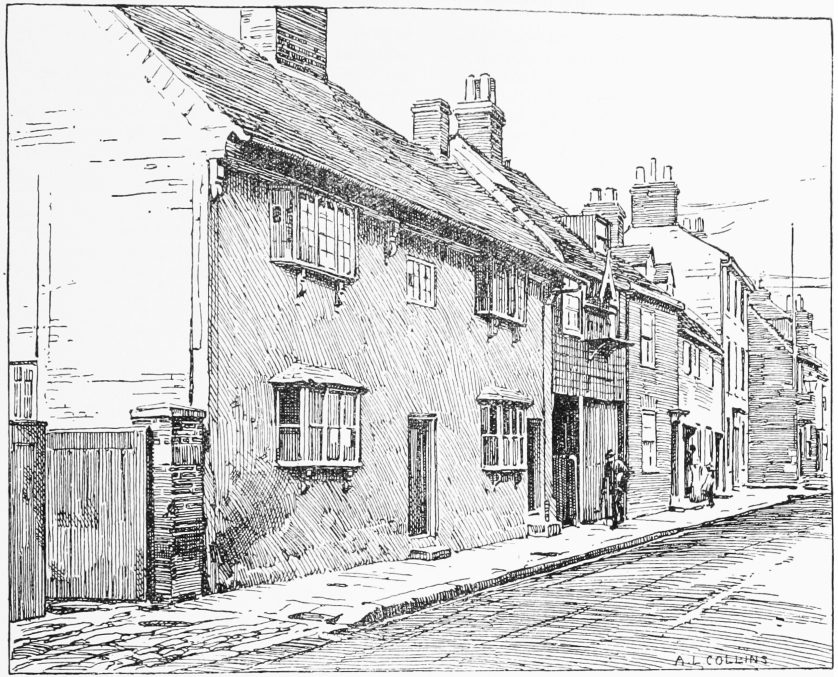
16th-century House, Crocker Street, Newport
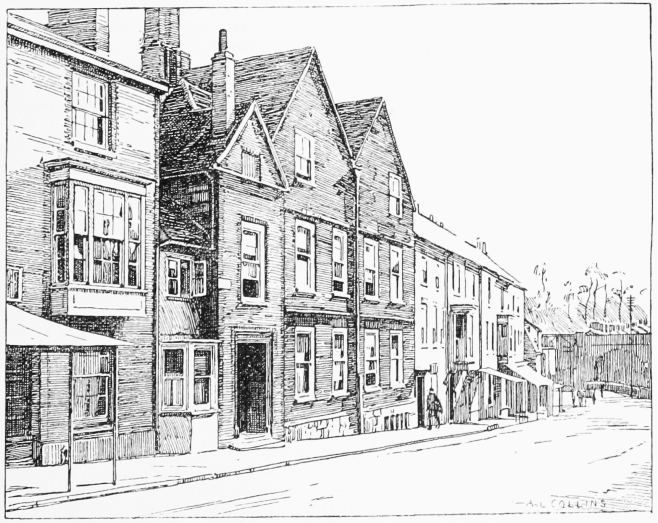
Hazards House, Newport
There are many mills (fn. 25) within the borough boundary, the oldest being West Mill and Ford Mill, both mentioned in the charter of Isabel de Fortibus. (fn. 26) The other mills are Home Mill, Westminster Mill, Towngate Mill, St. Cross Mill and Pan Mill.
Newport has numbered among its worthies many men of note. The three Elizabethan townsmen, Sir Thomas Fleming, Lord Chief Justice, 1607, Dr. Edes, Dean of Worcester (1597), Dr. James, physician in ordinary to the Queen, are good examples; while among its Parliamentary representatives the borough can claim Lucius, second Viscount Falkland (1640), the first Duke of Wellington (1807–9) and Henry John Temple, third Viscount Palmerston (1807). John Hamilton Reynolds, the friend of Keats, died at Node Hill in 1852. Newport, too, was the birthplace of Thomas James, first keeper of the Bodleian (1573), John Dennett the inventor and antiquary (1790), and it gave the title to Mountjoy Blount, created Earl of Newport by Charles I. (fn. 27)
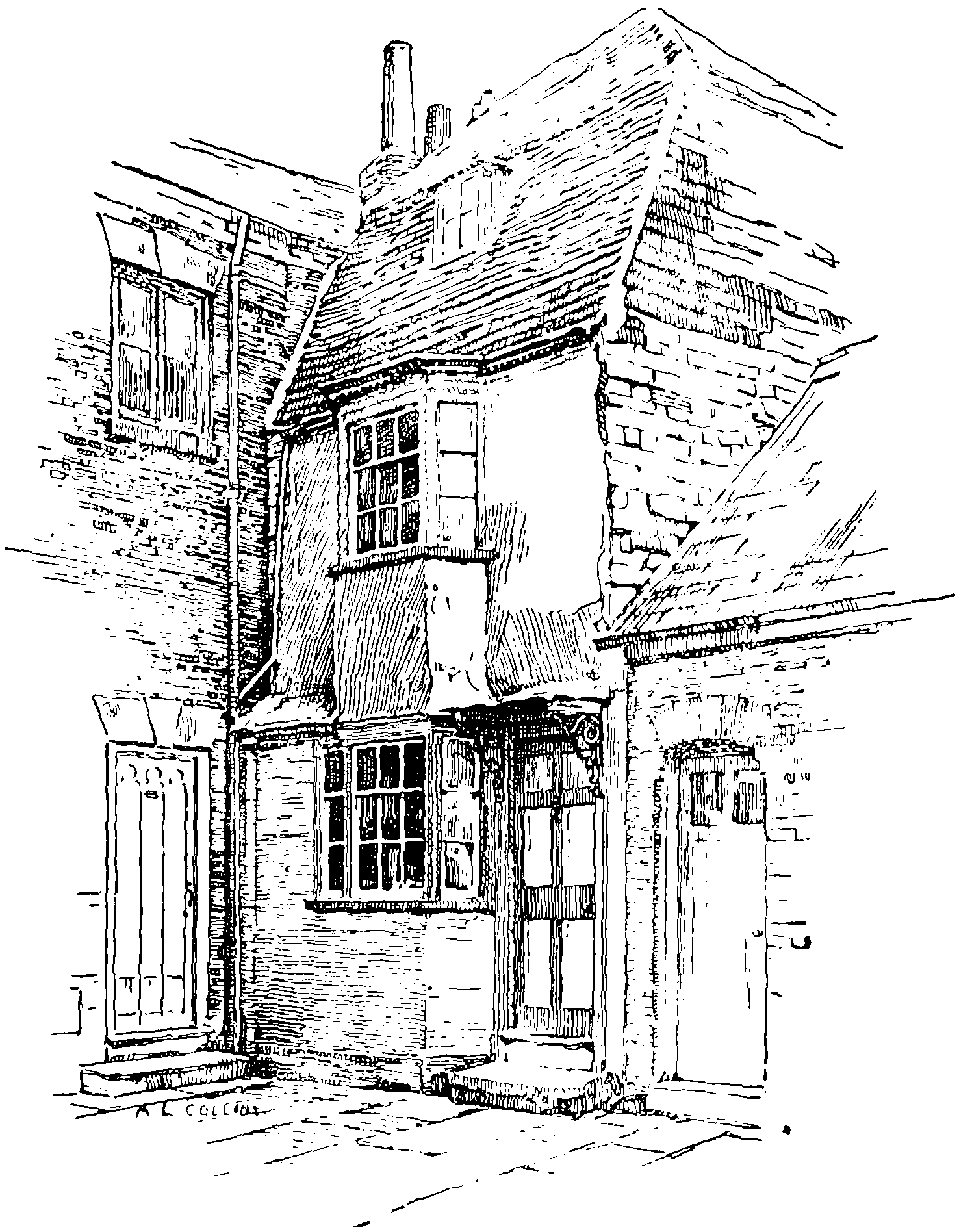
No. 77 High Street, Newport
BOROUGH
Newport takes its historical origin from the date of the charter granted to it by Richard de Redvers, fourth Earl of Devon (1180–4), though it may have had an earlier foundation without a special charter or privileges. (fn. 28) By this charter Richard de Redvers granted and confirmed to the burgesses freedom from tolls and customs at fairs and markets, from suits at shire and hundred, and common pasture in Parkhurst. All pleas belonging to the earl arising within the borough were to be pleaded there and none should be amerced save by the burgesses, nor for more than 30d. The burgesses were also to choose their own reeve. For this grant each burgess was to pay 12d. annually for his messuage. (fn. 29)
Isabel de Fortibus confirmed the existing privileges of the burgesses and allowed them to elect their bailiff as well as their reeve. Furthermore she granted them one mill and a moiety of another, and all amercements arising from pleas pleaded in the borough, and toll and custom in the borough except in the thirteen and a half places at Newport, afterwards known as Castle Hold, which the countess had already granted to the chapel of St. Nicholas. Instead of paying 1s. for each tenement the burgesses were now to pay a lump sum of 18 marks, 2s. 2d., to the lady and 1 mark to the hospital of St. Augustine for their burgages, (fn. 30) and for the mills, tolls and amercements 18 marks to the lady and 2 marks in frankalmoign to the monks of Carisbrooke. (fn. 31) A clause is inserted in this charter saving the liberties granted by the countess to the Abbot of Quarr and to the Priors of Christchurch and Appuldurcombe.
The burgages of Newport, like those of Christchurch (q.v.), were known as 'places' from the 13th to the 16th centuries. Thus they are called 'messuages' in the charter of Richard de Redvers, (fn. 32) 'tenements' in 1262 (fn. 33) and 'places' (fn. 34) in Countess Isabel's charter. In later times the value of these holdings varied considerably. Thus in an extent of the Island taken in 1297–8 the tenants of Newport 'places' paid sums varying from 15d. to 5s., (fn. 35) while in 1357–8 the bailiff and burgesses leased a 'place' 7ft. in length and 10 ft. in breadth for a rent of 2d. (fn. 36)
The charter of Isabel de Fortibus was confirmed by Edward III in 1352, (fn. 37) by Richard II twice in 1393, (fn. 38) by Henry IV in 1401, (fn. 39) by Henry V in 1414, (fn. 40) by Henry VI in 1439, (fn. 41) by Edward IV in 1464, (fn. 42) and by Henry VII in 1490. (fn. 43) Henry VII further granted the burgesses the lands and goods of outlaws, felons and fugitives and petty custom in all ports and creeks of the Island. (fn. 44) This charter was confirmed by Henry VIII in 1531, (fn. 45) by Edward VI in 1547, (fn. 46) and by Elizabeth in 1559. (fn. 47) Edward VI in 1549 confirmed the grant of tolls and customs and petty customs due under the grants of Isabel de Fortibus and Henry VII. (fn. 48)
In 1490 in the charter of Henry VII the style of the borough was for the first time changed from 'the burgesses of the borough' to 'the bailiff, (fn. 49) burgesses and inhabitants of the town,' and this later form was observed until 1608. In that year James I granted an incorporation charter by which the bailiff and burgesses were to be a body corporate under the name of 'the mayor and burgesses of the borough of Newport, and were to have a common seal.' (fn. 50) One of the burgesses was to be yearly elected mayor and twenty-four others were to be capital burgesses, and the mayor and capital burgesses, or the majority of them, were empowered to make by-laws. The other officers were a recorder, (fn. 51) a common or town clerk (fn. 52) and two serjeants-at-mace. A court of record, with jurisdiction over all causes arising in the borough, was to be held weekly on Fridays before the mayor and recorder and two capital burgesses. The mayor, recorder and predecessor of each mayor were to be justices of the peace and there was to be a double seal for recognizances of debt. The mayor was to be clerk of the market, and there was to be a gaol in a convenient place in the borough. Further, the corporation was empowered to acquire land to the annual value of £30. (fn. 53)
In December 1661 Charles II granted the burgesses their final charter, (fn. 54) under which the town was governed (fn. 55) until 1835. By this charter the limits of the borough were extended to include the Castle Hold. (fn. 56) Further, instead of the mayor and twentythree burgesses, the charter ordained that there should be a mayor and eleven aldermen, who with the recorder should form the common council of the borough, and twelve capital burgesses. The mayor was still to be elected yearly, while the aldermen, capital burgesses, recorder and town clerk were to hold office for life. In addition to the Friday court of record, another might be held on Tuesdays when occasion required. The number of justices of the peace was increased, the mayor, recorder, deputyrecorder, the last predecessor of each mayor and two other senior aldermen from thenceforth holding the office. The annual value of the land which the corporation might acquire was increased to £50, and the mayor, aldermen and chief burgesses were exempted from being jurors or suitors at any court outside the borough. Further, the inhabitants of Castle Hold were secured against the imposition of any military duties in the borough.
In 1683 the mayor, aldermen and burgesses of Newport surrendered to the king all their charters and possessions, (fn. 57) in accordance with the invitation of Charles II to all boroughs to surrender their charters as a sign of loyalty to the king, and a new charter was granted in March of the following year. (fn. 58) The Castle Hold was again excluded from the borough boundaries, the number of aldermen was reduced to nine and the capital burgesses to six. The mayor was vested with authority to nominate attorneys of the court of record, not exceeding four in number. All justices of the peace of the quorum of Hampshire who were resident in the Isle of Wight were to be justices of the peace in Newport. Charles II, in accordance with his policy of acquiring complete power over the chartered boroughs, inserted in this charter a clause reserving to the Crown the right to remove any mayor or other member of the corporation. On 17 October 1688 a proclamation was issued by James II annulling all surrenders made to Charles II, and restoring corporations to their ancient charters. (fn. 59) By this proclamation the corporation of Newport was re-established under the charter of 1661. In 1835 the town was divided into two wards, with six aldermen and eighteen councillors, and it was to have a commission of the peace. (fn. 60) The corporation has from that time remained unaltered.
The election of the early borough officers, the bailiffs, apparently took place in the church, and was a very solemn and ceremonious affair, (fn. 61) beginning with an assembly of bailiffs and burgesses in the town hall 'the Thursday before the Sunday preceding the feast of St. Michael the Archangel,' followed by a prayer in the church for God's guidance, the rendering up of the maces by the bailiffs, with an account of their stewardship and an endurance of criticism on the same. The bailiffs then resumed their office till Michaelmas, when they attended a dinner given by the junior bailiff at his house, where the whole company adjourned ' and there maketh merrie.' After dinner they all went to church, leaving the bailiffs behind, where, 'dividing themselves into two companies after the old usage,' those who had already served as bailiffs went into the chancel, the rest remaining in the nave. The elders then consulted and chose two candidates 'to supplie ye roome of ye Elder Baylive,' whose names written on a scroll of paper they sent down to the burgesses in the nave with instructions to prick. This settled, they chose the younger bailiff 'by voyces onlye,' and finally visited the new bailiffs' houses for a 'shortte drincking.' Before, however, they were admitted to office they had to attend at the castle and take the oath before the governor.

God's Providence House, Newport
Under the charter of 1608 the election of the mayor took place on the identical day that had been customary for the election of the bailiffs, and he, as they before him, had to take oath before the Captain of the Island or his seneschal in the chapel of the castle. (fn. 62) However, in 1661 he was ordered, in the absence of the captain and his seneschal, to take oath in the town hall before the then mayor and the other justices of the peace. (fn. 63)
Until 1621 the election took place by 'pricking,' (fn. 64) but in that year it was decreed (fn. 65) that it should be by ballot. (fn. 66)
In 1835 the existing method was as follows: the junior chief burgess was first called upon to sign his name under that of the alderman he wished to be mayor, then the rest of the electors were called upon by juniority to do the same, the mayor signing last. (fn. 67)
In addition to the functions already mentioned the mayor was also admiral of the borough, judge of the court of pie powder, returning officer in the election of members for Parliament, commissioner under the Act for the Court of Requests in the Isle of Wight, and king's escheator within the borough. (fn. 68) He also had the right to fix the assize of bread and ale and was entitled to 2 bushels of coal from every ship which discharged in Cowes Harbour, as well as fish to the value of 1s. 4d. from all parcels of fish brought to the town. (fn. 69)
The recorder and town clerk were, under the charter of 1608, to hold office during the pleasure of the mayor and capital burgesses by whom they were to be elected. (fn. 70) In 1661 they were to be appointed for life by the Crown. (fn. 71) A deputyrecorder was also to be nominated by the recorder. (fn. 72) The two serjeants-at-mace were elected by the mayor and capital burgesses. (fn. 73) Other officers of the corporation were: a town warden, (fn. 74) water bailiffs, (fn. 75) a harbour master, (fn. 76) con stables, (fn. 77) a beadle, (fn. 78) a receiver of assize returns, (fn. 79) coal meters, (fn. 80) corn measurers, (fn. 81) a measurer and gauger, (fn. 82) gashers of hides, sealers of leather, (fn. 83) and a gaoler.
There were also three classes of freemen or burgesses; first, those who, having a freehold of a whole place or half a place within the borough, built upon, and also a wife and household, had become free by payment of 6s. 8d. to the use of the common box; secondly, those who had become free by payment of a sum of money (varying from 13s. 4d. to £20) named by certain corporate functionaries (fn. 84); thirdly, the honorary freemen or burgesses. All burgesses of the first two classes had disappeared before 1835, and there were only four or five of the third class. (fn. 85)
Walter de Wyte and Peter de Coskevill attended the Parliament of 1295 as members for the boroughs of Newport and Yarmouth, (fn. 86) but no member for Newport was returned from that time until 1584, when two members were elected, (fn. 87) this privilege having been obtained for the burgesses by Sir George Carey. From 1584 until 1867 Newport regularly returned two members. In that year the number was reduced to one, (fn. 88) and in 1885 by the Redistribution of Seats Act the representation of Newport was merged in that of the Island. (fn. 89) Until the passing of the Reform Act in 1832 the elective franchise was exercised only by members of the corporation. (fn. 90)
Of the courts formerly held within the borough of Newport the most ancient was the Knighten Court or Curia Militum. (fn. 91) It is supposed to have been instituted by William Fitz Osbern and its suitors were those who held knights' fees or part of knights' fees of the honour of the castle of Carisbrooke. (fn. 92) It corresponded to the sheriff's court and was confirmed to Isabel de Fortibus at the end of the 13th century. (fn. 93) The Priors of Christchurch and Appuldurcombe, the Abbot of Quarr and the Abbess of Lacock received the amercements of their men in the knights' court, (fn. 94) the abbess having obtained the privilege by grant of Isabel de Fortibus. (fn. 95)
In 1626 the gentlemen of the Island addressed a report to Lord Conway on the constitution of the Knighten Court, suggesting alterations. It was held by the captain's steward in the town hall of Newport on Monday every three weeks, and had jurisdiction throughout the whole Island, with the exception of the borough of Newport. It held pleas of all actions of debt and trespass under the value of 40s., and all actions were entered and pleaded by certain attorneys allowed in that court. The petitioners suggested that as the judges were few in number and often did not attend it would be well to empower the election of a certain number of judges, in order that justice might not be delayed, and also to increase the value of actions to be tried in the court. The AttorneyGeneral was therefore ordered to draw up a grant enlarging the jurisdiction of this court to all cases, civil or criminal, under the value of £20, provided the same did not extend to the life, member or freehold of any of the inhabitants. (fn. 96) These reforms were, however, never carried into effect, and the jurisdiction of the court remained unaltered until 1806, when it was partially superseded by a Court of Requests for the Isle of Wight for the recovery of debts under £5, the commissioners of which were to be the several members of the corporation of Newport and the justices of the peace for the Island. (fn. 97) The Knighten Court and Court of Requests seem to have existed side by side in 1835, (fn. 98) but in 1847 the Court of Requests was superseded by the county court. (fn. 99) The Isle of Wight became a separate administrative county in 1890, (fn. 100) and the county court for the Island is held every month, alternately at Newport and Ryde.
The court leet of the borough was for convenience summoned to meet on the days of two of the quarter sessions. The corporation were lords of the leet, which did not include Castle Hold within its jurisdiction. As late as 1670 the court-leet jury were in the habit of formally presenting the different ordinances and customs of the borough. (fn. 101)
The mayor was judge and the town clerk registrar of the court of pie powder, which was proclaimed regularly once a year on the Saturday succeeding Michaelmas sessions. The corporation in 1832 published a notice that a court of pie powder would be held every market day. The petty constables were sworn in at this court, but the origin of this custom is not known. (fn. 102)
The corporation books contain entries of the holding of courts of Admiralty, presided over by the mayor as admiral of the borough, but in 1835 these courts had long been discontinued. (fn. 103) Newport became subject to the Admiralty jurisdiction of the Portsmouth Court in 1869. (fn. 104)
In 1835 petty sessions were held every Saturday for the borough, the county petty sessions being held at the same time. (fn. 105) The borough petty sessions have now for many years been held on Mondays in the town hall, the county petty sessions on Saturdays at Newport and on Tuesdays at Ryde. The magistrates at the quarter sessions in 1835 were the mayor, late mayor, recorder, deputy recorder and two senior aldermen, and the town clerk was clerk of the quarter sessions. (fn. 106)
No early grant of a market or fair to the borough of Newport has been found. Adams in his History of the Isle of Wight states that the privilege of holding a market was granted to the town about 1222, (fn. 107) while the Commissioners appointed to inquire into market rights in 1888 reported that the market had been granted to the town in 1184 by Richard de Redvers. (fn. 108) No mention of any market or fair is made in any charter until 1684, when in the cancelled charter of Charles II the burgesses obtained the right to hold a market every second Wednesday in each month with a toll of 1d. for each head of cattle and 3d. for every score of sheep sold. (fn. 109) A Saturday market and a fair lasting three days at Whitsuntide existed at Newport before 1280, when they were claimed by Isabel de Fortibus and allowed to her by the justices itinerant, (fn. 110) yet no tolls from the market or fair are entered in contemporary ministers' accounts for Newport. At the end of the 13th century part of the tolls of the market of Newport, namely, the tolls on all corn bought or sold there, were held by freeholders of the manor of Bowcombe for the service of carrying writs at the will of the lord or his bailiff throughout the whole Island. (fn. 111) The tolls of the Whitsuntide fair belonged in 1835 to the corporation and amounted to £8 or £10 a year. (fn. 112) This fair was abolished in 1871. (fn. 113) Until the end of the 19th century the market was held on Saturdays and alternate Wednesdays, the Saturday market being the principal one. The Wednesday market is now held on Tuesdays. Hiring fairs were formerly held on the three Saturdays nearest Michaelmas and were called 'Bargain Saturdays.'
The harbour dues were in 1835 received by the harbour master. The dues were levied on all unregistered vessels anchoring in Cowes Harbour or up the river. The rates in 1835 were 1s. 4d. for British vessels under 50 tons, 2s. 6d. for vessels above 50 and under 100 tons, and 5s. for vessels over 100 tons. The dues on foreign vessels were double in each case. These dues had not been levied for a long time, and on their renewal about 1830 great discontent arose in various quarters, causing the corporation some expensive litigation. (fn. 114)
The corporation parted with nearly all their landed property early in the 19th century to defray the expense of building a town hall and market-place. (fn. 115) Their property now includes wharfage and harbour dues, half of the latter being retained by the corporation since about 1835, the rest being taken by the harbour master. (fn. 116)
The corporation has two fine maces (fn. 117) of silver gilt, the one given by Lord Cutts in 1696, the other the gift of Leonard Troughear Holmes in 1766. (fn. 118) There are two good seals belonging to the corporation. The older 15th-century one is of bronze, bearing in the centre a ship with a single mast and sail; round the edge the legend in black letter, 'SIGILLUM COMUNE VILLE DE NEUPORT IN INSULA DE WIGHT.' It measures 2 in. in diameter. The other is of silver, 1 in. across, and displays in the centre a three-masted ship of the 16th century with the legend 'SIGILLVM COMVNE VILLAGE DE NEWPORT IN INSVLA VECTIS.' This is known as the Mayor's Seal.
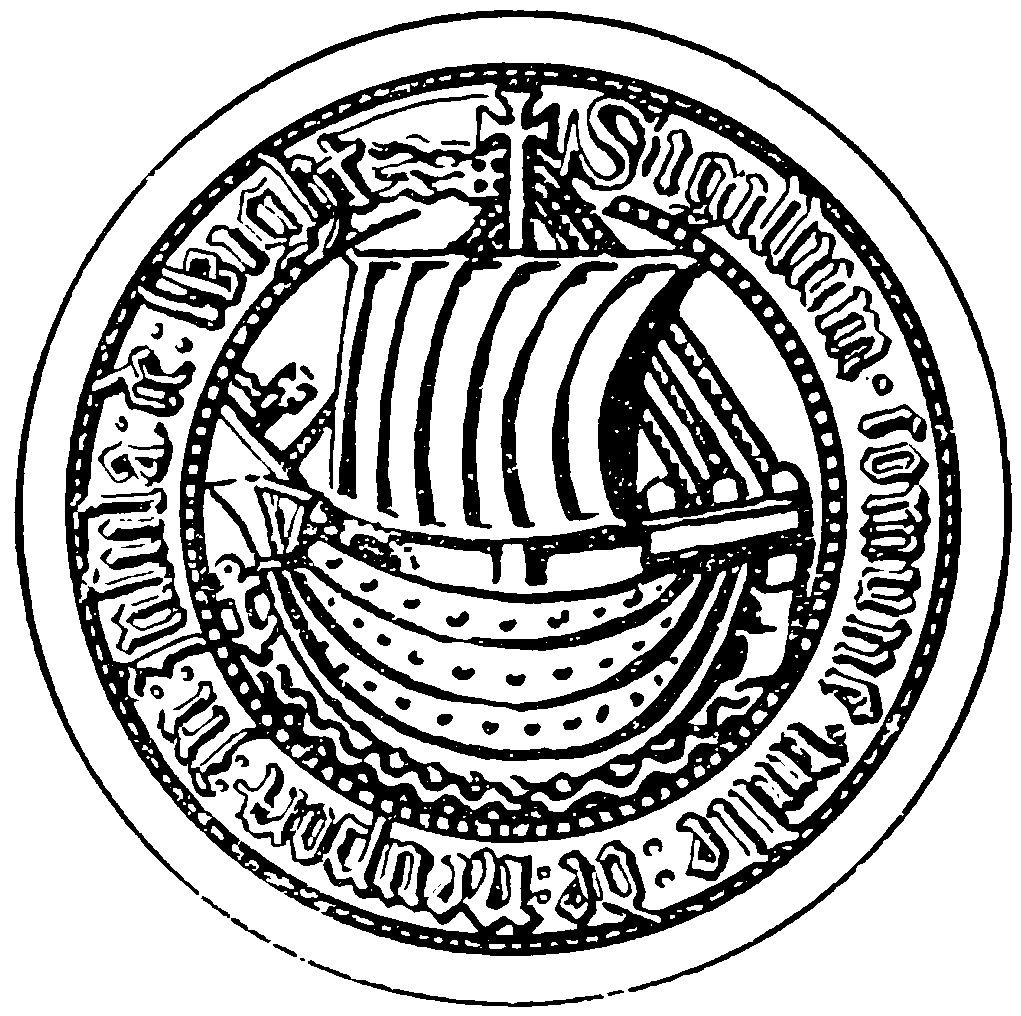
15th-century Seal of the Borough of Newport
Few details are known of the early life of the town, but in the spring of 1349 the Black Death, which had broken out the previous August at Weymouth, visited the Isle of Wight and wrought havoc amongst the Newport inhabitants. This was followed in August 1377 (fn. 119) by the total destruction of the town by a body of marauding Frenchmen, who did their work so thoroughly that for nearly two years afterwards the place was deserted. (fn. 120) It never seems to have thoroughly recovered itself, as at the lawday held there 8 October 1462 it was determined 'to note and consider and diligently search and learn of the people within the centon whereupon the cause of the decay of the people hath been grown and how the same may be restored again.' Despite this the decay of the town went on, and to such an extent that in 1559 a commission under the direction of Sir Francis Knollys was appointed to inquire into it. (fn. 121) To the interrogatories the bailiffs and burgesses made answer referring to the wasting of the town in 1377 and the endeavour to recover its prosperity in 1462, asserting that ever since the disaster of 1377 when 'we loste our habitacons, our people and the full use of our liberties' … the town 'hathe not, nor ys yette fullie builded and recouv'd,' and requesting 'the Queene's Matie and her honorable counsaylle' to give a favourable ear to the remedies they suggested for the prosperity of Newport and the Island in general, namely: To grant the endowments of Newport Chantry for the support of a schoolmaster 'to brynge uppe youthe in lerninge and vertewe'; to remit payment of tenths and fifteenths and the tax on 'Kersies made within the said towne' so that the industry may increase; to transfer the receipt of custom on goods entering and leaving the port from Southampton to Newport; to allow Island fishermen to sell their herrings and mackerel where they wished and forbid any Island sheepskins from being sold without being first tanned; to relieve Islanders from attendance at mainland sessions and allow outside processes to be served by the bailiffs of Newport; and that the Captain of the Wight 'may also be Vice-Admiral within its bounds.' Despite these suggestions little seems to have been done, though the population at the time the commission was appointed had increased since the reign of Edward VI by nearly 500—as the town, according to Sir John Oglander, was a poor sort of place in the 16th century, (fn. 122) and in such an insanitary condition that in Michaelmas 1583 the plague broke out and carried off over 200 inhabitants.
The Corporation Books of the 17th century give a very graphic insight into the daily life of a provincial town of the period. Curiously enough the very time when interesting entries are to be expected— during the Treaty of Newport, 6 September to 30 November 1648—is an absolute blank. Not a line of record is preserved about the coming of the king, his meeting with the Parliamentary Commissioners, the daily brawls between Cavaliers and Puritans which we know took place, or the final departure of Charles for Hurst Castle.
During the negotiations the king and his friends occupied the grammar school and the Parliamentary Commissioners the Bull Inn, while the meetings took place in the town hall. The subject of the negotiations related chiefly to the governance of the church and the militia, but the treaty led to no satisfactory results.
In the latter part of the 18th century Newport was quite a lively town, with dramatic performances, (fn. 123) a periodical assembly, (fn. 124) routs, reviews, and even duels, (fn. 125) for the Island was full of the military element (fn. 126) with the gay consequences. The country gentlemen drove in for diversion and many of them had town houses in the principal streets. On market days the town was crowded with farmers' waggons and country people. (fn. 127) It was in Newport market the legality of the customary bushel was first questioned. (fn. 128)
MANORS
The manor of NEWPORT was always held by the lords of the Island, whose representatives held courts. It passed with Carisbrooke Castle (q.v.) to the Crown, whose interest was eventually represented only by a fee-farm rent paid by the Corporation. (fn. 129)
During the 13th and 14th centuries the abbey of Quarr acquired in and near the borough of Newport numerous tenements and land, afterwards known as the manor of NEWPORT. (fn. 130) At the Dissolution the manor was valued at £6 6s. 2d. (fn. 131) The manor seems to have been retained by the Crown until 1628–9, when it was granted by Charles I to trustees for the City of London in payment of his debts to the city. (fn. 132) In February 1629 these trustees sold the manor to John Lamott and William Kinge, (fn. 133) and they conveyed it in 1632 to Humphrey afterwards Sir Humphrey Bennet. (fn. 134) It passed from him to his brother Thomas Bennet of Babraham, who was created a baronet in 1660 and died in 1667. (fn. 135) His son and successor Sir Levinus sold the manor in 1668 to Cheyney Colepeper, one of the younger sons of the Rt. Hon. John Lord Colepeper, and to Alexander Colepeper of Leeds Castle. (fn. 136) From them it seems to have passed to Thomas Lord Colepeper, elder brother of Cheyney, (fn. 137) who died in 1688–9, (fn. 138) leaving a daughter Katherine wife of Thomas Lord Fairfax of Cameron. Her two sons Thomas and Robert both died without leaving surviving issue, (fn. 139) and the latter on his death in 1793 left his estates to the issue of his sister Frances by Denny Martin. (fn. 140) Dr. Denny Martin, afterwards Fairfax, the elder son of Frances, died in 1800, and his brother General Philip Martin, who dealt with the manor of Newport in 1816, (fn. 141) died in 1821, leaving his estates to his paternal relative Fiennes Wykeham. (fn. 142) He assumed the name Martin (fn. 143) in accordance with the will of General Martin, and died in 1840, when his son Charles Wykeham Martin succeeded. (fn. 144) No manorial rights now exist in connexion with this estate, which is perhaps represented by two houses, two cottages and some land in Newport belonging to Mr. Charles Wykeham Martin.

Colepeper. Argent a bend engrailed gules.
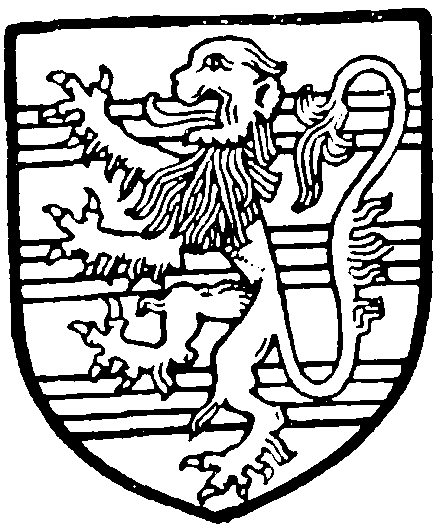
Fairfax. Argentthree gimel bars gules with a lion sable over all.

Wykeham. Argent two cheverons sable between three roses gules.
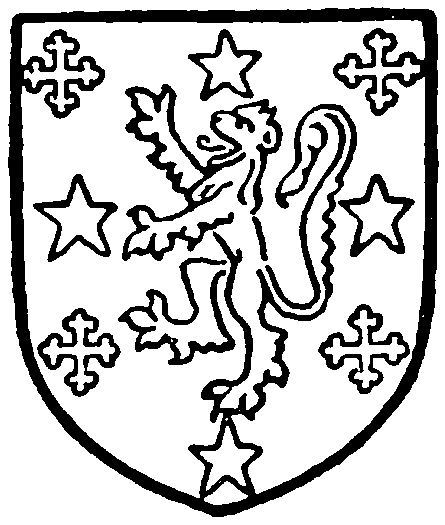
Martin. Gules a lion in an orle of crosslets and molets or.
Towards the end of the 13th century Henry Oglander held two thirds of half a fee in Nunwell and CODIBEAR (Cotebear, Codibere, xiii cent.; Codebare Poyly, Suthcodibear Poyly, Codibyarpoyli, xiv cent.) of the honour of Carisbrooke. (fn. 145) In 1285 Bartholomew Attenalre and Alice his wife quitclaimed half a messuage in Newport to Jordan de Poyly, (fn. 146) and in 1327 William de Poyly, rector of St. Mary the Greater, Ilchester, granted Nicholas le Yonge and Annora his wife all the lands and tenements at Codibear Poyly near Newport which had descended to him on the death of his kinsman John de Poyly. (fn. 147) Annora was the widow of Henry Poyley, William's brother, and in 1332–3 she granted this estate to her brother Henry Oglander. (fn. 148) William Poyly when granting the estate to his sister-in-law retained for himself a yearly rent, which in 1332–3 he granted to Henry Oglander. (fn. 149) The latter in 1333 agreed to grant this property to the Abbot of Quarr, (fn. 150) and did so on obtaining royal licence to that effect in 1337. (fn. 151) After this date Codibear was evidently included in the Abbot of Quarr's manor of Newport. The name has now disappeared, but a close called Coderberry on the north part of Powleslane in Newport is mentioned in a conveyance of the manor of Newport in 1628, (fn. 152) and in a conveyance of 1666 it occurs as a parcel of the manor of Newport. (fn. 153)
The priory of ST. CROSS, a cell of the abbey of Tiron, was sold by the Abbot of Tiron in 1391 to the warden and scholars of Winchester College. (fn. 154) The priory has long since disappeared, but St. Cross Farm, which marks its site, is still held by the warden and scholars of Winchester College. (fn. 155)
CHURCHES
In 1854 the 12th-century church of ST. THOMAS OF CANTERBURY, (fn. 156) built c. 1180, was pulled down to make way for the present structure, a fine building with 14th-century details, whose lofty tower dominates the town. The church, which is entered by a west door in the tower, has a long nave of five bays with high pointed arches with clearstory over and a chancel with north and south chapels, in the latter of which stands the fine 16th-century monument (fn. 157) to Sir Edward Horsey, Captain of the Wight 1565–82. This is of coloured alabaster, inlaid with marble, with side columns supporting a cornice, over which are the armorial bearings of Sir Edward, who lies in effigy below clad in the full armour of the period, his feet resting against a horse's head, his family bearing. In the north chapel is the memorial erected by Queen Victoria in 1856 to the Princess Elizabeth, (fn. 158) a remarkably fine piece of modern sculpture, and a good medallion bust of Prince Albert, both by Marochetti.
The church, which is of good proportions though rather poor detail, is much disfigured by western galleries which block the light and add a gloominess to the interior. There is a fine 17th-century pulpit with an elaborate canopy, (fn. 159) the gift of Stephen March in 1631. On the sides are emblematical figures representing the theological virtues, Faith, Hope and Charity, and the cardinal virtues, Justice, Prudence, Temperance, and Fortitude, beneath which are carved the seven liberal sciences. (fn. 160) The canopy bears figures of Peace and Justice, supported on either side by angels with trumpets, while along the frieze runs the legend, 'Cry aloud and spare not, lift up thy voice like a trumpet.' On a panel at the back is an arm holding in the hand a battle-axe, the crest of the donor. The remains of an old chancel screen (fn. 161) are worked into the reading desk. There is a Jacobean font inscribed 'THE · GIVET · OF · ANNE · KEITH · WIDOW · 1637,' the cover of which now does duty as a stand for the lectern. To this period belong the quaint oak collecting boxes on which is carved the date 1635. (fn. 162) The fine organ was built in 1870.
There are eight bells: the fourth, sixth, seventh and tenor cast by William Eldridge in 1675; the third and treble recast in 1808 and 1857 respectively; the second and fifth cast by Mears in 1808. (fn. 163)
The plate consists of two chalices with covers, 1630; two flagons, an almsdish and two patens, 1696; the gift of Eustace Man of Osborne.
The registers date from 1541. Under the year 1554 is a reference to the coming of 'a Navy of Shyppys oute of Spayne … wyth Phylyp Prynce of Spayne.'
The church of ST. JOHN BAPTIST in St. John's Road—a plain, uninteresting stone structure erected in 1837—consists of a nave and chancel with two octagonal turrets flanking the west end. The register dates from 1838, the ecclesiastical parish having been formed from Carisbrooke in 1837, (fn. 164) and the living is in the hands of trustees, the endowment being chiefly derived from pew rents.
ADVOWSON
Newport was originally a chapelry annexed to the church of Carisbrooke. Richard de Redvers, fourth Earl of Devon, arranged with the monks of Carisbrooke that they should hold divine service every day in the chapel of Newport, and his uncle and successor William de Vernon granted the monks a rent of 2 marks from the tolls of Newport on their undertaking to serve the chapel. (fn. 165) The townsfolk of Newport upon 'the great feast day' were to visit their mother church of Carisbrooke, as had formerly been the custom. In 1559 the burgesses of Newport stated that they had no parish church but a chapel maintained at their own expense belonging to the church of Carisbrooke, with a minister hired at a wage of £6 13s. 4d. They suggested that as no service had been held in the chapel of St. Nicholas for thirty years, the profits of the vicarage of St. Nicholas might be annexed to the chapel of Newport. (fn. 166)
In 1644 the inhabitants of Newport unsuccessfully petitioned that their chapel might be made parochial, and that an annual payment of 2s. in the pound might be made, half by the landlord and half by the tenants, from the rent of houses and lands in the town for the maintenance of the ministry, and that part of the tithes and profits belonging to the impropriation of Newchurch might be annexed to the living. (fn. 167) However, in 1653 the mayor and chief burgesses ordered that a rate not exceeding 1s. 6d. in the pound for one year should be levied on all lands and houses in the borough for the maintenance of a minister. (fn. 168) The chapelry became a vicarage in 1858, (fn. 169) and the patronage was transferred in 1871 from the provost and scholars of Queen's College, Oxford, to the Bishop of Winchester, (fn. 170) who has since held it.
At the time of the plague in Newport in 1582 the death rate was so great that the churchyard at Carisbrooke was found insufficient, and one had to be opened at Newport on a parcel of land called Cossam, part of the manor of Cosham where the shooting butts stood. (fn. 171) This burial-ground was superseded by a new one provided by the Burial Board in 1858. (fn. 172)
Sir John Oglander in his memorials of the 16th and 17th centuries mentions a custom which was then observed at Newport. On Easter Day the vicar of Carisbrooke came to his chapel of Newport to administer the sacrament, 'and he wase to dine with ye Baylie nowe maior of Nuport, and at suppor the Viccor invited ye burgesses to supper to an inne, where he wase to provyde gammons of bacon at his owne chardge, and to giye 5s. towardes ye wyne: and every burges was to pay his shilling, and every new burges that had been made since ye last meeting wase to give his pottell of wyne to ye maior: and then aftor supper the maior and burgesses weare to bring ye Viccor on his way to Caresbrooke as far as ye chappell fylde, and then to take theyre leaves. This wase called ye love feast betweene ye towne and theyre Viccor.' (fn. 173)
Sir Anthony Wydevil in 1468 agreed to pay the tenths and fifteenths due to the Crown from the bailiffs of Newport, on condition that they would pay 4d. in the pound to the indigent poor and pray specially for Sir Anthony and Elizabeth his wife, and find during the term of the grant a fit chaplain to celebrate masses at the altar of the Blessed Virgin Mary on four days in the year. (fn. 174)
In 1616 a faculty was granted by the Archbishop of Canterbury to the Mayor and burgesses of Newport for ten pews in the church to be reserved to their use.
John Garston, a prominent burgess of Newport, proposed to found a chantry dedicated in honour of the Virgin Mary in the chapel of Newport, but was prevented by death from doing so. But he left certain lands to Robert Parfite, John Vobe, Robert Virsey and John for its foundation, and these trustees obtained licence in 1449 to found a chantry, to be called the chantry of John Garston and John White. (fn. 175) Garston's object in founding the chantry was to supplement the services of the single chaplain of Newport by those of another 'chaplain to celebrate daily divine service and the sacraments to fishermen and other mariners coming to the said town in tempestuous times,' and 'also specially to pray for the welfare of our lord King Henry VI and Queen Margaret his consort.' (fn. 176) The chantry at its suppression is stated to have been founded by John Garston and John White to support a priest to sing for their souls. (fn. 177) In 1455–6 Robert Parfyte, clerk, granted a messuage, land and stalls in Newport, Fairlee and Shide (inter alia) to John Boynton, the chaplain of this chantry, (fn. 178) and in 1456–7 John leased to John White and John Baret a messuage called Chaunterie Barn. (fn. 179)
There is no record of any grant of this chantry after the time of its seizure by the Crown, but in 1559 the inhabitants of Newport suggested that its endowment should be granted to the grammar school. (fn. 180) This does not seem to have been done, for in 1780 John Fleming was paying rent for the chantry of Newport. (fn. 181)
There is a Roman Catholic church in Pyle Street, (fn. 182) a plain brick building erected in 1791, at the cost of Mrs. Elizabeth Heneage; a Congregational church in Lower St. James' Street, (fn. 183) established in 1662, built in 1699 and rebuilt in 1778 and again in 1848 (fn. 184); a Baptist chapel at the top of the High Street, built 1809, (fn. 185) enlarged 1872; Wesleyan (fn. 186) and Primitive Methodist (fn. 187) chapels in Pyle Street; a Unitarian (fn. 188) church in High Street, founded in 1728; a United Methodist chapel in Quay Street, built in 1880; a Friends' meeting-house in High Street; and a Salvation Army barracks in Lugley Street. There is also a Wesleyan Methodist chapel at Hunny Hill.
CHARITIES
The Free Grammar School in Lower St. James' Street was founded by subscription in 1614, and endowed by Sir Richard Worsley (deed 1617), Sir Thomas Fleming (deed 1617), John Pittis (deed 1625) and John Serle (deed 1620), and is endowed with houses and land of the annual rental value of £150 or thereabouts.
The Blue School Foundation, formerly the Girls' Charity School, is regulated by a scheme of the Board of Education, 23 December 1907, and possesses an endowment of £4,817 1s. 4d. consols, producing £120 8s. 4d. a year, of which £2,513 6s. 6d. arose from subscriptions and donations, £242 14s. 10d. consols from sale in 1889 of land and disused school buildings, and £723 8s. 9d. consols accumulations of income, and the remainder from legacies under the wills of Miss Scott (1860), Rev. G. Richards (1843), Mary Davis Parker (1876), Robert Bell (1880), and Miss Cecilia Scott (1888). The stock is held by the official trustees.
In 1688 John Mann by his will gave a fee-farm rent of £53 16s. 4d. issuing out of the manor of Overton, Yorkshire, for the benefit of poor orphans and maintenance of poor old people. The charity is applied in apprenticing poor children, a preference being given to orphans.
In 1909 four were apprenticed at a premium of £10 each.
Almshouse Charities.
The Lower or Worsley's Almshouse in Crocker Street was founded by Giles Kent, who devised the almshouse and £100 to Sir Richard Worsley, bart., for the accommodation of five or more old people. Sir Richard Worsley by deed 17 May 1618 granted the almshouse to the mayor and burgesses and also a rent-charge of £10 out of the manors of Chale and Walpen. The trust property now consists of the almshouse occupied by six inmates, a small garden at rear let at £5 a year, the rent-charge of £10 above mentioned, and a rent-charge of £10 under will of Christian Roman of Shorwell. There is also a sum of £160 in the Isle of Wight Savings Bank.
The Upper Almshouses in the High Street, supposed to have been established in 1650 by Stephen Marsh, are occupied by four inmates, who receive 10s. a year about Christmas in respect of the charity of John Serle for the grammar school. The upkeep of the almshouses is defrayed out of parochial funds.
The Broadlands Home Charity was founded and endowed by Mrs. Mary Nunn Harvey in 1880 for the following purposes, namely: to provide a home training (as servants) and outfit for a number of poor girls for two years, and to provide residence and board for forty ladies of limited means, on payment by them of sums varying from £20 to £26 per annum.
The endowment consists of £10,000 London and South-Western Railway 3½ per cent. preference stock, £9, 162 London, Tilbury and Southend Railway 4 per cent. debenture stock, £100 annuity East Indian Railway, £2,000 3 per cent. debenture stock of the same railway, and £12 annuity of the Great Indian Peninsular Railway.
The several securities are held by the official trustees, producing £890 a year or thereabouts.
The Poor's Land consists of 10 a. 1 r. 12 p. in Kitbridge, allotted in 1815 as compensation for the right of the inhabitants to sere and broken wood in Parkhurst Forest. The rents of about £15 a year are applied for the benefit of the poor.
The poor formerly received £4 a year in respect of a legacy of £100 by will of William Bowles, proved in the P.C.C. 1748; also £4 a year in respect of a legacy of £100 by will of Sarah Ruffin, proved in the P.C.C. 1773, which legacies were secured by two bonds of £100 each of the Isle of Wight House of Industry.
The Congregational United Charities are regulated by a scheme of the Charity Commissioners, 22 April 1910, namely:—
1. The chapel and trust property in St. James's Street, comprised in deeds dated in 1813, 1847 and 1877.
2. The school building and trust property in St. James's Street, comprised in deeds dated in 1835 and 1876.
3. The chapel building situate at Nodehill, comprised in deeds dated in 1811 and 1829.
4. Stephen Day's endowment (£115) for benefit of the minister of the congregation in St. James's Street.
5. Sundry school and trust property at Horsebridge Hill in the parish of Northwood, comprised in deed dated 26 December 1895.
The real estate consists of a house and shops producing £50 yearly belonging to the chapel in St. James's Street and a house and shop and a house at Nodehill producing £34 yearly.
The personal estate consists of £115, Stephen Day's endowment above mentioned, £100 given by Edward Cooke for the chapel in St. James's Street, £100 by the same donor for the school in the same street, and £180 given by Mrs. Mitchell for the chapel in St. James's Street. These several sums have been applied in liquidation of a mortgage of £500, and by an order of the Charity Commissioners 1 March 1889 are being replaced by payment of twenty-five annual instalments of £15 each.
The amount now (1910) held by the official trustees is £442 14s. 6d. consols.
There is also a sum of £150 consols held by the trustees representing Mrs. Moore's legacy.
In 1891 John Odyer by his will, proved at London 9 February, bequeathed £45, the interest to be applied in equal shares among poor men and women over sixty years of age, who shall receive Holy Sacrament on Christmas Day, Easter Day or WhitSunday. The legacy was invested in £46 17s. 2d. consols with the official trustees, producing £1 3s. 5d. a year.