A History of the County of Hampshire: Volume 5. Originally published by Victoria County History, London, 1912.
This free content was digitised by double rekeying. All rights reserved.
'Parishes: Shalfleet', in A History of the County of Hampshire: Volume 5, ed. William Page (London, 1912), British History Online https://www.british-history.ac.uk/vch/hants/vol5/pp272-278 [accessed 1 May 2025].
'Parishes: Shalfleet', in A History of the County of Hampshire: Volume 5. Edited by William Page (London, 1912), British History Online, accessed May 1, 2025, https://www.british-history.ac.uk/vch/hants/vol5/pp272-278.
"Parishes: Shalfleet". A History of the County of Hampshire: Volume 5. Ed. William Page (London, 1912), British History Online. Web. 1 May 2025. https://www.british-history.ac.uk/vch/hants/vol5/pp272-278.
In this section
SHALFLEET
Scealdanfleot (ix cent.); Seldeflet (xi cent.); Scaudeflete (xii cent.); Schaldeflet, Eskaudfflete, Scheldflute, Chaldflut (xiii cent.).
Shalfleet is a parish on the north of the Island, about midway between Newport and Freshwater, and at one time doubtless included the town of Yarmouth. The nearest station is at Calbourne on the Isle of Wight Central railway. The village consists of a grouping of cottages to the north and east of the church. In the hollow of the road, which here dips, lies the New Inn, behind which, a little to the north, stands the manor-house, a picturesque small building of the 16th–17th century.
East of the church is the old parsonage, now used as a cottage. Shalcombe Farm is picturesquely situated by the side of a large pond on the main road from Ventnor to Freshwater. Built in the early part of the 17th century, it has been modernized by the insertion of wooden windows, though many of the old stone mullions still remain. The general plan of the house is L-shaped, and with its ivied front mirrored in the water it makes a pleasant, homely picture.
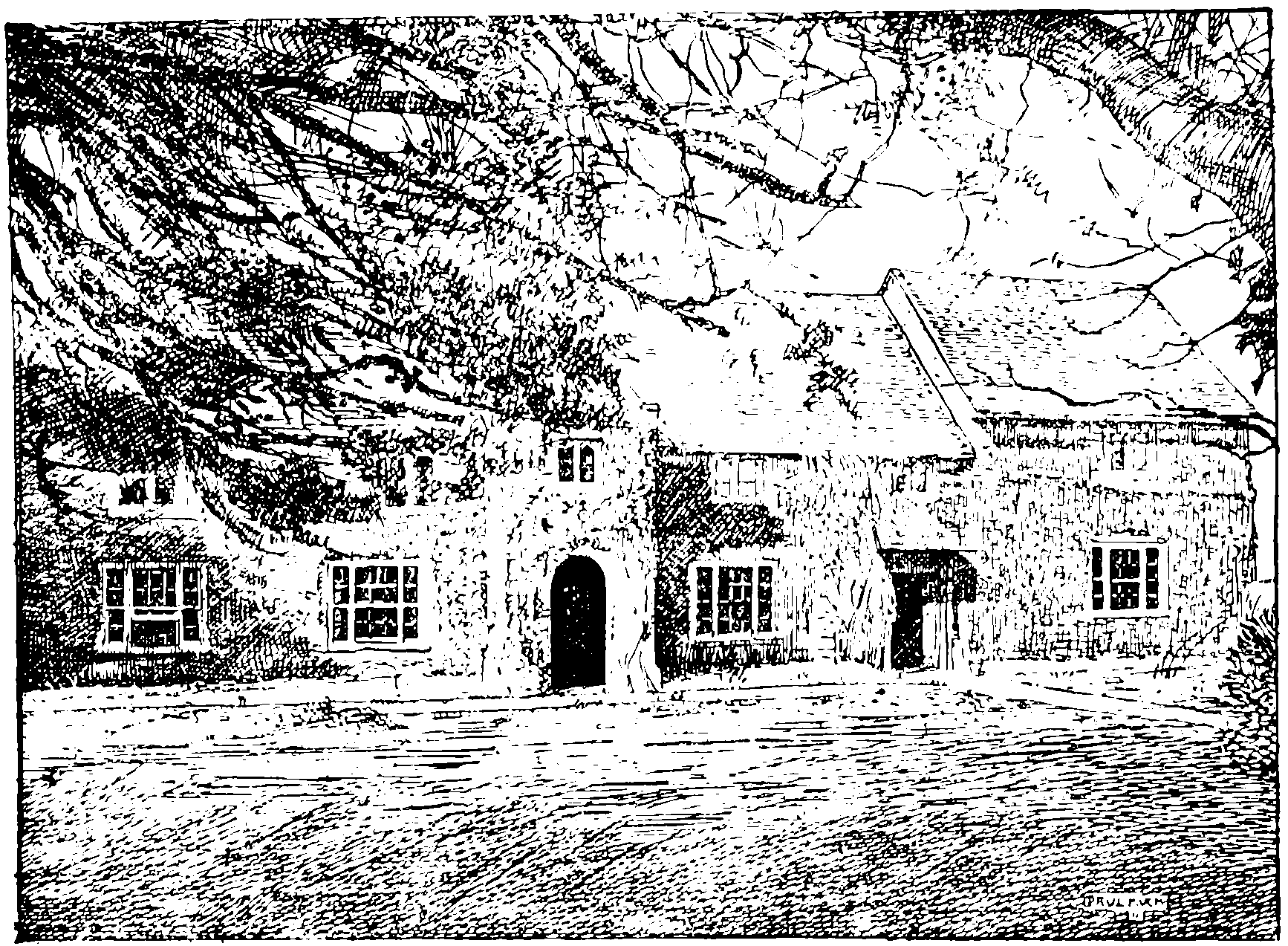
Shalfleet Manor-house
The parish includes the hamlets of Newbridge, Wellow and Ningwood. There is a National school (mixed) at Ningwood, built in 1870 and enlarged in 1905. There is a water mill at Shalfleet, (fn. 1) at the head of the Newtown River, and brickworks at Ningwood, Bouldnor and Hamstead. Bouldnor, about a mile from Yarmouth, has been lately developed for building purposes, and at Hamstead, the northernmost part of the parish, at the mouth of the Newtown River, are one or two private residences. Ningwood House, about half a mile from the station, is an 18th-century house, the residence of Mr. E. W. Cottle. The soil is a stiff clay, and in 1905 Shalfleet included 1,617½ acres of arable land, 2,406 acres of permanent grass and 504¼ acres of woodland. (fn. 2)
Hulverstone and part of Brook Green were transferred from Shalfleet to Brook in 1889, and at the same date part of Shalfleet was transferred to Calbourne and part of the parish of St. Nicholas in Carisbrooke to Shalfleet. (fn. 3)
MANORS
The manor of SHALFLEET, with its member of CHESSELL, (fn. 4) was in 1086 held in chief by Gozelin son of Azor as it had previously been held by Edric (fn. 5) of King Edward. For nearly three centuries the Trenchard family held Shalfleet in chief. It is possible that Payne Trenchard, collector of danegeld in the Isle of Wight about 1135, held the manor in the 12th century. (fn. 6) Payne was succeeded in his estates before 1164 by his grandson Robert, (fn. 7) who was still living in 1189 (fn. 8); he was succeeded by his son Henry. (fn. 9)
In the reign of Henry III Henry Trenchard, the son of this Henry, held the manors of Shalfleet and Chessell in demesne and John his son held of him the eighth part of a fee in Shalfleet. (fn. 10) In 1278 Henry Trenchard complained that Amice Countess of Devon and her men took thirty of his oxen at Chessell and detained them at her manor at Thorley and kept imprisoned Nicholas de Baseville till Henry ransomed him for 100s. Moreover, they broke his park of Chessell and 'rescued the beasts lawfully impounded therein' and drove off the deer from his park at Shalfleet. (fn. 11) Henry Trenchard was succeeded by his son John, who died about 1302, leaving the estate to his son Henry, a minor, (fn. 12) who eight years later settled the manor on himself and Eleanor his wife and his heirs. (fn. 13) This Henry Trenchard was hardly of a law-abiding nature. In 1309 the Abbot of Titchfield complained that Trenchard 'besieged his abbey, so that neither he, nor the canons, nor the servants of the abbey could go forth to transact business or bring in victuals.' Moreover the said Henry 'felled his trees . . . entered his free warrens, hunted therein, took away game and his goods, and assaulted his servants.' (fn. 14) Trenchard was excommunicated (see below). In 1320 Sir Ralph de Gorges informed the king that, although Trenchard had been outlawed in July 1318, Sir Henry Tyes, constable of the castle of Carisbrooke, maintained him and had bought from him 'the fair manor of Shalfleet' (fn. 15) and other lands which should have escheated to the Crown. (fn. 16) Sir Henry Tyes stated in defence that Trenchard had made him a life grant of the manor before the pronouncement of the outlawry. (fn. 17) In the end Trenchard was evidently pardoned, (fn. 18) since he was holding the manor in 1328, (fn. 19) and on his death in 1349 it passed to his son and heir Giles. (fn. 20) His second wife Joan survived him and married Richard Aleyn, and in 1365 she brought a suit against her stepson Giles for a third of Shalfleet Manor, which she claimed as her dower. He refused on the plea that Henry his father 'was not seised of the said manor on the day he married Joan, nor afterwards.' (fn. 21)
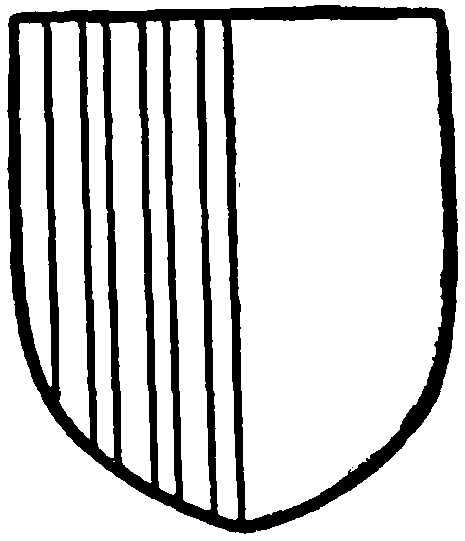
Trenchard. Party argent and azure with three pales sable in the argent.
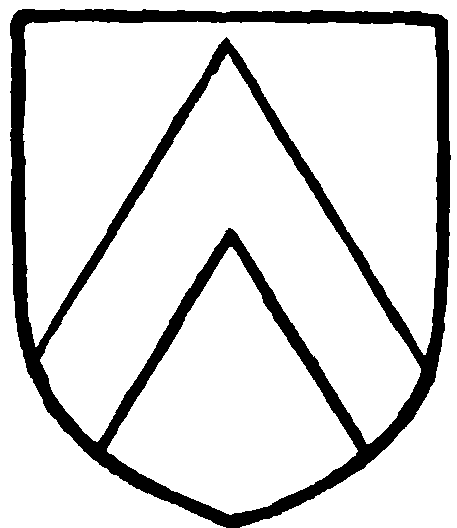
Tyes. Argent a cheveron gules.
Giles Trenchard left Shalfleet at his death to his daughter Margaret, (fn. 22) who was thrice married; her third husband John Pershute apparently survived her and was seised of the manor in accordance with a settlement of 1403, (fn. 23) but he died before 1428, in which year her son Thomas Deepdene was the owner. (fn. 24) Thomas died before 1438, leaving as his heir his daughter Agnes the wife of Edmund Brudenell, (fn. 25) whose daughter and heir Alice married Richard Waller of Groombridge (co. Kent). (fn. 26) Alice died in 1481, (fn. 27) leaving as her heir her son John, who in 1496 was expelled by the escheator because John Trenchard of Chessell was supposed to have died in September 1495 seised of the manor. (fn. 28) Waller won the suit, but died in July 1497, leaving a son and heir John, who died seised of Shalfleet in 1526, (fn. 29) leaving a grandson and heir Richard. (fn. 30) Richard Waller died in 1552 and was succeeded by his son William, (fn. 31) who conveyed the estate about 1575 to Anthony Kempe, (fn. 32) by whom it was sold in 1591 to Thomas Worsley for £900. (fn. 33) From this date the manor remained in the Worsley family (fn. 34) (see Appuldurcombe) until 1780, (fn. 35) when it was sold by the Worsleys to the Barringtons, and so passed by marriage to the Simeons, and descended like Swainstone (q.v.) to Sir Edmund Charles Simeon, bart., the present lord of the manor.
Until the early half of the 14th century (fn. 36) the manor of CHESSELL followed the descent of the manor of Shalfleet. However, before 1346 it had been acquired by John Gymminges, (fn. 37) who in 1349 settled it on himself and Avice his wife, with remainder to John son of John de Lisle of Gatcombe, (fn. 38) who died seised of it in March 1349. (fn. 39) In 1443 John Bramshott, who had succeeded to the Lisle property, (fn. 40) sued William Fauconer and others for the manor of Chessell, (fn. 41) but quitclaimed the same in the July of the following year. (fn. 42)
This transaction seems to have been for purposes of conveyance to the lord of Shalfleet, with which Chessell subsequently descended and in which it became merged.
It is just possible that the manor of NINGWOOD (Lingwede, xii cent.; Nyngewode, xiii cent.) was represented in 1086 by 1 hide in 'Lenimcode' held in chief by a certain Gerin. (fn. 43) Before the 12th century it had passed to the Crown and was granted by Henry I to Richard de Redvers, who gave it to the priory of Christchurch Twyneham. (fn. 44) This gift was confirmed in 1292 by Isabel de Fortibus, who further gave the prior and convent leave to inclose the land with dykes and hedges, 'save that the doe with her fawn should have free passage, and that the dyke of the wood of Ningwood should remain by the high road, and might be repaired without denial by the grantor and her heirs.' (fn. 45) The prior and convent received a grant of free warren in their manor from Richard II in 1384. (fn. 46)
At the Dissolution Ningwood was granted by Henry VIII with other church lands to Thomas Hopson in exchange for the manor of Marylebone. (fn. 47) Thomas died seised in 1559, leaving as his heir his son and namesake, (fn. 48) who was succeeded at his death in 1594 by his son, a third Thomas. (fn. 49) In November 1627 John Hopson, probably a son of the latter, was appointed 'to have the charge and leading of the company of Ningwood as their captain.' (fn. 50) In 1631 this John Hopson conveyed the manor to trustees, (fn. 51) who, according to Worsley, sold it to John Comber of Chichester (co. Sussex). (fn. 52) The latter died childless and was succeeded by his nephew Thomas the son of his sister Mary and Mark Miller. (fn. 53) From this date the manor passed like Froyle (q.v.) in the Miller family until the end of the 18th century, when it was sold to John Pinhorn (afterwards knighted), a London banker, who remodelled the house. In 1806 John Nash of East Cowes Castle bought it of a Mr. Chamberlayne. He died in 1835 and his widow devised it to John Pennethorne and his sister Anne, at whose death it came to their niece, Miss Rose Pennethorne, the present lady of the manor. (fn. 54)
The manor of WELLOW (Welige, xi cent.; La Wellonde, xiii cent.; Welewe, Welwe, xiv cent.) was held in parage of King Edward the Confessor by Coolf and afterwards by King William in demesne. (fn. 55) It was granted in 1337 by Edward III to Hugh le Despenser and descended with the manor of Thorley (fn. 56) (q.v.) until it passed to the Crown in 1478.
In 1540 it was leased to Thomas Dore for a yearly rent for twenty-one years (fn. 57); the lease was renewed in favour of John Dore, possibly a son of Thomas, about 1557 and again in 1581. (fn. 58) John Dore died before 1612, in which year his sons Thomas and John were the tenants of Wellow. (fn. 59) The third John Dore was still living at Wellow in 1629, (fn. 60) but after this date it is difficult to trace the history of the manor. According to Worsley, however, it was subsequently bought by John Comber and followed the descent of Ningwood until the end of the 18th century. (fn. 61) It was later acquired by the Rev. Richard Walton White, and at the end of the 19th century it belonged to Miss White, who died in 1911. It is now held by her nephew, Captain Macpherson, R.N.
The manor of HAMSTEAD (Hamestede, xi cent.) was held at the time of the Domesday Survey by Gozelin the son of Azor, and had previously been held in parage by Alvric. (fn. 62)
The 'land of Hamstead' was granted by Richard de Redvers with Ningwood to the priory of Christchurch Twyneham in the reign of Henry I, (fn. 63) and in 1263 the prior and convent enlarged their property by the acquisition of two small holdings from Geoffrey and Wymarc Brodheye and William de Egesford and Denise his wife. (fn. 64) In 1384 Richard II granted to the priory free warren in the lands of Hamstead. (fn. 65)
The grant of Richard de Redvers did not include all the land in Hamstead which belonged to the lords of the Isle, for in 1279 Isabel de Fortibus granted her lands of Hamstead to the abbey of Quarr. (fn. 66) In 1284 the abbot and convent received a grant of free warren in their lands in Hamstead from Edward I. (fn. 67) They remained in possession of the land till the Dissolution.
In 1544 Henry VIII granted to Thomas Hopson, in exchange for the manor of Marylebone, all the lands in Hamstead which had belonged to the priory of Christchurch and the abbey of Quarr. (fn. 68) The property subsequently followed the descent of the manor of Ningwood.
There was another manor of HAMSTEAD which was held at the time of the Domesday Survey by Nigel of William the son of Azor, and had previously been held by Alvric in parage. (fn. 69) It was held in the time of Henry III by John de Lisle of Wootton (fn. 70) and followed the descent of that manor until the early part of the 14th century. (fn. 71) In 1346 it was held by Idonea de Beauchamp, but it is impossible to trace its history with certainty after this date. (fn. 72)
The manor of SHALCOMBE (Eseldecombe, xi cent.; Shelcecumbe, xiii cent.; Shaldecombe, Shalecombe, xvi cent.) was held in the reign of Edward the Confessor by Alwin Forst and subsequently by the chapel of St. Nicholas of the castle of Carisbrooke. (fn. 73) This chapel was granted by Richard de Redvers Earl of Devon to the abbey of Quarr about 1195. (fn. 74) In 1284 Edward I granted free warren in the demesne lands of Shalcombe to the abbot and convent and their successors, (fn. 75) who remained in possession until the Dissolution.
The manor of Shalcombe was among the church lands granted by Henry VIII to Thomas Hopson in exchange for Marylebone (fn. 76); it subsequently followed the descent of the manor of Ningwood (q.v.) until it was sold, according to Worsley, by the third Thomas Hopson to the Stanleys of Paultons in the parish of Copythorne (fn. 77) (q.v.). It remained in the possession of this family till the end of the 18th century, when it was divided between Sarah the wife of Christopher d'Oyley and Anne the wife of Welbore Ellis, afterwards Lord Mendip, the sisters and co-heirs of Hans Stanley, after whose death it came back to the Stanley family and is now owned by Captain Sloane Stanley. (fn. 78)
At the time of the Domesday Survey there was 'a wood worth twenty swine' attached to the manor of Shalfleet. (fn. 79) The wood thus mentioned may have included both Ningwood and the holding known as SHALFLEET WOOD, which subsequently came into the possession of Hugh Gernon (fn. 80) and was granted by him to the abbey of Quarr. (fn. 81) This gift was confirmed about 1175 by Thomas de Evercy, Hugh's descendant, (fn. 82) and the abbey remained in possession of the land until the Dissolution.
In 1537 Henry VIII granted the land called Shalfleet Wood to Lord Chancellor Wriothesley, (fn. 83) who sold it in the following year to John Mill. (fn. 84) From the latter it passed, like Nursling (fn. 85) (q.v.), to Sir Richard Mill (1568), but after this date the history of the estate becomes obscure.
There were four messuages and land in Shalfleet which belonged in the 14th century to the Gorges of Knighton, who added to their holding between 1310 and 1315 the 3 acres of land called LA ELDELONDE, together with the patronage of the church, which had previously belonged to Henry Trenchard. Sir Ralph de Gorges, who thrice presented to the living between May 1320 and May 1321, (fn. 86) died in 1325 and was succeeded by his son, a namesake. (fn. 87) This Ralph de Gorges settled the estate in 1320 on himself with remainder to William son of his sister Eleanor and Theobald Russell, and the heirs of his body, and failing such to Theobald, William's brother. (fn. 88) Theobald, who subsequently took the name of Gorges, (fn. 89) succeeded his brother William in 1346 (fn. 90); his son Bartholomew died seised of the land in 1395, (fn. 91) leaving as his heir his brother Thomas, (fn. 92) but after this date the history of the estate becomes obscure.
A quarter of a fee at BOULDNOR (Bolenore, xiv cent.) was held towards the end of the 13th century of Isabel Countess of Devon by Henry Tolouse. (fn. 93) He or a descendant of the same name held an eighth of a fee at Bouldnor of the castle of Carisbrooke in 1334–5. (fn. 94) In 1345 Geoffrey Doget died seised of a messuage and land in Bouldnor, leaving Margaret his daughter and heir. (fn. 95) Margaret died in 1349 and was succeeded by her cousin Alice daughter of Walter Doget brother of Geoffrey. (fn. 96) Livery was made to Alice in 1354–5. (fn. 97)
From the Dogets the manor apparently passed to the Ringbournes of Afton in Freshwater, for in 1431, when the manor is next mentioned, it belonged to John Holcombe of Afton, (fn. 98) who had married Agnes the widow of William Ringbourne. From that date it descended with Afton (fn. 99) until 1591–2, when Henry Bruen sold it to Thomas Urry. (fn. 100) The further descent of the manor has not been traced.
The manor of HULVERSTONE (Hunfredeston, xiii cent.; Humfrideston, xiv cent.) was held at the end of the 13th century as a quarter of a knight's fee by Robert de Glamorgan and John Paslew, (fn. 101) and in 1346 the whole estate belonged to William Paslew son and successor of John. (fn. 102) John Roucle or Rookley, lord of Brook, had acquired this property before 1428, (fn. 103) and it probably then became merged in the manor of Brook. Hulverstone now forms part of the parish of Brook, having been transferred from Shalfleet in 1889. (fn. 104)
Land in Shalfleet was granted by Egbert King of the West Saxons (fn. 105) to the see of Winchester in 838, and this grant was confirmed in the following year.
CHURCH
Shalfleet Church, of which the invocation has been lost, is one of the most interesting in the Island. The original church was built before the Great Survey, as it is there mentioned, (fn. 106) and probably served all the inhabitants of the low ground watered by the Newtown River as well as the tenants of the manor. The massive tower, (fn. 107) with walls of over 5 ft. in thickness, belongs to the end of the 11th century, and till 1889 had no entrance except through the church. The present nave must have been added in the middle of the 12th century, to which period the north door belongs. That a south aisle may have been added later in the century is possible, as there are undefined signs of a widening in the west wall, but it is more probable this aisle belongs altogether, as do its details, to the latter half of the 13th century, (fn. 108) at which period the chancel was added with its series of windows of much the same detail as those at Arreton. Late in the 14th century the tower was buttressed at the south-west angle and the original round-headed windows filled in with tracery. The 15th century saw the addition of the south porch, the strengthening buttress to the east of it and a new roof, (fn. 109) as well as the insertion of square heads to the south-east and east windows of the aisle. (fn. 110)
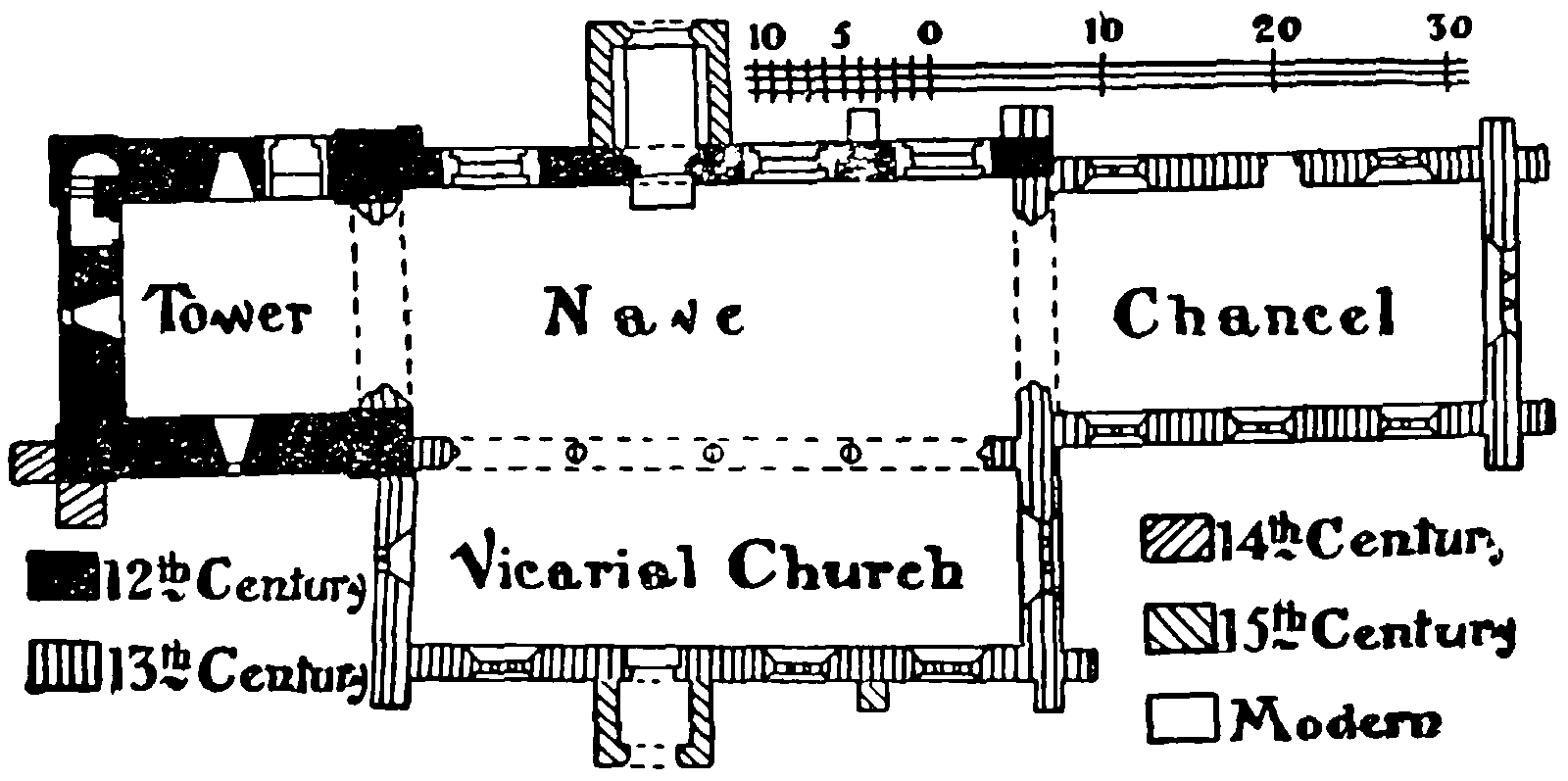
Plan of Shalfleet Church
Happily the two succeeding centuries saw little or no change beyond the addition of a cupola roof to the tower, which was replaced by the present spire during the first quarter of the 19th century. (fn. 111) In 1889 the plaster was removed from ceiling and walls—the latter a questionable proceeding—the tower arch unblocked, a new door cut through the north face and the east window of the aisle reconstructed.
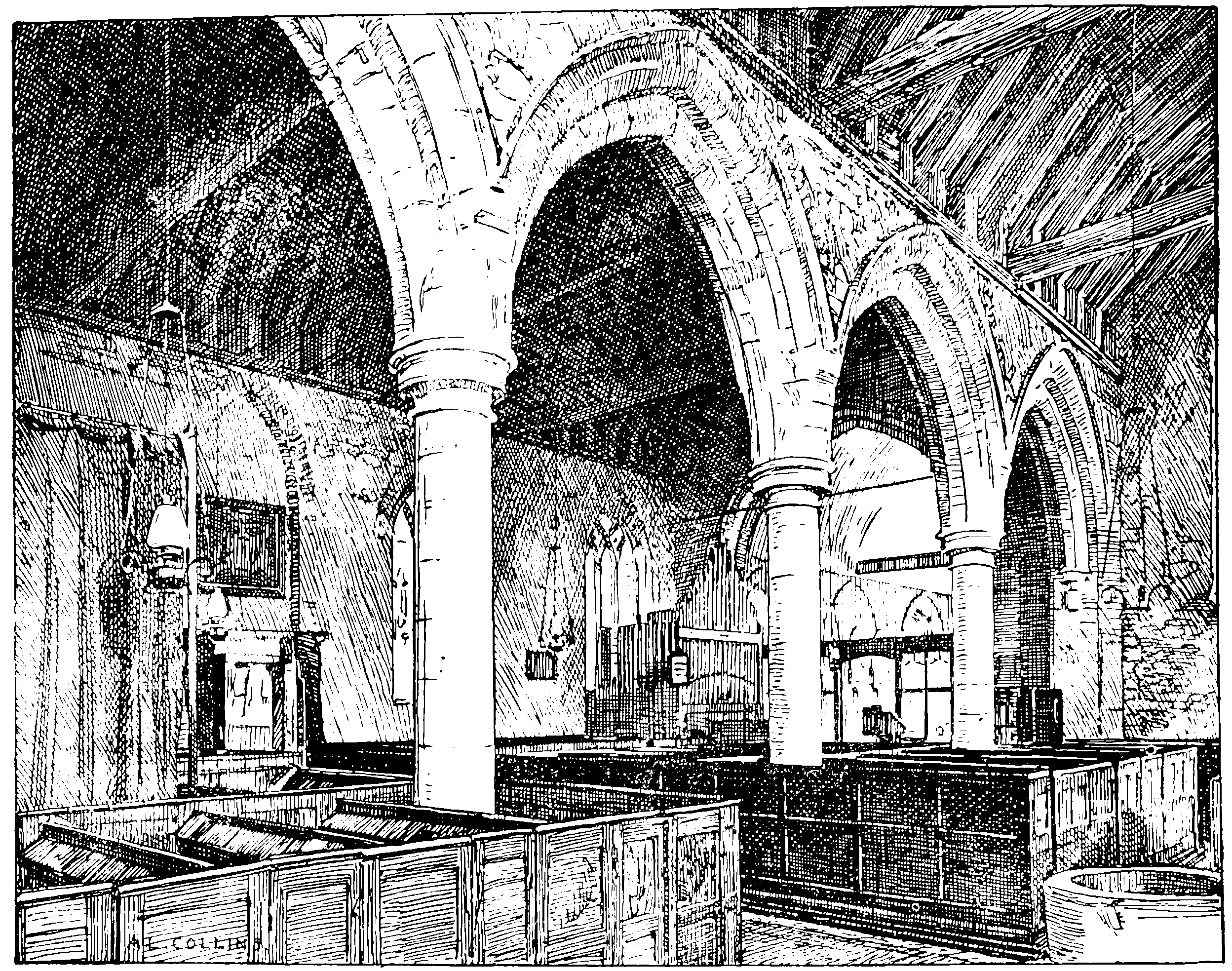
Shalfleet Church: The Nave looking North-east
The church is fortunate in having escaped late additions and thus remaining an excellent example, with the exception of the tower, of late 13th-century work. The entry is by the north door, bearing the date 1754 on its inner face, through the 12th-century opening with its primitive carved tympanum. (fn. 112) The north wall is practically modern work, partly rebuilt on the old foundation and of the same thickness in 1812, when wooden mullioned windows with brick reveals took the place of what may have been 15th-century lights. The insertion of the wide arch in the 13th century, practically cutting away the whole eastern face of the tower at this stage, has resulted in a serious subsidence to the north and east, with a corresponding contortion of the arch. When this was blocked as a precautionary measure there is nothing to show, but its opening in 1889 and the cutting of a door in the northern face of the tower was an unwise and risky proceeding, probably resulting in the serious crack in the upper part of the north-east angle. The nave arcade of four bays is supported, as at Arreton, (fn. 113) by Purbeck shafts and has settled considerably towards the east. (fn. 114) The windows of the aisle are somewhat singular with their curious oval tracery in the heads, that in the west wall being a double lancet with unpierced head. In the south door the arch mouldings run down the jamb and the roll finishes in a base. The outer splay on the east face of the chancel arch is cut away to the height of the respond cap, probably in connexion with the woodwork of a screen. (fn. 115) The chancel windows are of two lights in the side walls, (fn. 116) with engaged shafts and trefoiled circles in the heads, the east window being of three lights with three quatrefoiled circles above. There is a priest's door in the chancel north wall similar to that at Arreton. The tower has a belfry stage, but the bells are hung above it in the steeple, thus adding a good deal to the insecurity of the tower, which is here braced across the internal angles by iron ties. A 13th-century window similar to that in the west wall of the aisle has been inserted in the south wall of this stage. There is a trefoil-headed piscina below the sill of the easternmost window in the south wall of the aisle and an aumbry in the chancel rebated for a wooden door with a drop-arch over. On the floor are two interesting sepulchral slabs of the 13th century, (fn. 117) one bearing a spear and shield, the other spear, shield and pot helmet. On the east wall of the aisle is a 17th-century memorial tablet, which bears no inscription beyond the date 1630. It is divided into two panels with four-centred arched heads and has shields in the centre of each. There is an oak pulpit of the time of Charles I and altar-rails of the 18th century. (fn. 118) A simple oak chancel screen has lately been added.
A noticeable feature in the church is that the floor slopes down gradually to the east end without a break at the chancel arch.
The two bells in the tower are inscribed 'May all whom I shall summon to the grave, The ransom of a well-spent life receive. Thos. Way, James Street, Churchwardens, 1815. T. Mears of London fecit.' The smaller bell has only the names of the churchwardens, J. Jolliffe and J. Cooper, and the date 1807.
The communion plate consists of two silver patens (fn. 119) dated 1594 and a chalice 1798.
The registers are as follows: (i) all entries from 1604 to 1761; (ii) baptisms and burials 1762 to 1812; (iii) marriages 1754 to 1812.
ADVOWSON
The advowson belonged in early times to the lords of the manor, (fn. 120) and as late as 1310 it was in the possession of Henry Trenchard, who in that year conveyed it to Richard de Bourne, clerk, for purposes of settlement. (fn. 121) In 1315 Richard was summoned before Richard Woodlock, Bishop of Winchester, to answer for his intrusion into the living of Shalfleet (fn. 122); at the same time Henry Trenchard is stated to have laid claim to the advowson, which had come into the hands of the Gorges. (fn. 123) Both Henry and Richard were summoned to appear before Bishop Sendale in 1317, (fn. 124) and early in 1320 the rector of Shalfleet resigned. (fn. 125) In January 1323, however, Richard de Bourne obtained from Bishop Rigaud de Asserio, the successor of Bishop Sendale, a sentence of greater excommunication upon Henry Trenchard, (fn. 126) and two years afterwards he returned to Shalfleet, (fn. 127) of which place he was described as rector in the time of Bishop Stratford. (fn. 128) During this period Sir Ralph de Gorges had presented to the living and the patronage followed the same descent as his lands in Shalfleet until 1346, (fn. 129) when it passed from Theobald Russell to William Montagu Earl of Salisbury, (fn. 130) whose son and heir William in 1362 obtained a quitclaim from Giles Trenchard. (fn. 131)
The advowson presumably reverted to the Crown with the forfeiture of the earl in 1400, (fn. 132) but was restored to his son Thomas, by whom it was granted in 1414 to the Prior and convent of Bisham, (fn. 133) who subsequently presented to the living. (fn. 134) After the Dissolution in 1541 the patronage was granted to Anne of Cleves for life, (fn. 135) and it afterwards reverted to the Crown, (fn. 136) in whose possession it still remains, the patron at the present day being the Lord Chancellor. (fn. 137)
Hugh Goodacre, afterwards Primate of Ireland, was vicar of Shalfleet in the reign of Edward VI; about 1548 the Princess Elizabeth had procured from the Protector a licence for him to preach, saying that he had been a long time known unto her to be of sufficient learning and judgement in the Scriptures. (fn. 138)
In 1595 Fulk Greville sought to obtain 'the parsonage of Shawfleet' for Samuel Daniel the poet, (fn. 139) at whose request it was demised by the queen to Nicholas Browne in 1602. (fn. 140)
There are chapels for Wesleyans (1861), Primitive Methodists and Baptists, with a United Methodist chapel at Newbridge.
CHARITIES
In 1859 William Way, by his will proved at Winchester 7 July, left a legacy, now represented by £208 12s. 1d. consols, with the official trustees, the annual dividends, amounting to £5 4s. 4d., to be applied in aid of the funds of the parish school.
The charity of Mrs. Marianne Fletcher Farnall, founded by will proved 8 February 1838, consists of £900 consols, with the official trustees, producing £22 10s. a year, which, in pursuance of a scheme of the Charity Commissioners 27 November 1883, is applied for the benefit of the poor in the distribution of coal, clothing and subscriptions to the Isle of Wight Infirmary.
In 1909 coal to the value of £18 14s. 3d. was distributed to thirty-two recipients.