
Survey of London: Volume 40, the Grosvenor Estate in Mayfair, Part 2 (The Buildings). Originally published by London County Council, London, 1980.
This free content was digitised by double rekeying. All rights reserved.
'Brook Street: North Side', in Survey of London: Volume 40, the Grosvenor Estate in Mayfair, Part 2 (The Buildings), (London, 1980) pp. 2-21. British History Online https://www.british-history.ac.uk/survey-london/vol40/pt2/pp2-21 [accessed 24 April 2024]
In this section
North Side
Nos. 40–46 (even)
Nos. 40–46 (even), which form a uniform composition, were built by Holloways to the designs of Balfour and Turner in 1898–9 and replaced six houses latterly numbered 36–46 (even). Originally six houses had been erected here under building leases granted in 1724, the two easternmost having particularly cramped plans to fit the triangular plot at the corner with South Molton Lane. (fn. 4) By 1778 most of them had projecting shop windows (fig. 4 in vol. XXXIX). In 1832–3 the four easternmost houses were rebuilt, No. 36, at the corner with South Molton Lane, having a handsome symmetrical pilastered shop front, perhaps designed by Thomas Cundy II. (fn. 5)
In the late nineteenth century the Estate decided to raise the tone of this part of the street by eliminating the shops and redeveloping the site with four houses. In 1893 the occupant of No. 44 was informed that when his lease ran out it was likely that 'the whole block' would be pulled down and 'the Duke would probably have to offer a rebuilding contract to a builder who could build several houses together as one scheme'. (fn. 6) Four years later Holloways applied for rebuilding terms, and after Eustace Balfour, the estate surveyor, had successfully intimated to the Grosvenor Board that 'Perhaps it might be suggested to the Duke' that his own firm should be the architects, a building contract was exchanged in October 1897. Holloways were not entirely happy with Balfour and Turner's first design, and in March 1898 obtained the Duke's leave 'to dispense with the high gables at the corner house of South Molton Lane, . . . and also the turret'. (fn. 7) The new range was completed early in 1899 and in May of that year Balfour provided plans for the stabling in Davies Mews behind, which met with everybody's approval. (fn. 8)
Self-consciously eccentric in a mild way these houses are not among Balfour and Turner's happier efforts on the estate (Plate 1b: see also fig. 26a in vol. XXXIX). The composition is marred by the truncation of the polygonal turret on the eastern corner, for without it there is nothing to terminate the restless march of five gables along the rest of the range and this upsets the balance of the whole. The plain second and third floors also form an unhappy transitional zone between the wilfully busy ground and first floors, with their characteristically combined porches, bay windows and balconies, and the stepped gables and delicately modelled chimneys above, where further interest is added by the striping of the red brickwork with white bands of stone. All the detailing, however, is impeccable: the window mouldings, the little octagonal columns of the porches and the ironwork of the area and balcony railings. The latter is particularly attractive and exudes all the freshness of Arts and Crafts sensibility.
Occupants include: No. 38, 10th Earl of Devon, 1856–7. No. 40, Sir James Eyre, kt., physician, 1838–55 (previously at No. 48).
Nos. 48 and 50 (formerly Nos. 15 and 16).
The original houses here were erected under building leases granted in 1724. (fn. 9) Both were rebuilt in 1862–3 to elevational designs provided by Thomas Cundy II, the builder being George John Newson, who was active elsewhere on the estate at about this time (fn. 10) (Plate 1b). They and Nos. 56 and 58 (rebuilt in 1852–3) appear to be the only results of Cundy's attempt, begun in 1848, to impose a uniform design in the piecemeal rebuilding of the whole of the north side of Brook Street east of Davies Street. (fn. 11) They differ from Nos. 56 and 58 chiefly in having a standard portico projecting over a basement area, and brick instead of stucco fronts. In most other respects they closely resemble Nos. 56 and 58, particularly in their frieze and bracketed cornice. Small alterations were made to the balcony and first-floor windows of No. 50 in 1898. (fn. 12)
Occupants include: No. 48, Lord Mark Carr, 1731–3. Sir James Eyre, kt., physician, 1835–8 (later at No. 40). Francis Sibson, physician, 1850–1. Viscount Curzon, later 2nd Earl Howe, 1865. Sir Henry Hoare, 5th bt., 1866. Capt. Cecil Duncombe, son of 2nd Baron Feversham, 1868–80. No. 50, Gen. Joseph Sabine, 1728–39.
Nos. 52 and 54 (formerly Nos. 17 and 18).
The original houses here were erected under building leases of 1724, (fn. 13) and were demolished in 1895. The rebuilding lessees, Dr. Donald Baynes and Mr. Charles Higgens, a surgeon, were both about to be displaced for the impending rebuilding of Nos. 40–46, and their first architect was Frank Adams Smith, whose designs were approved by the Duke in June 1895. (fn. 14) But nine months later they asked to substitute Percy Morley Horder for Adams Smith, whose designs had proved too expensive, and who would 'not carry out their wishes in various respects'. After hearing that Adams Smith 'had never been an architect to a private residence before except small houses at Tottenham of trifling value', the Board raised no objection, despite Morley Horder's almost equal lack of experience at this time. (fn. 15) Morley Horder used a restrained Jacobean style for both houses but varied the components slightly, particularly in respect of the entrances and the bay windows, the latter at No. 54 being rectangular and three-storeyed while that at No. 52 is splayed and two-storeyed (Plate 1b). Both houses are of red brick with stone mullion-and-transom windows, and were completed in 1897, Holloways being the builders. (fn. 15)
Occupants include: No. 52, James Mivart, hotelier, 1821–43. No. 54, Dow. Countess of Buckinghamshire, wid. of 5th Earl, 1852.
Nos. 56 and 58 (formerly Nos. 19 and 20).
The original houses here (erected under building leases of 1724) were both rebuilt in 1852–3 'according to the drawing for the elevation in Brook Street' prepared by Thomas Cundy II (fn. 16) (Plate 1b). They and Nos. 48 and 50, which were rebuilt to a similar design in 1862–3, appear to be the only results of Cundy's attempt, begun in 1848, to impose a uniform design in the piecemeal rebuilding of the whole of the north side of Brook Street east of Davies Street. (fn. 11) Being set slightly forward from the adjoining house to the east, Nos. 56 and 58 are not separated from the pavement by the usual basement area and railings, and have no projecting porch. The single large ground-floor window in each house was evidently intended for a commercial occupant—a firm of upholsterers at No. 56, and at No. 58 a house agent, W. J. Alderton, who was also the building lessee. Both houses have four storeys, the fronts being faced throughout with stucco and surmounted by a frieze with Vitruvian scroll and a bracketed cornice corresponding with those later provided at Nos. 48 and 50. The building lessee at No. 56 was C. F. Sprigges, a land agent, who also occupied part of the house in 1853. (fn. 17)
Both houses were altered in the 1930's, (fn. 18) and No. 58 was reconstructed in 1971 by Olins John Associates, architects, but reproducing the Cundy front. (fn. 19)
Occupants include: No. 56, 13th Baron Willoughby De Broke, 1743. No. 58, Gerard Van Der Gucht, engraver, whose wife bore him 'between thirty and forty children', 1759–75: various members of the Van Der Gucht family, 1776–96. Henry Tresham, history painter, 1805–12. William Brinton, physician, 1855–62 (later at No. 70).
No. 60
No. 60 (formerly No. 21) was erected under a building lease of 1724, to the bricklayer, William Barlow, which he assigned to Thomas Lansdell, joiner. (fn. 20) It was not occupied until 1734. The house was much altered in the late nineteenth and early twentieth centuries and was internally remodelled in 1976. Some of the fabric of the original house survives but the front, with widened casement windows and bolection-moulded door surround, appears to be the product of work perhaps done around 1920, by which time, however, the cement rendering had already been applied. (fn. 21) Substantial ground-floor alterations were undertaken in 1881 when Ebenezer Gregg, architect, made a design for a new semi-circular staircase which was not adopted; (fn. 22) instead, the lower part of the staircase was more modestly altered at that time. Until 1976 there were fragments of simple early eighteenthcentury panelling in the entrance passage and some of the rooms, while the upper part of the staircase was original early eighteenth-century work with turned balusters and carved step-ends. At the rear there are toplit studios, perhaps built by the portrait painter John Partridge, who lived here from 1828 to 1872. Other inhabitants include Daniel Peter Layard, physician, 1762–78 (later at No. 64).
Brookfield House: Nos. 62 and 64 Brook Street with Nos. 46 and 48 Davies Street
Brookfield House: Nos. 62 and 64 Brook Street with Nos. 46 and 48 Davies Street were rebuilt as a bank and offices in 1922–3 to the design of Delissa Joseph. (fn. 23) One of the terms of the building contract was that 'the Brook Street elevation shall as much as possible bear the appearance of a private residence'. This was interpreted somewhat freely as the new building was frankly commercial, being two storeys higher than the adjoining house and clad in Portland stone in contrast to the stucco and brick used elsewhere in the street (Plate 1a). The second Duke himself approved the installation of a Lloyds' Bank sign over the ground-floor windows despite protests from neighbouring residents about 'the change which is taking place in the occupation of the houses in Brook Street'. (fn. 24) The principal elevation, with the entrances to both the bank and the office, is to Davies Street, where the ground-floor bay window was designed by Fernand Billerey. (fn. 25) The much narrower Brook Street elevation is set back three feet behind the old building line. The plain unenterprising brand of classicism adopted does not help to make the building an ornament to the area.
It replaces two houses originally erected under building leases of 1724 and first occupied in 1728 and 1731. (fn. 26) No. 64 (formerly No. 22B), at the corner, was larger than the adjoining houses, having a three-bay frontage to Brook Street, twenty-five feet wide. The entrance was at the side in Davies Street which made possible a more spacious plan. The main front rooms occupied the full width of the house as did the entrance hall and staircase compartment behind. In 1796, during negotiations for the renewal of the lease, the house was surveyed for Edward Meadows, esquire, by Samuel Wyatt, who may have designed 'the improvements' which Meadows was then projecting. (fn. 27)
Occupants of No. 64 include: Countess of Drogheda, wid. of 4th Earl, 1731–5. Daniel Peter Layard, physician, 1779–80 (previously at No. 60). Sir George Nugent, 1st bt., 1808–12. Edward Harbord, later 3rd Baron Suffield, philanthropist, 1813–14. Countess of Galloway, wid. of 7th Earl, 1815–30. Sir James Clark, 1st bt., physician, 1850–61. Baron Penzance, judge, 1880–4.
Nos. 66 and 68 Brook Street and No. 53 Davies Street
Nos. 66 and 68 Brook Street and No. 53 Davies Street (Plates 1a, 2, figs. 1–5: see also Frontispiece, Plates 6c, 9a, 20b in vol. XXXIX). The whole of these three buildings is now occupied as the headquarters of the Grosvenor Office. The history of No. 68 (formerly No. 23) Brook Street, which was added to the Grosvenor Office only in 1957, is mostly straightforward, but that of No. 66 (formerly No. 23A) Brook Street and No. 53 (formerly No. 9) Davies Street, which were originally one house, is more intricate. No. 66 Brook Street before its curtailment in the 1820's to make No. 53 Davies Street was one of the biggest houses on the estate and, apart from those in Grosvenor Square, probably one of the most embellished. Today it is the estate's outstanding survival from the early-Georgian period.
Unfortunately, the history of this complex of buildings is very imperfectly recorded: in particular, early plans are lacking. The difficulty of reading the building aright is, moreover, the greater by reason of the unspecified embellishments made to it in the present century by estate surveyors well versed in the styles of the eighteenth century.
To turn first to the history of No. 66 Brook Street and No. 53 Davies Street, it is known that the site (like that of No. 68 Brook Street, which will be discussed later) formed part of a large piece of ground which the architect and developer Edward Shepherd agreed to take from Sir Richard Grosvenor in November 1723. (fn. 28) Shepherd was already active in Mayfair and was at the time building a house at No. 47 Brook Street; he was to be one of the largest developers on the Grosvenor estate and had extensive commitments elsewhere.
Like the other houses in this range, No. 66 in its full, original extent consisted of a house, offices and garden with its own stables behind, and stretched northward along Davies Street all the way to the mews behind (now St. Anselm's Place). Shepherd was granted a building lease by Sir Richard Grosvenor in January 1725, when No. 66 was probably completed in carcase, to run from Christmas 1723. (fn. 29) In December 1729 Shepherd sold it for £3,000 (of which £2,100 was received by his mortgagee) to Sir Nathaniel Curzon of Kedleston, Derbyshire, who took up residence in that same year. (fn. 30)
The elaborate internal decorations of No. 66 Brook Street were probably carried out under Edward Shepherd's supervision for Sir Nathaniel Curzon. Outside the Grosvenor estate, Shepherd's main centre of building activity in Mayfair during the 1720's was on Curzon's own nearby property in Curzon Street, so that there is good evidence of a close relationship between them. (fn. 31) Minor payments made by Curzon in 1731–2 to tradesmen (fn. 1) who were associated with Edward Shepherd (including Lawrence Neale, carpenter, lessee of No. 70 Brook Street, and John Shepherd, plasterer, brother of Edward Shepherd) appear to relate to No. 66. (fn. 32) Thomas Fayram, mason, the lessee of the adjacent No. 68 Brook Street, may well also have worked on the house.
Sir Nathaniel Curzon inhabited No. 66 from 1729 until his death in 1758, when he was succeeded in occupation there by his second son, Assheton Curzon. A survey and valuation were carried out there in April 1759 by a Mr. Woolfe, possibly the architect John Woolfe, and Jason Harris, carpenter, but no major changes are known at that date. (fn. 33) However, in 1778 alterations were made under the direction of Samuel Wyatt, who had previously acted as clerk of works under Robert Adam at Kedleston for Assheton Curzon's brother, Lord Scarsdale. The basement storey of the house on the front towards Davies Street was stuccoed in Higgins's new patent cement to give the appearance of 'a piece of incrustation representing a very coarse stone'. The part of the Davies Street front immediately above this new cement (that is, the ground floor) was, Higgins says, already faced in 'common stucco' at that time. (fn. 34) If that work was recently done in 1778 it seems likely that it would have extended over the whole upper face in the fashion of the time, but there is no sign of this. If only the ground floor was already stuccoed it may be that this treatment dated from the beginning. The present ground-floor rendering of this front and the Brook Street front of No. 66 (and of No. 68) may, therefore, represent the original appearance (fig. 1). This is consistent with Shepherd's known penchant, as a plasterer, for stucco, and his stuccoing of ground-floor fronts elsewhere.
Higgins also tells us that on the Davies Street front his cement was applied to the basement 'immediately after the area had been opened to it', and that 'the earth had lain against this wall many years'. Some seven years later, between 1785 and 1786, the rate-collector changed the listing of this house in his books from Brook Street to Davies Street, where it remained until the recasting by which No. 53 Davies Street was separated in 1821. It is conceivable, therefore, that the work of 1778 was associated with the opening of an entrance in Davies Street, acknowledged by the rate-collector only belatedly.
In 1766 Assheton Curzon had married (as his second wife) Dorothy, sister of Richard, first Earl Grosvenor. Having been created Baron Curzon of Penn in 1794 and raised to a viscountcy in 1802, he died at No. 66 Brook Street in March 1820, aged ninety-two. (fn. 35) By May 1822 the Estate appears to have decided in principle to divide the house into separate parts, and the estate surveyor, Thomas Cundy I, then suggested requiring of any lessee that 'the greater part of the house and offices' should be 'taken down and rebuilt according to a plan to be approved by Lord Grosvenor's surveyor'. These terms were accepted by James Hurtle Fisher, a solicitor, who agreed to take the whole property for sixty-three years. In November 1823 Fisher asked for three separate leases to be granted; of the front part (No. 66 Brook Street) to Dr. William Frederick Chambers, of the middle part (later numbered 53 Davies Street) to himself, and of the stables and garden again to himself but at a much lower rent, as he evidently intended to erect speculative housing on this part of the site (now occupied by Nos. 55–61 odd Davies Street). No. 66 Brook Street was thus entirely separated off from the property immediately behind, though the line of demarcation between the two, following existing walls, was complicated. (fn. 36)
The recorded history of the reduced No. 66 Brook Street was relatively uneventful for the next hundred years. In 1900 the Reverend Sir Borradaile Savory, Rector of St. Bartholomew's, Smithfield, obtained a lease extension of twenty-one years on the strength of some proposed repairs which included the installation of a bathroom and electric lighting and the insertion of an extra window in the ground- and first-floor rear rooms. (fn. 37) In 1907, when the house was empty, Eustace Balfour, the estate surveyor, thought it 'should not be allowed to be rebuilt, being an interesting house and dovetailing into the Estate Office [No. 53 Davies Street], both must be dealt with together'. Balfour informed George William Dawson, the purchaser (who, like a number of previous occupants, was a surgeon), that 'the reinstatement of the drawing room would not be required and that possession would be accepted if the flank wall was in the same condition as it is now'. Balfour also advised the Grosvenor Board that there was no reason 'for requiring the reinstatement of the front drawing room ceiling to its old level'. (fn. 38) The reference to the front drawing-room is of interest as this is presumably the splendid room on the first floor of No. 66 Brook Street which later became the estate surveyor's office, and is now occupied by the chief executive. The significance is, however, obscure, although it is perhaps related to Sir Borradaile Savory's intention in 1899 to 'put two new ceilings upstairs'. (fn. 37) The surveyor's room, for all its elaboration, has a plain ceiling, but this gives no indication, in its relation to the walls, of heightening or lowering. Dawson lived and practised in the house until 1925, (fn. 17) when it was reunited with No. 53 Davies Street.
The story of No. 53 Davies Street before 1925 is even obscurer. The lease granted to James Hurtle Fisher of this ground in 1826 was in consideration of repairs made by him, but it is not likely that the present front of the building was put on at that date. (fn. 39) Fisher divided the garden site to the north into several plots and in 1824 four houses (now Nos. 55–61 odd Davies Street), a coach-house and stables were being erected there by his sub-lessee, Samuel Erlam, surveyor and builder. (fn. 40) However, by 1831 Fisher was described as insolvent, and in 1833 the ratepayer at No. 53 was his partner Thomas Rhodes. (fn. 41) Owing to legal difficulties over the ejectment of Fisher, Rhodes did not obtain possession until May 1836. Shortly afterwards he was granted a twenty-one-year lease at a greatly reduced rent 'in consideration of his having given up several apartments to the Marquess' and in the same year the Marquess of Westminster became the ratepayer for the whole building. (fn. 42)
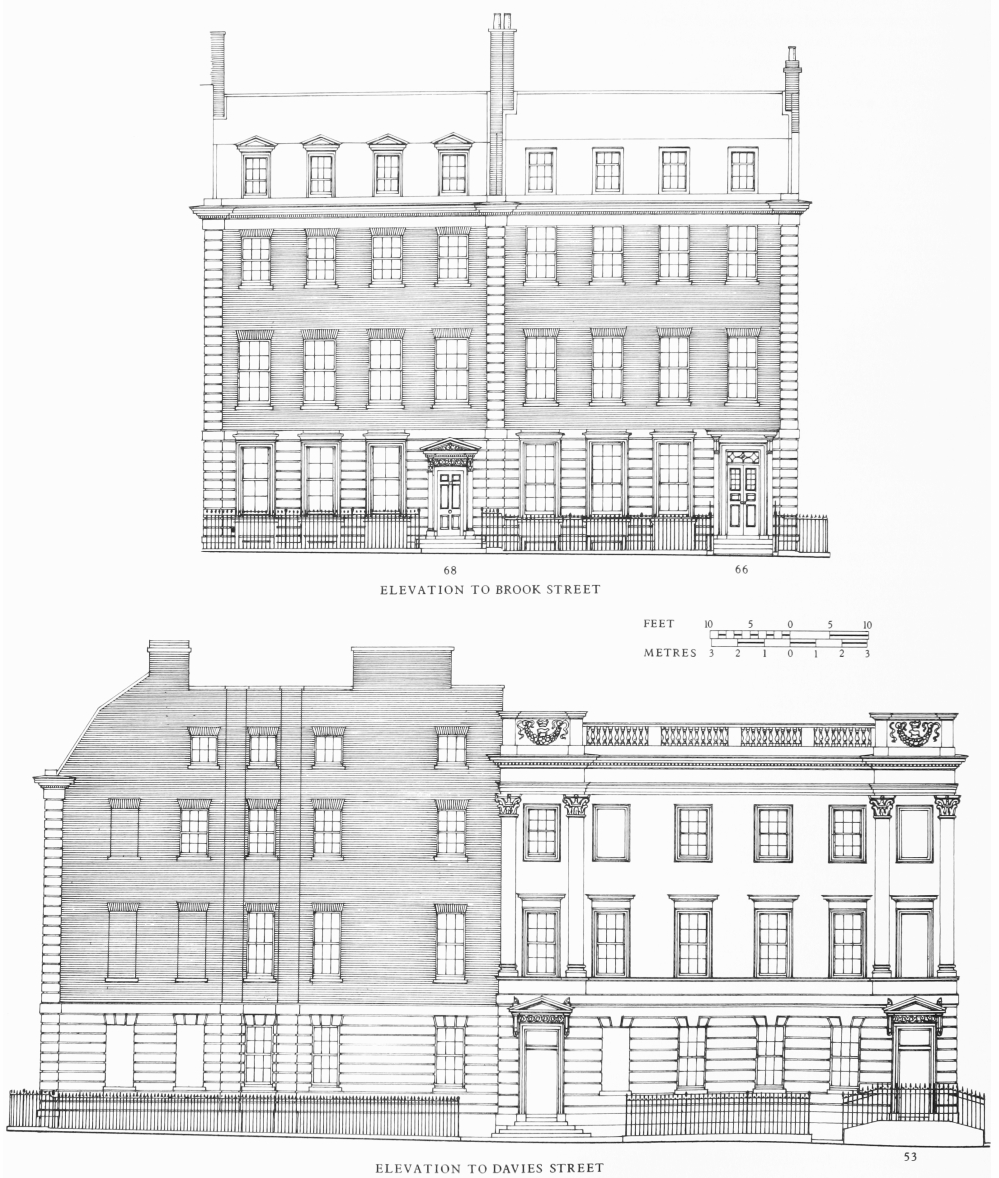
Nos. 66 and 68 Brook Street and No. 53 Davies Street, elevations
The use of at any rate part of No. 53 Davies Street as the administrative headquarters of the Grosvenor Estate clearly dates from that time. In the 1820's and 30's the rapid development of the Belgravia portion of the estate, and negotiations for the renewal of leases in Mayfair, were causing a very great increase in the volume of estate business, and the establishment for the first time of such a headquarters was therefore a natural step in the administrative evolution of the Grosvenor properties. Two years later, in 1838, Rhodes was sharing the premises with the Marquess's solicitors, Boodle and Partington, who moved across from No. 55 Brook Street; in 1841 the 'Grosvenor Estate Office' appears as a third occupant, and in 1843 Abraham Howard, 'agent to the Marquess of Westminster', is also listed. (fn. 17) Through there is no documentary evidence of the refacing of the building, its embellishment at either extremity with the crest of the Grosvenor family surmounted by a coronet seems to demonstrate that the new front was executed on behalf of the Marquess, presumably in the late 1830's and to the designs of his surveyor, Thomas Cundy II (fig. 1: see also Plate 20b in vol. XXXIX). The provision of two separate entrances also accords well with the divided occupancy of the building. To what extent internal alterations were made at that time remains obscure, although the entrance hall at the northern end has some early nineteenth-century characteristics.
Thomas Rhodes, however, followed by his kinsman Harrison Rhodes, continued in partial occupation of No. 53 until 1859. From 1841, if not earlier, until 1923 the building was shared by the Estate Office and Boodle and Partington (latterly Boodle Hatfield and Company). (fn. 17) In 1886 the Estate Office expanded into No. 55 Davies Street, hitherto a lodging-house and wine merchant's office, and in 1894 an opening was ordered to be made between the two houses at ground-floor level. (fn. 43) During the later nineteenth century alterations and redecorations were carried out from time to time; in 1883, for instance, during the painting of the outside stucco, the first Duke required 'the colour to be orange, like that at the bottom of Waterloo Place'. (fn. 44) Inside, in 1907 'the canvas on the walls of the Auditor's room' was removed and plaster substituted. A year later the ceiling and mantelpiece in 'the Board Room' (not the present board room, then still in separate private occupation as part of No. 66 Brook Street) were sufficiently admired for Eustace Balfour, then the estate surveyor, to obtain photographs (now evidently lost), and in 1912 a drawing was made of the mantelpiece in the 'waiting room' for the purpose of having a reproduction made for No. 41 Upper Grosvenor Street, then in course of rebuilding. (fn. 45) The location of these various rooms has not been identified. In 1911 'during the sitting of the Board several cracking sounds apparently proceeding from the walls were heard'. After minor repairs the new estate surveyor, Edmund Wimperis, reported that 'the building generally is in a very unsatisfactory, though not dangerous, state; and that in the ordinary course of a survey . . . I should certainly advise that it be pulled down'. (fn. 46) Nevertheless, no immediately drastic action was taken.
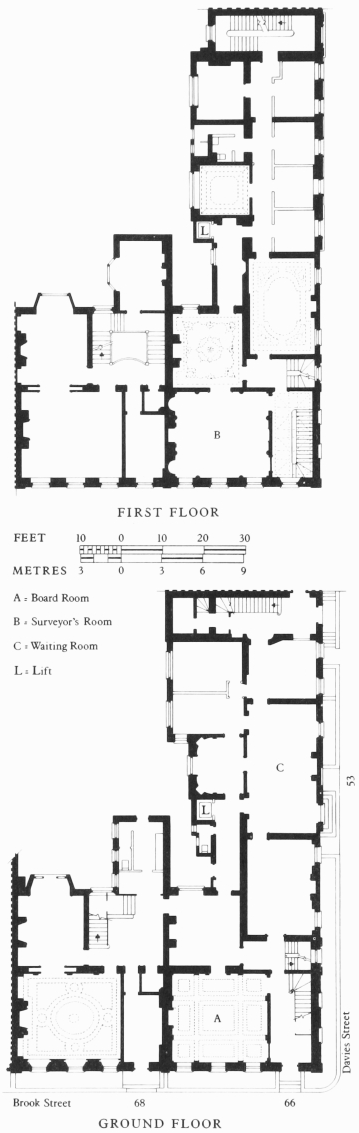
Nos. 66 and 68 Brook Street and No. 53 Davies Street, plans in 1976. Modern partitions shown in outline
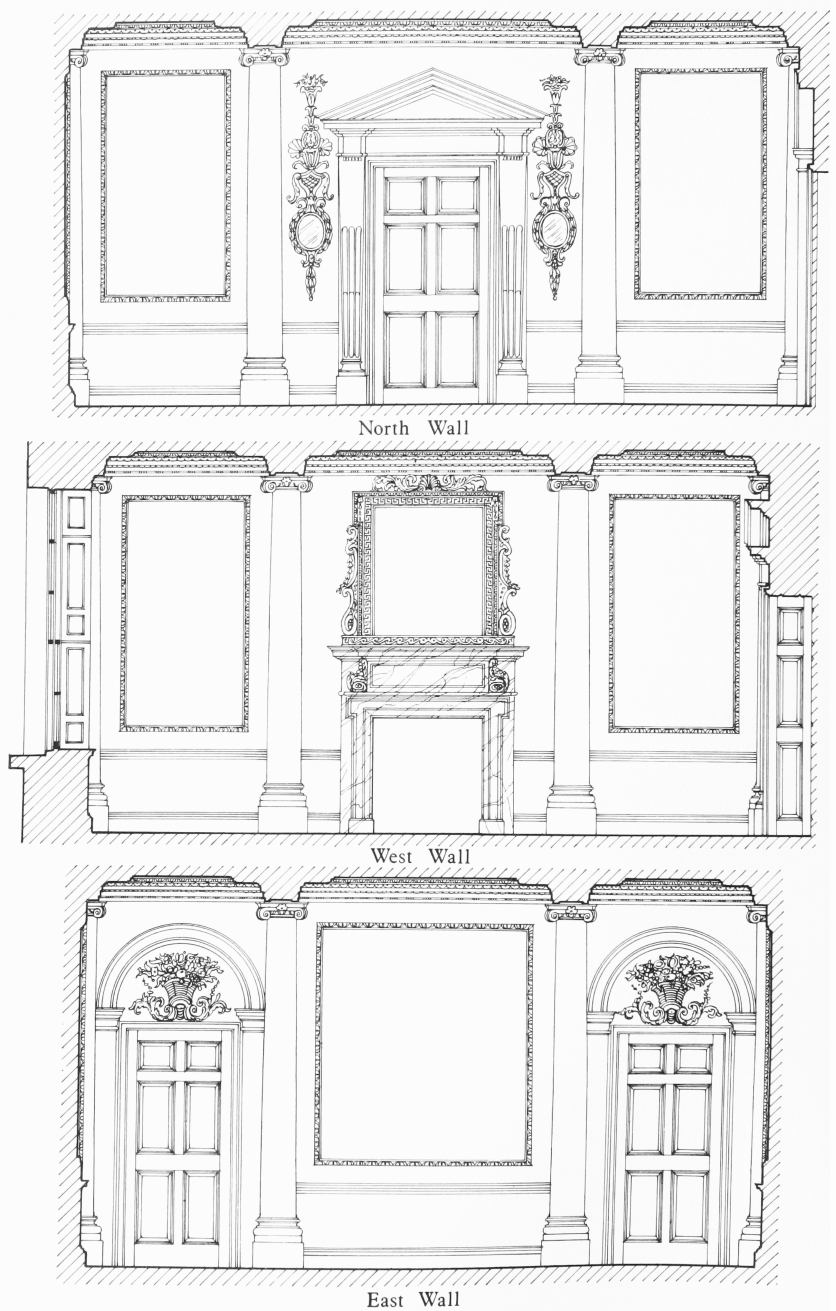
No. 66 Brook Street, internal elevations of ground-floor front room (board room)
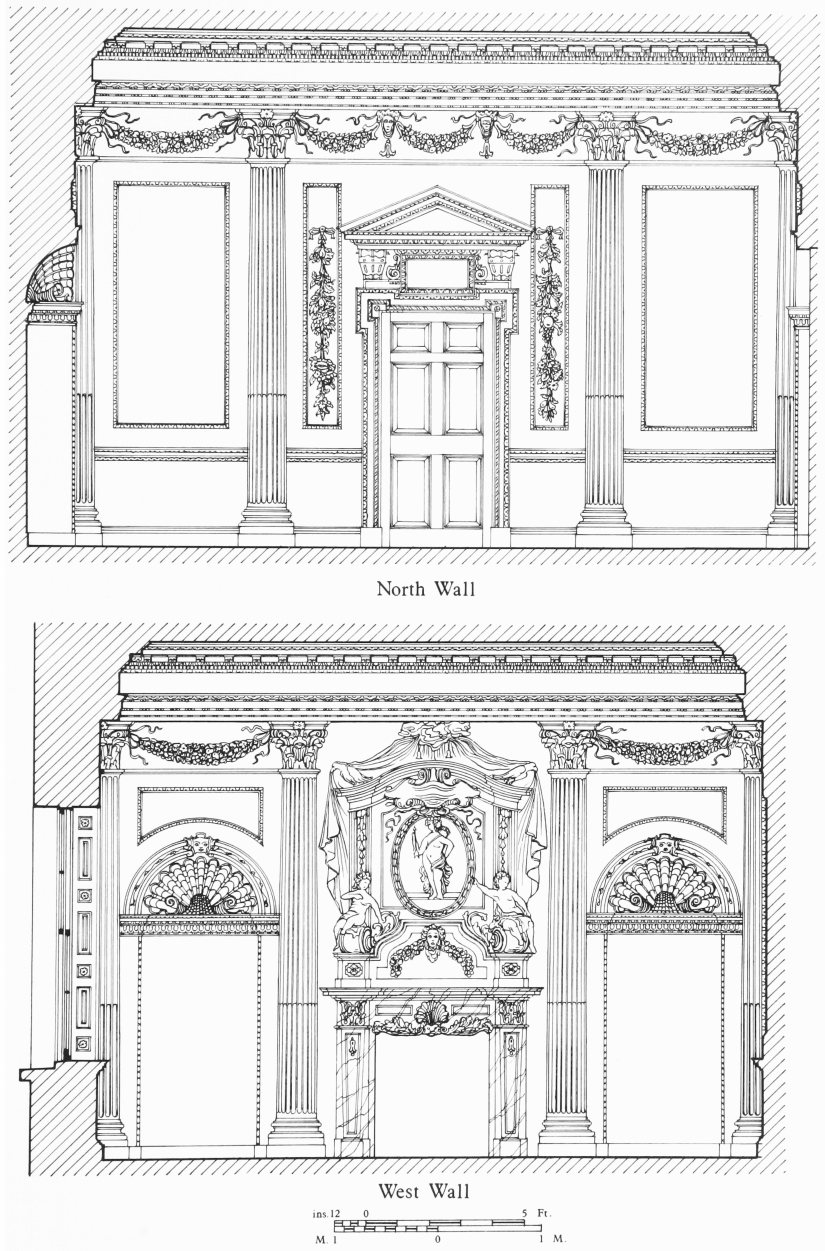
No. 66 Brook Street, internal elevations of first-floor front room (surveyor's room)
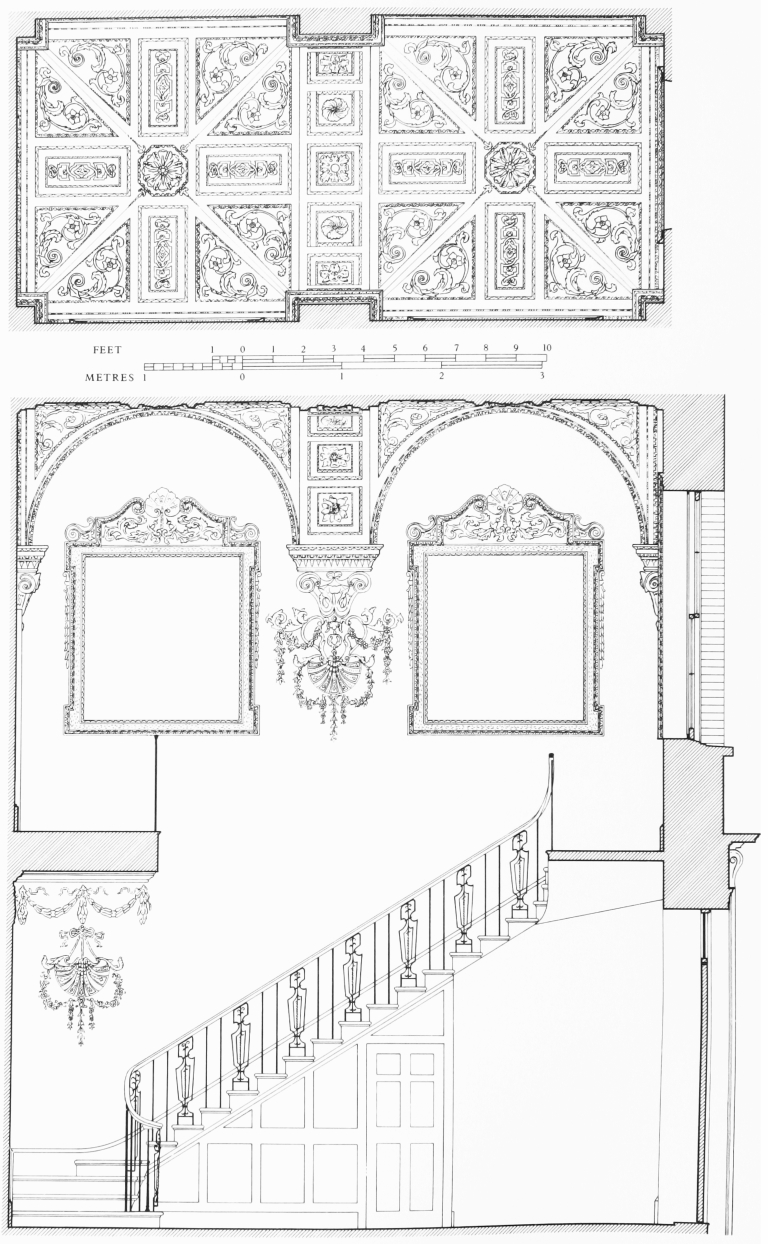
No. 66 Brook Street, section of staircase compartment and plan of ceiling
In the 1920's a series of changes led to the reunification of No. 53 Davies Street and No. 66 Brook Street. They then received what is approximately their present form, chiefly under the auspices of the second Duke's adviser, Detmar Blow. In 1923 Boodle Hatfield and Company took over Nos. 55 and 57 Davies Street, while the Estate Office left No. 55 and became virtually sole occupant of No. 53. (fn. 47) Prior to this rearrangement, over £5,000 was spent on the renovation of No. 53 (and over £10,000 on that of Nos. 55 and 57) under the direction of Edmund Wimperis. Few details relating to these works have come to light, except that the previous separate entrances to Nos. 55 and 57 were abolished and the entrance to No. 53 was adapted to serve all three buildings. (fn. 48) Payment of £75 for two pine bookcases may refer to the pair of glazed book-cumexhibition cases now in the present waiting-room on the ground floor of No. 53 and it seems likely that the room was then drastically altered by Blow and provided with not only a new fireplace but also with much of its panelling: it certainly had its present appearance by 1928 (fn. 49) (Plate 2b).
Two years later, in 1925, the Estate Trustees bought the lease of No. 66 Brook Street, apparently in order to provide accommodation for the estate surveyor's office, and in the autumn of that year Edmund Wimperis transferred estate business from the premises of his own architectural partnership at No. 61 South Molton Street. (It was temporarily conducted from No. 78 Park Street while the Davies Street-Brook Street buildings were being adapted.) Works mentioned in the contract included the removal of an old staircase at the back of the present waiting-room and the provision of a new one from ground to first floor only (since removed); the installation of a small lift and new lavatory in the same area; the conversion of the second floor to offices and the formation of flats above; and the cutting of openings between No. 66 Brook Street and No. 53 Davies Street at all the main levels. (fn. 50) Although Wimperis and his assistant G. A. Codd were formally in charge of these works (which eventually cost £6,768), it is clear that Detmar Blow intervened continually, especially over additional items. Wimperis himself ordered the second-floor windows to Brook Street to be heightened, but it was Blow who commanded an increase in height of some ground-floor windows, the choice of wood for the lift and of the external facing bricks for the lavatory-building—this last even involving the demolition of new work. As regards changes in decoration the records are silent, but it is known that much stripping of painted woodwork and wax polishing was done. In 1928 Country Life reported that several of the fine features in pine now conspicuous in the first-floor front room at No. 66 (the surveyor's room already mentioned) had recently been stripped, while in March 1926 Blow was evidently in charge of redecorating the ground-floor front room beneath—now the almost equally impressive board room (fn. 51) (Plate 2a, figs. 3–4).
In the summer of 1930 Trollope and Sons, decorators, were paid £2,300 for work in connexion with a ball held at the Grosvenor Office: £794 of this sum was deemed to have gone towards 'permanent improvement'. Later, quite sizeable payments to the same firm (for example, £1,801 in 1932) seem also to have chiefly related to decorations on the first floor for further balls. There is, however, an inexplicable reference in 1932 to 'the extension of the Board Room and works incidental thereto'. (This was not the present board room: the work cost something under £656.) Other (small) payments of these years remain equally unexplained. (fn. 52)
In 1957 the basement, ground and first floors of No. 68 Brook Street were taken over as extra accommodation for the Grosvenor Office, and openings from No. 66 were made at various levels then and in later years. (fn. 53) On the first floor of No. 53 Davies Street the largest room and the communicating room to its north were in 1962 subdivided into small offices and low false ceilings inserted below reputedly decorated plasterwork, now concealed; a small square room with a coved ceiling and decorated with fragments of old work was formed looking into the garden, and between these a new corridor was made, giving access also to the rear first-floor room of No. 66 Brook Street. Small alterations were made to the inner hall at the northern end of No. 53 Davies Street in 1969 and 1973, and in the latter year the staircase was turned at right angles on part of its lowest flight. (fn. 54)
To turn to the history of No. 68 Brook Street, it is to be noted that its site was, like that of No. 66, part of the ground which Edward Shepherd agreed to take from Sir Richard Grosvenor in November 1723. (fn. 28) Shepherd was granted a building lease in January 1725 running from Christmas 1723, but assigned it in April 1725 to Thomas Fayram, mason, one of the craftsmen associated with him in the construction of several houses in this range. (fn. 55)
Little is known of the subsequent history of No. 68, which originally had a conventional front-compartment staircase similar to but wider than that at No. 66. The bay at the back of the rear rooms was made in 1796, when Miss Maria Deborah Grosvenor took the house. (fn. 56) In 1821 the owner of the lease, Dugdale Stratford Dugdale, intended 'considerable improvements' under Mr. Hakewill (whether Henry or James Hakewill is meant is not recorded). (fn. 57) It was perhaps at that time that the front door was moved one bay eastward to its present position adjoining No. 66 and a rear wing made next to that house: both these changes had been made by 1870. The shift of the door probably betokens the narrowing of the entrance hall to its present width and the re-location of the staircase, in a rearward position. Alterations were made in 1873 but evidently were not extensive, as in 1916 the estate surveyor called the house 'very old' and reduced the rent. (fn. 58)
In 1933 changes to the entrance for a new occupant, Philip E. Hill, probably included the insertion of the present wooden doorcase, a piece seemingly of early date but of a type not otherwise known to occur on the Mayfair estate. (fn. 59) Very extensive alterations were also made for him inside in 1934–5 to designs by Joseph Emberton, which evidently included a new main staircase of oak and neoGeorgian room interiors. It is said that Syrie Maugham also decorated rooms here for the same client. (fn. 60)
In 1957 the house was taken over by the Grosvenor Office as an extension to their premises at No. 66 Brook Street and No. 53 Davies Street. The upper floors were from 1958 to 1964 occupied as a flat by Colonel Robert Grosvenor, later fifth Duke of Westminster. (fn. 17)
An architectural description of the present buildings should begin by noting that in essentials, the fronts of Nos. 66 and 68 Brook Street appear little different from when they were first built in the 1720's (Plate 1a, fig. 1: see also Plate 6c in vol. XXXIX). Their upper storeys are of plain brick but the basement and ground storeys together with the cornices and horizontally channelled quoins are faced in stucco (now painted). As has been seen, the stuccoing, however much changed and renewed, may be original. There are some differences between the houses. The flat window arches of the second floor at No. 66 were raised in 1925–6 and there were perhaps once pediments to the attic windows of this house. At No. 68, the nineteenth-century removal of the entrance to the corner position from the adjoining bay (perhaps in 1821) suggests that the ground storey received its present aspect at the same time, except for the doorcase probably inserted in 1933. Despite its quite separate history before 1957 No. 66 has the same window dressings and channelled rustication of the ground-floor front as No. 68.
Though the return front of No. 66 appears mainly original, two quasi-pilasters seem to mark where Horwood's map of 1792 shows a small projecting bay. This front immediately adjoins that of No. 53 Davies Street, probably recast as a separate elevation by Thomas Cundy II in the late 1830's (fig. 1: see also Plate 20b in vol. XXXIX). This fine stucco façade is Greek Revival in character, with pedimented entrances at either end. Above the ground storey the end bays are emphasised by pairs of plain pilasters and parapet panels containing swags, the Grosvenor crest and a coronet. A sign that the architect had to adapt his symmetrical design to fit an already existing plan is given by the number of blank windows in this front; there were six in 1946, but since then two have been opened.
The rear elevations of the houses are now jumbled, but enough can be made out to suggest that at some quite early date the back of No. 66 was stuccoed.
The interiors of No. 66 Brook Street call for more extended discussion. Their chief glory is a set of three superb interiors abounding in extravagant early-Georgian plasterwork: the main staircase compartment, the groundfloor front room (now the board room) and the first-floor front room (the estate surveyor's room). The style of these apartments is vigorous, masculine and, loosely speaking, Baroque. Their very attractive but slightly unsophisticated flavour accords better with the authorship of Edward and John Shepherd (both plasterers by trade) than with that of any more cultivated artists or Italian craftsmen.
The staircase is of the front-compartment variety, rising only to the first floor (fig. 5: see also Plate 9a in vol. XXXIX). Its stone steps are cantilevered, although cupboards have now been inserted beneath; there is a fine wrought-iron balustrade perhaps of later date, as is certainly the handrail. At upper level the ceiling is divided into two rich groined and plaster-vaulted compartments, and has arches springing from elaborate plaster brackets. The walls are further ornamented with a profuse succession of compartments, swags and shell motifs surrounded by garlands. The imperfect relationship of the vaulting to the door and window openings probably betrays the ordinary beginnings of the house as a piece of speculative building and needs raise no doubt about the early date of the plasterwork.
The board room is an equally striking composition, though different in mood (fig. 3). Here the ceiling is separated into nine deeply sunk but now quite plain compartments by beams carried across from Ionic pilasters against each of the walls. On the long sides the central bays contain narrow plaster cartouches very much in the Shepherd style framing small mirrors. Over the two doors on the staircase side spring semi-circular arches framing further plaster reliefs of baskets of fruit and flowers. The door to the rear room in the north wall has a pediment and is framed idiosyncratically by tapering pilasters. The good marble chimneypiece has a fine picture-frame in plaster above it. Whether any of this is owed to Blow's redecoration in 1926 or other operations of that period is uncertain.
The surveyor's room has something of the proportions and breathes something of the spirit of Vitruvius's Egyptian Hall (Plate 2a, fig. 4: see also Frontispiece in vol. XXXIX). Its Corinthian half-columns against the walls correspond to the Ionic pilasters in the room below, but here there is a deep frieze filled with bounteous plaster swags between the capitals. On the east side the doors are again under semi-circular arches, while the north wall boasts an elaborate doorcase with eared architrave and a pediment carried on consoles. This impressive feature, which is not perfectly adjusted to the adjacent panels, may conceivably have been imported from elsewhere or could even have been designed by Detmar Blow. Shell-headed niches and further half-columns on the west side frame a statuary marble chimneypiece, with tapering jambs, which is surmounted by a gorgeous plaster overmantel in which the modelling of figures, drapery, foliage and architectural members is carried off gracefully and exuberantly.
The other rooms in No. 66 Brook Street and No. 53 Davies Street are less notable. The ground-floor plan suggests that, although No. 66 Brook Street did not have the comparatively wide, two-bay entrance hall of No. 68 as first built, its arrangement probably followed that of No. 68 in providing a secondary staircase immediately behind the main stairs and at the eastern end of a transverse compartment. The present wooden staircase in that position descends to the basement and for that reason also seems likely to be evidence of the early arrangement. The staircase itself is probably not earlier than the late eighteenth century or, for the greater part, the nineteenth century. If Horwood in 1792 is reliable, it presumably once extended into a bay. An unexplained feature, however, is the round-headed arcading (blind and open) of the walls of this compartment at ground-floor level: the easternmost arches are negated by the lines of the staircase in a way that suggests they are earlier than the stairs (or record a previous scheme which was so). In that case Horwood's protrusion might conceivably have been a bay containing an entrance (possibly dating from c. 1778), but if so there must have been a very radical subsequent change to make a staircase here leading up from the basement, and the correspondence of this staircase compartment to that formerly at No. 68 Brook Street would be a coincidence.
Generally, the ground floor, apart from the areas already described, lacks significant plaster work but the rooms are panelled, though to what extent this is authentic is hard to say. The rear room of No. 66 Brook Street facing the garden does not seem to have been much altered: the window here dates from 1925–6. In the room immediately north of the secondary staircase, facing Davies Street, the panelling seems again largely unaltered, though the chimneypiece perhaps and the south door certainly date from the 1920's. Beyond this comes the waiting-room, where the woodwork was probably altered in 1923, when the present bookcases seem to have been installed (Plate 2b); again the fireplace is neo-Georgian. A small square room to its west, probably indicated in 1792 by Horwood as a rearward projection and perhaps once a little study, has its west wall shaped internally to a curve by what appears to be Georgian work. Inside the entrance at the northern end of No. 53, the stone staircase, though owing the right-angled forms of its lowest flight to 1973, could date from the time of either Fisher's alterations in the 1820's or, more probably, of the new front of the 1830's.
At first-floor level, the rear room of No. 66 Brook Street overlooking the garden has somewhat crude panelling, probably intended as the lining for paper or silk hangings. Its rococo-style plaster ceiling may well be of the mid eighteenth century. Towards Davies Street the room to the north of the secondary staircase has another ornamental ceiling and marble chimneypiece, both perhaps of the time of the new front. North of this are the small offices with the concealed plasterwork mentioned previously. Above the first floor, the buildings have few memorable features.
Though the interior of No. 68 Brook Street needs no special notice, its rooms and oak staircase are decent specimens of neo-Georgian craftsmanship.
Occupants include: No. 66, Sir Nathaniel Curzon, 4th bt., 1729–58: his son, Assheton Curzon, latterly 1st Baron and Viscount Curzon, 1758–1820. James Mivart, hotelier, 1820–1. William Frederick Chambers, physician, 1824–32. Maj. George Keppel, later 6th Earl of Albemarle, 1836–42. Edward Stanley, surgeon, 1843–62. (Sir) William Scovell Savory, latterly 1st bt., surgeon, 1864–95: his son, Rev. Sir Borradaile Savory, 2nd bt., rector of St. Bartholomew's, Smithfield, 1896–1906. George W. Dawson, surgeon, 1909–25. Grosvenor Office, 1925–. No. 68, 1st Viscount Vane, 1731–2. 10th Earl of Rothes, 1741–56. William Pitt, later 1st Earl of Chatham, statesman, 1757. (Sir) William Mildmay, latterly bt., 1757–71: his wid., 1771–96. Miss Maria Deborah Grosvenor, 1796–1808. Dugdale Stratford Dugdale, 1809–36. George Wilbraham, M.P., 1836–50: his wid., 1850–64. 11th Earl of Devon, Pres. of Poor Law Board, 1865–9. Dow. Countess Fortescue, wid. of 2nd Earl, 1870–96. (Sir) John Phillips, (kt.), physician, 1898–1921. (Sir) Max Julius Bonn, (kt.), merchant banker, 1924–8. Philip E. Hill, company chairman, 1932–43. 1st Earl of Woolton, Minister of Food, 1947–57. Lieut.-col. Robert Grosvenor, later 5th Duke of Westminster, 1958–64.
No. 70 Brook Street
No. 70 Brook Street (formerly No. 24), the site of which was part of the large piece of ground between Davies Street and Gilbert Street taken by Edward Shepherd, was leased at Shepherd's direction in 1725 to Lawrence Neale, carpenter. (fn. 61) Below the main cornice the original plain brick front survives unaltered except for the addition, in the late eighteenth or early nineteenth century, of a slightly projecting porch supported on slim Tuscan columns (Plates 1a, 3b). The façade is four bays in width, but this exaggerates the real size of the house, for the westernmost bay has a depth of only some ten feet, all the land behind this shallow projection having always formed part of the site of No. 72. This break in the boundary between the two houses partly explains the lop-sided aspect of the front of No. 70 above the main cornice, the westernmost bay of which has a single-storey square attic, while the other three bays have two-storey attics surmounted by a bracketed cornice. All these attics are evidently mid nineteenthcentury additions, the three higher bays of which were originally surmounted by a most unsightly gable (Plate 33c in vol. XXXIX). Their present less ugly appearance is the result of work done in 1882 by W. G. Habershon, whom Thomas Cundy III had required to 'submit a drawing for the improvement of the front at the top, the top room only extending about half across the elevation'. (fn. 62)
The plan originally comprised an L-shaped entrance hall, one arm formed by the shallow western bay and the other extending back to a dog-leg staircase, while to the right there were two rooms, one behind the other. (fn. 63) This layout no longer survives, however, for the projecting western bay now contains the staircase (probably placed here in 1935 (fn. 64) ), and most of the rest of the house has been extensively remodelled. Some of this work may have been by Habershon, relatives of whom lived in the house from 1868 to 1899 and made substantial 'structural improvements'. In 1898 the house was nevertheless still said to be 'very incommodious', and in 1900 it was repaired and improved by Read and Macdonald. (fn. 65) More internal remodelling took place in 1935, when a new staircase was inserted, and in 1949, the latter being done by Wells Coates, who at first wanted to remove the porch but after requests from the London County Council and the Georgian Group ultimately agreed to retain it. (fn. 66)
Occupants include: Brig. Robert Murray, son of 1st Earl of Dunmore, 1727–38. Gen John Leland, 1797–1807. Sir Godfrey Webster, 5th bt., 1813. James Stuart Wortley, M.P., later 1st Baron Wharncliffe, 1814–18. W. K. Barrington, later 6th Viscount Barrington, 1824–6. William Blaauw, antiquary, 1827–37. William Brinton, physician, 1863–7 (previously at No. 58). Samuel C. Habershon, physician, 1868–89: his son, Samuel H. Habershon, physician, 1889–99. Lady Hollins, wid. of Sir Frank Hollins, 1st bt., cotton-spinner, 1925–34.
No. 72
No. 72 (formerly No. 25) was first occupied, from 1726 to 1729, by Edward Shepherd, the plasterer and architect who was also one of the principal developers of the Grosvenor estate in Mayfair. The site was part of the large piece of ground hereabouts which he had taken in 1723, and the building lease of the house was granted to him in 1725. (fn. 67)
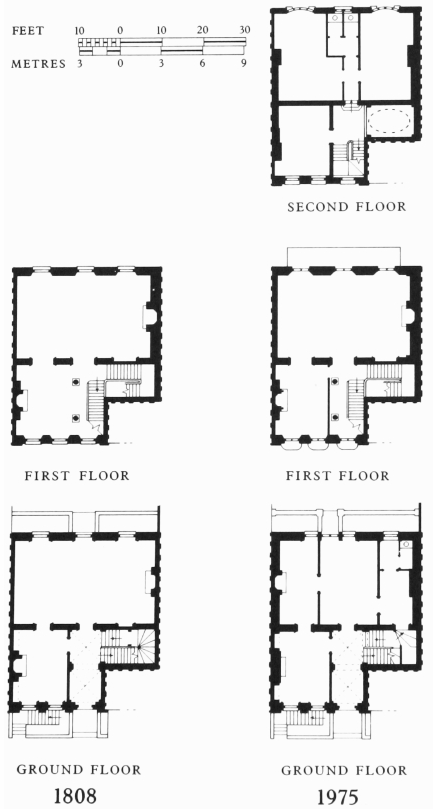
No. 72 Brook Street, plans in 1808 and 1975. Some modern partitions omitted
It was perhaps Shepherd's intention to provide a 'show house' in which to display his talents to potential customers, and this may explain the unusual plan and idiosyncratic detailing. The front elevation (Plate 3b) has boldly rusticated brickwork on the ground storey, and on either side there are oddly proportioned long and short quoins, all of which at first sight look like Edwardian alterations; but the condition of the tuck-pointed brickwork and the evidence of early photographs suggest that, apart from the later top storeys and alterations to the front door and windows (particularly on the first floor) the façade is substantially in its original condition.
Its style is, indeed, closer to the brick Baroque associated with Vanbrugh than to the staid frontage of the average London terrace house; and the interior is equally unexpected. The peculiarities of the plan (fig. 6) were caused partly by the break in the line of the boundary with No. 70, No. 72 being some twelve feet wider at the back than at the front. This interlocking plan—used elsewhere by Shepherd at Nos. 11 and 12 North Audley Street and at Nos. 74 and 75 South Audley Street—allowed for spacious rooms in one house at the expense of its neighbour and could be adapted to the requirements of prospective customers as occasion demanded.
The entrance hall has a ceiling divided into two crossvaulted compartments by a coffered arech (Plate 3a), as over the staircase at No. 66. The staircase is the most curious feature of No. 72. It rises at a right angle to the hall, behind the front of No. 70. At first-floor level it changes direction and continues towards the front of the house, leaving a high toplt void in the upper part of the main staircase compartment. This unusual handling of space and the flow of the staircase through the house is another Baroque contrivance. The wooden stairs themselves are of a most unusual design, the step-ends being carved with a Greek key pattern and the handrail having a Vitruvian scroll along the side, while the balusters take the form of little Tuscan columns (fig. 7).
Originally the first-floor front room opened directly on to the staircase through a screen of two fluted Ionic columns which are almost identical to those in the gallery at No. 12 North Audley Street. These columns still survive, looking sadly redundant alongside the modern partition. On the ground and first floors the rear of the house was taken up by one large room but both have been altered at later dates. The first-floor rear room has a carved wooden chimneypiece with a bold pulvinated frieze and carved drapery and tassels hanging at the sides. The small ground-floor front room has retained most of its original early eighteenth-century decoration, albeit in somewhat restored condition (Plate 3c). The walls are lined with finely carved deal panelling, now stripped but originally painted. There are round-headed alcoves flanking the chimneypiece and a handsome doorcase with lugged architraves. The ceiling has coarse Baroque plasterwork, almost certainly by Shepherd, with a pattern of thick scrolls, shells and female masks framing a plain rectangular central panel.
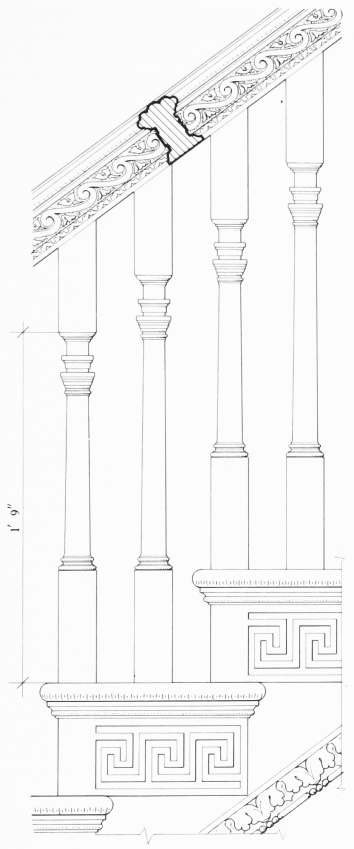
No. 72 Brook Street, detail of staircase
The house remained unaltered throughout the nineteenth century largely because of the way it impinged on No. 70, which made rebuilding difficult. As Thomas Cundy III, the estate surveyor, reported in 1880: 'This house should not be renewed, but rebuilt, were it not intermixed on plan with No. 70 and flanked by houses on either side which have been raised on weak party walls'. (fn. 68) Considerable alterations made in 1909–10 by Green and Abbott Limited, decorators and upholsterers of Oxford Street, included the addition of an extra storey and alterations to the windows, which it was hoped would preserve the 'Georgian character' of the house. (fn. 69) Further changes were made in 1930 and 1937. (fn. 70) (fn. c1)
Occupants include: Edward Shepherd, architect, 1726–9. Lady Margaret Fordyce, wid. of Alexander Fordyce, banker, 1803–12: her 2nd husband, Sir James Burges, 1st bt., 1813–21. (Sir) Henry Holland, latterly 1st bt., physician, 1822–4, 1827–73 (also at No. 74). Lady Randolph Churchill, mother of Sir Winston Churchill, 1915–17. Adela, Countess of Essex, wid. of 7th Earl, 1918–22: her stepson, 8th Earl of Essex, 1919–23: Lady Joan Peake, da. of Countess of Essex, and her husband, Osbert Peake, 1923–6.
No. 74
No. 74 (formerly No. 26) is situated on part of the large plot taken by Edward Shepherd in 1723, and was erected under a building lease granted to Thomas Hogg, lime merchant, in 1725. (fn. 71) It has been much altered since. In 1803 the lease was renewed to Elizabeth Lawrence, who contemplated spending a 'considerable sum of money' on repairs. (fn. 72) It is likely that such features as the stucco facing and the iron balcony at first-floor level of the front elevation and the round-headed windows lighting the staircase at the rear date from about that time (Plate 1a). In 1871 consent was granted for 'the extension of rooms at the top' to a design supplied by Thomas Cundy III, (fn. 73) and in 1900 various internal works were undertaken by Maple and Company on behalf of Lord Balcarres. These included the removal of the back stairs and the installation of overefficient heating stoves, the latter to the detriment of the panelling next door at No. 76. (fn. 74) In 1968 the interior was damaged by fire and its appearance now is largely the result of a subsequent reconstruction. A few fragments remain inside, notably some late eighteenth-century Adamesque decoration in the first-floor rooms. The front is largely plain early nineteenth-century work, though the doorcase with its fanlight looks late eighteenth-century. The back retains more of the original early eighteenth-century fabric, including a canted bay window extending to the full height of the house.
Occupants include: Capt. William Aislabie, 1729–42. Lieut.gen. Roger Handasyde, 1744–50. (Sir) Henry Holland, later 1st bt., physician, 1825–6 (also at No. 72). Col. (Sir) John-Hutton Cooper, latterly 1st bt., 1827–8: his wid., 1829–40: her nephew, Sir George Baker, 3rd bt., 1841–53. Robert Todd, physician, 1854–60. (Sir) William Gull, latterly 1st bt., physician, 1862–90. Lord Balcarres, later 27th Earl of Crawford, 1901–8. Catherine Hozier, da. of 1st Baron Newlands, 1909–12, and with her husband, Sir Algernon Law, K.C.M.G., 1913–36. D. J. B. Joel, M.P., 1937–41.
No. 76
No. 76 (formerly No. 27) was first occupied by the celebrated Scottish architect, Colen Campbell, who lived here from 1726 until his death, 'of a Dropsy, after having been twice tapp'd, at his House in Brook-street', on 7 September 1729. (fn. 75) The site of the house, and that of its neighbour No. 78 (formerly 28), were part of the large 'take' of ground agreed for by Edward Shepherd in 1723, and on 1 April 1726 both these plots were leased, at Shepherd's nomination, to Campbell in consideration that he 'hath at his own costs and charges erected and built or is erecting and building two brick messuages' there. (fn. 76)
No. 78, the larger of the two houses, was rebuilt in 1873–5, but Campbell's No. 76 survives, its narrow twobay front still much as he designed it, apart from the addition of the two top storeys in 1871–2 (Plate 1a, fig. 8). (fn. 2) This was the work of Thomas Cundy III, (fn. 77) who was sensitive enough, in his design for the fenestration of the new square storey, to match the Palladian proportions of Campbell's second-floor windows. The architraves of these and the lower windows, it may be noted, are very similar to those previously provided by Campbell at Nos. 31 and 32 Old Burlington Street. (fn. 78) Through its carefully thought out proportions and 'correct' classical detail this seemingly simple elevation exudes an air of good breeding and provides a notable contrast to Shepherd's bolder and less refined work.
The interior, though now used as solicitors' offices, still contains much of interest, but what was intended to be the pièce de résistance, the back parlour, as illustrated in 1729 in Campbell's edition of The Five Orders of Architecture (Plate 3d), was only executed in much simplified form. The elaborate chimneypiece, the carved or painted panels of gambolling cherubs over the doors, and the frieze of festoons and ox skulls were all omitted. The wall panelling, however, was carried out as shown and is a sophisticated arrangement of alternating narrow inset panels and panels with raised and moulded surrounds. The handsome doorcases with festoons and cat masks are also close to the published design (Plate 3e). A simpler wooden chimneypiece was adopted with lugged architraves, a carved bolection frieze and a central panel with festoons of drapery and a cat mask to match the doorcases. At some later date, probably in the nineteenth century, the ceiling was decorated with panels of painted flowers and scrollwork.
Other rooms on the ground, first and second floors retain original panelling, doorcases and wooden chimneypieces with bolection friezes. The staircase has been rebuilt to make room for a lift in the central well but at third-floor level the original ceiling survives with corner pendentives springing from moulded corbels and an oval skylight in the middle now blocked. In the front basement area is a lead water tank with Campbell's initials and the date: 'C.C. 1726'.
Occupants include: Colen Campbell, architect, 1726–9. Bernard Edward Howard, latterly 12th Duke of Norfolk, 1815–17. Lord Richard De Aquila Grosvenor, son of 2nd Marquess of Westminster, later 1st Baron Stalbridge, 1871–9.
No. 78
No. 78 (formerly No. 28) was rebuilt in 1873–5 after a fire had 'partially destroyed' the old house on 19 December 1872. This assertive replacement (Plate 33c in vol. XXXIX) is set back from the old building line, leaving a jagged edge to No. 76, and mars what is otherwise the finest group of eighteenth-century houses in Brook Street. The old house, like No. 76, was erected under a building lease granted to Colen Campbell in 1726. (fn. 79) Its appearance is not recorded but it had a more spacious plan than its neighbour, being three bays wide as opposed to two (fig. 8).
The occupant at the time of the fire was Joseph Hornby Baxendale, senior partner of Pickford's, the carriers, who chose Charles Forster Hayward as the architect for his new house. Hayward's first design did not meet with the unqualified approval of the third Marquess (later first Duke) of Westminster, who asked if the elevations could be improved. Hayward explained that Baxendale 'would be most willing to make improvements if he could have a longer lease'. An extended term at a rack rent was then offered, on condition that the new house should be built of red brick, and 'His Lordship also suggested an angle window looking towards Grosvenor Square'. Baxendale eagerly accepted these terms which he considered 'not only fair but liberal'. (fn. 80) The new house was nearly completed by the end of 1874 and was illustrated in The Builder in the following year as an example of high-quality street architecture arising from 'the enlightened policy of the present Duke of Westminster, who seems to be not only a discriminating judge of what suits his own position in the construction of magnificent works for himself in town and country, but also a wise and careful administrator of the various details arising on a vast estate; taking advantage of special opportunities to remove difficulties and to encourage the construction of work of an architectural and artistic character in place of mere speculative building'. The contractor was James Mugford Macey, 'by whom the works have been very well carried out'. (fn. 81)
The new house contained within its towering five storeys vastly more accommodation than its predecessor, extending over a hundred feet along Gilbert Street, which now became the principal front containing the main entrance. On the ground floor the central entrance hall, with the main and service staircases, separated the diningroom on the north from the 'gentlemen's room' on the south. The first floor was occupied by a suite of drawingrooms redecorated (perhaps by H. and J. Cooper (fn. 82) ) in about 1894 for Baxendale's son in an accomplished neoAdam taste, with elaborate stucco ceilings and wall panels with attenuated festoons of husks and scrolls framing a collection of watercolour pictures. Very little of this work now survives, the interior having been altered and subdivided to form offices, but the appearance of the rooms in 1894 is recorded in photographs taken by Bedford Lemere. (fn. 83) This elegant feminine pastiche formed a striking contrast with the coarse muscular Jacobean/Gothic of the exterior with its restless mutliplicity of oriels, bay windows, gables, decorative chimney-stacks and illusion of towering height.
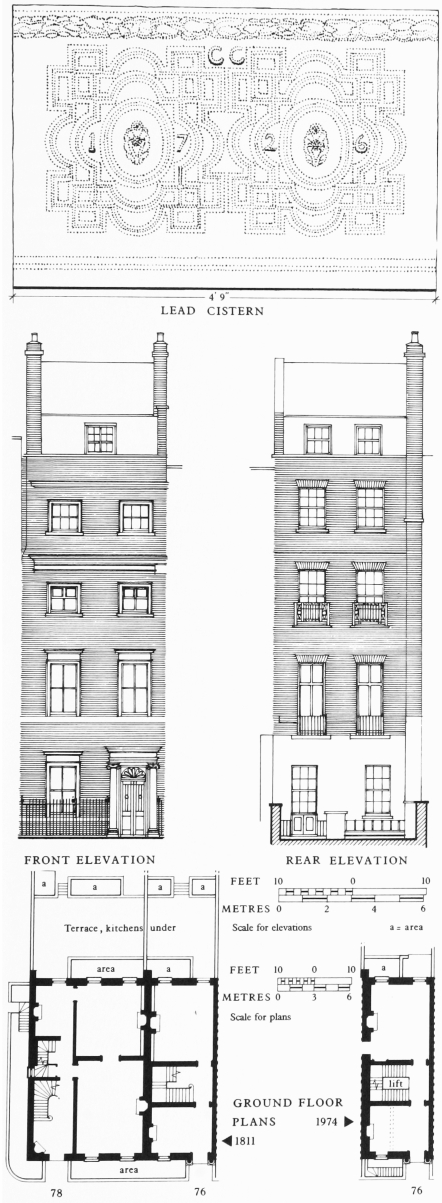
No. 76 Brook Street, plans in 1811 and 1974, elevations and lead cistern. Plan in 1811 includes No. 78 (demolished) and plan in 1974 omits modern partitions
Occupants include: Henry Vane, M.P., later 1st Earl of Darlington, 1727–34. 2nd Baron Wharncliffe, and latterly his son-in-law, 3rd Marquess of Drogheda, 1850–3. Sir Henry Dymoke, 1st bt., King's champion at the coronation of George IV, 1854–63. Joseph Hornby Baxendale, senior partner of Pickford's carriers, 1864–86: his son, Joseph William Baxendale, director of Phoenix Assurance Company, 1886–1915.
Nos. 80–84 (even) Brook Street and Nos. 22–26 (consec.) Gilbert Street
Nos. 80–84 (even) Brook Street and Nos. 22–26 (consec.) Gilbert Street are a favourable example of speculative building, undertaken in 1910–13 by Matthews, Rogers and Company of Green Street to the designs of their architect-partner, Maurice Charles Hulbert. (fn. 84) They consist of a corner block numbered in Brook Street and a terrace of five houses in Gilbert Street (Plate 1c: see also Plate 45d in vol. XXXIX). The design of the corner block is a competent piece of Francophile classicism finely executed in excellent orange-red brick and creamy stone with handsome ironwork and a steeply pitched roof of graded green Westmorland slates. The interiors are of similar quality with decent plasterwork, neo-Georgian chimneypieces and mahogany doors throughout. Some of the corner rooms at the front are octagonal. The five houses in Gilbert Street form an attractive subsidiary group and are a model of tactful and varied neo-Georgian street architecture. Built of similar materials as the corner block, they were erected at the suggestion of the second Duke of Westminster, who had 'expressed a wish that some quite small houses of about this class' should be erected in some 'suitable position' on his estate. (fn. 85)
Of the old houses on the Brook Street site, Nos. 80 and 82 (formerly Nos. 29 and 30) had been built under leases granted to James Heathfield, carpenter, in 1725 and No. 84 (formerly No. 31) under another lease of the same year to Augustin Woollaston, esquire, but assigned to Lawrence Neale, carpenter. (fn. 86) In 1910 the only feature considered to be of artistic merit was an Italian chimneypiece of sculptured marble, 'earlier than 1500 and probably about 1470', in the entrance hall at No. 84. It was believed to have been introduced in the 1890's by Sir William Broadbent, and at the time of demolition it was photographed and carefully removed as a landlord's fixture. It was subsequently sent to the Duke's house in France. (fn. 87)
Occupants include: No. 80, P. F. Robinson, architect, 1820–41. Lady Dufferin, wid. of 4th Baron, 1843–7. No. 82, Lady Barrington, wid. of 1st Baron, 1742–63. Lady Hales, wid. of Sir Thomas Hales, 3rd. bt., 1764–9: her son, (Sir) Philip Hales, latterly 5th bt., 1769–75 (later at No. 43): his sister-in-law, Lady Hales, wid. of 4th bt., 1776–81. Gen. George Ainslie, 1799. 3rd Baron Braybrooke, 1826. Sir Charles Bell, kt., surgeon, 1832–5. (Sir) Thomas Spencer Wells, later 1st bt., surgeon, 1855. (Sir) Crisp English, latterly K.C.M.G., surgeon, 1913–49. No. 84, Gen. John Griffin, later Field Marshal, 4th Baron Howard De Walden and 1st Baron Braybrooke, 1752–62. George Adams,? mathematical instrument maker to George III, 1763–73. Robert Hudson,? composer, 1773–8. Pelham Warren, physician, 1815–35. Arthur Duncombe, son of 1st Baron Feversham, 1837–41. Sir William Bowyer-Smijth, 11th bt., 1854–5. Sir William Broadbent, 1st bt., physician, 1893–1907. Claud Portman, later 4th Viscount Portman, 1914–21. Sir Robert Gardiner, kt., chairman of gas companies, 1922–5.
No. 86 Brook Street
No. 86 Brook Street (formerly No. 32). Neither this house nor its neighbour, No. 88, has ever been rebuilt de novo, but both were very thoroughly reconstructed in the early twentieth century, particularly No. 86, the present outward appearance of which is entirely modern neoGeorgian (Plate 31b, fig. 9). Although the original houses were erected under separate building leases of 1725, No. 86 to Augustin Woollaston, esquire, and No. 88 to William Barlow junior, carpenter, they were both soon bought by the fifth Earl of Northampton, and from 1729 to 1774 were occupied as a single dwelling. (fn. 88) (fn. c2) In 1776 the then owner, the second Earl of Upper Ossory. sold this 'Spacious Leasehold Mansion, Coach-houses, Stabling and extensive Offices' to John Edridge, a local poulterer, who immediately resold No. 88 to Richard Vaughan, esquire, a Carmarthenshire landowner. (fn. 89) Thereafter the two houses have remained in separate occupation, Edridge's No. 86 being for some years evidently sub-let to short-term tenants. In 1784–6 the ratebooks refer to a chapel here, on the Bird (now Binney) Street flank; by 1819 this had been converted into a warehouse with a carpenter's shop above. (fn. 90)
In 1819 James Hakewill acted for George John Legh of High Legh, Cheshire, in the renewal of the lease of No. 86, and may perhaps have made improvements here, for he later worked for Legh at High Legh in 1833–4. (fn. 91) In 1880 there was a considerable outlay on structural alterations, and J. G. Crace and Sons, the decorators, were also working here. (fn. 92) Lord Davey, a Lord of Appeal, employed 'Mr. Roberts', probably Percy Morton Roberts, architect and surveyor, to make internal alterations in 1899, (fn. 93) and shortly afterwards what one resident had described as early as 1812 as 'the disagreeable view from the back windows' was greatly improved by the formation of Duke's Yard. (fn. 94)
When its future was being considered in 1907 the house was said to be 'somewhat inconveniently arranged and . . . generally old fashioned', and in a list of works to be done Eustace Balfour, the estate surveyor, insisted that the tenant 'should be specially informed that the original oak sashes must not be removed, nor the tablet on the flank wall "Bird Street 1725" interfered with in any way without previous permission'. No further works were, however, carried out before the lease expired at Michaelmas 1919, when possession of the house reverted to the Estate. (fn. 93)
In 1922 it was reconstructed to provide consultingrooms and other accommodation for a 'group of distinguished doctors'. The architect was C. H. BiddulphPinchard, who had designed a number of country houses and was later to be the architect of the London Clinic in Marylebone Road. (fn. 96) The entrance was removed from Brook Street, where its foundations can still be seen at the east corner, and the nondescript rear range in Binney Street was replaced by a symmetrical neo-Georgian frontage. As executed this is less elaborate than was originally intended and has a recessed pedimented centre containing the main entrance, flanked by balustrades and obelisks carrying light globes. The new block is of purplebrown brick with tall sash windows and nice classical trim in painted stucco, while the old front in Brook Street is stuccoed all over. The annexe to the north, rather lower than the rest of the building in Binney Street, is similar but its first-floor window architraves were inspired by Italian quattrocento sculpture. The general external design was considered at the time (rather surprisingly) to represent 'a typical eighteenth-century London elevation'. The 'Bird Street 1725' tablet was incorporated in the new work and still remains. (fn. 97)
The disposition of the interior reflected the clients' special medical needs. A large 'muniment room' was incorporated in the basement, and the ground and first floors contained the waiting-rooms and consulting-rooms. The decoration was smart and fresh throughout. The hall and corridors were faced with stone-coloured 'stuc' and the ceilings painted blue. All the walls were treated with Kelasto to speed the drying of the plaster. In one of the waiting-rooms the Kelasto-treated plaster was left unpainted because it created an impression of green- and lapis-coloured marbling which amused both the architect and clients. The large waiting-room had primrose enamelled walls, and many of the doors were lacquered in black. Much of the furniture was made in a 'William and Mary' style by Messrs. Skull of High Wycombe. The main staircase also had a late seventeenth-century flavour. The plasterwork in the various rooms, carried out by H. E. Gaze Limited, varied from the manner of the late seventeenth century to the 'Adam'. (fn. 98) Several chimneypieces of the early 1920's still survive including one, of Wheldon stone, and another with Dutch tiles.
Biddulph-Pinchard's designs for No. 86 Brook Street were the only work on the Grosvenor estate to be represented in the Royal Academy Winter Exhibition of British Architecture in 1937.
Occupants include: Nos. 86 and 88, 5th Earl of Northampton, 1729–54: his son-in-law, George Townshend, later 4th Viscount and 1st Marquess Townshend, Wolfe's second-in-command at Quebec, Lord Lieut. of Ireland, 1755–9. 7th Earl of Northampton, 1760–1. 2nd Viscount Bolingbroke, 1762–6. 2nd Earl of Upper Ossory, 1767–74. Separated from No. 88, 1776. Keith Stewart, son of 6th Earl of Galloway, 1787–95. Lady Dering, wid. of Sir Edward Dering, 6th bt., 1799–1806. Dow. Duchess of Beaufort, wid. of 5th Duke, 1807–11. Lady Saltoun, wid. of 16th Baron, 1812–13. Sir John Throckmorton, 5th bt., 1814–19. Col. Patrick Vans Agnew, director of East India Company, 1836–42. Lady Borough, wid. of Sir Richard Borough, 1st bt., 1844–61. 2nd Baron De Tabley, 1862–71. 7th Earl of Dunmore, 1872–9. Sir John Heathcoat Heathcoat-Amory, 1st bt., 1881–2, 1886–7. 13th Earl of Dalhousie, 1885. Sir Horace Davey, latterly 1st Baron Davey, a Lord of Appeal, 1892–1907. Walter Cunliffe, latterly 1st Baron Cunliffe, Governor of Bank of England, 1910–16.
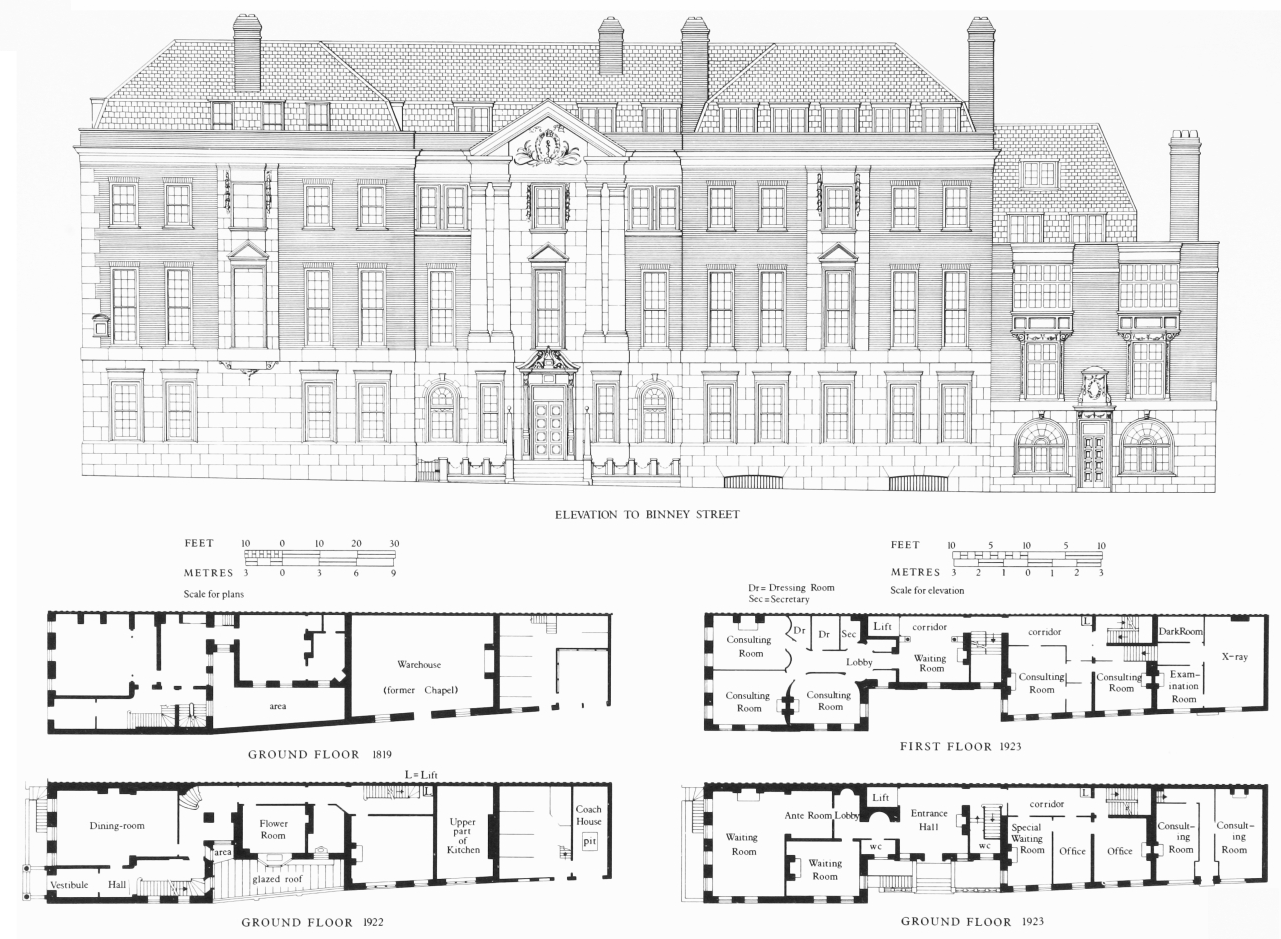
No. 86 Brook Street, elevation to Binney Street and plans
No. 88
No. 88 (formerly No. 33). (fn. 3) The early history of this house has been described with No. 86. As with the latter, No. 88 has never been rebuilt, but its outwardly Georgian appearance belies the interior, which contains a luxurious pastiche of 1909–10 by Mewès and Davis (Plates 5c, 31b, fig. 10).
In 1822–4 C. R. Cockerell made alterations for the lessee Henry Trail costing £3,384. (fn. 99) It must have been at about that period—and therefore just possibly at his hands—that the first-floor windows were lengthened and a continuous iron balcony and projecting Ionic porch added. More alterations were made in 1871, and for William Amherst in 1874 ('a new dining room'), 1880 and 1890. (fn. 100) Through the rebuilding of Duke's Yard in 1900–2 (see page 90) Lord Amherst (as William Amherst had now become) acquired large new stables there, and could now adapt his old stabling to domestic use. (fn. 101) After obtaining an extension of his lease he commenced operations in 1906, with R. S. Wornum as his architect; (fn. 102) but soon afterwards financial misfortunes caused by 'misplaced confidence in his legal adviser overwhelmed that worthy and amiable peer', (fn. 103) and in 1909 Lord Amherst sold the house to the Hon. and Mrs. Henry Coventry. (fn. 104)
The main contractor for the substantial works now put in hand was the builder John Garlick, who in May 1909 submitted to the Grosvenor Board plans prepared by R. G. Hammond. In July Garlick gave notice of his intention to begin construction of a new top storey and additions at the rear, but in October Mewès and Davis were presenting drawings for approval, and Eustace Balfour, the estate surveyor, was considering whether the height of the proposed additional storey might be objectionable when viewed from the Square. Shortly afterwards he approved amended plans by Mewès and Davis, and also plans sent by Garlick for the alteration of the stables at the rear in Duke's Yard. (fn. 105) Through his judicious interference the alterations to the exterior of the house were left to a minimum, the new square storey matching the appearance of the lower part of the front and the new mansard roof being neatly unobtrusive.
The interior, however, was remodelled and is now almost entirely the work of Mewès and Davis. Before its reconstruction the house comprised a narrow central entrance hall with a large room on the left, the rear wall of which formed a shallow segmental apse: on the right were two smaller rooms while the main staircase, situated behind the hall and left-hand room, had wall-supported stone treads and an S-scroll wrought-iron balustrade and was lit by a handsome Venetian window with Roman Doric columns and a tryglyph frieze. Mr. Amherst's narrow dining-room of 1874 projected into the garden at the back.
The Coventrys' particular wants had been a better staircase, an improved hall and a lighter dining-room. (fn. 106) Mewès and Davis's remodelled ground-floor plan comprised a small entrance hall leading into a central 'Grand Gallery' some forty feet in length (fig. 10). This provided access to the front rooms and to a new 'Grand Staircase' halfway down on the right. At the end of the gallery, and occupying the full width of the site, was a large new diningroom. Beyond, a new garden was laid out in the formal French style with accomplished architectural features in Portland stone: balustrades, sphinxes and an exedra at the end, with stalactite rustication and a shell-shaped fountain.
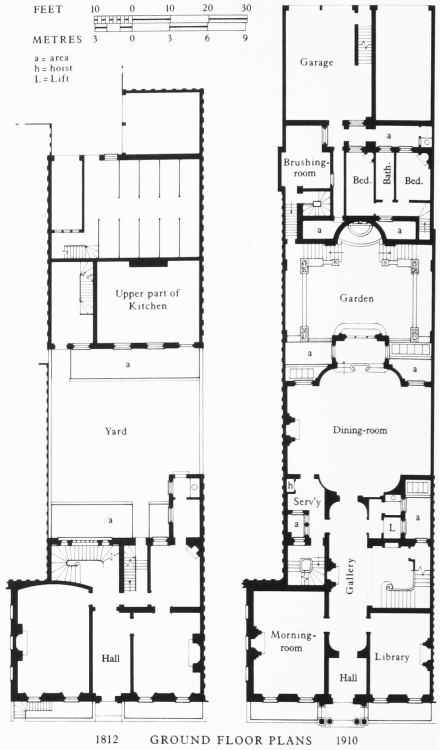
No. 88 Brook Street, plans in 1812 and 1910
The rooms were decorated in the most chic, luxurious and varied manner. The morning-room and library are in the neo-Adam style, having handsome mahogany doors and stucco cornices decorated (in the former) with wreaths and ears of wheat or (in the latter) with urns and anthemion, while the ceilings have sparsely applied plaques and festoons—all executed with such tact and care that they could easily be mistaken for genuine eighteenthcentury work, of which the sole examples in these two rooms are the marble chimneypieces (Plate 5c). The latter may be the two chimneypieces costing £250 which Garlick acquired in 1909 as replacements for 'two ordinary marble mantlepieces' then in the house. (fn. 107) In the 'Grand Gallery', principal staircase, dining-room and first-floor drawingrooms the Louis XVI manner was used to provide an immediate impact of subdued domestic magnificence. The 'Grand Gallery' has a marble floor, and the walls both here and on the staircase are lined with stone, while the staircase balustrade is a sumptuous design in wrought iron which culminates at the first-floor landing in a virtuosic panel containing a basket of flowers backed by crossed horticultural implements. In the dining- and drawingrooms the Louis XVI decoration has a cool 'Ritzy' quality, with carved boiseries and sculptural panels, coved stucco ceilings, and low-proportioned marble chimneypieces, the circular first-floor rear room being particularly pretty. The same style extends more modestly to the principal bedrooms, and even the back stairs have a French accent with an eighteenth-century-patterned iron balustrade.
When the house was converted to office use in 1950–1 the two first-floor windows in the western flank wall, blocked in 1909–10, were reopened. (fn. 108) It was perhaps at this time that the early nineteenth-century continuous iron balcony on the principal front was altered, the projecting porch and each of the four flanking windows now having individual balconettes, otherwise still of the old design (Plate 31b).
Occupants include, after the separation of the house from No. 86 in 1776, Richard Vaughan, Carmarthenshire landowner, 1776–80. Countess of Lincoln, wid. of Earl of Lincoln, who was son of 2nd Duke of Newcastle, 1781–5. 6th Earl of Guilford, 1831–9. William Amhurst Tyssen Amherst, latterly 1st Baron Amherst, 1874–1909. Henry T. Coventry, son of 9th Earl of Coventry, 1911–34: his wid., 1934–40.