Survey of London: Volume 40, the Grosvenor Estate in Mayfair, Part 2 (The Buildings). Originally published by London County Council, London, 1980.
This free content was digitised by double rekeying. All rights reserved.
'Grosvenor Street: North Side', in Survey of London: Volume 40, the Grosvenor Estate in Mayfair, Part 2 (The Buildings), ed. F H W Sheppard (London, 1980), British History Online https://www.british-history.ac.uk/survey-london/vol40/pt2/pp35-44 [accessed 30 April 2025].
'Grosvenor Street: North Side', in Survey of London: Volume 40, the Grosvenor Estate in Mayfair, Part 2 (The Buildings). Edited by F H W Sheppard (London, 1980), British History Online, accessed April 30, 2025, https://www.british-history.ac.uk/survey-london/vol40/pt2/pp35-44.
"Grosvenor Street: North Side". Survey of London: Volume 40, the Grosvenor Estate in Mayfair, Part 2 (The Buildings). Ed. F H W Sheppard (London, 1980), British History Online. Web. 30 April 2025. https://www.british-history.ac.uk/survey-london/vol40/pt2/pp35-44.
In this section
North Side
Nos. 4 and 5
Nos. 4 and 5 consist of a five-storey building at No. 5, and a lower, two-storey extension, having a canted front to the corner with Avery Row, at No. 4. No. 5, with its trimmings of a deep cornice and quoins, was originally a separate house which was built in 1863 to designs by Sydney Smirke, but with an elevational treatment largely dictated by the estate surveyor, Thomas Cundy II. Smirke took a building lease of the site, which had formerly been occupied by the Lion and Goat public house, 'that he may secure an unobjectionable building' opposite to his own house at No. 80. (fn. 1) An extra storey was added in 1905, (fn. 2) and in 1928 this house and its neighbour at No. 4 (which had been rebuilt as two 'kiosks' in 1888 (fn. 3) ) were drastically altered to their present appearance. The author of the conversion, which uses vestigial classical mouldings at first-floor level, was L. Youngman Harris of Gordon Jackson and Lambert. (fn. 4) Sir Edwin Lutyens acted for the Estate but it is unlikely that he had much influence on the design.
Nos. 6–8 (consec.)
Nos. 6–8 (consec.) are the much-mutilated survivors of a group of four houses (originally including No. 9) which were built by John Garlick to the designs of Edward I'Anson III in 1900–1. (fn. 5) They are tall, narrow, red-brick houses in a Queen Anne style that is rare in the old residential streets of the estate. Attractive ironwork survives on the continuous first-floor balcony.
At No. 7 the original house had by 1731 gilt leather panels in at least one room, a 'bath room' for Lord Paget and a 'green house' in the garden. (fn. 6)
Occupants include: No. 6, 2nd Earl of Radnor, 1804. (Sir) Ellis Ashmead Bartlett, (kt.), politician, 1888–96 (previously at No. 57). Sir Bruce Bruce-Porter, K.B.E., 1905–34. No. 7, Lady Hillsborough, wife of 1st Viscount Hillsborough, 1725, 1728–9. Lord Paget, son of 1st Earl of Uxbridge, 1730–7. Sir George Vandeput, 2nd bt., candidate in Westminster by-election of 1750, 1748–51. James Stuart, architect, 1759–63. Lady Anne Cecil, da. of 6th Earl of Salisbury, 1771–80. William Butter, physician, 1780–1805. Kensington Lewis, speculator, 1842. Sir Walter Riddell, 10th bt., and 3rd Earl of Romney, 1850–7. Sir James Lewis Walker, 1902–27. No. 8, Dr. John Savage, divine, lecturer at St. George's, Hanover Square, 1733–47.
Nos. 9–13 (consec.)
Nos. 9–13 (consec.) is a seven-storey block of showrooms, offices and flats built in 1962–4 to the designs of Hillier, Parker, May and Rowden (chief staff architect, Eric H. Davie), (fn. 7) the modular pattern of the main façade being formed by horizontal stone bands and slender vertical brick piers.
At No. 10 tenders for a rebuilding were invited in 1867 by the architect E. A. Gruning, doubtless with a Cundy front specified in 1865. (fn. 8)
Occupants include: No. 9, Gen. Diemer or Diemar, 'ambassador', 1727–41. Sir Roger Burgoyne, 6th bt., 1742–8. Robert Andrews, London agent for the Grosvenor family, 1750–5 (also at No. 10). (Sir) James Peachey, latterly 4th bt., later 1st Baron Selsey, 1755–71 (later at No. 33). Lieut.-gen. Sir Robert Hamilton, 6th bt., 1777–86: his wid., 1786–1816. William Claridge, hotelier, 1850–6. Sir Henry Stracey, 5th bt., 1876–80. No. 10, Col. George Churchill, 1725–30. Robert Andrews, London agent for the Grosvenor family, 1730–49, 1754–63 (also at No. 9). Col. (latterly gen.) Felix Buckley (Bulkeley), 1776–1801. Sir Hermann Weber, physician, 1868–1918. No. 11, Adm. Charles Cotterell (Cottrell), 1730–54. Sir John English, kt., surgeon-in-chief to the Swedish army, 1817–23. Sardinian Ambassador, c. 1841–50. Lady Victoria Templemore, wid. of 2nd Baron Templemore, 1908–22. No. 12, Earl of Burford, latterly 2nd Duke of St. Albans, 1725–6. Lady Sophia Leominster, wid. of 1st Baron, 1727–46. 1st Baron Cowley, diplomatist, 1832–47. Sir Thomas De Trafford, 1st bt., 1847–52. Lady Louisa Cotes, da. of 3rd Earl of Liverpool, 1856–87. No. 13, Sir Andrew Snape Hamond, 1st bt., latterly comptroller of the navy, 1787–98. William Huskisson, statesman, 1800–3. Maj.gen. George Russell, 1805–12. 5th Earl of Peterborough, 1814. 5th Earl of Buckinghamshire, 1817–18. William Sotheby, author, 1818–33: his son, Capt. (later rear-adm.) Charles Sotheby, 1833–45. Frederick Skey, surgeon, 1845–64. Maj.-gen. J. F. Brocklehurst, 1906–10.
No. 14
No. 14, which once formed a pair with No. 13, was erected in 1852–3 by the builder John Newson to an elevational design by Thomas Cundy II. (fn. 9) It is a brickfaced two-bay house of four main storeys with the typical Italianate appendages favoured by the Estate at that period.
Occupants include: 1st Earl of Leicester of Holkham, 1839–42. Henry Sturt, later 1st Baron Alington, 1856–64. Henry Graves, later 5th Baron Graves, 1883–92. 4th Baron Abercromby, 1893–1909.
No. 15
No. 15 was the rectory of St. George's, Hanover Square, until 1937 when it acquired its present-appearance. The original rectory house on the site was sold by its building lessee, John Jenner, bricklayer, to the 'Fifty Churches Commissioners' in 1724 for £1,300, and in the same year Sir Richard Grosvenor conveyed the freehold to them for £135 (thirty years' purchase of the ground rent of £4 10s). (fn. 10) In 1826 the house is said to have been 'rebuilt' at a cost of £3,960, (fn. 11) and after ceasing to be the rector's residence it was virtually rebuilt again in 1937, when the front elevation was altered to match that of No. 16 so that the two houses could be occupied jointly by a firm of dressmakers. The architects for the conversion were Wimperis, Simpson and Guthrie. (fn. 12)
Occupants include the following rectors: Andrew Trebeck, 1725–59. Dr. Charles Moss, latterly Bishop of St. David's, 1760–74. Dr. Henry Reginald Courtenay, latterly Bishop successively of Bristol and Exeter, 1774–1803. Robert Hodgson, latterly Dean successively of Chester and Carlisle, 1803–44. Henry Howarth, 1845–76. Edward Capel Cure, 1876–91. David Anderson, 1891–1911. F. N. Thicknesse, 1911–33. H. Montgomery-Campbell, 1933–7.
No. 16
No. 16, one of the largest houses on the estate, was built by the architect Thomas Ripley, who when he entered into an agreement to develop the plot in 1720 was described as a carpenter, but who had risen to the rank of 'esquire' by the time he was granted a building lease in 1724. (fn. 13) His advance in the world was largely due to the patronage of Sir Robert Walpole, (fn. 14) whose eldest son was the first occupant here. In 1740 Ripley sold the house for £5,000 to the second occupant, the second Baron Conway, later first Earl and first Marquess of Hertford. (fn. 15)
Despite later alterations, the decent but unadventurous street elevation that might have been expected from the architect of the Admiralty in Whitehall is still visible (Plate 9a, fig. 15). The exceptional width (fifty-five feet) allowed for five generous bays and probably accounts for the fact that the house has not been heightened from its original three main storeys and garrets. The ground storey has been altered beyond recognition but the upper floors, the first with straight-headed windows (perhaps altered) and the second with segmental ones very similar to those of the Admiralty, have retained much of their Georgian character. Inside little, if anything, has survived from the time the house was built (unless the lateral corridor in the garret storey is a remnant of the early arrangement). The first evidence of the interior is in an inventory and plans of c. 1763 (fig. 15), when the rather contrived-looking disposition of the entrance hall and staircase compartment suggests that some reconstruction, conceivably to replace a square, front-compartment staircase hall by something even more stately, may already have been effected. One change of use had certainly occurred, bringing the diningroom down from the first-floor front room to the highpanelled front room on the ground floor, where the crimson window curtains contrasted with the black-seated chairs and the black busts on the white marble chimneypiece. Gilded pier-glass frames and girandoles, gilded frames supporting marble slabs, and pictorial overdoors heightened the tone of this room, like that of the front room above. Ionic columns flanked the doorway to the back parlour, which was papered above the dado in a blue en suite with the curtains and furnishings. Lord Hertford's dressing-room was high panelled. Ceremonial access to the first floor was by the great stone, iron-balustraded stairs at the back of the hall, which turned and rose in a long flight, interrupted by a half-landing, to the front of the house. The walls of the staircase compartment were 'stuco with ornamental painting on ditto' and there were 'ornament frames in the Ceiling and paintings, as the walls'. The staircase led only to the long drawing-room, which, like the front room below, also had 'ornamental frames' on the ceiling. (fn. 16) In 1761 Robert Adam had designed Lord Hertford a ceiling for a 'drawing room' here (fn. 17) (Plate 16b in vol. XXXIX). Later references to Adam ceilings and other decoration in the house (fn. 18) suggest something was done, but if this was completed by 1763 the Adam ceiling design, lacking any obvious 'frames', was probably for a back room. The drawing-room was hung with tapestry on a side and end wall, and had a fitted Wilton carpet, and a brass chandelier. Otherwise, in its gildings it was like the room below, but the curtains and furnishings were green, and that colour prevailed throughout the first floor, where the back rooms were wholly en suite, with green damask hangings above panelled dadoes. The second floor contained family bedrooms (one also in green en suite) and a lady's-maid's bedroom. In the garrets the upper servants' bedrooms were also decorated en suite. The footmen's and maids' rooms had three and two beds respectively (only the maids had a table), and there were other servants' rooms, including the cook's, in the rearward stable-and-kitchen block. (fn. 16) Even so, some of the twenty-three servants or so probably lived out. (fn. 19) Throughout, the chimneypieces were of marble or (in garrets and basement) Portland stone. On the main floors they were evidently fitted with 'stoves'. Here the window shutters were all of mahogany, and so, predominantly, was the movable furniture. There was more than one water closet, at the back of the house, served by a 'force Engine' in the basement designed 'to throw water to the Cistern' above them, (fn. 16) and draining to a cesspool in the back area. (fn. 20) The segregation of the kitchen from the house is noticeable. (fn. 16)
In 1763 Lord Hertford agreed to let the house furnished for three years to the third Duke of Portland, (fn. 21) and in 1799 Lord Hertford's son let it to the Duke's son, the Marquess of Titchfield. (fn. 22) An inventory in the latter year shows that a rear wing had been added, containing the present Venetian window. The main stairs had probably been rearranged, and the old interior reconstructed, to give, at first-floor level, approximately the present plan. The dining-room had been moved again, to the former back parlour (now extended eastward). It retained the favoured red for its curtains but everywhere else in the main rooms the old furnishing colours in silk or damask had been replaced by printed or striped cottons, chintzes and calicoes. There were 'pink Stormont' curtains with festoon drapery in the library, for example, and 'geranium calico window curtains' under 'white and gold cornices' throughout the rooms on the first floor, where the old rooms now all had fitted Brussels carpets. In the former dining-room the panelling was now only dado high. There were water closets on all floors, still supplied from a cistern at the top of the house served by the 'hydraulic engine' below. The yard was 'clayed and gravelled' over lead, for a garden. (fn. 22)
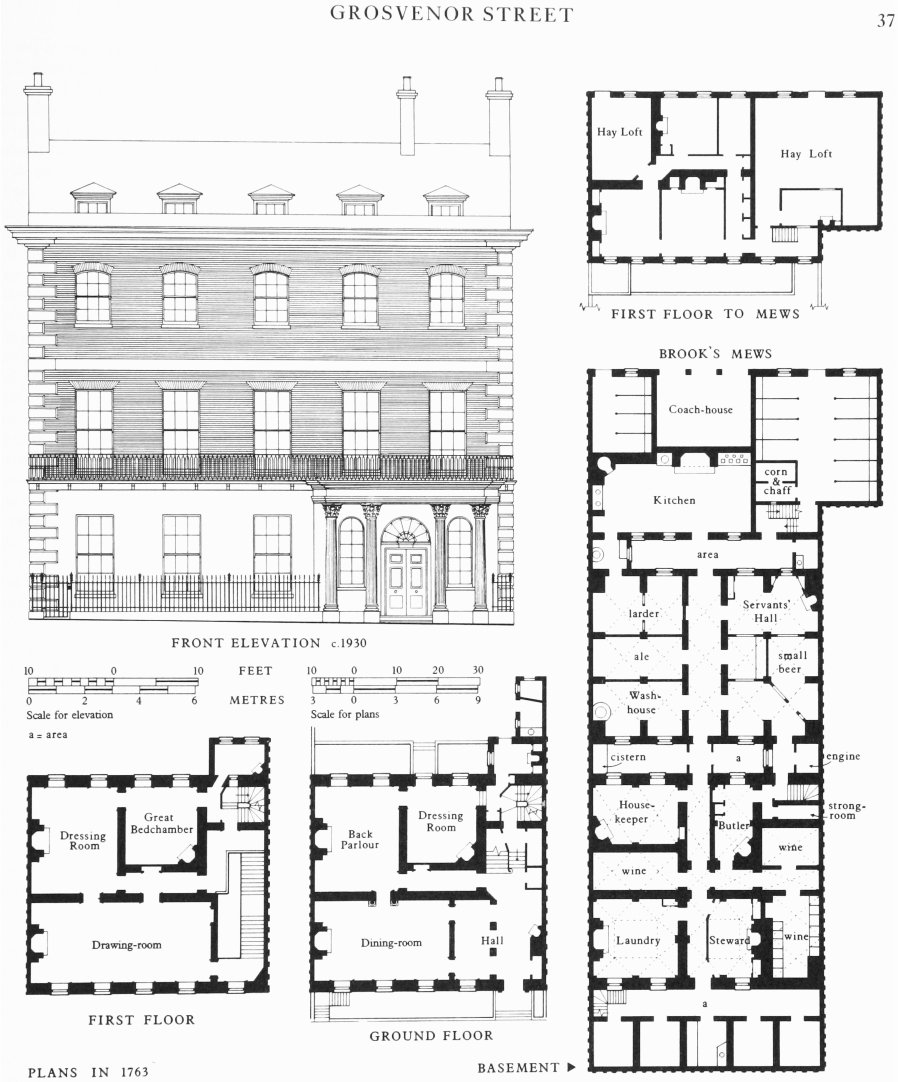
No. 16 Grosvenor Street, elevation c. 1930 and plans in 1763
In 1801 Lord Hertford granted a nineteen-year lease to the fifth Duke of Rutland, (fn. 15) but in 1819 the terms assessed by the estate surveyor, William Porden, for the renewal of the lease (a rent of £250 and a fine of £13,015) were so high that there were no takers and the house stood empty from 1820 to 1824, when Thomas and George Seddon of Aldersgate Street, cabinet-makers and upholsterers, were granted a twenty-one-year lease at a rack rent without a fine. (fn. 23) Three years later, having spent £7,000 on repairs and improvements, they were given a sixty-three-year lease on particularly favourable terms. (fn. 24) They were to use the house solely as a showroom and not as a manufactory or open shop, and all loading and unloading of goods was to take place at the rear. (fn. 25)
Within a few months of receiving their first lease in 1824 the Seddons had sub-let the upper part of the house furnished to the newly founded Oriental Club. An additional staircase and entrance were provided and a double portico was erected in Grosvenor Street, possibly to the designs of George Basevi, who was then acting for both the club and Seddons. The Oriental Club remained at No. 16 until 1828 when it moved to newly built premises in Hanover Square. (fn. 26) Part of the house continued to be let separately, and the (Royal) Institute of British Architects occupied rooms there from 1837 to 1859. (fn. 27)
In 1860 the house was taken by Collard and Collard, piano-makers, who engaged Owen Jones to colour the supposed 'Adam' ceilings and other parts. They also adapted a room somewhere at the back for afternoon concerts. (fn. 28) In Grosvenor Street, however, a small brass plate 'on the inside door was the only outward and visible sign of the considerable inward activities that took place there. Only top hats were allowed in the front, caps and aprons finding entrance at the back. If an unsuspecting vanman pulled up at the front door the whole street shuddered . . .' (fn. 29)
The house reverted to single private occupation in 1909 when Collards assigned their lease to Mrs. George Keppel, the confidante of King Edward VII. She engaged the architect F. W. Foster to make extensive alterations, and his plans were shown to and approved by the King. (fn. 30) Externally the double portico was remodelled and enclosed (fig. 15), and internally Mrs. Keppel's alterations were said to have included 'a new branching staircase' and the installation of a 'Dutch room' for which she paid £5,000. Little decoration was required, 'the old panelling being perfect, and the style of the house the best period of Adam', but Mrs. Keppel seems to have installed some chimneypieces of her own. (fn. 31) In March 1910 she had been anxious for the work to be done as quickly as possible as the King was going to see the house, (fn. 32) but he died on 6 May of that year, and Mrs. Keppel did not take up residence herself until 1912. (fn. 33)
In 1927, and again in 1932, Lenygon and Morant made alterations which included 'rebuilding portions' of the house for the last private occupant, Captain Gerard Leigh, (fn. 34) and in 1935–6 the premises were re-adapted for commercial use by a firm of dressmakers, with Wimperis, Simpson and Guthrie as architects for the conversion. On the exterior the portico and a continuous balcony with iron railings were replaced by pilasters framing the entrance and individual window guards at first-floor level, while inside on the ground floor one large open space was created by substituting columns and beams for the dividing walls. The columns were designed to match existing ones at the foot of the staircase (Plate 14d). The rear premises facing Brook's Mews were completely rebuilt. (fn. 35)
Inside the house there is now little evidence of the 'Adam' decorations which were more than once the subject of comment in the past. The ground floor is one vast space with Ionic columns and pilasters, mainly dating from 1935–6 and now artificially marbled. There are, however, two handsome marble chimneypieces, one with a bas-relief in the centre and the other with a sculptured frieze (Plate 15e), which are of late eighteenth-century appearance. The stone, open-well staircase, with lyre-shaped iron balusters (Plate 14d) does not fit the description of Mrs. Keppel's 'branching' staircase and possibly dates from Captain Leigh's occupation, although the delicately wrought balusters may have been preserved from the original great stairs. There is more decorative work in a mid- to lateGeorgian manner on the first floor. The two main rooms have ceilings modelled in low relief, and in the large former drawing-room at the front there are also Corinthian pilasters and a frieze of acanthus-leaf scrolls picked out in gilt to the walls. In the rear wing two adjoining rooms have simple plaster panelling and decorations to the walls and Adam-style architraves to a communicating doorway. There is also a marble chimneypiece decorated with urns here and another imposing one with a bas-relief in the large room at the front of the house.
Occupants include: 1st Baron Walpole, son of Sir Robert Walpole the statesman, later 2nd Earl of Orford, 1725–38. 2nd Baron Conway, latterly successively 1st Earl and 1st Marquess of Hertford, 1740–63, c. 1766–94. 3rd Duke of Portland, 1763–c. 1766. 2nd Marquess of Hertford, son of 1st Marquess, 1794–7. Marquess of Titchfield, later 4th Duke of Portland, 1799–1801. 5th Duke of Rutland, 1801–14. Oriental Club, 1824–8 (occupying only part of the house). (Royal) Institute of British Architects (occupying only part of the house), 1837–59. Collard and Collard, pianoforte makers, 1860–1909. Lieut.-col. George Keppel and his wife Alice Keppel, confidante of King Edward VII, 1912–24.
No. 17
No. 17, originally four windows wide, was rebuilt, three windows wide and set back, by the builder John Newson in 1855–6 for a private tenant. The architect was J. P. St. Aubyn (with G. R. Crickmay as his clerk of works) but Thomas Cundy II, as usual at this period, provided the elevation. (fn. 36) Behind this front, subsequent alterations include work by or for the architect and speculator, F. W. Foster, in 1914. A number of alterations have since been made to the interior and at the rear, (fn. 37) but, apart from changes at ground-floor level, the façade in Grosvenor Street remains an excellent example of the kind of street elevation favoured by the second Marquess of Westminster and his surveyor. Three windows wide and of four main storeys, it is faced with Suffolk bricks above a stuccoed ground floor with a Doric porch and balcony of Portland stone and has cement dressings to the windows, those on the first floor with hoods carried on consoles, and a deep, crisply modelled cornice with a Vitruvian-scroll frieze (Plate 9a: see also fig. 14c in vol. XXXIX).
The previous house is known chiefly from documents of 1798–9, when the decoration and furnishing materials (mainly new, from Gillows) matched both within and between adjacent rooms—striped linen fabrics on the ground floor, yellow in the first-floor drawing-rooms (with both the curtain-cornices and the chairs white-and-gold), green silk in the state bedroom, and flowered or yellow cottons on the second floor. The carpets were mostly fitted—imitation Turkey in the dining-parlour and library and Brussels in the first-floor rooms. The front door was painted and grained mahogany. At least three of the servants' beds in the two 'large attics' were double. (fn. 38)
Occupants include James Vernon, clerk of the Privy Council, 1725–55. Lady Sandys, wid. of 1st Baron, 1775–9. Samuel Whitbread, brewer and politician, 1792–8. Sir John Coxe Hippisley, 1st bt., politician, 1802–25 (previously at No. 43). Viscount Milton, eldest son of 4th Earl Fitz William of Norborough, 1869–73. 2nd Baron Chesham, 1874–82. 5th Baron Lyttelton, 1884. Sir Benjamin Phillips, warehouseman and sometime Lord Mayor of London, 1886–9.
No. 18
No. 18 is structurally a four-bay early-Georgian house erected under a building lease granted to Thomas Richmond, carpenter, in 1723, (fn. 39) but refronted in stone at the beginning of this century (Plates 9a, 13a, 14b). Decimus Burton made additions of unknown extent in 1835–6, (fn. 14) and in 1851 the façade was heightened and 'improved' to the usual Estate specifications (John Kelk, builder). (fn. 40) In 1901–2 John Garlick, the builder, made, as a speculation, a number of alterations including the erection of a new stone front with a canted bay. An advertisement commended the 'moderate number of bedrooms'— twelve. (fn. 41) The architects may have been Ayling and Littlewood, who did other work for Garlick at about this time. In 1937 Sidney Parvin was granted permission to replace the bay at ground-floor level with a shop front and make other alterations to the ground storey. (fn. 42)
Internally the pressures of commercial occupation and subdivision have resulted in many changes, but a number of Adamesque ceilings and neo-classical doorcases remain, perhaps mostly dating from the late nineteenth century. A grand stone staircase with unusual balusters (Plate 14b) may date from the late eighteenth century.
Occupants include: Elizabeth Strangeways, latterly Duchess of Hamilton, 1725–9: her husband, 5th Duke of Hamilton, 1729. Baron Hervey, politician, 1740–1. John Crewe, latterly 1st Baron Crewe, 1777–1829. Baron Norreys, latterly 6th Earl of Abingdon, 1845–84: his son, Francis Bertie, later 1st Viscount Bertie, 1884–96.
Nos. 19 and 20
Nos. 19 and 20 received their present appearance in 1935–6 when No. 19 was rebuilt with three neo-Georgian red-brick storeys and an attic above a ground-floor shop, and No. 20 was refaced to match. The architects were C. S. and E. M. Joseph. (fn. 43)
No. 20 had been rebuilt in 1852–3 for the builder and speculator, Wright Ingle. His architect was Henry Harrison but the façade had to adhere to the Estate's usual Italianate formula (fn. 44) (Plate 9b). Ingle contracted the building work out to R. Watts of Motcomb Street. (fn. 45) In 1929–30 Frederick Etchells designed a Georgian-style shop window and doorcase, but these too were removed in 1935–6. (fn. 46)
Occupants include: No. 19, Col. John Laforey, Huguenot, 1744–8, 1751–3. Gen. William Hargrove, 1750. Sir Frank Standish, 3rd bt., 1780–1812. Viscount Normanby, latterly 2nd Earl of Mulgrave, 1822–34. James Stuart-Wortley, lawyer and politician, 1843–6. Lord Kenlis, later styled Earl of Bective, 1868 (later at No. 34). Viscount Maidstone, later 14th Earl of Winchilsea, 1913–18. No. 20, Lady Stapleton, wid. of Sir William Stapleton, 4th bt., 1745–8. Dow. Countess of Essex (d. 1784), wid. of 3rd Earl, and Lady Mary Ker, da. of 2nd Duke of Roxburghe, 1780–6. Sir Thomas Stepney, 8th bt., 1814–20.
Nos. 21 and 22
Nos. 21 and 22 were erected as private houses in 1898–9 to the designs of Eustace Balfour, the estate surveyor, and Thackeray Turner, his partner. Above the ground floor the only serious alteration since has been the enlargement of the attic windows, and the buildings are excellent examples of the forceful and original domestic style of this partnership. Even the chimney-stacks with their decorative brick and stone arcading have survived. Originally it was intended that the façades should be entirely of stone, but the first Duke of Westminster, displaying his usual predilections, wanted them to be of red brick. (fn. 47) The result was a felicitous compromise in which irregular bands of brick and stone alternate in a display of polychromy of almost Butterfieldian intensity, relieved by a boldly projecting cornice of unusual design above the fourth storey and a subsidiary one above the ground floor which forms the base for a Philip Webb-derived arcade in shallow relief. Originally the houses had a remarkable double portico with a pitched roof and arched entrances and side openings, the latter filled with decorative ironwork (Plate 8a). The builder was Walter Holt of Croydon. (fn. 48)
The houses were built as speculations for Dr. Joseph Walker, a dentist, who had had premises at No. 22 for several years. He was granted new ninety-year leases in consideration of rebuilding, but the houses proved difficult to let. In 1900 Dr. Walker complained that he had 'been trying for more than a year to let the houses as private residences, and the tenants complain of the smallness of the rooms and state that there is not a good one in the houses. The premises are badly planned for private residences; the elevations and the small panes of glass in the windows are also objected to.' The Estate Board gave permission for the houses to be turned into a private hotel and they continued in this use until 1930. (fn. 49) They were afterwards converted into shops, showrooms and flats with consequent alterations to the ground floor, which was again altered in 1976 to the designs of Nicol Stuart Morrow. (fn. 50) Some of the original ironwork of the area railings survives.
Occupants include: No. 21, Gen. William Phillips, 1769–81. James Moore, surgeon, 1791–1802. With No. 22, Hagen's Hotel, 1901–6. Earle's Hotel, 1909–30.
Nos. 23–25 (consec.)
Nos. 23–25 (consec.) were rebuilt in 1854–7 with the usual elevational treatment dictated by the estate surveyor, Thomas Cundy II (Plate 8a). The builder of Nos. 23 and 24 in 1854–5, and most probably of No. 25 in 1856–7, was John Newson, and the architect for all three was F. W. Bushill (restricted, of course, by Cundy's watching brief). Nos. 23 and 24, at least, were rebuilt as speculations. A periodical commented on the similarity of the planning (which provided a 'gentleman's business room' on the ground floor) to that of houses in Rutland Gate. (fn. 51)
Apart from the insertion of a shop window the exterior of No. 23 has been little changed, but Nos. 24 and 25 have been joined together and altered at ground-floor level so that No. 25 has lost its portico and the balcony at first-floor level has also been removed. Anachronistically smallpaned sashes have been substituted for Victorian ones in some of the windows.
Occupants include: No. 23, Governor Morris, ? Bacon Morris, Governor of Landguard Fort, 1726–7. Lady FitzWalter, wid. of 18th Baron, 1728–38. Viscount Wallingford, son of 4th Earl of Banbury, 1739–40. Edward Lascelles, latterly Viscount Lascelles, 1801–14. Sir Humphry Davy, bt., natural philosopher, 1816–24. Sir Thomas Stamford Raffles, kt., colonial governor, 1825–6: his wid., 1827–36. Lieut.-col. Lord Frederick Fitzroy, younger son of 4th Duke of Grafton, 1857–1916. No. 24, Dr. Jeremiah Mills, President of the Society of Antiquaries, 1745–71. Lady Dorothy Hotham, wid. of Sir Charles Hotham-Thompson, 8th bt., 1794–8. Lord George Seymour, son of 1st Marquess of Hertford, 1800. No. 25, Italian Legation, 1875–6.
No. 26
No. 26 was built in 1913–16 as a speculation by the builder William J. Garlick to the designs of Wimperis and Simpson. Edmund Wimperis was the estate surveyor at the time but this individualistic neo-Georgian house (Plate 9c: see also fig. 26c in vol. XXXIX) is more likely to have been the work of William Begg Simpson, who 'explained' the plans and elevation to the Grosvenor Board. (fn. 52) Planned to include nine bedrooms, it is a tall house for its narrow twenty-five-foot frontage, with five main storeys and an attic.
Occupants include: Adm. Richard Edwards, 1788–94. Aylmer Bourke Lambert, botanist, 1803–42. Caesar Hawkins, surgeon, 1842–84.
No. 27
No. 27 was erected by Richard Davies, joiner, under a building lease granted in 1725. (fn. 53) At some time in the early nineteenth century the house was heightened and the façade stuccoed, but since then it has been relatively little altered externally and provides an attractive example of a stucco front dating from before the period of the second Marquess's elevational improvements (Plate 9c). Of four main storeys and garrets with three closely spaced windows to each floor, it has a balcony at first-floor level with elegant, thin iron rails, shallow mouldings to the windows, those on the first floor also having detached hoods carried on consoles, a plain cornice at third-floor level, and at the top of the house a decorative panel of anthemions and palmettes. Inside little of interest survives.
Occupants include: Duchess of Atholl, wife of 2nd Duke, 1746.
No. 28
No. 28, a corner house with a long frontage and entrance in Davies Street, was built in 1906–7 for Lord Edward Spencer-Churchill, son of the sixth Duke of Marlborough, to the designs of C. W. Stephens, the architect of Claridge's and Harrods (Plate 9c). The builders were W. King and Son of Vauxhall Bridge Road. (fn. 54)
There is little of the ornateness of Claridge's or Harrods in this rather sober design by Stephens for a four-storey town mansion in red brick with stone dressings, in which 'Queen Anne' is modified by the onset of Edwardian Baroque. The interior has little of interest.
Stephens found himself in difficulties with the Estate over this house. After having had to change his designs because he 'had not read the building contract', he stubbornly refused to carry out the specifications requiring fireproof floors. Eventually the Board resolved 'that Mr. Stephens' name be not approved of as the architect for any other buildings on the estate'. (fn. 55)
The previous house had had some work done to it by (Sir) William Chambers for Charles Turner in c. 1774–5. (fn. 56)
Occupants include: 7th Viscount of Falkland, 1750–5. (Sir) Charles Turner, latterly 1st bt., 1766–83. Christopher Wilson, Bishop of Bristol, 1784–92. Richard Beadon, Bishop of Gloucester, 1792–1801. Dow. Countess of Carnarvon, wid. of 1st Earl, 1813–26. 6th Viscount Allen, 1827–31. Sir William Domville, 2nd bt., 1835–8. 2nd Baron Templemore, 1852. Dow. Duchess of Marlborough, wid. of 6th Duke, 1868–97: her son, Lord Edward Spencer-Churchill, 1899–1911: his wid., 1911–40.
Nos. 29–31 (consec.)
Nos. 29–31 (consec.) were rebuilt with Nos. 29–37 (odd) Davies Street in 1926–8 (see page 76).
Occupants include: No. 30, 2nd Earl of Uxbridge, 1746. 4th Baron Bellew, 1747–51. James Stuart-Wortley-Mackenzie, son of 3rd Earl of Bute, 1809–18. 2nd Baron Auckland, later 1st Earl of Auckland, 1820–34. Henry Bence Jones, physician and chemist, 1843–55. No. 31, Charles George Perceval, later 2nd Baron Arden, 1782–4. Robert Barnes, obstetric physician, 1870–8. Lieut.-col. C. L. Fitzwilliam, consulting surgeon, 1920–4.
No. 32
No. 32 was rebuilt in 1933–5 to the designs of Toms and Partners as a shop with six storeys of flats above, the top storey contained within a mansard roof (Plate 9d). The style is a mechanical neo-Georgian with regularly spaced window openings and red brick as the principal facing material. The builders were William Moss and Son. (fn. 57) (fn. c1)
The original house on the site was erected under a building lease granted in 1725 to Robert Scott, carpenter, (fn. 58) who in the following year sold it for £2,800 to Charles Edwin, later M.P. for Westminster. (fn. 59) Until its demolition in 1933 this house remained one of the best early-Georgian houses in the street, despite the addition of a portico and balconettes in 1865. (fn. 60)
Occupants include: Lady Catherine Edwin, wid. of Samuel Edwin, M.P., 1726: her son, Charles Edwin, M.P., 1726–56: his wid., 1756–76. Lady Fetherstonhaugh, wid. of Sir Matthew Fetherstonhaugh, 1st bt., 1777–80. Francis Charteris, known as Lord Elcho after the death in 1787 of his uncle David Wemyss, who, but for his attainder in 1746, would have been 6th Earl of Wemyss, 1787–8 (later at No. 51). Felix Ladbroke, later owner of the Ladbroke estate in North Kensington, 1826–46. 22nd Baron Dacre, 1871–87. 7th Viscount Galway, 1898–1904.
No. 33
No. 33 was thoroughly recast, inside and out, in 1912 by Turner Lord and Company, but structurally it is still the original house erected under a building lease granted to Richard Lissiman, mason, in July 1725. (fn. 61) In 1867 various 'improvements' were made to the façade in the usual manner of that period. (fn. 62)
Several alterations were made to the interior before the house was taken under a new sixty-three-year lease in 1910 by Auguste Lichtenstadt, a stockbroker. (fn. 63) He engaged the architect W. L. Lucas with Howard and Sons as decorators to carry out an internal remodelling which included fitting up a back drawing-room 'in the German medieval style' with elaborately carved panelling and a highly ornate wooden hooded chimneypiece with the monogram AL repeated several times on the hood (Plate 13b): other rooms were in pleasantly simple Georgian styles. (fn. 64)
The following year, however, Lichtenstadt arranged to sell the house to the recently widowed Princess Hatzfeldt. She was the former Clara Huntington of Detroit, an heiress in her own right, whose husband, Prince Francis Hatzfeldt, had been a member of the German diplomatic service and owner of the winning horse in the Grand National of 1906. (fn. 65)
Princess Hatzfeldt promptly engaged Turner Lord and Company to replace the brand-new decorative scheme by another. Outside, they intended to alter the façade by removing the 'compo work' (presumably dressings added in 1867). The Estate refused to sanction this ('the Duke's friends would tell him that the appearance of the house had been spoiled'), but agreed to a complete refronting in stone. The refacing was begun during the London Season of 1912, and then postponed for a few months on protests from neighbouring tenants. The builder was Charles Ansell of Chicheley Street. (fn. 66)
Although structurally still a Georgian house, No. 33 is to all intents and purposes a first-rate town house of the period before the war of 1914–18, executed with great care and fine craftsmanship. The felicitous proportions of the façade (Plate 9d), which is four windows wide and four storeys high, were determined by the existing house, but the distinctive detailing is entirely work of 1912. The mouldings, which stand out sharply from the smooth ashlar facing of the upper storeys, are executed with great precision and the ironwork of the balcony railings, the sides of the portico, and of the entrance door is particularly inventive and delicately handled.
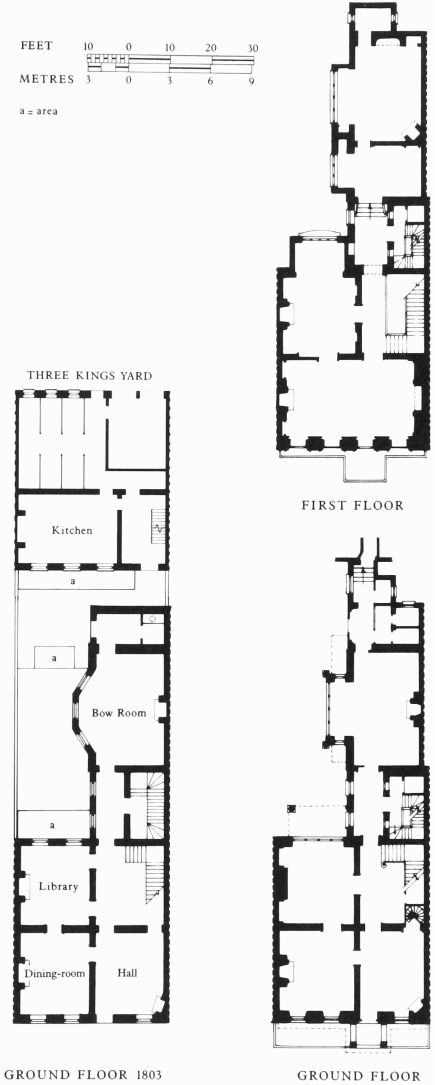
No. 33 Grosvenor Street, plans in 1803 and 1975
In sharp contrast to the front, the rear of the house is made up of a picturesquely accretive jumble of projections, some of them no doubt the work of John Newson and Son, who, in 1856, had enlarged a back drawing-room. (fn. 67)
Inside a stone staircase with elegant wrought-iron balustrading (fig. 6c in vol. XXXIX) is the only important early-Georgian feature to survive. Originally it was wallhung, but the underside is now partially enclosed. The panelling and much, if not all, of the plasterwork of the staircase compartment is, however, later. Elsewhere Turner Lord completely transformed the main rooms, even replacing the existing chimneypieces with 'copies of old French mantelpieces'. (fn. 68) The two principal rooms on the first floor are panelled throughout, the front room with rich carving in the manner of Grinling Gibbons, a wooden Corinthian cornice and pilasters and plasterwork modelled in high relief to the ceiling. The back room is treated in a different manner with oak panelling intricately carved with trophies and musical instruments, apparently incorporating sections of original boiseries of the French Régence period imported by Princess Hatzfeldt. (fn. 69) Above the panelling, on the coving of an otherwise plain ceiling, is a delightful plaster frieze in low relief of goddesses and cherubs among intertwining plants and animals.
Occupants include: Baron Sparre, Swedish Envoy, 1727–36. John Spencer, son of 3rd Earl of Sunderland, 1738–45. Viscount Trentham, later 2nd Earl Gower and 1st Marquess of Stafford, 1747–54. John Spencer, later Viscount and 1st Earl Spencer of Althorp, 1754–60. (Sir) John Fleming, latterly bt., 1761–3. 8th Earl of Northampton, 1764–8. Duchess of Beaufort, either wid. of 4th Duke or wife of 5th Duke, 1768–9. Sir James Peachey, 4th bt., latterly 1st Baron Selsey, 1772–1808 (previously at No. 9): his son, 2nd Baron, 1808–16: the latter's wid., 1816–37. 9th (Scottish) and 1st (U.K.) Baron Kinnaird, 1850–64. Lord Stanhope, latterly 7th Earl of Chesterfield, 1865–7. 8th Viscount Doneraile, 1868–80. Lady George Lennox, wid. of younger son of 5th Duke of Richmond and Lennox, 1881–2. 7th Baron Rodney, 1893–6. Princess Hatzfeldt (née Clara Huntington of Detroit), 1912–15. 6th Earl Cadogan, 1918–28.
No. 34
No. 34 has always been one of the finest houses on the estate, and, despite considerable alteration both inside and out, it still conveys much of the grace and elegance of the great Georgian town house. The builder was Richard Lissiman, mason, who was granted a building lease in July 1725. (fn. 70) Almost three years later, in March 1728, when the house was nearly complete, he sold it for £4,500 to the diplomatist Sir Paul Methuen, (fn. 71) whose fine picture collection (now at Corsham Court) attracted Queen Caroline and Lord Hervey to breakfast with him in 1735 to view it. (fn. 72)
The stucco façade (Plate 9d), parts of which look to be quite early, may have been added by Paul Cobb Methuen, who, in 1796, obtained a renewal of the original lease until 1858. (fn. 73) The architect John Nash, who remodelled part of Corsham Court in Wiltshire for Methuen, was directing work by Joseph Trollope's paperhanging firm at Grosvenor Street in 1798 for Methuen. (fn. 74)
In 1866 the estate surveyor found the floors shook (fn. 75) and in the 1870's William Cubitt and Company did extensive work for Lord Vernon including 'forming new rooms', apparently under the direction of George Devey. (fn. 76) The full nature of the changes made is now obscure, but a small single-storey lobby which has a surprisingly elaborate Palladian façade to the garden was added at the rear, next to No. 33, and the present secondary staircase may also date from this time. Work was also done in 1880 for Samuel Morley, (fn. 77) but the alterations most affecting the present interior were, however, made in 1909–13 to the designs of Owen Little for the banker Rupert Beckett. In 1912 The Lady reported Mr. and Mrs. Beckett's 'amazement' on finding out that 'having spent large sums in decorating, panelling and beautifying their new house', structural defects necessitated 'pulling down all their charming boiseries'. In fact the remedial work appears to have been confined to the party wall with No. 33 and part of the front. (fn. 78)
When Beckett left the house in 1936 it was taken by Keeble Limited, the firm of decorators and antique dealers, who immediately inserted a grossly over-large shop window in the ground floor covering all three bays to the east of the entrance porch. (fn. 79) During restoration work by Haslemere Estates in 1976–7 the shop window was replaced by three new sash windows aligned with those of the upper storeys. A plan of 1795 inexplicably shows only two windows to the right of the entrance. (fn. 80)
An immediately striking feature of the façade of the house (Plate 9d) is the height of its three main storeys, which makes it almost as tall as its four-storeyed neighbours on each side. All three houses were built by Richard Lissiman under one building agreement, (fn. 81) and the discrepancies in storey heights as well as in the widths of the frontages indicate how little the early-Georgian builder was concerned with uniformity.
The present front must date from several periods but documentary evidence is lacking. The plain stucco of the upper storeys with mouldings in low relief to the windows looks to be early, but the portico and balconettes were probably added later and the enclosing of the portico was done later still.
The original plan of the house has survived with little alteration except for the elimination of the 'passage room' (as it was called in 1761) at the rear of the secondary staircase and the consequent enlargement of the 'great room' in the rear wing (fn. 82) (fig. 17).
One of the best rooms in the house must always have been the main double-storey staircase compartment (Plate 9b, figs. 5d, 6f in vol. XXXIX). When Sir Paul Methuen bought the house in 1728 he held back £500 of the purchase money until certain items had been completed to his satisfaction. The most important instructions were that the staircase was to be wainscotted with oak in the same manner as No. 52 and the walls and ceiling above the panelling were to be plastered 'with Ornaments of Stucco'. For the latter work Lissiman (who signed the agreement with his mark) was to incur no greater expense than £40, Methuen having to pay the remainder if he 'should be desirous to have it done very finely'. (fn. 83)
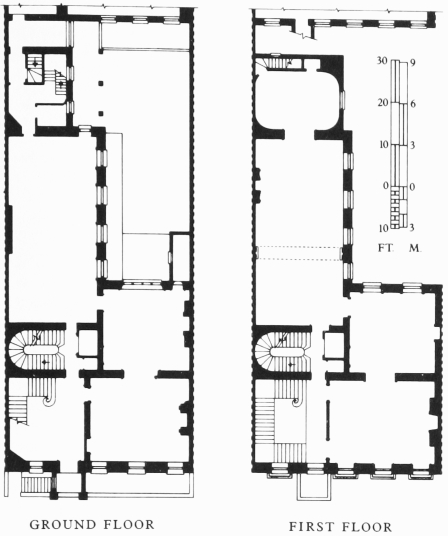
No. 34 Grosvenor Street, plans in 1975
The principal feature of the staircase compartment—by far the finest part of the house to have survived—is the great stone staircase itself which rises around three sides to first-floor level where a gallery occupies the fourth side. The stairs are wall-hung with a wrought-iron balustrade of delicately worked lyre pattern up to the gallery, where, in the level railings, the pattern becomes more complex: the wooden handrail appears to have been renewed relatively recently. The floor of the hall is paved with diagonally-laid black and white marble squares which have probably been renewed but equally probably repeat the original floor pattern. The walls are covered with long raised-andfielded panels, and on the wall side of the staircase there is a moulded dado-rail with small-scale Composite pilasters at the turns. Above the panelling is a plaster cornice and the ceiling of the compartment and the underside of the gallery have pleasant, rather conventional decorative plasterwork with acanthus-leaf scrolls and rosettes, which looks likely not to have cost more than the £40 specified. The doorcases have richly carved friezes and pediments with modillion cornices.
The principal rooms on the ground and first floors are almost entirely panelled, but only in the ground-floor front room does some of this panelling look original, although this room has undergone many changes. Here there are raised-and-fielded panels with carved borders, a dado-rail carved with a wave motif and a modillion cornice. The chimneypiece, an overblown affair with Composite pilasters supporting an open pediment and decorated with a cartouche and other carvings, looks to be Edwardian or later. The remaining rooms are panelled in a variety of woods and are principally the work of Owen Little. The secondary staircase occupies the same position as the original one but is a replacement, probably of the 1870's.
The rooms on the second floor, which have good panelling, box cornices and some simple marble fireplaces with shouldered architraves, have been altered less.
Occupants include: Sir Paul Methuen, K.B., diplomatist, 1728–57: his cousin and heir, Paul Methuen, 1757–95: the latter's son, Paul Cobb Methuen, 1795–1816. Sir William Rowley, 2nd bt., 1818–29. 2nd Earl of Glengall, 1840–58: his wid., 1858–61. 2nd Viscount Lismore, 1863–7. Lord Kenlis, later styled Earl of Bective, 1870 (previously at No. 19). 6th Baron Vernon, 1871–80. Samuel Morley, philanthropist, politician and textile manufacturer, 1880–6. Sir Theodore Henry Brinckman, 2nd bt., 1893–1905: his son, Sir Theodore Francis Brinckman, 3rd bt., 1905–9. Rupert Beckett, chairman of Westminster Bank Ltd. and of Yorkshire Post, 1909–36.
Nos. 35 and 36
Nos. 35 and 36 were completely rebuilt in 1976–7 but their façades are facsimiles of those of the previous houses on the two sites. The architects were the Rolfe Judd Group Practice and the builders were F. G. Minter and, in the later stages, A. E. Symes Construction Limited. Rebuilding became necessary when a partial collapse occurred during extensive alterations to the interiors of both houses.
At No. 35 the original house was erected under a building lease granted to Richard Lissiman, mason, in 1725, (fn. 84) but the façade that has been reproduced dated largely from the nineteenth century when the ground storey was stuccoed, a Doric open portico was erected (in 1865 (fn. 85) ) and stucco dressings were added to the windows (probably in 1882–3 (fn. 86) ). In the rebuilding no attempt has been made to duplicate the shop window that had been inserted, and the ground storey has been given its nineteenth-century form.
The present red-brick façade at No. 36 duplicates as far as possible the dignified Georgian elevation of four main storeys, each four windows wide, of the house which was demolished. The fourth storey was, however, a later addition, the house consisting of only three main storeys and garrets when originally erected under a building lease granted to John Simmons, carpenter, in 1726. (fn. 87) Individual cast-iron window guards which were added to the firstfloor windows in the late eighteenth or nineteenth century and a blockish Doric doorcase inserted during the present century have also been reproduced.
The house was originally square on plan without a closet wing, and had the unusual arrangement of a main staircase rising to first-floor level at the back of the house, with a secondary staircase serving all floors immediately adjacent (fig. 3e in vol. XXXIX). The dining-room was originally on the first floor. (fn. 88) Little of note remained inside by the time of demolition.
Occupants include: No. 35, Col. (latterly gen.) George Warde, 1804–12. Col. (latterly Sir) Henry Bentinck, K.C.B., 1852–65. (Sir) Alfred Webb-Johnson, surgeon, later Baron WebbJohnson, 1913–37. No. 36, 6th Earl of Salisbury, 1736–79. Sir Henry Dashwood, 3rd bt., 1783–8. Gen. (?Joseph) Smith, 1788–91. Sir Edward Leslie, bt., 1791–7. Peter Latham, physician, 1824–68. (Sir) Robert Burnet, (kt.), physician, 1896–1909. (Sir) Henry Simson, K.C.V.O., physician, 1906–28.
Nos. 37–40
Nos. 37–40 (demolished) occupied part of the site of the large block of flats and offices now numbered 1–3 Grosvenor Square and 38–41 Grosvenor Street. The houses, all four storeys high, were built under leases granted to John Simmons, carpenter, in 1731. (fn. 89) At No. 37 in 1737 the dining-room was on the first floor: the rooms and great staircase were panelled, the hall stone-paved, and the chimneypieces of marble or stone. (fn. 90) This house was demolished in 1858 to make way for a two-storey stable block for No. 2 Grosvenor Square which had its rear elevation in, but set back from, Grosvenor Street (fn. 91) (Plate 8b). The remaining Georgian brick houses were demolished in 1935.
The best of these houses, No. 38, was three windows wide and had a modillion cornice, a plain Doric porch and a balcony with particularly elegant iron railings of an early nineteenth-century type (Plate 8b). William Haldimand, who was one of the leading developers of Belgrave Square, occupied the house from 1819 to 1825 and George Basevi, his architect in Belgrave Square, acted for him in negotiations over the renewal of the lease, although it is not known whether Basevi was responsible for the 'improvements' made to the house. (fn. 92)
Occupants include: No. 37, Sir Thomas Hesketh, 1st bt., 1761–9. Sir Robert Lawley, 6th bt., later Baron Wenlock, 1794–1801. Sir Culling-Eardley Smith, 1st bt., 1802–12. Richard Ryder, politician, 1815–28. Lieut.-gen. Sir Edward Bowater, 1850. 3rd Baron Wodehouse, later 1st Earl of Kimberley, politician, 1852. No. 38, Lady Gray, ?wid. of Sir James Gray, 1st bt., 1733–4. Sir James Calder, 3rd bt., 1768–75: his wid, 1775–7: their son, Sir Henry Calder, 4th bt., maj.-gen., 1777–83, 1788–90. Sir John Bridger, kt., 1783–8. Baron Shuldham, admiral, 1791–8. William Haldimand, philanthropist and director of the Bank of England, 1819–25. Fox Maule, later 2nd Baron Panmure and 11th Earl of Dalhousie, politician, 1838–51. Marshall Hall, physiologist, 1852–7. Richard Cobden, statesman, 1855–8. (Sir) John Reynolds, latterly bt., physician, 1854–96. William Playfair, obstetric physician, 1898–1903: his son, (Sir) Nigel Ross Playfair, actor-manager, later kt., 1898–1902. Dow. Duchess of Roxburghe, wid. of 7th Duke, 1904–8. Earl of Ronaldshay, later 2nd Marquess of Zetland, 1909–22. No. 39, Marquess of Graham, later 2nd Duke of Montrose, 1734–42. 3rd Viscount Lisburne, 1744. 2nd Earl Cowper, 1744–50: his brother, Spencer Cowper, Dean of Durham, 1751–7. Sir George Wombwell, 2nd bt., 1811–12. Gen. Bayley Wallis, 1823–7. No. 40, Henrietta Wyatt-Edgell, latterly suo jure Baroness Braye, 1875–9: her son, 5th Baron Braye, 1880–9. Marquis de Casa Maury, 1929–30. Sir Alexander Roger, kt., company chairman, 1936.