
Survey of London: Volume 40, the Grosvenor Estate in Mayfair, Part 2 (The Buildings). Originally published by London County Council, London, 1980.
This free content was digitised by double rekeying. All rights reserved.
'Bourdon Street and Grosvenor Hill Area', in Survey of London: Volume 40, the Grosvenor Estate in Mayfair, Part 2 (The Buildings), (London, 1980) pp. 57-63. British History Online https://www.british-history.ac.uk/survey-london/vol40/pt2/pp57-63 [accessed 27 April 2024]
In this section
CHAPTER III
Bourdon Street and Grosvenor Hill Area
This former mews area in the south-east corner of the estate was originally part of the large parcel of ground fronting north on Grosvenor Street and west on Davies Street which was taken under a building agreement in August 1720 by the estate surveyor, Thomas Barlow, and subsequently leased to him en bloc in July 1721. (fn. 1) This particular part of Barlow's ground formed a hinterland behind the main street frontages of Grosvenor Street and Davies Street, and here he laid out a complex pattern of mews and narrow streets which has in large measure been retained, although several changes in street naming have taken place.
The name Bourdon Street originally only applied to a passage into Davies Street immediately to the south of Bourdon House. When rebuilding took place on the north side of Berkeley Square in 1820–2 the site of this passage was shifted a few yards further to the north. (fn. 2) The next section of Bourdon Street, to the south of the present Grosvenor Hill Court, was known as John Street until renamed in 1881. The streets in the central part of the area were collectively known as Grosvenor Mews until the southern arm was renamed as part of Bourdon Street in 1881 and the passage to the north and west of St. George's Buildings was called Bourdon Place. The remainder of Grosvenor Mews was given the more respectable name of Grosvenor Hill in 1947. Of the streets at the periphery of the area, Broadbent Street was originally Little Grosvenor Street until renamed in 1936 and formerly also extended to the south of Grosvenor Hill across the site now occupied by Grosvenor Hill Court; Jones Street has retained its original name, after William Jones, yeoman, who leased a large plot here in 1723; (fn. 3) Bloomfield Place acquired its name in about 1891 (see the account of Bloomfield Flats below); and the passage into Grosvenor Street by the side of the Aeolian Hall was numbered as part of Bourdon Street in 1936.
Within this maze of narrow mews, streets and passageways Barlow sub-let small plots to builders and other developers, usually for terms of about sixty years even though his own lease was for ninety-nine years. (fn. 4) The sublesses erected coach-houses, stables, farriers' shops and the like, generally with dwelling rooms above, as well as several small houses. There was from the first a substantial resident population in the area, consisting predominantly of coachmen, grooms and others involved with horses and carriages, but also including domestic servants, building workers, victuallers and a variety of lesser tradesmen. (fn. 5) By 1841, before the building of several blocks of model lodging-houses actually increased the population, there were over eight hundred people living here. (fn. 6)
In such an area there was inevitably much poverty. A charity book of the 1830's kept in the vestry of St. George's, Hanover Square, shows that many inhabitants of Grosvenor Mews were recipients of relief, and in 1858, when the prevalence of disease in the neighbourhood led to the prosecution of a house-owner for allowing part of his premises to be dangerous to the public health, it was revealed that his house 'contained fifty or sixty persons'. (fn. 7)
By this time the stirrings of the Victorian conscience had begun to have some practical effect. In 1853 St. George's Buildings, the first of several blocks of artisans' dwellings to be erected on the Grosvenor estates in Mayfair and Pimlico, provided accommodation for thirty-two families, and this was followed by three other small tenement blocks in the area. At the same time as St. George's Buildings, public baths and wash houses were built on a former coach-builder's premises behind Davies Street. The spiritual needs of the poor were the principal considerations behind the erection of the mission church of St. Mary's in 1880–1 and this was followed in 1883–4 by the provision of a parochial institution and dispensary 'for the good of the poor'. Considerations of health, morality, and, no doubt, spirituality prompted the adaptation of, at first, stables and then a former public house in Bourdon Street as a refuge for fallen women, and eventually the building in 1889–90 of St. George's Shelter, which was equipped with a small chapel. All of these buildings are described in greater detail below.
The increasing use of mews buildings for business and commercial purposes has led to a considerable decline in the residential population of the area during the present century, but in 1971 some 275 persons were still living there, principally in the blocks of working-class housing and in the new flats of Grosvenor Hill Court. (fn. 8)
Of the eighteenth-century building fabric of the area nothing appears to remain. The earliest surviving buildings are on the south side of Bourdon Street at the west corner with Jones Street. No. 4 Bourdon Street, which has a plain stock-brick façade, two windows wide, above ground-floor garages, was built by Thomas Cubitt in 1821–2 as stabling for No. 28 Berkeley Square. It was originally three storeys high but has recently been raised. (fn. 9) No. 6 Bourdon Street and No. 2 Jones Street, which have plain rendered façades above ground-floor shop fronts, are the much-altered survivors of a group of three small houses which were also built in 1821–2 for John Bailey, the proprietor of the hotel which stood on the site of No. 25 Berkeley Square. (fn. 10) They have three main storeys and garrets within a mansard roof, but on the Bourdon Street façade the front wall has been raised by a storey to hide the roof.
Much of the stabling in the centre of the mews was rebuilt in the 1830's and 40's, chiefly by Thomas Cubitt and John Newson, a builder who had an office and workshops in Grosvenor Mews. (fn. 11) Buildings erected by Cubitt in 1838–9 survive in an altered state at Nos. 42 and 44 Grosvenor Hill and Nos. 13, 15 and 15A Bourdon Place, the latter an attractive two-storey range of former stabling with living quarters above. No. 56 Grosvenor Hill and No. 21 Bourdon Street were built for Thomas Lilley, a coachsmith, possibly by Cubitt's firm, in 1847–8. Lilley had a small four-storey house, only one bay wide, built on the Grosvenor Hill frontage with a workshop behind in Bourdon Street, the latter recognizable by its very tall ground storey with three normal brick-faced storeys above. (fn. 12) The house in Grosvenor Hill to the west of No. 56 was also leased to Lilley, by Cubitt's direction, in 1844 but it was drastically altered in 1903 to accommodate a staircase serving a shirt and hosiery factory next door. (fn. 13)
Another early nineteenth-century survival is a pair of coach-houses (now garages) with one storey of accommodation above at Nos. 31 and 33 Grosvenor Hill. They were probably built by John Elger in 1838–40, when he made substantial repairs and alterations to No. 73 Grosvenor Street, and were converted by Collcutt and Hamp in 1928. (fn. 14) Other mews buildings on the north side of Grosvenor Hill which formerly belonged to the houses on the south side of Grosvenor Street have largely been replaced by nondescript office blocks of considerable height and bulk. At No. 9, however, the plain red-brick exterior of a racquets court, which was built in 1909–10 by White Allom and Company for the occupant of No. 59 Grosvenor Street, remains although windows have been inserted. (fn. 15) The rear elevation of an extension to No. 69 Grosvenor Street also presents a lively front to Grosvenor Hill. It was built by Dove Brothers to the designs of John Johnson in 1907, (fn. 16) has three storeys and an attic above ground-floor garages and is brick faced (now painted), with a slightly projecting bay in the centre of the upper storeys and large triple windows. At the west corner of Grosvenor Hill and Broadbent Street is Mayfair Chambers (No. 7 Broadbent Street), a small utilitarian red-brick block of 'bachelor chambers', of four tall storeys, the topmost lit by dormer windows, which was built by John Garlick in 1904–8 to the designs of R. G. Hammond. (fn. 17)
The most attractive group of buildings in the area is the multi-gabled range on the south side of Bourdon Street at Nos. 8–38 (even), all dating from approximately the last decade of the nineteenth century (Plate 16c). No. 8 (with No. 8A) is the former St. George's Shelter of 1889–90 (see below). Nos. 10–20 and 32–38 are spacious sets of identical red-brick stabling for the carriage-owning residents of nearby streets, and were erected by the speculative builder Jonathan Andrews of Mount Street, Nos. 10–14 in 1889–90, Nos. 32–38 in 1891–2 and Nos. 16–20 in 1899–1900. (fn. 18) By the time he built the last group Andrews had his own architect, Horace J. Helsdon, who submitted plans to the district surveyor for approval, (fn. 19) but whether Helsdon was with Andrews from 1889 and was responsible for the picturesque Queen Anne detailing is not known. No. 10 was adapted for use with the neighbouring St. George's Shelter in 1900 (fn. 20) and has a more overtly domestic appearance. Otherwise only No. 20 has been greatly altered, the remainder having survived conversion into garages, flats or studios with little change to their appearance, although at Nos. 36 and 38 the brickwork has been painted white. No. 30, which sits between Andrews' two ranges of stabling, was built in 1890–2 to the designs of Thomas Henry Watson for the Metropolitan Horse Shoeing Company and has two tall storeys faced with red brick and terracotta and three free-standing gables capped by triangular pediments. (fn. 21)
The latest building to be erected in the area, Grosvenor Hill Court, is totally different in scale and appearance. A tall, seven-storey slab clad in blue bricks with horizontal bands of concrete sitting on a wide double-storey podium, it incorporates flats, showrooms, offices and a parking garage, and was built in 1964–8 to the designs of B. and N. Westwood, Piet and Partners. (fn. 22)
St. Mary's Church, Bourdon Street (demolished).
A firm proposal to erect a church in the district of Grosvenor Mews appears first to have been made in 1878, when Canon Capel Cure, rector of St. George's, Hanover Square, requested a site 'for a Mission Church for the poor' from the Duke of Westminster. It was soon agreed that this church should replace St. Mary's proprietary chapel in Park Street, which the Duke intended to demolish. A plot for the new building was earmarked behind Bourdon House, at the corner of what was then John Street and the short arm of Grosvenor Mews (now respectively Bourdon Street and Grosvenor Hill), and the ends of the old leases were bought by the Duke's trustees. The site was to be held on a ninety-nine-year lease at a peppercorn rent by representatives of the parish of St. George's, Hanover Square, of which the new church was intended to be a chapel of ease. The building was to be designed by Arthur Blomfield, the much-favoured church architect on the Grosvenor estate at this period, and constructed by J. M. Macey and Son, whose contract was worth £8,500. On 23 July 1880 the Duke laid the first stone of the chancel, and eighteen months later, on 31 December 1881, the Bishop of London opened (but did not consecrate) the completed church. Immediately afterwards, the Park Street chapel was demolished. (fn. 23)
St. Mary's was an unpretentious and small church, designed to seat only three hundred. Nevertheless it was thoroughly fitted out and cost £11,222 in all, the money being entirely found by the Duke of Westminster. (fn. 24) Blomfield's chosen style throughout was a strict Early English Gothic. The chief features of the exterior, built of red brick with dressings of Ham Hill stone, were a wellplaced south-west tower with pyramidal cap, and three separate gables for the narrow south aisle (Plate 18a: see also Plate 29a in vol. XXXIX). Within, the lofty nave had a tall three-bay arcade surmounted by a clerestory and pitch-pine roof, and was flanked by narrow passage aisles (Plate 16b). The main shafts of the nave arcade were made of Lascelles' patent concrete, a material of some novelty at the time but one of which Blomfield had had experience, fixed on to an iron frame. In the more ornate chancel many of the shafts were of Purbeck marble. To the north were steps down to vestries in the crypt, while on the south side stood the organ chamber. The east end had triple lancets over elaborate blank arcading inlaid with flat foliated decoration. The central lancet had stained glass by Heaton, Butler and Bayne. The chancel floor was of mosaic work by Burke and Company and the font was executed by Thomas Earp, but apart from these features there was little decorative work. The organ, formerly in the Park Street chapel, was adapted by Bryceson Brothers and Ellis, and the pulpit may also have come from there. (fn. 25)
In 1885 some small alterations were made, and by this time three more stained-glass windows had been installed, probably in the south aisle. (fn. 26) But trouble soon started with the external Ham Hill stonework. The Duke paid £251 in 1891 for repairs by Macey, but in 1906 the stonework was said to be 'decaying all over the church'. Though Blomfield was then dead, on the advice of his firm (Sir Arthur Blomfield and Sons) repairs to the value of £1,050 were undertaken by J. Dorey and Company of Brentford and paid for by the second Duke. In 1912 electricity was installed and some further repairs undertaken. (fn. 27)
In 1940 the church became a temporary place of worship for the Dutch Reformed congregation after the destruction of its church in Austin Friars by bombing, (fn. 28) but on the return of the Dutch to their new church in Austin Friars in 1954, the lease of St. Mary's was surrendered, the church was closed, and demolition took place shortly afterwards. Its site now forms part of that of Grosvenor Hill Court.
The Aeolian Hall (formerly Grosvenor Gallery)
The Aeolian Hall (formerly Grosvenor Gallery) was built on land in two separate freehold ownerships. The main part of the building, including the art gallery which was later converted into a concert hall, was erected on the Grosvenor estate, but the public entrance and main façade stood in New Bond Street on land belonging to the Corporation of the City of London.
The Grosvenor Gallery was founded in 1876–7 by Sir Coutts Lindsay, baronet, himself an accomplished amateur artist. His decision to buy up the leases of some stabling and workshops in Grosvenor Mews and erect permanent art galleries there received not only the support of friends in the art world but also the endorsement of the Duke of Westminster, and Lindsay proceeded to acquire some houses in New Bond Street, partly to provide a public approach to his galleries and partly to overcome the opposition of their owners on the grounds of loss of light and air. (fn. 29) Lindsay chose as his architect the somewhat mysterious William Thomas Sams. A young man with little to his credit before the Grosvenor Gallery, his known works afterwards amount only to one or two other buildings in New Bond Street and a number of public houses. The builders were G. H. and A. Bywater and construction began in June 1876. (fn. 30) The building itself cost £30,000, but estimates of the total outlay including the acquisition of the site varied from £100,000 to £150,000. (fn. 31)
For the façade, which covers the site of three former houses at Nos. 135–137 (consec.) New Bond Street, Sams provided a restless, heavily ornamented, three-bay Italianate elevation in Portland stone. The entrance to the gallery was through a marble doorcase with coupled columns which came from the demolished church of Santa Lucia in Venice and was reputedly by Palladio. In 1925 this was replaced by the present dull entrance with Ionic columns, (fn. 32) but above the ground floor Sams's façade has survived with only minor alteration.
The large picture gallery at the rear of the site extended north-south, and for its exterior Sams adopted a utilitarian version of the South Kensington Rundbogenstil or roundarched style in multi-coloured brickwork. For the gallery itself, which was at first-floor level, he used a tall, blind arcade of red bricks with white glazed brick infilling. Window openings were made within the arches and exit doorways were added to the ground floor in 1903–4, when the gallery was converted into a concert hall. The original high roof of the gallery terminates in a gable-end with a lunette in the centre on the south elevation.
Inside the entrance a vestibule with marble columns and pilasters led to a grand staircase by which the complex of galleries at first-floor level was approached. In the lavishly appointed main, or west, gallery (Plate 16a) the walls were divided into bays by richly gilded Ionic pilasters which had been salvaged from the recently destroyed old Italian Opera House in Paris, and the intervening spaces were covered with red silk damask. The technique of lighting the gallery by means of a longitudinal skylight in the centre with coving on each side was also familiar from South Kensington. The decoration on the coving depicting the phases of the moon was by James McNeill Whistler, and Lindsay himself was responsible for the panels between the roof principals, where cherubs and cupids held festoons of fruit and flowers. (fn. 33)
The inaugural exhibition, which opened on 1 May 1877, included works by Millais, Leighton, Watts, Poynter, Alma Tadema, Burne-Jones, Whistler, Holman Hunt, Albert Moore and Walter Crane, and some 7,000 people were reported to have paid the admission fee of one shilling on the opening day. (fn. 34) Lindsay aimed to provide a bridge between the artistic establishment centred on the Royal Academy and the avant-garde painters of his day, but the Grosvenor Gallery became particularly associated with the latter. It was the sight of Whistler's painting, 'The Falling Rocket', shown in the opening exhibition, that led Ruskin to write that he 'never expected to hear a coxcomb ask two hundred guineas for flinging a pot of paint in the public's face'—a remark which in turn led to Whistler's celebrated but disastrous libel action. (fn. 35) And W. S. Gilbert's reference in Patience (1881) to 'A greenery-yallery, Grosvenor Gallery, Foot-in-the-grave young man' satirised the gallery's identification with the Aesthetic Movement. But in a retrospective notice written in 1912 The Times claimed that the gallery had shown 'the most brilliant series of exhibitions ever seen in London, so far as contemporary art is concerned'. (fn. 36)
Financial problems, however, partly caused by domestic difficulties, led Lindsay to attempt to place the gallery on a more business-like footing by expanding some of the other activities which he had established in the extensive premises. These included a restaurant and buffet, a circulating library and eventually a club and chambers. Several alterations were made to accommodate these, some at least to the designs of Fairfax B. Wade. These changes produced a growing rift between Lindsay and his assistant directors Charles Halle and Joseph Comyns Carr, and when they resigned in 1887 and subsequently founded the New Gallery in Regent Street they took with them some of Lindsay's most important exhibitors. (fn. 37) Faced with waning public support, Lindsay was forced to announce in 1890 that he could no longer sustain the yearly exhibitions and that the galleries were being taken over by the Grosvenor Club. (fn. 38)
One of the ancillary activities connected with the Grosvenor Gallery is of particular importance in the history of the electrical supply industry. In 1883 Lindsay decided to light his galleries by electricity, which was supplied from a small generating plant in an outbuilding, and this step has been described by one authority as 'the real cradle of the modern power station industry'. (fn. 39) Soon he was receiving demands for electricity from neighbouring shopkeepers in New Bond Street and nearby residents, and he therefore decided to build a larger generating station at the gallery. A private company, Sir Coutts Lindsay and Company, was formed and building began late in 1884 under the direction of the engineers Mackenzie and Brougham. A sub-basement was excavated under the gallery to accommodate the machinery and an underground tunnel connected this with other buildings which were erected on a plot on the south side of Bloomfield Place (now No. 5), formerly occupied by workshops. Here the boiler room and a chimney-shaft 110 feet high which acted as a flue and ventilator were situated (Plate 16d). The new station went into operation in 1885. (fn. 40)
The Grosvenor Gallery Station supplied customers over a very large area by means of overhead cables which radiated from a tower on top of the gallery and were carried on iron poles fastened to housetops. Difficulties were encountered in maintaining a constant supply, however, and in January 1886 the company appointed the youthful Sebastian Ziani de Ferranti as chief engineer. He installed machinery of his own design and introduced a system using transformers connected in parallel supplying alternating current at high tension which has since been almost universally adopted. The success of the station led in 1887 to the formation of the London Electric Supply Corporation Limited, which took over from Sir Coutts Lindsay and Company. A new generating station was built at Deptford, partly because of the numerous complaints which had been made about the operations of the Grosvenor Gallery Station in its cramped surroundings, and in 1890 the latter was converted into a distributing station. A fire occurred on the Bloomfield Place site in November 1890 which resulted in the company's whole supply being interrupted for three months, and the opportunity was taken to replace the overhead transmission wires with underground cables. The premises in Bloomfield Place were repaired and re-opened as a distributing station in 1891. (fn. 41) (The present sub-station on the site, which has a facing of dark bricks at ground-floor level and concrete above, was erected in 1967–8 to the designs of Mr. E. A. J. Hopkins of the Building and Civil Works Branch of the London Electricity Board.)
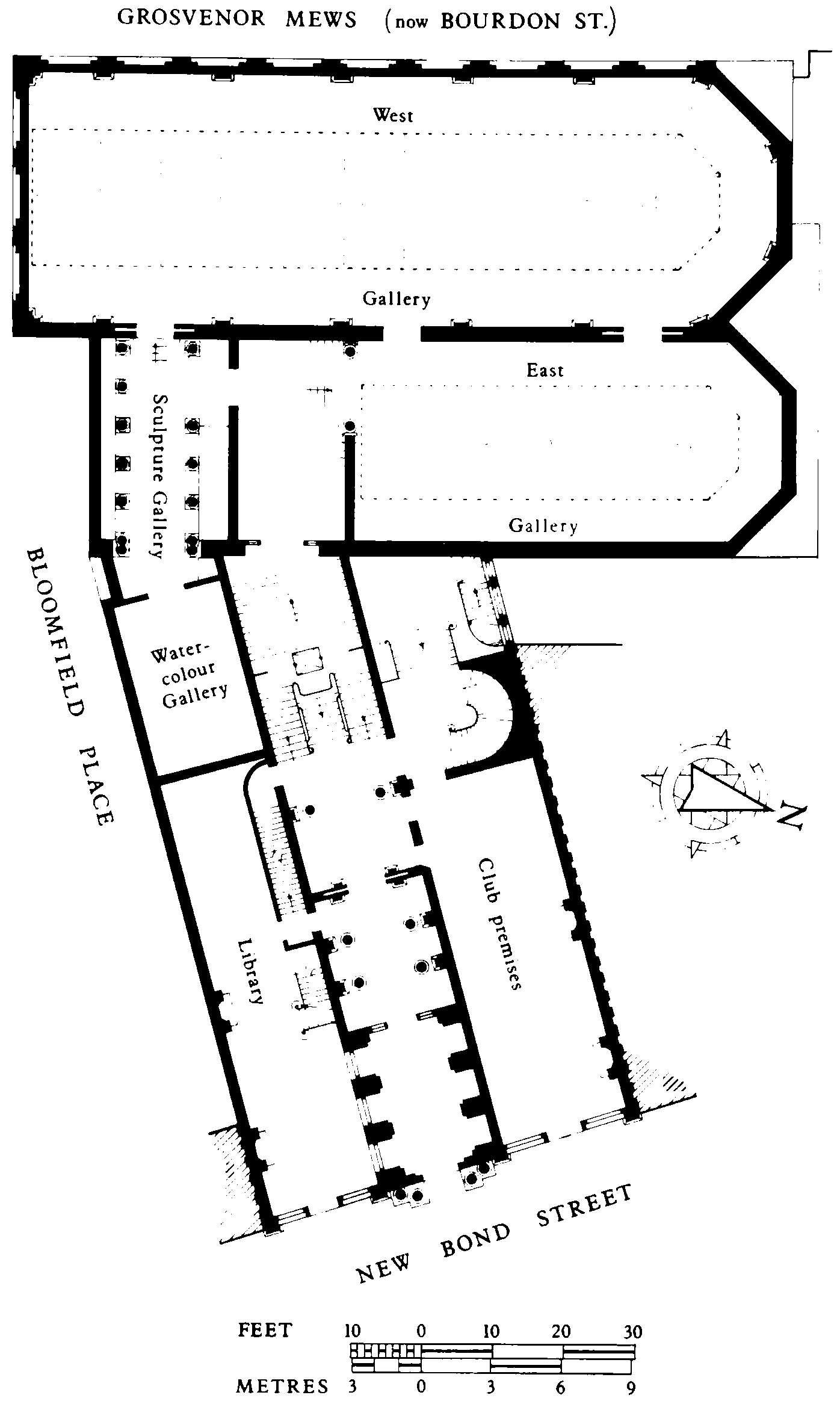
Grosvenor Gallery, plan in 1889
In 1903 the whole of the Grosvenor Gallery building was taken over by the Orchestrelle Company of New York (later the Aeolian Company), manufacturers of musical instruments, in particular the recently invented mechanical piano-player known as the pianola. (fn. 42) The premises were altered for them by Walter Cave. He converted the ground floor into one large showroom which was panelled in oak with verde-antique marble Ionic columns and pilasters. The main staircase was also panelled, and furnished with bronze handrails. The rest of the premises was substantially remodelled, primarily to provide showrooms and offices, and the main picture gallery was converted into a concert hall. Here most of Sams's work was stripped away. The lower parts of the walls were panelled with mahogany and the upper parts divided into bays by broad Ionic pilasters. Between these, windows were made in the west wall with corresponding shell niches opposite. A stage and huge organ case of oak were provided at the south end, and the original skylights were hidden by a panelled ceiling of cradle form. Cave was honorary secretary of the Art-Workers' Guild and several fellow members worked under him on the building including J. E. Knox for woodcarving, W. S. Frith for ornamental plasterwork and W. Bainbridge Reynolds for brasswork. The latter was presumably responsible for a series of highly original light fittings which have since been removed. The builders were James Simpson and Sons. The inaugural recital in the Aeolian Hall, as the new concert hall was named, took place on 19 January 1904. (fn. 43)
Several alterations were made subsequently, often by Cave himself, including the erection of a gallery in the concert hall (fn. 44) and eventually much of the ground floor was divided into separate shops. During the war of 1939–45 the British Broadcasting Corporation took over the Aeolian Hall, chiefly for recording concerts and recitals. When they gave up the premises in 1975 much of Cave's work in the concert hall and its approaches was still intact, although many of the fittings had been replaced and some of the decorative features were covered up. At the time of writing (1978) the hall is still empty and its future is uncertain.
St. George's Baths and Wash Houses (demolished).
In 1852 the Vestry of St. George's, Hanover Square, adopted the Act passed in 1846 to Encourage the Establishment of Public Baths and Wash Houses. Commissioners were appointed to carry out the Act, including the Marquess of Westminster, who had moved its adoption, and in Mayfair a suitable site was found in Davies Street consisting of a former coach-builder's house with extensive premises at the rear fronting on to Grosvenor Mews. The commissioners had to pay the existing lessees a rent of £380, and in 1853–4 the house was altered and new baths and wash houses were built behind to the designs of the Vestry's engineer, P. Pritchard Baly, at a cost of some £12,000. The builder was George Myers of Lambeth. (fn. 45) The four-storey house in Davies Street was given a crisp Italianate façade with a rusticated triplearched ground storey containing the main entrance to the baths. The elevation to Grosvenor Mews was of stock brick and the whole building was dominated by a massive chimney-shaft.
In 1881, the previous lease having expired, the Duke of Westminster granted a new twenty-three-year lease at a rent of £200 (which was acknowledged to be below market value) and added a piece of ground to the south on which an extension to the baths was built. During negotiations for a new lease in 1902, however, the town clerk of the newly formed Westminster City Council stated that a 'heavy annual loss' prevented the Council from paying the enhanced rent which the Grosvenor Board now thought the site demanded, and, after a short extension at the existing rent, the baths were closed in 1910, not without protest, and demolished for the building of the block of flats called The Manor (see page 74). (fn. 46)
St. George's Buildings
St. George's Buildings, erected in 1853, was the first of many blocks of workmen's dwellings to be built on the Grosvenors' London estates. It stands on an awkwardly shaped island site between Bourdon Street and Bourdon Place which the Estate Board had agreed to let to the builder John Newson in 1849 for the erection of stables or workshops. In December of that year, however, the St. George's Parochial Association (later known as the St. George's Workmen's Model Dwellings Association) was founded under the presidency of the Marquess of Westminster to provide artisans' dwellings in the parish of St. George's, Hanover Square, and in 1852 Newson made over his interest in the plot to the Parochial Association as the site for its first venture. Newson himself undertook the construction at a cost of £3,100 including his own profit and the plan was provided by Henry Roberts, who had designed the important prototypical block of model dwellings in Streatham Street, Bloomsbury. St. George's Buildings provided eight sets of two-roomed dwellings on each of four floors and was based on Roberts's favoured plan of one central staircase giving on to open galleries from which the flats were entered. (fn. 47) A fifth storey was added in 1876 (A. Stoner, builder). (fn. 48)
St. George's Buildings is a successful small-scale tenement block with robust brick elevations on three sides dressed with brick quoins at the corners and a brick cornice at the original roof level and galleries with simple but attractive ironwork on the south side (Plate 30a in vol. XXXIX). Necessary modernisation in recent years, however, has led to the making of a number of additional window openings.
Bloomfield Flats
Bloomfield Flats (formerly Buildings), a small block of artisans' dwellings at the south corner of Bloomfield Place and Bourdon Street (Plate 16d), were erected by the builder John Newson on his own initiative shortly after he had completed St. George's Buildings. He acquired the site in 1854 but was not granted a lease until 1858 and may not have completed the building until then. The design is similar to that of St. George's Buildings but here the open galleries are arranged on one side of a tiny courtyard which is approached from Bloomfield Place through an arched entrance way. The building, which provided for twentyeight families, cost £3,100 and the average rents of about 4s. 6d. per week were designed to give Newson a return of slightly over 5 per cent per annum on this sum after deducting his costs, including the ground rent of £55. This level of profitability was an important factor in encouraging the promotion of model dwellings and Newson's enterprise in erecting this and other small blocks elsewhere was used as propaganda for the working-class dwellings movement. (fn. 49) Bloomfield was Newson's wife's maiden name. (fn. 50)
Grosvenor Buildings
Grosvenor Buildings, the third block of model dwellings to be erected in the area, was built in 1868–9 for the St. George's Parochial Association, and was extended to the west in 1891–2. Robert Henry Burden was the architect and A. Stoner the builder for both parts. The first plot was provided on the initiative of the second Marquess of Westminster who decreed that it should be offered to the Association when the leases of the workshops which previously stood on the site expired in 1868. (fn. 51)
Burden's austere five-storeyed block is faced with grey bricks relieved by irregular bands of red brickwork (Plate 30b in vol. XXXIX). The entrance is set within a tall arch on the south side and gives access to a rather cramped staircase with open landings, but there are no external galleries of the kind found in the earlier blocks.
St. George's Institute and Bourdon Buildings
St. George's Institute and Bourdon Buildings (demolished) stood on the eastern part of the site now occupied by Grosvenor Hill Court. In 1877 the rector of St. George's, Hanover Square, Canon Capel Cure, had asked for a site for 'a Coffee house and for a Mission house' in Grosvenor Mews and the Duke was able to promise a site at a peppercorn rent when some of the leases there expired in 1882. A parochial committee was established to raise subscriptions, and appointed Joseph Peacock as architect. Part of the site was, at the request of the St. George's Workmen's Model Dwellings Association, used for a small block of model dwellings for which Peacock also provided the designs. The buildings, which were faced with red brick and artificial stone dressings, included a dispensary and were erected in 1883–4 by Perry and Company of Bow at a total cost of £17,000. The institute, facing Grosvenor Hill, had three storeys above a basement, the dispensary on an adjoining site to the east had four storeys, and the model dwellings which occupied the southern part of the site with an elevation to Bourdon Street were five storeys high, these complex relationships in height being partly offset by the slope of the ground. Besides a large hall, the institute had a gymnasium, parochial kitchen, library, boys' club, working-men's club and small flats for parish workers. The dispensary closed in 1941 and the institute in 1962, shortly after which all three buildings were demolished. (fn. 52)
Nos. 8 and 8a Bourdon Street (formerly St. George's Shelter).
This pleasant red-brick building with a picturesquely irregular outline was erected in 1889–90 as a refuge for fallen women. The architect was Stephen Salter, the contractors were Higgs and Hill, and the cost amounted to some £6,500. The shelter had originally been established in some nearby stabling in 1885 by the twentieth Baron Clinton, but had moved in the same year to a public house on the site of the present building which the Duke of Westminster had recently closed. The Duchess of Westminster laid the foundation stone of the new building in March 1889 and it was opened by the Bishop of Marlborough early in 1890. Later additions include an upper-storey projection with a pyramidal roof in one of the angles of the frontage, of 1892, and a double-storey porch, of 1897, the latter designed by Harry Wilson of Sedding and Wilson. The building incorporated a small chapel. (fn. 53)