
Survey of London: Volume 40, the Grosvenor Estate in Mayfair, Part 2 (The Buildings). Originally published by London County Council, London, 1980.
This free content was digitised by double rekeying. All rights reserved.
'Park Street and Culross Street: Park Street, East Side', in Survey of London: Volume 40, the Grosvenor Estate in Mayfair, Part 2 (The Buildings), (London, 1980) pp. 252-256. British History Online https://www.british-history.ac.uk/survey-london/vol40/pt2/pp252-256 [accessed 26 April 2024]
In this section
Park Street: East Side
No. 2
No. 2 see page 334.
Nos. 8–12 (even)
Nos. 8–12 (even) see page 334.
Nos. 14–22 (even)
Nos. 14–22 (even) see page 334.
Nos. 34–42 (even)
Nos. 34–42 (even) see page 324.
Nos. 44–50 (even) Park Street and Nos. 37 and 38 Upper Grosvenor Street
Nos. 44–50 (even) Park Street and Nos. 37 and 38 Upper Grosvenor Street (Plates 63c, 63d, 63e, 63f, 75d: see also Plate 46a in vol. XXXIX). These houses were built in 1911–12 to designs by Detmar Blow and his French partner Fernand Billerey, the latter being their principal progenitor. This, at any rate, was the opinion of Professor H. S. Goodhart-Rendel, who in reference some years later to this and other examples of their 'French architecture in London, architecture of the highest order, and of the kind which leads an Englishman to despair', thought that 'the easy certainty with which Mr. Billerey has grouped the houses in Park Street' was the product 'not [of] a lifetime, but [of] generations of inherited experience'. (fn. 2)
In the years between 1906 and 1911 the proposed redevelopment of this site was a source of anxious concern to the Estate because this section of Park Street, overlooking the garden of Grosvenor House and visible from Hyde Park, was much more prominent than it is now. The general intention was to treat the seven houses as one architectural unit on the lines of Nash's terraces in Regent's Park, but to improve on early nineteenth-century precedent by using 'fine materials instead of stucco'. (fn. 3) The gestation of the design was not, however, as effortless or simple as Goodhart-Rendel thought; the plans and elevations underwent almost continuous revision as the architects strove to reconcile monumental architecture with the requirements of individual houses. The internal layout was in fact to some extent sacrificed to a grand external effect, windows being in several cases placed in the corners of rooms so as not to disturb the rhythm of the façade, as a prospective occupant was later to complain. (fn. 4)
Uniform redevelopment of the site was proposed in the first place by Eustace Balfour, the estate surveyor. In March 1906 Mr. Saloman, the occupier of No. 37 Upper Grosvenor Street, was told that the lease of his house could not be renewed because 'the adjoining houses in Park Street must be rebuilt as part of one scheme for which Colonel Balfour states there must be one design …. The site is a very fine one, overlooking the garden of Grosvenor House into the Park, and the Duke would have to be specially consulted. There must be one elevation, under one architect and one builder for the whole.' (fn. 5) The redevelopment was planned to take place in 1910 and William Willett of Sloane Square agreed to take the building contract. (fn. 6) In June 1908 Balfour produced a pencil elevation for a stone front but the Duke did not like it and 'stated that he wanted a design prepared by Mr. Detmar Blow', who had recently been Sir Cuthbert Quilter's architect at No. 28 South Street. (fn. 7) Blow was invited to attend the Board and was told what was required for the site: namely moderate-sized houses with individual plans to suit prospective tenants (some of them occupiers of the existing houses) and a uniform frontage. After further negotiations with Willetts, Blow was appointed architect and in July 1910 produced a perspective drawing for submission to the Duke. Wimperis, who by that time had succeeded Balfour as surveyor to the estate, thought the roof line too monotonous and suggested that it should be broken up by gables but the Duke approved the elevation without change. (fn. 8) In November, however, Blow substituted a much grander elevation 'on different lines', evidently the work of himself and his partner Fernand Billerey. This did not meet with the unqualified approval of Wimperis and the Board; when the matter came up for discussion in May 1911 Blow agreed to alter the porches and also to reduce the recession of the ground-floor windows, the depth of which, it was feared, might deter prospective occupants. The revised elevation was approved by the Duke in the same month and work began immediately. (fn. 9)
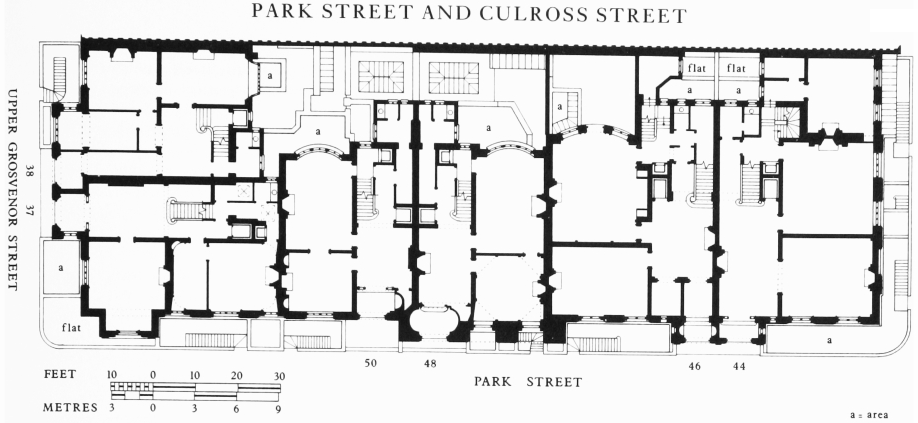
Nos. 44–50 (even) Park Street and Nos. 37 and 38 Upper Grosvenor Street, ground-floor plans
The façade is a fine piece of Beaux-Arts classicism, fifteen bays wide and four storeys high. The composition is tied together by a prominent modillion cornice at attic level, the balustrades below the first-floor windows and along the parapet, and the French-style channelling of the Portland stone masonry. The centrepiece is an attached Ionic portico with fluted columns stretched over three storeys. Perhaps because it is solidly executed in stone and because it is so carefully academic, the block lacks the irresistible and shameless theatricality of Nash's stucco terraces and looks more like a public building transplanted from Paris than a group of houses in Mayfair. Such magnificence seems almost incongruous now that the original setting has been lost and the houses face the monotonous back of new Grosvenor House instead of the garden of its more aristocratic predecessor.
The interiors are finely detailed and vary between French 'Louis XVI' and 'early Georgian', perhaps to suit the taste of individual lessees (Plate 63d, 63e, 63f). The joinery in particular is of high quality. Several rooms contain imported marble chimneypieces. Those in the first-floor rooms at No. 50 were once the property of Warren Hastings and came from Somerset House, Park Lane, in 1915 (fn. 10) (Plate 75d). They are decent examples of later eighteenth-century taste; one is decorated with marble inlay, the other with conventional carving in low relief. Some old chimneypieces may have been re-used from the former houses on the site, for in 1909 Balfour had reported that one chimneypiece in No. 37 and one in No. 38 Upper Grosvenor Street were 'of special value' and that others were 'quite nice'. (fn. 11) At No. 46 Park Street minor alterations were made for Lionel Nathan de Rothschild by W. H. Romaine-Walker in 1913. (fn. 12)
Nos. 58 and 60 Park Street
Nos. 58 and 60 Park Street were both built in 1826–7 on ground hitherto occupied by the stables and outbuildings of No. 12 Upper Grosvenor Street. (fn. 13) The developer was Sir Rufane Donkin, lessee of No. 12 from 1825, (fn. 14) but neither his builder nor architect is known. The houses are similar but not identical in appearance. Both have four main storeys (No. 60 is slightly lower) and plain brick fronts with stuccoed ground storeys typical of the 1820's. No. 60 has a Delian Doric porch and No. 58 formerly had a verandah at first-floor level. (fn. 15) The first occupant of the latter in 1827 was Sir Rufane Donkin himself. (fn. 16)
No. 62
No. 62 see page 225.
No. 64
No. 64 (Plate 58a, 58b).
The small figure of a polar bear in the pediment above the entrance to this 1920's neoGeorgian house commemorates an eighteenth-century tavern called the White Bear which stood here for more than a hundred and fifty years until its demolition in 1917. (fn. 17) Built under a sub-lease of 1728 to the carpenter and joiner Richard Teage, (fn. 18) who was himself the first occupant in 1729, the original house was the first to be erected in Park Street. (fn. 19) But it was not, it seems, a tavern from the beginning and first appears in the licensed victuallers' registers as the Bear in 1736, with Teage as the licensee. The name White Bear is first recorded in 1742. (fn. 20)
Left unmolested during the first Duke's purge of public houses in the 1870's and 80's, and never wholly rebuilt, the White Bear survived into the twentieth century as a homely brick building with a hipped roof, more typical, perhaps, of Shoreditch than of the heart of Mayfair. On the Culross Street side the original eighteenth-century front remained, above the ground storey, but the Park Street front had been rebuilt, probably in the early nineteenth century. It was finally suppressed after the lease expired in 1915, because the Estate had given an undertaking to this effect to Higgs and Hill, builders of the expensive Nos. 37–43 on the opposite side of Park Street. (fn. 21)
After demolition nothing was done until 1925 when a Mr. Stanley Cousins of Little Fishery, Maidenhead, contracted with the Estate to build a house here for his own occupation, the site being extended to include that of the first adjoining house in Culross Street. (fn. 22) Designed by Wimperis, Simpson and Guthrie, (fn. 1) and built by Foxley and Company, the house was completed in 1926. Externally it has something of the character of a small English manor house of the late seventeenth century with a symmetrical front and a graceful scroll pediment over the door. Small red and blue facing bricks are used for both street fronts and pantiles for the pitched roof. Inside, the two principal rooms on the ground floor have carved wooden chimneypieces and modillion cornices. The wooden staircase is in the seventeenth-century style with three balusters to a tread. Originally the house had no basement. (fn. 23)
Cousins lived here for only a very short time and from 1928 until 1936 the house was occupied by the Hon. John Dewar, of Dewar's whisky, who succeeded his father as second Baron Forteviot in 1929. (fn. 24)
Nos. 66–78 (even)
Nos. 66–78 (even) were originally built under leases of 1729 to John Barnes, bricklayer, or his nominees (fn. 25) and, with the exception of Nos. 66 and 68 (originally one house but reconstructed in 1845–6 as two, (fn. 19) with stuccoed elevations), they are among the more extensive early eighteenth-century survivals on the estate and retain brown-brick fronts with red-brick gauged arches and window trim (Plate 59: see also Plate 8b in vol. XXXIX). No. 72 preserves its original external appearance to a large degree, having a carved wooden doorcase with scrolly brackets supporting a prominent cornice and a square tablet in the entablature for the street number (Plate 59a), similar to early eighteenth-century doorcases in Meard Street, Soho, and at No. 44 Old Gloucester Street, Holborn. Nos. 74 and 76 remain three storeyed but the other houses have additional square fourth storeys. No. 74 has mid nineteenth-century stucco window architraves, quoins and rusticated ground storey, while Nos. 66, 68, 74, 76 and 78 have early nineteenth-century iron balconies of varying designs. Nos. 70, 72 and 74 still contain remarkably complete early eighteenth-century interiors, including dog-leg staircases with simple turned balusters and fully panelled rooms at ground- and first-floor levels (Plate 59b, 59c). The plans are of the usual early eighteenthcentury London pattern with a narrow entrance passage and staircase on the left, two rooms, one behind the other, on the right, and a full-height closet wing with corner chimneypieces at the rear.
Some occupants carried out improvements and alterations later in the eighteenth century. No. 70, for instance, underwent some changes during the occupancy of Bernard ('Bunny') Granville in the middle of the century. In 1750 his sister, Mrs. Delany, advised him that paper 'would look very handsome in your hall, give it a finished look—and it is cheaper than painting'. In May 1753 she noted 'I had yesterday a letter from my brother. He tells me he has begun building one good room to his house; he could not do more now without unfurnishing it and taking another house for the winter….' (fn. 26) Granville was a man of taste who also 'improved' his country house, Calwich Abbey in Staffordshire, (fn. 27) but no evidence of any embellishment made by him survives now in his house in Park Street. (fn. c1)
In the nineteenth century the houses passed gradually out of private occupation into commercial use. No. 78, for instance, was for many years occupied jointly with the adjoining No. 47 Upper Brook Street by a bookseller and warehouseman, but by the 1890's it had been separated again and was being used by the District Messengers' Company. Despite complaints from neighbours about the 'call bell and boys', the Grosvenor Board tolerated them because 'the Duke uses the District Messengers very largely, and it is thought that they are a convenience to the residents of the estate'. (fn. 28) While the Board was aware therefore of the usefulness of this pocket of commercial activity, it was also concerned at the run-down appearance of the area and soon after the accession of the second Duke proposals were conceived for redeveloping the whole range together with other neighbouring houses in Upper Brook Street and Culross Street. A rebuilding contract was drawn up with Matthews, Rogers and Company, but soon after the outbreak of war in 1914 it was put into abeyance and was not revived after the return of peace. (fn. 29) So the houses narrowly escaped rebuilding, and in the different social conditions of the post-war period they were judged capable of conversion into highly desirable Georgian residences. At various dates in the 1920's they were restored and embellished and are still in individual private occupation.
No. 80
No. 80 see page 204.
No. 82
No. 82 see page 204.
Nos. 84–90 (even).
These four houses, which stand on ground first occupied by coach-houses, stables and a yard, (fn. 30) were erected in about 1824–5, (fn. 19) probably by Samuel Erlam of Green Street, architect and builder. He originally built five houses and retained an interest in two of them, but the most northerly one was demolished in 1887 in order to widen the entry into Lees Place. (fn. 31) They were all more or less uniform brick buildings of four storeys above the pavement, with stuccoed ground floors (Plate 63a). Some at least were at first used as shops, but in the late nineteenth and early twentieth centuries alterations and additions were made to all the houses as the tone of Park Street improved, to the point where some of the householders could claim that they had 'raised them from the level of common lodging houses to private residences'. (fn. 32) The most-altered house in the row is No. 90, which was much rebuilt following bomb damage close by at No. 94.
No. 96
No. 96, a four-storey block of flats in a vaguely neoGeorgian idiom, was erected in 1963–4 to the designs of Wills and Kaula to replace two houses (one of them the Hertford Arms) which had been bombed during the war of 1939–45. (fn. 33)
Nos. 98–104A (even)
Nos. 98–104A (even) are the survivors of a group of seven red-brick houses with Portland-stone dressings built by William Cubitt and Company to the designs of H. O. Cresswell in 1896–8 (Plate 50c). Two houses at the south end, Nos. 94 and 96, which were damaged during the war of 1939–45, have been replaced by the present No. 96. The terrace was never entirely symmetrical, for the southernmost house was the Hertford Arms public house and was treated in a more restrained manner without a gable and projecting bays to the street front, while the northernmost house (No. 104A) was built two storeys lower than the remainder to satisfy the occupant of No. 52 Green Street who complained about the loss of light to his house.
The initial overtures for the erection of these houses may well have come from Cresswell himself, for when the leases of the previous houses on the site expired in 1896, H. T. Boodle, the Duke of Westminster's solicitor, informed the Grosvenor Board that Cresswell (whose name Boodle thought, apparently erroneously, was on the list of architects approved by the Estate) had submitted a design of which Balfour, the estate surveyor, approved. It was resolved to ask him to be the architect for this range and the one at Nos. 55–59 (consec.) Green Street which was built at approximately the same time, and to offer the rebuilding terms to William Cubitt and Company. The Hertford Arms was rebuilt, also by Cubitts, on a direct contract with the publican, but the remaining six houses were erected as a speculation. (fn. 34)
The original development of this site had taken place in and shortly after 1739 when the master builder Benjamin Timbrell organized the building of a terrace of six houses. He was a party to the several sub-leases granted in that year and the houses were all occupied by 1747. (fn. 35) The large house at the north end was built by Benjamin Timbrell's son William for his own occupation, and he lived there from 1739 until 1786. (fn. 19) These houses had undergone substantial alteration by the time of their demolition in 1896, and No. 98 is known to have been rebuilt in 1826 (fn. 19) (Plate 63a).
Occupants include: No. 96, Lord Edward Herbert Cecil, soldier and colonial administrator, 1900–4. Sir Victor Mackenzie, 3rd bt., 1914–17. No. 98, Major William Murray, M.P., 1920–3. No. 100, Lieut.-col. Sir Arthur Loetham, 1903–24.
St. Mary's Chapel
St. Mary's Chapel (demolished), a modest Georgian preaching box at the south-east corner of Park Street and Green Street, was built by William Timbrell and John Spencer, carpenters, in 1762–3. Its site had originally been acquired by Timbrell's father, Benjamin Timbrell, on eighty-three-year leases in 1739, (fn. 36) but had remained undeveloped. In 1762 William Timbrell and Spencer, who were then partners, entered into an agreement with the Reverend Pulter Forester of Cosgrove, Northamptonshire, to build a proprietary chapel there, half the cost of which was to be borne by them and half by Forester. The cost of building was £3,133. (fn. 37)
On the expiry of the original leasehold interest Lord Grosvenor decided to take over the chapel and in 1825–6 he had repairs totalling £1,681 put in hand, initially under the direction of Thomas Cundy I before his death in 1825. The work included the stuccoing of the exterior in Roman cement. (fn. 38) The chapel remained the direct concern of the Grosvenors until its demolition in January 1882, shortly after the opening of the new mission church of St. Mary's in Bourdon Street. (fn. 39)
St. Mary's Chapel attracted little attention from topographers or historians—one of the few to give it notice described it as 'a remarkably plain, and in some measure unsightly, looking building'—and there is little evidence of its appearance. A small engraving published in c. 1835 shows a pedimented west front with an upper row of windows, the centre one partly obscured by the pediment of a tetrastyle Doric portico which projects to the edge of the pavement: there are two more windows at ground level, one on each side of the portico. The roof is contained behind a parapet and is crowned by a domed turret with a vane on top. (fn. 40) A drawing made at the time of the chapel's demolition in 1882, however, shows a much changed west front, now windowless and with a higher and wider Doric portico, still tetrastyle but without a pediment (Plate 49a). The domed turret and an embellished vane remain but the eaves of the roof project forward. This transformation into a more correct classical idiom seems characteristic of the work of Thomas Cundy II and probably took place under the aegis of the second Marquess sometime after 1845.
The interior, a typical small Georgian chapel, had box pews, galleries carried on square piers which continued upwards above the galleries as Ionic columns, a coved ceiling in the centre with a modicum of ornamental plasterwork, and a shallow recess in the east wall serving as a chancel (Plate 49b).
The later history of this site is described on page 190.
Nos. 106–116 (even) Park Street and 19 Green Street
Nos. 106–116 (even) Park Street and 19 Green Street originally consisted of a group of seven tall, bulky, red-brick houses with large open projecting porches, which were erected as a speculation in 1887–9 by the architect James Trant Smith. His builder was G. Smethurst. (fn. 41) The houses back on to Red Place (originally Red Mews), which extended from Green Street to North Row and which was laid out in 1889–91. (fn. 42)
Nos. 114 and 116 were severely damaged by bombing during the war of 1939–45 and have been almost completely rebuilt with a simplified elevation as one building, now numbered 114.
Occupants include: No. 108, Marchioness of Blandford, exwife of Marquess of Blandford (later 8th Duke of Marlborough), 1903–32. No. 110, Thomas Cundy III, surveyor to the Grosvenor estate, and his son, Thomas Elger Cundy, 1889–92. No. 114, Dow. Lady Vernon, wid. of 6th Baron, 1892–8. No. 19 Green Street, Sir Edward Colebrooke, 5th bt. (later 1st Baron Colebrooke), 1892–4.