Survey of London: Volume 40, the Grosvenor Estate in Mayfair, Part 2 (The Buildings). Originally published by London County Council, London, 1980.
This free content was digitised by double rekeying. All rights reserved.
'Park Lane', in Survey of London: Volume 40, the Grosvenor Estate in Mayfair, Part 2 (The Buildings), ed. F H W Sheppard (London, 1980), British History Online https://www.british-history.ac.uk/survey-london/vol40/pt2/pp264-289 [accessed 30 April 2025].
'Park Lane', in Survey of London: Volume 40, the Grosvenor Estate in Mayfair, Part 2 (The Buildings). Edited by F H W Sheppard (London, 1980), British History Online, accessed April 30, 2025, https://www.british-history.ac.uk/survey-london/vol40/pt2/pp264-289.
"Park Lane". Survey of London: Volume 40, the Grosvenor Estate in Mayfair, Part 2 (The Buildings). Ed. F H W Sheppard (London, 1980), British History Online. Web. 30 April 2025. https://www.british-history.ac.uk/survey-london/vol40/pt2/pp264-289.
In this section
CHAPTER XV
Park Lane
Today, looking over the wide dual carriageway of Park Lane with Hyde Park stretching beyond, it is difficult to imagine that this road was once a narrow, rutted and unlit track alongside a high brick wall which screened it from the park. In 1741 Tyburn Lane (as it was then known) was one of a number of roads taken over by the Kensington Turnpike Trust because they had, 'by reason of many heavy Carriages, frequently passing through the same, become very ruinous, and many Parts thereof are, in the Winter and wet Seasons, so bad, that the same are dangerous to Passengers'. (fn. 5) The Trust paved the southern end of the road but the northern part, skirting the Grosvenor estate, was merely repaired with ballast obtained from the nearby building operations. (fn. 6)
It is small wonder that builders were circumspect in treating for those parts of the estate which fronted on to the lane. A short terrace of houses—King's Row on the site of the present Nos. 93–99 (consec.) Park Lane—was built there in the 1720's and 1730's, but it was set back from the roadway behind a small plantation, and few other houses were erected directly along its remaining frontage. When Norfolk (now Dunraven) Street was laid out in the 1750's the houses on the west side turned their backs to Park Lane, a circumstance that eventually led to much picturesque modification of these rear elevations still visible in the surviving houses of the range between Green Street and North Row (Plate 74a, 74b: see also Plate 19c in vol. XXXIX).
Nevertheless from the 1730's some independent houses of substance were built sporadically along or near its length (including, on the Grosvenor estate, those of Lords Dudley, Petre, Bateman, and Camelford), but the social ascent of Park Lane had no precise starting point. By the end of the eighteenth century it was recognized as a desirable situation even if 'long neglected', and improvements were being mooted. (fn. 7)
It was in the years 1822–32 that Park Lane finally came into its own, however, with a spate of reconstruction which obliterated some of the more slipshod parts of previous development and dramatically enhanced property values. At the southern end, these were the years of Benjamin Wyatt's remodelling of Londonderry House and of Apsley House (the latter strictly in Piccadilly). Further north, Dudley House was rebuilt and Grosvenor House was enlarged. Among the smaller buildings, Nos. 93–94, 96–99, 117 and 138 were rebuilt to a grander scale, and at about the same time many older residences received decorative additions in the shape of balconies and verandahs facing the park (Plates 73a, 73b, 73c, 74a, 74b, fig. 62: see also Plate 19 in vol. XXXIX). There was a general rise in fashionable house prices at this time, but the inflation along Park Lane was exceptional. Old Dudley House fetched £6,510 in 1789, but was believed (with improvements and a new lease) to be worth £24,000 in 1826. A year earlier, £14,000 was asked for No. 93 Park Lane, a house of only moderate size. (fn. 8) A little earlier, Lord Grenville managed briefly in 1816 to exact a yearly rent of no less than £2,500 for Camelford House, perhaps with a full establishment thrown in; yet less than twenty years before, Somerset House next door, with quite a substantial term of years in its lease still to come, had realized only £9,450 at auction.
A partial explanation for these rebuildings and increases in value may lie in the improvements made to Hyde Park in 1825–9, under the superintendence of Decimus Burton and James McAdam. For residents, the greatest boon was the substitution of iron railings for the old high wall which had hitherto impeded their prospect of the park. Some parts of this wall had already disappeared, however, for the Office of Woods' survey of 1823 which recommended these changes stated: 'The external Fences of the Parks, have of late years been considerably improved, without any charge to the public, by the Owners of Houses who have at their own Expence, and with the Sanction of the proper Department of the Government, removed the unsightly Brick walls, and substituted open Iron Railing opposite to their respective Mansions. This improvement does not however, appear likely to be carried farther at the Expence of Individuals . . .' (fn. 9)
High-class residents on the estate also benefited from a change in the position of Grosvenor Gate, their chief point of access into the park for the drives and promenades so fashionable at this period. The original Grosvenor Gate was opposite King Street Mews (now Culross Street) and had a lodge attached (Plate 13a, 13b in vol. XXXIX). It had been opened in 1724 following a petition to the Crown: Sir Richard Grosvenor, who had probably instigated the petition because the gate would add to the amenity of his new developments, had agreed to pay for the lodge and gateway and to find the keeper's salary. (fn. 10) By 1791 the lodge had cowsheds attached and was out of repair, but the Estate would do little, as it was hoped to remove the gate to a smarter position, possibly opposite Upper Brook Street. (fn. 11) Shortly after making minor repairs to the lodge in 1806–7, Earl Grosvenor asked permission to take down the Duke of Gloucester's old riding school (which had been built just inside the park wall in 1768 and detracted from his view from Grosvenor House), and to use its materials to build a new lodge. (fn. 12) The Government rejected this application, and a further initiative in 1808 from its own Surveyor General to build nine select villas in this sector of the park and move the gate to Upper Brook Street came to nothing, after a well-orchestrated outcry. (fn. 13) Instead, the old lodge was demolished by Earl Grosvenor in 1811 and apparently rebuilt close to the same spot, so as to allow for a new course already projected for the inner road behind the park wall (fn. 14) (Plate 67a).
Then, when Decimus Burton's comprehensive improvements to the park were finally sanctioned, this was the first sector to be improved. Work began on the revised course of the internal road in 1825, in which year the new fence was erected by Moorman and Westmacott and the Grosvenor Gate transferred to a position opposite Upper Grosvenor Street, where a new Doric lodge was ready for occupation by November (Plate 67c). The riding school close by had been demolished in 1824, but Burton's ambitious plans to enlarge the reservoir of the Chelsea waterworks next to it and build a central obelisk seem to have been frustrated; the ramshackle building which housed the engine (Plate 67b) did not disappear until 1835, at last leaving Grosvenor House with an unimpeded view over the park. (fn. 15) Burton's small Grosvenor Gate lodge disappeared in about 1960–3, at the time of the most recent remodelling of Park Lane.
By 1845 it was possible for an advertiser of a small house close to the corner with Upper Grosvenor Street to recommend its situation as 'one of the most recherché in London, enjoying the Varied Scenery of the Park, the distant Hills of Surrey, and the salubrious Air therefrom, while at the same time it is placed in the Centre of Fashion'. (fn. 16)
Though comparatively little major building occurred in Park Lane for many years after the outburst of activity in the 1820's, what did then appear was on the largest scale. Dorchester House, most opulent of all the Park Lane palaces, rose just off the estate in 1851–7, and Brook House followed further north in 1867–9 (Plate 72a). In both fact and fiction, no London address was so sought after during the mid-Victorian period as Park Lane.
But in view of increasing traffic, its uneven alignment and width began to cause serious inconvenience. In 1851 the Marble Arch, then 'lying piecemeal in an inclosure in the Green-park' following its ignominious expulsion from the forecourt of Buckingham Palace, was re-erected at Cumberland Gate, next to the junction of Oxford Street and Park Lane. (fn. 17) This led to the widening of a small section at the north end of Park Lane, but the enlargement as far as Grosvenor Gate at one time predicted did not take place. Nor could the notorious bottleneck at the narrow southern end, where Park Lane met Piccadilly, be altered for many years. But the accident of the great Reform demonstration of 23 July 1866, when the railings separating Park Lane from Hyde Park were trampled down by demonstrators almost all the way from Marble Arch to Stanhope Gate, allowed the Government to turn the occasion to minor advantage, and in about 1868 the road was widened from Oxford Street to Stanhope Gate. (fn. 18) In 1870–1 Hamilton Place was opened up to relieve the south end of Park Lane, but with ever-increasing traffic between Paddington and Victoria stations using this route the problem remained unresolved. (fn. 19)
Nevertheless Park Lane remained as eligible as ever until about 1905, though it began gradually to assume a nouveau riche tone. The Grosvenor estate's sector enjoyed its quota of the millionaire mineowners and financiers so prominent in Edwardian society. But men such as Sir Joseph Robinson of Dudley House, Alfred Beit of Aldford House and Sir Ernest Cassel of Brook House represented the dependable rather than the risqué element in new riches; adventurers like Barney Barnato and Whitaker Wright lived further south, Barnato being specifically blocked from acquiring a lease on the estate. Most of these magnates tried their hand at rebuilding or at least adapting their houses, but in few cases were the results of much architectural interest. Perhaps only Aldford House (by Balfour and Turner, 1894–7) offered real originality, and even this was not generally held to be successful (Plate 93). The ostentation of these new homes led a commentator to complain in 1901 that the street's old casual elegance was being lost in favour of a 'frippery and extravagance' which bade fair to convert Park Lane into another Fifth Avenue. (fn. 20)
The American analogy was a shrewd one, for changes over the next sixty years were to make Park Lane resemble nothing so much as one of the great avenues of New York. In 1905 a newspaper article questioned 'whether this thoroughfare is becoming a less popular place of residence, eight of the houses being to be let or sold'. (fn. 21) Soon afterwards, the first of many complaints of noise from motor buses was registered. (fn. 22) By 1909 the diminution in values was so pronounced that 'only an exceptionally attractive house would have any chance of finding a purchaser'. (fn. 23) These were the factors which led to the demolition of Somerset House and its replacement with the first flats in Park Lane. Despite some public opposition to this scheme, Frank Verity's Nos. 139–140 Park Lane went ahead in 1915–19 (Plate 48a in vol. XXXIX).
It was the neo-Georgian tradition championed by Detmar Blow and Edmund Wimperis rather than Verity's neo-Grec which triumphed in the flats built between the wars along the Grosvenor estate's frontage to Park Lane, as the great houses became uneconomic and were one by one torn down. The Grosvenor House development (1926–30) was the first (Plate 74d, fig. 61). The size and prestige of the project induced Blow to bring in Lutyens as consultant, and he continued subsequently to help with the elevations of later blocks. His contribution was undoubtedly largest at Grosvenor House, but there is a general stylistic correspondence between this and the new Brook House, which also involved a degree of collaboration between Lutyens and the main architects, Wimperis, Simpson and Guthrie. The new Aldford House and Fountain House (both by Myer and Watson-Hart) are more independent, and Lutyens was certainly not involved in the latter.
With these flats, shops for the first time crept into Park Lane, their lessees being 'regarded rather in the light of pioneers'. (fn. 24) The expectation that Park Lane would in time be considered as a shopping street has not been so far fulfilled. But the new blocks did introduce another novelty to the estate in the shape of the luxurious penthouse flat overlooking the park, of which the Mountbattens' at Brook House was by far the most impressive (Plate 72c, 72d).
Few save capitalists and contractors rejoiced over the changes in character of the new Park Lane (which, as the Dorchester Hotel recalls, were not confined to the Grosvenor estate). There were questions in the House of Commons and letters to The Times over Grosvenor House in 1928, and in the same year a thoughtful article in The Architect and Building News suggested a competition for a new façade for the whole length of Park Lane. (fn. 25) In employing Lutyens as consultant for the later flats, Blow and the Estate were perhaps thinking along these lines, but nothing as comprehensive as their policy for Grosvenor Square was ever attempted here. The new buildings did, however, precipitate a sudden onset of affection for the remaining stucco fronts along Park Lane, with Maxwell Fry in the van. (fn. 26) The new sentiment probably helped to save Nos. 93–99 when their future was seriously in doubt in 1931.
The war of 1939–45 and its aftermath have not been kind to these remaining houses. A direct hit in the centre of the range between Wood's Mews and Green Street led to the demolition of Nos. 25–31 Dunraven Street (among which No. 29 was of special interest) and their replacement by a building of no character. Dudley House too was badly damaged, losings its ballroom and picture gallery, though a skilful restoration here has made partial amends. All the older houses along the Grosvenor estate's frontage to Park Lane are now offices, and one or two (for instance No. 129) have been almost wholly reconstructed. Meanwhile, several of the freeholds of the new flats have been sold by the Estate.
When traffic had once again greatly increased, a large slice was taken out of Hyde Park and a broad dual carriageway with a green swathe in the centre built in 1960–3. This has once again affected Hamilton Place and the southern reaches of Park Lane more drastically than the northern end. But the 'parkway'-like character of the new arrangements has helped to fulfil the prediction made in 1901 that Park Lane would lose its individuality and become merely cosmopolitan. Nevertheless, sufficient remnants of the old houses still survive to fascinate, in their picturesque variety, the passer-by or even the speeding motorist, and to give him an inkling of former plutocratic glories.
The houses in Park Lane have twice been officially renumbered—in 1872 and again in 1934. Those discussed here extend northward of the Dorchester Hotel.
Nos. 55–62 (consec.) Park Lane and 2–22 (even) South Street.
The history of previous houses here will be found under South Street on pages 338–40. Their demolition was being contemplated from 1926, at about the time that negotiations began for the rebuilding of Dorchester House, off the estate immediately to the south. Sir Howard Frank, head of the firm of Knight, Frank and Rutley, estate agents, was entrusted with advising the Grosvenor Estate on the sites, which were to be divided between two developments: one (now Nos. 56–62 Park Lane and 2 and 4 South Street) at the corner of South Street and Park Lane, the other (No. 55 Park Lane and Nos. 6–22 South Street) with a small wedge to Park Lane and a long frontage to the side street. (fn. 27)
The old Nos. 2 and 4 South Street on the corner site were demolished in 1929–30, and plans for rebuilding here were subsequently prepared by Fernand Billerey. But in the event these were shelved, and it was not until 1933–4 that Gee, Walker and Slater erected the present plain block of flats at Nos. 56–62 Park Lane for Hyde Park Gate Estates Limited, to designs by Trehearne and Norman, Preston and Company. (fn. 28)
The developers of the new Dorchester Hotel did not show the expected interest in the larger and more irregular site. So precise boundaries had to be fixed between the properties, and a further cause of delay occurred when the tenant of the old No. 14 South Street refused to be bought out. But in 1934 agreement was reached with J. A. Mactaggart of the Western Heritable Investment Company Limited to build a block of flats which would surround No. 14, and this was duly done in about 1935–8 to the designs of Joseph Wilson of Glasgow. (fn. 29) Minor additions and alterations to these buildings have since been made, and No. 14 South Street was demolished in 1978.
Aldford House.
The present range of shops and flats here, erected in 1931–2, is the third construction on this site since the original development and the second to be called Aldford House. The first houses to be built here faced Park Street and are described under that street on page 256. In 1888 when the renewed leases of these houses were coming near to expiry, the first Duke of Westminster determined to rebuild the whole block between Chapel (now Aldford) Street and South Street. The undertaking was subsequently put off until 1892, a postponement which killed what had been a promising scheme. For in 1886–7 Robert Hugh Benson, who was to marry the daughter of R. S. Holford of Dorchester House, approached the Duke with a view to building in Park Lane to designs by Norman Shaw. It had been agreed that the old houses here should be replaced by two large 'villas', one at either end of the site with an open space between, and Benson was tentatively offered one of these. But the postponement occurred before Shaw could do more than produce a few sketches, and Benson had to content himself with No. 16 South Street as his nuptial home. (fn. 30)
In 1891 2 the matter was reopened and many enquiries were received about the two proposed plots. The Duke's surveyor, Eustace Balfour, laid down strict conditions for the houses (notably that the heights to the gutter should not exceed 27 feet), so that the amenity of the new houses proposed for the east side of Park Street should be protected. By 1893 the field had narrowed to two associated South African mining magnates, Alfred Beit and Barney Barnato. Despite repeated applications, Barnato was unacceptable to the Duke, as he 'does not stand in a high position in South Africa, and he is a land speculator'; he was therefore obliged to take land and build his house further south in Park Lane, off the Grosvenor estate. Beit agreed to take the northern plot in March 1893, but the future of the southern site was decided only in November 1894, after he had begun building, when he was permitted to use it for a single-storey conservatory or winter garden and billiard-room here, with an open garden towards South Street. (fn. 31) Work on the house proceeded from 1894 under the contractors George Trollope and Sons, who were hampered by a severe strike against them in 1894–5. (fn. 32) The lease was granted to Beit in August 1897 for £13,000. (fn. 33)
The late change of plan harmed the appearance of the new Aldford House (at first No. 26 Park Lane), as it turned what had been intended as one of two sizeable but low and compact villas into a single, straggling composition (Plate 93, fig. 59: see also Plate 38a in vol. XXXIX). The problem was hardly made easier by the eccentric style adopted by Beit's architects, who were Balfour and his partner Thackeray Turner; this was an unusual, loose mode of classicism, characterized by Arts and Crafts textures and detailing but also strongly under the influence of nearby Dorchester House. As a whole, it came closer to the domestic style prevalent in France at the time of François Premier, especially towards Park Street, where the bulk of the house was disposed symmetrically between two strong double-storey bay windows. But the entrance front towards Aldford Street and the 'show' side on to Park Lane were complicated by what The Builders' Journal termed 'a suggestion of the Archaic', that is to say, plain, stubby columns especially prevalent above the cornice, where they supported the pediments or minor gables of the attic windows. Columns of dark Alloa granite with 'archaic' capitals also served on the ground floor as supports for the round arches of the porch (Plate 93b), drawing-room recess and winter garden. The exterior was faced with rough-cut blocks of Portland stone, laid in alternately deep and thin courses, and the roof was of the mansard type. Two main gables to the south and one to the west were filled with florid carving by Henry Pegram. (fn. 34)
Balfour and Turner were responsible for the plan of Aldford House, which was straightforward, and unusual only in confining all the reception rooms to the ground floor. But their commission ceased after they had panelled the hall and stair and decorated the first floor, so that the finishing of the main rooms and toplighting of the staircase were not their work, and one periodical was induced to complain strongly of the want of harmony within the interior. The architects' intention was probably to install sober oak panelling throughout, but Beit's appetite for variety and display led him to decorate the rooms differently. The library received a panelled and inlaid ceiling of French character, a marble chimneypiece and a walnut overmantel; the dining-room was panelled in the French style and at first painted white; the two drawing-rooms, again panelled and containing most of Beit's good pictures, were said in 1909 to be in a 'Regency style'; while the billiard-room had a vaulted ceiling, with walls originally covered in silk brocade. (fn. 35) The spacious winter garden contained'a rockery and a fountain on one side, and a palm grove on the other. Tesselated pavements, brown rocks, and green ferns were all intermingled. It was an abode of dim coolness and sheltered silence.' (fn. 36)
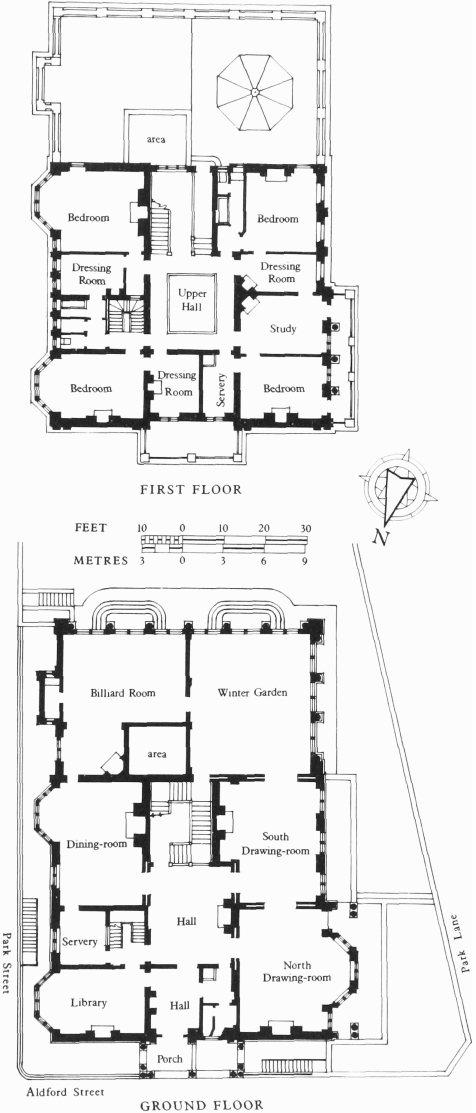
Aldford House (demolished), plans in 1898
Aldford House appears to have been untenanted for some years after Beit's death in 1906. His heir wished to build higher on top of the winter garden to facilitate a sale, but this was forbidden after protest from residents in Park Street. (fn. 37) Eventually in 1912 it was sold for £30,000 to Captain Frederick Edward Guest, M.P., and his American wife Amy, née Phipps. Having made some small internal changes, probably under the architect J. D. Coleridge, they proceeded in 1913 to undertake some larger works. To designs by George A. Crawley (who had worked for the Phipps family in both Britain and the United States), the main hall and stairwell were refaced in stone, and an entirely new staircase was inserted (Plate 93c). These alterations were made in a convincing Louis XVI style, with strong sculptural detailing and much ornamental ironwork. (fn. 38)
With the change in character of Park Lane, Mrs. Guest decided to part with Aldford House in 1929. The Estate now made an agreement to grant a new lease to J. A. Phillips in consideration of his pulling down the house and building a block of shops and flats. His architects were George Val Myer and F. J. Watson-Hart, but as was common at this period, Sir Edwin Lutyens was brought in by the Estate as consultant. The new building, erected by John Knox and Dyke Limited in 1931–2, is brisker and less cautious in detail than most other blocks of flats in Park Lane (Plate 49d in vol. XXXIX). The elevations alternate between brick and bands of stonework of French oolite. Shutters and cantilevered balconies are prominent, and towards Park Lane there is a calculated recession from the sixth to the eighth storey, ending in a 'penthouse' with a pitched roof. (fn. 39) Additions have since been made at high level towards Park Street. (fn. 40)
Fountain House.
Last of the large blocks of flats to be built between the wars on the Grosvenor estate's frontage to Park Lane, the present Fountain House (1935–8) replaces a row of houses between Mount Street and Aldford Street which were mostly numbered in and entered from Park Street (see page 256). In 1928 the Gas Light and Coke Company acquired a long lease of all the properties in the block except that of the comparatively recently rebuilt No. 15 Aldford Street (see page 256), and in 1931 the freehold of the whole block was sold to them. (fn. 41) The present Fountain House was designed by George Val Myer and F. J. Watson-Hart, architects for the new Aldford House, with W. L. Scott as engineer and Sir Giles Gilbert Scott as consultant architect on the Grosvenor Estate's behalf. (fn. 42) Built in 1935–8 by the contractors Sir Robert McAlpine and Sons, Fountain House comprises a garage and filling station in the basement, shops on the ground floor and luxury flats above, to which the main entrance is from Park Street. The construction is of reinforced concrete, and the style of the building is similar to the adjacent Aldford House, but less bold.

Lord Petre's (later Breadalbane) House (demolished), plans in 1783
Breadalbane House (demolished).
Built in 1766–70 for Robert, ninth Baron Petre of Thorndon Hall in Essex, this was both the largest and the most interesting of the three houses fronting Park Lane which formerly stood on the site of the modern Grosvenor House (fig. 55 on page 244). It survived until 1876–7 and during the nineteenth century was usually called Breadalbane House after the first two Marquesses of Breadalbane whose London home it was for sixty years. Prior to the renumbering of 1872 the house was also known as No. 21 Park Lane and afterwards as No. 26.
Lord Petre's architect was James Paine who subsequently published the designs in the second volume of his Plans Elevations and Sections of Noblemen and Gentlemen's Houses. (fn. 43) In 1766 Paine was already employed in rebuilding Thorndon Hall (fn. 44) and he acted on Petre's behalf in negotiating the site in Park Lane. This was a rather oddly-shaped five-sided plot taken out of the curtilage of No. 26 Upper Grosvenor Street and formerly used for a mason's yard. Under the terms of the agreement which Paine concluded with the leasehold owners in October 1766 he undertook to spend at least £5,000 in building 'one or more substantial messuages' here to be completed within three years. The house was finished, ready for Lord Petre's occupation, in 1770, and cost about £8,000. (fn. 45)
To make the most of this difficult site Paine devised an ingenious and irregular plan (fig. 60) for which he nevertheless contrived a grandly formal 'centre and wings' elevation towards Park Lane (Plate 68a: see also Plate 13b in vol. XXXIX). In the nineteenth century the front of the house was stuccoed, (fn. 46) but Paine's own illustration seems to suggest that it was originally brick-faced with stone dressings. The principal apartments were pleasingly varied in shape and size, though not having any great depth of plot Paine was unable to provide the sort of sequence which distinguished the planning of Robert Adam's houses in Grosvenor and St. James's Squares a few years later. The entrance hall and great circular staircase behind, however, must have made a fine effect. This arrangement was repeated in the basement which followed the main plan rather closely. The service quarters extended upward into the southern end of the house at ground-floor level, where they were completely walled-off from the family rooms although the butler's room enjoyed a fine view of Park Lane. Above was the chapel and a suite of rooms for Lord Petre's Roman Catholic chaplain. (fn. 1)
The drawing-room had an elaborately plastered ceiling with a painted centrepiece (Plate 16a in vol. XXXIX), and in both the drawing- and dining-rooms there were statuary marble chimneypieces, all these features being illustrated in Paine's book. Otherwise nothing is known of the original decorations. In 1787, however, Lady Mary Coke reported that in honour of his second marriage Lord Petre was making 'great alterations' to the house and that 'some part is to be new furnished with white damask—which will not last long in Town'. (fn. 47)
After Lord Petre's death in 1801 his son, the tenth Baron, sold the house to the fourth Earl and subsequently first Marquess of Breadalbane. (fn. 48) Lord Breadalbane promptly obtained a reversionary lease of the property from Lord Grosvenor, but had to agree to give up the stableyard on the south side of the house when the old lease expired in 1826. (fn. 49) New stables were later secured in Street's Buildings. (fn. 50)
Soane altered some of the windows on the principal floor in 1803, (fn. 51) and William Atkinson, Lord Breadalbane's architect for important additions at Taymouth Castle, (fn. 52) carried out repairs and other small works in the 1820's. These included the building of a single-storey stuccoed laundry and wash house at the south corner with Park Lane in 1828–9. (fn. 2) (fn. 52) Atkinson also drew up plans for a proposed new staircase from the library (probably the former chapel) to the bedrooms above. (fn. 53) By 1841 a portico had been added to the front entrance and a 'Trafalgar balcony' to the first-floor windows overlooking the park (Plate 67c).
Under the second Marquess, who succeeded his father in 1834, parts of the interior were evidently transformed in keeping with the owner's taste for 'ancestral' styles. No illustrations are known but the documents mention a Gothic passage, an Elizabethan staircase in carved oak, and an Elizabethan room. (fn. 54) Gothic panels were supplied (in 1839) by Pugin's friend Edward Hull, a dealer in antique furniture and fittings in Wardour Street, Soho. (fn. 55) (fn. 3)
For a ball attended by Queen Victoria and the King of Portugal in 1854 Lord Breadalbane erected a 'temporary' dancing saloon in the garden of No. 30 Upper Grosvenor Street which took the form of a 'Baronial Hall' with an imposing hammerbeam roof (Plate 68c). It was built by George Myers of Lambeth, and decorated by J. G. Crace, who may also have provided the design for the whole structure. (fn. 56) The principal roof timbers were coloured crimson and gold, while the intervening panels were painted with heraldic trophies and family crests as in the Banner Hall at Taymouth Castle, which Pugin had probably designed in 1838. (fn. 57) On the walls the painting imitated gold tapestry. The floor was inlaid with oak and cherry from the forests at Taymouth. In the roof were dormer windows filled with stained glass which on the night of the ball was displayed to 'great advantage' by the 'admirable mode of lighting' of Messrs. Faraday and Son, brass-founders and gas-fitters of Wardour Street. Other decorative features included suits of armour and heraldic banners. (fn. 58) A glazed corridor connected the ballroom to the house. (fn. 46)
The 'Baronial Hall' was demolished in 1863. (fn. 59) In the following year Lord Breadalbane's executors sold the house to Sir Edward Bulwer-Lytton who bought it as a speculation but lived there briefly before selling it to the recently widowed Lady Palmerston. (fn. 60) On arriving in London to take up residence in January 1866 she wrote: 'It is a fine healthy situation overlooking the Park and I shall be as comfortable there as I can be after suffering such an irreparable and overwhelming loss and all my happiness on earth.' (fn. 61)
The house was pulled down in the winter of 1876–7, when according to the estate surveyor, the 'very fine' reception rooms were still 'in very good order', and the site was taken into the grounds of Grosvenor House. (fn. 62)
Occupants include: 9th Baron Petre, 1770–1801. 4th Earl and latterly 1st Marquess of Breadalbane, 1802–34: his son, 2nd Marquess, 1834–62. Sir Edward Bulwer-Lytton, bt., novelist, later 1st Baron Lytton, 1864–5. Viscountess Palmerston, wid. of 3rd Viscount Palmerston, statesman, 1866–9. Thomas Eaden Walker, M.P., racehorse owner, 1871–6.
Former Nos. 27 and 28 (demolished).
Between Breadalbane House and Upper Grosvenor Street were two small houses (latterly Nos. 27 and 28) which survived until c. 1928 (Plate 73c). The corner house, No. 28, had originally been built under a lease of 1729 to the masons Richard Lissiman and William Hale, (fn. 63) and was first occupied, as the Wheatsheaf tavern, in 1730. (fn. 64) By 1771 it had ceased to be a tavern and may have been rebuilt at about this time, but nothing is known about its history to explain why the Park Lane front looked like two houses joined together. The adjoining No. 27 was newly built in about 1770 on part of a plot originally leased with No. 25 Upper Grosvenor Street, and first occupied in 1772. (fn. 65) In sale particulars of 1845 it was described as 'A Compact Cheerful Residence' which had just undergone 'Reparation and improvements'. The house then had a stone staircase rising from the hall to a thirty-four-foot drawing-room, which was papered in compartments with satinwood paintwork and two marble chimneypieces. (fn. 66)
Occupants include: No. 27 (formerly 22), 'Lady Bamfield', probably wife of Sir Richard Warwick Bampfylde, 4th bt., 1772–6. 'Lady Kircudbright', probably wife of 8th Lord Kirkcudbright, 1790–7. 3rd Baron Hawke, 1815. Dow. Countess of Bradford, wid. of 1st Earl, c. 1836–44. Col. (latterly maj.-gen.) Alastair Macdonald, 1875–82. Lieut.-col. Maurice Alexander, barrister and company director, 1923–c. 1928. No. 28 (formerly 23), Lady Almeria Carpenter, who 'reigned at Gloucester House', da. of 1st Earl of Tyrconnel, 1787–98. Sardinian Legation, 1857–61. Lord Ronald Leveson-Gower, sculptor and author, son of 2nd Duke of Sutherland, 1875. Samuel Plimsoll, M.P., 'the Sailors' Friend', 1877–96. Samuel James Waring, later Baron Waring, director of Waring and Gillow, furnishers, 1904–12. Sir Thomas Drysdale Nicol, K.B.E., 1920–c. 1928.
Grosvenor House.
The huge building which rises along Park Lane in tellingly designed echelon demands some account of its genesis, if only because it seems, and seemed when it was newly built, to be symbolic of its period, in the style used for its architecture, in the contrast with what it replaced, and in the expression it gave to a way of life which drew Park Lane nearer to Fifth Avenue (Plate 74d: see also Plate 48c in vol. XXXIX). Its erection as flats and a hotel in 1926–9 was not the first massive rebuilding on the site of a Park Lane mansion, but it was much the biggest and most spectacular, and caught the rising wind of disquiet at what was happening to central London. This has affected assessments of its architectural merits. There is some ambiguity in the evidence of the authorship of the whole design, which was in fact divided, but the outward face Grosvenor House presents to the world is an instance of the way Sir Edwin Lutyens could quickly put his stamp on a building, however difficult or imprecise the commission to him.
The transformation of the old Grosvenor House site was determined in the years 1919–25, being occasioned by the second Duke of Westminster's decision not to return there after the war. Up to the end of that period, however, it was uncertain that the redevelopment would turn out quite in the way it did.
Continued ducal occupation of the house was briefly in prospect in 1919, when the Duke of Sutherland was interested in it, and the Duke of Westminster would have accepted £6,000 a year for a tenancy—that is, £3,000 clear of outgoings, and substantially more than he was getting from the Government for its use of the house. (fn. 67) But the Duke of Sutherland went to Hampden House in Green Street instead, and the next four or five years saw increasing requirements on the part of the Duke of Westminster from the proceeds of any disposal of the property, together with a diminishing likelihood of finding an occupant for the old house. In 1923 the Duke's architectural adviser, Detmar Blow, was evidently having schemes for the site prepared by his associate Fernand Billerey, one of which provided for the retention of the old mansion, (fn. 68) and as late as the early months of 1924 it was still being advertised to let, but an offer to the American ambassador was unproductive. (fn. 69) The Duke was now, in January, looking for £10,000 a year from a short letting of the house, and by June had resolved to accept nothing less for the house than he could expect to receive from a building lease of the site for redevelopment. (fn. 70) The press had for some years thought such an outcome likely, and two syndicates had already made offers in 1923. The nearer to success had been New York-based, with Whitney Warren as their architect, and had impressed the Duke's advisers by their business-like and straightforward approach. They had offered £25,000 a year, but for an unknown reason the Duke had not then proceeded with the deal. (fn. 71) (No doubt various developers were turning their minds to the site: the building firm of George Trollope and Sons, for example, was at some time about this period sufficiently interested to have George A. Crawley—an architect with New York experience—and Gervase Bailey prepare outline plans for a grouping of flats around a central garden. (fn. 72) ) In June 1924 the search for a building, lessee was resumed determinedly—in part to forestall anticipated 'difficulty in the building trade' (fn. 73) —and was successful. The buyer, with whom a conclusive agreement was reached in October, was Lord Leverhulme.
In view of the significance which at the time and subsequently attached to the replacement of this noble mansion by a commercial development it is to be noticed that the agreement, at least on paper, envisaged at this stage that the Duke might make some economic sacrifice for a use of the site that would not be wholly commercial. (fn. 74) This was because Lord Leverhulme wanted, in his son's words a few years later, 'to build on the site some form of public building to be devoted to the Arts, but what his scheme would have been in detail is unknown. . . . It would probably have comprised a series of galleries, possibly a small permanent collection of pictures and other works of art, and premises to be used as studios and to provide rooms for various societies. . .' (fn. 75) The option of placing commercial buildings or (as a strangely optimistic alternative) an opera house upon the site was provided for in the agreement, and in that case a rent of £25,000 a year was to be paid, with a right to buy the freehold for £500,000. But Lord Leverhulme was conceded more favourable terms for the art-gallery project, with a rent of £20,000 and a purchase-option at £400,000. (fn. 74) (fn. 4) Lord Leverhulme was in his seventies, however, and the realization of that scheme must have seemed problematic. In the event, he died in 1925, and it was immediately recognized in the Grosvenor Office that a commercial use of the site would now follow the lease to Lord Leverhulme's executors. (fn. 76) This, granted in autumn 1925, was assigned by them to a commercial speculator in the following year. (fn. 77)
He was A. O. Edwards, founder and chairman of Edcaster, a Doncaster-based building firm which undertook the development of the Mayfair Hotel on part of the Devonshire House site in 1924–6. The architect Edmund Wimperis, whose client Edwards was, described him as 'a very straight little fellow'. Edwards subsequently built several large blocks of flats in Queensway and Kensington Park Road before emigrating to South Africa in 1936. Later he moved to America and died in Philadelphia in 1961. (fn. 78)
Edwards's architects were Wimperis, Simpson and Guthrie, of whom the last, a recent recruit to the firm, was the active partner here, although Wimperis himself—who was also, of course, the Grosvenor Estate's surveyor—is known to have provided a general scheme for the elevations. (fn. 79) According to one of Guthrie's daughters her father brought Edwards's commission with him when he joined the firm in 1926: (fn. 80) on the other hand, it seems at least possible that Edwards would in any case have been mindful of the advantages that might have been expected to follow the employment of the firm of the estate surveyor. In fact, however, it was Detmar Blow who was in the ascendant in the Grosvenor Office, and it was, moreover, thought desirable there that with Wimperis acting on behalf of the developers the Duke should be independently advised. In the summer of 1926, therefore, Sir Edwin Lutyens was called in to assist Blow in examining and approving the plans and elevations. (fn. 81)
The first part of the scheme to be taken in hand was a block of flats on the southern half of the site—initially intended to be separated from the northern half of the development (covering the site of the mansion itself) by a fifty-foot road between Park Lane and Park Street. At their first meeting, probably in June 1926, Edwards told Lutyens he wanted to build 'as tall as the L.C.C. would allow'. Lutyens 'immediately brought out five wee little pipes and put them on the table and exclaimed "What fun we are going to have"'. (fn. 82) According to Christopher Hussey, writing in 1928, the first design was to have 'gables and hanging bay windows' (fn. 83) —possibly like a rather enlivened version of Wimperis and Simpson's Upper Feilde in Park Street. By mid September, however, Guthrie had produced a design without such extravagances, but perhaps more suggestive of Baron's Court than Park Lane (fn. 84) (fig. 61a).
The Duke had been told by Blow and Lutyens that the development would be 'as far as possible in keeping with present or future buildings in Park Lane, Upper Grosvenor Street and elsewhere in the immediate neighbourhood'. (fn. 85) He was interesting himself in the elevations of the big new building, inspecting a specially prepared model, and Guthrie's elevations came under critical scrutiny. Before the end of September Lutyens had contrived to have 'pavilion flats' accepted for introduction into the design and it may therefore be that the essentials of the present exterior had already been quickly substituted for Guthrie's. (Writing on 23 September Edwards said 'the elevations have been discussed over and over again with Sir Edwin and Mr. Blow'.) (fn. 86) This had certainly been done by November. Edwards's solicitors had become exasperated at the liberal view Lutyens was taking of his commission, going beyond mere approval or disapproval ('We are astonished to hear from our clients that their Architects yesterday afternoon received from Sir Edwin Lutyens a fresh set of what he is pleased to term a tentative set of drawings. . . . This must really come to an end.'). (fn. 87) Guthrie also was querying whether these drawings of Lutyens's 'were to be adhered to in toto?'. Lutyens replied (as Edwards records) 'Not if you can show anything better', and a few days later the Duke approved the elevations in question. (fn. 88) They differed significantly from what was built only in the provision of a spectacular high-level bridge linking the north and south blocks, and of a feature somewhat reminiscent of Temple Bar to stand across the intended roadway between them (fig. 61b).
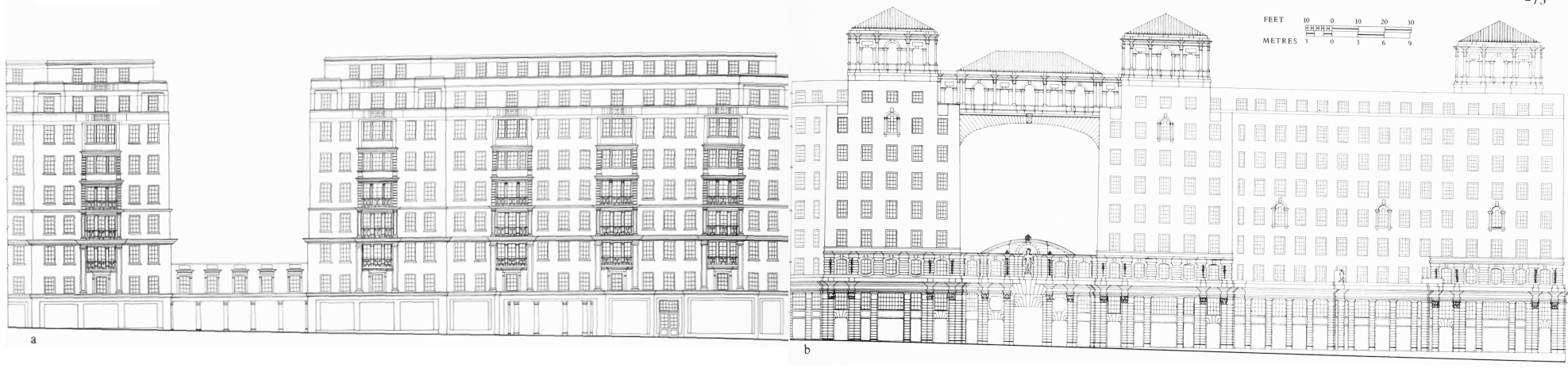
Grosvenor House
a. Part elevation to Park Lane as proposed by Wimperis, Simpson and Guthrie in September 1926
b. Part elevation to Park Lane altered by Lutyens and approved in November 1926 but executed in a modified form
Edwards was anxious to start work. His building operations at the Mayfair Hotel site were completed, his ground rent had become payable in full at Michaelmas 1926, and his solicitors emphasized the loss he was incurring through the rising cost of steel since he had concluded his agreement with the Leverhulme executors. (fn. 89) In fact, however, the Duke's solicitors conducted their end of the business with great dispatch.
Edwards told Blow 'we naturally want to have a nice building'. Publicly, at least, he professed himself pleased with the changes emanating from his landlord's advisers, and was proud of the architectural effect. (fn. 90) Outwardly this arises from the building's Lutyenesque features, which use the vocabulary of classicism to smarten and vitalize the exterior, at ground and skyline level especially. The four crowning stone pavilions along Park Lane which add a rather obvious 'thrill' to the silhouette of the building also assist the apparent organization of the whole complex as a quadruple sequence of masses—evidently without much, if any, recasting of Wimperis, Simpson and Guthrie's plan. (fn. 91) The two halves were joined at ground level by a single-storey 'lounge and reception area', extending back only part of the way to Park Street and surmounted on the Park Lane front by an eye-catching colonnade, the whole curved to accommodate the stepping-forward of the building line.
Lutyens was paid upward of £9,000 by the Estate, or perhaps in the end, if an early agreement held good, a sum approximating to 1.05 per cent of the building cost, which a newspaper report said was expected to be £1,250,000. (The final cost including equipment is said to have been 'about £2 million'.) At one time Detmar Blow was to share the money with him but this seemingly did not happen. It is not known if Edwards also paid Lutyens a fee or if the Estate recovered from Edwards any of their payment to Lutyens, nor if the payment affected the fees (presumably much greater) paid by Edwards to Wimperis, Simpson and Guthrie. (fn. 92)
Whether the excogitation of the exterior treatment was much influenced by larger ideas for Park Lane as a whole is not certain, probably because they were never clearly formulated. The intention to treat all the Grosvenors' Park Lane frontage consistently (and with stone facing at ground-floor level) was mentioned by Christopher Hussey in Country Life in 1928 and was evidently associated with the idea that 'there are to be shops in Park Lane', announced as a news item in The Architect and Building News in the same year. (fn. 93) That announcement spoke of a colonnaded treatment of the shop fronts, and the idea of incorporating an arcade of shops into at least part of the frontages of Grosvenor House had been considered in 1926. Blow wrote to Lutyens that the Duke had been interested by the suggestion, for the ground-floor frontage, of 'an arcadian type [sic] similar to one which used to be in Regent Street'. (fn. 94) In another recollection, the Duke had some hopes that Park Lane might become a 'rue de Rivoli', (fn. 95) but evidently there was not the resolve to attain that elusive end.
The Duke's solicitors had told Edwards he could begin excavations in October 1926. (fn. 96) By the early months of 1928 work on the south block was outwardly finished—sufficiently so, at least, for outraged letters to appear in The Times and a question to be asked in Parliament about the control of buildings that overlooked the Royal Parks. (fn. 97) The block, containing flats, was opened in May. (fn. 98) In October 1927 the demolition of old Grosvenor House began. (fn. 99) The northern block was commenced in the spring of 1928. (fn. 100) Built as a hotel, it was completed by the early summer of 1929. (fn. 101) Edwards claimed that 'as an individual effort there have been few undertakings of equal size or intricacy', (fn. 82) and in 1928 Christopher Hussey commented on the efficiency with which Edwards's building firm, Edcaster, was carrying on the work. It was employing 'many American methods ... to eliminate delay and inconvenience' (for example, in the disposal of builders' rubble). (fn. 83)
One respect in which Grosvenor House differed from many buildings of its type and date was in the stone chosen by Edwards to set off the brickwork, which is not Portland, but a French stone, Salamandre. Being imported from France, the stone merchants stressed in their advertisement in 1930 that it was 'carried in British Boats, handled by British Dock Labour, and worked and carved by British Artisans'. (fn. 102)
Critical reaction to the new building was chiefly adverse, but, as Hussey pointed out at the time, the hostility was mainly directed at the size and scale of the development and its impact on the Park and the surrounding streets rather than at the design itself. (fn. 83) Typical of this sort of criticism was a letter to The Times expressing concern that buildings 'which at one blow can alter the aspect of a whole neighbourhood, can apparently be erected without reference to any standard but that of private interest'. (fn. 103) Hussey himself took exception to some of the details, the 'unvarying fenestration' for example, but in his opinion Grosvenor House at least avoided the look of a small building magnified. That, however, was exactly how it appeared in 1930 to the architectural correspondent of The Times: 'It is an overgrown small building, stretching a familiar and endearing style of domestic architecture beyond its capacity to please.' Its great fault was 'that of a big woman who dresses to look petite. It never comes off.' (fn. 104)
In the transatlantic boom-years, then coming to an end, the hotel part of the complex had been specifically designed to appeal to the American market, and Edwards had collected information about the layout of 'Apartment Hotels' in the United States. At that time Grosvenor House was the only hotel in London to have a separate bathroom and a separate entrance lobby to each bedroom and running iced water in every bathroom. (fn. 105) As a further stimulus to the American trade a New York office was opened in Fifth Avenue. Prices ranged from a guinea a night for a 'minimum' single room in the low season, to ten guineas a night for two 'superior' double rooms with a sitting-room in the high season. Servants were accommodated at an inclusive daily rate of eighteen shillings. To facilitate telegraphic bookings there was a code based on the names of well-known figures from classical antiquity: 'Horatius', for example, reserved a sitting-room, a double bedroom and a bathroom. (fn. 106)
In the block of service-flats the advertized ideal was to 'embody the best that New York can give and that Paris can offer'. (fn. 107) A wide range of wants was to be supplied within the building. As Guthrie told a newspaper early in 1927 'tenants will be able to insure their lives and read the latest tape-machine prices without leaving the premises'. (fn. 108) An ice rink in the basement of the hotel block, now converted into the Great Room, was advertized as 'the Mürren of London'. (fn. 109)
The decoration of many of the public spaces in the hotel was designed and executed by Chappelow and Son of Charles Street, Mayfair, and included a Tudor grill-room. (fn. 110) The large 'Imperial Suite' was, as to its 'conception', by Mrs. Fargo Thomas of New York, who with Oliver Hill designed the furniture and fittings. (fn. 111) A later but informed comment is that 'from the outset Grosvenor House was advertized and maintained as one of the leading luxury hotels in London. But it never set out to provide the sort of luxury service of Claridges or the luxurious furnishings of the Savoy.' (fn. 112)
The Duke of Westminster's interest, so far as it went, in what Grosvenor House would look like was chiefly as the ground landlord of the surrounding property: it was always probable that the lessees would exercise their option to buy the freehold, which they did in 1935 for £475,000. (fn. 113) The deduction from the £500,000 envisaged in the agreement with Lord Leverhulme (which had been reflected also in a proportionate diminution of the ground rent) was in accordance with provisions made in that agreement and occasioned by the refusal of the tenant of No. 35 Park Street to surrender that property (see page 257 and Plate 63b). This prevented the extension of Grosvenor House over all its destined site until 1956–7, when an addition at the rear of the hotel was built to the designs of Gordon Jeeves. Here, and in a redecoration of much of the rest of the hotel in the 1950's, the interior designers were R. D. Russell and Partners. (fn. 114)
Nos. 93–99 (consec.).
The present houses constituting this attractive range between Upper Grosvenor Street and Culross Street were not the first to fill these sites. In accordance with the haphazard development of the estate's frontage to Park Lane, there originally stood here a row of modest, flat-fronted houses occupying shallow plots, erected between about 1727 and 1733 by a number of building tradesmen among whom the principal was Lawrence Neale, carpenter. (fn. 115) At first they were called King's Row, but in the early years of the nineteenth century the alternative name of Grosvenor Gate was adopted. By then the houses were shielded from Park Lane at the south end by some mature trees that had grown up on the strip of land in front, while at the other end a number of outbuildings had appeared (Plate 13a, 13b in vol. XXXIX).
The mistake of tolerating such poor houses on this site had been appreciated by 1791, when William Porden took the unusual step of suggesting that leases here should not be renewed, 'with a view to the building [of] houses better qualified to range with Lord Dudley's and Lord Petre's in order if possible to gain the advantage which was lost in originally laying out the ground of making a handsome front towards Hyde Park'. (fn. 116) At this time the social character of King's Row was mixed, with a public house at either end but, among other inhabitants, the fifth Earl of Scarbrough and Thomas Sanders Dupuis, composer and organist at the Chapel Royal. (fn. 117) The standard of the houses may perhaps be better judged from a tenant's complaint in 1811 as to the thinness of the walls and the lack of sewers or drains, 'which obliges me to submit to a cesspool and its bad smells'. (fn. 118)
Though Porden's policy was adhered to for twenty years, continued pressure by some of the tenants led to the renewal in 1811 of three of the leases, on the sites of Nos. 94, 95 and 96. This meant that when rebuilding became a reality in the 1820's, it could be undertaken only in parts and the old sites had, by and large, to be retained. But the rebuilt houses did adopt the prominent bays, bows and external ironwork gradually coming into fashion in Park Lane, though they were different from other such houses on the Grosvenor estate's sector in having their entrances on the west (fig. 62: see also Plate 19a, fig. 10 in vol. XXXIX). Whether architects were employed on most of the houses is doubtful, but John Goldicutt certainly designed Nos. 98 and 99.
The 'Grosvenor Gate' addresses were dropped in 1872, when these houses became Nos. 29–35 (consec.) Park Lane, which they remained until the present numbering was adopted in 1934. During later Victorian and Edwardian days the houses continued to be popular and were variously adorned with extra storeys, balconies and internal decorations, but increased traffic subsequently made them less fashionable. Rebuilding was on several occasions debated by the Estate, notably in 1931 when it was reported that four of the seven houses were unoccupied and two of the other lessees were keen to sell their interests. (fn. 119) But again no action was taken, and eventually each of the houses was made available for office use.
No. 93
No. 93, at the corner of Upper Grosvenor Street, is notable as the home of Benjamin Disraeli from 1839 to 1872. Together with No. 94 it was rebuilt as a speculation by Samuel Baxter of Regent Street, builder, in 1823–5. As it covered the site not only of the old King's Head public house at the corner but also of the previous No. 24 Upper Grosvenor Street, No. 93 enjoyed an L-shaped plot of some size and depth, with a strip extending right back to behind No. 97. (fn. 120) The house, at first called No. 1 Grosvenor Gate, had from the start stuccoed fronts, four main storeys, a bow to Park Lane and an entrance in Upper Grosvenor Street (Plate 60c), but a later attic has concealed what was once a prominent domed skylight over the staircase. In November 1825 Wyndham Lewis, M.P., was reporting to his wife that 'Baxter's House is still for sale but he now asks fourteen thousand Pounds for it being an addition of two thousand since we were last in Town'. Rather over a year later, in February 1827, they clinched the deal and in the following May George Morant of New Bond Street was estimating for decorating the drawing-rooms. (fn. 121)
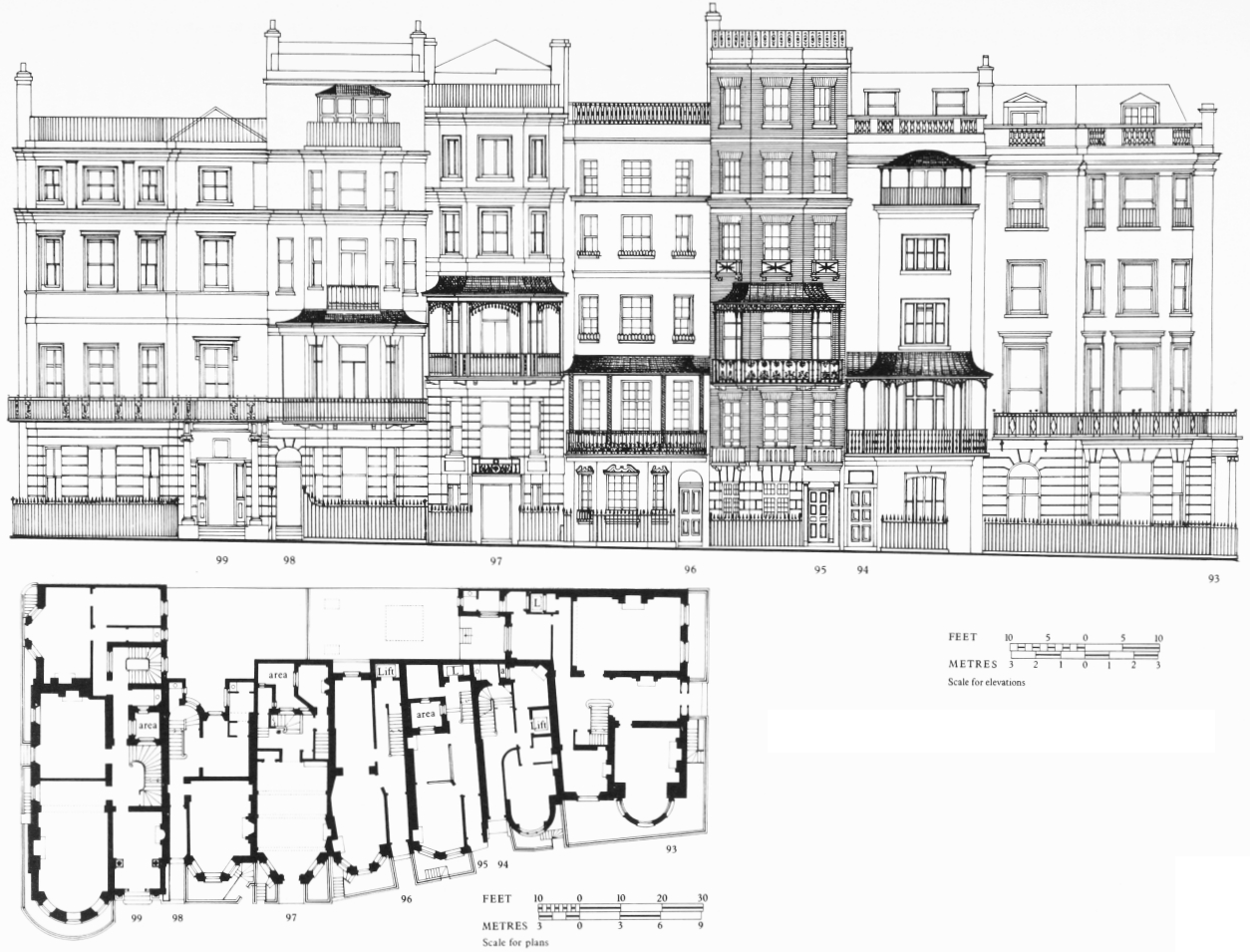
Nos. 93–99 Park Lane, ground-floor plans and elevations
Wyndham Lewis died in 1838, bequeathing to his wife a life-interest in the house. In the following year she married the thirty-four-year-old Disraeli, and the couple were to live here until her death in 1872. It was at No. 1 Grosvenor Gate that much of Coningsby, Sybil and several other of the novels were written. In 1842 Disraeli obtained a mortgage on the house, and an accompanying inventory itemizes its contents. The first-floor drawing-rooms seem to have been furnished in the French taste with carved and gilt chairs, an ormolu clock and several ornamental tables, while in the ground-floor dining-room and library the furniture was mostly of mahogany. Disraeli's books occupied 'a magnificent winged bookcase of ebonized wood richly ornamented with omolu ... the upper part enclosed with plate glass and supported by carved and gilt female figures'. (fn. 122)
In 1874 the house (by now No. 29 Park Lane) was bought and subsequently altered by the builder Charles Fish. (fn. 123) By 1876 he had sold to a new tenant, who employed the builders Jackson and Graham to make additions at the rear. (fn. 124) In 1887 further changes were being made, and in 1903 the dining-room was enlarged by the architect William Wallace for Mr. and Mrs. Hornby Lewis, who however were forbidden to throw out an additional small bow window towards the park. (fn. 125) Despite three such subsequent applications, the second Duke of Westminster refused to countenance external alterations to the house because of the association with Disraeli, to whom a plaque was erected at his expense in 1913. An attempt in 1914–16 to add No. 94 to No. 93 in exchange for the back premises behind Nos. 95, 96 and 97 also came to nothing. In 1931 the lease was purchased by the Estate, and since 1936 the building has been used for offices. (fn. 126)
The present interior of No. 93 combines good surviving features of Baxter's original house of 1823–5, particularly the stairs and fine toplight, with much decoration in the French and Adam tastes carried out since 1872, perhaps principally by William Wallace for the Hornby Lewises. The chief fittings of interest are two fine figurative marble chimneypieces in the Greek taste in the first-floor drawing-rooms (Plate 75a), which could either belong to the original house or have been imported at a later date.
Occupants include: Wyndham Lewis, M.P., 1827–38: his wid., Mary Anne, 1838–9: her 2nd husband, Benjamin Disraeli, Prime Minister, 1839–72. 2nd Baron Robartes, later 6th Viscount Clifden, 1889–96. Arthur Hornby Lewis, iron-master, 1900–26.
No. 94
No. 94, like its southern neighbour, was rebuilt in 1823–5 by Samuel Baxter, who had acquired the reversionary lease of the premises granted in 1811–12 and exchanged it for a new one from Earl Grosvenor. Baxter let the house to Lady Mary Ross in December 1825 and mortgaged his head lease, but Wyndham Lewis of No. 93 appears subsequently to have acquired an interest in this house as well as his own. (fn. 127) Though both houses were stuccoed and had bows towards the park they were not part of a single design, as No. 94 (originally No. 2 Grosvenor Gate) was much smaller and had lower storey heights than No. 93. No further details of the house are known until 1874, when it had become No. 30 Park Lane and alterations were being made by C. and W. Moxon, decorators. (fn. 128) In 1900 the decorators Charles Mellier and Company divided the ground floor to make two rooms; (fn. 129) it was perhaps then that the drawing-rooms received their present French character and a new stair was put in. Recently a lift has been installed and an extra storey added. There are however a few traces of Baxter's work remaining within the house.
Occupants include: Joseph Kelway, musician, 1746–82: his servant, Ann Philips, 1783–90. Robert Bourke, M.P., later Baron Connemara, 1870–4. (Sir) Arthur Frederick Bradshaw, principal medical officer to H.M. forces in India, later K.C.B., 1895–1900. Sir Philip Grey-Egerton, 12th bt., 1911–12. Laurance Lyon, M.P., 1917–19.
No. 95
No. 95 was not rebuilt until 1842–4 because General William Thornton, tenant of the previous house here from 1797 to 1842, had been so persistent that his lease had been renewed in 1811. (fn. 130) The new house (at first No. 3 Grosvenor Gate and later No. 31 Park Lane) was erected by John Harrison of Green Street, gentleman. (fn. 131) It is taller than its neighbours, having always had six full storeys above ground, with a three-sided bay running through them all; the front is mainly of brick.
Occupants include: Col. (latterly lieut.-gen.) William Thornton, 1797–1842. Col. Algernon G. A. Durand, formerly Military Secretary to the Viceroy of India, 1911–22.
No. 96.
The old house on this site was, like No. 95, renewed to General Thornton in 1811, but his tenant here, Captain E. Brenton, must have decided in 1826 to rebuild along with his neighbours. (fn. 132) The new house here, at first No. 4 Grosvenor Gate and later No. 32 Park Lane, was stuccoed and bowed and had five storeys above ground, and was elegant enough to be let to the fifth Duke of Manchester in 1828. (fn. 133) In 1894 a conservatory was built at half-landing level, and in 1903 White Allom and Company made alterations for a new tenant, Rufus Isaacs. (fn. 134) In its present state, however, the interior owes most to a thorough reworking by the architects Hildebrand and Glicker in about 1973.
Occupants include: John Dupuis, 1735–60: his wid., 1760–86: their son, Thomas Sanders Dupuis, organist and composer at the Chapel Royal, 1785–96. Capt. Edward Brenton, R.N., author, 1816–26. 5th Duke of Manchester, 1828–43. Sir Montagu Edward Smith, kt., judge, 1867–91. Rufus Isaacs, M.P., later Viceroy of India and 1st Marquess of Reading, 1903–10. Sir James Calder, kt., timber merchant, 1922–31.
No. 97.
A very large rise in the rateable value between 1826 and 1827, when this house (then No. 5 Grosvenor Gate) was unoccupied, indicates that it was rebuilt at this time. (fn. 133) In 1828 the tenant, Mrs. Harriet Scott Waring, was granted a new lease but sub-let to the Duchess of Marlborough until 1835. (fn. 135) Though the present angular bay and central entrance hardly warrant the suggestion, the house may have been half of an informal pair with No. 96, also rebuilt at this date. In 1893 a new tenant, Miss Dove, lavished large sums on the house (then No. 33 Park Lane) adding a storey and altering the back parts. (fn. 136) It is likely that the present arrangement of a capacious entrance hall and a staircase across the house at the rear dates from this time or from 1900, when a further £7,000 was spent on miscellaneous alterations including new panelling, windows and fireplaces. (fn. 137) In 1914 there was talk of rebuilding the house, but war intervened. (fn. 138)
Occupants include: Joseph Goupy, watercolour painter and etcher, 1750–2. Duchess of Marlborough, wife of 5th Duke, 1829–35 (later at No. 129). Sir John William Fisher, kt., surgeon-in-chief to Metropolitan Police, 1853–76: his wid., 1876–93. 8th Viscount Molesworth, 1895–9.
No. 98
No. 98, together with No. 99, is known to have been designed by the architect John Goldicutt, as a drawing for the elevation of the two houses survives. (fn. 139) The tenant of the previous house here, Susannah Curtis, was given a new lease in 1822 in anticipation of her erecting a new house 'of the Second Rate of Building', and this was duly done in 1823–5, (fn. 140) the house being known as No. 6 Grosvenor Gate. As befitted a more modest house than No. 99, the elevation from the first floor upwards was of brick; the bay running through the original four storeys above ground was three-sided (fig. 12b in vol. XXXIX), and it is likely that the elegant drawing-room verandah proposed by Goldicutt was not erected. When the lease ran out in 1886, the house (now No. 34 Park Lane) was offered to William Cubitt and Company, who undertook large internal works and may also have added the obtrusive top storey. (fn. 141) The interior of the house today exhibits a pleasant mixture of the original finishings of 1823–5, chiefly visible on the staircase, and some well-executed and preserved French decorations in the principal rooms, which were perhaps done at around the turn of the century.
Occupants include: Sir John Davis, kt., 1775–84. 5th Earl of Scarbrough, 1784–1807. Comte De Vandreuil, 1811 14. Maj.-gen. Sir Henry Bunbury, K.C.B., later 7th bt., 1815–16. Sir Augustus Foster, 1st bt., diplomatist, 1840–2. Archibald Billing, physician, 1843–81. Frank Harris, author and adventurer, 1888–94.
No. 99
No. 99, the corner house with Culross Street, was also built to designs by John Goldicutt in 1823–5. It was undertaken by Thomas Martin, probably the builder of that name, of George Street, Portman Square. (fn. 142) A broader house than No. 98, bowed and entirely stuccoed, it was originally meant by Goldicutt to have a verandah over the first-floor balcony, with an ornamental frieze above. The lease was granted in 1824 to (Sir) Moses Montefiore, successively stockbroker, philanthropist and centenarian, the house being then known as No. 7 Grosvenor Gate. Many of Montefiore's meetings on behalf of Jewish causes were held here, and he retained the house until his death in 1885, though nothing is known of any changes it underwent during this time.
The house (by this time No. 35 Park Lane) was then reserved by the Estate for the recently widowed Countess Grosvenor. William Cubitt and Company were entrusted with extensive works to the value of almost £12,000 on her behalf in 1885–6, which included demolishing the adjacent building behind in Culross Street and erecting a red-brick addition comprising a kitchen and three floors of rooms above. (fn. 143) Countess Grosvenor then moved in, and from 1889 lived here with her second husband, George Wyndham, M.P. Here too her son, the future second Duke of Westminster, resided as a boy. The interior retains some nice Grecian cornices.
Occupants include: (Sir) Moses Montefiore, latterly bt., stockbroker and philanthropist, 1826–85. Countess Grosvenor, wid. of Victor, Earl Grosvenor, 1887–1929 (and her 2nd husband, George Wyndham, statesman, 1889–1913). Douglas Fairbanks jun., actor and producer, 1939–40.
Dudley House: No. 100 Park Lane.
This is now the one aristocratic mansion of size to survive upon the Grosvenor estate's sector of Park Lane. Built almost certainly to designs by William Atkinson in 1827–8, then later altered by S. W. Daukes and more recently by Sir Basil Spence, it occupies a plot which for more than two centuries was associated with the Ward family.
The whole site of the present Dudley House was leased in 1736 to William Barlow and Robert Scott, (fn. 144) but was not at first treated as one. Almost immediately a house with stabling behind was built on the southern half of the plot at the corner with King Street Mews (now Culross Street), and leased in 1737 to Anna Ward. (fn. 145) The precise identity of this lady is unknown, but the natural assumption must be that she was a relation of John, sixth Baron Ward, who in 1742 acquired Nos. 35 and 36 Upper Brook Street, which were adjacent to the north (see page 213). Anna Ward also intended in 1737 to take a lease of the northern portion of the site, but for some reason she never completed the transaction, nor did she apparently ever live in the house on the southern plot, the history of which is somewhat obscure. It had a frontage towards the park of thirty-four feet, and Earlom's view of Park Lane in 1799 shows an elegant Palladian façade and pediment, perhaps embellishments of later date than the original building (see Plate 13a in vol. XXXIX); yet in its last years of independent existence the site seems mainly to have been used for livery stables. (fn. 146)
To its north, the broader part of the plot probably stood bare until just before 1759, when the ratebooks reported a 'house lately built'. (fn. 133) This was almost certainly the responsibility of John Spencer, carpenter, who at this time was helping to build Nos. 30–34 (consec.) Upper Brook Street to the immediate north. In 1756 Spencer leased this plot to John, sixth Baron Ward, subsequently first Viscount Dudley and Ward, who for the previous fourteen years had been living at No. 36 Upper Brook Street. (fn. 147) With brief interludes, the Ward family retained possession of the house and its replacements from this time until 1940. The original Dudley House had a plain but ample front fifty feet wide, with five windows and three lofty main storeys. In 1789 the third Viscount paid £6,510 at auction for his late half-brother the second Viscount's interest in the house, and proceeded over the next two years with 'judicious alterations', which included an entrance portico of wood and glass protruding fifteen feet out to the street (fn. 148) (Plate 67a: see also Plate 13a in vol. XXXIX). A few years later, perhaps in 1803, a stained-glass window by Francis Eginton illustrating 'The Elements' was installed in the house. (fn. 149)
The third Viscount Dudley and Ward was perhaps considering extension or rebuilding as early as 1809, when he attempted to purchase the head lease of the southern house and stables behind. (fn. 150) Having secured this, he obtained a new lease of it in 1819 and then sub-let it for seven years. (fn. 151) He died in 1823 and was succeeded by John William, fourth Viscount Dudley and Ward (created Earl of Dudley in 1827), an intellectual and politician of minor distinction but eccentric habits. Without waiting for the sub-lease of the neighbouring house to expire, the new owner quickly put in motion major alterations to the northern house and negotiated a new lease of it. (fn. 152) Nearly £4,600 of work was done by R. and J. Newton of Wardour Street, upholsterers, and W. T. Newton of Margaret Street, builder; of this, more than half was spent on furnishings. (fn. 153) The bills suggest that at this stage the house's front was at least partly stuccoed, and that the staircase was lined with mirrors. In February 1826 the refurbished house was said to be 'the most pleasing object in the vicinity', and the entrance hall or conservatory housed statuary and had stained glass (very possibly Eginton's) in the windows. (fn. 154) At about this time Lord Dudley told a friend that he had refused £24,000 for the house. (fn. 155)
Yet despite these improvements Lord Dudley decided towards the end of 1826 on a plan of total rebuilding, to include the southern house at the corner with King Street Mews. His architect was almost certainly William Atkinson, who also rebuilt his country house, Himley Hall in Staffordshire. (fn. 44) Whether Atkinson had been engaged on the works of 1823–4 is unknown; though he undertook a minor surveying job here in January 1826, for some reason it was not he but J. P. Gandy Deering who later that year applied for a new lease for Lord Dudley 'in consideration of his building one Mansion upon the Ground'. But in the summer of 1827 Atkinson was again concerned in gaining possession of part of the site. By August work was proceeding; the new house was nearing completion late in 1828, and was shown off to Lord Dudley's guests in May 1829. (fn. 156)
Because of later alterations, the precise extent and arrangement of the new Dudley House remain obscure. With the exception of the first-floor conservatory, the front probably appeared much as it does now (Plate 21a in vol. XXXIX): stuccoed, of three main storeys and nine windows' width, with a gently projecting centre bearing the Dudley arms upon the attic balustrade: a screen of Ionic columns, breaking forward at the centre to accommodate the entrance lobby, supports a first-floor balcony across the whole width of the front. The design is quiet, and perhaps owed something to Dudley's previous house upon the site. Within, there are four fine surviving ceilings, one on the ground floor (Plate 70a: see also Plate 21b in vol. XXXIX), and two still visible and one covered up on the first floor (rooms A, E, F and G on fig. 63). These are in the mixed Greek and Roman manner prevalent in the late 1820's, as are several chimneypieces. The old gilding of the plasterwork in these ceilings is probably part of Atkinson's decoration. At the back of the house is a staircase with a fine eighteenth-century wrought-iron balustrade which was perhaps retained from the old house (see fig. 6e in vol. XXXIX).
The Earl of Dudley having died childless and insane in 1833, his estates passed to cousins, and Dudley House was sub-let, first to the second Marquess Conyngham (1833–9) and then to the second Marquess of Abercorn (1839–47). (fn. 157) In 1847 the eleventh Lord Ward took over the house, remaining here after becoming the first Earl of Dudley of the second creation until his death in 1885. If, as a tradition goes, (fn. 158) any work was done here by Sir Charles Barry, it would have been in about 1847, but there is nothing to prove it. But in 1855 Lord Ward did put in hand a spectacular campaign of improvements under Samuel Whitfield Daukes, also his architect from just this time for the transformation of Witley Court, Worcestershire. With George Myers as builder, a ballroom on the north side connected to an eighty-foot picture gallery on the east was made at first-floor level. As at Witley, the style was strongly French, especially in the ballroom, which was gilded and ornamented in a Louis XVI manner, with mirrors and tapestry panels between pilasters, and a coved ceiling bearing emblems of music (Plate 40a in vol. XXXIX). Beyond this, the magnificent picture gallery (Plate 71a) was divided into three sections by pairs of columns, 'of white Parian marble or scagliola', to distract attention from its narrowness; each part was toplit, and special crystal gasoliers with hidden lights were installed by Hancock, Rixon and Company. The ceiling and other architectural features were ornamented in white and gold, while the walls were painted in a subdued green and gold diapered pattern, 'extremely harmonious with the pictures and frames'. The painting and gilding in both ballroom and picture gallery were done by Charles Moxon, but the architectural decoration in carton pierre was by Haber of Paris and the elaborate parquet floors were the work of another French firm, Messrs. Laurent. Several of these concerns also worked at Witley. Lord Ward's famous collection of Italian and Flemish paintings, which had for some years been shown at the Egyptian Hall in Piccadilly, was transferred to the completed gallery in about 1858. (fn. 159) It is likely that other parts of the house which have a French flavour, such as the entrance hall and principal stairs, were transformed to fit these additions at the same time, though the iron balustrade of the latter may be by Atkinson (Plate 70b). The main part of the conservatory towards Park Lane (Plate 71b) may also belong to Daukes's improvements.
In 1867 Lord Dudley lent the house for the state visit of the Khedive of Egypt and subsequently found himself obliged to make some repairs; The World commented, 'the expense was considerable, but then a nobleman whose money is generally reported to stock most of the banks in the Black Country could well afford it'. (fn. 160) Further small works were also undertaken in 1881–2, mainly to the stables. (fn. 161) After his father's death in 1885 at Dudley House, the second Earl kept the house for a few years. Photographs taken in 1890 show the ballroom and gallery in their full splendour and a suite of drawing-rooms on the first floor called respectively 'blue', 'yellow' and 'red' and also containing fine paintings and furniture. Two years later, W. Turner Lord and Company extended the conservatory over the porch and may also have made changes within. (fn. 162) But much of the picture collection was sold at this time, and in 1895 Dudley House was acquired by (Sir) Joseph Benjamin Robinson, a hard-headed South African mining magnate. During Robinson's time the house was described as 'a veritable palace, adorned with splendid pictures, beautiful statuary and priceless art treasures', (fn. 163) and his biographer commented that 'it could never be said of Robinson as it was of another magnate who also bought himself a house in Park Lane, that the only pictures it contained were photographs of himself, and the only book was Ruff's Guide to the Turf'. (fn. 164)
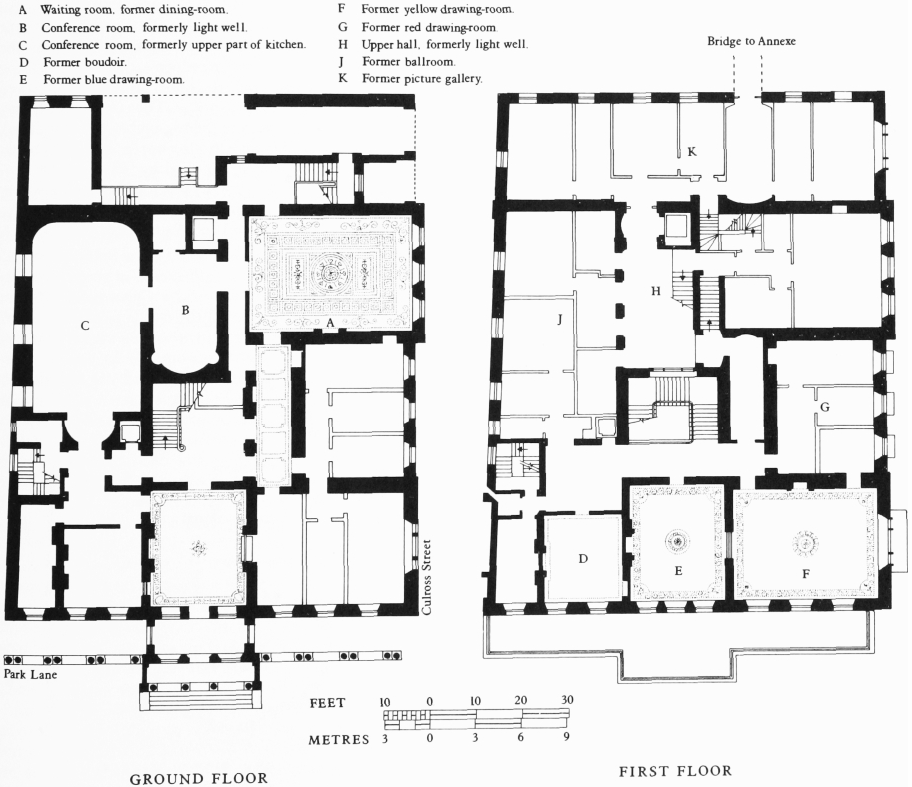
Dudley House, plans in 1968–9. Modern partitions shown in outline
Seventeen years later the second Earl's brother, (Sir) John Hubert Ward, bought back Dudley House for £10,000 and lived here from 1912 until his death in 1938. (fn. 165) The stucco was removed from the elevations during his occupancy, probably in 1930, when Trollope and Sons made alterations (perhaps under the architect W. A. Forsyth, who was paid a small sum in 1934 by the Estate for 'works of permanent improvement' here). (fn. 166)
Dudley House was badly damaged by bombing in 1940 and reverted into the Estate's possession. (fn. 167) The ballroom and gallery were the principal casualties, and their decorations were subsequently destroyed. Much later, in 1969–70, a major internal reconstruction was undertaken by the property group Hammersons to designs by Sir Basil Spence and Anthony Blee, with Sir Robert McAlpine and Sons as contractors. The fronts were re-stuccoed, the rooms in the rear of the house wholly reconstructed, and in the old light well behind the main stairs a new upper hall in classical taste was created, with a marble floor and a coved ceiling whose details were taken from those of the ballroom. Several new chimney pieces were also installed: that in the former yellow drawing-room is a handsome later eighteenth-century example in the Adam style flanked by a pair of Ionic columns and was formerly at Gloucester House, Park Lane. In the old red drawing-room Atkinson's ceiling was covered over, but the mid-Victorian fireplace with its mirrored overmantel, and the dado were moved to the former boudoir at the front of the house overlooking the park. The large Venetian window which used to light the main staircase was re-erected as a 'feature' in the larger of the two ground-floor conference rooms. Behind the house a noticeable survival in Culross Street is the old entrance to the stables, a substantial block of buildings now converted into flats for company executives and linked to the house by a cast-iron bridge at first-floor level. (fn. 168) Despite the many changes the entrance hall and staircase, the ground-floor waiting-room (formerly the dining-room) and the main front rooms on the first floor retain much of their character.
Occupants include: southern part of site, Lieut.-gen. Henry Hawley, 1746–58. Sir Robert Kemys (Kymiss), 1821–4. House demolished in 1827, site incorporated into Dudley House. Northern part of site and, after 1828, combined site, 6th Baron Ward, latterly 1st Viscount Dudley and Ward, 1758–74: his wid., 1774–82: her stepson, 2nd Viscount, 1783–8: his half-brother, 3rd Viscount, 1789–1823: his son, 4th Viscount, latterly Earl of Dudley, 1823–33, who rebuilt the house in 1827–8. 2nd Marquess Conyngham, 1833–9. 2nd Marquess (later 1st Duke) of Abercorn, 1839–47. 11th Baron Ward, latterly 1st Earl of Dudley of 2nd cr. (who was 2nd cousin of Earl of Dudley of 1st cr.), 1847–85: his wid., 1885–8: her son, 2nd Earl of 2nd cr., 1889–95. (Sir) Joseph Benjamin Robinson, latterly 1st bt., South African gold mine proprietor, 1895–1912. (Sir) John Hubert Ward, latterly K.C.V.O., brother of 2nd Earl of Dudley, 1912–38: his wid., Lady (Jean) Ward, C.B.E., 1938–40.
Nos. 105–108 (consec.).
This building, consisting of a bank with flats above, replaces three houses in Upper Brook Street whose history is given on page 210. Coutts and Company entered into negotiations with the Estate in 1930 to rebuild here and were speedily given the relevant permissions. The block was built in 1930–2 by Gee, Walker and Slater with W. Downs Limited, to designs by Wimperis, Simpson and Guthrie (fn. 169) (Plate 49c in vol. XXXIX). The whole building was treated in a careful neo-Georgian style so as to harmonize with the new Grosvenor House further south. The elevations are of stone on the bottom three floors, with Corinthian capitals and a strong cornice at mezzanine level; the upper storeys are in picked red bricks, and the roof is pantiled. The cornice and storey levels of Nos. 105–108 were followed when the new Brook House was undertaken shortly afterwards. Inside the bank, the elaborate fittings were supplied by Betty Joel. (fn. 170)
Brook House.
The present block of luxury flats here was built in 1933–5. It stands on the site of three early-Georgian houses numbered 27, 28 and 29 in Upper Brook Street whose history is discussed on page 210, but the first Brook House was a building of intervening date. In 1854 (Sir) Dudley Coutts Marjoribanks, banker and M.P., subsequently first Lord Tweedmouth, bought No. 29 at the corner with a view to rebuilding it in the future, possibly in conjunction with No. 28; this he was able to acquire ten years later, when its lease expired. (fn. 171) Marjoribanks then sought permission to build a grand mansion overlooking the park to designs by Thomas Henry Wyatt, and having gained vacant possession of No. 28 proceeded with the work in 1867. During construction there was some difficulty over a 'tower' destined for the outlying buildings at the north end of the site near Wood's Mews, but Marjoribanks agreed to omit or reduce this (Plate 27a in vol. XXXIX). The operations of his builders, J. and C. I'Anson, were completed by the end of 1869. The decorations were entrusted to Wright and Mansfield, the marble work to Banks and Company, and the ironwork to a Mr. Carslake. (fn. 172)
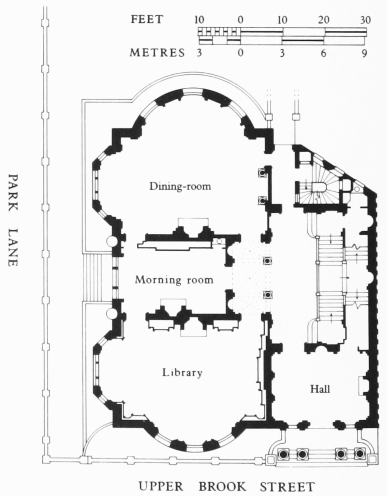
Brook House (demolished), ground-floor plan
Even from its earliest years T. H. Wyatt's Brook House (as the mansion was called from about 1872) was thought somewhat inelegant in appearance (Plate 72a). Its very French façades, of red brick with Portland stone dressings endowed with a medley of bays, balconies and crestings, were deemed by The Building News 'remarkable' rather than 'handsome', and 'unobjectionable in mass but not so in detail'. (fn. 173) But as Wyatt prided himself particularly on his arrangements, Brook House offered all that was latest in town-house planning (fig. 64). The entrance from Upper Brook Street led into a broad hall and hence to a mahogany staircase, rising in double flights and lined with variegated marbles. At ground level the chief rooms were the library, furnished in cherrywood, and the dining-room, which was probably where Marjoribanks installed 'the entire carved work of one of the rooms at Drapers' Hall', recently demolished. On the first floor was a great suite of drawing-rooms in the French style, perhaps including the Parisian panelling obtained from the 'Maison de la Poste'. In 1902 this suite, which had elaborate gilded ceilings and French furniture, was adorned with some of the largest paintings in the Marjoribanks collection, including canvases by Boucher and Fragonard (Plate 72b). (At this date it was said: 'There is no need for dwellers in Brook House to dream that they dwell in marble halls. They do dwell in them. They realise what the poet merely imagined.') On top of the house was a spacious flat roof, 'so as to give access for a large party in case of reviews and other displays in Hyde Park'. Separately, at the north end of the garden, stood servants' quarters with a large billiard-room above; this too had a prominent roof and was connected to Park Lane by its own outside staircase and an open colonnade. (fn. 174)
In 1897 J. D. Crace made designs for an eight-light stained-glass window on the main staircase of the house, but it is not known whether this was executed. (fn. 175) By 1904 the second Lord Tweedmouth had acquired an interest in No. 27 Upper Brook Street, where he put on a porch to designs by T. H. Smith, but shortly afterwards a reversal in his fortunes led him to part with his art treasures and look for a buyer for Brook House. (fn. 176) One was soon found in Sir Ernest Cassel, then at the height of his repute as one of the great financiers of the day and the closest confidant of Edward VII. Cassel, who also bought Tweedmouth's country estate at Guisachan, purchased Brook House only on the understanding that he could throw the small No. 27 into it. The Estate agreed, provided that the new elevation here was similar to the main house, and also submitted to the reconstruction of the garden buildings and a prominent new linking passage, which Cassel insisted had to be 'level with the ground floor (for the convenience of the king)'. (fn. 177) These lavish works were undertaken in 1905–7 with Holland and Hannen as builders. The architect, Arnold Mitchell, was responsible chiefly for external and structural matters, as the interior was entrusted to Charles Allom of White Allom and Company, then decorator to the Royal Family. The old No. 27 was heightened and its ground floor transformed into a luxuriously marbled suite of entrance hall, dome-topped staircase and upper hall, facetiously known to the next generation as the 'Giant's Lavatory'. The outer hall was veneered in a special blue marble from a quarry in Ontario owned by Allom and previously used by him at Marlborough House, while the inner hall and stair were of white Tuscan marble from Sarravezza. Beyond this the corridor, which could be closed off to form an octagonal morning-room, led to the new single-storey garden building, designed in a stone-faced Baroque style with apsidal ends and a coved ceiling. This was the dining-room, capable of seating a hundred and adorned with carving, works of art, and a Grecian chimneypiece of high quality designed by Mitchell for White Allom (fn. 178) (Plate 75e).
Sir Ernest Cassel retained Brook House until his death in 1921, but after his sister, Mrs. Wilhelmina Cassel, died in 1925 the house became the property of his granddaughter and her husband, Lord and Lady Louis Mountbatten, who had since 1922 enjoyed a suite on the third floor. They soon brought the living quarters up to date by installing smart bathrooms with naval decorations to suit Lord Louis' tastes. (fn. 179) But in 1930 the Mountbattens resolved on selling Brook House. Owing to the terms of Cassel's will there was some difficulty about this, but ultimately it was agreed that the Mountbattens would take a penthouse on the top of a new building to be erected on the site. The purchaser of the main interest was George Gee of the builders, Gee, Walker and Slater, who brought in Wimperis, Simpson and Guthrie as architects. But the Estate, probably in order to secure harmony with their other new buildings in Park Lane, paid small sums both to Fernand Billerey (1932–3) and to Lutyens (1933–6) in connexion with the project. (fn. 180)
The new Brook House, built in 1933–5 with neo-Georgian elevations similar to those of the neighbouring Nos. 105–108 Park Lane, epitomized the luxury of the inter-war apartment block in Mayfair. There was a single flat on each of the main floors, one of which was decorated by Robert Lutyens for Israel Sieff. (fn. 181) (fn. c1) But the crowning feature was the Mountbattens' double-storey penthouse, not finished until 1937 but then much publicized. Designed by L. Rome Guthrie and accessible from a special high-speed lift, the apartment was furnished and decorated by Mrs. Joshua Cosden of New York in collaboration with Victor Proetz. There was a spacious curving staircase (Plate 72c), a suite of reception rooms where the fine picture collection was lit by the latest in concealed lighting, and a room for cinema projection. The climax of the flat was Lady Mountbatten's boudoir on the upper floor, where the walls were entirely lined with decorative paintings on canvas, executed in silver and grisaille by Rex Whistler, who also painted the ceiling (Plate 72d). The wall-paintings were removed when the Mountbattens were obliged to leave Brook House in 1939. (fn. 182) (fn. c2)
Occupants include: Sir Dudley Coutts Marjoribanks, M.P., bt., latterly 1st Baron Tweedmouth, partner in Meux's brewery and a director of the East India Company, 1870–94: his son, 2nd Baron Tweedmouth, politician, 1894–1905. Sir Ernest Cassel, G.C.B., financier and philanthropist, 1908–21: Lord Louis Mountbatten, later Admiral of the Fleet Earl Mountbatten of Burma, and Lady Louis Mountbatten, grand-da. of Sir Ernest Cassel, 1922–31, and (after rebuilding of 1933–5) 1937–9 (penthouse flat).
No. 117.
This house, originally No. 32 Norfolk Street, and from 1872 to 1934 known as No. 37 Park Lane, stands on a plot sub-leased by Edmund Rush, mason, to John Adams, glazier, in 1756. (fn. 183) It is broader than were other houses between Wood's Mews and Green Street, having five windows towards Park Lane, four towards Dunraven (formerly Norfolk) Street, and stucco on all three elevations (Plates 73b, 74e). Almost certainly it is an entire replacement of the previous house on the site, which was smaller and was entered from Norfolk Street. The Greek style of the present broad porch and passage towards Park Lane and of the surviving interior features (Plates 74c, 75c), principally a fine staircase from ground- to first-floor level, suggest that this reconstruction took place in about 1822, when a new lease came into operation, but there is no certain evidence on the point. (fn. 184) Possibly somewhat later, an elaborate first-floor verandah was added, with a conservatory over the entrance passage.
In 1884 the house was taken by Robert Wellesley Grosvenor, subsequently second Lord Ebury, a first cousin to the Duke of Westminster. On his behalf new rooms were erected on the top, and the exterior was painted, 'orange colour with a deeper shade for the ground floor' being suggested. (fn. 185) In 1903 the next occupant, Victor Cavendish, M.P., added a completely new top storey. (fn. 186) On succeeding in 1908 as ninth Duke of Devonshire he moved to the family mansion in Piccadilly. The house then fell empty and a proposal by John Garlick to refront it came to nothing. But in 1911 Lord Moreton took it on, and his family remained here for some years. (fn. 187)
The house suffered some damage in the war of 1939–45, and much renovation took place in 1948–9 under the direction of C. Edmund Wilford for Hammersons, the developers. Inter alia, the approach from Park Lane and the verandah above were simplified. (fn. 188)
Occupants include: Countess of Huntingdon, wid. of 9th Earl and foundress of 'Lady Huntingdon's Connexion' of Calvinistic Methodists, 1759–62. Lieut.-gen. Lord John Murray, son of 1st Duke of Atholl, 1764–70. Lady Cunliffe, wid. of Sir Ellis Cunliffe, 1st bt., 1771–1814: her son-in-law, William Gosling, banker, 1816–27. Robert Wellesley Grosvenor, latterly 2nd Baron Ebury, 1884–94. Victor Cavendish, M.P., later 9th Duke of Devonshire, 1895–1908. Lord Moreton, son of 3rd Earl of Ducie, 1911–20: his wid., 1920–44.
Avenfield House: Nos. 118–127 (consec.).
This site is now occupied by a single plain building which is entered from Dunraven Street and was erected in 1959–61 to designs by Wills and Kaula. It replaces seven houses, some of which were badly bombed during the war of 1939–45. Plans for Avenfield House anticipated the extension of the building to Nos. 117 and 128 when these houses fell out of lease, but this did not occur. (fn. 189)
The previous houses here were numbered 25 to 31 consecutively from north to south in Norfolk (later Dunraven) Street, their sites having been sub-leased in 1756 by Edmund Rush, the principal developer of Norfolk Street (see page 194). (fn. 190) All the houses were gradually adorned by verandahs, balconies or prominent bays at the back overlooking Park Lane, reflecting their changed orientation as the former rear elevations facing Park Lane came to assume the character of principal fronts (Plate 73a, 73b: see also Plate 19b in vol. XXXIX). Towards the park, No. 25 retained a flat brick elevation until its demolition, but boasted three storeys of delicate iron balconies. Major works were undertaken here by General Alastair Macdonald in 1885, (fn. 191) the house being united for a few years with No. 26, when both houses were unofficially known as No. 37A Park Lane. Both No. 26 and No. 27 had a three-sided bay and iron verandahs and balconies at the back. No. 28 was a broader house with a back bay to the ground and first floors only; in 1890 the front towards Norfolk Street was still of brick but had recently been painted white. (fn. 192) The most important house in this group was probably No. 29, for many years the town house of the Agar family. Here Welbore Ellis Agar had his fine picture collection in the latter years of the eighteenth century. (fn. 193) A remarkable stuccoed rear elevation towards the park, consisting of a bowed first-floor extension on iron columns and an open Egyptian-style loggia above, must have dated from the occupation of Sir Emanuel Felix Agar (1806–31). Towards Norfolk Street, a new porch was added in 1879. (fn. 194) At No. 30, a smaller house which again was bowed and stuccoed at the back, additions were built for Lady Abinger by John Kelk in 1852, and further major changes may have been made in 1917–18. (fn. 195) The back bay at No. 31 was altered in 1858 and allotted a verandah, while in 1887–8 a storey was added and a porch put on the front. (fn. 196)
Occupants include: No. 25 Dunraven Street, Countess of Harborough, wid. of 3rd Earl, 1774–97. Abraham Wildey Robarts, banker, 1809–19. Henry Philip Hope, diamond collector, 1820–35. Gen. Sir Gordon Drummond, G.C.B., 1838–54. 4th Earl of Annesley, 1858–74. 5th Earl of Shannon, 1876–80. Lieut.-gen. Alastair Macdonald, c. 1885–99 (during most of these years the house was united with No. 26). Edward Kenrick Banbury Tighe, Irish railway director, 1900–5. Lieut.-col. James Blyth, company director, 1909–17, 1920–3. No. 26, 'Miss Catherine Fisher',? Kitty Fisher, courtesan, 1760–2. Lieut.-gen. Edward Bligh, 1823–40. Col. (later Gen. Sir) George W. A. Higginson, G.C.B., 1861–3. William Turquand, accountant, 1870–6 (later at No. 20). Lieut.-gen. Alastair Macdonald, 1885–93 (during most of these years the house was united with No. 25). John Young Buchanan, chemist, 1904–15. No. 27, Thomas Pownall, formerly Governor of Massachusetts and of South Carolina, 1764–6. William Maxwell, self-styled Earl of Nithsdale, son of attainted Jacobite 5th Earl, 1768–76. Countess of Elgin, wid. of 5th Earl, 1776–8. Lady Mary Ker, da. of 2nd Duke of Roxburghe, 1795–1818: her sister, Lady Essex Ker, 1819. George Stanley Repton, architect, 1821–58: his wid., Lady Elizabeth Repton, 1858–62. Sir Benjamin Lee Guinness, 1st bt., M.P., brewer, 1867–8: his son, Sir Arthur Edward Guinness, 2nd bt., later Baron Ardilaun, M.P., brewer, 1868–76. 7th Viscount Galway, M.P., 1881–2: his mother, wid. of 6th Viscount, 1883–5. Sir Philip Currie, K.C.B., diplomatist, later Baron Currie, 1886–9. 4th Earl of Dunraven and Mount-Earl, 1890–1905 (later at No. 22). Sir Ernest Burford Horlick, 2nd bt., 1923–34. No. 28, George Hunt, M.P., 1758–60. Lady Hesketh, wid. of Sir Thomas Hesketh, 1st bt., 1781–97. 7th Earl Ferrers, 1798–1827. Sir George Duckett, 2nd bt., 1829–32. Dow. Countess Somers, wid. of 1st Earl, 1844–68. James Milnes Gaskell, sometime M.P., 1871–3: his son, Charles George Milnes Gaskell, sometime M.P., 1872–6. William Quilter, accountant, 1877–88. No. 29, 2nd Earl of Uxbridge, 1758–61. Sir Charles Hotham, 6th bt., 1762–7. 4th Earl of Abingdon, 1767–8. 5th Baron Leigh, 1768–74. Welbore Ellis Agar, art collector, 1774–1805: his son, (Sir) Emanuel Felix Agar, 1806–31 (also at No. 21). Charles Waring, M.P., public works contractor, 1873–7. (Sir) Charles Edward Lewis, M.P., later bt., 1879–86. No. 30, Lady Mary Ker, 1786–94. Lady Tancred, wid. of Sir Thomas Tancred, 5th bt., 1796–1809. Sir William Wolseley of Mount Wolseley, 3rd bt., 1810–19. (Sir) Joseph Littledale, judge, 1821–42. Dow. Lady Abinger, wid. of 1st Baron, 1845–58. Lady Kerrison, wid. of Sir Edward Kerrison, 1st. bt., 1859–60. No. 31, William Dundas, M.P., 1799–1813. Col. (latterly maj.-gen.) William Hull, 1835–40: his wid., 1840–56. Lady Charles Bentinck, da.-in-law of 3rd Duke of Portland, 1860–75: her da., Anne Cavendish Bentinck, 1875–88.
No. 128.
The original house on this site was sub-leased by Edmund Rush, mason, to Edward Chapman Bird, stone merchant, in 1756. (fn. 197) It was demolished by order of the second Marquess of Westminster and entirely rebuilt in Thomas Cundy II's most Italianate style in 1857–8, with facings of white Suffolk bricks, cement dressings and strong consoles to the cornice (Plates 48a, 73a); the contractor and lessee was John Kelk. (fn. 198) In 1889–94 Lady Bouch, widow of the engineer of the ill-starred Tay Bridge, undertook extensive works including over £9,000 of upholstery and decorations by Cowtan and Sons; (fn. 199) she also during her residence installed a verandah and awning overlooking the park, and altered a recently erected conservatory over the porch, then in Norfolk Street. (fn. 200)
In 1902 the art dealer Henry Joseph Duveen agreed to buy the house, and the Estate was told it was to be 'practically reconstructed'. The works, carried out in 1903 by William Flockhart with Prestige and Company as builders, included a shallow two-storey bay towards Norfolk Street and a three-storey projection and new entrance in Green Street; the first-floor bay towards the park was also widened, and the attic cornice facing Norfolk Street carried up into a bold elliptical bow. (fn. 201) In 1905 the garden was re-arranged and further internal changes were made by White Allom and Company, but the house seems to have been spared another set of alterations proposed by W. H. Romaine-Walker and Besant in the following year. (fn. 202) Though the upper storeys have now been converted following war damage, and the sweeping cornice towards Dunraven Street has disappeared, the main interiors still keep much of the French character with which Duveen endowed them.
The house was originally No. 24 Norfolk Street, but in Duveen's time it was at first known as No. 37A and from about 1908 as No. 38 Park Lane. In 1934 it was officially renumbered as No. 128 Park Lane.
Occupants include: 4th Earl of Dysart, 1758–70: his 2nd son, Wilbraham Tollemache, later 6th Earl, 1770–81. Sir Thomas Hare, 2nd bt., 1868–75. 3rd Marquess of Bristol, 1876. William Gerard, later 2nd Baron Gerard, 1879–81. Lady Bouch, wid. of Sir Thomas Bouch, engineer of the first Tay bridge, 1882–1902. Henry Joseph Duveen, art dealer, 1903–16. 9th Duke of Manchester, 1917. Sir Edward Mackay Edgar, bt., 1924.
No. 129.
Originally sub-let to Thomas Walley Partington in 1758 by John Spencer, carpenter, and Edmund Rush, mason, (fn. 203) this house had a bow towards Park Lane in 1798 and was entered through a small lobby from Green Street. (fn. 204) In 1851 the sixteenth Lord Trimlestown was the occupant and requested a renewal, which was granted in return for substantial alterations by Thomas Cundy II. Though the house retained its previous shape, the three elevations were stuccoed, the attic storey was raised and garrets inserted, balustrading of stone replaced a previous iron balcony on the first floor, and the single-storey lobby was given a Doric character. These works were carried out by William Cubitt and Company in 1853, with the help of Trimlestown's architect, George Legg. (fn. 205)
Alterations were made in 1883 for a new resident by William Wallace and Flockhart, but these scarcely affected the exterior. (fn. 206) The next occupant was the art dealer Joel Joseph Duveen (latterly Sir Joseph Duveen), who remained here until his death in 1908, and probably made internal changes. The house sustained damage in the war of 1939–45, and was subsequently almost entirely rebuilt in 1950–2 to designs by Bernard Engle and Partners for the developers Hammersons (fn. 207) (Plate 74a, 74b). The original shape of the building was retained, but the entrance was moved to Dunraven Street. On this and the Green Street frontages the walls above ground-floor level are now not of stucco but of brick, and display unusual bonding patterns.
The house was at first numbered 33 in Green Street, but in the early nineteenth century was known as No. 35 Green Street. By 1851 it had become No. 24 Park Lane, and in 1872 it was officially renumbered as 38 Park Lane. In Duveen's time it was known as No. 24 Norfolk Street— very confusingly, this having hitherto been the number of the adjoining house (now No. 128 Park Lane) occupied by his brother, Henry Duveen. In 1923 it returned, by an official order, to its original number, 33 Green Street, but in 1925, by another official order, it became No. 38A Park Lane. In 1934 it was again renumbered as No. 129 Park Lane.
Occupants include: 'Colonel Frederick', i.e. Frederick De Neuhoff, Corsican adventurer, 1761–2. Sir Hildebrand Jacob, 4th bt., 1762–90. Sir Charles Watson, 1st bt., 1799–1835. Duchess of Marlborough, wife and latterly wid. of 5th Duke, 1835–41 (previously at No. 97). 16th Baron Trimlestown, 1841–79. Joel Joseph Duveen (latterly Sir Joseph Duveen, kt.), art dealer, 1905–8: his son, Joseph Duveen, later Baron Duveen, patron of and dealer in art, 1908–13. Sir Percy Malcolm Stewart, 1st bt., Chairman of London Brick Co. Ltd., 1929–40.
No. 130 Park Lane and No. 23 Dunraven Street
No. 130 Park Lane and No. 23 Dunraven Street, although transformed almost beyond recognition, was originally built under a sub-lease granted in 1758 to John Foord, painter, by John Spencer, carpenter, and Edmund Rush, mason, who were responsible for the development of Norfolk (now Dunraven) Street. (fn. 208) In 1885 alterations of an unknown extent were executed by Bywaters, (fn. 209) but the present appearance of the Dunraven Street front dates principally from 1907–8 when George Trollope and Sons and Colls and Son refaced the erstwhile brick façade with stucco in a mid nineteenth-century style and added an Italianate portico for good measure. They also built a bay window on the Park Lane front (fn. 210) (Plate 74a, 74b).
Occupants include: 4th Duke of Gordon, 1813–24. Sir John Carr, kt., traveller, 1825–32. Samuel Jones Loyd, later Baron Overstone, banker, 1835–8 (also at No. 22). James Arthur Joicey, latterly 2nd Baron Joicey, 1922–40.
No. 131 Park Lane and No. 22 Dunraven Street
No. 131 Park Lane and No. 22 Dunraven Street was erected under a sub-lease granted in 1758 to Robert Bacchus of St. Marylebone, carver, by John Spencer, carpenter, and Edmund Rush, mason, the developers of Norfolk (now Dunraven) Street. (fn. 211)
In 1801 (Sir) John Soane carried out alterations for John Hammet, M.P., banker, but the extent of his work here is uncertain, partly because his scheme was altered in execution and partly because this in turn led to an acrimonious dispute between architect and client and the replacement of Soane by John Spiller. The principal additions appear to have been a series of segmental bows on the Park Lane front, and one source of dispute was Hammet's instruction to the builders, made without consulting Soane, that the first floor was to be cantilevered out two feet beyond the ground floor. Soane wrote in peremptory tones which were hardly calculated to heal the breach, 'I flatter myself Sir inattention makes no part of my character, nor can I silently suffer any man to impute it to me and permit me to add what appeared to you neglect on my part was probably the mere effects of your own indecision, . . . if your communication had been directed to me . . . it would have prevented all the unpleasant sensations that your confidence in your own knowledge [of building] has produced'. Hammet replied by asking Soane to submit his account and had his way with the bows. (fn. 212)
Nevertheless a photograph of c. 1911 (fn. 213) shows several Soanic decorative touches to the Park Lane elevation, all now removed with the exception of the balcony at second-floor level (Plate 74a). On the Dunraven Street front, the porch, although much altered, may also show vestiges of Soane's work (Plate 48c). A section by Soane, presumably of the house as it existed, shows that it then had three main storeys above a basement and an attic to Norfolk Street, but four full storeys with an additional floor in the roof to Park Lane. This arrangement, whereby the back was higher than the front, also existed at No. 20 Norfolk Street before that house was heightened, although not to such an exaggerated extent, and may have been a common feature of these houses backing on to Park Lane. It is not known when the Dunraven Street front was raised and stuccoed.
Between 1818 and 1853 the house was occupied by the Loyds, the wealthy banking family, who were on friendly terms with the architect George Stanley Repton and were instrumental in getting Repton to settle nearby at the now demolished No. 27 Norfolk Street. (fn. 214) Repton produced an attractive design for stabling for S. J. Loyd in Wood's Mews (Plate 22c in vol. XXXIX), which, if erected, no longer survives, and he may also have carried out work at their house.
Among alterations made by the fourth Earl of Dunraven and Mount-Earl was the reconstruction of the first-floor balcony to the Park Lane front in steel with stucco facing, replacing the existing balcony of wood, to a design by John P. Bishop and H. L. Etherington-Smith in 1914 (fn. 215) (Plate 74a: see also Plate 19c in vol. XXXIX). New supporting columns on the ground floor also replaced existing iron stanchions and brackets. Lord Dunraven was a member of the London County Council, and when a change of street name was thought advisable in 1939 to avoid confusion with other Norfolk Streets, the name Dunraven Street was chosen because of his occupancy of this house.
Later alterations have included the extension of the porch in Dunraven Street to the front of the entrance steps in 1927, and the addition of a balustrade, probably at the same time (Plate 48c). In 1948 Nos. 21 and 22 Dunraven Street were united and converted into offices and flats, and shortly afterwards an entrance was made in the Park Lane front. (fn. 216)
Occupants include: 'Lady Powerscourt', either Viscountess Powerscourt, wid. of 1st Viscount, or wife of 3rd Viscount, 1761–71. Gertrude Reeson, heiress, 1771–8: and her husband, (Sir) Ralph Woodford, latterly 1st bt., diplomat, 1778–1801. John Hammet, M.P., banker, 1802–11. Lewis Loyd, banker, 1818–23: his son, Samuel Jones Loyd, latterly Baron Overstone, banker, 1823–53 (also at No. 23). Lady Northwick, wid. of 3rd Baron, 1894–1905. 4th Earl of Dunraven and Mount-Earl, 1910–26 (previously at No. 27). 1st Baron Denham, 1939–42.
No. 132 Park Lane and No. 21 Dunraven Street.
This is the much-altered house which was built on the west side of Norfolk Street during the first development of the street by John Spencer, carpenter, and Edmund Rush, mason. Their building lessee here was John Coffin of Tooting, a paper merchant, in 1758. (fn. 217)
In 1834–5 Sir Emanuel Felix Agar, a former officer in the Life Guards who had been knighted by the Prince Regent, added two storeys, (fn. 218) and further alterations were carried out by later occupants, including C. J. Wertheimer, a notable art collector. He enclosed the semi-circular balcony on the Park Lane front in 1887 (fn. 219) (Plate 19c in vol. XXXIX) and four years later added a portico to the Norfolk Street front, which was apparently still brick faced at that date. (fn. 220)
In 1948 No. 21 was united with No. 22 to the south and the basement, ground and first floors were converted to office use with flats above. (fn. 221)
Occupants include: Lady Hotham, wid. of Sir Charles Hotham, 5th bt., 1759–75. Sir William Thomas, 2nd bt., 1776–7: his son, Sir George Thomas, 3rd bt., 1777–81. Sir Emanuel Felix Agar, kt., 1816–40 (also at No. 29). Edward Levy (latterly Levy-Lawson), later 1st Baron Burnham, newspaper proprietor, 1870–80 (later at No. 20). C. J. Wertheimer, art collector, 1883–1911.
No. 20 Dunraven Street
No. 20 Dunraven Street, which has undergone a similar transformation to the other surviving houses on the west side of Dunraven Street (Plate 19c in vol. XXXIX), is structurally the original house which was built during the development of Norfolk Street in the 1750's by John Spencer, carpenter, and Edmund Rush, mason, who granted a sub-lease of the plot to Richard Smith, carpenter, in 1757. (fn. 222)
As late as 1875 the house still retained much of its original character with a brick façade of three main storeys to Norfolk Street. Since then the house has been raised by squaring off an attic storey and adding another full storey, probably in c. 1876 when a new lessee proposed to undertake works which were later said to have cost £2,000. (fn. 223) The present stucco façade apparently dates from after 1890. (fn. 224)
Occupants include: Lady Delaval, wife of Sir Francis Blake Delaval, 1762–3: her husband, Sir Francis Blake Delaval, K.B., 1764: her da. by previous marriage, Isabella Powlett, 1764–5, who in 1765 married Lord Perceval, later 3rd Earl of Egmont, 1765–8. Lady Montagu, 1775–9. Sir John Lade, 1st bt., 1796–9. Lord Ashley, later 7th Earl of Shaftesbury, the philanthropist, 1833. Capt. (later Adm. Sir) Arthur Cumming, (K.C.B.), 1867–76. William Turquand, accountant, 1877–94 (previously at No. 26). William Hesketh Lever, later 1st Viscount Leverhulme, soap manufacturer, 1894–7. Sir Edward Levy-Lawson, latterly 1st Baron Burnham, newspaper proprietor, 1898–1916 (previously at No. 21), and his da., Lady Hulse, wid. of Sir Edward Hulse, 6th bt., 1907–16.
No. 138 Park Lane.
This house occupies the site of two small houses, originally built at the corner of Dunraven (then Norfolk) Street and North Row; they were let in 1758 by John Spencer, carpenter, and Edmund Rush, mason, to John Morrice, glazier, and were known as No. 19 Norfolk Street and No. 1 North Row. (fn. 225)
In 1831 the builder John Elger applied for the site with the intention of 'laying the two houses . . . together', and there seems no question that they were substantially rebuilt by him in the following year. (fn. 226) The new house (at first No. 25 Park Lane but in 1872 renumbered as No. 39) was lofty and capacious, and had the stucco fronts, balustrading and first-floor balconies by now common hereabouts (Plate 19c in vol. XXXIX). Elger's first tenant was Lord Lincoln, M.P., subsequently fifth Duke of Newcastle. (fn. 227)
In 1909 the house fell out of lease. Despite doubts whether, with increased traffic and rebuilding contemplated to its north, it could still attract fashionable occupants, it was taken by the fourth Lord Newborough after works in 1910 to the value of £5,000 by the builders Higgs and Hill, probably under H. O. Cresswell. (fn. 228) In 1928, however, the Estate bought out the lease and prepared to convert the house to a shop, offices and flats. This was duly undertaken in 1928–9 by Bovis Limited at an expense of £12,500 to designs by G. Thrale Jell, but Sir Edwin Lutyens was called in on the Estate's behalf to add worthy Doric stone surrounds to the shop fronts, and these still remain. (fn. 229) The address, at that time still No. 39 Park Lane, was changed to No. 138 in 1934.
Occupants include: No. 19 Norfolk Street, (Sir) Joseph Pennington, latterly 4th bt., 1765–8. Richard Fitzpatrick, M.P., son of 1st Earl of Upper Ossory, 1773–91. Henry Fitzroy Stanhope, son of 2nd Earl of Harrington, 1792–1802. Lord Charles Bentinck, son of 3rd Duke of Portland, 1822–6: his wid., 1826–31. Combined site, Earl of Lincoln, later 5th Duke of Newcastle, 1834–42. John Attwood, M.P., 1842–52. Sir John Villiers Shelley, M.P., 7th bt., 1854–9. James Hall Renton, stock dealer and railway company director, 1882–95. 4th Baron Newborough, 1911–16: his wid., 1916–28.
Somerset House (demolished).
Known latterly as No. 40 Park Lane but more frequently referred to as Somerset House, this house was originally erected in 1769–70 by John Phillips, carpenter, for the second Viscount Bateman. Phillips was the undertaker for the whole of this northwest corner of the estate, and a surviving building agreement suggests that he was both principal contractor and designer of this house. It was from the first an irregular composition, built side-on to Park Lane, with an entrance from a courtyard which, like that of its neighbour Camelford House, continued the line of Hereford Street and was perhaps never wholly private (fig. 65). To the north of the yard, at the corner of Oxford Street, lay the stable building with a kitchen and offices beneath, connected to the main house by a basement passage (Plate 45a: see also Plate 14b in vol. XXXIX).
The house itself was of four storeys above ground and had bay windows running through the main floors, one towards Park Lane and two towards the garden, which stretched down to North Row (Plate 68b, 68d). The façades were probably in brick with Portland-stone dressings to the windows, though all known illustrations show the house recased in stucco. There were three principal rooms on each floor, including Lady Bateman's bedroom and dressing-room on the first floor, and a dining-room, drawing-room and Lord Bateman's dressing-room at ground level. The finishings seem to have mostly been of a simple plastered character; the main rooms were painted white ready to receive hangings, and given chimneypieces of £25 or, in the case of the two rooms facing the park, £50 in value. The entrance hall was paved in Portland stone and the staircase which rose from it had Portland steps and plain iron rails. By an interesting mid-Georgian prescription, Phillips was instructed to make the woodwork in all the sashes to the basement storey 'small and neat and the Glass as large as possible'. Lord Bateman agreed to pay Phillips £7,000 for building and completing the house, but seems in the end to have paid rather under £6,000, perhaps because other contractors were also involved. (fn. 230)
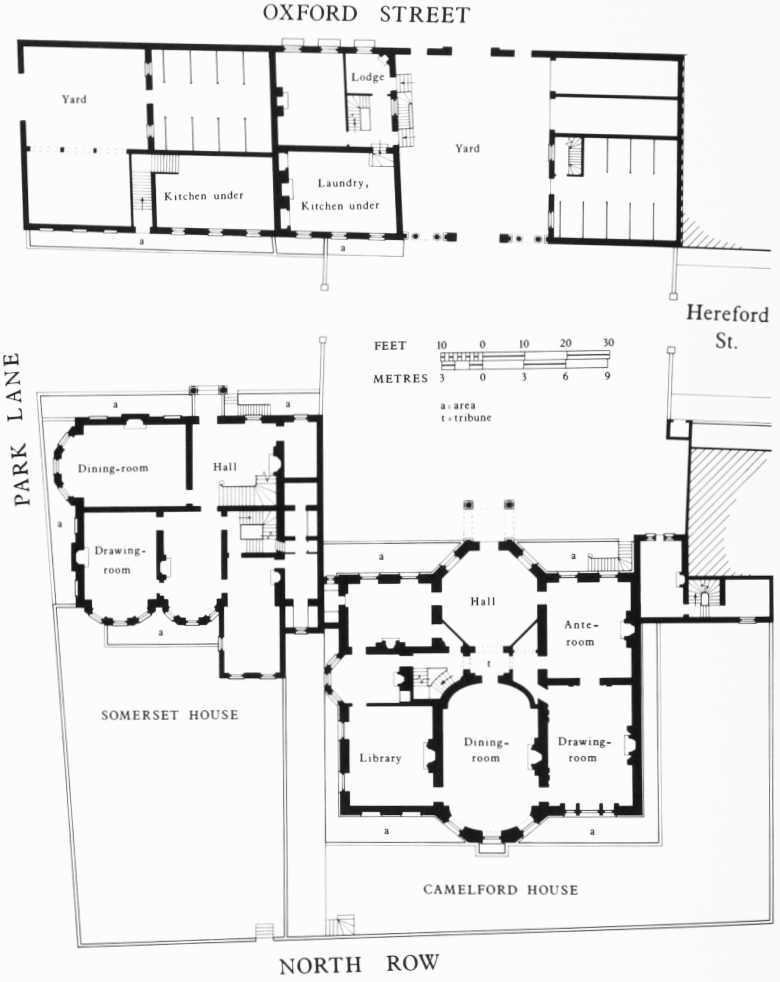
Camelford and Somerset Houses (demolished), ground-floor plans in c. 1820
In 1789 Lord Bateman left the house and was succeeded by Warren Hastings, who, having returned from India four years earlier, had recently been impeached. During the remainder of his long trial, culminating in acquittal in 1795, this was Hastings' London house, and his period here also coincided with his rebuilding of Daylesford House, Gloucestershire, under S. P. Cockerell. (fn. 44) The price paid to Bateman was probably £8,000, of which Hastings paid half immediately, moving in during November 1789. He made some minor changes which probably involved Cockerell, but does not appear to have undertaken serious alterations. In 1797 he resolved on selling the house and found a buyer in the third Earl of Rosebery, who paid £9,450 for it at auction but declined the pictures; these, Hastings laconically observed in his diary, were 'sold at Christie's for nothing'. (fn. 231)
After Lord Rosebery's occupation, in 1808 the eleventh Duke of Somerset bought the house, then described as 'a very good one'. (fn. 232) The Duke soon had plans for extension which necessitated the first of several negotiations with his close neighbour at Camelford House, Lord Grenville. Though not aligned, the houses nearly touched at one point, so that any southward enlargement of Somerset House was bound to detract from the amenity of Camelford House. In 1810, therefore, the Somersets agreed not to build on their garden and approached Earl Grosvenor with a view to filling in the space in the court between the house and stables. The Estate was averse to allowing this, as there was doubt as to the precise legal status of the court, and Lord Grosvenor thought that such an extension would darken Hereford Street. Eventually a small addition, probably designed by Jeffry Wyatt and consisting merely of a single-storey entrance corridor from Park Lane to the front door, was sanctioned but not built for the time being. (fn. 233) Instead, the Somersets contented themselves with interior decorations. In 1813 the Duke told his brother: 'Charlotte is as busy as a bee upon a bank of thyme. Furnishing her house has been one occupation, and she has the fashionable predilection for old things.' (fn. 234)
The confrontation with Camelford House recurred in 1819, when the Duke of Somerset again contemplated building on his garden, this time under P. F. Robinson, currently his architect at Bulstrode Park, his country seat. Alternatives were proposed: a long projection against the wall along Park Lane, or a shorter one close to the west-facing windows of the library at Camelford House. After delicate negotiations with Lords Grenville and Grosvenor, conducted upon what Edward Boodle was pleased to call a 'footing of liberal forebearance', the Duke accepted a curtailed version of the shorter projection, hardly interrupting the westward view from Camelford House. Even then Thomas Grenville was inclined to make light of Somerset's intentions: 'one has seen so many architectural plans discussed by the noble Duke, without a single brick being placed, that I know not how to think the danger very pressing, more especially when I recollect that there are already more rooms in their present house than are actually furnished or likely to be inhabited'. However the two-storey extension was duly built, and in 1820 the Duke was still thinking of further enlargements in the garden. These came to nothing, so in 1821 or 1822 he contented himself with building his single-storey entrance corridor on the north side, though whether to designs by Robinson or by Wyatt is unclear. (fn. 235)
The Duke's first wife died at Somerset House in 1827, but he remarried in 1836; after his own death there in 1855 his second Duchess lived on at the house until she died in 1880. At that date, the first floor was being used for drawing-rooms rather than bedrooms. (fn. 236) The twelfth Duke promptly made some repairs, which were undertaken by William Cubitt and Company and may have included alterations to the balconies and the raising of some of the bays to attic level. (fn. 237) After his death in 1885 the house was empty for some years, but in 1906, when Mrs. Murray Smith was living here, negotiations first began for rebuilding this site together with Camelford House. (fn. 238) The second Duke of Westminster was at first disinclined to allow the demolition of the houses, 'particularly having regard to No. 40 having historical associations', but eventually he submitted, though Somerset House remained inhabited for some little time after Camelford House was pulled down in 1913. (fn. 239) When Mrs. Murray Smith left in May 1914 she reported that 'there were vaults with chains in them'; the estate surveyor, Edmund Wimperis, duly investigated, but could find no trace of an alleged cell supposed to have been used for prisoners being taken to Tyburn. (fn. 240) When demolition occurred in 1915, four of the better mantelpieces were moved to houses elsewhere on the estate, two to No. 11 Green Street and two to No. 50 Park Street; those at the latter house still exist today (fn. 241) (Plate 75d).
Occupants include: 2nd Viscount Bateman, 1772–89. Warren Hastings, Governor General of India, 1789–97. 3rd Earl of Rosebery, 1798–1808. 11th Duke of Somerset, 1809–55: his wid., 1855–80: her step-son, 12th Duke, 1880–5.
Camelford House (demolished).
This interesting house, built in about 1773–4 on a confined site just behind Oxford Street between Lord Bateman's house in Park Lane and the new Hereford Street, survived until 1913. Its designer and first inhabitant was Thomas Pitt, M.P., of Boconnoc, from 1784 first Baron Camelford, a nephew of William Pitt the elder and an amateur architect of some ability. The site, averaging about ninety feet in width and stretching through from Oxford Street to North Row, was part of the large area in the north-west corner of the estate taken by John Phillips, carpenter, in 1765. Phillips granted a sub-lease to Pitt in 1773, when the house was probably nearing completion, and Pitt was soon afterwards in occupation. (fn. 242)
The result was a formally planned late-Palladian villa with a modest garden behind, a square courtyard in front on the line of Hereford Street, and a pair of low buildings housing stables and offices in the front toward Oxford Street, separated by a small yard (fig. 65). The house itself was of plain brick construction, with two storeys only above ground; there were three-sided bays in the centre at front and back, and a small open porte cochère in front (Plate 69c: see also Plate 14a in vol. XXXIX). The interior was probably characterized throughout by refined neo-classical detailing, some of which (notably in the octagonal entrance hall) survived until the house's demolition (Plate 69a). There were five main rooms on the ground floor and seven above, two of them octagonal and one almost circular. The staircase, though toplit, was described in 1822 as 'unusually small and contracted'. (fn. 243)
How far Pitt himself was responsible for all the arrangements and decorations at Camelford House is not known, but the house was completed and occupied before he met the young John Soane at Rome in 1778. Shortly afterwards, Soane was entrusted with repairs and improvements at a number of Pitt's properties, and in a letter he referred to 'a sketch of your house in London'. (fn. 244) In 1783–5 he superintended minor works at Camelford House, perhaps in connexion with the letting of the house during one of Pitt's frequent absences abroad. (fn. 245) He also in 1785 produced for his patron an ambitious scheme for reconstructing the two houses closest to Camelford House in Hereford Street as a headquarters for the Society of Dilettanti (Plate 69d), but this came to nothing. (fn. 244)
The first Lord Camelford may not have lived much at the house after his ennoblement, for in 1787 he was thinking of letting 'my palace in Oxford-Street till my son is old enough to marry and live in it'. Then, shortly after his daughter had married the first Lord Grenville in 1792, Camelford went to Italy and the Grenvilles moved in. (fn. 246) Following his death abroad in 1793, rates were paid by his son the second Lord Camelford till 1799, and then by the Dowager Lady Camelford until she died in 1803. (fn. 133) But after the second Baron was killed in a duel in 1804, the house passed permanently to Lord Grenville, then a prominent Whig politician and soon afterwards head of the 'Ministry of All the Talents'. In 1806–9 Grenville was undertaking major works to his country house, Dropmore, under the architect C. H. Tatham, (fn. 247) but the authorship of 'some very elegant improvements in the ornamental decorations of Camelford-house' reported in 1809 remains unknown. (fn. 248) Some florid plasterwork in the dining-room could well have dated from this time (Plate 69b).
In 1814 a small extension to the library on the west side of the house was contemplated to designs by Robert Smirke. This was not carried out, and Lord Grenville now began to look for another house. In 1816 he secured a short lease of a house in Hamilton Place, and offered a seven-year tenancy of Camelford House to Prince Leopold of Saxe-Coburg and his new wife, Princess Charlotte, through the Commissioners of Crown Lands. Soane surveyed the house, valuing it at £18,000, and Grenville managed to secure the vast rent of £2,500 per annum. But the Prince and Princess were soon disillusioned with the house and endeavoured to sub-let it and move elsewhere; in the end they were at Camelford House for scarcely more than eighteen months. (fn. 249) New tenants were found for the next five years in the persons of the Earl and Countess of Tankerville. (fn. 133) In 1819 came a further difficulty, when the Duke of Somerset contemplated overshadowing Camelford House with an extension to his house. This was quickly resolved, but Grenville soon afterwards determined to sell the house. Henry Harrison, who surveyed it, regarded it as 'not calculated to suit many persons' and pointed out the deficiency of the stairs and the bedrooms; he suggested a price of £13,000. (fn. 243) Eventually a buyer was found in Lord Midleton, who in 1824 paid only £11,000 for it. Lady Williams-Wynn, reporting this, added: 'for myself I have always thought it one of the most unpleasant habitations in London'. (fn. 250)
In 1828 Camelford House passed to (Sir) Charles Mills, of Glyn, Mills' bank, who early in the following year was 'modernizing and improving that spacious mansion'. (fn. 251) He lived here until his death in 1872, when he was succeeded by his son Sir Charles Henry Mills, from 1886 first Lord Hillingdon. In 1898 the second Lord Hillingdon succeeded his father, keeping the house till it fell out of lease in 1907. Few details are known of works carried out by the Mills family. The carriage entrance from Oxford Street between the stables and offices had been filled in by 1844, leaving the approach to the house from Hereford Street or from Park Lane through the neighbouring courtyard of Somerset House, and shortly after this date a verandah appeared on the garden front. Alterations by the builder John Kelk and his successor George Smith and Company are recorded in 1852, 1873, 1875 and 1898. In one of these campaigns the porte cochère was extended and filled in, and by the end of the house's life some of the rooms had been redecorated in the French style (Plate 69b). In 1879, 'a one storey Arab room' was erected by Smith to designs by George Aitchison; this was simply a small, separate smoking-room, built in the south-east corner of the garden. (fn. 252)
On the expiry of the lease in 1907, Camelford House became empty. At the second Duke of Westminster's insistence, terms were offered in 1909 to Mrs. Beatty, wife of Captain (later Admiral of the Fleet, Earl) Beatty; her refusal sealed the fate of the house, which was already being considered for rebuilding along with Somerset House. Photographs were taken by the London County Council shortly before demolition in 1913, after which the Pavilion Cinema was built on the site. (fn. 253)
Occupants include: Thomas Pitt, latterly 1st Lord Camelford, 1774–93: his son, 2nd Lord Camelford, 1793–9: the latter's mother, wid. of 1st Lord, 1799–1803: her son-in-law, Baron Grenville, Prime Minister, and his wife, Anne, da. of 1st Lord Camelford, 1805–16. Princess Charlotte, da. of George, Prince of Wales, and her husband Prince Leopold of Saxe-Coburg, 1816–17. 4th Earl of Tankerville, 1818–22: his wid., 1822–3. 4th Viscount Midleton, 1824–7. (Sir) Charles Mills, latterly 1st bt., member of banking firm of Glyn, Mills and Co., 1828–72: his son, Sir Charles Henry Mills, 2nd bt., latterly 1st Baron Hillingdon, banker, 1872–98: the latter's son, 2nd Baron Hillingdon, banker, 1898–1907.
Nos. 139 and 140 Park Lane and 527–539 (odd) Oxford Street.
The large stone-faced range of flats here, originally accompanied by a cinema behind, was built to the designs of Frank Verity in 1913–19. The main range has long been one of the most admired of Verity's large blocks of West End flats, and its clever mixture of Beaux-Arts and Greek motifs executed in Portland stone make a striking feature on one of London's most prominent sites (Plate 48a in vol. XXXIX).
When the lease of Camelford House was nearing expiry in 1906, the Estate started to think of rebuilding this whole site, but an offer at this time from the builders Perry Brothers to construct a hotel here, and another in 1910 from J. Lyons and Company, both fell through. This was chiefly because Somerset House did not fall out of lease until 1914; it was therefore necessary to build first on the site of Camelford House, where buildings of any height would have obstructed Hereford Gardens. The second Duke of Westminster and his surveyor, Edmund Wimperis, were also reluctant to sacrifice these two historic houses, even for the greater rent obtainable. (fn. 254)
Eventually it was agreed to build a low cinema first, next to Hereford Gardens, followed by flats on the corner site. In December 1911 the Grosvenor Board was entertaining several such propositions, of which one to be designed by Frank Verity met with most favour. At an advanced stage Verity's client backed out, and it was left to the Board to press his scheme on Israel Davis, another of the applicants. Though Davis and his company, the Electric Pavilion Limited, had already built several London cinemas, his financial position was somewhat infirm. His intention was to complete the cinema and then assign the site for the flats to another undertaker. On this basis work began in 1913 on the cinema, which was finished at a cost of about £24,000 shortly after the outbreak of war. The lease was then quickly granted to Davis, whose affairs were now pressing. (fn. 255)
The Pavilion Cinema, Marble Arch, as it was called, stretched right through from Oxford Street to North Row. It had a simple auditorium with decorative balconies, a generous vestibule, and four free-standing columns along the low stone front towards Oxford Street, with small shops left and right (Plate 47c). The cinema prospered as a result of the war and survived with some vicissitudes until 1957, when the site was rebuilt in a somewhat plebeian manner with shops, offices and a garage behind in North Row. (fn. 256)
The flats did not progress quite so smoothly. At first it was hoped to have shops on the ground floor and six storeys of flats above, but as early as 1912 agitation in the press against shops in Park Lane induced the Grosvenor Board, which was 'somewhat nervous as to the effect on the residents and public of the erection of the buildings', to request a revision. (fn. 257) New plans were soon forthcoming, and Wimperis in particular was impressed by 'the helpful spirit in which Mr. Verity has uniformly met every criticism made in the interests of the estate'. (fn. 258) In 1914 Somerset House was vacated and the site was made available to Davis, but not long after the completion of the cinema he assigned the flats to (Sir) John W. Lorden, a prominent developer with a base in South London. Under difficult wartime conditions his firm, W. H. Lorden and Son, began work on the flats in 1915, but in September 1916, when the structural steelwork was nearly complete, Lorden lost his licence for building here and operations closed down. A perspective view by William Walcot of Verity's revised design, which now included an extra storey of flats, was shown at the Royal Academy in 1917. (fn. 259) Meanwhile, a legal wrangle between Davis and Lorden had arisen over the payment of rent. This took some time to settle, and the work seems to have been resumed and finished only in 1919. The completed buildings were assigned to Sir Thomas Brooke-Hitching. (fn. 260) Some years later, in 1932, the Estate sold the freehold of the flats to the lessees, Town Investments Limited, for £44,000. (fn. 261) The present numberings in Park Lane and in Oxford Street were adopted in 1934 and 1939 respectively.