Survey of London: Volume 40, the Grosvenor Estate in Mayfair, Part 2 (The Buildings). Originally published by London County Council, London, 1980.
This free content was digitised by double rekeying. All rights reserved.
'South Audley Street: East Side', in Survey of London: Volume 40, the Grosvenor Estate in Mayfair, Part 2 (The Buildings), ed. F H W Sheppard (London, 1980), British History Online https://www.british-history.ac.uk/survey-london/vol40/pt2/pp291-303 [accessed 30 April 2025].
'South Audley Street: East Side', in Survey of London: Volume 40, the Grosvenor Estate in Mayfair, Part 2 (The Buildings). Edited by F H W Sheppard (London, 1980), British History Online, accessed April 30, 2025, https://www.british-history.ac.uk/survey-london/vol40/pt2/pp291-303.
"South Audley Street: East Side". Survey of London: Volume 40, the Grosvenor Estate in Mayfair, Part 2 (The Buildings). Ed. F H W Sheppard (London, 1980), British History Online. Web. 30 April 2025. https://www.british-history.ac.uk/survey-london/vol40/pt2/pp291-303.
In this section
East Side
No. 9
No. 9 (Plates 77c, 78b, 79c, figs. 66–7: see also fig. 6a in vol. XXXIX). This is the first of a group of eight good houses between Hill Street and South Street, built in the late 1730's and all more or less surviving. John Eds, carpenter, agreed in 1736 to take the site of Nos. 9–11, and No. 9 at the corner with Hill Street was leased in 1738 to John Blagrave, carpenter, by consent of Eds and Roger Blagrave (lessee of Nos. 10, 14, 15 and 16), followed a little later by the plot behind it stretching through to Union (now Waverton) Street. In 1739–40 the house and back buildings passed to their first occupant, Susannah Jennings. (fn. 2)
The fronts of Nos. 9 and 10 indicate that they were built as a pair of narrow two-bay houses, with matching windows and cornices and four original full storeys above ground (Plate 77c). Though both have kept their character very well, No. 9 has seen the greater changes. Originally the entrance was in South Audley Street next to No. 10. (fn. 3) The house's most striking feature, a three-storey projection overhanging the pavement in Hill Street and carried on plain stone columns, may be an early addition made after Hill Street was laid out in c. 1744, and perhaps the result of repairs recorded in 1754, when the rateable value increased pronouncedly. (fn. 4) But the entrance remained in South Audley Street until the nineteenth century.
Within, the house's Georgian character is well preserved. There is a single central stair between front and back rooms with good wrought ironwork to the balustrade (fig. 6a in vol. XXXIX). Several of the rooms retain old panelling, notably at the back, where the bow is original through all the main storeys except for the topmost. The finest room here is at ground level, where the ceiling displays the ornamental plasterwork typical of this group of houses (Plate 79c). A wooden fireplace featuring a winged eagle was stolen from this room in 1975, but has been replaced with another Georgian chimneypiece.
The entrance was moved to its present position under the projection in Hill Street some time between 1828 and 1872: (fn. 5) a possible date is 1855, when William Cubitt and Company made changes here. (fn. 6) Further alterations and additions, perhaps including the attics, were undertaken by another firm of builders, Colls and Sons, in 1873. (fn. 7) Thereafter the house's history seems to have been uneventful until it fell out of lease in 1928, except for the separation and demolition of the stabling in 1914 to add to the South Street garden. (fn. 8) In 1930 the second Duke of Westminster proposed that it should be made available to Gabrielle ('Coco') Chanel, who was chiefly to use the house for the business of her cosmetics firm. Works to the value of £8, 764 were directly undertaken by the Estate under the superintendence of G. A. Codd, the firm of Trollope and Sons being the main contractors and decorators. Despite her rent-free accommodation, Chanel kept the house only until 1934. (fn. 9) Next year the house passed to Humphrey Minto Wilson, who employed Lenygon and Morant to make changes. (fn. 10) The present neo-Georgian aspect of the outer hall, ground-floor front room and several upper rooms could be due to the works either of 1930–1 or of 1935.
Occupants include: Capt. David Brodie, R.N., 1755–67. Sir Simeon Stuart, M.P., 3rd bt., 1767–78. Sir George Paul, 2nd bt., 1778–80. Dow. Lady de Clifford, wid. of 20th Lord Clifford, 1802–28. 3rd Earl of Ashburnham, 1830. Edward Stafford Jerningham, son of 8th Baron Stafford, 1831–49.
No. 10
No. 10 is a pleasant, small Georgian house not now very different from when first leased to Roger Blagrave, carpenter, in 1738 (fn. 11) (Plates 77c, 78). It was essentially similar in front and plan to No. 9, but possessed no stabling behind. There is a central staircase of stone with a surviving wrought-iron balustrade (fig. 6b in vol. XXXIX), and Georgian panelling remains in several rooms. The ground-floor rear room has a door from the hall surmounted by a broken pediment and a good ornamental ceiling in plaster. The rear wall, unlike at No. 9, is flat but incorporates a carefully designed pattern of fenestration (Plate 78b).
A paucity of documentary evidence on the later history of No. 10 is redeemed by a fascinating set of pencil drawings made in 1813 by John Buckler for a new owner, the antiquary Thomas Lister Parker (fn. 12) (Plate 78). These show that by then the entrance had a fanlight and opened directly into the ground-floor front room; the rear room (as now, the only room to have an ornamental ceiling) served as a dining-room. Above the hall was Parker's library, decorated in an up-to-date taste with red walls and 'gray cloth' on the floor. Behind this was a single drawingroom.
Works of 1871 and 1877 may have included the lowering of the first-floor windows, but the roof was probably not raised until 1933. (fn. 13) Part of the garden was taken from the house in 1914 in order to be added to the proposed South Street garden. (fn. 14)
Occupants include: Thomas Lister Parker, antiquary, 1812–17. Henry Hake Seward, architect, 1826–48. Gen. (Sir) George Cadogan, son of 3rd Earl Cadogan, later K.C.B., 1855–9. Lord Arthur Russell, grandson of 6th Duke of Bedford, 1869–76. Maj.-gen. Inigo Richmund Jones, 1880–1914.
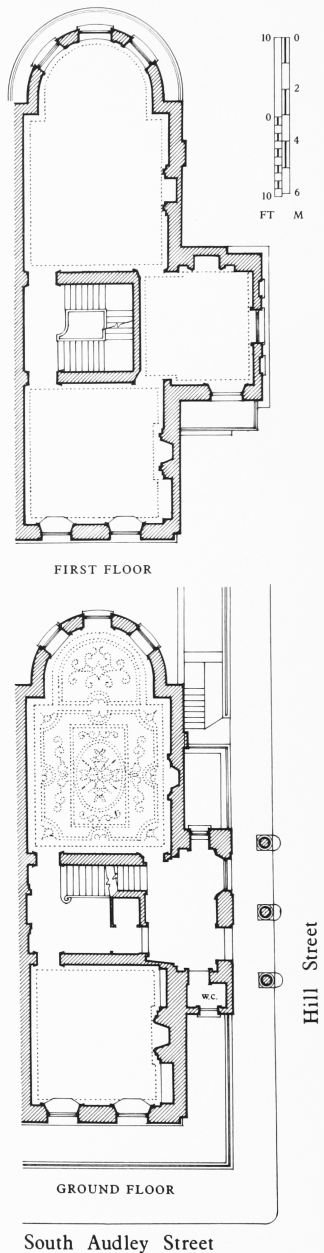
No. 9 South Audley Street, plans in 1974
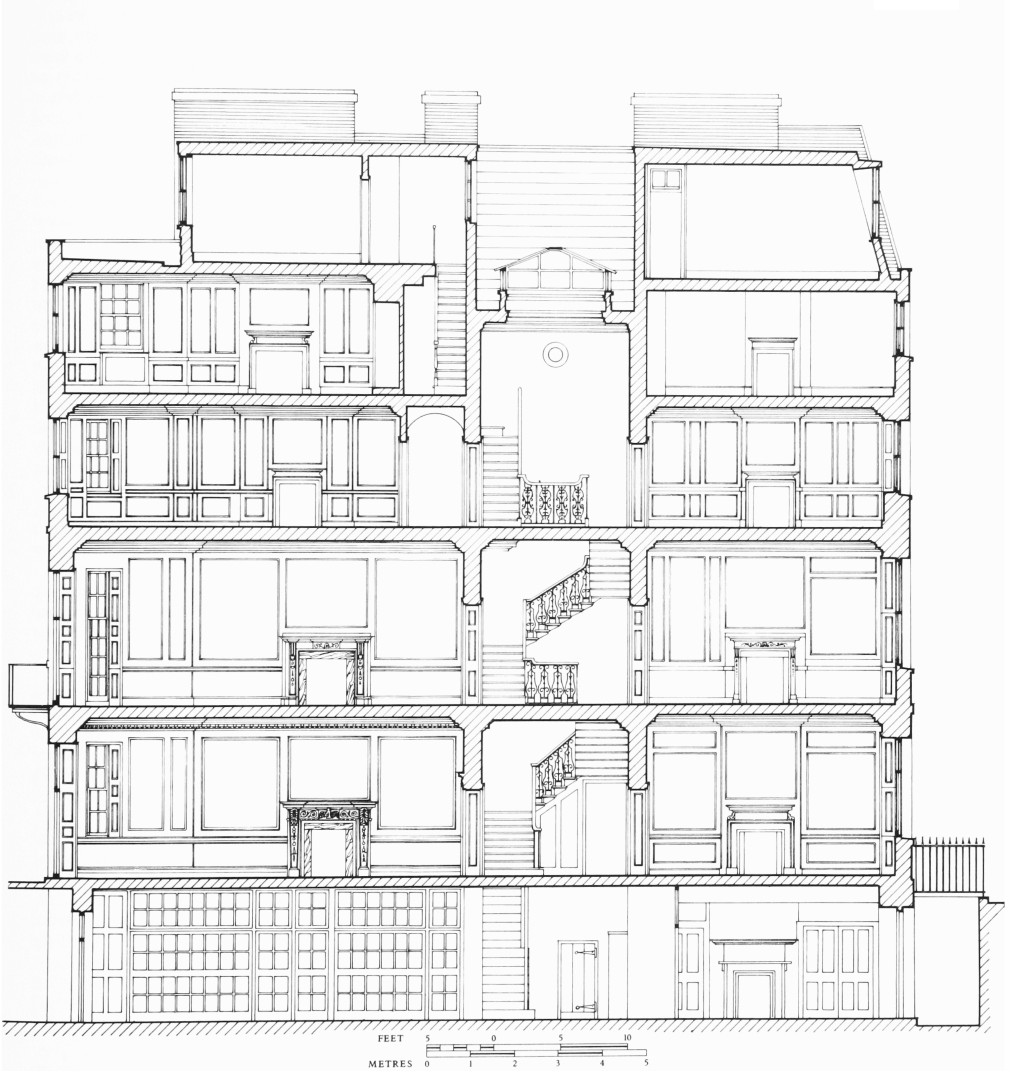
No. 9 South Audley Street, section in 1974
No. 11
No. 11 is now one of the less interesting houses in this sequence (Plates 77b, 78b). It was leased in 1737 by consent of John Eds, carpenter, to the first occupant, George Thwaits, gentleman, who also took some of the back premises but sub-let them separately. (fn. 15) The house may have been grouped with Nos. 9 and 10; if so, it was rebuilt with lower storey heights following a disastrous fire in 1769. According to Lady Mary Coke, who was dining opposite at the time and viewed the conflagration, the house was 'intirely destroy'd' and the occupants 'lost almost everything'. (fn. 16)
Whatever the scale of subsequent reconstruction, the plan probably followed that of the previous house, as the stair is centrally placed and portions suggest it may have been the original one. Apart from this, few features predate the granting of a long lease to John Balls, cabinetmaker, in 1826. (fn. 17) Balls most likely made substantial internal alterations before parting with the house. A festive verandah on the front at first-floor level had existed in 1813 but was replaced or extended in 1864. (fn. 18) An important set of works occurred when the builder John Garlick took No. 11 in 1899 and added a storey. (fn. 19) In 1914 the back premises were curtailed for the benefit of the South Street garden behind. (fn. 20) Since 1945 the verandah has been removed, the present state of the interior being largely due to a scheme of alterations carried out by Peter Wood and Partners, architects, in 1975–6. (fn. 21)
Occupants include: (Sir) Thomas Frankland, M.P., later 6th bt., 1775–7. Edward Utterson, literary antiquary, 1820–5. Lady Frances Somerset, da. of 5th Duke of Beaufort, 1830–41. Maj.gen. Samuel Lambert, 1842–6. George Skene Duff, M.P., 1854–9. George De Grey, son of 4th Baron Walsingham, 1860–71. Maria Louise Carleton, grand-da. of 1st and sister of 4th Baron Dorchester, 1873–98. 3rd Earl Cowley, 1900–5. Maj.gen. Sir Henry Bushman, K.C.B., 1908–20.
No. 12
No. 12 is the larger of two houses agreed for in 1736 by William Singleton, plasterer, and leased to him in 1737. (fn. 22) Singleton was a local figure of whom little is known, but on account of the fine plasterwork in Nos. 12 and 13 and other houses hereabouts some interest attaches to his name. From 1738 he was living in a house in Union (now Waverton) Street, behind Nos. 12 and 13, and at his death in 1756 he held leases of property in Chapel (now Aldford) Street and Mount Street. (fn. 23) At No. 12 Singleton soon disposed of his interest to the first occupant, James Lumley, M.P. In 1756 Isaac Ware was to publish a chimneypiece designed for Lumley's house in South Audley Street, but this probably refers not to No. 12 but to No. 8 (not on the Grosvenor estate), whither Lumley moved in 1744. (fn. 24)
Despite frequent alterations inside and out, the house is an interesting one. Though stuccoed, and enriched with a first-floor balcony, window dressings and new cornice, and subsequently heightened, the front still shares with No. 13 some quaint original rustication around the ground-floor windows (Plate 77a, 77b). Of early interior work the outstanding survivals are the ceilings of the two main ground-floor rooms, which are ornamented in the local, luscious style of plasterwork. The front room has an octagonal centrepiece and border motifs with baskets of fruit and Roman heads, whereas the ceiling behind incorporates embracing cherubs in the centre with putti, antique heads, birds and flora in the surrounding panels (Plate 79a, 79b: see also fig. 5a in vol. XXXIX).
Old features remain in some other rooms, notably a cornice in the back room on the first floor. But the present hall and stair suggest that a front-compartment staircase may have been removed at quite an early date. According to Lady Mary Coke, No. 12 'suffer'd a good deal' in the fire of 1769 which virtually destroyed No. 11. (fn. 16) The first-floor drawing-room, which would not have enjoyed its present breadth if a front-compartment stair existed, certainly now presents a mid-Georgian appearance consonant with a reconstruction of the 1770's. It may be added that at the time of the fire No. 12 belonged to the third Duke of Atholl. According to an inventory there were then both front and back stairs, the former in stone, and apparently only two main rooms on each storey. The dining parlour on the ground floor had '2 Figures on the Chimneypiece', and there was at the same level already a 'Water Closset', thoughtfully equipped inter alia with a cedar bookcase, a bow and two arrows, two state swords, two foils, a powder cask, and a 'flower pott'. (fn. 25)
Later evidence hardly helps to interpret the appearance of the house today. The insertion of the present plain stone stair and balustrade, remodelling of the hall, and stuccoing of the front perhaps date from 1848, when the builder John Newson made an addition. (fn. 26) But in 1876–7 another builder, Charles Fish, bought the house and stables and also made major changes, probably mainly at the back. (fn. 27) Further alterations in 1883, 1890 and 1892 (including the slight lengthening of the ground-floor back room) did not deter the estate surveyor, Edmund Wimperis, from condemning No. 12 in 1913 as 'a very bad old house and worn out'. (fn. 28) Much of the garden and rear premises, which as with other houses in this range did not extend right through to Waverton Street, was then cut off for the formation of the South Street garden. In 1954 the house was thoroughly overhauled by W. Turner Lord, decorators, on behalf of (Sir) James Harman. They installed a lift, paved the hall, and fixed new fireplaces in all the reception rooms. (fn. 29)
Occupants include: James Lumley, M.P., son of 1st Earl of Scarbrough, 1740–4. Julines Beckford, brother of William Beckford, 1744–5. Viscount Petersham, M.P., later 2nd Earl of Harrington, 1747–8. Rear-adm. (Sir) Charles Knowles, later 1st bt., 1750–1. John Murray, latterly 3rd Duke of Atholl, 1763–70. Thomas Bradshaw, M.P., 1770–4. Keith Stewart, M.P., son of 6th Earl of Galloway, 1774–8. Lieut.-gen. James Johnston, 1778–97. Lieut.-gen. Edward Pery Buckley, M.P., 1844–73. Gen. Sir Charles Ellice, K.C.B., 1878–82. 1st Baron Gerard, 1883.
No. 13
No. 13, leased to William Singleton, plasterer, in 1736 and assigned to Sir John Buckworth a year later, is a smaller house than its companion No. 12. (fn. 30) But it retains a front which, though painted, has not been much altered except for the unfortunate removal of the cornice (Plate 77a: see also fig. 2d in vol. XXXIX). With its rusticated ground-floor openings, its bandcourse and stringcourse, and, rising from the latter, its dressed and unlengthened first-floor windows, it still adheres to a more Palladian type than did most of the street architecture on the estate and, for example, the former No. 70 across the road.
Within, the plan originally followed the pattern of narrow-fronted Georgian houses in having a stair between front and back rooms. But, perhaps in 1928, parts of the house, probably including the ground-floor rear room and most of the basement, were taken into No. 14, so obscuring the old arrangement. (fn. 31) Photographs taken in 1948 show that rich plasterwork still then survived in the ceiling of this back room (Plate 79d); more unusually, there were also plaster panels including a bust in relief set in a medallion on the wall of the stair between the first and second floors (Plate 9c in vol. XXXIX). All traces of these decorations have now disappeared, perhaps in about 1953, and the only remnants of early work that remain are a plaster vault to the hall carried on large consoles and the woodwork of the upper parts of the stair.
Of the history of No. 13 there is little to say. In 1825 Richard Westmacott the sculptor, who lived at No. 14, took a lease of the house but never occupied it himself; £1,031 was deducted from the sum owed in consideration of bills due to Westmacott from Lord Grosvenor. (fn. 32) Later additions are insignificant except for the raising of the attics in 1909. (fn. 33)
Occupants include: Sir John Buckworth, 2nd bt., M.P., 1737–41. Lady Betty Montagu, 1741–2, and Lady Babb Montagu, 1744–8, da.'s of 1st Earl of Halifax. William Woodley, M.P., and Governor of Leeward Islands, 1767–72. Sir John Gresham, 6th bt., 1772–6. Thomas Steele, M.P., 1785–6. Maj.gen. Anthony St. Leger, 1786. Frederick Byng, son of 5th Viscount Torrington, 1826–30. Charles Edward PoulettThomson, M.P., latterly Governor General of Canada and Baron Sydenham, 1835–41: his brother, George Poulett Scrope, M.P., 1843–7. Sir Hyde Parker, 8th bt., 1848–51. 2nd Baron Forester, 1852–7. Capt. Douglas William Labalmondiere, Assistant Commissioner, Metropolitan Police, 1858–78. Sir William Eden, 7th bt., 1887. 2nd Viscount Tredegar, 1936–46.
No. 14
No. 14, the largest house in this range between Hill Street and South Street, despite heavy alteration possesses some distinction in history and appearance. Leased in 1736 to Roger Blagrave, carpenter, it was thirty-four feet wide and, uniquely among these houses, retained the full depth through to Union Street, so allowing substantial back buildings and stabling. (fn. 34) Though these have now disappeared, No. 14 itself has kept its basic early-Georgian character. The elevation has been raised and recently stuccoed (Plate 77a), but the old plan still remains with its front-compartment staircase and secondary stair behind. The back stair displays its original woodwork throughout and the front stair, though now having a later iron balustrade of S-shaped form, retains a good plaster ceiling. There is also an ornamental ceiling on the ground floor in the front room, with a central head of Apollo and other busts in the margins. In the rear room and higher up on the second floor, much Georgian panelling still survives.
In 1747 the house was sold to the first Lord Galway but soon passed swiftly to Admiral Edward Boscawen. (fn. 35) The surviving letters of his wife Fanny, who was to live here for over fifty years, reveal much about No. 14 and its district. In 1747–8 she was busy choosing papers from Thomas Bromwich and china ornaments for the chimneypieces and furnishings, repaving the street over the vaults 'with broad stones' and imploring her husband (then on service abroad) to bring back carpets, matting and muslins. (fn. 36) 'I am extremely well satisfied with my house and grow more and more settled in it every day', she wrote in 1748, and to another correspondent: 'Taste I always pretended to and must own I shall be greatly disappointed if you do not approve that which I have displayed in Audley Street'. (fn. 37)
Between 1755 and Boscawen's death in 1761 No. 14 was sublet. (fn. 4) After his widow's return in about 1764 she seems to have been much troubled in summer by heat, dust and noise, speaking once of her street as 'the most horrid place imaginable', and frequently took refuge in her well-tended garden. Having apparently made alterations in 1779 and 1791, Mrs. Boscawen remained at No. 14 until her death in 1805. (fn. 38)
In 1818 the sculptor (Sir) Richard Westmacott, having outgrown his premises in Mount Street nearby, bought No. 14, doubtless because it combined good residential accommodation with extensive space at the back for workshops. He did not however control all these premises, as there were two small houses facing Union Street divided by a passage leading to the stables; these houses were assigned to Westmacott in 1829 but continued to have subtenants. (fn. 39) Westmacott almost certainly undertook major alterations involving encroachment on the garden. In 1823 he asked for permission to 'disturb his casting pit'. (fn. 40) The offices and stabling were enlarged at about this time, presumably to fit them for the needs of his business, while immediately behind the house a broad toplit corridor leading to a single-storey room was added. These in part survive and perhaps functioned as studio and gallery. The present iron balconies on the front probably also date from Westmacott's time.
The 'wing buildings' together with the basements were apparently much rebuilt about fifteen years after Westmacott's death in 1856, and the house continued to be well tenanted, though the outbuildings were becoming dilapidated. (fn. 41) In 1914, when the South Street garden was formed, not only were these back premises removed but a small part of the house itself had to be demolished. (fn. 42) But the rear wing essentially remained and was one of the chief objects of alteration in 1922–3, when Sydney E. Castle (architect) and Head and Thurlow (builders) undertook major works for Captain D. S. P. Howard. A wall was cut away to make one large reception room with new windows at the back; bay windows were thrown out from the corridor and the first-floor back room, the entrance hall was repaved, a lift installed and a storey and a very inappropriate brick porch added. Much of this work was undertaken in a self-conscious, vernacular taste. (fn. 43) In 1928 part of No. 13, probably including its back room on the ground floor, seems to have been added to No. 14. This room is now featureless, having in about 1953 lost its fine plasterwork ceiling. Other alterations here and in the adjoining wing area of No. 14 have been made in the past thirty years, perhaps chiefly in 1952–3, the surprisingly late date at which the front elevation appears to have been stuccoed. (fn. 44)
Occupants include: Adm. Edward Boscawen, 1747–55. 3rd Earl of Tankerville, 1755–62. 'Earl of Kinmare',? Thomas Browne, 4th titular Viscount Kenmare, 1762–4. Mrs. Frances Boscawen, wid. of Adm. Boscawen, 1764–1805. Adm. George Cranfield Berkeley, 1813–14, 1817–18. (Sir) Richard Westmacott, latterly kt., sculptor, 1818–56. Edward Frederic Leveson-Gower, M.P., son of 1st Earl Granville, 1864–1906. Capt. D. S. P. Howard, M.P., latterly 3rd Baron Strathcona and Mount Royal, 1922–41.
No. 15
No. 15 was leased in 1736 to Roger Blagrave, carpenter, and soon afterwards occupied. (fn. 45) It was perhaps built together with No. 14, as the cornices align (Plate 77a), but its history is obscurer. Having a frontage of three windows' width but no full depth of plot, it was compensated in the original lease with a return front on part of the ground now occupied by No. 38 South Street, where stables were built. In 1790 No. 15 itself was said in a notice of auction to possess two good rooms on each floor, a stone staircase and a detached kitchen, wash house and laundry. (fn. 46)
In 1831–2 the lease was renewed to John Feetham, a speculator then much concerned with the properties opposite at Nos. 72–74 South Audley Street. Feetham curtailed the house, building new stables still extant and currently numbered No. 32 South Street on part of the back premises; these he let to Lord Cawdor of No. 74 South Audley Street. (fn. 47) The front was perhaps stuccoed at this time, but a portico and balcony erected in 1867 have been removed, perhaps in 1924. (fn. 48) A top storey may also have been added in 1867 (it was there in 1892) and the front otherwise elaborated. As for the interior, works were undertaken by the builder John Garlick and the purchaser from him, E. H. Cunard, in 1900–01. (fn. 49) A later occupant, Countess Zborowski, seems in 1904 to have indulged in some lavishly Edwardian expenditure. She failed at the end of her lease in 1914 to reinstate the chimneypieces she had removed, but some of the features were perhaps put back soon afterwards. The house narrowly escaped demolition when the South Street garden was laid out. (fn. 50)
Occupants include: Frederick Cornwallis, Bishop of Lichfield and Coventry, later Archbishop of Canterbury, 1750–67. Baptist Leveson-Gower, son of 1st Baron Gower, 1773–6. William Sturges-Bourne, M.P., 1819–31. Adm. Henry Raper, 1832–45. Rear-adm. Sir Thomas Hastings, kt., 1845–60. Rev. Annesley Gore, son of 3rd Earl of Arran, 1869–77. Ernest Haliburton Cunard, director of Cunard Steam Ship Co., 1901–3. Countess Zborowski, 1904–13. Frank Whiteley, 'formerly in the ivory and ostrich feather trade', Mayor of Mafeking during the siege, 1914–17. 3rd Earl of Kimberley, 1937–41.
No. 16
No. 16, a small corner house with a return frontage to South Street, was leased to Roger Blagrave, carpenter, in 1736 and first occupied by a chandler. (fn. 51) It was therefore a shop and so remained until 1900 (see Plate 86a), though in the later nineteenth century the upper parts of the house were separately and quite fashionably tenanted. (fn. 52) In 1900, however, the whole house was converted to private use and a Mr. Rhodes fathered a scheme of conversion, with Garlick and Horton as builders. (fn. 53) Shortly afterwards in 1903, some leaded windows were inserted and the door was altered. Other such temporarily fashionable accretions have since appeared on the fronts, while others have disappeared. (fn. 54) The interior retains few traces of Georgian work. Nevertheless the house is still the original one and has not been heightened (Plate 77a).
Nos. 17–22 (consec.).
This large and arresting pile ranks among the finest and best-preserved Victorian commercial premises in London (Plate 86: see also Plates 32, 33a, 33b, figs. 19, 23a, b in vol. XXXIX). In essentials it is due to reconstruction carried out between 1875 and 1891 for the firm of Thomas Goode and Company, china and glass merchants, to designs by Ernest George and Peto.
Thomas Goode (1794–1870) moved from a china shop in Mill Street, Hanover Square, to South Audley Street in 1844, where he took No. 19, promptly making an addition. (fn. 55) At this time the range between South Street and Chapel Place South still consisted of plain, small buildings, leased in 1730 to the consortium that also undertook the erection of the Grosvenor Chapel. (fn. 56) The ground floors were chiefly in commercial use, but Edward Martin Foxhall, district surveyor to the parish, inhabited No. 18 between 1828 and 1861. (fn. 57)
Goode's fashionable trade fast enlarged, especially after he was joined by his son William James Goode (1831–92). After Foxhall's death they took No. 18, and soon afterwards expanded into adjacent buildings on the north side of South Street. (fn. 58) The trend continued after the elder Goode's death, and in 1875 W. J. Goode began petitioning for a new lease of his premises, all of which he held as an under-tenant. So far as can be seen, Goode wished at this stage merely to improve the fronts, but in view of the complexity of the sites the Grosvenor Board made no promises. (fn. 59)
Soon, however, the first Duke took an interest in his case. In June 1875 Goode submitted an elevation that was rejected, but was told he might receive a new lease 'if he will build the front of the house … of red brick and terra cotta and of a design to be submitted to and approved of by the Duke, at an extra outlay'; with this went further advice that he should 'see the house which the Duke refers to in South Kensington'. This front was duly used as a 'model' for a new design, which the Duke quickly approved and admired. (fn. 60) Whatever the identity of this model (J. J. Stevenson's No. 8 Palace Gate seems the most likely candidate), the Duke plainly himself steered Goode and his architect towards a red-brick front in the fledgling Queen Anne style. At what exact point Ernest George was chosen architect is not clear, but none of his previous buildings had been in the full Queen Anne manner he was to adopt at Goodes and so often thereafter.
At first the reconstruction was scheduled to take in only Nos. 18 and 19. But in July 1875 Goode also acquired No. 17 at the corner with South Street, purposing in time to rebuild this site also. George's design, with two equal gables over Nos. 18 and 19, was amended to allow for an addition at this end with a lower gable. The contractors Manley and Rogers executed Nos. 18 and 19 in 1875–6, but before it was entirely finished Goode was able to get possession of No. 17, where the afterthought was duly built on in 1876. (fn. 61)
The original conception of Nos. 18 and 19, with double gables, a central entrance to the shop incorporating a self-opening door (still extant) and another door on one side leading to flats above, is typical of the slight asymmetries beloved of Queen Anne architects (fig. 19 in vol. XXXIX). This emphasis was diffused by the addition of No. 17, which in compensation was more richly decorated, notably with a series of cut-brick reliefs and ornaments carved by Harry Hems on the return front towards South Street (Plates 32, 33a in vol. XXXIX). In detail the whole building adheres faithfully to picturesque ideals, featuring prominent roofs, tile-hanging on the flanks of the gables, exaggerated chimneys (one ornamented with sunflowers) and frail wrought ironwork. The Building News adds: 'all the walls are built in cement, the brickwork being finished with a struck joint, as it was built. None of the work is gauged, and a fair width of joint is allowed to show through the carved panels as elsewhere. The window sashes and frames are finished white… . The woodwork of the ground floor is ebonised, and this with the red granite makes a setting for the ceramic wares for which Messrs. Goode are known.' (fn. 62) One surprising but apparently original feature is the blank arcade facing South Street behind No. 17, in stucco rather than brick and displaying ornamental tiles on the piers. Within, parts of the upper floors suggest that the rebuilding of 1875–6 was not a complete one. But the ground-floor showrooms are replete with the motifs of contemporary aestheticism. Several piers are decorated with Minton Hollins tiles, (fn. 1) and one remarkable room is intact, with leather paper on the walls, a fine painted frieze incorporating birds, and some mellow panels of secular stained glass.
After Nos. 17–19 were completed W. J. Goode continued to make changes behind the front, particularly in 1880–2. (fn. 63) In a bid for further premises he in 1886–7 considered building either on the opposite side of South Audley Street or further south, at No. 16. (fn. 64) In 1889 he negotiated instead for expansion northwards on to the site of Nos. 20 and 21, 'in order to exhibit goods immediately after the French Exhibition'. Providing that the tenant of No. 22 could be satisfied, the Duke promised Goodes the whole frontage up to a widened Chapel Place South, as it was then contemplated to rebuild the Grosvenor Chapel and open out its surroundings. Goode therefore had his way, and after some delays due to difficulties with the London County Council over the nature of the proposed fireproof flooring, in 1889–91 A. Bush and Sons built a large extension by George and Peto. (fn. 65)
The extension closely follows the Queen Anne style of the original, with one broad gable facing west towards South Audley Street, and one facing north towards the chapel, and similar walling, ironwork, and shop fronts divided by columns of red granite (Plate 86a). The external detailing is however simpler and the style of the main showrooms themselves chaster, having round-arched openings and, originally, painted figures in the spandrels (Plate 86b). Possibly these interiors were decorated by Liberty and Company, who made changes for Goodes towards South Street at this time. (fn. 66) The upper floors were also differently treated, for they were devoted to one expansive and cleverly planned house, No. 22 South Audley Street. In 1902–3 Detmar Blow, architect, undertook alterations here in a neo-Georgian taste for John Gordon, with Patman and Fotheringham as builders and Keeble Brothers as decorators. The structural work was not extensive, but other changes were made for the Gordons in 1905–6 and 1908. (fn. 67)
Among later changes at Goodes itself was an extensive set of alterations made by the architects Balfour and Turner behind No. 37 South Street, in 1907–8; an unusual stained-glass window in the rear of the shop may date from this time. (fn. 68) Small additions were made in 1911, 1928 and 1932, all (like those of 1907–8) by the local builders Haywood Brothers. (fn. 69)
No. 23
No. 23, at the east end of the short cul-de-sac between Goodes and the Grosvenor Chapel formerly named Chapel Place South, stands on land once disputed but now agreed not to be part of the Grosvenor estate. A building was perhaps first erected here in the early nineteenth century: a two-storey house with a pediment is shown in a drawing of 1830 (Plate 12b in vol. XXXIX). In 1889, when the Estate first claimed possession, it was called No. 5 Chapel Place South and it was described soon afterwards as a 'small red house'. Its proximity to the Grosvenor Chapel was one of the factors that prevented a rebuilding of the chapel at this time. (fn. 70)
The house's present appearance is due entirely to the Countess of Denbigh, the American second wife of the ninth Earl. Alterations were made in 1923 before the Denbighs moved in, and in 1926–8 further changes including an extra storey were made under the directions variously of W. J. Price, architect, and Victor Wilkins, architect. (fn. 71)
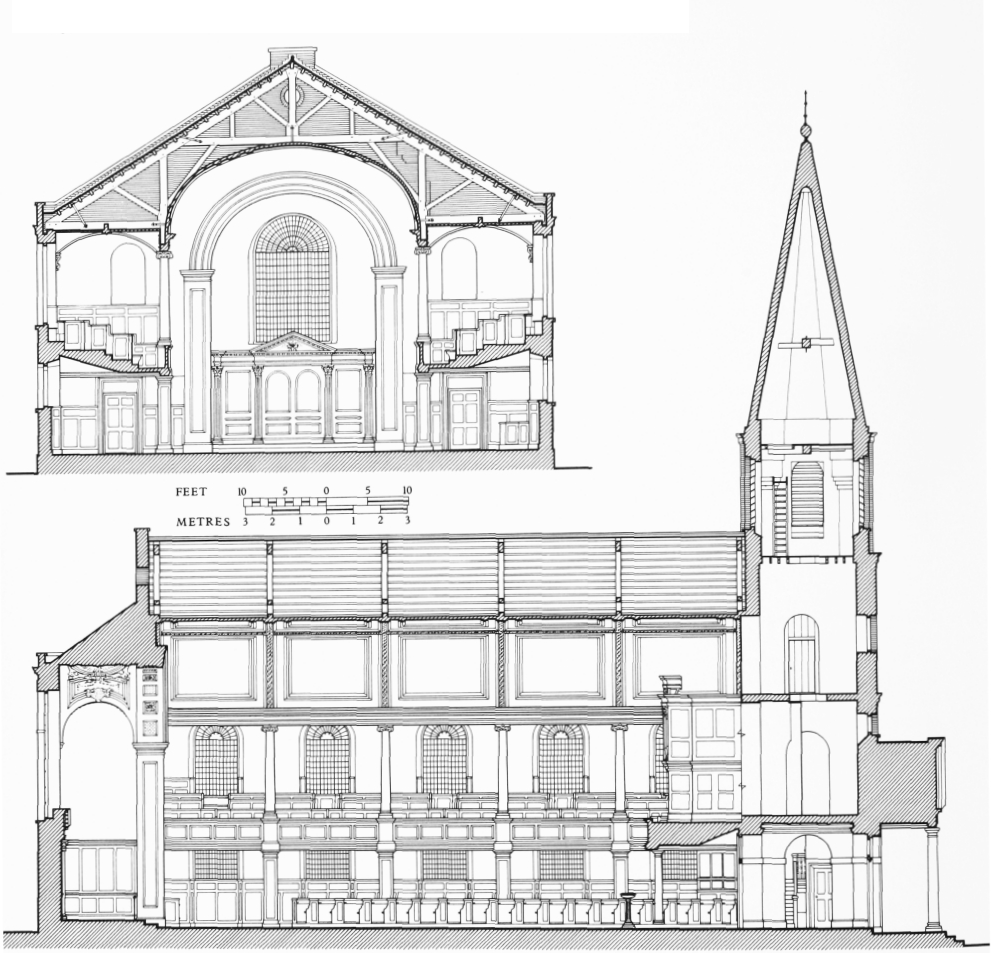
Grosvenor Chapel, longitudinal and cross sections as built. Pews in nave and font as altered in nineteenth century
The Grosvenor Chapel
The Grosvenor Chapel (Plate 76, figs. 68–70: see also Plate 12b, fig. 7 in vol. XXXIX). A site for a chapel on the east side of South Audley Street, opposite Chapel Street, had been provisionally settled as early as 1723, when John Mackay made his map showing the layout of the Grosvenor estate. In that year, Sir Richard Grosvenor sold an acre and a half to the south of Mount Street for use as a burial ground for the new parish of St. George, Hanover Square; the projected chapel was presumably conceived as a natural adjunct to this, though it was to have been sited to the south of the burial ground, not the west.
The proposal did not come forward until 1729, when a committee of the Vestry was appointed to look into the matter. But by an oversight on the part of the rector of St. George's, Sir Richard Grosvenor was able in April 1730 to conclude an agreement with four builder-proprietors, whereby they would erect a chapel under a long lease, while he would retain the freehold; and this meant that the vaults of the chapel could not be used for burials. By this agreement Benjamin Timbrell and Robert Scott, carpenters, William Barlow senior, bricklayer, and Robert Andrews, Sir Richard's lawyer and agent, agreed in return for low ground rents of adjacent properties to take a ninety-nine-year lease of the present site, and spend at least £4,000 on building a brick chapel with tower, steeple, portico, and internal galleries. Other minor stipulations were made in the agreement, and drawings which accord roughly with what was built were attached. The preamble made clear that both landlords and undertakers saw the chapel as a commercial proposition, which would derive its income from pew-rents and by serving the local residents would encourage other building. (fn. 72)
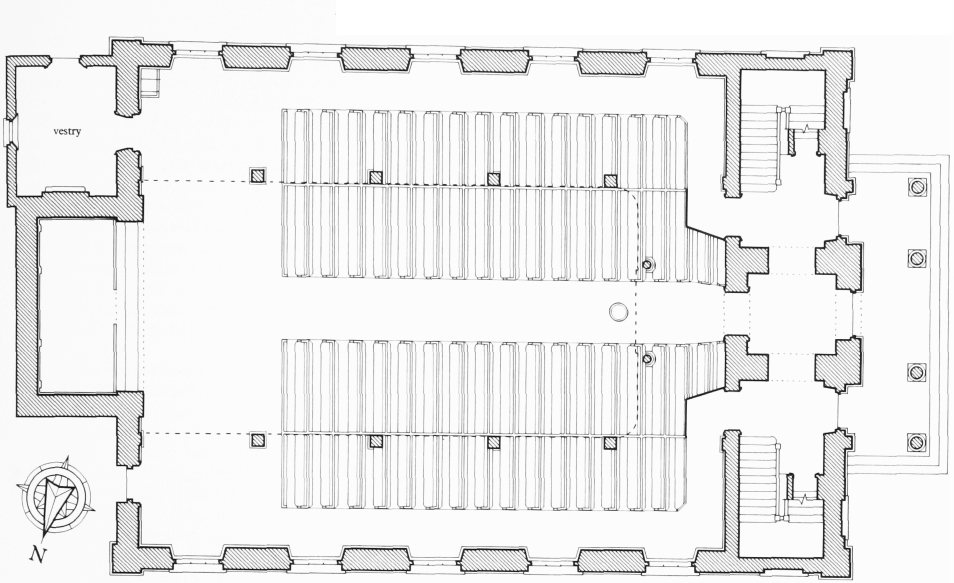
Grosvenor Chapel, plan
The foundation stone was laid by Sir Richard Grosvenor on 7 April 1730. (fn. 73) Building went speedily ahead, and the chapel was finished in about a year. By this time an accommodation with the Vestry had been reached, whereby in return for £500 Sir Richard Grosvenor agreed to grant to the rector and churchwardens the immediate freehold of the vaults and the yard between the chapel and the burial ground, and the freehold reversion of the chapel building once the leasehold term had expired; he also gave up the annual ground rent of £20 due to him from the chapel's proprietors. Two ministers having been appointed, the rector was requested in April 1731 to open the chapel, and the new arrangement was regularized in fresh deeds of the following year. (fn. 74) Of the four original undertakers William Barlow died in 1743, his share passing to his son John, and in 1751 Timbrell, Scott and John Barlow disposed of their interest to Robert Andrews. (fn. 75) The later presence of a Reverend Mr. Andrews as a minister until 1793 suggests that the Andrews family retained their interest in the chapel for many years. (fn. 4)
In attributing the design of the Grosvenor Chapel, there is no need to go beyond the best known of the four original undertakers. It bears telling resemblances to St. Peter's, Vere Street (originally the Oxford Chapel), for the construction of which Benjamin Timbrell had been largely responsible under James Gibbs in 1723. (fn. 76) The Grosvenor Chapel represents a cruder version of the same type of design, entirely consistent with the work of a capable master builder.
The west fronts of the two chapels were originally very similar. As first built, the Grosvenor Chapel had a substantial pedimented portico like that of St. Peter's, with windows left and right. Above, the roof line made two sides of a massive triangular pediment, here (unlike St. Peter's) brusquely interrupted by the lower stages of the tower. In execution, this tower's upper stage was altered from a Baroque cupola to a rather heavy-handed steeple (Plate 76a, 76b: see also Plate 12b, fig. 7 in vol. XXXIX). The sides of the Grosvenor Chapel had similar fenestration to that of St. Peter's, before stucco surrounds were added.
The general dispositions of the two interiors also conform. Both buildings have segmentally arched nave ceilings and simple cross-vaults in plaster over the galleried aisles (Plate 76c, 76d), but at St. Peter's there is an arcade of full Corinthian columns which helps to unify the design. At the Grosvenor Chapel the galleries project well forward, dividing the supports into square piers below and modest Ionic columns above, upon which rests a continuous entablature effectively dividing off nave and aisles. At the east end is a shallow chancel with a single, broad window and some more elaborate plasterwork in the ceiling. A substantial pulpit (of which only part survives), originally centrally placed, must have masked much of the altar rails, altar and reredos (fig. 70). To the north and south of the chancel there were once just two small rooms, accessible from the ends of the aisles. In the body of the chapel were pews of the old, high type, since cut down. The west gallery at first had two levels, in the higher of which stood the fine organ made by Abraham Jordan and given in 1732 by Sir Richard Grosvenor. (fn. 77) At either end of the lobby are two original stone staircases to the gallery.
The eighteenth-century history of the Grosvenor Chapel remains obscure and was probably not eventful. The most significant addition to the building was the elegant marble font on its slim, fluted pedestal, probably installed in about 1790. A number of pleasant memorials dotted about the walls (some, like Flaxman's tablet to Wilkes, 'A Friend of Liberty', commemorating the famous) indicate that the proprietors were successful in luring local fashionables to the services; but it must be remembered that the chapel functioned partly as a burial place for the parish church.
In 1828 the Grosvenor Chapel, evidently in a poor state of repair, was pilloried by John Britton as 'one of the most hideous chapels in the Metropolis' and contrasted unfavourably with the new church of St. Mark, North Audley Street. (fn. 78) In the following year, the freehold ownership reverted to the parish on the expiry of the original lease, and a committee of the Vestry was appointed to right matters. The local builder and architect William Skeat proceeded in 1829–30 with £2,850 of repairs, done 'in a plain and simple architectural Style' under the partial superintendence of a Mr. Abrahams (possibly the surveyor Robert Abraham). (fn. 79) A drawing of the chapel made by John Buckler in May 1830, when work was complete, shows the exterior much as it looks today (Plate 12b in vol. XXXIX), and it is likely that many of the changes from the original plain brick appearance of the west front were made then. (fn. 80) It was probably Skeat who removed the pediment from the portico, supported the main cornice to the tower on brackets, and interrupted the coping hiding the roof with scrolly volutes, so imparting a faintly Baroque flavour. The windows also received stucco surrounds, and some of them were lengthened. The tower clock was also installed at this date. Of alterations to the interior we know only that it was painted, cleaned and better ventilated.
By an Act of 1831, the Grosvenor Chapel became a consecrated chapel of ease to St. George's, Hanover Square. Provision for burials in the vaults was continued, but these were, like the ground to the east, by now almost full, so henceforward nearly all burials took place in St. George's Row, Bayswater Road. A hundred free sittings in the chapel were provided, but most of the pews continued to be rented. (fn. 81) The rector of St. George's appointed as first minister his curate Evan Nepean, who remained there for many years. Under his regime the Grosvenor Chapel was known as 'a very old-fashioned and steady-going place of worship', and the tall pulpit retained pride of place in the centre. (fn. 82) A watercolour of these years kept in the vestry depicts a christening attended by Prince Albert in 1840, and shows stained glass in the east window which has since disappeared.
Changes began to be made soon after Nepean's death in 1873, at which time there were 120 free seats in the chapel and 842 rented ones yielding an average annual income of just over £1,000. (fn. 83) In that year R. H. Burden, a local surveyor, superintended repairs and painting. (fn. 84) Then in 1877, with Dove Brothers as builders, Burden reduced and moved the pulpit, put in a few choir stalls and cut down some of the pews. (fn. 85) A decade later, plans for rebuilding the chapel were taken in hand by the incumbent, W. Foster Elliott. By this plan, approved in 1886–7 by the Vestry and the Duke of Westminster, the new chapel was to be set back twenty feet from South Audley Street and to extend over fifty feet into the burial ground. (fn. 86) This was presumably the scheme referred to in 1904, when Eustace Balfour spoke of plans prepared by his old master Basil Champneys 'some years ago when a popular preacher filled the chapel'. (fn. 87) For some reason this scheme was abandoned. Though the rector of St. George's continued to urge a rebuilding in the 1890's, the Duke of Westminster declined to take any responsibility for it. (fn. 88)
By 1899 the Grosvenor Chapel had again fallen on hard times, as the pew rents were inadequate and the structure was becoming dilapidated. So a new Act was obtained vesting the building more completely in St. George's, whose rector took on the pastoral responsibilities. (fn. 89) The preamble to this Act still anticipated reconstruction, but the chapel remained in a poor state for the next thirteen years and was often closed. The second Duke of Westminster thought that rebuilding was unnecessary, and rejected the rector's suggestion 'that Sir William Harcourt's Act [i.e. death duties, 1894] caused the late Duke to change his mind in regard to the Grosvenor Chapel'. In 1912 a new rector thought of moving the parish church to the chapel site, to which the Grosvenor Estate was even more averse. (fn. 90)
But revival was now soon to come. Later in 1912 the Reverend W. B. Trevelyan, rector of St. Matthew's, Westminster, and first warden of Liddon House, a High Church body recently founded to promote social service, agreed to come to the Grosvenor Chapel and establish his headquarters in the old infants' school next door. In the event Trevelyan never came because of illness, but with the help of influential patrons (among whom the Duke's mother Countess Grosvenor was prominent) the new arrangements were carried through. J. Ninian Comper was appointed architect, and after a series of alterations the chapel was re-opened in November 1913 with the popular H. R. L. Sheppard, a curate of St. George's, in charge. (fn. 91)
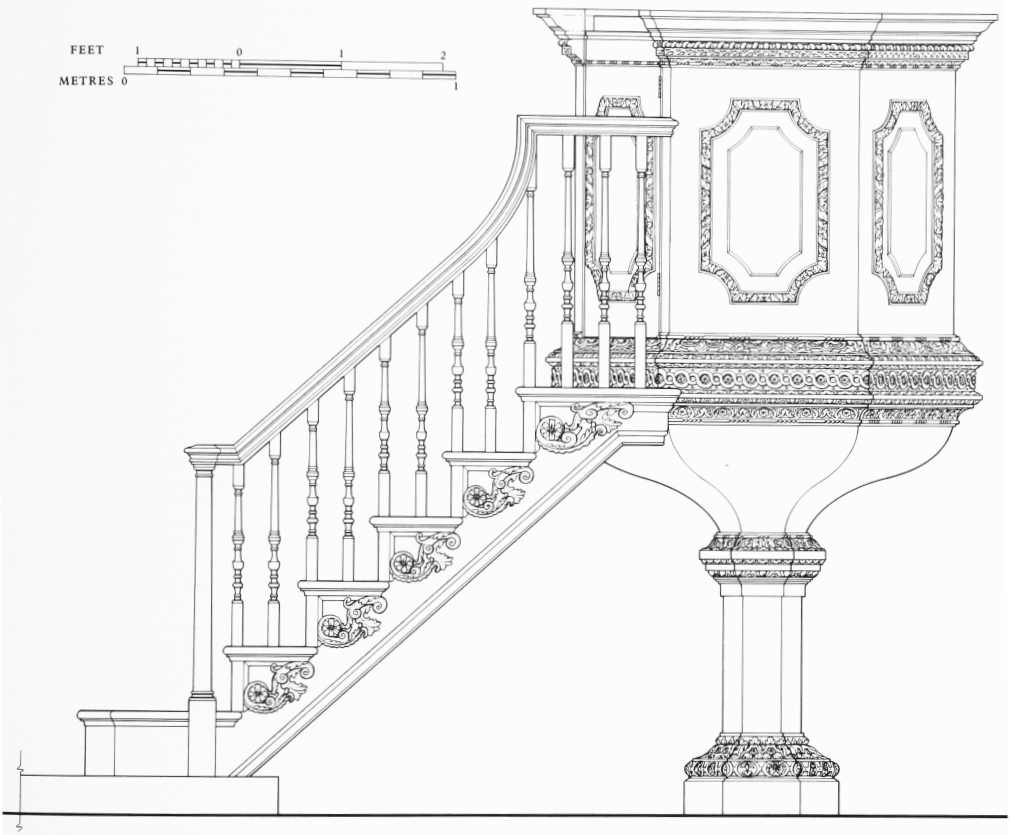
Grosvenor Chapel, pulpit. Balusters rationalized
Comper's works at the Grosvenor Chapel occasioned some controversy. To the exterior he made few or no alterations (though the strong quoins on the lower stages of the tower were added at some time between 1890 and 1920). But, inspired by his recent Mediterranean travels, he began with the romantic conception of the interior as a fragment of one of the ancient Roman temples converted to Christian use, wherein he could carry out his ideas of 'unity by inclusion'. The side galleries were to disappear, and overscaled columns were to stride down the small nave. The chancel was to be cut off by a screen and turned into a Lady Chapel, while the high altar was to be enshrined under a baldachin with a rood above.
This scheme soon ran into trouble. The 'Roman temple' conception was reduced, and the attempt to erect a baldachin met with difficulties in the ecclesiastical courts, where it was blocked. (fn. 92) Nonetheless Comper was able with comparatively few changes to effect a substantial transformation. Behind the altar he set a screen of quattrocento character, to which were attached two fluted columns intended as the rear supports of the baldachin, and surmounted by angels. Then, at either side of the sanctuary, came just two giant Ionic columns of plaster, carrying 'fragments' of a massive entablature. These columns merely braced the rood beam, which was thrown across at high level and carried figures in Comper's style. New sanctuary rails of wrought iron were installed, and the choir stalls and pulpit were moved (Plate 76c).
Comper continued to be associated with the Grosvenor Chapel for many years, and though he was never to realize a long-held ambition to carry out the baldachin, he did make some modest additions. In 1920 an elaborate pyx to his designs was hung from the top of the old reredos in the Lady Chapel, which at about this time was also supplied with a new cross and candles. Then in 1927 Comper's decorative painter H. A. B. Bernard-Smith at last painted the figures on the rood and the screen, though the screen itself has never received its intended colours. In the same year Comper installed the first of three characteristic windows in the south aisle. (fn. 93)
The only other major change between the wars was the rebuilding of the organ. This had already been moved in 1907, when the upper-tier western gallery in which it was sited disappeared. It then occupied a position with the case parallel to the gallery front and the console behind. In 1930 it was reconstructed, enlarged and moved to its present position by J. W. Walker and Sons (Plate 76d); in the process, the original inscription with Abraham Jordan's signature was lost. (fn. 77)
In a restoration of the exterior of the chapel by A. G. Nisbet of J. Douglass Mathews and Partners in 1951–2, the ornamental stucco elements of the west front were considerably simplified, while in 1966 and 1969 alterations were made to the roof and the old Victorian ventilating stacks removed. (fn. 94)
No. 24.
This little building, attached to the north-east end of the Grosvenor Chapel, began life as the Grosvenor Schools, a girls' and infants' school connected with the main parish schools in South Street. When building an infants' school for the parish was first contemplated in 1830, this site was considered; but because it would have been necessary to build 'partly upon pillars and partly upon walls which already form the sides to the engine house and entrance to the Vaults', it was passed over in favour of a site to the north of St. Mark's Church, North Audley Street. However, more infants' accommodation was evidently soon needed, for in 1841 the Vestry of St. George's agreed to allow a new school to be built here. The plan was devised by John Morris of John Morris and Sons, builders, of Mount Street, but Charles Jearrad, the parish surveyor, was asked to look over the plan. Living accommodation was provided for a teacher above the schoolroom. (fn. 95)
In 1855 the Grosvenor Schools were placed under separate management. There were enlargements in 1849–50, 1859–60 and 1874, when the parish surveyor R. H. Burden made a new entrance at the back, put in a new stair and added a classroom. At this time the attendance was frequently over two hundred, but subsequently the school declined. (fn. 96) From 1895 the premises were used merely as Sunday schools, with the curates of St. George's who served the Grosvenor Chapel living above. The school seems to have closed in 1905. (fn. 97)
In 1913 the premises were taken over for Liddon House, and much internal alteration has subsequently occurred. (fn. 85)
The building has a plain, amply fenestrated rear elevation to St. George's Hanover Square Gardens, but at the front only one bay is visible by the side of the Grosvenor Chapel. This is rendered and embellished with surprisingly Baroque features including an open pediment with scrolled sides above the entrance and a tall, free-standing Dutch gable.
Nos. 25–33 (consec.).
The history of present buildings on these sites, including the library (No. 25) in the former Chapel Place North, will be found on page 326.
Some interest attaches to a few of the preceding buildings. The houses facing South Audley Street had mostly been built following an agreement of 1726 with John Ellis, joiner, but those facing North Chapel Court (as Chapel Place North cul-de-sac was at first called) were leased in 1732 to the undertakers of the Grosvenor Chapel opposite. (fn. 98) About seven houses faced the court and were in 1807 under lease to John Foulston, an architect then unknown but soon to gain celebrity in the West Country. (fn. 99) In 1823 the Foulston family apparently declined renewal of the lease in favour of the local solicitor T. J. Burgoyne, and three houses at the east end of the court were rebuilt in 1828–9 by a Mr. Weston. (fn. 100) Nevertheless the boldly archaic Greek style of some details of the house at the corner of South Audley Street and Chapel Place North as shown in 1859 hints that Foulston may have been involved in a reconstruction here (fn. 101) (Plate 83a).
Later, a spectacular but short-lived rebuilding on the site of the former No. 26 juxtaposed the most aggressive Gothicism next door to these few Greek details. This was the work of the architect Thomas ('Victorian') Harris, who with John Hale, builder, in 1858 reconstructed, at what was said to be modest cost, much of the premises for Robert U. Potts, a chemist. Harris was currently experimenting in the free deployment of Gothic elements to create a Victorian style, and No. 26 was a rare monument to his queer ingenuity. It had an elevation of red, yellow and white bricks, dressings of Portland stone and much exposed ironwork in and over the shop front; all these materials were combined in a medley of profiles and segmental and relieving arches (Plate 83a). Within, the building exhibited a mélange of practical details and of 'honest' construction. There were sunk skirtings and architraves, ingenious iron shutters, coved cornices, and open-timber ceilings. Naturally Potts' premises occasioned controversy, and for several weeks two anonymous correspondents battled in The Building News over their merits and defects. (fn. 102) The building's notoriety did not, however, lengthen the lease, and in 1892 3 it disappeared along with its neighbours.
Nos. 34–42 (consec.).
The building now on this site, erected to designs by Thomas Verity in 1888–9, is described on page 324. Of its predecessors here there is little to be said. The frontage between Mount Street and Adams Row was part of a large plot stretching up to Grosvenor Square for which agreement was made in 1725. (fn. 103) From early times it was occupied by small shops and businesses, with a public house (the Bricklayers' Arms) on the site of the Audley Hotel at the corner with Mount Street. (fn. 57) Some rebuilding had taken place prior to their demolition; in 1858 Thomas Harris, doubtless on the strength of his efforts at No. 26 nearby, was enabled to erect a shop front of which nothing is known at the former No. 35 for Anthony Blackborne, lace dealer. (fn. 104)
Nos. 43–48 (consec.).
Though the present building here, stretching from Adams Row to Grosvenor Square, belongs to the story of modern Grosvenor Square (see page 168), mention may here be made of the neo-Georgian shop front and interiors designed for the showrooms of Holloway Brothers, builders and decorators, by Stanley Hall and Easton and Robertson in about 1935–6. Holloway Brothers had occupied premises here since 1903. (fn. 105)
The buildings previously on these sites, situated behind No. 35 Grosvenor Square, were originally erected following an agreement of 1725. (fn. 106) Many of the premises were subsequently rebuilt, and two examples may be mentioned (Plate 29d). One was a narrow brick house of four storeys capped by a pediment, which had according to the ratebooks been rebuilt in 1823. (fn. 4) Between this and No. 35 Grosvenor Square was another house, the simple stucco elevation of which was probably the work of Wright Ingle in 1834. (fn. 107) All the old houses here were in use as shops except for the corner house at Adams Row where was a public house, the Nag's Head, until its suppression in 1880. (fn. 108)