A History of the County of Gloucester: Volume 4, the City of Gloucester. Originally published by Victoria County History, London, 1988.
This free content was digitised by double rekeying. All rights reserved.
'Gloucester, 1835-1985: Economic development 1914-85', in A History of the County of Gloucester: Volume 4, the City of Gloucester, ed. N M Herbert (London, 1988), British History Online https://www.british-history.ac.uk/vch/glos/vol4/pp183-191 [accessed 3 May 2025].
'Gloucester, 1835-1985: Economic development 1914-85', in A History of the County of Gloucester: Volume 4, the City of Gloucester. Edited by N M Herbert (London, 1988), British History Online, accessed May 3, 2025, https://www.british-history.ac.uk/vch/glos/vol4/pp183-191.
"Gloucester, 1835-1985: Economic development 1914-85". A History of the County of Gloucester: Volume 4, the City of Gloucester. Ed. N M Herbert (London, 1988), British History Online. Web. 3 May 2025. https://www.british-history.ac.uk/vch/glos/vol4/pp183-191.
Economic Development 1914–85
The First World War greatly reduced Gloucester's foreign trade. Recovery was slow and traffic on the Gloucester and Berkeley canal did not return to its pre-war level until the 1930s, (fn. 1) though a service between the city and Norwegian ports had been restored by the early 1920s. (fn. 2) Activity in the docks continued to reflect the city's position as a centre for water, rail, and road transport and as a gateway to the Midlands, but grain and oil-seed imports were increasingly destined only for local industry and several warehouses were abandoned or put to other uses. Gloucester regained its role as a leading timber port, and other imports sent inland by river included cocoa beans, sugar, and chocolate crumb for the Cadbury Bros. factory at Bournville (Birmingham) and from the mid 1920s refined petroleum products. The Monk Meadow dock became a distribution point for the petroleum trade and was bordered by storage tanks. (fn. 3) Export trade remained much smaller and shipments of salt, which was usually brought to the docks by rail, became less frequent because of competition from Liverpool. Local traffic on the canal faced increasing competition from road transport, and in the early 1930s the regular steamer service between Gloucester and Sharpness was withdrawn.
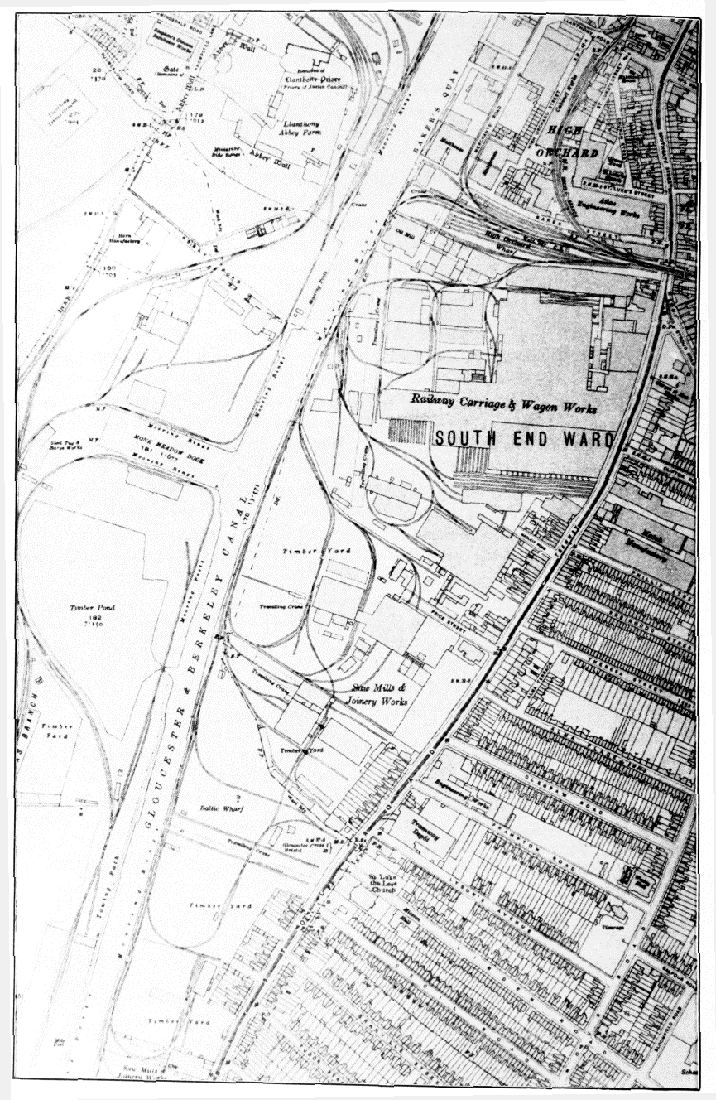
The upper Bristol Road area, 1921 (north at the top)
During the First World War Gloucester industry was subordinated to military needs. Products of the wagon works included stretchers and shells. (fn. 4) The war led to an expansion in engineering, and the firm of Williams & James, founded in 1915, was one of several new enterprises. (fn. 5) At Hempsted c. 350 men were engaged between 1917 and 1920 in building six concrete barges, begun as part of the war effort. (fn. 6) Aeroplanes were assembled and tested at an airfield laid out by the Air Board in 1915 on the boundary of Hucclecote and Brockworth. A munitions factory in Quedgeley provided wartime employment for 6,000 hands, many presumably from the city, (fn. 7) and a munitions store was laid out by the canal in Monk Meadow. (fn. 8) Attempts to foster industry during the post-war slump were generally unsuccessful. The match industry, at that time hit by taxation and foreign competition, (fn. 9) was unable to sustain a new factory, built at Hempsted bridge in 1920 and closed in 1923. (fn. 10) More successful was a factory built at Llanthony in 1919 for the manufacture of incubators and poultry houses. It employed c. 125 men in 1932. (fn. 11) In the early 1920s the engineering works of W. Sisson & Co. were enlarged to make chocolate-rolling machinery for Cadbury Bros. Ltd. (fn. 12)
The Gloucester Railway Carriage & Wagon Co. relinquished its repairing and hiring operations in 1918 and 1920 respectively. (fn. 13) From 1922 it was closely associated with Alfred Danks Ltd., a local engineering firm which that year purchased the Emlyn Works and closed the Kingsholm foundry. The wagon works purchased Danks Ltd. in 1929 and had a large interest in the Gloucester Foundry Ltd., set up in 1930 to run the Emlyn Works, from which it had obtained malleable castings. (fn. 14) The wagon works narrowly avoided financial disaster in 1930 when a railway-wagon hiring business which it controlled went into liquidation. Following the appointment in 1931 as chairman of Harold Leslie Boyce, M.P. for Gloucester, the wagon works were reorganized, and their financial recovery was helped by orders in the late 1930s for re-armament projects and from the London Passenger Transport Board. (fn. 15) Boyce, who was knighted in 1944, died in 1955. (fn. 16)
Production at the wagon works continued throughout the General Strike of 1926. The strike was joined by dockers, railwaymen, tramway employees, and printers, but economic activity was relatively undisturbed except in the docks where work halted for a fortnight. (fn. 17) In the later 1920s the Gloster Aircraft Co. gave a major boost to employment by transferring production from Cheltenham to Hucclecote, where it built a factory on the airfield. The company, which made military aircraft, had financial problems because of reduced orders in the early 1930s but it recovered and enlarged its factory after 1934 when Hawker Aircraft Ltd. secured control of it. G.A.C. continued to design and build its own products. (fn. 18)
Gloucester's major firms survived the depression of the early 1930s. The engineering firm of W. S. Barron & Son was building a factory in Bristol Road in 1934 when it started a collaboration with the milling engineers Henry Simon Ltd. of Stockport (Ches.). (fn. 19) The weaving of reversible carpets and rugs, introduced in 1915, (fn. 20) prospered and moved in the late 1930s to a factory at High Orchard. (fn. 21) In the late 1930s several new industries were established, (fn. 22) and among older ones to disappear was hairpin making. (fn. 23) The tannery in lower Northgate Street apparently closed in the early 1930s. (fn. 24) The clothing industry, which suffered a serious loss with the burning of a shirt factory in 1933, (fn. 25) employed fewer people. The number of employees in local government and public services such as gas, electricity, water, and transport doubled in the 1930s. (fn. 26)
From the later 1930s industry in and around Gloucester benefited from the re-armament programme. (fn. 27) The aircraft industry, including the Churchdown factory of Rotol Airscrews Ltd. formed in 1937, (fn. 28) became the principal employer. Between 1938 and 1943 it increased its workforce by 13,430 people, many of whom travelled to work from other areas. The Gloster Aircraft Co., which between 1938 and 1940 built a second factory, on the Brockworth side of the airfield, produced the Meteor, the country's first jet-propelled fighter, from 1943. A. W. Hawksley Ltd., a company formed in 1940, also built aircraft at the airfield. (fn. 29) During the Second World War many factories turned to military needs; the wagon works produced tanks, munitions, and Bailey bridges. (fn. 30) The number of people employed by national and local government, some administrative and military departments being moved to the area, and by the railways increased. The docks, which handled essential supplies for the industries and population of the Midlands, saw a revival in the corn trade and regular coal shipments to the new Castle Meads electricity generating station. (fn. 31) After the war industry quickly readjusted to peacetime production. Hawksley's factory prefabricated houses and bungalows for the Ministry of Supply. (fn. 32) In the early 1950s the aircraft industry accounted for the four largest employers in the area and for many of the 3,000 people travelling in each day for work. National and local government, public services, and the armed forces employed large numbers, and there were significant numbers engaged in professional services, notably nursing and teaching. (fn. 33)
After 1948, when the docks and associated waterways were acquired by the British Transport Commission, (fn. 34) the docks continued to handle a wide range of imports, including raw materials for industry, agricultural supplies, foodstuffs, and oil and petroleum. (fn. 35) Shell Mex & B.P. Ltd., whose needs outgrew its storage tanks at Monk Meadow, opened a larger depot on the canal near Quedgeley in 1960, and the construction of a pipeline from the new depot to Worcester before 1967 ended the principal river traffic above Gloucester. (fn. 36) In the early 1960s a substantial trade in boxed car parts to Ireland passed through the docks, (fn. 37) but in general the period after the Second World War was one of steady decline for docks and canal. Goods, including timber, bound for the city and the Midlands were transferred at Sharpness or at other ports to the roads, particularly the motorways built in the 1960s and early 1970s. (fn. 38) The British Transport Commission and the British Waterways Board, to' which the docks and canal were transferred in 1963, (fn. 39) improved and extended wharfage facilities, especially below Llanthony bridge. Those improvements stimulated some commercial activity, (fn. 40) and in 1967 the canal carried 547,686 tons, including timber, oil, and container traffic, (fn. 41) but the long-term decline was not halted and in 1980 only nine registered dockers were employed. (fn. 42) The decline was especially evident in the older part of the docks, where the surviving 19th-century warehouses were no longer suited to commercial needs and where goods traffic had been partly replaced by pleasure craft. Traffic passing into the river included wheat for a mill at Tewkesbury. The two graving docks maintained Gloucester's tradition of shipbuilding, mostly in repairing river and small seagoing craft, in the early 1980s. (fn. 43) Plans were then being discussed for reviving the docks as an area for trade, industry, leisure, and housing. (fn. 44)
Despite the decline of the timber trade after the Second World War, timber yards remained an important feature near the canal and several new ones were opened. (fn. 45) The firm of Price, Walker, and Co., which ceased to be independent in 1962, sold part of its yard in 1969 and employed 59 people in 1984. (fn. 46) A successful business to grow out of the trade was Permali Ltd., known until 1951 as the New Insulation Co. It was formed in 1937 to make 'permali', a reinforced electrical insulator obtained from wood veneer treated with synthetic resin, and leased the former tramways depot in Bristol Road. The company, which secured overseas markets and in 1957 opened a new factory in Bristol Road, developed a range of reinforced plastics, electrical insulation, and composite goods. Its factory space was enlarged after it became part of the B.T.R. Group in 1975. (fn. 47)
From the mid 1950s industrial estates were laid out on the outskirts of Gloucester, most of them near the bypass road. Initially they were intended for the relocation of badly sited firms, (fn. 48) but with the decline and disappearance of established manufactures, notably aircraft and railway rolling stock, they were used to encourage entirely new businesses. (fn. 49) Many Gloucester factories were closed by outside interests to benefit production elsewhere. The toy factory, which had been enlarged in the early 1930s to employ up to 750 people, was an early example. The Chad Valley Group, which acquired it in 1954, shut it with a loss of 198 jobs in 1956 and moved production to Birmingham. The jam and pickle factory also closed in 1956. (fn. 50) Bryant & May reduced the match factory of S. J. Moreland & Sons to branch status in 1972 and shut it with a loss of 280 jobs in 1976 to centre production on Liverpool and Glasgow. (fn. 51) The factory was reopened as a trading estate in 1978.
In response to changes in defence policy the Gloster Aircraft Co. reorganized its research department in 1956 and a few years later switched part of its Hucclecote factory to the manufacture of automatic vending machines and forage harvesters. Aircraft production ceased in 1960 and the factory was sold in 1964 to Gloucester Trading Estates, which converted it as an industrial estate. (fn. 52) In 1972 the estate, which was outside the city, housed over forty firms. They included Gloster Saro Ltd., (fn. 53) which as a new company within the Hawker-Siddeley Group had taken over production of vending machines, road tankers, and airfield refuellers in 1965. (fn. 54) The Gloucester Railway Carriage & Wagon Co. diversified its interests after 1948 by purchasing the Hatherley Works, the Gloucester Foundry, and William Gardner & Sons. (fn. 55) Because of a decline in orders for railway rolling stock the wagon works began production for the Winget Group of companies, which absorbed it in 1962. The works made specialist rolling stock and freight containers; contractors' plant, notably Muir-Hill dumpers, loaders, and tractors; and plant for the steel industry. At the same time production of machinery for chemicals, plastics, and food-processing industries was moved to the works from Gardners' factory, which was closed. (fn. 56) The companies within the Winget Group, which was itself acquired by the Babcock and Wilcox Group in the late 1960s, were reorganized several times before 1984. (fn. 57)
Despite the large number of men laid off at the aircraft works, the success of the Gloucester area in attracting new industry and the growth in service and distributive trades resulted in a shortage of labour in the early 1960s. (fn. 58) Many of the new factories were outside the city boundary, notably the light engineering works of the Dowty Group near Cheltenham (fn. 59) and the factory of British Nylon Spinners, opened on the site of the Brockworth aircraft works in 1960 and owned by I.C.I. Fibres Ltd. from 1964. (fn. 60) T. Wall & Son (Ice Cream) Ltd., which began a factory by the railway on the eastern boundary of the city in 1958, became a major employer. The factory, which in its first summer of full production, in 1961, had a workforce of 1,300, (fn. 61) was enlarged in 1984.
The natural recession in engineering and manufacturing led to a rise in unemployment in Gloucester from the later 1960s. The works of W. Sisson & Co., which had been acquired in 1958 by a Birmingham company, were closed with a loss of 160 jobs in 1968 and production moved to Bedford. (fn. 62) The decline in foundry work and engineering, which had been a major part of Gloucester's industry in the early 1960s, (fn. 63) became more pronounced from the later 1970s. The Gloucester Foundry, which had employed over 500 people, was shut in 1981 and replaced by a trading estate. (fn. 64) The workforce of Fielding & Platt fell from c. 500 in 1976 to 75 in 1983 (fn. 65) and that of Williams & James, which in the early 1960s employed 350 people to make hydraulic and pneumatic machinery for the motor car industry, (fn. 66) also dropped. Simon-Barron Ltd., formed in 1963 by the merger of Barron & Son and the animal-feed section of Henry Simon Ltd., employed 500 people to manufacture animal-feed milling plant in the early 1970s but only 200 in 1984. Part of the reduction was accounted for by the formation in 1974 of a marketing company. (fn. 67) Kell & Co., which had ceased to make agricultural implements in the early 1950s when it was acquired by Helipebs Ltd., moved in the late 1960s to the former Sisson's works where it made a wide range of castings and machinery. The workforce in the foundry and machine shop fall to c. 82 in 1984. (fn. 68)
The decline in manufacturing and the resulting loss of jobs was only partly compensated for by new businesses. In addition to the match factory, closures included the Hatherley Works furniture factory in 1983 (fn. 69) and the carpet factory at High Orchard, which had employed 250 people in 1975. (fn. 70) One successful venture was that started by G. R. Lane (d. 1964), who made health products and natural remedies from the 1930s. The business, which built up an export trade, employed nearly 100 people in 1984. (fn. 71) Another firm to prosper in the early 1980s was Mecanaids Ltd., which made equipment for hospitals and disabled people and in 1984 demolished the former jam and pickle factory for an extension of its works. (fn. 72)
Gloucester remained the market centre for north Gloucestershire and the adjoining parts of Herefordshire and Worcestershire. In the mid 1920s the livestock market near the railways handled c. 60,000 sheep, c. 52,500 pigs, c. 24,500 cattle, and c. 13,500 calves a year, with the September sheep sale at Barton Fair attracting buyers from Wales. (fn. 73) The volume of business was greater in the mid 1950s when the market was moved to a more convenient site on the bypass road. Horse sales had dwindled but the autumn sheep sales served a wide area in the Midlands, South Wales, and the West Country. (fn. 74) The fruit and vegetable market, which lost some of its trade to the Grange Court market started in Westbury-on-Severn in 1920, (fn. 75) sold over 6,000 tons of produce a year, as well as poultry and eggs, in the early 1930s and c. 10,000 head of live poultry in the mid 1950s. (fn. 76) In the early 1970s it was attended by buyers from Bristol and South Wales. (fn. 77) Organized corn dealing had apparently ceased by the mid 1950s. (fn. 78)
An important newcomer to Gloucester's animal feed industry was the West Midland Farmers' Association Ltd., an agricultural co-operative formed in 1909, (fn. 79) which acquired Island Mills in lower Westgate Street c. 1920. (fn. 80) British Oil & Cake Mills reduced operations at Baker's Quay after the Second World War (fn. 81) and West Midland Farmers' bought those premises in 1955 for its own compounding and milling activities. The association expanded in the 1970s, and in 1983, when it bought disused maltings at High Orchard, formerly the premises of G. and W. E. Downing, for grain storage, it traded and supplied farming services over a wide area and had 5,384 members and 383 employees. (fn. 82) The flour industry continued to shrink between the wars, and when Allied Mills Ltd. closed Albert Mills in 1977 only City Mills was left producing flour. (fn. 83) Priday, Metford, & Co. employed 55 people there in 1984. (fn. 84)
By the 1970s much of Gloucester's economic activity depended for transport on the developing road system, (fn. 85) which included the bypass, completed in 1959, (fn. 86) and attracted many new businesses to the city. The M5 motorway between the Midlands and south-western England opened east of the city in 1971. (fn. 87) The railways ceased to be an important employer at Gloucester after the Second World War (fn. 88) and the local branch lines to Hereford and to Ledbury were closed in 1964. (fn. 89) The decline of the docks also reduced railway traffic, and most lines serving the docks had been removed by the 1970s. (fn. 90) With the closure of Eastgate station and the Tuffley loop line in 1975 and the building of a new station on the site of Central station's down platform Gloucester's railways reverted to much the same pattern as before 1854. (fn. 91) The municipal airfield in Churchdown, laid out in 1936, (fn. 92) had limited impact on the city's economic life.
Emphasis on Gloucester's role as an administrative and service centre from the 1950s contributed to the changing pattern of employment and to a growth in jobs, (fn. 93) which in 1976 numbered 44,309. The number of workers travelling into the city each day passed 7,260 in 1971. (fn. 94) Local government and public services provided many new jobs, and the expansion of educational and health services, for which Gloucester was a major centre, helped the growth of the professions. (fn. 95) The city council employed over 2,000 people in 1959 (fn. 96) and, following local government reorganization in 1974, had 750 full-time employees. That figure fell to 650 in 1984, (fn. 97) when the county council employed c. 1,500 people at the Shire Hall. (fn. 98) The land registry's regional office, established at Elmbridge Court by 1964, moved in 1968 to an office block in Bruton Way, which was staffed by 672 people in 1976. (fn. 99) The number of jobs in insurance, banking, and postal and telecommunication services also rose. (fn. 100) The Trident Life and Ecclesiastical insurance companies moved their headquarters to Gloucester in 1974 and 1976 respectively, (fn. 101) Barclays Bank built a computer centre at Barnwood in the late 1970s, (fn. 102) and in 1974 the Central Electricity Generating Board completed at Barnwood the head office for its generation development and construction division, (fn. 103) which in 1984 employed 1,177 people. (fn. 104) Some civilians worked at R.A.F. Innsworth in Churchdown, opened in 1940. The station included from 1975 the R.A.F. personnel management centre, which had grown out of a merger in 1965 between the R.A.F. record and central pay offices. Those offices had been established in Eastern Avenue near Barnwood for several years, the record office opening a branch there in 1941. (fn. 105)
The growth of Gloucester in the 20th century benefited the building trades and increased the demand for shops as well as services. Between the wars more chain stores, including F. W. Woolworth & Co. in the early 1920s, opened branches in the city centre, and several established retailers extended their range of trade. (fn. 106) After the Second World War branches of chain stores became increasingly prominent in the principal shopping streets at the expense of local businesses, (fn. 107) notably Blinkhorn's which ceased trading in 1953 on its sale to F. W. Woolworth & Co. (fn. 108) The Bon Marché, acquired in the late 1920s by the Drapery Trust (later Debenhams Ltd.), (fn. 109) retained its traditional name until the early 1970s; the store employed 650 people in 1984. (fn. 110) The redevelopment of the city centre in the 1960s and 1970s, and particularly the completion of the King's Square and Eastgate shopping precincts, enhanced Gloucester's position as a retailing centre, (fn. 111) though the Severn Road Bridge opened in 1966 gave shoppers from west Gloucestershire access to Bristol. (fn. 112) In the early 1980s several large stores with their own car parks were built outside the city centre, including in 1982 one on the site of Eastgate railway station and another next to the former St. Bartholomew's Hospital in the Island. Others were on new housing estates, and in 1984 Tesco moved its supermarket from lower Northgate Street to a site outside the city in Quedgeley. The tourist trade depended mainly on the attraction of the cathedral and provided little employment. Hotel accommodation, which was limited in the city centre, especially after the closure of the Bell in 1967, (fn. 113) was increased with the opening of a large hotel on the Barnwood bypass in 1981.