A History of the County of Gloucester: Volume 4, the City of Gloucester. Originally published by Victoria County History, London, 1988.
This free content was digitised by double rekeying. All rights reserved.
'Gloucester: The cathedral and close', in A History of the County of Gloucester: Volume 4, the City of Gloucester, ed. N M Herbert (London, 1988), British History Online https://www.british-history.ac.uk/vch/glos/vol4/pp275-288 [accessed 9 May 2025].
'Gloucester: The cathedral and close', in A History of the County of Gloucester: Volume 4, the City of Gloucester. Edited by N M Herbert (London, 1988), British History Online, accessed May 9, 2025, https://www.british-history.ac.uk/vch/glos/vol4/pp275-288.
"Gloucester: The cathedral and close". A History of the County of Gloucester: Volume 4, the City of Gloucester. Ed. N M Herbert (London, 1988), British History Online. Web. 9 May 2025. https://www.british-history.ac.uk/vch/glos/vol4/pp275-288.
In this section
GLOUCESTER CATHEDRAL AND THE CLOSE
The minster of St. Peter (fn. 1) was established by Osric, under-king of the Hwicce, on the north side of Gloucester c. 679. It became a Benedictine abbey in 1022, and Eldred, bishop of Worcester 1047–62, rebuilt the abbey church. (fn. 2) Eldred's church was said, in an account of c. 1600, to have been built 'nearer the side of the town' than its predecessor, (fn. 3) which has been variously interpreted as meaning that the new site was further north or further south than the old one. Eldred's church was probably on the same site as the great Norman church that replaced it in the late 11th century, built over the north-west angle of the old Roman walls. The Norman church and its claustral buildings were later remodelled and embellished, particularly in the 14th century, when perpendicular architecture of a novel and highly ornamental character was introduced, and in the 15th, when the massive central tower, Gloucester's dominant feature, was built. Gloucester Abbey was dissolved in 1540, and in 1541 its church became the cathedral of the new diocese of Gloucester and with its precinct and claustral buildings was placed in the custody of the newly incorporated dean and chapter.
The original bounds of the precinct are not known. About the time the Norman church was begun in 1089 the abbey extended its boundaries over land of St. Oswald's minster, presumably an enlargement northwards or north-westwards, and Peter, abbot 1104–13, built a stone wall around the precinct. (fn. 4) Shortly before 1218 a further extension was made on to land of St. Oswald's and a new stretch of wall built. (fn. 5) At its fullest extent the precinct enclosed 13 a. of the north-western sector of the town. It was bounded on the west by Abbey Lane and Half Street (parts of the later St. Mary's Street), on the north by the later Pitt Street, on most of the east by Grace (later St. John's) Lane, and on the south by a back lane to the burgage plots on the north side of Westgate Street. (fn. 6) Water and drainage were provided by the southern branch of the river Twyver, or Full brook, flowing westwards through the precinct, and from the early 13th century a supply of fresh water was piped from springs on Robins Wood Hill. (fn. 7)
Jurisdiction over the close was sometimes a cause of dispute between the abbey and the town authorities (fn. 8) and continued to be a source of friction after the Dissolution until 1672 when the bishop, dean, and two prebendaries were given the status of city magistrates. (fn. 9) Ecclesiastically the close remained separate after the Dissolution but for some civil purposes it was attached to the adjoining parish of St. Mary de Lode, to which the private residents, and the chapter and its officers at a fixed composition, paid poor rates. The close was included in the city scheme for a workhouse, first implemented in 1703. (fn. 10) It remained independent, however, of statutory measures for lighting, paving, and scavenging the city in the later 18th century, (fn. 11) and the dean and chapter continued to provide some public services for the close out of their own funds until the late 19th century. (fn. 12) Until the late 18th century the gates leading from the close into the city were maintained and manned by porters. After soldiers had caused disturbances in the close in 1762 stricter rules for closing the gates at night were enforced, leading to a bitter dispute between the chapter and a prominent resident, the attorney and later M.P. John Pitt, who organized the pulling down of the infirmary gate in 1766. (fn. 13) Other measures taken by the chapter to preserve the peace and separate character of the close included barring alehouses and premises for trade. (fn. 14) New building for private residents had increased the total population of the close to 227 in 51 households by 1743. (fn. 15) In 1986 the buildings, almost all of which were still owned by the chapter, were mainly occupied by cathedral and diocesan staff as residences or offices, by the King's school, and by professional firms.
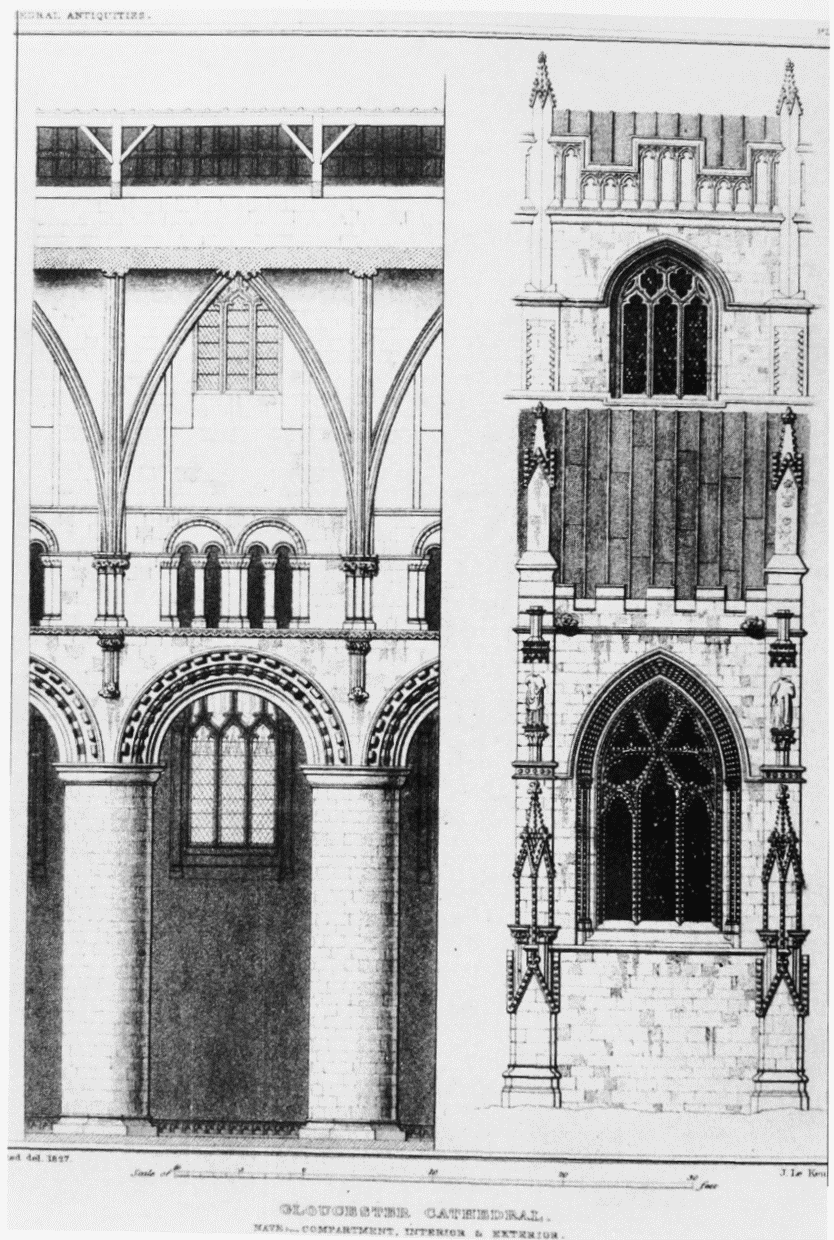
Gloucester cathedral: part of the nave arcade (north side) and elevation of a bay of the nave and the south aisle
ABBEY BUILDINGS.
By the Dissolution the abbey church of ST. PETER comprised lady chapel with side chapels, choir with ambulatory and chapels over a crypt, central tower, north and south transepts with chapels, nave with north and south aisles and south porch, and an extensive range of claustral buildings on the north side. The whole was built of oolitic limestone from the Cotswolds. (fn. 16)
No remains of the churches built by Osric and Eldred have been discovered. In 1089 (fn. 17) Serlo, the first Norman abbot, began building the large Romanesque church that remains the basis of the present structure. Work began with the crypt, presumably after the setting out of the church and cloister. The crypt has an ambulatory with three radiating chapels and a chapel on each side, below those of the transepts. Above the crypt the presbytery was of four bays with two further piers on the curve of the east end. In the crypt there are solid masses of masonry beneath the piers of the presbytery arcades but they soon proved to be an inadequate foundation for the weight that was placed upon them, and, following the deformation of the transverse arches of the ambulatory vault, supporting arches on large semicircular piers were inserted and the outer wall of the crypt was thickened. At the same time the central vaulted area, which probably originally had two aisles, was rebuilt with three aisles. Those alterations appear to have been completed before the presbytery aisles were vaulted.
It is likely that when the new church was consecrated in 1100 the building was roofed only as far as the crossing and transepts. The church suffered fires in 1102 and 1122, the second apparently destroying the roof of the completed nave. (fn. 18) It has been suggested that the early 12th-century nave was one bay longer before its west end was remodelled in the early 15th century, (fn. 19) but it had twin western towers over the ends of the aisles (fn. 20) and if they were supported by expanded piers then arcades of eight bays with an additional bay beneath the towers would fit the present length. The location of the towers, one of which fell between 1163 and 1179, (fn. 21) within the existing plan is suggested by the thickening of the north and south walls and by a blocked 12th-century window in the west end of the north wall.
The location of the cloister on the north side of the church was probably dictated by the easy availability of water from the Full brook. While the claustral buildings were probably laid out in the first phase of the Norman rebuilding the presumed survival of the buildings of the old monastery implies that the erection of domestic buildings was not a matter of priority. The earliest surviving claustral buildings are the slype, next to the north transept, which is lined with early 12th-century arcading, and the lower part of the west wall of the chapter house. The arcading lining the north and south walls of the chapter house is of the later 12th century, suggesting a remodelling at that time.
The original dormitory probably occupied the conventional position north of the chapter house with the reredorter beyond that over the course of the Full brook. The early 12th-century refectory was 6 ft. narrower than that of the 13th century which replaced it and was the length of the whole of the north side of the cloister. It was raised on a vaulted undercroft with a central row of piers. (fn. 22) Most of the west side of the cloister was flanked by a range of buildings, presumably lodgings, but at its southern end was an early 12th-century tower c. 35 ft square, which was probably the original accommodation for the abbot. The tower was separated from the north side of the nave by a vaulted ground-floor passage above which an abbot's chapel was built c. 1130. The guest range was possibly destroyed by a fire (fn. 23) which damaged the domestic buildings in 1190, and the abbot's lodging was given a western lobby behind an elaborate new front c. 1200.
Another fire destroyed some of the monastic offices on the west side of the precinct in 1222. Making good that damage must have been a great expense but the early 13th century was a period of considerable new building. Beginning in 1222 the sacrist, Ellis of Hereford (d. 1237), built a central tower on foundations which had been provided in the original plan and may have supported an earlier tower. The new tower carried a spire and had corner turrets. (fn. 24) Between 1224 and 1228 a lady chapel was built at the cost of Ralph of Willington of Sandhurst and his wife Olympia. (fn. 25) In 1232 Henry III gave 100 oaks and in 1233 10 more, perhaps for the completion of a new nave roof for which lead was being melted in 1234. (fn. 26) The church was dedicated again in 1239 and the vaulting of the nave was finished by 1243. (fn. 27) The south-west tower, perhaps that which had fallen, was rebuilt in the years 1242–3 and the refectory in 1246. Like its predecessor the refectory was raised on a vaulted basement and close to its north side one of the contemporary buildings, which is a also on a vaulted basement, may have been the misericord.
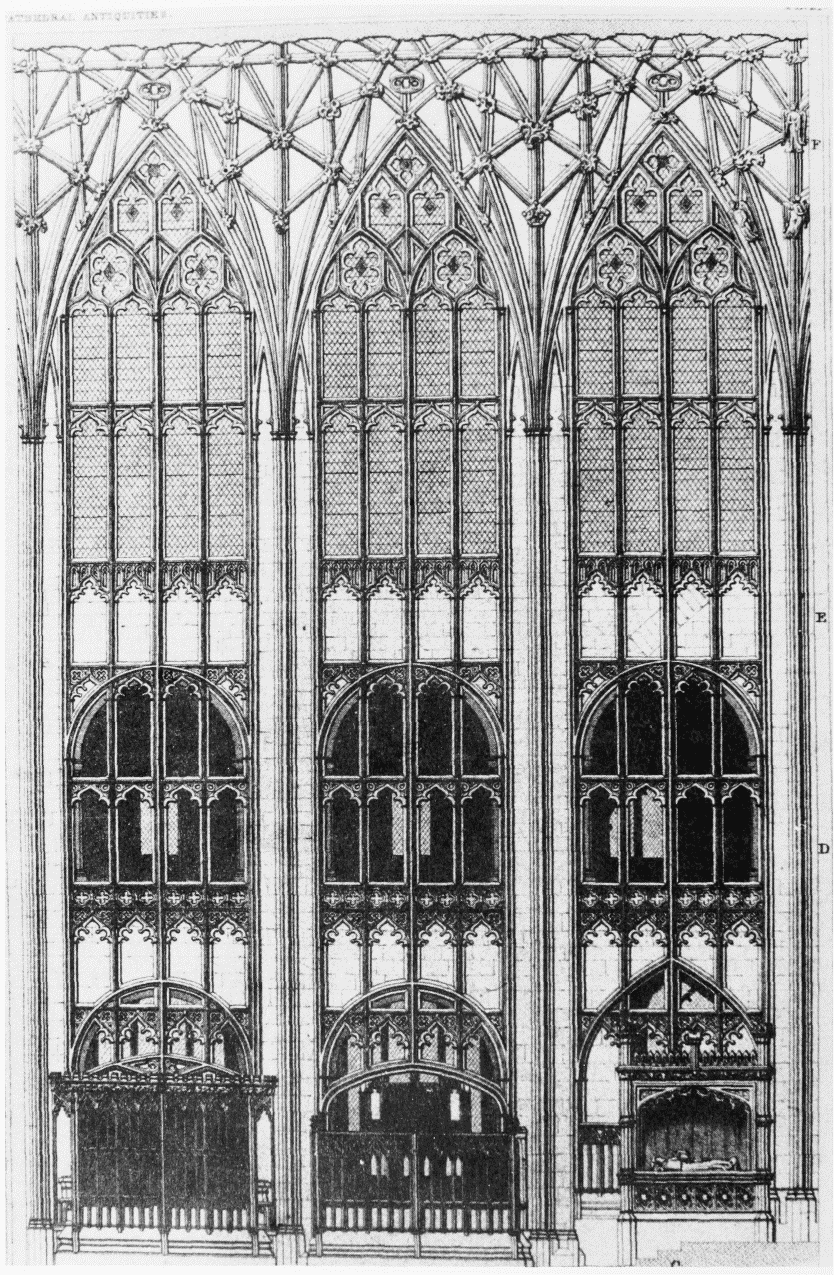
Gloucester cathedral: part of the north side of the choir
Separated from the north-east corner of the refectory by a small cloister was the 13th-century infirmary, an aisled hall of six bays which included a chapel dedicated to St. Bridget, (fn. 28) probably at the east end. A fire which began in the great court of the abbey in 1300 destroyed a great chamber, the cloister, and a small bell tower. In 1303 work began on a new dormitory, and the building was completed in 1313. It was aligned east-west, perhaps so that it could be longer than its predecessor and so that a new reredorter could be located further away from the infirmary.
The appearance of the southern side of the church was changed in the earlier 14th century by the rebuilding of the old south aisle wall between 1318 and 1329 and the remodelling of the south transept, dedicated to St. Andrew, between 1329 and 1337. The windows of the aisle are richly ornamented with ballflower, (fn. 29) and the great south window of the transept is one of the first examples of the early perpendicular style. The work on the transept was paid for out of gifts by visitors to the tomb of Edward II, buried in the church in 1327, and those gifts also financed an extensive remodelling of the choir begun under Adam of Staunton, abbot 1337–51, and completed under his successor Thomas Horton (d. 1377). A great east window was put in, the two eastern piers of the ambulatory were removed, and the inner faces of the other piers were recut or built up and incorporated in the open stone screens which filled the arcades. The tracery of those screens was carried up into a new and richly decorated vault. (fn. 30) The east window was filled with painted glass depicting the Coronation of the Virgin with attendant apostles and saints and included a series of shields of knights who fought in the Crécy and Calais campaigns of 1346 and 1347. (fn. 31) The carved wooden choir stalls, made c. 1350, have a set of 44 misericords depicting domestic scenes, fabulous monsters, and folk tales. (fn. 32)
Writers on architectural history once saw Gloucester Abbey as the cradle of the perpendicular style. The style is now thought to have been invented by royal masons in London and transmitted to Gloucester. There, however, the monks and their masons developed it in original and highly ornamental forms which were later a major influence on the growth of the style in England. (fn. 33) Even more elaborate than their decoration of the choir is the fan vault which they used in the great cloister, where rebuilding began under Horton with the east range. Work on the other ranges of the cloister continued in a similar style until after the accession of Abbot Walter Froucester in 1381. The north range includes a separately vaulted lavatorium opposite the doorway to the refectory stairs and each of the 10 bays of the south range has two carrels beneath its window. (fn. 34) The north transept, dedicated to St. Paul, was reconstructed in the years 1368–73, largely at Horton's expense. At about that time the east end of the chapter house was rebuilt with a large window in place of the former apse, and a vestry and library were built above the slype, which was extended eastwards some distance beyond the line of the transept. During the 14th century most of the crypt chapels were refitted and chapels were fitted up in the triforium gallery around the choir and transepts.
The west front and two western bays of the nave were rebuilt by John Morwent, abbot 1420–37, who was said to have intended to complete the whole nave. (fn. 35) The new design of the west front omitted the towers which had been a feature of the old front but provided for a large west window. Morwent also built a new two-storeyed south porch (fn. 36) against the second bay from the west; it emphazised the importance of that side, which was close to the gate from the town, as an entry to the nave rather than the west doorway which opened on to the great court of the abbey. The building of a great central tower was begun by Thomas Seabrook, abbot 1451–7, and completed before 1460 by a monk, Robert Tully. (fn. 37) It is richly decorated with blind tracery and surmounted by delicate open-work parapets and corner turrets. (fn. 38) Other work carried out during the 15th century included the remodelling of the nave clerestory and the rebuilding of the little cloister at the north-east corner of the claustral ranges.
The last major work on the church was the lady chapel, which replaced that of the earlier 13th century; it was begun under Richard Hanley, abbot 1458–72, and completed under his successor William Farley (d. 1498). (fn. 39) A tall and richly vaulted building of five bays, it has small flanking chapels. The west end is set back from the great east window of the choir so as not to obstruct the light and the triforium gallery is continued into the chapel on covered bridges which are decorated with re-used chevron arches. Those bridges have the characteristics of a 'whispering gallery', a widely known feature of the church by the early 17th century. (fn. 40) An early 13th-century stone screen placed across the north end of the north transept is thought to have been the narthex of the former lady chapel, moved there at the rebuilding. (fn. 41) Its original purpose has long puzzled visitors to the church who have described it variously as a prison, confessional, and reliquary. (fn. 42)
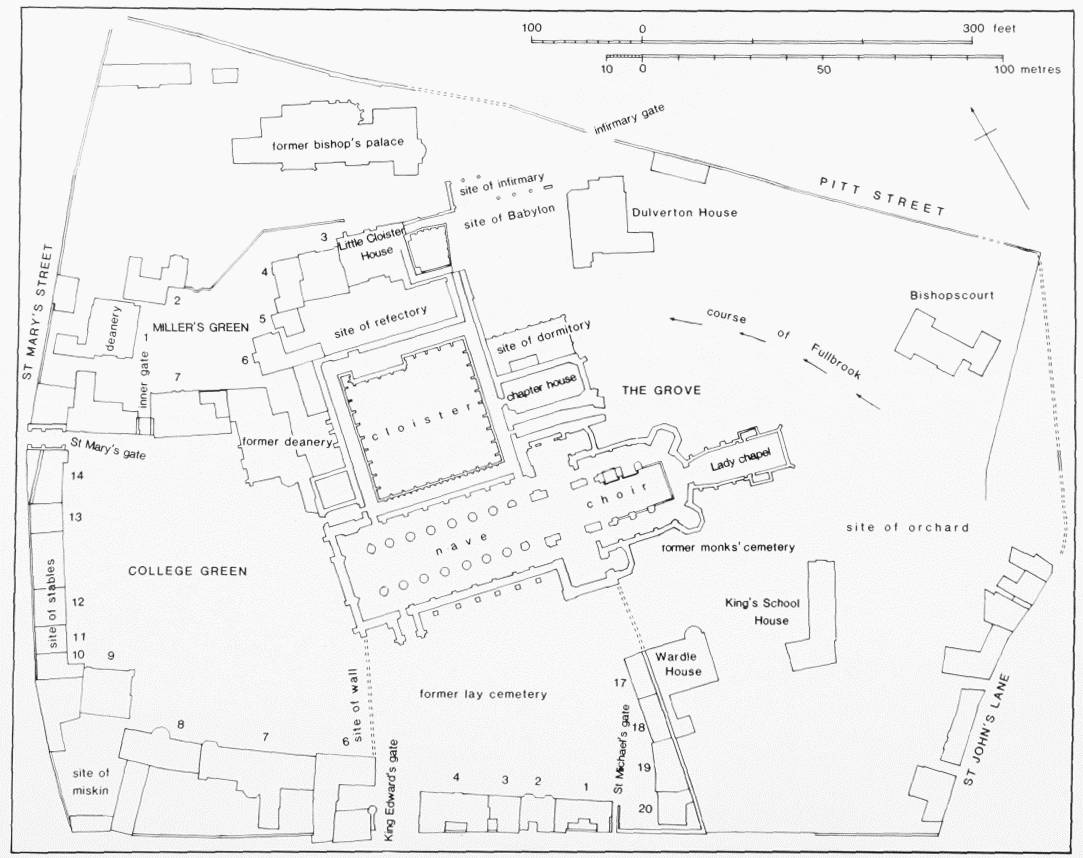
Gloucester cathedral and the close, 1986
Among the principal monuments (fn. 43) placed in the church in medieval times is that to Robert, duke of Normandy (d. 1134), who was buried before the high altar. (fn. 44) The effigy of Irish oak, depicting him cross-legged with his hand on his sword, is dated by the style of the armour to Henry III's reign and the chest on which it rests is of the late 14th century or the 15th. The effigy was broken up by soldiers in the Civil War but the pieces were preserved by Sir Humphrey Tracy of Stanway and after the Restoration were repaired and replaced in the presbytery. (fn. 45) The monument was moved to the chapel off the north-east ambulatory in the mid 18th century, (fn. 46) returned to the presbytery in 1905, and moved to the south ambulatory in 1986. Fixed to the wall on the south side of the presbytery is the 13th-century stone effigy of a priest, depicted as founder holding a model church; though identified in most early accounts as Eldred, (fn. 47) it is more probably Abbot Serlo. (fn. 48) Edward II, whose body was brought to the church by Abbot John Thoky after his murder at Berkeley castle in 1327, (fn. 49) is buried on the north side of the presbytery, his alabaster effigy covered by an elaborately carved stone canopy. Set in the wall at the east end of the south aisle are the early 15th-century effigies of an unidentified knight and lady. (fn. 50) On the opposite side of the aisle, adjoining the screen, Abbot Thomas Seabrook (d. 1457), is depicted in effigy on a tomb in a small chapel. The last abbot of Gloucester, William Malvern (d. 1539), (fn. 51) built himself a chapel with a tomb and effigy north-west of the presbytery. Malvern also built a founder's tomb north-east of the presbytery for King Osric, and the king's remains were moved there from the lady chapel. (fn. 52) Most of the abbots of Gloucester were buried, like John Wygmore in 1337, (fn. 53) at the entrance to the choir, their tomb slabs being later removed or obscured, (fn. 54) and many members of the knightly families of the county are said to have been buried in the ambulatory and its chapels. (fn. 55)
Apart from the great east window of the choir, the main surviving medieval stained glass is in the east window of the lady chapel, where the pieces are disordered and include glass introduced from other windows, and in two north aisle windows where the glass was restored in 1865. (fn. 56) Much medieval glass was broken in the Civil War, and that in the west choir window, depicting the Trinity, was smashed by a Whig prebendary of the cathedral, Edward Fowler, in 1679. (fn. 57) The church had an organ by the early 16th century. (fn. 58) Several bells were cast for the church in the early 15th century and others, including a great bourdon, were apparently added when the new tower was built. In 1525 there was a ring of eight, as well as a set of chimes which a Gloucester blacksmith contracted to maintain. (fn. 59) Of the many costly objects lavished on the church in medieval times one of the few survivors is a richly decorated gilt candlestick given in the time of Abbot Peter, 1104–13. (fn. 60) A pair of medieval cope chests are preserved in the south ambulatory.
The circuit of walls around the abbey was completed in the early 13th century. (fn. 61) The main, western gate to the precinct was recorded from 1190 (fn. 62) and was later known as St. Mary's gate from the parish and church of St. Mary de Lode which lay outside it. The gateway has a late 12th-century vault and its superstructure appears to be of the early 13th century. It stands not, as is often the case, in line with the west front of the church but at the centre of the west wall. The southern gateway, which opened on the lay cemetery, where many of the town's inhabitants were brought for burial in the early Middle Ages, (fn. 63) was recorded as the lich gate in 1223. (fn. 64) About 1600 it was known as King Edward's gate and was said to have been built and named from Edward I, (fn. 65) but the fact that in the early 16th century the lane leading to it, usually King Edward's Lane, was known alternatively as St. Edward's Lane, (fn. 66) suggests that both lane and gate had become popularly associated with Edward II and his burial in the abbey. The surviving portion of the gateway dates from a rebuilding by Abbot Malvern in the early 16th century, (fn. 67) and the small gate opening into the cemetery further east, called St. Michael's gate in 1649, (fn. 68) is of the same period. Their reconstruction may reflect a change in the relative importance and use of the gates into the precinct, the western gate continuing to be the principal entrance to the abbey but the southern ones providing more convenient access for visitors going from the town to the church. The three gates were apparently the only entrances through the precinct walls in the Middle Ages. The north wall formed part of the town's defences on that side and in 1447 a condition of the settlement of a dispute between abbey and town was that no breaches should be made in it. (fn. 69) Possibly the abbot had been pressing to make a more convenient entrance to his lodgings which adjoined the wall, for his only route from the main, western gate was through the service court and across the drains from reredorter and cloister.
Within the walls, the south-west part of the precinct was occupied by the great court of the abbey. To the north lay a smaller court divided from the great court by a range of buildings and entered by an inner gateway, which was rebuilt in the 14th century. The smaller court contained the service buildings including a mill, driven by the Full brook, at its north-west corner, the kitchen to the north-east adjoining the end of the refectory, (fn. 70) and probably the bakery and brewery mentioned in 1222. (fn. 71) South of the body of the church the lay cemetery was divided from the great court on the west by a wall running from below King Edward's gate to the south-west corner of the church and from the monks' cemetery on the east by a wall running from above St. Michael's gate to the south transept. (fn. 72) The monks' cemetery appears to have been bounded on the east by walls adjoining the end of the lady chapel and to have occupied land both north and south of the chapel. (fn. 73) The northern part would have been entered from the cloister by the parlour or slype and the southern part by the passage made below the east end of the lady chapel when the chapel was rebuilt on a larger scale in the late 15th century. The extensive area of land at the east end of the precinct was probably, as in the 17th century, occupied mainly by an orchard. (fn. 74)
The oldest surviving building adjoining the great court is the 12th-century block at the north-west corner of the church which was the abbot's lodgings until the early 14th century when new lodgings were built on another site. (fn. 75) On the north-west it is joined by a substantial 14th-century block which is possibly the great guest hall built by Thomas Horton, abbot 1351–77, and used for the sittings of the commons when parliament was held in the abbey in 1378. Those two blocks, which were apparently both parts of the hospitate at the time of the parliament, (fn. 76) were entered by a turret at the south-west angle where parts of a newel stair survive. In the late 15th century or the early 16th the upper part of the 14th-century block was rebuilt and the two blocks may then have become the prior's lodgings. To the north the 14th-century block abuts a range of building which has a 13th-century lower storey with a timber-framed upper storey (later called the Parliament Room) built on it in the late Middle Ages. That building evidently once extended further west and in the early 17th century, when it was occupied as part of the deanery, it was still adjoined on that side by an empty, ruinous range extending to the inner gate and known as the old workhouse and old schoolhouse. (fn. 77) The western range was apparently referred to c. 1600 as the 'long workhouse', the most ancient part of the abbey, where early kings were thought to have held councils or parliaments; (fn. 78) the building that replaced it on the site in the late 17th century was known as the Parliament House. (fn. 79)
A building on the west side of the inner gate, where a basement retains medieval walling, may have housed the cellarer or almoner. To the south-west St. Mary's gate lies within a range, partly of stone and partly timber-framed, which is still predominantly medieval but whose original function is not known. A stable mentioned in 1222 apparently adjoined the south end of that range (fn. 80) and perhaps, as in the 17th century, a range of stables extended along the precinct wall to the south-west corner of the outer court, where in the mid 17th century there was a walled miskin, or dungheap. (fn. 81) The buildings on the south side of the outer court are probably of medieval origin and may have been part of the accommodation for guests, but it is only at the western end, where there was a large upper room with an open roof and a fireplace, that early work can be seen. A building at the eastern end, adjoining the wall of the lay cemetery, was known in the 17th century as the sexton's house. (fn. 82) There is no evidence of medieval structures in the lay cemetery apart from a large cross which stood there until the 1640s. (fn. 83)
The abbot's lodgings adjoining the north wall of the precinct originated in a chamber built next to the infirmary garden shortly before 1329. (fn. 84) Surviving basement walls and a survey made before all but small parts of the buildings were demolished in the mid 19th century (fn. 85) suggest that the lodgings included at the west end a hall with private apartments, to which was added the chapel built by Abbot Horton in the mid 14th century. (fn. 86) The lodgings were extended in the 15th century and the early 16th. Abbot Malvern after 1514 enlarged the gate on the south side (fn. 87) and it was presumably he who added a gallery range on the north along the inside of the precinct wall. The gallery linked the hall block to an eastern block, which may in the late-medieval period have contained the private apartments of the abbot.
CATHEDRAL CHURCH FROM 1541.
In 1541 the abbey church became the cathedral of the HOLY AND UNDIVIDED TRINITY. (fn. 88) The ornaments and jewels which had enriched its interior were removed for the king's use, (fn. 89) and later many of its fittings were lost, particularly perhaps under John Hooper, bishop of Gloucester 1551–4, who went further than most of his contemporaries in ordering the removal of effigies, rood screens, and other such survivals. (fn. 90) Little is known of the fortunes of the cathedral during the later 16th century but it was in need of extensive repair in 1617 when the chapter, following the appointment of William Laud as dean, applied £60 a year to a maintenance fund. At Laud's first chapter meeting he ordered the most celebrated internal rearrangement in the history of the cathedral, the moving of the communion table from the centre of the choir to the east end, where new wooden altar rails were provided. Plans were also made to replace the existing decayed organs with a new instrument (fn. 91) but it was not until 1640 that a new organ, built by Robert Dallam, was installed in a loft on the south side of the choir. (fn. 92) The cathedral escaped serious damage in the siege of Gloucester in 1643 but later many of the windows were smashed by Scots soldiers, probably those of the earl of Leven's army which marched through the city in 1645. (fn. 93) After the sequestration of the building with the rest of the chapter property there is said to have been an attempt to demolish it and profit from the sale of the materials. (fn. 94) In 1652 it was described as being in danger of collapse and the town clerk of Gloucester, John Dorney, urged the corporation to help repair it. (fn. 95) In 1656 the corporation secured a grant of the cathedral (fn. 96) and organized repairs, raising some of the cost by an appeal for subscriptions. (fn. 97) After the return of the cathedral to the dean and chapter at the Restoration an extensive programme of reglazing was carried out in the early 1660s. (fn. 98) A new portable wooden font was made in 1663 (fn. 99), and a new organ was built by Thomas Harris in 1665 and the loft in the choir rebuilt for it. The organ was later restored or reconstructed a number of times but retains its elaborately carved case and painted pipes. (fn. 100)
In the earlier 18th century there were some major alterations to the internal arrangement of the cathedral. At the beginning of the century sermons were preached in the east end of the nave, where the pulpit, provided by Bishop Henry Parry in 1609, stood against the third pier on the north side. The east end of the aisles, including the second piers of the arcades, were enclosed by wooden partitions, the enclosure on the north, called the mayor's chapel, containing the seats used by the city corporation and that on the south those used by the cathedral clergy. A medieval screen, adjoining the first piers of the arcades, crossed the full width of the church, its central portion surmounted by a loft and altar, apparently the pulpitum built by Abbot John Wygmore c. 1330. (fn. 101) In the years 1717–18 the dean, Knightly Chetwood, with the help of a grant from the corporation, refitted the choir for hearing sermons, (fn. 102) providing new box pews, placed rather awkwardly in front of the medieval stalls, and a portable pulpit. A wooden altarpiece in classical style, (fn. 103) carved by Michael Bysaak, had been installed in 1716. (fn. 104) In 1741 Bishop Martin Benson replaced the central portion of the screen at the east end of the nave with a new gothick screen, designed by William Kent, with three ogee arches. (fn. 105) The organ was placed on top of the screen, and the wooden partitions at the east end of the aisles were apparently removed at the same time. During Chetwood's alterations the old pews of the choir were moved to the lady chapel, which was later used for morning prayers. Bishop Benson later put a new stucco altarpiece in the chapel. (fn. 106)
The fabric of the cathedral was regularly maintained during the 18th century and the earlier 19th, there being few years in which a mason, plumber and glazier, and carpenter from the city did not present substantial bills. (fn. 107) From 1738, in a measure that probably reflected Bishop Benson's concern for the upkeep and improvement of the building, the chapter applied the fines paid each year by prebendaries for non-residence to the fabric fund, and in 1740 Benson ordered that £20 a year, assigned by the cathedral statutes to the repair of roads and bridges on chapter property, should also be applied; (fn. 108) by the early 19th century, however, those sums were usually used on the general upkeep of the close. John Bryan of Gloucester and his partner and eventual successor, George Wood, were the cathedral masons in the late 18th century and the early 19th. (fn. 109) In the mid 1780s Bryan carried out a more than usually thorough restoration of the stonework (fn. 110) and, over a period of several years, he repaved most of the cathedral. (fn. 111)
In 1807 the altarpiece at the east end of the choir was replaced by a new stone one, designed by Robert Smirke, (fn. 112) and Benson's lady chapel altarpiece was removed in 1819, revealing once more the late-medieval reredos that survived there in a mutilated state. (fn. 113) In 1820 Benson's screen, by then regarded as thoroughly inconsistent with its surroundings, was replaced by a new screen, paid for and designed by a prebendary, James Griffith. At the same time the medieval screens across the aisles were removed. (fn. 114)
In 1855 the chapter commissioned a detailed report on necessary restoration work from the Gloucester architect F. S. Waller. He carried out a few of the proposed alterations during the next few years, including the clearing and restoration of the crypt, which had long been used as a bone hole, and the removal of soil and the insertion of drainage around the base of the walls, and in the early 1860s parts of the fabric were restored under the direction of his partner Thomas Fulljames. (fn. 115) In 1863 the sittings of the consistory court of the diocese, held since the beginning of the 18th century or earlier in a railed-off area at the west end of the south aisle, were removed to the chapter house. (fn. 116) During the late 1850s and the 1860s a series of stained glass memorial windows was introduced in the aisles and in the great cloister; most were by John Hardman or the firm of Clayton and Bell. The glass of the great west window of the nave, a memorial to Bishop James Monk (d. 1856), was made at the workshops of William Wailes in 1859. (fn. 117)
In 1865 when Thomas Fulljames gave up the post of cathedral architect the chapter offered it to (Sir) George Gilbert Scott, who was empowered to draw up plans for an extensive restoration. (fn. 118) A restoration of the chapel of St. Andrew in the south transept was completed in 1868, its walls and ceiling being painted with frescoes by Thomas Gambier Parry. (fn. 119) The general restoration under Scott was begun later that year; it was financed mainly by subscriptions, and the cost of particular parts of the building and items of furnishing was met by prominent county families and Gloucester citizens. By 1871 work had been completed on the choir, where the floor was retiled, the vault painted, the north clerestory windows reglazed, mainly with new stained glass, new choir seats provided, and the sedilia recarved, (fn. 120) and on the south porch, where the stonework was largely renewed and new figures placed in the niches. (fn. 121) Later in the 1870s much of the interior and exterior stonework of the nave, aisles, and transepts was restored and the north aisle reroofed. (fn. 122) A new reredos was installed in 1873 (fn. 123) and a new Romanesque-style font in 1878, both to designs by Scott. (fn. 124) After Scott's death in 1878 restoration of the fabric to his plans continued under the direction of F. S. Waller, (fn. 125) who had served as supervisor of the works since 1872 and succeeded Scott as cathedral architect. Most of the work was finished by the end of 1881 when Waller suggested that the chapter should make an appropriate reduction in his salary. (fn. 126)
During the 1880s and 1890s stained glass by C. E. Kempe was placed in the windows of the ambulatories. (fn. 127) Between 1893 and 1897 a thorough restoration of the fabric of the lady chapel was carried out, the work including the replacement of its parapet and pinnacles. (fn. 128) Stained glass by Christopher Whall was placed in the side windows of the chapel between 1898 and 1913. (fn. 129) A further extensive restoration of the tower, the fabric of the body of the cathedral, and the roofs was carried out between 1906 and c. 1914 under the direction of Waller's son and successor, F. W. Waller. (fn. 130) In the mid 1950s, under N. H. Waller, the third member of the family to serve as cathedral architect, and his partner B. J. Ashwell, the roofs of the nave, choir, north transept, and cloisters were reconstructed, (fn. 131) and in the mid 1960s a long programme of cleaning the begrimed exterior began, revealing once more the honey colour of the oolite.
In Tudor and Stuart times a number of substantial and ornate monuments were placed in the cathedral, commemorating among others prominent Gloucester citizens. (fn. 132) That to Richard Pate (d. 1588), recorder of the city, in the south transept had painted figures (hardly visible in 1986) of Pate, his wife, and children beneath a stone canopy. Against the wall at the east end of the north aisle painted effigies of Alderman Thomas Machen (d. 1614), in his mayoral robe, and his wife kneel on a canopied and painted tomb. A monument to Alderman John Jones (d. 1630), said to have been made under his direction, is fixed to the west wall of the south aisle, having been moved from its original position next to the west door; (fn. 133) Jones's half-length, upright effigy is surrounded by items of civic insignia and by bundles of deeds and other details recalling his long service as diocesan registrar. John Bower (d. 1614), a Gloucester apothecary, (fn. 134) is depicted with his wife and children on panels at the back of a large monument in the north transept. John Powell (d. 1713), town clerk of Gloucester, is commemorated in the lady chapel by a standing effigy by Thomas Green, depicting him in the robes of a judge of queen's bench. In the chapel on the south side of the lady chapel a monument to Thomas Fitzwilliams (d. 1579) comprises a painting on a mural slab and a plain table tomb. In the chapel opposite the painted effigy of Godfrey Goldsborough (d. 1604), bishop of Gloucester, lies on a table tomb, and two daughters of Bishop Miles Smith, Elizabeth Williams (d. 1622) and Margery Clent (d. 1623), are depicted in effigy on monuments near the west end of the lady chapel. Placed in the south transept but originally in the north aisle, where it was enclosed like Machen's monument in the mayor's chapel, (fn. 135) is a tomb with richly detailed alabaster effigies of Abraham Blackleech (d. 1639) and his wife; Blackleech, the son of a former chancellor of the diocese, was a prominent resident of the close. (fn. 136)
Of the many monuments fixed to the walls of the aisles in the Georgian period two of the most notable on artistic grounds are those to Sarah Morley (d. 1784) by John Flaxman and to Dame Mary Strachan (d. 1770) by John Ricketts the younger of Gloucester. Others commemorate prominent men of the city and county, including Ralph Bigland (d. 1784), herald and antiquary, Charles Brandon Trye (d. 1811), surgeon, the Revd. Thomas Stock (d. 1803), joint founder of the Gloucester Sunday schools, whose monument was erected c. 1840, (fn. 137) and the Revd. Richard Raikes (d. 1823), whose Gothic monument was designed by Thomas Rickman and Henry Hutchinson. In the south aisle a monument to Sir George Paul (d. 1820), prison reformer and county administrator, comprises a bust, carved by Robert Sievier, on a sarcophagus. Also by Sievier (fn. 138) is the figure of Edward Jenner (d. 1823), discoverer of smallpox vaccination, set on a pedestal beside the west door. There are monuments with medallion portraits to the two best known bishops of Gloucester of the period: that to Martin Benson (d. 1752) has been moved from the south transept to the south triforium gallery and that to William Warburton (d. 1779) is on the west wall of the north aisle.
A canopied Gothic sepulchre in the south ambulatory to John Kempthorne (d. 1838), rector of St. Michael's church, and a bronze, kneeling figure in the north aisle to Canon E. D. Tinling (d. 1897) are among the few monuments of the Victorian period, when the chapter encouraged the use of memorial windows instead. (fn. 139) Bishop Charles Ellicott (d. 1905) is commemorated by an alabaster effigy, carved by W. S. Frith, (fn. 140) on a tomb chest in the south ambulatory. There are plaques for Dorothea Beale (d. 1906), first principal of Cheltenham Ladies College, the musician Sir Hubert Parry (d. 1918), the poets Ivor Gurney (d. 1937) and Frederick Harvey (d. 1957), and Albert Mansbridge (d. 1952), founder of the Workers' Educational Association.
The oldest bells at the cathedral survive from the 15th century, and by the early 16th there was a ring of eight. (fn. 141) Individual bells of the ring were recast in 1598, 1626, 1686 (and again in 1810), 1736, and 1810. The ring, which was hung in a new oak frame in 1632, (fn. 142) often rang out over the city to mark events of national importance. (fn. 143) In 1956 it was augmented to 10 by the addition of two bells from St. Michael's church. In the years 1978–9, at the instigation of the dean, Gilbert Thurlow, an enthusiast for campanology, the ring was restored, augmented to 12, and rehung in a new frame by the Whitechapel foundry, London. The last five bells of the old ring were retained, three others recast, and four new bells cast, leaving the ring as follows: (treble and ii) 1978; (iii and iv) 1978, recastings of the former St. Michael's bells; (v and vi) 1978; (vii) 1978, recasting of a bell of 1810; (viii) 1810 by John Rudhall; (ix and x) early 15th century by a London foundry; (xi) 1626 by John Pennington of Exeter; (tenor) 1736 by Abel Rudhall. The two bells of the old ring not re-used were preserved in the bell chamber and are as follows: (old iii) 1598 by Robert Newcombe of Leicester; (old iv) mid 15th century by John Sturdy of London. (fn. 144)
A great bourdon bell, thought to be the largest medieval bell in existence, was made in the mid 15th century and bears the abbey's arms and the inscription: 'Me fecit fieri conventus nomine Petri'. It hung in the ringing chamber, where a new frame for it was provided in the 17th century. (fn. 145) Ringing the bell, which was used mainly as a passing bell, required considerable skill and strength. In the late 17th century it was said to need 10 men to raise it and 6 to swing it. (fn. 146) 'Great Peter' was temporarily silenced in 1827 when the experienced ringers resigned after a disagreement with the chapter (fn. 147) and it was not swung at all after 1878. In 1927 it was rehung 'dead' and sounded by means of a rope attached to the clapper until 1979 when it was rehung to be swung by an electric motor. The cathedral's sanctus bell was brought from St. Nicholas's church in the 1970s and dates from the early 16th century. (fn. 148) The chiming mechanism, installed before 1525 to strike the hours and play two hymn tunes on the bells, (fn. 149) was renewed in 1762 (fn. 150) and in the course of the centuries had a number of new tunes composed for it by cathedral organists or choristers. At the restoration of the bells a new electrically-operated chiming mechanism was installed to play the repertoire of seven tunes. (fn. 151)
After the Restoration the cathedral was provided with a new set of silver-gilt plate, comprising 2 chalices, 2 tankard flagons, and 3 patens, all dated 1660, and a pair of silver-gilt candlesticks dated 1661. Other pieces were added later, including a credence paten of 1705, given in 1905, and chalices of 1817 and 1862. A bishop's mace was given by Martin Benson in 1737. (fn. 152) In 1977 the cathedral plate, together with plate from other churches in the diocese, was put on permanent display in a treasury built in the slype adjoining the north transept. (fn. 153) The registers of christenings, marriages, and burials survive from 1662. (fn. 154)
BUILDINGS IN THE CLOSE FROM 1541.
On the creation of the see of Gloucester in 1541 the former abbot's lodgings were assigned to the bishop as his palace and the remainder of the close and the other abbey buildings to the dean and chapter. (fn. 155) The group of buildings at the north-west corner of the cathedral became the deanery and others were assigned as residences of the six prebendaries, the minor canons, the choristers, the masters of the College school run by the chapter, the almspeople maintained by it under its statutes of 1544, and other members of the establishment. (fn. 156) Some buildings were soon found superfluous and removed, and others were rebuilt or remodelled in the 17th and 18th centuries to house the cathedral staff in greater comfort or for letting to private households. (fn. 157)
Among the abbey buildings demolished were the dormitory, the refectory, which was damaged by fire soon after 1540, (fn. 158) and parts of the infirmary. By the mid 17th century surviving parts of the infirmary were incorporated, together with the east side of the little cloister, in an extensive range of buildings, the upper rooms of which were known as the Babylon; divided into numerous little chambers, the buildings housed choristers, almspeople, and poor widows. Buildings east of the infirmary (later Dulverton House), perhaps originally the infirmarer's lodging, and west of the little cloister (later Little Cloister House), including the supposed misericord, were among those adapted as the houses of prebendaries. The other four prebendal residences were in the great court, in buildings adjoining the south wall (nos. 7–8 College Green), south of St. Mary's gate (no. 14 College Green), and west of the inner gate (later Community House). The great cloister was preserved intact together with the chapter house, which was fitted up as a library in 1648 by Thomas Pury the younger with the support of the city corporation and remained the cathedral library after the Restoration. (fn. 159) The former abbey library, at the top of the range between the chapter house and north transept, became the schoolroom of the College school, while the rooms on the floor below were used as vestries, the treasury, and for chapter meetings. (fn. 160) The former abbey mill in the inner court, known as Miller's Green (and, in the 19th century, Palace Yard), was leased as a working corn mill until the mid 18th century.
The old circuit of walls was apparently first breached on the east side near St. John's church where one of the tenants had permission to make a gateway in 1626, (fn. 161) and the walls on that side were removed later as the west side of St. John's Lane was built up. A new entrance with a wicket gate, known as the infirmary gate, had been made in the north wall, east of the bishop's palace, by 1673. (fn. 162) The room over King Edward's gate was leased as a dwelling until it was removed in 1805 or 1806, leaving only the piers standing. (fn. 163) The eastern pier had been removed by the early 1890s when its site and the house adjoining (no. 5 College Green) were taken for the widening of College Street. (fn. 164) St. Mary's gate, St. Michael's gate, the inner gate, and most of the walls around the west part of the close, in a much-repaired state, survived in 1986.
Among the earliest new houses built for tenants was one in the east part of the close (later King's School House) of the late 16th century. In the same area the building of houses on the west side of St. John's Lane had begun by 1649. In the lay cemetery, known after the Dissolution as the upper churchyard and still used partly as a burial ground, (fn. 165) building had begun by 1616, and by 1649 there were houses ranged along its east wall and along the south wall between the two gates. In the great court, known as the lower churchyard or College Green, the two prebendal houses on the south side were remodelled in the 17th century. (fn. 166) In the late 17th century a number of new brick houses were built in the close, including the Parliament House (no. 7 Miller's Green) on the site of the old workhouse and schoolhouse c. 1670, (fn. 167) a house on the east side of Miller's Green (no. 6), one on the south side of the upper churchyard (no. 4 College Green), and one on the east side of its east wall (Cathedral, later Wardle, House) built c. 1680. One of the most imposing houses in the close was built c. 1707 at the south-west corner of College Green (no. 9) and is of three storeys and five bays with a central pediment and angle pilasters. (fn. 168)
There was another busy period of building and rebuilding in the mid 18th century. Under leases granted in 1735 and 1736 a timber merchant John Pasco in partnership with the cathedral organist Barnabas Gunn built a row of four houses (nos. 10–13) along the west wall of College Greeen on the site of the stables and coach houses of the bishop and dean. No. 12 includes a ground-floor assembly room with tall sash windows, which in the time of the first tenant, Alderman Benjamin Saunders, former landlord of the King's Head inn, (fn. 169) was used for concerts and social gatherings. On the west side of Miller's Green a tall house with imposing gate piers (no. 1) was built before 1741, and between c. 1746 and 1766 a number of other houses, including the eastern ones of the range at the south side of the upper churchyard, were rebuilt or remodelled. (fn. 170) The house adjoining the north side of St. Mary's gate (later Monument House) was rebuilt c. 1774 with a front with a gothick doorcase to St. Mary's Square, (fn. 171) and the prebendal house adjoining it on the east was rebuilt about the same time with a long front with a rusticated ground floor facing College Green. One of the last houses to be altered in the Georgian period was the former sexton's house on the west side of King Edward's gate (no. 6 College Green) which was extensively remodelled in 1813. (fn. 172)

The bishop's palace: the south side before rebuilding, with the portico added c. 1740
The two principal residences in the close, those of bishop and dean, remained basically medieval buildings. The palace was altered c. 1740 by Bishop Benson (fn. 173) who added on ornate classical portico to the south end of the great hall. Then or at other times in the 18th century many of its windows were replaced, particularly those on the west side (fn. 174) facing the spacious garden which occupied the north-west corner of the close. The deanery in the 17th century had included the 12th-century block at the north-west corner of the cathedral, the adjoining 14th-century block, where there was some internal refitting in the early 17th century including new panelling in the main first-floor rooms, the attached block on the north containing the Parliament Room, and a range of building on the east side of the courtyard adjoining the cloister. The last-mentioned range was removed in or before the mid 1730s when a brick coach house and stable were built on part of its site. The Parliament Room ceased to be occupied as part of the deanery c. 1720, (fn. 175) and in the 1760s, called the club room, was apparently used for social gatherings. The cloister garth served as the deanery garden. Dean Josiah Tucker spent considerable sums on the deanery c. 1760; (fn. 176) the new windows in various styles which the stair turret and the fronts towards College Green had before restoration in the mid 19th century (fn. 177) were presumably inserted during his long tenure.
By the mid 18th century College Green was landscaped, with walks lined with lime trees around the grassed central area. (fn. 178) The wall between it and the upper churchyard was removed in 1768 (fn. 179) and later the name College Green was applied to the whole area. The east side of the close was mainly occupied by gardens, including those of the two large houses standing south-east of the cathedral, (fn. 180) both of which were remodelled in the early 19th century, Cathedral House being given a prominent bow on its north front. Land in the angle formed by the lady chapel and the east claustral range became known as the Grove after the late 17th century when Maurice Wheeler, master of the College school, organized his pupils in clearing and planting work. (fn. 181) In 1777 there was a fives court in the Grove which the chapter ordered to be broken up because it attracted a disorderly crowd of players. (fn. 182)
Alterations in the close during the 19th century affected mainly buildings on the north side of the cathedral. In 1849 a new schoolroom for the College school was built against the north side of the chapter house. (fn. 183) During 1857 and 1858 the cathedral library was moved from the chapter house to the former schoolroom in the adjoining range, the chapter house was restored for its original purpose, and the rooms below the former schoolroom were restored as sacristies. (fn. 184) Between 1860 and 1862 the bishop's palace was rebuilt to the designs of Ewan Christian as a massive Tudor-style mansion in Cotswold stone; west of the great hall, which was rebuilt on the old cellars, were business offices and to the east the bishop's private apartments. (fn. 185) Some of the buildings of the Babylon on the east side of the little cloister had been demolished in 1831 (fn. 186) and another part, then occupied by the headmaster of the College school, in 1854 or 1855 when the site became the school playground. At the rebuilding of the palace a house built into the end of the infirmary arcade and other buildings further west were removed to open up a public way through to Miller's Green in place of a covered walk under the north side of Little Cloister House. (fn. 187) Those various alterations left the north and east walks of the little cloister unroofed and the remains of the infirmary arcade exposed. Beginning in 1863 the deanery was restored and remodelled to the designs of Thomas Fulljames: the fronts to College Green were refaced and the fenestration renewed, the stair turret was rebuilt, and additions were made to the courtyard side of the 14th-century block. (fn. 188) In the mid 19th century landscaping work was carried out around the east end of the cathedral and at its south side, (fn. 189) where the burial ground was closed in 1857. (fn. 190)
One of the few additions to the close in the 20th century was a war memorial to the Royal Gloucestershire Hussars Yeomanry in lower College Green, unveiled in 1922; the design includes bronze panels depicting incidents from the regiment's campaigns in the Middle East. (fn. 191) In 1940 the dean's residence was moved to no. 1 Miller's Green. The south block of the old deanery, renamed Church House, became diocesan offices in 1948 and the upper rooms of the adjoining block were assigned for meetings and social events. (fn. 192) The bishop's palace became part of the King's (formerly College) school in 1954, (fn. 193) and a new house for the bishop (called Bishopscourt in 1986) was built at the north-east corner of the close. In the 1970s during redevelopment of the area at the east side of the close between Pitt Street and St. John's Lane a new pedestrian entrance was made and a slightly different boundary from the ancient one was adopted. (fn. 194)